1. Introduction
Studies of sentence interpretation by adult and child monolinguals have shown that in online processing language internal elements may compete to perform particular grammatical roles (e.g. Bates & MacWhinney, Reference Bates, MacWhinney and MacWhinney1987; Bates, MacWhinney, Caselli, Devescovi, Natale & Venza, Reference Bates, MacWhinney, Caselli, Devescovi, Natale and Venza1984; Kail, Reference Kail1989; MacWhinney & Bates, Reference MacWhinney and Bates1989). To use an example from Gass (Reference Gass1987), in the English sentence The pencil sees the boys the syntactic and semantic cues give conflicting information about which participant is the agent. According to word order information, the pencil is the agent, but according to semantic and pragmatic information, the boys should be the agent, as boys typically perform the action of “seeing”, and pencils do not. In other words the two types of cues are in competition to provide information about the functional role of agent. Typologically similar languages make use of cues such as word order, case-marking, noun animacy or intonation to different extents, and can resolve the competition in different ways. For instance, although both English and Italian primarily use SVO word order to indicate grammatical relations, speakers of English give more weight to word order than speakers of Italian do (Bates, Reference Bates1982). The competition is viewed as a language internal phenomenon, with no reference to the sociolinguistic context in which each language is spoken.
But in some cases of bilingualism or multilingualism the resolution of internal competition between elements can be attributed to crosslinguistic influence from other languages spoken. Crosslinguistic influence has been seen in bilingual adult and child learners, whether learning their languages simultaneously or consecutively. The simultaneous bilingual child learners later converge on monolingual-like targets (Döpke, Reference Döpke2000a; Müller & Hulk, Reference Müller and Hulk2001), but later second language learners often do not (Cook, Iarossi, Stellakis & Tokumaru, Reference Cook, Iarossi, Stellakis, Tokumaru and Cook2003; MacWhinney, Reference MacWhinney1987a). They may show influence from one language on the other, or a combination of strategies in both (Wulfeck, Juarez, Bates & Kilborn, Reference Wulfeck, Juarez, Bates, Kilborn and Vaid1986). In some child learning contexts, children's production which shows an influence of one language on the other may reflect non-native input the children receive, or native input which contains transfer features, rather than a child's independent processing of two discrete systems (Paradis & Navarro, Reference Paradis and Navarro2003). In all of the studies reported on to date a bilingual group is compared to a monolingual group to compare crosslinguistic influence to monolingual acquisition.
However, in some populations all speakers of a language are multilingual, and there is no monolingual group available for comparison. Is it possible for crosslinguistic influence to be seen in such a context? This is the situation for speakers of Light Warlpiri and Gurindji Kriol, two newly emerged mixed languages spoken by different groups in northern Australia. The two languages are typologically very similar, and in both of them word order and ergative case-marking strategies are in competition to indicate core arguments. But there is a slight difference between languages in how the two strategies interact. Through a sentence interpretation study, we show that Light Warlpiri speakers are more sensitive to case-marking than are Gurindji Kriol speakers, who attend more to word order. We argue that the difference is due to the influence of other languages spoken by each group. We make a two-way comparison, comparing the strategies used by each language group overall, and comparing the strategies used by children and adults within each language group.
Light Warlpiri and Gurindji Kriol are new mixed languages which have emerged in two minority-language communities in northern Australia which have many sociolinguistic similarities. Light Warlpiri is spoken in the Warlpiri community of Lajamanu and Gurindji Kriol is spoken in the Gurindji community of Kalkaringi. The communities are situated approximately 110 kilometres from each other. Each new language combines features of varieties of English and Kriol (an English-lexified creole) and a Ngumpin-Yapa language (Pama-Nyungan family), Warlpiri and Gurindji respectively (McConvell & Meakins, Reference McConvell and Meakins2005; Meakins, Reference Meakins, Barddal and Chelliah2009; Meakins & O'Shannessy, Reference Meakins and O'Shannessy2010; O'Shannessy, Reference O'Shannessy2005). Light Warlpiri combines elements of Aboriginal English and Kriol with elements of Warlpiri, and Gurindji Kriol combines elements of Kriol with elements of Gurindji. The emergence of these two mixed languages is the result of rapid and dramatic language change, which has been discussed elsewhere (McConvell & Meakins, Reference McConvell and Meakins2005; Meakins, Reference Meakins, Meyerhoff and Nagy2008a; O'Shannessy, Reference O'Shannessy2005, Reference O'Shannessy, Preston and Stanford2009), and will not be the focus of this paper. These case studies provide the first empirical evidence that code-switching can lead to the emergence of a new mixed language. This evidence has important consequences for theories about the mechanisms of language change, which were posited in the absence of empirical data of the kind provided by the case studies of Light Warlpiri and Gurindji Kriol (see e.g. Bakker, Reference Bakker2003).
The sociolinguistic situations in the two communities are similar, and motivate the emergence of the new codes in similar ways – in both cases the speakers are partially maintaining their traditional Ngumpin-Yapa language in the face of great social pressure to shift to English or Kriol (see Section 3.1 below) (Meakins Reference Meakins, Meyerhoff and Nagy2008a, Reference Meakinsb; O'Shannessy, Reference O'Shannessy2008). The languages are also structurally similar – both show verbal structure from English and Kriol, and nominal structure from the Ngumpin-Yapa languages. In addition, in both new languages an ergative-absolutive case-marking pattern on nouns (from the Ngumpin-Yapa languages) and fixed SVO word order (from English and Kriol) compete for the function of indicating grammatical relations. The distributions of the strategies of ergative case-marking and SVO word order to indicate subjects of transitive verbs in each new language vary slightly (Section 3.2) (Meakins, Reference Meakins, Barddal and Chelliah2009; Meakins & O'Shannessy, Reference Meakins and O'Shannessy2010). The different distributions in speech production raise the question of how the speakers of each new language interpret ergative case-marking and SVO word order strategies in sentence processing. Are ergative case-marking and SVO word order interpreted differently in each language? If so, can the difference be explained by influence from other languages in which the speakers interact?
Light Warlpiri and Gurindji Kriol are symbiotic mixed languages (see Smith, Reference Smith2000), that is, they are spoken alongside their source languages English/Kriol, and Warlpiri and Gurindji. All speakers have exposure to the source languages, but the degree of exposure differs in each community. In Lajamanu, children over age four and young adults speak Light Warlpiri primarily, but also speak Warlpiri and English/Kriol (O'Shannessy, Reference O'Shannessy2008). In Kalkaringi, Gurindji is not actively spoken by people under age 40 though they have a good passive understanding. Speakers under age 40 are bilingual in the new mixed language, Gurindji Kriol, and English/Kriol (Meakins, Reference Meakins2008b). The difference in each group's active command of languages relates to how strongly Light Warlpiri and Gurindji Kriol speakers identify with the different source languages. There are several other Warlpiri-speaking communities, so Light Warlpiri speakers have a continuing identification with Warlpiri through familial and ceremonial links. In contrast, Kalkarindji is the only Gurindji-speaking community, so Gurindji Kriol speakers spend more time in Kriol-speaking areas than in Gurindji-speaking areas. We suggest that the greater identification of Light Warlpiri speakers with Warlpiri accounts for their greater reliance on case-marking in a comprehension task, and conversely Gurindji Kriol speakers greater identification with Kriol accounts for their greater reliance on word order.
In the next section of the paper we provide a discussion of literature on the processing of argument marking systems (Section 2). We then provide a discussion of the sociolinguistic situations in the two communities, Lajamanu and Kalkaringi (Section 3.1), then the similarities and differences in argument marking in Light Warlpiri and Gurindji Kriol and their source languages (Section 3.2). In Section 4 we set out the research questions for the study. Section 5 presents the method, Section 6 presents the results, the results are discussed in Section 7, and a conclusion is presented in Section 8.
2. Processing of competing argument marking systems
2.1 Monolinguals
Studies of sentence interpretation by adult and child monolinguals have shown that in language processing speakers choose from competing ways of determining which noun is the subject of a sentence (Cook et al., Reference Cook, Iarossi, Stellakis, Tokumaru and Cook2003; MacWhinney, Reference MacWhinney1987b, Reference MacWhinney2005). Many of the studies of sentence interpretation have been framed by the Competition Model (Bates, Reference Bates1982; Bates et al., Reference Bates, MacWhinney, Caselli, Devescovi, Natale and Venza1984; Bates & MacWhinney, Reference Bates, MacWhinney and MacWhinney1987; Kail, Reference Kail1989; MacWhinney, Reference MacWhinney2005), in which language internal cues, for instance case-marking, word order or verbal agreement systems, may compete to provide information for mapping forms onto functions. The most valid cues are those which are (i) most often available, (ii) most reliable, that is, most often lead to the correct interpretation, and (iii) are most regular in form. Languages may resolve the competition between language internal cues in different ways (See Bates, Reference Bates1982, for English and Italian, and MacWhinney, Bates & Kliegl, Reference MacWhinney, Bates and Kliegl1984, for English, German and Italian.) For example, in a study of Italian and English adults and children who were asked to identify the agent in simple transitive sentences, English listeners relied heavily on word order for the identification of agents, while Italian listeners relied more on semantic strategies, specifically the animacy of the referent (Bates, Reference Bates1982). The differences between strategies in each language spoken by monolinguals are related to the structure of the particular language spoken.
2.2 Bilingual adults
Studies of sentence processing in adult bilingual speech have mostly concentrated on the influence of a first language (L1) on the second language (L2) in L2 learning, and some have examined the influence of the L2 on the L1 (Cook et al., Reference Cook, Iarossi, Stellakis, Tokumaru and Cook2003, p. 195, and references therein). Second language learners often first use the cues from their L1 in both languages, then gradually use the cues of the L2 as they develop knowledge in that language, showing crosslinguistic influence in the earlier stages of learning (Kilborn & Ito, Reference Kilborn and Ito1989; MacWhinney, Reference MacWhinney1987a). But sometimes they use a separate set of strategies for each language, or a combination of strategies in both (Reyes & Hernandez, Reference Reyes and Hernandez2006, and references therein). Additionally, sometimes a second language learner will mistrust cues for subjects in the second language which are familiar from the first language, and rather use novel cues (Cook et al., Reference Cook, Iarossi, Stellakis, Tokumaru and Cook2003). L2 learners may eventually converge on the target system, but do not always do so (Cook et al., Reference Cook, Iarossi, Stellakis, Tokumaru and Cook2003; MacWhinney, Reference MacWhinney1987a). The contexts of these studies of adults differ from that being reported on in this paper, as the adult speakers of Light Warlpiri and Gurindji Kriol have been multilingual since childhood, and they may continue to develop skills in some languages they speak. Nevertheless, the reported studies lead us to expect that crosslinguistic influence may be seen in sentence interpretation by multilingual adults.
2.3 Monolingual children
When the argument marking cues of case-marking or word order are very regular in form and often available to children in the speech they hear, monolingual children learn to comprehend either a case-marking or a word order system fully by age 2;0–3;0 (Slobin & Bever, Reference Slobin and Bever1982). If the cues are less regular in form, that is, less available in the input or occur only under specific conditions, the systems are learned slightly later. The validity and cost of processing each cue or combination of cues determines when each is acquired (Reyes & Hernandez, Reference Reyes and Hernandez2006). Studies of language acquisition framed by the Competition Model show that children learning their first language initially make use of the most valid cues, and, if cues are in conflict in some contexts, may change their strategy as they develop (McDonald, Reference McDonald1989). For instance, seven-to-ten-year-old Dutch-speaking children made more use of word order and animacy as cues to subjecthood than did older children and adults, who relied more on case inflection, when the actor role was referenced by a pronoun (McDonald, Reference McDonald1989). Similarly, a study of Warlpiri children in the community of Yuendumu (located 600 kilometres south of Lajamanu), found that for children under 5, pragmatic and semantic cues, including verb semantics and the animacy of argument referents, were much stronger than the cues of case-marking and word order (Bavin & Shopen, Reference Bavin and Shopen1985), although in speech production adults indicated core arguments through case-marking.
2.4 Bilingual children
The question of the amount of crosslinguistic influence in morphosyntax seen in bilingual children's language production is currently being investigated by researchers working on different language pairs, with different results in different contexts. Bilingual English–Inuktitut children aged 1;8–3;9 showed no crosslinguistic influence in the amount of subject omission in each language (Zwanziger & Allen, Reference Zwanziger and Allen2005). Similarly, several studies of syntactic development in simultaneous bilingual children showed no influence of one language on the other (de Houwer, Reference de Houwer1990; Genesee, Nicoladis & Paradis, Reference Genesee, Nicoladis and Paradis1995; Meisel, Reference Meisel1986).
Where crosslinguistic influence in morphosyntax occurs, it occurs in constructions where pragmatics and syntax interact (e.g. Müller & Hulk, Reference Müller and Hulk2001; Paradis & Navarro, Reference Paradis and Navarro2003; Serratrice, Sorace & Paoli, Reference Serratrice, Sorace and Paoli2004). In a study of object omission by child learners of some Romance and Germanic languages, the amount of object omission by bilingual children aged 2;5–2;9 when speaking the Romance languages was greater than that of monolinguals in the same languages, and continued for a longer time period (Müller & Hulk, Reference Müller and Hulk2001). Similarly, some English–German bilinguals aged 2;0–4;1 produced particular word orders in German in more contexts than German permits, due to English influence (Döpke, Reference Döpke2000b). In both cases the children converge on the target form and function pairing after a period of non-target-like production of approximately 6–8 months. By the age of five, Spanish-speaking children learning English were shown to use word order and verb-agreement strategies which positioned them as somewhat, but not exactly, like Spanish and English monolinguals (Reyes & Hernandez, Reference Reyes and Hernandez2006). Paradis and Navarro (Reference Paradis and Navarro2003) found that subject omission in a bilingual Spanish–English child aged 1;9–2;6 could be attributed to the input the child received as much as to internal crosslinguistic influence in the child's language processing. The suggestion that input plays a role in crosslinguistic influence is relevant to the study reported on in this paper, where we claim that the resolution of competition in argument marking systems in one language spoken by each multilingual group is influenced by the other languages spoken and heard.
Two studies are directly concerned with crosslinguistic influence in argument marking in bilingual children's learning. The first examines Basque–Spanish bilingual children's speech production (Austin, Reference Austin2007). In Basque a split ergative case-marking system indicates grammatical relations, and in Spanish a nominative case system does so. (Split ergativity in Basque is conditioned differently from that in Gurindji and Warlpiri; see e.g. Hualde & de Urbina, Reference Hualde and de Urbina2003, for details). Monolingual child learners of Basque at first omit ergative marking more than adults do. But the bilingual children in the study, aged 2;01–3;04, omitted ergative case-marking in Basque more often than the monolingual children in the same age range did. For bilingual Basque–Spanish learners, omission of the ergative is reinforced by the nominative pattern of Spanish, in which A arguments are not marked, resulting in comparatively more ergative omission in Basque. The problem-solving task facing these learners for Basque can be viewed as one of competition between ergative and nominative cue systems, even though each target language makes use of only one system.
A study comparing sentence processing strategies in Warlpiri and Light Warlpiri by children (mean ages 5, 7 and 9) and adults in the multilingual context of Lajamanu community found that adults rely on ergative case-marking in both languages, but children at first rely on word order as well as case-marking (O'Shannessy, Reference O'Shannessy2011). In all age groups ergative case-marking was relied on more than word order, but the children's strategies were not adult-like at first. The children initially used both word order and case-marking as cues to A arguments, then as they got older, relied on the case-marking strategy more. It is hypothesised that for the children there was bi-directional influence between Light Warlpiri and Warlpiri – SVO word order in Light Warlpiri, English and Kriol probably strengthened word order as a cue in Lajamanu Warlpiri, and additionally, case-marking in Warlpiri probably strengthened case-marking as a cue in Light Warlpiri. The study reported on in this paper builds on that study.
The studies reported on above show that the way in which multilingual children resolve questions of competition between language-internal elements can be influenced by the other languages the children speak and hear. They also show that multilingual children's language processing strategies may change as they grow older. In the bilingual studies reported on here, a comparison is made between bilingual and monolingual groups. These contexts differ from that of the current study, in which there is no monolingual group for comparison – all speakers of both Light Warlpiri and Gurindji Kriol are multilingual.
3. Sociolinguistic factors and argument marking systems
3.1 Light Warlpiri and Gurindji Kriol: A sociolinguistic comparison
Sociolinguistic similarities
Light Warlpiri and Gurindji Kriol are north Australian mixed languages spoken by Warlpiri and Gurindji people respectively. Light Warlpiri is spoken in Lajamanu and Gurindji Kriol in Kalkaringi. Lajamanu and Kalkaringi are remote Aboriginal communities situated near each other in the southern part of the Victoria River District and the northern edge of the Tanami Desert.
Light Warlpiri and Gurindji Kriol are classified as mixed languages because their structural and lexical material are derived from more than one language, which means they cannot be traced back to a single parent language (see Matras & Bakker, Reference Bakker2003a; Thomason, Reference Thomason2001; Thomason & Kaufman, Reference Thomason and Kaufman1988). The source languages of Light Warlpiri are Warlpiri (a Ngumpin-Yapa language of the Pama-Nyungan family) and varieties of English and Kriol (an English-lexified creole language), written here as English/Kriol. The source languages of Gurindji Kriol are Gurindji (also a Ngumpin-Yapa language) and Kriol. The source languages combined to form the mixed languages through pervasive community-level code-switching practices. The patterns found in the code-switching stabilised to form the mixed languages, a process which took place rapidly, over about 30 years (see McConvell & Meakins, Reference McConvell and Meakins2005; Meakins, to appear; O'Shannessy, Reference O'Shannessy2005)
Light Warlpiri and Gurindji Kriol both originated from severe social upheaval which accompanied the arrival of non-Indigenous settlers to the areas in which the Warlpiri and Gurindji lived in the late 1800s. Until the time of non-Indigenous settlement in the area, the Warlpiri and Gurindji lived hunter-gatherer lifestyles, each within the bounds of their own traditional lands. But they had no option but to abandon that lifestyle and live in settled communities with the onset of non-Indigenous settlement.
These days Light Warlpiri and Gurindji Kriol are the main languages of younger people in Lajamanu and Kalkaringi. People under the age of approximately 35 years speak them as their main everyday language and they are the primary languages acquired by Warlpiri and Gurindji children (Meakins, Reference Meakins2008b; O'Shannessy, Reference O'Shannessy2008). In both communities, Standard Australian English is spoken in the schools by teachers, and is the language of the media and other services, but it plays little role in people's home lives (Meakins & O'Shannessy, Reference Meakins and O'Shannessy2005). Despite the prevalence of Light Warlpiri and Gurindji Kriol in Lajamanu and Kalkaringi, their source languages are still spoken in these communities. The source languages contribute to the language ecology of each community to differing extents, as discussed in the next section.
Sociolinguistic differences
Although many similarities in the sociohistorical context of the emergence of Light Warlpiri and Gurindji Kriol are apparent, the contact histories of the two language groups differ in detail. It is in this detail that differences in the weighting that Light Warlpiri and Gurindji Kriol speakers give to the source language argument marking systems can be attributed, as will be demonstrated in Section 7.
In the case of the Gurindji, their traditional lands were seized in the late 1800s by colonists who were searching for good grazing pastures for cattle. After initial attempts to cull the original inhabitants, cattle stations were set up and the remaining Gurindji in the area were brought to work on the stations in slave-like conditions with other Indigenous groups (Hardy, Reference Hardy1968; Wavehill, Reference Wavehill and Charola2000). The cattle station owners communicated with the Indigenous workers in a cattle station pidgin. The Gurindji added this language to their communicative repertoire. In 1966, the Gurindji initiated a workers’ strike to protest against the poor conditions of their employment and ultimately recover control of their traditional lands. Their campaign went on for nine years and resulted in the first Governmental recognition of Aboriginal land ownership in Australia. At this time, many other Indigenous groups in the region were undergoing language shift and beginning to speak Kriol as their primary language, but the Gurindji maintained a considerable amount of Gurindji in their speech. Gurindji Kriol represents an attempt to maintain an ancestry language under severe cultural incursion and functional pressure from Kriol (Meakins, Reference Meakins2008b).
Although Kalkaringi is the only Gurindji-identifying community, the use of Gurindji Kriol has also extended beyond Kalkaringi to two communities 300 km to the north – Pigeon Hole and Yarralin (Figure 1). Traditionally these two communities spoke Bilinarra and Ngarinyman which are mutually intelligible with Gurindji (Meakins, to appear). It is likely that access to a wider community of Gurindji Kriol speakers has reinforced and promoted regularity of structures in Gurindji Kriol. Gurindji itself is now severely endangered – only older people use Gurindji and even then often code-switch between Gurindji and Kriol. There have been few Gurindji programs in the school, which is in the main English-only (Meakins, Reference Meakins2010). All Gurindji people speak Kriol to varying extents when they visit Kriol-speaking areas to the north (Meakins, Reference Meakins, Meyerhoff and Nagy2008a).
Indigenous communities in the Victoria River District.

The main difference between the sociolinguistic situation described for Kalkaringi and that of Lajamanu is the viability of the traditional language. In Lajamanu, Warlpiri continues to be spoken, whereas Gurindji is waning in Kalkaringi. The strength of Warlpiri is most likely because Warlpiri is spoken in several other small communities in addition to Lajamanu. Lajamanu people maintain close links with people in other Warlpiri communities, and as a result, all members of Lajamanu community, including Light Warlpiri speakers, continue to learn and speak Warlpiri (O'Shannessy, Reference O'Shannessy2008, Reference Paradis and Navarro2009). Knowledge of Warlpiri is essential for maintaining familial and ceremonial links with Warlpiri in communities beyond Lajamanu. People constantly travel to visit family and take part in ceremonies. But Lajamanu is situated at least 600kms from the other Warlpiri communities and this distance is probably a factor in the development of Light Warlpiri (O'Shannessy, Reference O'Shannessy, Preston and Stanford2009). The geographic separation of Warlpiri people is the result of a non-Indigenous decision (O'Shannessy, Reference O'Shannessy2008). From 1949 onwards, a number of Warlpiri families were brought north by the government from Yuendumu Community to prevent overcrowding, and the community in Lajamanu grew from there. Additionally, a bilingual program in Warlpiri and English operated at Lajamanu school from the 1980s until recently (with some breaks). The bilingual program was a school-wide program with the aim of a transition from learning in Warlpiri to learning in English. The program followed a staircase model, in which most learning was in Warlpiri in the early years, transitioning to learning in equal amounts of Warlpiri and English by fourth grade, then transitioning to most learning in English in the senior years. The Warlpiri component was taught by Warlpiri teachers, the English component was typically taught by monolingual English teachers. The bilingual program has probably also contributed to the continuing use of Warlpiri in the community. The existence of the bilingual program in Lajamanu was due to a government response to local calls for education in Warlpiri. In Kalkaringi, similar requests have not resulted in the establishment of a bilingual program. Instead the school remains an English-only institution. The bilingual program in Lajamanu provided increased opportunities to use Warlpiri, and may have helped to maintain the Warlpiri components within Light Warlpiri (Meakins & O'Shannessy, Reference Meakins and O'Shannessy2010). Light Warlpiri speakers see Light Warlpiri as a kind of Warlpiri, have names for each speech variety, and compare and contrast the features of each. They see Light Warlpiri as the in-group code of young Warlpiri in the community of Lajamanu, as opposed to the speech styles of older community members, and of Warlpiri in other communities. In this social context, Light Warlpiri can be considered an expression of the identity of young people in a particular Warlpiri community, in addition to being partial maintenance of an ancestral language in the face of great pressure to shift languages. Varieties of English and Kriol are also spoken in Lajamanu, and code-switching between languages and varieties is common.
Thus, there are many sociolinguistic similarities between Light Warlpiri and Gurindji Kriol. Both are mixed languages which combine a Ngumpin-Yapa language with varieties of English and Kriol. Both have emerged from the conventionalisation of code-switching practices (McConvell & Meakins, Reference McConvell and Meakins2005; O'Shannessy, Reference O'Shannessy2005). Both are spoken by younger people in remote Indigenous communities, and represent the partial maintenance of a traditional language under great pressure to shift to English or Kriol.
The two language contexts differ in that Light Warlpiri speakers also speak Warlpiri, and interact in Warlpiri with people from other Warlpiri communities. In addition, there has been a Warlpiri–English program in the school for many years, providing more access to Warlpiri. Gurindji Kriol speakers typically do not also speak Gurindji, there are no other Gurindji-speaking communities, there have been very few Gurindji language programs in the school, and never a large-scale bilingual program. Their familial ties lie to the north – to other Gurindji-Kriol-speaking communities and to Kriol-speaking areas. As will be discussed in Section 7, these differences are important to the comprehension strategies adopted by Light Warlpiri and Gurindji Kriol speakers when disambiguating arguments. Although both groups rely on both case-marking and word order, Gurindji Kriol speakers orientate more to word order than Light Warlpiri speakers do. We argue that this is the result of the greater influence of Kriol on Gurindji Kriol, and of Warlpiri on Light Warlpiri.
3.2 Argument marking in Light Warlpiri, Gurindji Kriol and their sources
The main means of distinguishing arguments in the production of Light Warlpiri and Gurindji Kriol is through the combination of two systems – word order in a nominative–accusative pattern and case-marking in an ergative–absolutive pattern. The use of word order to mark arguments is derived from Kriol and English, and the case-marking system is derived from the relevant Ngumpin-Yapa language, either Warlpiri or Gurindji. This section will discuss the production of the two argument marking systems in Light Warlpiri and Gurindji Kriol and their source languages, and the interaction and competition between the systems in the mixed languages.
Warlpiri and Gurindji
Warlpiri and Gurindji are split ergative languages where the nominals pattern according to an ergative–absolutive system, and the bound pronouns, according to a nominative–accusative system. Nominal arguments are distinguished by case-marking – A (transitive subject) is marked ergative, and S (intransitive subject) and O (object) are unmarked.Footnote 1 Nominal arguments are commonly elided in both Warlpiri and Gurindji, with one overt argument or none being the most common pattern. In both Warlpiri and Gurindji bound pronouns are obligatory, generally attach to an auxiliary element and cross-reference arguments (Hale, Reference Hale, Anderson and Kiparsky1973, Reference Hale and Swartz1982; McConvell, Reference McConvell1996).
A example from Warlpiri is given in (1). Only one nominal argument is present – kamina-jarra “the two girls”, which is the A argument. It has an ergative marker, -rlu. The auxiliary cluster, ka-lu-jana, consists of a temporal element, ka “present imperfective”, a pronominal clitic marking the subject -lu “they”, and a different third plural suffix marking the object -jana “them”. (A list of abbreviations used in example glosses is given below, just before references.)
(1)


Gurindji is similar to Warlpiri typologically. In the example below, the nominal argument Nangala-kujarra “name-dual” is marked ergative and the arguments are cross-referenced by bound pronouns -yi “me” and -wula “the two of them” which attach to an auxiliary ngu.
(2)
Warlpiri and Gurindji are free word order languages, that is, word order is governed by information structure and does not play a syntactic role. AV word order is common (e.g. Swartz, Reference Swartz1991, for Warlpiri) but this is probably because first position is associated with focus (Hale, Reference Hale and Payne1992; Simpson, Reference Simpson, Grimshaw, King, Maling, Manning, Simpson and Zaenen2008), and A arguments, where they are overt, are often in focus. In Swartz’ oral narrative Warlpiri data, 58% of simple transitive sentences have only one lexical core argument, while only 6% of simple transitive sentences have two core lexical arguments (Swartz, Reference Swartz1991). In the same data, 13% of transitive clauses have AV order and 5% have VA order (Swartz, Reference Swartz1991).
Although Warlpiri and Gurindji are very similar, there are some differences, and one of these is relevant to the current study. In the variety of Warlpiri spoken at Lajamanu, ergative marking is somewhat optional, occurring on 90% or more of overt A arguments in narrative texts (O'Shannessy, Reference O'Shannessy, Preston and Stanford2009, p. 428). In Gurindji ergative case-marking is obligatory (McConvell, Reference McConvell1996).
English and Kriol
English and Kriol differ from Warlpiri and Gurindji by using SVO word order to indicate arguments. Departures from this order occur, but are marked. Kriol allows more non-SVO order than English does, but with particular pragmatic interpretations. Pronouns pattern according to a nominative–accusative system and occur in strict SVO order. Subject pronouns often occur in conjunction with nominal arguments. For instance, (3) is a typical example of a transitive sentence from Kriol where the A nominal occurs preverbally and is cross-referenced by the third singular pronoun im.
(3)
(4)
Example (4) shows an intransitive Kriol sentence. Both sentences have SVO word order.
Light Warlpiri and Gurindji Kriol
Light Warlpiri and Gurindji Kriol are remarkably similar typologically. Both languages derive their lexicon relatively evenly from their source languages (Meakins & O'Shannessy, Reference Meakins and O'Shannessy2005). In both languages there is a split between the verb phrase (VP) and noun phrase (NP) according to language source. Kriol contributes much of the verbal grammar in both languages including tense and mood auxiliaries, and transitive, aspectual and derivational morphemes. The Ngumpin-Yapa language, either Warlpiri or Gurindji, supplies most of the nominal structure including case and derivational morphology (Charola, Reference Charola2002; Dalton, Edwards, Farquarson, Oscar & McConvell, Reference Dalton, Edwards, Farquarson, Oscar and McConvell1995; Meakins, Reference Meakins2008b; Meakins & O'Shannessy, Reference Meakins and O'Shannessy2010; O'Shannessy, Reference O'Shannessy2005, Reference O'Shannessy2008, Reference O'Shannessy, Preston and Stanford2009).
Examples (5) and (6) show the typical structure of Light Warlpiri (LW) and Gurindji Kriol (GK). The Ngumpin-Yapa language elements are in italics.
(5)
(6)
In these examples, the verbal frame is Kriol, seen in the verbs luk “look” and straikim “strike”, and in temporal marking, = m, derived from Kriol, English and Warlpiri (Meakins & O'Shannessy, Reference Meakins and O'Shannessy2010; O'Shannessy, Reference O'Shannessy2005). The language of the NP structure is predominantly Warlpiri in (5) and Gurindji in (6). Warlpiri inflectional morphology is seen in (5) in ergative case-marking, -ng, and a temporal affix -juk(u) “still, yet”. Gurindji inflectional morphology is seen in (6) in ergative case-marking, -ngku, and locative case-marking, -ta. Nouns from both types of source language are present – hol “hole” and laitning “lightning” from English/Kriol; rdaka “hand” from Warlpiri and karu “child” from Gurindji. The use of inflection does not depend on the language of the stem. For instance, Warlpiri case-marking occurs on nouns of English and Kriol origin in Light Warlpiri, as in (5) in laitning-i-ng (lightningEnglish-ergWarlpiri), and Gurindji case-marking occurs on nouns of English and Kriol origin in Gurindji Kriol, as in (6), in hol-ta (holeKriol-locGurindji).
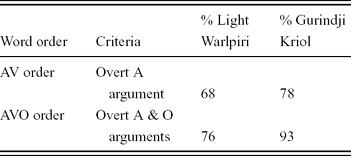
Arguments are distinguished in Light Warlpiri and Gurindji Kriol through the combination of two systems, one from each type of source language – word order from English/Kriol, and case-marking from the Ngumpin-Yapa languages. AVO is the unmarked word order in Light Warlpiri and Gurindji Kriol (Meakins, Reference Meakins, Barddal and Chelliah2009; Meakins & O'Shannessy, Reference Meakins and O'Shannessy2010; O'Shannessy, Reference O'Shannessy, Preston and Stanford2009). In Light Warlpiri adult narrative data, 69% of transitive and intransitive clauses have an overt initial A or S argument. Of those, 27% are A arguments, and 71% of the A arguments are marked ergative. Overt patients occur in 74% of transitive clauses, and of those, 97% occur after the verb. In transitive clauses with overt A arguments, 68% of Light Warlpiri clauses and 78% of Gurindji Kriol clauses have AV order (Meakins & O'Shannessy, Reference Meakins and O'Shannessy2010). When the O argument is overt, the predominant order is AVO – 76% and 93% of clauses with overt O arguments have AVO order in Light Warlpiri and Gurindji Kriol respectively. In Light Warlpiri and Gurindji Kriol narrative and spontaneous texts, transitive clauses with only one overt argument are most common (Meakins, Reference Meakins2011; O'Shannessy, Reference O'Shannessy2006); for instance, in Light Warlpiri narrative texts, 54% of transitive clauses with arguments have only one argument.
Arguments are also partially disambiguated through case-marking in both languages. Light Warlpiri and Gurindji Kriol are categorised as optional ergative languages, that is, ergative case-marking is not always applied to A arguments, and the domains in which it is applied are less rigidly specified than those for split ergative languages (McGregor, Reference McGregor2010). The optional ergative system was characterised in a study of Light Warlpiri and Gurindji Kriol adult speakers’ production. Narrative texts were collected from five Light Warlpiri-speaking adults, and from twenty Gurindji Kriol-speaking adults (Meakins & O'Shannessy, Reference Meakins and O'Shannessy2010). The speakers looked at textless picture books (e.g. Mayer, Reference Mayer1969; Egan, Reference Egan1986), some of which were designed to elicit overt transitive subjects (O'Shannessy, Reference O'Shannessy2004), and told stories from the picture stimuli. The same stimuli were used by both groups of speakers. The data set analysed consisted of 300 transitive clauses with overt A arguments from Light Warlpiri and 612 from Gurindji Kriol. The ergative marker occurred on 59% of A arguments in the Light Warlpiri adult narrative texts and on 64% of A arguments in the Gurindji Kriol adult narrative texts (Meakins & O'Shannessy, Reference Meakins and O'Shannessy2010, p. 1700). The word order figures are summarised in Table 1. In the transitive clauses with overt A arguments, in Light Warlpiri 59% of overt A arguments have ergative marking, and in Gurindji Kriol 64% of overt A arguments have ergative marking.
Word order frequencies in Light Warlpiri and Gurindji Kriol adult narrative data.

Examples from Light Warlpiri are given in (7) and (8). In (7) the A argument has an ergative marker, but in (8) the ergative marker is not present. Both sentences have AVO order.
(7)
(8)
Similar patterns can be seen in Gurindji Kriol as exemplified in (9) and (10). The agent, verb, patient, and word order are almost identical; however, the sentences differ according to the application of the ergative marker, present and not present respectively.
(9)
(10)
The optionality of the ergative marker in Light Warlpiri and Gurindji Kriol is closely linked with word order (see details in following section). This distribution of word order and ergative marking is demonstrated in the following Light Warlpiri examples. In (11) the word order is AVO and the A nominal is unmarked, whereas in (12) the word order is OVA and the A nominal is ergative-marked.
(11)
(12)
Optional ergativity in these languages results from much of the functional load of argument marking being borne by word order (Meakins & O'Shannessy, Reference Meakins and O'Shannessy2010). Since word order can indicate A arguments, case-marking is required for this function less often. Where AVO order is not found, ergative marking is often used to disambiguate arguments. Thus, though much of the functional load of argument marking is carried by word order, the ergative marker continues to contribute to the identification of the A argument, particularly where word order departs from the unmarked AVO pattern. This relationship between word order and ergative marking suggests that they exist in a partially complementary relationship, with the ergative marker retaining its original function in a limited capacity, most often when the subject is postverbal. However, about 55% of A arguments in Light Warlpiri and Gurindji Kriol occur with ergative marking even where word order is sufficient for argument discrimination. For instance in (13) and (14) the ergative marker is used despite the clear identification of the A argument by word order and through knowledge of the likelihood of real world events.
(13)
(14)
Examples such as these are evidence that the ergative marker is beginning to encode more than syntactic relations in both languages. Meakins and O'Shannessy (Reference Meakins and O'Shannessy2010) argue that the occurrence of the ergative marker in Light Warlpiri and Gurindji Kriol relates to discourse prominence. The ergative marker is employed as a specific discourse marker which highlights the agentivity of an agent. In this respect the ergative marker remains close to performing its syntactic function as a marker of A arguments, and in addition, it focuses on information already present in the discourse, drawing attention to the agentivity of the A argument.
Argument nominals in Light Warlpiri and Gurindji Kriol are often cross-referenced using pronouns which come from English and Kriol. They can be free or can host affixes indicating temporality and mood. In Light Warlpiri these form an innovative auxiliary paradigm derived from English, Kriol and Warlpiri (O'Shannessy, Reference O'Shannessy2005). Pronouns pattern according to a nominative-accusative system. Much like English, the A and S arguments are expressed using the same form, and the O argument takes a different form. Examples of transitive and intransitive sentences from Light Warlpiri and Gurindji Kriol with fully expressed nominals and third person subject pronouns are given below. The examples show 3sg.s i “he/she/it”, and 3sg.o im “him/her/it”.
(15)
(16)
(17)
(18)
Argument marking in Light Warlpiri and Gurindji Kriol: Differences
Although Light Warlpiri and Gurindji Kriol show many structural similarities in terms of argument marking, production studies show that they differ slightly in how the word order and case-marking systems interact. In Gurindji Kriol the correlation of ergative marking and word order is closer than that in Light Warlpiri. In Gurindji Kriol, 96% of postverbal A arguments are marked ergative compared with 55% of preverbal A arguments, whereas in Light Warlpiri, 68% of postverbal A arguments are marked ergative compared with 55% of preverbal A arguments (Meakins & O'Shannessy, Reference Meakins and O'Shannessy2010). Other features in the clause in Gurindji Kriol such as the presence of co-referential pronouns, the relative animacy of the actors, and transitivity variables also affect the use of the ergative marker, but by far the strongest factor is word order (Meakins, Reference Meakins, Barddal and Chelliah2009). In a study of 910 transitive clauses with overt A arguments produced in response to picture book stimuli by five adult Light Warlpiri and twenty adult Gurindji Kriol speakers, the difference between languages in the correlation of word order and ergative marking was found to be significant (p < .001) (Meakins & O'Shannessy, Reference Meakins and O'Shannessy2010).
The difference in production strategies is likely due to the different sociolinguistic situations – Gurindji Kriol speakers have less access to languages in which case-marking is a strong cue to arguments, such as Gurindji, and more access to languages where word order is relied on, such as Kriol and English. This may have led to word order having a more reliable role in Gurindji Kriol, and hence a strong interaction with case-marking. The implication is that in Gurindji Kriol, speakers could be fairly confident that an unmarked nominal in sentence-initial position is an A or S argument, and that an unmarked nominal occurring postverbally is an O argument. But Light Warlpiri speakers do not have the same degree of confidence in the role of word order. Through a combination of influence from Warlpiri, in which case-marking is relatively reliable, and a looser correlation between word order and case-marking in Light Warlpiri, they might need to rely on case-marking more than on word order in sentence interpretation.
To sum up the section on argument marking, both Light Warlpiri and Gurindji Kriol are mixed languages, which combine verbal structures from English and Kriol with nominal structures from the Ngumpin-Yapa languages. Nouns are drawn from both source languages. In both languages word order is variable, but SVO is the unmarked order (Meakins, Reference Meakins, Barddal and Chelliah2009; Meakins & O'Shannessy, Reference Meakins and O'Shannessy2010; O'Shannessy, Reference O'Shannessy2005). Therefore, in a transitive sentence, a noun in sentence-initial position, but without a case-marker, can often be correctly identified as the A argument. In addition, both languages optionally use ergative case-marking to indicate the A argument, particularly when the A argument occurs postverbally. So in both languages, word order and case-marking are in competition to provide information about the function of agent. Both languages also have a system of bound pronouns as part of an innovative auxiliary cluster which provides information about person and number for A and S arguments. The relevant structural difference between the two languages is that the correlation between word order and case-marking is tighter in Gurindji Kriol than in Light Warlpiri.
4. Research question
The sociolinguistic contexts of Light Warlpiri and Gurindji Kriol differ mainly in the speech repertoires of each community. Although both speaker groups are multilingual, there are no monolingual Light Warlpiri or Gurindji Kriol groups with whom to compare the multilinguals’ sentence interpretation strategies. The study explores whether crosslinguistic influence from the other languages that each group speaks can be seen, without a monolingual group for comparison.
In this study we examine whether the slight difference in the structures of the two languages, and the different sociolinguistic contexts, will be reflected in the sentence processing strategies each group of speakers employs. Specifically, we ask how adult and child speakers of Light Warlpiri and Gurindji Kriol interpret word order and ergative case-marking when listening to simple transitive sentences, given the similarities and differences in language structures and sociolinguistic contexts described above. A previous study has shown that Light Warlpiri adults use case-marking as the only sentence interpretation strategy, while children initially use both word order and case-marking, then make more use of case-marking as they get older, slowly becoming adult-like in their strategy (O'Shannessy, Reference O'Shannessy2006, Reference O'Shannessy2011). The current study asks two specific questions. First, do Gurindji Kriol adult speakers rely on case-marking as their only strategy, as Light Warlpiri speakers do, or do they also make use of word order? Second, will the Gurindji Kriol children rely on both word order and case-marking initially, slowly moving to greater reliance on case-marking, or will word order play a stronger role for them?
5. Method
5.1 Participants
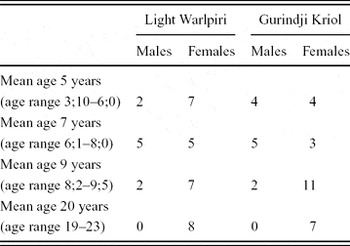
The participants were three groups of child speakers and one group of young adult speakers of each language, Light Warlpiri and Gurindji Kriol. The adults speakers were the same people who participated on the production studies reported in Meakins (Reference Meakins, Barddal and Chelliah2009), Meakins and O'Shannessy (Reference Meakins and O'Shannessy2010), and O'Shannessy (Reference O'Shannessy, Preston and Stanford2009). The details of the ages and genders within each group are given in Table 2. Permissions were obtained from appropriate organisations and carers. The tasks were conducted at the researchers’ places of accommodation, outside the participants' homes, in public areas in the community (for Gurindji Kriol) and in a school building (for Light Warlpiri). Participants were recruited partly through a friend-of-a-friend method for the adults (see Milroy, Reference Milroy1987) conducted by local research assistants, partly by asking children in the appropriate age group if they would participate, and also asking the children's carers.
Age and gender of participants in the study, Light Warlpiri and Gurindji Kriol.

All child and adult participants speak Light Warlpiri or Gurindji Kriol, respectively, as their primary language. The adults in each community are all women, of similar ages (19–25 years), of similar socio-economic status (stay-at-home mothers, low income levels), have similar education levels (some high school education), and live in small, remote Indigenous communities approximately 100 kilometers from each other. The children in each community attend the local schools. Warlpiri children have had access to schooling in Warlpiri, but Gurindji children have not had schooling in Gurindji. Most of the adults’ and children's day-to-day interactions are conducted in their primary language. Gurindji-Kriol speakers do not typically produce Gurindji – they almost always speak Gurindji-Kriol within the community. They speak English/Kriol to people who are not Gurindji-Kriol speakers – it is estimated that less than an hour per day would be spent using English/Kriol. Light Warlpiri speakers also speak Warlpiri, which speakers produce to differing extents, and they are often in environments in which they hear both Warlpiri and Light Warlpiri, even though they produce Light Warlpiri most often. English/Kriol is estimated to be used for less than an hour per day, whereas Warlpiri is heard for several hours per day. From our observations over many years in the respective communities, we judge the participants' language use to be typical of their peers in each community. Although in Warlpiri families some families speak Warlpiri more often than others do, our observations suggest that the children and adults in the study are in Light Warlpiri-speaking contexts for similar amounts of time.
5.2 Materials
The method follows that used in a study reported on by O'Shannessy (Reference O'Shannessy2006, Reference O'Shannessy2011) which compares comprehension strategies in Light Warlpiri and Lajamanu Warlpiri. In the current study, the same raw data from Light Warlpiri is compared directly to Gurindji Kriol data. The participants were shown a pair of simple animated scenes on a computer screen. The artwork and animations were created by a professional film company using Adobe Flash software, and were played through a web browser. In the scenes one cartoon-style human or familiar animal performed an action on another human or animal. The actions were simple events typically spoken about in each language using transitive verbs, for example, waking someone up from sleeping, picking someone up, or one animal biting another. All of the characters depicted referents familiar to the children (for example, a horse, a camel, a frog, a human) but the children had not seen the particular style of artwork or animation before participating in the task.
The scenes were presented in pairs. Each pair of scenes showed two characters, and in each scene the roles of the two characters were reversed, so that the agent in one scene was the patient in the other, and vice versa. In each scene the same action was performed by one of the characters on the other. Figure 2 shows the final images that the children saw when they heard the sentence in example (25) and (27) below.
A still shot of what the participants saw on the screen for examples (25) and (27).

Figure 2 shows that a woman is the agent, waking up a boy, on the left-hand side, and a boy is the agent, waking up a woman, on the right-hand side. The order of presentation of scenes and sentences within the task was randomised, then counter-balanced, so that a systematic interpretation was possible for an equal number of scenes appearing on each side of the screen.
The auditory stimulus consisted of simple transitive sentences recorded with a native speaker. Each sentence contained one core nominal argument, with or without ergative marking, a pronoun and a transitive verb. All argument referents were animate. Each sentence had only one nominal argument for reasons of naturalness, as explained in Section 3.2 above.
5.3 Procedure
Each author conducted the tasks with only one language group – O'Shannessy for the Warlpiri group and Meakins for the Gurindji group. First the participants saw each of the pair of animated scenes consecutively. One scene – with one character performing the action – appeared on one side of the screen for five seconds, then after a one-second pause, the other scene – with the other character performing the action – appeared on the other side of the screen for five seconds. After a two-second pause participants saw both scenes at the same time, in the same position on the screen as they were the first time. They heard a sentence at the same time as the appearance of the two scenes. There was a five-second interval between trials.
The auditory stimuli were loaded onto the computers separately and played in Quicktime format; each one was started by a mouse click from one of the authors. The auditory sentences began when the two scenes appeared on the screen side-by-side. The participants pointed to the scene which they thought best represented the sentence heard.
There was a series of warm-up scenes before the task, and an intransitive filler scene after every five test scenes, to counter any response pattern the participants might be using, and to make sure they were attending to the task. Intransitive scenes were chosen as fillers so that they did not lead to a biased response pattern. They also included an auditory recording. The 16 trial scenes were also presented in four different orders, which were counterbalanced so that different participants did the task with different combinations of orders, to offset possible effects of order of appearance (even though this is also accounted for in the statistical analysis, by including the items as random effects).
The task was administered to each participant individually, and the scene the child pointed to during the task was recorded on paper. The tasks were not video-taped because a pilot task in a previous study by O'Shannessy showed that it was difficult to position the video camera such that the participant's hand movement could be seen to differentiate clearly between scenes. When an author was not sure as to which scene the participant pointed she asked “Where?” in the appropriate language and recorded which scene the participant pointed to the second time. Some children's results were not included in the final set of data for analysis because the children's hand movements did not unambiguously indicate one or other of the scenes. For example, some children pointed to the same side of the screen for every sentence, including the intransitive filler items. If a child did not point to the correct scene in the filler items the task was abandoned for that child, and none of the child's choices were included in the data.
For Light Warlpiri trials, the children were also given a sandwich to eat while they watched the videos, in case being hungry caused them to lose concentration during the task, and they were given an ice-cup afterwards. Gurindji children were given an iceblock and apple after the task. Adults were paid for their participation.
5.4 Interpretation of participant choices
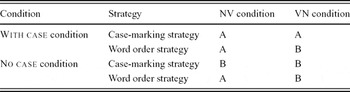
Two possible interpretations are possible in this task – the case-marking interpretation and the word order interpretation. In the case-marking condition the two levels were with and without ergative case-marking on the overt NP. In the word order condition the two levels were NV order and VN order. Table 3 summarises the conditions and possible interpretations.
Experimental conditions and possible interpretations.

Possible strategies – coding: A = listener chooses referent of named NP; B = listener does not chose referent of named NP.
The case-marking interpretation refers to the interpretation strategies used in traditional Warlpiri and Gurindji. The case-marking interpretation for the with case condition is that the referent indicated by the overt NP with ergative case-marking is the A argument. The case-marking interpretation for the no case condition is that the referent indicated by the overt NP without case-marking is the O argument, and the other referent is the A argument. This is because under the case-marking interpretation, in a transitive sentence, only a case-marked NP can be interpreted as an A argument, and an NP without case-marking must be interpreted as an O argument. When a scene is shown with two characters, and only one is referred to overtly in a sentence and the referent does not include an ergative case-marker, then the interpretation is that the other character is the agent, even if that character was not overtly mentioned.
The other possible interpretation of the sentences is the word order interpretation. Under this interpretation, the referent indicated by the overt NP is the A argument when the order is NV, in other words, NV = AV, regardless of case-marking. When the order is VN, the referent indicated by the overt NP is the O argument, in other words, VN = VO, regardless of case-marking.
The following examples show Light Warlpiri and Gurindji Kriol sentences for the same pair of scenes, with one example for each condition. Both the case-marking interpretation and word order interpretation are given in the glosses.
Examples (19) and (20) are Light Warlpiri, for the with case, NV order and with case, VN order conditions.
(19)
(20)
Examples (21) and (22) are Gurindji Kriol, for the with case, NV order and with case, VN order conditions.
(21)
(22)
Examples (23) and (24) are Light Warlpiri, for the no case, NV order and no case, VN order conditions. In (23) the case-marking and word order interpretations are in conflict and each strategy produces a different meaning, whereas in (24) the two strategies converge to produce the same meaning.
(23)
(24)
Examples (25) and (26) are Gurindji Kriol, for the no case, NV order and no case, VN order conditions. In (25) the case-marking and word order interpretations are in conflict and each strategy produces a different meaning, whereas in (26) the two strategies converge to produce the same meaning.
(25)
(26)
To summarise: On the basis of the two variables of word order and the use of ergative marking, four sets of sentences are generated, with and without ergative marking, and NV word order and VN word order.
In the first combination (NV with erg), both the word order interpretation and case-marking interpretation converge to confirm N (the named entity) as the agent. In the second combination (NV without erg) the word order interpretation and case-marking interpretation are in conflict, as the word order interpretation results in the interpretation of N as the agent, but the case-marking interpretation results in the interpretation of N as the object. Similarly in the third combination (VN with erg), the word order interpretation and case-marking interpretation are also in conflict. The ergative marker would suggest that N is the agent, however the word order interpretation leads the hearer to name N as the object. Finally in the fourth combination (VN without erg), the word order interpretation and case-marking interpretation converge to confirm N as the object.
5.5 Data analysis
A multi-level logistic regression analysis with a binomial link function (Baayen, Reference Baayen2008; Pinheiro & Bates, Reference Pinheiro and Bates2000) was run to see whether the participants used different strategies for interpreting the A argument in each language, Light Warlpiri and Gurindji Kriol, and whether the adults and children used the same or different strategies. The analysis is appropriate for data in which the dependent variable is binary – the participants could choose one of only two options – so a normal distribution of data points was not possible.
A multilevel analysis was conducted to take into account that individual units share certain properties, for example, the participants are the same in each condition within each language group, and the speakers of one language share more characteristics with each other than with the speakers of the other language. Further, although the number and type of items in a study are carefully considered during the design phase, the characteristics of items in a task differ. Some items might be easier to process or lead to a particular conclusion more easily than others for reasons that are not immediately clear (Clark, Reference Clark1973). Misleading results can be caused by assuming that the items are equivalent in every way. To account for these real world phenomena the analysis needs to treat both the items and the individuals performing the task as random effects (Raaijmakers, Schrijnemakers & Gremmen, Reference Raaijmakers, Schrijnemakers and Gremmen1999). A logistic regression analysis also allows for multiple predictor variables to be evaluated, in this case word order and case-marking. Sankoff (Reference Sankoff, Ammon, Dittmar and Mettheier1988) explains that when trying to distinguish between the effects of potentially explanatory factors on a particular linguistic choice, one needs to understand the combined effect of the factors, and statistical models that are simply additive make inaccurate predictions. The solution is to use a model with a link function. Multilevel logistic regression with a binomial link function and fixed and random effects (Baayen, Reference Baayen2008; Pinheiro & Bates, Reference Pinheiro and Bates2000) takes into account the characteristics of the participant groups, the items, and the contributing factors in one procedure.
The Light Warlpiri data was used in a separate study and compared to the same speakers’ use of Warlpiri (O'Shannessy, Reference O'Shannessy2011). The same raw data is used in the current study, but in the current study a new analysis is undertaken on the Light Warlpiri and Gurindji Kriol data. This is to ensure that the data sets from each language in this study are compared as accurately and closely as possible.
6. Results
Given the sociolinguistic similarities and differences between Light Warlpiri and Gurindji Kriol, the study asks if adult and child speakers of each language will use the same sentence processing strategies in interpreting simple transitive sentences. Previous research has shown that Light Warlpiri-speaking adults use case-marking as their main strategy, while children use both word order and case-marking at first, then use case-marking more as they get older (O'Shannessy, Reference O'Shannessy2011).
The current study asks the following two questions:
(i) Will Gurindji Kriol adult speakers use case-marking as their main strategy, as Light Warlpiri speakers do, or also use word order as a strategy?
(ii) Will Gurindji Kriol children show the same developmental pattern as Light Warlpiri children, using both word order and case-marking at first, then using case-marking more often with increasing age?
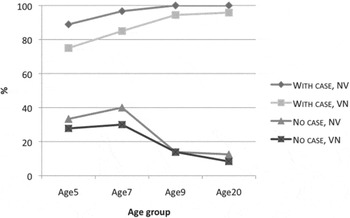
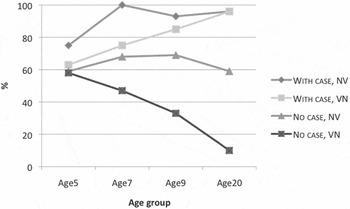
Figure 3 shows the choices made by each age group of Light Warlpiri speakers, and Figure 4 shows the choices made by each age group of Gurindji Kriol speakers.
Percentage (%) choices of named NP by Light Warlpiri speakers, by age group, by condition.

Percentage (%) choices of named NP by Gurindji Kriol speakers, by age group, by condition.

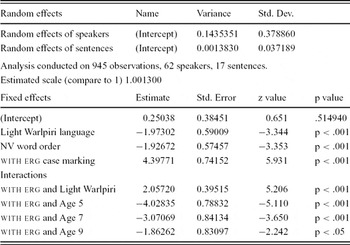
A multi-level logistic regression analysis with a binomial link function was run, as explained in Section 5 above. The output of the analysis is given in Table 4.
Output of multi-level logistic regression statistical analysis (modified).

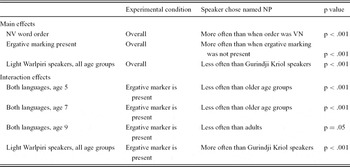
In response to the first question, there was no main effect of age – in both languages, across all age groups, speakers chose the NP which was named in the sentence when ergative marking was present (p < .001), and when the order was NV (p < .001). In other words, across all ages and in both languages, both strategies of case-marking and word order were used. There was one main effect of language – when the language was Light Warlpiri, speakers chose the named NP less often (p < .001). This can be interpreted as a greater use of the case-marking strategy by Light Warlpiri speakers, as explained in Section 7 below. The main effects show that the two language groups use very similar sentence interpretation strategies, but that there is a quantitative difference in how often the groups use each strategy.
Several interaction effects allow us to examine the difference more closely. There are two types of interaction – an interaction of language and ergative marking, and ergative marking and age. When ergative marking was present, across all age groups, Light Warlpiri speakers chose the named NP, that is, used case-marking as a strategy, more often than Gurindji Kriol speakers did (p < .001). But the children in both language groups showed the same kind of developmental pattern. The interactions of ergative marking and age show that in both languages, when ergative marking was present, the five-year-olds chose the named NP less often, that is, used case-marking strategy less often, than the other groups did (p < .001); the seven-year-olds chose the named NP less often than the older children and the adults (p < .001); and the nine-year-olds chose the named NP less often than the adults did (p = .05). The results are summarised in Table 5.
Summary of results of Light Warlpiri and Gurindji Kriol speaker choices in sentence processing task.

7. Discussion
This study asks whether Light Warlpiri and Gurindji Kriol adult speakers use a case-marking strategy in sentence interpretation to similar extents. The results show that both groups do use case-marking as a strategy, but that Light Warlpiri speakers use it more often. Two effects show this – a main effect of language (p < .001), and an interaction effect of language and ergative marking (p < .001). To understand the result that when the language was Light Warlpiri, speakers were less likely to choose the named NP (p < .001), we need to understand that listeners heard sentences with and without an ergative-marked NP. When the NP they heard was not case-marked, the case-marking interpretation of the sentence was that the named NP was the O argument, regardless of its position in the sentence. So, not selecting the named NP as the agent shows that the speakers were using the case-marking interpretation, and interpreting the unmarked, named NP as the O argument. In addition, when case-marking was present, Light Warlpiri speakers chose the named NP more often (p < .001). But both groups also used the word order strategy, choosing the named NP more often when the order was NV than VN (p < .001).
Interaction effects of case-marking and age provide information about the second question, of whether the two groups of children were adult-like in the strategies they used, and whether they used comparable strategies at similar ages. For both language groups, none of the age-cohorts of children were adult-like in their use of case-marking, although they moved steadily toward adult-like use. The five-year-old children used the case-marking strategy least often (p < .001), the seven-year-old group used it more often (p < .001), and the nine-year-old group used it more often again (p < .05). The same pattern can be seen for each age group in each language in Figures 2 and 3 above, except for the condition of NV order with no ergative marking, in Figure 2 (Gurindji Kriol speakers).
In other words, when speakers of each language hear sentences with overt ergative marking, they are more likely to choose the named nominal as the agent, regardless of word order. The response to the condition of VN order without ergative marking from both sets of speakers is similar – speakers of both languages tend to identify the named element as the object. This is not surprising given that both the word order interpretation and the case-marking interpretation converge to produce this reading – under either interpretation, N is the object. Where the speakers of the languages differ is their choice of agent in the condition NV order without ergative marking. In this condition, Light Warlpiri speakers were more likely to continue using the case-marking interpretation and interpret N as the object, and Gurindji Kriol speakers were more likely to use a word order interpretation and interpret N as the subject. For Gurindji Kriol speakers, when the ergative marker is not used, the word order interpretation is relied upon, whereas Light Warlpiri speakers are relying more heavily on case-marking in all instances.
The results for the condition of VN order without ergative marking are interesting in both languages. They are interesting because both the case-marking and word order strategies lead to not choosing the named NP as agent, but the children did choose the named NP as agent in up to 60% of trials (about 30% of trials for Light Warlpiri speakers and 60% of trials for Gurindji Kriol speakers). This suggests that in these trials they chose the named NP simply because it was named. As age increased they made this choice less often.
The differences in the performance of Light Warlpiri and Gurindji Kriol speakers in terms of the respective weightings given to word order and case-marking can be linked to sociolinguistic differences between the communities, and crosslinguistic influence from the other languages the participants speak and hear. As was shown in Section 3, the sociolinguistic situations in the two communities under study are very similar, and have given rise to two new mixed languages with similar structures. Both are spoken in remote, Indigenous communities and represent partial maintenance of the respective Ngumpin-Yapa languages under strong pressure to shift to English and/or Kriol. The differences are that Light Warlpiri speakers also speak Warlpiri, and have access to Warlpiri beyond their own community. In contrast, Gurindji Kriol speakers do not typically also speak Gurindji, and there are no other Gurindji-speaking communities. We suggest that these sociolinguistic differences have led to differences in the systems of argument marking. Both languages use a combination of word order and case-marking to indicate core arguments, and the two systems are correlated in both – postverbal A arguments are ergatively marked more often than preverbal A arguments. The languages differ as to how strong the correlation is – it is significantly stronger in Gurindji Kriol than in Light Warlpiri (Meakins & O'Shannessy, Reference Meakins and O'Shannessy2010).
A study comparing children's and adults’ sentence interpretation strategies in Light Warlpiri with those in Warlpiri (O'Shannessy, Reference O'Shannessy2011), showed that child Light Warlpiri speakers used both word order and case-marking strategies in sentence interpretation when they were younger, and increased their use of case-marking as a strategy as they got older. The current study finds that although the Gurindji Kriol speakers use case-marking as a strategy less often overall, the child speakers of each language do not show any significant difference in the age at which they begin to use case-marking more often. The children in both language groups show a clear developmental pattern, and there is no difference between them in terms of moving from favouring one strategy to favouring the other.
8. Conclusion
The current study finds that the different sociolinguistic situations and systems of argument marking in Light Warlpiri and Gurindji Kriol influence how speakers of each language interpret simple transitive sentences. Although there is no monolingual Light Warlpiri or Gurindji Kriol group for comparison, crosslinguistic influence is seen in how speakers of each language resolve the competition between case-marking and word order systems in each language. Light Warlpiri speakers rely on ergative case-marking as an indicator of agents more often than Gurindji Kriol speakers do. Conversely, Gurindji Kriol speakers rely on word order more often than Light Warlpiri speakers do.
One reason for the difference in interpretation is likely to be crosslinguistic influence from other languages each group speaks. The Light Warlpiri speakers also speak Warlpiri, a language with near-obligatory case-marking, and have access to other speakers of that language beyond their immediate community. Their access to Warlpiri strengthens their use of case-marking as a strategy in Light Warlpiri. In contrast, Gurindji Kriol speakers do not typically also speak Gurindji, the relevant case-marking language, and they do not have access to speakers beyond their immediate community who speak Gurindji. Their relative lack of access to Gurindji, and increased access to English and Kriol, strengthens the use of word order in Gurindji Kriol. The Gurindji Kriol speakers probably also use the case-marking strategy less often because they can rely on word order more confidently in certain environments, in which there is a tight correlation between case-marking and word order.
List of abbreviations
- ASSOC
associative
- AUX
auxiliary
- CONT
continuative
- DIM
diminutive
- DU
dual
- EPEN
epenthetic
- ERG
ergative
- FOC
focus
- IMPF
imperfect
- INC
inclusive
- LOC
locative
- NAME
a person's name
- NFUT
non-future (present or past)
- NPST
non-past (present or future)
- O
object
- ONLY
only, just, right, directly
- PERL
perlative
- PL
plural
- PROG
progressive
- PRS
present
- PST
past
- S
subject
- SG
singular
- TOP
topic
- TR
transitive
- 1
first person
- 3
third person
- –
morpheme break
- =
clitic break