Implications
During the last 30 years, the reduction of carcass fat content in pigs was one of the main objectives of genetic selection. It resulted in an important genetic increase in carcass lean content in French pig breeds. Due to the influence of cortisol and catecholamines on energy metabolism, the down-regulation of neuroendocrine stress-responsive systems may have contributed to this trend in the Large White breed. However, considering the importance of these hormones on several major production traits such as meat quality and newborn survival, this genetically driven down-regulation of cortisol and catecholamine production may also be responsible for the observed worsening of these traits. A better knowledge of the balance between favourable and unfavourable effects of these hormones, and of their genetic regulation, should help designing future selection strategies to jointly improve the level of performance, carcass composition, product quality and animal welfare.
Introduction
The two main stress-responsive neuroendocrine systems play a critical role in the regulation of energy fluxes. The hypothalamic–pituitary–adrenocortical (HPA) axis influences feeding behaviour, pancreatic hormone secretion, energy expenditure and the protein/lipid balance (Dallman et al., Reference Dallman, Strack, Akana, Bradbury, Hanson, Scribner and Smith1993). Cortisol, the main hormone of the axis, favours the accretion of fat at the expense of proteins (Devenport et al., Reference Devenport, Knehans, Sundstrom and Thomas1989). On the other hand, catecholamines (adrenaline and noradrenaline) released by the sympathetic nervous system increase the use of energy stores (glycogen and lipids) (Scheurink and Steffens, Reference Scheurink and Steffens1990) and exert anabolic effects on protein metabolism (Navegantes et al., Reference Navegantes, Migliorini and Kettelhut2002). Sympathetic activation by stress before slaughter reduces muscle glycogen content and post-mortem acidification, leading to dark, firm and dry type meat (Fernandez and Tornberg, Reference Fernandez and Tornberg1991; Monin, Reference Monin2003).
It is now well established that genetic factors influence individual variations in stress behavioural and neuroendocrine responses (Mormède et al., Reference Mormède, Courvoisier, Ramos, Marissal-Arvy, Ousova, Désautés, Duclos, Chaouloff and Moisan2002). In a study using a F2 segregating population between the Duroc and Large White pig breeds, we demonstrated that cortisol levels measured in urine collected in the bladder after slaughter correlated negatively to lean content of the carcass, and that urinary catecholamine levels correlated positively to ultimate pH of the meat (Foury et al., Reference Foury, Devillers, Sanchez, Griffon, Le Roy and Mormède2005). In the context of a larger study to explore the genetic components of meat quality (Plastow et al., Reference Plastow, Carrión, Gil, García-Regueiro, Font i Furnols, Gispert, Oliver, Velarde, Guárdia, Hortós, Rius, Sárraga, Díaz, Valero, Sosnicki, Klont, Dornan, Wilkinson, Evans, Sargent, Davey, Connolly, Houeix, Maltin, Hayes, Anandavijayan, Foury, Geverink, Cairns, Tilley, Mormède and Blott2005), the activity of neuroendocrine stress systems and the relationship of neuroendocrine characteristics with carcass composition were studied in five genetic lines representing a significant proportion of European pig production (Foury et al., Reference Foury, Geverink, Gil, Gispert, Hortos, Furnols, Carrion, Blott, Plastow and Mormède2007). The Large White, Landrace, Duroc and Meishan breeds show basal urinary cortisol levels negatively correlated to carcass lean content. Genetic selection on stress reactivity traits could improve both animal welfare and product quality. The mapping of chromosome regions involved in genetic variations opens the way to the identification of the molecular mechanisms involved in individual differences in stress responses (Désautés et al., Reference Désautés, Bidanel, Milan, Iannuccelli, Amigues, Bourgeois, Caritez, Renard, Chevalet and Mormède2002; Ousova et al., Reference Ousova, Guyonnet-Duperat, Iannuccelli, Didanel, Milan, Genet, Llamas, Yerle, Gellin, Chardon, Emptoz-Bonneton, Pugeat, Mormède and Moisan2004).
During the last 30 years, the reduction of carcass fat content was one of the main objectives of genetic selection, together with the increase in growth rate and, more recently, the prolificacy of sows (Legault, Reference Legault1998; Renand et al., Reference Renand, Larzul, Le Bihan-Duval and Le Roy2003). It resulted in an important genetic increase in the carcass lean content of French Large White (LW) and French Landrace (LR) populations (Bazin et al., Reference Bazin, Tiger, Tribout, Bouffaud, Madigand, Boulard, Deschodt, Flého, Gueblez, Maignel and Bidanel2003; Tribout et al., Reference Tribout, Caritez, Gogué, Gruand, Bouffaud, Billon, Péry, Griffon, Brénot, Le Tiran, Bussières, Le Roy and Bidanel2004). Selection for lean content also led to modifications in fibre type composition, which resulted in a higher proportion of glycolytic fibres and fibre hypertrophy (Rahelic and Puac, Reference Rahelic and Puac1981; Weiler et al., Reference Weiler, Appell, Kremser, Hofacker and Glaus1995). Because of a reduced capillary density and an impaired nuclear control of cellular processes, fibre hypertrophy seems to be associated with a lower capacity of the fibres to adapt to activity-induced demands (Rehfeldt et al., Reference Rehfeldt, Fiedler, Dietl and Ender2000). Therefore, the aim of this study was to analyse the consequences of genetic selection on the evolution of the stress-responsive neuroendocrine systems of pigs issued from LW and LR boars born either in 1977 or between 1998 and 2000.
Material and methods
Animals and experimental design
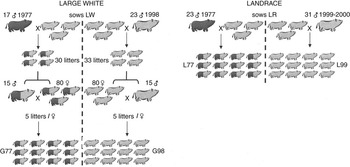
The present study is part of a vast experimental design aiming at estimating realized genetic trends in the French maternal porcine populations between 1977 and 1998 (LW) or between 1977 and 1999 to 2000 (LR) for a large number of growth, reproduction, body composition and carcass quality traits. Two different groups of animals (referred to as G77 and G98 for French LW and L77 and L99 for French LR) have been produced, by inseminating French LW and LR sows with semen from boars of the same breed born either in 1977 (frozen kept) or between 1998 and 2000. The experimental design is schematized in Figure 1.
Experimental design.

For the LW crossbreeding, randomly chosen males and females from each of the two F1 groups generated from boars born either in 1977 or in 1998 were kept for breeding and produced, respectively, G77 and G98 pigs by inter se mating. This part of the experiment took place in two INRA experimental herds: Le Magneraud (Charente-Maritime, France) and Bourges (Cher, France). Further details on the experimental design are given in Tribout et al. (Reference Tribout, Caritez, Gogué, Gruand, Bouffaud, Billon, Péry, Griffon, Brénot, Le Tiran, Bussières, Le Roy and Bidanel2004). At a live weight of approximately 106 kg, after 18 h of fasting and 4.5 h of transport, 236 pigs (castrated males and females) were slaughtered after electrical stunning in two INRA experimental abattoirs: Jouy-en-Josas (Yvelines, France) and Saint-Gilles (Ille-et-Vilaine, France).
The French Pig Institute (IFIP) was in charge of the LR crossbreeding. French LR sows were inseminated with semen from boars born either in 1977 or in 1999 and 2000 in seven farms and produced respectively L77 and L99 pigs. They were transferred in two testing stations for fattening: Mauron (Morbihan, France) and Le Rheu (Ille-et-Vilaine, France). Further details on the experimental design are given in Bazin et al. (Reference Bazin, Tiger, Tribout, Bouffaud, Madigand, Boulard, Deschodt, Flého, Gueblez, Maignel and Bidanel2003). At a live weight of approximately 105 kg, after 18 h of fasting and 0.5 h of transport, 189 pigs (castrated males and females) were slaughtered after electrical stunning in the Cooperl-Industrie abattoir (Montfort-sur-Meu, Ille-et-Vilaine, France).
Sampling procedure and chemical analyses
After evisceration, urine samples of 136 LW pigs and 126 LR pigs were collected from the bladder to measure stress hormone levels (cortisol and catecholamines). A preservative (ethylene diamine tetra acetic acid (EDTA) 10%, 1 ml/40 ml) was added and samples were frozen until analysis.
Urinary cortisol was assayed using a solid-phase extraction procedure on C18 cartridges followed by HPLC with UV absorbance detection (254 nm), as previously described (Hay and Mormède, Reference Hay and Mormède1997b). The intra- and inter-assay coefficients of variation (%) were 7.4 and 10.6, respectively.
Urinary catecholamines (adrenaline and noradrenaline) were assayed using an ion-exchange purification procedure followed by HPLC with electrochemical detection, as previously described (Hay and Mormède, Reference Hay and Mormède1997a). The intra- and inter-assay coefficients of variation (%) were 7.0 and 7.1 for adrenaline, and 6.5 and 11.6 for noradrenaline, respectively.
Concentrations of hormones in urine were expressed as their ratio to creatinine content (ng/mg creatinine), to correct for the variable dilution of urine related to water intake (Crockett et al., Reference Crockett, Bowers, Sackett and Bowden1993). Creatinine levels were determined using a colorimetric quantitative reaction (Creatinine; BIOLABO, Fismes, France).
Carcass composition measurements
The day after slaughter, the backfat thickness at the last cervical vertebra (neck), last dorsal vertebra (back) and last lumbar vertebra (rump) at the sectioned edge of the carcass were recorded with a ruler. Ultimate pH was measured 24 h after slaughter in the semi-membranosus muscle (pH24). Estimated carcass lean content (ECLC) was calculated from three joint weights expressed as a proportion of the half-carcass weight using the following equation (Métayer and Daumas, Reference Métayer and Daumas1998):

Statistical analyses
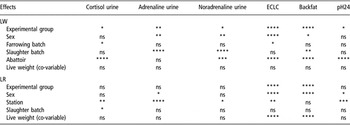
Because the LR and LW populations are totally independent, the data were analysed separately with the Statistical Analysis Systems (SAS) Institute software (Statistical Analysis Systems Institute, 2000). Hormone levels in urine were transformed into their logarithmic scores (ln) for data normalization. Experimental group (G77 v. G98 or L77 v. L99), sex, farrowing batch and station, abattoir and slaughter batch were included as fixed effects and live weight as a co-variable in the MIXED procedure of SAS when significant (Table 1). Least-squares means were generated by the LSMEANS statement. Pearson correlations were calculated between hormone concentrations, carcass composition (lean meat content and mean backfat thickness) and pH24 with the CORR procedure.
Fixed between subjects effects considered in the models of analysis for each trait

ECLC = estimated carcass lean content; Backfat = average of the backfat thickness measured at the neck, back and rump levels; pH24 = ultimate pH in the semi-membranosus muscle; LW = French Large White; LR = French Landrace.
*P < 0.05; **P < 0.01; ***P < 0.001; ****P < 0.0001; ns: non-significant.
The realised genetic trends from 1977 to 1998 (ΔG) and their standard errors (s.e. ΔG) were estimated for each considered trait as proposed by Smith (Reference Smith1977):

and s.e. ΔG = 2 × s.e. (G98 least-squares mean − G77 least-squares mean).
Results
Genetic group least-squares means and estimated genetic trends for stress hormones are shown in Tables 2 and 3 for LW and LR crossings, respectively. For the LW breed, urinary levels of cortisol, adrenaline and noradrenaline were lower in 1998 than in 1977 (−24.4%, −26.7% and −18.9% respectively). ECLC increased between 1977 and 1998 and carcass adiposity dropped significantly. Ultimate pH was lower in 1998 than in 1977. In the LR breed, ECLC and carcass adiposity followed the same trends as in LW, but ultimate pH, urinary levels of cortisol, adrenaline and noradrenaline did not significantly differ from 1977 to 1999.
Least-squares means and estimated genetic trends (ΔG) for endocrine, carcass composition and meat quality traits of G77 and G98 pigs (Large White breed)

LSM = least-squares means; n = number of observations in each group; ΔG = 2 × (G98 LSM − G77 LSM); ECLC = estimated carcass lean content; Mean backfat thickness = average of the backfat thickness measured at the neck, back and rump levels; pH24 = ultimate pH in the semi-membranosus muscle.
P > |t| = t-test probability for ΔG ≠ 0; *P < 0.05; **P < 0.01; ***P < 0.001; ****P < 0.0001.
Least-squares means and estimated genetic trends (ΔG) for endocrine, carcass composition and meat quality traits of L77 and L99 pigs (Landrace breed)

LSM = least-squares means; n = number of observations in each group; ΔG = 2 × (L99 LSM − L77 LSM); ECLC = estimated carcass lean content; Mean backfat thickness = average of the backfat thickness measured at the neck, back and rump levels; pH24 = ultimate pH in the semi-membranosus muscle.
P > |t| = t-test probability for ΔG ≠ 0; ****P < 0.0001; ns: non-significant.
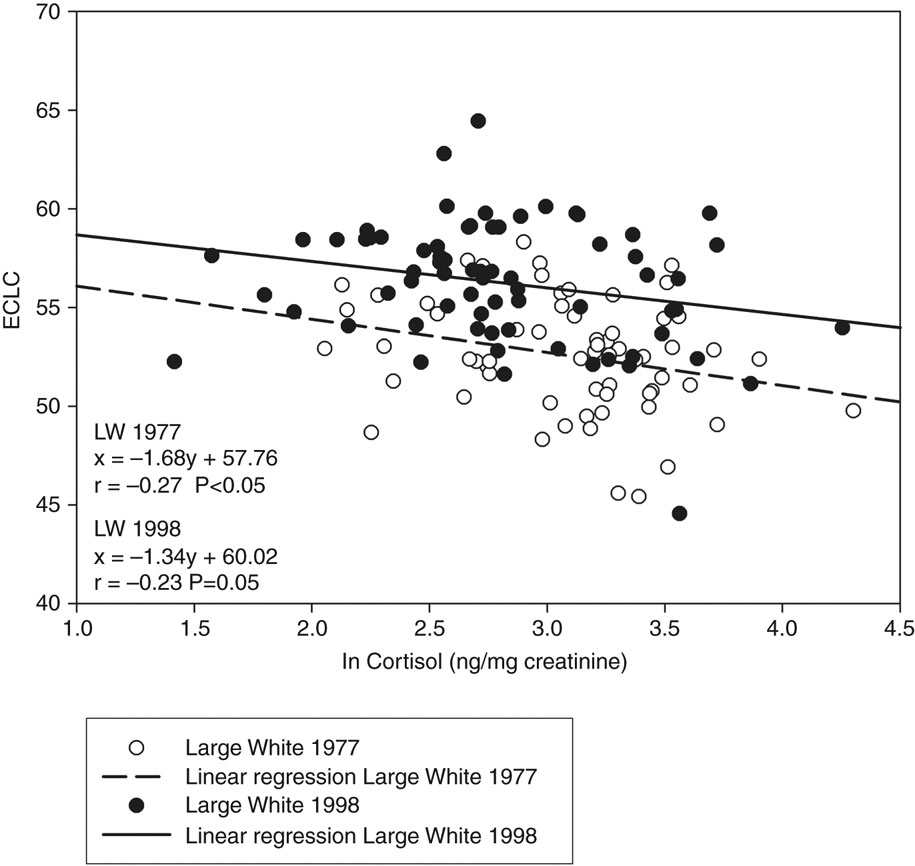
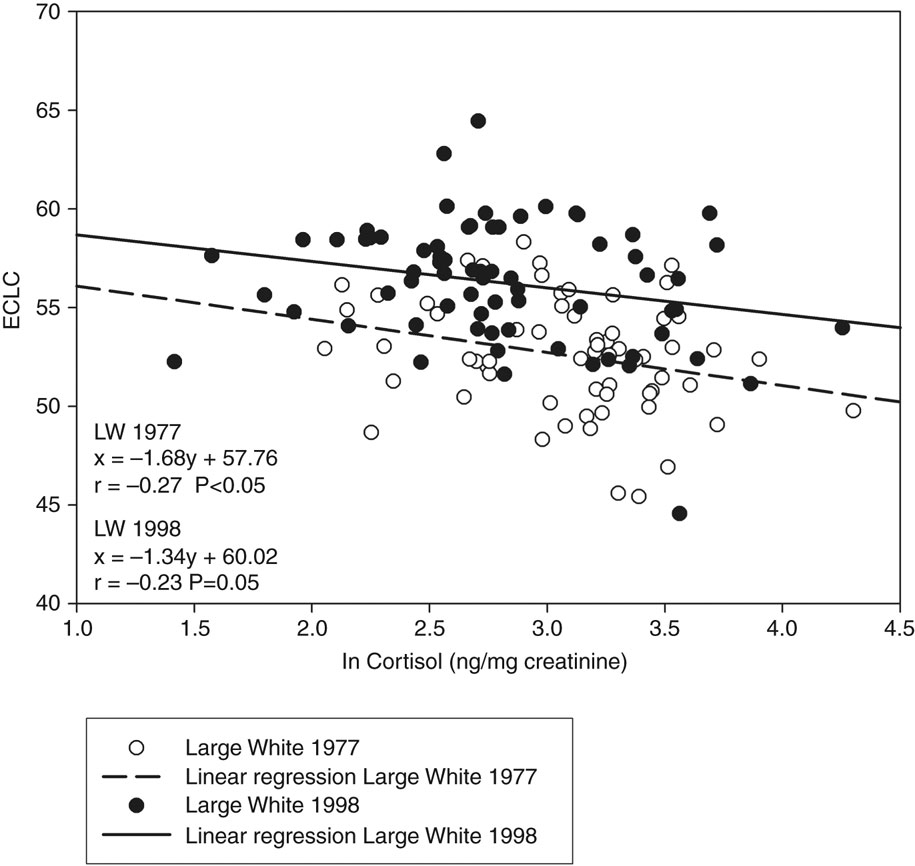
Pearson correlations between hormone concentrations and carcass composition were calculated. No significant correlations were found for the pigs generated from LR boars. Significant correlations were found for the pigs generated from LW boars born in 1977: urinary cortisol and adrenaline levels were negatively correlated with ECLC (r = −0.27, P < 0.05 and r = −0.36, P < 0.01, respectively), and urinary adrenaline concentrations were also positively correlated with mean backfat thickness (r = 0.33, P < 0.05). For the pigs generated from LW boars born in 1998, urinary cortisol levels were negatively correlated with ECLC (r = −0.23, P = 0.05). Correlations between levels of cortisol and ECLC for the LW population are presented in Figure 2. No significant correlations were found between stress hormones and pH24.
Scatter plot and regression line between estimated carcass lean content (ECLC) and concentration of cortisol in urine (ng/mg creatinine, ln scale) in the Large White (LW) breed.
Discussion
The aim of this study was to explore the consequences of this selection on the stress-responsive neuroendocrine systems of pigs issued from LW and LR boars born in 1977 or between 1998 and 2000. The results obtained here for ECLC, carcass adiposity and ultimate pH are in accordance with those obtained by Tribout et al. (Reference Tribout, Caritez, Gogué, Gruand, Bouffaud, Billon, Péry, Griffon, Brénot, Le Tiran, Bussières, Le Roy and Bidanel2004) and Bazin et al. (Reference Bazin, Tiger, Tribout, Bouffaud, Madigand, Boulard, Deschodt, Flého, Gueblez, Maignel and Bidanel2003) with the complete set of animals from the experiment. This shows that our sample of animals is representative of the whole experimental populations.
The generations studied in the two populations (F1 in LR and F2 in LW) and farming and slaughter conditions were different between LW and LR populations. As the results obtained may depend on all these factors, the two breeds were analyzed independently.
In the LW population, the consequences of selection are obviously a strong increase in carcass lean content and an important decrease in carcass adiposity, but also a decrease in cortisol and catecholamines levels. Cortisol favours the storage of lipids (in presence of insulin) at the expense of proteins, via peripheral catabolism and hepatic neoglucogenesis (Devenport et al., Reference Devenport, Knehans, Sundstrom and Thomas1989; Dallman et al., Reference Dallman, Strack, Akana, Bradbury, Hanson, Scribner and Smith1993); it is not surprising that selection on carcass lean content results in the selection of animals with lower levels of cortisol in the LW population. Nevertheless, the hypothesis of a genetic drift of hormone production independent of the selection traits cannot be completely discarded. The negative correlation between cortisol and lean content for the G77 and G98 pigs illustrates the relationship between cortisol and fatness. It also shows that selection did not reduce variability in the LW population between 1977 and 1998. The relationship found between catecholamines and fatness in the G77 pigs is more difficult to understand. As the activation of β-adrenergic receptors increases mobilization of fat and reduces protein catabolism (Navegantes et al., Reference Navegantes, Migliorini and Kettelhut2002), we could have expected the reverse result. Part of this relationship probably results from the coupling between adrenaline and cortisol secretions (Foury et al., Reference Foury, Devillers, Sanchez, Griffon, Le Roy and Mormède2005). Indeed, the synthesis of adrenaline is under control of cortisol that induces phenylethanolamine-N-methyl-transferase, the enzyme converting noradrenaline into adrenaline in the adrenal medulla (Ciaranello, Reference Ciaranello1978). The expected correlation between cortisol and ECLC was confirmed in G98 pigs; however, no relationship between adrenaline and carcass composition measures was found.
On the same experimental design, other studies have estimated genetic trends for traits measured at farrowing in the LW breed (Canario et al., Reference Canario, Père, Tribout, Thomas, David, Gogué, Herpin, Bidanel and Le Dividich2007a and Reference Canario, Rydhmer, Gogué, Tribout and Bidanel2007b). The results suggest that the improvement in lean growth rate and in sow prolificacy from 1977 to 1998 has resulted in a lower maturity of piglets at birth. Leenhouwers et al. (Reference Leenhouwers, Knol, Groot, Vos and Lende2002) showed that the degree of physiological maturity of piglets increases with increasing circulating cortisol concentrations at birth. Therefore, the selection of animals with a lower production of cortisol can lead to a lower maturity of piglets.
In the LW population, selection on lean tissue growth was also accompanied by a decrease in catecholamines and ultimate pH levels. Indeed, sympathetic activation before slaughter increases muscle glycogenolysis and therefore reduces lactic acid production post-mortem and meat acidification (Fernandez and Tornberg, Reference Fernandez and Tornberg1991). Therefore a reduced pre-mortem sympathetic activation, as observed in Large White pigs, spares muscle glycogen and, as a consequence, decreases ultimate pH. However, ultimate pH remains in the normal range for acceptable meat quality.
In the LR breed, selection did not affect cortisol levels. A hypothesis to explain this fact could be that genes responsible for the variability of cortisol secretion are not segregating in the LR population. However, this hypothesis could not be checked in the present population and no estimate of the heritability of blood and urinary cortisol concentrations is, to our knowledge, available in the literature. The stability of cortisol levels could be an explanation to the more limited gain in lean content for the LR breed in comparison with the LW breed, even if mean backfat thickness shows a greater decrease in LR than in LW pigs. Indeed, lean content may be more informative than carcass adiposity of the influence of cortisol that changes the proteins/lipids balance (Devenport et al., Reference Devenport, Knehans, Sundstrom and Thomas1989). This more limited gain in the LR breed can also be explained by the fact that one of the main selection goals in the 1980s and 1990s was the eradication of the halothane sensitivity gene (Renand et al., Reference Renand, Larzul, Le Bihan-Duval and Le Roy2003), which led to a reduction in the selection pressure on carcass composition traits. The eradication of this gene probably did not have consequences on cortisol levels since the halothane sensitivity mutation does not influence HPA axis activity (Mormède and Dantzer, Reference Mormède and Dantzer1978; Terlouw et al., Reference Terlouw, Ludriks, Schouten, Vaessen, Fernandez, Andanson and Père2001).
The present data show that, due to the influence of cortisol and catecholamines on energy metabolism, selection performed from 1977 to 1998 in the LW population to increase the carcass lean content has resulted in the selection of low cortisol and catecholamines level animals. Moreover, this indirect selection on stress-responsive systems may be responsible for negative trends on other traits such as meat quality (Lonergan et al., Reference Lonergan, Huff-Lonergan, Rowe, Kuhlers and Jungst2001) or newborn survival (Canario et al., Reference Canario, Père, Tribout, Thomas, David, Gogué, Herpin, Bidanel and Le Dividich2007a and Reference Canario, Rydhmer, Gogué, Tribout and Bidanel2007b; Herpin et al, Reference Herpin, Dividich and Amaral1993). A better understanding of the molecular and physiological mechanisms involved in the relationships between endocrine systems (cortisol and catecholamines) and different production traits would help to optimize selection to improve together the level of production, carcass composition, product quality and animal welfare.
Acknowledgements
We thank the staff of Le Magneraud, Bourges and Le Rheu experimental units and of Mauron testing stations for their careful data management, and Francis Bussières from the INRA Pig and Goat Insemination experimental unit for collecting, conditioning and stocking the semen of 1977 boars 30 years ago.
This work was supported by the INRA, the French Pig Institute (IFIP) and the ‘Actions Innovantes’ from the French Ministry of Agriculture.