Video-assisted thoracoscopic surgery, a major branch of endoscopic techniques, has brought breakthrough progress in minimally invasive thoracic surgery and is now widely adopted in thoracic surgery. Video-assisted thoracoscopic surgery is known to have advantages of reduced tissue trauma, decreased pain, shortened hospitalisation, and even better clinical outcome versus traditional surgical operations. Therefore, video-assisted thoracoscopic surgery has been utilised in paediatric surgeries since its first application in paediatric pleural biopsy at 1976 and thereafter promoted in 1979. Reference Rodgers, Moazam and Talbert1 During the last decade, video-assisted thoracoscopic surgery has been increasingly applied and is now considered as a standard procedure for several paediatric diseases both in China and other countries. However, video-assisted thoracoscopic surgery is still under development in infants and neonates (aged from 0–3 years) even it is more preferred than standard thoracotomy.
Enhanced Recovery after Surgery (ERAS®) refers to patient-centred, evidence-based, multidisciplinary team-developed pathways for a surgical specialty and facility culture to reduce the surgical stress response of patients, optimise their physiologic function, and facilitate recovery. Reference Ljungqvist, Scott and Fearon2,Reference Wilmore and Kehlet3 Inspired by the idea of ERAS, thoracic surgical procedures have undergone some paradigm shift in perioperative care. Reference Boffa, Kosinski and Paul4 Chest drainage by placing one or multiple drainage tubes was previously considered as a standard procedure after standard thoracotomy or endoscopic operation. Reference Takagi, Matsui and Umemoto5 Currently, as supported by progresses in evidence-based medicine, drainage tube placement in video-assisted thoracoscopic surgery can be waived and widely applied in the clinic since removal of this procedure could improve recovery, shorten hospitalisation and improve the quality of life of adult patients. However, whether the removal of drainage tubes in video-assisted thoracoscopic surgery could be beneficial in infants and neonates remains largely unknown.
Patient- and Family-Centered Care (PFCC) is a concept that are increasingly implemented in various settings to improve the quality of health care, especially in paediatric setting. Briefly, the patient-centred care is intended to amend treatment decisions to patients’ beliefs, preferences, and values. Family-centred care, an extension of this concept, accepts the concept that relatives of patients often acting as patients’ representatives. Giving the fact that children usually are unable to participate in the decision-making, information sharing, and collaboration in disease treatment and recovery process, PFCC is an ideal pattern for better health care. Therefore, by utilising the PFCC scale, the present study was designed to determine the necessity of chest tube drainage placement in video-assisted thoracoscopic surgery based on our previous clinical practice. We hope that our research may provide clinical experiences in the usage of video-assisted thoracoscopic surgery in infants and neonates.
Patients and methods
Data collection
This retrospective study analysed the clinical data of 30 children who underwent video-assisted thoracoscopic surgery at the Third Affiliated Hospital of Guangzhou Medical University from April 2018 to April 2020. Based on treatments taken, the patients were categorised into the tube group (children receiving video-assisted thoracoscopic surgery with chest tube drainage) and the non-tube group (children receiving video-assisted thoracoscopic surgery without chest tube drainage). The study protocol was approved by the ethics committees of the Third Affiliated Hospital of Guangzhou Medical University (No.030, 2020) and the study was carried out in accordance with the Declaration of Helsinki.
Inclusion and exclusion criteria
The inclusion criteria were (1) complete medical records; (2) no upper respiratory tract infection within 1 week before operation; (3) no infections within 6 months before operation; (4) no history of thoracic surgery; (5) unambiguous pathological diagnoses. The exclusion criteria were (1) congenital immunodeficiency and (2) congenital lung malformation.
Surgical procedures
All patients were given standard video-assisted thoracoscopic surgery. After general anesthesia and subsequent video-assisted thoracoscopic surgery, statues of lung inflation, errhysis, and air leakage of the wound area were observed. In the tube group, a 16-F chest drainage tube(s) was/were placed through the incision with the head of the tube placed close to diaphragm to drain potential surgery-induced blood, fluid, and gas leakage. The incision areas were sealed one by one after pulmonary expansion with positive pressure and the end of the tube was placed into a watered glass. The non-tube group received pulmonary expansion with positive pressure till no air bubble was present in the incision area without tube placement and the incision areas were sealed one by one.
Post-operative management
The procedures of post-operative management were performed in accordance with ERAS. Measures aimed at early discovery, early diagnosis, and early intervention were taken as listed below: (1) careful evaluation was performed before and during operation. (2) Optimised, personalised anesthesia procedures were taken, and surgeries were performed as gently as possible to avoid potential damage to lung tissues. (3) Post-operative care with timely analgesia and reasonable haemostasis was provided. (4) Standard observations including heart rate, blood pressure, blood oxygen saturation, temperature, respiratory rate, mental status and crying frequency were performed. (5) Blood routine examination and colour ultrasonography for detecting pleural effusion were performed at first 24 hours post-operatively. (5) Chest radiograph was obtained 3 days after operation.
Observational indicators
Demographic data
Parameters including gender, age, body weight, tumour size, and pathological diagnosis were recorded.
Operation-related indicators
Operative time, mean intraoperative blood loss, post-operative complications, and length of hospitalisation were observed of patients from both groups.
Blood routine examination
Indicators of haemoglobin concentration (Hb, g/L), haematocrit (%), mean corpuscular volume (fL), mean corpuscular haemoglobin (pg), mean corpuscular haemoglobin concentration (g/L), white blood cell count (×109/L), percentage of neutrophil (%), absolute neutrophil counts (×109/L), and C-reactive protein (×109/L) were determined in both groups.
Patients’ performance and psychological acceptance by patients’ guardians
Those indicators were determined using the PFCC scale. The frequencies of crying, quality of sleep, systematic reaction, and psychological acceptance of treatment were included in this scale. Five options ranged from 0 to 5, with 0 indicating the lowest acceptance and 5 the highest acceptance. To conveniently understand the results of PFCC scale, we took 0–2 as no acceptance, and more than 3 as acceptance.
Statistical analysis
Data were analysed by SPSS 23.0. Continuous variables were presented as mean ± standard error of mean and statistical difference was calculated by Student’s t-test. Categorical variables were presented as percentage and statistical difference was calculated by Fisher’s exact test. A P-value less than 0.05 was considered as statistically different.
Results
Demographic data
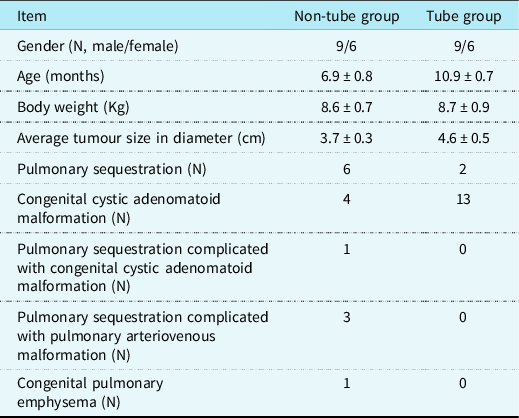
As presented in Table 1, 30 children were included in the current research and were categorised into the tube group and non-tube group (each group contained nine male and six female). The average age of patients in the tube group was 10.9 months with an average tumour size of 4.6 cm in diameter and an average body weight of 8.7 kg. Pathological diagnosis in the tube group included 2 cases of pulmonary sequestration and 13 cases of congenital cystic adenomatoid malformation. The average age of patients in the non-tube group was 6.9 months with an average tumour size of 3.7 cm in diameter and an average body weight of 8.6 kg. Pathological diagnosis in the non-tube group included six cases of pulmonary sequestration, four cases of congenital cystic adenomatoid malformation, one case of pulmonary sequestration complicated with congenital cystic adenomatoid malformation, three cases of pulmonary sequestration complicated with pulmonary arteriovenous malformations, and one congenital pulmonary emphysema patient.
Demographic data

Surgical operation
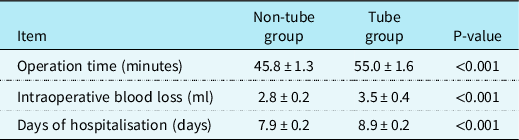
Video-assisted thoracoscopic surgery was performed for pulmonary segmentectomy, pulmonary lobectomy, or pulmonary sequestrations according to the type of diseases in the patients. A significantly decrease in operative time and intraoperative blood loss was observed in the non-tube group than the tube group. The mean time to tube removal was 2.9 days and the mean first 24-hour drainage flow was 34.7 ml in the tube group. More importantly, there was a significantly decrease in the length of hospitalisation of the non-tube group when compared with that of the tube group (p < 0.001, Table 2). All patients were discharged with cleared focus with stable vital signs.
Operation-related indicators

Laboratory examination
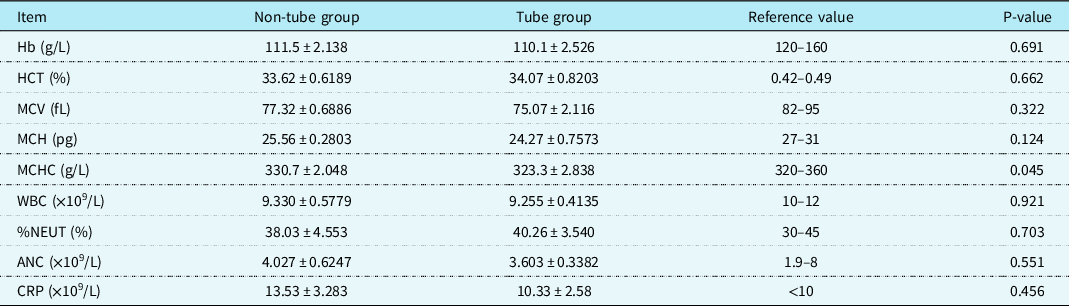
The results of laboratory examination were obtained within the first 24 hours after operation (Table 3). A significant increase in mean corpuscular haemoglobin concentration was detected in the non-tube group compared with the tube group (p < 0.05), which suggested that patients in the non-tube group could recover faster than patients in the tube group.
Laboratory examination

ANC = absolute neutrophil counts; CRP = C-reactive protein; Hb = haemoglobin concentration; HCT = haematocrit; MCH = mean corpuscular haemoglobin; MCHC = mean corpuscular haemoglobin concentration; MCV = mean corpuscular volume; %NEUT = percentage of neutrophil; WBC = white blood cell count
Post-operative complications
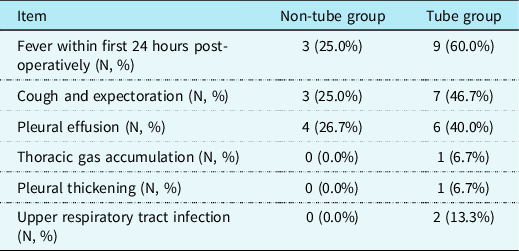
As shown in Table 4, a significant decrease in the occurrence of post-operative complications was observed in the non-tube group than the tube group. Of particular, the tube group had an increase in the rate of fever when compared with the non-tube group (60% versus 25%). Additionally, in the tube group, there were a case of thoracic gas accumulation, a case of pleural thickening, and two cases of upper respiratory tract infection, while those post-operative complications were absent in the non-tube group.
Post-operative complications

Patients’ post-operative performance and psychological acceptance by patients’ guardians
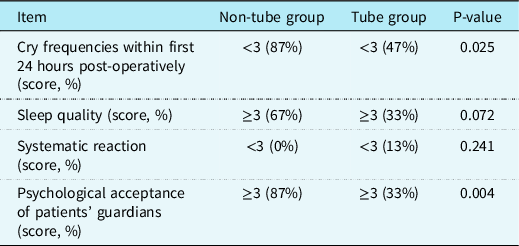
A PFCC-oriented questionnaire was applied to patients’ guardians to figure out patients’ post-operative performance and psychological acceptance by patients’ guardians (Table 5). The results revealed a significantly decrease in the frequency of crying in the non-tube group when compared with the tube group (87% versus 47%, p < 0.05). A higher rate of psychological acceptance by the guardians was observed when patients underwent video-assisted thoracoscopic surgery without tube placement than those with tube placement (87% versus 33%, p < 0.01).
Patients’ post-operative performance and psychological acceptance of patients’ guardians

Discussion
Our research has revealed that no tube placement in video-assisted thoracoscopic surgery could be beneficial in carefully evaluated children. Even the 24-hour drainage flow of tube placement in paediatric video-assisted thoracoscopic surgery was in a safe range in the current clinical setting, and this kind of treatment could significantly increase the risk of post-operative complications. In contrast, no tube placement could decrease the occurrence of post-operative complications, shorter hospital stay, lower caregiver burden, and higher psychological acceptance by the guardians. Previous research Reference Qi, Wang and Ming’an6 has found that adults who received video-assisted thoracoscopic surgery without tube placement were able to ambulate 1 day after operation, and 6 out of 20 patients were able to urinate with assistance. No patients died post-operatively, and no patients underwent reoperation. Another report Reference Yang, Wang and Shi7 of adult patients receiving video-assisted thoracoscopic surgery without tube placement for pneumothorax also revealed the same results with a decrease in the incidence of post-operative complications and absence of recurrence of pneumothorax. Those results were, together with other findings, Reference Nakashima, Watanabe and Mishina8 all proved that video-assisted thoracoscopic surgery without tube placement could effectively and safely remove thoracic benign lesions. As suggested by Cerfolio et al., Reference Cerfolio and Bryant9 drainage tube could be safely removed after video-assisted thoracoscopic surgery for pulmonary lobectomy if the amount of drainage flow was less than 450 ml/day. Clinically, drainage flow of 450 ml/day was rarely seen if video-assisted thoracoscopic surgery was performed proficiently. These results have laid a theoretical basis for performing video-assisted thoracoscopic surgery without tube placement in paediatric practice.
Additionally, drainage tube placement after video-assisted thoracoscopic surgery was meant to drain haemorrhage and air leakage of stumped lung tissues intraoperatively and/or post-operatively. Therefore, drainage tubes could be waived once haemorrhage and air leakage were absent after video-assisted thoracoscopic surgery. Reference Swanson, Meyers and Gunnarsson10 In adult patients, it was suggested that operations with such conditions should be performed without drainage tube placement in video-assisted thoracoscopic surgery Reference LIU11 : (1) the total operative time is shorter than 2 hours and major operation procedures are relatively easy to perform; (2) incisions caused by such operations are small without active intraoperative bleeding or the total amount of intraoperative haemorrhage is less than 50 ml intraoperation; (3) the diameter of substantial diseases was less than 3 cm and pulmonary diseases were limited within the same lobar; (4) no air leakage or haemorrhage is present in the operating region. As demonstrated by pathological diagnosis, all pulmonary diseases in the current study were benign. The average operative time in the current study was less than 1 hour with an estimated intraoperative blood loss of less than 10 ml. Those findings are consistent with previous reports. However, in some children in the current study, pulmonary lesions with a diameter of 3–4 cm were identified at different lobes, but at the same unilateral lung could also be cured by video-assisted thoracoscopic surgery without drainage tube, which is different from previous report. This difference may be due to the fact that infants and neonates are more capable of recovering from wounds.
With the rapidly increasing demand of aesthetics and the development of technology, cases of thoracoscopic surgeries would rise as time goes by in the treatment of paediatric pulmonary diseases. Through our research, video-assisted thoracoscopic surgery with no drainage tube had overwhelming advantages than tube placement after video-assisted thoracoscopic surgery. However, even ERAS is important, and the safety of such treatment should be carefully evaluated. More precise assessment before, during, and after operation should be considered. Support by the society and guardians of children should be enlisted when performing such treatments.
This study had several limitations. Firstly, the current study was a single-center retrospective study with a small sample size; prospective studies with a large sample size at multi-centres are needed to confirm the safety and efficacy of such treatment. Additionally, patients receiving video-assisted thoracoscopic surgery with no drainage tube were not followed up. Finally, children involved in the current study were diagnosed with multiple pulmonary diseases, and the applicability of video-assisted thoracoscopic surgery without drainage tube in specific pulmonary diseases should also be explored in further research.
Conclusion
In conclusion, our research has revealed that video-assisted thoracoscopic surgery with no chest drainage tube after video-assisted thoracoscopic surgery in very young children is safe and effective in treating paediatric pulmonary diseases. This research provided a novel clinical experience in paediatric thoracoscopic surgery to minimise potential harm and improve quality of care.
Declarations
Ethics approval and consent to participate: the research protocols were approved by ethics committees of The Third Affiliated Hospital of Guangzhou Medical University (No.030, 2020) and were in accordance with the Helsinki Declaration.
Consent for publication
Not applicable.
Availability of data and material
The datasets generated and analysed during the current study are available from the corresponding author on reasonable request.
Competing interests
The authors declare that they have no competing interests.
Authors’ contributions
XJ F and GY contributed to the conception and design of the study; DDL and GZ performed the experiments, CC and XL collected and analysed data; XJ F and GY wrote the manuscript; All authors reviewed and approved the final version of the manuscript.
Acknowledgements
None.
Financial support
This study was funded by Guangdong Provincial Science and Technology Plan Project (No. 2014A020213021).