Introduction
With young people spending increasing amounts of time online and on social media platforms (Office for National Statistics, 2017), there is widespread public concern about the impact of such technologies on mental health. Of particular concern is cyber-victimisation, which involves repeated and intentionally aggressive acts taking place through communication technology (e.g. social media, instant messaging, text messages, email). Given meta-analytic estimates suggesting that more than one in ten young people experience cyber-victimisation (Modecki, Minchin, Harbaugh, Guerra, & Runions, Reference Modecki, Minchin, Harbaugh, Guerra and Runions2014), it is essential to understand the impact of cyber-victimisation on mental health.
Evidence suggests that cyber-victimisation frequently co-occurs with face-to-face bullying victimisation (Przybylski & Bowes, Reference Przybylski and Bowes2017; Wolke, Lee, & Guy, Reference Wolke, Lee and Guy2017), which is a well-established risk factor for mental health problems (Schoeler, Duncan, Cecil, Ploubidis, & Pingault, Reference Schoeler, Duncan, Cecil, Ploubidis and Pingault2018). However, cyber-victimisation has three unique features which could be particularly harmful for young people's mental health (Kowalski, Giumetti, Schroeder, & Lattanner, Reference Kowalski, Giumetti, Schroeder and Lattanner2014; Pingault & Schoeler, Reference Pingault and Schoeler2017). First, it can be inescapable: unlike face-to-face victimisation, which is limited to a time and space (e.g. at school), cyber-victimisation can happen at any time and in any place. Second, cyber-victimisation can take place in front of a large audience (e.g. hundreds or thousands of viewers on social media), which could lead to public humiliation. Third, because perpetrators of cyber-victimisation are able to remain anonymous, they experience few negative consequences, increasing the potential for severe acts and making victimisation harder to stop.
Previous research has shown that cyber-victimisation is associated with a range of mental health problems in young people (Gini, Card, & Pozzoli, Reference Gini, Card and Pozzoli2018; Kim, Colwell, Kata, Boyle, & Georgiades, Reference Kim, Colwell, Kata, Boyle and Georgiades2018; Kowalski et al., Reference Kowalski, Giumetti, Schroeder and Lattanner2014; Perret et al., Reference Perret, Orri, Boivin, Ouellet-Morin, Denault, Côté and Geoffroy2020; Przybylski & Bowes, Reference Przybylski and Bowes2017; Wolke et al., Reference Wolke, Lee and Guy2017), but it is unclear whether these associations are causal or reflect confounding. One key source of confounding that has not been accounted for previously is genetic liability. Ignoring genetic confounds is problematic because vulnerability to cyber-victimisation is partly influenced by genetic factors (Fisher et al., Reference Fisher, Caspi, Moffitt, Wertz, Gray, Newbury and Mill2015) and the same genetic factors might also predispose to mental health problems. This might occur, for example, if heritable vulnerabilities to mental health problems make young people more likely to be targeted by cyber-bullies, as evidence has suggested is the case for face-to-face peer victimisation (Schoeler et al., Reference Schoeler, Choi, Dudbridge, Baldwin, Duncan, Cecil and Pingault2019). In addition to genetic liability, adverse family environments (e.g. parental separation, family conflict) predict both cyber-victimisation (Chen et al., Reference Chen, Lo, Zhu, Cheung, Chan and Ip2018) and mental health problems (Edwards, Holden, Felitti, & Anda, Reference Edwards, Holden, Felitti and Anda2003) and thus may confound the association.
A powerful way to account for these familial vulnerabilities is through the co-twin control design (Vitaro, Brendgen, & Arseneault, Reference Vitaro, Brendgen and Arseneault2009). This design tests whether twins that differ in an exposure (e.g. cyber-victimisation) differ in an outcome (e.g. mental health problems). If within-twin pair differences in an exposure are associated with within-twin pair differences in an outcome, this association can be assumed to be independent of the shared environment and genetic influences. To further account for non-familial confounders (e.g. individual-specific experiences or traits, such as co-occurring face-to-face victimisation), within-twin pair differences in measured individual factors can be additionally controlled for (Arseneault et al., Reference Arseneault, Milne, Taylor, Adams, Delgado, Caspi and Moffitt2008; Baldwin et al., Reference Baldwin, Arseneault, Caspi, Moffitt, Fisher, Odgers and Danese2019; Singham et al., Reference Singham, Viding, Schoeler, Arseneault, Ronald, Cecil and Pingault2017).
Studies employing the co-twin control design have provided evidence of a small direct effect of other forms of victimisation (including face-to-face bullying) on a range of mental health problems (Arseneault et al., Reference Arseneault, Milne, Taylor, Adams, Delgado, Caspi and Moffitt2008; Baldwin et al., Reference Baldwin, Arseneault, Caspi, Moffitt, Fisher, Odgers and Danese2019; Kendler et al., Reference Kendler, Bulik, Silberg, Hettema, Myers and Prescott2000; Schaefer et al., Reference Schaefer, Moffitt, Arseneault, Danese, Fisher, Houts and Caspi2017; Silberg et al., Reference Silberg, Copeland, Linker, Moore, Roberson-Nay and York2016; Singham et al., Reference Singham, Viding, Schoeler, Arseneault, Ronald, Cecil and Pingault2017). Notably though, these studies have also found that associations between victimisation and mental health problems are substantially attenuated after accounting for family-wide vulnerabilities, highlighting the role of confounding by genetic and shared environmental vulnerabilities. However, no study has used the co-twin design to examine the association between cyber-victimisation and mental health.
Here we employed the co-twin control design to examine the relationship between cyber-victimisation and mental health problems in a cohort of 7708 twins from the United Kingdom, followed to emerging adulthood. We examined a wide range of mental health problems across internalising, externalising and psychotic domains, assessed through multiple informants and scales. As well as accounting for familial vulnerabilities by design, we adjusted for key measured individual-specific confounders such as face-to-face peer victimisation and prior mental health problems. Finally, because the majority of research on cyber-victimisation and mental health has relied solely on self-report measures (Kowalski et al., Reference Kowalski, Giumetti, Schroeder and Lattanner2014), we also tested whether the relationship was sensitive to whether mental health problems were self- or parent-reported.
Method
Study sample
Participants were drawn from the Twins Early Development Study (TEDS) and were born in England and Wales between 1 January 1994, and 31 December 1996. The recruitment process and the sample are described in detail elsewhere (Rimfeld et al., Reference Rimfeld, Malanchini, Spargo, Spickernell, Selzam, McMillan and Plomin2019). The TEDS sample was at its inception representative of the UK population in comparison with census data and remains considerably representative, despite some attrition (Rimfeld et al., Reference Rimfeld, Malanchini, Spargo, Spickernell, Selzam, McMillan and Plomin2019). TEDS participants have been assessed in multiple waves across development, with the most recent assessment in emerging adulthood. Data for the emerging adulthood assessment were collected in two phases: phase 1 (including twin and parent questionnaires, beginning in June 2017; mean age = 22.3 years), and phase 2 (including twin questionnaires, beginning in February 2018, mean age = 22.9 years). Data collection was via a smartphone app, with the option to use web or paper-based questionnaires. The analysis in this study uses data collected when the participants were between 16 and 22 years of age from September 2010 to February 2019. The final study sample (N = 7708) includes 62% females, 93% with white ethnicity and 39% monozygotic twins. As shown in online Supplementary Table S1, participants included in this sample were slightly more advantaged in terms of parental education and employment than the original TEDS sample. The number of twins for each mental health outcome ranged from 7706 to 3860 depending on the assessment phase, informant and number of twin pairs with data available for exposure to cyber-victimisation and each mental health measure. Written informed consent was obtained from parents prior to data collection, and from TEDS participants themselves past the age of 18. Project approval was granted by King's College London's ethics committee for the Institute of Psychiatry, Psychology and Neuroscience PNM/09/10–104. This study follows the Strengthening the Reporting of Observational Studies in Epidemiology (STROBE) guidelines (Von Elm et al., Reference Von Elm, Altman, Egger, Pocock, Gøtzsche, Vandenbroucke and Initiative2014).
Cyber-victimisation
Cyber-victimisation was assessed at phase 1 of the emerging adulthood assessment through the Multidimensional Peer Victimisation Scale-Revised (Betts, Houston, & Steer, Reference Betts, Houston and Steer2015). Items were taken from the electronic victimisation subscale, adapted to provide up-to-date examples of social media platforms. Twins were asked the following four questions about their experiences in the last 12 months: ‘How often has someone sent you a nasty text (excluding family or partner)?’, ‘How often has someone said something mean about you on a social networking site, such as Facebook or Instagram (excluding family or partner)?’, ‘How often has someone written something spiteful about you in a chat room (excluding family or partner)?’, and ‘How often has someone written nasty things to you using instant messenger, such as Facebook Messenger, Whatsapp, Snapchat (excluding family or partner)?’. Responses were given on a 3-point scale (0 = ‘not at all’, 1 = ‘once’ and 2 = ‘more than once’). An exposure to cyber-victimisation score was computed as the mean of all present items multiplied by four. Participants were excluded if they were missing data for two or more of the four items. The internal consistency across the four items was α = 0.91. The test-retest reliability of the cyber-victimisation measure among 419 TEDS twins assessed twice within one month was r = 0.79.
Mental health problems
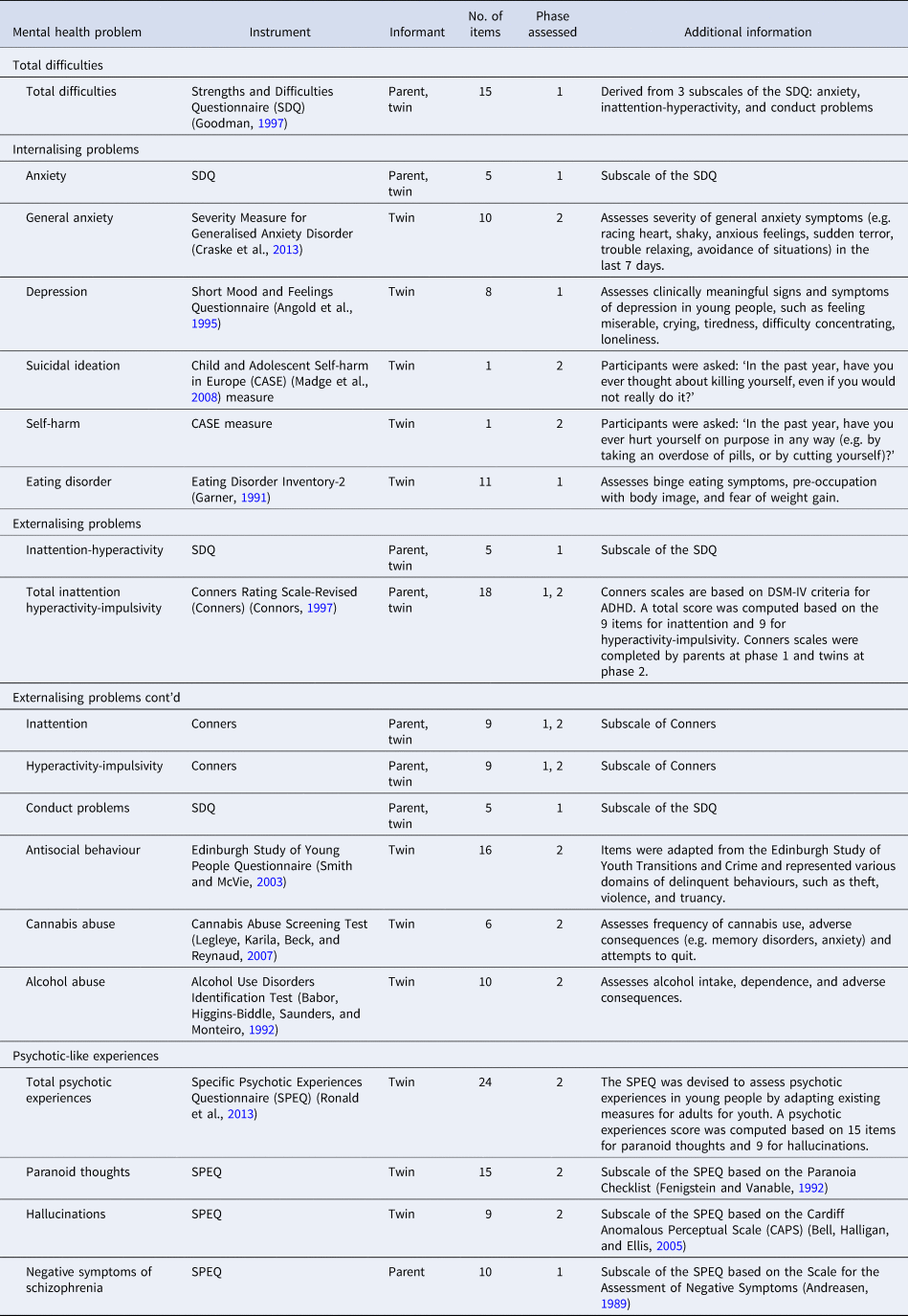
Mental health problems included total mental health difficulties, internalising problems (anxiety, depression, suicidal ideation, self-harm and eating disorder), externalising problems (inattention, hyperactivity and impulsivity, conduct problems, antisocial behaviour, alcohol abuse and cannabis abuse) and psychotic-like experiences (hallucinations, paranoid thoughts and negative symptoms of schizophrenia). These mental health problems were assessed through parent and self-reports in phases 1 and 2 of the overall emerging adulthood assessment. Details of the questionnaires used for assessment are in Table 1. For each mental health measure, participants were excluded if they were missing data for more than half of the respective assessment items.
Mental health problems measured in emerging adulthood and assessment instruments

Covariates
Face-to-face peer victimisation
We included face-to-face peer victimisation as an individual-specific covariate because it co-occurs with cyber-victimisation (Przybylski & Bowes, Reference Przybylski and Bowes2017; Wolke et al., Reference Wolke, Lee and Guy2017) and is associated with mental health problems (Schoeler et al., Reference Schoeler, Duncan, Cecil, Ploubidis and Pingault2018). Face-to-face peer victimisation was assessed through the self-report version of the Multidimensional Peer Victimisation Scale-Revised (Betts et al., Reference Betts, Houston and Steer2015), at phase 2 of the emerging adulthood assessment. Three subscales (with four items each) were used to assess face-to-face peer victimisation, including physical victimisation (e.g. ‘Kicked me’), verbal bullying (e.g. ‘Called me names’) and social manipulation (e.g. ‘Tried to make my friends turn against me’). Participants rated how often they experienced events mentioned under each item during the past year on a 3-point scale (0 = ‘not at all’, 1 = ‘once’ and 2 = ‘more than once’). An exposure to face-to-face peer victimisation score was computed as the mean of all present items multiplied by 12. Participants were excluded if they were missing data for four or more of the 12 items. The internal consistency across all of the items was α = 0.94.
Prior mental health problems
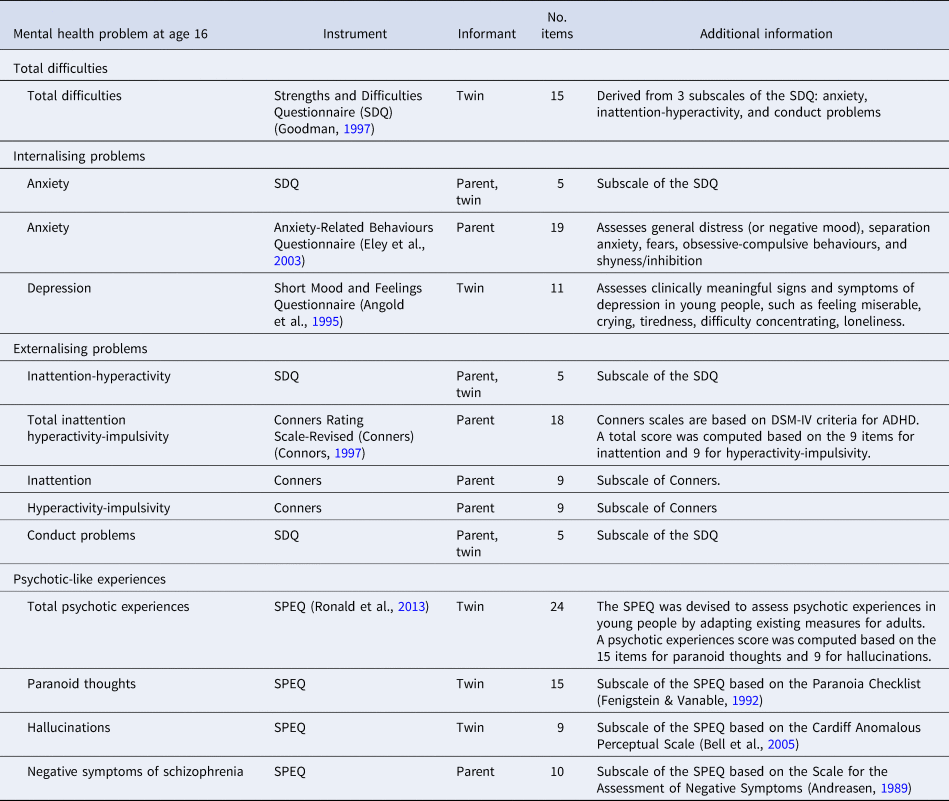
We included prior mental health problems as individual-specific covariates because evidence suggests that young people with mental health problems are more likely to experience cyber-victimisation (Gámez-Guadix, Orue, Smith, & Calvete, Reference Gámez-Guadix, Orue, Smith and Calvete2013; Rose & Tynes, Reference Rose and Tynes2015) and thus the associations may reflect reverse causality. Prior mental health problems were assessed at age 16 through parent and twin reports on paper-based questionnaires. Further details of these measures are provided in Table 2.
Mental health problems measured at age 16 and assessment instruments

Statistical analysis
To examine the association between cyber-victimisation and mental health, we conducted analyses to obtain the following estimates: (1) descriptive statistics on cyber-victimisation; (2) associations between cyber-victimisation and mental health problems at the individual level; (3) estimates from co-twin control analyses in DZ same-sex twins and MZ twins and (4) estimates from MZ co-twin control analyses controlling for individual-specific factors. All analyses were conducted in R version 3.6.2 (R Core Team, 2019) and the code is available on the Open Science Framework (https://osf.io/hy4pe/). Further details of the analyses are below.
First, we calculated descriptive statistics on cyber-victimisation (prevalence, mean, sex differences and heritability). Sex differences in cyber-victimisation were estimated using generalised estimating equation (GEE) models in the ‘gee’ package (Liang & Zeger, Reference Liang and Zeger1986; Zeger & Liang, Reference Zeger and Liang1986) with an exchangeable correlation structure to account for familial clustering. The heritability of cyber-victimisation (i.e. the proportion of variance due to additive genetic influences) was estimated from a univariate ACE twin model in the ‘OpenMx’ package (Boker et al., Reference Boker, Neale, Maes, Wilde, Spiegel, Brick and Bates2011). This involves using structural equation modelling to partition the variance in cyber-victimisation into additive genetic influences (A), shared environmental influences (C; environmental effects common to both twins) and nonshared environmental influences (E; environmental effects unique to each twin; Rijsdijk and Sham, Reference Rijsdijk and Sham2002). This can be estimated by exploiting the difference in genetic relatedness of MZ and DZ twin pairs, who share 100%, and on average 50% of their segregating genes, respectively, but are assumed to experience the same amount of shared environment.
Second, we tested whether cyber-victimisation was associated with mental health problems in unadjusted individual-level analyses using GEE models with an exchangeable correlation structure. To obtain standardised regression coefficients, we converted the cyber-victimisation and continuous mental health variables to standardised Z-scores. For binary mental health problems (suicidal ideation and self-harm), we used GEE models for binomial distribution with the ‘probit’ link function to obtain estimates as differences in Z-scores per one unit increase in the cyber-victimisation Z-score. We estimated the pooled effect size for the associations between cyber-victimisation and all mental health problems by aggregating all effect sizes while accounting for the mean correlation across outcomes (Borenstein, Reference Borenstein, Cooper, Hedges and Valentine2009), using the ‘MAd’ package (Del Re & Hoyt, Reference Del Re and Hoyt2014). To ensure a consistent effect size across all associations, probit regression coefficients for binary mental health outcomes were converted to correlation coefficients using relevant formula (Muthén & Muthén, Reference Muthén and Muthén2009) and the ‘compute.es’ package (Del Re, Reference Del Re2013). We also examined sex differences in the associations between cyber-victimisation and mental health problems by fitting GEE models with an interaction term for sex and cyber-victimisation.
Third, we tested whether cyber-victimisation was associated with mental health problems independent of familial vulnerabilities in co-twin control analyses. To do so, we used GEE models to estimate ‘between-twin pair’ effects and ‘within-twin pair’ effects of cyber-victimisation on mental health problems (Carlin, Gurrin, Sterne, Morley, & Dwyer, Reference Carlin, Gurrin, Sterne, Morley and Dwyer2005). The within-twin pair effects show whether a twin exposed to greater levels of cyber-victimisation has higher levels of mental health problems than their less exposed co-twin, over and above shared familial vulnerabilities. We conducted analyses first on same-sex DZ twins (who share on average 50% of their segregating genes and 100% of their shared environment) and then on MZ twins (who share 100% of their segregating genes and 100% of their shared environment). As with the individual-level analyses, we pooled the regression coefficients across all mental health problems to obtain an average effect size. To estimate the extent to which familial vulnerabilities contributed to the associations between cyber-victimisation and mental health, we calculated the average percentage decrease in effect size between individual-level estimates v. co-twin control estimates.
Fourth, we tested whether cyber-victimisation was associated with mental health problems independent of familial and individual-specific vulnerabilities by expanding the MZ co-twin control analyses to control for within-twin pair differences in co-occurring face-to-face peer victimisation and prior mental health problems at age 16 (e.g. controlling for within-twin pair differences in anxiety at age 16 for analyses on anxiety at age 22). When the corresponding mental health measure at age 16 was unavailable, we used the total difficulty score instead.
Finally, we conducted a sensitivity analysis to examine whether the associations between cyber-victimisation and mental health problems differed depending on whether mental health problems were self- or parent-reported. To do so, we conducted sub-group analyses testing the pooled effect size for the associations between cyber-victimisation and all mental health problems stratified by informant (i.e. self- v. parent-reported outcomes), using the ‘MAd’ package (Del Re & Hoyt, Reference Del Re and Hoyt2014).
Results
Description of cyber-victimisation in young adulthood
Over a quarter (28.8%) of young adults reported at least one instance of cyber-victimisation in the past year (score ⩾1), with 12.3% reporting repeated cyber-victimisation. The mean cyber-victimisation score was 0.75 [standard deviation (s.d.) = 1.54], and females reported slightly higher levels of cyber-victimisation than males [mean = 0.79, (s.d. = 1.55) v. 0.70 (s.d. = 1.53), p = 0.007]. A twin model showed that the variance in cyber-victimisation was accounted for by additive genetic influences (A = 0.26, 95% CI 0.25–0.27) and non-shared environmental influences (E = 0.74, 95% CI 0.73–0.75). Descriptive statistics for mental health problems and covariates are shown in online Supplementary Tables S2 and S3.
Is cyber-victimisation associated with mental health problems?
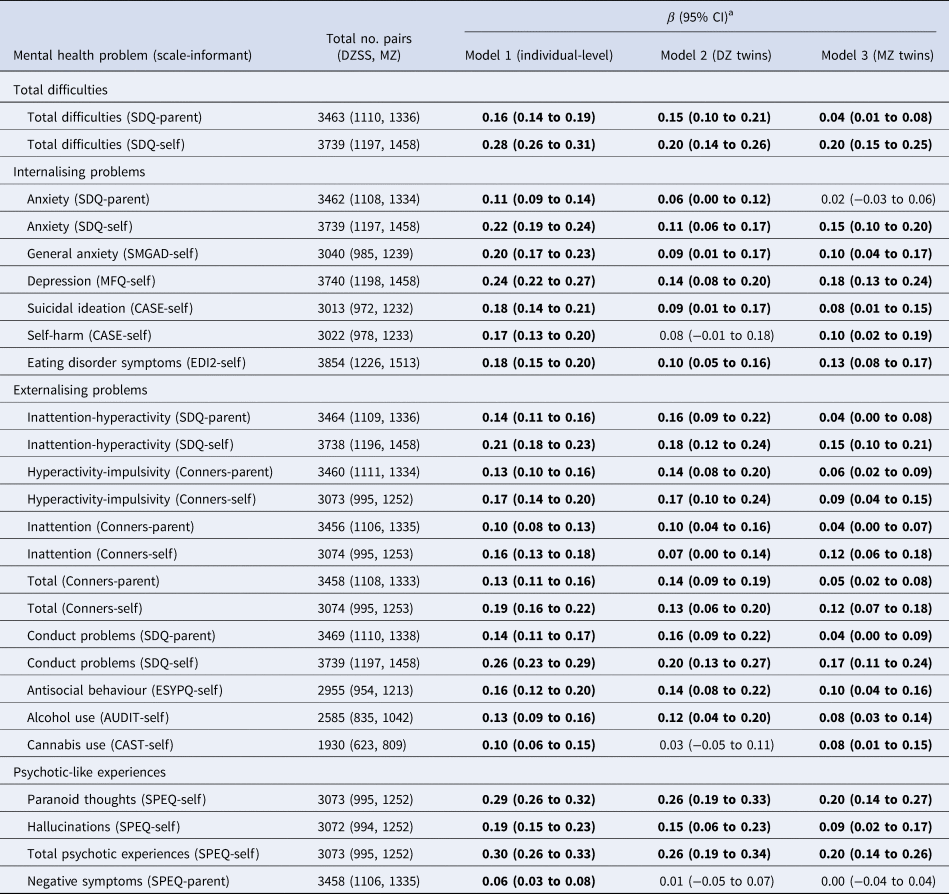
Young adults reporting greater exposure to cyber-victimisation had more symptoms of a range of mental health problems in young adulthood (Table 3, Model 1), including total difficulties, internalising problems (anxiety, depression, suicidal ideation, self-harm, eating disorder), externalising problems (inattention-hyperactivity/impulsivity, conduct problems, antisocial behaviour and substance use) and psychotic-like experiences (hallucinations, paranoid thoughts and negative symptoms of schizophrenia). These associations ranged from small (β = 0.06; negative symptoms of schizophrenia) to large effect sizes (β = 0.30; total psychotic experiences), and the pooled standardised coefficient across all mental health problems was β = 0.17 (95% CI 0.15–0.19), representing a small to medium effect (Funder & Ozer, Reference Funder and Ozer2019). There was no clear evidence of sex differences in the associations between cyber-victimisation and mental health problems (online Supplementary Table S4).
Individual-level and co-twin control associations between cyber-victimisation and mental health problems in emerging adulthood.

DZ, dizygotic (same-sex) twins; MZ, monozygotic twins; SDQ, Strengths and Difficulties Questionnaire; SMGAD, Severity Measure for Generalised Anxiety Disorder; MFQ, Mood and Feelings Questionnaire; CASE, Child and Adolescent Self-harm in Europe Study measure; EDI2, Eating Disorder Inventory-2; Conners, Conners Rating Scale; ESYPQ, The Edinburgh Study of Young People Questionnaire; AUDIT, The Alcohol Use Disorders Identification Test; CAST, Cannabis Abuse Screening Test; SPEQ, Specific Psychotic Experiences Questionnaire.
a Coefficients for suicidal ideation and self-harm are from probit regressions. Significant associations are shown in bold text.
Is cyber-victimisation associated with mental health problems independent of familial vulnerabilities?
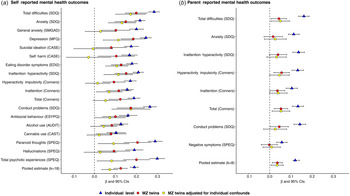
We next used the co-twin control design to test whether cyber-victimisation was directly associated with mental health problems after accounting for familial vulnerabilities. These findings are shown in Table 3 (Model 2 for DZ twins; Model 3 for MZ twins). DZ twins reporting greater exposure to cyber-victimisation had higher levels of most mental health problems relative to their less-exposed co-twins (who shared the family environment and 50% of their genetic material). However, these estimates were on average a quarter (26%) smaller than associations at the individual level (pooled β = 0.13, 95% CI 0.09–0.17). In MZ twin analyses accounting for all genetic influences, the estimates were attenuated on average by nearly half (47%) relative to individual-level associations (Fig. 1, red circles). However, MZ twins with greater exposure to cyber-victimisation still had significantly higher levels of most mental health problems across all informants, relative to their less-exposed co-twins (pooled β = 0.10, 95% CI 0.07–0.13).
Individual-level and MZ co-twin control associations between cyber-victimisation and mental health problems in emerging adulthood.
Note: Panel A shows self-reported mental health problems and Panel B shows parent-reported mental health problems. Individual confounds included face-to-face peer victimisation and corresponding mental health problems at age 16. Abbreviations: MZ, monozygotic twins; SDQ, Strengths and Difficulties Questionnaire; SMGAD, Severity Measure for Generalized Anxiety Disorder; MFQ, Mood and Feelings Questionnaire; CASE, Child and Adolescent Self-harm in Europe Study measure; EDI2, Eating Disorder Inventory-2; ESYPQ, The Edinburgh Study of Young People Questionnaire; AUDIT, The Alcohol Use Disorders Identification Test; CAST, Cannabis Abuse Screening Test; SPEQ, Specific Psychotic Experiences Questionnaire. Estimates for suicidal ideation and self-harm are probit coefficients.

Is cyber-victimisation associated with mental health problems independent of both familial and individual vulnerabilities?
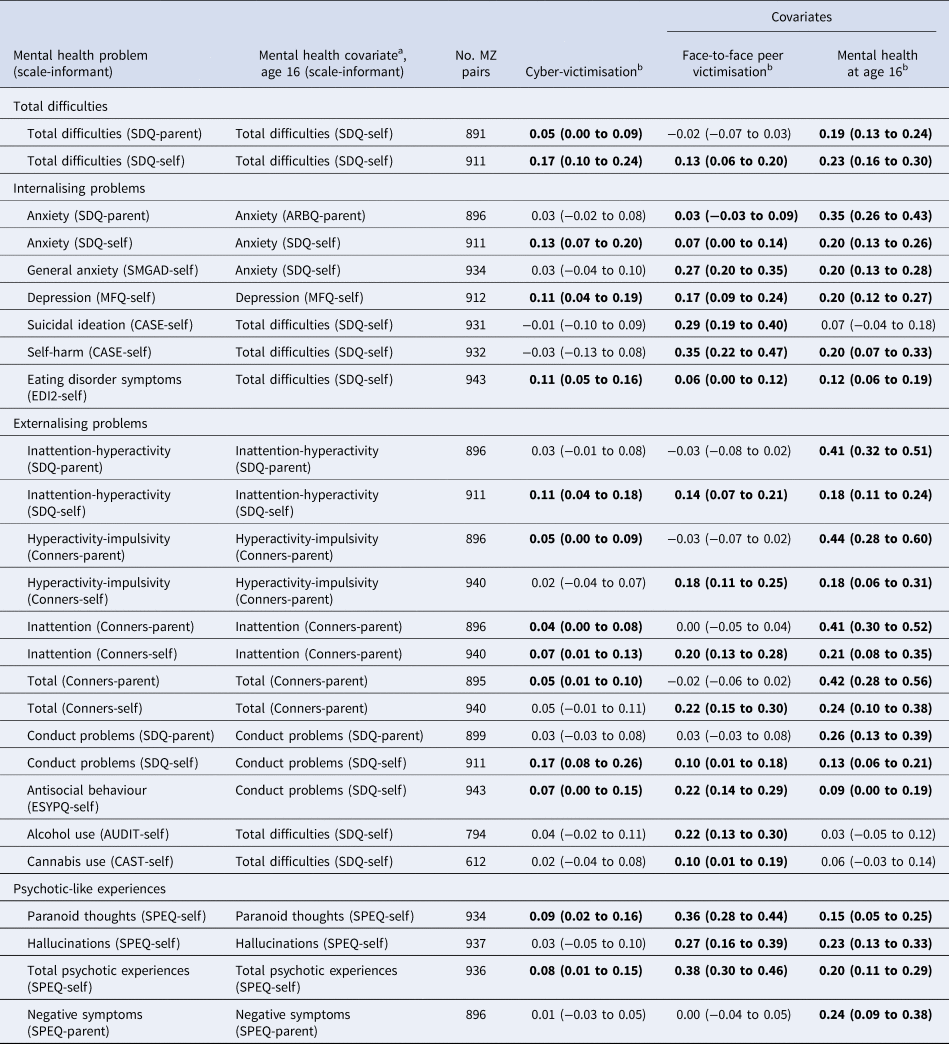
Because the MZ co-twin control design does not account for factors not shared by twins in a family, we additionally controlled for such individual-specific factors that might confound the associations between cyber-victimisation and mental health problems. Specifically, we adjusted for within-twin pair differences in co-occurring face-to-face peer victimisation and prior mental health problems (assessed at age 16), which were associated with both cyber-victimisation (online Supplementary Table S5) and mental health problems in emerging adulthood (online Supplementary Table S6). These findings are shown in Table 4 and Fig. 1 (yellow circles). After accounting for face-to-face peer victimisation and earlier mental health problems in MZ co-twin control analyses, the estimates were attenuated by 68% (pooled β = 0.06, 95% CI 0.03–0.10) compared to associations at the individual level. Cyber-victimisation was no longer significantly associated with most parent-reported mental health problems or with self-reported general anxiety, suicidal ideation, self-harm, hyperactivity-impulsivity (Conners assessment), substance abuse and hallucinations. However, cyber-victimisation remained associated with total difficulties (across both informants), parent-reported hyperactivity (Conners assessment), and self-reported anxiety (SDQ assessment), depression, eating disorder, inattention-hyperactivity (SDQ assessment), inattention (Conners assessment), conduct problems, antisocial behaviour, paranoid thoughts and psychotic experiences.
Association between cyber-victimisation and mental health in emerging adulthood in MZ twins after adjusting for co-occurring face-to-face peer victimisation and mental health problems at age 16.

MZ, monozygotic twins; SDQ, Strengths and Difficulties Questionnaire; SMGAD, Severity Measure for Generalized Anxiety Disorder; MFQ, Mood and Feelings Questionnaire; CASE, Child and Adolescent Self-harm in Europe Study measure; EDI2, Eating Disorder Inventory-2; Conners, Conners Rating Scale; ESYPQ, The Edinburgh Study of Young People Questionnaire; AUDIT, The Alcohol Use Disorders Identification Test; CAST, Cannabis Abuse Screening Test; SPEQ, Specific Psychotic Experiences Questionnaire.
aMental health covariates at age 16 were selected to correspond to the mental health problem at age 22; when the corresponding age 16 measure was unavailable, we used the total difficulty score.
bResults are presented as β coefficients (95% CIs); coefficients for suicidal ideation and self-harm are from probit regressions while all others are from linear regression; significant associations are in bold.
Is the association between cyber-victimisation and mental health moderated by reporter?
Lastly, we tested whether the associations between cyber-victimisation and mental health problems were sensitive to whether the problems were self- or parent-reported. Cyber-victimisation was significantly more strongly associated with mental health problems that were self-reported compared to parent reported in individual-level analyses (pooled β self−report = 0.19, 95% CI 0.17–0.21 v. β parent = 0.12, 95% CI 0.11–0.14) and MZ co-twin control analyses (pooled β self−report = 0.12, 95% CI 0.09–0.16 v. β parent = 0.04, 95% CI 0.01–0.06; online Supplementary Table S7).
Discussion
In this co-twin control study, we found that cyber-victimisation was directly associated with multiple mental health problems over and above genetic and environmental vulnerabilities. However, the associations between cyber-victimisation and mental health in stringent MZ co-twin control analyses were substantially smaller than associations observed at the individual level, and findings varied according to informants. These findings both support and extend previous research.
Consistent with previous research (Gini et al., Reference Gini, Card and Pozzoli2018; Kim et al., Reference Kim, Colwell, Kata, Boyle and Georgiades2018; Kowalski et al., Reference Kowalski, Giumetti, Schroeder and Lattanner2014; Perret et al., Reference Perret, Orri, Boivin, Ouellet-Morin, Denault, Côté and Geoffroy2020; Wolke et al., Reference Wolke, Lee and Guy2017), we found that young people exposed to greater cyber-victimisation had elevated levels of mental health problems in analyses at the individual level. These associations generalised across mental health domains and included total difficulties, internalising problems (anxiety, depression, suicidal ideation, self-harm, eating disorder), externalising problems (inattention-hyperactivity/impulsivity, conduct problems, antisocial behaviour and substance use) and psychotic-like experiences (hallucinations, paranoid thoughts and negative symptoms). These associations were present across different scales and informants, although effects were larger for self-reported mental health problems than parent-reported problems.
To extend previous research, we used the co-twin control design to account for genetic and shared environmental vulnerabilities. These analyses revealed three novel findings. First, over and above familial vulnerabilities, cyber-victimisation was independently associated with multiple mental health problems. For example, MZ twins reporting greater exposure to cyber-victimisation had more symptoms of various internalising problems, externalising problems and psychosis than their less victimised co-twins. Second, despite these independent effects, familial vulnerabilities also partly contributed to the associations between cyber-victimisation and mental health. For example, the associations between cyber-victimisation and mental health problems at the individual level were attenuated by a quarter in DZ co-twin control analyses and by a half in MZ co-twin control analyses, highlighting the presence of genetic confounding. Third, non-familial vulnerabilities - namely, face-to-face peer victimisation and prior mental health problems - contributed to the associations between cyber-victimisation and mental health, independent of familial vulnerabilities. For example, accounting for face-to-face peer victimisation and prior mental health problems in MZ co-twin control analyses attenuated the associations further (by two thirds compared to individual-level estimates), resulting in non-significant estimates for many mental health problems. Notably, cyber-victimisation remained significantly associated with total difficulties (across all informants), parent-reported hyperactivity (Conners assessment), and self-reported anxiety (SDQ assessment), depression, eating disorder, hyperactivity, inattention, conduct problems, antisocial behaviour, paranoid thoughts and psychotic experiences. Taken together, these findings suggest that (1) there are small direct associations between cyber-victimisation and multiple (largely self-reported) mental health problems, but (2) pre-existing vulnerabilities (e.g. familial factors, prior psychopathology) and face-to-face peer victimisation largely account for the association between cyber-victimisation and mental health. This pattern of findings is broadly consistent with other co-twin control studies examining the role of face-to-face victimisation in mental health, including bullying (Arseneault et al., Reference Arseneault, Milne, Taylor, Adams, Delgado, Caspi and Moffitt2008; Silberg et al., Reference Silberg, Copeland, Linker, Moore, Roberson-Nay and York2016; Singham et al., Reference Singham, Viding, Schoeler, Arseneault, Ronald, Cecil and Pingault2017) and poly-victimisation (Baldwin et al., Reference Baldwin, Arseneault, Caspi, Moffitt, Fisher, Odgers and Danese2019; Schaefer et al., Reference Schaefer, Moffitt, Arseneault, Danese, Fisher, Houts and Caspi2017).
Our study also found evidence of stronger associations between cyber-victimisation and self-reported mental health problems v. parent-reported mental health problems. This finding is consistent with other research on face-to-face bullying victimisation and mental health (Schoeler et al., Reference Schoeler, Duncan, Cecil, Ploubidis and Pingault2018) and technology use and well-being (Orben & Przybylski, Reference Orben and Przybylski2019), and could reflect two potential processes. On the one hand, associations might be stronger for cyber-victimisation and self-reported mental health problems due to common-method bias (i.e. covariance as a function of the same person reporting both cyber-victimisation and mental health; Podsakoff, MacKenzie, Lee, and Podsakoff, Reference Podsakoff, MacKenzie, Lee and Podsakoff2003). For example, young people with mental health problems might be more likely to interpret online interactions as hostile and thus report cyber-victimisation. On the other hand, the stronger associations for cyber-victimisation and self-reported mental health problems might more accurately reflect the ‘true’ associations between cyber-victimisation and mental health problems. This is plausible because young adults are likely to be more knowledgeable than their parents about their own mental health, particularly as many individuals are likely living away from their parents at age 22. We were not able to test either of these mechanisms in our study, but future studies with multiple measures of cyber-victimisation and mental health, including measures such as recorded cyber-interactions (e.g. via apps; Silva, Hall, and Rich, Reference Silva, Hall and Rich2018) and medical assessments of mental health, could provide further insight into these processes.
These findings should be considered in the context of limitations. First, we cannot infer the direction of effects between cyber-victimisation and mental health problems because both were assessed at age 22. Mental health problems might increase a person's risk of experiencing cyber-victimisation (e.g. by making a person appear vulnerable or different to their peers), or both might affect each-other reciprocally, as has been suggested in previous longitudinal research (Gámez-Guadix et al., Reference Gámez-Guadix, Orue, Smith and Calvete2013; Rose & Tynes, Reference Rose and Tynes2015). However, we did find that cyber-victimisation was associated with mental health problems independently of prior mental health, suggesting that the findings are not explained by earlier mental health problems in cyber-victimised individuals. Second, not all mental health problems were assessed through multiple informants and therefore it was not possible to directly compare self- versus parent-reports for all mental health problems. Third because the co-twin control design does not account for non-shared environmental influences, it is possible that these findings over-estimate the direct associations between cyber-victimisation and mental health problems. Although we accounted for key individual factors (co-occurring face-to-face peer victimisation and earlier mental health), other unmeasured individual-specific confounders may exist. Fourth, the use of difference scores in the co-twin control design can compound measurement error in the exposure variable, and in turn attenuate within-pair estimates even in the absence of familial confounding (Frisell, Öberg, Kuja-Halkola, & Sjölander, Reference Frisell, Öberg, Kuja-Halkola and Sjölander2012; McGue, Osler, & Christensen, Reference McGue, Osler and Christensen2010). Therefore, the within-twin pair estimates observed here might underestimate the true causal effects. Finally, our findings do not preclude the existence of a large causal impact of cyber-victimisation at the individual level (e.g. for suicide attempt), or in certain subpopulations.
Our findings have implications for future research. Through using the co-twin control design, we found that the direct associations between cyber-victimisation and mental health problems are much smaller than previously estimated in non-genetically informative studies. This finding, along with similar evidence from other twin studies (Baldwin et al., Reference Baldwin, Arseneault, Caspi, Moffitt, Fisher, Odgers and Danese2019; Dinkler et al., Reference Dinkler, Lundström, Gajwani, Lichtenstein, Gillberg and Minnis2017; Schaefer et al., Reference Schaefer, Moffitt, Arseneault, Danese, Fisher, Houts and Caspi2017; Shakoor et al., Reference Shakoor, McGuire, Cardno, Freeman, Plomin and Ronald2014; Singham et al., Reference Singham, Viding, Schoeler, Arseneault, Ronald, Cecil and Pingault2017), highlights the need for future genetically informative studies, alongside other complementary causal inference studies, to accurately estimate the direct contribution of environmental exposures to health problems. Furthermore, given that the associations between cyber-victimisation and mental health problems were partly explained by familial vulnerabilities, future research is needed to identify specific familial characteristics (e.g. disadvantaged family environments, heritable traits) that increase liability to cyber-victimisation and mental health problems, in addition to the non-familial vulnerabilities identified here (face-to-face peer victimisation and prior mental health). Lastly, whilst this study was not able to examine longitudinal effects of cyber-victimisation on mental health, future genetically informed longitudinal studies with repeated measures of cyber-victimisation and mental health will be well placed to strengthen causal inference.
Our findings can inform interventions in two ways. First, the direct associations between cyber-victimisation and multiple mental health problems suggest that, if causal, preventing cyber-victimisation could help to prevent mental health problems in the population. Alternatively, if the association is found to reflect mental health problems causing cyber-victimisation, then effective early mental health care could help to protect vulnerable young people from experiencing cyber-victimisation. Second, because the associations between cyber-victimisation and mental health were largely accounted for by pre-existing vulnerabilities (e.g. familial risk factors, psychopathology) and face-to-face peer victimisation, holistic interventions which target cyber-victimisation in combination with these factors are likely to be most effective in preventing mental health problems in young people.
Supplementary material
The supplementary material for this article can be found at https://doi.org/10.1017/S0033291720001178
Acknowledgements
TEDS is supported by a program grant to Professor Robert Plomin from the UK Medical Research Council (MR/M021475/1), with additional support from the US National Institutes of Health (AG046938). We gratefully acknowledge the ongoing contribution of the participants in the Twins Early Development Study (TEDS) and their families.