


Toward the end of the Cold War, a wave of scholarship emerged that associated internal conflict with ethnic factors. Ethnic conflict in the former Yugoslavia and in Rwanda lent such theories considerable credibility. More recently, however, the political-economy literature has generated major studies that challenge this causal link (Fearon and Laitin 2003; Collier and Hoeffler 2004). Their application of econometric methods suggests that ethnic grievance washes away once materialist factors, such as per-capita income, access to raw materials, are controlled for.
Some of the most prominent assessments of the role of ethnicity in internal conflicts rely on various versions of the ethnolinguistic fractionalization index (ELF). Despite its widespread use, however, this index has yet to be supported by a convincing set of causal mechanisms that links it to political violence. Before rejecting ethnic characteristics as determinants of civil war onset, it is therefore reasonable to question whether the ELF index serves as a meaningful operationalization of ethnic politics.
In this paper, we argue that specific ethnonationalist configurations are more prone to generate violence in civil wars. In order to back up this claim, we offer an alternative index of ethnonationalist exclusion called N*, which does a better job of capturing mainstream theories of ethnonationalist violence. It deviates from standard fractionalization measures by introducing state-centric, rather than symmetric, ethnic configurations and by postulating group-level, rather than individual-level micro mechanisms of mobilization.
Using Fearon and Laitin's (2003) well-known insurgency model as an empirical reference point, we compare our new measure N* to conventional indicators. Because of coding limitations, we focus on a subset of their global dataset, namely Eurasia and North Africa. The results are very encouraging: for the sub-sample in question, N* has a strong effect which is highly significant, thus casting doubt on the tendency to ignore ethnic politics as an explanation of civil wars.
In the following, we introduce the logic of fractionalization measures and attempt to derive causal mechanisms compatible with them. Building on theories of nationalism and ethnic politics, we then lay the conceptual foundations of our alternative measure. The N* index is defined and empirically deployed for the Eurasian cases, before being put to use in Fearon and Laitin's model. The essay ends with a discussion of the theoretical significance of our findings.
CONVENTIONAL INDICES OF ETHNICITY
In contrast to qualitative studies, econometrics allows us to draw systematic and precise inferences about a large number of cases, provided the underlying causal “story” remains stable throughout the population. However, this does not mean that there is no room for debate, even when highly significant findings are present. Apart from thorny issues of model specification and estimation, perhaps the most tricky issue is how to map micro-level mechanisms onto macro-level behavior (Schelling 1978). According to Sambanis (2004a, 259) this problem applies acutely to civil-war studies:
The already significant gap between micro-level behavior and their macro-level explanation is magnified when … micro-macro relationships are studied solely through cross-national statistical analyses. Such studies often overlook information about causal pathways that link individual or group behavior with the outbreak of civil war.
In this section, we show that similar uncertainty reigns with respect to hypotheses that relate civil war to ethnicity. Many prominent studies of the ethnic determinants of civil war rely on some type of fractionalization index.1
Other indicators of ethnic configurations include different operationalizations of ethnic dominance (Hegre et al. 2001; Collier and Hoeffler 2004), the size of the largest or second-largest groups (Ellingsen 2000), culture distance (Fearon 2003), and polarization (Reynal-Querol 2002; Garcia-Montalvo and Reynal-Querol 2005). As opposed to the studies that rely on fractionalization, many of these alternative measures of ethnicity receive statistical support. However, the status of their micro-level mechanisms remains as unclear as in the case of the models relying on fractionalization indices.
However, see Sambanis (2001) and Elbadawi and Sambanis (2002) for econometric models in which quadratic terms of the ELF attain significance. These authors justify the nonmonotonic relationship based on the observation that highly fragmented and ethnically cohesive countries offer less chances to stage rebellions.
In all its guises, the ELF is based on the Herfindahl concentration formula:

where si is the share of group i out of a total of n groups.
The logic behind this expression is well known and extremely simple, because it measures the probability that two randomly selected individuals from the entire population will be from different groups.
Despite its widespread use, the ELF has attracted considerable criticism. Drawing on constructivist assumptions, Laitin and Posner (2001) point out that attributing a fixed score to each state obscures the degree to which ethnic identities vary over time. They also note that a single index is underequipped to capture the multidimensional quality of ethnic identities and the endogenous effects that allow the dependent variable to influence the index over time.
In a sophisticated applied analysis of the ELF that focuses on sub-Saharan Africa Posner (2004) further elaborates on their fourth and final critique. Posner introduces a version of ELF that he calls PREG or “politically relevant ethnic groups.” His idea is to relate the identification of ethnic groups to the political logic under scrutiny. Based on extensive area expertise and thorough coding, Posner and his collaborators are able to provide PREG measures at 10-year intervals. Although the introduction of PREG represents considerable empirical and conceptual progress, Posner admits that it still afflicted by the same theoretical weaknesses as the other ELF indices, since it also relies on the Herfindahl logic.
To see what these difficulties entail for civil war studies, it is helpful to reconstruct an explicit causal theory of conflict that is compatible with the ELF logic. This calls for the identification of a micro-level mechanism of conflict M and of an ethnic configuration C that maps M onto the systemic probability of conflict:

Given this formalism, we can now derive a very simple individualist theory of conflict that is compatible with the ELF:
C: If two members i and j interact, the probability of conflict is p1 if they belong to different groups and p0 < p1 if they belong to the same group.
M: All pairs of individuals (i,j) in the population have an equal chance of interacting with each other.
Hence the probability of conflict is:

where (p1−p0)>0 by assumption C. Thus, the conflict propensity is an increasing linear function in ELF, which means that regression analysis should be well suited to capture the effect of ethnic fractionalization on conflict.
Some reflection suggests why the ELF model of civil wars is inappropriate. It appears to work much better for ethnic riots or brawls that occur between randomly interacting individuals (Tilly 2003). The problem is that full-fledged ethnonationalist warfare, whether within or among states, presupposes that violence is organized rather than random and that it is not generated in a completely bottom-up fashion. Our causal reconstruction says nothing about how a dyadic conflict at the individual level can escalate to a full-fledged civil war. Moreover, this account is silent on the role of the state, which is paramount in all civil wars by definition (Sambanis 2004b). In principle, it is possible that a nonindividualist theory of ethnic warfare based on the ELF could be developed, but to our knowledge, nobody has so far managed to construct plausible micro-level mechanisms to support such an account.3
In order to justify their polarization measure, Garcia-Montalvo and Reynal-Querol (2005) come close to developing a nonindividualist theory, but their account differs from the ELF primarily by factoring in relative group sizes and thus leaves the crucial question of group-level agency unspecified.
THEORIZING ETHNONATIONALIST CIVIL WARS
In this section, we reconsider how contemporary approaches relate ethnic nationalism to political violence. Theories of nationalism tell us that ethnonationalist wars, rather than being merely “horizontal” fights among ethnic groups after the collapse of state authority, are actually fought with the help of, and indeed over, state power (Cederman 1997, Chap. 7, 8; 2002). Thus, it is high time to bring the state back into our theories about ethnic conflict!4
Obviously, the state already figures in other explanations of civil wars, such as Fearon and Laitin's (2003) logistical theory of insurgency. However, their operational account of ethnicity makes no reference to state-specific mechanisms.
We follow Gellner 1983 in defining nationalism as “primarily a political doctrine, which holds that the political and the national unit should be congruent” (1). Wherever this principle is violated, that is, where “home rule” for each population has not been established, tensions often arise in response to the perceived incongruence. Such tensions tend to inspire ethno-nationalist mobilization, which may in turn provoke a realignment of previous political coalitions with conflict as a possible consequence. More specifically, Gellner's theory of societal conflict expects friction to be present wherever group interests are violated and access to power is blocked by discrimination and “counter-entropic” obstacles to assimilation. This account corresponds largely to Fearon and Laitin's (2003, 78) characterization of modernist theories, including that of Gellner (1983). However, their operational hypotheses H1 and H2, which focus on ethnic and religious diversity at the macro level, fail to articulate the relevant micro foundations that drive conflict.
In fact, Gellner's relatively apolitical account also falls short of pinpointing the identity of the key actors in question and their relationship to the state (O'Leary 1998). Therefore we turn to more recent contributions to the literature on nationalism. Building explicitly on Gellner's conceptual legacy, Wimmer (2002) interprets such conflict patterns as integral parts of political mobilization under modernity. Starting around the time of the French Revolution, this macro-historical process swept through the modernizing world, spilling over into the non-Western world in the twentieth century. In the Western world, this process usually led to the creation of relatively homogenous nation-states. In contrast, as nationalism continued to spread throughout the globe, nation-building tended to be much less successful. In cases where no nationalizing group managed to dominate the state,
… a fight erupts over which ‘people’ the state should belong to, and social closure proceeds along many ethnic lines instead of one national line. Sometimes this contest for the control of the state escalates into ethno-nationalist civil wars, destroying much of whatever social and political cohesion there was. (Wimmer 2002, 91)
This explanation of conflict rests on two crucial assumptions that are violated by ELF-based approaches to ethnic civil wars, namely that (A1) the state plays a central role for the evolution of conflict, and that (A2) conflict proceeds among groups rather than among individuals, once ethnicity has been politicized and social closure has occurred along ethnic lines.
A1. Conflict over Ownership of the State
The state is at the very center of nationalist conflict. In a competition for state goods, ownership of the state is the ultimate prize (Wimmer 2002). In addition to securing material resources, the winner acquires crucial symbolic powers and international recognition. Domestically, the state's importance grew as its role became increasingly intrusive in citizens' lives. As state control has increased, opportunities have arisen to favor a specific ethnic group or groups through an ethnicized bureaucracy in terms of public schooling, language laws, and religious regulations. In this way, ethnicity started to serve as a formidable instrument of social and political exclusion.
A2. Conflict at the Level of Entire Groups
In a pioneering contribution to the theory of nationalism, Gellner (1964) explained how individuals in the modern world identify themselves, and classify others, according to cultural categories. This stands in stark contrast to the pre-nationalist world, in which direct interpersonal connections were paramount. Categorization makes it possible to conceive of large groups as “imagined communities,” a prerequisite for nationalism (Anderson 1991). In general, nationalist groups derive their cohesion from collective-level identities that resonate deeply with the emotional needs of modern citizens. Conversely, nationalism can quickly implode multi-ethnic states, such as the former Yugoslavia, once ethnic mobilization starts to pull the component groups apart. All this supports the hypothesis that “competition for state resources is seen as a matter concerning not just individuals or associations of shared interests but rather whole ethnic groups” (Wimmer 2002, 103).
Still, establishing that internal conflict is over state ownership, and that the main competitors in such conflict are ethnonational groups, does not mean that we have explained why violence actually ensues in particular cases. Ultimately, this task calls for a complete theory of collective action that explains how the groups in question mobilize politically and how their mobilization triggers violence.
Mobilization depends on availability of collective identities, shared motivations and opportunities for collective action (Gurr 2000). Collective identities constitute the boundaries of the group in terms of ethnically defined membership and thus form the basis for the articulation of common interests. Shared motivations refer to the group members' incentives to participate in collective action endeavors. In general, perceived grievances, whether socioeconomic (Gellner 1983) or political (Wimmer 2002), could contribute to motivational articulation. Finally, action opportunities hinge on the power balance among ethnic groups, which in itself is a complex function of demographic, technological, geographic conditions, including the influence of international factors (Tilly 1978; Gurr 2000).
These key factors should be seen as necessary, rather than sufficient, conditions of collective action. In the following, however, we will focus primarily on ethnopolitical opportunity structures, while assuming that politically relevant group identities already exist and that all groups possess the motivation to engage in collective action. This does not mean that we believe that identities are primordially given or that the process of identity formation has nothing to do with the outbreak of conflict. Nor should it be concluded that the specific level of ethnopolitical grievance is unrelated to the frequency or intensity of violence. Rather than advancing a complete theory of nationalist mobilization and violence, our modest goal is to develop a simplified model that associates ethno-political configurations with civil-war outcomes.
It goes without saying that our mechanisms can only be partial and should be seen as the starting point for future theory building. In brief, we assert that escalation to violence is more likely where the dominant group is a demographic minority. The more demographically significant ethnic groups are excluded from state power, the more likely it is that there will be violent attempts at overcoming such imbalances. If the principle of ethnonational representativity is violated, we postulate a higher likelihood of grievance along ethnic lines, as well as a higher potential for escalation to political violence. In order to test this hypothesis, we need to measure the relative degree to which ethnic groups are included or excluded from state power.
The N* Index: A Model of Ethnonationalist Civil Wars
The general reasoning of the preceding section leaves many gaps open that will need to be filled before proceeding to empirical analysis. Our two main tasks are to identify the ethno-political configuration C* and the mechanism M* that make up the core of the model. We will consider each task in turn.
A Starlike Ethnic Configuration C*
Based on our assumption of the state's central role in ethno-nationalist conflict, we decided to reject the symmetric interaction topologies implied by the ELF index. Instead, drawing on assumptions A1 and A2, we postulate a starlike configuration with the ethnic group(s) in power (EGIP) at the center, surrounded by peripheral groups. This implies that the governmental group (or coalition) interacts with each nongovernmental group, and that the latter groups do not interact with each other. This configuration adds up to a starlike interaction topology.
It is now straightforward to compute the conflict propensity of the entire system:

where p(i) is the probability of dyadic conflict erupting between the EGIP and the excluded group i. Here we are assuming that the relational probability of conflict p(i) does not depend on the conflict propensity of the other dyads. A more realistic model could capture interactions among the provinces due to demonstration effects or other types of conflict contagion.
Note that this center-periphery logic resembles Fearon and Laitin's (2003) insurgency model, although their focus is of course entirely nonethnic. In contrast, Rokkan (1999) proposes a richer representation of how peripheries interact with central states, by accounting not only for economic and geographic factors but also for a cultural dimension (see also Cederman forthcoming).
An Opportunity-Based Mechanism M*
To complete our simple model, we need to specify what happens in each dyad, which in technical terms boils down to specifying the function p(i). Let us assume that the n ethnic groups can be ordered as a vector {s0, s1, s2…sn−1}, where s0 denotes the size of the EGIP and the remaining entries the non-governmental groups is whatever order. Following the logic developed in the last section, we assume that conflict is likely to occur wherever demographically important groups are excluded from power. The larger these peripheral groups are, the more likely it is that they will successfully challenge the center.
It seems reasonable to select a logistical contest success function to formalize this logic. In a seminal article, Tullock (1967) proposed a success contest function on ratio-form. According to Hirshleifer (2001, 94), however, logistical contest success functions are better suited to military contests under uncertain and unconventional conditions, as is usually the case in civil wars. Thus we define the probability of dyadic conflict with nongovernmental group i as

where r(i)=si/(si+s0) is group i's share of the total dyadic population, r is a threshold value and k a slope parameter. It should be noted that our functional form differs slightly from the standard version of the logistical conflict success function because it features the total dyadic resources in the denominator rather than merely those of the opponent. We choose this format since it seems more intuitive without changing our main findings.
The threshold parameter r stipulates at what demographic balance the odds are even for a challenge, that is, where p(i) = 0.5. Parameter k controls how steeply the curve slopes, and can be interpreted as a measure of how decisive combat is (Hirshleifer 2001). For k = 0 it is entirely flat and as k goes to infinity, it becomes a perfect step function. The curve in Figure 1 illustrates the functional form for parameters r = 0.5 and k = 5.

The Dyadic Probability of Conflict p(i) between Marginalized Group i and an Ethnic Group in Power
Note that although the mechanism seems to be entirely one-directional, this impression is misleading. In fact, no assumption has been made as to which side starts the fight. It may well be that the government preempts what it perceives as a threat by a demographically sizeable, but politically marginalized, group. Moreover, even if the peripheral actor takes action first, the most extreme instances of ethnic violence have almost all been perpetrated by states in response to insurgencies (Mann 2005, 7).
Obviously, beyond the initial demographic approximation of power, there are countless external factors that could enter this equation, including the geographic reach of the state as well as help to ethnic kin from third countries. These factors require additional coding and will therefore not be considered in this paper. Let us now define our indicator N* as C*(M*), a label that reflects the underlying model of ethnonational politics based on a star-like ethnic configuration C*:

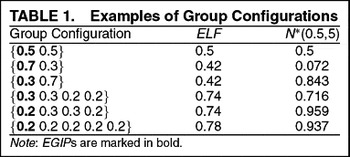
To get a better feeling for how N* behaves in comparison to the conventional measures, Table 1 lists the values of ELF and N*(0.5, 5) for a number of sample groups. It immediately becomes clear that the new index is asymmetric with respect to the order of groups. We always list the EGIP first (and to clarify matters, it is highlighted in boldface). Therefore, whereas {0.7 0.3} yields 0.072, the reversed order {0.3 0.7} has a high probability of conflict: 0.843. This is so because if the EGIP controls 0.7 of the resources, it is very hard to unseat, whereas a minority government of 0.3 would constantly be threatened. In contrast, the ELF does not change with the order of group listings. As more groups are successively added, the ELF increases due to growing fragmentation. In our model, however, the N* goes up as long as the dominant group's share of the total population declines.

Empirical Calibration of the N* Index
It is now time to turn to the empirical performance of the new measure. The main obstacle to coding N* is the need to specify the ethnic group(s) in power (EGIP) for each state. For operational purposes, we consider a group, or a coalition of groups, to be in power if their leaders serve (at least intermittently) in senior governmental positions, especially within the cabinet. Beyond the ethnic background of a country's leading politicians, specific institutional arrangements, such as different types of power sharing and consociationalism, may also be indicators of power inclusion. Mere regional autonomy without significant input into cabinet-level governmental decision-making, on the other hand, is clearly not sufficient to warrant status as EGIP. Thus, in cases where the group in question is systematically excluded from power it is judged to be a marginalized ethnic group (MEG).
It goes without saying that this definition is hard to operationalize (see the Appendix). One source of potential confusion relates to the exact nature of governmental involvement. For example, because of elite assimilation, our coding of Ukrainians as being marginalized within the USSR can be disputed. Another difficulty relates to the possibility that different parts of the ethnic group might be included while other, possibly more radical branches, are excluded.The contemporary U.S. counterinsurgency strategy in Iraq aims to split the Sunni resistance in this way. There is also a potentially treacherous temporal dimension: one group may be EGIP during one period of a country's history but an MEG during another. To be sure, the Sunni dominance in Iraq did not necessarily extend to the entire sample period, especially not before 1958. Moreover, from 1963 to 1970 the Syrian EGIP was Druze-Alwite dominated, and so forth. These are important shifts that would have to await a dynamic coding of N*.
Ultimately, it can be debated to what extent it is possible to identify clearly distinct ethnic groups at all. In the long run, at least, ethnic and national identifications are endogenous to other political processes, including state formation and conflict behavior (Laitin and Posner 2001). By applying the measure to the post-1945 period, however, we are assuming that group identities are, at least in the majority of the cases studied, clearly marked and relatively stable.
In a first cut, we focus on Eurasia and North Africa. Within this subset of the population, we believe that most of the cases can be coded in a relatively straightforward manner. Because of its notoriously hard-to-grasp, fluid identities, sub-Saharan Africa was judged to be too difficult to code with respect to EGIP without extensive additional research. In future work, we plan to extend the coding to this and to other parts of the world, but extensive area expertise will be needed to get this data-gathering exercise right (cf. Posner 2004).
Our coding effort yielded observations for 88 countries, as indicated in the Appendix. We built on Fearon's (2003) list of ethnic groups and selected the EGIPs. Wherever more than one group was found to belong to the EGIP, the strength of the entire coalition was summed and kept as the first entry in the group vector. We compared our EGIP partitioning with an independent coder. To determine if a group was an EGIP, we relied on Heger and Salehyan's (2005) data set of leaders' ethnic affiliations that is based on information from a leader data collected by Goemans et al. (2004). Because these data are limited to conflict periods, additional information was extracted from the Minorities At Risk (MAR) database and the CIA World Factbook.
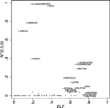
This empirical procedure generated an N* index that is radically different from the ELF (correlation-coefficient 0.42). This is confirmed by Figure 2, which plots N*(0.5, 5) based on real-world observations as a function of the ELF. If N* were identical to these other indices, the scatter plots would have formed a diagonal line from the lower left to the upper right. Instead, in both cases, the N* remains very low for most observations with low to medium ELF. For high ones, however, the variance is very high. Thus, there is no simple one-to-one correspondence between the N* and fractionalization.

A Scatter Plot of N* Against the ELF Index for All Countries in the Sample
Regression Analysis
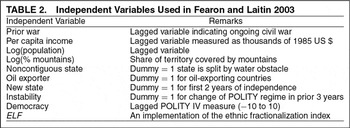
This section evaluates the N* index's impact on conflict behavior. We do so within the context of Fearon and Laitin's (2003) econometric model that focuses on the onset of civil wars during the post-WWII period. This model is based on a pooled time series that contains country-year observations coded as a one if a civil war started within that observation and as a zero for all other cases. We use exactly the same list of independent variables as Fearon and Laitin include in their Model 1 except for the religious fractionalization index, which is dropped due to its marginal theoretical relevance to this paper. We did not find any model specification in which it differed noticeably from the ELF. Without exception, it remained as insignificant as that index. Thus the list includes lagged ongoing wars, per capita income, population, terrain, territorial contiguity, oil exports, recent independence, political instability, democracy, and the ELF (see Table 2). For details about the operationalization of these variables, the reader is referred to Fearon and Laitin (2003).

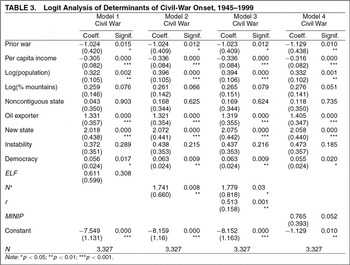
Relying on logit analysis, Table 3 contains the results of our first set of estimations.5
The models were implemented in Stata and Lisp-Stat (Tierney 1990). Java routines were also used for data management and for computation of the N* index.
These results are derived from Fearon and Laitin's (2003) ELF coding. It is also possible to compute the ELF based on Fearon's group data, which we used to calculate the N* index. Such a coding generates roughly the same results. The same thing applies for squared ELF terms, which are also insignificant.

Although the threshold r seems quite reasonably located at 0.5, it would be desirable to estimate its exact location. Fortunately, it is possible to do so by dynamically recomputing a new N*(r,k) vector each time the log-likelihood function is called in the course of the estimation. In this case, all dyadic probabilities p(i), which depend on parameter r and the group sizes, are recalculated as a part of the log-likelihood function.7
This step was carried out in Lisp-Stat. Unfortunately, we do not have enough information to estimate k as well, which is therefore kept at k=5. Additional regression runs, not shown in the tables, confirm that the main findings are not sensitive to the exact value of k. We experimented with k=2 and 10. The former setting weakened the significance of N* somewhat in Model 2, but the result remains significant (p=0.013).
Finally, in order to check the robustness of our parameter settings, we check whether a much simpler model yields convincing results. Model 4 introduces a dummy variable called “Minority in Power,” or MINIP for short, that is one if the EGIP is in demographic minority compared to the summed peripheral population and zero otherwise. The right-most column of Table 3 indicates that this simplified specification has a considerable impact that almost reaches significance at the 0.05 level.
It is quite remarkable that such crude models of ethno-nationalist politics generate strong results. All estimations reported in Table 3 are based on a dependent variable that treats all civil wars as one large category. Still, there are good reasons to believe that such an inclusive assumption ignores considerable unit heterogeneity, especially since it lumps together ethnonationalist civil wars with coups and other nonethnic conflicts (Sambanis 2004a). Fortunately, Fearon and Laitin's (2003) data set includes a variable that separates ethnic wars from other types of internal conflict. If our model of ethnonationalist conflict is correct, it should perform especially well for this dependent variable. After all, such a coding corresponds directly to the causal logic advanced in this paper.
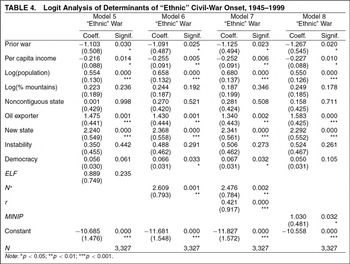
To find out if this intuition can be empirically confirmed, we reran all models of Table 3 for the alternative dependent variable (see Table 4). As expected, Model 5 shows that the ELF index remains totally insignificant for the new specification. In contrast, our new N* measure performs extremely well. As suggested by Model 6, a fixed index N*(0.5, 5) yields a very high level of significance at p = 0.001 that equals or even surpasses the materialist variables per capita income and oil exports in this respect. As before, the democracy indicator is significant and the variables associated with prior war, population size, and recent independence continue to have a strong impact.

Model 7 presents a dynamic estimation of r, similar to that shown by Model 3. In this case, the parameter comes out somewhat lower (r = 0.421) than in the previous model. As expected, the estimation is even more significant for ethnic wars than for all civil wars. The model seems to fit the data remarkably well for these cases. Indeed, the statistical results of N* confirm that the postulated causal mechanisms do a good job of summarizing the center-periphery relationship between EGIPs and MEGs. In addition, Model 8 reveals that the simple MINIP indicator now becomes significant, thus suggesting that our fundamental causal insight does not hinge on the exact functional form of the N* index.8
We tested a series of alternative ethnicity measures based on the RQ polarization index (Garcia-Montalvo and Reynal-Querol 2005), ethnic dominance (Collier and Hoeffler 2004), the largest ethnic group s (Ellingsen 2000), and 1-s2 (Hegre et al. 2001). All these measures were significant on their own replacing ELF in Model 5, except ethnic dominance, but when N* was added to the equation, none of them reached significance at the 0.05 level.
What is the substantive effect of our new indicator? Figure 3 plots the predicted annual probability of ethnic war as a function of the N* values. The graph displays three curves, all based on the estimates of Model 5. The middle one represents the conflict propensity of a typical state where all other independent variables are held at their means. If N*=0, conflict is virtually excluded. As the indicator increases, however, the risk of ethnic war grows steadily up to about 0.02 for N*=1. The two remaining curves correspond to two subsamples holding states with GDP values below and above the mean. Whereas the effect of N* is just below that of the overall sample for the wealthy cases, the poor ones demonstrate a much stronger effect. In these cases, the conflict propensity increases to almost 0.3 for N*=1.

The Substantive Effect of N* on the Probability of Ethnic Civil Wars
Of course, it would be premature to draw any definitive conclusions for the entire world. In this paper, we have limited ourselves to slightly more than half of the global sample studied by Fearon and Laitin. An extension of the N* index to the non-Eurasian cases will require careful empirical coding of EGIP. Moreover, it will be necessary to study the robustness of the operationalization proposed in the Appendix even for the cases at hand. Such a coding project should also pay more attention to diachronic differences in the status of EGIPs than we have been able to do in this paper.
A particularly exciting extension of the current paper would attempt to derive group-specific measures beyond demographic size. Based on the agent-based model introduced in Cederman (forthcoming), we expect the location of the ethnic group to be very important. Our current research, which is based on Geographic Information Systems (GIS), confirms the findings of this article at the level of geo-coded center-periphery dyads (Buhaug, Cederman and Rød 2006). In reality, even small groups can be very powerful in asymmetric conflicts, thanks to their ability to take advantage of difficult terrain far away from the capital. It would also be interesting to go beyond the primarily opportunity-driven logic of the present model by separating those cases that feature actual ethnonationalist escalation from structural situations that are conducive to conflict.
CONCLUSION
We started this paper by observing that the causal mechanisms implied by the ethnic fractionalization index have very little to do with any reasonable account of ethnonationalist civil wars. Such “tests” of ethnicity misstate the theory in at least two crucial ways. First, they tend to assume that violence is primarily a reflection of individual, as opposed to group-level, dynamics. Second, conventional econometric models also implicitly assume that conflict patterns are entirely symmetric.
The contemporary civil-war literature has systematically overlooked what a long tradition of qualitative scholarship has established, namely, that ethnic and national identities derive their political significance from their relationship to the state (e.g., Geertz 1963; Tilly 1996; Wimmer 2002). From this vantage point, it makes little sense to test hypotheses relating ethnicity to war without any explicit reference to the state. What matters are politically mobilized ethnic cleavages. However, the ELF index makes no attempt to locate ethnic groups in relation to state power. According to these models, ethnic conflict can be expected to unfold as if it occurred among ethnic gangs in an American city.
This misspecification would have been much less problematic had it not been dressed up as a main finding about civil wars. Far from shying away from making far-reaching policy conclusions, Fearon and Laitin (2003) warn policymakers and scholars against inferring
… that ethnic diversity is the root cause of civil conflict when they observe insurgents in a poor country who mobilize fighters along ethnic lines. Instead, the civil wars of the period have structural roots, in the combination of a simple, robust military technology and decolonization, which created an international system numerically dominated by fragile states with limited administrative control of their peripheries. (88)
We hope that the current study will provide a counterweight to such sweeping judgmentsAlthough we do not purport to have crafted a complete explanation of ethnonationalist conflict, we do think that our results are promising enough to inspire future research on how cultural and logistical mechanisms interact to produce political violence.

APPENDIX: ETHNIC GROUPS IN POWER
This table lists our coding of the EGIP in the Eurasian and North African sample used in this paper. Bold group names refer to the EGIP. Starred entries are coded as uncertain and are included in the regressions in Tables 3 and 4. However, their exclusion does not affect the results significantly.
Earlier versions of this article were presented at the University of California San Diego, the University of Bielefeld, the Graduate Institute of International Studies, Geneva, the Swiss Institute of Technology Zurich, and the Norwegian University of Science and Technology, Trondheim. We are grateful to the participants of those meetings and the anonymous reviewers of this journal for their helpful comments. We have drawn on the expertise of many colleagues, including Andreas Wimmer, Bear Braumoeller, Keith Darden, Scott Gates, Kristian Gleditsch, Simon Hug, Arman Grigorian, Hävard Hegre, Ian Lustick, Brendan O'Leary, Ellen Lust-Okar, Daniel Posner, and Idean Saleyan. However, the responsibility of any errors is ours alone. Finally, we would like to thank Lutz Krebs and Kimberley Sims for research assistance.





Comments
No Comments have been published for this article.