1. Preamble
The challenges of increasing the pace of socioeconomic development in sub-Saharan Africa (SSA) and, at the same time, coping successfully with the predicted huge negative impacts of climate change (CC) are strongly coupled. Several structural, technological and institutional weaknesses, low asset base, and high poverty are the main reasons for the high vulnerability of SSA to CC. At the same time, winning the battle against these same constraining factors through accelerated economic growth and social development is the best measure for enhancing the capacity of SSA to adapt to the adversities of CC. To achieve faster growth and development, however, SSA requires more aggressive efforts and major investments in many sectors that would require much higher levels of energy use and emissions and increase the pressures on the already stressed land, water and other natural resources of the region. Development and adaptation challenges for SSA are accordingly inseparable.
The first step in tackling contemporary development challenges for SSA given predicted future changes in the climate is to understand well how observed climatic changes have influenced the evolution of current socioeconomic systems. This is the task undertaken in the next section. This knowledge should then inform research efforts on how to better assess and measure likely impacts of predicted future climate. Section 3 of the paper accordingly discusses how knowledge gained from analysis of past trends and linkages between CC and the natural, social, and economic systems have been used to support proper assessment and analyses of likely future impacts of CC and what gaps remain challenging on this front. Available response options and development challenges facing SSA under predicted new climatic circumstances and attempts to quantify their costs and benefits and needed resources to implement climate actions are then evaluated in section 4. Section 5 concludes with implications for the way forward in successfully addressing the coupled challenges of achieving faster development in SSA to catch up with the rich world and cope well with the burdens of predicted changes in future climate.
2. Understanding impacts of observed changes in the climate in SSA
Knowledge of the nature and power of the relationship between CC and affected natural and socioeconomic systems is to come from deep scientific interrogation and analysis of information characterizing past trends of change in these interlinked systems. A trend of rising temperature has been observed since the 1960s across the African continent with some regional differences (IPCC, 2007d). The Fourth Assessment Report (FAR) of IPCC indicates relatively faster warming in tropical rain forest and southern regions compared to the rest of Africa. On the other hand, observed regional variations in rainfall depict higher irregularities. Mean annual precipitation registered a 20–40 per cent decline between 1960 and 1998 in West Africa (Sahel). Lower reductions in rainfall of between 2 and 4 per cent were observed in tropical rain forest regions, whereas the Guinean Coast experienced a 10 per cent increase in rainfall over the past 30 years. A mixed pattern of higher rain in the north and declining trends in the southern parts of East Africa was recorded.
While no long term trend in mean annual rainfall was observed in Southern Africa, inter-annual variability has increased since 1970 showing evidence of change in seasonality and extreme weather events (IPCC, 2007d). There is also evidence of more intense droughts and inter-annual fluctuations in levels and warming of surface- and deep-water temperatures of the major East African lakes since 1900 (IPCC, 2007b). These long-term changes induced important shifts in the hydrology and runoff regimes in southern Africa, Ethiopia, Kenya, and Tanzania as well as other parts of the continent (IPCC, 2007b).
Several studies have analyzed available data on observed trends and attempted to measure the relationship between variations in levels of some climate attributes, such as temperature and rainfall and several variables representing responses of affected systems.
2.1 Sector-specific impact models
Given that farming is the largest economic activity in SSA most vulnerable to CC, research efforts focused mainly on agricultural impacts of CC (IPCC, 2007b). The most commonly used approach to study impacts of CC on agriculture are the crop growth models based on data from controlled agronomic experiments to determine the response of specific crops and crop varieties to different climatic and other conditions. Most of this work was conducted at the international agricultural research centers—CGIAR (Alliance and CCAFS, 2009; Van de Steeg et al., Reference Van de Steeg, Herrero, Kinyangi, Thornton, Rao, Stern and Cooper2009). Similar efforts have been carried out at national research systems (Muchena, Reference Muchena, Rosenzweig and Iglesias1994; Magadza, Reference Magadza1994; Makadho, Reference Makadho1996; du Toit et al., Reference du Toit, Prinsloo, Durand and Kiker2002; Durand, Reference Durand2006; Abraha and Savage, Reference Abraha and Savage2006). Agronomic models are useful for understanding the biophysical responses but they do not account for economic factors such as human capital and other resource constraints affecting actual farm-level adaptation decisions. Economic analyses based on these estimates will therefore inherit biases of overestimating damages (or underestimating potential benefits) of CC. Experimental agronomic research is also costly and the robustness of generalizing inferences based on results from few experimental sites to large areas and diverse agricultural production systems is problematic (Adams, Reference Adams1999; Mendelsohn et al., Reference Mendelsohn, Morrison, Schlesinger and Andronova2000).
Few studies cited in the Intergovernmental IPPC Fourth Assessment Report on Africa attempted to estimate the impacts of CC on other sectors including soil and water, health and settlements, and infrastructure (IPCC, 2007b). Like other similar sector-specific studies, e.g., effects of temperature on mortality and migration (Curriero et al., Reference Curriero, Heiner, Samet, Zeger, Strug and Patz2002; Deschenes and Moretti, Reference Deschenes and Moretti2007), on crime (Jacob et al., Reference Jacob, Lefgren and Moretti2007), on tourism (Hamilton et al., Reference Hamilton, Maddison and Tol2005), and impacts of drought and floods on health, migration, social conflict, and disruption (Few et al., Reference Few, Ahern, Matthies and Kovats2004, Miguel et al., Reference Miguel, Satyanath and Sergenti2004), these studies consider climate influences through particular direct and indirect impact channels separately. Such sector-specific impact measures do not capture the complexity of the many dynamic interactions and feedback effects involved among various components of an entire system when analyzed as an integral whole.
Alternative analytical models were developed to address these deficiencies by accounting for interactions between various elements of a system in measuring the total or net effect of changes in the climate. A group of models known as the integrated assessment models (IAMs) adopted such an approach utilizing estimates of response parameters obtained from the above described family of sector-specific impact models in system-wide formulations. These include applications spanning various modeling approaches from partial equilibrium agronomic-economic models (Easterling et al., Reference Easterling, Crosson, Rosenberg, McKenny, Katz and Lemon1993; Iglesias et al., Reference Iglesias, Rosenzweig and Pereira1999; Chang, Reference Chang2002); through the spatially referenced agro-ecological zone (AEZ) models; to general equilibrium models (Darwin et al., Reference Darwin, Tsigas, Lewandrowski and Raneses1995; Calzadilla et al., Reference Calzadilla, Zhu, Rehdanz, Tol and Ringler2009). Estimates of impact parameters from crop growth models and other sources measuring statistical correlations with variations in climate attributes were used in a number of IAMs to assess vulnerability of agricultural production and food security to CC in Africa (Downing, Reference Downing1992; Benson and Clay, Reference Benson and Clay1998; Fischer and van Velthuizen, Reference Fischer and van Velthuizen1996; Thornton et al., Reference Thornton, Jones, Owiyo, Kruska, Herero, Kristjanson, Notenbaert, Bekele and Omolo2006). Other IAM studies attempted to measure impacts of CC on world agriculture, water, and food including SSA (Rosenzweig and Parry, Reference Rosenzweig and Parry1994; Rosegrant et al., Reference Rosegrant, Msangi, Ringler, Sulser, Zhu and Cline2008; Nelson et al., Reference Nelson, Rosegrant, Koo, Robertson, Sulser, Zhu, Ringler, Msangi, Palaazo, Bakta, Magalhaes, Valmonte-Santos, Ewing and Lee2009).
2.2 Total impact assessment models
Some applications of IAMs did go beyond sector-specific evaluations to measure and assess total impacts of CC (Darwin et al., Reference Darwin, Tsigas, Lewandrowski and Raneses1995; Desanker, Reference Desanker2002; Tol, Reference Tol2002). It remains however, that in spite of their very wide use in the CC impact literature, IAMs are based on aggregation of effects on selected subsets of sectors and impact mechanisms separately measured under a host of strong assumptions (Stern, Reference Stern2007, Dell et al., Reference Dell, Jones and Olken2008).
To address this shortcoming of adding up effects of separately specified impact pathways, Dell et al. (Reference Dell, Jones and Olken2008) analyzed effects of annual variations of rainfall and temperature on aggregate growth indicators for countries across the world. This approach avoids the need to make assumptions about what impact mechanisms to include and how they interact to generate aggregate impacts. While it is a shortcut attempt to directly measure aggregate outcomes of CC, this approach like most of the above models, is based on observed annual variations in temperature and precipitation. They accordingly measure short-term responses to more weather-like temporary climate shocks, the effects of which generally recede quickly and affected systems adjust back to the normal long-term climate conditions (with the exception of lasting effects of persistent climate episodes such as drought). These treatments therefore do not properly measure long-run responses to lasting shifts in the climate, which is what CC is about.Footnote 1 There is no doubt that CC produces drastic long-term effects that may lead to irreversible changes, flipping into new equilibria and alter the functioning and dynamics of key ecosystems that are quite different from short-run weather influences (IPCC, 2007a).
2.3 Cross-section impact assessment models
As CC happens over very long time horizons, one needs long time series data to capture its impacts. Such data may be available for key climate attributes. However, records over very long periods (covering decades) on changes in economic choices such as production and consumption decisions in response to CC for the same sample do not exist, even in countries with well organized information systems. Alternative approaches have therefore been attempted to analyze CC impacts, including the simulation modeling methods noted above and empirical studies based on cross-section variations.
The Ricardian model represents the key modeling approach to analyze impacts of CC based cross-section variations in long-term climates. Pioneered by Mendelsohn et al. (Reference Mendelsohn, Nordhaus and Shaw1994), the cross-section method builds on the early observation of David Ricardo (Reference Ricardo1817) that farmland rents capture long-term farm productivity and value. This model therefore represents an asset (land) valuation method which postulates that farmland value reflects the present value of future net farm revenue from all activities. It assesses performance of farms by quantifying impacts on agricultural productivity across the landscape, revealing the effects of variations between different climate zones. Measured changes in farmland value are used to estimate long-run sensitivity of agriculture to CC. Several studies under a recent GEF funded Africa-wide project applied the Ricardian approach to analyze impacts of CC on African crop and livestock agriculture at country and continental levels (Kurukulasyriya et al., 2006; Kurukulasyuriya and Mendelsohn, Reference Kurukulasuriya and Mendelsohn2008; Hassan and Nhemachena, Reference Hassan and Nhemachena2008; Dinar et al., Reference Dinar, Hassan, Mendelsohn and Benhin2008; Hassan et al., Reference Hassan, Dinar and Mendelsohn2008; Deressa and Hassan, Reference Deressa and Hassan2009; Seo et al., Reference Seo, Mendelsohn, Dinar, Hassan and Kurukulasuriya2009; Hassan, Reference Hassan2010; Nhemachena et al., Reference Nhemachena, Hassan and Kurukulasuriya2010).
The cross-section method automatically captures farmers' adaptation responses, assuming that cross-section variations reflect different states of long-term equilibria (inter-temporal changes). It does not, however, control for dynamic costs of adjustments between different states (Kelly et al., Reference Kelly, Kolstad and Mitchell2005). Moreover, while the Ricardian model controls for the effects of farm and household attributes (size, soil type, market access, assets, current technology, etc.), it does not account for future change in technology, policies, and institutions, which are important to keep in mind when interpreting results. Among its other limitations is the fact that it may overestimate welfare effects under large price shifts that can have offsetting effects to CC damages. The Ricardian framework also does not account for the effect of factors that do not vary across space such as CO2 concentrations that can be beneficial to crops. Changes in country level policies (e.g., taxes and subsidies) that distort observed states would also weaken the robustness of cross-section model estimates (Kurukulasuriya et al., Reference Kurukulasuriya, Mendelsohn and Hassan2006). The main limitation of the Ricardian approach is its focus on agriculture where all its empirical applications are found.
2.4 Vulnerability assessment models
A considerable share of the existing literature and information on impacts of observed CC and variability in Africa comes from studies on vulnerability and adaptation, with a noted recent shift in emphasis from what is known as ‘impact-led’ to the so called ‘vulnerability-led’ approaches (Adger et al., Reference Adger, Brooks, Kelly, Bentham, Agnew and Eriksen2004). Research on vulnerability to climate risks addresses a wide range of interest areas but particularly sensitivities and impacts of risks associated with extreme events (floods, droughts, and storms) and hydrological consequences and water resources’ stresses (Schulze et al., Reference Schulze, Meigh and Horan2001; Few et al., Reference Few, Ahern, Matthies and Kovats2004; Brooks et al., Reference Brooks, Adger and Kelly2005; Thornton et al., Reference Thornton, Jones, Owiyo, Kruska, Herero, Kristjanson, Notenbaert, Bekele and Omolo2006; New et al., Reference New, Hewitson, Stephenson and Tsiga2006; IPCC, 2007c; Deschenes and Moretti, Reference Deschenes and Moretti2007; Thornton and Herrero, Reference Thornton and Herrero2009). There is evidence to suggest that Africa bears a significant share of all droughts in the world (OFDA/CRED, 2007) and large populations, particularly in coastal areas, are under the risks of flooding and other natural disasters (IPCC, 2007b). Efforts to apply recent advances in vulnerability assessment modeling and indicators to CC risks in SSA have recently emerged (Deressa et al., Reference Deressa, Hassan and Ringler2008; Gbetibouo et al., Reference Gbetibouo, Ringler and Hassan2010b). Nevertheless, much more information and better knowledge of the magnitude of the overall economic damages inflicted by CC and variability and how sensitive SSA is to those, especially climate extremes, are needed.
With all of their discussed limitations, the above approaches and model formulations have been used to simulate regional and global impacts of predicted future climate scenarios, a challenge to which I will return next. Moreover, estimates of economic damages (and gains) of CC impacts simulated using the above models provided the basis for much of the recent adaptation cost–benefit assessment work (Stern, Reference Stern2007; UNFCCC, 2007; World Bank, 2010), the limitations of which will be discussed later.
3. The challenges of predicting future impacts of CC in SSA
From the above review one can conclude that the degree of confidence we have in our current knowledge and understanding of the nature and size of the impacts of climate shifts observed in the past remains low. Predicting probable future impacts of CC is even harder, due to the many uncertainties about what climate and what socioeconomic world will exist in the future. The first challenge relates to our current ability to forecast a future climate. Second, we face great uncertainties regarding what socioeconomic development path the world is likely to navigate towards the distant future of 100 years and beyond, when the forecasted new climate is expected to be in effect. Related to this is how adapted or less vulnerable (resilient) future natural, social, and economic systems will be to forecasted shifts in the climate. This in turn questions the relevance and robustness of our knowledge and estimation of impacts of past trends for informed decision making and evaluation of future costs and benefits of actions to be taken now to manage CC. One important implication of this is how one should compare values of future benefits from averting CC damages with the implied costs in today's welfare of such choices of actions, i.e., how to discount the future (Dasgupta, Reference Dasgupta2008). All these uncertainties pose major challenges for SSA on how to mitigate the negatives of expected CC while achieving accelerated growth and development.
3.1 Forecasting a future climate for SSA
Climate models provide the basis for future climate projections. Science is in agreement on the likelihood of general future climate trends, forecasting with high confidence a rise in sea levels, mean annual temperatures, and more frequent and more intense climate extremes (IPCC, 2007d). However, the set of widely used Global Circulation Models (GCMs) generate contrasting forecasts, especially of future rainfall patterns. Considerable disagreements are found among these models’ forecasts when downscaled to project regional and local climates. For instance, while the Commonwealth Scientific and Industrial Research Organization (CSIRO) forecasts large reductions in rainfall, the National Centre for Atmospheric Research (NCAR) projects increases in precipitation in SSA (IPCC, 2007d).
Such uncertainties about what future climate will unfold present a serious challenge to policy and decision making in SSA, where vulnerability to CC is high. Uncertainty about likely future precipitation patterns, for example, represents the greatest climate risk facing adaptation planning and investment decisions in SSA, where reliance on dryland agriculture is extremely high. The immediate implication is what course of action is appropriate to take since measures to prepare for increased wetness (e.g., flood protection) are quite different in nature and cost from those needed to prepare for dryness (e.g., irrigation and drought tolerance).
Investment in improving the capacity of climate science to better predict local climate futures is therefore a priority task of strategic significance for SSA. While recent efforts to downscale GCMs to regional and local levels have revealed high potential value in making climate predictions of more relevance to national and local decision making, a lot remains to be desired and many shortcomings need to be addressed (IPCC, 2007d). One major constraint to enhancing the regional capacity in this area has been insufficient funding and low investments in scientific research in general in SSA (IPCC, 2007b; World Bank, 2007, 2009). Strengthening findings of current efforts to develop better regional and local climate prediction models to expand the list of climate features and processes where there has been a reasonable degree of convergence and agreement in various model forecasts is crucial. Building on earlier examples of successes in this regard, such as the general agreement between predictions of several regional models on shifts in the onset of rains and length of the growing season (Tadross et al., Reference Tadross, Hewitson and Usman2005; Hewitson and Crane, Reference Hewitson and Crane2006), is to be pursued. As indicated above, this is of particular importance for generating more consistent predictions of regional and local future precipitation patterns, intensity and frequency of extremes and climate variability in general, not only changes in mean levels. Regional and local climate models with better capabilities to integrate links and feedback mechanisms between the atmosphere, land cover changes, and other processes (e.g., El Niño Southern Oscillations- ENSO, regional oceans) that shape the climate and particularly rainfall variability in SSA (Hulme et al., Reference Hulme, Doherty, Ngara, New and Lister2001; IPCC, 2007b) are needed.
3.2 Current development lags and future growth scenarios for SSA
In order to predict how future climate will affect SSA, one needs to be able to generate more credible forecasts not only of how climate systems in the region will change, but also how the natural, social, and economic systems will mutually evolve over the long time horizon during which CC takes effect. The uncertainties challenging our current ability to forecast future climate have been discussed in the previous section and now I turn to how able we are to project the future path of concomitant natural and socioeconomic changes. Given the inherent uncertainty about the future, it is a common practice for future impacts’ assessment frameworks in general, and the CC impacts literature, to use plausible development scenarios. The IPCC, for example, bases its prediction of future CC impacts on a whole set of assumptions to build emission scenarios. These are based on projections and assumptions made regarding likely levels of population and economic growth in different countries and associated levels of production and consumption activities, particularly of energy, food, water, and other key resource inputs (IPCC, 2007d). The general criteria is to build scenarios informed mainly by observed historical patterns augmented with variations in some key processes and parameters to compare alternative growth options to facilitate better decision making for CC management. Uncertainties surrounding the ability to build a likely future development scenario for SSA are quite large and stem from major challenges currently inhibiting the region from transcending the serious lags in achieving basic development goals, to which CC adds further complications. Contemporary development challenges to be addressed in SSA in light of predicted future climate scenarios relate mainly to structural features and systemic vulnerabilities as explained below.
A. High dependence on rain-fed agriculture and natural ecosystems
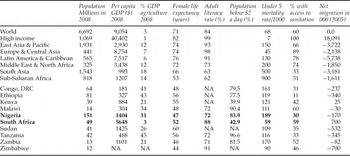
Incomes and livelihoods of large segments of the population of SSA are highly dependent on agriculture. In 2008 agriculture contributed on average 14 per cent of the gross domestic product (GDP) in SSA with some key member countries (Congo, Ethiopia, and Tanzania) showing in excess of 40 per cent income dependence and the most populous country (Nigeria) deriving more than 30 per cent of its income from agriculture (table 1). The World Development Report on agriculture (World Bank, 2007) estimates that 82 per cent of the rural population in SSA lives in countries where agriculture contributes more than 32 per cent of GDP growth. The major cause of high vulnerability of SSA to CC, especially to fluctuations in levels and distribution of rainfall, is the fact that agricultural production is mainly rain-fed with as little as below 4 per cent of cultivated land under irrigation (IAC, 2004; World Bank, 2007). Farming in SSA is also mainly practiced in regions that are already under climatic stresses (e.g., high temperatures, inherent low soil fertility, and considerable water stress), as two-thirds of the rural population lives in arid and semi-arid regions (World Bank, 2007). In addition to crop and animal farming, millions of rural people in SSA (especially the poor) rely heavily on direct extraction of food, timber, fish, water, and other products and services from natural ecosystems that are highly sensitive to climate adversities (MEA, 2005).
Selected economic performance and development indicators for sub-Saharan Africaa

Source: World Bank, World Development Indicators (2009).
aAll data for year 2007 except where indicated.
B. Low productivity and poor infrastructure and access to capital, information, and markets
One of the key factors contributing to the weak adaptive capacity of SSA is the low availability and use of modern technologies (including IT) and hence the low productivity particularly in agriculture, which is the backbone of the region's economy (Sachs et al., Reference Sachs, McArthur, Schmidt-Traub, Kruk, Bahadur, Faye and McCord2004; World Bank, 2007; Cooper et al., Reference Cooper, Dimes, Rao, Shapiro, Shiferaw and Twomlow2008). Most countries in SSA also have poor physical infrastructure (road, irrigation, and power networks) and weak economic institutions (markets, credit, insurance, etc.). Coupled with a low capacity to innovate due to negligible investments in science, information and technology generation, and dissemination, these factors impose serious limits on the capacity of most countries in SSA to respond to and cope with temporary and permanent climate shifts and natural disasters (Barrett et al., Reference Barrett, Lynam, Place, Barrett, Place and Aboud2002; Sachs, Reference Sachs2005; World Bank, 2009). The influences of such structural deficiencies and macroeconomic stress factors on vulnerability of SSA to CC are expected to be exacerbated under the predicted risks of future climate (IPCC, 2007b).
C. High poverty and social underdevelopment
The strongest source of vulnerability and biggest development challenge for SSA are the very low income and high poverty levels among its population. Per capita incomes are the lowest in the world with most of the population (more than 70 per cent) in countries where about half the people of SSA live (Nigeria, Ethiopia, Congo, Tanzania, Sudan) are under the poverty line of $2 per day (table 1). The asset base and real wealth of people in SSA has also been shrinking at higher rates than other regions of the developing world (Arrow et al., Reference Arrow, Dasgupta, Goulder, Daily, Ehrlich, Heal, Levin, Mäler, Schneider, Starrett and Walker2004; World Bank, 2007). The strikingly high level of social underdevelopment and the huge burdens that places on the most vulnerable groups (women and children) in SSA are evident from key human development indicators compared to the rest of the world (table 1). Dismal records on the status of human health indicate that diseases such as malaria and HIV/AIDS continue to be the main cause of death of millions, particularly women and children in SSA (Sachs, Reference Sachs2005; Ferguson, Reference Ferguson2006; Patz and Olson, Reference Patz and Olson2006). Coupled with increased incidences of natural disasters (droughts) and widespread civil conflicts, these factors have induced large population displacements and net out migration (table 1) leading to rapid urbanization and increased pressures on and degradation of key environmental resources, e.g., land, water, forests, etc. (IPCC, 2007b).
D. Low levels of energy use and emissions and high dependence on biomass
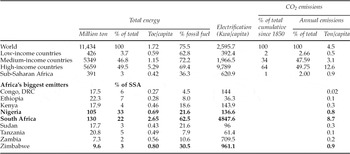
SSA used only 3 per cent of total global energy consumption in 2005 (table 2), about 80 per cent of which was from biomass sources (IEA, 2007; Hall and Scrase, Reference Hall, Scrase and Low2005). Per capita energy consumption in SSA is also lowest in the world at less than half a ton of oil equivalent (toe) compared to a world average per capita energy consumption that is more than four times that of SSA (table 2). With the exception of South Africa, use of electric power is very low across SSA (table 2) and only 8 per cent of the region's rural population enjoys such access compared to much higher rates in the rest of the world (IEA, 2002). While these statistics translate to low emissions (table 2) and minimal share contribution to global warming and CC from SSA, they are indicative of high vulnerability and a formidable basic development challenge facing the region. The above-discussed development lags and challenges of overcoming the current dismal state of social welfare in SSA suggest that energy consumption (consequently emissions) in these countries is bound to grow to meet demands for badly needed accelerated economic growth for higher social wellbeing and poverty reduction. This implies hard tradeoffs between improved resilience and adaptive capacity to be attained by accumulating sufficient economic, technological, and social (improved health and educational status) wealth through development, and the needed higher levels of energy and emissions to fuel such growth. Also as indicated above, this has important implications for what measures would be sound for SSA to take now in response to projected CC and thus adds to the uncertainty of what energy consumption path to chart and development scenario to use for SSA over the next 50–100 years.
Energy consumption and CO2 emissions (2005)

Source: World Resource Institute, International Energy Agency, http://earthtrends.wri.org.
3.3 Uncertainty about impacts on and resilience of key ecosystems
In spite of all advances achieved so far in the science of CC, our current knowledge and ability to predict the specific nature of future impacts on ecosystems and how they will respond to projected climate shifts remain with fundamental challenges. This is due to the complex dynamics involved between climate and ecological systems, given the very long time horizon over which CC unfolds. The likelihood of what is known as ‘tipping points’, thresholds and irreversible effects, are the main sources of uncertainty about impacts on and responses of ecosystems to long-term changes in the climate system. For instance, whether impacts on ecosystems will be of a permanent nature. And what new equilibria these systems will flip to after a climate disturbance pushes the system beyond a critical threshold. These have major implications for the nature of costs and benefits involved in evaluating appropriate courses of action and response measures to take (Pindyck, Reference Pindyck2006; IPCC, 2007d; Stern Reference Stern2007; World Bank, 2009). A number of key ecosystems in SSA have been studied, including forests, wetlands, grasslands, mangroves, coral reefs, and many animal species and were found to have endured significant impacts and projected to be at risk of radical transformations and extinction under forecasted future climate regimes (IPCC, 2007b, d). Large knowledge gaps and uncertainties remain, however, about the exact nature and magnitude of these risks.
4. Response options for a climate-sensitive development path for SSA
The world development report on ‘Development and Climate Change’ (World Bank, 2009) asserts that immediate action, by all and in fundamentally different ways, is necessary if catastrophic consequences of CC are to be averted. Deep inertia in the dynamics of climate and socioeconomic systems suggests that future economic and social costs are much higher than savings and benefits from a delayed action (IPCC, 2007a; Stern, Reference Stern2008). Mitigation measures to stabilize future global climate at below 2°C and coping with and/or adaptation to a relatively warmer and more erratic climate in the medium term are the two response options available to today's world. However, the distribution of roles and commitments among countries and regions and sequencing of mitigation and adaptation actions in a global deal to respond to CC are to be determined by various equity and efficiency considerations (Stern, Reference Stern2008; World Bank, 2009). Differences in responsibilities for contributing to present and future emissions, distribution and nature of predicted impacts, and ability to invest in and potential gains from these two measures vary significantly among regions, especially among developed and developing countries.
The fact that SSA contributes as little as 2 per cent to current global emissions indicates that potential gains from investment in mitigation actions in SSA are negligible compared to the huge potential from reducing the high shares (more than 95 per cent) of high- and medium-income countries (table 2). Equity and fairness suggest that the developed world should take the lead in the mitigation responsibility, being the source of almost all the historical loading of carbon emissions through which it was able to accumulate substantial economic wealth and technological advancement and hence a much bigger capacity to invest in innovation. Moreover, higher future levels of energy consumption are inevitable and necessary for SSA to address the above-discussed development lags and challenges of accelerated growth and poverty reduction.
While mitigation is not the focus and priority for SSA, effective adaptation and coping strategies and measures are necessary to manage the evident negative consequences of CC. This is due to all the factors discussed above—weak economic infrastructure; poor access to markets, information, and credit; low technology, incomes, and ability to invest and innovate; and high poverty—that suggest high vulnerability and weak capacity of the region to cope with the eminent risks of CC and variability. This section therefore begins with a discussion of adaptation response options and then returns to mitigation issues in SSA.
4.1 Adaptation options for SSA
Current knowledge and research on how human and natural systems in SSA have adapted to climate fluctuations in the past and how they might adapt to future climate is limited. Recent research efforts have focused on analyzing vulnerabilities and adaptation responses of rural communities and agricultural systems in SSA (Hassan and Nhemachena, Reference Hassan and Nhemachena2008; Kurukulasuriya and Mendelsohn, Reference Kurukulasuriya and Mendelsohn2008; Seo and Mendelsohn, Reference Seo and Mendelsohn2008; Deressa et al., Reference Deressa, Hassan, Alemu, Yesuf and Ringler2009; Gbetibouo et al., Reference Gbetibouo, Hassan and Ringler2010a). Results of these studies indicate that switching from specialized cattle-based beef and dairy systems (where hybrid species dominate) to small ruminants (goats and sheep) systems, which are predominantly of local breeds well adapted to the climate of the region, is an important adaptation strategy among livestock farmers in SSA. African farmers were also found to use more irrigation and choose multiple cropping and mixed crop–livestock systems over specialized mono systems to adapt to CC and variability.
Agricultural activity in SSA has also seen other major adjustments in response to CC and variability. Examples include growing different crops and high migration out of agriculture and rural areas in search of nonfarm income and employment opportunities to diversify and supplement sources of livelihoods, particularly in urban systems. This indicates that reducing vulnerability to future climate risks in SSA has important inter-sector and macroeconomic linkages to be innovatively exploited (IPCC, 2007b; World Bank, 2007; Dinar et al., Reference Dinar, Hassan, Mendelsohn and Benhin2008).
It is expected that with accelerated economic growth and rapid industrialization and urbanization, the role and size of agriculture in the developing world, including SSA, is bound to shrink (World Bank, 2007). However, SSA needs to produce enough food for the many millions of additional people predicted to populate the region in 2050 (IPCC, 2007b; World Bank, 2007). Agricultural productivity needs to accordingly increase substantially over the next few decades. No doubt there is high potential for achieving sizable growth in agricultural productivity in SSA through marginal gains from incremental adoption of new farming methods and plant and animal breeds with better tolerance to pest, disease, water, and low fertility stresses. Nevertheless, the high reliance on agriculture, especially rain-fed farming systems, is a major source of vulnerability to CC and variability in SSA, where currently only less than 4 per cent of the cultivated land is under irrigation (compared to more than 30 per cent in Asia). The fact that future climate in SSA is predicted to be warmer and dryer with increased variability indicates that expanding irrigation is a critical adaptation option. Although future climate scenarios predict reductions in water availability in SSA (IPCC, 2007d), the fact that the region is endowed with large water storage capacity that is currently highly underutilized suggests a high irrigation potential (World Bank, 2008).Footnote 2 Investment in expanding water storage infrastructure therefore holds an important potential for expanding irrigation agriculture in SSA. Policy measures to provide effective incentive systems to improve efficiency of water use (i.e., adoption of more efficient methods such as drip irrigation, greenhouses, etc.) and promote small farmers’ investment in water harvesting are necessary for increased agricultural productivity in SSA.
Other important complementary policies to enhance the adaptive capacity of SSA's agriculture include: strengthening local (community) credit and savings mechanisms and other forms of social capital; providing insurance against climate risks and safety nets; and improved infrastructure, particularly access to electricity and markets to increase income and employment opportunities outside agriculture and in downstream agro-processing activities. The above essentially means mainstreaming climate sensitivity in all agricultural and broader economic development planning and policy design (e.g., national poverty reduction, national adaptation action and macroeconomic development plans).
On the other hand, work on identifying and evaluating adaptation options and coping mechanisms for SSA outside agriculture is very scarce. Few studies have examined some nonfarm response options such as investments in improved climate information and weather forecasts dissemination, economic infrastructure, energy and water management, and better functioning economic (markets, credit and insurance) and social and community networks (Brooks et al., Reference Brooks, Adger and Kelly2005; Reid and Vogel, Reference Reid and Vogel2006; IPCC, 2007c; World Bank, 2009). Most of the nonagriculture adaptation measures, however, have been identified and evaluated in global studies that attempted to assess the aggregate costs and benefits of adaptation responses to be discussed in a subsequent section (Stern, Reference Stern2007; UNFCCC, 2007; Nelson et al., Reference Nelson, Rosegrant, Koo, Robertson, Sulser, Zhu, Ringler, Msangi, Palaazo, Bakta, Magalhaes, Valmonte-Santos, Ewing and Lee2009; World Bank, 2010).
Apart from the deficiency in efforts to identify and evaluate available or potential adaptation options, affected individual agents (both consumers and producers), managers, researchers, and policy makers in SSA often lack access to climate science information or find it irrelevant to the problems they seek to address. Promotion of better communication, interaction and collaboration between providers and users of climate information is therefore necessary for successful and effective adaptation. Major investments will be needed to create new technical capabilities in both groups, as well as appropriate facilitating institutional frameworks (IPCC, 2007b; Ziervogel et al., Reference Ziervogel, Cartwright, Tas, Adejuwon, Zermoglio, Shale and Smith2008).
4.2 The potential for mitigation responses in SSA
Recent research suggests that the world needs immediate action to stabilize global emission levels at the target of between 450 and 550 parts per million (ppm) of CO2e atmospheric concentration of GHGFootnote 3 to avoid catastrophic future climate consequences. This is predicted to result in a warming of between 2°C and 4°C but will require reducing global average per capita emissions from the current 7 tons to 2 tons (IPCC, 2007a; Stern, Reference Stern2008). As noted above, SSA contributes less than 2 per cent of the global emissions and per capita rates are far below this target (table 2). This indicates that potential gains from mitigation in SSA are negligible compared to industrialized countries where per capita emissions are currently far above target levels. Added to this are the huge challenges facing SSA in its struggle to accelerate economic growth and reduce the high poverty and social underdevelopment, achievement of which entail higher levels of energy consumption and emissions.
It is believed that from equity and ethical points of view, the developed countries should lead the mitigation challenge given the high potential gains as well as their much better financial, technological, and institutional capacity to invest in mitigation compared to developing countries. At current emission levels, most countries in SSA are unlikely to be required to meet climate stabilization targets and commit to emissions’ reductions in the near future. This however does not mean SSA should not participate in global mitigation efforts. It is beneficial to all developing countries with currently low emission levels and to global future climate for these countries to take advantage of expected advances to be made in the developed world towards low carbon growth and to adopt emerging low carbon development technologies and mechanisms.
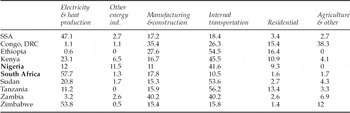
Energy intensity and emissions are highest in SSA from internal transportation, industry and construction and power generation activities (table 3). Due to the high potential gains, these sectors should be priority targets for mitigation actions in SSA. The power generation sectors in South Africa and Zimbabwe stand particularly high among all in potential gains from reduced emissions by switching to lower carbon sources and technologies. They have substantial opportunities for reducing reliance on fossil fuels and coal burning by switching to alternative options from renewable sources such as solar and wind. The high hydropower potential of SSA that is currently highly underutilized holds great promise for transforming energy supply and use and in meeting the expected growth in energy demand for accelerated development in the region (World Bank, 2009).
Carbon dioxide emissions by economic activity as percent of total in SSA (2000)

Source: World Resource Institute, International Energy Agency, http://earthtrends.wri.org.
Agriculture and forestry also provide substantial potential mitigation and carbon financing opportunities for SSA under appropriately reformed world carbon trading systems (World Bank, 2009). Implementing new innovative mechanisms such as REDD+ is of high priority for enabling developing countries to take advantage of carbon trading. Effective pricing and other appropriate policy instruments are to be introduced to reward improved energy efficiency in carbon intensive sectors and facilitate more participation of developing countries in the climate stabilization and mitigation challenge (IPCC, 2007d; Stern, Reference Stern2008; World Bank, 2009). Again, equity and ethical reasons necessitate provision of substantial external assistance from the developed world in financing necessary adaptations and transfer of new climate mitigation technologies. For SSA to position itself well to make use of carbon trading, it needs to invest in efforts to develop metrics for GHG credits and improve its capacity in carbon accounting in general. It is also crucial for SSA to streamline mitigation and adaptation in overall development planning and policy design to successfully manage the dual burden of combating the negatives of CC and achieving faster growth in economic and social wellbeing.
4.3 Evaluating the costs and benefits of climate actions
With information on the nature and magnitudes of expected impacts of CC and the distribution of their risks across regions and social groups, the task of identifying and evaluating potential coping actions and strategies to implement becomes feasible. The overall merit of observed successful coping mechanisms and potential adaptation strategies is to be evaluated on the basis of net gains in averting the projected negatives of CC, efficacy, social and environmental suitability, among other desirable features and outcomes. The evaluation process provides information guiding decisions on which actions to place top priority and accordingly, where to invest needed resources. Cost–benefit and cost-effectiveness methods have been used to evaluate the costs and benefits of private and mainly reactive (autonomous) adaptations. Another category of studies evaluated planned (mainly anticipatory) adaptations, undertaken or directly influenced by governments employing, in general, the multiple criteria evaluation which considers a range of objectives not only economic costs and benefits (Dolan et al., Reference Dolan, Smit, Skinner, Bradshaw and Bryant2001; Smit et al., Reference Smit, Burton, Klein and Wandel2000).
Unfortunately, little work has been carried out in SSA to evaluate the economic, social and environmental costs and benefits of autonomous or planned adaptation measures. Major efforts, however, have recently been made to generate information on the costs and benefits of global actions to manage CC for improved decision making at the global and national levels and for identifying priorities for investments and external assistance needed. In spite of all the above-described uncertainties and challenges in predicting a future climate and the difficulty with developing plausible scenarios for socioeconomic development, attempts have been made to evaluate the costs and benefits of climate actions in SSA as part of the said global efforts.
A number of studies attempted to generate information on likely costs and benefits to the world of actions in the face of CC, using a wide range of the above-described impact assessment models and making strong assumptions about the many uncertainties surrounding the ability to predict future climate and probable development scenarios involving assumptions on rates of population and economic growth, structural changes, human behavior, public and private investments, etc. First, all these efforts used predictions of selected climate models and hence maintained the uncertainties about what future climate will obtain, particularly with respect to conflicting forecasts of future precipitation patterns. Second, all models adopted development scenarios based on analysis of historical trends, modeling, and experts’ information, with key deficiencies and uncertainties (IPCC, 2007a; UNFCCC, 2007; Stern, Reference Stern2007; Nelson et al., Reference Nelson, Rosegrant, Koo, Robertson, Sulser, Zhu, Ringler, Msangi, Palaazo, Bakta, Magalhaes, Valmonte-Santos, Ewing and Lee2009; World Bank, 2010). For instance, all models either ignored or unsatisfactorily accounted for the strong interdependence and feedbacks between development and adaptation. It is a fact that development is the best adaptation measure that contributes tremendously to increased resilience and adaptive capacity, particularly where the development gap is currently huge such as in SSA. Accordingly, the extent of efforts and investments in accelerating economic growth and social development will have big implications on how much adaptation will be needed and the potential future climate impacts and associated costs and benefits of adaptation actions (e.g., the adaptation deficit). On the other hand, effective adaptation actions and measures enhance development opportunities and growth rates, which complicate the separation of costs and benefits of adaptation and development with no climate actions (World Bank, 2010).
More important is the fact that all these impact assessment and climate action evaluation studies have, at best, accounted only partially for impacts on ecosystems. This amounts to a substantial omission of the value of ecosystems in providing important climate mitigation and other services, e.g., the protective services of mangrove forests and wetlands (Sterner and Persson, Reference Sterner and Persson2007; Heal, Reference Heal2008; Parry et al., Reference Parry, Arnell, Berry, Dodman, Fankhauser, Hope, Kovats, Nicholls, Satterthwaite, Tiffin and Wheeler2009; World Bank, 2010). Moreover, the major uncertainties about likely radical impacts on and shifts in ecosystems, such as nonlinear changes and irreversibilities, transmit a large degree of uncertainty about the nature and size of future costs and benefits, particularly over the very long time horizon of CC (Pindyk, 2006). Furthermore, accounting for high uncertainty about the future has important implications on what discount rates to use, which makes a substantial difference in evaluating net gains from immediate versus delayed climate action (Weitzman, Reference Weitzman1998, Reference Weitzman2007; Nordhaus, Reference Nordhaus1994, Reference Nordhaus2007; Dasgupta, Reference Dasgupta2007; Stern, Reference Stern2008; World Bank, 2009). In general, high uncertainty implies low rates of discount on future cost–benefit flows, particularly if one considers probable catastrophic outcomes (Pindyk, 2006; Dasgupta, Reference Dasgupta2008; Yohe and Tol, Reference Yohe and Tol2008).
Global climate impact evaluation studies have generated a wide range of estimates of the costs and benefits of potential adaptation options and the amount of assistance needed to implement these actions for SSA, as summarized in the World Bank's Economics of Adaptation to CC study (World Bank, 2010). It is believed however, that donor countries and agencies need to tie external assistance to some conditionality requiring minimum reasonable commitment from recipient countries to adaptation, energy efficiency, and poverty alleviation targets (Stern, Reference Stern2008; World Bank, 2009).
5. Implications for climate-sensitive development policy and action research
Aggressive efforts to address the key structural, technological, and institutional constraints weakening the capacity of SSA and its poor to cope with predicted unfavorable future climate are overdue. One major source of climate vulnerability in SSA is the fact that rain-fed agriculture continues to be the main source of employment and livelihood for the vast majority of the population. Expanding irrigation farming is the best strategy to address this weakness through tapping the regions’ largely underexploited water storage potential. Programs and investments in increasing income and employment opportunities outside agriculture will also be necessary to reduce the risk of high dependence on farming. Investment in complementary infrastructure such as expanding the rural road and power supply networks, improved access to market, credit, and climate risk insurance services and information will contribute to more resilient economic systems and diversified livelihoods in SSA. Considerable effort is needed to unlock current barriers to technological advancement and productivity growth to ensure food security for the additional millions predicted to populate SSA. This will require major breakthroughs in development and deployment of crop varieties and animal breeds adapted to heat, water, low fertility and pest infestation stresses, and more efficient water use and soil management practices, given projected future climate scenarios and their implications for crop and livestock productivity and water availability.
Accelerated social development is a strategic priority for reducing poverty related climate vulnerabilities. Substantial investments are urgently needed to address the current dismal state and serious backlogs in provision of improved access to clean water and sanitation, basic education and public health services, and rural electrification to enhance the adaptive capacity among the poor and vulnerable in SSA, with special focus on women and children. Appropriate complementary policies and public support programs to strengthen local institutions, community self-help, and provision of climate insurance and safety nets were also found to enhance resilience to CC in poor communities.
To achieve the dual adaptation and fundamental development challenges, the currently low levels of energy consumption and emissions in SSA are bound to significantly surge. Although it is not expected that SSA will be required to commit to meeting emission reduction targets in the near future, countries of the region have great opportunities to benefit by participating in the global climate mitigation efforts. With the right financial and technology transfer assistance from the industrialized world, SSA can make a big leap on the road to low carbon growth. This will require key investments and policy measures to induce radical changes in the conventional way of life, particularly transforming current energy and food production and consumption behavior among others. There are real opportunities for supporting that through tapping the high potential of hydropower and other renewable sources of energy in SSA. Agriculture and forestry also hold huge potential for SSA to participate in and take advantage of global carbon trading and credits systems.
Major gaps, however, currently exist in the science and empirical research and policy analyses capacities in SSA to support the design and implementation of needed development and climate management actions. One priority area for investment and urgent action is improving the currently weak capacity in climate forecasting to reduce the uncertainties surrounding prediction of future local climate. It is also necessary to promote better communication and interaction between providers and users of climate information, which requires creation of new technical capabilities in both groups as well as appropriate facilitating institutional frameworks. Another important area where gaps in our current scientific knowledge need better attention is the ability to project plausible future development trajectories for SSA. Major research efforts are needed to improve the ability to better project plausible future development scenarios for SSA that address uncertainties associated with likely impacts of CC on ecosystems and probable irreversibilities and catastrophic outcomes. More research is also needed on identifying potential climate adaptation and mitigation actions and evaluating their costs and benefits to improve information necessary to support sound climate policy and decision making. Initiating research and programs on carbon accounting and metrics for greenhouse gas credits will be necessary to take advantage of emerging opportunities and participation in global carbon trading systems. Key policy reforms are required to support the needed radical transformation in the way we impact and respond to changes in the physical climate and linked ecological systems. Most important among those is correcting perverse subsidy and tax regimes currently biasing the structure of economic incentives against a climate-smart development path. All the above translates into essentially mainstreaming climate sensitivity as an integral part of all economic development planning and action.