Introduction
Knowledge creation is, in principle, the result of a combination of various external and internal knowledge sources (Song, Almeida, & Wu, Reference Song, Almeida and Wu2003). As most small and medium-sized enterprises (SME) have insufficient internal knowledge and resources, they must turn to external sources for knowledge creation. For SME, access to a variety of external knowledge sources through alliances is crucial to the knowledge creation process (Shan, Walker, & Kogut, Reference Shan, Walker and Kogut1994; Powell, Koput, & Smith-Doerr, Reference Powell, Koput and Smith-Doerr1996; Stuart, Hoang, & Hybels, Reference Stuart, Hoang and Hybels1999).
Interestingly, much prior research on alliance activities in SME focused on the biotech industry (e.g., Deeds & Hill, Reference Deeds and Hill1996; Powell, Koput, & Smith- Doerr, Reference Powell, Koput and Smith-Doerr1996; Baum, Calabrese, & Silverman, Reference Baum, Calabrese and Silverman2000; George, Zahra, Wheatley, & Khan, Reference George, Zahra, Wheatley and Khan2001; Rothaermel & Deeds, Reference Rothaermel and Deeds2004) due to the fact that this industry is representative of those that emphasize extensive collaboration with external entities (Hagedoorn, Reference Hagedoorn1993; Bas, Reference Bas2006). The strong tendency to form alliances in the biotech industry also originates from the complexity of the drug development process, which is difficult for one organization to manage alone (Powell & Brantley, Reference Powell and Brantley1992; Sorenson & Stuart, Reference Sorenson and Stuart2000). Among the various high-tech industries available for analysis, the biotech industry pursues alliance formation most actively (Sytch & Bubenzer, Reference Sytch and Bubenzer2008).
Alliance relationships in biotech industries are formed not only among commercial enterprises, but also actively among non-profit enterprises such as universities, government-affiliated institutions and hospitals (Hall & Bagchi-Sen, Reference Hall and Bagchi-Sen2002; Silverman & Baum, Reference Silverman and Baum2002; Müller, Fujiwara, & Herstatt, Reference Müller, Fujiwara and Herstatt2004). This makes sense, as the biotech industry was founded and developed based on basic scientific research conducted at such institutions from the very beginning of its development (Gittelman, Reference Gittelman2006). Many drugs with biotechnological origins are based upon the results of fundamental scientific research activities at universities and research institutions (Kenny, Reference Kenney1986; Argyres & Liebeskind, Reference Argyres and Liebeskind1998; Edwards,Murray, & Yu, Reference Edwards, Murray and Yu2003; Han, Reference Han2007). Up to 50% of current biotech enterprises were founded by scientists doing research at universities (Stuart, Ozdemir, & Ding, Reference Stuart, Ozdemir and Ding2007).
Because biotech enterprises generally form alliance relationships in the very early stages of their development and eventually manage many alliance relationships simultaneously (George et al., Reference George, Zahra, Wheatley and Khan2001; Sytch & Bubenzer, Reference Sytch and Bubenzer2008), alliance portfolio management is an important aspect of continued knowledge creation in biotech firms.
Focusing on the idiosyncratic nature of the biotech industry (i.e., active alliance participation and forming alliances with various types of organizations from commercial firms to universities, government-affiliated research institutions and hospitals), this study investigates the effects of network size and partner diversity on knowledge creation. While most studies of alliance network focus on the positive side of network expansion of a focal firm (e.g., Phelps, Reference Phelps2010; Srivastava & Gnyawali, Reference Srivastava and Gnyawali2011), some recent works have focused on the possible negative side of a large, diverse alliance network (e.g., Faems, De Visser, Andries, & Van Looy, Reference Faems, De Visser, Andries and Van Looy2010; Duysters & Lokshin, Reference Duysters and Lokshin2011; Vasudeva & Anand, Reference Vasudeva and Anand2011). These studies mainly highlighted managerial costs, which incur from higher levels of complexity due to growing alliance network size and partner diversity. Although they advanced our understanding about the negative side of a large, diverse alliance network, we need more empirical findings in diverse settings to generalize these findings. Moreover, we should go one step further by investigating how the disadvantages arise. The value of this research lies in the fact that it provides new insight into properties of alliance networks by highlighting potentially negative consequences of having an oversized alliance network and partner diversity.
The following questions are posed in an empirical analysis based on a sample of startup ventures in the biotech industry in the United States:
-
1. Does alliance network size have an influence on knowledge creation?
-
2. Does forming alliances with various kinds of organizations have a positive effect on knowledge creation?
In order to provide answers to these research questions, an empirical analysis was conducted employing alliance network size and network partner diversity as independent variables and the number of new post-alliance patent applications as the dependent variable. The sample included small and medium-sized biotech firms. Results from the Poisson regression show that the size of the network has a positive effect on knowledge creation to a certain extent, but that this effect is reversed when the network becomes too large. In addition, diversity of network partners is shown to have a consistently negative effect on knowledge creation.
This paper is organized as follows. The next section describes possible limits to the benefit of network size, outlining potential problems of alliance portfolios that include various kinds of organizations. Hypotheses are drawn from these discussions. In the third section, the methods and data needed for hypothesis testing are presented. In the penultimate section, the results of the empirical analysis are provided. In the last section, the conclusion is presented and implications of this research are discussed.
Theory and Hypotheses
Alliances and knowledge creation
Few organizations internally generate all the knowledge required for continuous technological development. Firms must therefore often turn to external sources such as suppliers, buyers, universities, consultants, and competitors (Song, Almeida, & Wu, Reference Song, Almeida and Wu2003). Yet given the tacit and complex nature of most valuable knowledge, its acquisition can be difficult (Kogut & Zander, Reference Kogut and Zander1992; Uygur, Reference Uygur2013).
Song, Almeida, and Wu (Reference Song, Almeida and Wu2003) argued that the extent to which firms can source external knowledge is determined, in part, by the nature of the knowledge to be sourced (Zander & Kogut, Reference Zander and Kogut1995) and by firm-specific absorptive capacity (Cohen & Levinthal, Reference Cohen and Levinthal1990). They suggested that firms use several mechanisms to access external knowledge. Huber (Reference Huber1991) and Puranam, Singh, and Zollo (Reference Puranam, Singh and Zollo2006) showed that M&A can be used to acquire external knowledge effectively. Shan & Song (Reference Shan and Song1997) showed that foreign direct investments are also used to source external knowledge embedded in foreign countries. Also, Song, Almeida, and Wu (Reference Song, Almeida and Wu2003) showed that ‘learning-by-hiring’ through scouting experienced engineers can be employed to access and build on external knowledge.
Another mechanism for external knowledge sourcing that we investigate in this paper is alliances (Mowery, Oxley, & Silverman, Reference Mowery, Oxley and Silverman1998). Organizations use alliances to obtain new knowledge (Rice, Liao, Martin, & Galvin, Reference Rice, Liao, Martin and Galvin2012). To form alliances with other organizations helps a focal firm to be embedded in the alliance network. In other words, by establishing alliances, a firm cannot only access information, market trend, future technology direction, but also interacts with others at both organizational and individual levels. As a result, major firms in high-tech industries such as Biotech, IT, and telecommunications are eager to establish alliances.
Resource-based view, network theory, and network benefits
Two broad theoretical streams have identified network benefits: the resource-based view and network theory. According to the resource-based view (e.g., Wernerfelt, Reference Wernerfelt1984), all firms are heterogeneous; they have unique characteristics due to their differing resource bases (Teece, Reference Teece1982). Thus, their knowledge bases are also unique, and the resulting idiosyncrasies determine firm performance (Grant, Reference Grant1996; Galunic & Rodan, Reference Galunic and Rodan1998). However, corporate resources and knowledge are often not tradable in the market (Barney, Reference Barney1986). Strategic alliances provide good opportunities to access partner companies’ knowledge pools (Mowery, Oxley, & Silverman, Reference Mowery, Oxley and Silverman1998).
Accordingly, as the absolute size of a research and development (R&D) alliance network increases, the level of knowledge creation also increases due to the benefits produced through the combination of complementary resources provided by many partner firms (Eisenhardt & Schoonhoven, Reference Eisenhardt and Schoonhoven1996).
On the other hand, according to network theory (e.g., Burt, Reference Burt1992), knowledge and information crucial to creating knowledge spread through the network’s nodes to reach various distant organizations (Podolny, Stuart, & Hannan, Reference Podolny, Stuart and Hannan1996; Lütz, Reference Lütz1997; Schilling & Phelps, Reference Schilling and Phelps2007). Network expansion through increasing the number of linkages is equivalent to being positioned in the midst of the broader social structures through which knowledge and other important information flow (Podolny, Reference Podolny2001; Oh, Chung, & Labianca, Reference Oh, Chung and Labianca2004). Thus, firms with more direct R&D contacts will be able to obtain more information faster because more ideas, information, and resources are embedded within their existing R&D alliance relations than in those of firms with smaller networks, and because distances are shorter between firms in the network structure (Gulati, Reference Gulati2007). They also have access to richer data sets and easier referrals (Hansen, Reference Hansen1999; Reagans & McEvily, Reference Reagans and McEvily2003).
Hypotheses
Alliance network size and knowledge creation
Drawing on the resource-based view and network theory, we suggest that benefits should come from collaboratively pooling distinct perspectives and resources within a network of R&D alliances and from having diverse resources from a large number of partners (Sampsonn, Reference Sampson2007).
Arguments have been made, however, that concurrent with increases in R&D alliance network size, the benefits from collaboration may decrease. Firms possess limited resources. In order to fulfill the objective of obtaining knowledge from other alliance partners, firms must be prepared to share their own resources with alliance partners to the fullest extent, because alliance relationships are based on reciprocity (Von Hippel, Reference Von Hippel1998). As they gain resources and knowledge from partners, firms should return the favor by providing an equivalent level of resources and knowledge (Schradar, Reference Schrader1991). This requires a sufficient basis of knowledge and adequate resources, which many firms are lacking.
When an alliance network grows, resources are stretched further as they are shared among a larger number of firms (Gorezen, Reference Goerzen2005). Firms need dispersion in their own resources in order to operate successfully, which limits the amount of expendable resources they can invest in maintaining alliance relationships. Just as competent use of resources affects the ability to maintain alliance relationships, the dispersion of those resources to too many allied firms may also negatively affect knowledge creation in SME.
Benefits of a large network may also decrease due to the possibility of redundancy among partner firms’ resources. Although heterogeneity is valuable within the unique knowledge bases of each firm, if an alliance network grows too large, knowledge overlap may occur. The result is diminishing returns from each additional firm added to the alliance portfolio after a certain point (Deeds & Hill, Reference Deeds and Hill1996). In sum, the positive effect of increases in alliance network size is evident up to a certain point, after which that positive effect decreases:
Hypothesis 1: An inverted U-shaped relationship is predicted between alliance network size and knowledge creation.
Alliance partner organizational diversity and knowledge creation
Diversity is evident in the types of organizations that partake in the knowledge creation process and are embedded within the alliance relationships in the biotech industry. This diversity is observable in the fact that not only commercial firms, but also universities, government-affiliated institutions, and hospitals belong to these networks (Hall & Bagchi-Sen, Reference Hall and Bagchi-Sen2002; Silverman & Baum, Reference Silverman and Baum2002; Müller, Fujiwara, & Herstatt, Reference Müller, Fujiwara and Herstatt2004). For example, of the 40 organizations that produced the most biotechnology-related patents in the United States from 1989 to 1999, 12 are non-commercial organizations such as Stanford University, MIT, Massachusetts General Hospital, and The Scripps Research Institute (Edwards, Murray, & Yu, Reference Edwards, Murray and Yu2003). Another example is the University of California which, when observing the combined performance of all nine campuses, has produced the most patents in life sciences in recent years (Stuart, Ozdemir, & Ding, Reference Stuart, Ozdemir and Ding2007).
Among biotech firms, forming alliances with various types of organizations is common (Stuart, Ozdemir, & Ding, Reference Stuart, Ozdemir and Ding2007) and considered vital for firm survival. However, the biotech industry is not immune to the disadvantages of excessive partner diversity. This is mainly because the concept of diversity implies potential compatibility and communication problems.
Unlike commercial organizations, universities, government-affiliated institutions, and hospitals have different organizational purposes, decision-making processes and evaluation systems (Santoro & Chakrabarti, Reference Santoro and Chakrabarti2002; Jung, Reference Jeong2014). When organizations differ in terms of objectives and structures, managerial attitudes to problem-solving, planning processes, organizational culture, and interpersonal relationships in the organizations also differ (Lawrence & Lorsch, Reference Lawrence and Lorsch1967; Bate, Reference Bate1984). For example, universities are more collegial and less bureaucratic. Power in the academic setting is wielded through collegial committees rather than through a hierarchy of authority (Salancik & Pfeffer, Reference Salancik and Pfeffer1974). This difference in the locus of decision-making between universities and commercial enterprises occasionally creates communication problems. Non-profit organizations such as government-affiliated institutions are again different from universities in terms of research purpose. Their approach to a joint research project may therefore be different (Bartholomew, Reference Bartholomew1997).
Another critical dimension is the evaluation systems of organizations. Different evaluation systems of the output of each type of organization also affect their R&D activities and goals (Abernethy & Brownell, Reference Abernethy and Brownell1999). Daily activities of R&D alliances and interactions between partnering organizations are affected as a result. Government-affiliated institutions are evaluated by their ability to carry out government policies (Gunasekara, Reference Gunasekara2006). In contrast, corporations are evaluated by the amount of profit made over a certain time period. Universities are valued for their ability to impart and create knowledge, while hospitals are judged by their ability to cure diseases and treat injuries (Fennell & Adams, Reference Fennell and Adams2011). These discrepancies in performance measurement criteria result in different communication patterns and goals.
All the differences between organizations in alliances in the biotech industry create clashes and costs in terms of cooperating and producing output (i.e., knowledge in this setting). For instance, many commercial firms involved in R&D alliances with universities complain that university researchers care more about their own research output rather than problems specific to the alliance’s projects (Iacono & Nagano, Reference Iacono and Nagano2009).
To sum up, successful alliances in the biotech industry require compatible culture and good communications (Fraser & Henderson, Reference Fraser and Henderson2007). Excessive diversity in a network alliance increases conflict, which may hinder knowledge creation processes within the alliance (Levitt & March, Reference Levitt and March1988). This is because incompatibility and miscommunication among partners can cripple efficient knowledge creation (Song, Reference Song2014). Therefore, as the diversity in partner firms increases, knowledge creation may be hindered.
The second issue that arises from diversity in network alliances is related to management costs necessary to maintaining an alliance portfolio (Faems et al., Reference Faems, De Visser, Andries and Van Looy2010; Vasudeva & Anand, Reference Vasudeva and Anand2011). As more diverse partners are added to the alliance, the task of managing the alliance becomes more complex (Bruyaka, Reference Bruyaka2008). Thus, total costs of monitoring and coordinating the diverse portfolio increase; these costs are distinct from those resulting from expansion of portfolio size. Complexity in the management of alliances can be fatal to the success of an alliance (Goerzen, Reference Goerzen2005; Duysters & Lokshin, Reference Duysters and Lokshin2011). Simultaneous coordination of various tasks among different types of alliance partners is challenging. Background experience and capability necessary for the management of such alliances is often lacking in SME (Coetzer, Battisti, Jurado, & Massey, Reference Coetzer, Battisti, Jurado and Massey2011). In addition, Goerzen and Beamish (Reference Goerzen and Beamish2005) found that partner diversity in Japanese firms’ foreign subsidy networks has a mostly negative effect on corporate performance. Therefore, the following hypothesis is presented:
Hypothesis 2: Diversity in the network alliance of a firm will negatively influence its knowledge creation.
Methods
Sample
Hypothesis testing was performed using a sample drawn from the BioScan Industry Directory, a database that provides information about firms in the biotech industry. Many prior researchers (e.g., Stuart, Hoang, & Hybels, Reference Stuart, Hoang and Hybels1999; Rothaermel & Boeker, Reference Rothaermel and Boeker2008) have performed empirical studies using samples from the biotech industry based on this directory.
The sample of this study was obtained according to the following procedures. First, we identified biotech firms in the therapeutics area in the year 2002. Among the firms, only firms with no commercial market products at the year 2002 were selected. This sample fits the purpose of this study of R&D alliances of SME, whose primary focus is knowledge creation rather than other business activities. Second, because partner diversity is one of the two major independent variables in this study, in order for the results to be meaningful, firms with at least two alliances during the observation period (2003–2007) were chosen. In this procedure, we narrowed down the scope of alliances to a single type of alliance – R&D agreement for new drug development. This is because R&D alliance is most closely related to knowledge creation. Through this sampling procedure, 85 firms in total were drawn from the BioScan Industry Directory to construct the sample for hypothesis testing, and 272 observations (i.e., unbalanced firm-year pairs) were drawn from the sample according to these criteria.
Measurements
Dependent variable
Patent count, which means the number of patents acquired by a firm in a given year, was used in this study as the dependent variable specifying the level of knowledge creation. The number of patents filed by a firm is widely used as a measure for the output of knowledge creation (e.g., Ahuja & Katila, Reference Ahuja and Katila2001; Puranam & Srikanth, Reference Puranam and Srikanth2007; Rothaermel & Hess, Reference Rothaermel and Hess2007; Song & Shin, Reference Song and Shin2008).
Independent variables
The first of the two independent variables is alliance network size. R&D alliance count, meaning the total number of R&D alliances formed between a given year and the 5 preceding years, was used as a measure of this variable. The 5-year time frame was chosen because initial formation of alliance relationships is influential to subsequent partnering behavior (Gulati, Reference Gulati1995; Roijakkers, Hagedoorn, & Van Kraneburg, Reference Roijakkers, Hagedoorn and Van Kraneburg2005).
The second independent variable is alliance partner diversity, meaning the variety of organizational types among a firm’s alliance partners between a given year and the 5 preceding years. Partner diversity was measured using the Herfindahl Index, which is calculated as the sum of the squares of the relative shares of each organizational type in the alliance portfolio formed between the observation year and the 5 preceding years. In order to get the Herfindahl Index score, each allied organization of a focal firm was classified into the following categories: commercial enterprise, university, hospital, and government-affiliated institution. For example, if a firm A has three alliances and all three alliance partners are universities, then the Herfindahl Index will be 1, given that there is no diversity among partner organizations. It is broadly used to measure diversity (Acar & Sankaran, Reference Acar and Sankaran1999). The Herfindahl Index values range from 0 to 1. Lower values indicate greater partner diversity, and higher values indicate less diversity in the alliance portfolio. To interpret the results more easily, values for the partner diversity variable were calculated by subtracting the index value from 1.
Control variables
In order to enhance the explanatory power of the statistical model, several variables were controlled that may affect knowledge creation in biotech firms. Technological capability was measured as the total number of patents acquired by a firm between a given year and the 5 preceding years. The number of accumulated patents of a firm is a good proxy of its technological capability. Many prior studies measured technological competence using this method (Song, Asakawa, & Chu, Reference Song, Asakawa and Chu2011).
High status in a technological network that includes various complicated technologies attracts attention from other firms, which increases the possibility of continuous knowledge creation (Podolny, Reference Podolny2005). Thus, in this study, technological network status, meaning comparative status obtained through relationships with other firms, was included as a control variable (Podolny, Reference Podolny2005). Firms with many connections to other firms in the network are more likely to have higher status (Knoke & Burt, Reference Burt1983). Accordingly, in the technology network structure connected through patents, firms whose patents are often cited by other firms are likely to have higher technological status (Podolny & Stuart, Reference Podolny and Stuart1995; Stuart, Reference Stuart1998). In this study, technological status is measured as the number of citations received by a firm between a given year and the 5 preceding years. Also, trust between partners is important for successful knowledge creation (Levin & Cross, Reference Levin and Cross2004; Guinot, Chiva, & Mallén, Reference Guinot, Chiva and Mallén2013). Thus, we included the number of previous ties as a proxy of trust (Gulati, Reference Gulati1995).
Other control variables include firm age (measured as the number of years of a firm’s existence at a given time point), ownership status (measured by whether a firm was publicly or privately owned at a given time point), and firm size (measured as the number of employees in a firm at a given time point).
Statistical analysis
A Poisson regression model was employed to test the hypotheses (Greene, 1997). The probability distribution of the number of patents is given by the following function:
 $$P\left( {y_{i} } \right)=\ {\hbox P \hbox r\hbox o \hbox b}[y_{i} =j]={{\hbox e\hbox x\hbox p}} ({\minus}{\rm \lambda }_{i} ){\rm \lambda }_{i} ^{j} /j\,!\,,\ j=0,1,\ldots\,$$
where λ i is the mean rate of occurrence of patents issued.
In this model, the probability that the number of patents issued will occur j times (j=0, 1, 2, …) is as follows:
 $$\partial {\rm E}[y_{i} \mid {\rm x}_{i} ]/\partial {\rm x}_{i} ={\rm \lambda }_{i} {\rm \beta }={\rm E}[y_{i} \mid {\rm x}_{i} ]{\rm \beta }.$$
For observed counts of patents issued y i with the vector of independent variable x i .
Clustered standard errors were reported because multiple observations of each firm were available. Thus, Huber–White robust standard errors were used because they do not assume independence in the cluster and to prevent errors resulting from correlations between multiple observations of the same firm.
Results
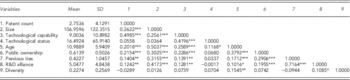
Before testing the hypotheses, correlations among different variables were analyzed. The analysis demonstrated that no case showed a level of correlation high enough to jeopardize the fitness of the model. To check whether the correlation causes a major bias, we examined variance inflation factors (VIF). All VIFs are below the critical value of 10 (Neter, Kutner, Nachtsheim, & Nachtsheim, Reference Neter, Kutner, Nachtsheim and Wasserman1996; Chatterjee, Hadi, & Price, Reference Chatterjee, Hadi and Price2000). VIFs appear to suggest that we do not have a serious multicollinearity problem (Table 1).
Summary statistics and correlations (n=272)

Two-tailed significance test.
*p<.10, **p<.05, ***p<.01.
In order to perform the hypotheses testing, an analysis was conducted on the base model that included only the control variables, after which an analysis on the full model, including both independent variables, was performed.
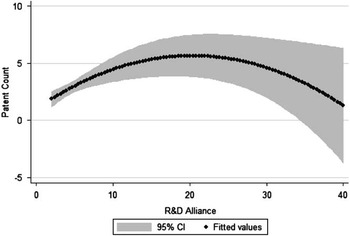
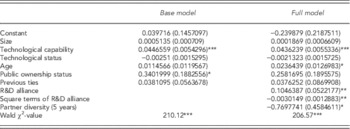
A statistically significant positive effect was observed for network size. A statistically significant negative effect was observed in the square term of the network size. Thus, the first hypothesis, which predicted an inverted U-shaped relationship between network size and knowledge creation, was supported. For verification purpose, we also made a quadratic prediction graph from the estimation. Figure 1 confirms a curvilinear relationship between the predicted patent count and R&D alliance. The results of the analysis also showed a statistically significant negative relationship between partner diversity and knowledge creation. Thus, Hypothesis 2 was also supported.
Quadratic prediction plot of patent count and R&D alliance.

Concerning the control variables, technological capability was observed to have a positive relationship with knowledge creation. Firm age was also observed to have a statistically significant positive relationship in the full model. Public ownership status had a positively significant impact on knowledge creation only in the base model. However, no significant relationship was found between knowledge creation and technological status, knowledge creation and previous ties or knowledge creation and organizational size (Table 2).
Statistical findings from Poisson regression analysis (standard errors in parentheses)

Two-tailed significance test.
*p<.10, **p<.05, ***p<.01.
Conclusion
This empirical analysis on the effect of network size and network partner diversity on knowledge creation involved a sample of US SME in the biotech industry. The results of the analysis revealed that network size had a positive effect on knowledge creation to a certain point, after which the effect on knowledge creation becomes negative. These findings suggest that above a certain threshold level, the benefit from alliance network growth diminishes. This is possibly because of limited resources and resource redundancy among firms in the alliance.
Diversity of organizational type among alliance partners was also shown to have a negative effect on knowledge creation. Due to the intrinsic characteristics of the biotech industry, biotech firms tend to form alliances not only with commercial firms, but also with diverse types of organizations such as hospitals, government-affiliated institutions, and universities. These diverse organizations have different goals, decision-making processes, and organizational structures, which may hinder efficient communication among partners. For SME with limited management capabilities, a diverse alliance portfolio may be difficult to oversee. Inadequate management of a diverse portfolio has negative effects on maintenance of network alliances and knowledge creation.
This research provides new insight into the properties of alliance networks. Focusing on the relationship between different characteristics of alliance networks and knowledge creation, this empirical analysis has shown that due to biotech firms’ limited resources and resource redundancy of their alliance partners, the relationship between network size and knowledge creation is not monotonous. Evidence was provided that diversity may have negative consequences due to possible communication problems and increased management costs. In a related vein, one point merits a mention. Some works (e.g., Nooteboom, Van Haverbeke, Duysters, Gilsing, & van den Oord, Reference Nooteboom, Van Haverbeke, Duysters, Gilsing and van den Oord2007) find that a curvilinear relationship between diversity (as a measure of cognitive distance in terms of technological knowledge) of alliance partners and innovation. This inconsistency may come from the fact that diversity can arise from differences in various dimensions. Unlike the study of Nooteboom et al., Reference Nooteboom, Van Haverbeke, Duysters, Gilsing and van den Oord2007, our study mainly focuses on the alliance partner diversity in terms of organizational type especially for SME.
The results have implications for the research on the alliance network. First, this study advances our understanding about the relationship between alliance network properties such as overall size and partner diversity in the context of small biotech firms. Second, this study adds empirical evidence to extant research on the negative side of the alliance network.
Practical implications for managers of SME in the biotech industry are as follows. Knowledge creation may be compromised if biotech firms overemphasize the positive effects of alliances and expand their networks beyond a certain extent. In addition, rather than forming alliances with diverse organizations in terms of organizational type, firms may better cultivate knowledge creation by maintaining alliances with organizations of similar types.
Despite conceptual and empirical contributions, this study suffers from some limitations. Due to data constraints, we could not empirically examine specific mechanisms that focal firms employ to facilitate knowledge creation from allied organizations. For the same reason, we failed to examine role of trust. We believe that future research along these lines will enrich our understanding of how a biotech firm creates knowledge in the alliance network effectively.
Acknowledgement
We appreciate support from the Institute of Management Research at Seoul National University.