Introduction
The cowpea aphid Aphis craccivora Koch (Homoptera: Aphididae) is a cosmopolitan insect pest that feeds on several host plants, especially Fabaceae. It is a major pest of the cowpea Vigna unguiculata (Walp.) (Leguminosae: Fabaceae) in Africa, Asia and Latin America (Singh and Jackai, Reference Singh, Jackai, Singh and Rachie1985; Pettersson et al., Reference Pettersson, Karunaratne, Ahmed and Kumar1998), and of alfalfa (Rakhshani et al., Reference Rakhshani, Talebi, Kavallieratos, Rezwani, Manzari and Zeljko2005). At high density, A. craccivora weakens plants and affects plant performance, causing yield losses up to >50% (Obopile, Reference Obopile2006) or transmission of some phytopathogenic viruses (e.g. cowpea yellow mosaic virus and cowpea aphid-borne mosaic virus; Coceano et al., Reference Coceano, Peressini and Bianchi1998, Chen et al., Reference Chen, Xu, Zhang, Fang and Yan1999). The low yield obtained in most cowpea-producing areas of West Africa is largely due to field insect pests that cause most economic damage, thereby necessitating appropriate control (Karungi et al., Reference Karungi, Adipala, Ogenga-Latigo, Kyamanywa, Oyobo and Jackai2000).
Effective chemical control measures have been developed (Jackai and Daoust, Reference Jackai and Daoust1986). However, synthetic pesticides (e.g. cypermethrin and pirimicarb), while valued for effectiveness and convenience in the control of cowpea pests (Ofuya, Reference Ofuya1987), pose certain problems, including phytotoxicity and toxicity to non-target organisms, environmental degradation and health hazards to farmers, and resistance in insect populations (Pimentel et al., Reference Pimentel, Acquay, Biltdnen, Rice, Silva, Nelson, Lipner, Giordano, Horowitz and D'Amore1992; Tian et al., Reference Tian, Sabbagh, Cuperus and Gregory1996). Moreover, insecticides are often not affordable to African peasant farmers. The over-reliance on chemicals might threaten the successful biological control of pests in agricultural ecosystems. Thus, the development of alternative control methods for A. craccivora has become of paramount importance to integrated pest management approaches (Hofsvang and Hagvar, Reference Hofsvang and Hagvar1991). A wide range of natural enemies are associated with aphid species in undisturbed systems. Several of these are used for biocontrol in greenhouses and fields: predators such as ladybird beetles and syrphids, entomopathogenic fungi such as Verticillium lecanii (Zimm.) and some parasitoid species (Couture, Reference Couture1997). Parasitoids play an important role in the control of aphid populations (Messing and Klungness, Reference Messing and Klungness2001; Matin et al., Reference Matin, Sahragard and Rasoolian2009; Rasekh et al., Reference Rasekh, Michaud, Kharazi-Pakdel and Allahyari2010; Barahoei et al., Reference Barahoei, Massoud and Mehrparvar2011) and therefore have been used in biocontrol programmes because of their greater specificity (Rakhshani et al., Reference Rakhshani, Talebi, Kavallieratos, Rezwani, Manzari and Zeljko2005). They have been preferred over predators in aphid control (Hofsvang and Hagvar, Reference Hofsvang and Hagvar1991). Aphis craccivora has been reported as a host for several Aphidiidae species in multiple regions of the world in diverse climatic and geographical conditions (Starý, Reference Stary1976). On alfalfa, Pons et al. (Reference Pons, Lumbierres, Antoni and Starý2011) reported Lysiphlebus fabarum (Marshall) (Hymenoptera: Aphidiidae) to be the prevalent parasitoid species associated with A. craccivora. In a 2-year survey of the melon aphid Aphis gossypii Glover (Homoptera: Aphididae) in Hawaii, Lysiphlebus testaceipes has been reported to be the most common parasitoid attacking this aforementioned aphid species (Messing and Klungness, Reference Messing and Klungness2001). Among Aphidiidae, L. testaceipes Cresson (Hymenoptera: Aphidiidae) is a good biocontrol candidate due to its high fertility, high host search capacity and functional response (Rodrigues and Bueno, Reference Rodrigues and Bueno2001; Jones et al., Reference Jones, Giles, Berberet, Royer, Elliott and Payton2003; Dogramaci et al., Reference Dogramaci, Mayo, Wright and Reese2004). However, in complex agro-ecosystems, parasitoids often have little regulation on aphid populations (Sullivan and van den Bosch, Reference Sullivan and van den Bosch1971; Horn, Reference Horn1989; Mackauer and Völkl, Reference Mackauer and Völkl1993). In insect parasitoids, fitness is dependent on host finding and recognition abilities of the female. Host recognition cues have been described for various host–parasitoid systems (Liepert and Dettner, Reference Liepert and Dettner1996; Muratori et al., Reference Muratori, Le Ralec, Lognay and Hance2006). Various hypotheses have been put forward to explain this lack of efficacy: host immunity (Salt and van den Bosch, Reference Salt and van den Bosch1967; Hufbauer and Via, Reference Hufbauer and Via1999; Oliver et al., Reference Oliver, Russell, Moran and Hunter2003), low host quality (Otto and Mackauer, Reference Otto and Mackauer1998; Harvey et al., Reference Harvey, Bezember, Elzinga and Strand2004), intraspecific competition between parasitoid larvae (Wylie, Reference Wylie1965; van Baaren et al., Reference van Baaren, Landry and Boivin1999), intraguild predation (Colfer and Rosenheim, Reference Colfer and Rosenheim2001; Manuele Snyder and Ives, Reference Snyder and Ives2003) and hyperparasitism (Sullivan and Völkl, Reference Sullivan and Völkl1999; Brodeur, Reference Brodeur, Hochberg and Ives2000). Many hymenopteran species have been reported to be hyperparasitoids, attacking parasitoid larvae inside the living aphid or after it has been mummified by the parasitoid. Hyperparasitoid attack results in a decrease in the parasitoid population and increases in the aphid population (Shi, Reference Shi1987), often destroying 80–90% of the parasitoids in several studies (Luck et al., Reference Luck, Messenger, Barbieri and Rosen1981; Höller et al., Reference Höller, Borgemeister, Haardt and Powell1993; Brodeur and Rosenheim, Reference Brodeur and Rosenheim2000; Buitenhuis, Reference Buitenhuis2004). Messing and Klungness (Reference Messing and Klungness2001) reported high levels of hyperparasitism to hinder the abundance of L. fabarum. Lysiphlebus testaceipes appeared in West Africa a couple of years ago (Sæthre et al., Reference Sæthre, Godonou, Hofsvang, Tepa-Yotto and James2011), so its association with the native hyperparasitoid Syrphophagus africanus Gahan (Hymenoptera: Encyrtidae) is quite recent. However, to date, there have been no studies to assess their interactions. In the present study, we investigated the influence of S. africanus on the parasitism rate of L. testaceipes and the effect of host larval age on several biological parameters of S. africanus, including development time, sex ratio, longevity and fecundity.
Materials and methods
Insect rearing
Mass rearing of A. craccivora was carried out with individuals collected from cowpea fields at the International Institute of Tropical Agriculture (IITA), Benin Station, 13 km north of Cotonou, Benin, and reared continuously on fresh and tender cowpea pods at 27–29 °C and 71–84% relative humidity (RH). The pods, renewed every 2 days, were maintained in cylindrical Plexiglas® jars (18 cm diameter × 6.5 cm height) with a nylon mesh covering on the lid.
A laboratory culture of L. testaceipes was established with field-collected A. craccivora mummies from the Département of Mono-Couffo in Benin, and kept on fresh cowpea pods (harvested from our own production at the IITA) bearing A. craccivora of different ages placed in the above-mentioned Plexiglas® jars. Three to five female L. testaceipes were released in each Plexiglas® jar for oviposition. After 24 h parasitization, the parasitoids were gently removed and the Plexiglas® jars placed in an insectary room (27–29 °C and 71–84% RH) where they were checked daily for the emergence of parasitoids. The emerged adult parasitoids were kept in small transparent plastic cups (3.5 cm diameter × 3.5 cm height) containing a droplet of honey solution smeared through small holes on the topside of the cups.
The hyperparasitoid S. africanus was collected from cowpea fields at the IITA, Benin Station and maintained under the same climatic conditions on parasitized A. craccivora and mummies using bouquets of peduncles and pods in wooden cages (44 × 45 × 58 cm) with three mesh sides (the two lateral and the front side), one glass side (the topside) and the remaining two sides (back side and bottom) made of plywood. Three to five female L. testaceipes were released in each cage for oviposition. After 3–4 h parasitization, the parasitoids were gently removed and three to five mated S. africanus females were introduced into the cages 5 days after L. testaceipes parasitization. Fresh peduncles and pods were supplied as needed. Emerged hyperparasitoids were thereafter transferred to cylindrical plastic containers (9 cm diameter × 12 cm height) and fed with honey.
Effect of S. africanus presence on L. testaceipes parasitism
This experiment was carried out to evaluate the capacity of L. testaceipes to parasitize its host in the presence and absence of the hyperparasitoid S. africanus. One hundred A. craccivora nymphs (fifty 2-day-old and fifty 3-day-old) were exposed to a mated parasitoid female ( < 24 h old) in the presence and absence of a pair of S. africanus (i.e. a male and a female). The choice of aphid host instar was based on previous investigations that reported 2-day-old and 3-day-old nymphs to be more suitable for L. testaceipes (Zanzana, Reference Zanzana2008). The aphid hosts were transferred to cowpea pods using a wet fine brush. Aphid hosts, parasitoids and hyperparasitoids were released into cylindrical plastic cups (9 cm diameter × 12 cm height), and the behaviour of female L. testaceipes was observed during 5 min. Afterwards, the cups were incubated in controlled cabinets at a temperature of 28 ± 0.1 °C and a RH of 75 ± 1% (mean ± SE) for 6 h. Thereafter, hyperparasitoids and primary parasitoids were both removed and the nymphs were fed with fresh cowpea pods renewed every 48 h until mummification 5–6 days later. Each treatment was replicated five times. The number of mummies formed was recorded and the parasitism rates of L. testaceipes calculated.
Effect of host age on adult female S. africanus reproductive capacity
This experiment was carried out to assess the influence of host developmental stage on host selection and parasitization by S. africanus as well as the effects of host age on egg-to-adult development time, the sex ratio of S. africanus and the sex ratio of L. testaceipes escaping hyperparasitism. Cowpea pods infested with 2-day-old and 3-day-old A. craccivora nymphs were introduced into parasitization cages (cylindrical Plexiglas® jars described above) and exposed to newly emerged and mated L. testaceipes females for 6 h. Thereafter, the parasitoids were removed and the cages were incubated at 27 ± 2 °C during 0, 1, 2, 3, 4 and 5 days to generate 1-, 2-, 3-, 4-, 5- and 6-day-old parasitized nymphs or mummies, respectively. For each age group, a pair of S. africanus, which were < 24 h old, was released per cylinder containing 100 parasitized aphids for 6 h in non-choice situation. The experiment was repeated five times. To evaluate the preference of the hyperparasitoid S. africanus for the parasitized A. craccivora of a specific age, 20 parasitized aphids of the five age groups (2, 3, 4, 5 and 6 days after parasitization) were put together in a Plexiglas® jar in a free-choice experiment. The parasitized aphids of 1 day after parasitization were not included in this experiment, as none of them showed any sign of hyperparasitism in the previous set of experiments. A pair of S. africanus, < 24 h old, was released into the cylinder for 6 h. After 2 days of incubation, the number of L. testaceipes escaping hyperparasitism was recorded daily and the sex ratio (F/(F+M)) calculated. In the same way, after 8 days of incubation, the number of emerged adult parasitoids and hyperparasitoids was counted. The percentage of hyperparasitism was calculated using the formula of Van Driesche (Reference Van Driesche1983):

where PA is the hyperparasitized aphid; EA, the number of emerged adult hyperparasitoids; N, the number of parasitoids escaped hyperparasitism; and U, the number of unhatched mummies.
The offspring were sexed and sex ratios calculated as the proportion of females on the total number of parasitoids or hyperparasitoids. The experiment was conducted at a temperature of 29 ± 1 °C and a RH of 78 ± 1%, and was repeated five times for each age group. For each age group tested, parasitoid and egg–adult hyperparasitoid development time was computed as:

where n i is the number of adult parasitoids or hyperparasitoids, respectively, emerging and x i is the time required for each individual to complete development, measured from the time the hyperparasitoid was removed from oviposition cups after 6 h exposition until adult S. africanus emerged from the parasitized hosts.
Longevity and reproductive capacity of adult S. africanus females
The influence of host developmental stage on the longevity and host reproduction capacity of S. africanus was assessed by submitting independently parasitized A. craccivora (4-day-old) and mummies (5-day-old) to a pair of S. africanus.
In a preliminary experiment, the maximum daily number of hosts that a hyperparasitoid female could parasitize was determined to be around 50. Based on this outcome, 50 fresh mummies obtained from the first and second instar nymphs of parasitized A. craccivora were exposed to a pair of hyperparasitoids in cylindrical Plexiglas® jars (18 cm diameter × 6.5 cm height) and replaced every 24 h until the death of the female, whose survival was monitored daily. The experiment was repeated with 15 S. africanus pairs. Exposed mummies were transferred to a new Plexiglas® jar and incubated at a temperature of 28 ± 1 °C and a RH of 69 ± 1% until emergence of the next generation. Emerging S. africanus adults were counted; the fecundity and longevity of females were calculated for each treatment. To estimate the longevity and fecundity of female S. africanus, 30 emerged females each from the previous experiment with either 4- or 5-day-old mummies were subdivided into two sets of 15 females. One set of 15 mated, < 24-h-old females was subjected to parasitism by exposing them individually to 50 mummies each, which were changed every day. The second set of 15 females was maintained separately in Plexiglas® jars without aphid mummies. During the whole experiment, hyperparasitoids were fed a droplet of honey solution smeared through small holes on the topside of the Plexiglas container. Mortality was assessed daily.
Response by S. africanus to aggregated versus dispersed mummies
Aphids close to mummification (4–5 days after being parasitized by L. testaceipes) were transferred into plastic containers (9 cm diameter × 5 cm height) on uninfested cowpea pods to obtain the dispersed mummies of A. craccivora. To obtain aggregated mummies, crowded aphid colonies on cowpea pods were exposed directly to L. testaceipes parasitism first, and subsequently the pieces of cowpea pods with 50 parasitized aphids in the same age range, as mentioned above, were transferred to the same plastic containers as described above, together with one < 24-h-old hyperparasitoid mated female, which was removed after 6 h. The containers were kept in climate chamber at 28 ± 1 °C and 68 ± 1% RH until adult emergence. Each treatment was repeated five times and parasitized mummies were recorded.
Statistical analysis
Differences in hyperparasitism rates, development time and sex ratios were analysed by applying the analysis of variance using the general linear model procedure of SPSS, and treatment means were separated with the Student–Newman–Keuls test at P ≤ 0.05.
The parasitism rate, fecundity, longevity and hyperparasitism rate of L. testaceipes between S. africanus females were compared using a paired t-test. Data on the sex ratios (female proportion) were analysed with the χ2 test. Percentage data, such as parasitism or hyperparasitism rates and proportions of females (sex ratio), and arithmetic data, such as longevity, were arcsine-square root (Arcsine√(x/100)) and logarithm (log(x+1)) transformed, respectively, prior to analysis. However, untransformed data are presented in Table 1. Simple linear regression was applied to determine the relationship between mummy density and the proportion of parasitized mummies. All comparisons were considered significant at a P value of α = 0.05.
Results
Effect of S. africanus presence on L. testaceipes parasitism
In general, distinct behavioural events were displayed by L. testaceipes in the presence and absence of its hyperparasitoid. In the absence of the hyperparasitoid, L. testaceipes immediately started searching for suitable nymphs for oviposition, and inserted its ovipositor upon locating the host. In the presence of the hyperparasitoid, L. testaceipes began to examine several nymphs by antennal palpation, and temporarily discontinued its oviposition activity to drive away the hyperparasitoid by using its antennas before continuing the host search. As a result, the rate of parasitism was significantly (P = 0.027) lower (21.2 ± 3.6%) in the presence of the hyperparasitoid when compared with its absence (36.6 ± 4.5%).
Effect of host age on adult female S. africanus reproductive capacity
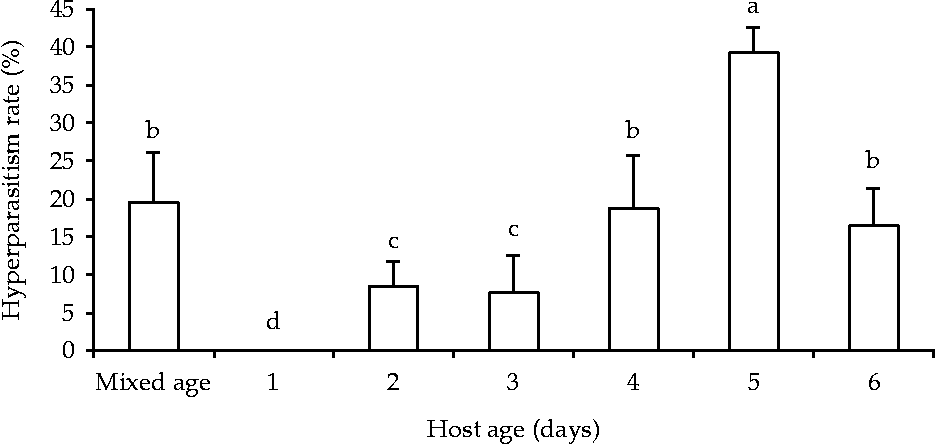
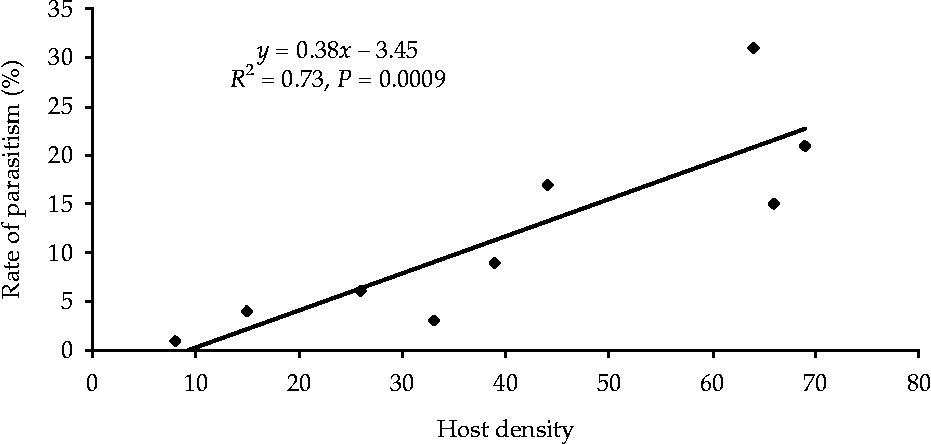
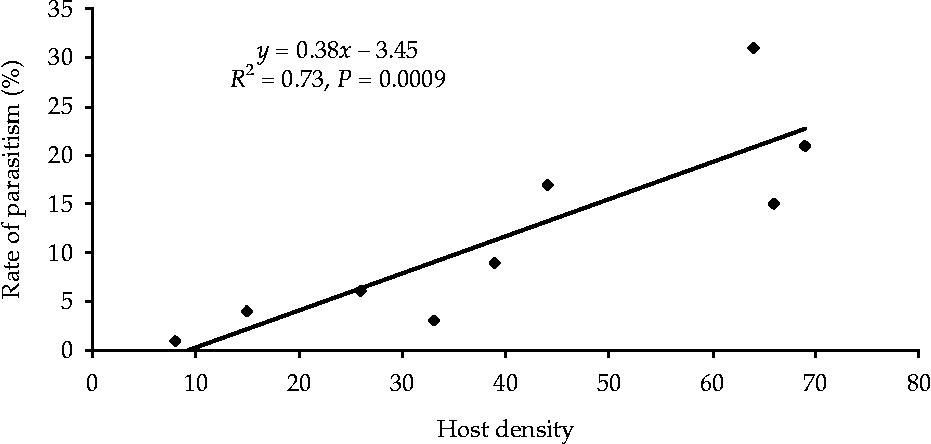
With the exception of 24-h-old hosts, S. africanus females were capable of successfully parasitizing L. testaceipes of all age classes tested (Fig. 1), with significant differences among the tested age classes (P < 0.001). The number of hosts that was visibly parasitized was significantly higher in the 5-day-old hosts (39.16 ± 3.31%,) followed by the 4- and 6-day-old hosts (18.78 ± 6.86 and 16.38 ± 5.08, respectively) and those of 2 and 3 days of age (8.47 ± 3.21 and 7.58 ± 4.9, respectively). When offered hosts of mixed ages, the total parasitism rate (19.46 ± 6.57) was similar to that in the 4- and 6-day-old hosts (Fig. 1). The total number of parasitized mummies in the 5-day-old hosts increased significantly with mummy density (y = 0.38x − 3.45; R 2 = 0.73; P =0.0009; Fig. 2).
Effect of Aphis craccivora host age on hyperparasitism rate (mean ± SE) by Syrphophagus africanus. Different letters above the bars indicate significant differences between means (Student–Newman–Keuls, P ≤0.05).
Rate of Lysiphlebus testaceipes parasitized mummies per female Syrphophagus africanus in relation to 5-day-old Aphis craccivora mummy host densities.
Egg-to-adult hyperparasitoid development
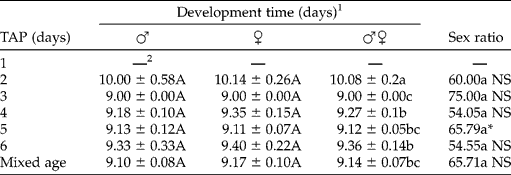
With the exception of 1-day-old hosts, the hyperparasitoid completed development in all five age classes tested (Table 1). The egg-to-adult development time of S. africanus was significantly affected by host age (F = 8.52; df = 5; P < 0.001). The development time of the progeny produced from 3-day-old host larvae was shorter than that produced from the older age groups, except the 5-day-old hosts (Table 1). Male and female S. africanus adults emerged simultaneously and lived a maximum of 15 and 21 days, respectively. There was no significant difference in the development time of males and females (F = 0.53; df = 1; P = 0.46). The proportion of males emerging each day was low, leading to a female-biased sex ratio in each age group tested (Table 1). Except for the progeny produced from the 5-day-old hosts (i.e. newly formed mummies), no statistically significant difference could be observed between the proportion of male and female S. africanus (χ2 = 0.6, 3.0, 0.24, 0.18, 3.45 for 2, 3, 4 and 6 days old and a mix of the six age groups, respectively, with df = 1; P>0.05 for the five age groups; and χ2 = 7.57; df = 1; P < 0.05 for the 5-day-old hosts). Moreover, no significant difference was noted between the mean number of female parasitoids emerging from 2-, 3-, 4-, 5- and 6-day-old hosts attacked by the hyperparasitoid and those that had escaped hyperparasitism (1-day-old host; F = 3.78; df = 1; P = 0.59).
Effect of time after parasitization (TAP) by Lysiphlebus testaceipes on the egg-to-adult development time and sex ratio of Syrphophagus africanus
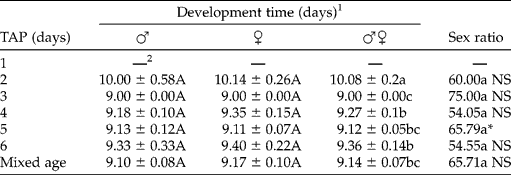
1 Means within a column followed by the same lower-case letter and in a row followed by the same upper-case letter are not significantly different (Student–Newman–Keuls, P ≤0.05).
2 Indicates that the parameter is not available because hosts of 1 day of age were not hyperparasitized.
* Indicates that there was a difference (χ2, P ≤0.05), and NS denotes no difference (χ2, P>0.05), between the sex ratio from the expected percentage of 50%, as assessed for each host age separately.
Longevity and reproductive capacity of S. africanus adult females
The hyperparasitoid females reared from live parasitized aphids (i.e. 4-day-old parasitized aphid) produced more progeny than those obtained from parasitized mummies (5-day-old host) (36.55 ± 6.28 and 25.00 ± 7.16, respectively; P < 0.001). Similarly, they lived longer on living aphids than on mummies (21.09 ± 1.57 and 10.88 ± 2.31 (no parasitism) and 4.33 ± 0.88 and 2.5 ± 0.64 (parasitism), respectively; P < 0.001).
Effect of aggregated versus dispersed mummies on the parasitism of S. africanus
The distribution pattern of mummies significantly affected the parasitism rate of S. africanus (P < 0.001): aggregated mummies were more parasitized (36.00 ± 2.86%) than the dispersed ones (20.66 ± 4.00%).
Discussion
The results of this study showed that the presence of the hyperparasitoid S. africanus in the same environment with its host L. testaceipes negatively influenced the efficiency of the parasitoid. In fact, L. testaceipes stopped parasitizing aphids in the presence of the hyperparasitoid, spending more time and energy in the attempt to drive it away with its antennae, with the resulting decrease in oviposition rate. Moreover, L. testaceipes could have avoided S. africanus aggression through chemical mimicry. Chemical mimicry has been reported in the aphid–ant–parasitoid systems (Liepert and Dettner, Reference Liepert and Dettner1993, Reference Liepert and Dettner1996; Kaneko, Reference Kaneko2002; Sanders and van Veen, Reference Sanders and van Veen2010). Liepert and Dettner (Reference Liepert and Dettner1996) reported that Lysiphlebus cardui (Marshall) used chemical mimicry to exploit the colonies of the ant-tended black bean aphid Aphis fabae cirsiiacanthoidis Schrank and had associated such behaviour to the cuticular hydrocarbon profile of the host. A significant increase in the number of emerging adults of A. gossypii primary parasitoid Lysiphlebus japonicas and its hyperparasitoids was associated with the ant Lasius niger Linnaeus (Hymenoptera: Formicidae) attending the cotton aphid on the young shoots of Satsuma mandarin (Citrus unshiu Marc) (Kaneko, Reference Kaneko2002).
Our results support the observations of Höller et al. (Reference Höller, Borgemeister, Haardt and Powell1993) and Mackauer and Völkl (Reference Mackauer and Völkl1993) who reported that hyperparasitoids exert a considerable influence on primary parasitoid populations by modifying their behaviour. Most reports on the interactions between a primary parasitoid and its hyperparasitoid suggested that in the presence of hyperparasitoids, primary parasitoid females could leave patches of their herbivore host without having exploited the resource completely, to minimize the mortality risks of their progeny (Ayal and Green, Reference Ayal and Green1993; Weisser et al., Reference Weisser, Houston and Völkl1994; Petersen, Reference Petersen2000; van Veen et al., Reference van Veen, Rajkumar, Müller and Godfray2001). Such behaviour may lead to the increased reproduction of the herbivore host populations in the presence of hyperparasitoids (Luck et al., Reference Luck, Messenger, Barbieri and Rosen1981; May and Hassell, Reference May and Hassell1981; Briggs, Reference Briggs1993; Boenisch et al., Reference Boenisch, Petersen and Wyss1997; van Veen et al., Reference van Veen, Rajkumar, Müller and Godfray2001). This contradicts, however, the results of Völkl et al. (Reference Völkl, Kranz, Weisser and Hübner1995) who reported that adult hyperparasitoids had no obvious effect on foraging behaviour or resource exploitation patterns of primary parasitoids within an aphid colony.
Except for 1-day-old hosts, the hyperparasitoid S. africanus was able to attack both the parasitoid larva in a live aphid and the parasitoid pre-pupa (or pupa) in a mummified aphid, although it showed preference for mummified aphids. In 1-day-old hosts, the L. testaceipes eggs did not hatch in time to be available as larvae for parasitization by S. africanus. Aphid hyperparasitoids have been reported either to attack exclusively the parasitoid pre-pupa or pupa after it has killed the aphid or the mummy is formed (Sullivan, Reference Sullivan1987), or to attack the parasitoid larva in live aphids before mummification (Gutierrez and van den Bosch, Reference Gutierrez and van den Bosch1970; Sullivan, Reference Sullivan1987). Secondary parasitoids in the genus Syrphophagus have a life history that is not fully understood but they appear to attack living and mummified aphids (Müller et al., Reference Müller, Adriaanse, Belshaw and Godfray1999). The atypical dualistic oviposition behaviour observed in this study for S. africanus, an endophagous koinobiont hyperparasitoid, corroborates previous reports by other authors. Sanders and van Veen (Reference Sanders and van Veen2010) reported that Syrphophagus mamitus (Walker) (Hymenoptera: Encyrtidae) have dual oviposition behaviour, attacking the parasitoid larvae in live aphids and parasitoid pre-pupae or pupae in mummified aphids. The conspecific hyperparasitoid Syrphophagus aphidivorus has been observed to attack both the primary parasitoid larva and the parasitoid pre-pupa or pupa in the mummified aphid (Sullivan, Reference Sullivan1987; Buitenhuis, Reference Buitenhuis2004), with higher preference for the aphid mummies (Kanuck and Sullivan, Reference Kanuck and Sullivan1992; Buitenhuis, Reference Buitenhuis2004). A similar host preference has also been reported for a number of primary parasitoid species (Bokonon-Ganta et al., Reference Bokonon-Ganta, Neuenschwander, van Alphen and Vos1995; Harvey and Thompson, Reference Harvey and Thompson1995; Brodeur et al., Reference Brodeur, Geervliet and Vet1996; Lauzière et al., Reference Lauzière, Brodeur and Perez-Lachaud2001), including aphid parasitoids (Gerling et al., Reference Gerling, Roitberg and Mackauer1990). Host defensive behaviour such as moving away and kicking has been reported to contribute to host preference in primary parasitoid species (Kanuck and Sullivan, Reference Kanuck and Sullivan1992; Godfray, Reference Godfray1994; Heng-Moss et al., Reference Heng-Moss, Baxendale and Riordan2001; Buitenhuis, Reference Buitenhuis2004), although Buitenhuis (Reference Buitenhuis2004) considered such defensive behaviour not to be a determining factor in aphid active life stages. According to Godfray (Reference Godfray1994), host nutritional quality, presence of toxic compounds and incapacity of the parasitoid to draw sufficient nutrients from the host may affect host preference in a primary parasitoid. In the genus Syrphophagus, S. aphidivorus (Mayr) (Hymenoptera: Encyrtidae) has been reported to be associated with aphid–parasitoid complexes, i.e. A. craccivora and Therioaphis trifolii Monell (Homoptera: Aphididae) (Pons et al., Reference Pons, Lumbierres, Antoni and Starý2011). This Syrphophagus species differs from other hyperparasitoids in that it is also a primary parasitoid of aphids, having interspecific competition with Aphidiinae parasitoids (Pons et al., Reference Pons, Lumbierres, Antoni and Starý2011), and acting facultatively as hyperparasitoids (Hoffer and Starý, Reference Hoffer and Starý1970).
In agro-ecosystems, the level of secondary parasitism of aphid parasitoids can be very high, in some cases reaching 100% (particularly towards the end of the growing season; Höller et al., Reference Höller, Borgemeister, Haardt and Powell1993). The hyperparasitism rates observed in our study were < 50%. According to Godfray (Reference Godfray1994), the progressive differentiation of parasitoids’ tissues into more complex morphological structures during parasitoid pupal development might have a negative impact on hyperparasitoid feeding and thus be responsible for the low hyperparasitism rate. Our results are consistent with those of Mertins (Reference Mertins1985) who reported Acyrthosiphon pisum (Homoptera: Aphididae) hyperparasitism rates of 17.8 and 34.4% for mummies containing the Aphidius and Praon genera, respectively, in field studies. In contrast, high levels of aphid hyperparasitism were reported in several laboratory studies. In laboratory studies, Kanuck and Sullivan (Reference Kanuck and Sullivan1992) and Buitenhuis (Reference Buitenhuis2004) observed S. aphidivorus hyperparasitism rates of 82 and 98.3% for mummy host, respectively, and 18 and 79.2% for parasitized aphids, respectively. The difference in hyperparasitism may be due to the low quality of the L. testaceipes larva or the defensive mechanism of L. testaceipes, as shown by Islam (Reference Islam1994) for Dinarmus basalis Rond. (Hymenoptera: Pteromalidae).
Hosts in mummies seemed to be more suitable than those in parasitized aphids (Buitenhuis, Reference Buitenhuis2004), offering better development and insurance for offspring survival. The number of hyperparasitized mummies in our study was positively correlated with the total number of mummies. Similarly, Mackauer and Völkl (Reference Mackauer and Völkl2005) showed that the number of Lysiphlebus hirticornis parasitized by the conspecific S. aphidivorus increased with the total number of mummies.
Living aphids might defend themselves and prevent S. africanus parasitism while the hyperparasitoid might benefit from the non-defensive behaviour of the fixed mummies. Moreover, it has been suggested that the relatively stable quantity and nutritional quality available in aphid mummies compared with the constantly changing quantity and nutritional quality in growing parasitoids within the living aphids could also affect the choice of hyperparasitoid (Buitenhuis, Reference Buitenhuis2004). In Alloxysta victrix (Westwood) (Hymenoptera: Charipidae), Grasswitz and Reese (Reference Grasswitz and Reese1998) suggested host selection to be affected by changes that occur on the surface of the host as the primary parasitoid Aphidius colemani Viereck (Hymenoptera: Braconidae) develops, and that these changes on the host surface are presumably stable, and remain detectable once the host has mummified.
Host age significantly affected the development time of S. africanus. This may depend on biological and physiological features such as host quality and nutritional attributes. It has been reported that in some of the idiobiont parasitoid species, e.g. Nasonia vitripennis (Wylie, Reference Wylie1964) and D. basalis (Islam, Reference Islam1994), the development time of the progeny varied with host age. The development time for males and females of S. africanus was not significantly different, corroborating the results reported by Couture (Reference Couture1997) for the hyperparasitoid Asaphes suspensus Walker (Hymenoptera: Pteromalidae) on their hosts Aphidius nigripes Ashmead and Praon simulans Provancher.
The sex ratio of S. africanus offspring was female biased and showed no significant differences among the various age groups (Table 1). This may be due to the homogeneous host size of the L. testaceipes larva (Barbosa and Frongillo, Reference Barbosa and Frongillo1979), the almost constant experimental temperature (Agboka et al., Reference Agboka, Tounou, Al-Moaalem, Poehling, Raupach and Borgemeister2004) and the parental sex ratio (in our case female biased; Barbosa and Frongillo, Reference Barbosa and Frongillo1979; Barbosa et al., Reference Barbosa, Martinat and Bennett1986), which are all factors influencing sex allocation. However, this contradicts the observations made by Ueno (Reference Ueno1997, Reference Ueno1999) on pupal parasitoids such as Itoplectis naranyae (Ashmead) and Pimpla nipponica Uchida (Hymenoptera: Ichneumonidae) whose sex ratio changed with host age. Hyperparasitism of S. africanus did not significantly influence the sex ratio of L. testaceipes. Both sexes of this primary parasitoid were equally at risk (Höller et al., Reference Höller, Borgemeister, Haardt and Powell1993; Snyder and Ives, Reference Snyder and Ives2003). In contrast, Mackauer and Völkl (Reference Mackauer and Völkl2005) found that hyperparasitoid-free broods of L. hirticornis contained approximately two females for one male (2:1). After hyperparasitism, the mean sex ratio approached 1:1, meaning that females of L. hirticornis are more vulnerable to hyperparasitism.
Females of S. africanus obtained from parasitized aphids produced more offspring than those from mummy hosts and lived longer. Increased longevity is one of the parameters that may provide a fitness gain to hyperparasitoids from the parasitized aphid host, over those from the mummy host (Buitenhuis, Reference Buitenhuis2004). The increased fertility observed in females emerged from parasitized aphids compared with those reared from mummies could be explained by the influence of intrinsic factors (low quality of vitellus, chromosomal anomalies and teratological developments) and extrinsic factors including temperature and RH (CIRAD, 2007). Our results partly confirmed the observations by Buitenhuis (Reference Buitenhuis2004) where females emerging from live aphids lived longer than those from mummies, and those from mummies had a higher fertility rate.
The process of host selection is a central step in the reproductive biology of parasitoid insects. Our study clearly indicates that female S. africanus showed a preference for mummies, especially grouped mummies, corroborating the results of Buitenhuis (Reference Buitenhuis2004). Numerous studies have shown that host discrimination is usually based on several physical or chemical cues (Godfray, Reference Godfray1994; Nufio and Papaj, Reference Nufio and Papaj2001; Goubault et al., Reference Goubault, Krespi, Boivin, Poinsot, Nenon and Cortesero2004). The types of stimuli involved in the recognition of parasitized hosts are based on host features, such as developmental stage, mobility, accessibility or their ability to defend themselves (Kanuck and Sullivan, Reference Kanuck and Sullivan1992; Lauzière et al., Reference Lauzière, Brodeur and Perez-Lachaud2001; Buitenhuis, Reference Buitenhuis2004). According to Stephens and Krebs (Reference Stephens and Krebs1986), female parasitoids maximize their lifetime fitness by optimizing the time and energy invested in evaluating the quality of their hosts, which depends on the host species, as well as developmental stage and size (van Alphen and Vet, Reference van Alphen, Vet, Waage and Greathead1986).
Conclusion
Our study has revealed that the impact of the hyperparasitoid S. africanus on the aphid parasitoid L. testaceipes can be substantial under laboratory conditions. However, to assess possible interactions between the two organisms at the population level and under natural environments, much more detailed ecological data will be required.
Acknowledgements
This study was made possible through support provided to the Dry Grains Pulses Collaborative Research Support Program (DGP-CRSP) by the Bureau for Economic Growth, Agriculture and Trade, USAID under the terms of grant no. EDH-A-00-07-00 005. The authors are grateful to Dr Georg Goergen for taxonomic assistance and Mr Mathias Azokpota and Ms Judith Glèlè for technical assistance.