Introduction
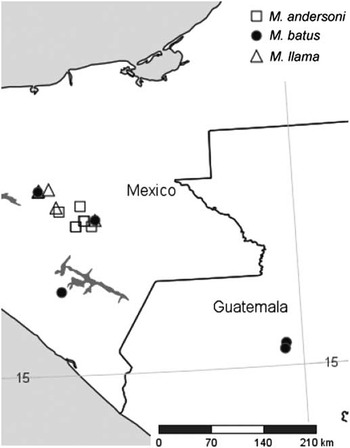
The genus Myrmolimosina Marshall (Diptera: Sphaeroceridae) was originally described for a highly distinctive apterous, ant-like species (M. andersoni Marshall, from Mexico) with a strongly petiolate abdomen in both sexes. The generic definition is here expanded to include M. llama new species, known only from strongly petiolate males, and M. batus new species, known only from non-petiolate females. Since these two species overlap in distribution (Fig. 10) and one is known only from multiple (50) females and one is known only from several (12) males, it initially seemed likely that they represented males and females of the same sexually dimorphic species. Molecular cytochrome c oxidase subunit I (COI) data reject this hypothesis and support their treatment as distinct species. They are thus described under separate names here.
Materials and methods
Male terminalia were examined after clearing whole abdomens in hot 10% KOH solution and subsequent neutralisation in glacial acetic acid. Females were cleared in lactic acid. Cleared structures were preserved in glycerin and pinned below specimens in microvials.
Terminology. Morphological terminology follows Marshall and Buck (Reference Marshall and Buck2010).
Acronyms of depositories. DEBU – School of Environmental Sciences, University of Guelph, Guelph, Ontario, Canada; UNAM – Universidad Nacional Autónoma de México, Mexico City, Mexico; UVGC – Colleción de Artrópodos, Universidad de Valle de Guatemala, Guatemala City, Guatemala. Unless otherwise indicated specimens are deposited in DEBU.
Molecular methods. All molecular specimens are dried, pinned, labelled and accompanied by a label with a unique number. Unique reference numbers follow the format DEBU-n and are intended to provide a method of identifying specific vouchers in perpetuity. Two legs were removed from each specimen and total genomic DNA was extracted using a DNeasy® Tissue kit (Qiagen Inc., Santa Clara, California, United States of America). DNA amplifications were carried out in 25 µL reactions with 14.7 µL ddH2O, 2.5 µL 10× PCR buffer, 0.65 µL 25 mM MgCl2, 1.0 µL of each 10 µM primer, 2.0 µL 10 mM dNTPs, 0.15 µL ExTaq Hot Start DNA polymerase (Takara Bio Inc., Otsu, Shiga, Japan), and 3 µL genomic DNA template. A 658 base pair fragment of the 5′ end of the COI gene was amplified using the primer pair LCO1490 (5′-GGTCAACAAATCATAAAGATATTGG-3′) and HCO2198 (5′-TAAACTTCAGGGTGACCAAAAAATCA-3′). DNA extraction and sequencing was performed at Agriculture and Agri-Food Canada (Ottawa, Ontario, Canada). Sequences and related data may be accessed through the Barcode of Life Data Systems (BOLD) (http://www.barcodinglife.org) in the public project Sphaeroceridae of the world [SPAWO]. In addition, all sequences were deposited in GenBank (GenBank numbers are provided in the comments sections for each species).
Myrmolimosina Marshall
Type species. Myrmolimosina andersoni Marshall (Reference Marshall2000: 109).
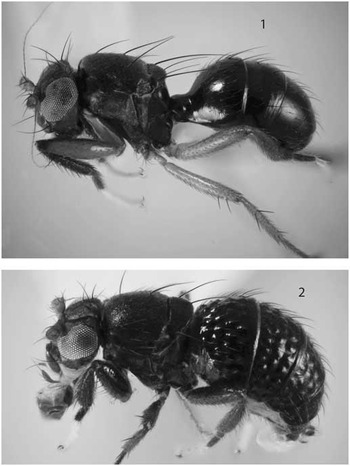
Generic diagnosis. Myrmolimosina species are heavily sclerotised, flightless flies without any trace of wings or halters. Both sexes of the type species and at least males of M. llama have a strikingly petiolate abdomen, unlike any other sphaerocerid. At least the females of M. batus new species, however, lack the petiolate abdomen. Other diagnostic features are as follows: Head shiny, dark orange to reddish brown with a single large (upper) orbital bristle (sometimes also with a minute lower orbital bristles) and two minute interfrontal bristles; face bare and mostly shiny, flat to convex; clypeus large and exposed; palpus long and thin, with a long apical bristle. Eye large, strongly sloped on ventral margin, maximum height four to six times genal height anteriorly, much less on posterior half. Arista with long setae. Thorax brown to black, fore leg with tibia and tarsomere 1 dark brown to black, distal tarsomeres pale. Prosternum broad and heavily sclerotised. Notum with very long presutural and postsutural dorsocentral bristles. Mid tibia dorsally with anterodorsal-posterodorsal bristle pair in proximal third and two to three bristles in distal third, ventrally with only a short apicoventral bristle. Hind leg with tibia and first two tarsomeres dark, distal tarsomeres pale. Abdomen black, very heavily sclerotised. Female terminalia (females unknown for M. llama) greatly reduced and pale, normally telescoped into preabdomen; epiproct small and transverse; cercus subequal in length and width; hypoproct broadly U-shaped and setulose. Spermathecae (3) small, dark, spherical with short ducts. Male terminalia (males unknown for M. batus) with surstylus pale, multi-layered but without large bristles or spurs. Distiphallus highly derived, with a long anterobasal whip-like sclerite. Hypandrium transverse, without anterior apodeme, arms fused with epandrium.
Natural history. With the exception of a single specimen of M. batus taken in a dung trap and two taken in a flight intercept trap, all known specimens of Myrmolimosina were extracted from sifted litter using a Berlese funnel, and almost all specimens were collected by Dr. Robert Anderson (Canadian Museum of Nature, Ottawa, Ontario, Canada). Like many other flightless sphaerocerids in every zoogeographic region (Richards Reference Richards1957; Marshall Reference Marshall1997; Luk and Marshall Reference Luk and Marshall2014), Myrmolimosina species are adapted to a terricolous habit by very heavy sclerotisation and loss of the wings and halters. Myrmolimosina andersoni and at least the males of M. llama appear to be ant mimics.
Relationships. Marshall (Reference Marshall2000) described the genus Myrmolimosina for the single ant-like species M. andersoni. Myrmolimosina llama is obviously closely related to M. andersoni, with which it shares the strikingly petiolate abdomen, highly derived distiphallus, and several other clearly homologous structures. Although M. batus lacks the petiolate abdomen and is thus superficially dissimilar from the type species, head structure and chaetotaxy, the unusual large anterior dorsocentral bristles, mid tibial chaetotaxy, leg colour, and female terminalia all show clearly that it belongs in the genus Myrmolimosina.

Myrmolimosina habitus photographs. 1.Myrmolimosina llama male. 2.Myrmolimosina batus female.

Myrmolimosina batus Marshall, new species
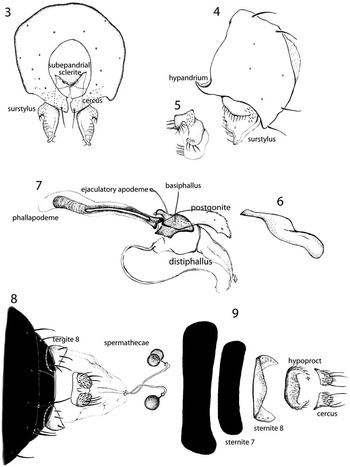
Description (female). Body length 2.0–2.2 mm. Face slightly bulging and medially setulose on upper third, otherwise flat and shiny. Upper orbital bristle large, lower orbital minute. Eye 4.0 times genal height at maximum height. Thorax mostly reddish brown, scutum darker anteriorly and medially, pleural suture dark. Scutum weakly punctate, shiny, sparsely microsetulose except for densely microsetulose posterior margin; acrostichal setulae sparse, prescutellar acrostichal setulae slightly enlarged; scutellum 2.5 times as wide as long, microsetulose, with four long marginal bristles. Mid tibia with two to three distal bristles on dorsal surface, with distal posterodorsal bristle smaller than distal dorsal bristle and inserted distinctly proximal to it. Abdominal tergites heavily sclerotised, shiny black, sparsely microsetulose and conspicuously tuberculate, with a small bristle arising from each tubercle. Abdomen: Terminalia greatly reduced, tergite 8 split into two small lateral sclerites; epiproct very pale, with two small bristles; cercus short and setulose with several small bristles (Fig. 8). Hypoproct with a pale medial part and darker, densely setulose posterolateral lobes. Sternite 8 pale, setulose, posteromedially convex (Fig 9). Spermathecae minute, spherical, with scattered vesicles visible under high magnification; apex sometimes everted as a fine point.
Myrmolimosina reproductive structures. 3, 4, 7.Myrmolimosina llama male terminalia. 3. Epandrium, cerci, and surstyli, posterior; 4. Epandrium and surstylus, left lateral; 7. Aedeagus and associated structures, left lateral. 5, 6.Myrmolimosina andersoni male. 5. Surstylus; 6. Postgonite. 8, 9.Myrmolimosina batus female terminalia. 8. Dorsal with spermathecae teased out. 9. Ventral.

Type material (all females). Holotype (debu00255789 (DEBU)) and 10 paratypes (5 UNAM, 5 DEBU): MEXICO. Chiapas, Tenejapa, Yashanal, 16°49'07"N, 92°26'34"W, 1650 m, valleyside wet montane forest litter, 21.vii.2003, R.S. Anderson.
Other paratypes: MEXICO. Chiapas, Cerro de Tapalapa, 17°11'16"N, 93°7'23"W, 2260 m, cloud forest ex sifted leaf litter, 28.v.2008, R.S. Anderson (2); Chiapas, 15.1 km NW Bochil, 1930 m, 24.x.1992, pine/oak/Liquidambar litter, R.S. Anderson (1); Chiapas, Coapilla, 5 km NE, 17°10'31"N, 93°08'58''W, 1775 m, oak-pine forest ex sifted leaf litter, 26.v.2008, R.S. Anderson (1); Chiapas, Cerro el Calvario, nr. Tapalapa, 17°10'26"N, 93°7'52"W, pine/oak/Liquidambar forest, R.S. Anderson (5; including molecular specimens debu00255920 and debu00255899). GUATEMALA. Baja Verapaz, 3.5 km S Puruha, Ranchito El Quetzal, 1700 m, 30.vi.1993, cloud forest litter, R.S. Anderson (1, UVGC); same as previous but 1770, 1825 m and 1.vii.1993 and 2.vii.1993 (3, UVGC); Baja Verapaz, 17.5 km N. Salama (on #5), 1650 m, 28.vi.1993, forest litter, R.S. Anderson (1); 15 km NW Bochil, 1930 m, 24.ix.1992, pine/oak/Liquidambar litter, R.S. Anderson (1); 8 km S. Puruha, 1660 m, 25.v. and 19.v.1991, pine/cloud forest litter, R.S. Anderson (3); 8 km S. Puruha, 1660 m, 25.v.1991, dung trap, H. and A. Howden (1); Baja Verapaz, 14.5 km S Purha, 1600 m, 21.v.1991, riparian bottomland oak forest litter, R.S. Anderson (3); 7.3 km E. Puruha, 1700 m, 19.v.1991, cloud forest litter, R.S. Anderson (2); 4.3 km E Puruha, 1680 m, 21.vi.1993, cloud forest litter, R.S. Anderson (1); 7.5 km S Puruha, 1630 m, 30.vi.1993, cloud forest litter, R.S. Anderson (2); 7 km NE Puruha, 1500 m, 20.v –8.vi.1991, flight intercept trap, B.D. Gill (2).
Etymology. The specific name is from the Latin for “blackberry”, and refers to the blackberry-like surface sculpturing of the abdominal tergites.
Comments. The type series of M. batus is made up entirely of females, while the type series of the other new species (M. llama) described here consists only of males. These species are treated as separate despite the improbability of two partially sympatric species in a small, distinctive genus being collected multiple times, and in good numbers, as only one sex per species. The reasons for this decision are as follows:
(1) The non-petiolate abdomen and the strikingly tuberculate tergites of female M. batus differ markedly from the petiolate abdomen and smooth tergites that characterise the other species (M. llama) known only from males.
(2) Males and females of the very closely related M. andersoni show no unusual sexual dimorphism.
(3) Molecular evidence indicates that these two taxa are different. Genetic variation in COI between M. batus and M. llama is considerable (7.0–9.0% uncorrected pairwise divergence). Intraspecific pairwise differences for M. batus is 0.8% (based on sequencing of two specimens: debu00255899, GenBank Number KM212009 and debu00255920 GenBank Number KM212010) and within M. llama is 0.9–1.8% (based on three specimens: debu00255811, GenBank Number KM212012; debu00255791, GenBank Number KM212011; debu00255795, GenBank Number KM212013).
Myrmolimosina llama Marshall, new species
Description (males only). Body length 2.0–2.2 mm. Face slightly bulging and medially setulose on upper third, otherwise flat and shiny. Upper orbital bristle large, lower orbital minute. Eye 5.0 times genal height at maximum height. Thorax mostly reddish brown, scutum darker anteriorly and medially, pleural suture dark. Scutum indistinctly punctate and microsetulose on anterior four fifths, shiny and bare on posterior fifth; acrostichal setulae sparse, prescutellar acrostichal setulae not enlarged; scutellum 2.5 times as wide as long, microsetulose, with four long marginal bristles. Mid tibia with two to three distal bristles on dorsal surface, with distal posterodorsal bristle smaller than distal dorsal bristle and inserted distinctly proximal to it. Abdominal tergites heavily sclerotised and convex, shiny black; syntergite 1+2 smooth and bare except microsetulose posterior margin and sparse setae, setae longer posteriorly. Syntergite strongly petiolate, with anterior third constricted into a bituberculate neck about the same width as the scutellum. Sternite 5 heavily sclerotised, black, broadly concave posteromedially. Synsternite 6+7 simple. Epandrium small, setulose and microsetulose but without large bristles. Surstylus pale, with inner and outer lobes and a posterior ridge, with rows of small marginal setae but no large bristles or spurs (Fig. 3–4). Cercus simple, not forming subanal plate, with a single bristle (in contrast to M. andersoni, which has no bristle but a dense covering of setulae). Postgonite broad and almost parallel sided before abruptly tapered apex, distal posterior surface serrate. Distiphallus with an elongate anterobasal whip-like structure (Fig. 7).
Type material (all males): Holotype (debu00255801 (DEBU)) and five paratypes (2 UNAM, 3 DEBU): MEXICO. Chiapas, Tenejapa, Yashanal, 16°49'07"N, 92°26'34"W, 1650 m, valleyside wet montane forest litter, 21.vii.2003, R. Anderson (includes molecular specimens debu00255791 and debu00255795). Other paratypes (DEBU): MEXICO. Chiapas, 8.9 km E Rayon, 19.ix.1991, cloud forest litter, R. Anderson (1); Coapilla, 5 km NE, 17°10'32"N 93°7'56"W, 1990 m, secondary mesophyl forest, ex sifted leaf litter, 25.v.–14.vi.2008 (3); Coapilla, 1600 m, 17°08'00"N, 93°10'00"W, oak forest litter, 26.vii.2005 (1; molecular specimen debu00255811); Cerro de Tapalapa, 17°11'16"N, 93°7'23"W, 2260 m, cloud forest ex sifted leaf litter, 28.v.2008, R.S. Anderson (1); 15.1 km NW Bochil, 1930 m, 24.x.1992, pine/oak/Liquidambar litter, R.S. Anderson (1).
Etymology. The species name is from the acronym for the project during which the type material was collected, project LLAMA (Leaf Litter Arthropods of MesoAmerica).
Comments: See comments under M. batus.
Myrmolimosina andersoni Marshall
Myrmolimosina andersoni Marshall (Reference Marshall2000:109)
Myrmolimosina andersoni was fully described and illustrated in Marshall (Reference Marshall2000) on the basis of 22 specimens from Chiapas, Mexico, all with only two scutellar bristles. Examination of another 53 specimens collected since that original description allows the addition of the following distributional records (Fig. 10). Three of these specimens, as noted, differ significantly from the original description in having four large scutellar bristles (like M. batus but unlike most M. andersoni). This is an unusual intraspecific variation and could cause some confusion in separating males of M. batus and M. andersoni. Male genitalic characters, however, are distinct and invariable, allowing these species to be distinguished on the basis of the gonostylus, male cercus, or surstylus. Unless otherwise noted, the new records below were collected by Robert Anderson.
Map showing all Myrmolimosina collection localities.

Specimens with four scutellar bristles: MEXICO: Chalchihuitan, Cerros de Chalchihuitan, wet cloud forest litter, 24.vii.2003 (one male, one female); Cerro Tzontehuitz, 2677 m, mixed oak forest litter, 29.vii.2005 (one male); Cerro Tzontehuitz (Pico), 2910 m, 10 km NE San Cristobal, 16.ix.1991, cloud forest litter (one female).
Typical specimens with two scutellar bristles, 50 specimens from the following localities and dates: MEXICO: San Cristobal, 15 km E, cloud forest, 2460, 2480, 2500, and 2800 m, v.2008 and xi.2001; Solhistuacan National Park, 2050 m, vii.2003; Huixtán Bazóm, 2450 m, vii.2003 (debu00255898); Huitepec Res., 2600 m, vii.2007, M. Branstetter, J. Longino.
Comments. A single specimen was sequenced for comparison with M. batus and M. llama (debu00255898; GenBank Number KM212008). This specimen is 9.8–12.1% different from these two species.
Acknowledgements
Robert Anderson generously provided almost all of the material upon which this paper is based. Sarah Schorno helped with the habitus photographs.