Introduction
Aphid defensive behavior is one of the most important selective forces driving the evolution of foraging behavior in aphid parasitoids (Völkl & Mackauer, Reference Völkl and Mackauer2000). Pea aphids, Acyrthosiphum pisum Harris, may escape by dropping quickly from the plant (Chau & Mackauer, Reference Chau and Mackauer1997; Villagra et al., Reference Villagra, Ramirez and Niemeyer2002), whereas other aphids may simply walk away (Weisser, Reference Weisser1994). However, some aphid species attempt to defend themselves in situ, thus avoiding the risks associated with host plant abandonment (Dill et al., Reference Dill, Fraser and Roitberg1990), and differences in defensive tactics among aphid species faced with parasitoid attack can be pronounced. Whereas pea aphids drop from the plant when attacked regardless of parasitoid identity, Myzus persicae (Sulzer) is driven off the plant by Aphidius ervi Halliday, but is more likely to respond to attacks by Aphidius colemani Viereck with kicking and cornicle secretion (Ingerslew & Finke, Reference Ingerslew and Finke2017). Aphis fabae Scopoli displays a suite of defensive behaviors that can all be accomplished without withdrawal of the stylet from plant tissues. These include kicking, secreting from the cornicles, and raising and swiveling the body in circles around the point of attachment to the plant, a behavior that can serve to smear the attacker with cornicle secretions (Rasekh et al., Reference Rasekh, Michaud, Kharazi-Pakdel and Allahyari2010a). However, because cornicle droplets usually contain alarm pheromones that serve to alert conspecifics (Mondor & Roitberg, Reference Mondor and Roitberg2003; Eichele et al., Reference Eichele, Dreyer, Heinz, Foster, Prischmann-Voldseth and Harmon2016), the purpose of their secretion in particular contexts can be ambiguous, especially since some aphids can modulate pheromone content in secretions in a context-dependent manner (Joachim et al., Reference Joachim, Hatano, David, Kunert, Linse and Weisser2013).
Aphid cornicle secretions are composed largely of triglycerides and function as a fast-drying liquid wax with strongly adhesive properties (Callow et al., Reference Callow, Greenway and Griffiths1973), although more recent analyses have revealed greater chemical complexity (Alfaress et al., Reference Alfaress, Hijaz and Killiny2016). Droplets of cornicle secretion can permanently seal the mouthparts of smaller predators or otherwise ensnare them (Butler & O'Neil, Reference Butler and O'Neil2006; Barry & Ohno, Reference Barry and Ohno2016), foul parasitoid antennae and force wasps to engage in an extended period of grooming, and even result in parasitoid death when wasps become permanently stuck to the aphid (Rasekh et al., Reference Rasekh, Michaud, Kharazi-Pakdel and Allahyari2010a). However, the secretion of cornicle droplets can result in various fitness costs for the aphid. Subsequent development and reproduction may be impaired (Mondor & Roitberg, Reference Mondor and Roitberg2003; Moayeri et al., Reference Moayeri, Mohandesi and Ashouri2012), and the alarm pheromones present in secretions may also act as kairomones that attract parasitoids (Micha & Wyss, Reference Micha and Wyss1996) and predators (Acar et al., Reference Acar, Medina, Lee and Booth2001; Verheggen et al., Reference Verheggen, Arnaud, Bartram, Gohy and Haubruge2008).
Although the fitness costs and benefits of cornicle secretions for aphids have received research attention, the fitness consequences for parasitoid wasps developing in such aphids has yet to be explored. Lysiphlebus fabarum (Marshall) (Braconidae: Aphidiinae) is the primary parasitoid attacking A. fabae throughout much of its range, including Iran (Talebi et al., Reference Talebi, Rakhshani, Fathipour, Starý and Tomanović2009). It attacks more than 70 species of aphids in agricultural and horticultural crops (Stary, Reference Stary1986; Völkl, Reference Völkl1992) and occurs in sexual and asexual strains (Rakhshani et al., Reference Rakhshani, Talebi, Kavallieratos, Rezwani, Manzari and Tomanović2005; Rasekh et al., Reference Rasekh, Kharazi-Pakdel, Michaud, Allahyari and Rakhshani2011), although the former appear to be more widely distributed. In the present study, we compared the developmental and life history consequences of cornicle secretion for A. fabae, with secretion occurring in the second or fourth instar. We also tested the acceptability of secreting aphids as hosts for L. fabarum, and whether cornicle secretion affected subsequent wasp–aphid interactions or the frequency of different aphid defensive behaviors. We hypothesized (1) that cornicle secretion would impose costs on developing aphids, and that these costs would scale inversely with the age of the aphid at secretion; (2) that cornicle secretion would diminish the probability of subsequent secretion by the aphid; (3) that cornicle secretion would increase the subsequent use of alternative defensive behaviors; and (4) that secretion would diminish host resistance to parasitism, which would be reflected in increased suitability for parasitoid development. We also tested whether development in secreting aphids would influence parental effects and thus the fitness of the subsequent wasp generation.
Materials and methods
Insect colonies
A stock colony of black bean aphids, A. fabae, was established from material collected in bean fields in Khuzestan Province (31°19′N, 48°41′E), Iran, in spring 2016, and mummies of the sexual strain of L. fabarum were obtained from these samples. The stock colony of A. fabae and the parasitoid wasp were maintained on potted broad bean, Vicia fabae, grown in pots filled with fertilized sawdust. All insects and experiments were maintained in growth chambers under the same environmental conditions: 21 ± 1°C, 65–75% RH, and a 16:8 (L:D) photoperiod.
To obtain synchronous cohorts of aphids for parasitism, broad bean shoots were each infested with 50 adult aphids from the stock colony. The cut stem of the bean shoot was immersed in a small vial of fertilized water (N:P:K = 20:20:20) to maintain turgor and placed in a ventilated plastic cylinder (8.0 cm diameter × 15.0 cm height) under the same physical conditions as the stock colony. The adult aphids were removed after 12 h, and the nymphs were left in situ to develop to the desired instar. Second- and fourth-instar A. fabae were 2.0 ± 0.4 and 3.5 ± 0.4 days old, respectively, at time of exposure to wasps. Second and fourth instars were selected for experimentation because they represent either end of the range of life stages suitable for parasitism by L. fabarum, both first instars and adults being outside the range of suitability, largely because of their small and large sizes, respectively (Ameri et al., Reference Ameri, Rasekh and Michaud2014).
In order to produce synchronous cohorts of parasitoid wasps, two-day-old L. fabarum females, without prior exposure to aphids, were introduced to an aphid cohort in a 1:5 ratio (one wasp for each five aphids) in plastic cylinders (as above). After 6 h, the wasps were removed and the parasitized aphids were reared on potted bean seedlings until mummies formed. These mummies were transferred into ventilated Petri dishes (3.5 cm diameter × 1 cm) until emergence of wasps, whereupon each wasp was provisioned with droplets of honey (diluted 50% in distilled water) on a strip of wax paper and water on a cotton ball. The water was refreshed daily, and the diluted honey every second day.
Bean leaves were collected from greenhouse plants and placed abaxial side on a layer of agar (1.5%) in a glass Petri dish (9.0 cm diameter). The desired number of A. fabae nymphs were then introduced to the Petri dish and allowed a period of 2 h to settle on the leaf before they were presented to parasitoids in experiments.
Elicitation of cornicle secretions
Within 12 ± 3 h of molting to the desired instar, aphids were stimulated to secrete cornicle droplets by gently stroking the anterior portion of the thorax with a fine brush. This was continued until it resulted in the secretion of visible cornicle droplets from both cornicles, as described by Mondor & Roitberg (Reference Mondor and Roitberg2003). These are referred to henceforth as ‘treated aphids’ and were used in experiments within 30 ± 10 min of cornicle secretion, and before any subsequent molt.
Aphid development and reproduction
A series of second and fourth instar aphids (n = 25 of each) were stimulated to secrete cornicle droplets and then isolated in glass Petri dishes (9.0 cm diameter) on a broad bean leaf. Each aphid was observed every 12 h to determine the developmental time of all instars. Once aphids molted to the adult stage, each was transferred to a broad bean shoot so that the number of nymphs could be counted and removed daily; data collection continued until death. After death, the hind tibia of each adult aphid was photographed under a stereomicroscope equipped with a digital camera (Nikon Coolpix S10; Nikon Corporation, Tokyo, Japan) attached to a binocular microscope at 100× magnification and the hind tibia length (HTL) measured with a precision of 0.003 mm.
Development of L. fabarum in secreting aphids
Synchronous cohorts of aphids were reared to the second instar and a subset were stimulated to secrete droplets from both cornicles as in the previous experiment. Leaves of broad bean, each infested with 25 treated or control aphids (n = 18 in both cases), were placed in glass Petri dishes (9.0 cm diameter). A single, mated, two-day-old L. fabarum female was then released into each dish and observed continuously under a stereomicroscope until she attacked (probed with the ovipositor) a total of 20 aphids. Each aphid attacked was removed and placed on an excised bean shoot in a mini-cage sitting on a small container of water. Any control aphids which secreted cornicle droplets during wasp encounters were replaced with non-secreting aphids. After 3 days of rearing, 10 aphids from each replicate were dissected to assess their parasitism status and record numbers of larvae in each. The remaining aphids were reared to emergence of wasps. We recorded wasp developmental times, percentage of aphids parasitized, percentage of mummies emerging, and sex ratio. The HTL of wasps were also measured as in the previous experiment. In order to assess wasp fitness, wasps from each treatment were paired (n = 14 in both cases) on their second day of life and each female was then provided with 20 s instar aphids on a bean leaf in a Petri dish for 120 min. This combination of aphid number and exposure period was selected to maximize the resolution of differences between treatments based on our knowledge of how many aphids can be parasitized per female, per unit of time. The aphids from each replicate were then reared (as above) to emergence of wasps and their life history data recorded. The HTL of wasps was again measured. The entire experiment was repeated using fourth-instar A. fabae as hosts.
Acceptability of secreting aphids as hosts for L. fabarum: a choice test
A preliminary experiment, conducted separately with both second- and fourth-instar aphids, tested whether amputation of an aphid antenna would affect its acceptability as a host for L. fabarum, with the aim of using antennectomy as a tool for marking secreting vs. non-secreting aphids in a choice test. A single antenna on each aphid was snipped at its base with fine scissors and the aphid was allowed 2 h to recover prior to testing. Mated females of L. fabarum (n = 10) were each provided a choice of ten antennectomized and ten control aphids on a bean leaf in a Petri dish (9.0 cm diameter) for a period of 2 h. The aphids were then reared to mummification in order to determine the percentage parasitized. There was no significant preference expressed for antennectomized vs. control aphids either as second instars (t = 0.43, P = 0.681), or as fourth instars (t = 0.23, P = 0.826), so we were able to employ antennectomy as a means of marking aphids in choice tests without biasing results.
For the choice test, synchronous cohorts of aphids were prepared and a subset treated to induce to cornicle secretions (as above). Mated, two-day-old female L. fabarum (n = 18) were then released singly into glass Petri dishes (as above) containing a broad bean leaf infested with ten treated and ten control A. fabae, which were labeled by snipping one antenna (control aphids were snipped in half the replicates, and treated aphids in the other half). After 2 h of foraging, female wasps were removed, the aphids of each replicate were separated by treatment, and each type placed on their own excised bean shoot in a mini-cage for rearing. The percentage of aphids parasitized, percent emergence, and sex ratio were recorded for each treatment group in each replicate. The experiment was repeated with fourth-instar aphids.
Cornicle secretion and subsequent wasp–aphid interactions
Synchronous cohorts of second- and fourth-instar A. fabae were produced, as described in the previous experiment. Bean leaves were infested with either 20 treated aphids (n = 16) or 20 control aphids (n = 16) and each placed in a glass Petri dish (2.5 cm diameter). Mated, two-day-old L. fabarum females were then singly released into each dish. Once a female encountered the first aphid, the lid of the arena was removed and she was observed continuously under a stereomicroscope for 30 min, during which time the onset and duration of all distinguishable behavioral events were tallied. Wasp behavior was categorized according to the scheme of Rasekh et al. (Reference Rasekh, Michaud, Allahyari and Sabahi2010b): latent period (time from introduction to patch until first aphid attack), resting, searching, host antennation, abdominal bending (in preparation for probing), grooming, probing aphids with the ovipositor, number of aphids encountered, number of aphids probed, and number of honeydew droplets consumed. Previous work has shown that L. fabarum females elicit honeydew secretion by A. fabae and consume droplets directly from the aphid's anus (Rasekh et al., Reference Rasekh, Michaud, Kharazi-Pakdel and Allahyari2010a). Aphid defensive behaviors tallied included kicking, escaping an ovipositor probe, secreting cornicle droplets, and raising and swiveling the body around the point of stylet insertion.
Calculations of life tables parameters
Because aphid generation time is so short, mothers can continue to reproduce long after their daughters become reproductive, albeit at low to insignificant rates. Thus, estimates of fecundity used in life table calculations for a particular treatments are best tallied for a period equal to the developmental time in that treatment, plus 1 day to allow for adult maturation (Bayoumy et al., Reference Bayoumy, Ramaswamy and Michaud2015), otherwise use of lifetime fecundities will lead to underestimates or r m. Thus, age-specific survival (l x) and fecundity (m x) were calculated for individual aphids using data from the first 7 days of adult life. Net reproductive rate, R 0, was defined as the product of age-specific survival and age-specific fecundity (R 0 = Σl xm x), where l x is the proportion of females alive on a given day, and m x is the mean number of female births on that day (Southwood & Henderson, Reference Southwood and Henderson2000). The mean generation time [GT = (Σl xm xx)/(Σl xm x)], intrinsic rate of natural increase (r m = Ln R 0/T), finite rate of increase (λ = erm) were estimated according to Carey (Reference Carey1993) using the program MicroSoft Excel (2003). The population doubling time (DT = Ln 2/r m) was calculated according to Mackauer (Reference Mackauer1983).
Statistical analysis
A factorial two-way analysis of variance (ANOVA) was used to analyze biological data with ‘treatment’ and ‘aphid instar’ as independent fixed factors (SPSS, 1998). Percent aphids mummified, percent mummies emerging, and sex ratio data were analyzed by G-test using GLM with a binomial error distribution (Crawley, Reference Crawley1993). A χ2 test was used to test for differences in numbers of aphids superparasitized. Data from choice tests were analyzed using a paired t-test (two-tailed). Since data generated by wasp–aphid interactions are either not normally distributed or are otherwise unsuited to parametric analysis, these data were analyzed by Mann–Whitney U-test (SPSS, 1998).
Results
Aphid development and reproduction
Cornicle secretions in the second instar decreased adult body size, as reflected in a mean (±SE) HTL of 2.19 ± 0.04 mm for treated aphids, compared with 2.33 ± 0.04 mm for control aphids (F 1,46 = 4.83, P = 0.033), but secretion in the fourth instar did not reduce body size relative to controls (2.23 ± 0.03 vs. 2.22 ± 0.04 mm, F 1,58 = 0.004, P = 0.949). Aphids secreting in the second instar molted to the third instar in 1.4 ± 0.05 days, faster than the 1.7 ± 0.1 days required for control aphids (F 1,45 = 5.56, P = 0.023), but their total period of nymphal development did not differ (F 1,45 = 0.28, P = 0.645), nor did the adult pre-reproductive period (F 1,45 = 0.11, P = 0.737). There was no significant effect of treatment on the 7-day fecundity of aphids, whether aphids secreted droplets in the second instar (F 1,46 = 0.63, P = 0.432), or in the fourth (F 1,46 = 0.63, P = 0.432).
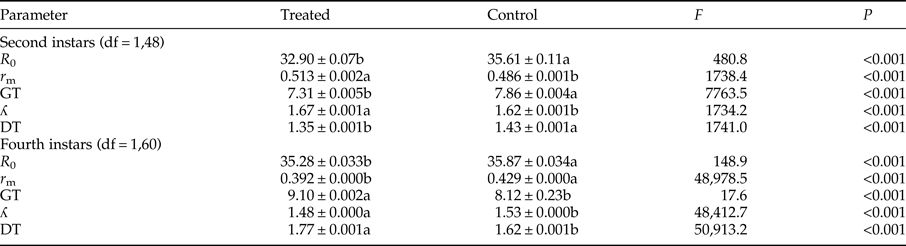
Analysis of population growth parameters suggested fitness benefits resulting from A. fabae cornicle secretion in the second instar, reflected in higher intrinsic rate of increase (r m), shorter generation time (GT), and higher finite rate of increase (ʎ), although the net reproductive rate (R 0) was lower (table 1). These results were reversed for fourth instars, indicating costs for cornicle secretion in this life stage, and supporting our first hypothesis.
Mean (±SE) population growth parameters for Aphis fabae which secreted cornicle droplets in either the second or fourth instar (treated) compared with non-secreting aphids (control).

Values bearing the different letters were significantly different between treatments (one-way ANOVA, α = 0.05).
Development of L. fabarum in secreting aphids
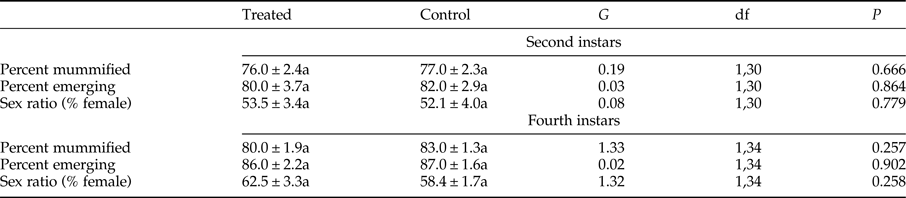
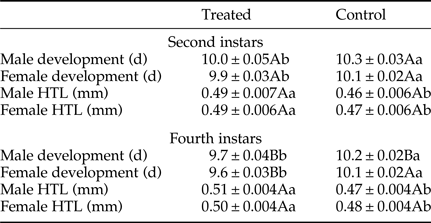
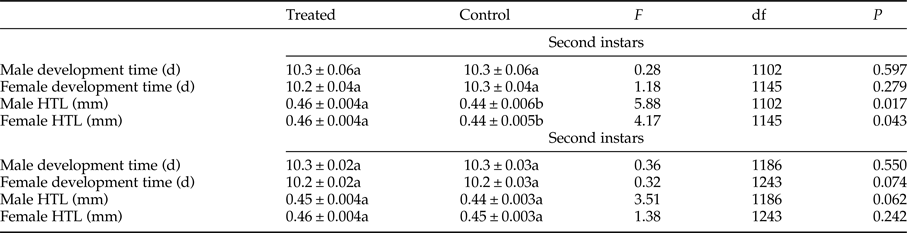
Dissection of parasitized aphids revealed that there was no effect of treatment on the percentage of aphids parasitized, the percentage of mummies emerging, or the sex ratio, whether host aphids secreted cornicle droplets in the second or fourth instar (table 2). Similarly, there was no effect of treatment on the number of aphids superparasitized, whether treatment occurred in the second instar (χ2 = 1.99, P = 0.158) or in the fourth instar (χ2 = 0.235, P = 0.628). The two-way ANOVA of male developmental time revealed significant main effects of treatment (F 1,269 = 121.33, P < 0.001) and aphid instar (F 1,269 = 37.63, P < 0.001), and a significant interaction between these factors (F 1,269 = 11.31, P = 0.001) and the same was true for female developmental time (F 1,375 = 121.89, P < 0.001; F 1,375 = 27.82, P < 0.001; and F 1,375 = 14.90, P < 0.001, respectively). The two-way ANOVA of male HTL revealed significant main effects of treatment (F 1,133 = 16.11, P < 0.001), but not aphid instar (F 1,133 = 0.75, P = 0.387), with no significant interaction between these factors (F 1,133 = 0.52, P = 0.820). For female HTL, the main effect of treatment was significant (F 1,147 = 6.51, P = 0.010), but not aphid instar (F 1,147 = 2.60, P = 0.110), nor the interaction term (F 1,147 = 0.10, P = 0.757). Developmental times were shorter, and HTLs longer, when either male or female L. fabarum developed in treated as opposed to control aphids, and this was true regardless of whether secretion occurred in the second or fourth instar, supporting our fourth hypothesis (table 3).
Mean (±SE) percentage of aphids mummified, percentage of mummies emerging, and sex ratio when mated Lysiphlebus fabarum females were individually provided with 20 Aphis fabae nymphs that had secreted cornicle droplets in either the second or fourth instar (treated), or non-secreting aphids (control).

Values bearing the same letter were not significantly different between treatments (G test, α = 0.5).
Mean (±SE) developmental times and hind tibia lengths (HTL) of Lysiphlebus fabarum developing in Aphis fabae nymphs that secreted cornicle droplets in either the second or fourth instar (treated), or in non-secreting aphids (control).

Values bearing the same upper case letters were not significantly different between aphid instars within a treatment; values bearing the same lower case letters were not significantly different between treatments within an aphid instar (two-way ANOVA, α = 0.05).
Development of L. fabarum when parental wasps developed in secreting aphids
When the treatment wasps obtained in the preceding experiment were paired, and the females provided with second-instar A. fabae, they mummified similar numbers of aphids as control wasps, and the mummies had similar emergence and sex ratios, whether their parents had emerged from host aphids that secreted cornicle droplets in either the second or fourth instar (table 4). Although there was no significant effect of host instar on the percentage of aphids mummified in either treated (G 1,30 = 0.014, P = 0.907) or control (G 1,30 = 0.522, P = 0.476) treatments, significantly more mummies emerged when parental wasps emerged from host aphids parasitized in the fourth instar than when they emerged from those parasitized in the second instar, and this was true for both secreting (G 1,30 = 3.481, P = 0.042) and non-secreting (G 1,30 = 6.868, P = 0.014) parental hosts. Sex ratio did not vary as a function of parental host instar for either treatment (G 1,30 = 1.050, P = 0.314) or control (G 1,30 = 0.336, P = 0.567) groups. Although developmental times were not affected by parental treatment, both male and female wasps had larger body size, as determined by HTL, when their parents emerged from host aphids secreting cornicle droplets in the second instar, but not when they secreted in the fourth instar (table 5).
Mean (±SE) percentage of aphids mummified, percentage of mummies emerging, and sex ratio when mated Lysiphlebus fabarum females were individually provided with 20 Aphis fabae nymphs.

Parental wasps had developed either in aphids that secreted cornicle droplets in either the second or fourth instar (treated), or in non-secreting aphids (control). Values bearing the same lower case letter were not significantly different between treatments within an aphid instar; values bearing the same upper case letters were not significantly different between aphid instars within a treatment (G test, α = 0.5).
Mean (±SE) developmental times and hind tibia lengths (HTL) of Lysiphlebus fabarum developing in Aphis fabae nymphs.

Parental wasps had developed either in aphids that had secreted cornicle droplets in either the second or fourth instar (treated), or in non-secreting aphids (control). Values bearing the same letter were not significantly different between treatments (one-way ANOVA, α = 0.05).
Acceptability of secreting aphids as hosts for L. fabarum in choice tests
When females of L. fabarum were provided a choice between 10 s instar A. fabae nymphs that had secreted cornicle droplets and ten control nymphs that had not, females expressed a significant preference for aphids that had secreted cornicle droplets in the fourth instar (t = 3.65, P = 0.002), but not when they secreted in the second instar (t = 0.54, P = 0.594).
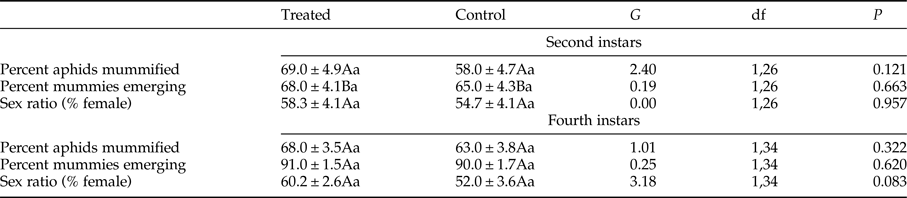
Cornicle secretion in the second instar did not improve emergence of mummies, but secretion in the fourth instar did (table 6). However, secretion in the second instar increased the proportion of female progeny, with a similar, if not quite significant, effect in the fourth instar. Secretion in the fourth instar increased the percentage of mummies emerging compared with the treatment in the second instar (G 1,34 = 10.917, P = 0.002), but instar had no effect on the emergence of control wasps (G 1,34 = 0.228, P = 0.636), and there was no significant effect of instar on sex ratio (treatment: G 1,34 = 0.036, P = 0.85; control: G 1,34 = 0.254, P = 0.618).
Mean (±SE) percentage of mummies emerging, and sex ratio when mated Lysiphlebus fabarum females (n = 18 per treatment) were given a choice of ten Aphis fabae nymphs that had secreted cornicle droplets in either the second or fourth instar (treated), or in non-secreting aphids (control).

Values bearing the same upper case letter were not significantly different between instars; those bearing the same lower case letter were not significantly different between treatments (G test, α = 0.5).
Cornicle secretion and subsequent wasp–aphid interactions
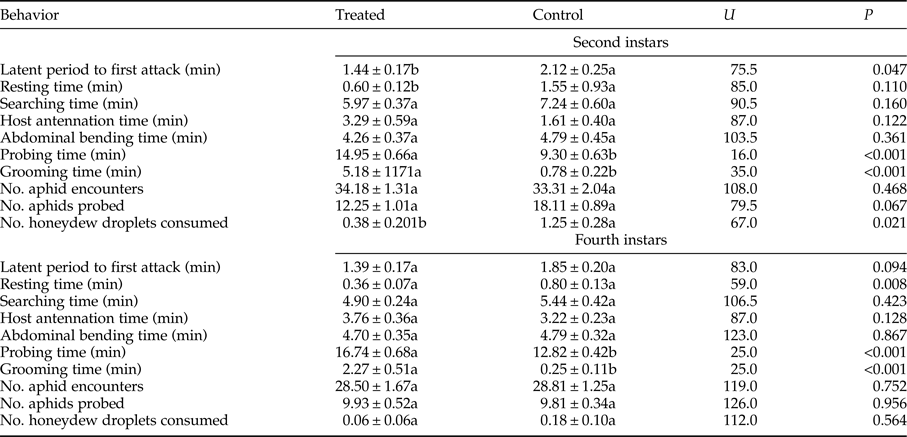
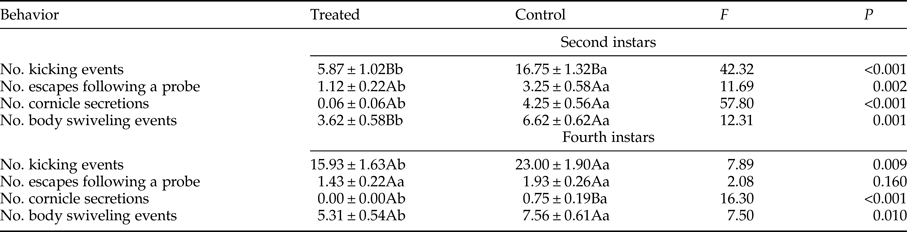
When females foraged for A. fabae nymphs that had secreted cornicle droplets in the second instar, they attacked the first aphid more quickly than when control aphids were provided, but this was not true of aphids that secreted in the fourth instar (table 7). A two-way ANOVA revealed significant main effects of treatment (F 1,60 = 35.30, P < 0.001) and instar (F 1,60 = 29.19, P < 0.001) on the number of aphid-kicking events, but no significant interaction between these factors (F 1,60 = 1.60, P = 0.212). There were significant main effects of treatment (F 1,60 = 13.60, P < 0.001), but not instar (F 1,60 = 1.97, P = 0.165) on the number of aphid escapes following a probe with the ovipositor, and there was a significant interaction between them (F 1,60 = 5.21, P = 0.026). Both treatment (F 1,60 = 68.89, P < 0.001) and instar (F 1,60 = 38.861, P < 0.001) affected the number of cornicle secretion events, and the interaction between these factors was also significant (F 1,60 = 33.39, P < 0.001). Finally, treatment (F 1,60 = 19.64, P < 0.001) and instar (F 1,60 = 4.91, P = 0.031) both affected the number of body-swiveling events, but without a significant interaction (F 1,60 = 0.40, P = 0.529).
Behavioral data for Lysiphlebus fabarum females foraging among 20 Aphis fabae nymphs (on a bean leaf disk) that had either secreted cornicle droplets in either the second or fourth instar (treated), or non-secreting aphids (control).

Values bearing the same letter were not significantly different between treatments (Mann–Whitney U-test, α = 0.05).
Among both control and treatment aphids, fourth instars tended to use kicking and body swiveling more than second instars, and cornicle secretion less often. Fourth-instar controls also tended to escape following a probe with the ovipositor more often than did second-instar controls, but this was not true for treatment aphids. Aphids that secreted cornicle droplets prior to testing were less likely to do so when subsequently attacked by an L. fabarum female, regardless of instar, supporting our second hypothesis. However, secreting aphids also diminished their subsequent use of behavioral defenses such as kicking and body swiveling, which contradicted our third hypothesis (table 8).
Frequencies of different defensive behaviors displayed by Aphis fabae nymphs (on a bean leaf disk) in response to attacks from Lysiphlebus fabarum females (n = 16 replicates per treatment, 20 aphids per female, for 30 min).

Aphids had either secreted cornicle droplets in either the second or fourth instar (treated), or were non-secreting aphids (control). Values bearing the same lower case letters were not significantly different between treatments within an aphid instar; values bearing the same upper case letters were not significantly different between aphid instars within a treatment (one-way ANOVA, α = 0.05).
Discussion
Our results revealed that cornicle secretion by immature A. fabae had developmental and life history impacts that depended on the age of the aphid at the time of secretion, confirming our first hypothesis. On balance, aphid fitness was increased by cornicle secretion in the second instar, but reduced by secretion in the fourth. Secretion in the second instar accelerated development, but reduced subsequent adult body size; although it did not affect fecundity, it increased r m and ʎ, while reducing GT and DT (table 1). Secretions in the fourth instar did not reduce adult body size or fecundity, but effects on life table parameters were negative rather than positive. Second-instar control aphids were also more than five times as likely to secrete cornicle droplets upon encounters with L. fabarum females as were fourth-instar control aphids (table 8), a result consistent with a higher cost of secretion in the fourth instar. A possible explanation is that second instars simply have more developmental time remaining in which to compensate for the cost of secretion, possibly by increasing their feeding rate. Cornicle secretion events also reduced the probability of subsequent secretion, and the subsequent use of defensive behaviors such as kicking or body swiveling, regardless of the instar in which secretion occurred. These changes in behavior likely reflect tradeoffs between various defensive tactics that derive from their respective costs within a limited energy budget for defense. However, aphids that secreted in the second instar became less likely to escape parasitoid attack following a probe with the ovipositor, an effect not seen in aphids that secreted in the fourth instar. The effectiveness of behaviors such as kicking and body swiveling is likely to scale with body size, and they are probably less costly than cornicle secretion, whereas cornicle secretion is probably a more effective defense for early instars, given their small size.
The cornicle secretions of A. fabae contain many volatile compounds, some of which have demonstrated kairomonal activity for foraging syrphid flies (Shonouda et al., Reference Shonouda, Bombosch, Shalaby and Osman1998), and some of which likely serve as alarm pheromones. Immature A. pisum Harris have been shown to secrete larger quantities of the alarm pheromone (E)-β-farnesene than reproductive adults, ostensibly because smaller aphids are more vulnerable to predation and parasitism (Mondor et al., Reference Mondor, Baird, Slessor and Roitberg2000). Moayeri et al. (Reference Moayeri, Rasekh and Enkegaard2014) showed that experienced females of Diaeretiella rapae (McIntosh) orient to volatiles present in the cornicle secretions of their host, Brevicoryne brassicae (L.). Thus, the presence of alarm pheromone in cornicle droplets may have contributed to some of our results in these experiments. Mondor & Roitberg (Reference Mondor and Roitberg2003) measured age-dependent fitness consequences of cornicle secretion in A. pisum and found a net benefit to fitness if secretion occurred in the third instar, a net cost if it occurred in the fourth instar, and no net impact if it occurred in the adult stage. These results are quite consistent with our own, in that secretion in a later immature stage had a more negative impact on aphid fitness than did secretion in an earlier stage.
Although cornicle secretion by A. fabae did not affect susceptibility to parasitism by L. fabarum, both male and female wasps developed faster and were larger when they emerged from secreting aphids, whether secretion occurred in the second or fourth instars (table 3). It is notable that female wasps parasitized significantly more secreting second instars than controls in the choice experiment, and also allocated more female eggs to secreting fourth instars than to controls (table 6). This suggests that females were sensitive to the increased suitability of secreting aphids and allocated proportionately more daughters to them, as predicted by sex allocation theory (Charnov et al., Reference Charnov, Los-den Hartogh, Jones and van den Assem1981). Cornicle secretions have been previously shown to stimulate attacks by aphidiine parasitoids (Battaglia et al., Reference Battaglia, Poppy, Powell, Romano, Tranfaglia and Pennacchio2000), but the present results illustrate another tradeoff for the aphid: although secretion may increase the probability an A. fabae nymph escapes attack by L. fabarum, it results in improved host quality for parasitoid development when attacks are successful.
Host resources for parasitoid development are finite and parasitoid fitness is closely linked to host quality (Vinson & Iwantsch, Reference Vinson and Iwantsch1980; Slansky, Reference Slansky1986; Sequeira & Mackauer, Reference Sequeira and Mackauer1992). However, because the hosts of koinobiont parasitoids continue to feed and grow after parasitism, host quality is a dynamic, rather than static, property for aphidiine wasps, generating greater complexity (Harvey, Reference Harvey2005). Host insects express varying levels of immunological response to parasitism (Salt, Reference Salt1941; Godfray, Reference Godfray1994) and parasitoids may require complex physiological mechanisms and a high level of host adaptation to overcome them (Carton et al., Reference Carton, Poirié and Nappi2008). Thus, reduced immunological resistance to parasitism is one possible mechanism by which cornicle secretion could increase host suitability for L. fabarum.
Interestingly, when parental wasps developed in aphids that had secreted cornicle droplets in the second instar, they gave rise to larger progeny as measured by HTL, a result that would suggest beneficial parental effects are yet another benefit of wasp development in secreting aphids (table 5). However, a larger proportion of mummies emerged when their parents began development in fourth-instar aphids compared with second-instar aphids, regardless of secretion status (table 4), a result that would suggest higher suitability of fourth instars, seemingly in contradiction to the life table data which indicate faster population growth in second-instar hosts.
Females L. fabarum seemed able to detect and respond to aphid cornicle secretion status, and this affected their foraging behavior. Females were faster to attack their first aphid in patches of aphids that secreted in the second instar, although this effect was not significant for aphids secreting in the fourth instar (table 7). Overall foraging efficiency appeared unaffected by host aphid secretion, but wasps spent more time probing aphids and grooming in arenas of treated aphids than in arenas of control aphids. They also spent less time resting and consuming honeydew droplets in the case of aphids that secreted in the second instar. Control aphids exhibited more frequent defensive behaviors than secreting aphids, including kicking, secreting cornicle droplets, and raising and swiveling the body (table 8), which may have caused wasps to spend more time grooming in control arenas. The greater reliance on kicking and body swiveling by fourth instars compared with second instars (table 7) probably reflects the greater effectiveness of these behaviors, and the higher costs of cornicle secretion, in later instars. These results reveal that cornicle secretion by A. fabae exacts a cost in the form of reduced capacity for subsequent defensive behavior, regardless of the instar in which it occurs, and that L. fabarum females adjust their foraging behavior to deal with the higher costs of handling non-secreting aphids that retain a higher defensive capability.
Acknowledgements
The authors are grateful to Shahid Chamran University of Ahvaz for providing financial support for this research (Grant no. 94.3.02.31580).