Introduction
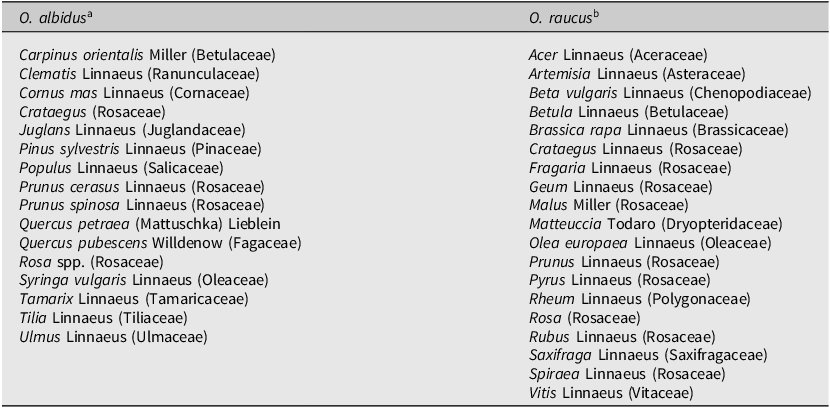
Eleven of the 15 Otiorhynchus Germar (Coleoptera: Curculionidae) species previously known to have been introduced from Europe to North America (excluding Greenland) occur in Canada (Bright and Bouchard Reference Bright and Bouchard2008; Bousquet et al. Reference Bousquet, Bouchard, Davies and Sikes2013; Lewis and Anderson Reference Lewis and Anderson2022; Hoebeke et al. Reference Hoebeke, LaBonte and Loeffler2024). All of these species are of economic importance because they are pests of cultivated crops and ornamentals (Warner and Negley Reference Warner and Negley1976; Hoebeke et al. Reference Hoebeke, LaBonte and Loeffler2024). For example, in British Columbia, Canada, black vine weevil, O. sulcatus (Fabricius), clay-coloured weevil, O. singularis (Linnaeus), rough strawberry root weevil, O. rugosostriatus (Goeze), and strawberry root weevil, O. ovatus (Linnaeus), are important pests of berry crops (Campbell et al. Reference Campbell, Sarazin and Lyons1989). Another species, O. raucus (Fabricius), is known to be present in the United States of America and several Canadian provinces (Warner and Negley Reference Warner and Negley1976; O’Brien and Wibmer Reference O’Brien and Wibmer1982; Anderson Reference Anderson1991; Klimaszewski et al. Reference Klimaszewski, Langor, Majka, Bouchard, Bousquet and LeSage2010; Bousquet et al. Reference Bousquet, Bouchard, Davies and Sikes2013), including British Columbia (Bright and Bouchard Reference Bright and Bouchard2008), where it has previously been reported as a pest of cherries and grapes (Acheampong and Hueppelsheuser Reference Acheampong and Hueppelsheuser2012, Reference Acheampong and Hueppelsheuser2013) and feeds, reproduces, or both on a number of other plant species in at least 10 different plant families (Hoffmann Reference Hoffmann1923, Reference Hoffmann1950; Balachowsky Reference Balachowsky1963; Yunakov Reference Yunakov2003; Table 1).
Previously reported host plants of Otiorhynchus albidus and O. raucus in the Palaearctic biogeographic realm as indicated by adults feeding on foliage, larvae feeding on roots, or both

a Arnoldi et. al. (Reference Arnoldi, Ter-Minasian, Slodovnikova and Кryzhanovskiy1974), Yunakov (Reference Yunakov2003), Munteanu et al. (Reference Munteanu, Moldovan, Bacal and Toderas2014), Kolov and Korotyaev (Reference Kolov and Korotyaev2017), Kizub and Slutsky (Reference Kizub and Slutsky2018), and Korotyaev et al. (Reference Korotyaev, Katayev and Kovalev2018)
b Hoffmann (Reference Hoffmann1923), Stackelberg (1932), Balachowsky (Reference Balachowsky1963), and Yunakov (Reference Yunakov2003)
Otiorhynchus albidus Stierlin is a polyphagous species of European origin known to occur in Austria, Bulgaria, Germany, Greece, Moldova, Montenegro, North Macedonia, Romania, Russia’s southern European territory, Serbia, Turkey, and Ukraine (Alonso-Zarazaga et al. Reference Alonso-Zarazaga, Barrios, Borovec, Bouchard, Caldara and Colonnelli2023). It has also been introduced in Kazakhstan and in Russia’s northern European territory (Alonso-Zarazaga et al. Reference Alonso-Zarazaga, Barrios, Borovec, Bouchard, Caldara and Colonnelli2023). This weevil feeds on a wide range of plants, including fruit trees and ornamentals (Arnoldi et al. Reference Arnoldi, Ter-Minasian, Slodovnikova and Кryzhanovskiy1974; Yunakov Reference Yunakov2003; Munteanu et al. Reference Munteanu, Moldovan, Bacal and Toderas2014, Kolov and Korotyaev Reference Kolov and Korotyaev2017; Kizub and Slutsky Reference Kizub and Slutsky2018; Korotyaev et al. Reference Korotyaev, Katayev and Kovalev2018; Table 1). Localised populations of O. albidus observed at two locations in Central Europe (Austria and Germany) between 2011 and 2015 are thought to have been introduced with cultivated plants or planting substrates (Yunakov et al. Reference Yunakov, Nazarenko, Filimonov and Volovnik2018). This species was not previously known to occur in North America.
In June 2022, weevils entering the basement of a home in Kelowna, British Columbia (GPS: 49.902, –119.429), led to the homeowner trapping 33 individuals with mouse and insect sticky glue traps and submitting them to S.A. for identification. The sticky trap samples submitted for identification had a mix of three weevil species: 24 O. albidus (Fig. 1A; identification confirmed by N. Yunakov), eight O. raucus (Fig. 2D; identified by P.B.), and one Dyslobus LeConte undetermined species (identified by P.B.). The O. albidus specimens represent the first detections of this species in North America.
Dorsal habitus photos of species of Otiorhynchus: A, O. albidus; B, O. carinatopunctatus; C, O. desertus; and D, O. ligneus. Scale: 1 mm.

Dorsal habitus photos of species of Otiorhynchus: A, O. ligustici; B, O. ovatus; C, O. porcatus; and D, O. raucus. Scale: 1 mm. Arrow: dorsal extension of apex of protibia.

Although dissections did not take place to confirm with certainty, the North American population of O. albidus is expected to be parthenogenetic, as it is in other areas where this species has been accidentally introduced (Kizub and Slutsky Reference Kizub and Slutsky2018). However, males are known to occur in parts of the range of this species (e.g., Germann et al. Reference Germann, Bahr, Braunert, Wartmann and Link2025) and could be present on this continent as well.
Voucher specimens of O. albidus and O. raucus were deposited at the Canadian National Collection of Arthropods and Nematodes (Ottawa, Canada).
Key to the species of Otiorhynchus known from Canada (modified from Bright and Bouchard Reference Bright and Bouchard2008)
-
1. Apex of protibia expanded dorsally; elytra finely granulate over entire surface; pronotal disc covered with large, flattened tubercles; distribution: Ontario, Quebec; length: 9.0–11.0 mm ……………………………O. ligustici (Linnaeus) (Fig. 2A)
-
–. Apex of protibia not expanded dorsally; other characters not as above ………… 2
-
2. Profemur not toothed …………………………………………… 3
-
–. Profemur with at least one small tooth ………………………………… 7
-
3. Elytra with at least some flat, appressed scales …………………………… 4
-
–. Elytra with fine, suberect setae only …………………………………… 6
-
4. Elytral interstriae flat, without tubercles; elytra densely covered with yellow–brown and grey–brown, narrow, attenuate, appressed scales; pronotal disc densely punctate–tuberculate, tubercles smooth, with large, recumbent, attenuate scales; distribution: British Columbia, Alberta, Saskatchewan, Ontario, Quebec, Nova Scotia; length 5.5–7.5 mm ……………………………… O. raucus (Fabricius) (Fig. 2D).
-
–. Alternate elytral interstriae more convex; other characters not as above ………… 5
-
5. Alternate elytral interstriae strongly convex, tuberculate, with short, curved scales rising from each tubercle; strial punctures on elytra not covered with a round scale; elytra with short, narrow scales forming scattered spots or generally distributed; pronotum tuberculate; distribution: Ontario, Quebec, Nova Scotia, Newfoundland and Labrador; length 3.5–5.0 mm ………………………… O. porcatus (Herbst) (Fig. 2C).
-
–. Alternate elytral interstriae weakly elevated, each with a row of long, club-shaped, semierect scales; each strial puncture on elytra covered with a round scale; elytra mottled with submetallic tan and brown scales; pronotum densely punctured; distribution: Nova Scotia; length 4.5–5.5 mm ……………… O. carinatopunctatus (Retzius) (Fig. 1B)
-
6. Each elytral interstria with two rows of pale red, curved, fine setae; rostrum with a deep longitudinal groove at base; distribution: British Columbia, Ontario east to Nova Scotia; length: 5.5–8.5 mm ……………………… O. rugosostriatus (Goeze) (Fig. 3B).
-
–. Each elytral interstria with a single row of curved, pale yellow setae; rostrum without median groove; distribution: Quebec east to Newfoundland and Labrador; length: 4.2–6.0 mm ……………………………… O. ligneus (Olivier) (Fig. 1D)
-
7. Profemur with single small tooth or pair of small teeth …………………… 8
-
–. Profemur with large bifid or apically notched tooth ……………………… 11
-
8. Profemur with pair of small teeth; each elytron with patches of light-coloured, appressed round scales; each strial puncture on the elytron covered with either an elongated or a round scale; distribution: British Columbia; length: 7.5–9.5 mm …………………………………………………………… O. albidus Stierlin (Fig. 2A).
-
–. Profemur with single small tooth; other characters not as above ………………9
-
9. Elytra with patches of golden, elongate, appressed scales; elytral interstriae convex, as wide as striae, each with irregular row of low, shiny tubercles; pronotum coarsely, densely, evenly tuberculate, each tubercle with a curved, yellow seta; rostrum with deep, broad, longitudinal groove; distribution: British Columbia east to Newfoundland and Labrador; length: 8.0–10.0 mm ……………………… O. sulcatus (Fabricius) (Fig. 3D).
-
–. Elytra without patches of golden, elongate, appressed scales; other characters not as above …………………………………………………………… 10
-
10. Elytra densely covered with tan, submetallic, small, round scales, with irregular patches of lighter scales scattered over the surface; each elytral interstria with a row of small, shiny tubercles, each tubercle with a semierect, golden seta; each strial puncture on the elytron covered with a round scale; pronotum coarsely, densely tuberculate, tubercles becoming smaller laterally, scales as on elytra; distribution: British Columbia, Ontario east to Newfoundland and Labrador; length: 6.5–8.0 mm … O. singularis (Linnaeus) (Fig. 3C).
-
–. Elytra with 2–3 rows of short, curled setae on each interstria; elytral interstriae wide, with scattered granules; each strial puncture with a fine, short seta; pronotum with low tubercles, each tubercle often with a deep puncture; distribution: Quebec, New Brunswick, Nova Scotia, Newfoundland and Labrador; length: 4.5–5.0 mm …………………………………………………………O. rugifrons (Gyllenhal) (Fig. 3A)
-
11. Elytra with sparse pale yellow setae; pronotum with large tubercles laterally, with several irregular, deep longitudinal grooves on disc; distribution: all provinces and territories except Nunavut; length: 4.5–5.5 mm …………… O. ovatus (Linnaeus) (Fig. 2B).
-
–. Elytra with denser pale yellow setae; pronotum with small, acute tubercles laterally, with single median, longitudinal carina on disc; distribution: New Brunswick, Newfoundland and Labrador; length: 4.0–5.0 mm …………… O. desertus Rosenhauer (Fig. 1C)
Dorsal habitus photos of species of Otiorhynchus: A, O. rugifrons; B, O. rugosostriatus; C, O. singularis; and D, O. sulcatus. Scale: 1 mm

Confirmation of identification with DNA barcodes
Three O. albidus specimens collected in 2022 were sent to T.D.G. for DNA barcoding. The DNA was extracted from a single leg of each specimen, and a 658-bp fragment of the 5′ region of the cytochrome c oxidase subunit 1 (CO1) gene was amplified and sequenced as described by Gariepy et al. (Reference Gariepy, Haye, Fraser and Zhang2014). Specimen data and DNA sequence data were uploaded to the Barcode of Life Database (BOLD; https://boldsystems.org/), under the public project Invasive Otiorhynchus albidus in Canada (https://v4.boldsystems.org/index.php/MAS_Management_DataConsole?codes=OTIO; GenBank accession numbers: PQ885595 to PQ885597). All three DNA sequences were identical and were a match to other sequences for this species from Germany and Ukraine in public DNA databases (e.g., barcode index number AEB8284 in BOLD).
Methods and materials
Study site
Our study site comprised a residential property with landscaped ornamental plantings and an adjacent undeveloped natural area with a trail behind the property. Ornamental plants on the property included Juniperus Linnaeus (Cupressaceae), Berberis Linnaeus (Berberidaceae), Cornus Linnaeus (Cornaceae), Rosa Linnaeus (Rosaceae), Cotinus Miller (Anacardiaceae), Lavandula Linnaeus (Lamiaceae), Hydrangea Linnaeus (Hydrangeaceae), Spiraea Linnaeus (Rosaceae), Ipomoea Linnaeus (Convolvulaceae), Zinnia Linnaeus (Asteraceae), and Tagetes Linnaeus (Asteraceae). The adjacent natural area had a mix of native species, including Abies Miller (Pinaceae), Symphoricarpos Duhamel (Caprifoliaceae), Rosa Linnaeus, Mahonia aquifolium (Pursh) Nuttall (Berberidaceae), Balsamorhiza sagittata (Pursh) Nuttall (Asteraceae), and Arnica cordifolia Hooker (Asteraceae).
Monitoring of presence and relative abundance
From June to September 2023, in order to monitor for the presence and relative abundance of O. albidus over time, traps (Fig. 4) were set up in the basement of the home (one sticky trap per week), the outdoor property around the home (three pitfall traps and five sticky traps), and the adjacent natural area (two sticky traps and two pitfall traps). Pitfall traps have previously been used for Otiorhynchus spp. surveys (Hanula Reference Hanula1990; Hoebeke and Griffin Reference Hoebeke and Griffin2015), and P.B. recommended the use of pitfall traps for the survey of the current study. Sticky mouse and insect glue traps were used based on the homeowner’s experience with different sticky traps and success with trapping.
Traps used for Otiorhynchus albidus surveys in Kelowna, British Columbia, Canada, June 2023: A, Vernon pitfall trap, and B, mouse and insect glue trap. Photo courtesy of British Columbia Ministry of Agriculture and Food, Victoria, British Columbia, Canada

Vernon pitfall traps (VPT, Intko Supply, Ltd., Chilliwack, British Columbia) were installed by digging a hole with a bulb planter, and the bottom of the trap was inserted in the hole and made snug and level with the soil surface. An inner cup filled up to three-quarters full with propylene glycol plumbing antifreeze (Recochem, Montréal, Quebec, Canada) was placed in the bottom, and the trap was covered with the lid and flagged (Fig. 4A). Yellow sticky traps (Pherocon; Trécé Incorporated, Adair, Oklahoma, United States of America) were used in June but were replaced with mouse and insect glue traps (Catchmaster, Brooklyn, New York, United States of America; Fig. 4B), based on the homeowner’s trapping experience and lack of trap captures observed on the yellow sticky traps.
Once weekly, traps were checked and weevils were removed; antifreeze was replaced in pitfall traps, and sticky glue traps were replaced. Weevils were sorted and identified based on morphology, with the identity of voucher samples later confirmed by P.B.
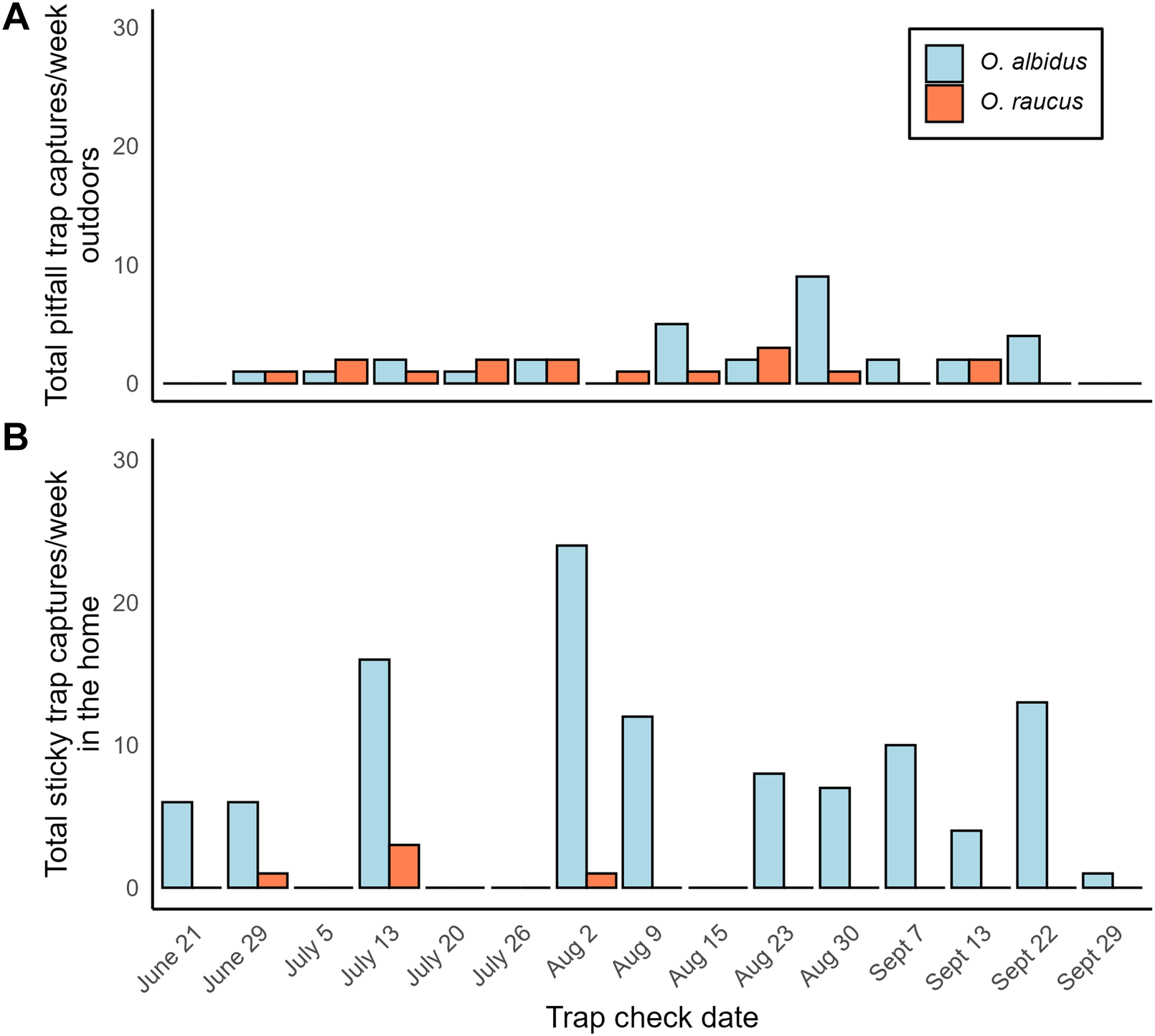
Otiorynchus albidus and O. raucus were the two main weevil species collected in our surveys. A total of 33 O. albidus and 16 O. raucus were collected from pitfall traps, and eight O. albidus and two O. raucus were collected from sticky glue traps on the property in 2023. Of the total number of weevils collected on the property, 68.4% were O. albidus and 31.6% were O. raucus. One hundred and seven O. albidus (95.5%) and five O. raucus (4.5%) were collected from sticky glue traps set up in the basement of the home. Otiorhynchus albidus was present in pitfall traps and in the home from June to September, with peak populations occurring in August (Fig. 5). In addition to trapped weevils, 18 O. albidus and two O. raucus were hand-collected during the first visit to the basement of the home on 21 June 2023.
Seasonal abundance (June–September 2023) of Otiorhynchus albidus and O. raucus surveyed in Kelowna, British Columbia, Canada: A, outdoors, and B, in the basement of a home

We also conducted a follow-up survey with seven pitfall traps on the property and the nearby hiking trail from June to August 2024. One O. albidus and 10 O. raucus were collected from pitfall traps outdoors, and the homeowner collected two O. albidus and 10 O. raucus from sticky traps inside the home. The reasons for the low numbers of O. albidus collected in 2024 compared to 2023 are unknown but may have been associated with the cool, wet spring in 2024. Average temperatures and precipitation in Kelowna in March 2024 ranged from –5.7 °C to 2.8 °C, with 29 mm of rainfall, whereas in March 2023, they ranged from –2 °C to 10 °C, with 21 mm of rainfall. Temperatures in April 2024 ranged from –1.9 °C to 8.5 °C, with 31 mm of rainfall, whereas April 2023 averaged from 3.1 °C to 16 °C, with 23–29 mm of rainfall. May 2024 (6–19 °C and 36 mm rainfall) was similar to May 2023 (7.4–20.8 °C and 31–40 mm rainfall; Environment and Climate Change Canada 2023; Weather Atlas Reference Atlas2024; WeatherSpark 2024a, 2024b, 2024c). Cool spring temperatures and increased rainfall can delay the emergence and reduce the abundance of Otiorhynchus weevils (Smith Reference Smith1932; Son Reference Son2005). The cooler early season conditions in 2024 may have delayed weevil emergence and reduced survival.
Summary of the natural history of O. albidus and related species
Little is known about the natural history of O. albidus. In Ukraine, O. albidus adults are nocturnal (Yunakov Reference Yunakov2003) and parthenogenetic (Yunakov Reference Yunakov2003; Yunakov et al. Reference Yunakov, Nazarenko, Filimonov and Volovnik2018). Bisexual forms of O. albidus are present in Greece, and one male has been found in the Crimea and described under the synonymous name O. strictipennis Magnano (Magnano Reference Magnano1999; Yunakov Reference Yunakov2003; Yunakov et al. Reference Yunakov, Nazarenko, Filimonov and Volovnik2018). Adults of some other Otiorhynchus species are flightless, and their larvae feed underground (Warner and Negley Reference Warner and Negley1976). Several Otiorhynchus species are known to be parthenogenetic in North America, with males known for a few species (Warner and Negley Reference Warner and Negley1976; Hoebeke et al. Reference Hoebeke, LaBonte and Loeffler2024). Other Otiorhynchus species that are pests of berries in British Columbia (i.e., O. sulcatus, O. singularis, O. rugosostriatus, and O. ovatus) overwinter as larvae or adults in the soil or in homes. Adults emerge in the spring, feed on foliage, and lay eggs in or on the soil. Larvae feed on roots, pupation occurs in the soil, and one generation occurs each year (Campbell et. al. Reference Campbell, Sarazin and Lyons1989).
A potential future agricultural and nuisance pest in North America?
Previous reports indicate Otiorhynchus species (O. sulcatus and O. ovatus) have entered human dwellings in large numbers and caused nuisance issues (Robinson Reference Robinson2005). Otiorhynchus albidus therefore has the potential to become a nuisance pest to homeowners in British Columbia, in addition to being a polyphagous pest of ornamentals and fruit crops. The detection of O. albidus could be of potential concern for the tree fruit, wine grape, vegetable, and ornamental plant industries in the interior valleys of British Columbia and elsewhere in North America. How widespread the species’ populations are in British Columbia remains unknown. The fact that O. albidus appears to enter human dwellings could help involve the public in future surveillance efforts, as has been done for other invasive pests that overwinter in homes (e.g., Maistrello et al. Reference Maistrello, Dioli, Bariselli, Mazzoli and Giacalone-Forini2016). This study provides a baseline and some methods for detection and spread of the weevil.
Ongoing monitoring and public involvement in surveillance will aid in early detections. Further research is needed to determine the basic natural history, host plant associations, and life cycle of introduced O. albidus populations in British Columbia to support the development of effective integrated pest management strategies, should the species become established and widespread. Phytosanitary measures (Canadian Food Inspection Agency 2023) and enforcement are also important in preventing additional introductions of O. albidus and other European Otiorhynchus species into North America.
Acknowledgements
The authors thank Noah Betz for technical support, a keen homeowner for her help, enthusiasm, and cooperation, and anonymous editors for reviewing the manuscript. The authors thank Dr. Nikolai Yunakov for identifying O. albidus. Anthony Davies generated the habitus photograph of O. albidus. Funding for the project was provided by the governments of Canada and British Columbia through the Sustainable Canadian Agricultural Partnership, a Canadian federal–provincial–territorial initiative.