INTRODUCTION
Whereas many oncology health professionals (OHP) feel comfortable and confident discussing different aspects of their patients' care, discussing the transition from curative cancer treatment to palliative care is often difficult and stressful for both clinicians and patients (Fallowfield et al., Reference Fallowfield, Lipkin and Hall1998; Baile et al., Reference Baile, Lenzi and Parker2002; Evans et al., Reference Evans, Tulsky and Back2006). Although it is recommended that palliative care concepts be introduced early in the care trajectory of patients with advanced cancer, this often does not happen. Patients may then feel that the introduction of palliative services implies that death is imminent, that nothing further can be done, or that they are being abandoned (Quill & Cassel, Reference Quill and Cassel1995; Baile et al., Reference Baile, Glober and Lenzi1999; Daneault et al., Reference Daneault, Lussier and Mongeau2006). OHP may have difficulties discussing various aspects of the transition to palliative care, including referral to palliative care services and cessation of anti-cancer treatments, as well as related topics such as discussing prognosis and establishing goals of care. Similarly, OHP may feel helpless, or believe that they are failing the patient (Meier et al., Reference Meier, Back and Morrison2001; Armstrong & Holland, Reference Armstrong and Holland2004), which may lead to distancing, withholding of prognostic information, or continuing unnecessary and risky treatments (Maguire, Reference Maguire1985; Jecker, Reference Jecker1995; Baile et al., Reference Baile, Lenzi and Parker2002).
Previous research has suggested that poor communication practices can affect cancer patients' psychological adjustment (Roberts et al., Reference Roberts, Cox and Reintgen1994; Bishara et al., Reference Bishara, Loew and Forest1997), quality of life (Ong et al., Reference Ong, Visser and Lammes2000), satisfaction (Ong et al., Reference Ong, Visser and Lammes2000; Back, Reference Back2006), and understanding of their condition and likely outcomes (The et al., Reference The, Hak and Koeter2000; Wolfe et al., Reference Wolfe, Klar and Grier2000; Hancock et al., Reference Hancock, Clayton and Parker2007). Poor communication practices may also cause extra stress for OHP themselves, which may in turn contribute to high rates of clinician burnout (Ramirez et al., Reference Ramirez, Graham and Richards1995; Graham et al., Reference Graham, Ramirez and Cull1996; Armstrong & Holland, Reference Armstrong and Holland2004; Trufelli et al., Reference Trufelli, Bensi and Garcia2008).
Although many OHP believe they communicate clearly and effectively, patients often report a lack of awareness or confusion surrounding their diagnosis and treatment intent, an insufficient amount of information, and little acknowledgement of their social/emotional issues (Pronzato et al., Reference Pronzato, Bertelli and Losardo1994; Evans et al., Reference Evans, Tulsky and Back2006; Hancock et al., Reference Hancock, Clayton and Parker2007; Pollak et al., Reference Pollak, Arnold and Jeffreys2007). Research does however suggest that OHP are receptive to communication skills training (Fallowfield et al., Reference Fallowfield, Lipkin and Hall1998; Barnett et al., Reference Barnett, Fisher and Cooke2007); and systematic reviews (Fellowes et al., Reference Fellowes, Wilkinson and Moore2004; Gysels et al., Reference Gysels, Richardson and Higginson2004) have shown these training programs can improve communication between OHP and their patients.
Many of the communication training programs included in these systematic reviews are retreat-based (with clinicians trained over a 2–3 day period), or involve multiple training sessions conducted over many months. Although the evidence supports the effectiveness of these programs, such protracted communication training may be impractical in the busy oncology setting. These types of training programs can also be expensive, making them unfeasible in many situations. Effective, practical, and inexpensive communication skill training programs, tailored to the unique needs of OHP, are therefore needed. In this paper we describe a program developed between the National Breast and Ovarian Cancer Centre (NBOCC) and Cancer Council Victoria (CCV), to improve OHP communication around the transition to palliative care; and report on the implementation of this program in cancer care hospitals in Victoria.
The VCCCP “Transition to Palliative Care” Communication Skills Training Program
The Victorian Cancer Clinicians Communication Program (VCCCP) is run by CCV, a leading cancer charity in Victoria, Australia. The VCCCP aims to provide evidence-based communications skills training for OHP, thus helping OHP communicate clearly and effectively with their patients (See Sutherland et al., Reference Sutherland, Hegarty and White2007 for further details on the development, structure, and rationale of the VCCCP training workshops). In 2007, NBOCC developed an evidence-based communication skills training module to help OHP communicate with their cancer patients about the transition to palliative care. The module was based on palliative care communication guidelines commissioned by NBOCC (National Breast and Ovarian Cancer Centre, 2005; Schofield et al., Reference Schofield, Carey and Love2006). CCV, with some funding support from NBOCC, then implemented this module through the VCCCP, providing communications training in palliative care discussion for Victorian cancer health professionals.
The VCCCP transition to palliative care workshop is conducted over 4.5 hours in the participants' own workplace. Each interactive workshop is conducted by two trained facilitators, includes a trained actor (simulated patient), and involves 6–10 participants. The workshops begin with a short slide presentation detailing the rationale for communication skills training, the evidence-base to support this training, and a review of the recommended guidelines regarding discussions around the transition to palliative care. A DVD demonstrating effective and appropriate communication is then shown. This is used as a starting point for group discussion of the communication techniques shown and their effectiveness.
The majority of each workshop involves individual participant role-play with a specialized and highly-trained actor simulating a cancer patient. The actors are given an extensive case scenario/briefing, to ensure their role is an accurate portrayal of a cancer patient. The role-play scenarios aim to explore challenging communication settings, as determined by the workshop participants. Aspects of the transition to palliative care may include breaking bad news, discussing prognosis and goals of care, introducing palliative care services, and discussing discontinuation of anti-cancer treatments. Participants are encouraged to experiment with recommended strategies and practice specific phrasing or communication techniques they have learned through the workshop. They reflect on their role-play experience, and receive feedback on their performance from the workshop facilitators, from other participants and, where appropriate, from the actor (in role as the patient).
The workshop promotes group discussion allowing participants the opportunity to share their experiences, talk about the challenges they face when engaging in palliative care discussions with patients, and discover possible ways in which these challenges can be overcome. These discussions show participants that they are not alone in their concerns, that their fears and difficulties are experienced by their peers, and they normalize participants' feelings and behaviors around palliative care discussions.
All participants are provided with a workshop pack containing a copy of the slides, a workshop manual (summarizing the topic area and the evidence-based communication guidelines), some background reading, and a copy of the communication guidelines (National Breast and Ovarian Cancer Centre, 2005; Schofield et al., Reference Schofield, Carey and Love2006).
Each workshop facilitator is a senior OHP with a special interest in communication. Facilitators for an individual workshop usually include a medically trained professional (doctor/nurse), with significant clinical experience, and an allied health professional such as a psychologist or social worker, who generally facilitates the experiential parts of the workshop and helps with communication and group discussion. All facilitators take part in an initial training program lasting 1.5 days; where they first participate in a transition to palliative care workshop (half day), primarily to familiarize themselves with the program, and then are taught and practice facilitation skills (1 full day).
The transition to palliative care workshops are held in hospitals involved in the care of cancer patients, with program oversight from CCV. Facilitators are responsible for organizing the workshops in their workplace, recruiting participants, and conducting the workshop sessions. Participation in the workshop is generally open to all OHP. The program is advertised within hospitals through a variety of methods including posters, staff emails, information brochures, and announcements at staff meetings. CCV provides promotional materials such as posters and information brochures to aid recruitment, and all materials for the workshop itself. CCV also provides initial training and support for facilitators, and a central contact person for all facilitators throughout Victoria.
Program Evaluation and Aim of Present Study
An important part of the transition to palliative care workshops involves regularly collecting feedback from participants on the workshops and their various components. Such feedback allows us to check that participants are satisfied with the information provided, and helps ensure that participants gain the maximum benefit from, and enjoy their participation in, the program. Workshop participants are asked for their views on the program and their satisfaction with the program through short evaluation questionnaires. Here, we report the results of a short satisfaction evaluation of the VCCCP transition to palliative care communication workshops.
METHOD
Workshops
Nine VCCCP transition to palliative care workshops were conducted over the period from July 2007 to September 2008. All workshops were conducted in metropolitan Melbourne, Victoria, Australia.
Evaluation Questionnaire
A self-administered, pen-and-paper, three-page questionnaire was completed at the end of each workshop. The questionnaire assessed satisfaction with different aspects of the workshop. Participants indicated the extent to which they agreed or disagreed with eight statements reflecting the relevance, usefulness, and perceived benefit of the workshop using a five-point Likert scale. Participants were then asked to indicate if they agreed or disagreed with six statements relating to the effectiveness of the role-play using a five-point Likert scale. Examples of these items included “The role-plays were believable” and “I developed skills during the role-plays that I will be able to use.” Five separate characteristics of the workshop, such as the workshop booklet and the time of day that the workshops were held, were rated by asking participants to indicate their views on a Likert scale ranging from 1 “excellent” to 4 “poor.” Participants also indicated their global level of satisfaction with the workshop overall and with the various components of the workshop, such as the actors used in the role-plays, and the workshop facilitators, using a Likert scale ranging from 1 “very satisfied” to 5 “very dissatisfied.”
One question assessed participants' beliefs regarding the extent that workshop had improved their confidence in discussing the transition to palliative care on a scale from 1 “not at all” to 5 “very much,” with a separate item “never been a problem for me.” Finally, demographic characteristics (gender, age, hours of work [full-time or part-time], years working in oncology, and clinical specialty), and participants' reasons for attending the workshop were assessed.
This study was conducted as part of CCV's Cancer Information and Support Service quality assurance, and was exempt from ethical review. However an independent senior researcher experienced in psychosocial research reviewed the study protocol prior to data collection.
Data Analysis
All data were analysed using SPSS version 14.0. Frequencies were used to describe the data and open-ended responses were back-coded to summarize the data. Participants' comments on the role-plays and separate workshop components were also examined for content.
RESULTS
Sample Demographics
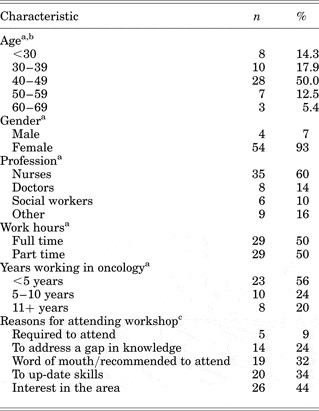
A total of 62 participants completed the workshop evaluation. Demographic characteristics are shown in Table 1. Most participants were women, and the majority were nurses. Participants were aged from 23 to 67 (mean = 42.3 years, SD = 10.1 years) and had been working in an oncology setting for an average of 5.9 years (SD = 6.5 years). The main reasons for attending the workshop were: interest in the area (44%), to up-date skills (34%), or because the workshop had been recommended to participants (32%).
Demographic characteristics of workshop participants (N = 62)

aNumbers do not add to 62 due to missing values (not shown).
bPercentages do not equal 100 due to rounding.
cPercentages do not equal 100 as multiple answers were possible.
Satisfaction with Transition to Palliative Care Workshop
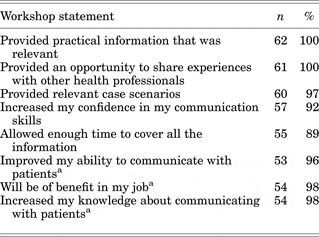
Participants' satisfaction with the workshop was very high (Table 2). All, or nearly all, participants thought that the workshop provided relevant practical information and case scenarios, and an opportunity to share experiences with their peers. Similarly, the vast majority of participants said that the workshop had increased their knowledge, ability, and confidence in their communication skills. Whereas the lowest level of satisfaction was found for the item “The workshop allowed enough time to cover the relevant information,” the majority of participants still agreed with this statement.
Percentage of participants answering “agree” or “strongly agree” to statements about the workshop preceded by “to what extent do you agree or disagree with the following statements about the workshop?”
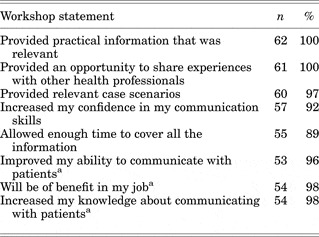
aData only available for 55 participants because of an administration error with seven questionnaires.
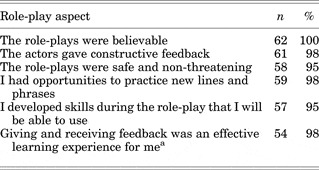
Participants were also very satisfied with the role-play component of the workshop (Table 3). All, or nearly all, participants reported that the role-plays were believable, the actors' feedback was constructive, that they had the opportunity to practice new lines and phrases, and that giving and receiving feedback during the role-play sessions was an effective learning experience. Participants' comments about their experiences of the role-plays were all positive, and mainly focused on the high quality of the acting and the usefulness of the role-plays as a learning tool, for example: “Actor was very believable,” “It will really help having done this workshop to deal with difficult situations,” and “Very challenging scenarios, fabulous acting.” Workshop characteristics such as the length, timing, and location of the workshop were also rated very highly by participants, with between 94% and 98% of participants rating each of these characteristics as “good” or “excellent.” All participants similarly rated the booklet provided in the workshop pack as being “good” or “excellent.”
Percentage of participants answering “agree” or “strongly agree” to statements about the usefulness of the role-plays, preceded by “to what extent do you agree or disagree with the following statements about the role-plays?”

aData only available for 55 participants because of an administration error with seven questionnaires.
All 62 participants were “satisfied” or “very satisfied” with the workshop facilitators, the DVD, the actors in the role-play sessions, the level of participation, and the workshop as a whole. Participants again expressed positive views about the actor from the role-play exercise, as well as the workshop facilitators: “Facilitators were most supportive and encouraging,” “Lots of feedback from facilitators, participants and actor. Very useful,” and “Facilitator was fabulous and made participants feel safe to explore the topic.”
Participants' Confidence in Discussing the Transition to Palliative Care in Clinical Practice
One global question assessed participants' opinions about how much the workshop had increased their confidence in discussing the transition to palliative care with cancer patients in the clinical setting. Most participants indicated that the workshop had increased their confidence in discussing the transition to palliative care “quite a bit” (50.0%), or “very much” (38.3%). Four participants felt their confidence levels had increased “somewhat” (6.7%), 3.3% felt their confidence had increased “a little bit,” and 1.7% felt their confidence levels had not increased from participating in the workshop.
DISCUSSION
The transition to palliative care is a difficult period for cancer patients, and presents difficult communication challenges for OHP. Discussing the diagnosis of advanced cancer, prognosis, goals of care, referral to specialist palliative care services, and cessation of anti-cancer treatments is challenging for OHP, and for patients and their families/carers. Sensitive, open, honest, and clear communication during this period is essential.
Increasingly, communication skills training is regarded as an essential component of training in palliative medicine and oncology. In Australia, participation in communication skills training is an absolute requirement for training in palliative medicine and branches of oncology. Government bodies, hospitals, and consumer groups are also pushing for improved communication skills, arguing that excellent communication skills are a key clinical competency.
We describe a brief, practical communication skills training workshop, specifically targeted to the unique needs of OHP, to aid them in negotiating the transition to palliative care with patients. Participant evaluation of the workshops showed very high satisfaction ratings for all aspects of the workshop content and format. Additionally, participants reported that the workshop increased their perceived confidence levels in these discussions. They also felt that the workshop provided practical information, was relevant, and would benefit them in their jobs. We believe that this type of training could be easily implemented within the workplace.
Strengths and Limitations of the Transition to Palliative Care Workshop
Unlike a number of other communication skills training programs (Fellowes et al., Reference Fellowes, Wilkinson and Moore2004; Gysels et al., Reference Gysels, Richardson and Higginson2004), our workshop was designed to meet the unique challenges of a busy oncology setting by providing a clear and effective training program to aid palliative care discussions, delivered in a half-day format. The workshop's main learning tool, participant role-plays, were rated as believable, safe, and non-threatening, and enabled participants to practice new communication skills. The actors used in the role-play situations, as well as the workshop facilitators, were rated extremely highly — suggesting that the use of a simulated patient in a role-play situation and guided discussions with trained facilitators presented an effective learning experience.
There are some weaknesses in our evaluation approach. First, the single post-workshop evaluation design does not allow exploration of participants' expectations of the workshop, nor does it allow us to assess whether participants' confidence levels changed significantly from pre-workshop levels. Second, the evaluation is based upon participant self-report. A lack of objective measures, or patient feedback on communication with their OHP around this period, means that we cannot determine whether the workshop resulted in any changes in OHP's actual clinical practices. Similarly, our design lacked a control group and a long-term follow-up period, meaning impact of the training on actual practice is not known.
In this evaluation, the majority of participants were female nurses (60%), with a small number of doctors (n = 8) and social workers (n = 6) participating. If the program aims to train clinicians who are most likely to discuss the transition to palliative care with patients, strategies to encourage clinician attendance at these workshops are needed. Attendance at the workshops is mostly voluntary, with >91% of participants (n = 57) self-selecting to attend. It is possible that participants who volunteer for the workshops may be better communicators, or more motivated to improve their communication skills compared to other OHP. Most participants in the present study were interested in communication or wanted to up-date their skills, suggesting that they were aware of their need for training in this area. These participants may be seen as “early adopters” (Rogers, Reference Rogers1995; Berwick, Reference Berwick2003), who can act as facilitators of the program in their workplace. Our transition to palliative care workshops were rated very highly in terms of their clinical applicability and practical benefit, and participants were very satisfied with all workshop components. This increases the likelihood that positive feedback about the trainings will be passed on to other OHP, therefore increasing future participant numbers and, by extension, the use of appropriate communication techniques during the transition to palliative care.
This brief evaluation shows that participants in the VCCCP transition to palliative care workshops are highly satisfied, and perceive the communications skill training as effective. The VCCCP “train-the-trainer” model, together with support for workshops in the hospital setting, represents a successful and sustainable model of communication skills training for cancer clinicians. The next step in the development of the training program is to broaden the type of people who attend the workshops. As mentioned previously, the workshops are administered at the individual hospital level, with staff from individual institutions organizing and conducting the workshops in their place of employment. Support for communications training from hospital management and administration is crucial for such an approach to succeed. Positive feedback such as that obtained from our evaluation could be used to highlight the high regard in which OHP hold our communications training workshops, therefore leading to more institutional support for the program. Our satisfaction-based evaluation therefore, should be seen as the first step toward wider dissemination of the transition to palliative care communication skills training framework.
ACKNOWLEDGEMENTS
We acknowledge the support of the National Breast and Ovarian Cancer Centre, in particular Caroline Nehill, for their assistance in developing this communication skills module.