Introduction
Hard turning is defined as a turning process of work pieces that have hardness values over 45 Hardness Rockwell C (HRC) (Saini et al., Reference Saini, Ahuja and Sharma2012). This process is intended for finish machining of a wide range of hardened steel work pieces. In addition to simplify the process, hard turning is capable of producing work pieces with the desired surface finish quality. Its advantages, such as increased flexibility of the manufacturing process, higher rate of material removal, better environmental characteristics, and less cost, make it an undeniably economical manufacturing process (Rashid et al., Reference Rashid, Goel, Luo and Ritchie2013). With all this, searching for the economically optimum cutting condition is of great importance in hard turning processes because of high tool wear rate (TWR) and resulting drastic tool costs (Chandrasekaran et al., Reference Chandrasekaran, Muralidhar and Dixit2014).
Increasing the productivity of machining processes and improving the surface quality of the machined parts are among the most important challenges, which have been subject of several research works, where different techniques and mathematical tools have been used. In traditional machining systems, the optimum cutting parameters are selected by the part programmer or information given in the tool manufacturer's catalog with no consideration of cutting tool variations such as tool wear during the machining process. These systems cannot offer an optimal process in the sense of material removal rate or machining costs, because the cutting conditions are selected conservatively and without taking account the real condition of a cutting tool. It has been proved that machining variations, such as gradual tool wear, affect the optimum cutting parameters and only selecting the appropriate optimal parameters could result in high performance of machining process (Chandrasekaran et al., Reference Chandrasekaran, Muralidhar and Dixit2014).
In recent years, various evolutionary algorithms have been used to optimize cutting parameters which include using the bio-inspired algorithm such as genetic algorithm (GA) (Kant and Sangwan, Reference Kant and Sangwan2015), particle swarm optimization (PSO) (Hu et al., Reference Hu, Wang, Wang, Wang and Zhang2014), artificial bee colony (ABC), and simulated annealing (SA) (Shukla and Singh, Reference Shukla and Singh2017). However, a remaining drawback of these prior works is that the operating parameters, which include feed rate, cutting speed, and depth of cut, are determined without considering cutting tool state (Chiang et al., Reference Chiang, Liu, Lee and Chieng1995). As a result, optimum conditions, which are obtained by the majority of these prior works, are inefficient and introduce operating conditions that are far from the optimal cutting criteria. For this reason, the adaptive optimization system, which applies an online adjustment of the operating parameters, is being studied with interest (Ko and Kim, Reference Ko and Kim1998).
Chiang et al. studied an intelligent-based architecture with neural networks for online determination of optimal cutting parameters. Information of tool state was extracted from trained neural networks. Optimum cutting parameters were obtained by maximizing the material removal rate according to defined operating constraints (Chiang et al., Reference Chiang, Liu, Lee and Chieng1995). Ko and Cho, in a milling process, investigated a model-based optimization method to maximize the material removal rate. In their method, a penalty function and a multilayer neural network for predicting tool flank wear were used (Ko and Cho, Reference Ko and Cho1998). Ko and Kim modeled a turning process by a multilayer neural network with an iterative learning method. Cutting parameters of the process model were optimized adaptively through GA. Some constraints were given on the input parameters and the outputs of the machining process to provide the desired surface quality (Ko and Kim, Reference Ko and Kim1998). Liu and Wang examined an adaptive controller with optimization for the milling process based on two kinds of neural network. One of them was used for the online modeling of the milling system, and the other one was used for the real-time optimal control of the milling process. They show that this method improved the efficiency of the milling process about 15% in comparison with that of traditional systems. Furthermore, the value of cutting force remained in a limited area (Liu and Wang, Reference Liu and Wang1999). A similar research was done by Zuperl and Cus in this field. They used a neural network-based approach for the optimization of cutting parameters. They described the multi-objective technique of optimization of cutting process considering the technological, economic and organizational limitations (Zuperl and Cus, Reference Zuperl and Cus2003). Ivester and Heigel, in the turning operation of complex parts, adaptively optimized the cutting parameters through a hierarchical supervisory control model (Ivester and Heigel, Reference Ivester and Heigel2000). Abellan et al. investigated an adaptive control optimization (ACO) system for optimizing a multi-objective function based on the material removal rate, quality loss function related to surface roughness, and cutting tool life subjected to surface roughness specification constraints. The overall desirability of their proposed method was 0.520, whereas optimization based on constant cutting parameters provided the value of 0.472 for desirability. It means that their method improved the process by approximately 10% (Abellan et al., Reference Abellan, Romero, Siller, Estruch and Vila2008). Silva et al. introduced an adaptive control with optimization methodology for optimizing the production cost subjected to quality constraints in high-performance milling operations of hardened steel. The paper dealt with optimizing the cutting operation considering the current state of the cutting tool using artificial intelligence techniques for modeling and optimizing. Their proposed methodology reduced the cost in a 13% experimentally in comparison with optimization with constant cutting parameters. It must be added that the surface roughness was also well contained within the specified limits at all times (Silva et al., Reference Silva, Abellán-Nebot, Siller and Guedea-Elizalde2014). Chandrasekaran et al. carried out an optimization of a finish turning process using a fuzzy set-based optimization strategy. The introduced optimization strategy was efficient for the problem with a large number of design variables. It also acknowledged the presence of statistical variation in the process (Chandrasekaran et al., Reference Chandrasekaran, Muralidhar and Dixit2014).
In general, tool wear is a critical factor in the turning process because of its negative effect on produced surface quality, production costs, and machining time. The selection of constant optimum cutting parameters cannot lead to optimal machining conditions. As a result, by gradually increasing tool wear, cutting parameters should be chosen accordingly to obtain optimal condition. In the majority of performed research in the field of optimization of machining processes, constant cutting parameters have been used until the end of machining process and the effect of gradual tool wear has been neglected, which leads to results far from the real optimal condition. On the other hand, other relevant research works that have considered the effect of tool wear on optimum cutting parameters have utilized expensive sensory systems to evaluate tool wear online. These sensory systems impose an extra cost to the machining process and make the process economically unjustifiable. Another important task that must be considered thoroughly in machining optimization is the selection of a comprehensive performance index (Pourmostaghimi and Zadshakoyan, Reference Pourmostaghimi, Zadshakoyan, Kumar and Davim2019). In most prior research, simple machining outputs such as cutting cost, machining time, or Material Removal Rate (MRR) have been investigated, and the usage of combinatorial indexes has to be developed. The shortage of the application of model-based strategies in the hard turning process is another important matter that must be considered.
In this work, an intelligent model-based optimization method was introduced for the hard turning of AISI D2. To reach optimal machining conditions, the proposed method was designed based on cutting tool flank wear during the process. Cutting parameters, which were considered to be optimized, were cutting speed (v) and feed rate (f). For modeling of the surface roughness and tool flank wear, artificial neural network (ANN) and genetic programming (GP) techniques were used, respectively. Then, the PSO algorithm was applied to find the optimum cutting parameters by maximizing the predefined performance index under the given constraints. A relatively thorough performance index combined with MRR and production cost subject to certain constraints on surface roughness and cutting parameters were defined. The defined performance index and given constraints reflect the real machining conditions and encompass all machining important aspects. The results of experiments showed that using the proposed optimization method increased the efficiency of turning process impressively and work pieces with acceptable surface quality were produced.
Intelligent optimization procedure
Intelligent model-based optimization methodology
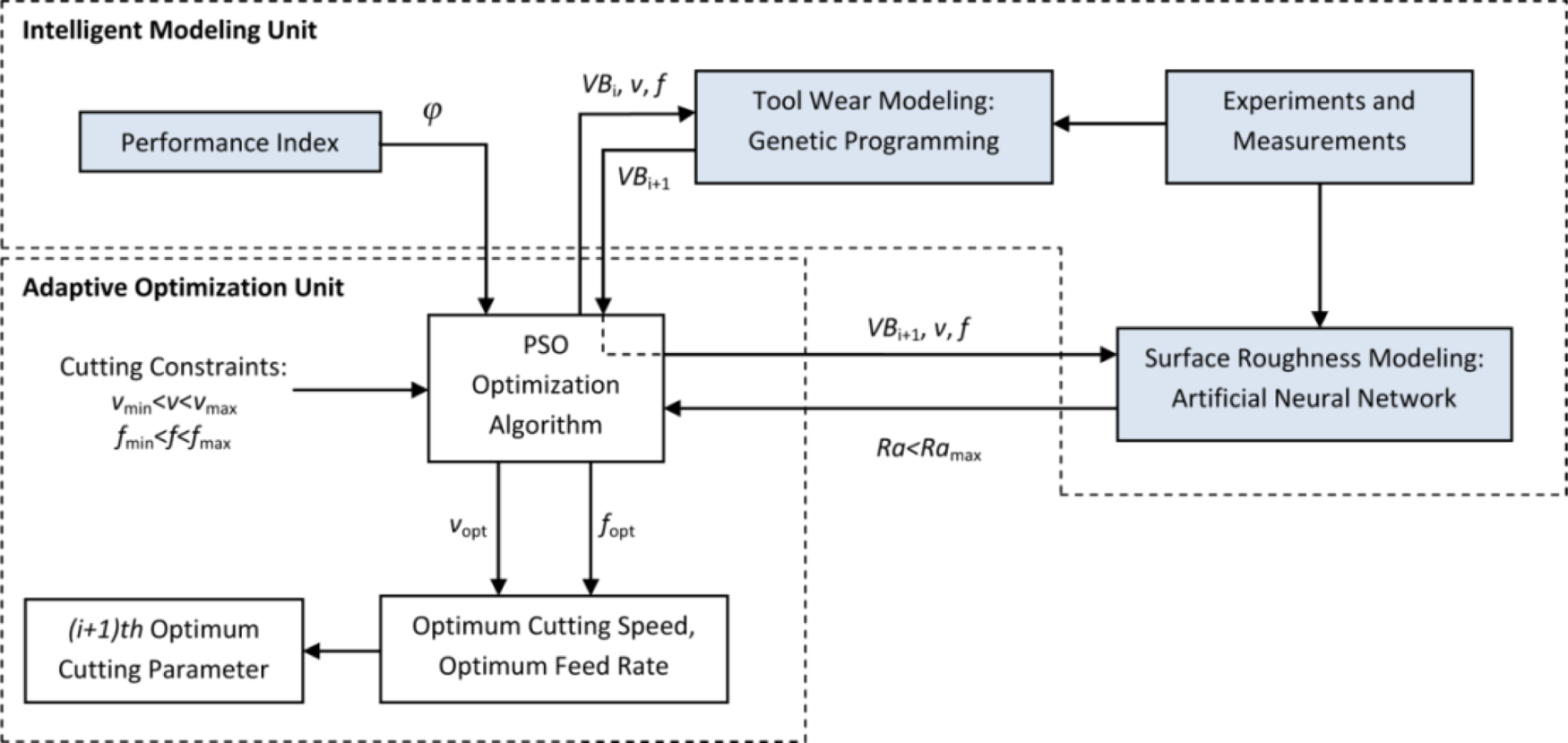
Surface roughness in hard turning, as well as machining costs, is under the influence of tool wear. On the other hand, TWR is drastically intense in hard turning. Therefore, it can be concluded that the major problem when optimizing cutting parameters in hard turning is to correlate optimum cutting parameters to gradually increasing tool wear. A general schematic overview of intelligent optimization methodology is shown in Figure 1. As it can be seen, the optimization unit based on information obtained from an intelligent modeling unit and considering specified constraints predicts optimum cutting parameters.
General schematic overview of intelligent model-based optimization methodology.

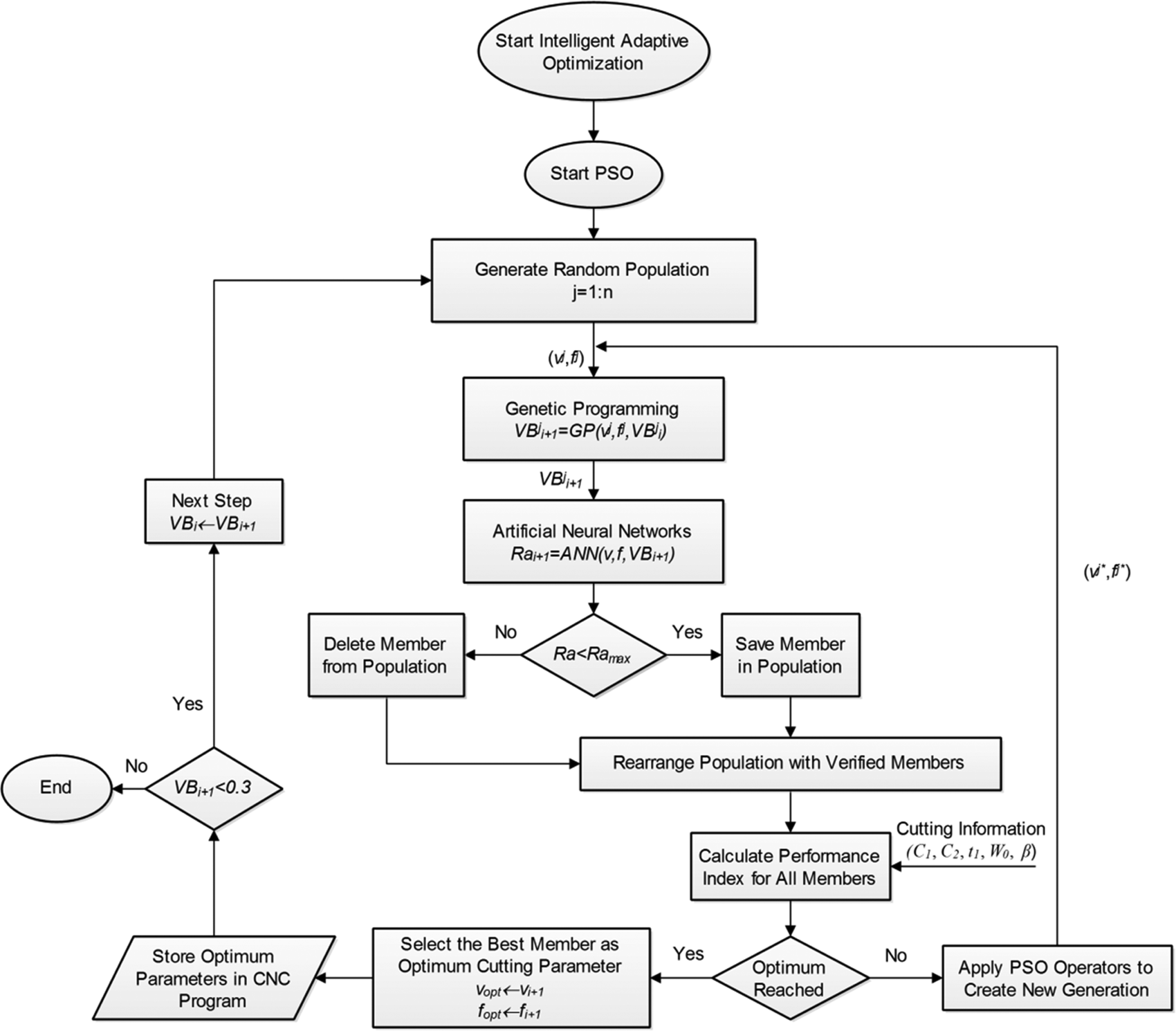
In this research, an intelligent optimization of machining performance during finish turning of hardened AISI D2 is proposed. The performance index includes both machining cost and material removal rate. The diagram of the proposed methodology is shown in Figure 2.
Proposed intelligent model-based optimization methodology.

PSO starts the optimization process by generating a random population composed of various cutting speeds and feed rates. GP predicts tool wear for each member of the population using the obtained genetic equation after 1 s of machining. Using the output of GP unit, surface roughness in the next step for that population can be predicted by trained ANN. The members that result in higher surface roughness than permissible value are removed from the population. For the rest, the value of the performance index is calculated. A member, or cutting parameter couple, which has the maximum performance index, is selected as the optimum cutting parameter for the next step. In the next step, the flank wear predicted for previous optimum cutting parameters is selected as the primary flank wear, and the optimization process is performed again. The performance index considered in this research was given as below (Koren, Reference Koren1988):
 $$\varphi = \displaystyle{{v \times f \times a_{\rm p}} \over {C_1 + \lpar {C_1 \times t_1 + C_2 \times \beta} \rpar \times \lpar {{\rm TWR}} \rpar /W_0}}.$$
Subject to the following constraints on the cutting parameters and surface roughness:
 $$v_{{\rm min}} \le v \le v_{{\rm max}},$$
 $$f_{{\rm min}} \le f \le f_{{\rm max}},$$
 $$Ra \le Ra_{{\rm max}}.$$
In which the numerator is the material removal rate and the denominator is machining cost. The depth of cut (a p) was selected as 1 mm. Cutting information includes C 1, C 2, t 1, W 0, and β. C 1 is the cost of a machine and operator per unit time and was set to 0.1 $/min (6 $/h). C 2 is the cost of a tool and regrind per change and was considered as 2.5 $. Tool change time, t 1, was 1 min in experiments. W 0 is a maximum flank wear and was considered as 0.3 mm. β is an adjustable parameter that varies between 0 and 1. This parameter determines the type of performance index. For β = 1, φ is the reciprocal cost per part unit; for β = 0, φ calculates the production rate; and for 0 < β < 1, φ considers both of them (Koren, Reference Koren1988). The value of β = 0.5 was selected in this research.
The main reasons for limitations on cutting parameters are economical and organizational aspects. For example, lower values of feed rate result in lower surface roughness but decrease the material removal rate remarkably. On the other hand, high feed rates enhance the removal rate but adversely affect the produced surface roughness. This matter can be considered when choosing appropriate values for cutting speed. High cutting speeds improve the removal rate but accompany with severe TWR. Low cutting speeds lead to lower TWR but decrease the removal rate drastically. Therefore, cutting speed and feed rate are limited to a specified range. The optimization operation continued until the end of tool life considering both produced surface roughness and the value of tool flank wear.
In order to evaluate the efficiency of the proposed method, a comparison was made with machining by constant optimized cutting parameters. For this purpose, the sum of performance indexes (∑φ i) was utilized as a comparison criterion. The performance index was considered as presented in Eq. (1), and the same intelligent models were utilized to find constant optimum cutting parameters.
Genetic programming
Recently, nature-inspired algorithms, such as GA, have found a special place in engineering optimization problems (Nikdel et al., Reference Nikdel, Hosseinpour, Badamchizadeh and Akbari2014). GP is basically a GA applied to a population of members or computer programs. Against GA, which operates on strings of numbers or codes, GP has to operate on members or string of functions and numbers (Ekárt and Márkus, Reference Ekárt and Márkus2003). GP allows, in comparison with GA, the optimization of much more complicated structures and therefore can be applied to a greater diversity of problems (Zadshakoyan and Pourmostaghimi, Reference Zadshakoyan and Pourmostaghimi2013). Steps of GP that are performed in each stage of programming include: (i) Generation of a random population. (ii) Evaluation of the fitness of all members of the population. Moreover, if a certain criterion is reached (e.g., a certain fitness threshold), the algorithm will be terminated and the member with the highest fitness will be selected as the final result. (iii) Replacing the current population by a new population by means of applying genetic operators (reproduction, crossover, and mutation) probabilistically. (iv) Return to step (ii). The aim of GP is to find out the member or offspring that best solves the problem (Koza et al., Reference Koza, Al-Sakran and Jones2008). Some successful applications of GP have been reported in product design (Lee and Tang, Reference Lee and Tang2009), learning parametric design (Matthews et al., Reference Matthews, Standingford, Holden and Wallace2006), human-competitive design challenge (Spector, Reference Spector2008), mechanical vibration absorbers (Hu et al., Reference Hu, Goodman, Li and Rosenberg2008), quantum computing circuits (Spector and Klein, Reference Spector and Klein2008), and creativity in automated design (Koza et al., Reference Koza, Keane, Streeter, Adams and Jones2004).
In this paper, for the determination of the relationship between tool flank wear and cutting parameters in hard finish turning of AISI D2, a genetic equation with GP was developed. The genetic equation for the flank wear characteristics was developed as follows:
 $$VB_{i + 1} = F\lpar {v\comma \,f\comma \,\Delta t\comma \,VB_i} \rpar, $$
where VB i+1 is flank wear after time Δt, VB i is the primary flank wear, v is cutting speed, and f is the feed rate. F is the function that correlates the value of flank wear after Δt seconds to the primary flank wear (VB i), cutting speed (v), and feed rate (f). Arithmetic functions were selected as follows:
 $$G = \lcub { +\comma -\comma \times \comma \,1/x \comma \, x^2\comma \, x^3\comma \, {\rm exp}} \rcub. $$
The evolutionary parameters for the determination of the genetic equation are the number of chromosomes, M s = 30, and the number of generations, G = 2000. The genetic operations rates are selected as P m = 0.1 for mutation and P c = 0.1 for crossover.
Artificial neural networks
Classifiers play a vital role in tool condition monitoring systems. ANN, as a popular classifier, is based on the massive parallelism of neurons that have high connectivity. This architecture differentiates ANN from conventional computing (Asadi et al., Reference Asadi, Asadi and Kareem2016). Each neuron in a network receives input signals from other neurons, and in turn, passes another signal to other neurons through weighted connections. The output signal passes through several pathways to provide an input signal to other neurons. Operating individually, an alone neuron lacks computational performance; however, the high connectivity among neurons results in the strength and speed in ANN that makes neural networks such a powerful algorithm (Chen and Chang, Reference Chen and Chang2016).
ANNs have been used in various engineering areas such as industrial and functional modeling (Goel, Reference Goel2013), automatic feature recognition (Babić et al., Reference Babić, Nešić and Miljković2011), structural analysis (Jadid and Fairbairn, Reference Jadid and Fairbairn1994), and computer-aided engineering (Dym and Levitt, Reference Dym and Levitt1994).
A three-layer neural network with 10 neurons in each hidden layer was utilized for the prediction of surface roughness based on flank wear and cutting parameters. Input parameters were flank wear (VB i), cutting speed (v), and feed rate (f). The Levenberg–Marquardt training algorithm was used to train the feed-forward back-propagation network in this research.
Particle swarm optimization
Inspired from the nature, new optimization techniques are devised and being investigated in various fields recently (Eby et al., Reference Eby, Averill, Punch and Goodman1999). Among these techniques, some have proved to be drastically effective in engineering-related subjects such as GA (Su and Yan, Reference Su and Yan2015), artificial ant colony (Rossi and Lanzetta, Reference Rossi and Lanzetta2013), SA (Brown and Cagan, Reference Brown and Cagan1997), and PSO (Badamchizadeh et al., Reference Badamchizadeh, Nikdel and Kouzehgar2010).
PSO is a relatively modern optimization method that has been used successfully in various optimization problems (Adeniran and El Ferik, Reference Adeniran and El Ferik2017). In the PSO algorithm, the population is considered as a swarm and each individual as a particle. The algorithm starts with the generation of random particles within the specified domain and searching for the global optimum solution by updating generation. This algorithm has the capability to serve fine optimum results compared with traditional techniques (Keles, Reference Keles2018).
In PSO, each particle has a cognitive factor and a social factor. Cognitive factor has a direct effect on the trajectories of particles, whereas a social factor makes the particle to keep its best position and affects the speed of the particle. By changing the values of these factors carefully, the optimum solution for the problem can be obtained. The positions of the particles are updated with respect to the velocity of the individual, and the fitness function value is evaluated through this new particle position. If the obtained fitness value is better than values in the last iteration, it will be stored and update the solution (Zeng et al., Reference Zeng, Tan, Dong and Yang2014). In the present study, the population size was 15 and appropriate values for both cognitive and social factors were selected. The optimization process would be stopped when the maximum of generation 100 was reached.
Experimentation
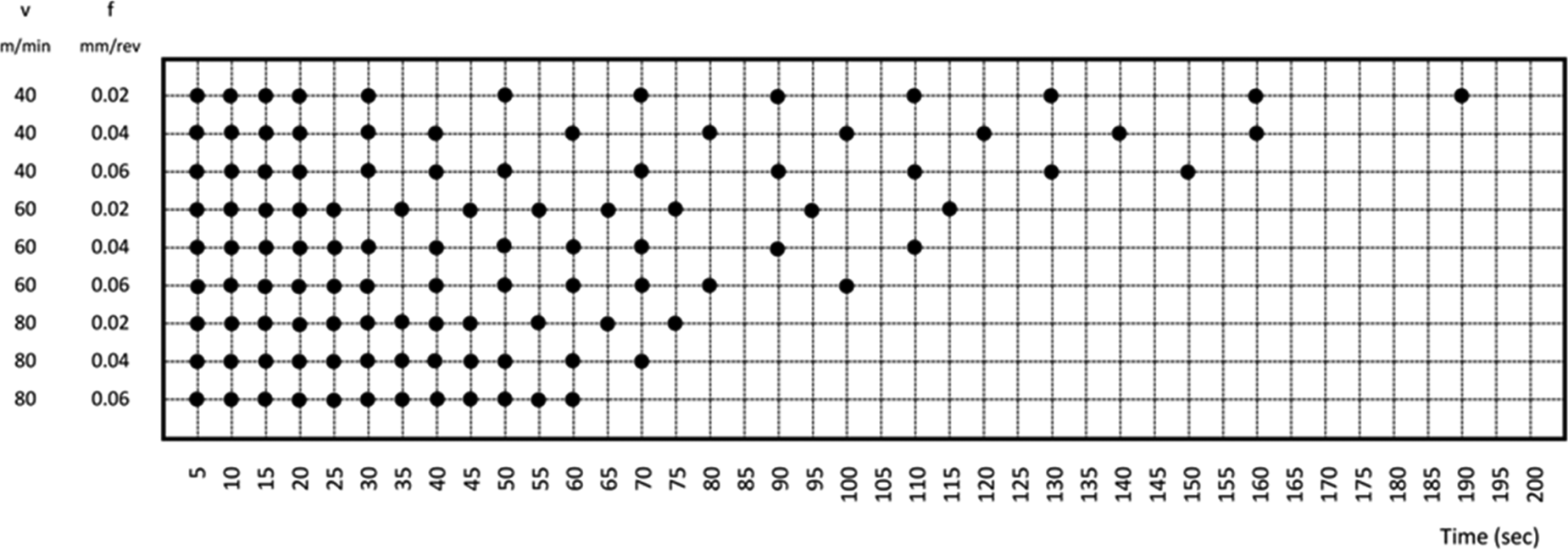
The experiments were performed on an EMCOTURN CNC lathe machine and in a dry cutting mode. The work piece was a round bar (60 mm diameter and 250 mm long) AISI D2 alloy steel with hardness 46 HRC. The TiN-coated carbide insert, type TNMG 220408 with grade NC3030, was used. The cutting parameters were cutting speed (v) at 40, 60, and 80 m/min; and feed rate (f) at 0.02, 0.04, and 0.06 mm/rev. The depth of cut was 1 mm since the process had been designed for finish turning. For each cutting condition, 12 tests were performed in various cutting times until the end of tool life (VB max = 0.3 mm). Moreover, some extra tests in different cutting parameters were performed to validate the accuracy and correctness of intelligent models. The selected sampling times for intended cutting parameters for the training of models are shown in Figure 3. Since TWR is intense in initial moments, more data were collected to enhance the precision of intelligent models.
Cutting parameters and corresponding sampling times.

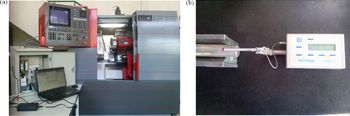
The accuracy of the intelligent models in this research was analyzed in terms of two statistical measures. These measures were the root-mean-square error, RMSE, and the fraction of variance, R 2. A light source microscope with magnification 36× and the image processing software were employed for measurements of flank wear values. A Taylor Hobson S100 surface profilometer was utilized to measure the roughness of machined parts. An experimental setup is shown in Figure 4.
Experimental setup of (a) CNC machine tool and (b) surface profilometer.

Results and discussion
Intelligent modeling
On the basis of primary Eq. (3) and using arithmetic functions mentioned in Eq. (4), a genetic equation was obtained for predicting the values of flank wear in the next Δt seconds (VB i+1). Input parameters were v, f, Δt, and VB i. The genetically obtained the equation is as follows:
 $$\eqalign{VB_{i + 1} & = VB_i + {\rm e}^{\lpar {v^2 + v + \lpar {\,f-7.004} \rpar \times 7.004 \times f} \rpar } \cr & + \left[ {\displaystyle{{({\rm e}^v-\Delta t)\;} \over {6.558}} \times \lpar {2 \times v-6.9} \rpar } \right] + (v \times \Delta t)^4 \cr & \times \lpar {\,f + 5.3753} \rpar.}$$
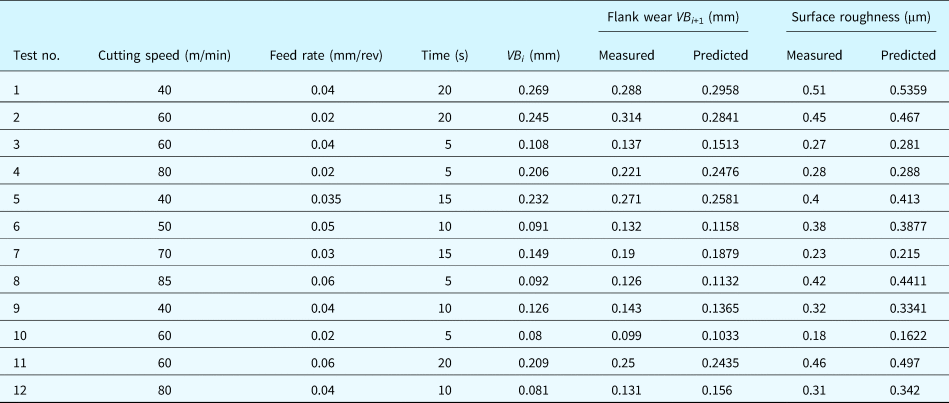
Using Eq. (5), it is possible to predict the value of flank wear for relevant cutting speeds and feed rates in the next Δt seconds. In addition, in this research, a three-layer feed-forward network is designed to predict the surface roughness. To train the intelligent models, 100 tests were performed according to mentioned cutting parameters. In addition, some tests, according to Table 1, were carried on to validate the obtained intelligent models. The values of input cutting parameters along with measured and predicted wear values and corresponding surface roughness values are shown in Table 1.
Experimental validation tests

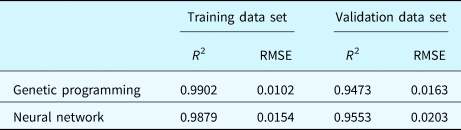
Based on selected statistical measures, the accuracy of the genetic equation and neural network for both the training and validation data sets are calculated and given in Table 2. Considering the results, it is concluded that the trained models have an acceptable accuracy and reliability; therefore, they can be used confidently in a model-based optimization system to predict required output machining characteristics.
Accuracy of intelligent models for training and validation data sets

Constant optimal cutting parameters
To show the effectiveness of the proposed intelligent optimization methodology, a comparison was made between the results of this method and results obtained through constant optimized cutting parameters. For this purpose, using the PSO algorithm and ANN and GP modeling techniques, the optimum cutting parameters that resulted the higher sum of performance indexes in specified cutting ranges were calculated. The optimum cutting parameters were computed as v = 67.5 m/min and f = 0.0425 mm/rev. The sum of performance indexes for the obtained optimum condition was calculated as ∑φ i = 25.4831.
Model-based optimization
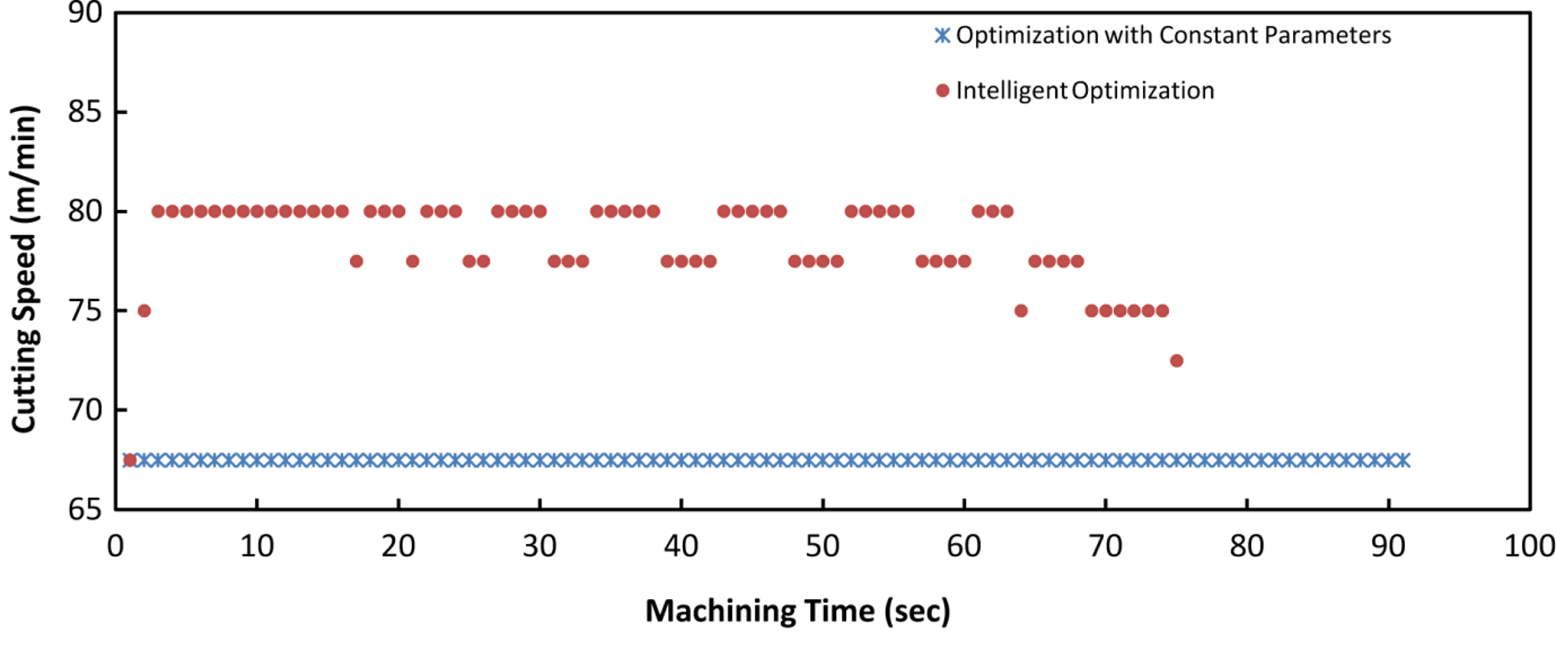
A method for model-based optimization of the cutting conditions for maximizing the material removal rate and minimizing the machining cost with some constraint was proposed. The procedure was described previously. After training intelligent models, the proposed optimization system starts with a fresh tool (VB = 0). It aims to find the next optimal cutting parameters that in addition to maximize the defined performance index, result permissible surface roughness. Variation in cutting speed during the optimization process is shown in Figure 5 that also demonstrates the value of constant optimized cutting speed.
Variation in cutting speed during the proposed intelligent optimization process.

As shown, the proposed optimization system, based on the defined performance index, tried to select the maximum values of cutting speed in initial seconds. Since the effect of cutting speed on the material removal rate is greater than its effect on TWR in initial moments; therefore, high values of cutting speed were more desirable in first times. Through time, TWR decreased and lower values of cutting speed were selected by the system since the high speeds had a negative effect on the values of the performance index.
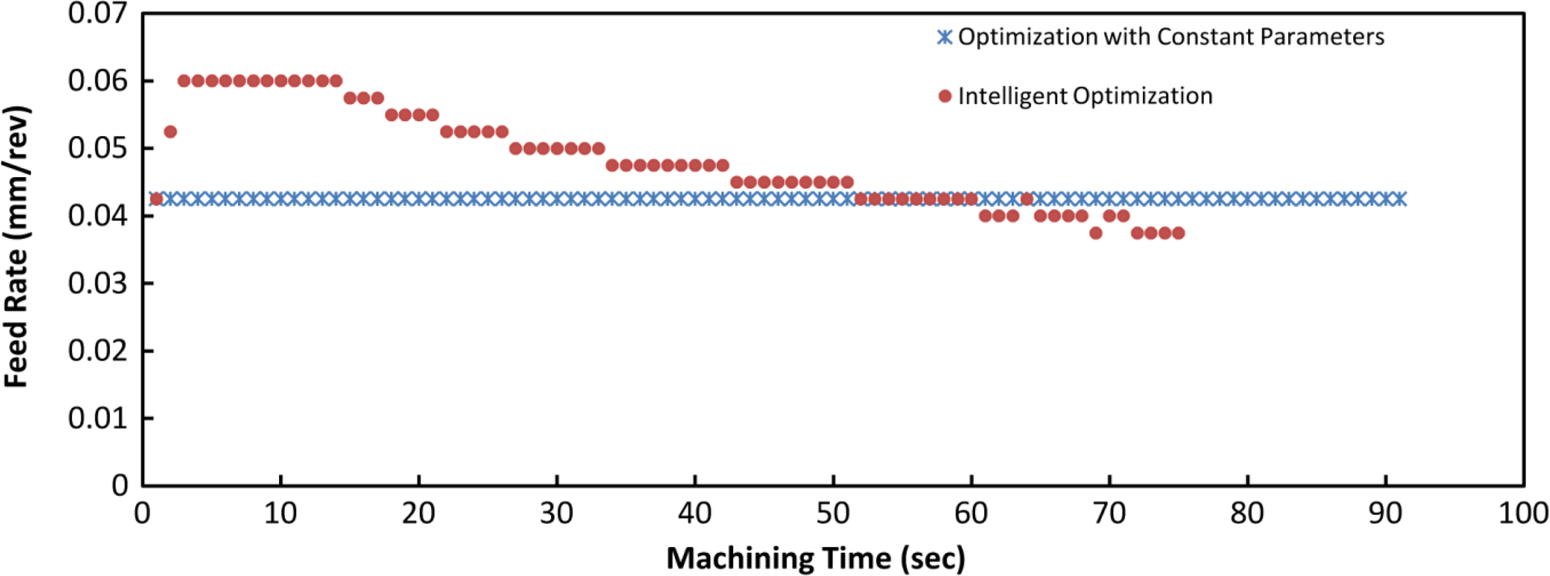
A similar manner was observed for adaptively optimized feed rates. Variation in the feed rate during model-based optimization is shown in Figure 6. The effect of feed rate on TWR is trivial, but the surface quality is under intense influence of feed rate. On the other hand, developing flank wear affects surface roughness adversely. A proposed optimization system, by decreasing the feed rate values during the process, tended to hold the surface roughness in a specified limit and to compensate the negative effect of flank wear on surface roughness.
Variation in the feed rate during the proposed intelligent optimization process.

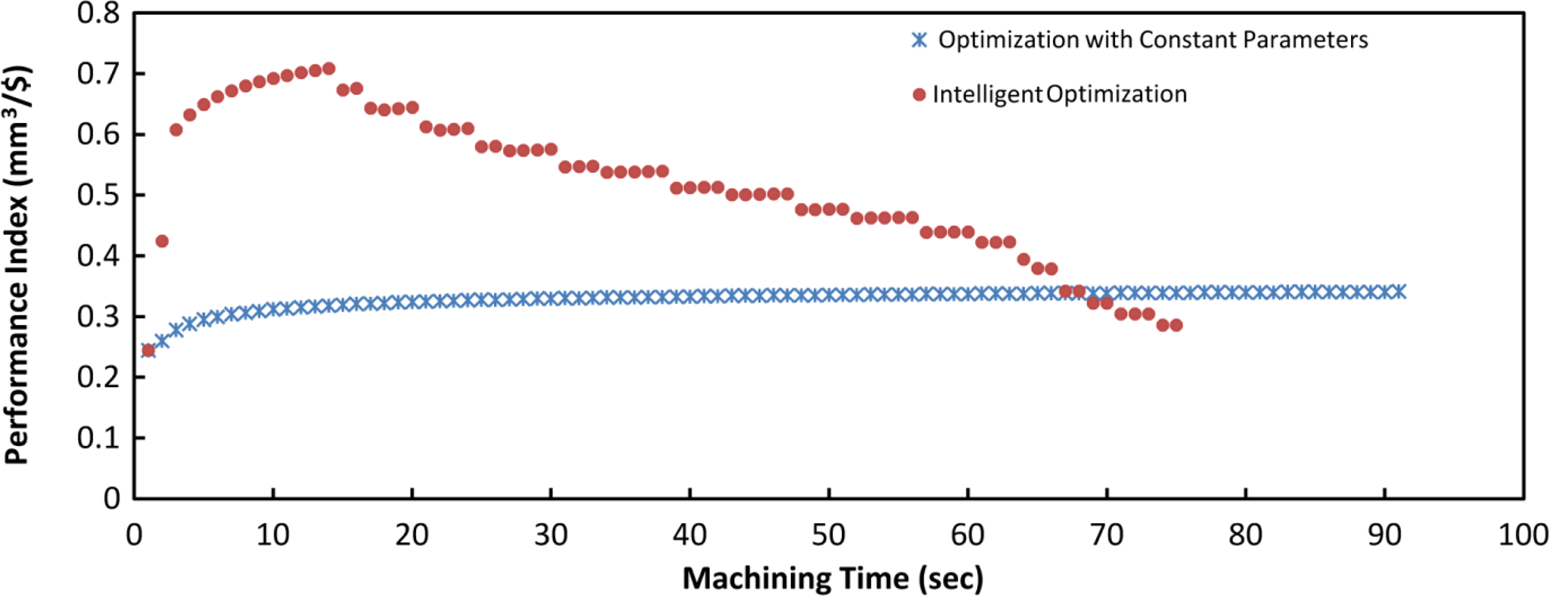
The values of performance indexes for both an intelligent model-based optimization method and optimization with a constant optimum cutting parameter are shown in Figure 7. Although the values of performance indexes for the proposed optimization technique decreased as the process continued, it was significantly higher than the performance indexes of machining with constant cutting parameters shortly after cutting commenced. This reduction was because of a decrease in cutting speed and feed rate during the machining process. In machining with constant optimized cutting parameters, TWR was higher in early times and then became approximately linear. Therefore, the performance index increased slightly in early times and then remained steady.
Variation in the performance index during machining with proposed intelligent optimization methodology and optimization with constant optimum cutting parameters.

The sum of performance indexes for constant optimum cutting parameters was calculated as ∑φ i = 25.4831 versus ∑φ i = 32.865 for a suggested optimization method which was 29% higher. It means that the proposed optimization methodology not only increased the material removal rate but also decreased machining costs impressively. Moreover, work pieces with accepted surface roughness were produced.
Comparing the results obtained from the proposed model-based optimization method with constant optimized cutting parameters and similar works allow concluding that the proposed system has an acceptable effectiveness and desirability. In addition, this technique will prevent additional costs of expensive sensory systems to evaluate online tool wear during machining.
Conclusion
In this paper, a new intelligent model-based methodology was proposed for the optimization of cutting parameters in finish hard turning of AISI D2 using PSO as an optimization technique and ANN and GP as modeling techniques. Since this method considers the variations of progressive tool wear, the methodology can be defined as an adaptive optimization system. The core of the system is composed of three process partitions: a GP model for predicting the values of tool flank wear, an ANN model for predicting the surface roughness, and a PSO unit to find optimum cutting parameters in each step of cutting. From the results obtained in the present work, the below conclusions can be made:
(1) Comparing the results of experiments and results obtained from intelligent methods show that GP and ANNs have unique ability and precision in predicting machining characteristics. Moreover, they can be used in new experiments that have not been used in the training stage, and therefore, they can be employed in ACO and model-based optimization systems with confidence.
(2) The presented model-based optimization technique can adjust cutting parameters to operate at maximum efficiency based on the defined performance index. It results in higher material removal rate accompanying with lower cutting costs. The results show that the proposed method improved the sum of performance indexes by 29% compared with machining with constant optimized cutting parameters.
Future work could be directed to the application of various intelligent models and optimization techniques in machining process optimization, the investigation of adaptive control with optimization by the implementation of various sensory systems to assess the variation of tool wear, and performing adaptive and model-based optimization experiments with different performance indexes and different constraints such as temperature, vibration, and other machining characteristics.
Vahid Pourmostaghimi was born in Tabriz, Iran, in January 1982. He received his BSc degree in Manufacturing Engineering in 2006 and the MSc degree in Manufacturing Engineering in 2009 from the University of Tabriz, Iran. He is currently a PhD student of Manufacturing Engineering at the University of Tabriz, Faculty of Mechanical Engineering. His focused area of research is adaptive control optimization, system identification, intelligent machining, predictive modeling in machining processes, and using metaheuristic methods.
Mohammad Zadshakoyan was born in Maragheh, Iran, in May 1964. He received his BSc degree in Mechanical Engineering from the University of Tabriz in 1987 and the MSc degree in Mechanical Engineering from the University of Bordeaux, France, in 1994. He received his PhD degree in Manufacturing Engineering from the University of Bordeaux, France, in 1998. He is now Assistant Professor in the Faculty of Mechanical Engineering at the University of Tabriz. His research interests include adaptive control, intelligent machining, and mechatronics in manufacturing systems.
Mohammad Ali Badamchizadeh was born in Tabriz, Iran, in December 1975. He received his BSc degree in Electrical Engineering, MS and PhD degrees in Control Engineering from the University of Tabriz, Iran, in 1998, 2001, and 2007, respectively. He is currently a Professor at the Faculty of Electrical and Computer Engineering, University of Tabriz, Iran. His research interests include adaptive control, fractional systems, stability of systems, and system identification.