


Non-technical Summary
Four species of Nummulites have been recorded from Egypt. Each species helps scientists pinpoint specific times within the Eocene. One species seems unique to Egypt. The other three were found all across the Tethys Ocean region. Warm waters throughout the middle and late Eocene helped Nummulites thrive in shallow, sunlit seas.
Introduction
The Paleocene–Eocene boundary is distinguished by the global Paleocene–Eocene Thermal Maximum (PETM) warming event, which was succeeded by another warm climatic event (Early Eocene Climatic Optimum EECO), which was followed by a gradual cooling trend throughout the middle to late Eocene (van der Ploeg et al., Reference van der Ploeg, Krabbendam, Vroman, van Nimwegen and de Bruijn2023; Morabito et al., Reference Morabito, Papazzoni, Lehrmann, Payne, Al-Ramadan and Morsilli2024). The general cooling during the middle Eocene was interrupted by the Bartonian (~40.1 Ma) short-lived warming event (Middle Eocene Climatic Optimum MECO) (Bohaty and Zachos, Reference Bohaty and Zachos2003; Jovane et al., Reference Jovane, Sprovieri, Florindo, Acton, Coccioni, Dall’Antonia and Dinar`es- Turell2007). The relatively high temperatures throughout the Eocene resulted in flourishing assemblages of the large benthic foraminifera (LBF) primarily in shallow-marine carbonate environments across the Tethys Ocean (Pomar et al., Reference Pomar, Baceta, Hallock, Mateu–Vicens and Basso2017). Large nummulitids (belonging mainly to the genera Nummulites and Assilina) were abundant during the middle Eocene, with a significant increase in their sizes (Hottinger, Reference Hottinger and Levi-Montalcini2001). Widespread accumulations of Nummulites in Eocene strata along the margins of Tethys (e.g., Oman, Iran, Egypt, Turkey, Crimea Peninsula, Libya, Tunisia, Morocco, Italy, and Spain) have been the subject of many publications (see Arni and Lanterno, Reference Arni and Lanterno1972; Decrouez and Lanterno, Reference Decrouez and Lantrno1979; Aigner, Reference Aigner, Einsele and Seilacher1982; Avsar, Reference Avşar1991; Racey et al., Reference Racey, Bailey, Beckett, Gallagher, Hampton and McQuilken2001; Beavington-Penney et al., Reference Beavington-Penney, Wright and Racey2005, Reference Beavington-Penney, Wright and Racey2006; Bassi and Nebelsick, Reference Bassi and Nebelsick2010; Less et al. Reference Less, Özcan and Okay2011; Bassi et al., Reference Bassi, Nebelsick, Puga-Bernabéu and Luciani2013; Costa et al. Reference Costa, Garcés, López–Blanco, Serra–Kiel, Bernaola, Cabrera and Beamud2013; Seddighi et al., Reference Seddighi, Briguglio, Hohenegger and Papazzoni2015; Hadi et al., Reference Hadi, Mosaddegh and Abbassi2016; Pomar et al., Reference Pomar, Baceta, Hallock, Mateu–Vicens and Basso2017; Abdel-Fattah, Reference Abdel-Fattah2018; Kayğili, Reference Kayğili2021; Al Menoufy et al., Reference Al Menoufy, Abd El-Gaied and Abd El-Aziz2022; Kövecsi et al., Reference Kövecsi, Less, Pleș, Bindiu–Haitonic, Briguglio, Papazzoni and Silye2022; Martín-Martín et al., Reference Martín-Martín, Tosquella, Guerrera, Maaté, Hlila, Maaté, Tramontana and Le Breton2023; Pakhnevich et al., Reference Pakhnevich, Nikolayev and Lychagina2023).
Excellent middle to upper Eocene exposures in the Fayum area yield prolific accumulations of Nummulites tests. The famous Nummulites gizehensis (Forskål, Reference Forskål1775) was identified for the first time from Eocene strata in the Pyramids Plateau in Giza. Forms of N. gizehensis were assigned later as groups because the boundaries between taxa are complicated and have an overlap between similar subdivisions (e.g., d’Archiac and Haime, Reference d’Archiac and Haime1853; de la Harpe, Reference de la Harpe1883; Kenawy, Reference Kenawy1978; Schaub, Reference Schaub1981; Boukhary and Hussein-Kamel, Reference Boukhary and Hussein-Kamel1993; Boukhary and Kamal, Reference Boukhary and Kamal2003; Afify et al., Reference Afify, Serra-Kiel, Sanz-Montero, Calvo and Sallam2016; Al Menoufy et al., Reference Al Menoufy, Abd El-Gaied and Abd El-Aziz2022). The taxonomy of the Nummulites spp. has a special attribute to population studies and measurements. These groups are used extensively within the biostratigraphic classification of Paleogene carbonate platforms of Egypt (e.g., Said, Reference Said1962, Reference Said1990; Strougo, Reference Strougo1985a; Issawi et al., Reference Issawi, Francis, Youssef and Osman2009; Sallam et al., Reference Sallam, Issawi and Osman2015; Afify et al., Reference Afify, Serra-Kiel, Sanz-Montero, Calvo and Sallam2016; Abdel-Fattah, Reference Abdel-Fattah2018; Al Menoufy et al., Reference Al Menoufy, Abd El-Gaied and Abd El-Aziz2022). The Eocene strata of Egypt have been investigated in the Great Cairo area, Gulf of Suez, Qattamiya–Sukhna stretch, and Bahariya Oasis (Said, Reference Said1990; Strougo and Abd-Allah, Reference Strougo and Abd-Allah1990; Strougo, Reference Strougo2008; Sallam et al., Reference Sallam, Issawi and Osman2015; Afify et al., Reference Afify, Serra-Kiel, Sanz-Montero, Calvo and Sallam2016; Assal et al., Reference Assal, Wanas and Abou Awad2024).
Most previous studies on the Fayum successions focused on stratigraphy and briefly mentioned the occurrences of Nummulites (Beadnell, Reference Beadnell1905; Iskandar, Reference Iskander1943; Bown and Kraus, Reference Bown and Kraus1988; Said, Reference Said1990; Gingerich, Reference Gingerich1992, Reference Gingerich, Clary, Pyle and Andrews2023; Seiffert et al., Reference Seiffert, Bown, Clyde, Simons, Fleagle and Gilbert2008; Abdel-Fattah et al., Reference Abdel-Fattah, Gingras, Caldwell and Pemberton2010, Reference Abdel-Fattah, Gingras and Pemberton2011, Reference Abdel-Fattah, Gingras, Caldwell, Pemberton and MacEachern2016; Gingerich et al., Reference Gingerich, Antar and Zalmout2011; Zalmout and Gingerich, Reference Zalmout and Gingerich2012; Strougo et al., Reference Strougo, Faris, Haggag, Abul-Nasr and Gingerich2013; King et al., Reference King, Underwood and Steurbaut2014; Abdel-Fattah, Reference Abdel-Fattah2016; Abdel-Fattah and Gingras, Reference Abdel-Fattah and Gingras2020; El Baz et al., Reference El Baz, Wanas, Abou Awad and Assal2023). Beadnell (Reference Beadnell1905) and Said (Reference Said1990) documented the presence of Nummulites gizehensis within the middle Eocene rock units in Fayum. Said (Reference Said1971) mentioned the abundance of small-sized Nummulites striatus (Bruguière, Reference Bruguière, Bruguière, Deshayes and Lamarck1792) and Operculina sp. in the Birket Qarun Formation. Abu El-Ghar (Reference Abu El-Ghar2012) and King et al. (Reference King, Underwood and Steurbaut2014) distinguished the dominance of large-sized Nummulites lyelli d’Archiac and Haime, Reference d’Archiac and Haime1853 within the strata of the middle Eocene El-Gharaq Formation. A few studies (e.g., Kenawy, Reference Kenawy1978; Boukhary and Kamal, Reference Boukhary and Kamal2003; Boukhary et al., Reference Boukhary, Hussein and Kamal2010) investigated the taxonomy, diversity, and stratigraphic distribution of the middle to late Eocene Nummulites assemblages in Egypt. Nummulites was documented and described for the first time from the late Lutetian Midawara Formation by Kenawy (Reference Kenawy1978). The endemic Nummulites praelyelli was initially described from the middle Eocene El-Gharaq Formation in Fayum, Egypt, by Boukhary and Kamal (Reference Boukhary and Kamal2003). The precursors of the N. gizehensis group and the N. partschi group were studied in the whole Eocene of Egypt, comprising the Fayum area (Boukhary et al., Reference Boukhary, Hussein and Kamal2010).
This study investigates the taxonomy, biostratigraphy, and paleogeography of LBF, particularly Nummulites, from the middle to upper Eocene rock units of the Fayum depression, Egypt (Figs. 1, 2). The present paper aims to: (1) conduct a comprehensive taxonomic analysis and re-evaluation of Nummulites’ taxa in the study area; (2) develop biostratigraphic zonations of the identified taxa of the Nummulites, documented from the middle to upper Eocene successions of Fayum; (3) correlate and analyze the identified Nummulites species and documented biozones with their counterparts across the Tethyan region and worldwide; and (4) elucidate the paleoceanographic connections and paleobiogeographic evolution during the middle to late Eocene.
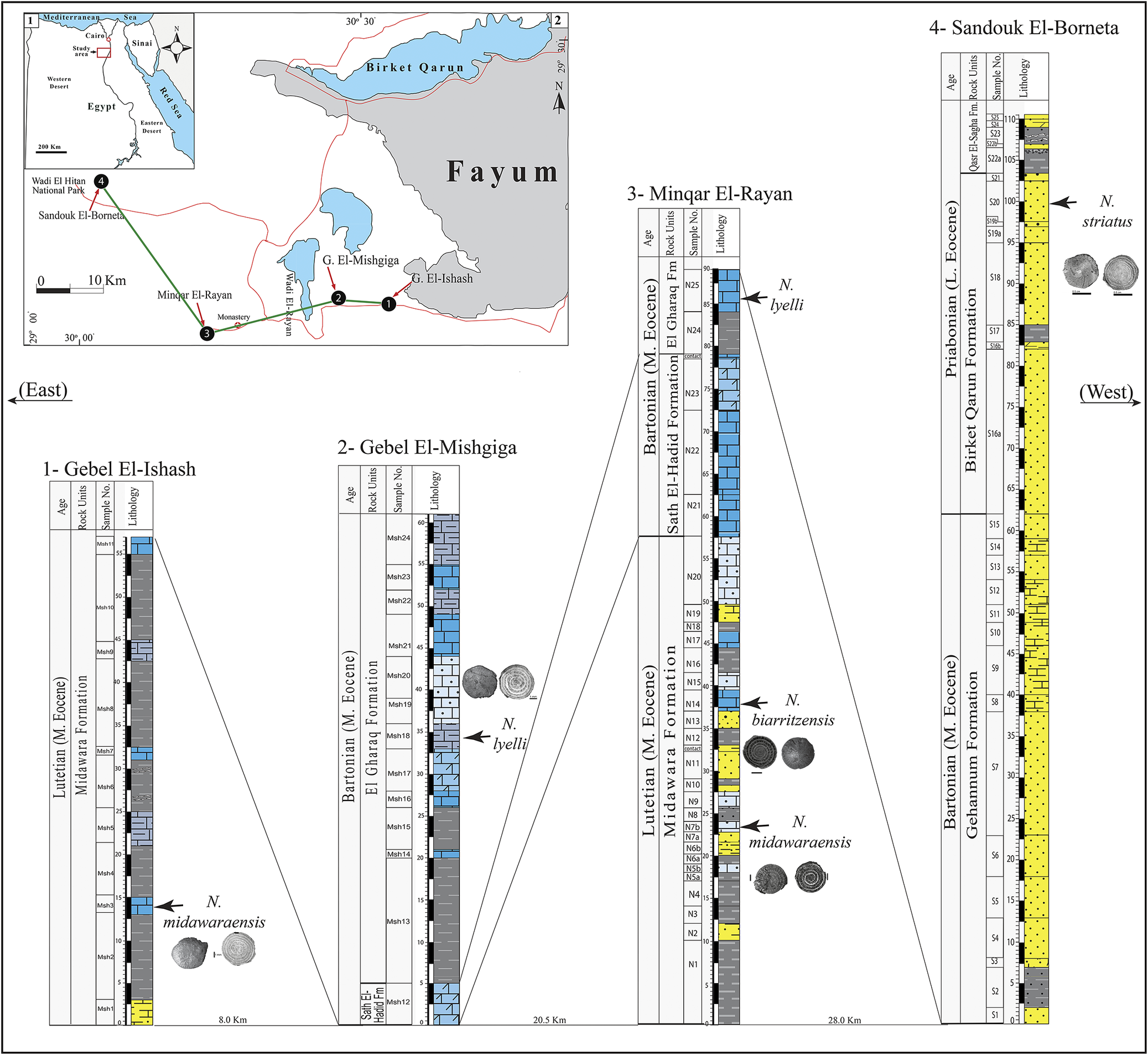
(1) Location map of the study area. (2) Geologic map of the Fayum depression showing the locations of studied sections (modified and redrawn after Beadnell, Reference Beadnell1905; Conoco, Reference Conoco1987; Gingerich, Reference Gingerich1992; Abdel-Fattah et al., Reference Abdel-Fattah, Gingras, Caldwell and Pemberton2010).

The lithostratigraphic correlation chart of the four studied sections, with emphasis on occurrences of the Nummulites taxa.

Geologic setting and stratigraphy
The Fayum depression represents a landmark subtriangular geomorphic feature in Egypt (Fig. 1). The Fayum or Gindi Basin belongs to the northern pericratonic sag basins that were located on the unstable shelf of Egypt (El Hawat, Reference El Hawat and Selley1997). The Fayum Basin originated during the Middle Jurassic rifting and the subsequent opening of Tethys (Smith, Reference Smith1971). The Late Cretaceous compressional Syrian Arc tectonics (Guiraud et al., Reference Guiraud, Bosworth, Thierry and Delplanque2005) led to uplift and subdivision of the Fayum Basin into two significant Paleocene–Eocene depocenters: the northern Tiba Basin and the southern Gindi Basin. The northern pericratonic basins, including the Fayum Basin, were subjected to uplift after the middle Eocene, which was associated with higher relative sea levels (Sestini, Reference Sestini1984). The late Eocene was characterized by continual uplift and lower relative sea levels that initiated a general regression phase, progressive emergence/erosion, and predominantly clastic sediments (Salem, Reference Salem1976). The Oligocene Gulf of Suez rifting resulted in a period of uplift, regression, volcanicity, and continental sedimentation in the Fayum area (Said, Reference Said1990). The stratigraphic successions in the Fayum or Gindi Basin consist mainly of horizontal strata, which show gentle dipping of 2–3° toward the north (Fig. 1). Relatively small and local normal faults are also reported.
The present work follows the earlier and basic classification of the Fayum area into five series by Beadnell (Reference Beadnell1905) and the later lithostratigraphic subdivisions of Iskandar (Reference Iskander1943) and Said (Reference Said1990). Recent emendations of Gingerich (Reference Gingerich1992, Reference Gingerich, Clary, Pyle and Andrews2023), Abdel-Fattah et al. (Reference Abdel-Fattah, Gingras, Caldwell and Pemberton2010, Reference Abdel-Fattah, Gingras and Pemberton2011, Reference Abdel-Fattah, Gingras, Caldwell, Pemberton and MacEachern2016), and Abdel-Fattah (Reference Abdel-Fattah2016, Reference Abdel-Fattah2018) have also been adopted. The outcrop stratigraphy in the studied successions is expressed herein by the following rock units, in ascending order: (1) the basal middle Eocene (Lutetian) Midawara Formation; (2) the middle Eocene (Bartonian) Sath El-Hadid, El-Gharaq, and Gehannam formations; and (3) the upper Eocene (Priabonian) Birket Qarun and Qasr El-Sagha formations (Figs. 1–4).
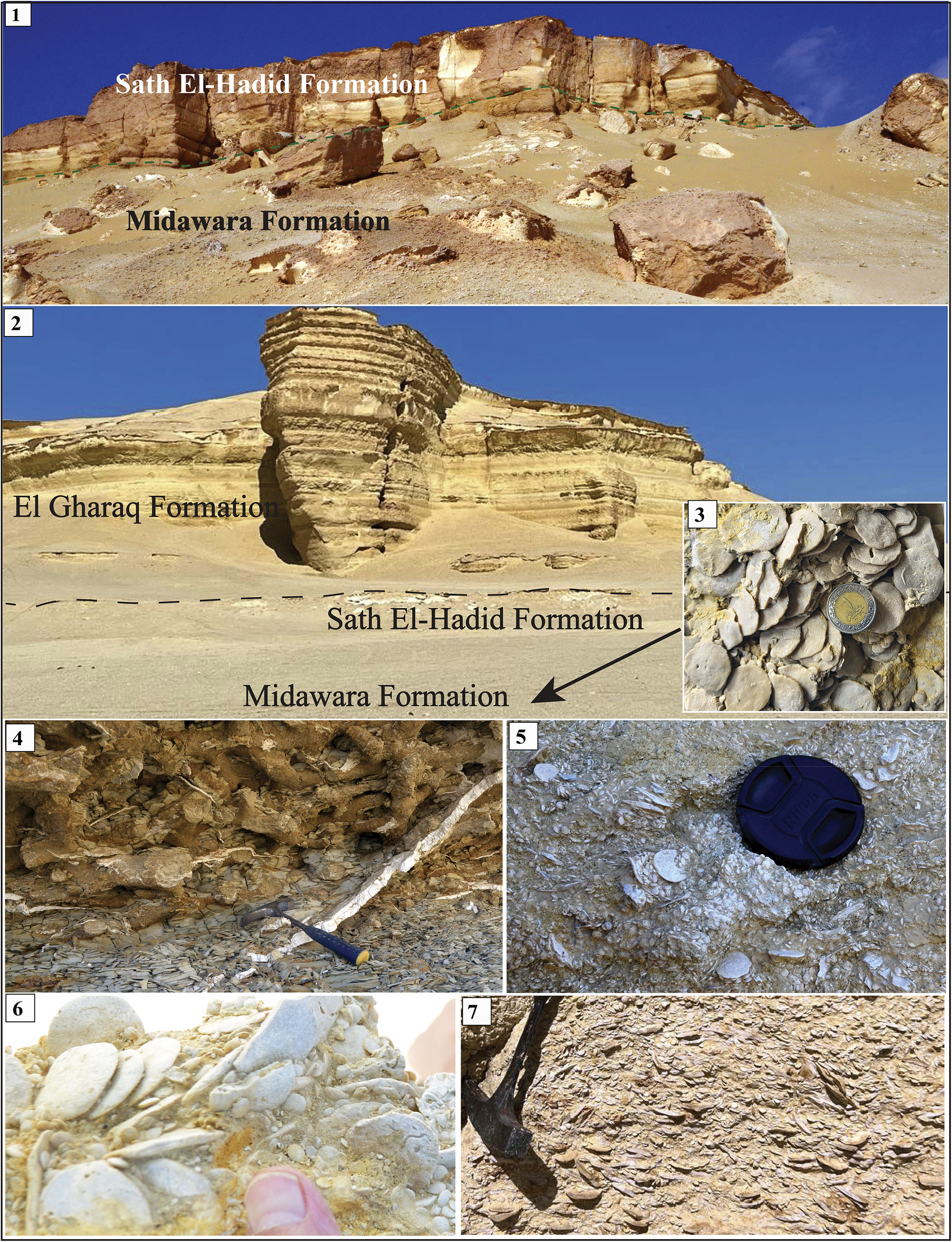
(1) A field view of the middle Eocene succession at the Minqar El-Rayan section; the lower, thick-bedded Midawara Formation and the overlying carbonates of the Sath El-Hadid Formation. (2) Another view captures the stratigraphic relationships at the Gebel El-Mishgiga section; the middle Eocene (Lutetian) Midawara Formation at the base, the middle Eocene (Bartonian) Sath El-Hadid Formation in the middle, and the overlying middle Eocene (Bartonian) El-Gharaq Formation. (4) The grey to dark gypsiferous shale topped by bioturbated sandstone of the Midawara Formation at the Minqar El-Rayan section. (3, 5, 6) Close-up photos reveal the abundance of Nummulites midawaraensis fossils within the Midawara Formation (Lutetian) at the Gebel El-Mishgiga (3), the Minqar El-Rayan (5), and the Gebel El-Ishash (6) sections. (7) A magnified view illustrates the characteristic packed texture of the El-Gharaq Formation limestones, dominated by large Nummulites lyelli specimens at the Gebel El-Mishgiga section.

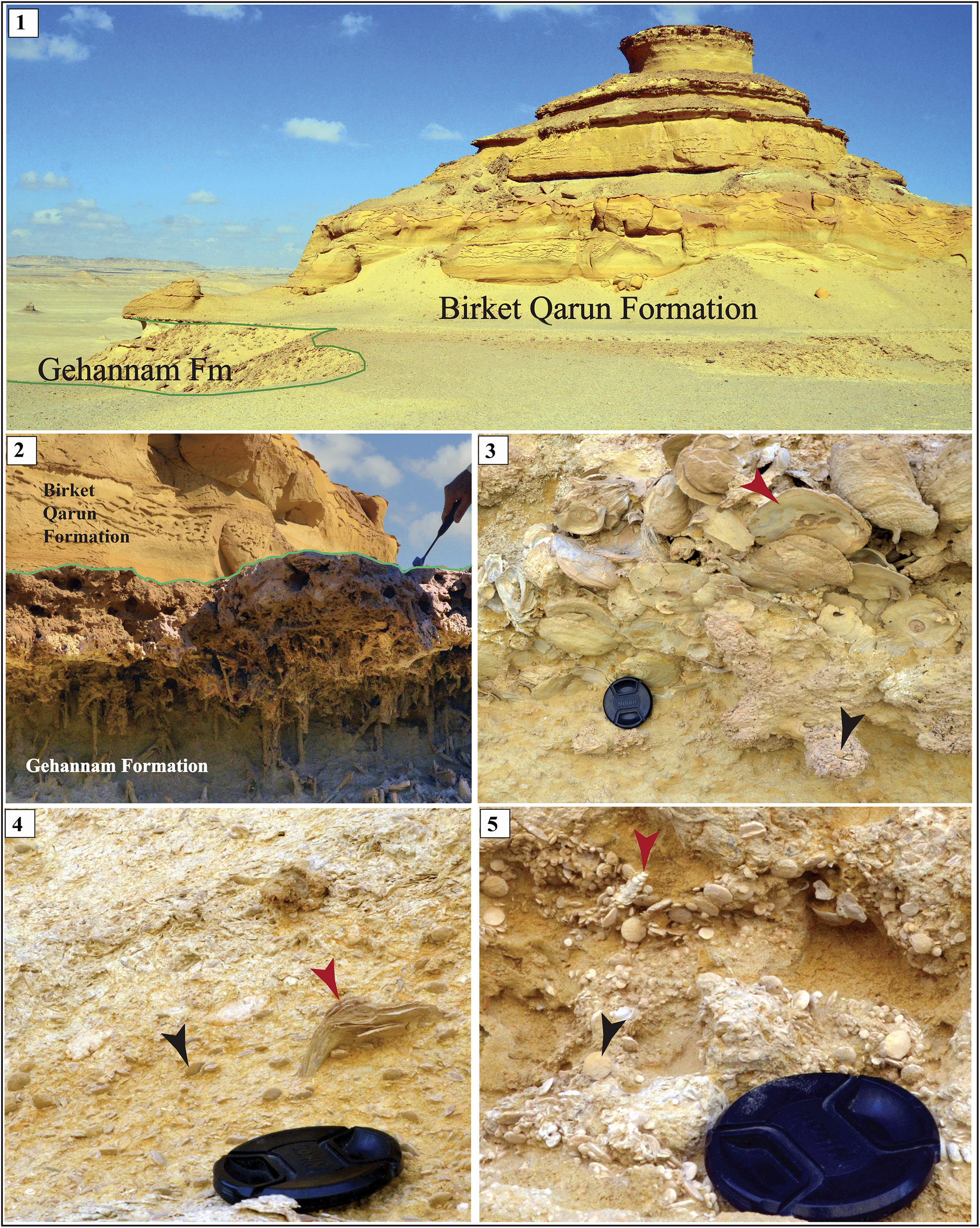
(1) A field view of the middle–upper Eocene succession at the Sandouk El-Borneta section, the lower Gehannam Formation (Bartonian), and the overlying Birket Qarun Formation (Priabonian). (2) Close-up photo displays the dense bioturbated sandstone (rhizoliths and burrows) on the contact between the Gehannam and Birket Qarun Formations. (3–5) Close-up images showcase the diverse Nummulites spp. (black arrows) assemblage found within the upper Eocene (Priabonian) Birket Qarun Formation at the Sandouk El-Borneta and the associated fauna (red arrows) such as Carolia placunoides and Turritella sp.

The Midawara Formation
This unit was investigated at the Minqar El-Rayan and the Gebel El-Ishash sections, having an average thickness of approximately 58 meters (Figs. 1–3.1). The Midawara Formation either conformably overlies the middle Eocene Muweilih Formation or is unexposed. It conformably underlies the middle Eocene Sath El-Hadid Formation (Figs. 2, 3.1, 3.2). The Midawara Formation is composed mainly of gray to dark gypsiferous shale (~ 46–74%), bioturbated and fossiliferous sandstones (~ 21–23%), and limestone (~ 21–31% of the whole formation) (Fig. 3.4). The later rock unit is highly fossiliferous with LBF, especially Nummulites (Figs. 2, 3.3, 3.5–3.7). Common invertebrate faunas include bivalves (e.g., Wakullina [H.] lefevrei [Fischer, Reference Fischer1880], Plicatula [D.] polymorpha [Bellardi, Reference Bellardi1854], and Ostrea [T.] multicostata [Deshayes, Reference Deshayes1832]), gastropods (e.g., Sigmesalia fasciata [Lamarck, Reference Lamarck1804]), cephalopods (e.g., Aturoidea sp. and Aturia aturi [Basterot, Reference Basterot1825]), anthozoa (e.g., Siderastrea sp. and Goniopora elegans [Leymerie, Reference Leymerie1846]), echinoids (e.g., Echinolampas africana de Loriol, Reference de Loriol1880 and Schizaster sp.), and arthropods (e.g., Lobocarcinus lumacopius Anderson and Feldmann, Reference Anderson and Feldmann1995). Vertebrate remains of whale bones and shark teeth are commonly reported. Significantly, the age of this formation aligns with the occurrence of the Egyptian assemblage of early archaeocete whales. This assemblage encompasses Protocetus atavus (Fraas, Reference Fraas1904) and Eocetus schweinfurthi (Fraas, Reference Fraas1904) and is further distinguished by the presence of the recently described protocetid whale, Phiomicetus anubis (Gohar et al., Reference Gohar, Antar, Boessenecker, Sabry, El-Sayed, Seiffert, Zalmout and Sallam2021). The fossil content and stratigraphic setting are used to assign the age of the Midawara Formation to the middle to late Lutetian (Said, Reference Said1990; Abu El Ghar, Reference Abu El-Ghar2012; Zalmout and Gingerich, Reference Zalmout and Gingerich2012).
The Sath El-Hadid Formation
This rock unit outcrops as white escarpments on top of the Midawara Formation at the Minqar El-Rayan and the Gebel El-Mishgiga, with a thickness of 5–21.5 m (Figs. 2, 3.1, 3.2). It overlies the Lutetian Midawara Formation, and it underlies the Bartonian El-Gharaq Formation (Figs. 2, 3.1, 3.2). This rock unit is composed mainly of hard cliff-forming limestone to chalky limestone. The limestone is intensively bioturbated and fossiliferous. The bioturbation is represented mainly by abundant well-developed Thalassinoides burrows. Strata of this rock unit are rich in Nummulites spp. Invertebrate fauna are represented by small- to large-sized bryozoans, bivalves (e.g., Spondylus caldesensis Carez, Reference Carez1881), gastropods (e.g., Architectonica aegyptiacum [Cuvillier, Reference Cuvillier1933], echinoids) (e.g., Echinolampas africana, Ova sp., and Schizaster sp.), and decapod crustaceans (mainly fossilized crab remains). Sporadic vertebrate bone fragments, shark teeth, and fish remains are also reported. This rock unit gains particular recognition for preserving the Bartonian diminutive whale, Tutcetus rayanensis (Antar et al., Reference Antar, Gohar, El-Desouky, Seiffert, El-Sayed, Claxton and Sallam2023). The age of the Sath El-Hadid Formation is equated herein to the middle Eocene (Bartonian) (see Iskander, Reference Iskander1943; Said, Reference Said1990; Zalmout and Gingerich, Reference Zalmout and Gingerich2012; Strougo et al., Reference Strougo, Faris, Haggag, Abul-Nasr and Gingerich2013).
The El-Gharaq Formation
This unit outcrops on top of the Sath El-Hadid Formation at the Minqar El-Rayan and Gebel El-Mishgiga sections, with a total thickness of 10–57 m (Fig. 2). The El-Gharaq Formation underlies the Bartonian Gehannam Formation and overlies the Bartonian Sath El-Hadid Formation (Figs. 2, 3.1, 3.2). The boundary between the El-Gharaq and the Gehannam formations appears near Garet Gehannam (King et al., Reference King, Underwood and Steurbaut2014). The El-Gharaq Formation consists mainly of limestones with interbedded shales at the two investigated sections. The limestones are yellowish white, sandy, occasionally chalky, and bioturbated. The limestone strata are full of small- and large-sized tests of the Nummulites lyelli d’Archiac and Haime, Reference d’Archiac and Haime1853 (Fig. 3.7), bivalve molds, and echinoids (e.g., Schizaster sp.).
The Gehannam Formation
This unit was described as Ravine beds by Beadnell (Reference Beadnell1905). It is well exposed at the base of the Sandouk El-Borneta section (Figs. 2, 4.1, 4.2). The base of the Gehannam Formation is not exposed in the Sandouk El-Borneta section and has a total thickness of ~62 m. The Gehannam Formation overlies the Bartonian El-Gharaq Formation and conformably underlies the Priabonian Birket Qarun Formation (Fig. 4.1, 4.2). This rock unit is composed mainly of highly bioturbated sandstone, sandy siltstone, and shale. The Gehannam Formation is topped by a densely bioturbated sandstone layer (the Camp White layer) that has compound rhizoliths and burrows (Abdel-Fattah and Gingras, Reference Abdel-Fattah and Gingras2020) and abundant small-sized tests of the Nummulites sp. (Fig. 4.2). Macrofossils are sporadic and comprise badly preserved tests of Nummulites in addition to bivalves, gastropods, and echinoid fragments. This formation is notable for the occurrence of the recently described protocetid whale Aegicetus gehennae (Gingerich et al., Reference Gingerich, Antar and Zalmout2019). The Gehannam Formation is referred herein to the late middle Eocene (Bartonian) on the basis of the stratigraphic relations and biostratigraphic data (see Said, Reference Said1990; Gingerich, Reference Gingerich1992; Abdel-Fattah et al., Reference Abdel-Fattah, Gingras, Caldwell and Pemberton2010, Reference Abdel-Fattah, Gingras, Caldwell, Pemberton and MacEachern2016; Zalmout and Gingerich, Reference Zalmout and Gingerich2012; Strougo et al., Reference Strougo, Faris, Haggag, Abul-Nasr and Gingerich2013; Abdel-Fattah, Reference Abdel-Fattah2018).
The Birket Qarun Formation
This rock unit is measured from the Sandouk El-Borneta section in Wadi El-Hitan area. It has a thickness of 40.5 m of cliff-forming clastics that overlie the middle Eocene Gehannam Formation and conformably underlie the upper Eocene Qasr El-Sagha Formation (Figs. 2, 4.1, 4.2). It is composed mainly of yellow, medium- to fine-grained, thick-bedded, and highly bioturbated sandstones and characteristic occurrences of the Glossifungites ichnofacies in the uppermost parts. The strata of this rock unit are rich in the LBF, especially Nummulites and Operculina (Said, Reference Said1971). The uppermost strata of the Birket Qarun Formation contain abundant Nummulites sp. with the guide fossil Carolia placunoides Cantraine, Reference Cantraine1838 (Fig. 4.3, 4.4), which provides biostratigraphic evidence of a late Eocene age (see Gingerich, Reference Gingerich1992; Strougo, Reference Strougo2008; Abdel-Fattah et al. Reference Abdel-Fattah, Gingras, Caldwell and Pemberton2010, Reference Abdel-Fattah, Gingras, Caldwell, Pemberton and MacEachern2016; Strougo et al., Reference Strougo, Faris, Haggag, Abul-Nasr and Gingerich2013). This formation is characterized by a vertebrate fauna that includes the archaeocetes Basilosaurus isis Beadnell in Andrews, Reference Andrews1904 and Dorudon atrox (Andrews, Reference Andrews1906).
Materials and methods
Four well-exposed middle to upper Eocene successions have been investigated and measured spatially along the southern Fayum depression (Figs. 1, 2). The middle Eocene successions include the Minqar El-Rayan (29°04’6"N, 30°14’53"E), the Gebel El-Ishash (29°06’30"N, 30°32’18"E), and the Gebel El-Mishgiga (29°07’08"N, 30°27’08"E), in addition to the middle to upper Eocene succession at the Sandouk El-Borneta (29°17’29"N, 30°03’25"E) in the vicinity of Wadi El-Hitan area (Fig. 1). A total of 896 tests of Nummulites were collected from various stratigraphic horizons within the middle to upper Eocene successions in Fayum, Egypt. Approximately 350 specimens of Nummulites midawaraensis Kenawy, Reference Kenawy1978 were collected from fossiliferous beds such as N7 and MSh3 of the Lutetian Midawara Formation at the Minqar El-Rayan and the Gebel El-Ishash sections, respectively. Biometric measurements were performed on 121 representative specimens of N. midawaraensis, comprising 81 A-form and 40 B-form individuals. Approximately 96 specimens of Nummulites biarritzensis d’Archiac and Haime, Reference d’Archiac and Haime1853 were collected only from bed N14 within the Midawara Formation at the Minqar El-Rayan section. Biometric analyses of N. biarritzensis were conducted on 14 specimens, including eight A-form and six B-form individuals. About 200 specimens of Nummulites lyelli were gathered from two fossiliferous beds, MSh18 and MSh20, in the Bartonian El-Gharaq Formation at the Gebel El-Mishgiga section. Herein, biometric measurements were performed on 11 well-preserved specimens, consisting of six A-form and five B-form individuals. Around 250 specimens of Nummulites striatus were collected from fossiliferous beds S19b and S21 in the Priabonian Birket Qarun Formation at the Sandouk El-Borneta section. The biometric analyses were conducted on 17 selected specimens of N. striatus, including 14 A-form and three B-form individuals. Fifty petrographic thin sections were prepared from representative rock samples of various studied successions. These thin sections were studied and photographed under petrographic and binocular microscopes for detailed petrographic analyses of the Nummulites-hosting strata and documentation of various foraminiferal assemblages associated with the identified Nummulites species.
Macrofossils were collected and identified from the studied sections. The LBF, particularly the tests of Nummulites, were carefully collected, labeled, and photographed in situ at various stratigraphic zones. Field data were refined and analyzed by additional laboratory examination of the reported fossils and rock samples. The Nummulites tests were cleaned using appropriate techniques to remove the matrix and adhering sediments. Selected, well-preserved tests were examined and photographed under a binocular microscope with different magnifications. Classification of larger foraminifera employed the taxonomic scheme outlined by Loeblich and Tappan (Reference Loeblich and Tappan1988), in addition to the detailed work on Nummulites by Blondeau (Reference Blondeau1972), Schaub (Reference Schaub1981), Serra-Kiel et al. (Reference Serra-Kiel, Hottinger, Caus, Drobne and Ferrandez1998), Holzmann and Pawlowski (Reference Holzmann and Pawlowski2017), and Papazzoni et al. (Reference Papazzoni, Ćosović, Briguglio and Drobne2017). Measurements of A and B forms of identified species of Nummulites were compared with the reference data from Schaub (Reference Schaub1981), Boukhary and Kamal (Reference Boukhary and Kamal2003), Boukhary et al. (Reference Boukhary, Hussein and Kamal2010, Reference Boukhary, Abul-Nasr, Al Menoufy, Cherif and Höntzsch2013), Abd El Naby et al. (Reference Abd El Naby, Boukhary and Al Menoufy2013), and Al Menoufy et al. (Reference Al Menoufy, Abul-Nasr and Askar2019). The tests of representative samples of Nummulites were thin-sectioned into two parts to reveal and photograph the detailed internal structures, which are vital in the identification and classification of different species. The identified Nummulites species show megalospheric and microspheric forms. The systematic analysis is based mainly on the external morphological characteristics such as test shape, septal-filament shape, presence or absence of granules, granule arrangements, and test geometry diameter and thickness. Furthermore, a detailed set of biometric parameters were measured from both microspheric and megalospheric forms at various growth stages. These parameters include test diameter, test thickness, level of granulation, number of whorls per unit radius, number of coiling steps, whorl height, protoconch diameter (A forms only), test diameter/thickness ratio, test radius/number of whorls relationship, minimum/maximum values for radius, and the chamber height. Comprehensive analyses of external morphological features as well as internal measurements (for both A and B forms) led to a robust identification of the documented species of Nummulites. Data on biometric measurements and test morphologies were further analyzed and illustrated using software such as Microsoft Excel, Corel Draw, Adobe Photoshop, and Adobe Illustrator.
Repository and institutional abbreviation
All rock samples, macrofossils, specifically the LBF Nummulites, images, petrological slides, and all the measured data were deposited in the Geological Museum of the Department of Geology, Damietta University (GMDGDU), under these prefixes: N for Minqar El-Rayan, MSh for Gebel El-Ishash-Gebel El-Mishgiga, and S for Sandouk El-Borneta.
Systematic paleontology
Kingdom Protista Haeckel, Reference Haeckel1866
Phylum Foraminifera D’Orbigny, Reference D’Orbigny1826
Class Globothalamea (Pawlowski, Holzmann, and Tyszka, Reference Pawlowski, Holzmann and Tyszka2013)
Order Foraminiferida Eichwald, Reference Eichwald1830
Superfamily Nummulitacea (de Blainville, Reference de Blainville1827)
Family Nummulitidae de Blainville, Reference de Blainville1827
Subfamily Nummulitinae de Blainville, Reference de Blainville1827
Genus Nummulites Lamarck, Reference Lamarck1801
Type species
Camerina laevigata Bruguière, Reference Bruguière, Bruguière, Deshayes and Lamarck1792—accepted as Nummulites laevigatus (Bruguière, Reference Bruguière, Bruguière, Deshayes and Lamarck1792).
Group Nummulites praelucasi
Nummulites biarritzensis d’Archiac and Haime, Reference d’Archiac and Haime1853
Reference Schaub1981 Nummulites biarritzensis; Schaub, p. 123, pl. 51, figs. 30–46, pl. 15, figs. c, d.
Reference Costa, Garcés, López–Blanco, Serra–Kiel, Bernaola, Cabrera and Beamud2013 Nummulites biarritzensis; Costa et al., p. 14, fig. 1.2 (5–8), fig. 1.9 (9–13).
Reference Afify, Serra-Kiel, Sanz-Montero, Calvo and Sallam2016 Nummulites biarritzensis; Afify et al., p. 54, pl. 1, fig. 25.
Reference Silva-Casal, Serra-Kiel, Rodríguez-Pintó, Pueyo, Aurell and Payros2021 Nummulites biarritzensis; Silva-Casal et al., p. 49, fig. 30, V, W.
Holotype
Nummulites biarritzensis d’Archiac and Haime, Reference d’Archiac and Haime1853 (p. 133, pl. 8, figs. 1a–e, 2, 3). The holotype of N. biarritzensis is currently housed in the collections of the Muséum national d’Histoire naturelle in Paris, France.
Diagnosis
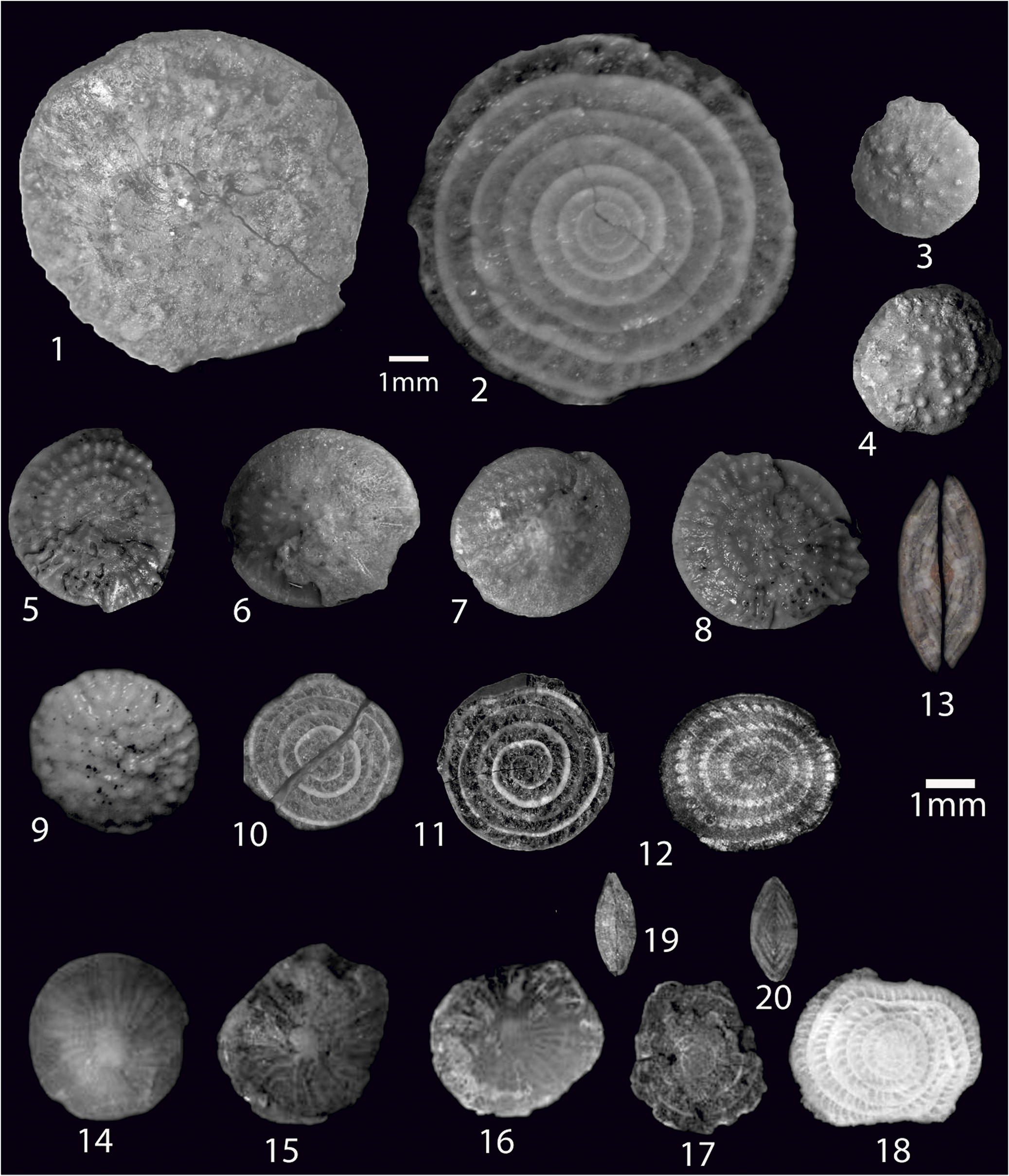
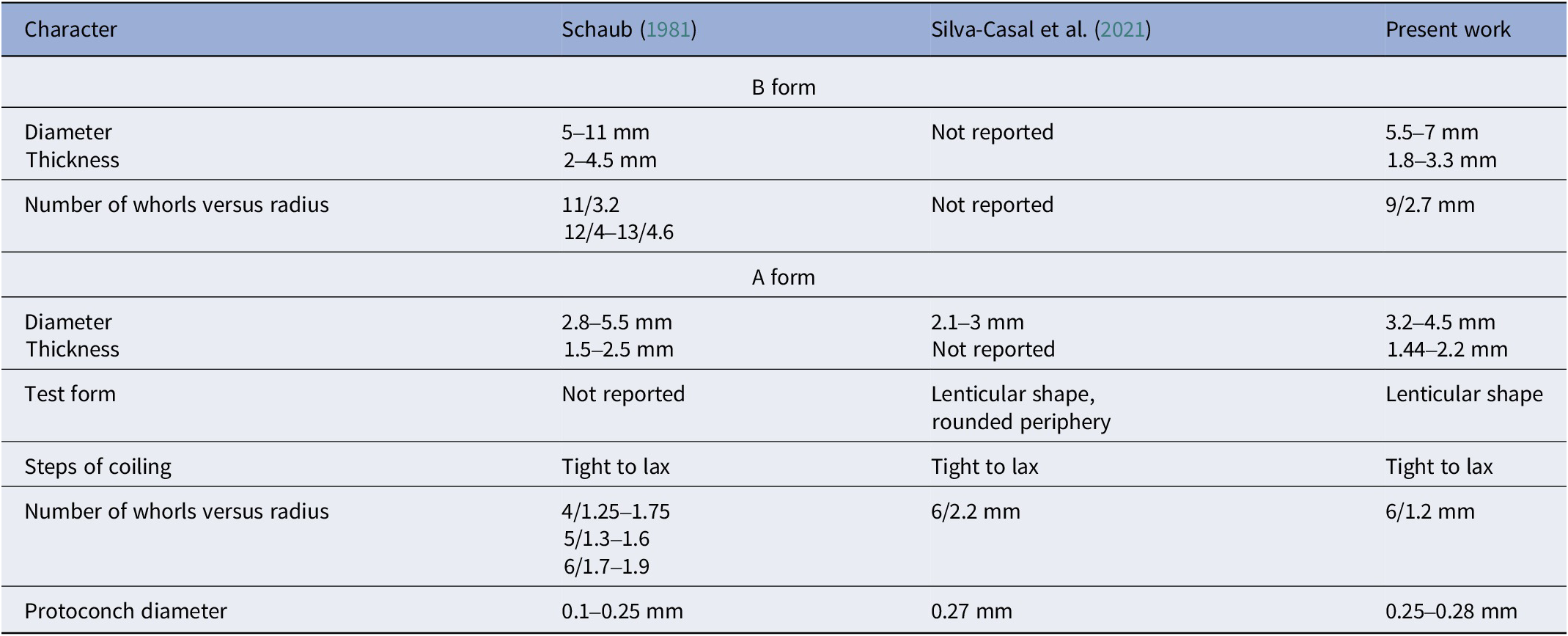
The microspheric test (B form) has a lenticular shape to biconical form, with a slightly rounded periphery. The surface is smooth, lacking any granules. The septal filaments are radially arranged and twisted near the poles. These filaments are curved throughout. In the equatorial section, the chambers are rectangular and taller than wide. Septa are perpendicular at the base and are slightly inclined at the top. The marginal cord is relatively thick and irregular. The coiling starts tight and becomes gradually looser toward the periphery. The spire is overall regular and looser near the periphery. The number of whorls is nine within a radius of 2.7 mm.
The megalospheric test (A form) has a lenticular shape and a rounded periphery. The septal filaments are curved and interconnected near the poles. In the equatorial section, the chambers are rectangular (taller than wide) with less obtuse margins. The septa are nearly straight. The marginal cord is thinner than those in the B form. The spire is slightly less regular than the B form. The coiling starts tight and gradually becomes looser. The polar pustule is visible in the axial section. The number of whorls is six within a radius of 1.2 mm. The protoconch is relatively small, with a diameter of 0.25–0.3 mm.
Occurrence
Nummulites biarritzensis is documented from the middle Eocene strata of Western Desert (Adams, Reference Adams1988) as well as the Bartonian strata of the Bahariya oasis in the Western Desert and the northern Eastern Desert of Egypt (Afify et al., Reference Afify, Serra-Kiel, Sanz-Montero, Calvo and Sallam2016). It is commonly present in the middle Eocene strata in the northern Mediterranean and Spain (Papazzoni and Sirotti, Reference Papazzoni and Sirotti1995; Papazzoni, Reference Papazzoni2008; Silva-Casal et al., Reference Silva-Casal, Serra-Kiel, Rodríguez-Pintó, Pueyo, Aurell and Payros2021). It is also found in the Lutetian Midawara Formation at the Minqar El-Rayan section (present study).
Dimensions
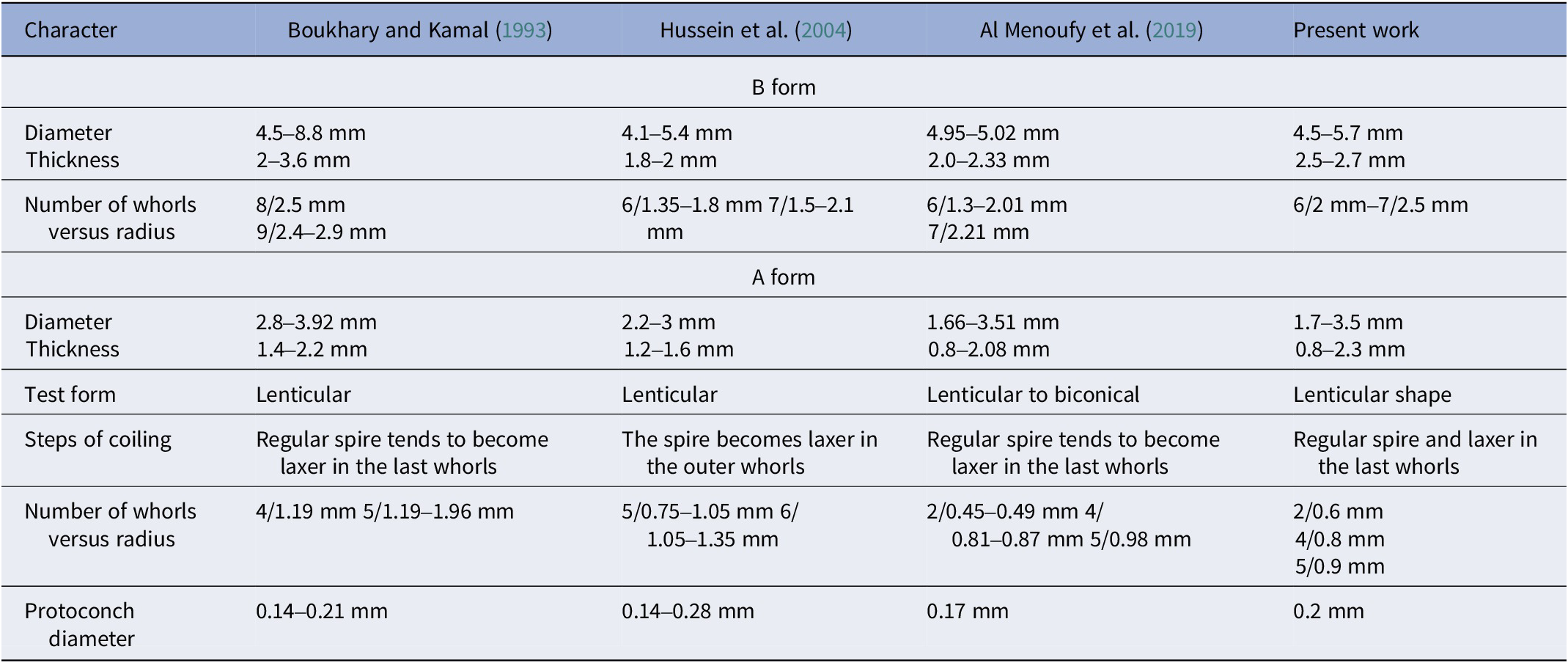
In microspheric forms, the diameter ranges from 5.5 to 7 mm, while the thickness varies between 1.8 and 3.3 mm (see Figs. 5, 6; Table 1). In megalospheric forms, the size ranges from 3.2 to 4.5 mm in diameter and from 1.44 to 2.2 mm in thickness.
Nummulites midawaraensis Kenawy, Reference Kenawy1978 (sample no. N7, MSh3, from the Midawara Formation at the Minqar El-Rayan and the Gebel El-Ishash sections). (1, 2) Microspheric forms: (1) external view; (2) equatorial section. (3–13) Megalospheric forms: (3–9) external view; (10–12) equatorial section; (13) axial sections. (14–20) Nummulites biarritzensis d ’Archiac and Haime, Reference d’Archiac and Haime1853, sample N14, the Midawara Formation, the Minqar El-Rayan section. (18) Microspheric forms: equatorial section. (14–17, 19, 20) Megalospheric forms: (14–16) external view; (17) equatorial section; (19, 20) axial sections.

Morphometric data for the Nummulites biarritzensis d’Archiac and Haime, Reference d’Archiac and Haime1853 (B and A forms, sample no. N14, from the Midawara Formation at the Minqar El-Rayan section): (1) test thickness plotted against test diameter; (2) test radius plotted against number of whorls; (3) test radius (minimum and maximum); (4) chamber height (minimum and maximum).

Comparison of measurements of Nummulites biarritzensis

Remarks
Microspheric N. biarritzensis possesses curved and compact septal filaments that radiate and twist at the polar region. Axial sections of the megalospheric form display sub–obtuse chambers and a polar pustule. Differentiating between N. biarritzensis and Nummulites beaumonti (d’Archiac and Haime, Reference d’Archiac and Haime1853) can be somewhat challenging. In general, N. biarritzensis is larger than N. beaumonti, with a thicker and more irregular marginal cord. In addition, N. biarritzensis tends to have slightly more inflated chambers than N. beaumonti. By contrast, N. beaumonti exhibits tighter and more involute coiling, with its chambers packed more closely together and the spire less visible. Further biometric details for both B and A forms from specimen N14–25 are well presented in Figure 6; the details in Table 1 facilitate comparison with other related species.
Subgroup Nummulites lyelli
Nummulites lyelli d’Archiac and Haime, Reference d’Archiac and Haime1853
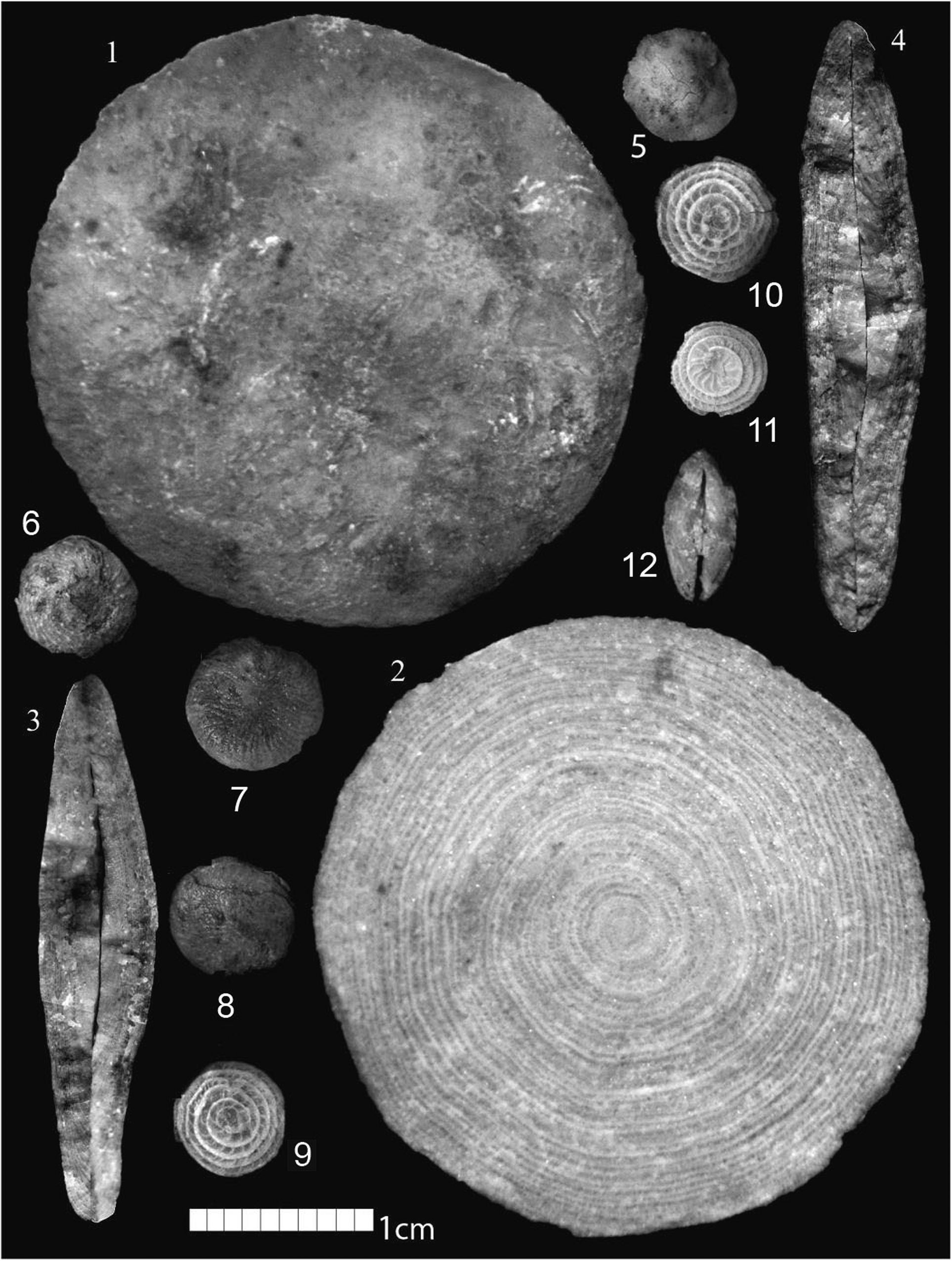
Nummulites lyelli d’Archiac and Haime, Reference d’Archiac and Haime1853 (sample no. MSh18, from the El-Gharaq Formation, the Gebel El-Mishgiga section). (1–4) Microspheric forms: (1) external view; (2) equatorial section; (3, 4) axial section. (5–12) Megalospheric forms: (5–8) external view; (9–11) equatorial section; (12) axial sections.

Reference Blondeau1972 Non Nummulites lyelli; Blondeau, p. 151.
Reference Shamah1981 Nummulites lyelli; Shamah, p. 177, pl. 11, fig. la, b, c).
Reference Schaub1981 Non Nummulites lyelli; Schaub, p. 116, pl. 38, figs. 8–20.
Reference Boukhary and Kamal2003 Nummulites lyelli; Boukhary and Kamal, p. 180, pl. 2, figs. 1–16, pl. 3, figs. 1–10, pl. 4B, figs. 13–24.
Reference Seddighi, Briguglio, Hohenegger and Papazzoni2015 Nummulites lyelli; Seddighi et al., p. 108, fig. 2d.
Holotype
Nummulites lyelli d’Archiac and Haime, Reference d’Archiac and Haime1853 (p. 95, pl. 111, figs. la, b, 2). The holotype of this species resides within the collections of the esteemed Muséum national d’Histoire naturelle in Paris, France.
Diagnosis
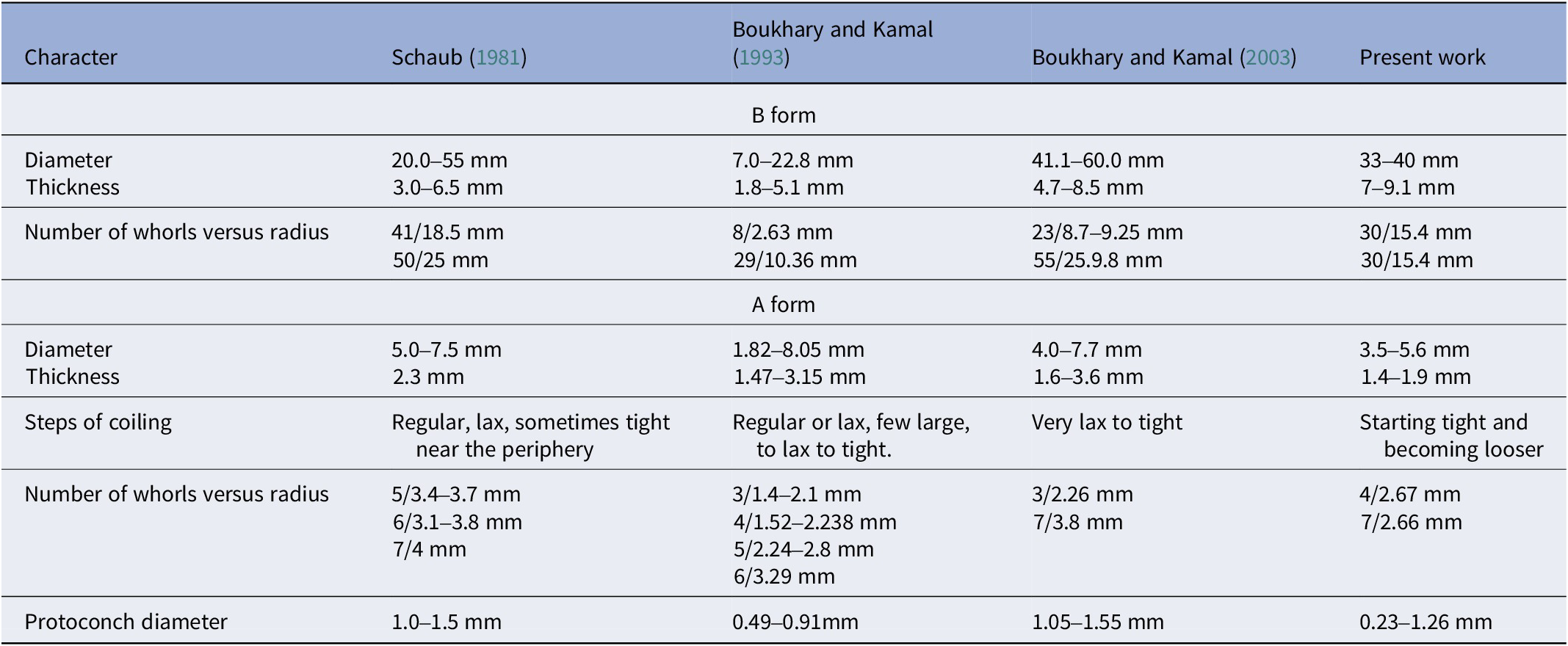
The microspheric form (B form) is discoid in shape, thicker in the center with a flat edge. Surface granules are present on the septal filaments near the edge. The septal filaments are wavy and S–shaped. The coiling starts tight and becomes looser toward the periphery. The chambers are taller than wide, especially in the looser coiling areas. The septa are tilted at the base then become vertical and hook-shaped at the ends. The number of whorls varies with radius, ranging from 30 to 48 whorls within a specific radius of 15.4–19.4 mm (see Figs. 5, 6). The megalospheric form (A form) is discoidal in shape, but it is commonly thinner and smaller than the B form. The surface is originally granulated. Septal filaments are arched, especially in the center of the test. Near the periphery, they become straighter. The coiling is similar to the B form, starting tight and becoming looser. The chamber has a rectangular shape, with a height surpassing its width. The number of whorls varies with radius, ranging from 4 to 7 whorls within a radius ranging from 2.3 to 2.7 mm. The protoconch is large, with a diameter of ~1 mm (see Fig. 8).
Morphometric data for the Nummulites lyelli d’Archiac and Haime, Reference d’Archiac and Haime1853 (B and A forms, sample no. MSh18, from the El-Gharaq Formation at the Gebel El-Mishgiga section): (1) test thickness plotted against test diameter; (2) test radius plotted against number of whorls; (3) test radius (minimum and maximum); (4) chamber height (minimum and maximum).

Occurrence
Nummulites lyelli were documented from the middle Eocene (Bartonian) successions in the Fayum, Egypt (Boukhary and Kamal, Reference Boukhary and Kamal2003; Abdel-Fattah, Reference Abdel-Fattah2018; Assal et al., Reference Assal, Wanas and Abou Awad2024). It was also recorded from the middle Eocene (Bartonian) strata in Oman (Racey Reference Racey and Simmons1994), Italy (Papazzoni and Sirotti, Reference Papazzoni and Sirotti1995; Seddighi et al., Reference Seddighi, Briguglio, Hohenegger and Papazzoni2015), Turkey (Less et al., Reference Less, Özcan and Okay2011), Spain, and the Mediterranean–Western Tethys (Racey, Reference Racey and Simmons1994; Papazzoni and Sirotti, Reference Papazzoni and Sirotti1995). This species is recorded from the middle Eocene (Bartonian) El-Gharaq Formation at the Gebel El-Mishgigah section (present study).
Dimensions
In microspheric forms, the diameter ranges from 30 to 40 mm, and the thickness varies between 4.4 and 9.1 mm (see Figs. 7, 8; Table 2). In megalospheric forms, the diameter ranges from 3.5 to 5.6 mm, and the thickness is between 1.3 and 2.2 mm.
Comparison of measurements of Nummulites lyelli

Remarks
According to Boukhary and Kamal Reference Boukhary and Kamal2003, N. lyelli differs from N. gizehensis by its larger size, thicker shells in both generations, and the larger protoconch. The wrinkled septal filaments of the A form are a distinctive feature of N. lyelli. For detailed measurements of both B and A forms in specimen MSh18, see Figure 6 and Table 2, which show the difference between similar species.
Group of Nummulites partschi
Nummulites midawaraensis Kenawy, Reference Kenawy1978
Reference Kenawy1978 Nummulites subreticulata Kenawy, p. 62, pl. 2, fig. 2.
Reference Boukhary, Hussein and Kamal2010 Nummulites midawaraensis; Boukhary et al., p. 48, pl. 4, figs. 1–24.
Holotype
Nummulites midawaraensis Kenawy, Reference Kenawy1978 (p. 61, pl. 1, fig. 5, pl. 2, fig. 1), from the middle Eocene Midawara Formation, Fayum, Egypt. Holotype deposited in the collection of the Department of Geology, University of Assiut.
Diagnosis
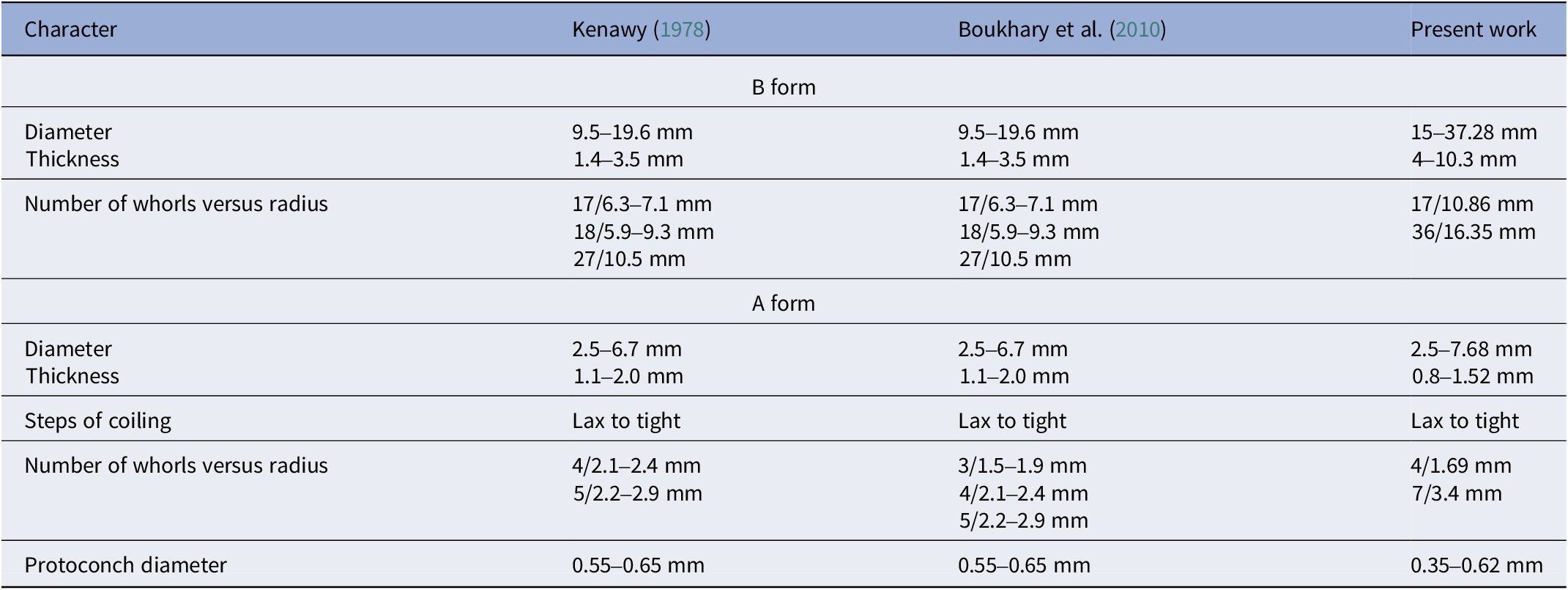
The microspheric test (B form) is flattened with a rounded periphery. Number of whorls is 17 in a radius of 10.8 mm, 18 in a radius of 10.4 mm, and 36 in a radius of 16.4 mm. Septa are thick and regular. The chambers have a greater height than width throughout the test. The megalospheric test (A form) is flattened with a sharp periphery. The surface is covered with granules that follow the spire and appear on the septal filaments. In the equatorial section, the number of whorls averages between three and five, depending on the radius. Septa of A forms are similar to those of B form. The chamber height is greater than its width. The protoconch diameter ranges from 0.55 to 0.65 mm (Figs. 5, 9).
Morphometric data for the Nummulites midawaraensis Kenawy, Reference Kenawy1978 (B and A forms, sample no. N7, MSh3, from the Midawara Formation at the Minqar El-Rayan and the Gebel El-Ishash sections): (1) test thickness plotted against test diameter; (2) test radius plotted against the number of whorls; (3) test radius (minimum and maximum); (4) chamber height (minimum and maximum).

Occurrence
Nummulites midawaraensis is observed from the late Lutetian Midawara Formation of Wadi El-Rayan and El-Mishgigah areas, in the Fayum, Egypt (Boukhary and Kamal, Reference Boukhary and Kamal2003; Boukhary et al., Reference Boukhary, Hussein and Kamal2010). This species is recognized from the Lutetian Midawara Formation at the Minqar El-Rayan and the Gebel El-Ishash sections (present study).
Dimensions
In microspheric forms, the diameter ranges from 9.5 to 19.6 mm, and the thickness is 1.4–3.5 mm (Figs. 5, 9; Table 3). In megalospheric forms, the diameter varies between 2.5 and 6.7 mm, and the thickness ranges from 1.1 to 2.0 mm.
Comparison of measurements of Nummulites midawaraensis

Remarks
Boukhary et al. (Reference Boukhary, Hussein and Kamal2010) transformed the N. midawaraensis from the N. gizehensis group to the N. partschi group. The unique granulation pattern, with its characteristic regular distribution of small raised granules, becomes a crucial diagnostic tool for identifying the N. midawaraensis. This textured “fingerprint” on the megalospheric form distinguishes it from other species and serves as a tangible reminder of its evolutionary journey. Biometric details of N7 and MSh3 (B and A forms) are illustrated in Figure 9.
Group of Nummulites striatus
Nummulites striatus (Bruguière, Reference Bruguière, Bruguière, Deshayes and Lamarck1792)
Nummulites striatus (Bruguière, Reference Bruguière, Bruguière, Deshayes and Lamarck1792) (sample no. S19b, from Birket Qarun Formation at the Sandouk El-Borneta section). (1–14) Microspheric forms: (1–5) external view; (6–12) equatorial section; (13, 14) axial section. (15–18) Megalospheric forms: (15) equatorial section; (16, 17) external view; (18) axial sections.

Reference Blondeau1972 Nummulites striatus; Blondeau, p. 148, pl. 24, figs. 1–10.
Reference Avşar1991 Nummulites striatus; Avşar, p. 71, pl. 2, figs. 13–16.
Reference Seddighi, Briguglio, Hohenegger and Papazzoni2015 Nummulites striatus; Seddighi et al., p. 108, fig. 2c.
Holotype
Camerina striata Bruguière, Reference Bruguière, Bruguière, Deshayes and Lamarck1792 (p. 399). The holotype of this species is housed in the collections of the Muséum national d’Histoire naturelle in Paris, France.
Diagnosis
The microspheric test (B form) has a lens shape, with a puffed center and a thin, slightly rounded edge. Younger specimens have polar bumps (pustules) on the edges. The surface is smooth, lacking prominent granules. Septal filaments radiate outward, straight near the rim but twisting toward the center. In the equatorial section, the spire is regular, becoming looser in the final coils. Septa are thin and straight at the base, leaning slightly inward higher up. The chambers are taller than wide. The marginal cord is relatively thick. The number of whorls is 6–7 within a radius of 1.66–2.21 mm. The megalospheric form (A form) has a lens to slightly conical shape, with radial septal filaments that twist in the center. The edge is rounded with a small central bump (polar pustule) present in younger individuals but absent in adults. In the equatorial section, septa are straight and thin, with a regular spire that loosens slightly in the final coils. The spiral cord is thick. The chambers have a rectangular shape, with a greater height than width. The axial section has a bluntly pointed edge. The number of the whorls is 2–5 within a radius of ~0.98 mm. The protoconch is small, with a diameter of about 0.5–1 mm.
Occurrence
The Nummulites striatus was reported from the Priabonian strata in Sinai, Egypt (Issawi et al., Reference Issawi, Francis, Youssef and Osman2009), and the Bartonian of the Cairo-Suez district, Egypt (Abu-Ellil, Reference Abu-Ellil2004). Nummulites striatus was also recorded from the late Bartonian to early Priabonian of northern Bahariya, Western Desert, Egypt (Assal et al., Reference Assal, Wanas and Abou Awad2024). Regionally, it is documented from the middle Eocene of Libya (Al Faitouri et al., Reference Al Faitouri, Muftah, Al Tarhouni and El Zaroug2019), the Priabonian strata of eastern Turkey (Avsar, Reference Avşar1991), and the middle Eocene of northern Italy (Seddighi et al., Reference Seddighi, Briguglio, Hohenegger and Papazzoni2015). This species is recorded from the Priabonian Birket Qarun Formation at the Sandouk El-Borneta section (present study).
Dimensions
In microspheric forms, the size ranges from small (8 mm in diameter and 3 mm in thickness) to large (25 mm in diameter and 6 mm in thickness) (Figs. 10, 11; Table 4). The megalospheric forms have a diameter of 7 mm and a thickness of 2.5 mm.
Morphometric data for the Nummulites striatus (Bruguière, Reference Bruguière, Bruguière, Deshayes and Lamarck1792) (B and A forms, sample no. S19b, from Birket Qarun Formation at the Sandouk El-Borneta section): (1) test thickness plotted against test diameter; (2) test radius plotted against number of whorls; (3) test radius (minimum and maximum); (4) chamber height (minimum and maximum).

Comparison of measurements of Nummulites striatus

Remarks
The juvenile stage of this species is uniquely marked by a central polar bump, which entirely disappears in the adult form. Its periphery flattens, resulting in an exceptionally thin edge. Judging from their geological and morphological similarities, researchers believe that the Nummulites praestriatus (Boukhary and Kamal, Reference Boukhary and Kamal1993) directly evolved into Nummulites striatus (Hussein et al., Reference Hussein, Boukhary and Kamal2004). Parameters for the current species (both B and A forms, sample S19b) are shown and illustrated in Figure 12 and Table 4 to compare the measurements of the reported species with its counterpart species.
The phyletic series of the Nummulites species (modified after the phyletic chart of Schaub, Reference Schaub1981).

Discussion
Biostratigraphy
The Nummulites groups and taxa are widely used locally and regionally to define distinctive biostratigraphic zones during the Eocene (e.g., Schaub, Reference Schaub1981; Papazzoni, Reference Papazzoni1992; BouDagher-Fadel, Reference BouDagher-Fadel2005). The integration of taxonomic data (Figs. 5–11; Tables 1–4) and spatial/temporal correlations of the reported taxa (Figs. 2, 12) led to recognition of three Nummulites biozones from the studied middle to upper Eocene rock units in the Fayum depression (Fig. 13). The first biozone, the Nummulites midawaraensis Biozone, characterizes the strata of the middle Eocene (Lutetian). The second biozone, the Nummulites lyelli Biozone, distinguishes the middle Eocene (Bartonian) rock units. The third and final biozone, the Nummulites striatus Biozone, discriminates the upper Eocene (Priabonian) successions.
Biostratigraphic correlation chart of the middle to upper Eocene biozones in Egypt and the Tethyan Realm.

The Nummulites midawaraensis Biozone (Lutetian)
This biozone is defined herein as Nummulites midawaraensis Taxon Range Zone. The Nummulites midawaraensis Biozone is associated with Nummulites biarritzensis and Nummulites beaumonti. This biozone occurs within the Midawara Formation at the Minqar El-Rayan section and the Gebel El-Ishash section (Figs. 2, 13). The biozone reaches a maximum thickness of about 57.5 m. This foraminiferal biozone is associated with macrofauna, including bivalves (e.g., Ostrea [Turkostrea] multicostata, Ostrea [T.] reili [Frass, Reference Fraas1867], Pycnodonte brongniarti [Bronn, Reference Bronn1831], Wakullina [H.] lefevrei, Vulsella [V.] crispata [Fischer, Reference Fischer1871], Chlamys sp., Pecten sp., Spondylus sp., and Plicatula [Darteplicatula] polymorpha), gastropods (e.g., Sigmesalia fasciata, Architectonica aegyptiacum, Gisortia gigantea [Münster, Reference Münster1828] and Clavilithes [C.] nilotica [Abbass, Reference Abbass1967]), cephalopods (e.g., Euciphoceras regale [J. Sowerby in Sowerby and Sowerby, Reference Sowerby and Sowerby1823], Eutrephoceras [S.] centrale [J. Sowerby in Sowerby and Sowerby, Reference Sowerby and Sowerby1823], and Aturoidea sp.), colony and solitary corals (e.g., Siderastrea sp., Goniopora elegans, and Trochocyathus cf. T. johannis [White, Reference White and Hayden1879]), echinoids (e.g., Cassidulus romani Gauthier in Fourtau, Reference Fourtau1900, Echinolampas africana de Loriol, Reference de Loriol1880, Echinolampas bastai Elattaar and Strougo, Reference Elattaar and Strougo2001 , Ova africanus [de Loriol, Reference de Loriol1863], Schizaster sp., Brissopsis sp., Pericosmus sp.), and decapods (e.g., Lobocarcinus lumacopius).
In Egypt, this biozone can be correlated to the Lutetian N. midawaraensis–N. depressa zone (e.g., Boukhary and Kamal, Reference Boukhary and Kamal1993, Reference Boukhary and Kamal2003; Kenawy et al., Reference Kenawy, Mohamed and Mansour1993) and the middle Lutetian to early Bartonian N. beaumonti zone of Afify et al. (Reference Afify, Serra-Kiel, Sanz-Montero, Calvo and Sallam2016). In the Tethyan Realm, the current biozone can also be correlated to the Nummulites aturicus–Nummulites beneharnensis–Nummulites obtusus Biozone of Oman (Racey, Reference Racey and Simmons1994); the Nummulites pinfoldi–N. beaumonti–N. acutus Biozone of Pakistan (Ahmad et al., Reference Ahmad, Kroon, Rigby and Khan2017; the Nummulites bullatus Biozone from Western Tethys (e.g., Özcan et al., Reference Özcan, Okay, Özcan, Hakyemez and Altiner2012, Reference Özcan, Okay, Bürkan, Yücel and Özcan2018; Costa et al., Reference Costa, Garcés, López–Blanco, Serra–Kiel, Bernaola, Cabrera and Beamud2013), and the Nummulites gizehensis Biozone from the middle–late Lutetian of Libya (Al Faitouri et al., Reference Al Faitouri, Muftah, Al Tarhouni and El Zaroug2019) (Fig. 13). The Nummulites midawaraensis Biozone corresponds to the LBF biozones SBZ16 of Serra-Kiel et al. (Reference Serra-Kiel, Hottinger, Caus, Drobne and Ferrandez1998) and SBZ15 of Papazzoni et al. (Reference Papazzoni, Ćosović, Briguglio and Drobne2017) (Fig. 12).
The Nummulites lyelli Biozone (Bartonian)
This biozone demarcates the predominance of N. lyelli, which often exceeds ~85% of the total faunal assemblages (Figs. 3.7, 13). The remaining assemblage (about 15% of the total faunal assemblages) consists of foraminiferal assemblages such as Assilina sp., Bolivina sp., Bulimina sp., which together form about 10%, and only about 5% of macrofaunal shells (bivalves, echinoids, and bryozoan). The Nummulites lyelli Biozone is documented from the El-Gharaq Formation at the Minqar El-Rayan and the Gebel El-Mishgiga sections (Figs. 2, 13). The maximum thickness of the biozone is about 56 m. The Nummulites lyelli Biozone is characterized by poor to moderately diverse macrofauna, including bivalve internal molds and echinoids (e.g., Schizaster sp.). This nummulitic biozone is restricted to the early Bartonian age in Egypt (see Boukhary et al., Reference Boukhary, Hussein and Kamal2010; Afify et al., Reference Afify, Serra-Kiel, Sanz-Montero, Calvo and Sallam2016; Assal et al., Reference Assal, Wanas and Abou Awad2024). Regionally, N. lyelli was also recorded from the Bartonian of Italy (Papazzoni and Sirotti, Reference Papazzoni and Sirotti1995) and synchronized with the Nummulites brongniarti–perforates Zone in Oman (Racey, Reference Racey and Simmons1994). The Nummulites lyelli Biozone can be correlated well with LBF assemblages such as Alveolina fragilis (Hottinger, Reference Hottinger1960), N. perforatus (Montfort, Reference Montfort1808), N. beaumonti, N. hottingeri (Schaub, Reference Schaub1981), and N. praegarnieri (Schaub, Reference Schaub1981) (Costa et al., Reference Costa, Garcés, López–Blanco, Serra–Kiel, Bernaola, Cabrera and Beamud2013) and N. brongniarti–N. puschi groups, N. gizehensis–lyelli group, N. millecaput–maximus group, N. perforates–biedai group, N. lorioli–ptukhiani group, N. garganicus (Tellini, Reference Tellini1890) (Less and Özcan, Reference Less and Özcan2012; Özcan et al., Reference Özcan, Okay, Özcan, Hakyemez and Altiner2012, Reference Özcan, Okay, Bürkan, Yücel and Özcan2018), which are consistent with SBZ17 in the western Tethyan. Furthermore, it matches well with the Bartonian Nummulites lyelli Biozone from Libya (Al Faitouri et al., Reference Al Faitouri, Muftah, Al Tarhouni and El Zaroug2019) (Fig. 13). The age of the Nummulites lyelli Biozone can be correlated with SBZ 17 defined by Serra-Kiel et al. (Reference Serra-Kiel, Hottinger, Caus, Drobne and Ferrandez1998) and the SBZ 16/17 of Papazzoni et al. (Reference Papazzoni, Ćosović, Briguglio and Drobne2017) (Fig. 12).
The Nummulites striatus Biozone (Priabonian)
The Nummulites striatus Biozone defines the occurrence of the species N. striatus as an interval zone. This biozone was recognized from the Birket Qarun Formation at the Sandouk El-Borneta section (Figs. 2, 13). The thickness of the biozone reaches up to 40.5 m. The Nummulites striatus Biozone is associated with a diverse assemblage of bivalves (e.g., Glyptoactis [C.] corpulenta Strougo, Reference Strougo1985b [Strougo, Reference Strougo1985b], Cubitostrea cubitus [Deshayes, Reference Deshayes1832], Crassostrea elegans [Deshayes, Reference Deshayes1832], Ostrea [T.] multicostata, Striostrea qeruniana Mayer-Eymar, Reference Mayer-Eymar1889, Pycnodonte oligoplana [Sacco, Reference Sacco1897], Vulsella [V.] crispata, Carolia placunoides, Pecten sp.), gastropods (e.g., Architectonica saghansis Abbass, Reference Abbass1967 and Acrilla issawii [Abbass, Reference Abbass1967]), coral (e.g., Oculina sp.), and hydrozoans (e.g., Kerunia cornuta Mayer-Eymar, Reference Mayer-Eymar1899), offering a glimpse into a rich marine life of the Priabonian in the Fayum province. This biozone is recognized from the Birket Qarun Formation and assigned to the Priabonian age.
The occurrences of N. striatus in the Birket Qarun layers are consistent with the presence of the upper Eocene guide fossil Carolia placunoides (Fig. 4.3, 4.4). This biozone corresponds to the late Eocene (Priabonian) age because of the co–occurrence of Carolia placunoides, which has been documented from the late Eocene of Egypt (Strougo, Reference Strougo1977, Reference Strougo1983; Strougo et al., Reference Strougo, Faris, Haggag, Abul-Nasr and Gingerich2013). Furthermore, the occurrence of the common late Eocene Nummulites striatus (Avsar, Reference Avşar1991; Less et al., Reference Less, Özcan and Okay2011; Costa et al., Reference Costa, Garcés, López–Blanco, Serra–Kiel, Bernaola, Cabrera and Beamud2013; Kayğili, Reference Kayğili2021), strongly supports the Priabonian age. This Biozone can be correlated to the various Tethyan biozones, including the Nummulites fabianii s.s. from the Priabonian of Oman (Racey, Reference Racey and Simmons1994), the Nummulites variolarius–incrassatus–Nummulites fabianii s.s. of Italy (Papazzoni and Sirotti, Reference Papazzoni and Sirotti1995), as well as the N. fabianii, N. chavannesi, N. cunialensis, N. pulchellus, N. stellatus, and N. chavannesi from Western Tethys (e.g., Less and Özcan, Reference Less and Özcan2012; Özcan et al., Reference Özcan, Okay, Özcan, Hakyemez and Altiner2012, Reference Özcan, Okay, Bürkan, Yücel and Özcan2018; Costa et al., Reference Costa, Garcés, López–Blanco, Serra–Kiel, Bernaola, Cabrera and Beamud2013) (Fig. 13). The Nummulites striatus zone matches well with the LBF biozones SBZ 19 of Serra-Kiel et al. (Reference Serra-Kiel, Hottinger, Caus, Drobne and Ferrandez1998) and the upper part of SBZ 18 of Papazzoni et al. (Reference Papazzoni, Ćosović, Briguglio and Drobne2017) (Fig. 12).
Paleobiogeographic distribution
The groups of Nummulites that flourished in the ancient Tethys have revealed important information about the paleogeography and the biotic distributions during Eocene time (Blondeau, Reference Blondeau1972; Kenawy et al., Reference Kenawy, Mohamed and Mansour1993; Kövecsi et al., Reference Kövecsi, Less, Pleș, Bindiu–Haitonic, Briguglio, Papazzoni and Silye2022). During the middle to late Eocene, the characteristic Egyptian Nummulites taxa, including N. midawaraensis, N. biarritzensis, N. lyelli, and N. striatus (Figs. 12, 13; Tables 1–4) resonate with a compelling link between the Indo-Pakistani and Tethyan provinces, deepening our understanding of the biogeographical distribution of Nummulites and tracing their immigration paths across the Eocene maps (Fig. 14).
(1) Paleogeographic map of the distribution of the middle Eocene Nummulites spp. (2) Paleogeographic map of the distribution of the late Eocene Nummulites spp. (data based mainly on the previous studies of Blondeau, Reference Blondeau1972; Kenawy, Reference Kenawy1978; Racey, Reference Racey and Simmons1994; Papazzoni and Sirotti, Reference Papazzoni and Sirotti1995; Boukhary and Kamal, Reference Boukhary and Kamal2003; Papazzoni, Reference Papazzoni2008; Boukhary et al., Reference Boukhary, Hussein and Kamal2010; Costa et al., Reference Costa, Garcés, López–Blanco, Serra–Kiel, Bernaola, Cabrera and Beamud2013; Ahmad et al., Reference Ahmad, Kroon, Rigby and Khan2017; Özcan et al., Reference Özcan, Okay, Bürkan, Yücel and Özcan2018; Kövecsi et al., Reference Kövecsi, Less, Pleș, Bindiu–Haitonic, Briguglio, Papazzoni and Silye2022).

Nummulites biarritzensis and N. lyelli were found to be Tethyan taxa (Fig. 14) that occurred in Oman, Italy, Spain, and Turkey (e.g., Racey, Reference Racey and Simmons1994; Papazzoni and Sirotti, Reference Papazzoni and Sirotti1995; Papazzoni, Reference Papazzoni2008; Özcan et al., Reference Özcan, Okay, Özcan, Hakyemez and Altiner2012, Reference Özcan, Okay, Bürkan, Yücel and Özcan2018; Costa et al., Reference Costa, Garcés, López–Blanco, Serra–Kiel, Bernaola, Cabrera and Beamud2013; Seddighi et al., Reference Seddighi, Briguglio, Hohenegger and Papazzoni2015; Ahmad et al., Reference Ahmad, Kroon, Rigby and Khan2017; Silva-Casal et al., Reference Silva-Casal, Serra-Kiel, Rodríguez-Pintó, Pueyo, Aurell and Payros2021). The Nummulites biarritzensis was recognized from the middle Eocene strata of Egypt (Adams, Reference Adams1988; Afify et al., Reference Afify, Serra-Kiel, Sanz-Montero, Calvo and Sallam2016). Nummulites biarritzensis was known from the Lutetian of Oman (Racy, Reference Racey and Simmons1994) and from the Bartonian strata of Spain (Papazzoni and Sirotti, Reference Papazzoni and Sirotti1995; Costa et al., Reference Costa, Garcés, López–Blanco, Serra–Kiel, Bernaola, Cabrera and Beamud2013; Fig. 14). Nummulites beaumonti that was recorded associated with N. biarritzensis was also recorded regionally (Abd El Naby et al., Reference Abd El Naby, Boukhary and Al Menoufy2013) and globally (Fig. 14) from the middle Eocene Tethyan Ocean around the world, such as Somalia, Senegal, Madagascar, Turkey, India, and Pakistan (Blondeau, Reference Blondeau1972; Racy, Reference Racey and Simmons1994; Papazzoni and Sirotti, Reference Papazzoni and Sirotti1995; Ahmad et al., Reference Ahmad, Kroon, Rigby and Khan2017; Özcan et al., Reference Özcan, Okay, Bürkan, Yücel and Özcan2018; Kövecsi et al., Reference Kövecsi, Less, Pleș, Bindiu–Haitonic, Briguglio, Papazzoni and Silye2022). Nummulites lyelli was documented from the middle Eocene (Bartonian) of Fayum, Egypt (Boukhary and Kamal, Reference Boukhary and Kamal2003; Abdel-Fattah, Reference Abdel-Fattah2018). Furthermore, it is regionally reported from the middle Eocene (Bartonian) of Oman (Racey, Reference Racey and Simmons1994), Italy (Papazzoni and Sirotti, Reference Papazzoni and Sirotti1995; Seddighi et al., Reference Seddighi, Briguglio, Hohenegger and Papazzoni2015), and Turkey (Less et al., Reference Less, Özcan and Okay2011; Fig. 14). Conversely, the Nummulites midawaraensis Kenawy (Reference Kenawy1978) was described for the first time from Egypt (Kenawy, Reference Kenawy1978) and most probably was endemic to the Egyptian southern Tethys during the Eocene Epoch. Nummulites midawaraensis was locally recorded from the late Lutetian Midawara Formation at Wadi El-Rayan and El-Mishgigah areas, in the Fayum depression, Egypt (Kenawy, Reference Kenawy1978; Boukhary et al., Reference Bohaty and Zachos2003, Reference Boukhary, Hussein and Kamal2010; Fig. 14).
The Tethyan Nummulites striatus was reported from the late Eocene Priabonian of Eastern Turkey (Avsar, Reference Avşar1991; Less et al., Reference Less, Özcan and Okay2011; Kayğili, Reference Kayğili2021), the Bartonian of Italy (Papazzoni and Sirotti, Reference Papazzoni and Sirotti1995; Seddighi et al., Reference Seddighi, Briguglio, Hohenegger and Papazzoni2015), as well as from the northern, southern, eastern Tethys, Oman, and the Middle East (Schaub, Reference Schaub1981; Racey, Reference Racey and Simmons1994). Nummulites striatus was also recorded from the Bartonian–Priabonian strata of Spain (Costa et al., Reference Costa, Garcés, López–Blanco, Serra–Kiel, Bernaola, Cabrera and Beamud2013; Fig. 14).
According to BouDagher-Fadel and Price (Reference BouDagher-Fadel and Price2014), the nummulitoids originated in the North American region and spread in two groups across the Atlantic paleogeographic province during the late Paleocene. The Tethys Sea group diversified rapidly and migrated to the Indo-Pacific during the Eocene. The Eocene Epoch witnessed significant geological and biological events. The middle Eocene (Lutetian–Bartonian) to upper Eocene (Priabonian) was marked by the diversification and widespread distribution of LBF, particularly the iconic genus Nummulites in the Tethyan region, in which a vast Tethys Ocean separated Laurasia from Gondwana (e.g., Papazzoni, Reference Papazzoni1992; Serra-Kiel et al., Reference Serra-Kiel, Hottinger, Caus, Drobne and Ferrandez1998; BouDagher-Fadel, Reference BouDagher-Fadel2005; BouDagher-Fadel and Price, Reference BouDagher-Fadel and Price2014). The wide distribution of Nummulites biarritzensis, Nummulites lyelli, and Nummulites striatus suggests adaptation to a broader range of ecological conditions compared with potentially endemic species. The presence of the N. midawaraensis and N. biarritzensis Biozone indicates an open marine environment with warm, well-oxygenated, sunlit waters. The abundance of N. lyelli coincides with a specific interval within the Bartonian Stage of the middle Eocene. The exceptional abundance of N. lyelli indicates optimal conditions for its growth and reproduction.
The community maturation period (GCM; Hottinger, Reference Hottinger1997) is controlled by the worldwide oceanic current pattern that derived from the circumantarcatic current system. The endemism of certain species in the Fayum region during the Eocene epoch is likely attributed to a combination of paleoceanographic and paleogeographic factors. The geographic position of the Fayum area in the southern Tethys as well as specific shallow-marine environmental conditions, dominating the tidal flats, bays, back-reef shoals, and shelf-edge environments, may have favored the development of specialized adaptations and possible endemism of certain species (e.g., Nummulites midawaraensis).
Conclusion
On the basis of morphological characters and detailed biometric data of the population (B and A forms), four Nummulites species, belonging to four groups, have been identified from the middle to upper Eocene successions from the Fayum depression, Egypt: N. midawaraensis, N. biarritzensis, N. lyelli, and N. striatus. The spatial and temporal distribution of Nummulites spp. resulted in the identification of three main biozones. The Lutetian Stage is defined by the occurrence of the lower N. midawaraensis Biozone that characterizes the Midawara Formation. The Nummulites lyelli Biozone marks the Bartonian Stage and a transition within the middle Eocene. The Priabonian Stage of the upper Eocene is demarcated by the N. striatus Biozone. These biozones match well with the biostratigraphic biozones of LBF during the middle to late Eocene in Egypt and can be correlated to those in the Tethyan region. Nummulites biarritzensis and N. lyelli were found to be widely distributed in the Tethys Ocean (Egypt, Middle East, Oman, Italy, Spain, Turkey, Somalia, Senegal, Madagascar, India, and Pakistan). By contrast, N. midawaraensis is considered herein as an endemic taxon that inhabited the Egyptian southern Tethys during the Eocene Epoch. The distribution patterns of the Nummulites species compellingly support a connection between the Indo-Pakistani and Tethyan provinces during the Eocene and provide valuable insights into paleogeography and evolutionary pathways of the LBF.
Acknowledgments
Sincere thanks to M. Boukhary (Geology Department, Faculty of Science, Ain Shams University) for his kind help in the systematics of the Nummulites samples. We thank M. Sameh (Egyptian Environmental Affairs Agency) for assistance in obtaining fieldwork permits and helping in the fieldwork. We also thank H.M. Sallam and his research team of MUVP at Faculty of Science, Mansoura University, for their kind help in the fieldwork. We extend our sincere gratitude to P. Hallock Muller (University of South Florida, College of Marine Science, USA) for her invaluable linguistic review of the manuscript. We are grateful to the editor, B. Huber, and the anonymous reviewers for their insightful comments and discussions that significantly improved the quality of the manuscript.
Competing interests
The authors declare none.