




No CrossRef data available.
Variation in the expression of possession by Latino children
Published online by Cambridge University Press: 05 January 2006
Abstract
As part of a national effort to improve reading levels, spontaneous speech samples were collected from 630 Latino, African American, and white children in grades 2 through 4 in Georgia, California, and Pennsylvania. In this study, data was used from 126 Latinos, and a comparison group of 28 African American and 28 white children to study their use of 3rd person possessive pronouns, periphrastic of possessives, and attributive -s possessives. It was found that Latino children confused his for her and her for his; used more periphrastic of constructions; and omitted the attributive -s marker in noun + -s + noun constructions. Multivariate analyses revealed that beyond Spanish influence, speaker sex, language origin, and grade also affected the expression of possession. Most striking are the differences according to speaker sex, and between Mexican and Puerto Rico origin children, which are considered in light of the closer relationship between Puerto Ricans and African Americans in Philadelphia.The research on which this report is based was carried out at the Linguistics Laboratory of the University of Pennsylvania, supported by NSF and the Interagency Educational Research Initiative as proposal 0115676 and the Spencer Foundation under Grant 200200074.
Information
- Type
- Research Article
- Information
- Copyright
- © 2006 Cambridge University Press
This report of possessive structures in Latino1
The term Latino is used here to refer to children of Puerto Rican, Mexican, and Mexican-American descent.
(1) … my mother's not going to go work—tomorrow his day off. (= her day off)
(2) … and the friend of my brother brought it back. (= my brother's friend)
(3) … like when I go to my cousin house. (= cousin's house)
The deviations from other English dialects seen in these examples are consistent with contrastive analyses of English and Spanish. Specifically, the pattern evident in (1) is generally considered a feature common to nonnative English speakers from Spanish language backgrounds. In such constructions, it is believed that the pronoun is selected to agree with the possession, or noun that follows, instead of the possessor (Hill & Bradford, 2000:111). As Whitley stated, “in Spanish one rarely uses a noun without marking its gender, thanks to the required agreement of modifiers” (Whitley, 2002:148). The periphrastic of construction in (2) is common to Spanish speakers learning English, as the syntax of such constructions mirrors the most common form in Spanish for expressing possession (Whitley, 2002:153–154), shown in example (4).
(4) el libro de Juan (the book of Juan/Juan's book)
What follows from this idea about Spanish-speaking English language learners is that they should show a greater dependence on the periphrastic form and, as a consequence, the attributive possessive construction in example (3) should be less common (Fernández Domínguez, 2000a:134).
A contrastive analysis also tells us that when the attributive construction in (3) is used, there is no reason to expect a high rate of absence of the -s, which is a feature generally seen in African American Vernacular English (AAVE) (Baugh, 1983:94–97; Labov et al., 1968:169) and English first language acquisition (Brown, 1973:335–337). Furthermore, it actually has been proposed that possessive -s should be easily acquired by Spanish-speaking English language learners because Spanish syntax enclitic formation is similar. Fernández Domínguez (2000b:91) stated, “The status of the English genitive as a clitic should certainly cause no major problems to the native speakers of Spanish, since they should be used to the frequent use of clitic elements in their own language, where, for instance, a syntactically independent direct object pronoun can enclitically merge with an intransitive verb, other than the verb that governs it, and behave, from an orthographic and phonological point of view, as a suffix: Podrían estarlo construyendo sin permiso (They can beit building without permission).”
PARTICIPANTS
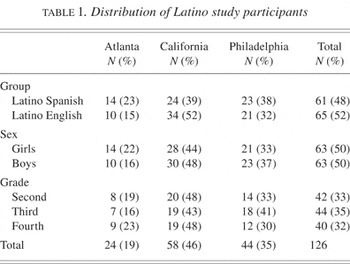
In the 2001–2002 school year, spontaneous speech samples were collected from 630 elementary school children in Atlanta, Philadelphia, and several cities in California. The present study included speech samples from 61 Latino children who learned to read in Spanish (referred to here as Latino Spanish) and 65 who learned to read in English (Latino English),2
Although all of the Latino children spoke English, the two Latino groups represent different types of bilingualism, in which the Latino Spanish group learned to read in Spanish and the Latino English group was exposed to English instruction in the earlier grades. Details about their early academic experiences were not, however, solicited from the children, who were just asked which language they learned to read in.
Distribution of Latino study participants

DATA COLLECTION
Part-time tutors collected the speech samples. They received minimal training in the methods of sociolinguistic interviewing and were provided with a question guide to assist them in the interview process. The types of questions used to elicit speech from the children included items like:
‘Did you ever do something that your mom told you not to do?’
‘Have you ever gotten blamed for something that you didn't do?’
‘Do you know any place that's really scary?’
The interviews lasted 30 minutes to 1 hour and were recorded on Sony mini-disk recorders. The quality and quantity of the speech samples were variable, as would be expected with 8 to 10 year-old children. Some children were not really forthcoming, while others continued to talk whether prompted or not. Approximately 170,000 words were transcribed, for an average of about 1,300 words per child. Despite an equal number of boys and girls, the number of words for each was 75,000 and 95,000, respectively, with girls producing, on average, 300 more words per interview than boys.
THIRD PERSON POSSESSIVE PRONOUN CONFUSION
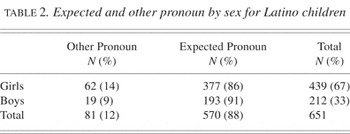
The variables considered for the analysis of third person possessive pronouns were those used to mark possession in pronoun + noun constructions involving the third person pronouns his and her. All instances of his + noun and her + noun were identified. The distribution of third person possessive pronoun tokens by speaker sex and pronoun choice is shown in Table 2. The rate for pronoun confusion is 12% overall, which is sufficiently common to warrant further investigation. Also, while the number of boys and girls in the cohort is almost equal, the girls used twice as many third person possessive pronouns as the boys. This is not surprising as it has been shown that female discourse is characterized by more talk about people than male discourse, which is more focused on things (Macaulay, 2005:129–138).3
Also see Eggins and Slade (1997), Holmes (1997), Johnstone (1990), Kipers (1987), Lippa (1998), and Nordenstam (1992).
Expected and other pronoun by sex for Latino children

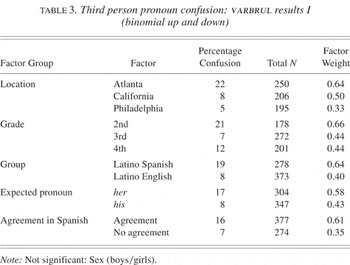
To explore the possible social and linguistic influences on pronoun confusion, a multivariate analysis using goldvarb 2.0 on the Macintosh was conducted. The dependent variable was use of incorrect pronoun (his when her was expected, or vice versa). The factor groups shown in Table 3 were selected as contributing significantly (p = .035) to pronoun confusion. These findings confirm that pronoun confusion is more likely when the pronoun agrees with the Spanish translation of the noun, as shown in example (5), where name in Spanish is a masculine noun and the pronoun his is selected instead of her. Out of all 81 cases of pronoun confusion, 75% involved this type of pronoun and noun agreement.
(5) His name is Jacqueline.
Third person pronoun confusion: varbrul results I (binomial up and down)

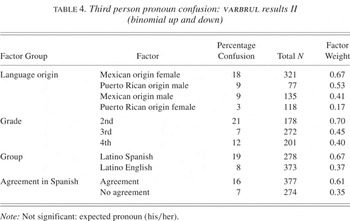
There are also some interesting group differences shown here. First, pronoun confusion is more likely to occur in the Latino Spanish children, who learned to read in Spanish first. Furthermore, there is a developmental effect, with second graders more likely to confuse pronouns. In terms of geographical distribution, Atlanta favors pronoun confusion, California is neutral, and Philadelphia favors correct pronoun use. This distribution suggested a difference between Mexican origin and Puerto Rican origin children, which was explored by recoding the data to include Spanish language origin plus sex as a factor group. Factors were created for Mexican boys and girls by combining Atlanta and California data, and for Puerto Rican boys and girls based on the Philadelphia data. The new varbrul results (Table 4) show that it is actually the Mexican origin females who are responsible for the greater part of gender confusion. The effects of learning to read in Spanish and pronoun and noun agreement continued to be favoring factors, as did the developmental effect. Of particular interest, however, is the sharp split between Mexican origin and Puerto Rican origin females, with the first group favoring pronoun confusion and the latter group disfavoring it. The factor weights for both male groups are in the neutral range and the difference between the two is not significant. The reorganization of the data uncovered interaction between speaker sex and language origin, which is quite striking, though not easily accounted for.
Third person pronoun confusion: varbrul results II (binomial up and down)

USE OF PERIPHRASTIC of VERSUS ATTRIBUTIVE -s
The variables used in the analysis of periphrastic of were noun + of + noun constructions that could be expressed as noun + -s + noun (or noun + noun when the -s is not expressed), as in example (6).
(6) So my dad, he got the gun of the bad guy. / So my dad, he got the bad guy's gun.
There are many factors that may affect the choice of one or the other form, including topicality of the possessor [± topical], animacy of the possessor [± animate], and the nature of the possession relation [± prototypical]. In a recent study of U.S. and British English, Rosenbach (2002) found that the most influential factors affecting the choice of periphrastic of over attributive -s were the presence of an [− animate] and [− topical] possessor, and a [− prototypical] possessive relation, as in the fumes of a car compared to a car's fumes. Accordingly, the preferred environment for the attributive possessive involved a [+ animate] and [+ topical] possessor, and a [+ prototypical] possessive relation, as in the girl's arm compared to the arm of the girl.
The possessive categories included in the present study are based on three main types identified by Rosenbach (2002): real possessives, subjective possessives, and objective possessives. Real possessives describe an intimate relationship, often involving parts of a whole, as in, John's arm or the arm of John. Real possessives also express actual possession, as in, the girl's dog or the dog of the girl. Subjective possessives imply a transitory or abstract relationship, as in, the pool's clarity or the clarity of the pool. And finally, objective possessives do not signal actual possession, but the two nouns are nonetheless closely related, as in, Mary's murder or the murder of Mary.
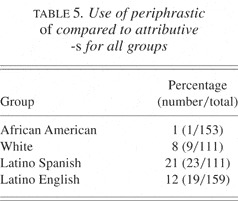
The rates for periphrastic of compared to attributive -s for all groups are shown in Table 5. Both the Latino Spanish and Latino English groups had a significantly higher rate of periphrastic of than the African American group (chi-square, p < .001), which virtually does not use this form. The Latino Spanish group had a significantly higher rate of periphrastic of than the white group (chi-square, p = .0028), but was not significantly different from the Latino English group.
Use of periphrastic of compared to attributive -s for all groups

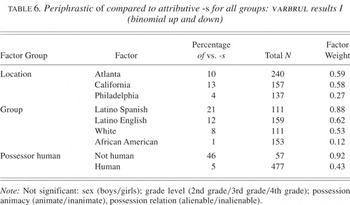
An initial varbrul run was done to evaluate the selection of of compared to -s for all four language groups. The dependent variable was periphrastic of as opposed to attributive -s. The attributive -s factor group included all noun + noun possessive constructions whether or not the -s was expressed. The factor groups that were selected as contributing significantly (p = .009) to periphrastic of use are shown in Table 6. The result for the third factor group is in line with our current understanding of the selection of the periphrastic form over the attributive form, which is preferred when the possessor is [− animate], as mentioned earlier. Furthermore, it was the Latino Spanish children who favored periphrastic of, as did the Latino English children.
Periphrastic of compared to attributive -s for all groups: varbrul results I (binomial up and down)

In an initial exploration of the preference for periphrasis by the Latino children, the author conducted a review of the constructions produced by them. As mentioned earlier, many factors are involved in the selection of periphrastic of versus attributive -s and it is difficult to determine what is actually different about the Latino children's constructions. Accordingly, it was concluded that a first step was to have the constructions rated as ‘native’, ‘nativelike’, or ‘nonnative’ in a pilot grammaticality study involving native English speakers. Preliminary results show that the Latino children's utterances were considered ‘nonnative’ more often than those of the other speakers. More details on the grammaticality of the utterances will be reported at a later time.
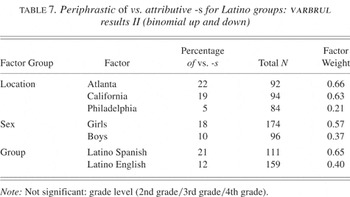
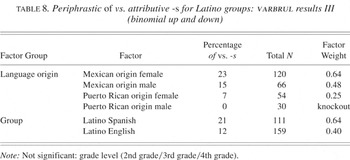
In the initial varbrul run for only the Latino children, the factor groups that were selected as contributing significantly (p = .04) to of use are shown in Table 7. These data demonstrate more clearly that the children from California and Atlanta are equally likely to favor the periphrastic construction compared to the children from Philadelphia, as was the case with pronoun confusion. Accordingly, the data were again reorganized to include a Spanish language origin plus sex factor group. In the second varbrul run for the Latino groups (Table 8), two factor groups were selected as significant (p = .009). The factor weights for these factors confirm that periphrastic of is a feature preferred by Mexican origin girls as compared to the Puerto Rican children in general. Mexican origin boys are neutral and Puerto Rican boys did not use the periphrastic of construction at all, hence the knockout category. Furthermore, learning to read in Spanish clearly contributes to a preference for this form.
Periphrastic of vs. attributive -s for Latino groups: varbrul results II (binomial up and down)

Periphrastic of vs. attributive -s for Latino groups: varbrul results III (binomial up and down)

What might have been considered a Spanish-language feature has proven to be quite variable among the Spanish speakers in the cohort. This is not to say that the parallels between Spanish and English are not related to an increased reliance on the periphrastic of possessive, but being Latino by no means guarantees an overgeneralization of this construction. It may be that the different histories of bilingualism and English contact of Mexicans and Puerto Ricans has contributed to differing patterns in Spanish influence. For example, the use of English as the official language in Puerto Rico has afforded Puerto Ricans more opportunity for English contact (Zentella, 2000:137–138). Furthermore, in areas with high concentrations of Mexican origin Spanish speakers (in particular in the Southwest United States), Spanish continues to be used in the home more than for most other groups for whom English is a second language (Alba et al., 2002). There are also different patterns of -s treatment in the Spanish of the two groups, with Puerto Ricans allowing -s elision freely (Poplack, 1980), which is not generally associated with Mexican Spanish. The preference on the part of Puerto Rican origin males for the attributive construction will be considered now by looking more closely at the use of attributive -s.
ATTRIBUTIVE -s ABSENCE
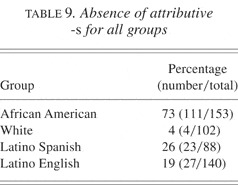
With the attributive -s construction, absence of the possessive -s marker also varies among children from different racial and ethnic backgrounds. Absence of attributive -s is well documented in the African American community (Baugh, 1983:94–97; Labov et al., 1968:169; Labov & Harris, 1986:11–12; Rickford, 1992:185–186), and occurs at a rate of over 70% for the African American children in the present study (Table 9). Interestingly, it also seems to be a feature common to the Latino children. As compared to the white children, there were significantly higher rates of -s absence among the Latino Spanish (chi-square, p = .0001) and Latino English (chi-square, p = .002) groups.
Absence of attributive -s for all groups

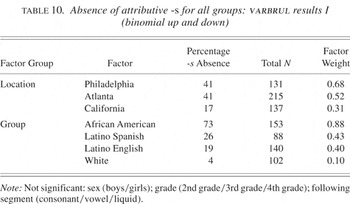
An initial varbrul run to assess these differences included five factor groups, with -s absence as the dependent variable. The factor groups selected as contributing significantly (p = .001) to -s absence are shown in Table 10. The findings confirm what was already evident, which is that African Americans favor the absence of -s. We also see that there are regional differences, with Philadelphia being a favoring factor. Following segment did not significantly affect the model however, which suggests that we are dealing with a morphological rather than a phonological variable, as has been noted in other studies of the absence of -s in AAVE (Labov, 1984:147–150; Labov et al., 1968:170; Rickford, 1992:186).
Absence of attributive -s for all groups: varbrul results I (binomial up and down)

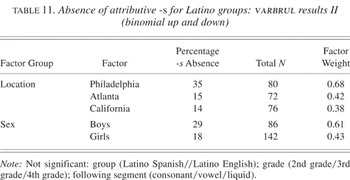
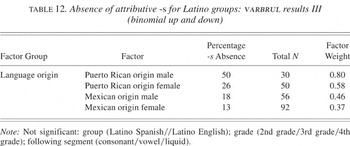
In the initial varbrul analysis for the Latino children alone, two factor groups were selected as contributing significantly (p = .04) to -s absence (Table 11). Once again, we see a bigger difference between Philadelphia, on the one hand, and Atlanta and California on the other, suggesting a Spanish language origin effect. But this time, boys favor the form over girls, and language group is not included. Data from a second Latino group varbrul analysis including the language origin group are shown in Table 12. Spanish language origin plus sex is the only factor group selected as significant (p < .001); the absence of attributive -s is clearly favored by the Puerto Rican boys, and to a lesser extent by the girls, but not among the Mexican girls.
Absence of attributive -s for Latino groups: varbrul results II (binomial up and down)

Absence of attributive -s for Latino groups: varbrul results III (binomial up and down)

DISCUSSION
The present findings support a substrate effect that is clearly mediated by social and cognitive factors. While variation in the expression of possession could be attributed to incomplete acquisition, the different sociolinguistic patterns for the different variables suggests otherwise. A relationship between the increased frequency of pronoun confusion and agreement in Spanish between the possessor pronoun and the possession noun was shown. Such agreement was found in 75% of the cases of pronoun confusion. There is also a developmental effect evident in pronoun confusion, with an increased frequency found in the second graders. This can be viewed in combination with the high level of salience of this feature, where the use of the incorrect pronoun might impede communication and cause misunderstandings, which underscores the difference between this and the other variables being studied. In the two cases where Spanish language influence was expected—pronoun confusion and periphrastic of—there was an increased occurrence of the nonstandard form among the children who learned to read in Spanish first compared to those who learned to read in English. With possessive -s absence, there was no difference between these two groups, which contradicts the idea that attributive -s acquisition may be facilitated by Spanish structural similarities.
The difference between boys and girls for two of the analyses was surprising, as was the interaction between speaker sex and language origin for all of the analyses. Most striking here is that a group of girls favored the use of periphrastic of and a group of boys favored absence of the attributive -s. An explanation for the preference of periphrastic of by the Mexican girls may lie in the fact that girls have closer ties to their homes, and less outside contact, which could limit their exposure to English. However, the same does not hold true for Puerto Rican girls, which could be due to the sociocultural differences between the Latino groups. At the same time, the increased absence of attributive -s among the Puerto Rican boys, and to a lesser extent girls, suggests that there is a link between them and black street culture. Poplack (1978) first reported on Puerto Rican bilingual boys use of AAVE features in Philadelphia in the late 1970s. In this study, Poplack looked at the realization of six phonological variables in the speech of Puerto Rican bilingual children attending a Catholic high school in North Philadelphia that was 51% Puerto Rican, 46% white, and 3% black. The purpose of the study was to examine the acquisition of the local Philadelphia dialect compared to AAVE dialect features by the Puerto Rican bilinguals. The boys in the study not only showed a higher percentage of the AAVE variants than the girls, but also had significantly more AAVE use in casual compared to careful speech. In their discussion of segregation in Philadelphia, Labov and Harris (1986:12) showed that Philadelphia African American speech patterns also extend to Puerto Rican males in that city. Specifically, it was the Puerto Rican males linked to the African American community through marriage who showed higher rates of both verbal and possessive -s deletion. An earlier study on assimilation by Wolfram (1974) found similar evidence of AAVE influence on Puerto Rican English in New York. Current, ongoing ethnographic and linguistic studies being conducted in Philadelphia confirm that Puerto Ricans have a close relationship with local African Americans and, as a consequence, certainly have the opportunity to absorb their grammatical features and are doing so (Wolford, Evans, & Cakiades, 2005).
Finally, the differences between the Mexican and Puerto Rican children are striking, beyond the differences between boys and girls noted earlier. The Mexican and Puerto Rican origin children are clearly divided in their use of both periphrastic of and absence of possessive -s. These findings point to a possible differentiation in Mexican or Mexican American and Puerto Rican English, with the latter being more and more characterized by features of AAVE, with less apparent influence from Spanish. At the same time, the former group may continue to be subject to a broad range of influences, as well, including Spanish language structures and forms.
References
REFERENCES
Alba, Richard D.,
Logan, John,
Lutz, Amy, &
Stults, Brian
(2002).
Only English by the third generation? Loss and preservation of the
mother tongue among the grandchildren of contemporary immigrants.
Demography
39(3):467–484.Google Scholar
Baugh, John.
(1983).
Black street speech: Its history, structure, and survival.
Austin:
University of Texas Press.
Brown, Roger William.
(1973).
A first language; the early stages.
Cambridge, MA:
Harvard University Press.
Eggins, Suzanne, &
Slade, Diane.
(1997).
Analyzing casual conversation.
London:
Cassell.
Fernández Domínguez, Joaquín
José.
(2000a).
An English–Spanish contrastive study of the genitive
construction: Some remarks on research and methodological issues.
In
A. Bruton,
L. García García, &
J. J. Fernández Domínguez
(eds.),
Perspectives on the genitive in English: Synchronic, diachronic,
contrastive and research.
Sevilla:
Universidad de Sevilla Secretariado de Publicaciones.
131–140.
Fernández Domínguez, Joaquín
José.
(2000b).
The English genitive construction: Perspectives from an
English–Spanish contrastive description.
In
A. Bruton,
L. García García, &
J. J. Fernández Domínguez
(eds.),
Perspectives on the genitive in English: Synchronic, diachronic,
contrastive and research.
Sevilla:
Universidad de Sevilla Secretariado de Publicaciones.
87–108.
Hill, Sam, &
Bradford, William.
(2000).
Bilingual grammar of English—Spanish syntax.
Lanham, MD:
University Press of America.
Holmes, Janet.
(1997).
Story-telling in New Zealand's women's and men's
talk.
In
R. Wodack (ed.),
Gender and discourse.
London:
Sage.
245–293.
Johnstone, Barbara.
(1990).
Stories, community, and place: Narratives from middle
America.
Bloomington:
Indiana University Press.
Labov, William.
(1984).
The interpretation of zeroes. In
W. U. Dressler,
H. C. Luschützky,
O. E. Pfeiffer, &
J. R. Rennison (eds.),
Phonologica 1984: Proceedings of the Fifth International Phonology
Meeting.
Cambridge:
Cambridge University Press.
135–156.
Labov, William,
Cohen, Paul,
Robins, Clarence, &
Lewis, John.
(1968).
A study of non-standard English of Negro and Puerto Rican speakers
in New York City.
Philadelphia:
U.S. Regional Survey.
Labov, William, &
Harris, Wendell.
(1986).
De facto segregation of Black and White vernaculars. In
D. Sankoff (ed.),
Diversity and diachrony.
Philadelphia:
Benjamins.
1–24.
Lippa, Richard.
(1998).
Gender-related individual differences and the structure of
vocational interests: The importance of the people-things
dimension.
Journal of Personality and Social Psychology
74:996–1009.Google Scholar
Macaulay, Ronald K. S.
(2005).
Talk that counts: Age, gender, and social class difference in
discourse.
New York:
Oxford University Press.
Nordenstam, Kerstin.
(1992).
Male and female conversational style.
International Journal of the Sociology of Language
94:75–98.Google Scholar
Poplack, Shana.
(1978).
Dialect acquisition among Puerto Rican bilinguals.
Language in Society
7:89–103.Google Scholar
Poplack, Shana.
(1980).
The notion of the plural in Puerto Rican Spanish: Competing
constraints on (s) deletion.
In
W. Labov (ed.),
Locating language in time and space.
New York:
Academic Press.
55–67.
Rickford, John R.
(1992).
Grammatical variation and divergence in Vernacular Black
English.
In
M. Gerritsen &
D. Stein (eds.),
Internal and external factors in language change.
Berlin:
Mouton de Gruyter.
175–200.
Rosenbach, Anette.
(2002).
Genitive variation in English: Conceptual factors in synchronic and
diachronic studies.
New York:
Mouton de Gruyter.
Whitley, M. Stanley.
(2002).
Spanish-English contrasts: A course in Spanish linguistics.
Washington, DC:
Georgetown University Press.
Wolford, Tonya,
Evans, Keelan, &
Cakiades, Athos.
(2005).
Origin of AAVE features in Puerto Rican English spoken in North
Philadelphia.
Paper presented at The Second Symposium of the Penn Working
Group on Language. University of Pennsylvania, Philadelphia, PA.
Wolfram, Walt.
(1974).
Sociolinguistic aspects of assimilation: Puerto Rican English in New
York City.
Arlington, VA:
Center for Applied Linguistics.
Zentella, Ana Celia.
(2000).
Puerto Ricans in the United States: Confronting the linguistic
repercussions of colonialism.
In
S. L. McKay &
S. C. Wong (eds.),
New immigrants in the United States: Readings for second language
educators.
New York:
Cambridge University Press.
137–164.
Distribution of Latino study participants
Expected and other pronoun by sex for Latino children
Third person pronoun confusion: varbrul results I (binomial up and down)
Third person pronoun confusion: varbrul results II (binomial up and down)
Use of periphrastic of compared to attributive -s for all groups
Periphrastic of compared to attributive -s for all groups: varbrul results I (binomial up and down)
Periphrastic of vs. attributive -s for Latino groups: varbrul results II (binomial up and down)
Periphrastic of vs. attributive -s for Latino groups: varbrul results III (binomial up and down)
Absence of attributive -s for all groups
Absence of attributive -s for all groups: varbrul results I (binomial up and down)
Absence of attributive -s for Latino groups: varbrul results II (binomial up and down)
Absence of attributive -s for Latino groups: varbrul results III (binomial up and down)
 You have
Access
- 6
- Cited by