Introduction
Suicide is a major public health concern in many parts of the world. Suicide rates are found to be highest among older people with a clear relationship globally between increased rates and age (World Health Organization, 2002; Shah et al., Reference Shah, Bhat, Zarate-Escudero, DeLeo and Erlangsen2016). A number of risk factors associated with late-life suicide have been identified and these include psychiatric illness (particularly depression); a history of previous suicide attempts; physical illness; pain; functional impairment; and social disconnectedness (Cattell, Reference Cattell2000; Conwell and Thompson, Reference Conwell and Thompson2008; Conwell et al., Reference Conwell, Van Orden and Caine2011; Fassberg et al., Reference Fassberg2012). A previous New Zealand case-control study of suicide and attempted suicide in older adults (age 55+ years) found suicide risk was elevated among those with concurrent mood disorders, psychiatric hospital admission within the previous year, and a limited social network (Beautrais, Reference Beautrais2002). Further, older people who die by suicide are more likely to have had a diagnosis of depression than their younger counterparts (Conwell and Brent, Reference Conwell and Brent1995). While the interaction between physical illness, depression, and suicide was described in Barraclough's classic study on late-life suicide, the association between physical illness and suicide is seldom direct and is largely thought to be mediated through mood disorder (Barraclough, Reference Barraclough1987). Other authors have also suggested a similar role of mood disorder in its association with physical illness and late-life suicide (Garand et al., Reference Garand, Mitchell, Dietrick, Hijjawi and Pan2006; Conwell and Thompson, Reference Conwell and Thompson2008).
Globally, suicide rates are highest in people aged 70 years or over for both men and women (World Health Organization, 2014). However, suicide rates among older people have been falling in some countries. For example, the 75+ years male suicide rate in the UK has dropped from 28.6 to 14.4 per 100,000 between 1981 and 2014; while the 75+ years female rate has dropped from 13.6 to 4.6 per 100,000 in the same period. Similarly, there is a substantial downward trend in the 65+ years male suicide rate in New Zealand with a decrease of 71.3% between 1950 (when it peaked) and 2012; and the female rate has fallen by 75.5% between 1967 (when it peaked) and 2012 (New Zealand Ministry of Health, 2015). However, it is important to note that the current cohort of older people is different from their historical counterparts with longer life expectancy, improved medical treatment for age-related illness, and better social and health policy. Gunnell et al. suggested that increases in national gross domestic product, anti-depressant prescribing, and other measures of improved healthcare provision for older people may have been associated with a decline in suicide trends in people aged over 60 years in England and Wales between 1950 and 1998 (Gunnell et al., Reference Gunnell, Middleton, Whitley, Dorling and Frankel2003). Nevertheless, Burns (Reference Burns2016) found that in Australia the 85+ years male ten-year average (2004–2013) age standardized suicide rate (33.4 per 100,000) was the highest among all age groups in both genders and the rate has not improved in the past decade. Similarly, data obtained from the New Zealand Ministry of Health have shown the 85+ years male ten-year average (2004–2013) suicide rate (32.4 per 100,000) was the highest among all age groups in both genders in this country. More effort to address suicide in this subgroup is therefore needed.
With the growing number of people surviving into old age, late-life suicide will continue to be a major public health concern. In New Zealand, the Coroners Act 2006 came into effect on 1st July 2007 and a new Chief Coroner (who is legally qualified) and other full-time coroners were appointed. The Act standardized the procedures coroners and other agencies used to investigate unexpected deaths. The police must also report every suspected suicide to a coroner. A coroner then investigates the death and makes a formal finding, either at inquest or through a hearing on papers. While suicides are investigated independently by individual coroners, the Chief Coroner maintains an overview of cases. These data provide an opportunity to investigate the factors associated with unexpected deaths.
The aims of this study were to (i) report the characteristics of older people who died by suicide and (ii) investigate whether these characteristics differ in three age bands: 65–74 years, 75–84 years, and 85+ years. Analyzing our data using these three age bands allows comparison with previous international late-life suicide studies that used similar age criteria (Erlangsen et al., Reference Erlangsen, Bille-Brahe and Jeune2003; Waern et al., Reference Waern, Rubenowitz and Wilhelmson2003; Erlangsen et al., Reference Erlangsen, Mortensen, Vach and Jeune2005; Paraschakis et al., Reference Paraschakis2012; Sinyor et al., Reference Sinyor, Tan, Schaffer, Gallagher and Shulman2016). These studies have found differences in suicide characteristics in “young-olds” (generally defined as between 65 years and 80 years) and “old-olds” (aged 80 years and above) including lower rates of contact with psychiatric services in “old-olds” (Erlangsen et al., Reference Erlangsen, Mortensen, Vach and Jeune2005; Paraschakis et al., Reference Paraschakis2012; Sinyor et al., Reference Sinyor, Tan, Schaffer, Gallagher and Shulman2016). This raises the possibility that lower mental health literacy, barriers to accessing psychiatric services and diagnostic challenges may play a part in the high rate in the older age group. The “old-olds” also generally have more health problems, greater losses and more existential issues. Apart from contact with psychiatric services, this study will also examine contact with general practitioners (GPs) prior to suicide and explore whether there is a role for better screening of suicide risk in primary care. We believe this study will help improve our understanding of late-life suicide in New Zealand, and the results can potentially be used to inform clinicians, researchers, and policy-makers internationally to develop effective interventions to support older people who are at risk of suicide.
Methods
This was a retrospective descriptive study of all cases with a coronial suicide verdict for any person in New Zealand over the age of 65 years from 1st July 2007 to 31st December 2012. In 2013, there was a total of 607,032 people (14.3% of the population) over the age of 65 years living in New Zealand (Statistics New Zealand, 2013). Within the 65+ years age group, 57% were between 65 years and 74 years old, 31% were between 75 years and 84 years and 12% were 85 years and older. Their marital status was married/defacto (65–74 years: 66.8%, 75–84 years: 50.9%, 85+ years: 24.0%), divorced/separated (65–74 years: 11.0%, 75–84 years: 6.7%, 85+ years: 3.0%), widowed (65–74 years: 10.4%, 75–84 years: 27.0%, 85+ years: 47.0%), and never married (65–74 years: 3.5%, 75–84 years: 2.9%, 85+ years: 2.9%).
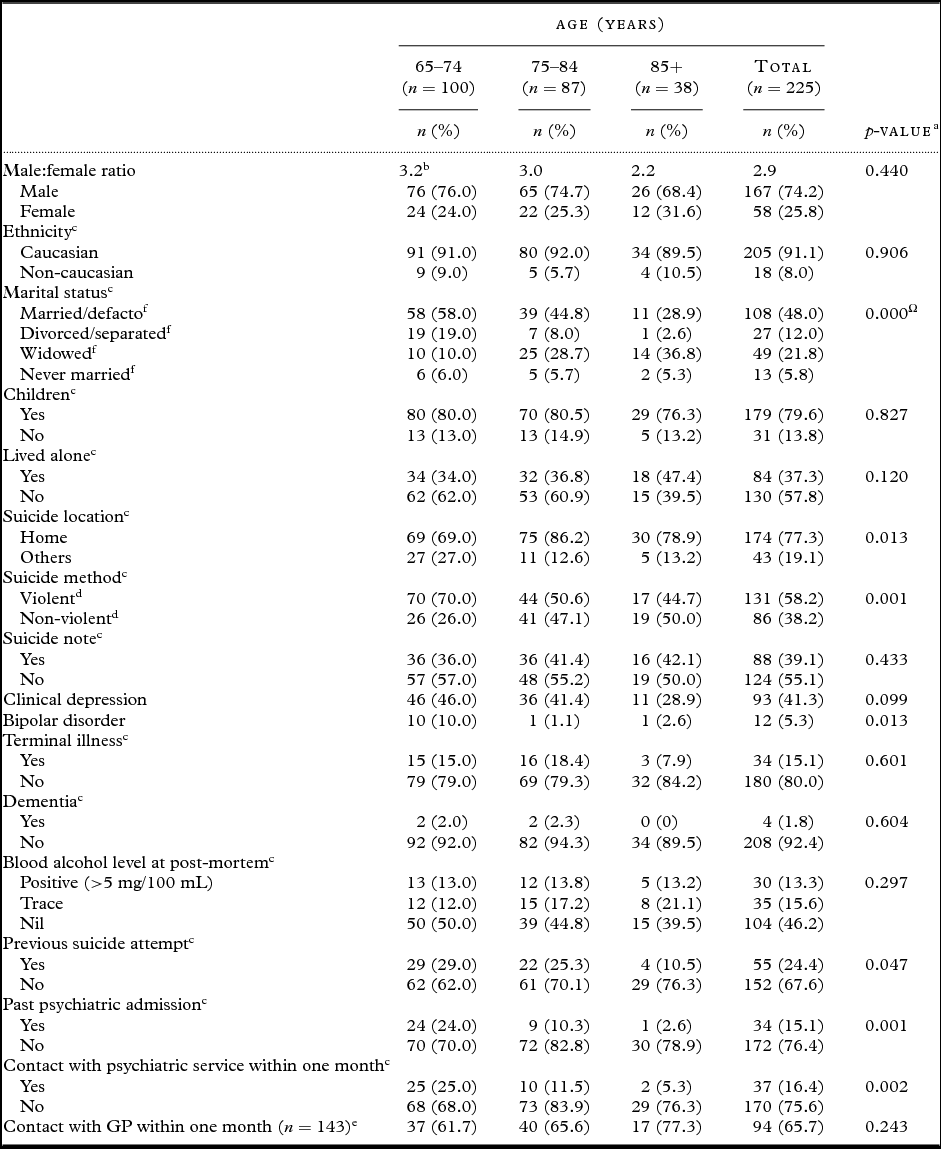
The Chief Coroner was approached by the lead author in August 2013 and his office provided copies of the coroner records on all cases with a suicide verdict. The coroner records included police reports, post-mortem findings, and GP reports. Sometimes specialist reports were available. We developed a pro forma based on the variables (refer to Table 1) examined in a recent literature review on late-life suicide (Cheung et al., Reference Cheung, Merry and Sundram2015): socio-demographics (age, gender, ethnicity, marital status, children status, living alone); details of the suicide (location, method, suicide notes, blood alcohol level at post-mortem); psychiatric conditions (schizophrenia, bipolar disorder, depression, and previous suicide attempts); medical conditions (dementia, terminal illness); past psychiatric admission and recent contact with psychiatric services; and recent contact with GPs. Suicide methods were categorized as either non-violent or violent. Non-violent methods included poisoning, overdoses and carbon monoxide inhalation and all other means were grouped as violent methods (Conwell et al., Reference Conwell, Rotenberg and Caine1990). The diagnoses of schizophrenia, bipolar disorder, clinical depression, and dementia were based on the diagnosis made by a GP and/or specialist at their last contact with the decedents.
Univariate analysis of socio-demographics and clinical factors of the 225 suicides

aMann–Whitney U test was used for variables containing two individual groups; Kruskal–Wallis test was used when variables had more than two individual groups (Ω).
bOne person was identified as a male-to-female transgender person (age = 66 years). For the purpose of reporting here, this person was included in the female gender group.
cDenotes missing data in this variable.
dSuicide methods were categorized as non-violent and violent. Non-violent methods included poisoning, overdoses, and carbon monoxide inhalation and all other means were grouped as violent methods (Conwell et al., Reference Conwell, Rotenberg and Caine1990).
eTiming of the last general practitioners’ visit was able to be determined in 143 cases.
f Marital status mean rank: Married/defacto = 91.4; Divorced = 74.0; Widowed = 129.1; Single = 100.5.
For data collection, the lead author trained and supervised two undergraduate medical students who were in their ten-week research studentships awarded by the University between November 2013 and February 2014. The first student researcher focused on the data related to timing of the last GP contact and primary reason for visiting their GP while the second student researcher extracted data on the remaining variables. Each coroner record was read through in its entirety. Data were extracted from the coroner records and entered into an Excel spreadsheet. Most variables (Table 1) were coded as binary variables (Yes or No). The researchers consulted the lead author whenever there was any uncertainty about data extraction or coding and they would go through all the material contained in the coroner record before final data entry.
The Statistical Package for the Social Sciences (SPSS) Version 22 was used for data analysis. Age band was coded as an ordinal variable (1 = 65–74 years; 2 = 75–84 years; 3 = 85+ years). A biostatistician (YH) was consulted on the most appropriate statistical methodology to use for the assessment of variables across the three elderly age bands. Non-parametric tests were performed to examine potential differences in socio-demographic and/or clinical characteristics across the three age groups (Table 1). The Mann–Whitney U test was used for variables containing two individual groups, whereas the Kruskal–Wallis test was employed when variables had more than two individual groups (McCrum-Gardner, Reference McCrum-Gardner2008). Because of the high number of variables and the potential for Type 1 error, we have presented all individual p-values and set a more stringent level of significance at 1% (instead of the usual 5%). Post-hoc analysis was performed to determine whether the use of violent and non-violent methods across the three age bands was different in males and females.
This study was approved by the Ministry of Health's Health and Disability Ethics Committee in New Zealand (Reference: 13/STH/95).
Results
A total of 225 older people (65–74 years: n = 100; 75–84 years: n = 87; 85+ years: n = 38) died by suicide in this five-and-a-half-year period. Table 1 shows the socio-demographics and clinical factors of the three age bands. No one in this cohort was diagnosed with schizophrenia. Firearms (26.0%), hanging (25.0%), and carbon monoxide poisoning (12.0%) were the most frequently used methods in the 65–74 years age band. Hanging (21.8%), drug overdose, and ingestion of poisonous substances (21.8%), and firearms (17.2%) were the most frequently used methods in the 75–84 years age band. Hanging (18.4%), drug overdose, and ingestion of poisonous substances (15.8%), and multiple lethal methods (15.8%) were the most frequently used methods in the 85+ years age band. An example of multiple lethal methods used in the 85+ years age band was drug overdose with plastic bag asphyxiation (three people). Women used non-violent methods more often than men (67.3% vs. 30.2%). Post-hoc analysis found non-violent methods were more frequently used by men as they got older (15.1% of 65–75 years, 40.6% of 75–84 years, 48.0% of 85+ years, p < 0.0001); while the rates of non-violent methods used by women were similar across the three age bands (65.2% of 65–75 years, 71.4% of 75–84 years, 63.6% of 85+ years, p = 0.874).
Timing of the last GP's visit could be determined in 143 cases (Table 1). Of the 143 cases, 65.0% had a visit to their GP within one month of suicide: 61.7% of 65–74 years, 65.6% of 75–84 years, and 77.3% of 85+ years (p = 0.243). With increasing age, the primary reason for visiting their GP within one month of suicide was more frequently related to physical health (65–74 years: 58.8%; 75–84 years: 75.7%; 85+ years: 88.2%) than mental health (65–74 years: 41.2%; 75–84 years: 24.3%; 85+ years: 5.9% (p = 0.009).
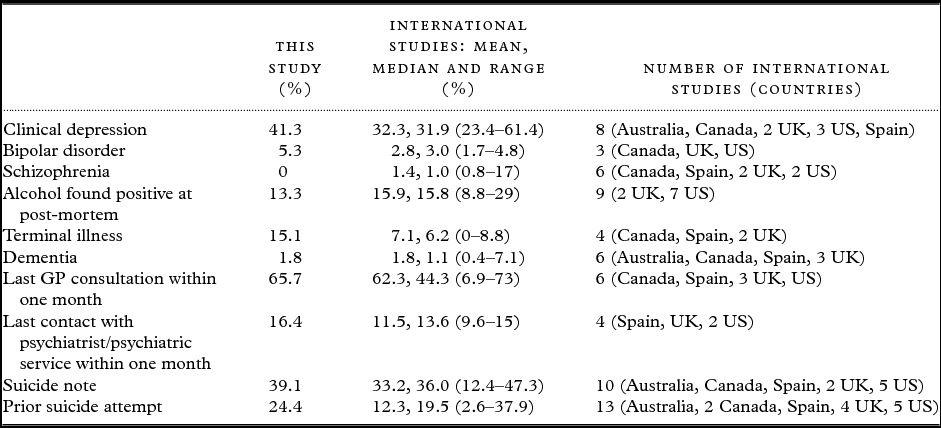
Table 2 compares the results of this study with other similar international work identified in a recent literature review (Cheung et al., Reference Cheung, Merry and Sundram2015).
Comparisons with international late-life suicide studies

Discussion
This is the first New Zealand report on a complete set of coroner records of late-life suicide from July 2007 to December 2012. We found age has an impact on suicide characteristics in older people: the older the person, the more likely they are to be widowed and to choose a non-violent way of ending their life, but the less likely they are to have a past psychiatric admission or recent contact with psychiatric services in the month prior to suicide. A good proportion (65.0%) of older people had contact with their GP within one month of suicide, and these rates are not significantly different in the three age bands. The New Zealand Health Survey found older people were more likely to have visited a GP in the past 12 months than younger adults (New Zealand Ministry of Health, 2016). For example, more than 90% of people aged 65 years and over had visited a GP in the preceding 12 months, compared with less than 80% of those younger than 45 years (New Zealand Ministry of Health, 2016). The visits to their GPs may not always be related to mental health needs but the clinical implications of our findings include the possibility that while older people are more likely to be seeing their GP for potentially physical health-related needs, it is important to screen for mental health problems. Primary care-based suicide prevention strategies could become more relevant for older people as they age.
Previous studies have also found older people were more likely to have contact with primary care (rather than mental health) services prior to suicide (Cheung et al., Reference Cheung, Merry and Sundram2015). For example, a U.K. study found 43% of their suicide cases had seen their GP within the previous month; while only 14% had contact with psychiatric services in the month before suicide (Cattell and Jolley, Reference Cattell and Jolley1995). Conwell and Thompson suggested that primary care-based collaborative depression care management is a promising approach to addressing late-life suicide (Conwell and Thompson, Reference Conwell and Thompson2008). However, while primary care physicians can recognize suicidal ideation, they may be less willing to manage it if the patient is older and retired (Uncapher and Arean, Reference Uncapher and Areán2000). Using evidence-based primary care collaborative late-life depression interventions (e.g. the PROPSECT and IMPACT trials) may be a way to overcome such difficulties (Unützer et al., Reference Unützer2002; Alexopoulos et al., Reference Alexopoulos2009). It is important to note that suicide is a rare event and completed suicide was not measured as a primary outcome in these primary care collaborative interventions. Therefore, adequately powered pragmatic studies of primary care interventions are needed to examine their effectiveness on suicide prevention. The Telehelp/Telecheck service in Northern Italy is one example where the observed suicide rate of their users was six times lower than the expected suicide rate over an 11-year period (De Leo et al., Reference De Leo, Buono and Dwyer2002). In that study, 18,641 participants were referred by their GPs or social workers because of their disability, social isolation, psychiatric needs, or poor compliance with hospital outpatient regimes. Participants received an alarm device, welfare monitoring, and emotional support via twice-weekly telephone interviews by trained staff, and participants could initiate calls at any time.
With regard to gender, worldwide, there are more male suicides than female suicides (World Health Organisation, 2015) and in New Zealand, male suicide rates have also been consistently higher than in females since records began in 1948. For example, the male:female suicide ratios across all ages from 2007 to 2012 were between 2.6:1 to 3.6:1 (New Zealand Ministry of Health, 2015). The ratio of male:female suicides in our study (2.9:1) falls within this range and the ratios were not significantly different across the three age bands. We also found women were more likely to use non-violent methods than men in all three age bands. This is consistent with previous studies where men were found to use more violent methods than women (Cattell and Jolley, Reference Cattell and Jolley1995; Cattell, Reference Cattell2000; Salib et al., Reference Salib, Rahim, El-Nimr and Habeeb2005). However, with increasing age, men in our study were less likely to use violent methods.
Some of our findings are consistent with similar international studies on late-life suicide. A study in Greece found people aged 75+ years were more frequently widowed and only a small proportion had been admitted to a psychiatric facility (Paraschakis et al., Reference Paraschakis2012). The authors highlighted the devastating consequences of spousal loss on the mental health of the “survivor.” A Danish study similarly found only a small proportion of older people aged 80+ years who died by suicide had previously been hospitalized with psychiatric disorder (Erlangsen et al., Reference Erlangsen, Mortensen, Vach and Jeune2005); while a Canadian study found older people aged 80+ years had a low rate of recent contact with mental health services or an emergency department (Sinyor et al., Reference Sinyor, Tan, Schaffer, Gallagher and Shulman2016). In contrast, Paraschakis et al. found people aged 65–74 years were more frequently single or separated; and Erlangsen et al. found people aged 80+ years who were married had a higher suicide rate than that found among younger age groups (50–64 years and 65–79 years) (Erlangsen et al., Reference Erlangsen, Bille-Brahe and Jeune2003). The interactions between age, marital status, and culture are complex and may play a role in explaining some of the differences observed between these studies and the current study.
Our finding that hanging and firearms were the most frequently used suicide methods by older people in New Zealand is similar to findings in Australia, Canada, and U.K. (Cheung et al., Reference Cheung, Merry and Sundram2015). Screening for firearm possession in older people, particularly men aged 65 years to 74 years who are more likely to use violent methods, should form part of a routine risk assessment in New Zealand but also elsewhere. Apart from the higher rate of terminal illness and bipolar disorder, the rates of psychiatric and physical disorders and previous contact with psychiatric services and GPs in this study are comparable to other international studies (see Table 2). To better understand terminal illness and late-life suicide, we are currently undertaking a more in-depth analysis of these cases with the aim of elucidating the role of depression and suffering and determining whether they resembled “rational suicide” (Siegel, Reference Siegel1986).
Limitations
Like other international studies that used coroner records to investigate late-life suicide, this study did not have a comparison or control group (Cheung et al., Reference Cheung, Merry and Sundram2015). Future studies could compare suicides with natural deaths or undetermined deaths and accidents. Another limitation relates to the reliability and validity of the data collected as part of coronial inquiries which are not primarily intended for use in suicide research. As with other international work, the information available in coroner records varied in breadth and depth and resulted in some missing data (Cheung et al., Reference Cheung, Merry and Sundram2015). It is recognized that clinical diagnoses such as depression and dementia based on coroner records can result in a lower number of people with these diagnoses than when they are derived from psychological autopsies (Draper et al., Reference Draper, Snowdon and Wyder2007). However, on broad parameters of known suicide risk factors, data from coroner records are comparable to those from psychological autopsies (De Leo et al., Reference De Leo2010). The coroner records used in this study also did not contain sufficient information for us to firmly conclude the direct impact of precipitants/stressors such as physical illness, functional impairment, depressed mood/psychological distress in these suicide cases.
Another limitation is that due to the design of this study, we are not able to compare whether older people who died by suicide were different from the general elderly population. For example, the rate of being widowed in our 85+ years group (36.8%) is lower than the 85+ years older people in the general population (47.0%); whereas the rate of being divorced/separated in our 65–74 years group (19.0%) is higher than the 65–74 years older people of the general population (11.0%). Similarly, 13.8% of our sample had no children, as compared to 9% of the 65+ years women in the general population (only data on number of children in the general population of women were available) (Statistics New Zealand, 2013). Caution needs to be taken when interpreting these rates given our relatively small sample size; and to answer the question whether older people who die by suicide are different from general population, a different study methodology, for example, a case-control study, will be necessary.
Conclusion
The findings from this study broadly support reports in the international literature and we have additionally found higher rates of terminal illness and bipolar disorder. The oldest people who die by suicide are not necessarily under the care of psychiatric services but frequently consult their GPs, mainly for physical problems, before suicide. Therefore, screening for depression and suicide risk within primary care could potentially reduce the suicide rate in older people. Additionally, screening for firearms should form part of the routine risk assessment in older people. New Zealand and many other countries currently do not have a suicide prevention program aimed specifically at older people. GPs could be supported to help their older patients with depression, physical problems, and social isolation through the provision of programs similar to collaborative depression care management and Telehelp/Telecheck services. Unless collaborative and targeted approaches are implemented, suicide across the lifespan will continue unchecked and therefore, researchers, clinicians, and healthcare policy-makers need to be mindful of approaches that benefit the various age groups.
Conflict of interest
None.
Description of authors’ roles
All authors contributed to the study design. G. Cheung was responsible for data collection and analysis and led on drafting the paper. S. Merry and F. Sundram revised the draft and read the final version of the paper.
Acknowledgments
The authors would like to thank Judge MacLean, ex-Chief Coroner, Coronial Services of New Zealand for supporting this research; Amy Lockwood and Kody Shaw for data collection as part of their medical student summer studentships at the University of Auckland in 2013/2014; and Ying Huang, Biostatistician, School of Population Health, the University of Auckland.