Ever since Bowlby (1969/Reference Bowlby1982, Reference Bowlby1973) first proposed his seminal, groundbreaking, and heuristically powerful theory of human attachment, the research on developmental implications of the parent–infant relationship has thrived. Researchers studying the early roots of antisocial or externalizing behavior problems have focused extensively on early attachment, inspired by Bowlby's (Reference Bowlby1944) compelling thoughts on the pathways from disrupted early child–caregiver bonds to future delinquency. A wealth of evidence has documented higher risks for antisocial and externalizing behavior problems in children who have failed to develop secure attachments with their caregivers during infancy and early development (e.g., Belsky & Nezworski, Reference Belsky and Nezworski1988; DeKlyen & Greenberg, Reference DeKlyen, Greenberg, Cassidy and Shaver2008; Fearon, Bakermans-Kranenburg, van IJzendoorn, Lapsley, & Roisman, Reference Fearon, Bakermans-Kranenburg, van IJzendoorn, Lapsley and Roisman2010; Fearon & Belsky, Reference Fearon and Belsky2011; Greenberg, Reference Greenberg, Cassidy and Shaver1999; Kobak, Cassidy, Lyons-Ruth, & Ziv, Reference Kobak, Cassidy, Lyons-Ruth, Ziv, Cicchetti and Cohen2006; Moss et al., Reference Moss, Smolla, Cyr, Dubois-Comtois, Mazzarello and Berthiaume2006; Sroufe, Carlson, Levy, & Egeland, Reference Sroufe, Carlson, Levy and Egeland1999), although the findings have not been uniform (Dodge, Coie, & Lynam, Reference Dodge, Coie, Lynam, Damon, Lerner and Eisenberg2006; Thompson, Reference Thompson, Damon, Lerner and Eisenberg2006) and have sometimes been applied to attachment disorganization rather than insecurity in general.
There is a consensus that the long-term implications of the infant attachment organization on antisocial, disruptive future pathways are certain to involve complex processes rather than simple main effects (Greenberg, Reference Greenberg, Cassidy and Shaver1999; Greenberg, Speltz, & DeKlyen, Reference Greenberg, Speltz and DeKlyen1993; Sroufe, Reference Sroufe2005; Sroufe et al., Reference Sroufe, Carlson, Levy and Egeland1999; Waters, Posada, Crowell, & Lay, Reference Waters, Posada, Crowell and Lay1993). That complexity is inevitable, given the broad range of phenomena encompassed by the child's security or insecurity that includes physiology, emotion regulation, behaviors, and internal cognitive representations. Moreover, those components interface with other complex systems at multiple levels at which development occurs: the child's temperament, the parent–child dyadic interactions and their evolving relationship, and external stresses and adversity that may impinge on the parent and the child. Consequently, pathways and trajectories set in motion by early security or insecurity are necessarily multiple and complex. Most likely, early attachment serves an important conditional or probabilistic role by influencing complex mediation and moderation effects that change the dynamics of future developmental cascades. The need to study such “hidden” or indirect effects of early attachment has been stressed repeatedly (Cox, Mills-Koonce, Propper, & Gariepy, Reference Cox, Mills-Koonce, Propper and Gariepy2010; Fearon & Belsky, Reference Fearon and Belsky2011; Fearon et al., Reference Fearon, Bakermans-Kranenburg, van IJzendoorn, Lapsley and Roisman2010; Masten & Cicchetti, Reference Masten and Cicchetti2010; Sroufe, Reference Sroufe2005; Sroufe et al., Reference Sroufe, Carlson, Levy and Egeland1999; Thompson, Reference Thompson, Cassidy and Shaver2008).
To address those questions, we have proposed that early attachment security may serve two major sets of developmental goals (Kochanska, Reference Kochanska1995; Kochanska et al., Reference Kochanska, Woodard, Kim, Koenig, Yoon and Barry2010). Those correspond to a more narrow view of attachment security as a biobehavioral safety-regulating system that is focused on protection (Goldberg, Grusec, & Jenkins, Reference Goldberg, Grusec and Jenkins1999), and to a broader view as an implicit positive relationship context that forms a foundation conducive to socialization (Emde, Biringen, Clyman, & Oppenheim, Reference Emde, Biringen, Clyman and Oppenheim1991).
In the first view, the most often studied goals of the attachment system are for the child to achieve confidence in protection; to establish trust in the parent; and to form the expectation that the parent will be reliably available and willing to provide effective comfort in case of stress, distress, or threat. The parent comes to serve as a secure base when the child explores and as a safe haven when he or she is distressed. Security fosters the child's enthusiasm for exploring the environment; and it promotes his or her adaptive physiological and behavioral emotion regulation strategies that develop in concert with the parent's acceptance and support for the child's open emotion expression and comfort seeking, as well as the provision of effective comfort when needed. When early attachment is organized suboptimally, those outcomes are compromised: lacking trust in parental reliable protection, the child engages in impoverished exploration and develops less adaptive emotion regulation strategies.
In the second, broader view, early attachment is seen as serving another set of key developmental goals: to create a foundation for the future relationship between the child and the parent and as a context for future socialization. Early attachment may therefore indirectly influence the parenting process and its socialization outcomes. A secure attachment contributes to a relatively enduring reciprocal, cooperative, mutually responsive orientation between the parent and the child. That orientation enhances the effectiveness of future parent–child socialization, likely because of the child's increased receptiveness to parental influence and willing compliance with the parent's agenda and the parent's expectations of the child's cooperation. In such contexts, the likelihood of child adaptive outcomes (the embrace and internalization of parental values, competence) is enhanced.
By contrast, an insecure attachment creates a socialization context conducive to a future negative reciprocity and a mutually adversarial and resentful dynamic, where the parent and the child become increasingly antagonistic, undermining socialization outcomes. In sum, early attachment, even if not directly influencing developmental outcomes, becomes a potent catalyst that alters the future parent–child dynamic.
Theoretical models consistent with such a broader view have been proposed (van IJzendoorn, Reference van IJzendoorn1997; Waters, Kondo-Ikemura, Posada, & Richters, Reference Waters, Kondo-Ikemura, Posada, Richters, Gunnar and Sroufe1990). Maccoby (Maccoby, Reference Maccoby, Higgins, Ruble and Hartup1983, Reference Maccoby1992; Maccoby & Martin, Reference Maccoby, Martin, Hetherington and Mussen1983) has long argued that the early “mutually responsive, positive set” (a construct conceptually akin to and incorporating secure attachment) between the parent and the child constitutes a foundation for well-functioning future socialization processes.
Although the empirical base is quite sparse, some supportive data exist. For example, Deater-Deckard and Dodge (Reference Deater-Deckard and Dodge1997) reported that parent–child warmth (a likely index of the quality of early relationship) moderated the deleterious developmental effects of harsh parental discipline. For parent–child dyads that were below the median on parental warmth the correlations between harsh parental discipline and children antisocial outcomes from kindergarten to Grade 6 were all positive and significant, whereas the correlations for the dyads that were above the median were all negligible. Alink, Cicchetti, Kim, and Rogosch (Reference Alink, Cicchetti, Kim and Rogosch2009) found that, for 7- to 10-year-olds who reported insecure relatedness with their mothers, a history of maltreatment was related to poor emotion regulation, which in turn was related to more behavior problems. However, secure relatedness disrupted this pattern: for secure children, history of maltreatment was unrelated to emotion regulation. Allen, Moore, Kuperminc, and Bell (Reference Allen, Moore, Kuperminc and Bell1998) found that mothers' firm control predicted low levels of their adolescent children's externalizing behavior, but primarily for secure adolescents. Marsh, McFarland, Allen, Boykin McElhaney, and Land (Reference Marsh, McFarland, Allen, Boykin McElhaney and Land2003) and Allen et al. (Reference Allen, Marsh, McFarland, Boykin McElhaney, Land and Jodl2002) found that adolescents' attachment style moderated the links between mothers' behavior (self-confident, assertive, dominating style of discourse) and their adolescents' internalizing problems, risky behaviors, and social skills. Allen et al. (1998) explicitly underscored the need to modify theories of parenting in a way that incorporates the organization of parent–child attachment as a moderator. Despite those suggestive data from several laboratories, the proposed entire causal chain from early attachment to future parent–child socialization to long-term child outcomes has rarely been tested systematically, rigorously, and longitudinally.
We tested and supported several components of this model in our past work. For example, we found that security of attachment to the mother (assessed in the Strange Situation) significantly moderated the beneficial effects of the mother's positive parenting, assessed throughout the toddler age, on children's moral development at preschool age. Security enhanced the effects of positive parenting: positive parenting predicted moral development in secure dyads, but there were no effects in insecure dyads (Kochanska, Aksan, Knaack, & Rhines, Reference Kochanska, Aksan, Knaack and Rhines2004). Further, we also found that early security significantly enhanced positive future effects of children's willing compliance on socialization outcomes (Kochanska et al., Reference Kochanska, Woodard, Kim, Koenig, Yoon and Barry2010). We also established that in the context of early insecurity, parental power assertion led to children's resentment toward the parents, and that resentment in turn led to disruptive behavior problems at kindergarten age. In secure dyads, that causal chain was absent (Kochanska, Barry, Stellern, & O'Bleness, Reference Kochanska, Barry, Stellern and O'Bleness2009). It was notable that security had few main effects on parenting, children's compliance, or children's outcomes.
In the present article, we continue, replicate, and expand our research inspired by this model, applying it specifically to the prediction of children's antisocial developmental pathways. We again test the component of the model that predicts different implications of parental power assertion for antisocial outcomes in dyads that developed insecure or secure attachment organization in infancy. We expected that early attachment organization would moderate the future effects of power assertion, such that in insecure dyads those effects would be quite “toxic,” leading to an increased risk for children's rule-breaking conduct, compromised self-regulation, and disruptive, oppositional, aggressive qualities. In secure dyads, we expected such risks to be effectively defused.
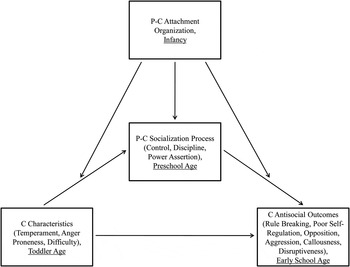
Furthermore, we test a new component of the model: the role of the child's individual characteristics in the path leading to antisocial outcomes in the context of insecure and secure parent–child relationships. We focus on difficult temperament or anger proneness, most often implicated in antisocial developmental cascades (Bates, Reference Bates1980; Cox et al., Reference Cox, Mills-Koonce, Propper and Gariepy2010; Lahey et al., Reference Lahey, Van Hulle, Keenan, Rathouz, D'Onofrio and Rodgers2008; Sanson, Hemphill, & Smart, Reference Sanson, Hemphill and Smart2004). We expected that early security would moderate the commonly assumed developmental causal pathway, where anger-prone children inspire more power-assertive discipline and that discipline in turn leads to an increased risk for antisocial outcomes. We expected to find such a chain in parent–child dyads that had been insecure in infancy, but not in those that had been secure. Figure 1 presents a simplified depiction of the model.
The conceptual model: The causal chain from child characteristics to parental socialization to child antisocial outcomes in insecure and secure relationships. P, parent; C, child.

We tested the model using data from two longitudinal studies: the Family Study (mothers, fathers, and children followed from infancy through age 6.5) and the Parent–Child Study (mothers and children followed from infancy through age 6). In both studies, the participating parents and children were community volunteers. The Parent–Child Study was first chronologically, and several methodological refinements were introduced in the Family Study (e.g., paradigms, coding, and data aggregation strategies). Consequently, the Family Study is presented first and the Parent–Child Study second.
We followed several conceptual and methodological guidelines. In both studies, measures were collected at several levels: child attachment security (assessed using the gold standard, the Strange Situation, at the end of the first year), child characteristics, parent–child discipline interactions, and child antisocial developmental outcomes. Most measures were purposely designed to be directly comparable across the studies. The observational contexts of the parent–child discipline were scripted yet naturalistic, and they revolved around typical requests and prohibitions of the toddler and preschool periods (off-limits objects, cleaning up toys). Children's anger proneness was assessed in a standard temperament episode in the Family Study and in parent–child interactions in the Parent–Child Study. Multiple informants (mothers and fathers in the Family Study, teachers in the Parent–Child Study) provided reports about the children.
The measures of children's antisocial outcomes encompassed observed behavior in laboratory paradigms and ratings by informants. The assessments targeted several well-established aspects of the antisocial trajectory: children's rule-breaking conduct when without supervision, a compromised capacity for self-regulation when asked to delay gratification, and opposition, aggression, callousness, and disruptive conduct in daily life.
All observational paradigms were videotaped for future coding by multiple teams. Reliability was established on approximately 15% to 20% of cases, followed by frequent realignments to prevent drift. Kappas were used for discrete variables. For continuous variables, either alphas or intraclass correlations (ICCs) were used, because the best practices in that regard have varied over the last 15 years, when the data reported here were collected. Note that both approaches are essentially equivalent (Bravo & Potvin, Reference Bravo and Potvin1991; Shrout & Fleiss, Reference Shrout and Fleiss1979). To achieve robust constructs, we programmatically deployed extensive data aggregation strategies whenever possible and justified.
Family Study Method
Participants
Two-parent community families of normally developing infants (N = 102) volunteered. The families came from a college town, a small city, and rural areas and towns in the Midwest; they represented a broad range of education levels. Among mothers, almost 25% had a high school education (or less), 54% had an associate or college degree, and 21% had a postgraduate education. The corresponding figures for fathers were almost 30%, 51%, and 20%. They also ranged in annual family income: 8% made less than $20,000, 17% made between $20,000 and $40,000, 26% made between $40,000 and $60,000, and 49% made over $60,000. Regarding ethnic background, 90% of mothers were White, 3% Hispanic, 2% African American, 1% Asian, 1% Pacific Islander, and 3% other non-White. Among fathers, 84% were White, 8% Hispanic, 3% African American, 3% Asian, and 2% other. In 20% of families, one or both parents were non-White.
Overview
In this article, we focus on data collected at four points in development: the child's attachment organization with the mother and the father, assessed at 15 months (N = 101, 51 girls); his or her proneness to anger, assessed at 38 months (N = 100, 50 girls); each parent's power-assertive control style at 52 months (N = 99, 49 girls); and antisocial developmental outcomes at 80 months (N = 90, 43 girls). There were two 1.5- to 3-hr laboratory sessions at each time, one with each parent (at 38 months, there was one home and one laboratory session, with each parent participating in half of each session). The order of the sessions (with mother and with father) was randomized. All sessions were conducted by female experimenters, and videotaped for future coding.
Measures
Children's attachment security at 15 months
Children participated in the standard Strange Situations (Ainsworth & Wittig, Reference Ainsworth, Wittig and Foss1969) with both parents (the first paradigm during each of the two laboratory sessions). Data were coded by professional coders blind to all other information about the families. One coder coded the paradigm with one parent only. The reliability (κs) were 0.78 for the main attachment categories (avoidant [A], secure [B], resistant [C], and disorganized or unclassifiable [D/U]) and 0.85 for the coding of security versus insecurity. All cases coded with low confidence and all D/U cases were double-coded and adjudicated. In this article, we compare secure children (B) versus insecure (A, C, D/U combined).
Regarding mother–child attachment, 56 children were secure and 45 were insecure. Regarding father–child attachment, 66 children were secure and 34 were insecure (parents of one child who had been very upset during the separation with the mother declined to participate in the paradigm with the father). There were no significant differences in the distribution of security versus insecurity in girls and boys with mothers, Pearson χ2 (1) = 2.22, ns, or fathers, Pearson χ2 (1) < 1. Security with the mother was unrelated to that with the father, Pearson χ2 (1) = 1.67, ns.
Children's proneness to anger at 38 months
The observed paradigm
The episode was modeled after the “End of the line” anger episode from the Laboratory Temperament Assessment Battery, Preschool Version (Goldsmith, Reilly, Lemery, Longley, & Prescott, Reference Goldsmith, Reilly, Lemery, Longley and Prescott1993). Once the child became engaged with an attractive toy for about 1 min, the experimenter took the toy away, saying “I don't want you to play with it.” The experimenter then held the toy out of the child's reach, responding “Not now” to the child's overtures and efforts to get back the toy, and pretended to be reading a magazine. After 30 s, the experimenter handed the toy back to the child and said that she decided it was OK for him/her to play with it and that she was sorry for having taken it away.
Coding and data aggregation
The child's anger expression was coded for every 5-s segment when the toy was out of reach. The codes included facial anger (κ = 0.58), intensity of facial anger (from 0 = none to 3 = in all three facial regions, α = 1.00), vocal anger (κ = 0.95), intensity of vocal anger (from 0 = none to 5 = full intensity cry or scream, α = 0.99), and bodily anger (struggling, kicking, arching back, κ = 0.84). Latency to first anger expression was also coded (α = 1.00). Those codes were standardized and averaged into an overall anger composite (M = 0.00, SD = 0.70, range = –0.70 to 1.72; Cronbach α = 0.66).
Mothers' and fathers' power-assertive control style at 52 months
The observed contexts
The child was observed with each parent during several naturalistic but scripted control contexts (75 min with each parent). Those contexts encompassed paradigms focused on a request, “Do” (toy cleanup, 10 min), and on a prohibition, “Don't” (not touching very attractive, off-limits objects on a low shelf in the laboratory, 65 min).
Coding and data aggregation
The parent's style of control was coded for every 30-s segment (throughout the entire toy cleanup and whenever the parent and/or child were involved with the prohibited objects). The codes used to create the power assertion measure included the global ratings for each segment and the coding of all physical techniques in each segment. The global ratings included “no interaction,” “social exchange,” “gentle guidance,” “control,” and “forceful, negative control” (κs = 0.94 for “Do,” 0.76 for “Don't”). The physical techniques included “assertive interventions” (holding the child's hand firmly, physically preventing the child from leaving the chore, blocking access to toys) and “forceful interventions” (taking away a toy abruptly, handling the child roughly, κs = 0.83 for “Do,” 0.68 for “Don't”).
For each context (“Do” and “Don't”), each code was tallied and divided by the number of segments. Then weights were applied to reflect the amount of power used: –2 to “no interaction,” –1 to “social exchange,” 1 to “gentle guidance,” 2 to “control,” 3 to “forceful control,” 4 to “physical assertive,” and 5 to “physical forceful.” Those figures were summed, creating weighted power assertion composites for “Do” and for “Don't.” The “Do” and “Don't” composites cohered, r (98) = .35 for mothers and r (98) = .38 for fathers (ps < .001). Those two composites were then standardized and averaged across “Do” and “Don't” into one overall power assertion score for each parent: mothers, M = 0.00, SD = 0.82, range = –1.50 to 4.14; fathers, M = 0.00, SD = 0.83, range = –1.74 to 3.95.
Children's observed antisocial outcomes at 80 months: Observed violations of rules regarding prohibited objects
The paradigm
Upon the parent's and child's arrival to the laboratory, the experimenter brought the child to the “Living Room,” where again there was a shelf with age-appropriate prohibited objects. Among other attractive objects, there was also a small TV with an interesting movie already running (chosen from three titles, based on the parent's recommendation as most interesting to the child). The experimenter asked the child not to touch anything on the shelf. Then, she asked the child to work on a mundane prosocial task (cutting out individual stickers from sheets, to be later given to child patients in a local hospital), not to engage in any other activity, and not to watch the movie. The child was then left alone for 8 min.
Coding and data aggregation
Child behavior was coded for each 10-s segment (48 segments, with up to two behavioral codes allowed per segment). The coding captured all instances when the child violated the experimenter's instructions: touching the prohibited objects, taking any of them from the shelf, engaging in other activity, and watching the movie. The instances when the child engaged in the requested, “legal” prosocial behavior (cutting the stickers) were also tallied. The latencies to the first instance of touching the prohibited objects, taking them from the shelf, and watching the movie were also coded. The intercoder reliability (κ) for the child's four behaviors was 0.95; for latencies, ICC = 1.00.
Each of the four behaviors that violated the experimenter's rules and the “requested, “legal” behavior was tallied, and the three latencies were reversed. Then the four “violation” behaviors and the three reversed latencies were standardized and averaged into a behavioral score of rule violation regarding prohibited objects (M = 0.00, SD = 0.68, range = –0.85 to 5.62; Cronbach α = 0.81).
Children's observed antisocial outcomes at 80 months: Observed violations of rules regarding a game
The paradigm
The task was broadly modeled after Eisenberg et al. (Reference Eisenberg, Guthrie, Fabes, Shepard, Losoya and Murphy2000), and further adapted. The experimenter placed a large (22 × 14 × 14 in.) box on a table in front of the child. The child was seated facing one side of the box that was missing and thus fully open. The opposite side was a transparent plastic door, held by hinges, so the child could walk around the table, see inside the box, and easily open the door and reach inside. The remaining four sides were wooden and opaque. An alphabet puzzle was inside the box. The experimenter described the task to the child (matching puzzle pieces to pictures). The experimenter then covered the fully open side with a black curtain so that the child could not see anything inside (however, the curtain could be easily lifted) and spilled the puzzle pieces into the box. She specified the rules to be followed: not looking under the curtain, not taking any pieces out of the box to see them, and not looking or reaching through the transparent door on the other side. Thus, the task was to be accomplished by touch alone. The experimenter made sure the child understood the rules, set the timer for 3 min, promised the child a prize if he or she completed the puzzle before the timer went off, and left the room. When the timer went off, the experimenter returned, “discovered” with dismay that she had given the child the wrong rules (the puzzle was actually to be solved when not hidden from view), removed the puzzle from the box and set it on a table, let the child solve it in 3 min (all children succeeded), and then let the child choose the prize.
Coding and data aggregation
The child's behavior was coded for each 3-s segment as uninvolved in the game, violating one of the three rules, and trying to solve the puzzle in compliance with the rules (κ = 0.89). The latencies to the first violation of each type of rule were also coded (ICCs = 0.85–1.00).
All instances of rule-compliant behaviors and behaviors violating each of the rules were tallied, divided by the number of segments when the child was involved with the puzzle, and standardized. The latencies to the first violations were reversed and standardized. Then the behaviors violating the rules and reversed latencies were aggregated into one behavioral composite of rule violations while playing the box game (M = 0.00, SD = 0.69, range = –0.8 to –2.27; Cronbach α = 0.63).
Overall observed rule violations score
We aggregated the two behavioral scores of rule violations regarding prohibited objects and the violations while playing the box game and the two reversed scores for “legal” behaviors (cutting the stickers, trying to solve the puzzle as instructed) into one overall composite of children's observed rule violations (M = 0.01, SD = 0.67, range = –0.74 to 3.94; Cronbach α = 0.77).
Observed compromised capacity for delay at 80 months
The paradigms (Wrapped Gift and Gift in Bag)
At the end of each session, the experimenter requested that the child delay a desired behavior (peeking while a gift for him or her was being wrapped, opening the gift) while without supervision. After the first session, the experimenter brought in the gift, asked the child to turn away and not peek while she noisily wrapped it (60 s), and then to stay in the chair and not touch the gift while she was gone to get the bow (3 min). After the second session, the experimenter brought in the gift in a gift bag and asked the child not to touch it until she came back with another gift for the parent (3 min).
Coding and data aggregation
In the Wrapped Gift, during the wrapping phase, the child's peeking behavior was coded from 1 (turns around to see, does not return to the requested position) to 5 (does not try to peek at all). The κ value was 0.87. The latencies to peek over the shoulder and to turn the body around were also coded (α = 0.97 and 0.99, respectively). During the waiting phase, the touching behavior was coded from 1 (opens gift) to 4 (never touches; κ = 0.93) and remaining in the seat from 1 (remains in seat for less than 30 s) to 4 (in seat for more than 2 min; κ = 0.82). The latencies to touch, lift, and open the gift and to leave the seat were also coded (α = 0.94–1.00).
In the Gift in Bag, the touching behavior was coded from 1 (pulls gift from bag) to 5 (does not touch bag; κ = 1.00) and remaining in seat from 1 to 4 (κ = 1.00). The latencies to touch the bag, open the bag, put hand in the bag, pull gift from the bag, and to leave the seat were also coded (αs = 1.00).
Data aggregation was straightforward: the behavioral scores and latencies were standardized and aggregated for each task (Cronbach α = 0.86 for Wrapped Gift and 0.72 for Gift in Bag). Those two scores correlated, r (85) = .74, p < .0001. We then reversed each score and aggregated them to create one score of the child's observed compromised capacity to delay (M = –0.01, SD = 0.60, range = –0.44 to 3.51).
Children's parent-rated antisocial outcomes at 80 months
Mothers and fathers completed three well-established questionnaires about the child: the Inventory of Callous–Unemotional Traits (ICU; Frick, Reference Frick2004), the Child Symptom Inventory (CSI-4; Gadow & Sprafkin, Reference Gadow and Sprafkin2002; Gadow, Sprafkin, & Nolan, Reference Gadow, Sprafkin and Nolan2001; Sprafkin, Gadow, Salisbury, Schneider, & Loney, Reference Sprafkin, Gadow, Salisbury, Schneider and Loney2002), and the MacArthur Health Behavior Questionnaire (HBQ; Boyce et al., Reference Boyce, Essex, Woodward, Measelle, Ablow and Kupfer2002; Essex et al., Reference Essex, Boyce, Goldstein, Armstrong, Kraemer and Kupfer2002). In the ICU, each item was rated from 0 (not at all true) to 3 (definitely true); ICU produced one score, with all items averaged (α = 0.86 for mothers, α = 0.82 for fathers). Two scores were selected from the CSI-4: oppositional defiant disorder and conduct disorder, both based on the symptom severity scoring, with each item rated from 0 (never) to 3 (very often). From the HBQ, we selected the overt aggression score rated from 1 (never/not true) to 3 (often/very true). The α value for mothers was 0.67 and for fathers was 0.60. For each parent, those four scores were standardized and averaged into the mother- and father-rated child antisocial conduct scores (for mothers, M = 0.00, SD = 0.77, range = –1.15 to 3.57, α = 0.78; for fathers, M = 0.00, SD = 0.75, range = –1.25 to 2.05, α = 0.74). Mothers' and fathers' scores significantly cohered, r (84) = .51, p < .001, and they were aggregated into an overall parent-rated antisocial outcomes score (M = 0.01, SD = 0.67, range = –0.97 to 2.76).
Family Study Results
Preliminary analyses
We examined the data for the presence of simple main effects of attachment security on the remaining constructs. The t tests largely indicated the absence of such effects. Insecure children did not differ from secure children with regard to their anger proneness, rule-violating conduct, and parent-rated antisocial outcomes; and their mothers and fathers did not differ in their use of power assertion. The null findings were true for both mother– and father–child security. The only difference was found for compromised capacity for delay: children who had been insecure with their fathers had higher scores (M = 0.23, SD = 0.87) than those who had been secure (M = –0.14, SD = 0.32), t (86) = 2.82, p < .01.
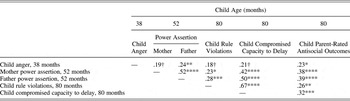
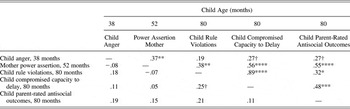
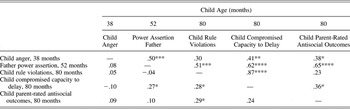
The correlations among the Family Study variables for the entire sample and for the mother–child and father–child relationships (insecure and secure) are presented in Table 1, Table 2, and Table 3.
Correlations among Family Study variables for the entire sample

†p < .10. *p < .05. **p < .025. ***p < .01. ****p < .001.
Correlations among Family Study variables in insecure and secure mother–child relationships
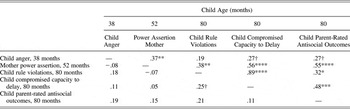
Note: The correlations above the diagonal are for insecure mother–child relationships and below the diagonal for secure mother–child relationships.
†p < .10. *p < .05. **p < .025. ***p < .01. ****p < .001.
Correlations among Family Study variables in insecure and secure father–child relationships

Note: The correlations above the diagonal are for insecure father–child relationships and below the diagonal for secure father–child relationships.
*p < .05. **p < .025. ***p < .01. ****p < .001.
The correlations for all families were typical for data reported in the literature. Both parents' power-assertive discipline related moderately and positively to the child's antisocial outcomes and modestly to the child's anger proneness. Anger proneness in turn related marginally to antisocial outcomes.
The patterns, however, were different for children with histories of insecure and secure early relationships, and those differences held for both mother– and father–child dyads. The most striking differences were in the links between parental power assertion and child antisocial outcomes and between child anger and parental power assertion. For children who had been insecure with the given parent, parental power assertion was a robust predictor of antisocial outcomes, and it was significantly predicted by child anger proneness. However, for children who had been secure with the given parent, parental power assertion did not predict antisocial outcomes (with only one exception), and it was unrelated to child anger proneness.
Children's proneness to anger at 38 months, parental power assertion at 52 months, and children's antisocial outcomes at 80 months: An overview of the analytic approach to moderated mediation by attachment security at 15 months
We applied Preacher, Rucker, and Hayes' (2007) method to test moderated mediation. In those analyses, children's anger proneness at 38 months was considered the predictor, the parent's power assertion at 52 months was the mediator, children's antisocial outcomes at 80 months were the dependent variables, and the child's attachment security with the parent at 15 months was the moderator of the causal chain. Specifically, the child's security was proposed to moderate both the effect of the predictor (anger) on the mediator (power assertion) and the effect of the mediator (power assertion) on the given dependent variable (an antisocial outcome) simultaneously. Figure 1 depicts the tested mediating process (anger → parental power assertion → antisocial outcomes) and the tested moderating effects of attachment security for the links between anger and power assertion and between power assertion and the dependent variable.
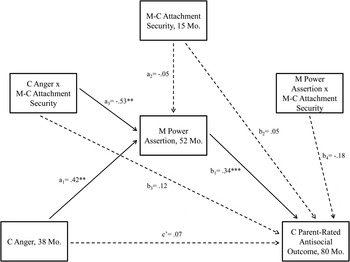
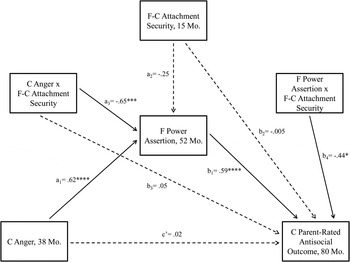
The analyses were conducted separately for each outcome (children's observed rule violations, Figure 2 and Figure 3; a compromised capacity to delay, Figure 4 and Figure 5; and parent-rated antisocial outcomes, Figure 6 and Figure 7) and for each relationship (mother–child, Figures 2, 4, and 6; and father–child, Figures 3, 5, and 7). Consequently, the analyses included six different moderated mediation models. The results of each analysis are presented as a path diagram (Figures 2–7). In all moderated mediation analyses, child gender was included as a covariate, but it was not depicted in the figures for the purpose of clarity.
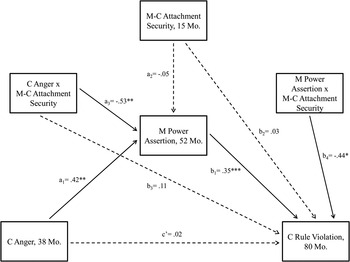
The Family Study: The moderated mediation model predicting the mother's power assertion at 52 months as the mediator and the child's observed rule violations at 80 months as the dependent variable, with the child's anger proneness at 38 months as the predictor and mother–child attachment security at 15 months as the moderator. The child's gender was a covariate (not depicted). Solid lines represent significant effects and dashed lines represent nonsignificant effects. M, mother; C, child; Mo., months.

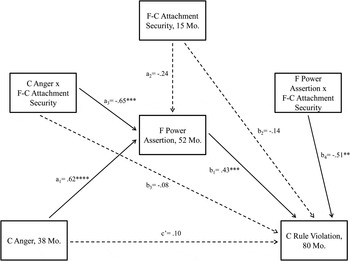
The Family Study: The moderated mediation model predicting the father's power assertion at 52 months as the mediator and the child's observed rule violations at 80 months as the dependent variable, with the child's anger proneness at 38 months as the predictor and father–child attachment security at 15 months as the moderator. The child's gender was a covariate (not depicted). Solid lines represent significant effects and dashed lines represent nonsignificant effects. F, father; C, child; Mo., months.

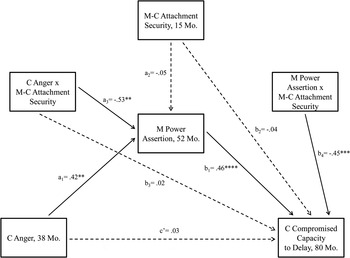
The Family Study: The moderated mediation model predicting the mother's power assertion at 52 months as the mediator and the child's compromised capacity to delay at 80 months as the dependent variable, with the child's anger proneness at 38 months as the predictor and mother–child attachment security at 15 months as the moderator. The child's gender was a covariate (not depicted). Solid lines represent significant effects and dashed lines represent nonsignificant effects. M, mother; C, child; Mo., months.

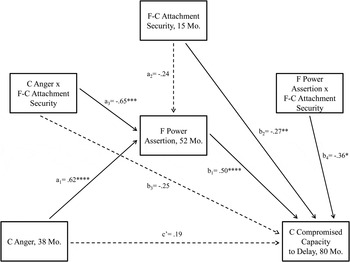
The Family Study: The moderated mediation model predicting the father's power assertion at 52 months as the mediator and the child's compromised capacity to delay at 80 months as the dependent variable, with the child's anger proneness at 38 months as the predictor and father–child attachment security at 15 months as the moderator. The child's gender was a covariate (not depicted). Solid lines represent significant effects and dashed lines represent nonsignificant effects. F, father; C, child; Mo., months.

The Family Study: The moderated mediation model predicting the mother's power assertion at 52 months as the mediator and the child's parent-rated antisocial outcomes at 80 months as the dependent variable, with the child's anger proneness at 38 months as the predictor and mother–child attachment security at 15 months as the moderator. The child's gender was a covariate (not depicted). Solid lines represent significant effects and dashed lines represent nonsignificant effects. M, mother; C, child; Mo., months.

The Family Study: The moderated mediation model predicting the father's power assertion at 52 months as the mediator and the child's parent-rated antisocial outcomes at 80 months as the dependent variable, with the child's anger proneness at 38 months as the predictor and father–child attachment security at 15 months as the moderator. The child's gender was a covariate (not depicted). Solid lines represent significant effects and dashed lines represent nonsignificant effects. F, father; C, child; Mo., months.

Following Preacher et al.'s (2007) recommendations, in each analysis, first, we examined the mediator variable model, where the effects of the predictor (path a1 in Figures 2–7), the moderator (path a2 in Figures 2–7), and their interaction (path a3 in Figures 2–7) on the mediator were estimated. Second, we examined the dependent variable model, where the effects of the predictor (path c' in Figures 2–7), the mediator (path b1 in Figures 2–7), the moderator (path b2 in Figures 2–7), the interaction of the predictor and the moderator (path b3 in Figures 2–7), and the interaction of the mediator and the moderator (path b4 in Figures 2–7) were estimated. Third, we examined conditional indirect effects for the different levels of the moderator (i.e., in the insecure and secure parent–child relationships).
To probe the conditional indirect effects, we first indicated point estimates and their significance levels as the most broadly accepted strategy to test mediation (Baron & Kenny, Reference Baron and Kenny1986; MacKinnon, Lockwood, Hoffman, West, & Sheets, Reference MacKinnon, Lockwood, Hoffman, West and Sheets2002; Muller, Judd, & Yzerbyt, Reference Muller, Judd and Yzerbyt2005). Then, we also presented confidence intervals using the bootstrapping sampling method. The bootstrap method, although less broadly used, has been sometimes preferred mainly because it does not require any assumption on the sampling distribution and particular formula for the standard error (MacKinnon, Lockwood, & Williams, Reference MacKinnon, Lockwood and Williams2004; Shrout & Bolger, Reference Shrout and Bolger2002). However, because both methods are broadly accepted, we present both statistics: the point estimates and the confidence intervals using the bootstrapping.
Predicting children's observed rule violations at 80 months
Testing attachment security as a moderator of the relations between anger proneness and power assertion and between power assertion and rule violations
Figure 2 presents the moderated mediation model where the child's anger proneness at 38 months is the predictor, the mother–child attachment security at 15 months is the moderator, the mother's power assertion at 52 months is the mediator, and the child's observed rule violations at 80 months is the dependent variable. In the mediator variable model, the child's anger proneness led to the mother's higher power assertion (b = 0.42, SE = 0.16, p < .025). The mother–child attachment security, however, had no main effect on the mother's power (b = –0.05, SE = 0.16, ns). The interaction of the child's anger proneness and mother–child security was significant (b = –0.53, SE = 0.23, p < .025), such that the effect of the child's anger proneness on maternal power was significant in insecure mother–child relationships, but not in secure relationships.
In the dependent variable model, the mother's increased power assertion led to the child's increased observed rule violations (b = 0.35, SE = 0.11, p < .01). The interaction of the mother's power assertion and mother–child attachment security was significant (b = –0.44, SE = 0.20, p < .05), such that the effect of the mother's power assertion on the child's rule violations was significant in insecure relationships, but not in secure relationships.
The next moderated mediation model in Figure 3 includes father–child attachment security and the father's power assertion as the new moderator and mediator, respectively. The dependent variable is the same as in Figure 2 (the child's rule violations).
Figure 3 generally shows the patterns of relations consistent with Figure 2. Particularly in the mediator variable model, the main effect of child anger proneness (b = 0.62, SE = 0.17, p < .001) and the interaction effect of child anger proneness and father–child attachment security (b = –0.65, SE = 0.22, p < .01) predicting the father's power assertion were significant.
In the dependent variable model, the main effect of the father's power assertion (b = 0.43, SE = 0.16, p < .01) and the interaction effect of the father's power assertion and father–child attachment security (b = –0.51, SE = 0.21, p < .01) predicting children's observed rule violations were significant. The same directions of path coefficients in Figures 2 and 3 imply the same moderation patterns in insecure and secure father–child relationships as those in mother–child relationships (a significant effect of paternal power in insecure dyads, but no effect in secure dyads).
Testing the mediational causal chains from anger proneness to power assertion to rule violations in insecure and secure relationships
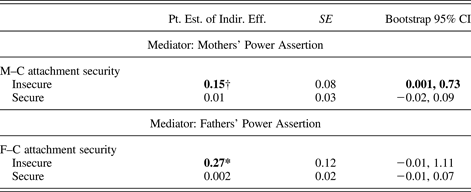
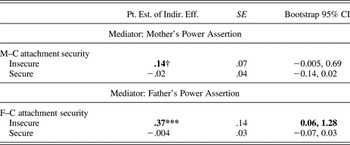
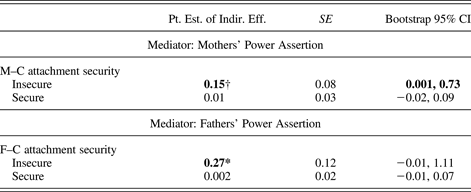
In the next step, we estimated conditional indirect effects to examine different mediation processes in insecure and secure parent–child relationships. Table 4 presents the conditional indirect effects for the mother's and father's power assertion as the mediators of child anger on his/her future rule violations, corresponding to Figure 2 (mother–child) and Figure 3 (father–child), respectively. As mentioned earlier, both point estimates and the bootstrapping methods were used to estimate those effects.
Family Study point estimates and bootstrap confidence intervals (bias corrected and accelerated) for conditional indirect effects in moderated mediation models predicting the effect of children's anger proneness at 38 months on their rule violations at 80 months, mediated by mothers' and fathers' power assertion at 52 months
Note: The findings suggesting the presence of mediation are in bold. Attachment security was assessed at 15 months. Pt. Est. of Indir. Eff., point estimate of indirect effect; M, mother; C, child; F, father.
†p < .10. *p < .05.
The point estimates of indirect effects based on second-order standard errors indicated that the indirect effect of child anger on rule violations, mediated by the mother's power assertion, was marginally significant in insecure mother–child relationships (p = .054), but it was not significant in secure relationships. Similarly, the indirect effect mediated by the father's power assertion was significant in insecure father–child relationships, but it was not significant in secure relationships.
The bootstrapping method provided support for our model for mothers and children, but it suggested a somewhat more cautious interpretation for fathers and children. The bootstrap 95% confidence interval of the indirect effect of child anger on his/her rule violations, mediated by the mother's power assertion, did not include zero in the insecure mother–child relationship; therefore, we can conclude that the indirect effect is not equal to zero at the α = 0.05 level. This increases our confidence in the mediation process for mothers and children.
For fathers and children, the bootstrap 95% confidence intervals of the indirect effect of child anger on his/her rule violations, mediated by the father's power assertion, did include zero in both insecure and secure relationships. Therefore, we cannot conclude that there were substantial indirect effects at the α = 0.05 level. Thus, together, the results of point estimates and bootstrapping suggest the expected mediation, but they inspire caution.
Predicting children's compromised capacity to delay at 80 months
Testing attachment security as a moderator of the relations between anger proneness and power assertion and between power assertion and compromised capacity to delay
Figure 4 presents the moderated mediation model that fully parallels Figure 2 (mothers and children), but with the child's compromised capacity to delay at 80 months as the dependent variable. Therefore, the results of the mediator variable model are identical with those in Figure 2 (the main effect of the child's anger proneness and its interaction with mother–child security on the mother's power assertion are significant). In the dependent variable model, the mother's increased power assertion led to the child's increasingly compromised capacity to delay (b = 0.46, SE = 0.09, p < .001). The interaction of the mother's power assertion and mother–child attachment security was also significant (b = –0.45, SE = 0.16, p < .01), such that the effect of the mother's power assertion on the child's compromised capacity to delay was significant in insecure relationships, but not in secure ones.
Figure 5 presents the moderated mediation model that fully parallels Figure 3 (fathers and children), but again with the child's compromised capacity to delay at 80 months as the dependent variable. Again, the results of the mediator variable model are identical with those in Figure 3 (the main effect of the child's anger proneness and its interaction with father–child security on the father's power assertion are significant). In the dependent variable model, the main effects of the father's power assertion (b = 0.50, SE = 0.12, p < .001), the child's security with the father (b = –0.27, SE = 0.11, p < .025), and the interaction of paternal power with security (b = –0.36, SE = 0.16, p < .05) on the child's compromised capacity to delay were all significant. The father's power assertion undermined the child's capacity to delay in insecure relationships, but not secure relationships.
Testing the mediational causal chains from anger proneness to power assertion to compromised capacity to delay in insecure and secure relationships
Again, we estimated the conditional indirect effects to examine different mediation processes in insecure and secure parent–child relationships. Table 5 presents the conditional indirect effects for the mother's and father's power assertion as the mediators of child anger on his/her future compromised capacity to delay, corresponding to Figure 4 (mother–child) and Figure 5 (father–child), respectively. Again, both point estimates and the bootstrapping methods were used to examine those effects.
Family Study point estimates and bootstrap confidence intervals (bias corrected and accelerated) for conditional indirect effects in moderated mediation models predicting the effect of children's anger proneness at 38 months on their compromised capacity to delay at 80 months, mediated by mothers' and fathers' power assertion at 52 months

Note: The findings suggesting the presence of mediation are in bold. Attachment security was assessed at 15 months. Pt. Est. of Indir. Eff., point estimate of indirect effect; M, mother; C, child; F, father.
**p < .025. ***p < .01.
The point estimates indicate that the indirect effect of child anger on his/her compromised capacity to delay mediated by the mother's power assertion was significant in insecure relationships, but not in secure relationships. The findings for fathers and children were analogous: the indirect effect was significant in insecure relationships, but not in secure relationships.
For mothers and children, the bootstrap 95% confidence interval of the indirect effect of child anger on his/her compromised capacity to delay, mediated by the mother's power assertion, yielded consistent findings with the point estimate, supporting our model. The interval did not include zero in the insecure mother–child relationship, and we can therefore conclude that the indirect effect is not equal to zero at the α = 0.05 level.
However, for fathers and children, the bootstrap 95% confidence intervals of the indirect effects of child anger on his/her compromised capacity to delay, mediated by the father's power assertion, did include zero in both insecure and secure relationships, and therefore we cannot conclude that there were substantial indirect effects at the α = 0.05 level. This is a source of caution in interpreting the effects of the point estimates in insecure father–child relationships.
Predicting children's parent-rated antisocial outcomes at 80 months
Testing attachment security as a moderator of the relations between anger proneness and power assertion and between power assertion and parent-rated antisocial outcomes at 80 months
Figure 6 presents the moderated mediation model that fully parallels Figures 2 and 4 (mothers and children) for the final dependent variable: the child's parent-rated antisocial outcomes at 80 months. Therefore, the results of the mediator variable model are identical with those in Figures 2 and 4 (the main effect of the child's anger proneness and its interaction with mother–child security on the mother's power assertion are both significant).
In the dependent variable model, the mother's increased power assertion led to the child's more antisocial outcomes as rated by parents (b = 0.34, SE = 0.11, p < .001). In contrast with Figures 2 and 4, the interaction of the mother's power assertion and mother–child attachment security was not significant (b = –0.18, SE = 0.19, ns).
Figure 7 presents the moderated mediation model that fully parallels Figures 3 and 5 (fathers and children), but again with the child's parent-rated antisocial outcomes at 80 months as the dependent variable. The results of the mediator variable model are identical with those in Figures 3 and 5 (the main effect of the child's anger proneness and its interaction with father–child security on the father's power assertion are significant). The very minor difference in path a2 is due to the sample sizes (89 in Figures 6 and 7, 88 in Figures 3 and 5).
In the dependent variable model, the main effect of the father's power assertion (b = 0.59, SE = 0.15, p < .001) and its interaction with father–child attachment security (b = –0.44, SE = 0.20, p < .05) on the child's antisocial outcomes were significant, such that the father's power assertion led to more antisocial behavior problems in insecure relationships, but not secure relationships.
Testing the mediational causal chains from anger proneness to power assertion and parent-rated antisocial outcomes at 80 months in insecure and secure relationships
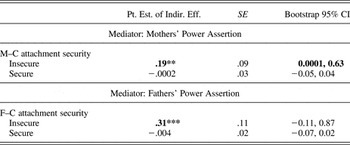
Table 6 presents the conditional indirect effects for the mother's and father's power assertion as the mediators of child anger on his/her future antisocial outcomes as rated by parents, corresponding to Figure 6 (mother–child) and Figure 7 (father–child), respectively.
Family Study point estimates and bootstrap confidence intervals (bias corrected and accelerated) for conditional indirect effects in moderated mediation models predicting the effect of children's anger proneness at 38 months on their parent-rated antisocial outcomes at 80 months, mediated by mothers' and fathers' power assertion at 52 months

Note: The findings suggesting the presence of mediation are in bold. Attachment security was assessed at 15 months. Pt. Est. of Indir. Eff., point estimate of indirect effect; M, mother; C, child; F, father.
†p < .10. ***p < .01.
The point estimates indicate that the indirect effect of child anger on parent-rated antisocial outcome, mediated by the mother's power assertion, was marginally significant in insecure mother–child relationships (p = .052), but not significant in secure mother–child relationships. The indirect effect mediated by the father's power assertion was significant in insecure father–child relationships, but not significant in secure relationships.
For mothers and children, the bootstrap 95% confidence interval of those indirect effects included zero in both insecure and secure relationships, and we cannot therefore conclude that there were substantial indirect effects at the α = 0.05 level. Given the marginal result of the point estimates, the inference about mediation in insecure mother–child dyads should be tentative.
For fathers and children, the findings were consistent with the point estimates: the bootstrap 95% confidence interval of the indirect effect did not include zero in insecure relationships, indicating that this indirect effect is not equal to zero at the α = 0.05 level and supporting mediation, but it included zero in secure relationships, indicating no significant mediation.
Family Study Summary and Discussion
It was quite striking that, by the toddler age and beyond, parent–child security in and of itself was largely not associated with any main effects in children's anger proneness, parental power, or children's antisocial outcomes (with one exception for father–child security and child capacity for delay). Yet, there were pervasive differences in the relations among security, child anger, parental power, and antisocial outcomes in the secure and insecure dyads.
First, as expected, the quality of the parent–child relationship in infancy significantly altered the future link between the child's characteristics at toddler age and the given parent's discipline style at preschool age. The theoretical models that emphasize the importance of child characteristics, particularly child difficulty, for eliciting parental response (Bates & Pettit, Reference Bates, Pettit, Grusec and Hastings2007; Bell, Reference Bell1968; Lytton, Reference Lytton1990) and the coercive cycles of transactions (Pardini, Reference Pardini2008; Patterson, Reid, & Dishion, Reference Patterson, Reid and Dishion1992) clearly applied to insecure relationships: children who were more prone to anger and presumably more difficult to handle and less well regulated as toddlers received more power-assertive discipline approximately a year later. This was true for both mother–child and father–child relationships. Thus, insecurity in infancy created a fertile ground for the emergence of a coercive reciprocal dynamic between the difficult child and the parent.
There was no evidence of a similar process in secure dyads. In those relationships, the child's difficulty was unrelated to the amount of power assertion received at preschool age. Thus, security defused the maladaptive potential for the coercive dynamic seen in insecure parent–child dyads.
Second, as expected, in all but one analysis, the quality of the early relationship significantly altered the future link between parental power-assertive, heavy-handed discipline and antisocial outcomes at age 6.5. In insecure relationships, both mothers' and fathers' forceful discipline was quite “toxic” in that it significantly increased the risk of children's rule-violating behavior and undermined their capacity for delay or ability for self-regulation. In addition, fathers' power assertion in insecure relationships predicted a range of children's antisocial behavior in daily life, as seen by both parents.
Again, those detrimental effects of power assertion were absent in secure relationships. In those relationships, variations in parental power were not significantly linked to variations in the antisocial outcome measures.
Third, the results provide initial insight into the process that accounts for the causal chain from the child's anger proneness to parental power to antisocial outcomes and the differences in that process between insecure and secure dyads. The pattern of the findings was impressively consistent across all three outcomes: the child's tendency to violate rules, his or her compromised capacity to delay, and parent-rated antisocial problems. It was also largely replicated across mother–child and father–child relationships.
Recall that we tested 12 mediational paths: for each of the three outcomes, within each relationship (mother–child and father–child), and for insecure and secure dyads. We used two broadly accepted methods to test mediation. There was evidence of mediation, indicated by at least one method, for all of the outcomes in insecure relationships (although in one case, parent-rated antisocial outcome in the mother–child relationship, the path was marginally significant). There was no evidence of mediation in any secure relationship for any of the outcomes.
The results strongly suggest that the quality of the parent–child relationship in the first year sets the stage for two different unfolding causal pathways, or cascades of events, that are distinct even when assessed several years later, between toddler and early school age. When that relationship is insecure, children who are more prone to anger elicit more power-assertive discipline from the given parent, and that discipline in turn predicts more antisocial development. Clearly, in the context of early insecurity, the child and the parent easily embark on a maladaptive, mutually coercive dynamic that is ultimately developmentally destructive.
By contrast, in secure relationships, that dynamic is effectively defused. Variations in child anger proneness do not predict the degree of parental power assertion, and power assertion, even if applied, does not lead to antisocial developmental outcomes.
Parent–Child Study Method
Participants
The sample was comparable to that in the Family Study: two-parent community families with normally developing infants (although behavioral data were collected only from mothers and children), drawn from the same Midwestern area, and similar demographically. Among mothers, 26% had no education past high school, 15% had some college education, and 59% completed college or some postgraduate education. For fathers, the respective figures were 31%, 10%, and 57%. Family annual income varied: under $20,000 (7%), $40,001–$50,001 (17%), $50,001–$60,000 (l6%), and more than $60,001 (25%). The sample was relatively homogeneous ethnically: 97% of mothers and 92% of fathers were White.
Overview
We focus on measures collected at four assessments: mother–child attachment organization observed in the Strange Situation at 14 months (N = 108, 53 girls); the child's angry defiance (N = 106, 53 girls), observed in mother–child interactions at 22 months; maternal power assertion (N = 104, 52 girls), observed at 33 months, also in interactions; and children's antisocial outcomes, rated by teachers at 73 months (N = 57, 31 girls, with teachers' data available for 48 children). The families had originally committed only up to age 4 (and 90% remained in the study); but by the time additional funds became available, many had moved away or were too busy to continue, causing a much larger attrition at 73 months. There were no significant differences between children who did and did not have teachers' data with regard to security of attachment, Pearson χ2 (1) = 1.16, ns, and angry defiance at 22 months, t (104) < 1, but mothers of children who had teachers' data had been more power assertive at 33 months, t (102) = 2.39, p < .05.
As in the Family Study, mother–child dyads were observed in 2- to 3-hr laboratory sessions, all conducted by female experimenters. Because the measures were comparable to the Family Study, their descriptions are brief.
Measures
Children's attachment security at 14 months
As in the Family Study, the Strange Situation was the first paradigm during the laboratory session, and it was coded by the same coders who were also blind to all other data (reliability, κ = 0.90). Out of 108 children, 58 were secure (B) and 50 were insecure (A, C, D/U). Security was unrelated to child gender, Pearson χ2 (1) < 1, ns.
Children's angry defiance at 22 months
The paradigm, coding, and data aggregation
Children's anger was observed in two mother–child sessions. There were 88 min of observed control contexts (20 min of cleanup contexts, “Do,” and 68 min of prohibition contexts, “Don't”). Child behavior was coded for each 30-s segment. Angry defiance was described as overt, poorly regulated anger accompanied by whining, screaming, kicking toys or the mother, temper tantrum, and other expressions of frustration. The reliability, κs, ranged from 0.82 to 0.98. All instances of child angry defiance were tallied and divided by the number of segments (M = 0.03, SD = 0.05, range = 0.00–0.22).
Mothers' power-assertive control style at 33 months
The paradigm, coding, and data aggregation
The observed control contexts (“Do” and “Don't”) and the coding system were directly comparable to those used in the Family Study. There were 20 min of toy cleanup (10 min in each session) and approximately 65 min of the prohibition context (across the two sessions). The same global ratings and the codes for physical techniques were applied to each 30-s segment. The reliabilities, κs, for the global ratings were 0.71–0.85 for “Do” and 0.70–0.76 for “Don't,” and for the physical techniques, 0.72–0.77 for “Do” and 0.69–0.76 for “Don't.” Data aggregation followed a similar strategy as in the Family Study; however, no weights were applied, and constituent variables were standardized before being aggregated into two power assertion composites for “Do” and for “Don't” contexts. Those composites cohered, r (104) = .40, p < .001, and were aggregated into one overall maternal power assertion score (M = 0.00, SD = 0.58, range = –0.37 to 2.42).
Children's antisocial outcome at 73 months
Teachers (N = 48) rated the children's behavior using the Preschool Behavior Questionnaire (Behar, Reference Behar1977). The 30 items capture typical behavior problems, and they are rated from 0 = does not apply to 2 = certainly applies. We used two original externalizing behavior scores: hostile–aggressive and hyperactive–distractible. The hostile–aggressive score was the mean of 7 items (e.g., fights with other children, destroys belongings, bullies, kicks, bites, hits, α = 0.84). The hyperactive–distractible was the mean of four items (e.g., inattentive, restless, fidgety, α = 0.80). Those scores correlated, r (48) = .55, p < .001, and were averaged into one teacher-rated antisocial outcome score (M = 0.31, SD = 0.36, range = 0.00–1.41).
Parent–Child Study Results
Preliminary analyses
There were no significant differences with regard to any constructs between children who had been insecure and secure with their mothers. The correlations among the variables indicated that, for the entire sample, children's angry defiance at 22 months was uncorrelated with mothers' power assertion at 33 months, r (104) = .16, ns, or with teacher-rated antisocial outcomes at 73 months, r (48) = .16, ns. Mothers' power assertion and antisocial outcomes were correlated, r (48) = .30, p < .05.
For the insecure children, however, angry defiance correlated with maternal power, r (49) = .35, p < .025, and with antisocial outcomes, r (25) = .35, p = .05, and maternal power correlated with antisocial outcomes, r (25) = .49, p < .025. For the secure children, the corresponding correlations were all not significant: r (55) = .12, r (23) = .07, and r (23) = –.18.
Children's angry defiance at 22 months, mothers' power assertion at 33 months, and children's antisocial outcomes at 73 months: An overview of the analytic approach to moderation by mother–child attachment security at 14 months
The small sample size for the teacher-rated antisocial outcomes precluded the use of the moderated mediation approach (Preacher et al., Reference Preacher, Rucker and Hayes2007). Consequently, we focused on the testing of two moderation effects, parallel to those tested in the Family Study: the effect of security as moderating the relation between children's angry defiance and mothers' power assertion, and the relation between mothers' power assertion and teacher-rated children's antisocial outcomes. We relied on hierarchical multiple regressions, and we used simple slope analyses (Aiken & West, Reference Aiken and West1991) to probe the significant interactions.
Testing attachment security as a moderator of the relations between child angry defiance and maternal power assertion
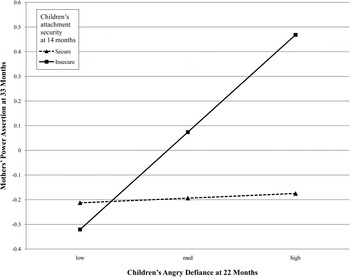
In the first regression, maternal power assertion was the dependent variable. Child gender (0 = girl, 1 = boy) was entered first, followed by security at 15 months (0 = insecure, 1 = secure), angry defiance (standardized), and an interaction term of Security × Defiance. In the final equation, the effects of security and of angry defiance were both significant. Their respective βs were –0.23 (p < .025) and 0.68 (p < .01). Both effects, however, were qualified by a significant interaction (β = –0.58, p < .01). The final equation was significant, F (4, 99) = 4.23, p < .01.
To probe the interaction effect, we estimated the simple slopes of children's angry defiance on the mothers' power assertion in insecure and secure relationships (Aiken & West, Reference Aiken and West1991). High angry defiance was represented by the score 1 SD above the mean and low angry defiance by 1 SD below the mean. The simple slope for the insecure children was significant (b = 0.39, SE = 0.13, p < .01), but for secure children it was not (b = 0.02, SE = 0.06, ns). The increase of children's angry defiance scores led to a significant increase in mothers' power assertion in insecure mother–child relationships, but not in secure relationships. Figure 8 illustrates the results.
The Parent–Child Study: Mother–child attachment security at 14 months moderates the effect of the child's angry defiance at 22 months on the mother's power assertion at 33 months. The child's gender was a covariate (not depicted). The solid line represents the significant simple slope and the dashed line represents the nonsignificant simple slope.

Because maternal power assertion is naturally associated with concurrent child angry defiance during the same control context, we performed the same regression controlling for the child's angry defiance at 33 months that was also coded. The results were unchanged. Despite a strong effect of concurrent angry defiance, as expected (β = 0.39, p < .0001), the interaction effect of Security × Angry Defiance at 22 months remained significant (β = –0.44, p < .05) and so did security (β = –0.17, p < .06) and angry defiance at 22 months (β = 0.43, p < .05).
Testing attachment security as a moderator of the relations between maternal power assertion and teacher-rated antisocial outcomes
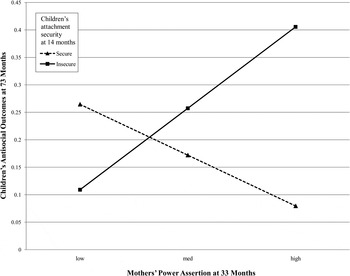
In the second regression, the teacher-rated antisocial outcomes score was the dependent variable. Child gender was entered first, followed by security at 15 months and maternal power assertion at 33 months, and an interaction term of Security × Power Assertion. In the final equation, the effect of power assertion was significant (β = 0.41, p < .025). It was qualified by the significant interaction (β = –0.35, p < .05). The final equation was significant, F (4, 43) = 3.22, p < .025.
This interaction was also probed using simple slopes (Aiken & West, Reference Aiken and West1991). High maternal power assertion was represented by the score 1 SD above the mean and low maternal power assertion by 1 SD below the mean. The simple slope of power assertion on antisocial outcomes for the insecure children was significant (b = 0.22, SE = 0.09, p < .025), but for the secure children it was not (b = –0.13, SE = 0.14, ns). The increase of maternal power assertion led to a significant increase in children's antisocial outcomes rated by teachers in insecure mother–child relationships, but not in secure relationships. Figure 9 illustrates the results.
The Parent–Child Study: Mother–child attachment security at 14 months moderates the effect of the mother's power assertion at 33 months on the child's antisocial outcomes at 73 months. The child's gender was a covariate (not depicted). The solid line represents the significant simple slope and the dashed line represents the nonsignificant simple slope.

Parent–Child Study Summary and Discussion
Because of the diminished sample size in the Parent–Child Study at the time when the antisocial outcome was assessed, the findings on security as a moderator of implications of power assertion on antisocial behavior should be treated with caution. The study is best viewed as one that supplements the Family Study's findings. Although the sample size precluded a rigorous testing of mediation, the Parent–Child Study is nevertheless valuable in that it essentially replicated, in another longitudinally followed sample, both of the moderation effects found in the Family Study.
Again, there were no significant main effects of security on children's angry defiance, mothers' discipline, or children's antisocial problems at school. However, we found that the quality of the early relationship substantially altered the future potentially coercive dynamic between the anger-prone child and the mother, and it altered the effects of maternal discipline for future maladaptive, antisocial developmental outcomes assessed by teachers' ratings of the child's behavior in school at age 6.
As in the Family Study, early insecurity set the stage for the emerging negative and mutually coercive pattern between difficult toddlers and their mothers. Highly angry toddlers elicited power-assertive maternal discipline a year later. In addition, early insecurity seemed to infuse maternal power assertion with the same toxic potential to increase children's antisocial behavior as rated by teachers. In insecure dyads, power-assertive discipline resulted in a high level of antisocial behavior problems when assessed 3 years later. Early security served as a beneficial catalyst: in secure relationships, children's angry defiance was unrelated to mothers' heavy-handed, power-assertive control, and such control, even when applied, did not increase the risk of child maladaptive outcomes.
It is encouraging that those effects were replicated for a different measure of child effects and a different measure of the antisocial outcome. In contrast to the Family Study, child anger proneness was assessed in the context of the mother–child relationship rather than in a standardized temperament episode involving an unrelated adult, and antisocial behavior was rated by teachers rather than mothers and fathers. Thus, the outcome measure captured the child's functioning in a broader social context that involved a range of new demands and developmental competencies, including interactions with peers and school authorities, and the abilities to meet academic and institutional standards of behavior.
General Discussion
Bowlby's groundbreaking ideas about the role of the early parent–child relationship for future development and psychopathology have retained their generative heuristic potential, and they continue to compel and inspire us today. In the attachment theory, psychopathology results from a successive series of adaptations. A pattern of insecure attachment in infancy may initiate such a process, but only if subsequent adaptations continue to represent deviation from positive functioning does psychopathology become likely. According to Sroufe et al. (Reference Sroufe, Carlson, Levy and Egeland1999), although early experience does not cause later pathology in a linear way, it nevertheless has special significance because of the complex, systemic, transactional nature of development. Early insecurity itself is not viewed as psychopathology or as a direct cause of psychopathology, but it is best viewed as initiating pathways probabilistically associated with later maladaptive outcomes. Our findings are quite consistent with such a view.
The findings from our two longitudinal studies substantially converged, supporting our view of early attachment as a powerful factor whose role goes beyond issues of biobehavioral security. Early attachment becomes a foundation for future socialization processes within the parent–child dyad. The quality of the early attachment organization between the parent and child exerts its hidden yet powerful moderating and mediating effects up to the early school age.
The two longitudinal studies affirm the largely accepted consensus that, when studying complex developmental cascades and processes, researchers should search beyond main effects (Masten & Cicchetti, Reference Masten and Cicchetti2010). In particular, when studying long-term implications of early relationships, we should aim to understand how those relationships set the stage for future complex dynamics between the parent and the child that in turn influence the child's developmental trajectories (Sroufe, Reference Sroufe2005; Sroufe et al., Reference Sroufe, Carlson, Levy and Egeland1999).
The current findings and the findings from our past research substantially converge. Together, they support the hidden yet powerful “sleeper” effects of early insecurity and security for the future adaptive and maladaptive socialization pathways. Across both studies and multiple measures, early insecurity clearly emerged as a potent factor that created a conducive, fertile ground for a mutually adversarial parent–child ambience that had high-risk long-term implications for antisocial trajectories. In those insecure relationships, a maladaptive causal chain was at work: the child's anger proneness or difficult temperament at toddler age led the parent to deploy power-assertive or heavy-handed control strategies, and those strategies led to more antisocial behavior problems, assessed using observations in structured laboratory situations and parents' and teachers' ratings.
By contrast, early security emerged as a long-term beneficial factor or a catalyst capable of defusing or preventing such a maladaptive chain before it began. Although secure children were no more or no less anger prone than insecure ones, their individual characteristics did not elicit differential levels of power assertion from their parents. Perhaps even more important, when parents of secure children did resort to power assertion (which they did no more or no less often than parents of insecure children), their use of power did not result in the increased risk of observed or informant-rated antisocial conduct.
Although we have replicated the above findings across several studies and a host of measures, many exciting questions still remain to be addressed to fully elucidate the developmental processes that lead children to embark on antisocial pathways. The future directions apply to theory, methodology, and translational research (intervention and prevention).
Looking forward: Theory
We do not yet understand exactly how the different causal chains in insecure and secure relationships might work and what specific mechanisms and processes account for the different developmental links between the child's characteristics and parental socializations strategies and for the links between parental strategies and risks for future antisocial behavior problems. Several possibilities are theoretically compelling and empirically testable. We now address the role of security with regard to the two parts of the causal chain: the link between the child's characteristics and parental power assertion, and the link between power assertion and children's antisocial outcomes.
Why, in insecure relationships, do more difficult children draw their parents into coercive mutual cycles, whereas in secure relationships, children's difficulty does not have similar implications?
A considerable amount of research has shown that parents of insecure infants enter the caregiving relationship equipped with preexisting maladaptive mental models of the child and parenting, often dating back to their own early suboptimal experiences (van IJzendoorn, Reference van IJzendoorn1995), and with poor skills for reflective functioning regarding the child (Slade, Reference Slade2005). Those internal mental models disrupt the parent's responsiveness and the provision of optimal care, and they consequently interfere with the formation of a secure bond. The child's high negative emotionality may amplify those maladaptive processes. Children who are biologically difficult, hard to comfort and soothe, and prone to anger and other negative emotions engender a sense of frustration and reinforce the parent's negative internal model and expectations of the child (Bates, Reference Bates1980; Bates & Pettit, Reference Bates, Pettit, Grusec and Hastings2007; Shaw, Owens, Vondra, Keenan, & Winslow, Reference Shaw, Owens, Vondra, Keenan and Winslow1996). Moreover, the difficult child's signals of distress are likely to trigger the parent's own insecure attachment memories (Suchman et al., Reference Suchman, DeCoste, Castiglioni, McMahon, Rounsaville and Mayes2010). Consequently, over time, the parent's internal working model of the child as difficult, hard to handle, and oppositional becomes further entrenched and the parent becomes increasingly sensitized to the challenges of child rearing, particularly as the child moves into the toddler and preschool age and issues of control and discipline become salient. Moreover, the parent is likely to form hostile attributions and negative expectations, often combined with a sense of powerlessness (Bugental & Johnston, Reference Bugental and Johnston2000), that lead directly to the increased use of power in disciplinary encounters.
As Kobak et al. (Reference Kobak, Cassidy, Lyons-Ruth, Ziv, Cicchetti and Cohen2006) noted, attachment researchers have spent more time studying children's attachment organization and their internal working models of their caregivers than studying complementary processes in parents. A fruitful future avenue of research will be to integrate several different traditions that up to now have evolved relatively separately and rarely intersected. Those include studies of parental states of mind regarding attachment, their working models of the child, and reflective functioning regarding the child, inspired by the attachment theory (Fonagy, Gergely, Jurist, & Target, Reference Fonagy, Gergely, Jurist and Target2002; George & Solomon, Reference George and Solomon1996; Slade, Reference Slade2005; Suchman et al., Reference Suchman, DeCoste, Castiglioni, McMahon, Rounsaville and Mayes2010; van IJzendoorn, Reference van IJzendoorn1995), as well as studies of parental cognition and social information processing, perceptions, and attributions (Beauchaine, Strassberg, Kees, & Drabick, Reference Beauchaine, Strassberg, Kees and Drabick2002; Bugental & Johnston, Reference Bugental and Johnston2000; Goodnow, Reference Goodnow1988; Holden & Edwards, Reference Holden and Edwards1989).
Why, in insecure relationships, does parental power assertion lead to increased risks for antisocial outcomes, whereas in secure relationships, its toxicity appears defused?
Again, the study of internal working models, but here, the child's rather than the parent's, can elucidate some of the processes involved. The research from two rarely intersecting, but clearly converging areas is ripe for integration. Research inspired by the attachment theory has emphasized insecure and secure children's emerging internal working models of the parent as unavailable, untrustworthy, unresponsive, aloof, and unpredictable, or as reliably available, responsive, and warm, respectively (Belsky, Spritz, & Crnick, Reference Belsky, Spritz and Crnic1996; Bretherton, Ridgeway, & Cassidy, Reference Bretherton, Ridgeway, Cassidy, Greenberg, Cicchetti and Cummings1990; Johnson, Dweck, & Chen, Reference Johnson, Dweck and Chen2007; Johnson et al., Reference Johnson, Dweck, Chen, Stern, Ok and Barth2010; Main, Kaplan, & Cassidy, Reference Main, Kaplan and Cassidy1985; Sroufe et al., Reference Sroufe, Carlson, Levy and Egeland1999). Consequently, insecure children are likely “primed” to perceive the parent's use of power-assertive discipline in toddler or preschool age as hostile, unfair, threatening, and mean spirited, whereas secure children are likely to see it as well intentioned, legitimate, and benevolent. This possibility provides a conceptually compelling, but not yet empirically tested, bridge to the extant evidence on children's perceptions of discipline collected within the parenting literature (Bugental & Grusec, Reference Bugental, Grusec, Damon, Lerner and Eisenberg2006; Dodge, Bates, & Pettit, Reference Dodge, Bates and Pettit1990; Gershoff, Reference Gershoff2002; Grusec & Goodnow, Reference Grusec and Goodnow1994; Holden, Reference Holden2002; Vittrup & Holden, Reference Vittrup and Holden2010). Insecure children's hostile perceptions and attributions lead to anger, resentment, rejection of parental influence (Grusec & Goodnow, Reference Grusec and Goodnow1994), shallow processing of parental messages (Hoffman, Reference Hoffman, Higgins, Ruble and Hartup1983), and ultimately to a general adversarial and oppositional stance, noncompliance, and failure to embrace and internalize parental values, rule-breaking conduct, poor internal controls, and other symptoms typical for antisocial trajectories.
Those dynamics are defused in a secure child. Given the child's history with the parent, and the resulting internal working model of the parent as responsive, trustworthy, and supportive, the child likely perceives parental discipline as legitimate and well intentioned and parental motives as benign. In turn, the secure child is likely to accept and embrace parental messages and to actively cooperate in his or her socialization process (Kerns, Aspelmeier, Gentzler, & Grabill, Reference Kerns, Aspelmeier, Gentzler and Grabill2001).
Studies in the infant cognition literature have recently provided compelling evidence of infants' capacity to form expectations of responsiveness consistent with their attachment status (Johnson et al., Reference Johnson, Dweck and Chen2007, Reference Johnson, Dweck, Chen, Stern, Ok and Barth2010) and to differentiate between a benign and malevolent intent (Hamlin, Wynn, & Bloom, Reference Hamlin, Wynn and Bloom2007). That research opens exciting new research avenues. It provides empirical support for Bowlby's belief that the coalescence of attachment and the formation of mental models of the parent as responsive or hostile may co-occur and that such models may have very early roots. It also offers attachment researchers exciting new tools by demonstrating that infant cognition paradigms can be successfully used to gain insight into those processes. In older children, measures of internal working models of their parents, both in direct format (Toth, Cicchetti, & Kim, Reference Toth, Cicchetti and Kim2002) and in semiprojective format (Macfie et al., Reference Macfie, Toth, Rogosch, Robinson, Emde and Cicchetti1999), have yielded very promising results.
Finally, the study of transactions between reciprocally evolving internal working models of each other in the parent–child relationship studied over time holds great promise. Although long advocated (Greenberg et al., Reference Greenberg, Speltz and DeKlyen1993; Richters & Waters, Reference Richters, Waters, Lewis and Feinman1991), such research remains sparse.
Many other questions await inquiry. We focused here on parental power assertion as the mediating socialization mechanism that links the child's characteristics with future antisocial, disruptive outcomes and is moderated by early attachment organization. Other socialization mediators are also possible, however. The classic modeling process is one such possibility. For example, we found that early security enhances the effects of children's willing imitation on future positive developmental outcomes (Kochanska et al., Reference Kochanska, Woodard, Kim, Koenig, Yoon and Barry2010). Again, bridging attachment theory and research on socialization and parenting will benefit both domains.
Looking forward: Methodology
We embraced the multilevel approach and examined constructs at multiple levels in their interplay (the child's characteristics, parent–child relationship and socialization, antisocial outcomes). In future research, the multilevel approach should remain the desired standard and be further expanded, including measures of child and parent biological profiles, relationships, and the ecology of the family in their complex interplay, because all of them have been implicated in emerging antisocial trajectories. We have demonstrated that the early parent–child relationship differentially affects children with different biological profiles. For example, using a range of measures of self-regulation, peer functioning, and moral development as outcomes, we found that children with certain genotypes (carriers of a short serotonin transporter linked polymorphic region allele) are significantly more susceptible or vulnerable to variations in the quality of the early parent–child relationship than those who have two long alleles (Kochanska, Kim, Barry, & Philibert, Reference Kochanska, Kim, Barry and Philibert2011; Kochanska, Philibert, & Barry, Reference Kochanska, Philibert and Barry2009). Measures of children's electrodermal reactivity produced conceptually converging results, in that hyporeactive children were particularly affected by variations in early security (Fowles & Kochanska, Reference Fowles and Kochanska2000).
Robust measurement of constructs at every level should remain an important methodological goal. It is desirable to collect data in multiple ecologies (home, laboratory, school) and multiple contexts (standardized temperament episodes, scripted but naturalistic parent–child interactions that encompass both stress-free interactions, such as play, and challenging interactions, such as chores and discipline) and using multiple measures (behavioral observations, informants' reports). It is further desirable to aggregate thoughtfully across multiple measures to create robust, internally coherent constructs.
Although not examined in the current work, the parent's and the child's internal working models of each other play a key role in the conceptual model; consequently, including measures of those representations will be critical in future research. Multiple methodological directions can be fruitfully pursued, including the comparison of instruments that assess parents' and children's representations directly with those that rely on semiprojective, narrative-style coding.
Recruiting large, diverse samples, both clinical or high-risk families and community families, remains an important goal. The current work was limited in that it involved low-risk community samples, where discipline was generally adaptive, including a relatively low level of power assertion, and children largely functioned relatively well. Testing the present conceptual model in at-risk samples would be very valuable. For example, in physically abusive families the level of and variation in power assertion are greatly increased. It is an empirical question whether early security would still remain an effective catalyst that defuses the detrimental impact of harsh discipline. In addition, in high-risk families, multiple types of ecological adversity (poverty, chaotic lives, high stress, poor support, parental psychopathology) would likely act as additional moderators of the processes depicted in Figure 1 (Fearon & Belsky, Reference Fearon and Belsky2011).
The study of high-risk children would also provide new insights. As one example, given the importance of the child's internal representations of the parent in our model, an investigation involving autistic children would be extremely informative. How would the general impairments in autistic children's theory of mind, including their capacity to understand others' intentions, impact the forming internal working models of their parents in relationships varying in attachment history and their attributions during socialization process in later childhood?
Note, however, that although disadvantages of low-risk samples in developmental psychopathology have been pointed out (Greenberg, Reference Greenberg, Cassidy and Shaver1999; Kobak et al., Reference Kobak, Cassidy, Lyons-Ruth, Ziv, Cicchetti and Cohen2006), potential advantages have rarely been discussed. The latter include the ability of studying patterns of subtle individual differences among parents and children using relatively typical behaviors in natural and normative contexts. Our work shows that, given sensitive measures, meaningful patterns of relations that are directly relevant to psychopathology can be discerned by examining children's anger expressions in standard episodes and daily interactions, their minor rule infractions in “benign” laboratory paradigms, parents' relatively low-level power-assertive discipline in scripted naturalistic contexts, and reports of the child's behavior by well-informed caregivers.
Looking forward: Translational research
If further replicated, the proposed model will inform translational research. One can imagine several “points of entry” for a developmentally informed intervention. Of course, several existing intervention programs already address components of the model. For example, interventions have been designed to foster secure attachment (e.g., Berlin, Ziv, Amaya-Jackson, & Greenberg, Reference Berlin, Ziv, Amaya-Jackson and Greenberg2005). Given the conceptual primacy and long-term potency of the early parent–child attachment in our model, those remain critically important. Promoting security is especially important for infants who are temperamentally difficult, as assessed either at the behavioral level (Kim & Kochanska, in press; Stupica, Sherman, & Cassidy, Reference Stupica, Sherman and Cassidy2011), or molecular genetic level (Kochanska et al., Reference Kochanska, Barry, Stellern and O'Bleness2009). Several programs target parental use of maladaptive control strategies, including power assertion (e.g., McMahon & Forehand, Reference McMahon and Forehand2003). To our knowledge, however, such parenting interventions have rarely been integrated in a conceptually grounded manner with attachment-focused interventions and implemented as two parts of a comprehensive approach. Typically, when both interventions are used, the goal is to compare their effectiveness in separate groups (e.g., Toth, Maughan, Manly, Spagnola, & Cicchetti, Reference Toth, Maughan, Manly, Spagnola and Cicchetti2002).
We posited a key role for parents' and children's internal working models. Encouraging and promising evidence shows the effectiveness of attachment-informed interventions that target the parent's and the child's representations of each other. In the Suchman et al. (Reference Suchman, DeCoste, Castiglioni, McMahon, Rounsaville and Mayes2010) study, therapists addressed drug-abusing mothers' reflective functioning with regard to their young children and their parenting. That intervention resulted in more improvements in caregiving than a traditional educational intervention. Toth et al. (Reference Toth, Cicchetti and Kim2002) addressed the mother's representations of her past relationships in the context of her interaction with the child (preschooler–parent psychotherapy). Preschooler–parent psychotherapy had significant beneficial effects for the child's internal working models of the mother; those effects were stronger than the effects in the Psychoeducational Home Visitation group, focused on behavioral parenting strategies, although there were improvements in both groups.
Finally, the Family Study's findings suggest that similar processes operate within mother–child and father–child dyads. It is an empirical question whether either relationship could become a point of entry for an intervention and whether enhancing security with one parent would lead to improvements in the relationship with the other, perhaps mediated by the generalization of the child's mental representations to other social partners.
Conclusion
Antisocial and disruptive developmental trajectories are common; and the burdens, costs, and pain they cause to individuals, families, and societies are enormous. The attachment theory continues to provide a heuristically powerful theoretical context for new insights into the origins of antisocial behavior by studying the complex sequelae of early experience. As Sroufe (Reference Sroufe2005) aptly stated,
Variations in infant–caregiver attachment do not relate well to every outcome, nor do they relate inexorably to any outcome whatsoever. They are related to outcomes only probabilistically and only in the context of complex developmental systems and processes. Still, the importance of attachment is not trivialized by such considerations. Within a systemic, organismic view of development, attachment is important precisely because of its place in the initiation of these complex processes. It is an organizing core in development that is always integrated with later experience and never lost. While it is not proper to think of attachment variations as directly causing certain outcomes, and while early attachment has no privileged causal status, it is nonetheless the case that nothing can be assessed in infancy that is more important. Infant attachment is critical, both because of its place in initiating pathways of development and because of its connection with so many critical developmental functions—social relatedness, arousal modulation, emotional regulation, and curiosity, to name just a few. Attachment experiences remain, even in this complex view, vital in the formation of the person. (p. 365)
New rapid developments in statistical methodology, particularly with regard to the testing of moderation and mediation, now offer useful tools for understanding such complex and long-term developmental cascades. Those tools allow us to revisit and reinvigorate the study of early relationships in the emergence of antisocial developmental pathways.