I. INTRODUCTION
Since the development of gelcasting as a novel technique compared with conventional techniques like slip casting for forming of engineering ceramics by Omatete et al.,Reference Omatete, Janney and Strehlow1 gelcasting has exhibited advantages for near-net shaping and the production of complicated shapes, and preparation of homogeneous green bodies with sufficient strength for handling and machining. This gelling system, based on free radical polymerization, involves the use of five kinds of additives, e.g., dispersant, monomer, cross-linking agent, catalyst, and initiator.Reference Omatete, Janney and Strehlow1 The ceramic slurry behavior changes from liquid-like to gel after being poured into a mold. However, the disadvantages of this gelling system are the toxicity of the monomer and the complicated processing because of oxygen inhibition and multiple additives.
Takeshita and KuritaReference Takeshita and Kurita2 reported the self-hardening slip casting of yttria-partially stabilized zirconia (Y-PSZ) ceramics with three kinds of additives. The essence of gelation in this case is the nucleophilic addition polymerization between epoxy resin and amine. They prepared Y-PSZ slurry with the addition of dispersant and found that gelation occurred in air. The merits of this gelation system are low toxicity, and absence of oxygen inhibition. At a subsequent stage, several groups have investigated the epoxy resin and amine system for gelcasting dense ceramics,Reference Mao, Shimai, Dong and Wang3 translucent ceramics,Reference Mao, Shimai, Dong and Wang4 and porous ceramics.Reference Park, Lee and Lee5,Reference Mao, Shimai and Wang6 Recently, based on an esterification reaction or acetal reaction, several cross-linkable systems have been developed for gelcasting, such as polyvinyl alcohol (PVA)—organotitanate,Reference Morissette and Lewis7 PVA—2,5-dimethoxy-2,5-dihydrofuran (DHF),Reference Chabert, Dunstan and Franks8 PVA—dialdehydes,Reference Hansen, Holm, Jahr, Olafsen and Stori9 and chitosan—DHF.Reference Johnson, Franks and Dunstan10 Utilizing PVA cross-linked by DHF for the gelation of alumina slurry is notable because PVA is a low-cost and commonly used binder in the ceramic industry. However, to generate a gel using the PVA-DHF system, a strong acidic media (pH, 1.5–2) and a temperature of 60–80 °C are required. Another problem is that PVA addition resulted in high-viscosity slurry, which limits the preparation of slurry with high solids loading.
More recently, new monomers such as glycerol monoacrylateReference Tallon, Jach, Moreno, Nieto, Rokicki and Szafran11 and 3-O-acrylic-D-glucoseReference Bednarek, Szafran, Sakka and Mizerski12 with low toxicity were developed for gelcasting of alumina. They do not require addition of any external cross-linking agent. However, a dispersant and an initiator are necessary for these monomer systems. Similarly, some natural polymers, which are nontoxic, such as agar,Reference Fanelli, Silvers, Frei, Burlew and Marsh13 alginate,Reference Jia, Kanno and Xie14 protein,Reference Lyckfeldt, Brandt and Lesca15 agarose,Reference Adolfsson16 gelatine,Reference Chen, Xie and Huang17 and starch,Reference Mao, Wang and Shimai18 have been used as gelling agents to form polymer network by hydrogen bonding. A typical example is gelcasting of zirconia by agarose.Reference Adolfsson16 First, the zirconia slurry was prepared with dispersant and kept at 60–65 °C, then a preheated agarose aqueous solution was added and finally, gelation occurred during cooling. However, the solids loading of this system was <40 vol%. Thus, we searched for a novel nontoxic gelation system, which works with a slurry of high solids loading and can gel at room temperature in air.
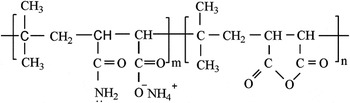
As mentioned above, forming a polymer network in a slurry relies on the reaction/interaction between different functional groups of two kinds of polymer molecules. However, a dispersant is inevitably needed to disperse ceramic powder in the gelling systems. Therefore, to develop a new gelling system, the first key point is to find a dispersant with excellent dispersibility. If a dispersant molecule contains multifunctional groups, polymer network may form by the reaction/interaction between multifunctional groups of the dispersant. Here, we report on a commercial copolymer of isobutylene and maleic anhydride (Isobam), which has three kinds of functional groups (Fig. 1). The copolymer has active –COO−NH4+ and –CONH2 groups, and anhydride groups can yield –COOH by hydrolysis. Isobam is a promising candidate as both a dispersant and gelling agent.
Molecular structure of Isobam (m/n = 1:1).

The aim of this study is to demonstrate the rheological and casting behavior of alumina using Isobam alone. It is shown that an alumina slurry of 50 vol% solids loading gels in 38 min with only 0.3 wt% Isobam at room temperature in air.
II. EXPERIMENTAL
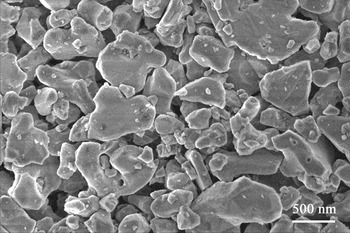
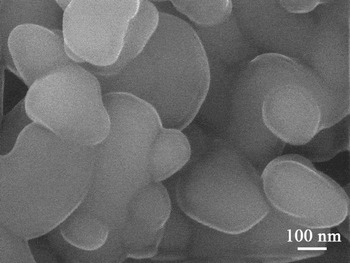
The process in the present study is similar to the general gelcasting method described elsewhere.Reference Mao, Shimai, Dong and Wang3 A commercial alumina powder (AES-11, Sumitomo, Osaka, Japan) with an average particle size of 0.45 µm was used as the raw material. The morphology of this powder is shown in Fig. 2. The copolymer of isobutylene and maleic anhydride has an average molecular weight of 55,000–65,000 (Isobam 104#, Kuraray, Osaka, Japan) and the ratio of the two polymers is 1:1 in the copolymer.
Scanning Electron Microscope (SEM) image of the raw alumina powder.

The zeta potentials of the dilute alumina slurries (powder/water: 0.15 g/L) were measured by electrophoretic mobility (ZetaPlus, Brookhaven, NY). Hydrochloric acid and sodium hydroxide were used to adjust pH.
The slurries containing 38–50 vol% solids were prepared by ball-milling the alumina powder with 0.3–1.0 wt% Isobam. Rheological behavior was characterized with a stress-controlled rheometer (Physica MCR301, Anton Paar, Graz, Austria) with a parallel plate (25 mm in diameter). The viscosities of the slurries were measured with the continuous shear mode increasing from 1/s to 1000/s at 25 °C. After milling, the slurries were cast into a mold with a typical size of 50 × 30 × 30 mm3 and gelled, the wet green bodies were dried at room temperature for 24 h, and then heated at 110 °C for 48 h. Sintering was carried out at 1500 °C for 2 h. Bulk densities of sintered bodies were determined by Archimedes principle. The flexural strength was measured using three-point bending on bars of 36 × 4 × 3 mm at a crosshead speed of 0.5 mm/min (Instron-5566, Norwood, MA).
III. RESULTS AND DISCUSSION
A. Effect of Isobam content on alumina slurry dispersion and gelation
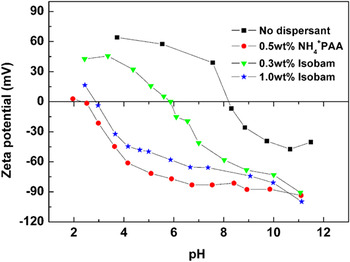
Figure 3 shows the effect of Isobam on the zeta potentials of alumina slurries. For comparison, the zeta potential of the alumina slurry with 0.5 wt% NH4+PAA (ammonium polyacrylate) is included in the figure. The isoelectric point of the alumina with no dispersant is pH 8.3. With the addition of 0.3 wt% Isobam, the isoelectric point decreases to pH 5.8, and further decreases to pH 2.8 when 1.0 wt% Isobam is added, which is close to the isoelectric point pH 2.5 of the slurry with 0.5 wt% NH4+PAA. The zeta potential of the alumina slurry increases to 60 mV at pH 8.3 with 0.3% Isobam and further increases to 75 mV at pH 8.3 with 1.0% Isobam, which is close to the value of the slurry with the conventional alumina dispersant (0.5 wt% NH4+PAA). These results indicate that the Isobam has a similar dispersing role as that of NH4+PAA. Israelachvili reported that the conformation of polymer in water is like thread, loop, mushroom or ball with increasing concentration.Reference Israelachvili19 In the present slurry composition (50 vol% solids loading, 0.3 wt% Isobam), the concentration of Isobam in water is 1.2%. Isobam polymer chains are stretched at this low concentration. The conformation of Isobam adsorbed on the surface of alumina powder may be zigzag and/or loop-like by means of charge appealing or chelation reaction. As shown in Fig. 1 Isobam molecule contains many –COO− groups after hydrolysis. They will be appealed by the positive charges on the surface of alumina particles and also possibly react with –OH groups on the surface of alumina particles. Thus, a stable alumina slurry was prepared by the addition of Isobam.
Effect of Isobam addition on zeta potentials of alumina slurry (powder/water: 0.15 g/L).

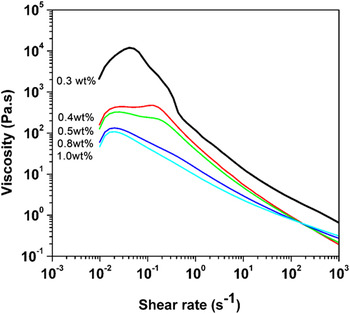
Figure 4 shows the effect of Isobam concentration on the rheological behavior of slurries with a solids loading of 50 vol% alumina powder at room temperature. It is clear that all slurries show a shear-thickening behavior at low shear rate and then a shear-thinning character with increasing shear rate. Rheological properties were measured within 20 min after ball-milling the mixture of water, Isobam, and alumina powder. During this period or even in the mixing process microgelling may proceed. This may bring rheological changes for the slurry. Anyway, we must do other experiments to clarify the initial increase in viscosity. The viscosity decreases with increasing Isobam content from 0.3 to 1 wt%. However, when Isobam content is decreased to 0.1 or 0.2 wt%, the slurry undergoes coagulation and forms a wet paste. For the sample with 0.25 wt% Isobam addition the viscosity is too high and its rheological properties cannot be measured.
Viscosity versus Isobam content for the slurries with 50 vol% solids loading.

Figure 5(a) shows the effect of Isobam content on the evolution of storage modulus G′ of 50 vol% AES11 slurries. To be mentioned, gelation behavior measured within 20 min for the preparation of measurement was similar to the rheological measurement after ball-milling the mixture of water, Isobam, and alumina powder. For the slurry with 0.3 wt% Isobam, the storage modulus increased slowly with increasing time, revealing the formation of a microgel,Reference Tallon and Franks20 and gradual microgel growth until a monolithic gel formed. Although microgel started at the beginning of the measurement or even during the mixing of the slurry, from Fig. 5(b) we find the loss modulus is sufficiently low for a period of time, to allow for casting. With the increase of Isobam concentration, the storage modulus decreased. Meanwhile, gelation rate decreases with increasing Isobam concentration. If we assume a storage modulus G′ of 1500 Pa as a goal, the gelation time increases from 38 to 160 min and 368 min with increasing Isobam concentration from 0.3 to 0.4 wt% and 0.5 wt%, respectively. Compared with most gelcasting systems where either initiatorReference Omatete, Janney and Strehlow1 or moderate temperatureReference Adolfsson16 was necessary to induce polymerization, gelation of alumina slurry with Isobam is relatively fast at room temperature and no other additives are needed. However, we must admit that the mechanism of spontaneous gelling of alumina ceramics is not clear. Possibly, Isobam molecules are first adsorbed on the surface of alumina particles, then polymer linking proceeds through ionic interaction and/or hydrogen bonding among different functional groups of Isobam molecules adsorbed on different alumina particles, resulting in the spontaneous gelation of the alumina slurry.
Effect of Isobam content on the evolution of (a) storage modulus G′ and (b) Loss modulus of slurries with a solids loading of 50 vol%.

B. Effect of solids loading on alumina slurry gelation
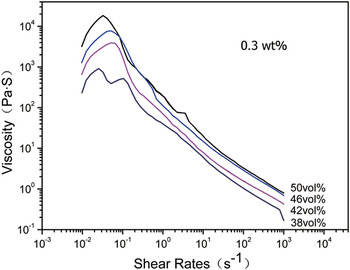
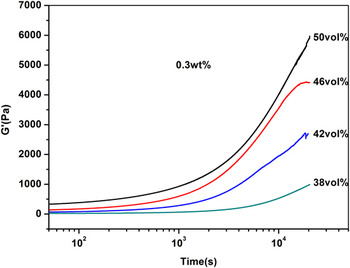
Figure 6 shows the viscosity of slurries as a function of solids loading and 0.3 wt% Isobam. From this figure, it is found that all slurries are shear-thinning. The viscosity of all the slurries was <10 Pa s at a shear rate of 100 per second, which means the slurries are suitable for casting. Figure 7(a) shows the storage modulus for slurries as a function of solids loading and 0.3 wt% Isobam. Similarly, as shown in Fig. 5(a), the storage modulus increased slowly at the beginning and then rapidly until an elastic body (gel) was formed. With increasing solids loading, the storage modulus increased and concurrently gelling time decreased. If we assume a storage modulus G′ of 1500 Pa as a goal, the time decreased from 108 to 52 min and 38 min when the solids loading increased from 42 to 46 vol% and 50 vol%, respectively. A similar phenomenon was found by Morissette et al.Reference Morissette and Lewis7 and Chabert et al.Reference Chabert, Dunstan and Franks8 They suggested that alumina particles might directly participate in the gel structure. The alumina particle number concentration increases with solids loading which increases the viscosity of the slurry. The increase may be due to the shorter distance between Isobam molecules adsorbed on the alumina particles and thus molecule chains of Isobam easily interact with each other.
Solids loading versus viscosity of slurries with different solids loadings (0.3 wt% Isobam).

Solids loading versus storage modulus and gelling time (inserted) of slurries with different solids loadings (0.3 wt% Isobam).

C. Gelcasting of dense alumina ceramics
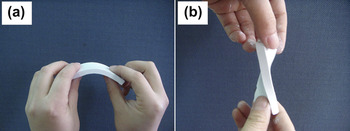
Figure 8 shows bending and twisting of wet gel of alumina prepared out of a slurry (50 vol% solids loading; 0.3 wt% Isobam). Such deformation is reversible just like gel foods. It shows that the wet gel is strong and flexible, suitable for demolding and handling. Figure 9 shows the fracture surface of dried green body gelled from a slurry with 50 vol% solids loading and 0.3 wt% Isobam. Compared with the raw material (Fig. 2), it can be seen that the alumina particles in the dried gel are covered with a thin layer of Isobam. Dense alumina ceramics with a relative density of 98% were obtained by sintering the green bodies at 1500 °C for 2 h. The average flexural strength is 439 MPa (n = 12).
(a) Bending and (b) twisting of wet gel of alumina (50 vol% solids loading; 0.3 wt% Isobam).

Fracture surface of dried alumina gel from a slurry (50 vol% solids loading; 0.3 wt% Isobam).

IV. CONCLUSIONS
A novel and simple method was developed for gelcasting alumina at room temperature in air, wherein only an additive, i.e., a copolymer of isobutylene and maleic anhydride (Isobam 104#), which acts as both dispersant and gelling agent, is used. With a small amount of Isobam (0.3 wt%), a slurry with as high as 50 vol% solids loading was prepared. After pouring into the mold, gelation occurred in 38 min. The gelling rate could be controlled by adjusting Isobam content and/or solids loading and the resultant wet gel of alumina was strong enough for handling.
The advantages of this novel gelling system are that only one additive is used, and it is easy to remove before sintering and furthermore it is environmental friendly (low exhaustion) due to as low as 0.3 wt% addition. Other merits of this spontaneous gelling system include nontoxicity, besides being a low-cost industrial product, and it has high purity, which is very important for preparation of technical ceramics.
ACKNOWLEDGMENTS
This work was financially supported by China National 863 Project (Grant No. 2009AA03Z440) and partly by 2011 Project of SICCAS—GuangSheng R&D Center for Rare Earth New Materials. The authors would like to thank Mr. Yoshihiro Yoshioka of Kuraray Polymer Co., Ltd. Japan for his helpful discussion and donation of Isobam 104# for this study. We also thank Prof. Hidehiro Kamiya, from Tokyo University of Agriculture and Technology, Japan for his helpful discussions.