


We report the case of a young transgender patient on long-term testosterone therapy who presented with features of the syndrome headache and neurological deficits with CSF lymphocytosis (HaNDL), alongside markedly elevated intracranial pressure and severe papilledema. Although we could not confirm with certainty concurrent idiopathic intracranial hypertension (IIH) given the CSF pleocytosis, the degree of pressure elevation, the severity of papilledema and the presence of established IIH risk factors raised strong enough clinical suspicion to warrant treatment. This case illustrates the diagnostic uncertainty that can arise when two distinct conditions with overlapping phenotypes occur together and the role of clinical judgment in guiding management when formal diagnostic criteria cannot be fully met.
A 25-year-old transgender patient on long-term testosterone therapy since age 17, with a body mass index of 32, presented with a one-month history of unilateral, throbbing left-sided headaches associated with nausea, vomiting, photophobia and phonophobia, with no prior history of migraine. A right peripheral blurred spot lasting several minutes during headache episodes was also reported.
He was initially diagnosed with migraines at an outside hospital and prescribed zolmitriptan with partial relief; papilledema was not identified at the time. Riboflavin and amitriptyline were subsequently added. Shortly after, he experienced a stroke-like episode with right hemibody paresthesia, leg weakness, behavioral arrest, expressive aphasia and confusion lasting up to one hour with complete resolution, without loss of consciousness or seizure features. CT head was normal. Diplopia at extremes of gaze was noted, and referral to an optometrist identified bilateral papilledema, prompting transfer to our institution.
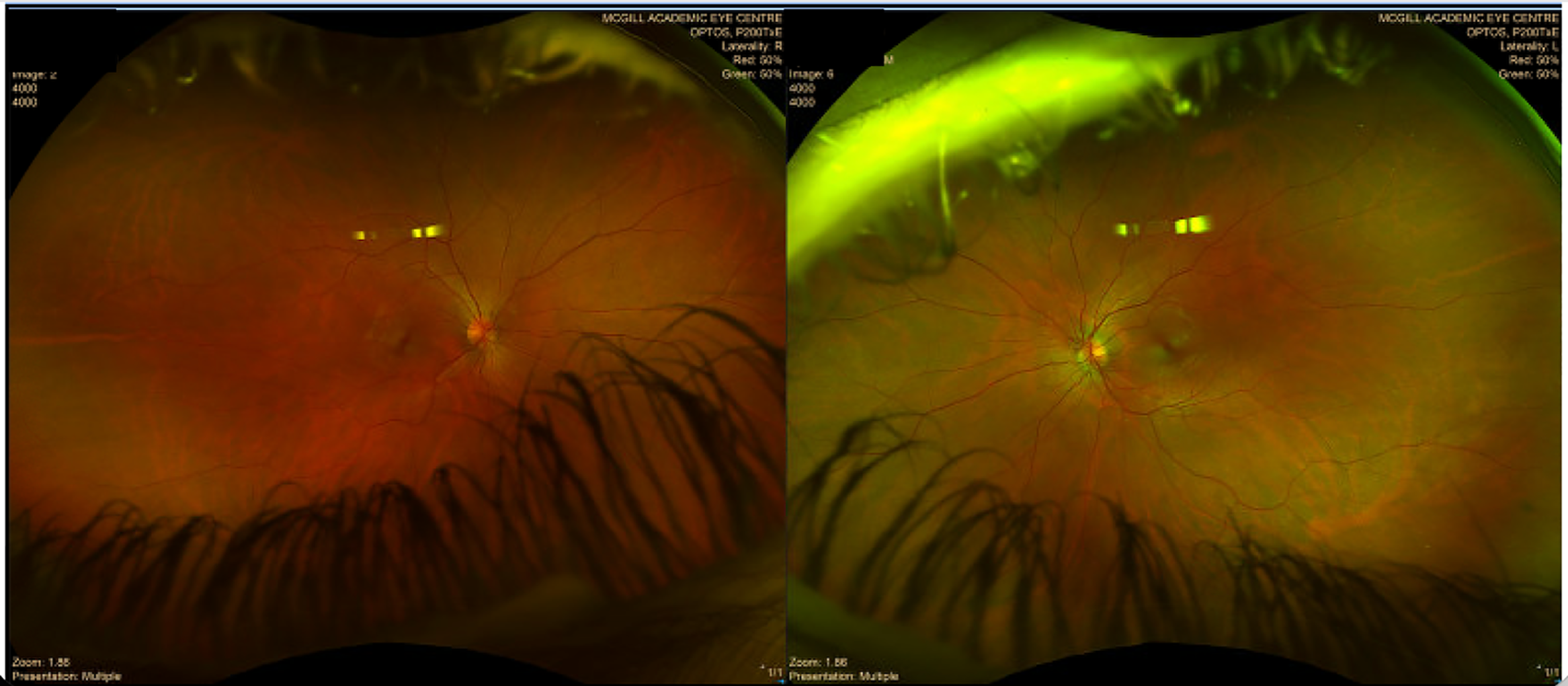
Additional history included a 30-pound weight gain over two months and left-sided pulsatile tinnitus. There was no history of recent viral illness prior to symptom onset. Examination confirmed diplopia on left lateral gaze and Frisén grade 3–4 papilledema with obscured vessels and hemorrhages. Brain MRI with venous sequences was normal, with no evidence of cerebral venous sinus thrombosis or venous sinus stenosis. Lumbar puncture revealed an opening pressure of 50 cmH2O, white blood cell count of 50 cells/µL (99% lymphocytes), mildly elevated protein at 0.54 g/L, normal glucose and negative infectious studies, including polymerase chain reaction (PCR) testing for herpes simplex virus type 1/2 (HSV-1/2), human herpesvirus 6 (HHV-6), human herpesvirus 8 (HHV-8), cytomegalovirus (CMV), varicella-zoster virus (VZV), parechovirus, enterovirus, cryptococcal antigen and bacterial cultures. The combination of migrainous headache, transient neurological deficits and CSF lymphocytosis raised the diagnosis of HaNDL; however, the markedly elevated opening pressure and papilledema supported concurrent IIH. Formal diagnostic criteria for IIH require a normal CSF composition, which was not met given the lymphocytic pleocytosis, and a definitive dual diagnosis could not be established. However, several features pointed toward concurrent IIH beyond what HaNDL alone could explain: the opening pressure of 50 cmH2O that far exceeded the range reported in HaNDL (18–37 cmH2O), severe papilledema and the presence of IIH risk factors such as obesity and long-term testosterone therapy. Given that the risk of untreated IIH outweighed the diagnostic uncertainty, we made a decision to manage the concurrent IIH. The patient was started on acetazolamide 500 mg twice daily, continued migraine preventive therapy, advised to avoid triptans and counseled on weight loss. At two-month follow-up, symptoms had largely resolved with mild residual tinnitus and marked improvement in papilledema. He had lost weight and had discussed decreasing his testosterone dose with his family physician, though no abrupt changes were made at that time. A fundus photograph two months post-treatment is shown in Figure 1. At 21 months, papilledema had fully resolved, and acetazolamide was reduced to 250 mg twice daily.
Right and left fundus photo demonstrating marked improvement of papilledema at two-month follow-up after acetazolamide treatment.

Figure 1. Long description
Panel A: Fundus photo showing the retina with visible blood vessels and optic disc. The optic disc appears swollen with obscured vessels and hemorrhages. Panel B: Fundus photo showing the retina with visible blood vessels and optic disc. The optic disc appears swollen with obscured vessels and hemorrhages.
HaNDL is a self-limited syndrome of migraine-like headache, transient neurological deficits and CSF lymphocytosis requiring extensive workup to exclude infectious, vascular and inflammatory causes. Reference Qureshi and Samanta1 Elevated intracranial pressure and papilledema have been described within its spectrum, with CSF opening pressures typically ranging from 18 to 37 cmH2O. Reference Al-Chalabi, Hegde and Asghar2,Reference Gomez-Aranda, Canadillas and Marti-Masso3 When both pleocytosis and markedly elevated opening pressure coexist, as in our patient, distinguishing HaNDL from concurrent IIH becomes particularly challenging and may delay appropriate management.
The coexistence of HaNDL and markedly raised intracranial pressure in a patient on testosterone therapy has not been previously reported. It remains unclear whether the elevated intracranial pressure is directly related to testosterone therapy and obesity or represents a rare complication of HaNDL that ultimately resolved on its own or reflects a combination of inflammatory and metabolic factors in a susceptible individual. This case highlights that multiple overlapping mechanisms may contribute rather than a single unifying etiology.
Testosterone therapy has been identified as a potential risk factor for IIH, with obesity further amplifying this risk. Reference Gutkind, Tse, Johnson and Tse4,Reference Nguyen, Gilbert and Fortin5 The relationship appears independent of dose or formulation, with symptom onset reported from 10 weeks to 13 months after initiation, suggesting cumulative exposure or individual susceptibility as key factors. Reference Gutkind, Tse, Johnson and Tse4 Patients with IIH also exhibit a distinct androgen profile with elevated CSF testosterone and androstenedione, implicating altered androgen signaling in CSF dynamics. Reference O’Reilly, Westgate and Hornby6 Management follows standard IIH principles; testosterone dose reduction may be considered alongside acetazolamide, weight loss and, in refractory cases, surgical intervention. Reference Gutkind, Tse, Johnson and Tse4,Reference Nguyen, Gilbert and Fortin5,Reference Ducros and Biousse7 GLP-1 receptor agonists show emerging promise but warrant further study. Reference Sioutas, Mualem, Reavey-Cantwell and Rivet8 No guidelines address testosterone continuation versus cessation in this setting. This represents an important knowledge gap, necessitating individualized risk–benefit assessment with careful attention to visual outcomes.
Neurologists should maintain a high index of suspicion for intracranial hypertension in patients presenting with headache, transient focal neurological deficits and CSF lymphocytosis when no alternative etiology is identified, as it may coexist with HaNDL. Additionally, IIH should be considered in patients receiving testosterone therapy who present with new or persistent headaches. More broadly, this case illustrates the risk of anchoring to an initial diagnosis when not all clinical features are adequately explained. Although HaNDL and IIH share phenotypic overlap, they represent distinct conditions without an established pathophysiological link, and their coexistence may represent a coincidence in susceptible individuals. Clinicians should remain vigilant for additional diagnoses when key features, such as markedly elevated intracranial pressure, papilledema or relevant risk factors, fall outside the expected spectrum of the primary diagnosis and be prepared to act on clinical suspicion even when formal diagnostic criteria cannot be fully met.
Data availability statement
Case material is available from the author on request.
Acknowledgments
None.
Author contributions
LH and EE wrote the manuscript.
Funding statement
None.
Competing interests
The authors have no conflicts of interest relevant to this study.
Consent
Consent was obtained.

 Open access

