Introduction
Schizophrenia is a disorder of aberrant thought and perception, yet a wealth of evidence shows that schizophrenia patients also exhibit pervasive cognitive dysfunction (Heinrichs & Zakzanis, Reference Heinrichs and Zakzanis1998; Reichenberg & Harvey, Reference Reichenberg and Harvey2007). For decades, studies have sought to establish whether cognitive impairment precedes onset of psychosis, with an early meta-analysis showing evidence for small cognitive deficits in future schizophrenia patients as early as age 5 (Aylward et al. Reference Aylward, Walker and Bettes1984). Similarly, two recent meta-analyses have reported a medium average deficit equal to around 8 IQ points (Woodberry et al. Reference Woodberry, Giuliano and Seidman2008; Khandaker et al. Reference Khandaker, Barnett, White and Jones2011), approximately half of the magnitude seen in first episode and chronic patients (Reichenberg & Harvey, Reference Reichenberg and Harvey2007; Mesholam-Gately et al. Reference Mesholam-Gately, Giuliano, Goff, Faraone and Seidman2009). Evidence that schizophrenia is associated with premorbid cognitive deficits adds substantial plausibility to neurodevelopmental models of the disorder (Murray & Lewis, Reference Murray and Lewis1987; Weinberger, Reference Weinberger1987), by showing that the earliest signs of illness are not overt abnormalities in behavior, but rather subtle deviations in developmental processes.
Several methodologies have been implemented to examine premorbid cognitive functioning in schizophrenia. Genetic and clinical high-risk studies have generated important findings thanks to their prospective nature, but such studies are prone to issues of generalizability and power. Since these studies have recently been comprehensively and quantitatively reviewed (Agnew-Blais & Seidman, Reference Agnew-Blais and Seidman2013; Bora & Murray, Reference Bora and Murray2013), they will not be discussed herein. Instead, the current review serves as an update on findings from population cohort studies (Maccabe, Reference Maccabe2008; Khandaker et al. Reference Khandaker, Barnett, White and Jones2011) and will follow three main lines of enquiry. First, are premorbid cognitive deficits specific to non-affective psychotic disorders, such as schizophrenia, or are they also apparent in other psychotic and/or psychiatric disorders? Second, is the profile of cognitive impairment qualitatively similar prior and post onset of psychosis, with smaller verbal than nonverbal deficits? Third, does the magnitude of premorbid cognitive deficits increase with age? Understanding the nature and course of premorbid cognitive functioning in schizophrenia may not only shed light on impairments that predict important functional outcomes, but also on pathophysiological pathways that lead to the disorder. Finally, we will discuss possible genetic and environmental mechanisms underlying these premorbid cognitive deficits.
Are premorbid cognitive deficits specific to schizophrenia?
Bipolar disorder
The question of whether premorbid cognitive functioning differs in schizophrenia and bipolar disorder was addressed in a recent meta-analysis, which reported on both estimated and actual premorbid IQ (Trotta et al. Reference Trotta, Murray and MacCabe2015). Only four of the included studies utilized prospective measures of premorbid IQ, with overall effect sizes equal to −0.41 standard deviations in schizophrenia and −0.03 s.d. in bipolar disorder. An Israeli conscript study also failed to find an association between IQ at age 17 and hospitalization for bipolar disorder (Reichenberg et al. Reference Reichenberg, Weiser, Rabinowitz, Caspi, Schmeidler, Mark, Kaplan and Davidson2002). While future schizophrenia patients showed significant premorbid impairments across all intellectual measures, future nonpsychotic bipolar disorder patients showed no significant premorbid cognitive impairment. A direct group comparison also revealed significantly more severe premorbid cognitive deficits in schizophrenia compared with bipolar disorder. Moreover, while future schizophrenia patients showed small premorbid reading impairments, bipolar patients actually scored higher than comparison subjects on one measure of reading ability, albeit not statistically significantly (Reichenberg et al. Reference Reichenberg, Weiser, Rabinowitz, Caspi, Schmeidler, Mark, Kaplan and Davidson2002).
Contrarily, a Finnish study of male conscripts reported a linear increase in risk of both schizophrenia and bipolar disorder with decreasing visuospatial scores, although, in line with the Israeli conscripts study increasing arithmetic scores were also associated with increasing risk for bipolar disorder (Tiihonen et al. Reference Tiihonen, Haukka, Henriksson, Cannon, Kieseppä, Laaksonen, Sinivuo and Lönnqvist2005). Above average childhood IQ has also been associated with adult mania in the Dunedin cohort, while low childhood IQ was associated with schizophrenia in this sample (Koenen et al. Reference Koenen, Moffitt, Roberts, Martin, Kubzansky, Harrington, Poulton and Caspi2009). More recently, Swedish national cohort data showed that school achievement was inversely associated with both schizophrenia and bipolar disorder, although the relationship was stronger in schizophrenia (Kendler et al. Reference Kendler, Ohlsson, Mezuk, Sundquist and Sundquist2016). Interestingly, school achievement equal to or higher than two standard deviations above the mean was also associated, albeit non-significantly, with increased risk for both disorders.
Other psychotic disorders
In the same Swedish national cohort study described above (Kendler et al. Reference Kendler, Ohlsson, Mezuk, Sundquist and Sundquist2016), school achievement was also inversely associated with non-affective psychoses other than schizophrenia, with the strength of the association being similar to schizophrenia. A similar finding was reported in a Danish study of male conscripts, in which premorbid IQ was linearly associated with both schizophrenia and other non-affective psychoses (Urfer-Parnas et al. Reference Urfer-Parnas, Mortensen, Saebye and Parnas2010). Moreover, average premorbid IQ did not differ significantly between individuals with schizophrenia and those with other non-affective psychoses. In a Swedish study of male conscripts, risk for both schizophrenia and other non-affective psychoses increased significantly in those with the lowest compared to highest scores on tests of mechanical, verbal and visuospatial skills, as well as general intelligence (Gunnell et al. Reference Gunnell, Harrison, Rasmussen, Fouskakis and Tynelius2002). For all of these measures, associations were stronger in schizophrenia than other non-affective psychoses. In a Swedish study of male conscripts, on the other hand, there was a strong association between IQ score and both schizophrenia and other non-affective psychoses, with a descriptive plot actually suggesting a stronger association in non-affective psychoses other than schizophrenia.
Recently published results from the New England Family Studies of the Collaborative Perinatal Project (CPP) showed that compared with controls, childhood IQ at ages 4 and 7 was lower among future schizophrenia spectrum psychoses, but not future affective psychoses cases. An earlier study of premorbid cognitive functioning in schizophrenia and affective psychoses from the 1958 British birth cohort revealed statistically significant impairments on tests of general, verbal, non-verbal, reading and mathematics abilities in individuals later diagnosed with schizophrenia through the ages of 7, 11 and 16. Deficits in those who later developed affective psychoses did not reach statistical significance at age 16 and were of smaller magnitude than in schizophrenia at ages 7 and 11 (Crow et al. Reference Crow, Done and Sacker1995). In the 1932 Scottish Mental Ability Survey, on the other hand, neither schizophrenia spectrum disorders or affective psychoses were associated with statistically significant deficits in IQ at age 11 (Walker et al. Reference Walker, McConville, Hunter, Deary and Whalley2002).
Other psychiatric disorders
While the few studies addressing the specificity of premorbid cognitive impairment to schizophrenia have focused mostly on bipolar disorder and other psychoses, select studies have examined premorbid cognitive functioning in schizophrenia compared to a range of other psychiatric disorders. In a Danish study of male conscripts, medium premorbid IQ deficits were seen in schizophrenia spectrum disorders and other psychoses, while individuals with affective disorders showed only a small, not statistically significant premorbid IQ deficit (Mortensen et al. Reference Mortensen, Sørensen, Jensen, Reinisch and Mednick2005). Interestingly, the largest premorbid IQ deficits were seen in individuals with personality and substance use disorders. Premorbid IQ deficits in individuals who developed personality and substance use disorders were larger than future schizophrenia cases, equating to almost one standard deviation below controls. In the Dunedin cohort, on the other hand, childhood IQ was not associated with risk for adult substance use disorders, but was linearly associated with risk for depression, albeit to a lesser degree than schizophrenia (Koenen et al. Reference Koenen, Moffitt, Roberts, Martin, Kubzansky, Harrington, Poulton and Caspi2009). In a study on premorbid IQ in subjects assessed at a child and adolescent psychiatric unit and followed-up in adulthood, individuals who later developed schizophrenia showed lower premorbid scores than controls, as well as individuals who later developed affective disorder. Moreover, individuals who later developed affective disorder did not differ from controls in childhood IQ (Amminger et al. Reference Amminger, Schlögelhofer, Lehner, Looser Ott, Friedrich and Aschauer2000). Finally, in a Finnish birth cohort, school marks at age 16 were significantly lower in individuals who went on to develop a non-psychotic disorder, but not schizophrenia or other psychoses (Isohanni et al. Reference Isohanni, Järvelin, Nieminen, Jones, Rantakallio, Jokelainen and Isohanni1998).
What is the profile of cognitive impairment prior to onset of psychosis?
Verbal and non-verbal abilities
Meta-analyses of premorbid cognitive impairment in schizophrenia have focused on general IQ and yet several studies have reported on separate verbal and performance IQ, or verbal and non-verbal scores. In a study of subjects assessed at a child and adolescent psychiatric unit and followed-up in adulthood, individuals who later developed schizophrenia showed significant premorbid deficits in performance, but not verbal IQ (Gunnell et al. Reference Gunnell, Harrison, Rasmussen, Fouskakis and Tynelius2002). Results from the Philadelphia cohort of the CPP, on the other hand, showed that age 7 verbal and performance IQ were equally impaired in schizophrenia patients (Cannon et al. Reference Cannon, Bearden, Hollister, Rosso, Sanchez and Hadley2000). Similarly, in the New England cohort of the CPP, the magnitude of impairment in verbal and performance IQ at age 7 was almost identical (Seidman et al. Reference Seidman, Buka, Goldstein and Tsuang2006).
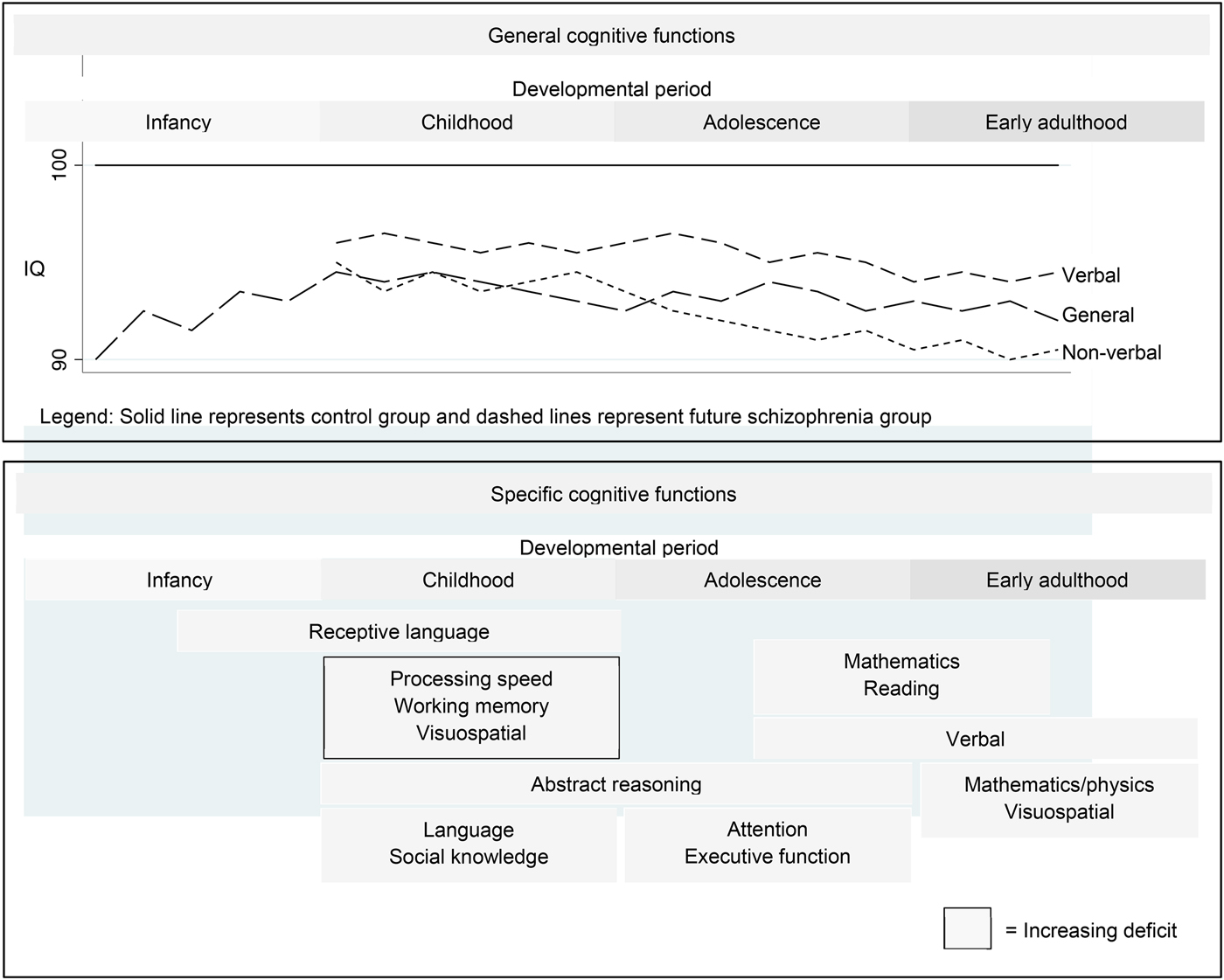
Other reports on premorbid cognitive functioning have used dichotomies of verbal and non-verbal abilities. For example, in the 1946 British birth cohort, future schizophrenia patients showed small deficits in both verbal and non-verbal tests through ages 8, 11 and 15, although at age 15 the non-verbal deficit showed a small increase in magnitude, while the verbal deficit did not (Jones et al. Reference Jones, Murray, Jones, Rodgers and Marmot1994). Similarly, in the 1958 British birth cohort, the non-verbal deficit at age 11 appeared to be larger than the verbal deficit, although both were significant (Crow et al. Reference Crow, Done and Sacker1995). Conscript studies have also categorized cognitive tests as verbal and non-verbal abilities, with a Swedish study of males reporting that lower performance on both verbal and non-verbal tests were significantly associated with increased risk of schizophrenia even after adjusting for the other subtests (Zammit et al. Reference Zammit, Allebeck, David, Dalman, Hemmingsson, Lundberg and Lewis2004). In an Israeli study of male conscripts, on the other hand, only non-verbal performance remained significantly inversely associated with risk for schizophrenia spectrum disorders when adjusting for other subtests (Reichenberg et al. Reference Reichenberg, Weiser, Caspi, Knobler, Lubin, Harvey, Rabinowitz and Davidson2006). A summary of current findings on verbal and non-verbal premorbid cognitive deficits in schizophrenia can be seen in Fig. 1.
Summary of findings on cognitive impairment in general and specific cognitive functions prior to onset of psychosis. General cognitive functions: Meta-analytic findings suggest that future schizophrenia patients show an average premorbid IQ deficit equal to around 0.5 standard deviations (8 points) below controls(Woodberry et al. Reference Woodberry, Giuliano and Seidman2008; Khandaker et al. Reference Khandaker, Barnett, White and Jones2011), with some evidence of greater non-verbal than verbal deficits(Jones et al. Reference Jones, Murray, Jones, Rodgers and Marmot1994; Gunnell et al. Reference Gunnell, Harrison, Rasmussen, Fouskakis and Tynelius2002; Reichenberg et al. Reference Reichenberg, Weiser, Caspi, Knobler, Lubin, Harvey, Rabinowitz and Davidson2006). One study has reported a decreasing general IQ deficit in future schizophrenia spectrum patients during early childhood (Agnew-Blais et al. Reference Agnew-Blais, Buka, Fitzmaurice, Smoller, Goldstein and Seidman2015). Between late childhood and adolescence, studies have shown evidence for an increasing deficit in general cognitive function (Fuller et al. Reference Fuller, Nopoulos, Arndt, O'Leary, Ho and Andreasen2002; Bilder et al. Reference Bilder, Reiter, Bates, Lencz, Szeszko, Goldman, Robinson, Lieberman and Kane2006; Osler et al. Reference Osler, Lawlor and Nordentoft2007), particularly in non-verbal tests (Jones et al. Reference Jones, Murray, Jones, Rodgers and Marmot1994; Reichenberg et al. Reference Reichenberg, Caspi, Harrington, Houts, Keefe, Murray, Poulton and Moffitt2010). Decline in verbal IQ has been reported later, during adolescence (MacCabe et al. Reference MacCabe, Wicks, Lofving, David, Berndtsson, Gustafsson, Allebeck and Dalman2013). Specific cognitive functions: Several studies have reported deficits in receptive language across infancy and childhood (Cannon et al. Reference Cannon, Caspi, Moffitt, Harrington, Taylor, Murray and Poulton2002; Kremen et al. Reference Kremen, Vinogradov, Poole, Schaefer, Deicken, Factor-Litvak and Brown2010; Welham et al. Reference Welham, Scott, Williams, Najman, Bor, O'Callaghan and McGrath2010). In childhood, deficits in processing speed, working memory, visuospatial ability, language and social knowledge have been reported (Niendam et al. Reference Niendam, Bearden, Rosso, Sanchez, Hadley, Nuechterlein and Cannon2003; Reichenberg et al. Reference Reichenberg, Caspi, Harrington, Houts, Keefe, Murray, Poulton and Moffitt2010; Seidman et al. Reference Seidman, Cherkerzian, Goldstein, Agnew-Blais, Tsuang and Buka2013), as well as increasing deficits/developmental lags in processing speed, working memory and visuospatial ability (Reichenberg et al. Reference Reichenberg, Caspi, Harrington, Houts, Keefe, Murray, Poulton and Moffitt2010). Deficits in tests of abstract or non-verbal reasoning have been reported across childhood (Reichenberg et al. Reference Reichenberg, Caspi, Harrington, Houts, Keefe, Murray, Poulton and Moffitt2010) and adolescence (Reichenberg et al. Reference Reichenberg, Rabinowitz, Weiser, Mark, Kaplan and Davidson2000; Reichenberg et al. Reference Reichenberg, Weiser, Rabinowitz, Caspi, Schmeidler, Mark, Kaplan and Davidson2002; Welham et al. Reference Welham, Scott, Williams, Najman, Bor, O'Callaghan and McGrath2010). In early adolescence, a study has reported deficits in measures of attention/executive function (Cannon et al. Reference Cannon, Moffitt, Caspi, Murray, Harrington and Poulton2006). In mid to late adolescence, studies have reported deficits in mathematics (Jones et al. Reference Jones, Murray, Jones, Rodgers and Marmot1994; Ang & Tan, Reference Ang and Tan2004) and reading tests (Reichenberg et al. Reference Reichenberg, Weiser, Rabinowitz, Caspi, Schmeidler, Mark, Kaplan and Davidson2002). In early adulthood, there have been reports of deficits in mathematics/physics and visuospatial abilities (David et al. Reference David, Malmberg, Brandt, Allebeck and Lewis1997; Zammit et al. Reference Zammit, Allebeck, David, Dalman, Hemmingsson, Lundberg and Lewis2004). Verbal deficits have been reported across late adolescence and early adulthood (Ang & Tan, Reference Ang and Tan2004; Zammit et al. Reference Zammit, Allebeck, David, Dalman, Hemmingsson, Lundberg and Lewis2004; Reichenberg et al. Reference Reichenberg, Weiser, Caspi, Knobler, Lubin, Harvey, Rabinowitz and Davidson2006). NB blocks signify the developmental periods during which cognitive tests were administered.

Other specific cognitive abilities
The majority of studies on premorbid cognitive functioning in schizophrenia have reported on general measures, but there have also been some findings on specific cognitive domains. Conscript studies provide initial insight into potentially specific premorbid deficits. In the Swedish study of male conscripts mentioned above, while premorbid scores on all subtests were significantly associated with risk for schizophrenia, the strongest predictor of risk was the ‘technical’ test, which broadly assesses basic mathematical and physics abilities (David et al. Reference David, Malmberg, Brandt, Allebeck and Lewis1997). This finding was replicated in an updated report on the same cohort, although verbal and visuospatial test scores were also found to be significantly associated with later risk for schizophrenia, albeit to a lesser extent (Zammit et al. Reference Zammit, Allebeck, David, Dalman, Hemmingsson, Lundberg and Lewis2004). In Israeli conscripts, future schizophrenia patients showed small to medium cognitive deficits across all intellectual and reading measures, but not speaking and writing measures (Reichenberg et al. Reference Reichenberg, Weiser, Rabinowitz, Caspi, Schmeidler, Mark, Kaplan and Davidson2002). However, an earlier report of premorbid cognitive functioning in twins discordant for schizophrenia from the same sample showed that affected twins performed non-significantly worse than control twins and their co-twins only on a measure of abstract reasoning (Reichenberg et al. Reference Reichenberg, Rabinowitz, Weiser, Mark, Kaplan and Davidson2000). In the Finnish study of male conscripts, the risk of schizophrenia increased linearly with declining performance on a measure of visuospatial ability, but not arithmetic or verbal tests (Tiihonen et al. Reference Tiihonen, Haukka, Henriksson, Cannon, Kieseppä, Laaksonen, Sinivuo and Lönnqvist2005). Contrarily, small, yet statistically non-significant decrements in age 16 scholastic mathematics and English tests were reported in a study of Singaporean military servicemen presenting with a first episode of schizophrenia in adulthood (Ang & Tan, Reference Ang and Tan2004).
Similarly, in the 1946 British birth cohort mentioned above, future schizophrenia patients showed premorbid deficits in arithmetic/mathematics, but not vocabulary and reading tests (Jones et al. Reference Jones, Murray, Jones, Rodgers and Marmot1994). More recent findings from studies of birth cohorts have provided additional evidence on the profile of specific premorbid cognitive deficits in schizophrenia. Results from the Philadelphia cohort of the CPP showed significant cognitive deficits at age 7 across all administered subtests of the Wechsler Intelligence Scale for Children, including measures of visuospatial ability, social knowledge, working memory, processing speed, language and general knowledge (Niendam et al. Reference Niendam, Bearden, Rosso, Sanchez, Hadley, Nuechterlein and Cannon2003). Interestingly, however, future schizophrenia patients performed significantly worse than their unaffected siblings only on the coding subtest, a measure of processing speed. In the New England cohort of the CPP, statistically significant cognitive deficits were also seen at age 7 in future schizophrenia patients, but only in measures of general knowledge, working memory and processing speed (Seidman et al. Reference Seidman, Buka, Goldstein and Tsuang2006). On the other hand, large decrements in receptive vocabulary in early childhood were reported in another birth cohort study (Kremen et al. Reference Kremen, Vinogradov, Poole, Schaefer, Deicken, Factor-Litvak and Brown2010). In an Australian prospective cohort, males with a future schizophreniform diagnosis, but not females, scored lower on a measure of receptive vocabulary at age 5 and a measure of general non-verbal reasoning at age 14 (Welham et al. Reference Welham, Scott, Williams, Najman, Bor, O'Callaghan and McGrath2010). Finally, in the Dunedin study, statistically significant premorbid deficits were seen across ages 7, 9, 11 and 13 in measures of general knowledge, abstract reasoning, language, social knowledge, visuospatial ability, working memory and processing speed (Reichenberg et al. Reference Reichenberg, Caspi, Harrington, Houts, Keefe, Murray, Poulton and Moffitt2010). The nature of these deficits is discussed below in more detail. A summary of current findings on premorbid deficits in specific cognitive functions can be seen in Fig. 1.
Do schizophrenia patients experience cognitive decline prior to onset of psychosis?
While the finding of a moderate premorbid cognitive impairment and of large deficits at the first episode is suggestive of cognitive decline preceding the onset of schizophrenia, literature on the course of premorbid impairments in schizophrenia remains scarce. Perhaps one of the earliest indications that the magnitude of cognitive impairment may indeed increase with increasing age came from the 1946 British birth cohort, in which future schizophrenia patients showed a larger average non-verbal deficit at age 15 than at ages 8 and 11 (Jones et al. Reference Jones, Murray, Jones, Rodgers and Marmot1994). Verbal deficits, on the other hand, did not show an increase in magnitude over time. In the 1958 British birth cohort, on the other hand, deficits in reading and mathematics scores at ages 7, 11 and 16 were reported to be of similar magnitude at age 7 as at later ages (Crow et al. Reference Crow, Done and Sacker1995). Further evidence of an increasing cognitive impairment prior to psychosis onset came from a Danish cohort of males, in which cognitive functioning was ascertained through school records at age 12 and through conscript data at age 18 (Osler et al. Reference Osler, Lawlor and Nordentoft2007). The authors noted that the association between cognition and schizophrenia was stronger at age 18 than age 12, and also that decline in cognitive functioning was an independent risk factor for the disorder (Osler et al. Reference Osler, Lawlor and Nordentoft2007).
Follow-back studies have also provided evidence of premorbid cognitive decline, with a report of increasing discrepancy in scholastic achievement scores between controls and future first episode patients from kindergarten (age 5–6) to 12th grade (age 17–18)(Bilder et al. Reference Bilder, Reiter, Bates, Lencz, Szeszko, Goldman, Robinson, Lieberman and Kane2006). In another study, future schizophrenia patients showed statistically significant deficits in scholastic test performance in 11th grade (age 16–17), but not 4th (age 9–10) or 8th (age 13–14) grades (Fuller et al. Reference Fuller, Nopoulos, Arndt, O'Leary, Ho and Andreasen2002). Moreover, scores in two educational domains were significantly lower in 11th than 8th grade, with language scores also showing a significant linear decline over time (Fuller et al. Reference Fuller, Nopoulos, Arndt, O'Leary, Ho and Andreasen2002). Data from a Swedish longitudinal cohort study of males provided further evidence of cognitive decline in adolescence (MacCabe et al. Reference MacCabe, Wicks, Lofving, David, Berndtsson, Gustafsson, Allebeck and Dalman2013). A relative decline in verbal ability scores between ages 13 and 18 was the strongest and only statistically significant predictor of schizophrenia, with the magnitude of decline approximating 6 IQ points.
Prospective data on childhood cognitive functioning in future schizophrenia patients is rare, but data from the Dunedin birth cohort has provided direct evidence of increasing cognitive impairment during this developmental period (Reichenberg et al. Reference Reichenberg, Caspi, Harrington, Houts, Keefe, Murray, Poulton and Moffitt2010). While both future schizophrenia cases and controls showed increasing scores on subtests of the Wechsler Intelligence Scale for Children through ages 7, 9, 11 and 13, the rate of increase differed between groups and subtests. Future schizophrenia patients showed small, stable decrements in verbal subtests, with the rate of growth over time indistinguishable from that of controls. Scores on tests of visuospatial ability, working memory and processing speed, on the other hand, showed a reduced rate of growth over time, resulting in increasing deficits over time in these domains. Findings from the New England cohort of the CPP, on the other hand, showed that although future schizophrenia spectrum disorder patients exhibited significant IQ deficits at both the ages of 4 and 7, they also showed a slight increase in IQ over time, relative to a small decrease in controls (Agnew-Blais et al. Reference Agnew-Blais, Buka, Fitzmaurice, Smoller, Goldstein and Seidman2015). A summary of current findings on the course of premorbid cognitive deficits in general and specific cognitive functions can be seen in Fig. 1.
Potential underlying genetic and environmental mechanisms
Genetic
Molecular genetics and twin studies have reported substantial genetic overlap between cognition and schizophrenia (Toulopoulou et al. Reference Toulopoulou, Picchioni, Rijsdijk, Hua-Hall, Ettinger, Sham and Murray2007; Lencz et al. Reference Lencz, Knowles, Davies, Guha, Liewald, Starr, Djurovic, Melle, Sundet, Christoforou, Reinvang, Mukherjee, DeRosse, Lundervold, Steen, John, Espeseth, Raikkonen, Widen, Palotie, Eriksson, Giegling, Konte, Ikeda, Roussos, Giakoumaki, Burdick, Payton, Ollier, Horan, Donohoe, Morris, Corvin, Gill, Pendleton, Iwata, Darvasi, Bitsios, Rujescu, Lahti, Hellard, Keller, Andreassen, Deary, Glahn and Malhotra2014), and research on the genetics of cognition in schizophrenia has shown a recent, rapid proliferation (Golimbet, Reference Golimbet2007; Zai et al. Reference Zai, Robbins, Sahakian and Kennedy2016). However, there have also been reports of only small genetic overlap between premorbid cognition and schizophrenia (Fowler et al. Reference Fowler, Zammit, Owen and Rasmussen2012; Kendler et al. Reference Kendler, Ohlsson, Sundquist and Sundquist2015).
Nevertheless, several genes have been associated with cognition in schizophrenia, with catechol-O-methyltransferase (COMT) being the most extensively examined due to its role in dopaminergic neurotransmission and longstanding candidacy in schizophrenia risk. Several studies have reported an association between the COMT Val158Met polymorphism and a variety of cognitive domains, such as verbal learning (Greenwood et al. Reference Greenwood, Lazzeroni, Murray, Cadenhead, Calkins, Dobie, Green, Gur, Gur and Hardiman2011), abstraction (Twamley et al. Reference Twamley, Hua, Burton, Vella, Chinh, Bilder and Kelsoe2014) and executive function (Green et al. Reference Green, Chia, Cairns, Wu, Tooney, Scott, Carr and Bank2014). The brain-derived neurotrophic factor (BDNF) gene, which is involved in cell differentiation, survival and synaptic plasticity, has also been examined. While there have been reports of an association between the BDNF polymorphism rs6265 and several cognitive domains, such as attention (Alfimova et al. Reference Alfimova, Lezheĭko, Golimbet, Korovaĭtseva, Lavrushkina, Kolesina, Frolova, Muratova, Abramova and Kaleda2007) and verbal memory (Ho et al. Reference Ho, Milev, O'Leary, Librant, Andreasen and Wassink2006), other studies have failed to find an association (Ahmed et al. Reference Ahmed, Mantini, Fridberg and Buckley2015). A handful of glutamatergic and serotonergic system genes have also been examined in relation to cognition in schizophrenia, with mixed findings (Jablensky et al. Reference Jablensky, Morar, Wiltshire, Carter, Dragovic, Badcock, Chandler, Peters and Kalaydjieva2011; Nicodemus et al. Reference Nicodemus, Elvevåg, Foltz, Rosenstein, Diaz-Asper and Weinberger2014). Nevertheless, the role of small polygenic effects on cognition in schizophrenia is supported by reports of an association between polygenic risk for schizophrenia and cognitive functioning (Hubbard et al. Reference Hubbard, Tansey, Rai, Jones, Ripke, Chambert, Moran, McCarroll, Linden and Owen2015; Kauppi et al. Reference Kauppi, Westlye, Tesli, Bettella, Brandt, Mattingsdal, Ueland, Espeseth, Agartz, Melle, Djurovic and Andreassen2015), as well as cognitive decline between childhood and adulthood (McIntosh et al. Reference McIntosh, Gow, Luciano, Davies, Liewald, Harris, Corley, Hall, Starr and Porteous2013).
Rare genetic variants, including copy number variations (CNVs), have also been implicated in schizophrenia (Stone et al. Reference Stone, O'Donovan, Gurling, Kirov, Blackwood, Corvin, Craddock, Gill, Hultman and Lichtenstein2008; Kirov et al. Reference Kirov, Pocklington, Holmans, Ivanov, Ikeda, Ruderfer, Moran, Chambert, Toncheva and Georgieva2012) and more recently in cognition (Stefansson et al. Reference Stefansson, Meyer-Lindenberg, Steinberg, Magnusdottir, Morgen, Arnarsdottir, Bjornsdottir, Walters, Jonsdottir, Doyle, Tost, Grimm, Kristjansdottir, Snorrason, Davidsdottir, Gudmundsson, Jonsson, Stefansdottir, Helgadottir, Haraldsson, Jonsdottir, Thygesen, Schwarz, Didriksen, Stensbol, Brammer, Kapur, Halldorsson, Hreidarsson, Saemundsen, Sigurdsson and Stefansson2014). Indeed, 22q11.2 deletion syndrome (22q11DS) confers a risk for schizophrenia of 25%, making it the strongest single genetic risk factor for the disorder (Karayiorgou et al. Reference Karayiorgou, Simon and Gogos2010). Children with 22q11DS have also been found to exhibit significant IQ decline with increasing age, with a steeper decline seen in children who later developed psychosis (Vorstman et al. Reference Vorstman, Breetvelt, Duijff, Eliez, Schneider, Jalbrzikowski, Armando, Vicari, Shashi, Hooper, Chow, Fung, Butcher, Young, McDonald-McGinn, Vogels, van Amelsvoort, Gothelf, Weinberger, Weizman, Klaassen, Koops, Kates, Antshel, Simon, Ousley, Swillen, Gur, Bearden, Kahn and Bassett2015). Moreover, a recent report of overlap between genes affected by rare variants and those within GWAS loci suggest the importance of studies driven by rare genetic variation to complement common variant studies (Schizophrenia Working Group of the Psychiatric Genomics, 2014). For example, in a longitudinal study of adolescents with 22q11DS, the COMT low-activity allele was associated with a decline in cognition and subsequent development of psychotic symptoms (Gothelf et al. Reference Gothelf, Eliez, Thompson, Hinard, Penniman, Feinstein, Kwon, Jin, Jo, Antonarakis, Morris and Reiss2005).
Genetic studies of cognitive deficits across the lifespan and from premorbid to post-onset disease stages are undoubtedly critical to bettering our understanding of the complex interactions between genetic factors on cognition and schizophrenia risk across the lifespan. Just as an association has been reported between the apolipoprotein E (APOE) gene and cognition in older individuals (Shi et al. Reference Shi, Han and Kuniyoshi2014), other genes may also have critical windows of action. For example, alleles of complement component 4 (C4) genes, which have been implicated in schizophrenia risk in humans and synaptic elimination in mice (Sekar et al. Reference Sekar, Bialas, de Rivera, Davis, Hammond, Kamitaki, Tooley, Presumey, Baum, Van Doren, Genovese, Rose, Handsaker, Daly, Carroll, Stevens and McCarroll2016), may also be associated with premorbid cognitive deficits and/or cognitive decline.
Environmental
While cognitive impairment in schizophrenia may have a strong genetic component, environmental factors are also thought to play an important role in the disorder's etiology. Obstetric complications (OCs) are one of the most well-documented risk factors for schizophrenia (Clarke et al. Reference Clarke, Harley and Cannon2006), and are also associated with childhood cognitive functioning (Seidman et al. Reference Seidman, Buka, Goldstein, Horton, Rieder and Tsuang2000; Bass et al. Reference Bass, Corwin, Gozal, Moore, Nishida, Parker, Schonwald, Wilker, Stehle and Kinane2004). Early studies, however, failed to find an effect of OCs on the association between cognitive impairment and schizophrenia (Cannon et al. Reference Cannon, Bearden, Hollister, Rosso, Sanchez and Hadley2000; Gunnell et al. Reference Gunnell, Harrison, Rasmussen, Fouskakis and Tynelius2002), although a review reported an association between OCs and poor premorbid functioning more generally (Kunugi et al. Reference Kunugi, Nanko and Murray2001). More recently, OCs have been found to predict poorer academic performance in the offspring of parents with schizophrenia, but not in low genetic-risk offspring (Forsyth et al. Reference Forsyth, Ellman, Tanskanen, Mustonen, Huttunen, Suvisaari and Cannon2013). Similarly, cognitive deficits were reported in individuals with psychosis who had been exposed to influenza prenatally, but not in unexposed cases (Ellman et al. Reference Ellman, Yolken, Buka, Torrey and Cannon2009). A genome-wide study also reported gene-by-environment interactions between OCs and genes implicated in cognition on schizotypal personality (Gountouna et al. Reference Gountouna, Hafferty, Campbell, Porteous, McIntosh and Nicodemus2017). While the current literature suggests an important role for OCs in the etiology of cognitive impairments in schizophrenia, prospective studies on their association with other environmental and genetic risk factors, premorbid cognition and psychosis will aide our understanding of the pathophysiological processes involved in schizophrenia.
The relationship between cannabis use, cognitive functioning and psychosis has been examined more extensively and recent reviews have generated thought-provoking findings (Rabin et al. Reference Rabin, Zakzanis and George2011; Yucel et al. Reference Yucel, Bora, Lubman, Solowij, Brewer, Cotton, Conus, Takagi, Fornito, Wood, McGorry and Pantelis2012; Volkow et al. Reference Volkow, Swanson, Evins, DeLisi, Meier, Gonzalez, Bloomfield, Curran and Baler2016). Heavy cannabis use has been frequently associated with increased risk for psychosis and cognitive impairment (Volkow et al. Reference Volkow, Swanson, Evins, DeLisi, Meier, Gonzalez, Bloomfield, Curran and Baler2016). Yet, first episode and chronic schizophrenia patients with a history of cannabis use have been found to exhibit, not only less cognitive impairment than patients without a history of use, but also only small and selective deficits compared with controls (Rabin et al. Reference Rabin, Zakzanis and George2011; Yucel et al. Reference Yucel, Bora, Lubman, Solowij, Brewer, Cotton, Conus, Takagi, Fornito, Wood, McGorry and Pantelis2012). However, these cross-sectional data bring into question the causality of this association, which may be driven by a subgroup of patients with superior cognitive functioning whose cannabis use precipitates the onset of psychosis. Evidence that exposure to cannabis during adolescence leads to more adverse effects than during adulthood suggests that this developmental period may be one of critical risk for the effects of cannabis (Lubman et al. Reference Lubman, Cheetham and Yucel2015). The endocannabinoid system may also play an important role in brain development during adolescence, with synaptic pruning and white matter development having been hypothesized to be particularly vulnerable to cannabis exposure and possibly to underlie premorbid cognitive deficits (Lubman et al. Reference Lubman, Cheetham and Yucel2015). Prospective studies examining the association between cannabis exposure, other environmental and genetic risk factors, cognitive development and psychotic illness may provide important knowledge about the etiology of premorbid cognitive deficits schizophrenia.
Finally, early exposure to metals has long been implicated in neurodevelopment, with lead thought to have a deleterious effect (Bellinger, Reference Bellinger2008). More recently, higher early-life lead exposure was reported in schizophrenia patients compared with controls, as well as a negative association between lead levels and adult IQ (Modabbernia et al. Reference Modabbernia, Velthorst, Gennings, De Haan, Austin, Sutterland, Mollon, Frangou, Wright and Arora2016). Moreover, childhood blood lead levels were associated with lower cognitive function in adulthood, as well as IQ decline in the Dunedin cohort (Reuben et al. Reference Reuben, Caspi, Belsky, Broadbent, Harrington, Sugden, Houts, Ramrakha, Poulton and Moffitt2017). While this line of investigation remains neglected, new technologies (Modabbernia et al. Reference Modabbernia, Velthorst, Gennings, De Haan, Austin, Sutterland, Mollon, Frangou, Wright and Arora2016) may offer opportunities to delineate the effects of environmental toxins on cognitive functioning in schizophrenia.
Discussion
The current literature on premorbid cognitive functioning in schizophrenia suggests small to medium deficits across general and specific cognitive domains. A similar profile of impairment has also been reported in other non- schizophrenia non-affective psychoses, but less consistently in bipolar disorder, affective psychoses and other psychiatric disorders. Cognitive dysfunction appears to emerge very early in life and may show a dynamic course, particularly during late childhood and adolescence. However, substantial inconsistencies exist in the literature and important questions remain regarding the specificity, profile and course of premorbid cognitive deficits prior to onset of psychosis.
Specificity
First, the evidence regarding the specificity of cognitive deficits to schizophrenia v. bipolar disorder is mixed, with a meta-analysis reporting no deficits in future bipolar patients (Trotta et al. Reference Trotta, Murray and MacCabe2015). However, there have also been reports of below, but also above average, premorbid scores in bipolar disorder. Heterogeneity in study design may partly explain this discrepancy. For example, while the Israeli conscript study excluded psychotic bipolar cases (Reichenberg et al. Reference Reichenberg, Weiser, Rabinowitz, Caspi, Schmeidler, Mark, Kaplan and Davidson2002), the Swedish national cohort study did not (Kendler et al. Reference Kendler, Ohlsson, Mezuk, Sundquist and Sundquist2016). Moreover, while the former used neuropsychological measures, the latter reported on school achievement. Nevertheless, cognitive development prior to onset of psychosis appears to differ between schizophrenia and bipolar patients, suggesting different neurodevelopmental processes (Murray et al. Reference Murray, Sham, Van Os, Zanelli, Cannon and McDonald2004) despite certain common genetic determinants (Purcell et al. Reference Purcell, Wray, Stone, Visscher, O'Donovan, Sullivan and Sklar2009). While there may be substantial genetic overlap between schizophrenia and bipolar disorder (Purcell et al. Reference Purcell, Wray, Stone, Visscher, O'Donovan, Sullivan and Sklar2009), additional genetic and/or environmental factors may lead to distinct neurodevelopmental profiles prior to onset of psychosis (Murray et al. Reference Murray, Sham, Van Os, Zanelli, Cannon and McDonald2004). The evidence regarding the specificity of premorbid cognitive deficits to schizophrenia v. other psychotic disorders is perhaps more consistent, with reports of similar deficits in other non-affective (Zammit et al. Reference Zammit, Allebeck, David, Dalman, Hemmingsson, Lundberg and Lewis2004, Kendler et al. Reference Kendler, Ohlsson, Mezuk, Sundquist and Sundquist2016), but not affective psychoses (Crow et al. Reference Crow, Done and Sacker1995; Agnew-Blais et al. Reference Agnew-Blais, Buka, Fitzmaurice, Smoller, Goldstein and Seidman2015). Major depression, on the other hand, has generally been associated with smaller deficits compared with schizophrenia (Amminger et al. Reference Amminger, Schlögelhofer, Lehner, Looser Ott, Friedrich and Aschauer2000; Mortensen et al. Reference Mortensen, Sørensen, Jensen, Reinisch and Mednick2005; Koenen et al. Reference Koenen, Moffitt, Roberts, Martin, Kubzansky, Harrington, Poulton and Caspi2009). Overall, current evidence suggests that aberrant neurodevelopmental processes may not be specific to schizophrenia and may also be implicated in other non-affective psychoses, but not bipolar disorder or major depression. Despite evidence for genetic overlap between schizophrenia, bipolar disorder and major depression (Steinhausen et al. Reference Steinhausen, Strauss, Strohmaier, Stroup, Sutcliffe, Szatmari, Szelinger, Thirumalai, Thompson and Tozzi2013), diverging profiles of premorbid cognitive impairment suggest distinct neurodevelopmental processes.
Profile
Regarding the profile of premorbid cognitive impairment in schizophrenia, there is some evidence, albeit mixed, that future patients show greater non-verbal than verbal deficits. Again, heterogeneity in study design and cognitive measures used may explain discrepancies. For example, studies reporting lower non-verbal scores have generally measured cognitive functioning during adolescence (Jones et al. Reference Jones, Murray, Jones, Rodgers and Marmot1994; Reichenberg et al. Reference Reichenberg, Weiser, Caspi, Knobler, Lubin, Harvey, Rabinowitz and Davidson2006), whereas those reporting verbal and non-verbal deficits of similar magnitude have used childhood measures of cognition (Cannon et al. Reference Cannon, Bearden, Hollister, Rosso, Sanchez and Hadley2000; Seidman et al. Reference Seidman, Buka, Goldstein and Tsuang2006). Together, these findings suggest that future schizophrenia patients may exhibit early, static verbal deficits alongside increasing non-verbal deficits. Early verbal deficits resulting from neurodevelopmental insults may interact with later neurodevelopmental processes, leading to increasing deficits in non-verbal functions that mature later. Alternatively, early verbal deficits may inhibit normal developmental growth in other cognitive functions, leading to increasing deficits during adolescence. In terms of specific premorbid cognitive deficits, the evidence remains sparse and inconclusive, with reports of deficits across most neuropsychological domains. However, there is also evidence that premorbid visuospatial, working memory and processing speed impairments (Niendam et al. Reference Niendam, Bearden, Rosso, Sanchez, Hadley, Nuechterlein and Cannon2003; Tiihonen et al. Reference Tiihonen, Haukka, Henriksson, Cannon, Kieseppä, Laaksonen, Sinivuo and Lönnqvist2005; Seidman et al. Reference Seidman, Buka, Goldstein and Tsuang2006) may be particularly indicative of future schizophrenia illness. Overall, the profile of premorbid cognitive impairment in schizophrenia highlights the importance of examining specific cognitive functions since certain abilities may be most amenable to early intervention efforts.
Course
In line with the finding of greater non-verbal premorbid deficits in future schizophrenia patients, are findings from the Dunedin cohort of slower rates of growth in visuospatial, working memory and processing speed abilities in late childhood, leading to increasing deficits (Reichenberg et al. Reference Reichenberg, Caspi, Harrington, Houts, Keefe, Murray, Poulton and Moffitt2010). However, there is also evidence of verbal IQ decline later in adolescence in males who go on to develop schizophrenia (MacCabe et al. Reference MacCabe, Wicks, Lofving, David, Berndtsson, Gustafsson, Allebeck and Dalman2013). Since different cognitive processes appear to mature during different developmental periods, it is possible that cognitive decline only becomes apparent during these critical periods. While verbal functions begin to develop early in infancy, working memory functions only reach maturation years later, possibly in adulthood (De Luca et al. Reference De Luca, Wood, Anderson, Buchanan, Proffitt, Mahony and Pantelis2003). As a consequence of these potentially critical developmental periods, verbal deficits may emerge early and remain relatively static through childhood, while working memory functions may show a gradually increasing lag due to a failure to keep up with normal rates of growth. This working memory lag may subsequently interact with neurodevelopmental processes during adolescence, leading to further decline in verbal IQ. Alternatively, early neurodevelopmental insults may deplete cognitive reserves, leading to a subsequent cascade of impairments across cognitive functions, which emerge and/or evolve due to an increasingly demanding world. The contrary finding of increasing IQ during early childhood in future patients, particularly in relation to a decrease in controls (Agnew-Blais et al. Reference Agnew-Blais, Buka, Fitzmaurice, Smoller, Goldstein and Seidman2015), may be indicative of neurodevelopmental delay processes. The neurodevelopmental delay hypothesis posits decreasing cognitive deficits as individuals show early impairment, but catch up, at least to some extent, with their normally developing peers with increasing age. Importantly, data from Dunedin suggest that observed cognitive decline is indicative of a failure to keep up with developmentally normal rates of cognitive growth, rather than an absolute loss in function. Nevertheless, these findings warrant extending during earlier and later developmental periods. It is possible that individuals who go on to develop schizophrenia exhibit abnormal cognitive development more generally, including developmental lags, but also delays and perhaps even loss of some cognitive abilities.
Conclusions
There is almost unequivocal evidence that schizophrenia patients show some degree of cognitive impairment prior to onset of psychosis. However, further examination of the specificity, profile and course of this impairment is warranted. Future studies using longitudinal population cohort data on cognitive functioning in individuals with psychotic and non-psychotic disorders from infancy to adulthood will aid early detection and treatment of schizophrenia and its associated cognitive dysfunction.
Acknowledgements
None.
Declaration of Interest
None.