Background
Alarms are being raised about limited preparation of the health and social care workforce to meet the needs of an aging population. Educators are told that preparation of their graduates for seniors’ care must improve (Zou & Tannenbaum, Reference Zou and Tannenbaum2014; Gordon, Reference Gordon2011; McCleary, McGilton, Boscart, & Oudshoorn, Reference McCleary, McGilton, Boscart and Oudshoorn2009). A 2012 (Sinha) report to the government of the Province of Ontario, Canada, recommended requiring geriatrics content and clinical experience in entry-to-practice education of health and social care workers. Supporting widespread adoption of curricular enhancements requires an understanding of the readiness of educators and educational institutions for these changes. This article reports on gerontology and geriatrics content in curricula of health and social service worker education programs in Ontario and on educators’ readiness to enhance curriculum.
Lack of preparation for seniors’ care in the workforce is a global issue (Coleman, Reference Coleman2015; Oakley et al., Reference Oakley, Pattinson, Goldberg, Daunt, Samra, Masud and Gordon2014). Canadian researchers have noted variability in curricula and limitations in gerontology content in the education of nurses (Hirst, Lane, & Stares, Reference Hirst, Lane and Stares2012), physicians (Gordon, Reference Gordon2011), and pharmacists (Zou & Tannenbaum, Reference Zou and Tannenbaum2014; Misiaszek et al., Reference Misiaszek, Borrie, Grymonpre, Brymer, Crilly and Viana2008). Canadian research about improving curriculum has focused on nursing, medicine, and social work (Baumbusch, Dahlke, & Phinney, Reference Baumbusch, Dahlke and Phinney2014; St. Onge, Ioannidis, Papaioannou, McLeod, & Marr, 2013; McCleary et al., Reference McCleary, McGilton, Boscart and Oudshoorn2009; McAiney, Reference McAiney2006). Issues recently identified in other jurisdictions about the education of other professions such as occupational therapy and physiotherapy (Horowitz, Tagliarino, & Look, Reference Horowitz, Tagliarino and Look2014; Wong, Odom, & Barr, Reference Wong, Odom and Barr2014) have not yet surfaced in Canadian literature.
Improving gerontology and geriatrics education requires change by university and college educators as well as by education programs. Armenakis, Harris, and Mossholder’s (Reference Armenakis, Harris and Mossholder1993) model of organizational change readiness explains both individual readiness and factors that influence collective readiness. It is a highly cited model that has been revised and elaborated over the years (Rafferty, Jimmieson, & Armenakis, Reference Rafferty, Jimmieson and Armenakis2013). According to this model, readiness for change is the individual’s “beliefs, attitudes and intentions regarding the extent to which changes are needed” (Armenakis et al., Reference Armenakis, Harris and Mossholder1993; p. 681). Furthermore, in the context of an organization (in this case, an education program within a college or university), readiness is influenced by beliefs about organizational capacity to change.
Belief that change is needed is influenced by a perceived discrepancy between the current state and the desired state, and by a perception that change is appropriate (Armenakis et al., Reference Armenakis, Harris and Mossholder1993; Armenakis & Harris, Reference Armenakis and Harris2002, cited in Rafferty, Jimmieson, & Armenakis, Reference Rafferty, Jimmieson and Armenakis2013). For example, change readiness would be influenced by educators’ beliefs that gaps exist in the achievement of gerontological competencies and that achieving those competencies is important and appropriate for their programs. This would be influenced by their knowledge of what competencies are needed for practice with older adults (e.g., National Initiative for Care of the Elderly, n.d.). Efficacy beliefs also influence readiness for change; specifically, individuals’ beliefs that they are capable of changing and beliefs that their organization (i.e., supervisors, curriculum committees, colleagues) will support the change (Rafferty et al., Reference Rafferty, Jimmieson and Armenakis2013). Efficacy beliefs are based on past experience, vicarious experience, social persuasion, and emotional arousal (Bandura, Reference Bandura1977). For example, past success enhancing curriculum or knowledge of others’ success would influence efficacy beliefs. Rafferty et al. (Reference Rafferty, Jimmieson and Armenakis2013) further specified that affect and positive emotions such as hope, optimism, and excitement influence change readiness. Leaders’ messages and vision have an important influence on affective responses to potential change. In this case, the opinions of administrators would influence teaching faculty within education programs.
Within organizations, change readiness at a collective level is influenced by readiness of individuals, messages from leaders about the need for change and their vision for change, and external or contextual factors (Rafferty et al., Reference Rafferty, Jimmieson and Armenakis2013; Armenakis et al., Reference Armenakis, Harris and Mossholder1993). Examples of external or contextual factors for gerontological education of health professions include professional regulation, educational accreditation, trends in education and health care, and the aging population. For example, the Province of Ontario was advised that setting provincial-level core competencies would contribute to enhanced curricula (Sinha, Reference Sinha2012). Another contextual factor is the hiring shortage of gerontological experts for colleges and universities (Baumbusch et al., Reference Baumbusch, Dahlke and Phinney2014; Charles, Triscott, Dobbs, & McKay, Reference Charles, Triscott, Dobbs and McKay2014; Gordon, Reference Gordon2011; Wang & Chonody, Reference Wang and Chonody2013; Oakley et al., Reference Oakley, Pattinson, Goldberg, Daunt, Samra, Masud and Gordon2014).
This research investigated change and efficacy beliefs among administrators and teaching faculty in Ontario health and social service education programs. The views of teaching faculty are important because the faculty plan and implement curricular change. The views of administrators are valuable because, as leaders, administrators influence organizational level beliefs, efficacy, and affective responses. The research questions addressed beliefs about the need for change and two factors that influence change efficacy: beliefs about capacity for change and contextual factors. The research questions were as follows: (1) Do administrators and teaching faculty believe that curricular change is needed? (2) Do administrators and teaching faculty believe that they and their organizations have capacity to enhance gerontological aspects of curriculum? and (3) What internal and external contextual factors do administrators and teaching faculty identify as important for achieving an enhanced curriculum?
Methods
We conducted a descriptive study of administrators and teaching faculty in health and social service workers in Ontario, Canada.
Setting
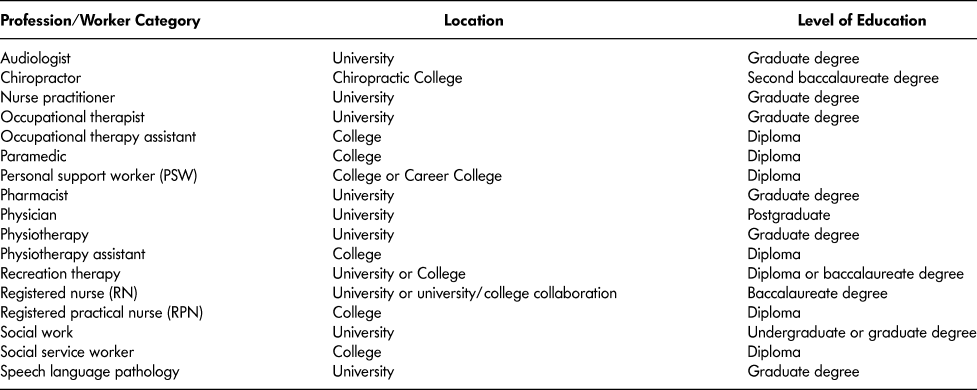
In Ontario, health and social service workers are educated in universities and colleges. This education is provided by 18 universities (Ontario Universities Application Centre, 2015), 24 colleges (Colleges Ontario, n.d.), and more than 70 small private career colleges (Career Colleges Ontario, 2013). Universities and colleges are funded by government grants and tuition; career colleges, by tuition. Most health and social service professions are regulated under provincial law. Recreation therapists and personal support workers (health care aides or resident care assistants) are not regulated. Table 1 presents details about location of education and level of education required for entry-to-practice for each worker and profession category represented in this study. With the exception of registered nurses, recreation therapists, and personal support workers (PSWs), entry-to-practice education for each profession is exclusively at a college or university.
Location and level of entry-to-practice education of professions and worker categories represented in sample

Sample and Sampling
A survey was conducted with administrators (deans, directors, and program chairs) and teaching faculty at university, college, and career college education programs for 17 health and social service worker categories (Table 1). All administrators and educators in these programs were eligible to participate. Included categories of education programs were consistent with priorities identified in a report to the Government of Ontario (Sinha, Reference Sinha2012). For medical education and training, the target programs were undergraduate medicine and residency programs for family medicine and internal medicine.
There is no publicly available list of teaching faculty to use as a sampling frame, so we emailed survey invitations to deans, directors, and program chairs who were asked to complete the administrator version of the survey and to forward the study invitation to teaching faculty in their program. Most survey invitations were sent on behalf of the researchers by provincial organizations of education programs (Council of Ontario Universities, Colleges Ontario, and Career Colleges of Ontario). For professions where education programs were not part of these provincial organizations, survey invitations were sent to the administrators directly by the researchers (university programs for social work, dentistry, pharmacy, and recreation therapy). The distribution lists for direct invitations were compiled with input from provincial committees of deans and directors of these programs or through website searches. A reminder email invitation was sent one week after the initial email. Information about the purpose of the study was provided to all participants. Ethics approval for the study was deemed not required by the university Research Ethics Board. We used standard procedures to ensure data confidentiality and security.
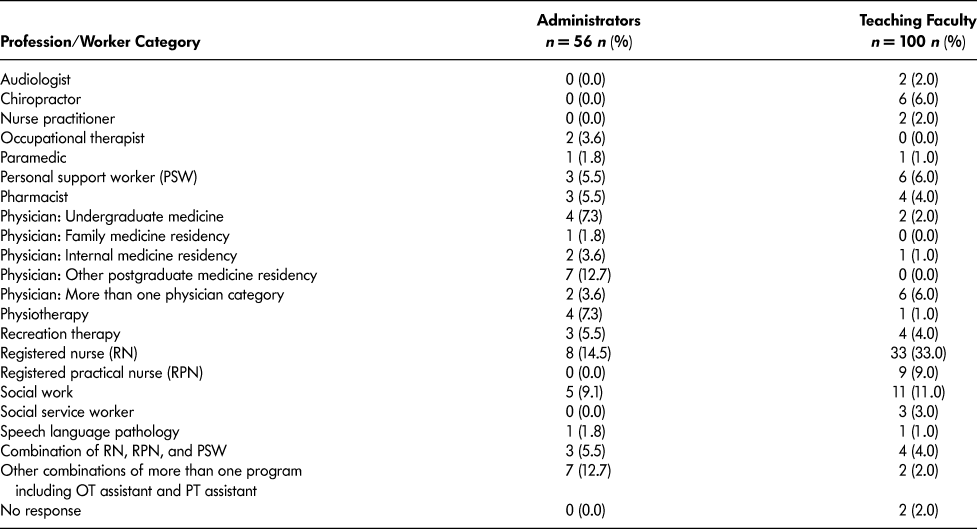
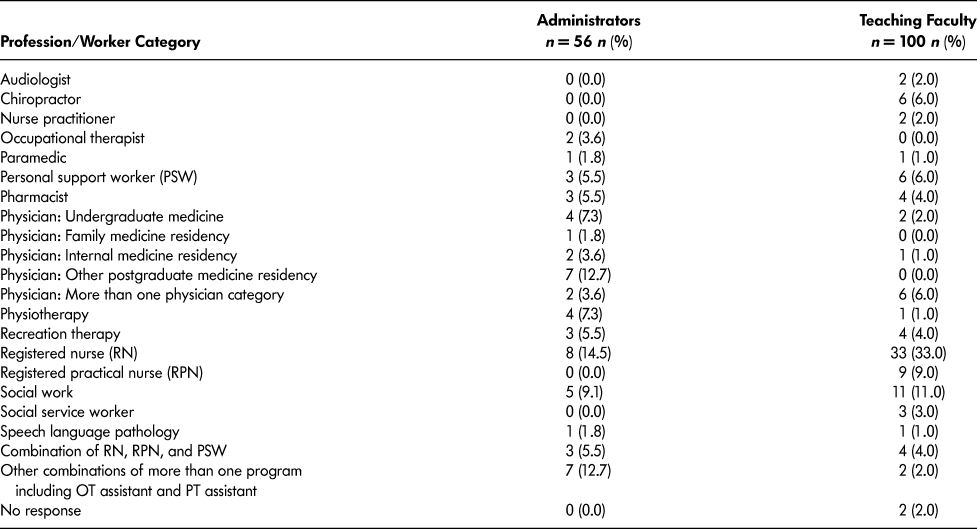
The sample of 156 (n = 56 administrators and n = 100 teaching faculty) included 103 respondents from universities, 32 from colleges, and 11 from career colleges. There were 38 educational institutions and 89 education programs represented in the sample, with respondents from 18 categories of health and social service worker (Table 2). There were between two and 41 respondents from each category of worker education program. Several respondents (n = 23) taught in or administered more than one program, mostly multiple categories of nursing or medicine. Twenty-five administrators (44.6%) and 53 teaching faculty (53%) indicated they had some expertise in gerontology or geriatrics.
Professions and worker categories represented in sample
Survey Items
Administrators were asked about the programs they directed; educators were asked about the programs they taught in. The online survey platform used was FluidSurveys. The complete questionnaire is available on request from the authors.
Sample Description
Sample description items included (1) the profession/worker category program directed or taught in; (2) setting (career college, college, or university); (3) respondent’s self-identification as an expert in seniors’ care, gerontology, or geriatrics; and (4) information about required gerontological courses (Table 3).
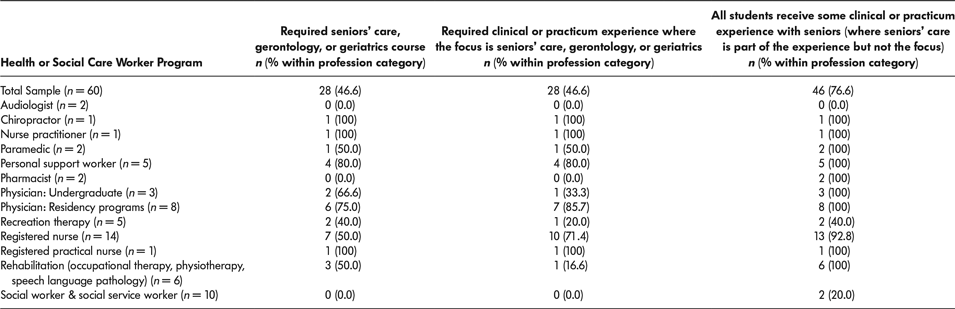
Required gerontology or geriatrics courses and practical experience by program type
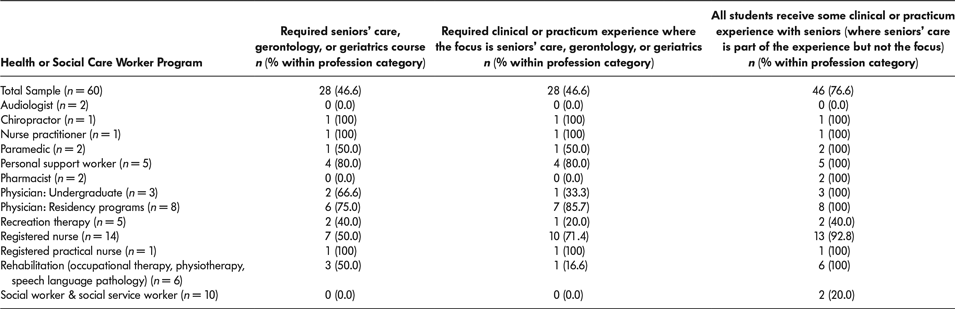
Note: Columns represent responses to three survey items: (1) Does your program have a required seniors’ care, gerontology, or geriatrics course? (2) Does your program have a required clinical or practicum experience where the focus is seniors’ care, gerontology, or geriatrics? (3) Do all students in your program receive some clinical or practicum experience with seniors (where seniors’ care is part of the experience but not the focus)? Values are number responding yes to these items for the sample and within worker category.
Readiness for Curricular Change
Three items measured perceptions of the need for change (Research Question 1). To measure discrepancy between current and desired state, and perception that change is appropriate, we asked educators and administrators to indicate how strongly they agreed with two statements: “Graduates of the program I direct (teach in) have the necessary competencies to provide seniors’ care” and “Gerontology content should improve in my program.” All level of agreement items in the survey were rated on a 5-point scale (strongly disagree; disagree; undecided; agree; and strongly agree). To gauge whether perceived gaps in curricula are based on understanding of recommendations by gerontological experts, we asked respondents: “Are you aware of published health care worker gerontological/geriatric competencies (i.e., generic gerontological/geriatric competencies for health care workers or health professionals)?” and “Are you aware of published specialized gerontological/geriatric competencies that are specific to students in your program (e.g., gerontological or geriatric competencies for nursing, social work, medicine, etc.)?” If participants responded yes to either question, they were asked to list the competency documents. Responses from administrators provided information about the extent to which leaders have potential to influence collective perceptions in their communication about the need for change.
Capacity for Curricular Change
The questionnaire featured four items about capacity for change (Research Question 2). First, all respondents were asked: “Has your educational unit developed or modified curriculum to enhance gerontological content or to meet generic or specialized gerontological/geriatric competencies?” Second, educators were asked: “Have you developed or modified a course to enhance gerontology content or to better meet generic or specialized gerontological/geriatric competencies?” These two questions were indicators of the potential for past experience to improve efficacy and of potential optimism or excitement about enhancing curriculum, especially in the historical Canadian context of limited enthusiasm for gerontology in curriculum (Monette & Hill, Reference Monette and Hill2012).
Third, respondents indicated their level of agreement with the statement: “In my program, we have enough faculty and instructors with expertise in seniors’ care, gerontology, or geriatrics.” This item was an indicator of collective capacity for change. Lack of expert faculty has been cited as a problem in previous research (Baumbusch et al., Reference Baumbusch, Dahlke and Phinney2014; Oakley et al., Reference Oakley, Pattinson, Goldberg, Daunt, Samra, Masud and Gordon2014).
The fourth item on the questionnaire was an indicator of change efficacy. Respondents ranked eight potential strategies to achieve better preparation of future health and social care providers to meet the needs of older adults (seven specified strategies and an option for an “other” strategy; Table 5). Three strategies would be implemented in entry-to-practice education (improving content; clinical or practicum experience; and interprofessional education) (The John A. Hartford Foundation, 2012; Fulmer, Flaherty, & Hyer, Reference Fulmer, Flaherty and Hyer2004). Two strategies put responsibility for achieving competencies on graduates (postgraduate education and continuing professional education or certificate programs) or employers (employer-provided education). The final strategy would indirectly change entry-to-practice education (provincial standards for gerontology content) as suggested in a report to the Province of Ontario (Sinha, Reference Sinha2012). Higher change efficacy would be indicated by highly ranking strategies that respondents have authority over. Lower change efficacy would be indicated by highly ranking strategies that place responsibility for achieving gerontological competencies outside of entry-to-practice education or by highly ranking the strategy of having change imposed by the government.
Contextual Factors
The third research question was addressed through the open-ended question “What would your program and faculty [administrator respondents]/you and your colleagues [educator respondents] need (e.g., resources, supports, etc.) in order to modify your curriculum to enhance gerontology content or better meet gerontological/geriatric competencies?”
Analysis
We analysed quantitative data by using IBM SPSS 20. These analyses included frequency counts and, for comparisons between educators and administrators, chi-square test for linear trend. To explore possible bias in responses attributable to self-declared gerontological expertise, chi-square test for linear trend was used to test for differences between experts and non-experts. The Kruskall-Wallis Independent Samples test was used to test differences between teaching faculty and administrators in preferred strategies to improve curriculum. We analysed responses to the open-ended question about needs using content analysis (Elo & Kyngäs, Reference Elo and Kyngäs2008). The responses were read and reread several times by one author (LM). The descriptive codes we developed were applied to the text about what would support curricular change. Redundant codes were collapsed. We compared the codes and grouped them into four emergent categories.
Findings
Current Gerontology Content
Respondents provided data about required courses and practica focused on seniors’ care, gerontology, or geriatrics for 60 of the 89 education programs represented in the sample. This number is lower than the sample size because (1) responses were collapsed by program and (2) some data were missing. Responses, broken down by program type, are provided in Table 3. Almost half of the programs (n = 28, 46.6%) reported having a required course on seniors’ care, gerontology, or geriatrics. The same number reported having a required clinical or practicum experience focussed on seniors’ care, gerontology, or geriatrics. Three-quarters of programs (n = 46, 76.6%) reported that all students receive some clinical or practicum experience with seniors.
Readiness for Curricular Change
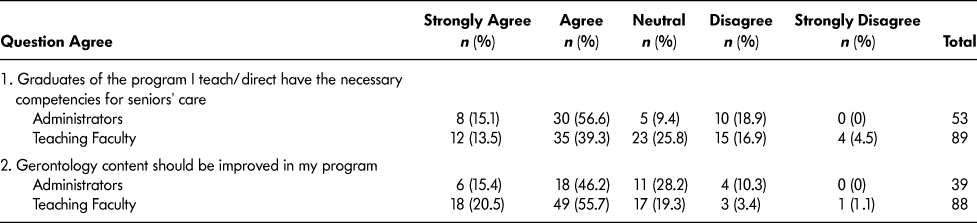
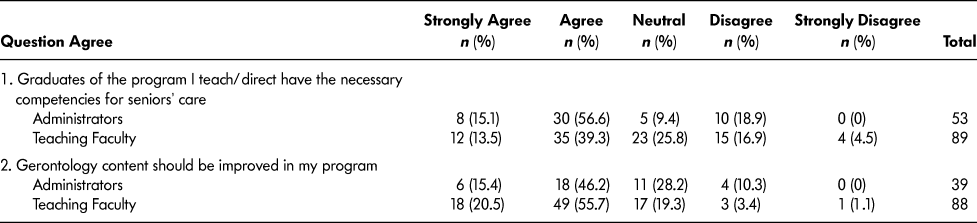
Responses to items about perceived need for curricular change are presented in Table 4. Responses of administrators and teaching faculty were not significantly different. Respondents with self-reported expertise in seniors’ care, gerontology, or geriatrics were more positive than non-experts about their programs; 53 (68%) self-identified experts agreed or strongly agreed with the statement: “Graduates of the program I teach in/administer have the necessary competencies to provide seniors’ care”, whereas 32 (50.8%) of non-experts agreed with this statement (χ2 for linear association 7.04, df 1, p < .01). Self-reported expertise was not associated with responses about perceived need for change.
Administrator-and-teaching-faculty−perceived need for curricular change
Twelve administrators (21%) and 20 teaching faculty (20%) indicated awareness of interprofessional gerontological competency documents or frameworks. Eighteen administrators (32%) and 32 teaching faculty (32%) indicated awareness of gerontological competency frameworks specific to their programs. These responses overestimate knowledge of gerontological competency documents. About half of these respondents (n = 30) responded to the request to provide the name of the competency document; 10 (33%) listed documents that are not competency frameworks or are generic discipline-specific competencies (e.g., entry-to-practice competencies for a profession); nine (30%) listed competency documents pertaining to specialist practice; and 11 (36%) listed relevant entry-to-practice documents.
Capacity for Change
Seventy-nine administrators and teaching faculty indicated whether or not their program had modified curriculum to enhance gerontology content. Of these, 45 (57%) responded affirmatively. Thirty-seven teaching faculty respondents (37%) reported having developed or modified a course to better achieve seniors’ care competencies. Programs that had made enhancements did so by adding content to existing courses, with one respondent indicating that an elective was added.
A minority of respondents thought that their programs had sufficient faculty expertise in seniors’ care, gerontology, or geriatrics. Half of the 52 administrators who provided a response agreed or strongly agreed that there were sufficient faculty; 11 (21.2%) were neutral; 15 (28.8%) disagreed or strongly disagreed. Thirty-two (35.9%) of the 89 teaching faculty who responded to this item agreed or strongly agreed that there were sufficient expert faculty; 19 (21.3%) were neutral; 38 (42.6%) disagreed or strongly disagreed. Administrators and teaching faculty did not differ significantly in their responses (χ2 for linear association 2.36, df 1, p = .12). Respondents who self-identified as having expertise in gerontology were more likely than other respondents to agree or strongly agree that their program had sufficient faculty (n = 39 [50.7%] and n = 19 [30.1%] respectively; χ2 for linear association 5.09, df 1, p = .02).
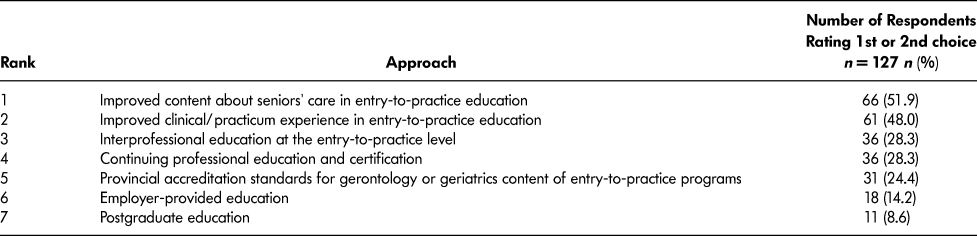
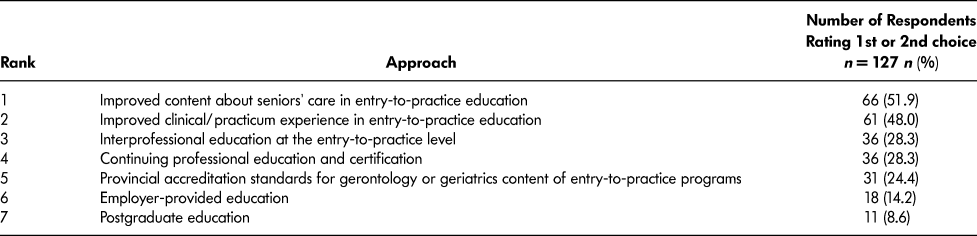
Table 5 presents the strategies for achieving better preparation of future health and social care providers to meet the needs of older adults, ranked from most to least preferred. The three most preferred strategies involved enhancing entry-to-practice education: (1) improved content about seniors’ care in entry-to-practice education; (2) improved clinical and practicum experience in entry-to-practice education; and (3) interprofessional education at the entry-to-practice level. One of the seven strategies was ranked differently by administrators and educators; 45.5 per cent of administrators ranked continuing professional education and certification first or second while 23.2 per cent of educators did so (Kruskal-Wallis Independent Samples test, p = .04).
Ranking of approaches to achieve enhanced education of health and social service workers
Eleven respondents suggested other strategies. Suggestions were to (1) incorporate seniors’ care competencies in education accreditation standards or licensing exams or mandating particular content; (2) integrate content throughout courses; (3) conduct seminars by leaders at the point-of-care; (4) improve status of seniors’ care and overcome negative student attitudes; (5) communicate among programs about promising practices; and (6) balance education that addresses the needs of seniors with education that addresses the needs of other populations.
External and Contextual Factors Associated with Readiness for Curricular Change
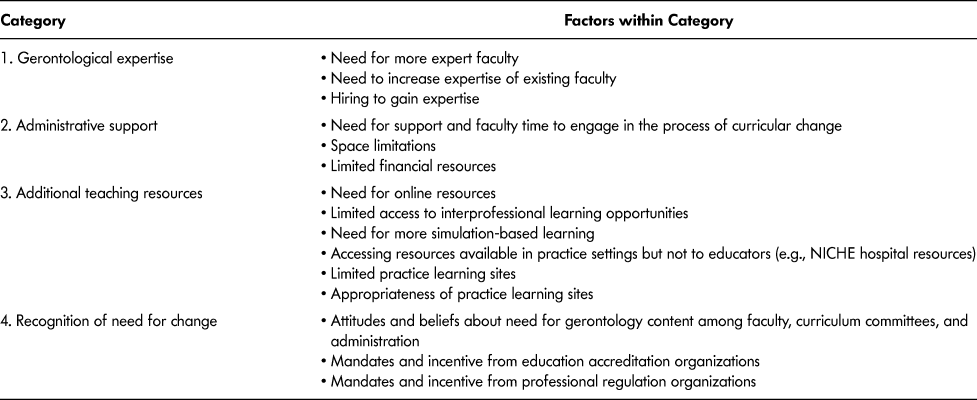
In response to the open-ended question of what would be needed to enhance curriculum, one administrator and two educators indicated that their programs are achieving gerontological competencies. One administrator and two educators indicated that it is inappropriate for them to focus on gerontological competencies because either they are preparing generalist practitioners, not specialists, or because they do not accept the notion of competencies. Sixty-three respondents provided responses about what would be needed to change curriculum. The responses fell into four categories: (1) gerontological expertise, (2) administrative support, (3) additional teaching resources, and (4) recognition of the need for change. Factors within each category are listed in Table 6.
External and contextual factors associated with readiness for curricular change

NICHE = Nurses Improving Care for Healthsystem Elders
The most frequently identified need and contextual factor was the need for more faculty and clinical instructors with gerontological expertise. Several respondents indicated that their programs would have to hire new faculty to gain this expertise.
The second category, administrative support, refers to context within the education institution. Respondents indicated that support from their education institutions, curriculum committees, and deans would be needed to successfully develop geriatrics within the core curriculum, to substitute gerontology content for existing content, and to change evaluation processes.
The third category, additional teaching resources, refers to internal and external contextual factors including resources controlled by the educational institution, partnerships, accessing resources in practice settings, and availability of appropriate practice learning settings.
The final category was recognition of the need for change. The internal context of attitudes and beliefs was identified in responses about a need for faculty, curriculum committees, and administration to recognize that gerontology content is important for generalist practice and that content is lacking. The external context was identified in responses about the need for mandates from accreditation and professional regulation organizations. Changes by these organizations were identified as a potential incentive for curricular change.
Discussion
There was mixed evidence about readiness for changing gerontology curriculum in Ontario education programs for health and social care workers.
Readiness for Curricular Change
With respect to the first research question, most respondents believed that change was needed. More than 70 per cent of respondents thought gerontology content should improve in their programs. This contrasts with respondents’ belief that their students obtained necessary gerontological competencies. This discrepancy may be due to social desirability bias and a reluctance to negatively rate their programs. On the other hand, it may indicate that for some respondents, motivation for change rests with values such as value for excellence rather than an identified problem within their curriculum. Appealing to educators’ values may be more successful as a change strategy to achieve curricular enhancement than trying to convince them that their curriculum is deficient. Future research could evaluate this possibility.
Most respondents reported that all of the students in their programs have practice experience with older adults. This might have created a false sense of security about adequacy of curriculum for some respondents. A Canadian survey of geriatric content in undergraduate medical programs found “a common misconception that as students encounter many older patients in clinical practice they will acquire these skills during other (non-geriatric) rotations” (Gordon, Reference Gordon2011, p. 37).
Belief that change is necessary is influenced by discrepancy between the current and desired state (Armenakis et al., Reference Armenakis, Harris and Mossholder1993). Most respondents were unaware of published geriatric and gerontological competency frameworks. This is consistent with teaching faculty perceptions of the lack of awareness of the need for change among their administrators and colleagues, a contextual factor in Armenakis et al.’s (1993) model of organizational change readiness. This indicates that if educators were more aware of published competencies, readiness for change could be enhanced. This finding also calls into question the ability of faculty and administrators to judge the adequacy of their curricula. Furthermore, it indicates that caution should be used in interpreting self-reports of adequacy of current curricula.
According to change readiness theory, organizational-level belief that change is necessary is influenced by leaders’ messages about the need for change. In this study, respondents indicated that lack of acceptance of the need for change among administrators was a negative contextual factor. Furthermore, there was some evidence of a lower recognition of the need for change among administrator respondents, who were more likely than teaching faculty respondents to be in favour of continuing education as the best way to achieve competence in the workforce and less likely to answer the question about the need for change in their programs. Through leadership, administrators influence culture and value for change in their organizations and have a strong impact on the sustainability of change (Rafferty et al, Reference Rafferty, Jimmieson and Armenakis2013; Buchanan et al., Reference Buchanan, Fitzgerald, Ketley, Gollop, Jones, Lamont and Whitby2005). Our findings suggest an opportunity to support leaders’ beliefs that curricular enhancement is necessary. Systematic efforts to increase administrators’ value for geriatrics education are effective. For example, geriatric education retreats for leaders were successful for enhancing curriculum in internal medicine subspecialties in the United States (The John A. Hartford Foundation, 1999). The Geriatric Nursing Education Consortium (Gray-Miceli et al., Reference Gray-Miceli, Wilson, Stanley, Watman, Shire, Sofaer and Mezey2014) and a similar Canadian program for faculty (McCleary et al., Reference McCleary, McGilton, Boscart and Oudshoorn2009) included strategies to influence deans and colleagues.
Change Efficacy
The high prevalence of respondents reporting that curriculum change is underway indicates that efficacy based on past experience and vicarious experience may grow. Furthermore, these changes may contribute to positive emotions about change such as optimism and excitement (Rafferty et al., Reference Rafferty, Jimmieson and Armenakis2013). A Canadian survey of nursing and social work programs found that 42 per cent of programs had enhanced gerontology content, and another 37 per cent intended to modify curriculum (Hirst et al., Reference Hirst, Lane and Stares2012). However, sustaining curricular enhancements may be challenging. A comparison of 2005 and 2008 Canadian medical curricula found that geriatrics content increased in some undergraduate programs and decreased in others, and there was a decline in programs requiring geriatrics in senior undergraduate clinical practice (Gordon, Reference Gordon2011). Achieving curricular change in medicine in Canada has been referred to as a process of “arm twisting” (Monette & Hill, Reference Monette and Hill2012, p. E515). Research indicates that support is often necessary to have change take hold and be sustained (Rogers, Reference Rogers2003). Supporting educators, once they commit to enhancing curriculum, could increase the chances of sustained change.
Change efficacy is evident in the extent to which respondents endorsed changing entry-to-practice curriculum as an approach to achieve preparation of the workforce for seniors’ care. The most preferred approaches were those that involve change on the part of the respondents, as opposed to placing responsibility externally with employers or graduates. There was, however, variability within the sample. Employer-provided education and continuing education were the first or second choice for 14 per cent and 28 per cent of the sample respectively. This indicates that, although there is evidence of change efficacy among some educators, the process of curricular enhancement is in the early stages of change. Research about organizational change shows that some people are skeptical about or resist change and need to see others successfully adopt the change before they come on board (Rogers, Reference Rogers2003). Success stories from other educators or programs may provide vicarious experience and increase efficacy and momentum for curricular change.
External and Internal Contextual Factors Influencing Change Readiness
Respondents who had expertise in gerontology or geriatrics were more likely to believe that their programs had sufficient faculty expertise for curriculum change. Most respondents believed that their programs did not have sufficient gerontological expertise, underscoring the importance of having gerontological expertise among teaching faculty. The context of limited personnel with gerontological expertise makes enhancing curriculum challenging, especially given evidence that the pool of potential experts to hire is limited (Baumbusch et al., Reference Baumbusch, Dahlke and Phinney2014; Charles et al., Reference Charles, Triscott, Dobbs and McKay2014; Gordon, Reference Gordon2011; Oakley et al., Reference Oakley, Pattinson, Goldberg, Daunt, Samra, Masud and Gordon2014; Wang & Chonody, Reference Wang and Chonody2013). This problem could be addressed in the long term by encouraging graduate students to specialize in gerontology and geriatrics. However, faculty interest in gerontology was found to be associated with experiences with seniors prior to graduate education (Wang & Chonody, Reference Wang and Chonody2013), indicating that recruiting clinicians with interest and expertise in gerontology to move to the education sector may be required. In the short term, enhancing capacity of existing faculty is required, and there is interest among faculty for this approach (Baumbusch et al., Reference Baumbusch, Dahlke and Phinney2014). Successful train-the-trainer approaches for increasing faculty capacity (e.g., Gray-Miceli et al., Reference Gray-Miceli, Wilson, Stanley, Watman, Shire, Sofaer and Mezey2014) could be used across professions. This could create small successes that result in improved efficacy and lead to bigger change.
Settings for practicum experience are an important part of the context of curricular change. Our findings are consistent with previous findings that standards of care and staff attitudes in practice settings may hinder achieving gerontological competencies and foster negative attitudes (Baumbusch, Dahlke, & Phinney, Reference Baumbusch, Dahlke and Phinney2012; Baumbusch et al., Reference Baumbusch, Dahlke and Phinney2014; Gould, Dupuis-Blanchard, & MacLennan, Reference Gould, Dupuis-Blanchard and MacLennan2015; Fox, Reference Fox2013). The view that standards of care in practice settings are a barrier may be a fallacy. Students and educators can have a positive influence on clinical care and benefit from experts in the practice setting. Nursing clinical instructors rely on the expertise of nurses in geriatrics practice settings (Baumbusch et al., Reference Baumbusch, Dahlke and Phinney2014). Better outcomes have been reported for patients of senior medical students who had participated in geriatrics education (St. Onge et al., Reference St. Onge, Ioannidis, Papaioannou, McLeod and Marr2013), indicating that students with appropriate education can positively impact practice settings. Innovative partnerships and models of practice education may be required. For example, the nature of partnerships with community agencies influenced curriculum change in U.S. social work programs (McCaslin & Barnstable, Reference McCaslin and Barnstable2008). An Australian model of a student nurse−led ward resulted in an addition of 100 additional clinical placements per year (Grealish et al., Reference Grealish, Lucas, Neill, McQuellin, Bacon and Trede2013).
Some respondents indicated a need for change in attitudes among faculty and administrators. This suggests limitations in collective readiness for change. A belief that enhancing gerontological content is inconsistent with a mandate to prepare generalist practitioners was evident in a small minority of our respondents. Ageism is a significant barrier to enhancing curriculum (Coleman, Reference Coleman2015; Baumbusch et al., Reference Baumbusch, Dahlke and Phinney2012; Gould et al., 2013). Stall (Reference Stall2012) argues that ageism influences the hidden curriculum in Canadian medical education through students’ exposure to ageist practices in the context of lack of education about geriatrics issues.
Education accrediting and professional regulation organizations were contextual factors influencing respondents’ readiness for change. Accreditation standards were ranked 5th out of seven ways to achieve gerontological competencies and some participants indicated that gerontological competencies should be incorporated into accreditation standards or licencing exams. A need for mandates from accreditation bodies and professional regulators was identified by respondents. This approach would be challenging because Canadian accreditation organizations do not typically prescribe content (Monette & Hill, Reference Monette and Hill2012) and educators are expected to prepare generalist practitioners. However, Canadian family medicine education standards are more prescriptive about geriatric content (The College of Family Physicians of Canada, 2013).
Many Canadian and U.S. organizations of health and social service professionals, recognizing the need for improved achievement of gerontological competencies, have published recommended competencies. In Canada, these include interprofessional competencies published by the National Initiative for Care of the Elderly (n.d.) and discipline-specific competencies for medical students (Canadian Geriatrics Society, n.d.) and nurses (Canadian Gerontological Nursing Association, 2010). Several interdisciplinary and discipline-specific gerontological competency frameworks are published by U.S. organizations and are relevant to educators internationally. Respondents to this survey were largely unaware of published competency frameworks, indicating that the impact of these documents on curriculum is limited. Strategies to increase awareness of these documents might include publicized endorsement by professional associations; health care organizations such as national and provincial associations of hospitals, community care, and long-term care providers; and education accreditors. For example, in the United States, a set of entry-to-practice multidisciplinary gerontological competencies is endorsed by 21 organizations (Partnership for Health in Aging, 2010).
This research did not compare colleges and universities, which may have differed in terms of contextual factors. For example, the provincial government could influence gerontological competencies in college education programs. The Ontario Ministry of Colleges, Training and Universities influences curriculum through vocational standards. The vocational standards for personal support workers include statements and learning outcomes that are specific to practice with seniors (Ministry of Training, Colleges and Universities, 2014), resulting in education that includes gerontology. Similar direction is possible in other vocational standards. Future research could examine contextual differences between colleges and universities with respect to enhancing gerontology curriculum.
Study Limitations
This study begins to expand the literature about gerontology and geriatrics curriculum in health and social care worker categories beyond nursing, medicine, social work, and pharmacy. Sample size is relatively large overall, but small within several profession and worker categories. The larger sample from nursing, medicine, and social work may reflect higher awareness of the issue of aging in curricula. Additional research with large samples from professions that were less represented in this sample, and from occupations that were not included, is needed in order to make conclusions specific to these professions.
We asked respondents about the perceived need for curriculum change. Curriculum change may mean different things to different people. We attempted to address this by asking about both adequacy and need for change. However, we did not differentiate scale of change, and this may have affected responses. Future research could examine curriculum documents and compare curriculum to published gerontological competencies. Respondents who had engaged in this process within their organizations, however, indicated that it was a time- and resource-intensive process.
Some indicators of the lack of readiness for change in this sample may have been influenced by respondents working in excellent programs where change is not needed or desirable. A minority of respondents strongly agreed that their programs achieved required competencies and did not need to improve. Although we did not directly assess curriculum adequacy, clearly, some of the programs do not need large-scale change.
The sampling method of contacting faculty through administrators was necessary because contact information for all teaching faculty is not publicly available. This sampling method has advantages for coverage of programs in the province and potentially for response rates. Deans and directors may have been more likely to respond and pass on the invitation because it was delivered by respected organizations rather than directly from the researchers (Dillman, Smyth, & Christian, Reference Dillman, Smyth and Christian2009). However, it is impossible to determine the population size and, thus, the response rate.
Lastly, there was an over-representation of respondents with self-reported gerontological expertise. However, for the most part, these self-reported experts did not differ from non-experts in their responses. Where there were differences, self-reported experts were more positive than non-experts, indicating that any bias is towards underestimating perceived problems. Nonetheless, a response bias is possible in this study, whereby respondents may be more interested in enhancing gerontology than non-respondents. Thus, readiness for change may be overestimated.
Conclusion
We found mixed evidence about readiness for change, consistent with theory and research about organizational change, indicating that administrators and educators vary in the rate at which they adopt innovations and change (Rogers, Reference Rogers2003). There is an opportunity to capitalize on the large proportion of faculty and administrators who thought their programs should improve. Commitment of resources and time to build capacity and to evaluate and modify curriculum would realize this opportunity.