1. Introduction
Ambiguity is ubiquitous in language throughout all its subsystems (morphological, syntactic, semantic, or pragmatic). While it is generally agreed that ambiguity can be resolved by taking into account contextual constraints, the exact nature of the conceptual parameters along which these contextual constraints are organized is not well understood. We aim to address this question by investigating one specific case of semantic ambiguity, one for which contextually based disambiguation is required: the transitive aspectual-verb construction. This construction, containing aspectual verbs (AspVs) such as start, finish, continue, and animate or inanimate subject–complements pairs, is observed to support multiple semantic readings which result from the necessary specification of the under-specified lexical meaning of aspectual verbs (Lai, Lacadie, Constable, Deo, & Piñango Reference Lai, Braze and Piñango2017; Piñango & Deo, Reference Piñango and Deo2016).
For example, sentence (1) below gives rise to an agentive reading as in (2a), in which the individual denoted by the subject takes an agent role, performing some activity involving the complement denotation (e.g., Jackendoff, Reference Jackendoff1997; Katsika, Braze, Deo, & Piñango, Reference Katsika, Braze, Deo and Piñango2012; McElree, Traxler, Pickering, Seely, & Jackendoff, Reference McElree, Traxler, Pickering, Seely and Jackendoff2001; Pustejovsky, Reference Pustejovsky1995; Zarcone, McRae, Lenci, & Padó, Reference Zarcone, McRae, Lenci and Padó2017). The same sentence can also yield a constitutive reading as in (2b) below – a reading that has been left out in previous studies on the aspectual-verb transitive construction – whereby the subject denotation is interpreted as a subpart of the entity denoted by the complement.
(1) Adele started the CD of pop songs.
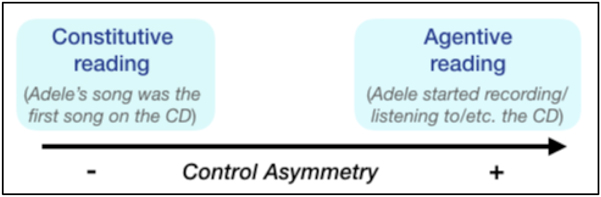
(2) a. Agentive reading: Adele started recording / listening to / etc. the CD of pop songs. (Figure 1, right)
b. Constitutive reading: Adele’s song was the first song on the CD of pop songs. (Figure 1, left)
Two kinds of readings of (1) “Adele started the CD of pop songs”. Right: Agentive reading. Left: Constitutive reading.

Notice that in (1) the complement “the CD of pop songs” can be interpreted as a physical entity (i.e., a set of tracks) or a body of informational content (i.e., a set of songs) (as in 2b), or serving as an undergoer participant in an event (as in 2a). Without further information of the dimension – the perspective from which the entity is construed (e.g., eventive, spatial, informational) – as intended by the speaker, the comprehender is left with more than one possible interpretation. That is, the interpretation for sentences like (1) demands the specification of a conceptual relation between the subject and complement participant (i.e., actor–undergoer or part–whole), as well as the specification of the dimension along which the complement denotation must be construed, i.e., spatial, informational, eventive, etc. (Krifka, Reference Krifka and Rothstein1998; Piñango & Deo, Reference Piñango and Deo2016). Sentences like (1) thus present a problem for the comprehension system; on the one hand the lexical meanings appear unambiguous regarding the references of the participants, and on the other hand the intended relation between these participants, other than the indication that their relation may be construed over some kind of mereological system, remains uncertain, leaving the sentence uninterpretable. Without a precise specification of this relation, a viable interpretation cannot be obtained. Therein lies the relevance of this construction for our understanding of the processes underlying the real-time linguistic meaning composition system.
In sum, the transitive aspectual-verb construction allows us to examine how comprehension is achieved in the face of meaning under-specification while factoring out morphosyntactic structure, structure that appears dissociable from the semantic compositional at hand. The specific question we ask is the following: What principles of context structure are available to the comprehension system such that it is able to derive a specific sentential interpretation that is based on lexically under-specified meaning variables?
We propose that for the transitive aspectual-verb construction meaning specification takes place through a lexically guided search carried out over a parameterized conceptual space. The “trigger” for the search is the lexical requirement by all aspectual verbs that their complement be construed as a structured individual along a specific dimension (Piñango & Deo, Reference Piñango and Deo2016). Meeting this requirement involves two components which are distinct yet not disconnected: (a) the role that the entity denoted by the subject plays vis-à-vis the structured individual denoted by the complement, and (b) the dimension along which the structured individual is to be construed. Consider sentence (1) above; if the role that the entity denoted by the subject plays vis-à-vis the structured individual denoted by the complement is one of actor, the dimension along which the structured individual is to be construed is eventive and the reading is thus agentive. Alternatively, if the role that the entity denoted by the subject plays vis-à-vis the structured individual denoted by the complement is one of subpart, the reading is thus constitutive. Notice that, while the agentive reading is construed along the eventive dimension, the eventive dimension itself does not guarantee an agentive reading. This is demonstrated by “A short announcement ended the conference”, which gives rise to a constitutive reading along the eventive dimension such that the announcement is a final subpart (subevent) of the (macro-)event denoted by the conference. As can be seen, whereas the choice of dimension has to do with the comprehender’s familiarity with conceptualizations of the complement denotation, the determination of the role of the subject denotation – and consequently the specific sentence interpretation – involves an evaluation of the possible relations between the subject and complement denotations. We propose that this factor is key to sentence meaning specification and argue that such calculation results from an evaluation process of a specific conceptual relation between the two entities involved in the situation denoted by a sentence. We call this conceptual relation control asymmetry.
Control asymmetry refers to a parameter of context evaluation, at play during sentence comprehension, that allows the processor to assess the degree of relative control power between the participants in a situation. It is a generalization over our perception of causality, a fundamental property of human cognition (e.g., Carey, Reference Carey2009; Piñango, Reference Piñango, Huang, Jing-Schmidt and Meisterernst2019). In a two-participant situation, an evaluation of high control asymmetry means that one participant is construed as having control over the other participant (and not the other way around). An evaluation of low control asymmetry means that either participant can exert equal control over the other. Control asymmetry is thus an independently motivated parameter of conceptual organization, fundamental to the cognitive infrastructure within which linguistic meaning associated with sentence composition is construed.
The motivation for control asymmetry as a conceptual parameter emerges from a generalized observation that the relation between participants in terms of control power is essential for identifying their roles in events. On the force-dynamics approach, one key function of language is to mark a role difference between two entities exerting force in a causal chain (Talmy, Reference Talmy1988, Reference Talmy2000). This relation of force transmission underlies linguistic structure and is argued by Croft (Reference Croft2012) to modulate thematic role assignment (e.g., agent, patient, theme) as well as argument realization (e.g., which participant is mapped onto which grammatical relation). The relation of force transmission is by nature an asymmetry relation (Croft, Reference Croft2012, p. 198); in the context of causal events, Pinker (1989, p. 194) notes it as a relation (between the participants) that is “asymmetric in that the first argument is causally responsible for the relationship”.
In this manner, control asymmetry subsumes the conceptual representation of agency. In line with previous work on thematic relations, we take an agent as an actor that is perceived as having self-control and potential power over another participant, the entity responsible for possible changes resulting from the action denoted by the predicate (Carey, Reference Carey2009, p. 217; Croft, Reference Croft, Fox and Hooper1994; Jackendoff, Reference Jackendoff1983, p. 181; Pinker, Reference Pinker1989, p. 31; Talmy, Reference Talmy1988). The construal of agency is thus obtained from a conceptualized relation between participants (actor–undergoer). The more control power a participant is construed to possess over another in a situation, the more likely it will be taken as an agent. This said, causality is a necessary yet not sufficient component of agency (Carey, Reference Carey2009, p. 217). This can be exemplified by the sentence “The heavy rain ruined the man’s shoes”. It involves an accidental causal relation between the two participants (heavy rain & the man’s shoes) yet does not encode agency as normally understood. And that would be because agency requires a self-generated force in the causer, a self-generated force that control asymmetry entails. Control asymmetry is also implicated in sentential readings that are normally expected to depend on the animacy of the participants involved. Consider the aspectual-verb sentence “The printer started my paper”. This sentence gives rise to an agentive reading yet it has an inanimate-denoting subject. By contrast, the sentence “The little girl began the queue in front of the candy shop” yields a constitutive reading even though its subject-denotation is animate. The agentive vs. constitutive reading thus appears orthogonal to animacy considerations yet it is naturally predicted by control asymmetry distinctions – high control asymmetry engenders an agentive reading whereas low control asymmetry engenders a constitutive reading.
The conceptual parameter of control asymmetry and the evaluation process that it demands has also been claimed to underpin the meaning comprehension of other linguistic constructions. Piñango (Reference Piñango, Huang, Jing-Schmidt and Meisterernst2019) suggests that it supports the comprehension of circumstantial metonymy (i.e., reference transfer) such as “a waiter said to another: ‘The ham sandwich ordered another coffee.’” Proper comprehension of this sentence arises from an evaluation of high control asymmetry between “ham sandwich” and “another coffee” determined by the semantic requirements of “ordered”. This evaluation in turn enables the expansion in conceptual structure of the original sentential event whereby the participant “ham sandwich” is construed not as an “controller” argument but as a “controllee” participant, “the person who ordered the ham sandwich”. One virtue of this approach to circumstantial metonymy is that it allows for a unified treatment with other metonymic processes such as lexical/systematic metonymy: “Every student reads Hemingway.” The interpretation of cases like this, the analysis goes, results from an evaluation of high control asymmetry between “every student” and “Hemingway”, determined by the lexico-conceptual requirements of “reads”, such that the latter participant is understood again not as a controller (as a proper name normally would) but as a controllee – a piece of work by Hemingway. So, in this way a control asymmetry-based approach serves as a unifying parameter for the computation of reference during adult sentence composition above and beyond lexical-level factors such as expected causal agency and animacy (see Piñango, Zhang, Foster-Hanson, Negishi, Lacadie, & Constable, Reference Piñango, Zhang, Foster-Hanson, Negishi, Lacadie and Constable2017, for processing and neurological evidence supporting this unified approach).
Another source of evidence for the existence of control asymmetry as a fundamental conceptual parameter comes from research on early human development. Saxe, Tenenbaum, and Carey (Reference Saxe, Tenenbaum and Carey2005) and Saxe, Tzelnic, and Carey (Reference Saxe, Tzelnic and Carey2007) show that preverbal infants as young as 7 months of age compute agency from patterns of interaction among entities and that they infer dispositional properties of the participants involved in a situation (Carey, Reference Carey2009, pp. 232–233). Infants categorize entities that move themselves (e.g., human hands) as potential causal agents while conceiving inert entities (e.g., bean bags) as potential patients. For example, when the infants construe a moving object as an inert entity (which has no control over itself and others), they look for an external explanation for the motion. They do not do so when they take a moving object as self-regulating. This is precisely the behavior that a hypothetical control asymmetry evaluation would predict and supports our proposal that the evaluation of the control relation between participants is fundamental to the specification of sentence meaning.
In sum, research from linguistics and cognitive psychology is consistent with the proposal that humans appear to “parse” the world in terms of situational segments and evaluate the participants in a situation in terms of their relative control relations; one fundamental aspect of which is whether or not the participants are in a position to control each other equally (low control asymmetry) or not (higher control asymmetry). Crucially, the evaluation of control relation between participants, one on which a specific sentence reading depends, is context-dependent: the relation is expected to vary depending on the specific contextual setting. Context-dependence is clearly instantiated in the current case of aspectual-verb sentences, illustrated in Figure 2. When the control asymmetry between the participants denoted by the subject and the complement is perceived as high, such that the subject participant is interpreted as exerting control over the complement participant, an AspV sentence like (1) “Adele started the CD” receives an agentive reading as in (2a). By contrast, if the two participants are construed as having equal control power over each other i.e., low control asymmetry (≌ control symmetry), the sentence receives a constitutive reading as in (2b).
Control asymmetry and the Agentive/Constitutive reading.

Once control asymmetry has been determined as high, leading to an agentive reading, no ambiguity remains, as this reading is only compatible with the construal of the complement along an eventive dimension, a dimension whereby the subject denotation takes the role of actor and the complement denotation takes the role of undergoer in an under-specified event (e.g., Adele started doing something with the CD of pop songs.). If control asymmetry is deemed low, leading to a constitutive reading, further ambiguity remains. This is because the complement denotation (e.g., “the CD”) can be interpreted as a physical entity along the spatial dimension or as a body of musical content along the informational dimension; this further disambiguation will take place through further contextual search, this time in terms of the specific dimension (i.e., the perspective from which the complement denotation must be construed as a structured individual) intended by the speaker. If no information regarding the expected control asymmetry is available (through context or conventionalization), reading ambiguity remains. Unresolved ambiguity due to unavailability of disambiguating cues results in meaning indeterminacy, which crucially impacts the perceived acceptability of the sentence. The specifics of this connection between meaning ambiguity and acceptability are discussed below.
1.1. contextual informativity and sentence comprehensibility
Previous work has established a robust relationship between meaning ambiguity, context informativity and sentence acceptability. Specifically, availability of relevant contextual information has been shown to influence sentence acceptability for otherwise grammatical sentences. Acceptability increases, the proposal goes, because a supporting context speeds up the determination of sentence meaning by making available information needed to resolve compositional and/or lexical ambiguity, thus decreasing the computational effort that a similar search through a non-supporting context would represent. Comprehenders are sensitive to this comparable decrease in effort which translates as an experience of greater acceptability (Ariel, Reference Ariel1991, Reference Ariel, Sander, Schilperoord and Spooren2001; Burmester, Spalek, & Wartenburger, Reference Burmester, Spalek and Wartenburger2014; Hofmeister, Jaeger, Arnon, Sag, & Snider, Reference Hofmeister, Jaeger, Arnon, Sag and Snider2013). The possibility of a semantic ambiguity acceptability rating inverse relation is consistent with predictions from well-established theoretical proposals such as Ariel’s Accessibility Theory (Ariel, Reference Ariel1991, Reference Ariel, Sander, Schilperoord and Spooren2001); Accessibility Theory states that the more informative, unambiguous, and unattenuated an expression is, the lower the accessibility it encodes. For the purposes of comprehension, lower accessibility of contextual cues reduces the effort of an otherwise necessary contextual search, and this, in turn, raises the perceived sentence acceptability.
Experimentally, the impact of contextual facilitation on acceptability ratings has been demonstrated independently in connection to wh-dependency processing. Hofmeister et al. (Reference Hofmeister, Jaeger, Arnon, Sag and Snider2013) and Sag et al. (Reference Sag, Arnon, Estigarribia, Hofmeister, Jaeger, Pettibone and Snider2008) show that which-NPs, which carry richer semantic features that facilitate the identification of the dependent argument and the dependency linking in discourse, induce higher acceptability judgments as compared to bare wh-words. They also find that acceptability scores negatively correlate with processing difficulty measured by online reading times. Kluender and Kutas (Reference Kluender and Kutas1993), examining sentences with different complementizers (that/if) and different interrogative pronouns (who/what), show that offline sentence acceptability decreases when comprehenders need to hold a filler in working memory (who/what < if < that). Along similar lines, Burmester et al. (2014, Exp. 1) report that acceptability ratings appear modulated by the preceding context type (neutral context vs. context with a given aboutness topic). Converging with these findings, a direct relation between context informativity and offline judgments has also been manifested in referentiality processing, indicating a robust correlation between uninformative contexts and lower acceptability ratings (Davies & Katsos, Reference Davies and Katsos2013; Engelhardt, Bailey, & Ferreira, Reference Engelhardt, Bailey and Ferreira2006). Davies and Arnold (Reference Davies, Arnold, Cummins and Katsos2019) interpret these results as indicative of a system whereby supporting contextual information constrains sentence meaning construal such that it serves as a means of prediction for incoming meaning, thus facilitating the unfolding of comprehension. Just and Carpenter (Reference Just and Carpenter1992) similarly contend that contextual information benefits processing by pre-activating relevant concepts or relations in comprehension. Altogether, these findings evidence that acceptability judgments are modulated by processing difficulty and mediated by the ease of contextualization (e.g., accessibility of discourse referent linking).
Unlike previous studies, we tackle the influence of contextual informativity on semantic composition independent of morphosyntactic factors by probing the mechanisms underlying the resolution of lexical meaning under-specification. As such, this study contributes to establish how – in the face of lexico-semantic under-specification – a search for meaning is grounded in contextual cues, and how the related processing factors impact offline acceptability. Furthermore, whereas previous work has identified a tight relation between context informativity and acceptability (e.g., Beltrama & Xiang, Reference Beltrama and Xiang2016; Davies & Katsos, Reference Davies and Katsos2013; Engelhardt et al., Reference Engelhardt, Bailey and Ferreira2006; Hofmeister & Sag, Reference Hofmeister and Sag2010), the conceptual parameters that guide the comprehension system in accessing such context are less clearly understood. With control asymmetry, this is a specific gap that the present study seeks to bridge.
Specifically, we hypothesize that the initially under-specified meaning is ultimately determined from a search through contextual content, and that this search is guided by the control-asymmetry assessment in a given context. If such contextual content is under-informative, it will increase the comprehender’s effort in carrying out the search. This, in turn, decreases immediate comprehensibility of the sentence in question, lowering its acceptability as compared to a fully explicitly contextualized counterpart. We thus test the hypothesis that sentence acceptability is proportional to “context-sentence fit”, where the metric for acceptability is gradient, stemming from the degree to which compositional demands in the sentence are satisfied. The greater the compositional demands that are satisfied for a given sentence, the greater the acceptability rating for that sentence. In cases where the lexical-semantics are under-specified and thus demand a supporting context, acceptability will be predictable from the properties of the context. The more supporting it is, the easier it is for the processor to achieve meaning composition, the greater the perceived acceptability of the sentence.
We test this hypothesis by examining the comprehension of aspectual-verb sentences, where a specific interpretation can only be obtained by searching through contextual information to precisify the otherwise multiply ambiguous semantic interpretations. To recapitulate, two factors play a role in this precisification process: (a) the control relation between the participants denoted by the subject and the complement as perceived by the comprehender, and (b) the exact dimension relevant in a given context. We take such disambiguating information as constraints that the processor needs to satisfy in pursuit of an adequate interpretation. The more accessible this information is in the explicit context, the less the comprehender needs to compute it by their own search (i.e., the more the constraints are satisfied in the context, the less they need to be satisfied by the comprehender’s own computation); this means, in turn, that lesser processing effort is required, leading to higher acceptability of the sentence in question.
To summarize, in this study we aim to (i) explore the interpretive differences, agentive vs. constitutive readings of transitive aspectual-verb sentences, caused by control asymmetry evaluation in context, and on this basis (ii) examine the impact of contextual informativity on sentence comprehensibility measured by acceptability. Our hypothesis predicts that comprehenders will obtain the agentive reading when the control asymmetry between the participants is perceived as high; in contrast, the constitutive reading will be obtained when the control asymmetry is perceived as low (or control symmetric) in context (Figure 2). In addition, we hypothesize that the availability or specificity of this conceptual relation between participants in context, which disambiguates the reading, will impact the comprehensibility and hence acceptability of the sentence accordingly. This predicts that a context that contains such disambiguating cues will be preferable to comprehenders, raising sentence acceptability by reducing the processing effort needed to resolve meaning ambiguity. We present the specifics of the study that tests these predictions directly below.
2. Methods
2.1. materials
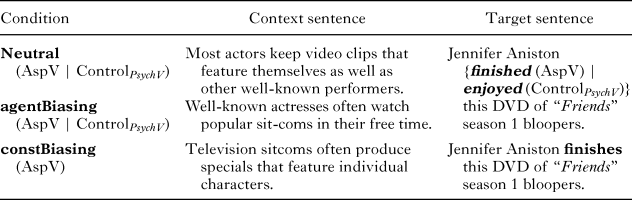
Thirty sets of two-sentence passages were created. Each passage consisted of a context sentence followed by a target sentence that contained either an aspectual verb (AspV) or a control psychological verb (ControlPsychV). Each target AspV sentence was preceded by three types of context sentences. In the agentive-biasing context (agentBiasing), an action (e.g., watch) was mentioned and the control asymmetry was manipulated as high such that the subject of the target sentence could be easily perceived as an agent. In the constitutive-biasing context (constBiasing), a structured entity (e.g., specials that feature individual characters) was mentioned and the control asymmetry was manipulated as low to bias the subpart–whole/constitutive reading; also, the aspectual verb in the following target sentence appeared in the present tense form to further facilitate the constitutive (stative) reading (while the target sentences in other conditions appeared in the past tense form).Footnote 1 The tense shift in the target AspV sentences between the agentBiasing condition and the constBiasing condition only serves to maximize the availability of the two readings to comprehenders respectively. Verb tense itself, while privileging one reading over another, does not predict the agentive vs. constitutive reading, as the agentive reading can be obtained with the present tense (e.g., The researcher begins a new project every year.) while the constitutive reading can be obtained with the past tense (e.g., A short announcement began the conference.). The two biasing-context conditions were contrasted with a baseline in which AspV sentences were preceded by a neutral context (Neutral), which involved no information about control asymmetry and was compatible with both agentive and constitutive readings. On the other hand, each target sentence with the control psychological verbs was preceded by either an agentBiasing or Neutral context sentence; they were not paired with the constBiasing context because sentences with psychological verbs do not give rise to a constitutive reading. A set of conditions and sample sentences are provided in Table 1. In addition, fifty filler items were introduced, half of which were sensical and the other half were not.
Conditions and sample sentences

The target sentences were normed through a cloze study (DiNardo, Reference DiNardo2015) and a questionnaire study (Lai, Lacadie, Constable, Deo, & Piñango, Reference Lai, Lacadie, Constable, Deo, Piñango, Hampton and Winter2017, acceptability). Those results show that AspV sentences are equally acceptable and equally expected to native speakers of American English as compared to psychological verb sentence counterparts (age range reported: 18∼30). These tested target sentences were the basis for the three types of context sentences. The context-sentence pairs were subsequently presented to five native speakers of English who as consultants were instructed to judge whether the intended preference bias of the target sentences under different contexts had been achieved. To ensure that the AspV sentences in the neutral context give rise to both agentive and constitutive readings, the stimuli of the Neutral-AspV condition were presented to an additional nine native consultants to ascertain that both readings were perceived as equally available as intended. The stimuli pairs were further modified according to these consultants’ comments to maximize the expected sentence readings.
Finally, to control for any unintended lexical level variation which could facilitate/hinder comprehension, we checked the frequencies of the critical verbs in both their lemma forms and the exact forms used in the target sentences via the Corpus of Contemporary American English (COCA). Results of the item-analysis using Analysis of Variance (ANOVA) showed that aspectual verbs were significantly more frequent than the control verbs in both the lemma forms (MeanAspV = 67283.13, MeanControl = 43238.53; F (1,148) = 8.23, p < .005) and the exact forms appeared in the target sentences (MeanAspV = 71407.20, MeanControl = 8186.73; F (1,148) = 81.65, p < .001). Assuming that the more frequent an item appears the less processing effort it induces, this difference in frequency would predict that AspV sentences will be easier to process than the controls. The effect of verb type in frequency, if anything, goes against our prediction that AspV sentences should be less acceptable than controls due to under-specified semantic ambiguity. With this consideration in mind, we proceeded with the resulting stimuli set.
2.2. participants
We recruited 30 native speakers of American English (22 females), aged 18∼30 with normal or corrected-to-normal vision; none of them reported to have reading disability. The participants were recruited via advertisements posted around the campus, and received monetary compensation for their participation. Written informed consent was obtained from each participant prior to the experimental session.
2.3. procedures
The questionnaire implemented by the Qualtrics Survey software (Qualtrics, Provo, UT <https://www.qualtrics.com/blog/citing-qualtrics>) was carried out in a quiet room. The items were pseudo-randomized to avoid consecutive items with the same condition; each participant received a distinct order of the stimuli. The stimuli were visually presented on a computer screen. For each passage (i.e., a pair of context sentence and target sentence), the participants were asked to (i) rate its acceptability on a 1∼5 scale (5 = fully understandable) in response to the question “Is the above passage acceptable?”Footnote 2 The mid-point 3 was defined and visually presented as “I know what you mean, and maybe I could say it in that way”. Hence, an item receiving a score equal or above 3 is interpreted as comprehensible.
After the rating task, the participants received a multiple-choice question asking them to (ii) choose the plausible interpretation(s) for the target sentence given the context. The question template of this interpretation task was: “Given [the context sentence], what could [the target sentence] possibly mean?” For example: Given “Most actors keep video clips that feature themselves as well as other well-known performers”, what could “Jennifer Aniston finished this DVD of ‘Friends’ season 1 bloopers” possibly mean? Four response types were provided to answer the question: (a) the agentive reading (e.g., Jennifer Aniston finished watching this DVD …), (b) the constitutive reading (e.g., Jennifer Aniston was the last character featured on this DVD …), (c) nonsensical (The sentence does NOT make sense), and (d) others, for which a blank text box ▭ was provided for the participants to fill in voluntarily. The order of the agentive and the constitutive option was randomized throughout the trials. Multiple answers were allowed.
2.4. data analyses
The data from one participant were excluded due to problems in the protocol administration. Statistical analyses were run on the data from the remaining twenty-nine participants. Data from the acceptability task and the sentence interpretation task were analyzed separately to address different research questions (Lai & Piñango, Reference Lai and Piñango2019).Footnote 3
Regarding acceptability judgments, the rating scores (1∼5) were transformed to z-scores for each participant to account for potential individual scale bias (Schütze & Sprouse, Reference Schütze, Sprouse, Sharma and Podesva2014). A mixed-effect model analysis was performed in the R environment (R Core Team, 2017) using the lme4 package (Baayen, Davidson, & Bates, Reference Baayen, Davidson and Bates2008). Two sets of analyses on the rating scores were carried out. First, we assessed the effect of semantic ambiguity and contextual informativity. To this end, we crossed Verb Type (AspV/ControlPsychV) × Context Type (Neutral/agentBiasing), which were incorporated in the model as two fixed factors in a 2 × 2 design. We began with the maximal model structure, which incorporated random intercepts for subject and item as well as random slopes over verb type and context type along with their interaction. Since the maximal models failed to converge, we simplified the random effect structure by dropping the interaction term between the two fixed factors. The resulting models incorporated random intercepts for subject and item as well as random slopes for context type plus verb type over subject and item.Footnote 4 Significant effects were evaluated by model comparisons (Winter, Reference Winter2013). An interaction effect was assessed by contrasting a model incorporating the interaction of verb type and context type as the fixed effect structure against the additive model that dropped their interaction. A verb type effect was assessed by contrasting the additive model against the model that dropped the fixed factor of verb type. Likewise, a context effect was evaluated by contrasting the additive model against the model that dropped the fixed factor of context type.
Second, we evaluated whether or not the availability of contextual constraints impacts the acceptability of semantically under-specified sentences. To this end, we examined the effect of Context Type (3 levels: Neutral/agentBiasing/constBiasing) on AspV sentences. Context effects were assessed by contrasting a model with this fixed factor against a base model without it. All models included random intercepts for subject and item as well as random slopes for context type over subject and item.Footnote 5 Pairwise comparisons between conditions were corrected by Tukey tests.
With respect to the sentence interpretation task, we examined the effect of different contextual cues on the ultimate sentence reading(s). This allowed us to ascertain whether or not comprehenders arrived at the reported interpretation guided by control asymmetry specifications available from context (high control asymmetry in agentBiasing, low control asymmetry in constBiasing, null in Neutral). To this end, we first calculated the proportions of the agentive vs. constitutive reading chosen by the participants for the target AspV sentences under different contexts. Additionally, the responses of the participants were coded dichotomously for each reading type (agentive/constitutive) per condition: 1 if a reading type in question was chosen and 0 otherwise. Hence, if all participants select the agentive reading for the stimuli of the agentBiasing-AspV condition, that condition would receive a value of 1 (i.e., 100 in percentage) on the agentive reading. For each AspV condition of different context types, we evaluated if there was a difference in reading type by performing a logistic mixed-effect model analysis for binominal dependent variables (0/1) on the readings. A difference in reading type was assessed by contrasting a model with a fixed factor of reading type against a base model without it. All models in this analysis incorporated random intercepts for subject and item as well as random slopes for reading type over subject and item.Footnote 6
3. Results
3.1. acceptability rating results
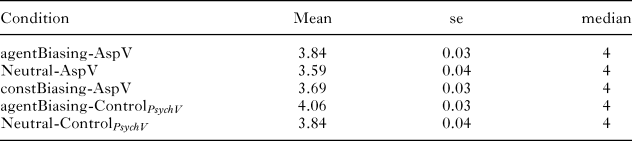
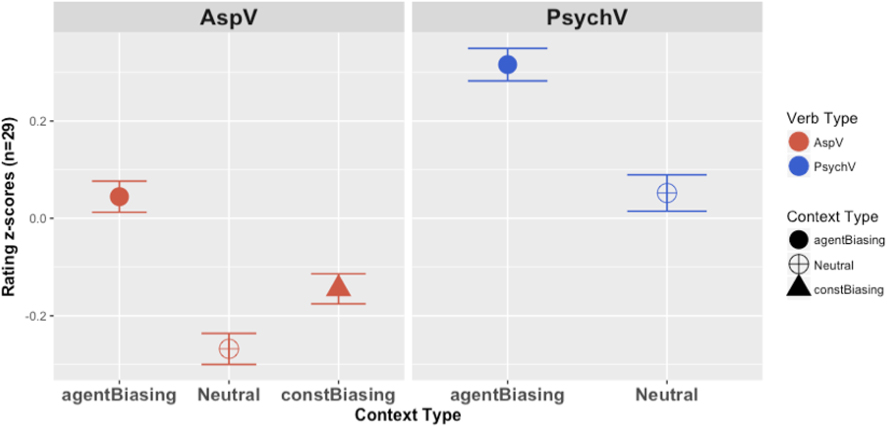
Results of the acceptability rating task are summarized in Table 2 and visualized in Figure 3. On average, all critical sentences were within the comprehensible range (> 3.5). The first analysis on acceptability rating that crossed Verb Type (AspV/ControlPsychV) and Context Type (Neutral/agentBiasing) revealed a main effect of verb type (χFootnote 2(1) = 10.26, p = .001): AspV sentences were rated significantly lower than the ControlPsychV sentences. We also found a main effect of context type, such that the Neutral context conditions were rated significantly lower than the agentBiasing context conditions (χFootnote 2(1) = 24.52, p < .001). No interaction was found (χFootnote 2(1) = 0.60, p < .44).
Results of acceptability rating (n = 29)

Results of the acceptability rating task (5 = fully understandable).

Second, the analysis evaluating the three context types of AspV sentences showed a significant effect of context in acceptability rating (χFootnote 2(2) = 17.06, p < .001), in the direction of Neutral < constBiasing < agent-Biasing. Pairwise comparisons (corrected) revealed that the Neutral-AspV condition was rated significantly lower than the agentBiasing-AspV condition (z = –4.73, p < .001). The comparisons between Neutral-AspV vs. constBiasing-AspV and between agentBiasing-AspV vs. constBiasing-AspV did not reach significance.
3.2. sentence interpretation results
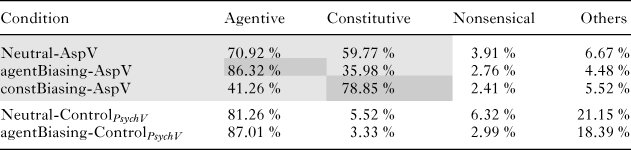
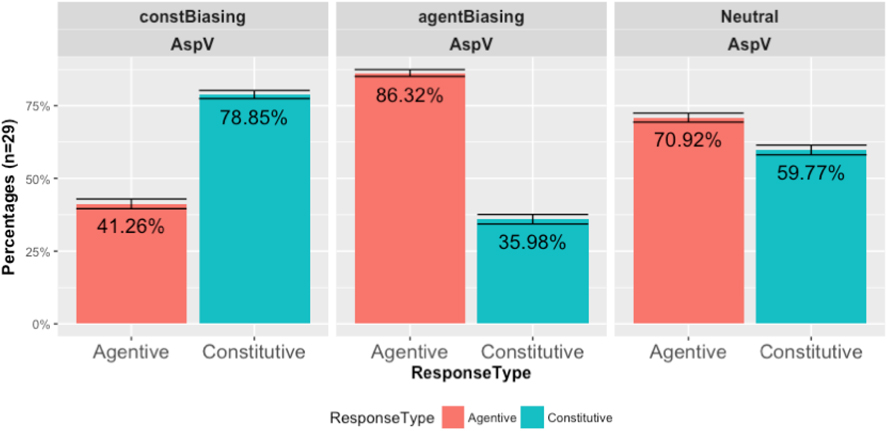
The percentages of the reading types chosen by the participants per condition are shown in Table 3. Results on the three AspV conditions indicated that sentence interpretation is modulated by contextual information. The Neutral context engendered both the agentive and constitutive readings with roughly equal percentages, showing no significant difference between the two readings (χFootnote 2(1) = 1.84, p = .175). In comparison, the agentBiasing context elicited the agentive reading significantly more often than the constitutive reading (χFootnote 2(1) = 28.67, p < .001). In contrast, the constBiasing context engendered the constitutive reading significantly more often than the agentive reading (χFootnote 2(1) = 13.29, p < .001). These are illustrated in Figure 4.
Results of the interpretation task: the percentage of each reading type obtained per condition

Results of sentence interpretation showing contextual modulation for the three AspV conditions.

On the other hand, the control conditions, i.e., Neutral-ControlPsychV and agentBiasing-ControlPsychV, did not show a context effect. Both received mostly the agentive reading (> 80%). We observed that around 1/5 of the ControlPsychV sentences received the [Others] response, and accordingly we examined the participants’ comments in the text box provided (see Section 2.3). As it turns out, many of the responses referred to what we call “the content reading” for the psychological-verb sentences. As indicated by the participants, these sentences could simply refer to the content denoted by the complement itself (e.g., Jennifer Aniston enjoyed the content of the DVD.) without being associated with any event or subpart relation.
4. Discussion
In this section, we first discuss the findings as captured by our hypothesis. We then elaborate further on how the conceptual parameter of control asymmetry connects more generally to sentential meaning construal relative to other sentential constructions.
First, results of the acceptability questionnaire show that aspectual-verb sentences as well as the control counterparts were deemed acceptable by comprehenders, evidencing their grammatical well-formedness. Moreover, and as predicted, we observe that when comparing aspectual-verb sentences with the control counterparts, the former received lower acceptability rating scores. We attribute this difference to the effect of comprehension uncertainty resulting from the semantic ambiguity inherent in aspectual-verb sentences among multiple readings. This pattern not only resonates with previous findings on the impact of linguistic ambiguity on acceptability (see Section 1.1), but is also consistent with reported comprehension patterns of decontextualized AspV sentences exhibiting longer reading times and additional brain activity during real-time processing (DiNardo, Reference DiNardo2015; Katsika et al., Reference Katsika, Braze, Deo and Piñango2012; Lai et al., Reference Lai, Braze and Piñango2017). This interpretation is further supported by the acceptability results from the comparison between Neutral vs. Biasing context whereby sentences in the Neutral context received lower scores than those in the Biasing context.
Altogether, this pattern suggests that while sentences with under-specified meaning are above the “acceptable” threshold, they differ in the degree of acceptability as a function of contextual informativity (the availability of relevant information in the utterance context as dictated by the lexical requirements in the utterance). This, we argue, reflects the degree of comprehender’s certainty about the specific interpretation of the sentence in question. In this way, and in line with previous work, aspectual-verb sentence acceptability appears modulated by context informativity (Burmester et al., Reference Burmester, Spalek and Wartenburger2014; Davies & Arnold, Reference Davies, Arnold, Cummins and Katsos2019; Davies & Katsos, Reference Davies and Katsos2013; Engelhardt et al., Reference Engelhardt, Bailey and Ferreira2006; Hofmeister & Sag, Reference Hofmeister and Sag2010). If context contains information that directs comprehenders towards a specific interpretation, hence resolving ambiguity and thus increasing the certainty of the interpretation, the target sentence’s referentiality increases, resulting in increased acceptability to comprehenders. By contrast, if supporting cues are absent in the context (e.g., for AspV sentences this would be in the form of an indication of the degree of control asymmetry and/or the intended dimension for the structured individual), the exact meaning of the target sentence remains uncertain, resulting in decreased ability of comprehenders to refer and hence lower acceptability.
The pattern that emerges is consistent with a constraint-satisfaction approach to sentence processing, according to which the amount of available constraining information negatively correlates with processing load (e.g., during inference generation, bridging or presupposition accommodation in the case of definite noun phrase interpretation), thus impacting comprehenders’ acceptability judgments (e.g., Altmann & Steedman, Reference Altmann and Steedman1988; Crain & Steedman, Reference Crain, Steedman, Dowty, Karttunen and Zwicky1985; Davies & Katsos, Reference Davies and Katsos2013).
Second, sentence interpretation results support the above conclusion that the comprehension of AspV sentences appears guided by the presence of specific contextual cues, and the sentences remained ambiguous otherwise. Here we have tested the hypothesis that an important constraint that determines the agentive vs. constitutive readings of AspV sentences is the parameter of control asymmetry between the subject and complement participants, and consequently that contextual cues in the direction of establishing the presence of control asymmetry is relevant to sentence meaning disambiguation. As observed, a high control asymmetry as cued in the agentBiasing context elicited mostly the agentive reading, whereas a lower control asymmetry (≌ control symmetry) as cued in the constBiasing context led to a constitutive reading. When the control relation between the participants denoted by the arguments of an aspectual predicate was left unclear, as in the Neutral context, both readings appeared available to comprehenders. This indicates that comprehenders make reference to this conceptual parameter in a given context to obtain a specific sentence reading.
One concern is that the difference in acceptability and interpretation between the AspV conditions might be due to the difference in verb tense (present tense in the constBiasing-AspV condition; past tense in others) rather than the proposed control asymmetry. We think this is unlikely for the following reasons: (i) as indicated in Section 2.1, both agentive and constitutive readings can be obtained with either past or present tense, suggesting a dissociation between verb tense and sentence reading; (ii) the target sentences in both the Neutral-AspV and agentBiasing-AspV condition appeared in their past tense forms, with identical target sentences, yet the two differed in both acceptability and sentence interpretation. Results of pairwise comparisons on acceptability ratings showed that the constBiasing-AspV condition did not differ from either agentBiasing-AspV or Neutral-AspV despite the tense difference. At the same time, the latter two past tense conditions with the identical target sentences differed significantly (z = –4.725, p < .001). If the present tense in the constBiasing-AspV condition had contributed to any differentiation, we would have observed that it is rated either the lowest or the highest among the three conditions, contrary to the findings which showed Neutral < constBiasing < agentBiasing. Finally, (iii) the agentBiasing-AspV and the Neutral-AspV condition received different interpretations – mostly agentive reading for the former; comparable agentive and constitutive readings for the latter – though their target sentences were identical, both in past tense, within each item-set. These observations combined indicate that the differences in ratings and interpretations between conditions could not result from tense alternation. Instead, and as argued, they appear to result from the difference in prior sentence context (because Neutral-AspV and agentBiasing-AspV differed only in the prior context sentence). An additional piece of evidence comes from our lab. A recent eye-tracking study (Lai, Braze, & Piñango, Reference Lai, Braze and Piñango2017) shows, using the same context-target sentences, that the target sentences of the constBiasing-AspV condition (present tense), agentBiasing-AspV (past tense), and Neutral-AspV (past tense) do not differ in reading times during real-time comprehension. Relatedly, Desai, Conant, Waldron, and Binder (2006) report no difference in reading times or accuracy when comprehenders read verbs in the present tense vs. past tense forms. Taken together, it is unlikely that the effect reported here is driven by verb tense alternation in the target sentences. Rather, the differential results of AspV sentences in different contexts are modulated by control asymmetry considerations between the participants as cued by the prior context, irrespective of tense. The fact that the Neutral-AspV condition was rated the lowest and received comparable agentive and constitutive reading suggests that context informativity regarding control relation is the modulating factor in the sentence acceptability pattern observed.
The conceptualized control relation between participants not only accounts for the meaning of aspectual-verb sentences but applies to other cases as well. As Piñango (Reference Piñango, Huang, Jing-Schmidt and Meisterernst2019) notes, it marks a semantico-conceptual difference in the English genitive ’s. For example, “John’s spot”, “John’s school”, and “John’s house” exhibit a low-to-high degree of control asymmetry between two entities, corresponding to a shift in interpretation from incidental location, non-incidental location, to possession, respectively (Figure 5). In “John’s spot”, the two entities (John & his spot) are in an incidental locative relation such that John happens to be in the space denoted by the spot, with no strong control over that specific space (low control asymmetry). On the other hand, in “John’s house”, it is clear that John has control over his house and the expression encodes a possessive relation (higher control asymmetry).
Manifestation of control asymmetry in the English genitive ’s construction.

Connectedly, control asymmetry also factors into models of the locative and possessive meaning space associated with English have (Zhang, Piñango, & Deo, Reference Zhang, Piñango and Deo2018). As they show, the meaning of the sentence “the maple tree has a car” is perceived as marginally acceptable, at best, in large part because it involves low control asymmetry between the participants, leading to the uninformative locative interpretation (this locative interpretation is even more salient when following a context sentence like “The motorcycle is under the pine tree while …”). By contrast, the meaning of the sentence “the maple tree has a big branch” exhibits a relatively higher control asymmetry, leading to a possessive interpretation. The English have collocations manifest specific points in a low-to-high control asymmetry continuum, a distribution which crucially appears independent of animacy of the denoted participants.
The above two cases demonstrate that like the case of the transitive aspectual-verb construction the exact sentential meaning can be modulated by control asymmetry between two entities involved in the situation denoted by an expression. Positing control asymmetry between sentence participants as perceived in a situation thus allows us to predict possible gradability effects across semantico-conceptual representations within meaning domains, ranging from semantic under-specification (e.g., AspV sentences), metonymy (see Section 1 for details), and the specific meaning of the genitive ’s and have-constructions.
As mentioned in Section 1, the ability to evaluate control asymmetry between participants is likely a conceptual bias in children; previous studies on cognitive development have shown that children make reference to the control relation between event participants in situations before one year of age (Carey, Reference Carey2009; Saxe et al., Reference Saxe, Tenenbaum and Carey2005, Reference Saxe, Tzelnic and Carey2007). Such conceptualization of control asymmetry may allow the multiple related word senses to be under-specified under a common construction (such as various dimensional meaning of AspV sentences), reducing arbitrariness in language as Srinivasan and Rabagliati (Reference Srinivasan and Rabagliati2015) suggest for polysemy. Children would learn various senses or what we call dimensions of words like “the book”, such that such a lexical item can refer to a physical entity or a body of informational content, depending on context. The aspectual-verb construction “began the book” for example, would then allow the encoding of various dimension interpretations that are all associated with the conceptual representation of “the book”, resulting in meaning under-specification: the lexical meaning establishes that a structured individual along a dimension be construed, but more than one dimension may satisfy that requirement. This means in turn that for a given utterance the intended meaning of a word like “book” awaits to be precisified in context, in the case of the aspectual-verb construction, by evaluating the conceptual parameter of control asymmetry associated with it and the subject of the sentence. If true, this interpretive mechanism suggests an organizing principle underlying the language–cognition interface: the outsourcing of lexical-meaning encoding to cognitive evaluation spaces (e.g., semantic memory) which are constrained by parameters such as control asymmetry and which allow precisification of linguistic compositional meaning by taking into account the lexical meanings of the utterance together with the context of the utterance.
In sum, our findings show (1) that the presence of semantic ambiguity and contextual informativity affect sentence acceptability, and (2) that the precise sentence interpretation is the result of a search through context as situation participants are evaluated under control asymmetry. In the absence of disambiguating contextual cues, the meaning search will be unfruitful and the sentence is allowed to remain uncertain (ambiguous). This meaning uncertainty decreases sentence comprehensibility (referentiality), lowering its acceptability. In comparison, availability of disambiguating information in the context supports ambiguity resolution. This guides sentence meaning precisification which raises sentence acceptability. The findings support previous observations in the literature that sentence acceptability, a traditional proxy measure for sentence grammaticality, is impacted by processing factors such as how productive the effort of meaning search through context is to resolve semantic under-specification (cf. Davies & Katsos, Reference Davies and Katsos2013; Engelhardt et al., Reference Engelhardt, Bailey and Ferreira2006; Fanselow & Frisch, Reference Fanselow, Frisch, Fanselow, Féry, Vogel and Schlesewsky2006; Hofmeister et al., Reference Hofmeister, Jaeger, Arnon, Sag and Snider2013; Kleiman, Reference Kleiman1980).
5. Conclusion
In this study, we show that context informativity, conditioned by the control relation between participants as perceived in a given context, influences the ultimate interpretation of sentences that involve under-specified meaning ambiguity and its corresponding degree of acceptability. When meaning-constraining information is unavailable, sentences that are otherwise grammatical remain semantically under-specified at the expense of lower comprehensibility manifested as lower acceptability. We find support for this conclusion in the results of a close examination of the comprehension of aspectual-verb sentences in the transitive construction, which involve semantic ambiguity between an agentive and a constitutive reading, argued to be modulated by the control asymmetry between the participants denoted by the subject and the complement of the predicate. As it turns out, control asymmetry between participants as perceived in context not only determines the ultimate interpretation of aspectual-verb sentences but also captures the conceptual-semantic dynamics in other English constructions. Capitalizing on this body of evidence, we argue that control asymmetry is a fundamental conceptual relation that structures linguistic meaning and guides contextual search during comprehension. This in turn suggests that context has organizing principles that are directly tied to the semantic requirements of the lexical items in the utterance, above and beyond morphosyntactic ones.
Appendix: Stimuli