Implications
With regard to housing of growing rabbits, the size of the pen, the group size and also floor-type are the most important points from the animal welfare aspect. The floor size of pens can be increased by using elevated platforms, which allows the growing rabbits higher locomotor activity. In addition, the floor-type of the platform could also contribute to the well-being of rabbits.
Introduction
In intensive production, the cages of growing rabbits are mainly constructed using wire. The main advantage of cages with a wire floor is that faeces can pass through them, reducing the risk of enteric diseases, for example, coccidiosis. Most commonly, growing rabbits are housed in pairs or in small groups (five to eight rabbits per cage). Housing of growing rabbits in large groups or on deep-litter is used only in alternative systems (European Food Safety Authority, EFSA, 2005).
One of the critical questions with regard to rabbit housing is the floor-type of cages or pens. The animals are constantly sitting, lying and moving across this surface; because of this, floor-type significantly influences their well-being (Szendrő and Luzi, Reference Szendrő and Luzi2006; Verga et al., Reference Verga, Luzi and Szendrő2006). Most consumers believe deep-litter to be the best possible surface for rabbits. Several organic production systems for rabbits (BioSuisse, BioAustria and Naturland) mandate the use of deep-litter and allow the application of wire-net only for a smaller part (maximum 50%) of the floor. Some authors (e.g. Morton et al., Reference Morton, Jennings, Batchelor, Bell, Birke, Davis, Eveleigh, Gunn, Heath, Howard, Koder, Phillips, Poole, Sainsburg, Sales, Smidt, Stauffacher and Turner1993) have recommended the use of deep-litter, which is considered important for animal behaviour, as an environmental enrichment. However, approximately 40 to 50 years ago, rabbit cages with wire-net floors were developed to reduce the problems associated with coccidia infection. Experimental results (Dal Bosco et al., Reference Dal Bosco, Castellini and Bernardini2000 and Reference Dal Bosco, Castellini and Mugnai2002; Lambertini et al., Reference Lambertini, Vignola and Zagnini2001) have shown a higher mortality rate in rabbits housed on deep-litter compared with those housed on wire-net floors. This higher mortality rate is primarily caused by coccidia infection. Rabbits consume the litter material (Lambertini et al., Reference Lambertini, Vignola and Zagnini2001; Dal Bosco et al., Reference Dal Bosco, Castellini and Mugnai2002; Jekkel and Milisits, Reference Jekkel and Milisits2009), which opens the re-infection chain of coccidiosis. Moreover, the litter material contains low levels of nutrients, and the correspondingly reduced pellet intake lowers the performance of the animals for most production and carcass traits (Dal Bosco et al., Reference Dal Bosco, Castellini and Bernardini2000 and Reference Dal Bosco, Castellini and Mugnai2002; Lambertini et al., Reference Lambertini, Vignola and Zagnini2001; Metzger et al., Reference Metzger, Kustos, Szendrő, Szabó, Eiben and Nagy2003; Trocino et al., Reference Trocino, Xiccato, Majolini and Fragkiadakis2008).
In preference tests, rabbits have shown low preference for planked floor or for deep-litter (Morisse et al., Reference Morisse, Boilletot and Martrenchar1999; Bessei et al., Reference Bessei, Tinz and Reiter2001; Orova et al., Reference Orova, Szendrő, Matics, Radnai and Biró-Németh2004). At temperatures higher than 15°C, wire-net fulfills needs of rabbits better than deep-litter (Bessei et al., Reference Bessei, Tinz and Reiter2001). Clearly, consumers’ preference and rabbits’ needs are not always in harmony. Because it is difficult to change the preferences of consumers, researchers initially tried to offer a compromise by combining both floor types. In those experiments (Morisse et al., Reference Morisse, Boilletot and Martrenchar1999; Jekkel et al., Reference Jekkel, Milisits, Biró-Németh, Radnai, Matics, Princz and Gerencsér2008), where one half of the floor was of wire-net and the other of deep-litter, the same problems occurred as had occurred with simple deep-litter rearing (consumption of the litter material, coccidia infection, higher mortality, lower production). Researchers have since tried another approach in which rabbits are housed on wire-net floors immediately after weaning, and deep-litter is placed into the pens only some weeks later (Kustos et al., Reference Kustos, Tóbiás, Kovács, Eiben and Szendrő2003; Jekkel et al., Reference Jekkel, Milisits, Biró-Németh, Radnai, Matics, Princz and Gerencsér2008; Princz et al., Reference Princz, Nagy, Radnai, Gerencsér and Szendrő2008c). Keeping the young rabbits on wire-net minimises coccidia infection during the most critical period, directly after weaning. After the rabbits had received the litter material, straw consumption (Jekkel et al., Reference Jekkel, Milisits, Biró-Németh, Radnai, Matics, Princz and Gerencsér2008), lower feed intake and lower body weight gain were observed (Kustos et al., Reference Kustos, Tóbiás, Kovács, Eiben and Szendrő2003; Princz et al., Reference Princz, Nagy, Radnai, Gerencsér and Szendrő2008c). However, this system can significantly decrease mortality and morbidity, the most important problems in terms of animal welfare (Hoy and Verga, Reference Hoy and Verga2006).
In this study, to increase the available space and provide alternative places for the rabbits on elevated platforms with wire-net or deep-litter floors, the usage of different parts of pens by growing rabbits depending on the platform’ floor-type were monitored.
Material and methods
Animals, housing and feeding
The experiment was conducted at Kaposvár University using Pannon White rabbits. The 5-week-old weaned rabbits (n = 168) were housed in 0.84 m2 pens with wire-net floors, and the experiment lasted 6 weeks. The temperature ranged between 15°C and 19°C. The lighting regime was 16 h of light (between 0600 and 2200 h, 30 to 50 lx) and 8 h of darkness.
A feeder and two nipple drinkers were located at the opposite ends of the pens. The rabbits were fed ad libitum a commercial pellet (between the ages 5 and 9 weeks: 9.7 MJ digestible energy (DE)/kg, 16.0% CP, 17.2% crude fibre supplemented with medication (Tiamulin; Cycostat; Tetravet); between the ages of 9 and 11 weeks: 10.5 MJ DE/kg, 16.0% CP, 14.6% crude fibre without medication). Water was available ad libitum. Gnawing sticks of Little-leaf linden (20 cm long and 3 cm in diameter) were placed horizontally 20 cm above the floor on the wall of every pen.
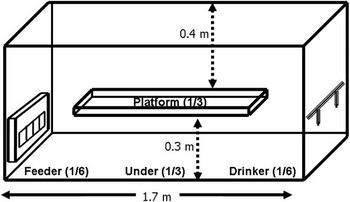
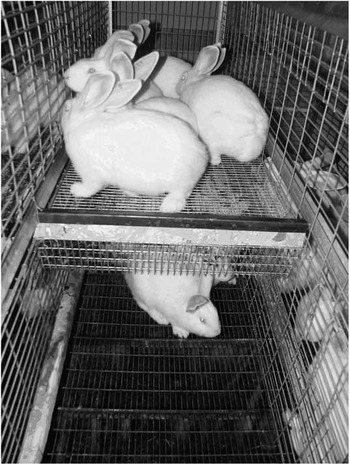
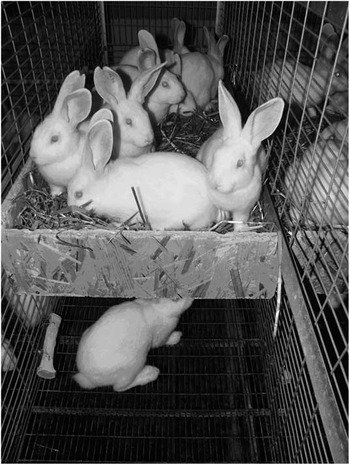
Elevated horizontal platforms (0.42 m2) were placed 30 cm above the floor in each pen (Figure 1). The floor of the elevated platform was made of either wire-net or deep-litter (Figures 2 and 3). A 20-cm-high box was placed in each pen to help the rabbits climb onto the platform.
Design of the pen with elevated platform.

Pen with wire-net platform (in the electronic version).

Pen with deep-litter platform (in the electronic version).

Three treatments were evaluated:
1. Treatment deep-litter: the elevated platform was made of deep-litter (3 pens, 14 kits per pen, n = 42 rabbits in Experiments 1 and 2).
2. Treatment wire-net without tray: the elevated platform was made of wire-net and a manure tray was not inserted under the platform (3 pens, 14 kits per pen, n = 42 rabbits, Experiment 1).
3. Treatment wire-net with tray: the elevated platform was made of wire-net, and a manure tray was fixed below each platform to collect urine and faeces (3 pens, 14 kits per pen, n = 42 rabbits, Experiment 2).
In Experiment 1, treatment deep-litter and treatment wire-net with no tray were examined. In Experiment 2, treatment deep-litter and treatment wire-net with tray were examined.
The stocking density was 16.7 or 11.1 rabbits/m2 in each pen, taking into account the basic area of the pen or the area of the pen and the platform together, respectively.
Video recording
Infra-red cameras were fixed above the pens. A 24 h video recording was made once a week while the rabbits were between 5 and 11 weeks of age. On the days of recording, nobody entered the room. The number of rabbits in each location in the pens was recorded every 30 min. To evaluate the preference of the rabbits, the pen was divided into three equal parts: the platform, the area under the platform and the area not covered by the platform at the feeder and drinker. The 24 h observations were divided into four 6-h periods starting at 0500 h. From the number of rabbits located at the three parts, percentages were calculated. The percentages were averaged for that part of the day. Thus, at every week of age, each pen provided four sets of data for each location.
Statistical analysis
Statistical analysis was performed by means of the SAS 9.1 software package. The percentages of rabbits located in the three different parts of the pens were evaluated using the General Linear Model. The applied model was the following:

where μ is the general mean; Pli the effect of the platform (i = 1 to 2); Agej the effect of the age (j = 1 to 6); (Pl × Age)ij the effect of interaction of level i of factor Pl with level j of factor Age; eij is the random error. The frequencies at the different locations were compared by means of Chi-square test testing the difference between observed and expected (33.3%) frequencies.
The authors have read the policy relating to animal ethics and confirm that this study complies.
Results
During Experiments 1 and 2 when deep-litter was used, the growing rabbits spent 29.6% (P < 0.001) and 38.1% (P < 0.001) of their time at the area of the feeder and drinker, and such values were close to the expected 33.3%. Using wire-net without tray and with tray, these values were 35.4% (P < 0.01) and 36.8% (P < 0.001), respectively.
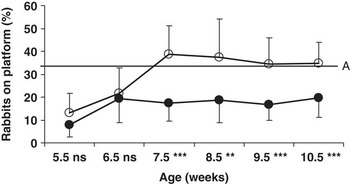
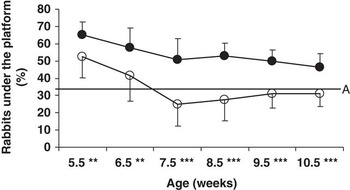
Percentages of staying on the platform or under the platform are shown in Figures 4 to 7. During Experiments 1 and 2 when deep-litter was used, percentages of platform usage or staying under the platform between the ages of 5 and 11 weeks were 16.7% and 53.7%, and 7.6% and 54.3%, respectively. The figures changed to 29.9% and 34.7%, and 19.5% and 43.7%, respectively, in case of wire-net without tray and with tray.
Percentage of growing rabbits using the elevated platform of deep-litter (-●-) and wire-net without manure tray beneath the wire-net (-○-). Line A shows the expected frequency of 33.3%. ns: difference is not significant; **, ***indicates the significant difference (P < 0.01; P < 0.001) between the two treatments.

Percentage of growing rabbits staying under the elevated platform of deep-litter (-●-) and wire-net without manure tray beneath the wire-net (-○-). Line A shows the expected frequency of 33.3%. ns: difference is not significant; **, ***indicates the significant difference (P < 0.01; P < 0.001) between the two treatments.

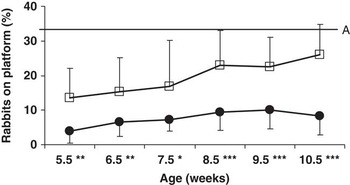
Percentage of growing rabbits using the elevated platform of deep-litter (-●-) and wire-net with manure tray beneath the wire-net (-□-). Line A shows the expected frequency of 33.3%. ns: difference is not significant; *, **, ***indicates the significant difference (P < 0.05; P < 0.01; P < 0.001) between the two treatments.

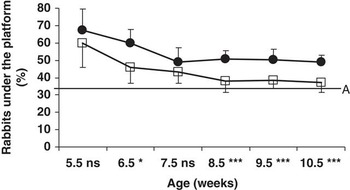
Percentage of growing rabbits staying under the elevated platform of deep-litter (-●-) and wire-net with manure tray beneath the wire-net (-□-). Line A shows the expected frequency of 33.3%. ns: difference is not significant; *, **, ***indicates the significant difference (P < 0.05; P < 0.01; P < 0.001) between the two treatments.

The area below the platform was chosen more frequently (P < 0.001) than the platform on each occasion. Between the ages of 5 and 11 weeks, the percentage of growing rabbits using the elevated platform of deep-litter and wire-net without manure tray beneath the wire-net was significantly lower (16.7% and 29.9%, respectively, P < 0.001) than the expected 33.3% (Figure 4). In case of deep-litter, the use of the elevated platform was low at every week of the experiment. When applying wire-net without tray at the ages of 5 to 6 and 6 to 7 weeks, the use of the platform ranged only between 13.1% and 21.7%, but after the age of 7 weeks it exceeded the expected 33.3%, although the difference compared with 33.3% was not significant between the ages of 9 and 11 weeks. The effect of age was significant in both cases (P < 0.01 and P < 0.001, respectively). The differences between the two cases were not significant between the ages of 5 and 7 weeks; on the contrary, between the ages of 7 and 11 weeks the use of platform was significantly higher in case of wire-net without tray than in case of deep-litter (P < 0.001 or P < 0.01). The interaction between treatment and age was significant (P < 0.05).
Examining the same two groups, it was found that between the ages of 5 and 11 weeks the percentage of growing rabbits staying under the elevated platform of deep-litter and wire-net without manure tray beneath the wire-net was significantly higher (53.7% and 34.7%, P < 0.001 and P < 0.05, respectively) than the expected 33.3% (Figure 5).
In case of deep-litter, use of the area under the platform was high at every week of the experiment, although the values showed a decreasing trend. When applying wire-net without tray between the ages of 5 to 6 and 6 to 7 weeks, use of the area under the platform was 52.5% and 41.5%; however, after the age of 7 weeks, this percentage was lower than 33.3%, and between the ages of 9 and 11 weeks the difference was not significant. The effect of age was significant in both treatments (P < 0.001). Comparing the two treatments, use of the area under the platform was significantly higher in case of deep-litter at every stage than in case of wire-net without tray (P < 0.001 or P < 0.01). The interaction between the treatment and age was not significant.
The percentage of growing rabbits using the elevated platform of deep-litter and wire-net with manure tray beneath the wire-net between the ages of 5 and 11 weeks was significantly lower (7.6% and 19.5%, respectively; P < 0.001) than the expected 33.3% (Figure 6). The values showed an increasing trend by both treatments, but the differences compared with the expected 33.3% were significant at every stage (P < 0.001). The effect of age was significant in both treatments (P < 0.01). Comparing the two treatments, use of the platform was significantly lower in case of deep-litter at every stage than in case of wire-net with tray (P < 0.001, P < 0.01 or P < 0.05). The interaction between the treatment and age was not significant.
Examining the same two groups, it was found that, between the ages of 5 and 11 weeks, the percentage of growing rabbits staying under the elevated platform of deep-litter and wire-net with manure tray beneath the wire-net was significantly higher (54.3% and 43.7%, P < 0.001, respectively) than the expected 33.3% (Figure 7).
In case of deep-litter, the difference was significant at every stage (P < 0.001). When wire-net was applied, the difference from the expected 33.3% was significant at the ages of 5 to 8, 8 to 10 and 10 to 11 weeks at different levels (P < 0.001, P < 0.01 and P < 0.05). At the beginning of the experiment, there were more rabbits found below the platform than at the end of the experiment (P < 0.001). The effect of age was significant in both treatments (P < 0.001). Comparing the two treatments, the differences were not significant between the ages of 5 to 6 and 7 to 8 weeks; however, the use of the area under the platform was significantly higher in treatment deep-litter between ages of 6 to 7 (P < 0.05) and 8 to 11 weeks (P < 0.001) than in case of wire-net with tray. The interaction between the treatment and age was not significant.
In both experiments, rabbits showed higher usage of platforms of wire-net floor than of platform floors of deep-litter (the differences in usage of wire-net platform (without or with manure tray) and deep-litter were 13.2% and 11.9%, respectively, P < 0.001). The area under the platform was chosen more frequently when its floor-type was deep-litter than when it was wire-net (the differences in use of deep-litter or wire-net platforms (without or with manure tray) were 19.0% and 10.6%, respectively, P < 0.001). In pens with wire-net, more rabbits stayed on wire-net platforms without a manure tray than on platforms with a manure tray (the difference was 10.4%, P < 0.001), and fewer rabbits choose the area under the platform (the difference was 9.0%, P < 0.001).
Discussion
The time spent at the feeder and drinker differed only by a few percent from the expected 33.3%. The relatively higher values could be explained by the fact that the rabbits consumed the pellet and the water using this area. Thus, examining this area has no importance because it seems to be independent from the treatment. Therefore, the discussion is restricted to the areas on and below the platform.
As the age of the rabbits increased, an equalisation pattern could be observed (for both experiments and for both floor types of the platforms). During the period immediately after weaning, greater differences were found between the most- and least-used locations than during the final period of the experiment. This finding can probably be explained by the growth of the rabbits – fewer rabbits could comfortably fit in a given part of the pen – and by the area requirement of the rabbits (total BW/m2). Similar results were reported in our previous studies (Matics et al., Reference Matics, Szendrő, Radnai, Biró-Németh and Gyovai2003; Princz et al., Reference Princz, Dalle Zotte, Radnai, Biró-Németh, Matics, Gerencsér, Nagy and Szendrő2008a), where the growing rabbits chose a less-used area rather than tolerate a high total BW/m2.
The greatest number of rabbits stayed in the area under the platform when the platform's floor-type was deep-litter or when a manure tray was fixed below the wire-net platform. The area under the platform may provide safety for the rabbits, which would explain their high use. European wild rabbits prefer areas covered with vegetation (e.g. bushes) because they are safer from birds of prey (Virgós et al., Reference Virgós, Cabezas-Dyaz, Malo, Lozano and López-Huertas2003; Beja et al., Reference Beja, Pais and Palmo2007). The area under the platform is similar to the burrow that European wild rabbits dig for safety from predators (Lombardini et al., Reference Lombardini, Fernández, Moreno and Villafuerte2003 and Reference Lombardini, Fernández and Moreno2007; Palomeras, Reference Palomeras2003). In the experiment of Princz et al. (Reference Princz, Radnai, Biró-Németh, Matics, Gerencsér, Nagy and Szendrő2008b), growing rabbits were free to choose between cages with tops at different heights (20, 30 and 40 cm) or open-top cages. Cages with tops (regardless of height) were chosen at a higher frequency than open-top cages. This result was in accordance with the high use of the area under the platform found in this study.
The lowest usage rate was found on the platform of deep-litter during each period of the day, as well as for the day as a whole. Although the rabbits quickly learnt how to approach the platform, this area was avoided throughout the whole experimental period. Similar findings were reported by Morisse et al. (Reference Morisse, Boilletot and Martrenchar1999) and by Orova et al. (Reference Orova, Szendrő, Matics, Radnai and Biró-Németh2004), in whose experiments rabbits had a free choice between areas with deep-litter and wire-net floor. Bessei et al. (Reference Bessei, Tinz and Reiter2001) observed that the choice between a perforated plastic-floor and deep-litter was affected by the temperature. The temperature during this study was sufficiently high (15°C to 19°C) to impede dissipation of metabolic heat (Bessei et al., Reference Bessei, Tinz and Reiter2001), which may have given rise to the lower usage of the deep-litter platform.
During Experiments 1 and 2, the percentage of rabbits using the platform was 16.7% and 7.6%, respectively. The ambient temperature was higher by 2°C to 3°C during Experiment 2 than during Experiment 1, which could have an effect on the results (Bessei et al., Reference Bessei, Tinz and Reiter2001).
When there was no manure tray fixed below the platform with wire-net floor, more rabbits used the platforms than when a manure tray was below the platform. The rabbits’ avoidance of the area under the platform without a manure tray can be explained by the fact that the rabbits on the platform may urinate on the rabbits underneath the platform. Therefore, the rabbits stayed on the platforms with an increased frequency. This supposition was supported by the results of the treatment, ‘wire-net with platform’. After placing a manure tray below the platform, the area under the platform provided a safe place for the rabbits just as it did in the case of the platform with deep-litter floor. In this treatment, the smallest number of rabbits was found on the platform, whereas almost half of the rabbits chose the area under the platform.
Parallel with this study, the productive performance and the carcass traits of rabbits housed in pens with or without platforms (wire-net or deep-litter floors) were also examined (Szendrő et al., Reference Szendrő, Matics, Nagy, Odermatt, Gerencsér, Szendrő, Radnai and Dalle Zotte2009). No significant differences were observed, suggesting that the use of a platform with deep-litter floor in a pen does not compromise the growth of rabbits.
Conclusions
The wire-net platform with the manure tray provides the optimal environment as it leads to the rabbits spreading themselves more evenly in the pen (i.e. the platform expands available floor area) without the risk of soiling from above, and without adverse effects on heat dissipation, and with the possibility of seeking cover when desired.
Acknowledgement
Financial help of TECH_08_A3/2-2008-0384 (OM-00198/2008) is gratefully acknowledged. Authors thank Geoffrey Meldahl for valuable comments and suggestions that improved the manuscript.