Introduction
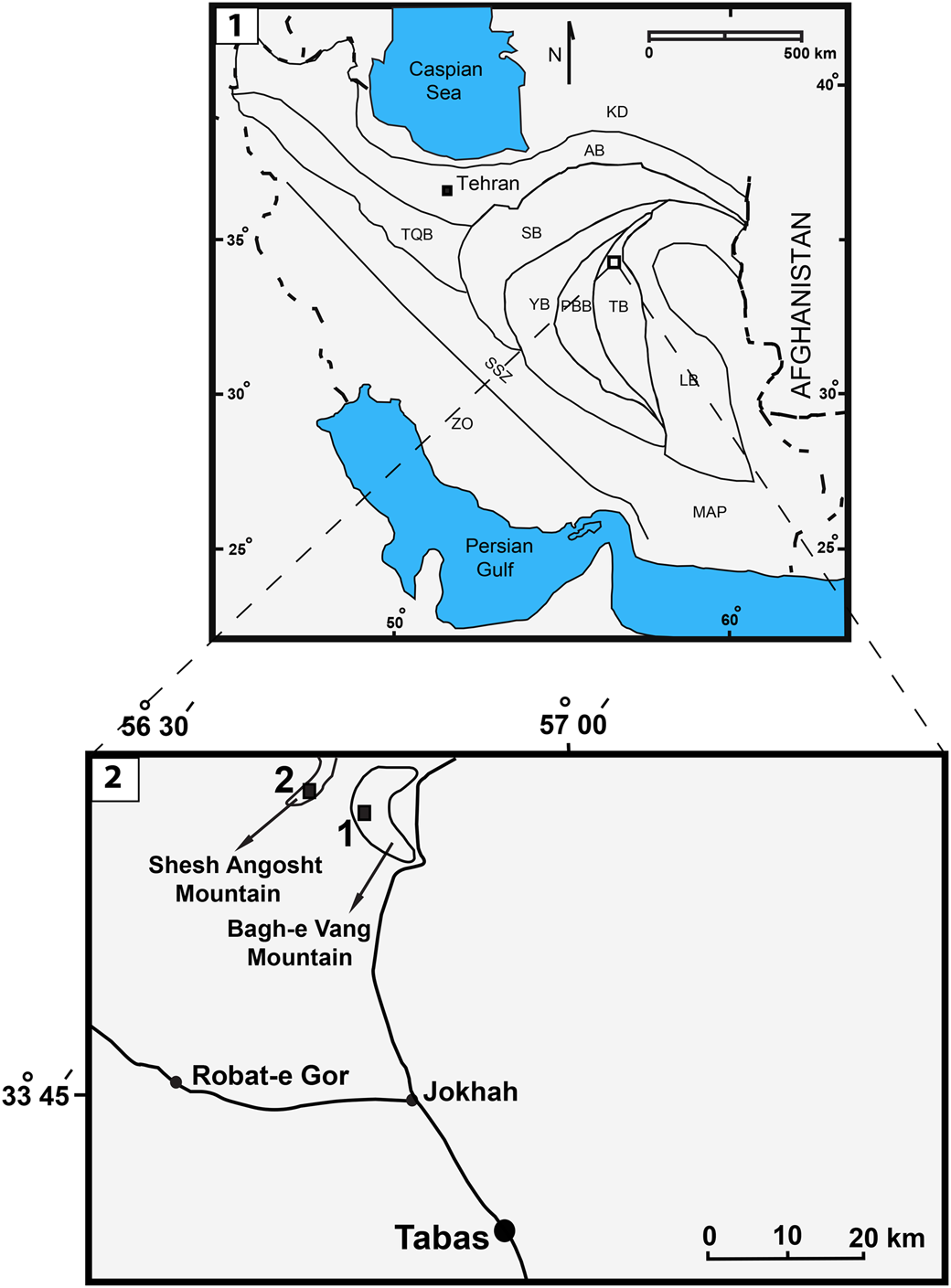
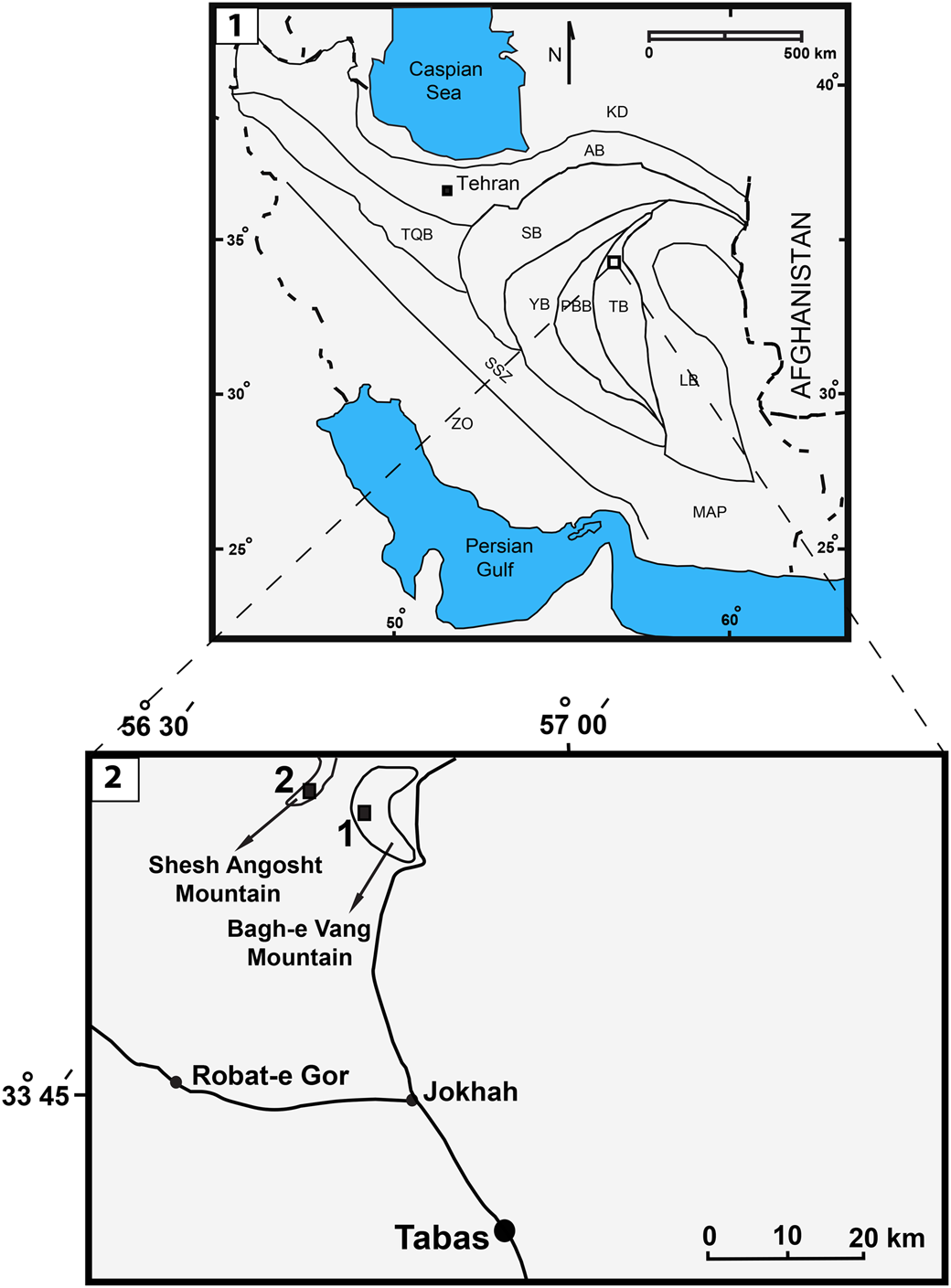
In east-central Iran, the Jamal Formation is underlain by the Carboniferous–lower Permian shales and sandstones of the Sardar Formation (e.g., Leven and Taheri, Reference Leven and Taheri2003) and is composed, from base to top, of gray medium-bedded, sandy bioclastic grainstone, gray thick-bedded calcareous conglomerate, red marl and alternating calcareous shale, and gray to dark gray, medium- to thin-bedded bioclastic wackestone to packstone. Outcrops of the Jamal Formation in the Shirgesht area, north of the town of Tabas, were first studied by Ruttner et al. (Reference Ruttner, Nabavi and Hajian1968), who assigned a late Permian age. They are composed mainly of limestone and dolomitic limestone, with chert nodules, containing small foraminifers, fusulinids, calcareous algae, bryozoans, brachiopods, crinoids, and corals. The basal part of the Jamal Formation has well-exposed outcrops on the western side of Bagh-e Vang Mountain and on the northwestern side of Shesh Angosht Mountain (Fig. 1) and is named the Bagh-e Vang Formation (Partoazar, Reference Partoazar1995). The basal part of the Jamal Formation was named the Bagh-e Vang Member by Leven and Vaziri Moghaddam (Reference Leven and Vaziri Moghaddam2004) in the Shirgesht area (eastern Iran), but later was considered as a formation at the base of the Shirgest Group (Leven et al., Reference Leven, Davydov and Gorgij2006). It includes calcareous algae, smaller foraminifers, fusulinids, corals, bryozoans, brachiopods, crinoids, ostracodes, and ammonoids (Fig. 2). The boundary between the Bagh-e Vang and Sardar formations is a disconformity, and there are some additional discontunities as a result of minor faulting.
(1) Location map showing the position of studied sections in the east-central Iran, Tabas area. Abbreviations: AB = Alborz Belt; KD = Kopeh Dagh, LB = Lut Block, MAP = Makran accretionary Prism, PBB = Posht-e-Badam Block, SB = Sabzevar Block, SSZ = Sanandaj-Sirjan Zone, TB = Tabas Block, TQB = Tabriz-Qom Block, YB = Yazad Block, ZO = Zagros Orogen. (2) Enlarged map showing the studied sections in the Tabas area, east-central Iran: 1 = Bagh-e Vang section; 2 = Shesh Angosht section.
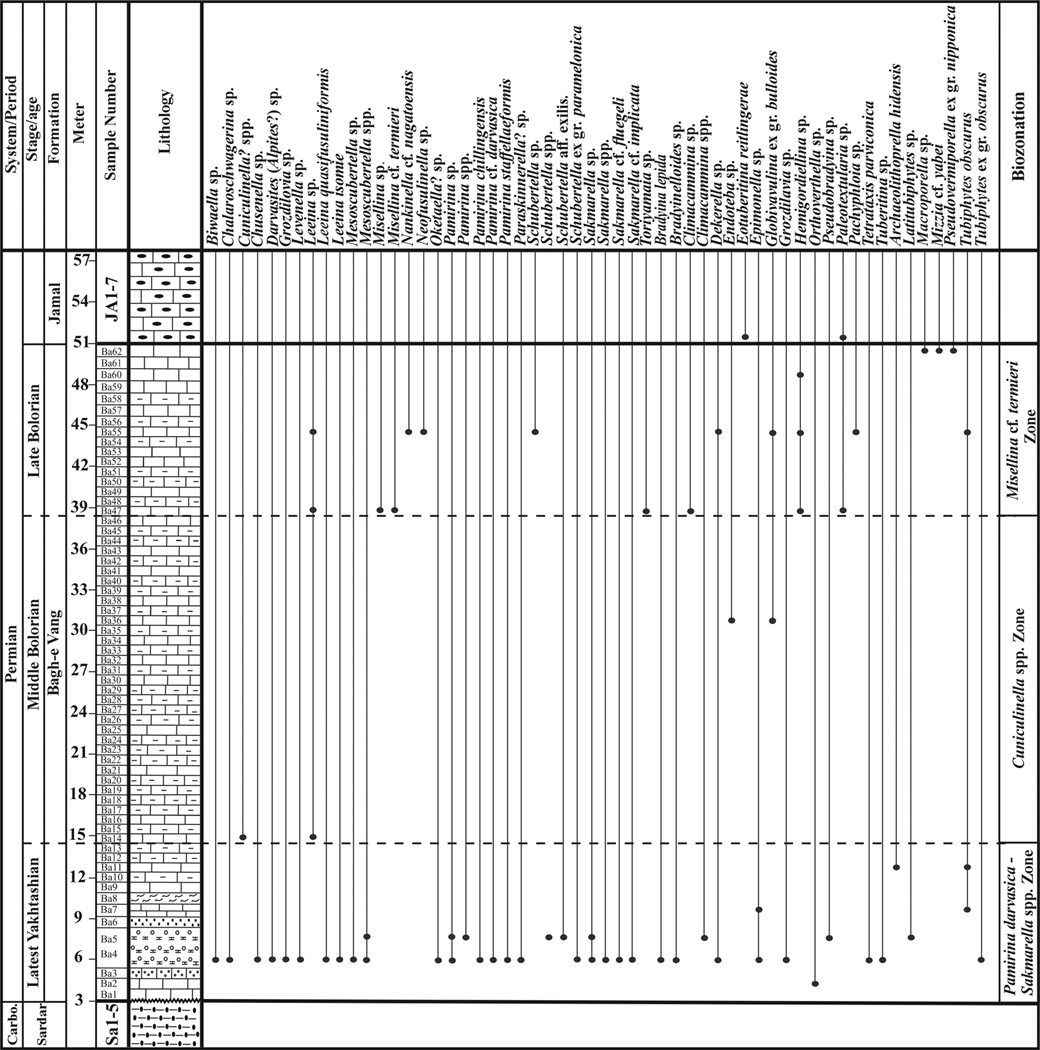
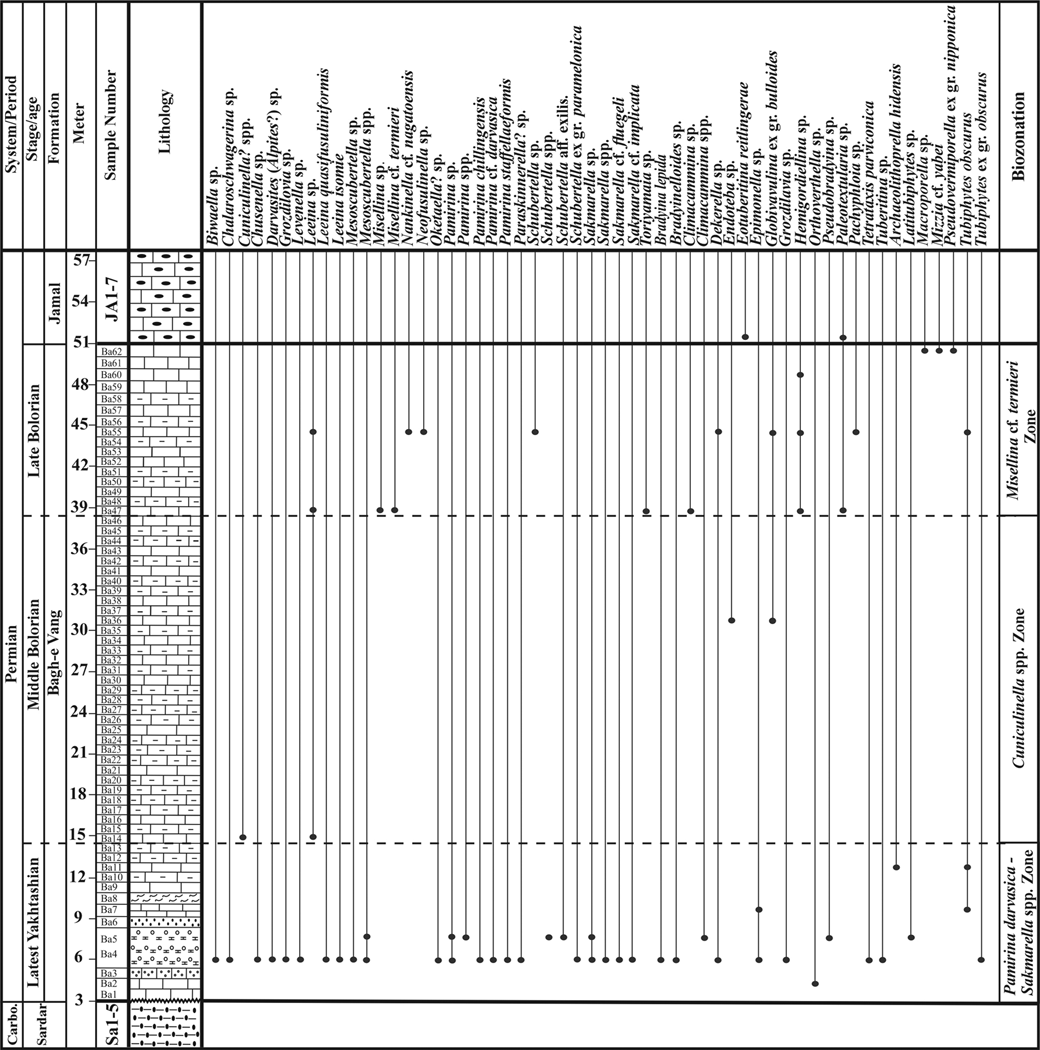
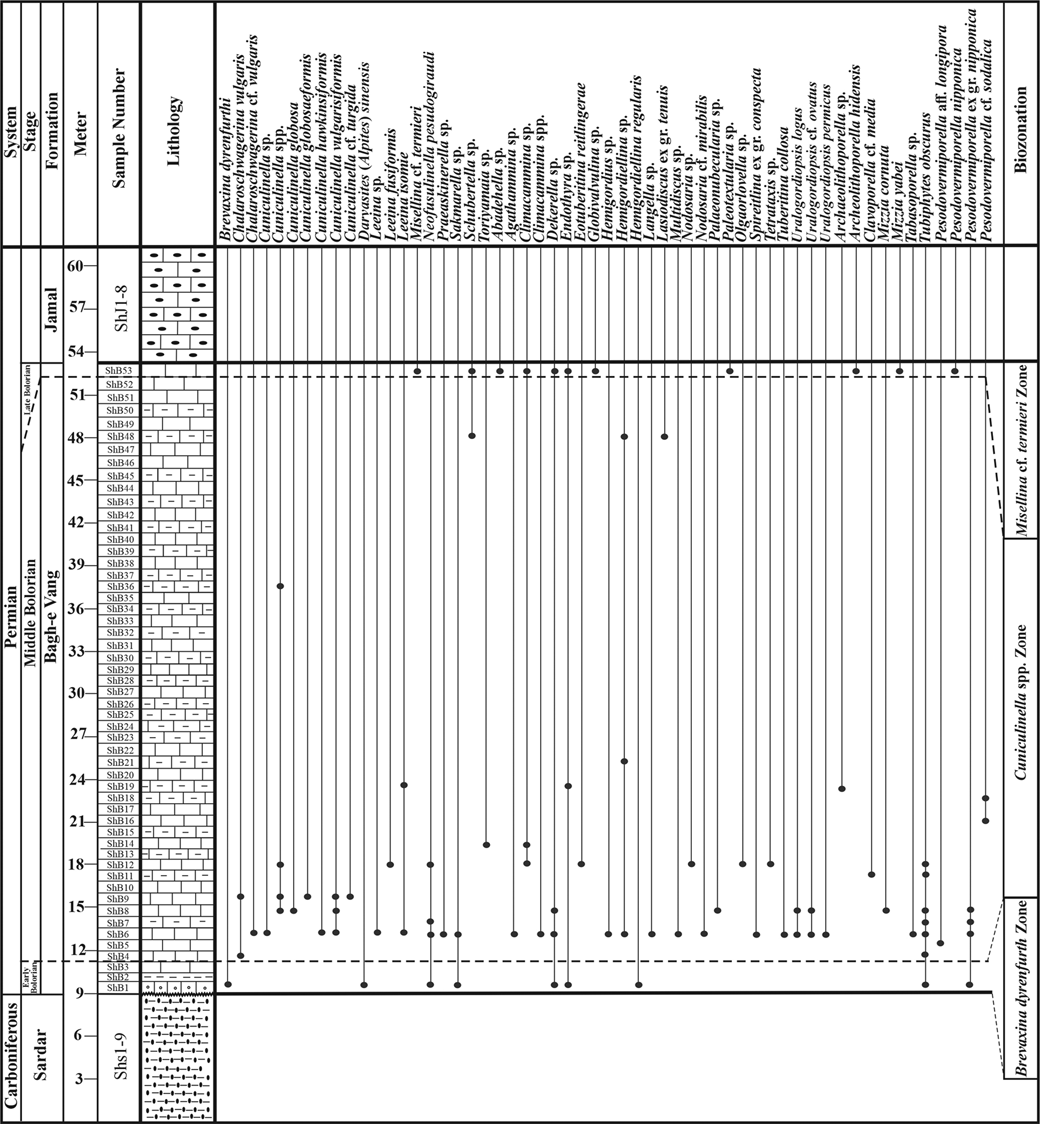
Fusulinid biozonation and faunal distribution of the Bagh-e Vang Formation, Bagh-e Vang section, east-central Iran. Abbreviation: Carbo. = Carboniferous.
Kahler (Reference Kahler1974) examined the fusulinid contents of a few samples collected from the Shesh Angosht section and assigned them to the Misellina Zone of Kungurian age. Partoazar (Reference Partoazar1995) considered the Bagh-e Vang Formation in the type section as Asselian–Sakmarian in age based on its fusulinid content. Later, Leven and Vaziri Moghaddam (Reference Leven and Vaziri Moghaddam2004) re-examined the biostratigraphy of the Bagh-e Vang Formation using fusulinids and identified several fusulinid biozones, in ascending order, including Pamirina-Mesoschubertella, Misellina-Chalaroschwagerina-Paraleeina, and Misellina-Armenina, ranging in age from upper Cisuralian to possibly lower Guadalupian (i.e., lower–middle Permian boundary interval). Although most fusulinid assemblages of the Bagh-e Vang Formation in the type section are indicative of the upper Cisuralian, the age of the upper part of this formation remains uncertain. Therefore, it is necessary to check the precise age of the Bagh-e Vang Formation in the Shesh Angosht section, which has not been examined using high-resolution biostratigraphy.
Here, we examine lithological and faunal changes within the Bagh-e Vang Formation at two stratigraphic sections in the Bagh-e Vang and Shesh Angosht mountains. The Bagh-e Vang section is located 54 km north of Tabas and the Shesh Angosht section is 4 km northwest of the Bagh-e Vang section. Unlike at the Bagh-e Vang section, the basal part of the Bagh-e Vang Formation at Shesh Angosht does not contain sandy bioclastic grainstone, calcareous conglomerate, and red marls. It is instead composed of alternating bioclastic wackestone and/or packstone with calcareous shales and lies conformably on greenish shales and sandstones of the Sardar Formation (Fig. 2). The purpose of this research is to: (1) identify the foraminiferal fauna and calcareous algae flora of the Bagh-e Vang Formation in both sections, (2) describe their biozones and stratigraphic distribution, and (3) discuss the paleobiogeographic affinity of their fusulinid faunas.
Geological setting
The area under study is situated in the Tabas Block (Fig. 1). The Tabas Block is bounded to the west by the Kalmard fault and to the east by the Nayband fault, which are both strike-slip faults (Alavi, Reference Alavi1991). The Tabas Block, together with the Posht-e Badam, Yazd, and Lut blocks, forms the Central Iranian Midcontinent. Ruttner et al. (Reference Ruttner, Nabavi and Hajian1968) reported more than 8 km of Paleozoic deposits in this block; these outcrops represent the most complete Paleozoic section of the Central Iran Midcontinent and include Upper Devonian and upper Carboniferous deposits that are missing in most parts of Iran. The Permian stratigraphic sections in the Shirgesht area include deposits that span the early Permian, with early part of the early Permian in the Zaladu section and the later part of the early Permian in the Bagh-e Vang and Shesh Angosht sections. There are also some outcrops of mid- and late Permian carbonates in the Tabas Block, both in the type section of the Jamal Formation and elsewhere. Therefore, the study of this block is particularly significant in terms of paleobiogeographic and tectonic reconstructions of Iran during the late Paleozoic.
Biostratigraphy
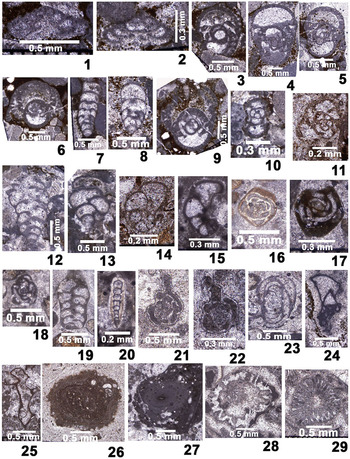
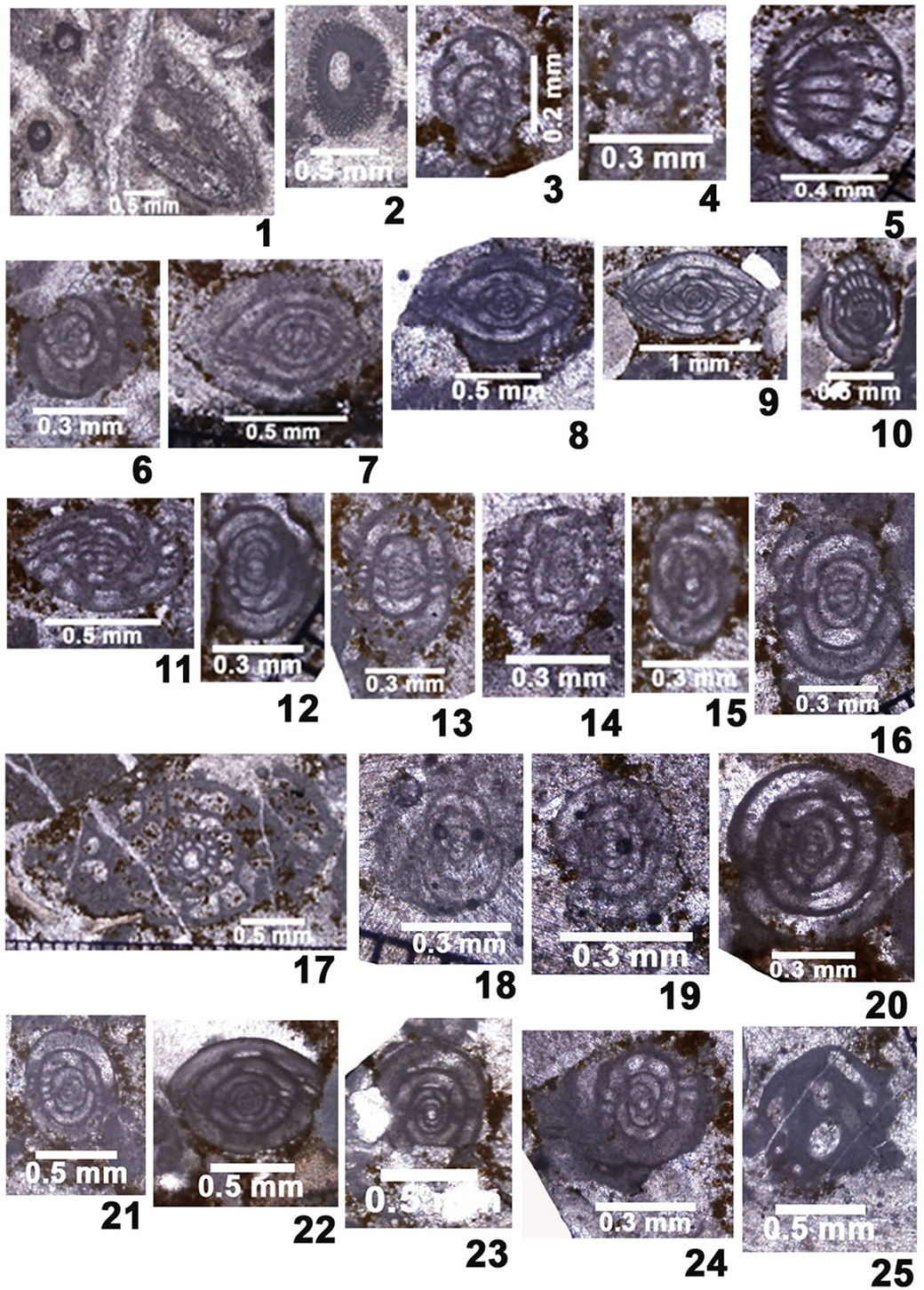
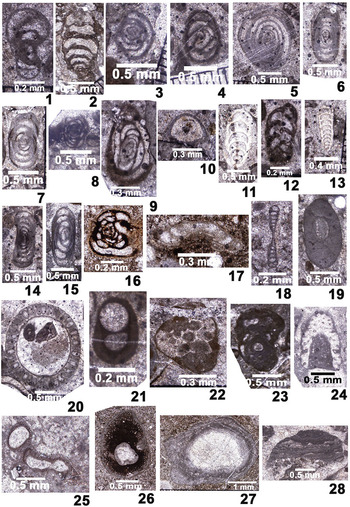
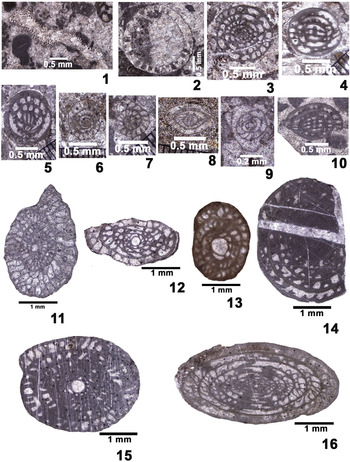
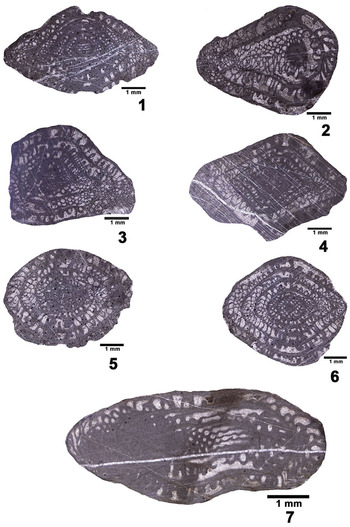
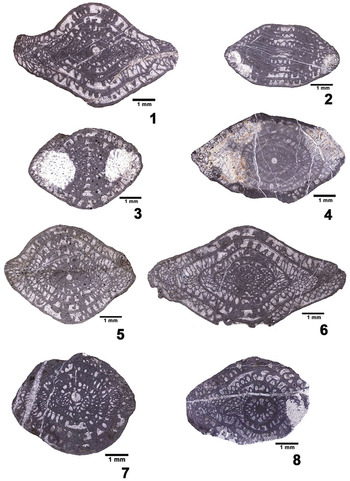
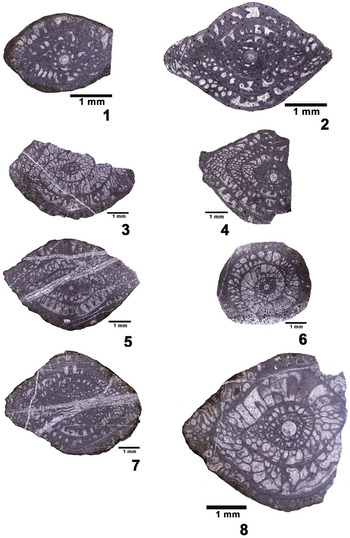
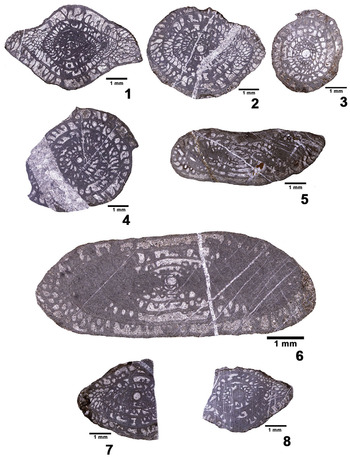
In this study, the series are subdivided into four biozones, which are: (1) Pamirina darvasica and Sakmarella spp. Zone, upper Yakhtashian; (2) Misellina (Brevaxina) dyrhenfurthi Zone, lower Bolorian; (3) Cuniculinella spp. Zone, mid-Bolorian); and (4) Misellina (Misellina) cf. M. (M.) termieri Zone, upper Bolorian (Fig. 2). The photomicrographs of the identified fusulinids, smaller foraminifer, microproblematica, and algae of this study are provided in Figures 3–7 for the Bagh-e Vang section and Figures 9–14 for the Shesh Angosht section.
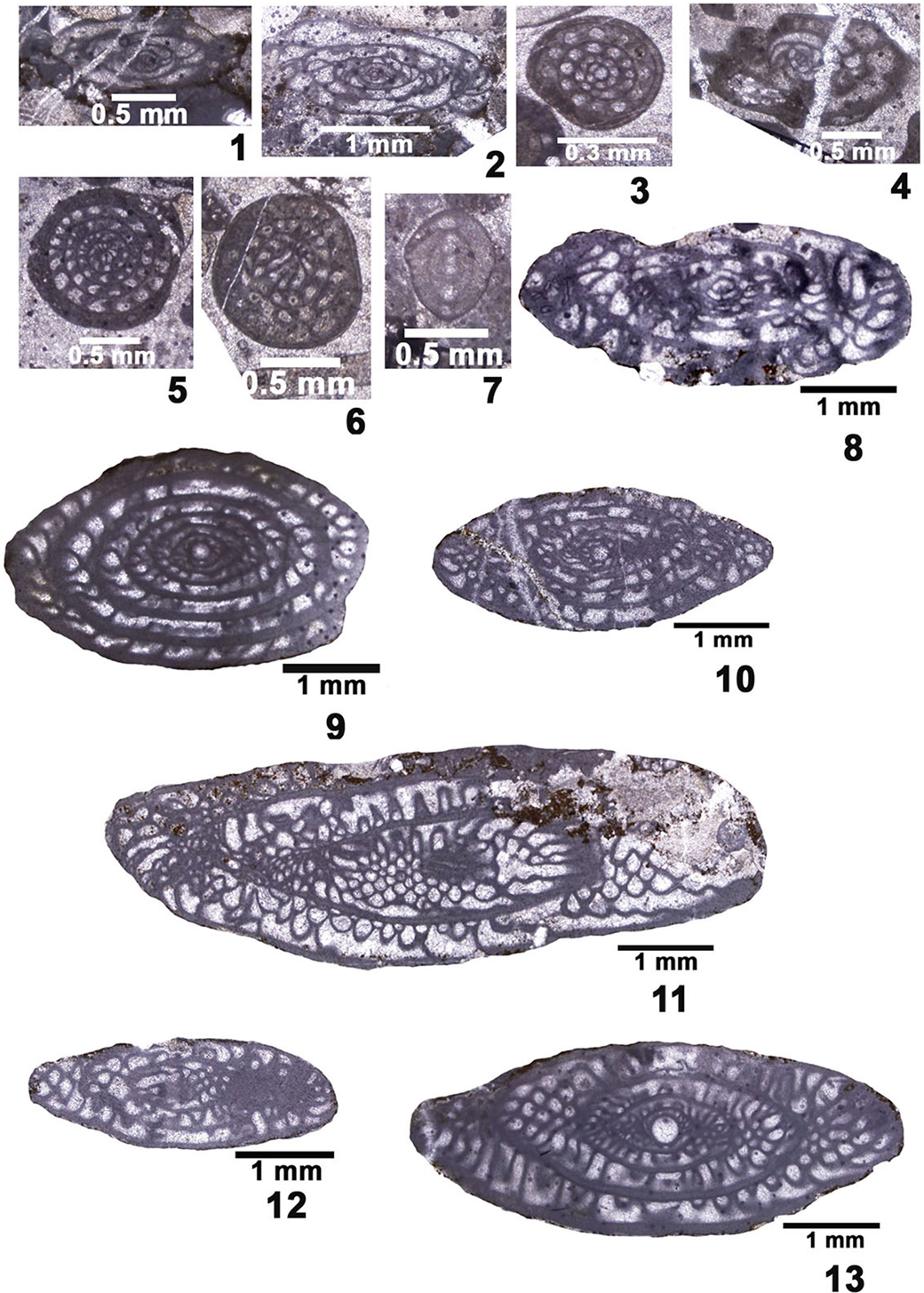
Lower Permian small foraminiferans and calcareous algae from the Bagh-e Vang Formation, Bagh-e Vang section, in east-central Iran. (1, 2) Tetrataxis parviconica Lee and Chen in Lee, Chen, and Chu, Reference Lee, Chen and Chu1930, (1) axial section, BA-4-5-2, ALU-902, (2) subaxial section, BA-4-30-3, ALU-903; (3–6) Bradyina ex gr. B. lepida Reitlinger, Reference Reitlinger1950, (3) subaxial section, BA-4-16-2, ALU-909, (4) axial section, BA-4-26-1, ALU-910, (5) subaxial section, BA-4-31-1, ALU-911, (6) oblique subaxial section, BA-4-49-2, ALU-912; (7, 8) Deckerella sp., (7) subaxial section, BA-4-24-4-1, ALU-913, (8) oblique section, BA-4-54-2, ALU-914; (9) Bradyina sp. 2, axial section, BA-4-49-1, ALU-916; (10) Bradyina sp. 3, transverse section, BA-5-2-3, ALU-917; (11) Endoteba sp., axial section, BA-36-4, ALU-944; (12, 13) Climacammina spp., four subaxial sections, (12) BA-5-14-1, ALU-919, (13) BA-5-19-4, ALU-920; (14, 15) Globivalvulina ex gr. G. bulloides (Brady, Reference Brady1876), (14) transverse section, BA-36-2, ALU-942, (15) transverse section, BA-55-14-2, ALU-943; (16–18) Hemigordiellina sp., three random sections, (16) BA-47-10-2, ALU-945, (17) BA-47-12-1, ALU-946, (18) BA-47-12-3, ALU-947; (19) Palaeotextularia sp., subaxial section, BA-47-11-1, ALU-954; (20) Pachyphloia sp., axial section, BA-55-13-2, ALU-956; (21, 22). Orthovertella sp., (21) subaxial section, BA-3-1, ALU-958, (22) subaxial section, BA-3-3, ALU-959; (23) Agathammina sp., subaxial section, BA-47-15-1, ALU-960; (24, 25) Epimonella sp., two longitudinal sections, (24) BA-4-9-3, ALU-969, (25) BA-7-6, ALU-970; (26) Archaeolithoporella hidensis Endo, Reference Endo1961, transverse section of an oncoidal grain of tebagite type, BA-11-6, ALU-996; (27) Tubiphytes obscurus Maslov, Reference Maslov1956, transverse section, BA-55-4-1, ALU-993; (28) Mizzia cf. M. yabei (Karpinsky, Reference Karpinsky1909) emend. Pia, Reference Pia1920, transverse section, BA-62-2, ALU-1003; (29) Macroporella sp., subaxial section, BA-62-3, ALU-1004.

Lower Permian fusulinids and calcareous algae from the Bagh-e Vang Formation, Bagh-e Vang section, in east-central Iran. (1) Permocalculus sp., longitudinal section, BA-62-8, ALU-1010; (2) Pseudovermiporella ex gr. P. nipponica (Endo in Endo and Kanuma, Reference Endo and Kanuma1954), transverse section, BA-62-10, ALU-1012; (3, 4) Levenella sp. transitional to Pamirina sp., (3) oblique section, BA-4-1-3, ALU-1015, (4) transverse section, BA-4-1-4, ALU-1016; (5, 6) Pamirina spp., (5) subtransverse section, BA-4-8-1, ALU-1026, (6) oblique section, BA-4-15-1, ALU-1027; (7–11) Mesoschubertella spp., five different sections, (7) BA-4-4-3, ALU-1017, (8) BA-2-5-1, ALU-1019, (9) BA-4-6-2, ALU-1020, (10) BA-4-15-2, ALU-1022, (11) BA-4-8-4, ALU-1021; (12–15) Pamirina chilingensis (Wang and Sun, Reference Wang and Sun1973), (12) axial section, BA-4-8-2, ALU-1028, (13) subaxial section, BA-4-10-2, ALU-1029, (14) oblique section, BA-4-16, ALU-1030, (15) axial section, BA-4-15-3, ALU-1031; (17) Chusenella? sp., oblique section, BA-4-14-2, ALU-1034; (16, 18–20) Pamirina cf. P. darvasica Leven, Reference Leven1970, (16) subaxial section, BA-4-30-1, ALU-1048, (18) axial section, BA-4-30-8, ALU-1049, (19) oblique section, BA-4-32-1, ALU-1050, (20) oblique section, BA-4-22-1, ALU-1051; (21) Pamirina staffellaeformis Zhou, Sheng, and Wang, Reference Zhou, Sheng and Wang1987, axial section, BA-4-42-2, ALU-1057; (22) Schubertella ex gr. S. paramelonica Suleimanov, Reference Suleimanov1949, axial section, BA-4-53-2, ALU-1062; (23, 24) Pamirina darvasica Leven, Reference Leven1970, (23) axial section, BA-4-56-2, ALU-1063, (24) oblique section, BA-42-57-2, ALU-1064; (25) Latitubiphytes, oblique section, BA-5-5-2, ALU-1067.

Lower Permian fusulinids from the Bagh-e Vang Formation, Bagh-e Vang section, in east-central Iran. (1, 2) Schubertella aff. S. exilis Suleimanov, Reference Suleimanov1949, (1) subaxial section, BA-5-9-3, ALU-1078, (2) axial section, BA-5-12-2, ALU-1079; (3) Misellina (Misellina) sp., BA-47-1-1, ALU-1102; (4) Toriyamaia sp., axial section, BA-47-11-2, ALU-1104; (5, 6) Misellina (Misellina) cf. M. (M.) termieri (Deprat, Reference Deprat1915), (5) transverse section, BA-47-12-4, ALU-1105, (6) oblique subaxial section, BA-47-13-1, ALU-1106; (7) Nankinella cf. N. nagatoensis Toriyama, Reference Toriyama1958, axial section, BA-57-15-1, ALU-1109; (8) Grozdilovia sp., subaxial section, BA-4-2-2, ALU-1110; (9) Darvasites (Alpites?) sp., oblique section, BA-4-17-12-2, ALU-1111; (11) Sakmarella cf. S. fluegeli Davydov in Davydov, Krainer, and Chernykh, Reference Davydov, Krainer and Chernykh2013, subaxial section, BA-4-11-2, ALU-1112; (10, 12) Sakmarella spp., (10) axial section, BA-4-19-3, ALU-1113, (12) oblique subaxial section, BA-4-27-1-1, ALU-1115; (13) Sakmarella cf. S. implicata (Schellwien, Reference Schellwien1908), axial section, BA-4-37-1, ALU-1116.
Lower Permian fusulinids from the Bagh-e Vang Formation, Bagh-e Vang section, in east-central Iran. (1) Leeina cf. L. quasifusuliniformis (Leven, Reference Leven1967), axial section, BA-4-38-1, ALU-1117; (2) Chalaroschwagerina sp., oblique section, BA-4-41-1-1, ALU-1118; (3) Biwaella sp., axial section, BA-4-57-5, ALU-1119; (4, 5) Sakmarella spp., (4) axial section, BA-4-47-1, ALU-1120, (5) oblique section, BA-5-4-3, ALU-1121; (6) Paraskinnerella? sp., subaxial section, BA-4-53-1, ALU-1122; (7, 8) Sakmarella spp., (7) axial section, BA-5-20-1-1, ALU-1124, (8) subaxial section, BA-5-8-2, ALU-1126.

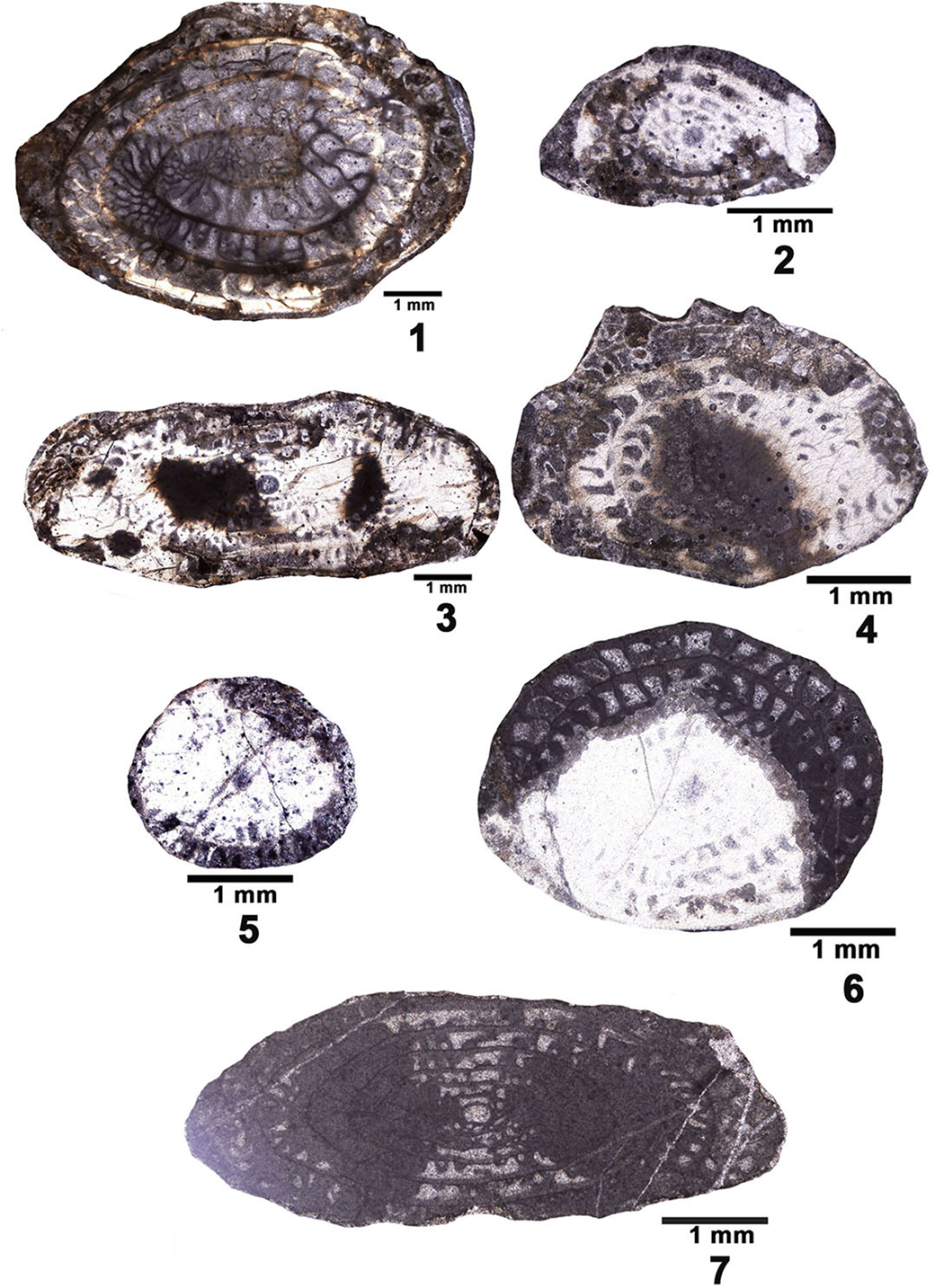
Lower Permian fusulinids from the Bagh-e Vang Formation, Bagh-e Vang section, in east-central Iran. (1) Cuniculinella? spp., subaxial section, BA-14-3, ALU-1128; (2) Sakmarella? sp., axial section, BA-47-18-3, ALU-1129; (3–6) Silicified Leeina sp., (3) axial section, BA-14-5-1, ALU-1130, (4) oblique section, BA-47-18-4, ALU-1131, (5) oblique axial section, BA-55-5-1, ALU-1132, (6) oblique axial section, BA-55-11-1, ALU-1133. (7) Leeina isomie (Igo, Reference Igo1965), axial section, BA-61-1, ALU-1134.
Biozone 1
Pamirina darvasica and Sakmarella spp. Zone
Definition
This zone, with a thickness of ~8 m in the Bagh-e Vang section, is an assemblage zone characterized by the first occurences of two fusulinid markers, Pamirina and Sakmarella. The base of this biozone rests on the Sardar Formation. The top of this biozone is characterized by the first occurrence/first appearance datum (FO/FAD) of the markers of the overlying zone (i.e., several species of the fusulinid Cuniculinella; see later discussion, with “Cuniculina” pre-occupied). It is noteworthy that the FO of Pamirina is probably coeval with its probable FAD in the Pamirs in the upper Yakhtashian (see Leven, Reference Leven1970; Davydov et al., Reference Davydov, Krainer and Chernykh2013).
Distribution
This first biozone is recorded in the Bagh-e Vang section, from samples BA-4 to BA-13, but not in the Shesh Angosht section.
Composition
The microproblematica, smaller foraminifers, and fusulinids in biozone 1 (Figs. 3–6) include Archaeolithoporella hidensis Endo, Reference Endo1961; Tubiphytes obscurus Maslov, Reference Maslov1956; T. ex gr. obscurus; Epimonella sp.; Latitubiphytes sp.; Eotuberitina reitlingerae Miklukho-Maklay, Reference Miklukho-Maklay1958; Bradyina ex gr. lepida Reitlinger, Reference Reitlinger1950; B. sp. 2; B. sp. 3; Climacammina spp.; Deckerella sp.; Tetrataxis parviconica Lee and Chen in Lee, Chen, and Chu, Reference Lee, Chen and Chu1930; Orthovertella sp.; Hemigordiellina sp.; Schubertella ex gr. S. paramelonica Suleimanov, Reference Suleimanov1949; S. aff. S. exilis Suleimanov, Reference Suleimanov1949; S. spp.; Toriyamaia sp.; Mesoschubertella sp.; Biwaella sp.; Levenella sp.; Pamirina darvasica Leven, Reference Leven1970; P. chinlingensis (Wang and Sun, Reference Wang and Sun1973); P. staffellaeformis Zhou, Sheng, and Wang, Reference Zhou, Sheng and Wang1987; P. sp.; Darvasites (Alpites?) sp.; Sakmarella cf. S. fluegeli Davydov in Davydov, Krainer, and Chernykh, Reference Davydov, Krainer and Chernykh2013; S. cf. S. implicata (Schellwien, Reference Schellwien1908); Leeina cf. L. quasifusuliniformis (Leven, Reference Leven1967); Grozdilovia sp.; Chalaroschwagerina? sp.; Chusenella sp.; Paraskinnerella? sp.
Remarks
The regional Pamirina darvasica and Sakmarella spp. Zone is assigned to the upper Yakhtashian based on the recent dating of the Pamirina darvasica Zone of Darvaz by Davydov et al. (Reference Davydov, Krainer and Chernykh2013) and Krainer et al. (Reference Krainer, Vachard and Schaffhauser2019) in the Carnic Alps. However, the same interval was previously included in the lower Bolorian by Leven and Vaziri Moghaddam (Reference Leven and Vaziri Moghaddam2004), who had another interpretation of the stratigraphic range of Pamirina (see discussion in Davydov et al., Reference Davydov, Krainer and Chernykh2013).
Biozone 2
Misellina (Brevaxina) dyrhenfurthi Zone
Definition
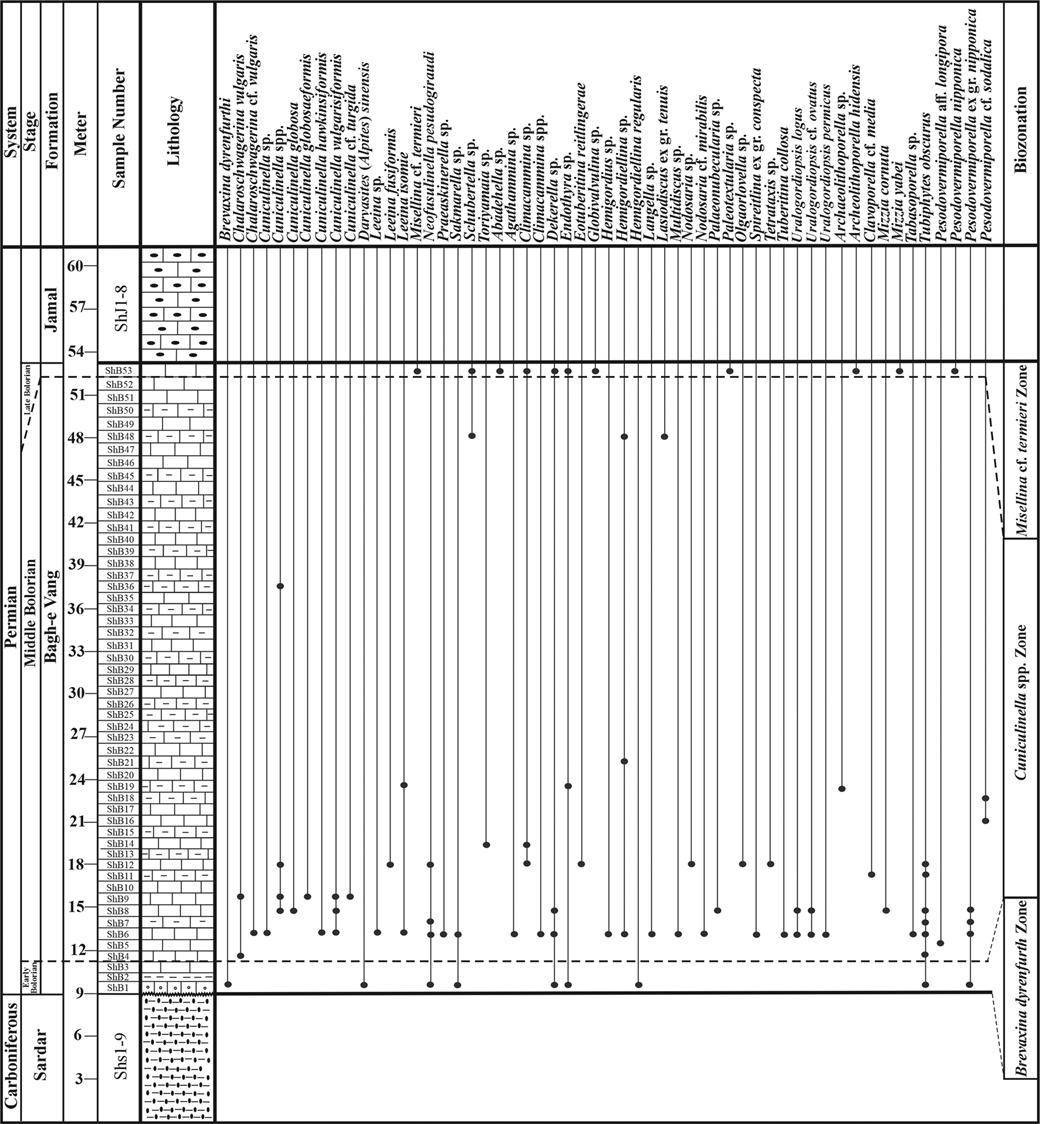
This zone is the range zone of Misellina (Brevaxina) dyrhrenfurthi (Dutkevich in Likharev, Reference Likharev and Likharev1939), with a thickness of 3 m in the Shesh Angosht section. The lower boundary of this zone is characterized by the FO/FAD of Misellina (Brevaxina) dyhrenfurthi and its upper boundary is marked by the last occurrence/last appearance datum (LO/LAD) of Misellina (Brevaxina) dyhrenfurthi and/or the FO/FAD of Cuniculinella.
Distribution
Misellina (Brevaxina) dyrhenfurthi was not recovered in our samples from the Bagh-e Vang section, but it was found in this locality by Leven and Vaziri Moghaddam (Reference Leven and Vaziri Moghaddam2004). We have found Misellina (Brevaxina) dyrhenfurthi in the Shesh Angosht section (Fig. 8), where it is present in the SHB-1 to SHB-3 samples.
Fusulinid biozonation and faunal distribution of the Bagh-e Vang Formation, Shesh Angosht section, east-central Iran.
Composition
The second biozone contains the microproblematica, smaller foraminifers, and fusulinids: Tubiphytes obscurus; Endothyra sp.; Deckerella sp.; Hemigordiellina regularis (Lipina, Reference Lipina1949); Schubertella sp.; Neofusulinella? pseudogiraudi (Sheng, Reference Sheng1963); Darvasites (Alpites) sinensis; Sakmarella sp.; and Misellina (Brevaxina) dyrhenfurthi (Figs. 9, 10).
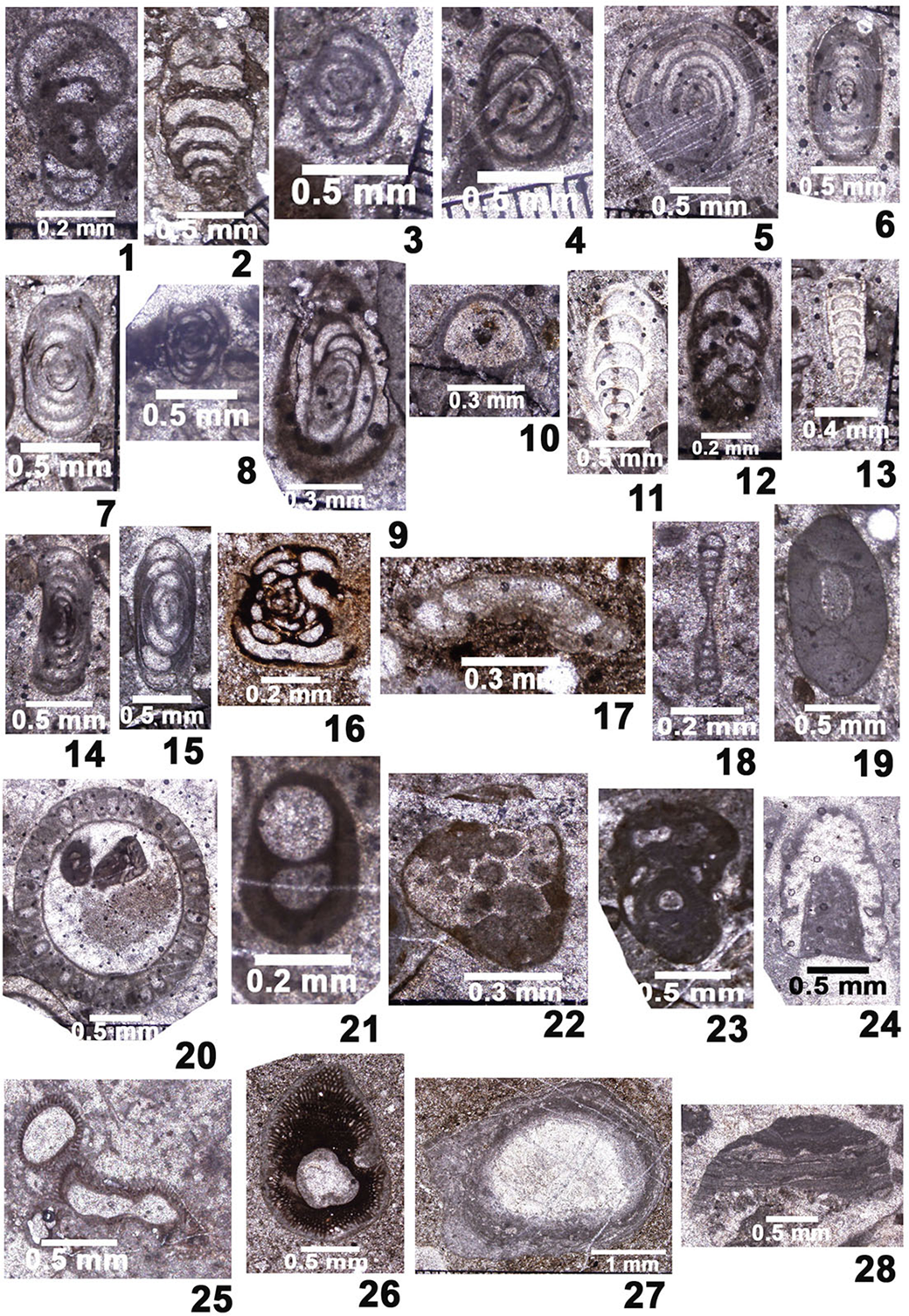
Lower Permian small foraminiferans and calcareous algae from the Bagh-e Vang Formation, Shesh Angosht section, in east-central Iran. (1) Endothyra sp., axial section, SHB-1-3-1, ALU-1135; (2) Deckerella sp., oblique longitudinal section, SHB-1-7-2, ALU-1136; (3) Hemigordiellina regularis (Lipina, Reference Lipina1949), transverse section, SHB-1-8-1, ALU-1137; (4) Uralogordiopsis cf. U. ovatus (Grozdilova, Reference Grozdilova1956), subaxial section, SHB-6-4-3, ALU-1140; (5–7). Uralogordiopsis longus (Grozdilova, Reference Grozdilova1956), (5) subtransverse section, SHB-6-4-2, ALU-1142, (6) axial section, SHB-6-5-4, ALU-1143, (7) axial section, SHB-6-9-3, ALU-1145; (8) Hemigordiellina sp., axial section, SHB-6-7-1-2, ALU-1153; (9) Agathammina sp., transverse section, SHB-6-16-2, ALU-1155; (10) Tuberitina collosa Reitlinger, Reference Reitlinger1950, axial section, SHB-6-9-4, ALU-1160; (11) Langella sp., axial section, SHB-6-26-1, ALU-1164; (12) Spireitlina ex gr. S. conspecta (Reitlinger, Reference Reitlinger1950), subaxial section, SHB-6-26-2, ALU-1165; (13) Nodosaria cf. N. mirabilis Lipina, Reference Lipina1949, axial section, SHB-6-33-1, ALU-1172; (14, 15) Uralogordiopsis permicus (Grozdilova, Reference Grozdilova1956), (14) axial section, SHB-6-37-1, ALU-1178, (15) subaxial section, SHB-8-2-3, ALU-1179; (16) Olgaorlovella sp., random section, SHB-12-7-1, ALU-1192; (17) Tetrataxis sp., subaxial section, SHB-12-8-2, ALU-1195; (18) Lasiodiscus ex gr. L. tenuis Reichel, Reference Reichel1946, axial section, SHB-48-1, ALU-1204; (19) Tubiphytes obscurus Maslov, Reference Maslov1956, oblique section, SHB-1-1-2, ALU-1216; (20) Tabasoporella sp. (see Rashidi and Senowbari-Daryan, Reference Rashidi and Senowbari-Daryan2010), transverse section, SHB-6-10-4, ALU-1221; (21) Pseudovermiporella ex gr. P. nipponica (Endo in Endo and Kanuma, Reference Endo and Kanuma1954), transverse sections, SHB-6-21-2, ALU-1228; (22) Mizzia cornuta Kochansky and Herak, Reference Kochansky-Devidé and Herak1960, subtangential section, SHB-8-4, ALU-1239; (23) Palaeonubecularia sp., oblique section, SHB-8-4-3-3, ALU-1240; (24) Clavaporella cf. C. media (Vachard in Vachard and Montenat, Reference Vachard and Montenat1981), sublongitudinal section, SHB-11-1, ALU-1249; (25, 26) Pseudovermiporella cf. P. sodalica Elliott, Reference Elliott1958, two oblique sections, (25) SHB-16-2, ALU-1251, (26) SHB-18-1, ALU-1252; (27) oncoid of Archaeolithoporella sp., longitudinal section, SHB-19-3, ALU-1253; (28) Archaeolithoporella hidensis Endo, Reference Endo1961, longitudinal section, SHB-53-6, ALU-1254.
Remarks
This lower Bolorian zone has been traditionally mentioned in the Cisuralian fusulinid-based biozonation since the work of Deprat (Reference Deprat1915) and Leven (Reference Leven1967, Reference Leven1997, Reference Leven1998). It was recently re-studied in its type locality by Angiolini et al. (Reference Angiolini, Campagna, Borlenghi, Grunt, Vachard, Vezzoli and Zanchi2016).
Biozone 3
Cuniculinella spp. Zone
Definition
This zone is the probable range zone of Cuniculinella, the taxonomy of which is discussed hereafter. Its thickness is 24 m in the Bagh-e Vang section and 41 m in the Shesh Angosht section. The base of this biozone is characterized by the FO/FAD of Cuniculinella. The top of this biozone is marked by the LO/LAD of this genus and/or the FO/FAD of typical Misellina (Misellina).
Distribution
In Bagh-e Vang section, this biozone extends from BA-14 to BA-46; in the Shesh Angosht section, it is located between SHB-10 and SHB-52.
Composition
In our material from the Bagh-e Vang section, we found the following microproblematica, smaller foraminifers, and fusulinids (Fig. 7): Tubiphytes sp.; Endoteba sp.; Globivalvulina ex gr. G. bulloides (Brady, Reference Brady1876); Schubertella spp.; Cuniculinella? sp.; and Leeina spp. The sample BA14 collected near the base of this zone was silicified. The material of Leven and Vaziri Moghaddam (Reference Leven and Vaziri Moghaddam2004) was richer in larger fusulinids with Cuniculinella hawkinsiformis (Igo, Reference Igo1965), C. vulgarisiformis (Morikawa, Reference Morikawa1952), C. globosaeformis (Leven, Reference Leven1967), Skinnerella spp., “Iranella” spp. (this name is also pre-occupied according to F. Le Coze, personal communication, June 2019), Leeina fusiformis (Schellwien in Schellwien and Dyhrenfurth, Reference Schellwien and Dyhrenfurth1909), and Paraleeina postkraffti (Leven, Reference Leven1967). In the Shesh Angosht section, we identified the microproblematica, cyanobacteria, dasycladale algae, smaller foraminifers, and fusulinids: Tubiphytes obscurus; Archaeolithoporella hidensis; Mizzia cornuta Kochansky and Herak, Reference Kochansky-Devidé and Herak1960; Tabasoporella sp.; Tuberitina collosa Reitlinger, Reference Reitlinger1950; Climacammina spp.; Spireitlina ex gr. S. conspecta (Reitlinger, Reference Reitlinger1950); Palaeonubecularia sp.; Pseudovermiporella aff. P. longipora (Praturlon, Reference Praturlon1963); P. ex gr. P. nipponica (Endo in Endo and Kanuma, Reference Endo and Kanuma1954); Hemigordiellina sp.; Agathammina spp.; Uralogordiopsis longus (Grozdilova, Reference Grozdilova1956); U. permicus (Grozdilova, Reference Grozdilova1956); U. cf. U. ovatus (Grozdilova, Reference Grozdilova1956); “Multidiscus” sp.; Nodosaria cf. N. mirabilis Lipina, Reference Lipina1949; Langella sp.; Neofusulinella? pseudogiraudi; Sakmarella sp.; Leeina isomie (Igo, Reference Igo1965); L. sp.; Chalaroschwagerina? vulgaris (Schellwien in Schellwien and Dyhrenfurth, Reference Schellwien and Dyhrenfurth1909); C.? cf. C. vulgaris; Cuniculinella hawkinsiformis; C. vulgarisiformis; C. tumida Skinner and Wilde, Reference Skinner and Wilde1965a; C. globosa (Schellwien in Schellwien and Dyhrenfurth, Reference Schellwien and Dyhrenfurth1909); C. spp.; and Praeskinnnerella sp. (Figs. 9–14).
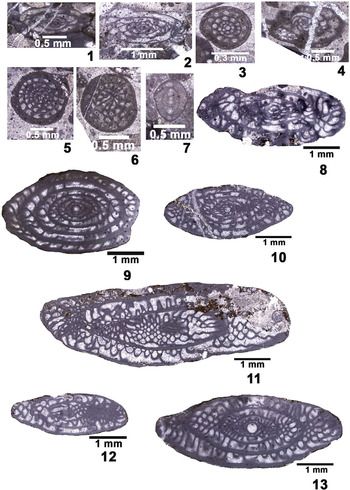
Lower Permian fusulinids and calcareous algae from the Bagh-e Vang Formation, Shesh Angosht section, in east-central Iran. (1) Pseudovermiporella nipponica (Endo in Endo and Kanuma, Reference Endo and Kanuma1954), subtangential section, SHB-53-10, ALU-1255; (2) Mizzia yabei (Karpinsky, Reference Karpinsky1909) emend. Pia, Reference Pia1920, transverse section, SHB-53-11, ALU-1256; (3–5) Misellina (Brevaxina) dyrenfurthi (Dutkevich, Reference Dutkevich and Likharev1939), (3) subtransverse section, SHB-1-2-3, ALU-1261, (4) subaxial section, SHB-1-12-5, ALU-1263, (5) oblique section, SHB-1-8-3, ALU-1262; (6–8) Neofusulinella? pseudogiraudi (Sheng, Reference Sheng1963), (6) transverse section, SHB-1-5-2, ALU-1264, (7) subtransverse section, SHB-1-8-2, ALU-1265, (8) subaxial section, SHB-7-1, ALU-1270; (9) Toriyamaia sp., oblique section, SHB-14-1, ALU-1274; (10) Misellina (Misellina) cf. M. (M.) termieri (Deprat, Reference Deprat1915), subaxial section, SHB-53-4, ALU-1277; (11) Chalaroschwagerina? vulgaris (Schellwien in Schellwien and Dyhrenfurth, Reference Schellwien and Dyhrenfurth1909), oblique section, SHB-4-1-2, ALU-1278; (12, 13). Sakmarella sp., (12) oblique section, SHB-1-4-2, ALU-1279; (13) subtransverse section, SHB-6-12-1, ALU-1280; (14) Leeina isomie (Igo, Reference Igo1965), subtransverse section, SHB-6-6-5, ALU-1288; (15) Leeina sp., transverse section, SHB-6-1-1, ALU-1281; (16) Darvasites (Alpites) sinensis (Chen, Reference Chen1934), axial section, SHB-1-7-4, ALU-1282.

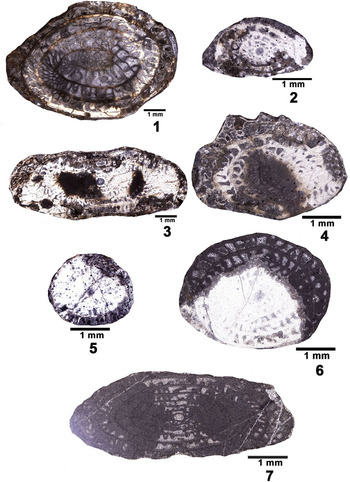
Lower Permian fusulinids from the Bagh-e Vang Formation, Shesh Angosht section, in east-central Iran. (1–6) Cuniculinella vulgarisiformis (Morikawa, Reference Morikawa1952), (1) oblique subaxial section, SHB-6-16-1, ALU-1292, (2) oblique section, SHB-6-17-1, ALU-1293, (3) subaxial section, SHB-6-18-1, ALU-1295, (4) axial section, SHB-6-19-1, ALU-1296, (5) subaxial section, SHB-6-20-1, ALU-1297, (6) subaxial section, SHB-6-24-2, ALU-1298; (7) Leeina isomie (Igo, Reference Igo1965), subaxial section, SHB-6-9-1, ALU-1289.

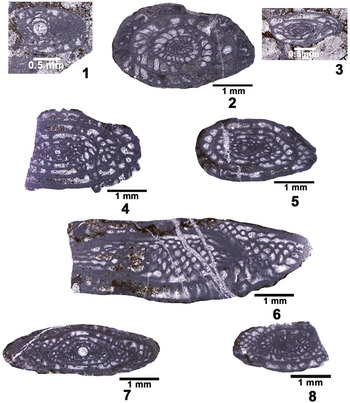
Lower Permian fusulinids from the Bagh-e Vang Formation, Shesh Angosht section, in east-central Iran. (1) Cuniculinella hawkinsiformis (Igo, Reference Igo1965), axial section, SHB-6-2-2, ALU-1283; (2) Praeskinnnerella sp., subaxial section, SHB-6-32-3, ALU-1302; (3–5) Cuniculinella sp., (3) axial section, partly silicified, SHB-6-31-2, ALU-1305, (4) axial section, SHB-6-38-1, ALU-1307, (5) axial section, SHB-6-31-3, ALU-1306; (6) Cuniculinella vulgarisiformis (Morikawa, Reference Morikawa1952), axial section, SHB-6-34-2, ALU-1309; (7, 8) Cuniculinella tumida Skinner and Wilde, Reference Skinner and Wilde1965a, (7) oblique axial section, SHB-8-3-2, ALU-1312, (8) oblique subaxial section, SHB-8-4-2, ALU-1314.

Lower Permian fusulinids from the Bagh-e Vang Formation, Shesh Angosht section, in east-central Iran. (1, 2) Cuniculinella tumida Skinner and Wilde, Reference Skinner and Wilde1965a, (1) axial section, SHB-8-11-1, ALU-1317, (2) axial section, SHB-8-12-2, ALU-1319; (3) Chalaroschwagerina globosa (Schellwien in Schellwien and Dyhrenfurth, Reference Schellwien and Dyhrenfurth1909), axial section, SHB-8-6-2, ALU-1320; (4) Cuniculinella vulgarisiformis (Morikawa, Reference Morikawa1952), axial section, SHB-8-9-1-1, ALU-1322; (5, 6) Chalaroschwagerina? vulgaris (Schellwien in Schellwien and Dyhrenfurth, Reference Schellwien and Dyhrenfurth1909), (5) axial section, SHB-9-3-1, ALU-1334, (6) subaxial section, SHB-9-10-2, ALU-1335; (7) Cuniculinella vulgarisiformis (Morikawa, Reference Morikawa1952), axial section, SHB-9-5-1, ALU-1336; (8) Cuniculinella globosaeformis (Leven, Reference Leven1967), oblique axial section, SHB-9-17-1, ALU-1343.
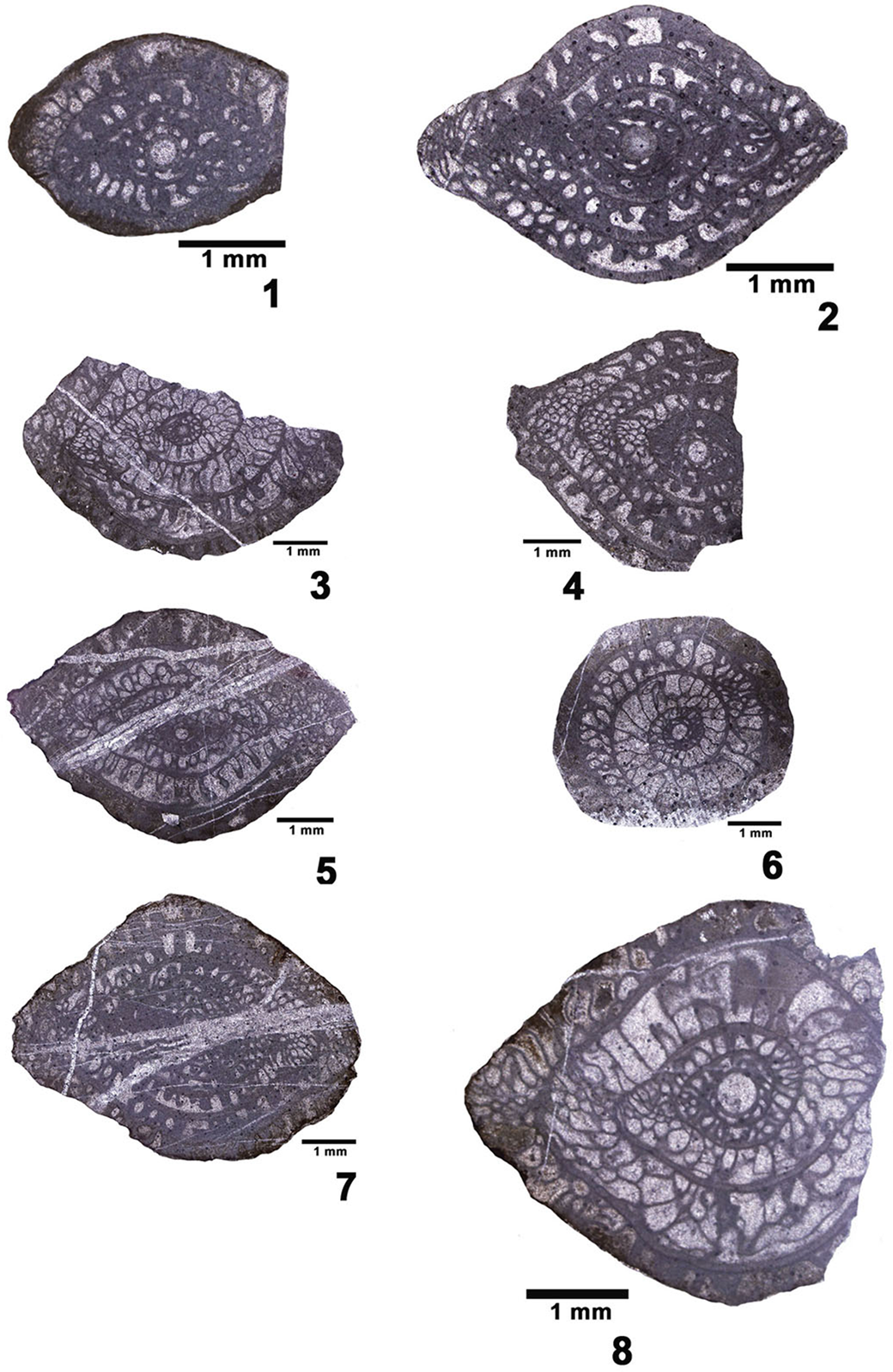
Lower Permian fusulinids from the Bagh-e Vang Formation, Shesh Angosht section, in east-central Iran. (1) Chalaroschwagerina? vulgaris (Schellwien in Schellwien and Dyhrenfurth, Reference Schellwien and Dyhrenfurth1909), subaxial section, SHB-9-22-1, ALU-1350; (2) Cuniculinella vulgarisifomis (Morikawa, Reference Morikawa1952), oblique axial section, SHB-9-22-2, ALU-1351; (3, 4) Cuniculinella spp.; (3) transverse section, SHB-12-8-1, ALU-1348, (4) transverse section, SHB-9-23-1, ALU-1347; (5) Leeina fusiformis (Schellwien in Schellwien and Dyhrenfurth, Reference Schellwien and Dyhrenfurth1909), subaxial section, SHB-12-2-1, ALU-1352; (6) Leeina isomie (Igo, Reference Igo1965), axial section, SHB-19-1, ALU-1353; (7, 8) Cuniculinella cf. turgida Skinner and Wilde, Reference Skinner and Wilde1965a, (7) axial section, SHB-9-19-1, ALU-1344. (8) subaxial section, SHB-9-20-1, ALU-1345.

Remarks
A mid-Bolorian age is suggested here for this biozone because of its occurrence between a well-characterized lower Bolorian biozone and an upper Bolorian biozone, but this suggestion can be debated because, so far, Cuniculinella has not been mentioned, either in Leven's work in Darvaz (e.g., Leven et al., Reference Leven, Leonova and Dmitriev1992) or in the Bolorian stratotype by Angiolini et al. (Reference Angiolini, Campagna, Borlenghi, Grunt, Vachard, Vezzoli and Zanchi2016). In this case, this local zone corresponds either to the top of the Misellina (Brevaxina) dyhrenfurthi Zone (i.e., upper lower Bolorian); or to the lower part of the Misellina (Brevaxina) parvicostata Zone (i.e., lower upper Bolorian).
Biozone 4
Misellina (Misellina) cf. M. (M.) termieri Zone
Definition
This appearance zone is characterized by the FO/FAD of Misellina (Misellina) cf. M. (M.) termieri (Deprat, Reference Deprat1915). It is 12 m thick in the Bagh-e Vang section and 1 m thick in the Shesh Angosht section.
Distribution
This biozone extends from BA-47 to BA-62 in the Bagh-e Vang section and occurs in the Shesh Angosht section in SHB-53.
Composition
The microproblematica, smaller foraminifers, fusulinids, and cyanobacteria occurring in this zone in Bagh-e Vang section are: Tubiphytes obscurus; Palaeotextularia sp.; Deckerella sp.; Climacammina sp.; Globivalvulina ex gr. G. bulloides; Hemigordiellina sp.; Agathammina sp.; Pachyphloia sp.; Nankinella cf. N. nagatoensis Toriyama, Reference Toriyama1958; Schubertella spp.; Toriyamaia sp.; Leeina isomie; Misellina (Misellina) cf. M. (M.) termieri; and M. (M.) sp. (Figs. 5, 7). The microproblematica, smaller foraminifers, and fusulinids occurring in this zone in Shesh Angosht section are: Archaeolithoporella hidensis; A. sp.; Mizzia yabei (Karpinsky, Reference Karpinsky1909) emend. Pia, Reference Pia1920; Eotuberitina reitlingerae; Lasiodiscus ex gr. L. tenuis Reichel, Reference Reichel1946; Endothyra sp.; Palaeotextularia sp.; Deckerella sp.; Climacammina sp.; Tetrataxis sp.; Globivalvulina sp.; Pseudovermiporella nipponica; P. cf. P. sodalica Elliott, Reference Elliott1958; Schubertella sp.; Neofusulinella? pseudogiraudi; Toriyamaia sp.; Leeina fusiformis; L. isomie; and Misellina (Misellina) cf. M. (M.) termieri (Figs. 9, 10).
Remarks
Our Misellina (Misellina) cf. M. (M.) termieri is not necessarily the M. (M.) aff. M. (M.) termieri in the sense of Leven and Vaziri Moghaddam (Reference Leven and Vaziri Moghaddam2004, pl. 6, fig. 7), but most probably something similar to Misellina (Misellina) claudiae (Deprat, Reference Deprat1915) in the sense of Leven and Vaziri Moghaddam (Reference Leven and Vaziri Moghaddam2004, pl. 6, fig. 3), which was found by these authors in the same sample as Misellina (Brevaxina) parvicostata (pl. 6, figs. 4, 8–10) and is the zonal marker of the upper Bolorian. Inversely, if our Misellina (Misellina) cf. M. (M.) termieri is the M. (M.) aff. M. (M.) termieri in the sense of Leven and Vaziri Moghaddam (Reference Leven and Vaziri Moghaddam2004), this last local biozone 4 could be lower Kubergandian in age. However, that is unlikely, due to the absence of associated Armenina found by Leven and Vaziri Moghaddam (Reference Leven and Vaziri Moghaddam2004).
Materials and methods
For the biostratigraphic study, 62 and 49 samples were collected from the Bagh-e Vang Formation in the Bagh-e Vang and Shesh Angosht sections, respectively. In order to study smaller foraminifers and algae, 128 thin sections were prepared as well as 250 oriented thin sections for fusulinid identification. The biostratigraphical analyses and biozones described in this study have been established following Salvador (Reference Salvador1994), Armstrong and Brasier (Reference Armstrong and Brasier2008), and Owen (Reference Owen2009), with references therein. Taxonomically, we have followed the classification of Vachard (Reference Vachard and Montenari2016, Reference Vachard, Lucas and Shen2018) for the Paleozoic foraminifers and that of Vachard et al. (Reference Vachard, Hauser, Martini, Zaninetti, Matter and Peters2001a) and Vachard (Reference Vachard, Lucas and Shen2018) for the Paleozoic cyanobacteria, calcareous algae, and microproblematica. In the regional biozones established here, the lower boundary of each zone is defined by the presence of a characteristic assemblage or a characteristic taxon. The upper boundary is generally conventional and placed under the base of next zone. The ranges of markers of biozones were mainly compiled from Leven (Reference Leven1970, Reference Leven1993a, b, Reference Leven1997, Reference Leven1998), Leven et al. (Reference Leven, Leonova and Dmitriev1992), Leven and Vaziri Moghaddam (Reference Leven and Vaziri Moghaddam2004), Davydov et al. (Reference Davydov, Krainer and Chernykh2013), and Krainer et al. (Reference Krainer, Vachard and Schaffhauser2019). In this research, specimens larger than 1 mm are considered large in size, those between 500 μm and 1000 μm are medium in size, and those less than 500 μm are small in size.
Repository and institutional abbreviation
The prepared thin sections are housed in the Paleontology Repository of Lorestan University, Iran (Collection ALU-900–ALU-1353).
Systematic micropaleontology
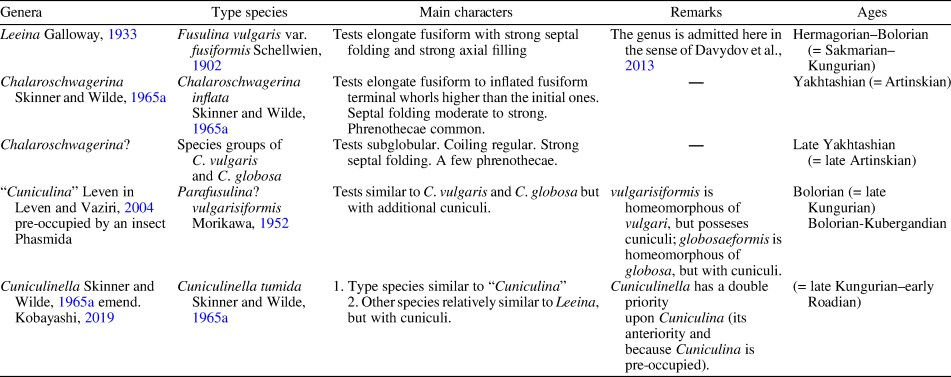
This section describes foraminiferal taxa that are biostratigraphically interesting. The main nomenclatural problem is a taxon called Cuniculina or Cuniculinella (in part) in the literature, the most advanced forms of chalaroschwagerinids exhibiting cuniculi.
The abbreviations used are as follows: w = width; D = diameter; h = height of last whorl; s = wall thickness.
Subkingdom Rhizaria Cavalier-Smith, Reference Cavalier-Smith2002
Phylum Foraminifera d'Orbigny, Reference Orbigny1826 emend. Cavalier-Smith, Reference Cavalier-Smith2003
Class Fusulinata Maslakova, Reference Maslakova and Menner1990 nom. translat. Gaillot and Vachard, Reference Gaillot and Vachard2007 emend. Vachard, Krainer, and Lucas, Reference Vachard, Krainer and Lucas2013
Subclass Fusulinana Maslakova, Reference Maslakova and Menner1990 nom. correct. Vachard, Pille, and Gaillot, Reference Vachard, Pille and Gaillot2010 emend. Vachard, Reference Vachard and Montenari2016
Order Endothyrida Fursenko, Reference Fursenko1958
Suborder Endothyrina Bogush, Reference Bogush1985
Superfamily Bradyinoidea Rauzer-Chernousova et al., Reference Rauzer-Chernousova, Bensh, Vdovenko, Gibshman, Leven, Lipina and Chediya1996
Family Bradyinidae Reitlinger, Reference Reitlinger1950 nom. translat. Reitlinger, Reference Reitlinger1958
Genus Bradyina Möller, Reference Möller1878
Type species
Bradyina nautiliformis Möller, Reference Möller1878; subsequently designated by Cushman (Reference Cushman1928).
Other species
See Morozova (Reference Morozova1949); Reitlinger (Reference Reitlinger1950); and Pinard and Mamet (Reference Pinard and Mamet1998).
Diagnosis
Tests free, nautiloid, involute, and planispirally coiled, with a few whorls and chambers. Septa short with additional, longer and thinner, pre- and post-septal lamellae. Alveolar wall overlain by a continuous tectum. Simple aperture becomes cribrate in the last chamber. Additional sutural pores present.
Occurrence
Upper Visean (Poty et al., Reference Poty, Devuyst and Hance2006; Somerville, Reference Somerville2008; Hance et al., Reference Hance, Hou and Vachard2011) to upper Cisuralian (Baryshnikov et al., Reference Baryshnikov, Zolotova and Kosheleva1982; Filimonova, Reference Filimonova2010; Vachard, Reference Vachard, Lucas and Shen2018). Our study makes it possible to establish that the LAD of Bradyina is definitively upper Yakhtashian. The Guadalupian and Lopingian species assigned to Bradyina belong in reality to Postendothyra (see Hance et al., Reference Hance, Hou and Vachard2011; Vachard, Reference Vachard, Lucas and Shen2018). The genus Bradyina was Paleotethyan and Panthalassan in the Upper Mississippian, and cosmopolitan since the Lower Pennsylvanian (e.g., Mamet, Reference Mamet1970; Hance et al., Reference Hance, Hou and Vachard2011; Vachard, Reference Vachard, Lucas and Shen2018).
Bradyina spp.
Figure 3.3–3.6, 3.9, 3.10
Remarks
The exact LAD of Bradyina was discussed in Vachard (Reference Vachard, Lucas and Shen2018) and Krainer et al. (Reference Krainer, Vachard and Schaffhauser2019). Our material makes it possible to establish that this LAD is upper Yakhtashian in age because representatives of this genus are still numerous in samples BA-4 and BA-5, but are absent from younger samples, despite the paleoenvironments remaining identical (i.e., a shallow carbonate platform).
Suborder Palaeotextulariina Hohenegger and Piller, Reference Hohenegger and Piller1975 emend. Vachard, Reference Vachard and Montenari2016
Superfamily Endoteboidea Vachard, Krainer, and Lucas, Reference Vachard, Krainer and Lucas2013
Family Endotebidae Vachard et al., Reference Vachard, Martini, Rettori and Zaninetti1994
Genus Endoteba Vachard and Razgallah, Reference Vachard and Razgallah1988
Type species
Endoteba controversa Vachard and Razgallah, Reference Vachard and Razgallah1988, by original designation.
Other species
See Vachard and Razgallah (Reference Vachard and Razgallah1988) and Vachard et al. (Reference Vachard, Martini, Rettori and Zaninetti1994).
Diagnosis
Endothyroidally coiled Palaeotextulariina with faint deviations of the axis. Wall brownish, microgranular with a calcareous, or rarely siliceous, agglutinate. Aperture terminal, basal simple.
Occurrence
The genus Endoteba first occured in the upper Cisuralian (Vachard et al., Reference Vachard, Martini and Zaninetti2001b; Vachard, Reference Vachard, Lucas and Shen2018; Krainer et al., Reference Krainer, Vachard and Schaffhauser2019; and this paper). It was recently mentioned in the Kubergandian (lower Guadalupian) of Japan (Kobayashi, Reference Kobayashi2019). It becomes abundant in the Capitanian (upper Guadalupian), is rare in the Lopingian and Lower Triassic, and diversifies again in the Middle Triassic (Vachard et al., Reference Vachard, Martini, Rettori and Zaninetti1994).
Endoteba sp.
Figure 3.11
Remarks
There was a question about the exact FAD of Endoteba (see Vachard et al., Reference Vachard, Martini and Zaninetti2001b and Vachard, Reference Vachard, Lucas and Shen2018). Our samples indicate a FO (first local occurrence), and probable FAD (oldest occurrence), of this genus in the upper Yakhtashian of central Iran.
Class Miliolata Saidova, Reference Saidova1981
Order Cornuspirida Mikhalevich, Reference Mikhalevich1980
Superfamily Cornuspiroidea Bogdanovich in Subbotina et al., Reference Subbotina, Voloshinova and Azbel1981
Family Hemigordiidae Reitlinger in Vdovenko et al., Reference Vdovenko, Rauzer-Chernousova, Reitlinger and Sabirov1993
Genus Agathammina Neumayr, Reference Neumayr1887
Type species
Serpula pusilla Geinitz in Geinitz and Gutbier, Reference Geinitz and Gutbier1848, by original designation.
Other species
See Zolotova and Baryshnikov (Reference Zolotova, Baryshnikov, Rauzer-Chernousova and Chuvashov1980) and Gaillot and Vachard (Reference Gaillot and Vachard2007).
Diagnosis
Test formed by the coiling of an undivided tubular chamber similar to that of the eosigmoilinid archaediscoids and not, as classically indicated, to miliolid chambers with a quinqueloculine coiling. Wall porcelaneous. Aperture terminal and simple.
Occurrence
The Permian FAD and LAD of this genus, relatively common from Capitanian to Changhsingian, are poorly known; its so-called Triassic survivors are now assigned to other genera.
Agathammina sp.
Figures 3.23, 9.9
Remarks
As indicated by Gaillot and Vachard (Reference Gaillot and Vachard2007), the transitional form between Hemigordiellina and Agathammina seems to be Glomospira parapusilliformis Baryshnikov in Zolotova and Baryshnikov, Reference Zolotova, Baryshnikov, Rauzer-Chernousova and Chuvashov1980, which is Kungurian in age. Our samples indicate a FO (and probable FAD) of this genus in the upper Bolorian; this datum is relevant to a problem mentioned by Gaillot and Vachard (Reference Gaillot and Vachard2007, p. 87) and Vachard (Reference Vachard, Lucas and Shen2018, p. 221) concerning the exact age of the FAD of the genus Agathammina.
Family Neodiscidae Lin, Reference Lin1984 nom. translat. and emend. Gaillot and Vachard, Reference Gaillot and Vachard2007
Genus Uralogordiopsis Vachard in Krainer, Vachard, and Schaffhauser, Reference Krainer, Vachard and Schaffhauser2019
Type species
Uralogordiopsis grozdilovae Vachard in Krainer, Vachard, and Schaffhauser, Reference Krainer, Vachard and Schaffhauser2019, by original designation.
Other species
See Krainer et al. (Reference Krainer, Vachard and Schaffhauser2019).
Diagnosis
Planispiral, lenticular, and often biumbilicate. Proloculus is followed by an undivided tubular chamber with a high lumen and poorly developed buttresses. Porcelaneous wall generally well preserved and amber-colored. Aperture terminal and simple.
Occurrence
Cisuralian of the Urals, Carnic Alps, and Mexico; Kubergandian of Japan and northern Afghanistan; Upper Murgabian of Japan; Guadalupian of Transcaucasia; ?Guadalupian of Yunnan (according to Krainer et al., Reference Krainer, Vachard and Schaffhauser2019).
Remarks
Uralogordiopsis differs from Hemigordius by the bilayered wall and the much larger size, and from Uralogordius Gaillot and Vachard, Reference Gaillot and Vachard2007 (= Arenovidalina sensu Baryshnikov et al., Reference Baryshnikov, Zolotova and Kosheleva1982) (Vachard et al., Reference Vachard, Flores de Dios, Buitrón and Grajales2000a, p. 9; Vachard and Bouyx, Reference Vachard and Bouyx2001; not Ho, Reference Ho1959) by the planispiral coiling entirely evolute and the discoid profile.
Uralogordiopsis spp.
Figure 9.4–9.7, 9.14, 9.15
Remarks
We have found Uralogordiopsis cf. U. ovatus (Grozdilova, Reference Grozdilova1956) and U. longus (Grozdilova, Reference Grozdilova1956) in sample SHB-6, and U. permicus (Grozdilova, Reference Grozdilova1956) in samples SHB-6 and SHB-8. Such biodiversity in a few beds of the studied section indicates an acme and diversification of this genus in the mid-Bolorian Cuniculinella sp. Zone. This local datum is possibly a general datum for the genus Uralogordiopsis, recently described by Vachard in Krainer et al. (Reference Krainer, Vachard and Schaffhauser2019), and still poorly known.
Order Fusulinida Fursenko, Reference Fursenko1958
Suborder Staffellina Zhang et al., Reference Zhang, Wang and Wang1981 emend. Vachard, Reference Vachard and Montenari2016
Superfamily Staffelloidea Miklukho-Maklay, Reference Miklukho-Maklay1949 nomen translat. Solovieva, Reference Solovieva1978
Family Nankinellidae Miklukho-Maklay, Reference Miklukho-Maklay1963
Genus Nankinella Lee, Reference Lee1934
Type species
Staffella discoides Lee, Reference Lee1931, by original designation.
Other species
See Sheng (Reference Sheng1963); Rozovskaya (Reference Rozovskaya1975); Wang et al. (Reference Wang, Sheng and Zhang1981); and Zhang (Reference Zhang1982).
Diagnosis
Tests lenticular to rhombic, carinate, and moderate- to large-sized. Planispiral and involute, with planar septa, and faint pseudochomata. The wall, originally aragonitic, becomes secondarily completely microsparitized. Aperture terminal and simple.
Occurrence
Guadalupian–Lopingian; on the Palaeotethyan, Neotethyan, and Panthalassan shelves.
Nankinella cf. N. nagatoensis Toriyama, Reference Toriyama1958
Figure 5.7
- Reference Toriyama1958
Nankinella nagatoensis Toriyama, p. 65, pl. 6, figs. 5–13.
- Reference Toriyama1958
Nankinella spp.; Toriyama, p. 68, pl. 6, figs 14, 15 (fide Kobayashi, Reference Kobayashi2019).
- Reference Ishizaki1962
Nankinella nagatoensis; Ishizaki, p. 137, pl. 7, figs. 2, 3.
- Reference Kahler and Kahler1966
Nankinella nagatoensis; Kahler and Kahler, p. 57.
- Reference Leven1998
Nankinella nagatoensis; Leven, pl. 1, fig. 19.
- Reference Zhang and Hong1998
Nankinella nagatoensis; Zhang and Hong, p. 209, pl. 2, figs. 15–17.
- Reference Kobayashi2012
Nankinella nagatoensis; Kobayashi, fig. 6.40, 6.41, 6.52.
- Reference Kobayashi2017
Nankinella nagatoensis; Kobayashi, p. 33, pl. 1, figs. 51–54.
- Reference Kobayashi2019
Nankinella nagatoensis; Kobayashi, p. 58, pl. 3, figs. 21–30, 34–36.
Holotype
Axial section (No. GK.D1623, Loc. 497, Department of Geology, Kyushu University) from the Cisuralian of Akiyoshi (Loc. 4E97), Japan (Toriyama, Reference Toriyama1958, pl. 6, figs. 8, 13, which is the same specimen in two magnifications).
Occurrence
Guadalupian of Japan (Akiyoshi Group; Toriyama, Reference Toriyama1958), Transcaucasia (Asni Fm; Leven, Reference Leven1998), and South China (Zhang and Hong, Reference Zhang and Hong1998). It is found in the upper Bolorian Misellina (Misellina) cf. M. (M.) termieri Zone of the Bagh-e Vang section (sample BA-55).
Description
Species are relatively small for the genus, subrhomboidal or rarely inflated lenticular, with a few whorls and an exceptionally narrow whorl section in axial section. Measurements: D = 770–1250 μm; w = 500–540 μm; w/D = 0.40–0.77; proloculus diameter = 55 μm; number of whorls = 3–5; h = 250 μm; s = 20 μm.
Remarks
Our specimens are smaller than the type material of Toriyama (Reference Toriyama1958) and that of Kobayashi (Reference Kobayashi2019) from Japanese localities, but, characteristically, they show the highest whorl profile immediately above the tunnel and decreasing in height poleward.
Suborder Fusulinina Wedekind, Reference Wedekind1937 nom. correct. Loeblich and Tappan, Reference Loeblich and Tappan1961 emend. Vachard, Reference Vachard and Montenari2016
Superfamily Schubertelloidea Vachard in Vachard, Clift, and Decrouez, Reference Vachard, Clift and Decrouez1993
Diagnosis
According to Vachard (Reference Vachard and Montenari2016), tests are small- to medium-sized, short fusifom, and inflated fusiform to elongate fusiform. Spherical proloculi testify to generations A and B. Juvenaria generally lenticular and perpendicular to the adult whorls. Primitive forms of schubertelloids, such as Schubertina Marshall, Reference Marshall1969 emend. Davydov, Reference Davydov2011 (= Eoschubertella of the authors, non Thompson, Reference Thompson1937; see discussion in Ghazzay-Souli et al., Reference Ghazzay-Souli, Vachard and Razgallah2015, p. 257), have a unilayered, dark, microgranular wall, but, typically, the wall is bilayered with an outer, dark, microgranular tectum and an inner, thicker, yellowish, microgranular layer, called the protheca. Septa planar in the central parts of the chambers and faintly to moderately folded at the poles. Chomata small to moderate. Cuniculi very rarely conspicuous.
Occurrence
Mid-Bashkirian to upper Lopingian; with endemic or cosmopolitan genera.
Family Schubertellidae Miklukho-Maklay, Rauzer-Chernousova, and Rozovskaya, Reference Miklukho-Maklay, Rauzer-Chernousova and Rozovskaya1958 emend. Leven, Reference Leven1987
Subfamily Schubertellinae Skinner, Reference Skinner1931
Genus Schubertella Staff and Wedekind, Reference Staff and Wedekind1910 emend. Sheng, Reference Sheng1963
Type species
Schubertella transitoria Staff and Wedekind, Reference Staff and Wedekind1910, by subsequent designation by Thompson (Reference Thompson1937) due to the initial monotypy (see Dunbar and Henbest, Reference Dunbar and Henbest1942; Kahler in Ebner and Kahler, Reference Ebner and Kahler1989).
Other species
See Kahler and Kahler (Reference Kahler and Kahler1966); Rozovskaya (Reference Rozovskaya1975); Leven et al. (Reference Leven, Leonova and Dmitriev1992); and Davydov (Reference Davydov2011).
Diagnosis
Test shortly fusiform, often asymmetrical. Early stage discoidal and forms a juvenarium perpendicular to the later stage, which is more or less fusiform, with acute poles. Septa numerous, unfluted in the center of the chambers and slightly fluted at the poles, especially in the outer whorls. Chomata low, asymmetrical, bordering a broad and low tunnel. Wall bilayered with an outer tectum and a protheca. Primitive forms (Schubertina or Eoschubertella of the authors) exhibit only the dark tectum. Advanced forms (Dutkevitchites, Oketaella, and Biwaella) show tectum and an inner porous layer. Aperture terminal and simple.
Occurrence
Bashkirian–lower Moscovian forms belong more probably to the genus Schubertina (or Eoschubertella of the authors), whereas typical representatives are distributed from the upper Moscovian (only lower Virgilian in North America; according to Sanderson et al., Reference Sanderson, Verville, Groves and Wahlman2001) to Lopingian. Schubertella is cosmopolitan from the Moscovian to the Wordian (see Rauzer-Chernousova et al., Reference Rauzer-Chernousova, Gryzlova, Kireeva, Leontovich, Safonova and Chernova1951; Skinner and Wilde, Reference Skinner, Wilde, Skinner and Wilde1966a, Reference Skinner and Wildeb; Leven, Reference Leven1998; Davydov, Reference Davydov2011); then, it is only Paleotethyan.
Schubertella ex gr. S. paramelonica Suleimanov, Reference Suleimanov1949
Figure 4.22
- Reference Suleimanov1949
Schubertella paramelonica Suleimanov, p. 31, pl.1, fig.5.
- Reference Krainer, Vachard and Schaffhauser2019
Schubertella paramelonica; Vachard in Krainer et al., p. 66, pl. 16, figs. 2?, 7, 8, 10? (with 22 references in synonymy).
Holotype
Axial section (No. 3494, Institute of Geological Sciences, Academy of Sciences of the SSSR), from the Sakmarian (lower Tastubian) of Shak-Tau Hill, Russia (Suleimanov, Reference Suleimanov1949, pl. 1, fig. 5).
Occurrence
Cisuralian of southern Urals, Darvaz, Slovenia (as mentioned by Forke, Reference Forke2002), Artinskian of Japan (Ueno, Reference Ueno1996). Yakhtashian–Bolorian of the Carnic Alps (Krainer et al., Reference Krainer, Vachard and Schaffhauser2019) and found in the upper Yakhtashian of the Bagh-e Vang section (sample BA-4).
Description
Shell is large for the genus, fusiform to ovoid with variable shapes of the lateral slopes, and broadly rounded to more or less truncated axial regions. The small and spherical proloculus is followed by a small juvenarium, nautiloid, and deviated at ~60° compared to the adult whorls. The septa are almost planar. The chomata are relatively well developed, especially in the penultimate and last whorls. Measurements: D = 500–700 μm; w = 675–1000 μm; w/D = 1.35–1.43; proloculus diameter = 30 μm; number of whorls = 4; h = 150 μm; s = 10 μm.
Remarks
Compared to the type material of Suleimanov (Reference Suleimanov1949), our specimens are smaller and have fewer whorls and a thinner wall.
Schubertella aff. S. exilis Suleimanov, Reference Suleimanov1949
Figure 5.1, 5.2
- Reference Suleimanov1949
Schubertella kingi var. exilis Suleimanov, p. 33, pl. 1, figs. 11–13.
- Reference Wang, Sheng and Zhang1981
Schubertella kingi var. exilis; Wang et al., p. 19, pl. 12, figs. 4, 5, 12.
- Reference Zhang1982
Schubertella kingi exilis; Zhang, p. 145, pl. 2, fig. 22.
- Reference Krainer, Vachard and Schaffhauser2019
Schubertella exilis; Vachard in Krainer et al., p. 65, pl. 15, figs. 11–17, pl.16, fig. 1, pl. 17, figs. 1, 2 (with 21 references in synonymy).
Holotype
Axial section (No. 7637; Institute of Geologic Sciences, Academy of Sciences of the SSSR), from Sakmarian of Preurals, Russia (Suleimanov, Reference Suleimanov1949, pl. 1, fig. 11).
Occurrence
Cisuralian of the Paleotethys and Urals Ocean shelves (Krainer et al., Reference Krainer, Vachard and Schaffhauser2019), lower Yakhtashian (Zweikofel Fm and Zottachkopf Fm) of the Carnic Alps (Davydov et al., Reference Davydov, Krainer and Chernykh2013; Krainer et al., Reference Krainer, Vachard and Schaffhauser2019), and found in the upper Yakhtashian of the Bagh-e Vang section (sample BA-5).
Description
The elongate species of Schubertella correspond to the group of S. kingi Dunbar and Skinner, Reference Dunbar and Skinner1937. In this group, S. exilis is a relatively small and biconvex species. Measurements: D = 610–800 μm; w = 1200–2000 μm; w/D = 2.00–2.50; proloculus diameter = 20–25 μm; number of whorls = 4–5; h = 100–200 μm; s = 10 μm.
Remarks
Compared to the type material of Suleimanov (Reference Suleimanov1949), our specimens have a thinner wall and a smaller proloculus diameter.
Genus Neofusulinella Deprat, Reference Deprat1912b
Type species
Neofusulinella lantenoisi Deprat, Reference Deprat1913, by subsequent designation (Thompson, Reference Thompson1934, not Galloway and Ryniker, Reference Galloway and Ryniker1930).
Other species
See Kahler and Kahler (Reference Kahler and Kahler1966); Rozovskaya (Reference Rozovskaya1975); and Leven et al. (Reference Leven, Leonova and Dmitriev1992).
Diagnosis
Test fusiform, medium-sized, with planar septa only folded in the polar extremities. Chomata moderately developed. Wall typically schubertelloid with dark tectum and yellowish primatheca. Aperture terminal and simple.
Occurrence
Bolorian–Murgabian (= Kungurian–Wordian) of the Paleotethyan shelves (Leven et al., Reference Leven, Leonova and Dmitriev1992).
Genus Neofusulinella?
Remarks
Apparently, several representatives of the group Schubetella paramelonica were called Mesoschubertella by Ueno (Reference Ueno1996) (see below). On the other hand, Leven (Reference Leven1987) considered Mesoschubertella Kanuma and Sakagami, Reference Kanuma and Sakagami1957 as transitional between Schubertella and Yangchienia Lee, Reference Lee1934 (see Leven, Reference Leven1987, pl. 2, fig. 5), whereas the Mesoschubertella of Ueno (Reference Ueno1996) are obviously transitional between Schubertella and Neofusulinella Deprat, Reference Deprat1912b. Such forms, which are transitional between S. paramelonica and Neofusulinella giraudi (Deprat, Reference Deprat1915), are known from the upper Yakhtashian–Bolorian of Japan, Iran, and Darvaz (Uzbekistan), Pamir (Tajikistan), Thailand, and North and South China (Leven, Reference Leven1987; Ueno, Reference Ueno1996; Leven and Vazari Moghaddam, Reference Leven and Vaziri Moghaddam2004). We infer also that this transitional stage is present in Guatemala with Neofusulinella? muelleriedi (Thompson and Miller, Reference Thompson and Miller1944), as redescribed by Vachard et al. (Reference Vachard, Fourcade, Romero, Mendez, Cosillo, Alonzo, Requeña, Azema and Cros1997), Davydov (Reference Davydov2011), and Granier et al. (Reference Granier, Basso and Vachard2017).
Neofusulinella? pseudogiraudi (Sheng, Reference Sheng1963 non 1962)
Figure 10.6–10.8
- Reference Sheng1962
Schubertella pseudogiraudi Sheng, p. 427, pl. 1, figs. 8, 9 (holotype not designated).
- Reference Sheng1963
Schubertella pseudogiraudi Sheng, p. 159, pl. 4, figs. 14–19.
- Reference Sheng1965
Schubertella pseudogiraudi; Sheng, p. 566, pl. 5, figs. 15–17.
- Reference Kahler and Kahler1966
Schubertella pseudogiraudi; Kahler and Kahler, p. 211.
- Reference Rozovskaya1975
Schubertella (Schubertella) pseudogiraudi; Rozovskaya, p. 13.
- Reference Lin, Li, Chen, Zhou and Zhang1977
Schubertella pseudogiraudi; Lin et al., p. 34, pl. 6, fig. 20.
- Reference Chen and Wang1978
Schubertella pseudogiraudi; Chen and Wang, p. 26, pl. 3, figs. 36, 37.
- Reference Liu, Xiao and Dong1978
Schubertella pseudogiraudi; Liu, Xiao, and Dong, p. 20, pl. 2, fig. 4.
- Reference Igo, Rajah and Kobayashi1979
Schubertella pseudogiraudi; Igo et al., pl. 17, figs. 9, 10, pl. 18, figs. 11–14.
- Reference Zhou1982
Schubertella pseudogiraudi; Zhou, p. 230, pl. 1, fig. 10.
- Reference Xie1982
Schubertella pseudogiraudi; Xie, p. 15, pl. 6, fig. 7.
- Reference Zhang1982
Schubertella pseudogiraudi; Zhang, p. 144, pl. 2, figs. 18, 20, 21, 24, 25, 34, 35.
- Reference Zhou1982
Schubertella pseudogiraudi; Zhou, p. 230, pl. 1, fig. 10.
- Reference Zhou and Zhang1984
Schubertella pseudogiraudi; Zhou and Zhang, pl. 2, figs. 12, 13.
- Reference Zhou, Sheng and Wang1987
Schubertella pseudogiraudi; Zhou, Sheng, and Wang, pl. 3, fig. 10.
- Reference Leven1987
Schubertella pseudogiraudi; Leven, pl. 2, fig. 7.
- ?Reference Sun and Zhang1988
Schubertella pseudogiraudi; Sun and Zhang, pl. 1, fig. 7, pl. 2, figs. 15, 18, pl. 3, figs. 3, 13.
- Reference Zhang1992
Schubertella pseudogiraudi; Zhang, pl. 1, figs. 3, 7.
- Reference Ueno and Sakagami1993
Neofusulinella? pseudogiraudi; Ueno and Sakagami, p. 282, fig. 5.11–5.13.
- Reference Partoazar1995
Neofusulinella? pseudogiraudi; Partoazar, pl. 5, figs. 11–13 (from Ueno and Sakagami, Reference Ueno and Sakagami1993).
- Reference Leven and Okay1996
Schubertella pseudogiraudi; Leven and Okay, pl. 9, fig. 13.
- Reference Angiolini, Campagna, Borlenghi, Grunt, Vachard, Vezzoli and Zanchi2016
Neofusulinella pseudogiraudi; Angiolini et al., p. 567, figs. 9E–G, 13A–D, 14H, 15D–F.
Holotype
Axial section (No. 12009, Institute of Geology and Palaeontology, Academia Sinica, Beijing, People's Republic of China) from the Maokou Limestone, near Zisongzheng of Wangmo, Kueichow Province, China (Sheng, Reference Sheng1963, pl. 4, fig. 15).
Occurrence
Bolorian–Murgabian (= Kungurian–Wordian) of eastern Paleotethys (as indicated by the synonymy list, above), Darvaz (Leven, Reference Leven1987), and Turkey (Leven and Okay, Reference Leven and Okay1996). Identified from the lower and mid-Bolorian Misellina (Brevaxina) dyhrenfurthi and Cuniculinella spp. zones of the Shesh Angosht section (samples SHB-1 and SHB-7).
Description
The test is fusiform, moderately sized, and primitive for the genus; it is harmoniously vaulted in the central regions and bluntly pointed in the polar regions. The septa are planar, and only folded in the polar extremities, but more than in Schubertella. The proloculus is spherical. The first whorl is deviated, like many schubertellids. Moderate chomata are present in all of the whorls. The tunnel is low, but relatively wide. The wall is typically schubertelloid, with a dark tectum and yellowish primatheca. Septal pores are conspicuous. The aperture is terminal and simple. Measurements: D = 500–700 μm; w = 1000 μm; w/D = 2.00; number of whorls = 4–5; proloculus diameter = 20 μm; h = 100–170 μm; s = 50 μm.
Remarks
As indicated by Ueno and Sakagami (Reference Ueno and Sakagami1993), this species is transitional between Schubertella and Neofusulinella. However, due to the symmetrical, fusiform shape, the species closely resembles Neofusulinella. Comparisons with Neofusulinella giraudi were indicated by Sheng (Reference Sheng1963) and Igo et al. (Reference Igo, Rajah and Kobayashi1979) (e.g., smaller w/D ratio, thicker wall, and stronger chomata).
Genus Mesoschubertella Kanuma and Sakagami, Reference Kanuma and Sakagami1957 emend. Rozovskaya, Reference Rozovskaya1975
Type species
Mesoschubertella thompsoni Kanuma and Sakagami, Reference Kanuma and Sakagami1957, by original designation.
Other species
See Rozovskaya (Reference Rozovskaya1975); Leven et al. (Reference Leven, Leonova and Dmitriev1992); Ueno (Reference Ueno1996); and Davydov (Reference Davydov2011).
Diagnosis
Test small, subrhombic to fusiform, with strong chomata and polar folding relatively developed. Aperture terminal and simple with tunnel. Wall schubertelloid with primatheca.
Occurrence
Yakhtashian–Bolorian (= Artinskian–Kungurian) of the Paleotethyan and Panthalassan shelves (see Leven et al., Reference Leven, Leonova and Dmitriev1992; Leven and Vaziri Moghaddam, Reference Leven and Vaziri Moghaddam2004; Kobayashi, Reference Kobayashi2019).
Remarks
The type of wall of Mesoschubertella has been discussed by many authors. We follow the authors Rozovskaya, Reference Rozovskaya1975; Leven et al., Reference Leven, Leonova and Dmitriev1992; Ueno, Reference Ueno1996; Davydov, Reference Davydov2011; and Kobayashi, Reference Kobayashi2019, who consider Mesoschubertella as a taxon possessing a typical schubertellid wall with a primatheca, and not a keriothecal wall, as indicated by Kanuma and Sakagami (Reference Kanuma and Sakagami1957) and Loeblich and Tappan (Reference Loeblich and Tappan1987). Mesoschubertella and Schubertella have such a wall, therefore, the same microstructure; nevertheless, Mesoschubertella morphologically differs by its symmetrical shape, often rhombic, with strong chomata, and slightly more-developed septal folding. Mesoschubertella is relatively characteristic of the Kungurian/Bolorian.
Mesoschubertella spp.
Figure 4.7–4.11
Remarks
Representatives of this genus, although relatively abundant in our material, are left in open nomenclature due to the discussed definition of the genus. This genus is distinguished in the upper Yakhtashian of the Bagh-e Vang section (sample BA-4).
Genus Toriyamaia Kanmera, Reference Kanmera1956
Type species
Toriyamaia laxiseptata Kanmera, Reference Kanmera1956, by original designation.
Other species
See Kahler and Kahler (Reference Kahler and Kahler1966); Rozovskaya (Reference Rozovskaya1975); Leven et al. (Reference Leven, Leonova and Dmitriev1992); Krainer et al. (Reference Krainer, Vachard and Schaffhauser2019).
Diagnosis
Test involute, elongate fusiform, and asymmetrical with weakly deviated juvenarium. Adult stages loosely coiled. Planar septa only gently curved in the polar areas. Wall typical of schubertellid with primatheca. Chomata more distinct than in Schubertella.
Occurrence
?Sakmarian–Artinskian–Kungurian–Guadalupian of the Paleotethys and Panthalassa; very rare in the USA (Texas; Stewart, Reference Stewart1966).
Toriyamaia sp.
Figures 5.4, 10.9
Remarks
Rare sections in our material correspond to an undetermined species of Toriyamaia. Measurements: Diameter = 1400–2000 μm; w = 1300–3000 μm; w/D = 1.50. This taxon, in open nomenclature, was found in the upper Bolorian Misellina (Misellina) cf. M. (M.) termieri Zone of the Bagh-e Vang and Shesh Anghost sections (samples BA-47 and SHB-14).
Family Biwaellidae Davydov, Reference Davydov1984 nom. translat. Leven in Leven et al., Reference Leven, Leonova and Dmitriev1992
Occurrence
Late Pennsylvanian–upper Cisuralian; rare, but probably cosmopolitan.
Remarks
Test schubertelliform, inflated fusiform to elongate fusiform, or subcylindrical, with an inconspicuous juvenarium. Septa weakly folded. Chomata diversely developed. Wall initially dark microgranular becoming porous, perforated and falsely keriothecal in adult whorls. Aperture terminal, simple.
Genus Biwaella Morikawa and Isomi, Reference Morikawa and Isomi1960
Type species
Biwaella omiensis Morikawa and Isomi, Reference Morikawa and Isomi1960, by original designation.
Other species
See Kahler and Kahler (Reference Kahler and Kahler1966); Rozovskaya (Reference Rozovskaya1975); Leven et al. (Reference Leven, Leonova and Dmitriev1992); Davydov (Reference Davydov2011); and Krainer et al. (Reference Krainer, Vachard and Schaffhauser2019).
Diagnosis
Test moderately large and elongate fusiform. Proloculus relatively small, juvenarium absent. Septa planar to slightly folded in the poles. Wall pseudokeriothecal with tectum. Central aperture with tunnel and asymmetrical chomata.
Occurrence
Gzhelian–Cisuralian (Davydov, Reference Davydov2011) or mid-Asselian–lower Bolorian (Leven et al., Reference Leven, Leonova and Dmitriev1992), cosmopolitan. The Gzhelian–Asselian forms assigned to Biwaella often belong to Oketaella because the acme of true Biwaella is generally Sakmarian and Yakhtashian. Moreover, Pasini (Reference Pasini1965, p. 85) indicated that Oketaella and Biwaella may be two generations, megalo- and microspheric, of the same genus. In our opinion, the relationship of both genera is justified, and several species of Biwaella in the literature more probably belong to Oketaella (see Krainer et al., Reference Krainer, Vachard and Schaffhauser2019, p. 70). Rare Bolorian Biwaella were mentioned by Leven et al. (Reference Leven, Leonova and Dmitriev1992) and Leven (Reference Leven1993b).
Biwaella sp.
Figure 6.3
Remarks
Test elliptical with sparsely located chomata and relatively developed septal folding. D = 1300 μm; w = 2000 μm; w/D = 1.53; proloculus diameter = 40 μm; number of whorls = 5. A few specimens were found in the upper Yakhtashian of the Bagh-e Vang section (sample BA-4).
Superfamily Schwagerinoidea Solovieva, Reference Solovieva1978 (as Schwagerinacea)
Family Triticitidae Davydov, Reference Davydov1986 nomen translat. Rauzer-Chernousova et al., Reference Rauzer-Chernousova, Bensh, Vdovenko, Gibshman, Leven, Lipina and Chediya1996
Subfamily Darvasitinae Leven in Leven, Leonova, and Dmitriev, Reference Leven, Leonova and Dmitriev1992 nom. translat. Herein
Genus Darvasites Miklukho-Maklay, Reference Miklukho-Maklay1959
Subgenus Alpites Davydov, Krainer, and Chernykh, Reference Davydov, Krainer and Chernykh2013
Type species
Fusulina contracta Schellwien in Schellwien and Dyhrenfurth, Reference Schellwien and Dyhrenfurth1909, by original designation.
Diagnosis
Test medium sized and subcylindrical fusiform with slightly convex lateral slopes and bluntly rounded poles. Small to medium spherical proloculus. No individualized juvenarium, but the first whorls are more tightly coiled. Septal folding developed in lateral zones, absent in central zones. Chomata small and asymmetrical. Tunnel has more or less regular path. Axial filling faint or absent. Wall shows fine keriotheca.
Occurrence
Upper Asselian of Turkey (Kobayashi and Altıner, Reference Kobayashi and Altıner2008); Lower Sakmarian of the Urals (Grozdilova and Lebedeva, Reference Grozdilova and Lebedeva1961); Hermagorian–Bolorian (= Sakmarian–Kungurian in the Paleotethys; Davydov et al., Reference Davydov, Krainer and Chernykh2013) of South China (Chen, Reference Chen1934; Zhou, Reference Zhou1998), Japan (Nogami, Reference Nogami1961; Choi, Reference Choi1973), Vietnam (Saurin, Reference Saurin1954), Malaysia (Vachard, Reference Vachard1990), NE Thailand (Igo et al., Reference Igo, Ueno and Sashida1993), Sumatra (Vachard, Reference Vachard1989), North China (Han, Reference Han1975), Tarim (Zhao et al., Reference Zhao, Han and Wang1984), Pamirs (Leven, Reference Leven1967), Darvaz (Miklukho-Maklay, Reference Miklukho-Maklay1949; Leven and Shcherbovich, Reference Leven and Shcherbovich1980; Leven, Reference Leven1998), Afghanistan (Leven, Reference Leven1997), Iran (Kahler, Reference Kahler1976; Lys et al., Reference Lys, Stampfli and Jenny1978; Leven and Vaziri Moghaddam, Reference Leven and Vaziri Moghaddam2004), Turkey (Leven, Reference Leven1995; Leven and Okay, Reference Leven and Okay1996; Okuyucu, Reference Okuyucu1999), Hungary (Bérczi-Makk and Kochansky-Devidé, Reference Bérczi-Makk and Kochansky-Devidé1981), Croatia (Kochansky-Devidé, Reference Kochansky-Devidé1955, Reference Kochansky-Devidé1964, Reference Kochansky-Devidé1970; Ramovš and Kochansky-Devidé, Reference Ramovš and Kochansky-Devidé1965; Kochansky-Devidé and Ramovš, Reference Kochansky-Devidé and Ramovš1966), Sicily (Carcione et al., Reference Carcione, Vachard, Martini, Zaninetti, Abate, Lo Cicero and Montanari2004), and Carnic Alps (Kahler and Kahler, Reference Kahler, Kahler and Flügel1980; Kahler, Reference Kahler, Ebner and Kahler1989; Davydov et al., Reference Davydov, Krainer and Chernykh2013; Krainer et al., Reference Krainer, Vachard and Schaffhauser2019). Alpites is currently unknown in the Americas; however, some forms are relatively similar to Alpites, such as Pseudofusulinoides pusillus and P. aff. P. changi (Schellwien, Reference Schellwien1898) sensu Vachard et al., Reference Vachard, Vidaurre-Lemus, Fourcade and Requeña2000c in Guatemala and “Schwagerina” tintensis Roberts in Newell, Chronic, and Roberts, Reference Newell, Chronic and Roberts1953, in Peru.
Darvasites (Alpites) sinensis (Chen, Reference Chen1934)
Figure 10.16
- Reference Chen1934
Triticites sinensis Chen, p. 36, pl. 7, figs. 8, 12.
- Reference Saurin1954
Triticites cf. sinensis; Saurin, p. 10, pl. 1, figs. 28, 29.
- Reference Rozovskaya1958
Triticites (Rauserites) sinensis; Rozovskaya, p. 100, pl. 8, figs. 8, 9.
- Reference Kahler and Kahler1966
Triticites sinensis; Kahler and Kahler, p. 524.
- Reference Rozovskaya1975
Nagatoella (Darvasites) sinensis; Rozovskaya, p. 163.
- Reference Zhou1982
Darvasites sinensis; Zhou, p. 244, pl. 4, figs. 5–8.
- Reference Xie1982
Darvasites sinensis; Xie, p. 23, pl. 9, figs. 4–7.
- Reference Xiao, Wang, Zhang and Dong1986
Darvasites sinensis; Xiao et al., p. 144, pl. 2, fig. 23.
- Reference Leven, Leonova and Dmitriev1992
Darvasites sinensis; Leven in Leven et al., p. 86, pl. 11, figs. 10, 11.
- Reference Leven1995
Darvasites sinensis; Leven, p. 238, pl. 1, fig. 9.
- Reference Zhou1998
Darvasites sinensis; Zhou, pl. 1, fig. 11.
Lectotype
We herein designate as lectotype the axial section (No. 3262, Research Institute of Geology, Academia Sinica, Nanking) from the Permian Swine Limestone, Chuanshan, southern Kiangsu, China (Chen, Reference Chen1934, pl. 7, fig. 8).
Occurrence
Yakhtashian–Bolorian (= Artinskian–Kungurian) of the Paleotethyan and Panthalassan shelves. It is found in the lower Bolorian Misellina (Brevaxina) dyhrenfurthi Zone of the Shesh Anghost section (sample SHB-1).
Description
This species is ellipsoidal and relatively large for the genus. The chomata begin to show the regular arrangment of those of Darvasites, which is the descendent of Alpites. Measurements: w = 4000–6220 μm; D = 2100–3090 μm; w/D = 1.90–2.0; number of whorls = 9; proloculus diameter = 60 μm; h = 300 μm; s = 80 μm.
Remarks
In their morphology and dimensions, our specimens are similar to the lectotype of Chen (Reference Chen1934), designated herein.
Darvasites (Alpites?) sp.
Figure 5.9
Remarks
An oblique section with a diameter of 2500 μm in our material could be a representative of this subgenus. Rare specimens were found in the upper Yakhtashian of the Bagh-e Vang section (sample BA-4).
Family Schwagerinidae Dunbar and Henbest, Reference Dunbar and Henbest1930
Subfamily Schwagerininae Miklukho-Maklay, Reference Miklukho-Maklay1953.
Genus Sakmarella Bensh and Kireeva in Bensh, Reference Bensh1987
Type species
Fusulina moelleri Schellwien, Reference Schellwien1908, by original designation.
Other species
See Bensh (Reference Bensh1987).
Diagnosis
Test large and moderately to strongly elongate fusiform with tighter internal volution. Polar extremities smooth and rounded. Septal folding strong and developed in the entire chamber. Tunnel absent. Axial filling absent or weakly developed. Phrenothecae present.
Occurrence
Sakmarian of Central Pamir (Leven, Reference Leven1993a); upper Sakmarian of Central Afghanistan (Vachard, Reference Vachard1980; Vachard and Montenat, Reference Vachard and Montenat1981; Leven, Reference Leven1997); upper Asselian–lower Sakmarian of Pre-Urals, South Urals, and Precaspian Basin (Schellwien, Reference Schellwien1908; Korzhenevskiy, Reference Korzhenevskiy1940; Leven, Reference Leven1993a); Sakmarian–Kungurian of NW Pakistan (Leven, Reference Leven2010); Cisuralian of South China (Chen and Wang, Reference Chen and Wang1978) and the Carnic Alps (Davydov et al., Reference Davydov, Krainer and Chernykh2013); Wolfcampian of the USA (Nevada, New Mexico, Texas, California; Thompson, Reference Thompson1954; Skinner and Wilde, Reference Skinner and Wilde1965a; Kahler and Kahler, Reference Kahler and Kahler1966).
Remarks
This genus has been discussed for a long time, and there are several partial synonyms of Sakmarella (see Davydov et al., Reference Davydov, Krainer and Chernykh2013; Krainer et al., Reference Krainer, Vachard and Schaffhauser2019), the species of which were previously assigned to the following taxa: Nonpseudofusulina; Pseudofusulina (part., especially in Leven, Reference Leven1993a); Schwagerina (part.); Fusulina (part.); Daixina (part.); and Paraschwagerina (part.).
Remarks
Our sections are too oblique to provide precise species names; hence, they are only compared with known species (such as S. cf. S. fluegeli and S. cf. S. implicata) or remain in open nomenclature. Specimens occur in the upper Yakhtashian Pamirina darvasica and Sakmarella spp. Zone of the Bagh-e Vang section and in the lower Bolorian Misellina (Brevaxina) dyhrenfurthi Zone and the mid-Bolorian Cuniculinella Zone of the Shesh Anghost section (samples BA-4, BA-5, BA-47, SHB-1, and SHB-6).
Genus Chalaroschwagerina Skinner and Wilde, Reference Skinner and Wilde1965a
Type species
Chalaroschwagerina inflata Skinner and Wilde, Reference Skinner and Wilde1965a, by original designation.
Other species
See Choi (Reference Choi1973), Bensh (Reference Bensh1987), Zhou (Reference Zhou1989), Leven et al. (Reference Leven, Leonova and Dmitriev1992); Leven (Reference Leven1997), Vachard et al. (Reference Vachard, Martini and Zaninetti2001b), and Krainer et al. (Reference Krainer, Vachard and Schaffhauser2019).
Diagnosis
Test inflated fusiform to globular and constantly bilaterally symmetrical, often strongly vaulted in median part, with poles rounded to bluntly pointed. Proloculus moderate to large, spherical to reniform. No true juvenarium, but 0.5–2 initial whorls are often more tightly coiled and followed by later, loosely coiled whorls. Septa strongly fluted and form rounded to triangular loops that reach three-quarters of the chamber height. Cuniculi absent. Axial filling absent or very weak. Weak chomata on the proloculus and absent in the later whorls. Low and narrow tunnel and diversely developed phrenothecae and septal pores. Wall composed of a tectum and an alveolar keriotheca.
Occurrence
Cosmopolitan (see e.g., Leven, Reference Leven1995, Reference Leven1998, and Vachard et al., Reference Vachard, Martini and Zaninetti2001b) and known from Sakmarian–Kungurian of Uzbekistan (Darvaz; Leven et al., Reference Leven, Leonova and Dmitriev1992, Reference Leven, Gaetani and Schroeder2007), Pakistan (Leven, Reference Leven2010), Malaysia (Fontaine et al., Reference Fontaine, Bin Amnan and Vachard1999), Sumatra (Nguyen Duc Tien, Reference Nguyen Duc Tien1986), South China (Zhou et al., Reference Zhou, Sheng and Wang1987; Zhou, Reference Zhou1989) and western Yunnan (Ueno et al., Reference Ueno, Wang and Wang2003), East Siberia (Davydov et al., Reference Davydov, Belasky and Karavayeva1996), Mexico (Chiapas) (Thompson and Miller, Reference Thompson and Miller1944; Vachard et al., Reference Vachard, Flores de Dios, Pantoja, Buitrón, Arellano and Grajales2000b), southern Chile (Douglass and Nestell, Reference Douglass and Nestell1976), and the Carnic Alps (Davydov et al., Reference Davydov, Krainer and Chernykh2013; Krainer et al., Reference Krainer, Vachard and Schaffhauser2019).
Remarks
Before being formally described, this genus was assigned to the following taxa: Pseudofusulina (part), Schwagerina (part.), and Taiyuanella (part.); see discussion in Krainer et al. (Reference Krainer, Vachard and Schaffhauser2019).
Chalaroschwagerina sp.
Figure 6.2
Remarks
Rare Chalaroschwagerina have been observed in our material, but not determined because they are oblique sections. They were found in the upper Yakhtashian of the Bagh-e Vang section (sample BA-4).
Genus Chalaroschwagerina?
Remarks
This form is transitional between true Chalaroschwagerina and Cuniculinella emend. Kobayashi, Reference Kobayashi2019 (= Cuniculina Leven and Vaziri Moghaddam, Reference Leven and Vaziri Moghaddam2004) because it has the rhombic form septal folding of the former, but does not exhibit cuniculi. It is recognized in the upper Yakhtashian of eastern Paleotethys (see the synonymy lists of the two species described below).
Chalaroschwagerina? vulgaris (Schellwien in Schellwien and Dyhrenfurth, Reference Schellwien and Dyhrenfurth1909)
Figures 10.11, 13.5, 13.6, 14.1
- Reference Schellwien and Dyhrenfurth1909
Fusulina vulgaris Schellwien in Schellwien and Dyrhenfurth, p. 163, pl. 14, figs. 1, 2.
- Reference Ozawa1925
Schellwienia vulgaris; Ozawa, p. 23, pl. 7, fig. 3.
- Reference Likharev and Likharev1939
Schwagerina vulgaris; Likharev, p. 39, pl. 2, figs. 7–9.
- Reference Miklukho-Maklay1949
Pseudofusulina vulgaris; Miklukho-Malay, p. 87, pl. 8, figs. 2, 3, pl. 9, figs. 1–3.
- Reference Kalmykova1967
Pseudofusulina vulgaris; Kalmykova, p. 179, pl. 8, figs. 1–6.
- Reference Ota1977
Pseudofusulina vulgaris; Ota, pl. 2, figs. 7, 8.
- Reference Liu, Xiao and Dong1978
Pseudofusulina vulgaris; Liu, Xiao, and Dong, p. 58, pl. 12, fig. 2.
- Reference Zhang1982
Pseudofusulina vulgaris; Zhang, p. 177, pl. 15, figs. 2, 5, 6, 8.
- Reference Leven, Leonova and Dmitriev1992
Chalaroschwagerina vulgaris; Leven in Leven et al., p. 91, pl. 14, figs. 5–7.
- Reference Ueno1992
Chalaroschwagerina vulgaris; Ueno, fig. 3.1–3.4.
- Reference Leven1997
Chalaroschwagerina vulgaris; Leven, p. 67, pl. 10, figs. 1, 2.
- Reference Leven1998
Chalaroschwagerina vulgaris; Leven, pl. 4, figs. 2, 4.
- Reference Zhou1998
Chalaroschwagerina vulgaris; Zhou, pl. 3, fig. 11.
- Reference Leven and Özkan2004
Chalaroschwagerina vulgaris; Leven and Özkan, pl. 2, figs. 12, 13.
Lectotype
Axial section (Geologisches Institut, Königsberg, Germany, currently Kaliningrad, Russia; catalogue number not given) from Permian of Obi-Niou river, Darvaz, Uzbekistan (Schellwien in Schellwien and Dyhrenfurth, Reference Schellwien and Dyhrenfurth1909, pl. 14, fig. 1; subsequently designated by Toriyama, Reference Toriyama1958, p. 167).
Occurrence
Upper Yakhtashian of Darvaz, Afghanistan, South China, Japan (see references in Leven et al., Reference Leven, Leonova and Dmitriev1992; Ueno, Reference Ueno1992). It is found in the mid-Bolorian Cuniculinella Zone of the Shesh Anghost section (samples SHB-4 and SHB-9).
Description
Test relatively large and subglobular with highly vaulted median portion and blunt poles. Proloculus spherical. Initial two whorls tightly coiled, adult whorls loosely coiled. Septa intensively fluted. Thin phrenothecae. Chomata absent. Tunnel indistinct. Measurements: w = 6000–7855 μm; D = 2000–6000 μm; w/D = 1.52–1.67; proloculus diameter = 200– 310 μm; number of whorls = 5; s = 100 μm.
Remarks
Cuniculinella emend. Kobayashi, Reference Kobayashi2019 (= Cuniculina Leven and Vaziri Moghaddam, Reference Leven and Vaziri Moghaddam2004) probably derives from Chalaroschwagerina vulgaris (Table 1). Its difference in shape, in comparison with true other Chalaroschwagerina, justifies a posteriori the name “Chalaroschwagerina? vulgaris” with a question mark, proposed by Vachard et al. (Reference Vachard, Martini and Zaninetti2001b).
Elements of comparison between the fusulinid genera Leeina, Chalaroschwagerina, Chalaroschwagerina?, Cuniculina, and Cuniculinella.

Chalaroschwagerina? globosa (Schellwien in Schellwien and Dyhrenfurth, Reference Schellwien and Dyhrenfurth1909)
Figure 13.3
- Reference Schellwien and Dyhrenfurth1909
Fusulina vulgaris var. globosa Schellwien in Schellwien and Dyrhenfurth, p. 164, pl. 14, figs. 3–7.
- Reference Deprat1912a
Fusulina globosa; Deprat, p. 22, pl. 6, figs. 5–7.
- Reference Ozawa1925
Schellwienia vulgaris var. globosa; Ozawa, p. 24, pl. 7, figs. 1, 2.
- Reference Toriyama1958
Pseudofusulina vulgaris var. globosa; Toriyama, p. 168, pl. 21, figs. 16–18, pl. 22, figs. 1–7.
- Reference Igo1959
Pseudofusulina vulgaris var. globosa; Igo, p. 240, pl. 1, figs. 4–6, pl. 3, fig. 4.
- Reference Morikawa and Isomi1961
Pseudofusulina globosa; Morikawa and Isomi, p. 17, pl. 13, fig. 8.
- Reference Kalmykova1967
Pseudofusulina globosa; Kalmykova, p. 178, pl. 7, figs. 1–4.
- Reference Zhang1982
Pseudofusulina vulgaris globosa; Zhang, p. 178, pl. 15, fig. 3, 11, 12.
- Reference Rui and Hou1987
Pseudofusulina vulgaris globosa; Rui and Hou, p. 231, pl. 26, figs. 5–7.
- Reference Leven, Leonova and Dmitriev1992
Chalaroschwagerina globosa; Leven in Leven et al., p. 91, pl. 15, fig. 3.
- Reference Leven1998
Chalaroschwagerina globosa; Leven, pl. 4, fig. 8.
- Reference Vachard, Martini and Zaninetti2001b
Chalaroschwagerina (?) globosa; Vachard et al., p. 47, pl. 2, figs 1–8.
Lectotype
Axial section (Geologisches Institut, Königsberg, Germany, currently Kaliningrad, Russia; catalogue number not given) from Permian of Obi-Niou river, Darvaz, Uzbekistan (Schellwien in Schellwien and Dyhrenfurth, Reference Schellwien and Dyhrenfurth1909, pl. 14, fig. 3; subsequently designated by Toriyama, Reference Toriyama1958, p. 168).
Occurrence
Upper Yakhtashian–Bolorian of Transcaucasia, Urals, Darvaz, Afghanistan, North China, South China, Indochina, Japan (compiled in Leven et al., Reference Leven, Leonova and Dmitriev1992; Vachard et al., Reference Vachard, Martini and Zaninetti2001b), and Sicily (Vachard et al., Reference Vachard, Martini and Zaninetti2001b). It is found in the mid-Bolorian Cuniculinella Zone of the Shesh Anghost section (sample SHB-8).
Description
Measurements: w = 6500 μm; D = 4900 μm; w/D = 1.33; proloculus diameter = 400 μm; number of whorls = 7.
Remarks
Test is more globose than that of C.? C. vulgaris, but similar in size and septal folding (Toriyama, Reference Toriyama1958). It also has more phrenothecae.
Genus Cuniculinella Skinner and Wilde, Reference Skinner and Wilde1965a emend. herein
Type species
Cuniculinella tumida Skinner and Wilde, Reference Skinner and Wilde1965a by original designation.
Diagnosis
Test moderately large, inflated fusiform to subglobular with prominent, bluntly pointed poles. Intense septal folding. Phrenothecae and cuniculi present. See also Kobayashi, Reference Kobayashi2019, p. 65.
Occurrence
Bolorian/Kungurian and other stratigraphic equivalents; probably cosmopolitan.
Remarks
The genus Cuniculina Leven in Leven and Vaziri Moghaddam, Reference Leven and Vaziri Moghaddam2004 has a name pre-occupied by an insect name (F. Le Coze, personal communication, June 2018). On the other hand, as recently indicated by Kobayashi (Reference Kobayashi2019), the type species of Cuniculinella, C. tumida Skinner and Wilde Reference Skinner and Wilde1965a (pl. 35, figs. 13–18) and sensu Kahler, Reference Kahler1987 (pl. 5, fig. 4), has an inflated to subrhombic form, with faint axial filling, characteristic of “Cuniculina.” It differs, therefore, basically from all the other species of “Cuniculinella” described by Skinner and Wilde (Reference Skinner and Wilde1965a), which are fusiform and with thick axial fillings: Cuniculinella ventricosa, C. fusiformis, C. acuta, C. munda, C. extensa, C. solita, C. mira, C. rotunda, C. ampla, and C. inflata. These latter species are most probably related to Paraleeina Leven in Leven and Vaziri Moghaddam, Reference Leven and Vaziri Moghaddam2004 and/or some Parafusulina Dunbar and Skinner, Reference Dunbar and Skinner1931, such as P. of the group kaerimizensis (Ozawa, Reference Ozawa1925), or Praeparafusulina Tumanskaya, Reference Tumanskaya1962, such as P. of the group lutugini (Schellwien, Reference Schellwien1908), in the upper Cisuralian of northern California (Skinner and Wilde, Reference Skinner and Wilde1965a), Pamirs (Leven, Reference Leven1967; as Parafusulina [part.]), and Chios and Kos islands (Kahler, Reference Kahler1987). On the other hand, some “Cuniculinella” sensu Bensh, Reference Bensh1972 belong to another genus, which could be Pseudochusenella Bensh, Reference Bensh1987; Rugochusenella Skinner and Wilde, Reference Skinner and Wilde1965b; or Leeina in the sense of Davydov et al., Reference Davydov, Krainer and Chernykh2013 (for discussion with Leeina Galloway, Reference Galloway1933 sensu stricto; see Krainer et al., Reference Krainer, Vachard and Schaffhauser2019).
Cuniculinella tumida Skinner and Wilde, Reference Skinner and Wilde1965a
Figures 12.7, 12.8?, 13.1, 13.2
- Reference Skinner and Wilde1965a
Cuniculinella tumida Skinner and Wilde, p. 84, pl. 35, figs. 13–18.
- Reference Kahler and Kahler1966
Cuniculinella tumida; Kahler and Kahler, p. 624.
- Reference Rozovskaya1975
Praeparafusulina tumida; Rozovskaya, p. 176, pl. 22, figs. 3–5.
- Reference Kahler1987
Cuniculinella tumida; Kahler, p. 308, pl. 5, fig. 5.
- Reference Loeblich and Tappan1987
Cuniculinella tumida; Loeblich and Tappan, p. 281, pl. 288, figs. 7, 8.
- Reference Zhang1992
Pseudofusulina tumida; Zhang, pl. 4, fig. 7.
- Reference Rauzer-Chernousova, Bensh, Vdovenko, Gibshman, Leven, Lipina and Chediya1996
Cuniculinella tumida; Rauzer-Chernousova et al., p. 141, pl. 39, fig. 7.
Holotype
Axial section (Skinner and Wilde, Reference Skinner and Wilde1965a, pl. 35, fig. 13) from Leonardian McCloud Limestone, Klamath Mountains, Shasta County, California.
Occurrence
Zone E of the Klamath Mountains (Skinner and Wilde, Reference Skinner and Wilde1965a), Chios Island (Kahler, Reference Kahler1987), South China (Zhang, Reference Zhang1992). It is found in the mid-Bolorian Cuniculinella Zone of the Shesh Angosht section (sample SHB-8).
Description
Test is subrhombic to subglobular with highly vaulted median portion and blunt poles. The proloculus is spherical, large, and relatively thick-walled. The two initial whorls are tightly coiled and the adult whorls are loosely coiled. The septa are intensively and rather irregularly fluted with high and narrow septal loops. The tunnel is low and narrow. Other characteristics are: poorly developed axial filling, thin phrenothecae, absence of chomata, relatively thick wall, and presence of cuniculi in outer whorls. Measurements: w = 4200–6500 μm; D = 2600–4300 μm; w/D = 1.51–1.62; proloculus diameter = 250–350 μm; number of whorls = 4.
Remarks
Our specimens are smaller than the type material of Skinner and Wilde (Reference Skinner and Wilde1965a), but are morphologically similar.
Cuniculinella cf. turgida (Thompson and Wheeler in Thompson, Wheeler, and Hazzard, Reference Thompson, Wheeler and Hazzard1946)
Figure 14.7, 14.8
- Reference Thompson, Wheeler and Hazzard1946
Parafusulina? turgida Thompson and Wheeler in Thompson et al., Reference Thompson, Wheeler and Hazzard1946, p. 30, pl. 4, figs. 1–3, pl. 5, figs. 1–6.
- Reference Skinner and Wilde1965a
Cuniculinella turgida; Skinner and Wilde, p. 85, pl. 46, figs. 7–12, pl. 40, figs. 8–11, pl. l 41, fig. 1.
- Reference Kahler and Kahler1966
Parafusulina? turgida; Kahler and Kahler, p. 654.
- Reference Zhou1989
Chalaroschwagerina turgida; Zhou, p. 260, pl. 1, fig. 6.
Holotype
Axial section (Type Collection 7638, Stanford University Paleontology) from upper McCloud Limestone, Shasta County, California (Thompson and Wheeler in Thompson et al., Reference Thompson, Wheeler and Hazzard1946, pl. 5, fig. 2).
Occurrence
Bolorian? (zone G) of Klamath Mountains (California, USA). It is found in the mid-Bolorian Cuniculinella Zone of the Shesh Anghost section (sample SHB-9).
Description
Globose species characterized by a thick wall, moderately developed axial filling and well-developed phrenothecae. Measurements: w = 5000–5500 μm; D = 3000–4000 μm; w/D = 1.38; proloculus diameter = 400 μm; number of whorls = 4.5 (to compare with the measurements of type material: w = 5600–10400 μm; D = 4500–6650 μm; w/D = 1.25–1.56; number of whorls = 7–8)
Remarks
Our specimens are smaller than the type material of Thompson, Wheeler, and Hazzard (Reference Thompson, Wheeler and Hazzard1946), and have fewer whorls.
Cuniculinella hawkinsiformis (Igo, Reference Igo1965)
Figure 12.1
- Reference Igo1965
Schwagerina hawkinsiformis Igo, p. 216, pl. 30, figs. 7, 8.
- Reference Leven and Vaziri Moghaddam2004
Chalaroschwagerina (Cuniculina?) hawkinsi (Dunbar and Skinner); Leven and Vaziri Moghaddam, p. 452, pl. 2, fig. 8.
- Reference Leven and Gorgij2011
Chalaroschwagerina (Cuniculina) hawkinsi; Leven and Gorgij, pl. 25, fig. 10.
Holotype
Axial section (No. 23999, Institute of Geology and Mineralogy, Tokyo University of Education) from Permian of the Sote Formation, Nyukawa, Central Japan (Igo, Reference Igo1965, pl. 30, fig. 7).
Occurrence
Permian of central Japan (Igo, Reference Igo1965). Bolorian of Iran: Bagh-e Vang (Leven and Gorgij, Reference Leven and Gorgij2011) and Shesh Angosht sections (sample SHB-6).
Description
Our material differs from the representatives of C. hawkinsi by the presence of cuniculi and the less-coarse keriotheca. It measures: w = 8500 μm; D = 5200 μm; w/D = 1.63; proloculus diameter = 400 μm; number of whorls = 6; h = 600 μm; s = 150 μm.
Remarks
Our specimens are smaller than those of Igo (Reference Igo1965), but exhibit the same form ratio (w/D) and almost the same number of whorls.
Cuniculinella vulgarisiformis (Morikawa, Reference Morikawa1952) emend. Bensh, Reference Bensh1987
Figures 11.1–11.6, 12.6, 13.4, 13.7, 14.2
- Reference Morikawa1952
Parafusulina? vulgarisiformis Morikawa, p. 31, pl. 1, figs. 1–4.
- Reference Kahler and Kahler1966
Parafusulina? vulgarisiformis; Kahler and Kahler, p. 70.
- Reference Leven1967
Parafusulina vulgarisiformis; Leven, p. 176, pl. 27, figs. 2, 3, 5 (with six references in synonymy).
- Reference Kahler1974
Parafusulina vulgarisiformis; Kahler, p. 102, pl. 1, fig. 6, pl. 2, fig. 9.
- Reference Rozovskaya1975
Parafusulina vulgarisiformis; Rozovskaya, p. 17.
- Reference Bensh1987
Cuniculinella vulgarisiformis; Bensh, p. 49.
- Reference Leven, Leonova and Dmitriev1992
Chalaroschwagerina vulgarisiformis; Leven in Leven et al., p. 92, pl. 14, fig. 4.
- Reference Leven1997
Chalaroschwagerina vulgarisiformis; Leven, p. 67, pl. 10, fig. 3.
- Reference Ueno, Ikeya, Hirano and Ogasawara2001
Parafusulina vulgarisiformis; Ueno, p. 197.
- Reference Leven2003
Chalaroschwagerina vulgarisiformis; Leven, text-fig. 5.
- Reference Leven and Vaziri Moghaddam2004
Chalaroschwagerina (Cuniculina) vulgarisiformis; Leven and Vaziri Moghaddam, p. 452, pl. 2, figs. 2–6.
- Reference Leven and Gorgij2011
Chalaroschwagerina (Cuniculina) vulgarisiformis; Leven and Gorgij, pl. 25, figs. 7, 8.
- Reference Kobayashi2019
Cuniculinella vulgarisiformis; Kobayashi, p. 66, pl. 6, fig. 1
Holotype
Axial section (No. 10800, Laboratory of Earth Sciences, Saitama University) from Permian of Urawa, Honshu, Japan (Morikawa, Reference Morikawa1952, pl. 1, fig. 1).
Occurrence
Bolorian of the SE Pamirs (Leven, Reference Leven1967); upper Yakhtashian–Bolorian of Darvaz (Leven et al., Reference Leven, Leonova and Dmitriev1992); Afghanistan (Khoja Murod area; Leven, Reference Leven1997); Shesh Angosht section (Kahler, Reference Kahler1974; this study: samples SHB-6, SHB-8, SHB-9); Bagh-e Vang section (Leven and Vaziri Moghaddam, Reference Leven and Vaziri Moghaddam2004; Leven and Gorgij, Reference Leven and Gorgij2011); and Japan (Koika, Kanto Mountains: Morikawa, Reference Morikawa1952; Akiyoshi Limestone: Kobayashi, Reference Kobayashi2019).
Description
This species is characterized by particularly intensive septal folding at the poles and well-developed phrenothecae. Measurements: w = 6000–8000 μm; D = 4000–5200 μm; w/D = 1.19–1.80; proloculus diameter = 250 μm; number of whorls = 5–7; h = 500–600 μm; s = 100 μm.
Remarks
Our specimens are similar to the material described in the Pamirs and Darvaz by Leven (Reference Leven1967) and Leven et al. (Reference Leven, Leonova and Dmitriev1992), and in the Bagh-e Vang section by Leven and Vaziri Moghaddam (Reference Leven and Vaziri Moghaddam2004) and Leven and Gorgij (Reference Leven and Gorgij2011).
Cuniculinella globosaeformis (Leven, Reference Leven1967)
Figure 13.8
- Reference Leven1967
Parafusulina globosaeformis Leven, p. 176, pl. 27, figs. 2, 3, 5.
- Reference Kahler1974
Parafusulina cf. globosaeformis; Kahler, p. 98, pl. 2, fig. 2.
- Reference Leven, Leonova and Dmitriev1992
Chalaroschwagerina globosaeformis; Leven in Leven et al., p. 92, pl. 14, figs. 1–3.
- Reference Leven and Gorgij2011
Chalaroschwagerina (Cuniculina) globosaeformis; Leven and Gorgij, pl. 25, fig. 4.
Holotype
Axial section (No. 3475/164, Geological Science Institute, Academy of Sciences SSSR) from Artinskian of the southeastern Pamirs, Tajikistan (Leven, Reference Leven1967, pl. 27, fig. 5).
Occurrence
Bolorian of southeastern Pamirs (Leven, Reference Leven1967), upper Yakhtashian–Bolorian of Darvaz (Leven et al., Reference Leven, Leonova and Dmitriev1992), Bagh-e Vang section (Leven and Gorgij, Reference Leven and Gorgij2011), and Shesh Angosht section (Kahler, Reference Kahler1974; this study: sample SHB-9).
Description
Test globose with relatively few whorls. The median portion is highly vaulted and has blunt poles. The proloculus is spherical and large. The initial two whorls are tightly coiled and more rhomboidal, and adult whorls are loosely coiled. Septa are intensively and irregularly fluted. Tunnel is indistinct. Phrenothecae and cuniculi are relatively well developed. Measurements: w = 5500 μm; D = 3000 μm; w/D = 1.83; proloculus diameter = 400 μm; number of whorls = 4–5; h = 500 μm; s = 75 μm.
Remarks
Our specimens are identical to the material of this species previously described in the Bagh-e Vang section by Leven and Gorgij (Reference Leven and Gorgij2011).
Cuniculinella spp.
Figures 7.1, 12.3–12.5, 14.3, 14.4
Remarks
Several sections, in open nomenclature, belong to Cuniculinella. They were found from the mid-Bolorian Cuniculinella spp. Zone of the Shesh Angosht section (samples SHB-9 and SHB-12) and the Bagh-e Vang section (sample BA-12).
Genus Leeina Galloway, Reference Galloway1933
Type species
Fusulina vulgaris var fusiformis Schellwien in Schellwien and Dyhrenfurth, Reference Schellwien and Dyhrenfurth1909, by original designation.
Diagnosis
Test fusiform to stumpy fusiform with heavy to very heavy axial filling. Proloculus large, spherical to reniform. Septa intensively folded, except in central part of chambers. Chamber height increases moderately and gradually. Chomata and phrenothecae absent.
Occurrence
Cisuralian–Guadalupian of Darvaz, Pamirs (Bensh, Reference Bensh1987), South China (Sheng, Reference Sheng1963; Zhou, Reference Zhou1998), Japan (Ueno, Reference Ueno1992; Kobayashi, Reference Kobayashi2019), Malaysia (Fontaine et al., Reference Fontaine, Bin Amnan and Vachard1999), Oman (Vachard et al., Reference Vachard, Hauser, Martini, Zaninetti, Matter and Peters2001a), North Pakistan (Leven et al., Reference Leven, Gaetani and Schroeder2007; Leven, Reference Leven2010), and Austria (Davydov et al., Reference Davydov, Krainer and Chernykh2013).
Remarks
As suggested by Krainer et al. (Reference Krainer, Vachard and Schaffhauser2019, p. 85), there are probably several groups of species in the genus Leeina sensu lato: (1) the group L. fusiformis more or less phylogenetically related to the genus Kutkanella Bensh, Reference Bensh1987; (2) the group of species accurately described in the Carnic Alps by Davydov et al. (Reference Davydov, Krainer and Chernykh2013), which is the possible ancestor of Cuniculinella Skinner and Wilde, Reference Skinner and Wilde1965a of the authors (presented and discussed later in this paper as the taxon Leeina?, with question mark); and (3) the group L. kraffti Schellwien, Reference Schellwien1908, which gives rise to Paraleeina Leven in Leven and Vaziri Moghaddam, Reference Leven and Vaziri Moghaddam2004.
Leeina isomie (Igo, Reference Igo1965)
Figures 7.7, 10.14, 11.7, 14.6
- Reference Igo1965
Pseudofusulina isomie Igo, p. 219, pl. 29, fig. 6, pl. 30, figs. 5, 6, pl. 31, figs. 6, 7.
- Reference Leven, Leonova and Dmitriev1992
Pseudofusulina isomie; Leven in Leven et al., p. 100, pl. 23, fig. 6.
Holotype
Axial section (No. 23999, Institute of Geology and Mineralogy, Tokyo University of Education) from the Permian of the Sote Formation, Nyukawa, Central Japan (Igo, Reference Igo1965, pl. 30, fig. 5).
Occurrence
Permian of central Japan (Igo, Reference Igo1965), upper Yakhtashian–Bolorian of eastern Paleotethys (see Leven et al., Reference Leven, Leonova and Dmitriev1992), and the Bagh-e Vang (sample BA-61) and Shesh Angosht sections (samples SHB-6 and SHB-19).
Description
Test is elongate fusiform with rectilinear central parts of chambers. Axial filling is heavy. Measurements: w = 7500–8000 μm; D = 2500–3000 μm; w/D = 2.50–3.90; proloculus diameter = 250 μm; number of whorls = 6–7; h = 450 μm; s = 75 μm.
Remarks
Our specimens are similar to the type material described in Japan by Igo (Reference Igo1965), in morphology as well as in measurements.
Leeina cf. L. quasifusuliniformis (Leven, Reference Leven1967)
Figure 6.1
- Reference Leven1967
Pseudofusulina quasifusuliniformis Leven, p. 151, pl. 12, figs. 7–9.
- Reference Kobayashi and Ishii2003
Pseudofusulina quasifusuliniformis; Kobayashi and Ishii, p. 316, pl. 3, figs. 12, 13.
Holotype
Axial section (No. 3475/81, Institute of Geological Science, Academy of Sciences of the SSSR) from Kubergandian of the southeastern Pamirs (Tajikistan) (Leven, Reference Leven1967, pl. 12, fig. 8).
Occurrence
Kubergandian of the Pamirs (Leven, Reference Leven1967). It is found in the upper Yakhtashian Pamirina darvasica and Sakmarella spp. Zone of the Bagh-e Vang section (sample BA-4).
Description
Test is relatively short fusiform. Axial filling is heavy. Measurements: w = 3300 μm; D = 1800 μm; w/D = 1.61; proloculus diameter = 300 μm; number of whorls = 3; h = 100 μm; s = 20 μm.
Remarks
Our specimens have the shape and the heavy axial filling of L. quasifusuliniformis, but differ in their smaller measurements; nevertheless, they are supposed to be immature specimens of L. quasifusuliniformis.
Leeina fusiformis (Schellwien in Schellwien and Dyhrenfurth, Reference Schellwien and Dyhrenfurth1909)
Figure 14.5
- Reference Schellwien and Dyhrenfurth1909
Fusulina vulgaris var. fusiformis Schellwien in Schellwien and Dyhrenfurth, p. 165, pl. 15, figs. 1–4.
- Reference Chen1934
Pseudofusulina tschernyshewi; Chen, p. 52, pl. 10, fig. 11.
- Reference Kanuma1959
Pseudofusulina vulgaris var. fusiformis; Kanuma, p. 75, pl. 7, figs. 7–11.
- Reference Igo1959
Pseudofusulina valida; Igo, p. 242, pl. 2, figs. 5, 6.
- Reference Kalmykova1967
Pseudofusulina fusiformis; Kalmykova, p. 181, pl. 9, figs. 1–5.
- Reference Chen and Wang1978
Pseudofusulina fusiformis; Chen and Wang, p. 86, pl. 19, figs. 12, 13.
- Reference Liu, Xiao and Dong1978
Pseudofusulina fusiformis; Liu, Xiao, and Dong, p. 59, pl. 13, fig. 1.
- Reference Huang and Zeng1984
Pseudofusulina fusiformis; Huang and Zeng, pl. 3, fig. 13.
- Reference Leven, Leonova and Dmitriev1992
Pseudofusulina fusiformis; Leven in Leven et al., p. 100, pl. 20, figs. 2, 3.
- Reference Ueno1992
Pseudofusulina fusiformis; Ueno, p. 1283, fig. 3.7–3.11.
- Reference Leven1997
Pseudofusulina fusiformis; Leven, p. 69, pl. 12, fig. 14.
- Reference Zhou1998
Pseudofusulina fusiformis; Zhou, pl. 3, fig. 2.
- Reference Leven and Vaziri Moghaddam2004
Leeina fusiformis; Leven and Vaziri Moghaddam, p. 454, pl. 6, figs. 1, 2.
- Reference Angiolini, Campagna, Borlenghi, Grunt, Vachard, Vezzoli and Zanchi2016
Leeina fusiformis; Angiolini et al., figs. 9B, 14I.
- Reference Kobayashi2019
Pseudofusulina fusiformis; Kobayashi, p. 71, pl. 6, figs. 2–4.
Lectotype
Axial section (Geologisches Institut, Königsberg, Germany, currently Kaliningrad, Russia; catalogue number not given) from Safed-Koh Mountain, Darvaz, Uzbekistan (Schellwien in Schellwien and Dyhrenfurth, Reference Schellwien and Dyhrenfurth1909, pl. 15, fig. 2; subsequently designated by Thompson, Reference Thompson1948).
Occurrence
Yakhtashian and Bolorian of eastern Paleotethys and western Panthalassa (see Leven et al., Reference Leven, Leonova and Dmitriev1992; Ueno, Reference Ueno1992; Kobayashi, Reference Kobayashi2019). It is found in the upper Bolorian part of the Shesh Anghost section (sample SHB-12).
Description
Test is subcylindrical with rounded poles. It has loosely, but uniformly coiled volutions. Septa are weakly fluted in the central parts and strongly folded at the poles. Small chomata are present in earlier whorls. Axial filling is weak or relatively developed.
Remarks
This well-known species is easy to identify. Our specimens are particularly similar to the specimens from the Darvaz and the Pamirs described in the literature (Schellwien in Schellwien and Dyhrenfurth, Reference Schellwien and Dyhrenfurth1909; Kalmykova, Reference Kalmykova1967; Angiolini et al., Reference Angiolini, Campagna, Borlenghi, Grunt, Vachard, Vezzoli and Zanchi2016).
Leeina spp.
Figures 7.3–7.6, 10.15
Remarks
There are additional, indeterminate, often silicified, oblique sections of Leeina in our material. They were found in the mid-Bolorian Cuniculinella Zone and upper Bolorian Misellina (Misellina) cf. M. (M.) termieri Zone of the Bagh-e Vang (samples BA-14-5-1, BA-47, and BA-55) and Shesh Anghost sections (sample SHB-6).
Chusenellinae Kahler and Kahler, Reference Kahler and Kahler1966
Genus Chusenella Hsu, Reference Hsu1942
Type species
Chusenella ishanensis Hsu, Reference Hsu1942, by original designation.
Other species
See Sheng (Reference Sheng1963); Stewart (Reference Stewart1963); Rozovskaya (Reference Rozovskaya1975); Lin et al. (Reference Lin, Li, Chen, Zhou and Zhang1977); Wang, Sheng, and Zhang (Reference Wang, Sheng and Zhang1981); Bensh (Reference Bensh1987); and Vachard and Ferrière (Reference Vachard and Ferrière1991).
Diagnosis
Test fusiform. Proloculus small. Early whorls tighly coiled, adult whorls more loosely coiled. Septa strongly folded. Rudimentary chomata on the proloculus. Axial filling heavy.
Occurrence
The FAD was supposed to be Kubergandian (Bensh, Reference Bensh1987; Leven, Reference Leven1997); its FO/FAD is possibly upper Yakhtashian in our material. The LAD is recorded in the upper Capitanian/Midian (Ghazzay-Souli et al., Reference Ghazzay-Souli, Vachard and Razgallah2015).
Chusenella? sp.
Figure 4.17
Remarks
Our sections are too oblique to be assigned precisely to the genus Chusenella. They were found in the upper Yakhtashian Pamirina darvasica and Sakmarella spp. Zone of the Bagh-e Vang section (sample BA-4).
Genus Grozdilovia Bensh, Reference Bensh1987
Type species
Schwagerina ellipsoides Grozdilova, Reference Grozdilova and Toltstikhinoy1938, by original designation.
Other species
See Bensh (Reference Bensh1987).
Diagnosis
Test ellipsoidal, fusiform to elongate fusiform. Juvenarium, axial filling, chomata, cuniculi absent. Phrenothecae rare. Septal folding strong, generalized to the entire chamber, except in its center. Tunnel irregular, but often present.
Occurrence
Upper Asselian–Sakmarian of the Paleotethyan, Uralian, and western Panthalassan shelves (see Bensh, Reference Bensh1987; Krainer et al., Reference Krainer, Vachard and Schaffhauser2019; and this study).
Grozdilovia sp.
Figure 5.8
Remarks
Test is elongate fusiform with moderately to strongly septal folding. Measurements: w = 4500 μm; D = 1750 μm; w/D = 2.60; number of whorls = 5. It is found in the upper Yakhtashian Pamirina darvasica and Sakmarella spp. Zone of the Bagh-e Vang section (sample BA-4).
Family Polydiexodinidae Miklukho-Maklay, Reference Miklukho-Maklay1953
Genus Praeskinnerella Bensh, Reference Bensh1991
Type species
Schwagerina guembeli Dunbar and Skinner, Reference Dunbar and Skinner1937, by original designation.
Other species
Schwagerina guembeli pseudoregularis Dunbar and Skinner, Reference Dunbar and Skinner1937; S. crassitectoria Dunbar and Skinner, Reference Dunbar and Skinner1937; Pseudofusulina cushmani Chen, Reference Chen1934; Schwagerina cushmani longa Zhou, Reference Zhou1982; S. cushmani robusta Zhou, Reference Zhou1982; Pseudofusulina ellipsoidalis Sheng, Reference Sheng1963; Schwagerina formosa Kochansky-Devidé, Reference Kochansky-Devidé1959 (= Schwagerina postcallosa huanghuigouensis Zhang and Xia in Rui and Hou, Reference Rui and Hou1987 = Praeskinnerella pseudofragilis Leven in Leven, Leonova, and Dmitriev, Reference Leven, Leonova and Dmitriev1992 = ?Schwagerina moorei Skinner and Wilde, Reference Skinner and Wilde1965a); Schwagerina meloformata Roberts in Newell, Chronic, and Roberts, Reference Newell, Chronic and Roberts1953; Pseudofusulina parviflucta Zhou, Reference Zhou1982; P. pavlovi Leven, Reference Leven1967; Praeskinnerella pseudogruperaensis Leven in Leven, Leonova, and Dmitriev, Reference Leven, Leonova and Dmitriev1992.
Diagnosis
Test short ellipsoidal to subhexagonal with convex to flattened lateral slopes and bluntly pointed poles. Individualized juvenarium absent. Early whorls more fusiform and more closely coiled. Proloculus small to moderate in size. Septa folded. Tunnel poorly defined or absent. Chomata absent. Axial filling heavy and developed in all whorls. Cuniculi present in the last whorls.
Occurrence
Sakmarian–Bolorian of Darvaz (Leven et al., Reference Leven, Leonova and Dmitriev1992; Davydov et al., Reference Davydov, Krainer and Chernykh2013), Cisuralian of Croatia (Kochansky-Devidé, Reference Kochansky-Devidé1959), Leonardian of the North American craton (Dunbar and Skinner, Reference Dunbar and Skinner1937), Peru (Roberts in Newell et al., Reference Newell, Chronic and Roberts1953), and Zone F of California (Skinner and Wilde, Reference Skinner and Wilde1965a), Cisuralian of South China (Rui and Hou, Reference Rui and Hou1987), Yakhtashian–Bolorian of the Carnic Alps (Davydov et al., Reference Davydov, Krainer and Chernykh2013; Krainer et al., Reference Krainer, Vachard and Schaffhauser2019), and Yakhtashian of eastern Iran (Leven and Vaziri Moghaddam, Reference Leven and Vaziri Moghaddam2004; Leven and Gorgij, Reference Leven and Gorgij2011; this study).
Remarks
The genus was initially called Guembelites Bensh, Reference Bensh1987, but this pre-occupied name was subsequently changed to Praeskinnerella.
Praeskinnerella sp.
Figure 12.2
Remarks
Test is subhexagonal with heavy axial filling. Measurements: w = 5300 μm; D = 2830 μm; w/D = 1.52; number of whorls = 6; h = 415 μm; s = 25 μm. Our unique specimen is in subaxial section and therefore difficult to identify to the species level; however, it differs from Praeskinnerella pavlovi as well as P. pseudogruperaensis, which were both found by Leven and Vaziri Moghaddam (Reference Leven and Vaziri Moghaddam2004) in the Bagh-e Vang section. It is identified in the mid-Bolorian Cuniculinella spp. Zone of the Shesh Anghost section (sample SHB-6).
Genus Paraskinnerella Bensh in Rauzer-Chernousova et al., Reference Rauzer-Chernousova, Bensh, Vdovenko, Gibshman, Leven, Lipina and Chediya1996
Type species
Parafusulina leonardensis Ross, Reference Ross1962, by original designation.
Other species
Parafusulina apiculata Knight, Reference Knight1956; P. allisonensis Ross, Reference Ross1960; P. australis Thompson and Miller, Reference Thompson and Miller1944; P. brooksensis Ross, Reference Ross1960; P. deltoides Ross, Reference Ross1960; P. durhami Thompson and Miller, Reference Thompson and Miller1944; Schwagerina graciliseptata (sic: gracilseptata) Xie, Reference Xie1982; Eoparafusulina juvaensis Chuvashov in Chuvashov et al., Reference Chuvashov, Dyupina, Mizens and Chernykh1990; Parafusulina? khossedaensis Konovalova, Reference Konovalova1991; P.? kolvensis Grozdilova and Lebedeva in Grozdilova, Izotova, and Lebedeva in Azbel, Bagdasaryan, and Belyakova, Reference Grozdilova, Izotova, Lebedeva, Azbel, Bagdasaryan and Belyakova1980; P.? lajaensis Konovalova in Konovalova and Baryshnikov, Reference Konovalova, Baryshnikov, Rauzer-Chernousova and Chuvashov1980; Fusulina Lutugini Schellwien, Reference Schellwien1908; Parafusulina skinneri Dunbar, Reference Dunbar1939; P. vidriensis Ross, Reference Ross1960.
Diagnosis
Test elongate fusiform to subcylindrical with bluntly pointed poles and convex to flattened lateral slopes. Individualized juvenarium absent, even if early whorls more fusiform and more closely coiled. Proloculus small to moderate in size. Septa strongly folded with numerous loops, irregular in size and shape. Tunnel poorly defined or absent. Chomata absent. Axial filling present in initial whorls, but poorly represented or absent in last whorls. Cuniculi present in the last whorls.
Occurrence
Upper Artinskian–Kungurian (Sarginian–Irginskian) of southern Urals (Schellwien, Reference Schellwien1908; Rauzer-Chernousova, Reference Rauzer-Chernousova1949), northern Timan (Grozdilova and Lebedeva, Reference Grozdilova and Lebedeva1961), Spitsbergen (Forbes, Reference Forbes1960), Croatia (Ramovš and Kochansky-Devidé, Reference Ramovš and Kochansky-Devidé1965), Japan (Toriyama, Reference Toriyama1958), eastern Iran (Kahler, Reference Kahler1974), Italy, Darvaz, and China (Kahler, Reference Kahler, Ebner and Kahler1989), Carnic Alps: Treßdorfer Kalk, Forni Avoltri (Kahler and Kahler, Reference Kahler, Kahler and Flügel1980), and Trogkofel Formation (Krainer et al., Reference Krainer, Vachard and Schaffhauser2019), and Leonardian of the USA (Bensh, Reference Bensh1987).
Remarks
Paraskinnerella, initially described as a subgenus of Skinnerella Coogan, Reference Coogan1960, is considered here as a genus transitional between Skinnerella and Parafusulina Dunbar and Skinner, Reference Dunbar and Skinner1931 (see discussion in Bensh in Rauzer-Chernousova et al., Reference Rauzer-Chernousova, Bensh, Vdovenko, Gibshman, Leven, Lipina and Chediya1996; Vachard et al., Reference Vachard, Flores de Dios, Buitrón and Grajales2000a, Reference Vachard, Flores de Dios, Pantoja, Buitrón, Arellano and Grajalesb; and Vachard in Krainer et al., Reference Krainer, Vachard and Schaffhauser2019).
Paraskinnerella? sp.
Figure 6.6
Remarks
Only one section in our material is close to Paraskinnerella by the shape of its test, but it does not show the cuniculi that distinguish this genus, due to its type of oblique section. Measurements: w = 9000 μm, D = 2500 μm. It was found in the upper Yakhtashian of Bagh-e Vang section (sample BA-4).
Superfamily Neoschwagerinoidea Solovieva, Reference Solovieva1978
Family Misellinidae Leven, Reference Leven1982
Subfamily Misellininae Miklukho-Maklay, Reference Miklukho-Maklay1958
Genus Levenella Ueno, Reference Ueno1994 (= Levenia Ueno, Reference Ueno1991 pre-occupied)
Type species
Pamirina leveni Kobayashi, Reference Kobayashi1977, by original designation.
Other species
See Kobayashi (Reference Kobayashi1977) and Ueno (Reference Ueno1991).
Diagnosis
Test small, discoid, almost planispiral, biumbilicate, with rounded periphery. Septa planar. Rare neoschwagerinoid parachomata present, instead of schubertelloid chomata. Wall composed of a tectum and a thin, finely keriothecal, inner layer. Aperture terminal and simple.
Occurrence
Upper Yakhtashian–lower Bolorian of central and eastern Paleotethys (see Ueno, Reference Ueno1991; Leven et al., Reference Leven, Leonova and Dmitriev1992).
Levenella sp.
Figure 4.3, 4.4
Remarks
The species observed in our material is advanced for the genus because its shape is nautiloid instead of discoid, and already transitional to Pamirina. It is possibly a new species, but more specimens are necessary to describe it. It was identified in the upper Yakhtashian of the Bagh-e Vang section (sample BA-4).
Genus Pamirina Leven, Reference Leven1970
Type species
Pamirina darvasica Leven, Reference Leven1970.
Other species
See Wang and Sun (Reference Wang and Sun1973) and Leven et al. (Reference Leven, Leonova and Dmitriev1992).
Diagnosis
Test moderate in size, nautiloid to subglobose, planispirally coiled, involute. Juvenarium absent. Septa planar. Wall schubertelloid to finely keriothecal. Parachomata relatively numerous. Aperture simple and terminal.
Occurrence
Darvaz (Leven, Reference Leven1970; Leven et al., Reference Leven, Leonova and Dmitriev1992), South China (Wang and Sun, Reference Wang and Sun1973; Ueno, Reference Ueno1991), Carnic Alps (Kahler and Kahler, Reference Kahler, Kahler and Flügel1980; Kahler in Ebner and Kahler, Reference Ebner and Kahler1989; Davydov et al., Reference Davydov, Krainer and Chernykh2013), Afghanistan (Vachard, Reference Vachard1980; Leven, Reference Leven1997), Karakorum (Gaetani and Leven, Reference Gaetani and Leven2014), northern Thailand (Igo et al., Reference Igo, Ueno and Sashida1993), and Japan (Ueno, Reference Ueno1991; Kobayashi, Reference Kobayashi2019).
Remarks
The phylogeny of this genus is well known (Leven, Reference Leven1970; Ueno, Reference Ueno1991; Vachard et al., Reference Vachard, Krainer and Lucas2013; Angiolini et al., Reference Angiolini, Campagna, Borlenghi, Grunt, Vachard, Vezzoli and Zanchi2016; Krainer et al., Reference Krainer, Vachard and Schaffhauser2019). Some individuals that are transitional between Levenella Ueno, Reference Ueno1994 and Pamirina are present in our material (see earlier).
Pamirina darvasica Leven, Reference Leven1970
Figure 4.23, 4.24
- Reference Leven1970
Pamirina darvasica; Leven, p. 23, pl. 1, figs. 1–12.
- Reference Kahler1974
Pamirina darvasica; Kahler, p. 85.
- Reference Rozovskaya1975
Pamirina darvasica; Rozovskaya, pl. 35, figs. 4, 5.
- Reference Liu, Xiao and Dong1978
Pamirina darvasica; Liu, Xiao, and Dong, p. 80, pl. 18, figs. 8, 12.
- Reference Kahler, Kahler and Flügel1980
Pamirina darvasica; Kahler and Kahler, p. 187, pl. 3, figs. 7, 8.
- Reference Huang and Zeng1984
Pamirina (Pamirina) darvasica; Huang and Zeng, pl. 4, fig. 14.
- Reference Xiao, Wang, Zhang and Dong1986
Pamirina darvasica; Xiao et al., p. 144, pl. 12, figs. 8, 9, 13 (fide Leven et al., Reference Leven, Leonova and Dmitriev1992).
- Reference Loeblich and Tappan1987
Pamirina darvasica; Loeblich and Tappan, p. 286, pl. 295, figs. 11, 12.
- Reference Ebner and Kahler1989
Pamirina darvasica; Kahler in Ebner and Kahler, p. 137, pl. 1, figs. 2–4.
- Reference Ueno1991
Pamirina (Pamirina) darvasica; Ueno, p. 744, fig. 3.1–3.7.
- Reference Leven, Leonova and Dmitriev1992
Pamirina darvasica; Leven in Leven et al., p. 72, pl. 3, fig. 12.
- Reference Igo, Ueno and Sashida1993
Pamirina (Pamirina) darvasica; Igo et al., p. 20, figs. 3.1–3.9, 4.1–4.33.
- Reference Leven and Vaziri Moghaddam2004
Pamirina (Pamirina) darvasica; Leven and Vaziri Moghaddam, p. 450, pl. 1, fig. 9.
- Reference Leven and Gorgij2011
Pamirina darvasica; Leven and Gorgij, pl. 24, fig. 8.
- Reference Kobayashi2019
Pamirina darvasica; Kobayashi, p. 56, pl. 3, figs. 32, 38, 45–50.
Holotype
Axial section (No. MGRI, VI-160/1, Moscow Geological Prospecting Institute) from Artinskian of Safet-Daron suite, Obi-Niou river, southwestern Darvaz, Uzbekistan (Leven, Reference Leven1970, pl. 1, fig. 1).
Occurrence
Upper Yakhtashian–lower Bolorian of Darvaz (Leven, Reference Leven1970; Leven et al., Reference Leven, Leonova and Dmitriev1992), Iran: Koh-e Shesh-Angosht (Kahler, Reference Kahler1974) and Kaviz sections (Leven and Gorgij, Reference Leven and Gorgij2011), Carnic Alps (Kahler and Kahler, Reference Kahler, Kahler and Flügel1980; Kahler in Ebner and Kahler, Reference Ebner and Kahler1989; Davydov et al., Reference Davydov, Krainer and Chernykh2013), South China and Japan (Ueno, Reference Ueno1991; Kobayashi, Reference Kobayashi2019), and North Thailand (Igo et al., Reference Igo, Ueno and Sashida1993). It is found in the upper Yakhtashian of the Bagh-e Vang section (sample BA-4).
Description
This species is characterized by its globose and slightly biumbilicated test. It measures: w = 600–700 μm; D = 600–870 μm; w/D = 0.63–0.80; proloculus diameter = 20 μm; number of whorls = 4–4.5; h = 100–200 μm; s = 20–30 μm.
Remarks
This well-known species is easy to identify. The morphologies and measurements of our specimens correspond exactly to those of Leven (Reference Leven1970).
Pamirina chinlingensis (Wang and Sun, Reference Wang and Sun1973)
Figure 4.12–4.15
- Reference Wang and Sun1973
Chinlingella chinlingensis Wang and Sun, p. 152, pl. 1, figs. 12, 17–32, pl. 3, figs. 1, 5, 10.
- Reference Huang and Zeng1984
Pamirina (Pamirina) chinlingensis; Huang and Zeng, pl. 4, fig. 7.
- Reference Xiao, Wang, Zhang and Dong1986
Pamirina chinlingensis; Xiao et al., p. 144, pl. 12, figs. 3, 4 (fide Leven et al., Reference Leven, Leonova and Dmitriev1992).
- Reference Loeblich and Tappan1987
Pamirina chinlingensis; Loeblich and Tappan, p. 286, pl. 295, figs. 8–10.
- Reference Leven, Leonova and Dmitriev1992
Pamirina chinlingensis; Leven in Leven et al., p. 73, pl. 3, figs. 8, 9.
Holotype
Axial section (No. CFO15, Depository not given. Probably deposited in the collections of the Department of Invertebrate Fauna, Academy of Geological Sciences, Ministry of Geology, Beijing, China) from Cisuralian, Yazi Formation, Chinling Range, China (Wang and Sun, Reference Wang and Sun1973, pl. 1, fig. 10).
Occurrence
Yakhtashian of South China, lower Bolorian of Darvaz, and upper Yakhtashian of the Bagh-e Vang section (sample BA-4).
Description
This species differs from P. darvasica in its smaller parameters for an identical w/D ratio. Our material measures: w = 140–430 μm; D = 320–600 μm; w/D = 0.70–0.73; proloculus diameter = 30–40 μm; number of whorls = 3.5–4.5; h = 70–100 μm; s = 25–100 μm.
Remarks
We consider our specimens as immature P. chinlingensis because they are smaller and have fewer whorls than this latter species; nevertheless, their form ratio (w/D) is typical of P. chinlingensis.
Pamirina staffellaeformis Zhou, Sheng, and Wang, Reference Zhou, Sheng and Wang1987
Figure 4.21
- Reference Zhou, Sheng and Wang1987
Pamirina staffellaeformis Zhou, Sheng and Wang, p. 141, pl. 3, figs. 1, 2.
- Reference Leven, Leonova and Dmitriev1992
Pamirina staffellaeformis; Leven in Leven et al., p. 72, pl. 3, figs. 10, 11.
Holotype
Axial section (No. 101978, Nanjing Institution of Geology and Paleontology, Academica Sinica, Nanjing) from Permian of Eastern Yunnan, China (Zhou, Sheng, and Wang, Reference Zhou, Sheng and Wang1987, pl. 3, fig. 2).
Occurrence
Cisuralian of South China (Zhou et al., Reference Zhou, Sheng and Wang1987) and upper Yakhtashian of the Bagh-e Vang section (sample BA-4).
Description
This species differs from P. darvasica in its thinner wall. Our material measures: w = 580 μm; D = 710 μm; w/D = 0.80; proloculus diameter = 20 μm; number of whorls = 4.5; h = 100 μm; s = 10 μm.
Remarks
Same remark as for P. chinlingensis: we consider that our specimens of P. staffellaeformis are immature, with smaller dimensions and fewer whorls.
Pamirina spp.
Figure 4.5, 4.6
Remarks
Several specimens of our material are poorly oriented and remain in open nomenclature. They were found in the upper Yakhtashian Pamirina darvasica and Sakmarella spp. Zone of the Bagh-e Vang section (sample BA-4).
Genus Misellina (Brevaxina) Schenck and Thompson, Reference Schenck and Thompson1940
Type species
Doliolina compressa Deprat, Reference Deprat1915, by original designation.
Other species
See Lin et al. (Reference Lin, Li, Chen, Zhou and Zhang1977).
Diagnosis
Test subspherical with flattened poles. Proloculus small. Early whorls deviated (“endothyroid” juvenarium). Septa planar. Parachomata numerous, high, wide. Wall with a tectum and an inner, fine keriotheca. Aperture simple and terminal.
Occurrence
Bolorian–Kubergandian; rare in western Paleotethys and relatively common in eastern Paleotethys and western Panthalassa (see Deprat, Reference Deprat1915; Kobayashi, Reference Kobayashi1977; Lin et al., Reference Lin, Li, Chen, Zhou and Zhang1977; Loeblich and Tappan, Reference Loeblich and Tappan1987; Leven et al., Reference Leven, Leonova and Dmitriev1992; and Ueno, Reference Ueno1992).
Misellina (Brevaxina) dyrhenfurthi (Dutkevich in Likharev, Reference Likharev and Likharev1939)
Figure 10.3–10.5
- Reference Likharev and Likharev1939
Doliolina dyrhenfurthi Dutkevich in Likharev, p. 42, pl. 4, figs. 3–5.
- Reference Kalmykova1967
Brevaxina dyrhenfurthi; Kalmykova, p. 216, pl. 30, figs. 1–8.
- Reference Leven1970
Misellina (Brevaxina) dyrhenfurthi; Leven, pl. 1, figs. 14, 20, 25.
- Reference Lin, Li, Chen, Zhou and Zhang1977
Brevaxina dyrhenfurthi; Lin et al., p. 86, pl. 26, figs. 12, 13.
- Reference Kobayashi1977
Misellina dyrhenfurthi; Kobayashi, pl. 2, figs. 4–7, 12, 13.
- Reference Xiao, Wang, Zhang and Dong1986
Brevaxina dyrhenfurthi; Xiao et al., p. 152, pl. 19, figs. 22, 23.
- Reference Leven, Leonova and Dmitriev1992
Misellina (Brevaxina) dyrhenfurthi; Leven in Leven et al., p. 73, pl. 3, figs. 19–21.
- Reference Leven1997
Misellina (Brevaxina) dyrhenfurthi; Leven, p. 74, pl. 20, figs. 8, 9.
- Reference Zhou1998
Brevaxina dyrhenfurthi; Zhou, pl. 3, fig. 11.
- Reference Leven and Vaziri Moghaddam2004
Misellina (Brevaxina) dyrhenfurthi; Leven and Vaziri Moghaddam, p. 455, pl. 5, figs. 10, 11.
- Reference Angiolini, Campagna, Borlenghi, Grunt, Vachard, Vezzoli and Zanchi2016
Brevaxina dyrhenfurthi; Angiolini et al., p. 547, figs. 9B–E, 10 B–D, 11B, 12D, 13G, 15D–F.
- Reference Kobayashi2019
Misellina dyrhenfurthi; Kobayashi, p. 73, pl. 16, figs. 1–22.
Holotype
Axial section (The Central Geological and Prospecting Institute, Leningrad/Saint Petersburg, depository number not given), from Cisuralian of Charyndar River, Darvaz, Uzbekistan (Dutkevich in Likharev, Reference Likharev and Likharev1939, pl. 4, fig. 3).
Occurrence
Lower Bolorian of the Palaeotethys (as for the subgenus). It is found, in this study, in the lower Bolorian Misellina (Brevaxina) dyrenfurthi Zone of the Shesh Anghost section (sample SHB-1).
Description
This species is relatively large for the subgenus and was recently redescribed in detail by Kobayashi (Reference Kobayashi2019). Measurements: D = 800–1000 μm; number of whorls = 4–5; h = 130–150 μm; s = 20 μm.
Remarks
Our specimens are typical representatives of Misellina (Brevaxina) dyrhenfurthi and similar to material from Darvaz and the Pamirs (Dutkevich in Likharev, Reference Likharev and Likharev1939; Kalmykova, Reference Kalmykova1967; Leven in Leven et al., Reference Leven, Leonova and Dmitriev1992; Angiolini et al., Reference Angiolini, Campagna, Borlenghi, Grunt, Vachard, Vezzoli and Zanchi2016).
Genus Misellina (Misellina) Schenck and Thompson, Reference Schenck and Thompson1940
Type species
Doliolina ovalis Deprat, Reference Deprat1915, by original designation.
Other species
See Deprat, Reference Deprat1915; Kahler and Kahler, Reference Kahler and Kahler1966; Leven, Reference Leven1967, Reference Leven1998; Rozovskaya, Reference Rozovskaya1975; Lin et al., Reference Lin, Li, Chen, Zhou and Zhang1977; and Leven et al., Reference Leven, Leonova and Dmitriev1992.
Diagnosis
Test relatively small, subspherical or ellipsoidal. Septa planar. Numerous parachomata generally low and wide. Wall with tectum and fine keriotheca.
Occurrence
Bolorian–lower Kubergandian (see discussion in Angiolini et al., Reference Angiolini, Campagna, Borlenghi, Grunt, Vachard, Vezzoli and Zanchi2016), Paleotethys (see Deprat, Reference Deprat1915; Loeblich and Tappan, Reference Loeblich and Tappan1987; Leven et al., Reference Leven, Leonova and Dmitriev1992).
Misellina (Misellina) cf. M. (M.) termieri (Deprat, Reference Deprat1915)
Figures 5.5, 5.6, 10.10
- Reference Deprat1915
Doliolina Termieri Deprat, p. 17, pl. 3, figs. 15–20.
- Reference Miklukho-Maklay1949
Misellina termieri; Miklukho-Maklay, p. 106.
- Reference Leven1967
Misellina termieri; Leven, p. 183, pl. 29, figs. 10, 11.
- ?Reference Toriyama1975
Misellina (Misellina) cf. termieri; Toriyama, p. 49, pl. 2, figs. 5–10.
- Reference Xiao, Wang, Zhang and Dong1986
Misellina termieri; Xiao et al. p. 147, pl. 19, figs. 26, 27.
- Reference Leven, Leonova and Dmitriev1992
Misellina (Misellina) termieri; Leven in Leven et al., p. 74, pl. 3, figs. 28, 29.
- Reference Leven1997
Misellina (Misellina) termieri; Leven, p. 75, pl. 20, figs. 14, 15.
- Reference Leven and Vaziri Moghaddam2004
Misellina (Misellina) termieri; Leven and Vaziri Moghaddam, p. 455, pl. 6, fig. 7.
- Reference Angiolini, Campagna, Borlenghi, Grunt, Vachard, Vezzoli and Zanchi2016
Brevaxina sp. 1 transitional to the first true Misellina, i.e., M. termieri (Deprat, Reference Deprat1915); Angiolini et al., p. 549, fig. 15 K.
Lectotype
Axial section (No. F61569, Collection de Micropaléontologie, Muséum National d'Histoire Naturelle, Paris) from Permian of Cam-mon (Laos) (Deprat, Reference Deprat1915, pl. 3, fig. 15; subsequently designated by Toriyama, Reference Toriyama1975, p. 49).
Occurrence
Upper Bolorian–lower Kubergandian; rare in western Paleotethys, relatively common in eastern Paleotethys and western Panthalassa (see Miklukho-Maklay, Reference Miklukho-Maklay1949; Kahler and Kahler, Reference Kahler and Kahler1966; Leven et al., Reference Leven, Leonova and Dmitriev1992). Upper Bolorian of the Shesh Anghost section (sample SHB-53).
Description
Test is elliptical with numerous parachomata that are relatively high in outer whorls. Measurements: D = 1300–2000 μm; number of whorls = 4; h = 130–180 μm; s = 30 μm.
Remarks
We found only immature specimens of M. termieri in our material; they are relatively similar to the M. cf. M. termieri of Toriyama (Reference Toriyama1975) in Thailand.
Misellina (Misellina) sp.
Figure 5.3
Remarks
A unique transverse section, identified in sample BA-47 of the Bagh-e Vang section, cannot be assigned to Misellina (Misellina) cf. M. (M.) termieri. Because it is difficult to assign it to another particular species of Misellina, it remains in open nomenclature.
Paleobiogeographic implications
Iran is considered to be a Gondwanan-derived block that broke off from the eastern margin of the Gondwana supercontinent in the late Paleozoic, moved northward across the Paleotethys, and eventually collided with the southern margin of Eurasia in the Late Triassic, creating the Eo-Cimmerian orogeny (Sengör, Reference Sengör1979; Besse et al., Reference Besse, Torcq, Gallet, Ricou, Krystyn and Saidi1998; Ruban et al., Reference Ruban, Al-Husseini and Iwasaki2007; Muttoni et al., Reference Muttoni, Gaetani, Kent, Sciunnach, Angiolini, Berra, Garzanti, Mattei and Zanchi2009a, Reference Muttoni, Mattei, Balini, Zanchi, Gaetani, Berra, Brunet, Wilmsen and Granathb; Zanchi et al., Reference Zanchi, Zanchetta, Berra, Mattei, Garzanti, Molyneux, Nawab, Sabouri, Brunet, Wilmsen and Granath2009, Reference Zanchi, Malaspina, Zanchetta, Berra, Benciolini, Bergomi, Cavallo, Javadi and Kouhpeyma2015; Berra and Angiolini, Reference Berra, Angiolini, Marlow, Kendall and Yose2014). Paleomagnetic data obtained in northern Iran and Alborz (Besse et al., Reference Besse, Torcq, Gallet, Ricou, Krystyn and Saidi1998; Muttoni et al., Reference Muttoni, Gaetani, Kent, Sciunnach, Angiolini, Berra, Garzanti, Mattei and Zanchi2009a; Berra and Angiolini, Reference Berra, Angiolini, Marlow, Kendall and Yose2014) suggest a location in the mid-latitude belt of the southern hemisphere, on the northern margin of Gondwana and the southern margin of the Paleotethys (Angiolini et al., Reference Angiolini, Gaetani, Muttoni, Stephenson and Zanchi2007, Reference Angiolini, Crippa, Muttoni and Pignatti2013; Brenckle et al., Reference Brenckle, Gaetani, Angiolini and Bahrammanesh2009; Qiao et al., Reference Qiao, Falahatgar and Shen2017; Vachard and Arefifard, Reference Vachard and Arefifard2015).
The presence of early Carboniferous warm-water smaller foraminifers (Zandkarimi et al., Reference Zandkarimi, Najafian, Vachard, Bahrammanesh and Vaziri2014; Vachard and Arefifard, Reference Vachard and Arefifard2015) and brachiopods (Brenckle et al., Reference Brenckle, Gaetani, Angiolini and Bahrammanesh2009; Bahrammanesh et al., Reference Bahrammanesh, Angiolini, Antonelli, Aghababalou and Gaetani2011; Qiao et al., Reference Qiao, Falahatgar and Shen2017) in Iran has been explained by counterclockwise oceanic currents and warm surface current gyres that brought warm taxa from the tropics toward intermediate latitudes (Kiessling et al., Reference Kiessling, Flügel and Golonka1999; Angiolini et al., Reference Angiolini, Gaetani, Muttoni, Stephenson and Zanchi2007; Brenckle et al., Reference Brenckle, Gaetani, Angiolini and Bahrammanesh2009). Other workers suggested that the Paleotethys was narrow during the early Carboniferous, facilitating faunal exchanges between its northern and southern margins, as well as the occurrence of warm water fauna along its southern margin (Zandkarimi et al., Reference Zandkarimi, Najafian, Vachard, Bahrammanesh and Vaziri2014; Falahatgar et al., Reference Falahatgar, Vachard and Ahmadi Sakha2015; Vachard and Arefifard, Reference Vachard and Arefifard2015).
The first evidence of continental breakup and onset of Neotethyan rifting (Al-Belushi et al., Reference Al-Belushi, Glennie and Williams1996; Garzanti and Sciunnach, Reference Garzanti and Sciunnach1997) is constrained to mid-Sakmarian time by brachiopod assemblages from central Oman (Angiolini et al., Reference Angiolini, Balini, Garzanti, Nicora and Tintori2003, Reference Angiolini, Gaetani, Muttoni, Stephenson and Zanchi2007). Indications of Iran separating from the northern margin of Gondwana and moving toward lower latitudes include: (1) upper Carboniferous fusulinid assemblages (Leven and Gorgij, Reference Leven and Gorgij2011); (2) geochemical features of the upper Carboniferous coal-bearing Sardar Formation (Khanehbad et al., Reference Khanehbad, Moussavi-Harami, Mahboubi, Nadjafi and Mahmudy Gharaie2012); (3) paleogeographic reconstruction based on paleomagnetic data (Muttoni et al., Reference Muttoni, Mattei, Balini, Zanchi, Gaetani, Berra, Brunet, Wilmsen and Granath2009b), which suggests a 30°S paleolatitude for Iran during the late Carboniferous; and (4) radiometric ages of the magmatic complex of NW Iran (Saccani et al., Reference Saccani, Azimzadeh, Dilek and Jahangiri2013; Dilek et al., Reference Dilek, Azimzadeh, Saccani and Jahangiri2014; Moghaddam et al., Reference Moghadam, Li, Ling, Stern, Santos, Meinhold, Ghorbani and Shahabi2014). These data are contradict a previously reported middle Cisuralian (Muttoni et al., Reference Muttoni, Mattei, Balini, Zanchi, Gaetani, Berra, Brunet, Wilmsen and Granath2009b) or Guadalupian (Besse et al., Reference Besse, Torcq, Gallet, Ricou, Krystyn and Saidi1998; Chauvet et al., Reference Chauvet, Dumont and Basile2009) opening time of Neotethys in Iran. We infer that the Iran block started to move from intermediate paleolatitudes toward lower latitudes as early as the late Carboniferous, but the rate of this movement during the Permian is unclear.
To examine the paleogeographic distribution of the Bolorian fusulinid taxa from the Bagh-e Vang Formation, we plotted the occurrence of some of the significant identified fusulinid species in the studied sections with their coeval occurrences in other regions of western and eastern Paleotethys as well as Panthalassa on a schemathic upper Cisuralian paleogeographic map (Fig. 15). It is obvious that different species of the genus Cuniculinella were common in western, central, and eastern Paleotethys, as well as Panthalassa (Morikawa, Reference Morikawa1952; Skinner and Wilde, Reference Skinner and Wilde1965a; Leven, Reference Leven1967, Reference Leven1997; Kahler, Reference Kahler1974; Zhang, Reference Zhang1992; Leven and Gorgij, Reference Leven and Gorgij2011) (Fig. 15). On the other hand, Pamirina species and Misellina termieri were mostly reported from the western, central, and eastern Paleotethys. However, faunal similarity between Iran and central (like Darvaz) and eastern (such as South China and Thailand) Paleotethys and Panthalassa (North America and Japan) does not mean that Iran was geographically close to these sites. We instead propose three potential explanations for the observed fusulinid faunal similarity. First, warm water paleocurrents existed that helped faunal exchange. Second, climate warming from the lower to mid-Kungurian, evidenced by low conodont apatite δ18O values (Chen et al., Reference Chen, Joachimski, Shen, Lambert, Lai, Wang, Chen and Yuan2013), facilitated the dispersal of warm-water fusulinids toward high latitudes and caused the world-wide occurrence of tropical species (Davydov and Arefifard, Reference Davydov and Arefifard2013). The third possible explanation is that continued northward movement of Iran toward tropical and subtropical latitudes started in the late Carboniferous, based on newly obtained evidence of volcanic activity (Moghadam et al., Reference Moghadam, Li, Ling, Stern, Santos, Meinhold, Ghorbani and Shahabi2014).
Paleogeography of Iran and surrounding areas during the late ealy Permian showing several paleobiogeographically important taxa (map modified from Rees et al., Reference Rees, Ziegler, Gibbs, Kutzbach, Behling and Rowley2002; Zhang et al., Reference Zhang, Shi and Shen2013, Liu et al., Reference Liu, Jarochowska, Du, Munnecke and Dai2017). Abbreviations: B = Baoshan Block, IC = Indochina Block, L = Lhasa Block, Klamath Mtn = Klamath Mountains, N Afghan = North Afghanistan, N. China = North China, Qa = Qamdo Block, Qi = Qiangtang Block, S = Sibumasu Block, S. China = South China, SA = South Afghanistan, SP = South Pamir, T = Tengchong Block.

Conclusions
Based on fusulinid contents of the studied materials, three biozones are identified in each of the selected sections. The Bagh-e Vang section includes the upper Yakhtashian Pamirina darvasica and Sakmarella spp. Zone, the lower Bolorian Misellina (Brevaxina) dyrhenfurthi Zone, the mid-Bolorian Cuniculinella Zone and the upper Bolorian Misellina (Misellina) cf. M. (M.) termieri Zone. In the fusulinid literature, two genera presented nomenclatural problems: Cuniculina was pre-occupied; Cuniculinella had a type species differing from the other species of the genus and similar to Cuniculina. Therefore, Cuniculinella is proposed as a subjective synonym of Cuniculina pre-occupied. Furthermore, a lectotype is designated for Darvasites (Alpites) sinensis (Chen, Reference Chen1934). The contemporaneous occurrence of Cuniculinella and other fusulinid species in Iran and eastern Paleotethyan and Panthalassan areas (including central Afghanistan, Karakoram, SE Pamir, South China, central Japan) and exotic terranes of North America implies paleobiogeographic connections among all these regions. Either a paleocurrent flow facilitated faunal exchange between these areas and Iran or global warming during the lower and mid-Kungurian allowed world-wide distribution of these fusulinids. The continued northward movement of Iran toward the tropical/subtropical paleolatitudes is another possible factor.
Acknowledgments
The authors wish to thank the reviewers F. Kobayashi, P. Isaacson, and C. Colpaert for their constructive comments on this paper. We particularly thank editor E. Currano for the very careful editing of the final draft and associate editor L. Soriano for his incisive and insightful critiques of the paper. We are indebted to S. Lucas for improving the English in our manuscript. We appreciate the help of F. Le Coze (Saint-Etienne), S. Clausen (Villeneuve d'Ascq). and R. Leroy (Tourcoing).