By reporting in 1997, a transparent semiconducting material (the delafossite CuAlO2) with “reasonable” p-type conductivity, Kawazoe [Reference Kawazoe, Yasukawa, Hyodo, Kurita, Yanagi and Hosono1] and his co-workers opened a new era of “invisible electronics” [Reference Thomas2] built on active devices such as diodes. This led to the opening of a variety of fields, including transparent electronics and opto-electronics, organic light-emitting diodes, integrated electro-optical (waveguide) sensors, novel solar cells, and functional smart windows.
The major ingredient missing for large-scale development of such technologies is a p-type semiconductor with a large gap, high conductivities and mobilities, together with controlled transparencies that can be manufactured industrially. The most promising materials are still probably the delafossites, such as the original p-type transparent conductive oxide (TCO), CuAlO2 [Reference Kawazoe, Yasukawa, Hyodo, Kurita, Yanagi and Hosono1].
From all the Cu-based delafossites, CuBO2 is particularly interesting as it possesses large band gaps (direct and indirect) and higher intrinsic conductivity than any other Cu-based TCO [Reference Snure and Tiwari3]. Furthermore, it has a structure symmetry compatible with α-Al2O3 sapphire and ZnO, the latter being already widely used as n-type TCO. This last point is important for the design of a p–n junction, the initial brick of any active electrical component.
CuBO2 thin films were for the first time synthesized and characterized in 2007 by Snure and Tiwari [Reference Snure and Tiwari3]. However, a theoretical work by Scanlon et al. [Reference Scanlon, Walsh and Watson4] questioned the validity of the experimental lattice parameters, as they were in disagreement by more than 10% with the theoretical values obtained using either the local density approximation or the Heyid–Scuseria–Ernzerhof (HSE06) [Reference Heyd, Scuseria and Ernzerhof5] functional. This result was quite unexpected, as density functional theory (DFT) calculations usually (and, in particular, for the other delafossite structures) give good estimations of the lattice parameters, within a couple of percent. Moreover, the direct band gap calculated with accurate many-body methods for the CuBO2 delafossite structure relaxed within the local density approximation yielded 3.52 eV [Reference Trani, Vidal, Botti and Marques6], much smaller than the reported experimental optical gap of 4.5 eV [Reference Snure and Tiwari3]. On the other hand, the same technique yielded, for other delafossites (CuAlO2, CuGaO2, and CuInO2), direct band gaps consistently larger than experiment [Reference Trani, Vidal, Botti and Marques6] (with the difference being due to excitonic effects and lattice contribution to the screening [Reference Botti and Marques26]). These facts were very surprising, and led to identifying CuBO2 as an atypical compound within the class of Cu delafossites.
To shed more light on this controversial issue, we performed global structural prediction calculations for the CuBO2 system to determine the ground-state structure of this material. We employed the minima hopping method (MHM) [Reference Goedecker8,Reference Amsler and Goedecker9], an efficient crystal structure prediction algorithm designed to find the low-energy structures of a system, given solely its chemical composition. The energy surface is explored by performing consecutive short molecular dynamics escape steps followed by local geometry relaxations, taking into account both atomic and cell variables. The initial velocities for the molecular dynamics trajectories are chosen approximately along soft-mode directions, thus allowing efficient escapes from local minima and aiming toward low-energy structures. The predictive power of this approach has been demonstrated in a wide range of applications [Reference Flores-Livas, Amsler, Lenosky, Lehtovaara, Botti, Marques and Goedecker10–Reference Botti, Flores-Livas, Amsler, Goedecker and Marques12]. We used cells containing 1, 2, and 3 formula units (up to 12 atoms), and forces and energies were obtained using DFT as implemented in the code vasp [Reference Kresse and Furthmüller13] with the Perdew–Burke–Ernzerhof approximation (PBE) [Reference Perdew, Burke and Ernzerhof14] to the exchange-correlation functional.
We note that there are two possible stacking configurations available for the delafossite structure: hexagonal (space group P63/mmc) and rhombohedral (space group  $R\bar{3}m$) [Reference Köhler and Jansen15], with very similar energies, density of states, and bond lengths [Reference Arnold, Payne, Bourlange, Hu, Egdell, Piper, Colakerol, De Masi, Glans, Learmonth, Smith, Guo, Scanlon, Walsh, Morgan and Watson16]. Both structures did indeed appear in our simulations; however, they were not, by far, the lowest energy phases. In our extensive structural search, we could not find any low-energy local minimum with lattice constants similar to the ones given by Snure and Tiwari [Reference Snure and Tiwari3]. The most stable structure turned out to be a low-symmetry atomic arrangement, that isotropy [Reference Stokes and Hatch17] classified as belonging to space group Cc with a = 3.63 Å, b = 12.45 Å, c = 4.42 Å, α = γ = 90°, and β = 86.78°, with the Cu atoms at the 4a Wyckoff position (−0.0055, 0.2465, 0.0439), B at the 4a Wyckoff position (−0.3632, 0.4496, 0.1981), and two non-equivalent O at the 4a Wyckoff positions (0.2555, 0.1490, −0.2105) and (0.0791, 0.0349, 0.3937). This crystal structure, which can be seen in the lower panel of Fig. 1, has planar Cu layers intercalated by linear BO2 networks where B is threefold coordinated.
(Color online) Different crystal structures of CuBO2 studies in this work. Top panel: delafossite ( $R\bar{3}m$), tetragonal (
 $I\bar{4}m2$), orthorhombic (Cmc21). Bottom panel: two views of the monoclinic (Cc) space group along the a and c crystallographic directions.

Other interesting high-symmetry phases found during our MHM runs were a body centered tetragonal phase (space group  $I\bar{4}m2$) and an orthorhombic phase (space group Cmc21) (see Fig. 1). Like the delafossite and the Cc structure, they have a layered geometry, consisting in alternating planar layers of Cu and layers of BO2. However, for the tetragonal structure Cu atoms form a square planar lattice (and not an hexagonal as in the delafossites), while B atoms are also fourfold coordinated (and not sixfold as in the delafossite). This tetragonal phase has a = 2.54 Å and c = 10.82 Å, with Cu at the Wyckoff position (a), B at the Wyckoff position (d), and the two O atoms at Wyckoff positions (e) with z = 0.175. On the other hand, the orthorhombic phase is composed of corrugated hexagonal Cu layers, separated by BO2 layers where B is fourfold coordinated. The orthorhombic phase has a = 2.57 Å, b = 11.67 Å, and c = 4.51 Å, with Cu at the 4a Wyckoff position (−0.2118, −0.4770), B at the 4a Wyckoff position (−0.0571, 0.0860), and two non-equivalent O atoms att he 4a Wyckoff positions (−0.3770, −0.4942) and (0.0477, −0.0862).
The Cc structure lies almost 0.6 eV per atom lower in energy than the  $R\bar{3}m$ delafossite phase, while the Cmc21 and
 $I\bar{4}m2$ phases are almost degenerate at around −0.5 eV per atom. Furthermore, many other phases (mostly of very low symmetry) were found in an energy range between the ground state and the delafossite structure. Finally, we also performed, as a cross-check, minima hopping runs for CuAlO2, CuGaO2, and CuInO2. All these runs yielded invariably the delafossite structure as the ground state of these systems. Note that, in these cases, the delafossite structure was reached within very few steps (usually two or three) during the minima hopping runs, and temperatures in excess of 104 K were required to exit these valleys. Finally, we note that the lower symmetry Cc and Cmc21 structures are not stable for CuAlO2, CuGaO2, and CuInO2.
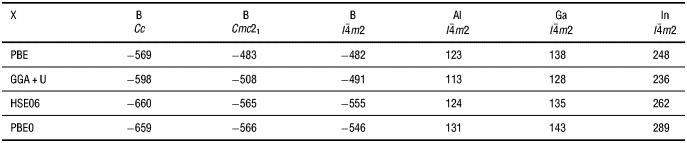
Although an energy difference of 0.6 eV is considerably larger than the typical error incurred in PBE calculations, we performed calculations (using the PBE geometry) at higher levels of theory and for the other delafossites to confirm our findings. We used the HSE06 screened hybrid [Reference Heyd, Scuseria and Ernzerhof5], the PBE0 hybrid [Reference Ernzerhof and Scuseria18], and GGA + U in the framework of Ref. Reference Dudarev, Botton, Savrasov, Humphreys and Sutton19 (we set U − J = 5 eV for the d states of Cu). Our findings are summarized in Table 1. Results for the P63/mmc phase were virtually identical (to a few meV) to the  $R\bar{3}m$ structure and are therefore not shown in the table.
Energy per atom (in meV) of different structures of CuXO2 studied in this work using different theoretical methods. The zero is the energy of the delafossite  $R\bar{3}m$ structure
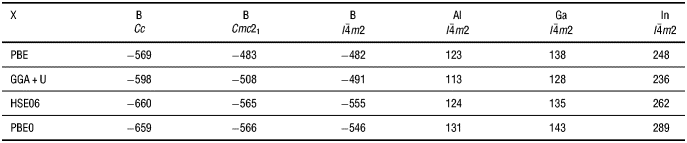
Remarkably, the four methods (PBE, GGA + U, HSE06, and PBE0) yield essentially the same energy differences for all structures and compounds studied (CuBO2, CuAlO2, CuGaO2, and CuInO2). Furthermore, and confirming our minima hopping simulations, the Cc structure is only the ground state for CuBO2. Finally, we see that the  $R\bar{3}m$ phase is stabilized with respect to the
 $I\bar{4}m2$ structure with increasing size of the trivalent metal (i.e., descending the IIIA column). This means that probably only B crystallizes in this tetragonal structure as it is the only trivalent metal smaller than Al, making this phase quite unique.
A possible explanation for destabilization of the delafossite phase of CuBO2 can be found by analyzing the oxidation state of the metal. In fact, in the delafossite structure, the metal atom is in the oxidation state +3. However, on performing a Bader analysis of delafossite CuBO2 one finds a Bader charge for B of +2.15, to compare with +2.54 for Al in CuAlO2. Note that this charge increases to +2.30 in  $I\bar{4}m2$ CuBO2 and +2.31 in Cc.
All the considered phases of CuBO2 turned out to have indirect fundamental band gaps, and all band gaps are large enough to assure transparency. The  $I\bar{4}m2$ phase has a calculated indirect gap of 4.0 eV, whereas the monoclinic Cc and orthorombic Cmc21 phases have very similar indirect band gaps of 4.0 and 4.2 eV, respectively. These band gaps are larger than the corresponding band gap for the delafossite structure (3.7 eV). Note that we chose PBE0 values as we expect them to give the best estimate, in analogy with previous calculations for other members of the delafossite family [Reference Trani, Vidal, Botti and Marques6,Reference Vidal, Trani, Bruneval, Marques and Botti7]. The experimental indirect band gap reported in Ref. Reference Snure and Tiwari3 is 2.2 eV. Once again, as it happens for CuAlO2, CuGaO2, and CuInO2, the calculated indirect band gap is much larger than the experimental gap. This finding supports the recent view that the low-energy absorption bands of this class of TCOs are probably due to defect states in the gap [Reference Trani, Vidal, Botti and Marques6, Reference Pellicer-Porres, Segura, Gilliland, Munoz, Rodriguez-Hernendez, Kim, Lee and Kim20–Reference Scanlon and Watson22].
The calculated direct band gaps within PBE0 are 4.4 eV for the  $I\bar{4}m2$ crystal, 4.2 eV for the Cc phase, 4.2 eV for the Cmc21 phase, and 4.7 eV for the delafossite. These values are close to the measured optical direct gap of 4.5 eV. However, one should not for get that the fundamental band-edge transitions can be forbidden by selection rules in highly symmetric structures, as it happens in delafossites [Reference Scanlon, Walsh and Watson4, Reference Nie, Wei and Zhang23], moving to higher energy the measured absorption edge. For an accurate quantitative comparison of theory and experiments, the excitonic binding energy and renormalization of the gap due to lattice polarization should also be included [Reference Botti and Marques26].
The top of the valence band turns out to be of mixed Cu d with O d character while the bottom of the conduction is a mixture of Cu s, p, and d states with mainly O p (and some O s) states, and a significant amount of B p. This is similar to the case of the delafossite structure [Reference Trani, Vidal, Botti and Marques6]. Moreover, we observed that the projected densities of states of different phases do not show qualitatively different features.
We remark that the main reason as to why it is so difficult to develop high mobility p-type TCOs is the localized O p nature of the valence band in most oxides, yielding large hole effective masses. In the delafossite structure, and also in the other lowest-energy structures that we have identified, strong hybridization of the O p states with Cu d states leads to a dispersive top valence band with a lower effective mass than in other oxides.
The average in-plane hole effective mass of the Cc phase is 1.0, to be compared, e.g., with 2.6 for CuAlO2 [Reference Scanlon, Godinho, Morgan and Watson24]. On the other hand, the perpendicular mass is 5.0, an order of magnitude smaller than 58.4 for CuAlO2 [Reference Scanlon, Godinho, Morgan and Watson24]. This indicates that CuBO2, even if it does not crystallize in the delafossite phase, has the potential to be an excellent p-type TCO.
Another essential requirement for p-type conductivity is the possibility to dope with acceptor defects, the most common hole-killer being O vacancies. The formation energy of the neutral O vacancy is around 5 eV in the Cc phase, very much in line with the other delafossites. We observed that Cu vacancies have a large negative formation energy in the delafossite phase, a further indication that this structure is not stable.
Finally, in Fig. 2 we present x-ray diffraction results for different structures of CuBO2. These are quite different from each other and should allow for an experimental identification of any of this phases in samples. Unfortunately, the experimental spectra of Ref. Reference Snure and Tiwari3 and Ref. Reference Santra, Das and Chattopadhyay25 are either contaminated or do not have enough resolution to allow for an unambiguous identification. We observe that a peak at 2θ ≃ 35° is present in both experiments and the simulated spectra of the new structures reported in this work, whereas it is absent in the simulated x-ray diffraction spectrum of the delafossite  $R\bar{3}m$ phase.
(Color online) Simulated x-ray diffraction spectrum with Cu Kα radiation λ = 1.54178 Å.
In conclusion, we performed global structural optimization for the CuBO2 system. Our results indicate that it is extremely unlikely that the experimentally produced phase belongs to the delafossite family. The most likely candidate is instead a low symmetry monoclinic structure, consisting of alternating planar Cu layers (fourfold coordinated) and BO2 networks (where B is threefold coordinated). These results call for further experimental work to determine unambiguously the structure of this promising p-type TCO.
ACKNOWLEDGMENTS
M.A.L.M. and S.B. acknowledge the financial support from the French ANR projects ANR-08-CEXC8-008-01 and ANR-12-BS04-0001-02. Computational resources were provided by GENCI (project x2012096017).