Introduction
Events such as being directly or indirectly exposed to actual or threatened death, serious injury, or sexual violence are commonly experienced, with about 70% of individuals experiencing at least one event during their lifetime (e.g. Benjet et al., Reference Benjet, Bromet, Karam, Kessler, McLaughlin, Ruscio and Koenen2016; Dückers, Alisic, & Brewin, Reference Dückers, Alisic and Brewin2016). Although trauma exposure is common, the majority of survivors will be resilient (Galatzer-Levy, Huang, & Bonanno, Reference Galatzer-Levy, Huang and Bonanno2018). A significant subgroup of individuals does, however, develop trauma-related disorders, such as posttraumatic stress disorder (PTSD; DSM-5; American Psychiatric Association, 2013). According to the DSM-5, PTSD is defined as a heterogeneous syndrome that lasts more than a month and includes intrusion and avoidance symptoms, hyperarousal, and changes in cognitions and mood. PTSD is a major public health issue, with potential negative consequences including difficulties with intimate relationships, decreased academic or job performance, substance use problems, physical illness, and elevated risk of suicidal ideation and attempts (e.g. Boscarino, Reference Boscarino2004; Boyraz, Granda, Baker, Tidwell, & Waits, Reference Boyraz, Granda, Baker, Tidwell and Waits2016; Hawn, Cusack, & Amstadter, Reference Hawn, Cusack and Amstadter2020; LeBouthillier, McMillan, Thibodeau, & Asmundson, Reference LeBouthillier, McMillan, Thibodeau and Asmundson2015; Loya, Reference Loya2015; Taft, Watkins, Stafford, Street, & Monson, Reference Taft, Watkins, Stafford, Street and Monson2011).
Nightmares are a highly prevalent symptom of PTSD and they also often occur as an acute stress symptom following a potentially traumatic event (PTE), with up to 50% of trauma survivors reporting replicative (very close to exact replays of the PTE) or mixed (partly similar to the PTE) posttraumatic nightmares and 17–30% reporting nontraumatic nightmares (content unrelated to the PTE). Notably, mixed and especially replicative posttraumatic nightmares following a PTE seem to be associated with a greater risk for developing PTSD and more severe psychopathology (Davis, Byrd, Rhudy, & Wright, Reference Davis, Byrd, Rhudy and Wright2007; David & Mellman, Reference David and Mellman1997; de Dassel, Wittmann, Protic, Höllmer, & Gorzka, Reference de Dassel, Wittmann, Protic, Höllmer and Gorzka2018; Langston, Davis, & Swopes, Reference Langston, Davis and Swopes2010; Phelps, Forbes, Hopwood, & Creamer, Reference Phelps, Forbes, Hopwood and Creamer2011; Schreuder, Igreja, van Dijk, & Kleijn, Reference Schreuder, Igreja, van Dijk and Kleijn2001; Schreuder, Kleijn, & Rooijmans, Reference Schreuder, Kleijn and Rooijmans2000; Wittmann, Zehnder, Schredl, Jenni, & Landolt, Reference Wittmann, Zehnder, Schredl, Jenni and Landolt2010).
The reason for this close relationship between posttraumatic nightmares and PTSD could lie in a common pathophysiology. In this context, elevated arousal is discussed as a central pathophysiological factor in PTSD as well as in nightmare etiology (Gieselmann et al., Reference Gieselmann, Aoudia, Carr, Germain, Gorzka, Holzinger and Pietrowsky2019; Levin & Nielsen, Reference Levin and Nielsen2007). Studies have found associations between PTSD and decreased heart rate variability (HRV; e.g. Campbell, Wisco, Silvia, & Gay, Reference Campbell, Wisco, Silvia and Gay2019) and an elevated autonomic startle response to a series of sudden loud tones in the form of an increased eye blink response, a larger skin conductance response (SCR) and, most robustly, a larger heart rate response (HRR; e.g. Carson et al., Reference Carson, Metzger, Lasko, Paulus, Morse, Pitman and Orr2007; Orr, Lasko, Shalev, & Pitman, Reference Orr, Lasko, Shalev and Pitman1995; Orr et al., Reference Orr, Metzger, Lasko, Macklin, Hu, Shalev and Pitman2003; Pole, Reference Pole2007). For nightmares, studies have found associations with altered HRV (Nielsen et al., Reference Nielsen, Paquette, Solomonova, Lara-Carrasco, Colombo and Lanfranchi2010) and elevated mean heart rate (HR) during REM sleep, elevated HR acceleration during nightmare sleep (Nielsen & Zadra, Reference Nielsen, Zadra, Kryger, Roth and Dement2000), and more leg movements and frequent awakenings than healthy controls, while this last association seems to be stronger for posttraumatic than for nontraumatic nightmares (Germain & Nielsen, Reference Germain and Nielsen2003; Simor, Horváth, Gombos, Takács, & Bódizs, Reference Simor, Horváth, Gombos, Takács and Bódizs2012). During wakefulness, nightmare distress is negatively associated with baseline resting HRV (vagal tone) in children (Secrist, Dalenberg, & Gevirtz, Reference Secrist, Dalenberg and Gevirtz2019) and using an acoustic startle paradigm, Tanev et al. (Reference Tanev, Orr, Pace-Schott, Griffin, Pitman and Resick2017) found a positive correlation between posttraumatic nightmare severity and HRR, but not the SCR or the eye blink startle response, to sudden loud tones in a sample of women with PTSD. SCR primarily reflects sympathetic activity (e.g. Critchley & Nagai, Reference Critchley, Nagai, Gellman and Turner2013) and the eye blink startle response is a reflex circuit that can be modulated by limbic input, such as amygdala activity, as well as sympathetic activation (e.g. Koch & Schnitzler, Reference Koch and Schnitzler1997; Liu, Amey, Magerman, Scott, & Forbes, Reference Liu, Amey, Magerman, Scott and Forbes2020; Szabadi, Reference Szabadi2012). HR, on the other hand, is regulated by both the sympathetic and the parasympathetic nervous systems. Sympathetic stimulation increases HR, while parasympathetic stimulation decreases HR (e.g. Gordan, Gwathmey, & Xie, Reference Gordan, Gwathmey and Xie2015). Changes in HR within a few seconds of a low intensity stimulus, typically show an initial deceleration (orienting response) followed by subsequent recovery of HR (Chen, Aksan, Anderson, Grafft, & Chapleau, Reference Chen, Aksan, Anderson, Grafft and Chapleau2014; Orr et al., Reference Orr, Lasko, Shalev and Pitman1995; Vila et al., Reference Vila, Guerra, Munoz, Vico, Viedmadeljesus, Delgado and Rodriguez2007). However, as the stimulus intensity increases, the decelerative feature is reduced and HR acceleration instead occurs (e.g. Turpin, Schaefer, & Boucsein, Reference Turpin, Schaefer and Boucsein1999; Vossel & Zimmer, Reference Vossel and Zimmer1992). Therefore, one might expect that heart rate acceleration following a startling stimulus with a very short latency could occur due to rapid parasympathetic withdrawal. Tanev et al. (Reference Tanev, Orr, Pace-Schott, Griffin, Pitman and Resick2017) concluded that posttraumatic nightmares might be associated with reduced parasympathetic rather than increased sympathetic activity. This altered autonomic activity might be associated with both PTSD and posttraumatic nightmares and could explain their close relationship.
In summary, there is a growing body of evidence that suggests that posttraumatic nightmares are predictive of a later PTSD diagnosis. However, the role of nontraumatic nightmares in the development of PTSD as well as the potentially shared pathophysiology of these phenomena is not well understood (Levin & Nielsen, Reference Levin and Nielsen2007). In this study, we aimed to investigate the associations between PTSD and nontraumatic and posttraumatic nightmares, as well as the specific associations between different psychophysiological measures during wakefulness and PTSD, posttraumatic nightmares, and nontraumatic nightmares. Psychophysiological measures included resting HRV as well as HR, SC, and eye blink startle responses to a series of sudden loud tones. The current study was primarily of an exploratory nature. However, we expected: (1) a stronger association between posttraumatic nightmares and PTSD than between nontraumatic nightmares and PTSD, (2) an association between PTSD and an increased HRR to a series of loud tones, and (3) negative relationships between resting HRV and PTSD, posttraumatic nightmares, and nontraumatic nightmares.
Methods
Participants and procedure
As part of a larger project, participants were recruited from the greater Boston area via online and posted advertisements. The sample consisted of 122 participants who had experienced a DSM-5 Criterion A index trauma in the past 2 years but not within the past month. Due to significant effects of age on some of the sleep physiology variables included in the larger project (Ohayon, Carskadon, Guilleminault, & Vitiello, Reference Ohayon, Carskadon, Guilleminault and Vitiello2004), the age range for study participation was chosen to be between 18 and 40 years. Participants reported various types of trauma, such as sexual or physical assaults or traffic accidents. Individuals eligible to participate in the study were invited for psychiatric and sleep interviews (see online Supplementary materials for exclusion criteria). After the interviews, participants took part in an acoustic startle paradigm, during which psychophysiological measures were assessed. After the acoustic startle paradigm, participants received nightmare logs, which they were instructed to fill out for 14 consecutive days. The Partners Healthcare Institutional Review Board approved all study procedures. All participants provided written informed consent and were paid for their participation.
Structured diagnostic interview for PTSD diagnosis
PTSD diagnosis was assessed by a highly experienced interviewer using the Clinician-Administered PTSD scale for DSM-5 (CAPS-5; Weathers et al., Reference Weathers, Blake, Schnurr, Kaloupek, Marx and Keane2013a), a 30-item structured interview, which queries DSM-5 diagnostic criteria for PTSD and is considered the gold standard in PTSD diagnosis. We created ‘PTSD’ and trauma-exposed ‘No-PTSD’ groups based on whether or not participants met the diagnostic criteria.
PTSD symptom severity
The PTSD Checklist for DSM-5 (PCL-5; Weathers et al., Reference Weathers, Litz, Keane, Palmieri, Marx and Schnurr2013b) was used to quantify the severity of DSM-5 PTSD symptoms over the past month. The PCL-5 is a self-report questionnaire containing 20 items with 5-point Likert scales. A total symptom severity score was obtained (range: 0–100). For our analyses, we excluded item 2 (‘In the past month, how much were you bothered by repeated, disturbing dreams of the stressful experience?’), since we used diary-based nightmare assessments.
Nightmare log
A nightmare log that was filled out every morning upon awakening, defined nightmares as very disturbing or unpleasant dreams that may cause awakening or are remembered in the morning. Including nightmares (leading to awakening) and bad dreams (not leading to awakening) is in line with previous findings suggesting that nightmares and bad dreams are expressions of the same phenomenon, differing in their intensity (e.g. Robert & Zadra, Reference Robert and Zadra2014) as well as with the operational definitions of nightmares in previous studies (e.g. Lemyre, Bastien, & Vallières, Reference Lemyre, Bastien and Vallières2019; Wittmann et al. Reference Wittmann, Zehnder, Schredl, Jenni and Landolt2010). The nightmare log also queried whether nightmares were exactly like (replicative), similar to (mixed), possibly related to, or unrelated to the PTE. Replicative or mixed nightmares were categorized as posttraumatic and unrelated nightmares as nontraumatic. Possibly related nightmares were not included in either nightmare category. To account for differences in the number of days the nightmare log was filled out, weighted nightmare frequency scores were calculated (total nightmare frequency divided by the number of log entries). Based on these nightmare categories and frequency scores, we created two dichotomous groupings of participants in addition to the PTSD/No-PTSD diagnosis dichotomy: (1) ‘Posttraumatic nightmares’ (n = 26, at least one replicative or mixed nightmare/week), ‘No posttraumatic nightmares’ (n = 96, less than one replicative or mixed nightmare/week), (2) ‘Nontraumatic nightmares’ (n = 22, at least one trauma-unrelated nightmare/week), and ‘No nontraumatic nightmares’ (n = 100, less than one trauma-unrelated nightmare/week or at least one posttraumatic nightmare/week). Participants qualified for the nightmare groups if they had a total average of one nightmare per week, which did not require them to have a nightmare in each of the 2 weeks. These groupings allowed overlap when participants experienced both PTSD and nightmares or posttraumatic and nontraumatic nightmares, but participants were assigned to the more severe posttraumatic nightmare group when reporting at least one posttraumatic nightmare a week, regardless of their nontraumatic nightmare frequency.
Acoustic startle paradigm: HR, SC, and EMG responses and resting HRV
For the acoustic startle paradigm, we used the same stimuli, procedures, and response score calculations as in previous studies (e.g. Buhlmann et al., Reference Buhlmann, Wilhelm, Deckersbach, Rauch, Pitman and Orr2007; Carson et al., Reference Carson, Metzger, Lasko, Paulus, Morse, Pitman and Orr2007; Mueller-Pfeiffer et al., Reference Mueller-Pfeiffer, Zeffiro, O'Gorman, Michels, Baumann, Wood and Orr2014; Pace-Schott et al., Reference Pace-Schott, Tracy, Rubin, Mollica, Ellenbogen, Bianchi and Orr2014). Participants were asked to sit upright, quietly, with their eyes open, and with headphones placed over both ears. They were informed that they would hear a series of loud tones. After a 5-min baseline period with full physiological recording, the first startle tone was presented without warning. They were presented with 16 loud tones (500 ms, 100–102 dB, 1000 Hz) with random intervals between them (27 to 52 s). Mean startle response scores for the HR acceleration responses (HRR), skin conductance responses (SCR), and orbicularis oculi electromyogram responses (EMGR) were calculated as the mean of the responses to each of the first 15 tones. The greater the response scores, the greater the physiological reactivity. Resting HRV for the 5-min baseline phase was calculated using previously published guidelines and recommendations (e.g. Malik, Reference Malik1996; Shaffer & Ginsberg, Reference Shaffer and Ginsberg2017). We used, for time domain, measurement of the root of the mean square of successive differences (RMSSD) between normal heartbeats and, for frequency domain, the power in the high frequency band (0.15–0.40 Hz; HF power). In line with previous research, the raw HF power scores were log-transformed before analysis to normalize the relevant distributions. RMSSD and HF power are highly correlated (e.g. Kleiger, Stein, & Bigger, Reference Kleiger, Stein and Bigger2005) and higher RMSSD and HF power scores reflect more parasympathetic activity (Laborde, Mosley, & Thayer, Reference Laborde, Mosley and Thayer2017; Shaffer & Ginsberg, Reference Shaffer and Ginsberg2017; Shaffer, McCraty, & Zerr, Reference Shaffer, McCraty and Zerr2014). See online Supplementary materials for a more detailed description of the physiological measurements used in this study.
Statistical analyses
To examine the relationships between the psychophysiological measures (HRR, SCR, EMGR, RMSSD, and HF power), PTSD, posttraumatic nightmares, and nontraumatic nightmares, we performed bivariate correlation analyses using Spearman's rank correlation, since quantile–quantile plots and Shapiro–Wilk tests showed that most variables did not follow a normal distribution. Due to our large sample size, we employed Welch's t tests to investigate potential group differences in our psychophysiological variables, despite the non-normality of our variables (according to the central limit theorem; e.g. Kwak & Kim, Reference Kwak and Kim2017). The t tests were conducted with the three previously described dichotomous groupings for ‘PTSD/No PTSD’, ‘posttraumatic nightmares/no posttraumatic nightmares’, and ‘nontraumatic nightmares/no nontraumatic nightmares’. Cohen's d effect sizes were calculated for the Welch's t tests. Based on the correlation analyses and t tests, we further investigated potential associations using logistic regression analyses. We created separate models for PTSD diagnosis, posttraumatic nightmares, and nontraumatic nightmares as the categorical outcome variables, while accounting for the simultaneous contribution of psychophysiological measures and control variables (sex, age, and months since trauma). Visual inspection of scatter plots suggested that the assumption of a linear relationship between the predictors and the logits of the outcome variables was sufficiently met. Additionally, variance inflation factors (VIFs) were within an acceptable range (VIF < 3), suggesting that the assumption of the absence of multicollinearity was met. Outliers were excluded based on the visual inspections of scatter plots and the ±3 s.d. cutoff for very likely erroneous data points and missing data were handled using list-wise deletion. Cook's distances for residuals in our logistic regression analyses were in an acceptable range. All statistical tests were performed two-tailed, with an alpha level of 0.05 using the statistical software R (version 3.6.1).
Results
Descriptive statistics
Sample demographics and characteristics are displayed in Table 1. See online Supplementary materials for more detailed sample of nightmare characteristics.
Sample demographics and characteristics

M, mean; s.d., standard deviation; CI, confidence interval; PCL-5, PTSD Checklist for DSM-5 (total score, including item 2).
Nightmares were reported with an average of 2.6 nightmares in 13.5 days. At least one posttraumatic nightmare was reported by 26 participants (21.3%), while 22 participants (18.0%) reported at least one nontraumatic nightmare per week with no frequent posttraumatic nightmares. Spearman correlation showed that prospective posttraumatic nightmare frequency measures (nightmare log) and retrospective posttraumatic nightmare frequency measures (item 2 of the PCL-5) were significantly correlated (r s(121) = 0.45, p < 0.001). Most of the posttraumatic nightmares were mixed; 18 participants (14.8%) reported at least one mixed and seven participants (5.7%) at least one replicative posttraumatic nightmare per week. One participant of the posttraumatic nightmare group reported one mixed and one replicative posttraumatic nightmare. Overall mean nightmare frequency was higher among participants in the posttraumatic nightmare group (5.7 of total diaries; posttraumatic: 3.3, nontraumatic: 1.3) compared to participants in the nontraumatic nightmare group (3.5; posttraumatic: 0.2, nontraumatic: 2.8). In the PTSD group, 23 participants (39%) reported at least one posttraumatic and 10 participants (17%) at least one nontraumatic nightmare a week. Consequently, PTSD criteria were met by 88% of the posttraumatic nightmare group and 45% of the nontraumatic nightmare group.
PTSD diagnosis, symptom severity, and nightmares
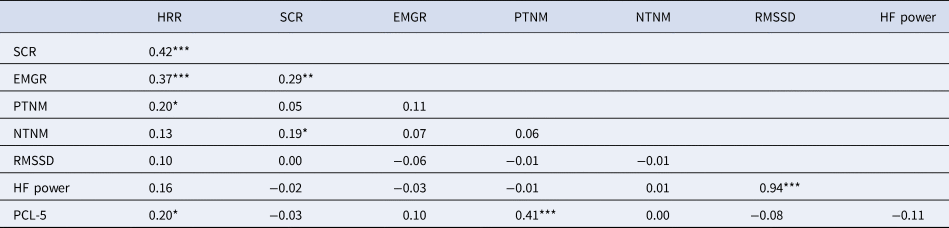
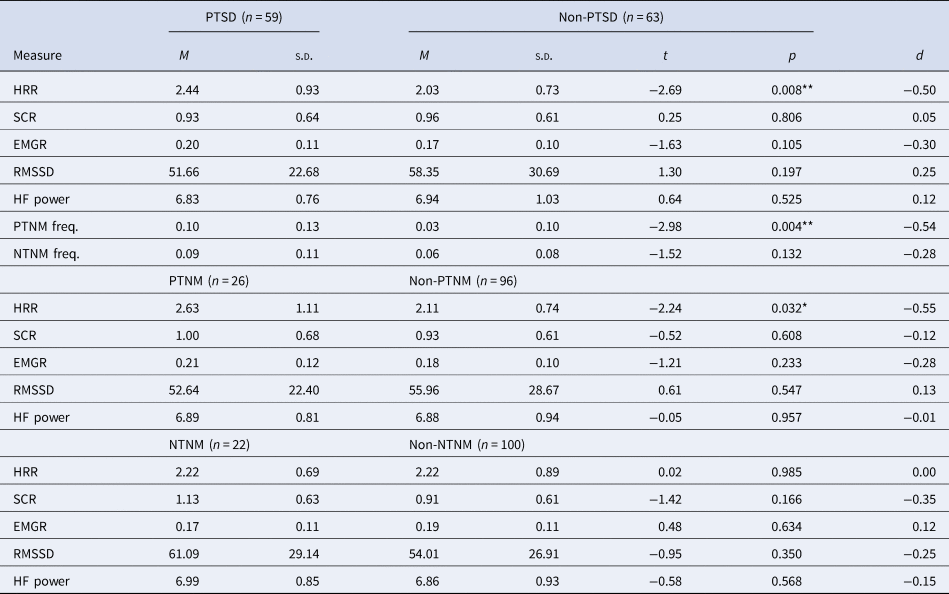
Results of the correlation analyses are shown in Table 2. Group mean responses to each of the 15 tone presentations are displayed in Fig. 1, and group means, standard deviations, and t test results of the main variables are presented in Table 3. Results of the logistic regression analyses are displayed in Table 4.
Plots of the group mean responses to the 15 loud tone presentations. The groups shown in this figure represent alternate ways of dichotomizing the total sample and the PTSD and nightmare groups are not mutually exclusive. Participants who reported both frequent posttraumatic and nontraumatic nightmares were assigned to the more severe PTNM group. (a) Responses for ‘PTSD’ (solid line) v. ‘No PTSD’ (dotted line) groups, (b) responses for the ‘PTNM’ (solid line) v. ‘No PTNM’ (dotted line) groups (PTNM = at least one posttraumatic nightmare/week), (c) responses for the ‘NTNM’ (solid line) v. 'No NTNM' (dotted line) groups (NTNM = at least one nontraumatic nightmare/week). HRR = heart rate mean response, SCR = skin conductance mean response, EMGR = electromyogram mean response (left orbicularis oculi).

Results of Spearman correlation analyses

PTNM, frequency of posttraumatic nightmares (weighted by number of diary nights); NTNM, frequency of nontraumatic nightmares (weighted by number of diary nights); HRR, heart rate mean response; SCR, skin conductance mean response; EMGR, electromyogram mean response (left orbicularis oculi); RMSSD, root mean square of the successive differences (resting HRV); HF power, log-transformed high frequency power (resting HRV); PCL-5, PTSD Checklist for DSM-5 (without item 2).
Note. This table shows correlation coefficients (Spearman's rho).
*p < 0.05, **p < 0.01, ***p < 0.001.
Group sizes, means, standard deviations, and results of t tests

PTNM, at least one posttraumatic nightmare/week; NTNM, at least one nontraumatic nightmare/week; M, mean; s.d., standard deviation; t, t-value; d, Cohen's d; PTNM freq., weighted posttraumatic nightmare frequency; NTNM freq., weighted nontraumatic nightmare frequency; HRR, heart rate mean response; SCR, skin conductance mean response; EMGR, electromyogram mean response (left orbicularis oculi); RMSSD, root mean square of the successive differences (resting HRV); HF pow. (ln), log-transformed high frequency power (resting HRV).
Note. The groups shown in this table represent alternate ways of dichotomizing the total sample and the PTSD and nightmare groups are not mutually exclusive. Participants who reported both frequent posttraumatic and nontraumatic nightmares were assigned to the more severe PTNM group.
*p < 0.05, **p < 0.01 .
Logistic regression analyses results

Note. The groups shown in this table represent alternate ways of dichotomizing the total sample and the PTSD and nightmare groups are not mutually exclusive. Participants who reported both frequent posttraumatic and nontraumatic nightmares were assigned to the more severe PTNM group.
PTNM, at least one posttraumatic nightmare/week; NTNM, at least one nontraumatic nightmare/week; PTNM freq., posttraumatic nightmare frequency; NTNM freq., nontraumatic nightmare frequency; OR, odds ratios; CI, confidence intervals; HRR, heart rate mean response; SCR, skin conductance mean response.
*p < 0.05, **p < 0.01.
Spearman correlations showed significant positive associations between PTSD symptom severity and posttraumatic nightmare frequency (r s(121) = 0.41, p < 0.001) and a t test showed that posttraumatic nightmare frequency was significantly higher for participants with a PTSD diagnosis compared to those without a PTSD diagnosis (t(104.35) = −2.98, p = 0.004, d = −0.54). Nontraumatic nightmare frequency was not significantly correlated with the PCL-5 score (r s(121) = 0.00, p = 0.986) and t tests showed no significant difference in nontraumatic nightmare frequency for participants with or without a PTSD diagnosis (t(99.91) = −1.52, p = 0.132, d = −0.28). Logistic regression analysis with posttraumatic and nontraumatic nightmare frequency as the main predictors, while also controlling for sex, age, and months since trauma, showed that PTSD diagnosis was significantly predicted by posttraumatic nightmare frequency [odds ratio (OR) 1.70, confidence interval (CI) 1.18–2.45, p = 0.005] but not by nontraumatic nightmare frequency (OR 1.25, CI 0.91–1.71, p = 0.171). In this model, women were more likely to meet PTSD criteria (OR 0.36, CI 0.15–0.87, p = 0.023).
Psychophysiological measures and PTSD, posttraumatic nightmares, and nontraumatic nightmares
Positive correlations were observed between the HRR and SCR (r s(119) = 0.42, p < 0.001), HRR and EMGR (r s(119) = 0.37, p < 0.001), and SCR and EMGR (r s(119) = 0.29, p = 0.002). RMSSD and HF power were significantly correlated as well (r s(108) = 0.94, p < 0.001). There were no significant correlations or trends between loud tone responses and the resting HRV variables.
Psychophysiological measures and PTSD symptom severity and diagnosis
Spearman correlations showed a significant positive association between the HRR and the PCL-5 score (r s(118) = 0.20, p = 0.030) and a t test showed that the HRR was significantly larger for participants with a PTSD diagnosis than for participants without a PTSD diagnosis (t(106.18) = −2.69, p = 0.008, d = −0.50). None of the other psychophysiological measures showed a significant association with PTSD symptom severity or diagnosis. A logistic regression analysis with the HRR and SCR as the main predictors, while also controlling for age, sex, and months since trauma showed that the HRR was a significant predictor of PTSD diagnosis (OR 2.13, CI 1.18–3.88, p = 0.013), while the SCR did not significantly predict PTSD diagnosis (OR 0.58, CI 0.28–1.18, p = 0.134). In this model, women were more likely to meet PTSD criteria (OR 0.40, CI 0.16–0.96, p = 0.040).
Psychophysiological measures and nightmares
Spearman correlations showed a significant positive association between posttraumatic nightmare frequency and the HRR (r s(119) = 0.20, p = 0.027) and a t test showed that the HRR was significantly larger for participants in the posttraumatic nightmare group compared to participants without frequent posttraumatic nightmares (t(31.38) = −2.24, p = 0.032, d = −0.55). Nontraumatic nightmare frequency was significantly correlated with the SCR (r s(119) = 0.19, p = 0.040), although a t test did not show a significant difference in the SCR between participants with frequent nontraumatic nightmares and participants without frequent nontraumatic nightmares or with frequent posttraumatic nightmares (t(26.69) = −1.42, p = 0.166, d = −0.35). A logistic regression analysis with the HRR and SCR as the main predictors, while also controlling for age (grand-mean centered), sex, and months since trauma, showed that the HRR significantly predicted posttraumatic nightmares (OR 1.97, CI 1.04–3.74, p = 0.038), but not nontraumatic nightmares (OR 0.86, CI 0.43–1.68, p = 0.661). The SCR, on the other hand, did not significantly predict posttraumatic nightmares (OR 0.69, CI 0.29–1.64, p = 0.399), but it showed a trend for nontraumatic nightmares (OR 2.07, CI 0.87–4.92, p = 0.098). None of the other psychophysiological measures showed an association with either posttraumatic or nontraumatic nightmares.
Discussion
Using an acoustic startle paradigm in a civilian sample of trauma survivors, we found that PTSD diagnosis and symptom severity were strongly associated with posttraumatic nightmares. PTSD diagnosis and posttraumatic nightmares were significantly associated with a larger mean HRR to a series of loud tones. Nontraumatic nightmare frequency, on the other hand, was associated with a larger mean SCR. The mean EMGR of the left orbicularis oculi and baseline resting HRV were not associated with any of our PTSD or nightmare measures.
Our results are in line with previous findings suggesting a strong association between posttraumatic nightmares and the development of PTSD (Davis et al., Reference Davis, Byrd, Rhudy and Wright2007; de Dassel et al., Reference de Dassel, Wittmann, Protic, Höllmer and Gorzka2018; Wittmann et al., Reference Wittmann, Zehnder, Schredl, Jenni and Landolt2010). Furthermore, since the rapid changes in HR in our acoustic startle paradigm seem to be primarily driven by withdrawal of parasympathetic activity (Chen et al., Reference Chen, Aksan, Anderson, Grafft and Chapleau2014; Orr et al., Reference Orr, Lasko, Shalev and Pitman1995; Vila et al., Reference Vila, Guerra, Munoz, Vico, Viedmadeljesus, Delgado and Rodriguez2007), our findings suggest that the close relationship between posttraumatic nightmares and PTSD might be due to a shared pathophysiology in the form of reduced activity of the parasympathetic nervous system. These findings are consistent with the only other study investigating posttraumatic nightmares in an acoustic startle paradigm (Tanev et al., Reference Tanev, Orr, Pace-Schott, Griffin, Pitman and Resick2017). Our finding that nontraumatic nightmare frequency was associated with an elevated SCR is partly consistent with a study by Nielsen et al. (Reference Nielsen, Paquette, Solomonova, Lara-Carrasco, Colombo and Lanfranchi2010), which found an elevated sympathetic drive during sleep in individuals with frequent nontraumatic nightmares following REM deprivation. However, sympathetic drive was most prominent during REM sleep compared to stage 2 sleep or wakefulness. Therefore, future research should investigate differences in autonomic activity between posttraumatic and nontraumatic nightmares in different sleep stages. It is possible that these differences might be more pronounced during sleep than during wakefulness.
Although some studies suggest a role of sympathetic activity in the development of PTSD (e.g. Geracioti et al. Reference Geracioti, Baker, Ekhator, West, Hill, Bruce and Kasckow2001; Mellman, Kumar, Kulick-Bell, Kumar, & Nolan, Reference Mellman, Kumar, Kulick-Bell, Kumar and Nolan1995; Southwick et al. Reference Southwick, Bremner, Rasmusson, Morgan, Arnsten and Charney1999), elevated HR seems to be one of the most reliable correlates of PTSD, while the SCR and EMG features of the startle response have not consistently discriminated between PTSD and non-PTSD (e.g. Orr et al., Reference Orr, Metzger, Lasko, Macklin, Hu, Shalev and Pitman2003; Pole, Reference Pole2007). Such findings imply the potential importance of the parasympathetic nervous system in psychophysiological abnormalities of PTSD. Parasympathetic influence might also explain the somewhat inconsistent findings for current pharmacological treatments of PTSD and nightmares, which mainly rely on medication designed to reduce sympathetic activity, such as prazosin (Gieselmann et al., Reference Gieselmann, Aoudia, Carr, Germain, Gorzka, Holzinger and Pietrowsky2019; Morgenthaler et al., Reference Morgenthaler, Auerbach, Casey, Kristo, Maganti, Ramar and Kartje2018; Raskind et al., Reference Raskind, Peskind, Chow, Harris, Davis-Karim, Holmes and Huang2018; Reist et al., Reference Reist, Streja, Tang, Shapiro, Mintz and Hollifield2020; Yücel, van Emmerik, Souama, & Lancee, Reference Yücel, van Emmerik, Souama and Lancee2020). Although patients may still respond well to these medications, it seems important for future clinical trials to investigate the efficacy of medications that target parasympathetic activity as well as to compare the effects of these substances on posttraumatic and nontraumatic nightmares.
These previous findings are also in line with a recent study using an acoustic startle and fear conditioning paradigm in trauma-exposed women, which found that reduced parasympathetic activity may play an important role in impaired fear extinction (Seligowski et al., Reference Seligowski, Merker, Swiercz, Park, Marvar, Ressler and Jovanovic2020). Impaired fear extinction has not only been suggested to be an important risk factor for PTSD, but also as a potential etiological factor of nightmare disorder (Levin & Nielsen, Reference Levin and Nielsen2007). Nightmares might impair the consolidation of extinction memory by activating and reinforcing arousing fear memories, which cannot be integrated into the associative memory network and this might be further reinforced by sleep disruption, which in turn might further exacerbate stress responses and elevate sympathetic activity during sleep (Gieselmann et al., Reference Gieselmann, Aoudia, Carr, Germain, Gorzka, Holzinger and Pietrowsky2019; Levin & Nielsen, Reference Levin and Nielsen2007; Nielsen, Reference Nielsen2017; Pace-Schott, Germain, & Milad, Reference Pace-Schott, Germain and Milad2015). Although impaired fear extinction may play an important role in both nontraumatic and posttraumatic nightmares, these associations could be especially strong for nightmares that activate and reinforce trauma-related fear memories.
Contrary to previous studies (e.g. Campbell et al., Reference Campbell, Wisco, Silvia and Gay2019), we did not find a significant association between resting HRV and PTSD. However, results are mixed and the associations are likely complex. Notably, these associations might be more pronounced during sleep (e.g. stage 2 or REM sleep; Nielsen et al. Reference Nielsen, Paquette, Solomonova, Lara-Carrasco, Colombo and Lanfranchi2010; Simor et al. Reference Simor, Körmendi, Horváth, Gombos, Ujma and Bódizs2014; Ulmer, Hall, Dennis, Beckham, & Germain, Reference Ulmer, Hall, Dennis, Beckham and Germain2018).
Our findings should be interpreted in the context of some limitations. We did not control for nightmare intensity or distress in our analyses. It could be assumed that frequent posttraumatic nightmares are high in intensity and distress, whereas for nontraumatic nightmares these measures might vary more significantly. Therefore, our findings are not able to clarify whether posttraumatic and nontraumatic nightmares are categorically distinct phenomena or whether they differ along a continuum of nightmare severity (Blaskovich, Reichardt, Gombos, Spoormaker, & Simor, Reference Blaskovich, Reichardt, Gombos, Spoormaker and Simor2020; Mysliwiec et al., Reference Mysliwiec, Brock, Creamer, O'Reilly, Germain and Roth2018; Nielsen, Reference Nielsen2017; Phelps, Forbes, & Creamer, Reference Phelps, Forbes and Creamer2008). Furthermore, a previous study suggests that it might be important to take prior adversity into account when comparing posttraumatic and nontraumatic nightmares (e.g. Nielsen et al., Reference Nielsen, Carr, Picard-Deland, Marquis, Saint-Onge, Blanchette-Carrière and Paquette2019). Due to the close relationship between posttraumatic nightmares and PTSD, there was a significant overlap between the members of the PTSD and posttraumatic nightmare groups. As part of the structured diagnostic interview, frequent trauma-related nightmares also contributed to the PTSD diagnosis. Although about 61% of the PTSD group did not report frequent posttraumatic nightmares and we also found an association between elevated HRR and posttraumatic nightmares when using continuous frequency measures to operationalize these constructs, future studies should try to specifically investigate the pathophysiology of posttraumatic nightmares in trauma survivors suffering from posttraumatic nightmares, but not from PTSD. Our cross-sectional design does not allow our findings to be interpreted as direct evidence for causal associations. Future studies should use longitudinal designs, in order to further unmask the complex and potentially bi-directional associations between these phenomena. Decreased parasympathetic activity may be both a symptom as well as a shared pathophysiological factor for posttraumatic nightmares and PTSD. Additionally, as a hypothesis generating exploratory first analysis of findings, and so as to avoid type II error, we did not adjust for multiple comparisons. Future replications of these findings should take into account both the possible inflation of type I error by multiple comparisons as well as the fact that the psychophysiological measures were intercorrelated. However, it is important to note that overall, our findings, relative to their respective dichotomized comparators, of a significantly larger mean HRR in individuals with a PTSD diagnosis and in individuals with frequent posttraumatic nightmares as well as a potentially larger mean SCR in individuals with frequent nontraumatic nightmares were fairly consistent, supporting the validity of our results. Finally, following the Research Diagnostic Criteria (RDoC) paradigm (Lang, McTeague, & Bradley, Reference Lang, McTeague and Bradley2016), our community sample included sub-clinical as well as entirely resilient trauma-exposed individuals, which placed our sample, on average, toward the lower end of posttraumatic symptom severity. There are also indications, that the relatively young age of our sample might have contributed to the lower symptom severity of our sample (e.g. Kobayashi, Sledjeski, & Delahanty, Reference Kobayashi, Sledjeski and Delahanty2019).
Our findings have important implications. Despite the strong association between posttraumatic nightmares following a PTE and the development of PTSD, nightmares are often underreported and undertreated, with the majority of nightmare sufferers believing that their nightmares cannot be treated (Nadorff, Nadorff, & Germain, Reference Nadorff, Nadorff and Germain2015; Schredl, Reference Schredl2013; Thünker, Norpoth, von Aspern, Özcan, & Pietrowsky, Reference Thünker, Norpoth, von Aspern, Özcan and Pietrowsky2014). It is therefore of great importance that health care providers are trained to thoroughly assess nightmares during initial encounter with trauma survivors and to be able to offer evidence-based treatment as soon as possible (e.g. Augedal, Hansen, Kronhaug, Harvey, & Pallesen, Reference Augedal, Hansen, Kronhaug, Harvey and Pallesen2013; Gieselmann et al., Reference Gieselmann, Aoudia, Carr, Germain, Gorzka, Holzinger and Pietrowsky2019). Our findings suggest that psychological and pharmacological treatments that positively influence parasympathetic nervous system activity might be especially effective. Since posttraumatic nightmares following a PTE might also interact strongly with other acute symptoms (Haag, Robinaugh, Ehlers, & Kleim, Reference Haag, Robinaugh, Ehlers and Kleim2017), such interventions might have a far-reaching impact.
In conclusion, our findings point to a shared pathophysiology between PTSD and posttraumatic nightmares in the form of reduced parasympathetic activation. This is of particular importance given that augmented startle response is one diagnostic criterion in the hyperarousal cluster of PTSD symptoms (DSM-5) and has been noted in numerous experimental studies of PTSD (Glover et al., Reference Glover, Phifer, Crain, Norrholm, Davis, Bradley and Jovanovic2011; Robison-Andrew et al., Reference Robison-Andrew, Duval, Nelson, Echiverri-Cohen, Giardino, Defever and Rauch2014). For nontraumatic nightmares the influence of the sympathetic nervous system might be more pronounced. Further research is warranted to confirm whether posttraumatic and nontraumatic nightmares are indeed two categorically distinct phenomena that may require specific and potentially different treatment approaches.
Supplementary material
The supplementary material for this article can be found at https://doi.org/10.1017/S0033291721002075.
Financial support
This study was supported by the National Institute of Health/National Institute of Mental Health (EPS, grant number R01MH109638) and the Swiss National Science Foundation (TM, grant number P0ZHP1_168869).
Conflict of interest
None.
Ethical standards
The authors assert that all procedures contributing to this work comply with the ethical standards of the relevant national and institutional committees on human experimentation and with the Helsinki Declaration of 1975, as revised in 2008.