Individuals are naturally driven to show their positive aspects to others. In a wide range of social interactions, most people use self-promotion to make a deep impression on others (Bolino, Long, & Turnley, Reference Bolino, Long and Turnley2016; Stevens & Kristof, Reference Stevens and Kristof1995). Self-promotion is the act of highlighting one's personal accomplishments, characteristics, or qualities in order to present oneself in the most favorable manner (Ferris & Judge, Reference Ferris and Judge1991), and is regarded as an important tactic of impression management strategies. It has been discussed in the fields of pragmatics, social psychology, and organizational behavior.
Scholars dispute the influences of self-promotion in the workplace. On the one hand, some studies indicate that self-promotion improves one's likeability (Pfeffer, Fong, Cialdini, & Portnoy, Reference Pfeffer, Fong, Cialdini and Portnoy2006), evaluation from interviewers (Kristof-Brown, Barrick, & Franke, Reference Kristof-Brown, Barrick and Franke2002; Swider, Barrick, Harris, & Stoverink, Reference Swider, Barrick, Harris and Stoverink2011), job offer opportunities (Higgins & Judge, Reference Higgins and Judge2004; Kacmar, Delery, & Ferris, Reference Kacmar, Delery and Ferris1992; Zhao & Liden, Reference Zhao and Liden2011), performance evaluation (Barrick, Shaffer, & DeGrassi, Reference Barrick, Shaffer and DeGrassi2009; Den Hartog, De Hoogh, & Belschak, Reference Den Hartog, De Hoogh and Belschak2020), and promotion opportunities (Judge & Bretz, Reference Judge and Bretz1994; Rudman, Reference Rudman1998). On the other hand, some studies have found that self-promotion may have deleterious effects on actors' interpersonal skills (Colvin, Block, & Funder, Reference Colvin, Block and Funder1995; Wayne, Liden, Graf, & Ferris, Reference Wayne, Liden, Graf and Ferris1997), liking (Van Damme, Deschrijver, Van Geert, & Hoorens, Reference Van Damme, Deschrijver, Van Geert and Hoorens2017; Wayne et al., Reference Wayne, Liden, Graf and Ferris1997), career success (Higgins, Judge, & Ferris, Reference Higgins, Judge and Ferris2003), and performance evaluation (Ferris, Judge, Rowland, & Fitzgibbons, Reference Ferris, Judge, Rowland and Fitzgibbons1994; Wayne & Liden, Reference Wayne and Liden1995) as well as leading to increased aggression (Van Damme et al., Reference Van Damme, Deschrijver, Van Geert and Hoorens2017) and job rejections (Kacmar, Delery, & Ferris, Reference Kacmar, Delery and Ferris1992). In short, there are no consistent findings on self-promotion and there are many different understandings amongst academics and in practice.
Research on self-promotion therefore faces many challenges, due to a lack of classification and of accurate measurement instruments of self-promotion in the workplace. To specify, previous studies have been limited to the individual orientation of self-promotion based on traditional ‘either-or’ thinking of self-orientation (Dayter, Reference Dayter2014; Hoorens, Pandelaere, Oldersma, & Sedikides, Reference Hoorens, Pandelaere, Oldersma and Sedikides2012; Wayne & Ferris, Reference Wayne and Ferris1990), ignoring the reality that when presenting their own advantages, people may mention others' advantages. Praises of others' advantages when praising the self may bring more favorable consequences than purely praising the self. After all, making others happy and consideration of others' feelings is critical in social relations. Therefore, the narrow definition and single dimension in traditional self-promotion literature have brought paradoxical findings.
To address these issues, we first put forward a two-dimensional structure of self-promotion, including sole self-promotion (the act of solely highlighting the speaker's personal accomplishments, characteristics, or qualities in order to be seen as competent by listeners, without identifying these qualities in the listeners) and joint self-promotion (the act of not only highlighting the speaker's personal accomplishments, characteristics, or qualities, but also identifying those of listeners in order to be seen as both competent and likable by listeners). Second, we developed and validated the scale by assessing the psychometric properties (i.e., content validity, factor structure, and reliability) by using three samples (samples 1–3). Third, we extended self-promotion in an overall model (sample 4) by exploring the antecedents and consequences of sole self-promotion and joint self-promotion, and discussed the different effects of these two behaviors on career success.
This study offers three major contributions. First, we enrich the construct of self-promotion, expand the research perspective and provide a feasible measurement scale. Studies show that ignoring others' feelings is socially risky, while paying attention to others' feelings can have positive effects (Dayter, Reference Dayter2014; Hoorens et al., Reference Hoorens, Pandelaere, Oldersma and Sedikides2012; Jones & Pittman, Reference Jones, Pittman and Suls1982; Stevens & Kristof, Reference Stevens and Kristof1995). The construction of two-dimensional self-promotion includes not only sole self-promotion (self-focused behavior) influenced by ‘either-or’ thinking (creating a competent but unlikable image, Bolino, Long, & Turnley, Reference Bolino, Long and Turnley2016; Den Hartog, De Hoogh, & Belschak, Reference Den Hartog, De Hoogh and Belschak2020; Yi, Zhang, & Windsor, Reference Yi, Zhang and Windsor2019), but also joint self-promotion influenced by ‘both-and’ thinking (creating an image of both competence and likeability). We expand self-promotion from the traditional sole self-promotion to joint self-promotion, thus forming a two-dimensional self-promotion, breaking the limitations of the single perspective in the past and the self-promoter's paradox (Bolino, Long, & Turnley, Reference Bolino, Long and Turnley2016).
Second, our research explores the antecedents and results of sole self-promotion and joint self-promotion, and make clear that they have different effects on personal career success. We identify the commonalities and distinctions between these two behaviors (reflected in the purpose, context, behavioral content, implications for consequences, and listeners). Furthermore, we clarify the differences in antecedents, consequences, and the effects on career success between the two types of self-promotion by validating our proposed overall model. Past studies have not unified the valence of some results in self-promotion (e.g., liking, Pfeffer et al., Reference Pfeffer, Fong, Cialdini and Portnoy2006; Van Damme et al., Reference Van Damme, Deschrijver, Van Geert and Hoorens2017; Wayne et al., Reference Wayne, Liden, Graf and Ferris1997). Our model, to some extent, addresses the issue of inconsistent results of self-promotion in the previous literature.
Third, we use social comparison theory to interpret these two typical social comparison activities and to analyze the motivation of self-promoters and the impact on listeners of the behavior in detail. It is worth noting that sole self-promotion compares the speaker with others, including the listeners, to gain the difference (Dayter, Reference Dayter2014; Hoorens, Reference Hoorens1993; Hoorens et al., Reference Hoorens, Pandelaere, Oldersma and Sedikides2012), while joint self-promotion compares the speaker with listeners to pursue the similarities. In these comparisons, because sole self-promotion and joint self-promotion involve different comparison objects, different interesting results are produced. All of these deepen our understanding of the various links of social comparison activities by acquiring, thinking about, and reacting to social comparison information between the speaker and listeners in the process of the realization of self-promotion (Festinger, Reference Festinger1954; Mussweiler, Reference Mussweiler2001; Wood, Reference Wood1996).
Defining sole self-promotion and joint self-promotion
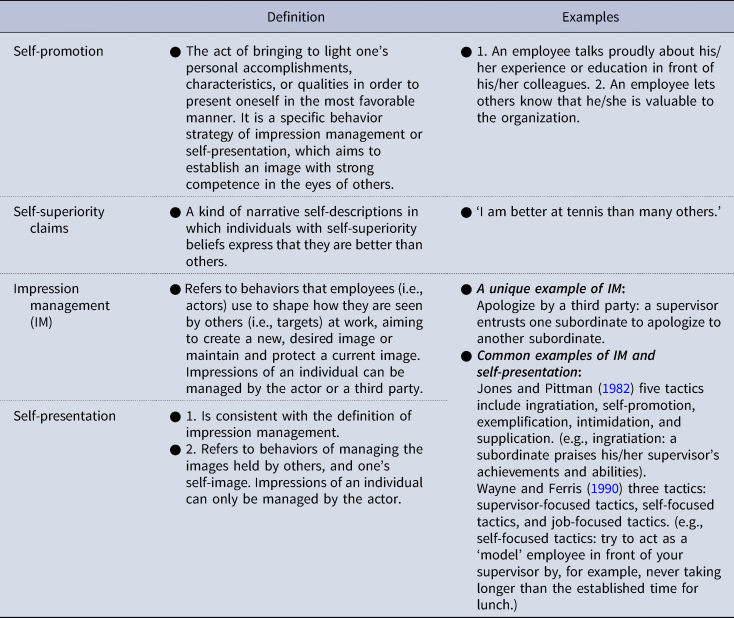
As one of the impression management strategies, self-promotion seeks the attribution of competence by highlighting one's personal accomplishments, characteristics, or qualities, such as personal traits, skills, status, and achievements (Bolino & Turnley, Reference Bolino and Turnley1999; Jones & Pittman, Reference Jones, Pittman and Suls1982; McClean, Courtright, Yim, & Smith, Reference McClean, Courtright, Yim and Smith2020). Self-promotion is often confused with such terms as self-superiority claims, impression management, and self-presentation. We distinguished it from these similar concepts in Table 1. The self-promoters wish to be seen as competent and confident by listeners (Kacmar, Delery, & Ferris, Reference Kacmar, Delery and Ferris1992), and thus tend to describe themselves positively by presenting key information about themselves (Stevens & Kristof, Reference Stevens and Kristof1995). Undoubtedly, self-promotion is a typical self-focused behavior (Bolino & Turnley, Reference Bolino and Turnley1999; Chawla et al., Reference Chawla, Gabriel, Rosen, Evans, Koopman, Hochwarter and Jordan2021), but is socially risky (Dayter, Reference Dayter2014; Ferris & Judge, Reference Ferris and Judge1991; Higgins, Judge, & Ferris, Reference Higgins, Judge and Ferris2003). This is because self-promotion tends to ignore the feelings of listeners, and may even be considered to contain subtext that devalues listeners, likely to elicit listeners' dislike (Bolino, Long, & Turnley, Reference Bolino, Long and Turnley2016; Dayter, Reference Dayter2014; Van Damme et al., Reference Van Damme, Deschrijver, Van Geert and Hoorens2017; Wayne et al., Reference Wayne, Liden, Graf and Ferris1997). Consequently, self-promotion can create a competent but unlikable image (Bolino, Long, & Turnley, Reference Bolino, Long and Turnley2016; Chawla et al., Reference Chawla, Gabriel, Rosen, Evans, Koopman, Hochwarter and Jordan2021).
The differences between self-promotion and other similar concepts

Note. The above concepts refer to the following scholars' literature: Bolino, Long, and Turnley, Reference Bolino, Long and Turnley2016; Ferris and Judge, Reference Ferris and Judge1991; Hoorens et al., Reference Hoorens, Pandelaere, Oldersma and Sedikides2012; Jones and Pittman, Reference Jones, Pittman and Suls1982; Leary and Kowalski, Reference Leary and Kowalski1990; Wayne and Ferris, Reference Wayne and Ferris1990.
As mentioned previously, prior findings have identified inconsistent results concerning self-promotion (Higgins, Judge, & Ferris, Reference Higgins, Judge and Ferris2003; Judge & Bretz, Reference Judge and Bretz1994; Stevens & Kristof, Reference Stevens and Kristof1995), and there is no clear understanding of the different effects of different self-promotion behavior. Some scholars call for dividing the dimensions of impression management behavior (Judge & Bretz, Reference Judge and Bretz1994), so we propose sole self-promotion and joint self-promotion based on whether the speaker praises listeners. The former is based on ‘either-or’ thinking, aiming to build a competent image (whether listeners like it or not), while the latter is based on sound thinking mode, aiming to build an image of both competence and likeability. Furthermore, these two behaviors have different objects of comparison. Sole self-promotion compares the speaker with others (which may include listeners); joint self-promotion compares the in-group (a group that includes both the speaker and listeners) with the out-group, in addition to the speaker and listeners. Moreover, in terms of the content, whether to mention the listeners or not, these two behaviors will produce very different results. Thus, it is necessary to distinguish the self-promotion as this two-dimensional structure.
Sole versus joint self-promotion
A critical step in scale development is to give an accurate definition of construct and outline its conceptual boundaries (Hinkin, Reference Hinkin1995). Therefore, according to the refined definition of self-promotion by some scholars (Bolino & Turnley, Reference Bolino and Turnley1999; Ferris & Judge, Reference Ferris and Judge1991), we propose the definitions of sole self-promotion and joint self-promotion: Sole self-promotion is the act of solely highlighting the speaker's personal accomplishments, characteristics, or qualities in order to be seen as competent by listeners, without identifying these qualities in the listeners. Joint self-promotion is the act of not only highlighting the speaker's personal accomplishments, characteristics, or qualities, but also identifying those of the listeners in order to be seen as both competent and likable by listeners.
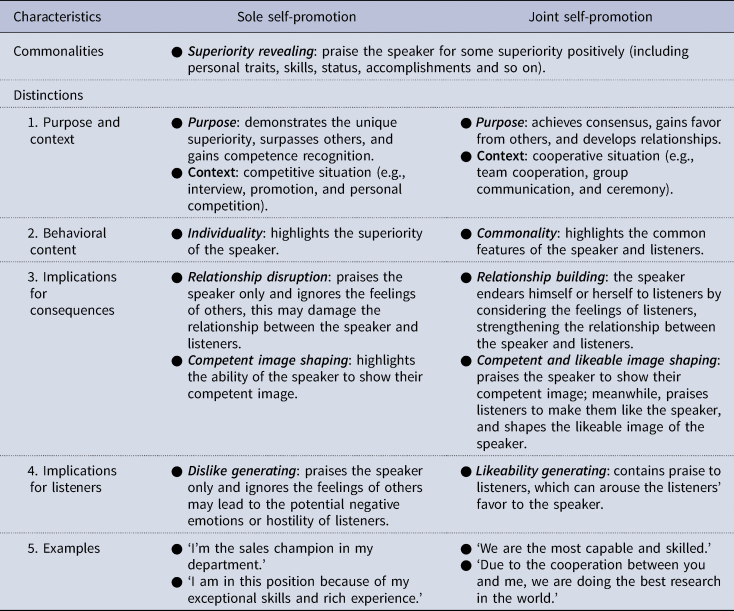
As two types of self-promotional behavior, we think that both sole self-promotion and joint self-promotion have similarities and differences in several important ways, and are summarized in Table 2.
A comparison of sole self-promotion and joint self-promotion

Regarding commonalities, both behaviors adopt the form of positive praise to highlight the superiority of the speaker, convey an extremely positive self-view, and promote the construction of a desirable image of oneself (Dayter, Reference Dayter2014; Higgins & Judge, Reference Higgins and Judge2004; Stevens & Kristof, Reference Stevens and Kristof1995). In this regard, both behaviors are positive and superior statements, except that joint self-promotion is praise to ‘us,’ and sole self-promotion is praise to ‘me.’ Most importantly, these two behaviors express the positive aspects of the speaker (e.g., personality characteristics, competence, status, and accomplishments). It is worth noting that joint self-promotion is not divorced from the speaker's focus on the self, although this behavior shows the speaker's care for the listener's feelings.
Although there are many similarities between sole self-promotion and joint self-promotion, the differences between them are more worthy of further discussion. First, the purposes and contexts of the speakers using these two behaviors are different. As far as the purpose is concerned, speakers tend to show their unique superiority, highlight that they are better than others, and gain listeners' recognition of their competence through sole self-promotion (Bolino, Long, & Turnley, Reference Bolino, Long and Turnley2016; Jones & Pittman, Reference Jones, Pittman and Suls1982). While the joint self-promoters hope to reach a consensus with the listeners, gain the favorable feelings of the listeners, and establish a relationship based on their common superiorities. In terms of applicable contexts, sole self-promotion is more suitable for use in competitive situations such as interview, promotion, and personal competition (Bolino, Long, & Turnley, Reference Bolino, Long and Turnley2016; Higgins & Judge, Reference Higgins and Judge2004; Kristof-Brown, Barrick, & Franke, Reference Kristof-Brown, Barrick and Franke2002). Joint self-promotion is more suitable for team cooperation, communication, and public ceremonies that emphasize mutual cooperation.
Second, as previously noted, these two types of self-promotional behavior differ in behavioral content. The only direct target of sole self-promotion is the self-promoter, that is, the speaker (Bolino, Long, & Turnley, Reference Bolino, Long and Turnley2016; Dayter, Reference Dayter2014; Judge & Bretz, Reference Judge and Bretz1994), while joint self-promotion focuses on both the speaker and listeners. In terms of superiority, sole self-promotion highlights the aspects that the speaker possesses, regardless of whether the listener has these superiority, emphasizing and praising the self and individuality (Bolino, Long, & Turnley, Reference Bolino, Long and Turnley2016; Dayter, Reference Dayter2014; Den Hartog, De Hoogh, & Belschak, Reference Den Hartog, De Hoogh and Belschak2020; Wayne & Ferris, Reference Wayne and Ferris1990), while joint self-promotion stresses the advantages shared by both speaker and listeners.
Third, in terms of their impact on consequences, sole self-promotion is risky (Rudman, Reference Rudman1998), because it ignores listeners' feelings and even implies the intention to belittle them (Dayter, Reference Dayter2014; Hoorens et al., Reference Hoorens, Pandelaere, Oldersma and Sedikides2012), and thus is not conducive to establishing a relationship between the speaker and listener. On the contrary, joint self-promotion shows the speaker's active recognition of the superiority of listeners, and in getting close to listeners, facilitates the establishment of a good mutual relationship. While sole self-promotion helps the speaker to shape a competent image, joint self-promotion can also build a competent image by praising the superiority of the speaker, as well as a likeable image by praising listeners to gain their liking.
Fourth, regarding implications for listeners, as sole self-promotion ignores (intentionally or unintentionally) the feelings of listeners, listeners are likely to perceive the speaker as demeaning to them and to dislike this attitude. Alternatively, as joint self-promotion praises listeners, listeners feel the speaker's willingness to reduce the psychological distance between them, and that the speaker is thinking and acting from their own point of view, allowing for a good impression of the speaker.
Theoretical overview
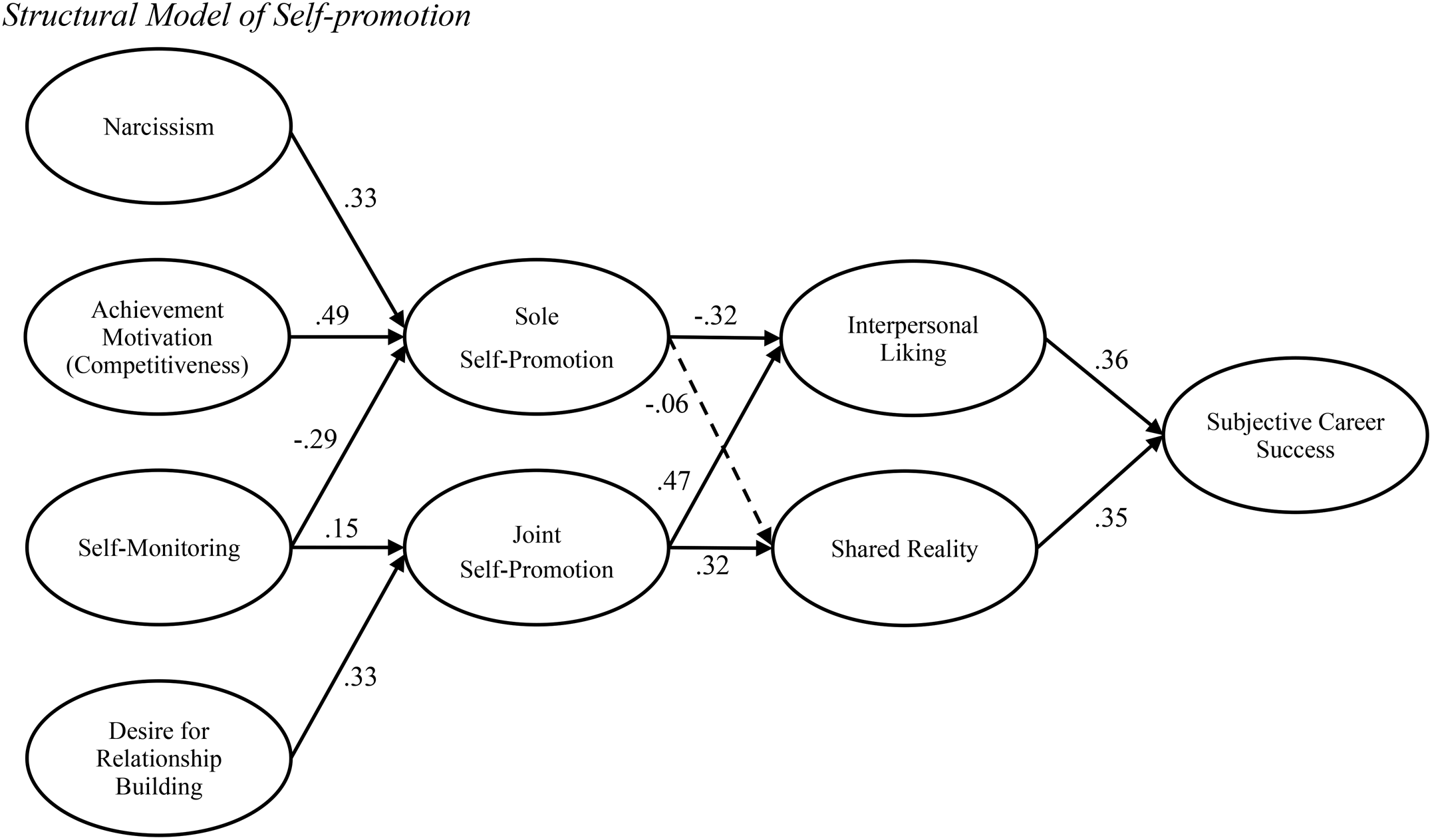
We indicate a model delineating antecedents and consequences of the two self-promotional behaviors (see Figure 1), and we draw further on social comparison theory to explicate this model.
Structural model of self-promotion.
Note. N = 491. Solid lines represent paths that were significant at p < .05 and dashed lines represent paths that were specified but found to be non-significant. Numbers are unstandardized estimates.

Employees perform social comparison activities by acquiring, thinking about, and reacting to social comparison information, determining the similarity of the self and others, and then forming an assessment of themselves (Festinger, Reference Festinger1954; Mussweiler, Reference Mussweiler2001; Wood, Reference Wood1996). Interestingly, self-promotion is a typical social comparison activity. We classify this behavior into sole self-promotion and joint self-promotion. We postulate that sole self-promotion makes a downward comparison between the speaker and others (which may include the listener), and the speaker aims to pursue the difference between himself/herself and others. Joint self-promotion, on the other hand, treats the speaker and the listener as an in-group, and make a lateral comparison between the speaker and the listener (in-group members) to pursue the similarity. Indeed, employees with different characteristics (e.g., personality, motivation, needs) select different social comparison information to be thought about and processed (Wood, Reference Wood1989, Reference Wood1996), and respond with different (sole or joint) self-promotion.
First, we discuss a narcissistic personality (Krizan & Bushman, Reference Krizan and Bushman2011) that emphasizes superiority, and achievement motivation (competitiveness; Cassidy & Lynn, Reference Cassidy and Lynn1989) that focuses on outperformance in competition with others, arguing that these two factors give rise to sole self-promotion. Then, we consider self-monitoring that focuses on self-image and motivates people to behave in accordance with others' expectations (Scott, Barnes, & Wagner, Reference Scott, Barnes and Wagner2012; Snyder & Gangestad, Reference Snyder and Gangestad1986); exploring its negative effect on sole self-promotion and its positive effect on joint self-promotion. Eventually, we view the desire for relationship building that seeks opportunities to get closer to others, as an immediate precursor of joint self-promotion.
We then suggest that the two types of self-promotional behavior have a differential influence on receivers (listeners). Receivers will passively obtain social comparison information according to the self-promotional behavior of the speaker, then process the information and finally respond to it based on their own needs (Mussweiler, Reference Mussweiler2003; Wood, Reference Wood1996). In this process, social comparison determines the similarity of two objects (Mussweiler, Reference Mussweiler2001). Notably, the tests of similarity and difference play significant roles in comparing results, in that similarity leads to assimilation and difference leads to contrast (Mussweiler, Reference Mussweiler2001, Reference Mussweiler2003; Wood, Reference Wood1996). To be more precise, sole self-promotion may inhibit listeners' interpersonal liking toward the speaker and reduce listeners' shared reality with the speaker. But joint self-promotion enhances listeners' interpersonal liking toward the speaker and increases listeners' shared reality with the speaker. Interpersonal liking and shared reality will promote the speaker's subjective career success.
Narcissism
Narcissism contains grandiosity, entitlement, dominance, and superiority from a nonclinical perspective (Paulhus & Williams, Reference Paulhus and Williams2002). These features demonstrate the extremely inflated self-concept of narcissists (Den Hartog, De Hoogh, & Belschak, Reference Den Hartog, De Hoogh and Belschak2020), who in social interaction often act in the pursuit of the ideal self (Drigotas, Rusbult, Wieselquist, & Whitton, Reference Drigotas, Rusbult, Wieselquist and Whitton1999), and tend to have a grandiose yet fragile self-image (Back, Küfner, Dufner, Gerlach, Rauthmann, & Denissen, Reference Back, Küfner, Dufner, Gerlach, Rauthmann and Denissen2013; Chatterjee & Pollock, Reference Chatterjee and Pollock2015; Morf & Rhodewalt, Reference Morf and Rhodewalt2001). Drawing on social comparison theory, highly narcissistic employees need to gain favorable social comparison information to maintain their ‘strong’ self-image. That is, to show their superiority, narcissists often use downward comparison to compare themselves with those who are inferior (Gerber, Wheeler, & Suls, Reference Gerber, Wheeler and Suls2018; Wood, Reference Wood1989, Reference Wood1996).
As noted above, sole self-promotion focuses on the speaker and seeks the attribution of competence. Narcissistic employees demonstrate their superiority (Den Hartog, De Hoogh, & Belschak, Reference Den Hartog, De Hoogh and Belschak2020), excellent ability, and extraordinary charisma to others through sole self-promotion that implicitly demeans others (Hoorens et al., Reference Hoorens, Pandelaere, Oldersma and Sedikides2012), is used to promote themselves (John & Robins, Reference John and Robins1994) and to increase psychological distance by displaying the differences between others and themselves (Wills, Reference Wills1981) to ward off potential threat (Speer, Reference Speer2012). This is based on their excessive attention to themselves (Crowe, Campbell, & Miller, Reference Crowe, Campbell and Miller2019). Clearly, such employees prefer sole self-promotion to joint self-promotion. In addition, some scholars believe that narcissism leads to self-promotion, which partially overlaps with our assumption (Hewitt et al., Reference Hewitt, Flett, Sherry, Habke, Parkin, Lam and Stein2003; Molleman, Reference Molleman2019; Scopelliti, Loewenstein, & Vosgerau, Reference Scopelliti, Loewenstein and Vosgerau2015). To summarize, sole self-promotion is a convenient and prioritized means for narcissists to project a superior self-image.
Hypothesis 1: Employee narcissism is positively related to sole self-promotion.
Achievement motivation (competitiveness)
Achievement motivation (competitiveness) refers to the enjoyment of competing against others with the ultimate goal of winning (Cassidy & Lynn, Reference Cassidy and Lynn1989). Employees with a high need for achievement (competitiveness) are result-oriented, pursue success, and value highly their own abilities and performance (Harackiewicz, Sansone, & Manderlink, Reference Harackiewicz, Sansone and Manderlink1985; Turban & Keon, Reference Turban and Keon1993). Additionally, they have a desire to outperform and dominate others, and are always looking for opportunities to compete with others, to beat them and to enjoy the joy of victory.
Employees with high achievement motivation (competitiveness) have a tendency to assess their competence and are eager to compare their competence with those of others in order to form a perception of their own competence (Harackiewicz, Sansone, & Manderlink, Reference Harackiewicz, Sansone and Manderlink1985). Therefore, we predict that these employees always consciously seek available competence information (Harackiewicz, Sansone, & Manderlink, Reference Harackiewicz, Sansone and Manderlink1985). They especially favor information that reflects the difference between themselves and others, allowing them to claim that they are superior and dominant in their competence. As found in previous research, individuals high in subjective traits (e.g., competitive, ambitious, and dominant) prefer to perform downward comparison (Buunk & Gibbons, Reference Buunk and Gibbons2007). Taken together, achievement motivation (competitiveness) drives employees to prove that they are better than others, resulting in sole self-promotion.
Hypothesis 2: Employee achievement motivation (competitiveness) is positively related to sole self-promotion.
Self-monitoring
Self-monitoring is commonly viewed as the extent of individual sensitivity to interpersonal and situational cues, monitoring the appropriateness of self-behavior and adapting self-behavior to situational demands (Snyder & Mark, Reference Snyder and Mark1974). In social interaction, individuals with high self-monitoring are good at understanding the needs and intentions of interacting objects, have a strong ability to adjust their external behavior to match others and to adapt to the environment (Allen, Weeks, & Moffitt, Reference Allen, Weeks and Moffitt2005; Johnson, Griffith, & Buckley, Reference Johnson, Griffith and Buckley2016). They have been described as acting as ‘social chameleons’ (Scott, Barnes, & Wagner, Reference Scott, Barnes and Wagner2012; Snyder & Mark, Reference Snyder and Mark1974).
We assume that employees with different self-monitoring abilities exhibit different self-promotion behavior when interacting in the workplace. Normally, employees low in self-monitoring are insensitive to people and the environment around them and do not give much thought to the impact on others when demonstrating their superiority (Scott, Barnes, & Wagner, Reference Scott, Barnes and Wagner2012). Accordingly, these employees deliberately search for socially comparative information about differences (rather than similarities) between themselves and others in self-promotional behavior. Conversely, employees with high self-monitoring are concerned about the appropriateness of self-promotional behavior on others and ensure that it meets the expectations of others. Prior research has shown high self-monitors compared with low self-monitors to be more selective in using impression management tactics and in avoiding high-risk behavior (Bolino & Turnley, Reference Bolino and Turnley2003; Turnley & Bolino, Reference Turnley and Bolino2001). Self-monitoring can positively predict self-promotion (Bolino & Turnley, Reference Bolino and Turnley1999; Higgins & Judge, Reference Higgins and Judge2004). We further refine this relationship as follows: high self-monitors prefer to use joint self-promotion in expressing themselves, emphasizing commonalities (e.g., ‘we are great’) and considering the feelings of listeners, rather than sole self-promotion. In this way, self-monitoring drives employees to seek common ground between their personal goals and the expectations of others (Dahling, Whitaker, & Levy, Reference Dahling, Whitaker and Levy2009).
Hypothesis 3a: Employee self-monitoring is negatively related to sole self-promotion.
Hypothesis 3b: Employee self-monitoring is positively related to joint self-promotion.
Desire for relationship building
Individuals with a strong desire for relationship building try their best to seize every opportunity to get close to others and create the possibility of mutual communication. Compared with people with less desire for relationship building, they spend more time with others and prefer to be social (Ashford & Black, Reference Ashford and Black1996; Ellis, Nifadkar, Bauer, & Erdogan, Reference Ellis, Nifadkar, Bauer and Erdogan2017; Wanberg & Kammeyer-Mueller, Reference Wanberg and Kammeyer-Mueller2000). A strong desire for relationship building is highly correlated with seeking support from others (Thompson, Reference Thompson2005). They display higher levels of sense-making behavior, especially information-seeking behavior of benefit to themselves and to others (Wanberg & Kammeyer-Mueller, Reference Wanberg and Kammeyer-Mueller2000). In organizations, employees with a strong desire for relationship building present their common superiority with others. To do so, they positively evaluate themselves to proclaim their extraordinary competence and get support from others, while also positively evaluating others to gain their favor (Thompson, Reference Thompson2005). To reduce the psychological distance from listeners, they use lateral comparisons to highlight similarities (Buunk & Gibbons, Reference Buunk and Gibbons2007). This indicates that desire for relationship building leads employees to perform joint self-promotion using lateral comparisons to gain similarities.
Hypothesis 4: Employee desire for relationship building is positively related to joint self-promotion.
Interpersonal liking
As a target-specific affect, interpersonal liking is a subjective overall evaluation of others (Brown & Keeping, Reference Brown and Keeping2005; Sezer, Gino, & Norton, Reference Sezer, Gino and Norton2018). Previous studies on the relationship between self-promotion and liking are contradictory (positive relationship: e.g., Pfeffer et al., Reference Pfeffer, Fong, Cialdini and Portnoy2006; negative relationship: e.g., Van Damme et al., Reference Van Damme, Deschrijver, Van Geert and Hoorens2017; Wayne et al., Reference Wayne, Liden, Graf and Ferris1997). Fortunately, our two-dimensional division of self-promotion provides a feasible way to solve this problem. We assume that two types of self-promotional behavior convey different social comparison information and create different images in the minds of others; thus, listeners' interpersonal liking of the speaker may also vary.
In organizations, the impact of sole self-promotion on interpersonal liking is reflected in the following aspects: on one hand, sole self-promotion strongly shapes a particularly inflated image (Kristof-Brown, Barrick, & Franke, Reference Kristof-Brown, Barrick and Franke2002; Van Damme et al., Reference Van Damme, Deschrijver, Van Geert and Hoorens2017), likely to be perceived by listeners as ‘bragging.’ As this behavior violates social norms of modesty, listeners perceive the speaker as an untruthful person, generating negative emotions (Chen, Liu, & Mattila, Reference Chen, Liu and Mattila2020; Fiske, Cuddy, Glick, & Xu, Reference Fiske, Cuddy, Glick and Xu2002). On the other hand, sole self-promotion implies a difference between the speaker and others (Rudman, Reference Rudman1998) and may contain a subtext ‘I am better than others’ that belittles listeners (Hoorens et al., Reference Hoorens, Pandelaere, Oldersma and Sedikides2012), may be regarded as a passive upward comparison by listeners, and can reduce self-evaluation (Lockwood & Kunda, Reference Lockwood and Kunda1997). This comparison, which ignores listeners' feelings, increases the psychological distance between listeners and the speaker and triggers the defense model of listeners to avoid the reduction of self-worth to resist the threat (Buunk & Gibbons, Reference Buunk and Gibbons2007). The most direct way is to point the sword at the speaker (Fiske et al., Reference Fiske, Cuddy, Glick and Xu2002; Lockwood & Kunda, Reference Lockwood and Kunda1997; Wills, Reference Wills1981), and thus, this behavior will not be welcomed by others (Dayter, Reference Dayter2014). In short, sole self-promotion elicits a passive upward comparison from listeners, highlights differences, produces a contrast effect, and stimulates dislike for the speaker.
Hypothesis 5: Employee sole self-promotion is negatively related to coworkers' interpersonal liking toward the employee.
In contrast, joint self-promotion considers the feelings of listeners, praises listeners as well as the speaker, and emphasizes their common superiorities. Joint self-promotion provides positive information, allowing listeners to see similarities between themselves and the speaker (Gerber, Wheeler, & Suls, Reference Gerber, Wheeler and Suls2018). This similarity-seeking behavior allows listeners to perceive a strong connection with the speaker. Furthermore, this behavior conforms to social desirability, treats the listener and speaker equally, shortens their psychological distance from each other, enhances listeners' self-esteem, and maximizes the likeability of the speaker (Chen & Jing, Reference Chen and Jing2012; Walter, Lam, Van Der Vegt, Huang, & Miao, Reference Walter, Lam, Van Der Vegt, Huang and Miao2015; Wilson & Chambers, Reference Wilson and Chambers1989). Listeners perceive that the speaker has enthusiasm, excellent morals, and thinks of others, leading to likeability (Sezer, Gino, & Norton, Reference Sezer, Gino and Norton2018). In short, joint self-promotion can achieve an assimilation effect through lateral comparison between the speaker and listeners, producing an interpersonal liking for the speaker.
Hypothesis 6: Employee joint self-promotion is positively related to coworkers' interpersonal liking toward the employee.
Shared reality
Shared reality is defined as the subjective experience of having the same feelings, beliefs, or concerns (i.e., inner state) with another person concerning a target referent (Rossignac-Milon, Bolger, Zee, Boothby, & Higgins, Reference Rossignac-Milon, Bolger, Zee, Boothby and Higgins2020; Wilson, Kleshinski, & Matta, Reference Wilson, Kleshinski and Matta2021). Apparently, sole self-promotion emphasizes the speaker's own merits and ignores the merits and feelings of listeners. According to social comparison theory, sole self-promotion that pursues differences (contrast effect) will widen the distance between listeners and the speaker (Mussweiler, Reference Mussweiler2001, Reference Mussweiler2003; Wood, Reference Wood1996). Therefore, sole self-promotion does not facilitate the realization of shared reality, but rather reduces each other's shared reality.
Hypothesis 7: Employee sole self-promotion is negatively related to coworkers' shared reality with the employee.
On the contrary, joint self-promotion shows the speaker's recognition of the competence of listeners. Since individuals generally hold positive perceptions of themselves (Colvin, Block, & Funder, Reference Colvin, Block and Funder1995; Taylor & Brown, Reference Taylor and Brown1988; Taylor, Lerner, Sherman, Sage, & McDowell, Reference Taylor, Lerner, Sherman, Sage and McDowell2003), it is likely that listeners and the speaker will reach a consensus when listeners hear a positive evaluation of themselves by the speaker. Thus, we believe that joint self-promotion can induce listeners' shared reality with the speaker. In other words, this behavior carries a wealth of shared collective information (Echterhoff, Higgins, & Groll, Reference Echterhoff, Higgins and Groll2005; Hirst & Echterhoff, Reference Hirst and Echterhoff2012), constructs a shared identity between the listener and speaker (Rossignac-Milon et al., Reference Rossignac-Milon, Bolger, Zee, Boothby and Higgins2020), and is a typical construction process of shared reality.
Consistent with the previous discussion, joint self-promotion achieves assimilation effects through lateral comparisons (Mussweiler & Bodenhausen, Reference Mussweiler and Bodenhausen2002). The compliment of joint self-promotion to listeners evokes a high subjective value (Becker & Curhan, Reference Becker and Curhan2018), and emphasizes similarities. When listeners internalize and recognize this behavior, it is seen as group-oriented behavior (Tyler & Blader, Reference Tyler and Blader2002), resulting in strong identification (Festinger, Reference Festinger1954; Lockwood & Kunda, Reference Lockwood and Kunda1997; Tajfel, Reference Tajfel1974, Reference Tajfel1982). This behavior treats listeners and the speaker as an ‘in-group,’ providing the opportunity to share a ‘similar fate’ (Gerber, Wheeler, & Suls, Reference Gerber, Wheeler and Suls2018; Wills, Reference Wills1981) with each other, and giving listeners and the speaker a collective self (Echterhoff, Higgins, & Levine, Reference Echterhoff, Higgins and Levine2009; Gardner, Gabriel, & Hochschild, Reference Gardner, Gabriel and Hochschild2002; Gómez, Seyle, Huici, & Swann, Reference Gómez, Seyle, Huici and Swann2009). Under the assimilation of ‘we are all excellent,’ listeners will generate a shared reality consistent with the speaker. In this way joint self-promotion can provoke listeners' shared reality by proclaiming the shared superiority of listeners.
Hypothesis 8: Employee joint self-promotion is positively related to coworkers' shared reality with the employee.
Career success
Substantial evidence proves that good interpersonal relationship can drive individuals to higher level of achievement in their careers (Montani, Maoret, & Dufour, Reference Montani, Maoret and Dufour2019; Thacker & Wayne, Reference Thacker and Wayne1995). First, being liked by others drives the individual to be approached or accepted by others (Colvin, Block, & Funder, Reference Colvin, Block and Funder1995). When an employee is liked by others, coworkers are willing to get close to him/her and enhance their communication and cooperation (Ganegoda & Bordia, Reference Ganegoda and Bordia2019; Sluss, Ployhart, Cobb, & Ashforth, Reference Sluss, Ployhart, Cobb and Ashforth2012). At the same time, employees who are liked by others and have good interpersonal relationships with others can get more resources (Manuscript & Exchange, Reference Manuscript and Exchange2020), that help them complete tasks and work better, and then get more favorable performance evaluation (Barrick, Shaffer, & DeGrassi, Reference Barrick, Shaffer and DeGrassi2009; Ferris & Judge, Reference Ferris and Judge1991; Liu, Ferris, Xu, Weitz, & Perrewe, Reference Liu, Ferris, Xu, Weitz and Perrewe2014). Apparently, individuals liked by others are more likely to be successful in the workplace than those who are unpopular (Brown & Keeping, Reference Brown and Keeping2005; Dimotakis, Mitchell, & Maurer, Reference Dimotakis, Mitchell and Maurer2017).
Hypothesis 9: Coworkers' interpersonal liking toward the employee is positively related to employee's subjective career success.
People with the shared reality have common memories, feelings about organizations and things, and have a high degree of similarity and familiarity with each other (Rossignac-Milon et al., Reference Rossignac-Milon, Bolger, Zee, Boothby and Higgins2020). On the one hand, employees who have the shared reality with coworkers can quickly integrate with their coworkers and organization to improve work efficiency and reduce communication time and costs (Higgins, Echterhoff, Crespillo, & Kopietz, Reference Higgins, Echterhoff, Crespillo and Kopietz2007). On the other hand, these employees can gain the trust of coworkers (Echterhoff, Higgins, & Groll, Reference Echterhoff, Higgins and Groll2005), reach consensus with others, be accurately understood (Wilson, Kleshinski, & Matta, Reference Wilson, Kleshinski and Matta2021), and are easier to obtain the support of coworkers (Enestrom & Lydon, Reference Enestrom and Lydon2021). Therefore, individuals who have the shared reality with coworkers succeed easily in the workplace.
Hypothesis 10: Coworkers' shared reality with the employee is positively related to employee's subjective career success.
Method overview
We tested the theoretical framework of this article in two phases consisting of four independent samples through a combination of qualitative and quantitative methods. In phase 1, we performed deductive and inductive approaches which were based on a thorough review of the literature to generate items and an interview (sample 1), and used sample 2 to test the content validity of the scale we had developed. Next, we utilized an exploratory factor analysis using the quantitative data (sample 3) designed to test the reliability and the factor structure. In phase 2, a three-wave, two-source research design was implemented to obtain quantitative data (sample 4) to validate our proposed overall model. All materials were presented in Chinese and we followed the standard translation and back-translation procedures (Brislin, Reference Brislin, Triandis and Berry1980) to generate a Chinese version of all measure instruments.
Phase 1
Scale development
Drawing on Hinkin's (Reference Hinkin1998) scale development procedure, we combined inductive and deductive approaches to generate questionnaire items. Firstly, we extensively reviewed the relevant literature on the measurement of self-promotion (e.g., Bolino & Turnley, Reference Bolino and Turnley1999; Higgins & Judge, Reference Higgins and Judge2004; Stevens & Kristof, Reference Stevens and Kristof1995), checked all items of these scales, and included these items in our initial item pool as far as possible. Notably, as these items all described a speaker's self-promotion and some of the items overlapped, we modified the existing items to measure sole self-promotion more accurately. Then, based on the characteristics of joint self-promotion, we modified the sole self-promotion items to form the joint self-promotion items. Based on our conceptualization, an item pool containing 46 items (24 items of sole self-promotion, and 22 items of joint self-promotion) was initially created.
We also used a critical incident method through interviews, one of the inductive approaches, to obtain critical incidents. We obtained 152 incidents (sample 1) described in interviews with 31 full-time employees. Of these 152 incidents, 85 concerned sole self-promotion and the remaining 67 concerned joint self-promotion. The majority of our participants were aged between 26 and 35 (71.0%), male (54.8%), college educated (77.4%), and had more than five years of working experience (58.1%). Additionally, participants in this sample were from a variety of industries (e.g., consulting services, information technology, manufacturing, architecture, education and training, journalism). Sample incidents included: ‘I used to praise myself in front of my leaders that I was good at financial work because I was naturally sensitive to numbers’; ‘I talked proudly about my own excellent sales ability and skills in front of the interviewer during an interview’; ‘I not only praised my excellent work ability, but also praised a colleague of mine face to face’; ‘In front of my colleagues, I actively expressed the excellent performance of all of us.’
Notably, we found that when describing their self-promotion behaviors, participants revealed the purposes and situations of their implementation. Among these incidents, 57 sole self-promotion incidents clearly displayed the purposes of implementers, including ‘showing one's own excellent characteristics,’ ‘presenting one's superior ability over others,’ ‘shaping a very good impression on listeners,’ etc.; 45 joint self-promotion incidents demonstrated that the purpose of speakers included ‘winning the favor of the audience,’ ‘getting the approval of others,’ ‘establishing a cooperative relationship,’ ‘building a friendly image,’ ‘improving the relationship,’ etc.; 49 sole self-promotion incidents described the situations, such as ‘job interview,’, ‘promotion recommendation,’ ‘self-introduction of new employees,’ ‘skill competition’; 32 joint self-promotion incidents presented the following situations: ‘team cooperation,’ ‘internal communication,’ ‘project mobilization,’ ‘annual meeting,’ etc. These meant that participants selectively used sole self-promotion and joint self-promotion according to their different purposes and different situations in the workplace.
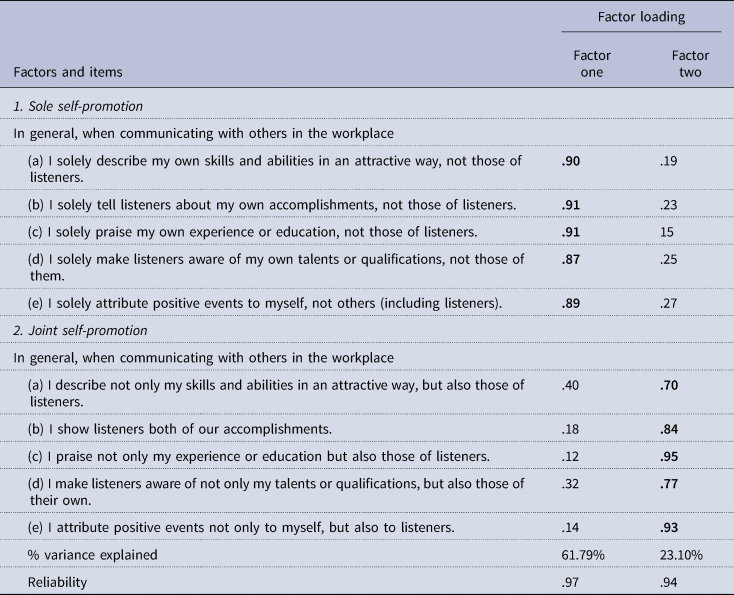
Lastly, after matching our item pool (42 items) with 152 critical incidents, two organizational behavior professors, one linguistic expert, and four Ph.D. students removed all items deemed redundant or nonrepresentative, resulting in 10 items (five items each for sole self-promotion and joint self-promotion, see Table 3).
EFA results for the 10-item self-promotion scale for sample 3

Note. N = 489. Bold figures are the highest factor loadings of indicators on factors from EFA.
Content validity
We used a sample of 32 employees (sample 2) from one Chinese manufacture company in Beijing to test the content validity of the scale we had developed. The majority of our participants were aged between 26 and 35 (84.4%, M = 29.84, SD = 4.29), male (56.3%), and had a college degree or above (82.5%). Their average organizational tenure was 4.2 year (SD = 1.71). Specifically, we provided participants with the definitions of sole self-promotion and joint self-promotion in the questionnaire, and ask them to use a 5-point scale (1 = not at all and 5 = strongly) to assign each of the 10 items to the structure they feel most accurately reflects. We used intraclass correlation coefficient, that is ICC(1), to assess the degree of agreement among participants (Bliese, Reference Bliese, Klein and Kozlowski2000). Results demonstrated that the values of ICC(1) for sole self-promotion and joint self-promotion were .83 and .89, higher than the threshold value of .70, showing high levels of agreement. Consequently, our scale which adequately reflected the underlying constructs had high content validity.
Exploratory factor analysis
Exploratory factor analysis can reduce a group of observed variables into a smaller group of variables and can also be used to test whether the items of the scale are consistent with the measured constructs (Hinkin, Reference Hinkin1998). Therefore, we conducted exploratory factor analysis to find out if we could continue to streamline these items, and to further clarify the factor structure through these items.
Participants, procedure, and measures
The participants in the survey were 489 full-time employees (sample 3) from a construction company in northern China. Among the participants, 35% were female, the average age was 33 years old, the mean full-time work experience was 10.9 years, and 77.3% had bachelor's or master's degrees. The 10-item scale we developed was used to measure self-promotion (five items each for sole self-promotion and joint self-promotion). Participants in sample 3 responded to all items on a 5-point scale (1 = never behave this way to 5 = always behave this way). In this survey, participants were asked to recall their behavior in the workplace and rate the frequency of the above two behaviors. Before starting, we provided participants with clear verbal and written instructions and guaranteed anonymity.
Data analysis and results
The results of exploratory factor analysis indicated that a two-factor solution fit the data best using principal axis factoring with the direct oblimin rotation, identifying common factors with eigenvalues greater than one (Fabrigar, Wegener, MacCallum, & Strahan, Reference Fabrigar, Wegener, MacCallum and Strahan1999; Hinkin, Reference Hinkin1998). First, 10 items loaded on two factors, with five sole self-promotion items loading on the first and the other five joint self-promotion items on the second. Second, all items had significant and high factor loadings (ranging from .70 to .95), exceeding the threshold of .40 (Hinkin, Reference Hinkin1998). Finally, two factors explained 84.88% of total variance explained, which reached the minimum threshold of 60% (Hinkin, Reference Hinkin1998). Additionally, the correlation between sole self-promotion and joint self-promotion was significant (r = .47, p < .001). Cronbach's alphas of the two constructs were .97 and .94, exceeding the recommended value of .70, which demonstrated acceptable reliability. The 10 finalized items, EFA factor loadings, percentage of variance explained, and reliabilities are provided in Table 3. Overall, the results of EFA demonstrated that the self-promotion scale (five items per subscale) was succinct enough and could distinguish the two constructs of sole self-promotion and joint self-promotion.
Phase 2
The main purpose of phase 2 was to examine our theoretical model presented earlier, including all hypotheses related to the antecedents and consequences of sole self-promotion and joint self-promotion.
Participants and procedure
We surveyed 852 employees (sample 4) from two information technology companies in China. Firstly, we took the personnel list of employee names provided by the human resources departments of these companies. Then, we excluded work groups with fewer than three individuals (cf. Glomb & Liao, Reference Glomb and Liao2003), this is because group members would rate each other (time 2 only). Before starting the questionnaires, we informed the participants of the academic purpose and procedure of this survey, provided clear verbal and written instructions, and ensured a high degree of confidentiality and anonymity in the process (without exposing our hypotheses). After all the questionnaires were completed, they were sealed in the envelopes we provided in advance and taken back.
We collected data three times. The time 1 (T1) survey was completed by 810 employees. Of these, 657 employees and their coworkers (i.e., fellow work group members) completed the time 2 (T2) survey. Finally, 523 employees completed the time 3 (T3) survey. After removing missing data, our final sample size was 491 and the staff final response rate was 60.62%. It is worth noting that these employees stem from 98 work groups, with about five employees per group. Specifically, employees averaged 38.53 years old (SD = 8.64), with an average of 8.97 years of company tenure (SD = 5.77), 90.40% had a bachelor's degree or above, and 45.80% were female.
Measures
To establish direct relationships between variables and to avoid potential common method bias, we used a three-wave, two-source data collection method. At T1, employees rated their own narcissism, achievement motivation (competitiveness), self-monitoring, and desire for relationship building. After two weeks, at T2, employees rated their own sole and joint self-promotion behavior, ingratiation, bragging, and political skill; group members then rate each other's interpersonal liking and shared reality. After another two weeks, at T3, employees rated subjective career success. Unless otherwise specified, the measurement items used in phase 2 are all on a 5-point Likert-type scale (1 = strongly disagree and 5 = strongly agree).
Sole and joint self-promotion
The 10 items (five items per subscale) developed in phase 1 were used to measure employee sole and joint self-promotion behavior. Response scales ranged from 1 (never behave this way) to 5 (always behave this way). Coefficient alphas of the sole and joint self-promotion subscales, respectively, were .96 and .94.
Narcissism
We measured narcissism using nine items from the Narcissism subscale of the Short Dark Triad (Jones & Paulhus, Reference Jones and Paulhus2014). An example item is ‘I know that I am special because everyone keeps telling me so.’ Coefficient alpha was .99.
Achievement motivation (competitiveness)
We assessed achievement motivation (competitiveness) using Cassidy and Lynn's (Reference Cassidy and Lynn1989) seven-item Competitiveness subscale. A sample item reads ‘I judge my performance on whether I do better than others rather than on just getting a good result.’ Coefficient alpha was .95.
Self-monitoring
Consistent with Scott, Barnes, and Wagner (Reference Scott, Barnes and Wagner2012) measure, we used eight positively worded items (Snyder & Gangestad, Reference Snyder and Gangestad1986) to assess self-monitoring. An example item is ‘In different situations and with different people, I often act like very different persons.’ Coefficient alpha was .98.
Desire for relationship building
We measured the desire for relationship building with coworkers using three items adapted from the Build Relationship-Boss subscale (Ashford & Black, Reference Ashford and Black1996). The original scale measures individuals' behavior in building relationships with the boss, but we adapted it to measure individuals' intentions to build relationships with coworkers. A sample item is ‘To what extent have you wanted to spend as much time as you could with your coworkers.’ Response scales ranged from 1 (to no extent) to 5 (to a great extent). Coefficient alpha was .97.
Interpersonal liking
In order to measure the focal employee's degree of being liked, we used the average level of coworker interpersonal liking toward the focal employee. That is, each group member took turns being the focal employee, then the average score of other group members (excluding the focal employee) on the focal employee became the interpersonal liking rating for this employee. The similar operation can see Kim and Glomb's (Reference Kim and Glomb2014) approach to assess envy. We captured coworkers' interpersonal liking toward the focal employee by using four items adapted from Wayne and Ferris (Reference Wayne and Ferris1990). An example item is ‘I think this colleague would make a good friend.’ Coefficient alpha was .96.
Shared reality
Similar to the measurement of interpersonal liking, we also used the average score of other group members to capture coworkers' shared reality with the focal employee. We used eight items (Rossignac-Milon et al., Reference Rossignac-Milon, Bolger, Zee, Boothby and Higgins2020) to assess coworkers' shared reality with the employee. A sample item is ‘[Target's name] and I typically share the same thoughts and feelings about things.’ Coefficient alpha was .96.
Subjective career success
According to previous studies (e.g., Blokker, Akkermans, Tims, Jansen, & Khapova, Reference Blokker, Akkermans, Tims, Jansen and Khapova2019; Seibert, Grant, & Kraimer, Reference Seibert, Grant and Kraimer1999), Greenhaus, Parasuraman, and Wormley's (Reference Greenhaus, Parasuraman and Wormley1990), five-item Career Satisfaction Scale was used to assess subjective career success. A sample item from this scale is: ‘I am satisfied with the progress I have made toward meeting my goals for advancement.’ Coefficient alpha was .93.
Control variables
Some studies have shown that individual demographic variables may be correlated with social comparisons (Gardner, Gabriel, & Hochschild, Reference Gardner, Gabriel and Hochschild2002; Lockwood & Kunda, Reference Lockwood and Kunda1997; Mussweiler, Reference Mussweiler2003). Therefore, it seems reasonable to control employee gender (1 = male, 0 = female), employee age, education, organizational tenure in analyses. Meanwhile, we also included similar constructs in models. So ingratiation (four items; Bolino & Turnley, Reference Bolino and Turnley1999), bragging (six items; Chen & Jing, Reference Chen and Jing2012), and political skill (six items; Ahearn, Ferris, Hochwarter, Douglas, & Ammeter, Reference Ahearn, Ferris, Hochwarter, Douglas and Ammeter2004) were operated as control variables which influence interpersonal liking and shared reality. The scales of ingratiation and bragging ranged from 1 (never behave this way) to 5 = (always behave this way). Coefficient alphas were .93, .93 and .95, respectively.
Preliminary analysis
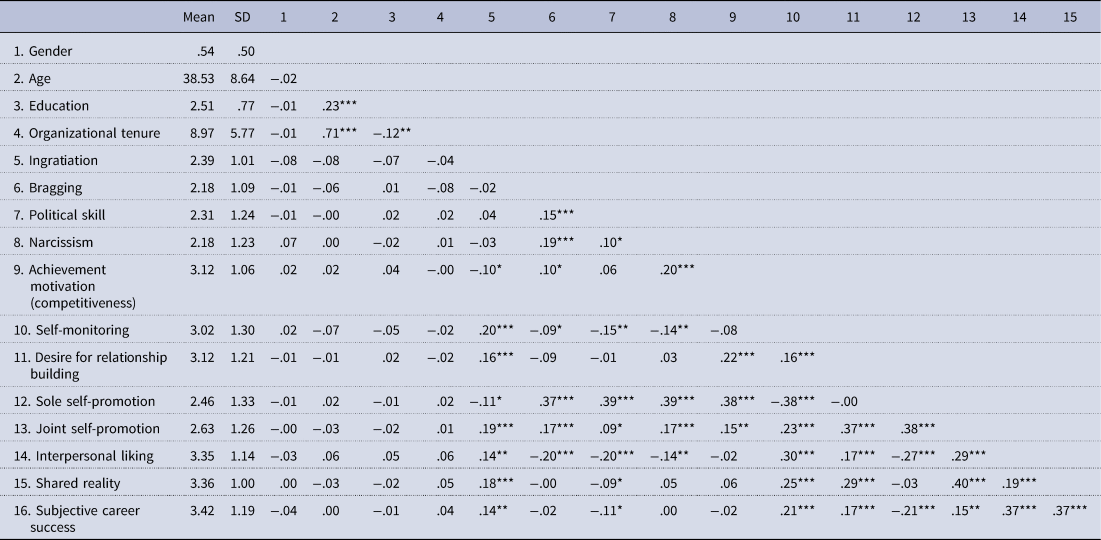
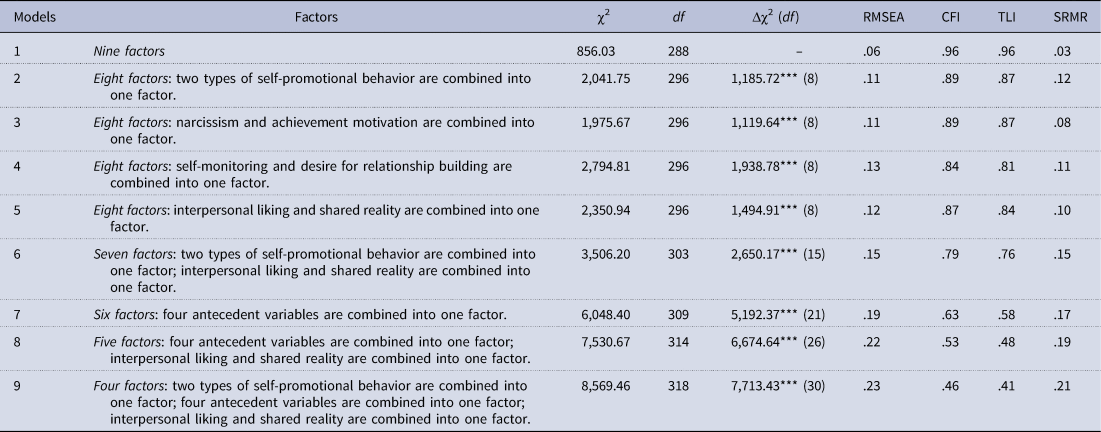
The mean, standard deviance, and correlations among the variables can be seen in Table 4. Because the small sample size-to-item ratio impairs the overall model fit, we followed recommendations (Little, Rhemtulla, Gibson, & Schoemann, Reference Little, Rhemtulla, Gibson and Schoemann2013; Williams, Vandenberg, & Edwards, Reference Williams, Vandenberg and Edwards2009) to parcel the constructs. Specifically, the constructs that had more than three items were parceled into three items respectively, using random algorithm recommended by Little, Cunningham, Shahar, and Widaman (Reference Little, Cunningham, Shahar and Widaman2002). The results showed that the hypothesized nine-factor model had an acceptable fit, χ2(288) = 856.03, p < .001; root mean squared error of approximation [RMSEA] = .06, comparative fit index [CFI] = .96, Tucker–Lewis index [TLI] = .96, standardized root mean square residual [SRMR] = .03. Importantly, it outperformed the alternative models (see Table 5). Thus, our findings provide strong evidence supporting the discriminative validity among variables.
Descriptive statistics and correlations among variables for sample 4

Note. N = 491. Gender (0 = female; 1 = male). Education (1 = college or below, 2 = bachelor's degree, 3 = master's degree, 4 = doctoral degree). Organizational tenure was measured in years.
*p < .05 (two-tailed); **p < .01 (two-tailed); ***p < .001 (two-tailed).
Comparison of measurement models for sample 4

Note.***p < .001 (two-tailed).
Hypothesis testing
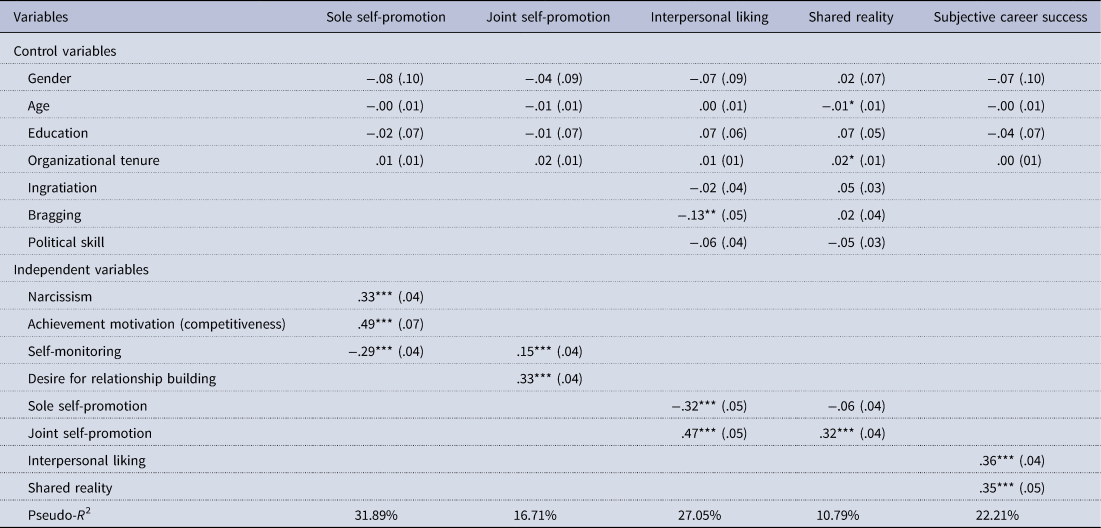
We run the structural equation model using Mplus 8.3 (Muthén & Muthén, Reference Muthén and Muthén2017). As Table 6 presents, both employee narcissism and achievement motivation (competitiveness) were significantly and positively related to sole self-promotion (γ = .33, SE = .04, p < .001 and γ = .49, SE = .07, p < .001, respectively). Thus, Hypotheses 1 and 2 were supported. We also found that employee self-monitoring was negatively and significantly related to sole self-promotion (γ = −.29, SE = .04, p < .001), but positively and significantly related to joint self-promotion (γ = .15, SE = .04, p < .001). Therefore, Hypotheses 3a and 3b were supported by our data. Meanwhile, we found that the desire for relationship building was positively and significantly related to joint self-promotion (γ = .33, SE = .04, p < .001). Thus, Hypothesis 4 was supported.
Structural equation model for sample 4

Note. N = 491. Unstandardized regression coefficients are reported. Standard errors are reported in parentheses. *p < .05 (two-tailed), **p < .01 (two-tailed), ***p < .001 (two-tailed).
Furthermore, the results indicated that, employee sole self-promotion was significantly and negatively related to coworkers' interpersonal liking toward the employee (γ = −.32, SE = .05, p < .001), but employee joint self-promotion was significantly and positively related to coworkers' interpersonal liking toward the employee (γ = .47, SE = .05, p < .001). Therefore, Hypotheses 5 and 6 were supported by our data.
The results demonstrated that employee sole self-promotion was not significantly related to coworkers' shared reality with the employee (γ = −.06, SE = .04, p = .093). Thus, Hypothesis 7 was not supported. We found that employee joint self-promotion was significantly and positively related to coworkers' shared reality with the employee (γ = .32, SE = .04, p < .001), thereby supporting Hypothesis 8. Supporting both Hypotheses 9 and 10, we found that coworkers' interpersonal liking toward the employee (γ = .36, SE = .04, p < .001) and coworkers' shared reality with the employee (γ = .35, SE = .05, p < .001) were significantly and positively related to subjective career success. With or without these control variables, our hypotheses were all supported. Standardized parameter estimates are shown in Figure 1 and Table 6.
Discussion
In phase 2, the data validated the assumptive antecedents and consequences of sole and joint self-promotional behaviors, indicating that our preconceived overall model was reasonable. Notably, the only inconsistency with our hypotheses is that employee sole self-promotion has no significant impact on coworkers' shared reality with the employee. We believe that sole self-promotion focuses on the speaker and does not involve the listener, and thus cannot touch the shared reality of both, and is therefore irrelevant to shared reality. The core of phase 2 was to confirm the difference between sole self-promotion and joint self-promotion through data (sample 4), give the evidence that different psychological factors lead to different employee self-promotional behavior, and these two behaviors lead to different reactions of coworkers toward the target employee, ultimately affect career success differently. Thus, we verified the overall model and deepened our understanding of self-promotion.
General discussion
Although many meaningful results have been obtained from previous studies on self-promotion, the overall literature is imperfect and the outcomes are contradictory (Den Hartog, De Hoogh, & Belschak, Reference Den Hartog, De Hoogh and Belschak2020; Higgins, Judge, & Ferris, Reference Higgins, Judge and Ferris2003). Self-promotion is ubiquitous in organizations; however, scholars have only touched the surface of the dimension division, antecedents, and consequences of this behavior (Bolino & Turnley, Reference Bolino and Turnley1999; Bolino, Long, & Turnley, Reference Bolino, Long and Turnley2016; Kristof-Brown, Barrick, & Franke, Reference Kristof-Brown, Barrick and Franke2002).
To make up for the deficiencies of the current literature, we reviewed the research on self-promotion, divided it into sole and joint self-promotional behaviors, then developed and validated a 10-item measurement scale using samples 1–3. Based on social comparison theory, we then explored the different antecedents and consequences (i.e., an overall model, sample 4) of sole and joint self-promotional behaviors by viewing them as two typical social comparison behaviors. Specifically, we confirmed that narcissism and achievement motivation (competitiveness) were significantly positive predictors of sole self-promotion, and that self-monitoring was a significantly negative predictor. Meanwhile, both self-monitoring and the desire for relationship building were proved as significantly positive predictors of joint self-promotion. In addition, we also found that two types of self-promotional behavior could lead to different responses from others. Sole self-promotion suppressed coworkers' interpersonal liking toward the employee and was not significantly related to coworkers' shared reality with the employee; whereas joint self-promotion inspired coworkers' interpersonal liking toward the employee and coworkers' shared reality with the employee. Interpersonal liking and shared reality can evoke employee subjective career success.
Theoretical implications
The first and critical contribution of our research is that, based on a two-dimensional structure, it enriches the connotation, broadens the research perspective on self-promotion, and reveals the different results of the two behaviors. The two-dimensional self-promotion concept we proposed takes into account the feelings of the listener and breaks through the traditional self-promotion from a single perspective. As mentioned above, the past literature demonstrates that self-promotion not only plays a positive role (Barrick, Shaffer, & DeGrassi, Reference Barrick, Shaffer and DeGrassi2009; Bornstein, Riggs, Hill, & Calabrese, Reference Bornstein, Riggs, Hill and Calabrese1996; Higgins & Judge, Reference Higgins and Judge2004; Swider et al., Reference Swider, Barrick, Harris and Stoverink2011; Zhao & Liden, Reference Zhao and Liden2011) but also has negative effects (Dayter, Reference Dayter2014; Hoorens et al., Reference Hoorens, Pandelaere, Oldersma and Sedikides2012; Pfeffer et al., Reference Pfeffer, Fong, Cialdini and Portnoy2006). The root cause is that its traditional narrow one-dimensional structure hinders the development of related theories and restricts its research perspective. Based on this, we proposed a two-dimensional construct of sole self-promotion and joint self-promotion. This responds to the call of some scholars for the dimensional classification of impression management behavior (Judge & Bretz, Reference Judge and Bretz1994). We also discussed the different consequences of sole self-promotion and joint self-promotion, clarifying the contradictions in the previous literature to a certain extent. For example, Pfeffer et al. (Reference Pfeffer, Fong, Cialdini and Portnoy2006) believed that self-promotion stimulates others' likeability, but other scholars have recognized that self-promotion has a negative relationship with likeability (e.g., Van Damme et al., Reference Van Damme, Deschrijver, Van Geert and Hoorens2017; Wayne et al., Reference Wayne, Liden, Graf and Ferris1997). Our results demonstrate that by ignoring their listeners' feelings, employee sole self-promotion inhibits listeners' interpersonal liking. By contrast, in considering listeners' feelings and praising them, employee joint self-promotion evokes interpersonal liking of their listeners. Obviously, the different results of self-promotion are caused by whether the two behaviors consider listeners' feelings or not. Meanwhile, these differences lead to different effects on career success. Thus, this two-dimensional perspective also deepens our further understanding of self-promotion and career success. Overall, the two-dimensional structure of self-promotion provides a feasible way of clarifying the contradictions of the current literature. Our work also theoretically explains the odd phenomenon that self-promotion, which is not advocated by theorists, is implemented tirelessly by individuals in practical communication.
Secondly, our research also contributes to the literature on self-promotion by expounding the different antecedents of sole self-promotion and joint self-promotion. Many scholars believe that it is necessary to discuss the antecedents and results of specific behavior in impression management (Bolino & Turnley, Reference Bolino and Turnley1999; Bolino, Long, & Turnley, Reference Bolino, Long and Turnley2016; Kristof-Brown, Barrick, & Franke, Reference Kristof-Brown, Barrick and Franke2002). We demonstrate that these two behaviors are driven by different individual psychological factors. Specifically, we suggest that narcissism can positively influence sole self-promotion, which is consistent with previous research findings (e.g., Hewitt et al., Reference Hewitt, Flett, Sherry, Habke, Parkin, Lam and Stein2003; Molleman, Reference Molleman2019; Scopelliti, Loewenstein, & Vosgerau, Reference Scopelliti, Loewenstein and Vosgerau2015). We also confirm that achievement motivation (competitiveness) drives employees to practice sole self-promotion. Interestingly, our conclusions on the relationship between self-monitoring and self-promotion are different from those of previous studies. Past research indicates that self-monitoring leads to self-promotion (Bolino, Long, & Turnley, Reference Bolino, Long and Turnley2016; Higgins & Judge, Reference Higgins and Judge2004). However, we found that self-monitoring engenders joint self-promotion but inhibits sole self-promotion. Moreover, employees' desire for relationship building can irritate joint self-promotion. In short, our research makes a bold attempt to clarify the relationship between individual factors (personalities and individual purposes) and different self-promotional behavior.
A third contribution is that our studies develop impression management theory by proposing sound thinking that constructs simultaneously both a competent and likeable image. Combining competence and likeability has always been a major challenge in the development of impression management literature (Bolino, Long, & Turnley, Reference Bolino, Long and Turnley2016). Indeed, self-focused self-promotion is used to seek the attribution of competence rather than of likeability, but other-focused ingratiation is used to seek the attribution of likeability rather than competence (Bolino & Turnley, Reference Bolino and Turnley1999; Chawla et al., Reference Chawla, Gabriel, Rosen, Evans, Koopman, Hochwarter and Jordan2021; Ellis, West, Ryan, & DeShon, Reference Ellis, West, Ryan and DeShon2002; Jones & Pittman, Reference Jones, Pittman and Suls1982; Judge & Bretz, Reference Judge and Bretz1994; Stevens & Kristof, Reference Stevens and Kristof1995; Yi, Zhang, & Windsor, Reference Yi, Zhang and Windsor2019). Other-focused and self-focused behaviors have different functions and construct different personal images (Ingold, Kleinmann, König, & Melchers, Reference Ingold, Kleinmann, König and Melchers2016; Kristof-Brown, Barrick, & Franke, Reference Kristof-Brown, Barrick and Franke2002). Fortunately, self-promotion (especially joint self-promotion) solves this problem by considering the feelings of listeners. That is to say, narrow self-promotion (i.e., sole self-promotion) in prior literature creates a competent but unlikable image of the individual. However, the joint self-promotion we put forward avoids the modesty maxim, breaking the spell of the hubris hypothesis (Hoorens et al., Reference Hoorens, Pandelaere, Oldersma and Sedikides2012) and the self-promoter's paradox (Bolino, Long, & Turnley, Reference Bolino, Long and Turnley2016) by creating the competent image by the speaker praising themselves and the likable image by praising listeners.
Finally, our detailed revelation of the differences between these two types of self-promotional behavior directly enriches and expands social comparison theory. We use social comparison theory to view sole and joint self-promotional behaviors as two typical and different social comparison activities. More specifically, our findings show that sole self-promotion is a typical active downward comparison behavior that emphasizes the superiority of individuals. In terms of the speaker's subjectivity, it aims to highlight the differences between the self and others, most likely leading to the contrast effect (Mussweiler, Reference Mussweiler2001, Reference Mussweiler2003; Wood, Reference Wood1996). In the listeners' view, sole self-promotion of the speaker is a passive upward comparison behavior. Although listeners receive this social comparison information passively, the processing is active (Wood, Reference Wood1996), and the results of listeners' responses may be based on contrast effects. Unlike sole self-promotion, we reveal that joint self-promotion for the speaker, is an active lateral and downward comparison behavior, emphasizing the similarity between the speaker and listeners (Lockwood & Kunda, Reference Lockwood and Kunda1997; Mussweiler, Reference Mussweiler2001, Reference Mussweiler2003; Taylor & Lobel, Reference Taylor and Lobel1989; Wood, Reference Wood1996). In the view of the listeners, joint self-promotion is a passive lateral and downward comparison behavior that results in an assimilation effect with the speaker. As Taylor and Lobel (Reference Taylor and Lobel1989) have pointed out, one of the most important aspects of refining social comparison theory is the effort to identify and distinguish the preconditions and outcomes of different types of social comparison activities. Furthermore, as advocated by Chawla et al. (Reference Chawla, Gabriel, Rosen, Evans, Koopman, Hochwarter and Jordan2021), it is meaningful to use different theoretical perspectives to expand the relationship network related to impression management behavior. In line with this, our interpretation of sole and joint self-promotion and their antecedents and consequences deepens our understanding of the function of social comparison theory between implementers and recipients.
Practical implications
Because of the different functions of these two kinds of self-promotion behaviors, employees should use them selectively according to their own purposes and contexts. Specifically, when individuals want to show their competence, especially in a competitive situation (such as interview, promotion, and personal competition), they can demonstrate their superiority and shape a competent image quickly through sole self-promotion. Alternatively, when individuals want to achieve consensus or develop a relationship with others, especially in a cooperative situation (e.g., team cooperation, group communication, and ceremony), they need to consider the feelings of the listeners. In other words, when individuals tend to show their own competence, win the favor of the listeners, and avoid social exclusion and punishment, they can adopt joint self-promotion that does not contradict the group's expectations.
In addition, our findings provide valuable practical implications for organizations. First, organizational intervention efforts may focus on providing a good environment or on using training to motivate employees' joint self-promotion to help employees establish good relationships with coworkers. When employees are needed by the organization to display their personal abilities, the organization can encourage employees to perform sole self-promotion. Of course, sole self-promotion may have negative effects if used irrationally, so the organization should manage and intervene sole self-promotion of employees reasonably and effectively to achieve the organization's goals. Lastly, we offer human resource leaders and staff the tools to understand employees with different self-promotional preferences, and provide the basis for employee selection, promotional decision-making, and performance evaluation.
Limitations and future research
Our research has several limitations, but also points out the direction for future research. First of all, our research opens up a new avenue for self-promotion and the image construction in impression management, and future research can be further explored in this direction. The development of two-dimensional self-promotion and its measuring scale in the current manuscript provides a new perspective and method for the research based on self-promotion. Based on this, scholars can rethink and explore the antecedents, outcomes, boundary conditions, and applicable situations of two-dimensional self-promotion. Following the direction of this study, future research can examine more detailed issues (e.g., in the context of newcomer socialization, how the purpose and intentions of newcomers affect their different self-promotion behaviors and socialization outcomes). Second, scholars can learn from the lens of this study to solve more problems related to image construction in impression management literature. For a long time, theorists have been unable to find one behavior that simultaneously creates an image of both competence and likeability (Bolino, Long, & Turnley, Reference Bolino, Long and Turnley2016; Chen & Jing, Reference Chen and Jing2012; Sezer, Gino, & Norton, Reference Sezer, Gino and Norton2018). The proposal of two-dimensional self-promotion we proposed solves this self-promoter's paradox (Bolino, Long, & Turnley, Reference Bolino, Long and Turnley2016). Our research provides a feasible perspective for impression management scholars, that is, to make a conceptual breakthrough through ‘both-and’ thinking. Therefore, future research can be based on this to solve more paradoxes about image construction in impression management (e.g., ingratiator's dilemma, Bolino, Long, & Turnley, Reference Bolino, Long and Turnley2016).
The second limitation is that as we adopted a limited set of variables to explore antecedents and consequences of two types of self-promotion, other possible variables may have been ignored. Future research could extend the depth of the nomological network of self-promotion. This could include individual factors such as individualism, open-mindedness, agreeableness, and self-efficacy (Higgins & Judge, Reference Higgins and Judge2004) or contextual factors such as environmental uncertainty and competitive atmosphere as antecedents. By extension, self-promotion may affect other outcome variables, such as individual status, satisfaction, job performance, team creativity, amongst others. It is important to note that joint self-promotion has positive effects, but we have not investigated its negative effect at present. The negative consequences of joint self-promotion may become a significant research direction.
The third point is that we call for future research to explore more expressions and application contexts of self-promotion. As we have suggested, the actor of self-promotion may ignore the feelings of listeners, and may not intend to compare themselves with listeners, but with outsiders (excluding listeners), in order to proclaim the superiority of the self. However, the listeners are likely to view themselves as the object of comparison, thereby being ‘injured by mistake’ (Dayter, Reference Dayter2014; Hoorens et al., Reference Hoorens, Pandelaere, Oldersma and Sedikides2012). This distortion of information in the transmission process is widespread in interpersonal interactions (Baron, Reference Baron1986; Hoorens, Van Damme, Helweg-Larsen, & Sedikides, Reference Hoorens, Van Damme, Helweg-Larsen and Sedikides2017) and is not discussed in depth in this research. We believe that this distortion could be studied by combining self-promotion with different language expressions (direct and indirect), and suggest that more research is needed to examine the impact of sole self-promotion and joint self-promotion on information processing in more subtle cases. In addition, we hope future studies to explore more specific situations, such as teamwork, business negotiation (Bolino, Long, & Turnley, Reference Bolino, Long and Turnley2016). By exploring the role of these two self-promotion behaviors in different situations, scholars can better understand their scope of application.
Finally, more samples could be collected to improve the research generalizability. The Chinese cultural emphasis on maintaining harmonious interpersonal relationships rather than personal abilities may inhibit the predictive role of narcissism and achievement motivation (competitiveness) and increase the relative importance of both self-monitoring and the desire for relationship building. Furthermore, there are cross-cultural differences in the acceptance of self-promotion between the two parties of speaker and listener (Scopelliti, Loewenstein, & Vosgerau, Reference Scopelliti, Loewenstein and Vosgerau2015).
Conflict of interest
We declare that we have no financial and personal relationships with other people or organizations that can inappropriately influence our work. There is no professional or other personal interest of any nature or kind in any product, service, and/or company that could be construed as influencing the position presented in, or the review of, the manuscript entitled.
Chong Chen is a PhD candidate of Organizational Behavior and Human Resources at Beijing Jiaotong University. His research interests include impression management and newcomer organizational socialization.
Wen Wu is an associate professor of the Department of Business Management in the School of Economics and Management at Beijing Jiaotong University. He teaches courses at the PhD and undergraduate level on Organizational Behavior. He received his PhD in Organizational Behavior and Human Resources from Beijing Jiaotong University. His research interests include employee voice, newcomer organizational socialization, leadership, and deviant behavior.
Dan Ni is an Assistant Professor of the School of Business at the Sun Yat-sen University. She teaches courses at the undergraduate level on Management. She received her PhD in Organizational Behavior and Human Resources from Tsinghua University. Her research interests include mindfulness, newcomer organizational socialization, and leadership.
Mingyu Zhang is a professor of the Department of Business Management in the School of Economics and Management at Beijing Jiaotong University. He teaches courses at the MBA and PhD level on Management. He received his PhD in Engineering from Huazhong University of Science and Technology. His research interests include employee voice, newcomer organizational socialization, leadership, agricultural product logistics, and strategic management.
Yihua Zhang is a PhD candidate of Educational Psychology at Pepperdine University. Her research interests include employee voice, leadership emergence and newcomer organizational socialization.