Introduction
The 2008 ‘Great Recession’ had a dramatic effect on demographic processes across the Western World, and specifically on fertility. Despite well understood variation in responses to economic conditions at a population level, there remains scant evidence on the effect of economic recession on fertility that accounts for individual responses, and little account of the role of indirect effects such as perceived economic or labour market uncertainty (Kreyenfeld, Reference Kreyenfeld2005). Macro-level variables (such as GDP growth or unemployment rates) are often operationalized as sole predictor variables of interest, with individual-level data being mostly treated as a control variable rather than a specific source of variance. Even where the direct effects are the sole effect of interest, the most dramatic responses in terms of both partnership and fertility behaviour tend to be concentrated among the most disadvantaged (e.g. Vikat, Reference Vikat2004; Kreyenfeld, Reference Kreyenfeld2005) and hence an assumed homogeneity in responses to the recession will not capture vital differences in fertility behaviour by economic well-being. This paper therefore examines variation in fertility behaviour during, before and after the 2008 Great Recession, focusing on the heterogeneity of responses depending on individual characteristics.
The effect of economic slumps is well documented in historical European fertility series: for example, the slump in UK fertility during the Great Depression to below replacement fertility during the early part of the 20th century (Hinde, Reference Hinde2003) and during the economic trauma experienced by Eastern European countries following the fall of socialism, which saw falls to record low fertility levels (e.g. Sobotka et al., Reference Sobotka, Skirbekk and Philipov2011). Previous research on the effect of economic recessions on fertility has shown that fertility declines in times of economic crisis (Sobotka et al., Reference Sobotka, Skirbekk and Philipov2011) and finds a pro-cyclical relationship between fertility and economic growth. The effect of recession on fertility is most strongly felt among young women about to become mothers for the first time, as demonstrated by Witte and Wagner (Reference Witte and Wagner1995). Nulliparous women report the most drastic falls in both fertility and the probability of considering a birth in the near future (compared with higher order parities). Further evidence was provided by Goldstein et al. (Reference Goldstein, Kreyenfeld, Jasilioniene and Orsal2013), who found the strongest effect of unemployment tends to be on first birth rates, with an attenuated effect for higher order births. Although the decline in fertility rates in response to economic context is concentrated at younger ages, this can be followed by a ‘compensatory’ fertility increase and recuperation at older ages (Sobotka et al., Reference Sobotka, Skirbekk and Philipov2011). Furthermore, previous research has shown that tempo effects are among the main factors explaining variation in fertility rates in recent decades (Kohler et al., Reference Kohler, Billari and Ortega2002; Sobotka, Reference Sobotka2004; Frejka & Sardon, Reference Frejka and Sardon2007; Goldstein et al., Reference Goldstein, Sobotka and Jasilioniene2009; Cherlin et al., Reference Cherlin, Cumberworth, Morgan and Wimer2013). This paper focuses on the timing of first births, i.e. the short-term effects of the 2008 recession, taking into account pre-existing trends. In particular it assesses the direct and indirect responses of first birth rates to the Great Recession, and how responses differ depending on individual-level characteristics as well as by birth cohort. The paper thus contributes to the debate regarding the impact of macro-level shocks on individual-level behaviour by addressing two research questions: ‘What are the direct and indirect responses of first birth rates to the Great Recession?’ and ‘How do responses differ depending on individual-level characteristics as well as by birth cohort?’
Variation in fertility responses
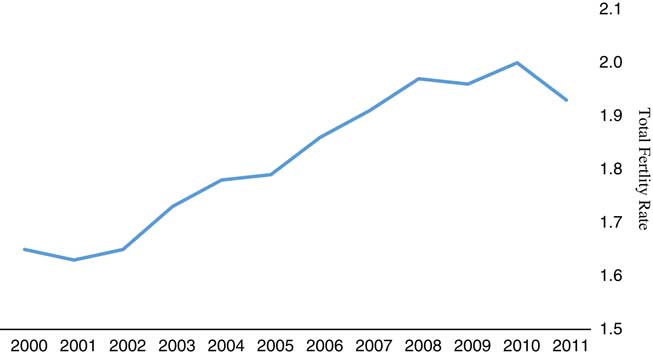
A major trend prior to the 2008 recession in the UK was the postponement of fertility, with an increasing share of births to older mothers. Postponement of first birth in Europe has been associated with expanding tertiary education, female labour market engagement and rising unemployment levels following the successive economic recessions occurring during the early 1970s, the mid-1980s and the mid-1990s (Neels et al., Reference Neels, Theunynck and Wood2013). Education is a key predictor (Ni Bhrolcháin & Beaujouan, Reference Ní Bhrolcháin and Beaujouan2012) and, critically in the context of recession employment, household wealth and household income are also closely related to the incidence of first births (Kravdal, Reference Kravdal1994). More general insecurity for disadvantaged youths characterized by unemployment, fixed-term contracts and unstable work environment have been proffered as an explanation for low fertility in Southern Europe (McDonald, Reference McDonald2000). Many of these effects tend to be on the timing of fertility, with the effect on cohort fertility levels being much more mixed (Kravdal, Reference Kravdal1994; Sobotka, Reference Sobotka2004). However, in general increasing economic uncertainty (often indicated through measures of aggregate unemployment levels) was found to be broadly associated with falls in period fertility rates, a finding that has been replicated across a number of settings where fertility was already at exceptionally low levels (Witte & Wagner, Reference Witte and Wagner1995; Perelli-Harris, Reference Perelli-Harris2003, Reference Perelli-Harris2006; Bernardi et al., Reference Bernardi, Klaerner and von der Lippe2007). Yet, it is debatable whether similar falls in fertility are applicable to the UK following the 2008 recession. The UK was experiencing an upsurge in fertility prior to the 2008 crash (see Fig. 1), and in contrast to much of Europe there has been remarkably little response in total fertility rate (TFR) to the economic downturn. The TFR for the UK since 2000 increased from just above 1.6 to nearly replacement level in 2010, and continued to increase following the 2008 crash, albeit at a slightly slower rate.
United Kingdom period TFR since 2000. Source: Office for National Statistics.

Moreover, there are significant variations in fertility behaviour among different subgroups of the population, as defined by age, gender, education and socioeconomic status. Similar to many other European countries, the United Kingdom has been experiencing falling fertility rates among younger women, with the increases in fertility seen being primarily driven by increasing birth rates among older women. United Kingdom fertility is also increasingly polarized, with fertility among younger women being concentrated among those not in higher education (Ni Bhrolcháin & Beaujouan, 2012). Similar polarization of fertility (and partnership) behaviour between relatively advantaged and disadvantaged groups has been observed in other country contexts, primarily the United States (McLanahan, Reference McLanahan2004). The extent to which education is a predictor of demographic behaviour varies strongly between country contexts (Perelli-Harris & Lyons-Amos, Reference Perelli-Harris and Lyons-Amos2015).
The effect of female education plays a key role, not only in determining initial fertility behaviour but also responses to economic shocks. In the United Kingdom early fertility precludes women from further education enrolment, due to the difficulty of role combination (Berrington, Reference Berrington2004), which in turn has implications for their employment opportunities. This in general tends to lead to a dichotomized career path, similar to the diverging destinies pattern observed in the United States (McLanahan, Reference McLanahan2004). Fertility divergence and increasing diversity of family forms is part of a more general trend in the evolution and diversification of the interrelationship between different demographic processes and the replacement of homogenous marriage norms with more varied precursors of family formation, such as co-residence, and in particular joint housing purchase (Heuverline & Timberlake, Reference Heuveline and Timberlake2004; Elzinga & Liefbrouer, Reference Elzinga and Liefbroer2007; Holland, Reference Holland2012; Perelli-Harris & Lyons-Amos, Reference Perelli-Harris and Lyons-Amos2015).
Increasing diversity in fertility has been historically associated with a diverse set of responses to external macro-economic shocks. In particular, Vikat (Reference Vikat2004) identified that social subgroupings tend to respond very differently to recessions in the Finnish setting, with the role of uncertainty – especially regarding employment – being particularly important to low socioeconomic status women and tending to depress fertility. Sobotka et al. (Reference Sobotka, Skirbekk and Philipov2011) also noted that beyond primary effects of unemployment, perceptions of the economy and labour market have a critical effect on fertility decisions, and tend to vary between population subgroups. However, Andersson (Reference Andersson2000) found that social institutions designed to support vulnerable groups can compensate for the depressive effect of recession on fertility, and can explain the counter-cyclical pattern observed among poorer women in Sweden. Kreyenfeld (Reference Kreyenfeld2005) found similar effects in Germany, where women with low educational attainment tend to compensate for a peripheral attachment to the labour market by starting a family.
Direct and indirect effects of recession
Many previous studies (e.g. Kohler & Kohler, Reference Kohler and Kohler2002; Neels et al., Reference Neels, Theunynck and Wood2013) operationalized the effect of economic recession only in terms of direct or observable macro-economic indicators, such as GDP growth or unemployment rates. Meso-level indicators, such as measures of regional unemployment, may reflect the impact of the recession more closely than general indicators such as GDP and can capture within-country regional variation (Sobotka et al., Reference Sobotka, Skirbekk and Philipov2011; Neels et al., Reference Neels, Theunynck and Wood2013). Studies combining measures of unemployment at the individual and aggregate levels suggest that the aggregate indicators play an independent role over and above individual-level indicators, suggesting perceptions of contextual economic uncertainty play an important role in linking macro-level economic conditions and fertility behaviour at the individual level (Witte & Wagner Reference Witte and Wagner1995; Perelli-Harris, Reference Perelli-Harris2006; Bernardi et al., Reference Bernardi, Klaerner and von der Lippe2007; Neels et al., Reference Neels, Theunynck and Wood2013).
This study focused on the effect of the 2008 recession on first birth rates among UK women, assessing heterogeneous responses to exposure to economic adversity. Specifically, the analysis aimed to synthesize the direct effects of individual and regional economic instability on first birth rates with unobserved indirect effects (due to factors beyond conventional economics variables) to produce an holistic assessment of the effect of the Great Recession. Moreover, the study examined variation in fertility behaviour in the post-recession period, focusing on the heterogeneity of responses depending on individual characteristics. This analysis used the British Household Panel Survey in combination with the Understanding Society survey, together known as the UK Household Longitudinal Study. The effect of the recession was measured not only through direct measures of regional unemployment rates and average regional earnings, but through a test of the significance of a residual indicator variable designed to capture any residual effects, for instance perceptions of economic uncertainty. Furthermore, the effects of the recession were allowed to vary according to individual characteristics. The analysis tested for variations in response by cohort, age, education and socioeconomic status, allowing the differential effect of the recession to be determined, and to identify those groups that were able to withstand economic trauma, and those most affected by it.
Methods
Data
Data for the analysis came from the British Household Panel Survey (BHPS) and Understanding Society survey, which jointly make up the UK Household Longitudinal Study (UK-HLS). The BHPS is a nationally representative household-based survey comprised of 10,300 individuals in c. 5500 households in the initial wave in 1991. Households were contacted on a yearly basis. A boost sample for Wales and Scotland was added in 1999, and for Northern Ireland in 2001. In 2009 the BHPS was replaced with the Understanding Society survey, which incorporated 40,000 households. The BHPS members re-entered the Understanding Society panel at Wave 2. Thus, UK-HLS represents a continuous series for women between the years 1991 and 2011, save for 2009 when no data were collected due to the fact that BHPS respondents were not included in the first wave of the Understanding Society survey.
Some of the information for this analysis could be derived solely from the Understanding Society survey via the retrospective information included in the survey (for example, fertility and employment histories), taking advantage of the larger sample size and removing potential sample attrition issues. In particular, ‘own child in the household’ reconstructions were used to obtain the date of birth for the first child (Berrington, Reference Berrington2004); this was critical to determine fertility behaviour during the year 2009. However, variables such as the receipt of benefit or employment were not collected retrospectively but on a yearly basis, and the analysis therefore used the full run of the BHPS/Understanding Society surveys to ensure that this information was included accurately across the life course. Data in the Understanding Society survey were therefore restricted to those respondents who were also present in the BHPS so that respondent information was present for each yearly wave (some 6000 cases were available at this point). A relevant analytic sample to the research questions was selected comprising women restricting the age range of the analysis to 17–30 years, and differentiating women born in 1980–84, 1985–89 and 1990 and later. The higher likelihood of children living with their mother in the event of union dissolution meant that reconstructions of fertility histories using own-child methods were possible (see Berrington, Reference Berrington2004, for more details). The three age cohorts contained 761, 596 and 1217 women respectively.
Analysis
The variable of interest was a binary indicator of whether a woman has had first birth by a given age. This variable took the value 1 after a women experienced first birth, and 0 before that. Women were right-censored by the date of interview for wave 3 of the Understanding Society survey, reaching age 30 or drop-out from the survey. In this instance, births that occurred during wave 1 of the survey were reconstructed, and hence there was no interval censoring, although the time-varying covariate information could not be reconstructed (although age and pre-/post-recession indicators in these years could be identified). This variable was modelled as the cumulative probability of having had a first birth as a quadratic function of age. This specification of the model allowed the cumulative probability of transitioning from nulliparous to parity 1 across specified ages to be measured, and could be interpreted analogously to a growth model. This approach was taken to adequately capture changes in the timing of first birth behaviour and postponement effects liable to be evident due to temporary economic effects (e.g. Sobotka, Reference Sobotka2004). This was advantageous over approaches such as event history modelling, which would have provided a measure of the rate or intensity of childbearing but would not have captured recuperation effects. Alternative specifications of the underlying growth curve were tested, including linear, cubic and fully non-parametric (each age was represented by a dummy variable). Quadratic form demonstrated the best model based on a comparison of Akaike (AIC) statistics. To better estimate the model, the growth curve was centred around the age of 21, since this placed the intercept for the model within the range of the data. The model allowed for the baseline age–fertility profile to vary by birth cohort, to reflect shifts in birth behaviour among women. This was achieved by interacting birth cohort with the underlying polynomial for age
Pre-/post-recession indicator
The effect of the recession was captured by the dummy variable recession, which took the value 0 for all years prior to the 2008 crash, and 1 for all years including and following 2008. This allowed for a displacement in fertility due to the 2008 crash, of magnitude of the estimated coefficient of the dummy variables and enabled disturbances in the age-specific fertility behaviour before and after the crash to be captured. A limitation of this model was that it assumed that the effect was homogenous by birth cohort. A further interaction term was therefore introduced into the model, by interacting the recession dummy with the term for birth cohort to produce a cohort-specific recession effect.
The robustness of the regression effect could be assessed via the inclusion of further explanatory variables. If the effects of recession operate completely through labour market activity (or changes to any other control variable), then the inclusion of explanatory variables in the model should render the dummy variable non-significant. On the other hand, if the recession dummy variable remains significant after the inclusion of controls this indicates that there is a recession effect not captured by the direct effects alone, but rather by indirect influences not included in the model, e.g. the role of uncertainty (Vikat, Reference Vikat2004; Sobotka et al., Reference Sobotka, Skirbekk and Philipov2011). These residual effects are likely to be comprised of multiple influences outside of those controlled for, such as general feeling of insecurity fuelled by the rising unemployment rate, declining GDP and cuts in public spending, and mirrored in shrinking consumer confidence. Interacting the recession dummy with these explanatory variables tested whether the effect of the recession differed according to respondent characteristics.
Modelling strategy
The model was assembled by first establishing the base model that describes cumulative fertility transitions for each cohort in turn. This model was then extended to test the significance of the recession dummy on cumulative fertility. Significance was assessed by the Likelihood Ratio test comparing the base model nested within a model including a main effect for recession, with significance set to the 5% level. On significance of the recession effect, a further test was performed to see if the effect of the pre-/post-2008 dummy varied between birth cohorts, by including an interaction between cohort and the dummy variable. Significance was again assessed on a test of global test of significance using a Likelihood Ratio test at 5% significance.
The robustness of this effect was then assessed by the addition of individual-level control variables. Controls were added sequentially for education (educational attainment), receipt of housing benefit (a measure of low income), employment status and de facto partnership status. Since these variables are all time-varying, these variables were lagged by one year to reduce ambiguity in the direction of any associations found (e.g. women may change their labour market activity as a result of having a child by withdrawing from the labour market). This lagging occurs for each wave of the dataset. Clearly, in certain circumstances this lagging structure will be inadequate. The lagging by one year will deal with circumstances where a change in covariate status is preceded by a fertility event such as pregnancy (which clearly occurs in less than one year). However, under circumstances where anticipatory effects take longer than one year (e.g. women specialize in childbearing and do not engage in labour market activity in long-term anticipation of having a child) this lagging structure will still be open to reverse causal effects. Whilst multiple lags could have been included (similar to Holland, Reference Holland2012) this would have made the model structure very complicated and severely limited the degree of inference made about the youngest cohort (who had the fewest years of flagged information).
Following selection of the individual-level model, the significance of the Government Office Region (GOR) level information was tested, namely the proportion of respondents within the GOR with low pay, and the proportion unemployed. These were aggregations from individual-level data in the current dataset, rather than using comparable datasets used to produce official rates, to ensure a complete and consistent series for all GORs equivalent to the direct influence of employment considered in other analyses. Significance of the recession dummy variables after the inclusion of direct effects and controls was taken to indicate some sort of unspecified indirect effect of the recession on fertility beyond those of employment.
Testing for significant interactions between all individual-level variables and the recession effect was then conducted to capture differential effects of the recession by respondent characteristics. These interactions were added to the model sequentially, and retained on passing the criterion of significance at the 5% level based on a Likelihood Ratio test. Significance in this instance was indicative of variation of responses to the recession according to individual characteristics.
Results
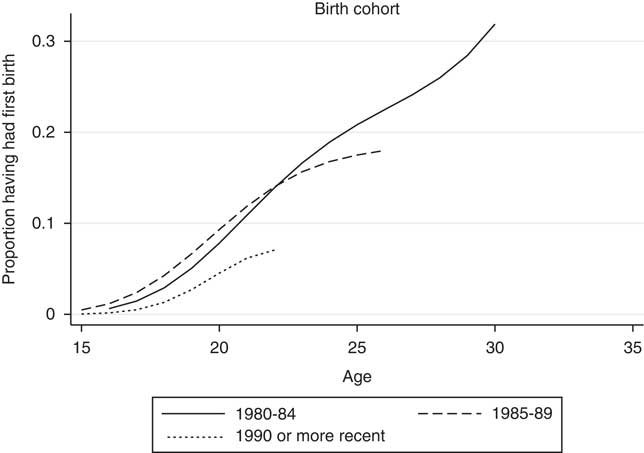
Figure 2 presents the predicted curves for the cumulative probability of having had first birth in the absence of a recession effect for each birth cohort. The 1980–84 and 1985–89 birth cohorts exhibit similar patterns with increasing cumulative fertility for both such that roughly 10% of women have had their first birth by age 23. Thereafter there is some divergence between the birth cohorts: the younger cohort (1985–89) flattens in fertility profile, while the 1980–84 cohort exhibits an upward trend, with 20% of women having had first birth by age 27 and 30% by age 32. In contrast, the fertility profile for the 1990 or more recent birth cohort is considerably lower than that of older cohorts: the teenage childbearing rate is considerably below that of the older cohort, and a 5% cumulative transition is not reached until some 3 years later than the 1980–84 birth cohort.
Cumulative transition probabilities of having first birth in UK women by birth cohort.
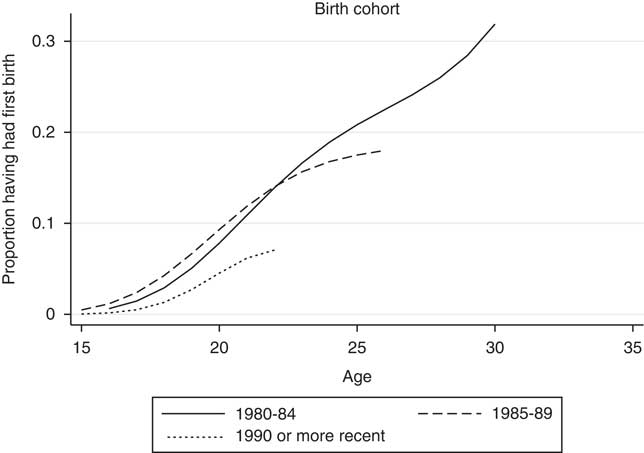
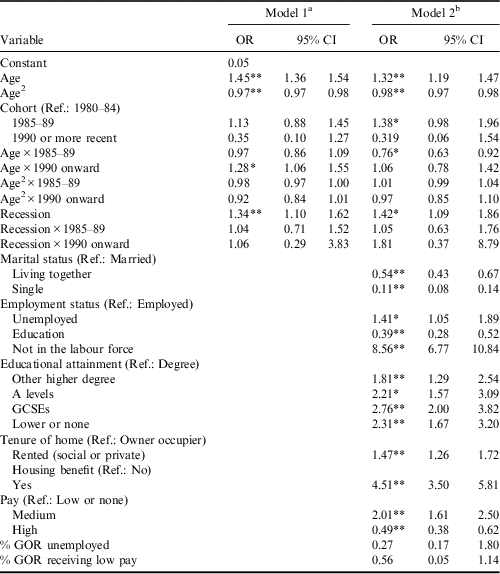
Table 1 presents the estimated model including cohort-specific recession effects and controls. Model 1 presents the results for the cohort-specific effect of recession only, while Model 2 includes control variables. Both models correct for the correlation between respondents with GOR via the use of clustered standard errors. All coefficients are presented in terms of odds ratios (ORs).
Estimated model for cohort-specific effect of recession on probability of having first birth in UK women
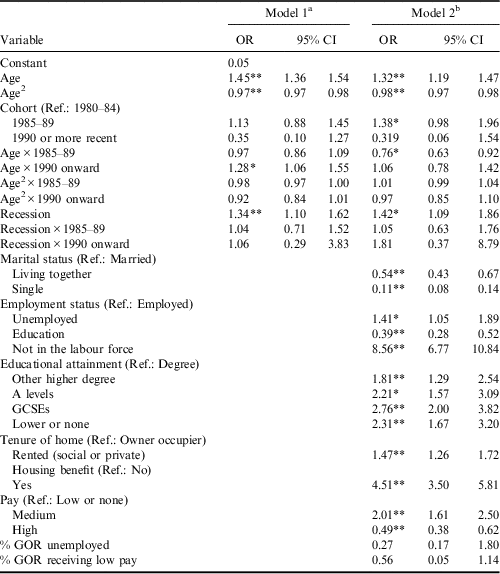
a Model 1: without other explanatory variables.
b Model 2: with other explanatory variables.
*p<0.05; **p<0.01.
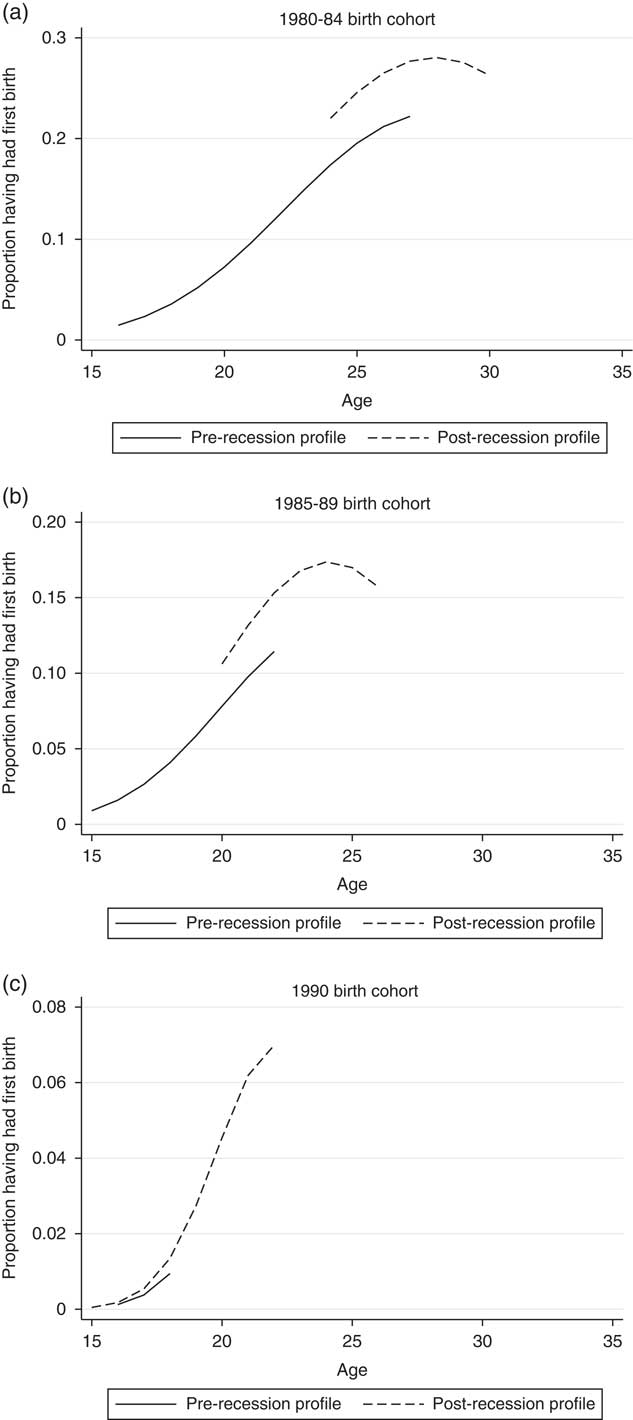
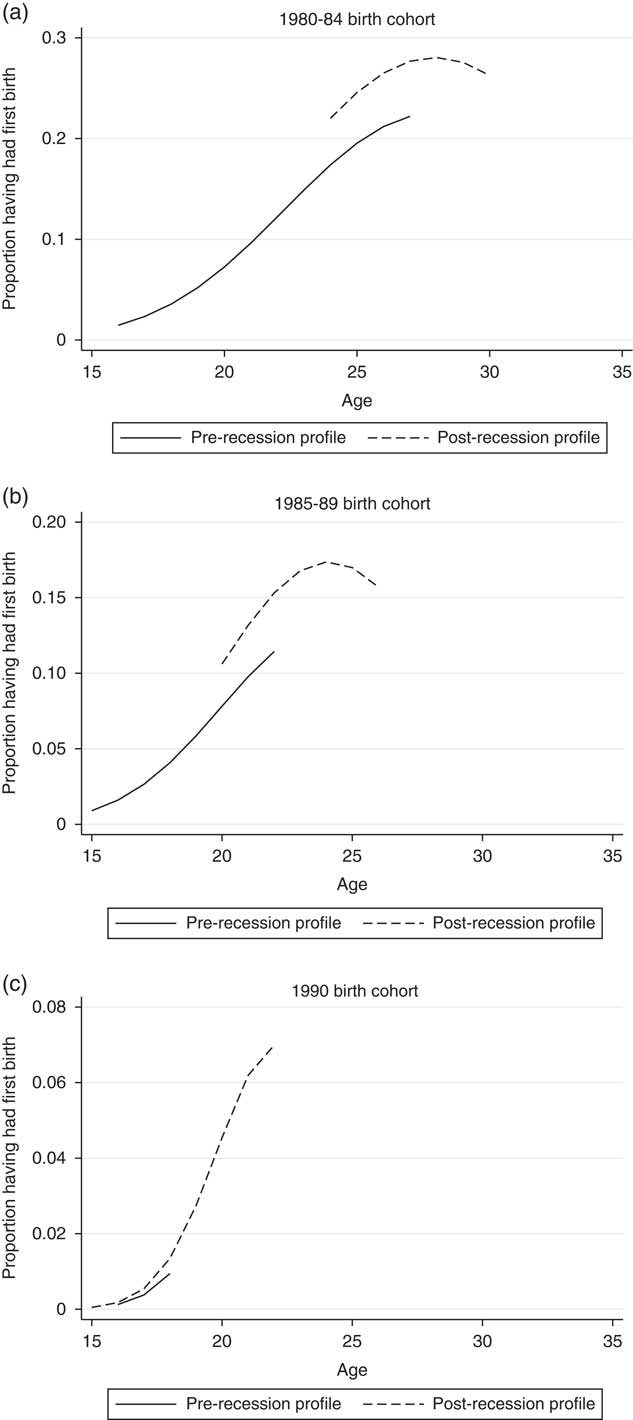
There is a significant recession dummy variable in both models, indicating a difference in pre- and post-2008 fertility profiles that is robust to the introduction of other explanatory variables. In both models the effect is predicted to increase, rather than decrease, fertility. This effect is highlighted in Fig. 3, which describes the predicted probabilities for the a) 1980–84 birth cohort, b) 1985–89 birth cohort and c) 1990 or more recent birth cohort. In all three panels, the predicted effect of the recession variable is that fertility is higher in the post-recession period, indicative of counter-cyclical fertility. That said, the only significant effect is for women in the oldest birth cohort (1980–84), while for the other birth cohorts the effect is not significant in the main effect models. This reflects both the relative ageing of the UK fertility profile, and the fact that older age groups are less likely to delay childbearing (resulting in a depressed period fertility) compared with younger women (e.g. McDonald, Reference McDonald2000).
Cumulative transition in population having first birth predicted in pre-/post-2008 period for a) 1980–84 birth cohort, b) 1985–89 birth cohort and c) 1990 or more recent birth cohort.
Considering the effect of other explanatory variables from Model 2, married women are most likely to have had a first birth, with odds ratios lower than 1 indicating that women who are living with their partner (OR=0.54) and single (OR=0.11) both being considerably less likely to have had first birth. This is consistent with persistently elevated rates of fertility among married couples, even after the widespread transmission of fertility behaviour to cohabiting relationships (e.g. Holland, Reference Holland2012).
All other explanatory variables indicate a pattern of heightened fertility among disadvantaged women. Women who are unemployed have higher predicted fertility than women who are in work, while women not in the labour force have considerably higher cumulative transition rates (OR=8.56). This probably reflects anticipatory behaviour of more than one year, where women have specialized in childbearing rather than engaged in work. Women enrolled in education demonstrate extremely low first birth rates – only 39% of those of women in work. A clear gradient of fertility behaviour exists for education: compared with the reference category (women with a degree) there is a significantly higher cumulative fertility for women with only A levels (OR=2.21), GSCEs (OR=2.76) or lower qualifications (OR=2.31). This indicates higher fertility among women with lower educational attainment. Women living in rented accommodation demonstrate a higher cumulative birth rate than those who own their own home (OR=1.47). Similarly, women in receipt of housing benefit were considerably more likely to have had a first birth than women who were not reliant on support. Compared with the baseline category of no/low pay, women in the highest pay tertile were significantly less likely to have had a first birth, although surprisingly women in the middle pay tertile were most likely to have experienced first birth.
Considering the effect of GOR-level characteristics, controlling for individual-level effects means that poorer labour market and wage environments are associated with depressed fertility rates: both odds ratios for the ‘proportion of women unemployed’ and the ‘proportion of women receiving low pay’ are below 1 indicating lower cumulative transitions. However, neither of these effects are significant.
Differential effects of recession
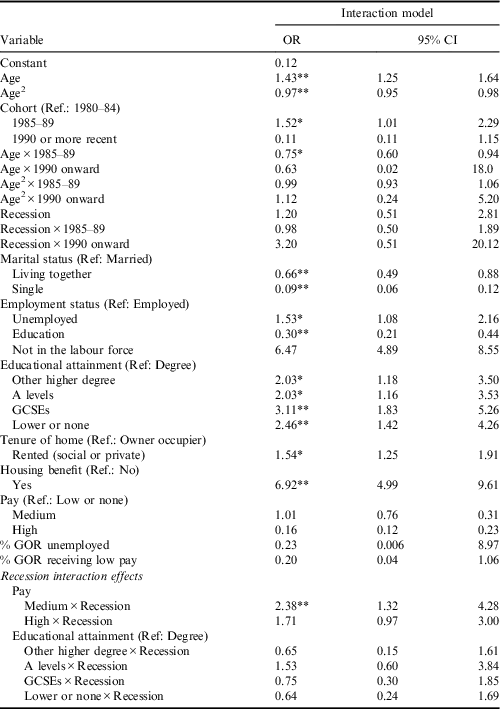
Two variables have significant interactions with the recession effect: education (p=0.02) and pay category (p<0.001), based on a global test of variable significance. The interaction model is presented in Table 2. Within the interaction effects model, again the effect of the main recession dummy is counter-cyclical at 1.20 (albeit not statistically significant due to inflated standard errors).
Estimated model for cohort- and covariate-specific effect of recession on probability of having first birth in UK women
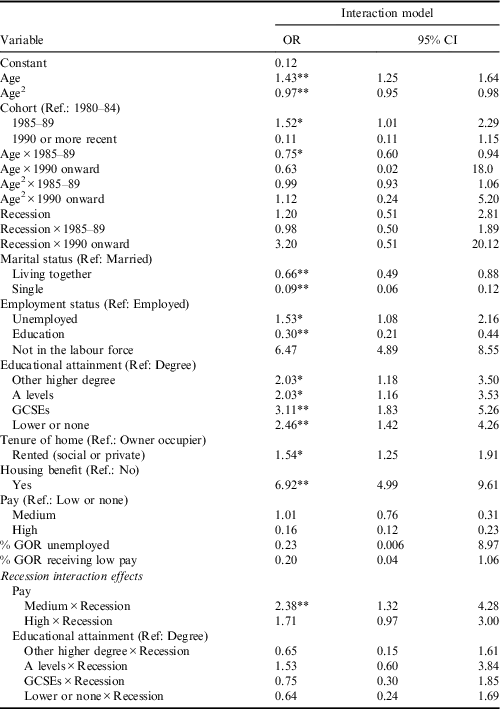
Examining the effect of the interaction compared with pay category, there is a significant effect of the dummy variable for medium pay post-2008, with the coefficient of 2.38 indicating greater acceleration of first-birth transitions in the post-2008 period compared with the baseline category of low pay. Similarly, the coefficient for those with high pay indicates that this group also experiences higher rates of first birth than women with low pay, although on this occasion the level of statistical significance is not reached.
Examining the effect of education, the pattern is slightly different. Compared with the category of ‘Degree’, only women with A level education show counter-cyclical patterns in their fertility behaviour, with the categories of ‘Other higher’, ‘GCSE’ and ‘Lower or none’ showing depressed levels of fertility post-2008, indicated by coefficients of 0.65, 0.75 and 0.64 respectively. It should be noted that the overall levels of predicted fertility are still above those for women with degree-level education due to the strong and significant main effect for educational attainment, but the degree of acceleration in fertility post-recession for women with low education is retarded.
Discussion
This study evaluated the effect of the 2008 ‘Great Recession’ on fertility in the UK, focusing on first births rates. Although recessions generally tend to depress fertility (as has been seen in both previous European economic transitions and economic recessions), the UK, in contrast, continued to see rising aggregate fertility rates (albeit more slowly), which continued to increase despite the incidence of the recession. The major contribution of this paper is to extend existing analyses to assess the effect of the recession by direct and indirect effects (via economic indicators, and a pre-/post-2008 dummy variable) and to allow these effect to vary according to individual characteristics. The findings suggest that measurement of fertility at an aggregate level will mask variation in subgroups within the population, calling for a more in-depth analysis of macro-level events on micro-level processes.
The findings suggest that there is a significant effect of the recession on fertility rates, which is significant net of other explanatory variables. The manifestation of the effect of the recession is highly dependent on birth cohort, however; older women seem relatively immune to the effect of the recession, indeed showing a significant increase in cumulative fertility post-2008. In contrast, among younger groups the effect of the recession is not significant before considering subgroup analysis. The most disadvantaged women, characterized by less than degree qualifications, living in rented housing and receiving housing benefit are in general most likely to make the step into first parenthood, while women with degree-level education, highly paid and those owning their own homes are least likely to. However, testing the interactions between the individual-level variables and recession suggests that these patterns might indicate pre-recession trends, which dissipate in the post-recession period. Indeed, for education this is clear; the educational gradient in fertility before the recession narrows with a much lower degree of counter-cyclical behaviour among women with lower educational attainment. Similarly, those with higher levels of pay tend to experience bigger increases in fertility after the recession. In general then, the trend is one of counter-cyclicality with increases in fertility in the post-2008 period, but overall for women with lower pay and education this increase is muted. Tentative explanations can be offered: for instance, the composition of the group may have changed post-recession, shifting away from those who are specialized in childbearing but reflecting an increase in the prevalence of those who are NEETs (Not in Education or Training; Schoon & Lyons-Amos, Reference Schoon and Lyons-Amos2016). This is particularly pertinent considering that the effects of low pay will be particularly strong among felt among those at a relatively young age, with a high proportion of the early life course among those in the 1990 or more recent birth cohort in the post-2008 period.
These findings are somewhat in contrast to the trends observed in Southern Europe and Eastern Europe in the immediate post-socialist period, where economic instability has tended to depress overall completed fertility rates (McDonald, Reference McDonald2000; Sobotka, 2011). Instead, the analysis found that the polarization of British fertility patterns extends not only to overall fertility behaviour but to responses to external economic pressures. Relatively advantaged women seem resilient to external economic pressures, while women most vulnerable to external economic shocks exhibit exaggerated responses to the recession through falling fertility behaviour.
A limitation of the study is that the analysis was unable to establish whether the effects on fertility are permanent quantum or postponement effects. These influences are generally seen manifested by downward and rightward shifts in the overall growth curve. However, at present the available data series provides a post-2008 period only 4 years in length, and as such this analysis was unable to reliably estimate a change in the slope parameter in the post-2008 period required to detect postponement. Similar economic crises have in general been associated with postponement, where overall fertility has not been broadly affected (Sobotka, 2011), and while external factors seem to affect the tempo of fertility in the short-term, the extent to which this is reflected in cohorts rates varies according to external but critically individual characteristics (Kravdal, Reference Kravdal1994). The operationalization of the effect of the indirect effects of the Great Recession as a pre-/post-2008 indicator means that it is difficult to generalize the indirect effects to other recessions. Moreover, the differences in responses to the recession among social strata will be specific to the UK context due to the policy context within which they occur: different policy regimes in other settings will manifest responses differently (e.g. Andersson, Reference Andersson2000; Vikat, Reference Vikat2004). The specification of the pre-/post-recession effect is also very general: as already noted, the current measure captured all effects beyond those controlled for and could not specify what the nature of the indirect effects were. Finally, the lagging structure, whilst dealing with some cases of reverse causality, was too simple for some cases (in particular where women were not in the labour force for a longer period of time than this study’s lag captures). Since multiple lags (e.g. Holland, Reference Holland2012) could capture this more complicated structure, this would leave us unable to make inferences about the primary cohort of interest (the youngest women) due to their very short histories.
This analysis disaggregated fertility behaviour by individual characteristics, and found very different responses to the recession in terms of fertility behaviour. In general, two distinct patterns emerged from the results. Women in relatively advantaged positions – for instance those with higher education – exhibited relatively lower rates of first birth that were relatively unaffected by the recession. This group will in general tend to have lower fertility rates, especially in the current observation (age 16–30 years), partly due to the difficulty in being in higher education and establishing a secure work pattern, which has been driving trends towards older motherhood among this groups, even without recession effects (Ni Bhrolcháin & Beaujouan, 2012). Moreover, this group is most likely to be resilient to external economic shocks on fertility behaviour due to higher income (Kranvdal, 1994; Mills & Blossfeld, Reference Mills and Blossfeld2003) and a greater resilience to fulfilment via work (Vikat, Reference Vikat2004). In contrast, among disadvantaged groups the effect of the pre-/post-2008 indicator indicates a sensitivity to external economic circumstances, and slowing of fertility rates compared with more advantaged groups, exacerbated by enhanced temporal uncertainty beyond the effect of control variables (Testa & Basten, Reference Testa and Basten2014). Indeed, the fact that there are significant interactions between the recession dummy with income indicates both that the accumulation of wealth is critical to establishing a family (Kravdal, Reference Kravdal1994; Mills & Blossfeld, Reference Mills and Blossfeld2003) and that the lack of wealth closes the possibility of motherhood to disadvantaged women.
Acknowledgments
This study received funding from the Jacobs Foundation PATHWAYS Fellowship programme.