The effects of natural disasters are observed not only on the physical environment of the affected area but also on the health of those living there. The incidence of myocardial infarction (MI) increased in the areas impacted by Hurricane Katrina and the 1994 Northridge earthquake in California.Reference Gautam, Menachem and Srivastav 1 , Reference Kloner, Leor and Poole 2 It was reported that the incidence of and mortality from MI increased by over 20% and 30%, respectively, in the most impacted areas in New Jersey in the 2 weeks following Hurricane Sandy.Reference Swerdel, Janevic and Cosgrove 3 These results are indicative of the significant effect natural disasters have on individual health.
Dehydration is an important health issue and may have been prevalent following the storm as a result of several factors that occurred during Sandy. Sweating and overexertion obviously played a significant role. The impact of the storm on the physical environment of New Jersey was dramatic, and extensive flooding and property damage required many to put extraordinary effort into the cleanup process.Reference Hoopes Halpin 4 Fluid restriction is another key factor leading to dehydration. Power outages, which in some areas lasted nearly 2 weeks, prevented many households from maintaining appropriate refrigeration and cooking of food. In addition, transportation disruptions because of blocked roads prevented many from replenishing diminished supplies of food and water after the storm.
The objective of this study was to examine dehydration after Hurricane Sandy in New Jersey. We hypothesized that the rate of hospitalizations for dehydration would increase during the 2 weeks after Hurricane Sandy. We also hypothesized that rates of dehydration would likely increase more in older than in younger adults.
METHODS
We obtained data for the incidence of dehydration from the Myocardial Infarction Data Acquisition System (MIDAS) for the years 2008 through 2012. MIDAS is an administrative database containing hospital records of all patients discharged from nonfederal hospitals in New Jersey with a cardiovascular disease diagnosis or invasive cardiovascular procedure.Reference Kostis, Wilson and O’Dowd 5 Information from death certificates was linked to the hospitalization records. The data were obtained from the New Jersey Department of Health by use of the New Jersey Discharge Data Collection System (NJDDCS). The current study was approved by the Robert Wood Johnson Medical School institutional review board.
Data for the year Sandy occurred were categorized as follows: 2 weeks before Sandy (the “pre-study period”); 2 weeks directly following Sandy making landfall in New Jersey (the “study period”); and the 2 weeks after the study period (the “post-study period”). Two-week study periods were chosen on the basis of the near complete restoration of electrical power and roadway access 2 weeks after the storm.Reference Hoopes Halpin 4 For each of the prior years, we utilized the same calendar 2-week periods for the pre-study period, the study period, and the post-study period.
To identify a hospitalization for dehydration, we used the algorithm developed by the Agency for Healthcare Research and Quality (AHRQ). 6 It includes principal diagnoses such as “dehydration” (ICD-9 code 276.51), “volume depletion (unspecified)” (276.50), and “hypovolemia” (276.52). In conformance with this algorithm, patients were excluded if they were transferred from another health care facility or had comorbid chronic renal disease. After applying this algorithm to our data set, we identified 4261 patients, 0.8% of the 517,355 hospitalizations recorded during the time periods, with a principal discharge diagnosis of dehydration.
Patients were included if they were hospitalized during the pre-study, study, or post-study periods for a nonelective visit. Patients were excluded if their home residence was outside New Jersey (N=14,935, 2.6% of eligible MIDAS hospitalization records). Subanalyses were performed in an attempt to understand the characteristics associated with being at higher risk of developing dehydration after an extreme weather event. For this analysis, we used the patient’s gender, race-ethnicity (non-Hispanic white, other than non-Hispanic white), and age at time of hospitalization (≤65 years old, >65 years old) as these have previously been shown to be risk factors for hospitalization for dehydration.Reference Warren, Bacon and Harris 7 , Reference Biello, Rawlings and Carroll-Scott 8 For our analyses we combined Hispanic ethnicity and African American and other races into one category owing to small sample sizes. We also used neighborhood socioeconomic status (≤$50,000 average household income per year, >$50,000 average household income per year) as a proxy for patient socioeconomic status. Neighborhood socioeconomic status was determined by census data based on the residential zip code of the patient. 9
The relative impact of the storm on each New Jersey county was taken from the work of Hoopes Halpin, who utilized data from several federal and state sources.Reference Hoopes Halpin 4 In the Hoopes Halpin analysis, a Community Hardship Index was developed on the basis of power loss; residential, commercial, and municipal damage; emergency shelters established; and gasoline shortage. We utilized the index at the county level for our analyses. In this report, New Jersey counties were grouped into quintiles on the basis of scores from the formula above. We defined the high-impact area as those counties in the state with an index in the upper 2 quintiles because these categories included only those counties with hardship indexes significantly above the mean level for the state. The high-impact area encompassed 8 counties and a population of about 3.5 million people. The remaining 13 counties, with a population of about 5.1 million people, were considered the low-impact area. County-level census data from the New Jersey Department of Labor for the years of the study were utilized to determine incidence and mortality rates per 100,000 person-weeks to allow direct comparison between the high- and low-impact areas. 9 Intercensal population estimates were used for all years other than 2010.
The relative rate (RR) of dehydration in the study period and the post-study period compared with the same periods in the 4 years before Sandy were estimated by using log-linear regression with the GENMOD procedure in SAS V9.3 (SAS Institute Inc, Cary, NC). The RR of dehydration during each period was estimated as follows:
 $$\eqalign{{\rm RR}_{{{\rm period}}} {\rm =Rate}\,{\rm Dehydration}_{{{\rm period}}} {\rm 2}0{\rm 12}/\cr\quad{\rm Rate}\,{\rm Dehydration}_{{{\rm period}}} {\rm 2}00{\rm 8}\!\!-\!\!{\rm 2}0{\rm 11}$$
Both crude and adjusted RRs were calculated. The adjusted RRs included the event count from the pre-study period as a covariate to account for yearly variations in event counts. Parameter estimates were determined by utilizing generalized estimating equations with robust variances for repeated measures, the repeated measure being the 2 weekly counts from each period (pre-study, study, or post-study) from each year. The level for statistical significance for all tests was set at two-sided P values <0.05.
RESULTS
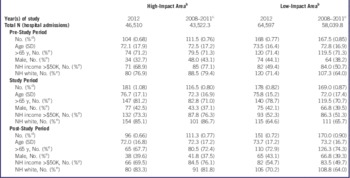
Table 1 contains the demographic information from our study sample. The number of hospitalizations for cardiovascular disease increased over the 5 years of our study. The yearly hospitalization rate for New Jersey increased during each year of the study (2008: 96,471; 2009: 99,941; 2010: 104,027; 2011: 105, 809; 2012: 111,107). This was likely due to an increase in discharge diagnoses involving cardiovascular disease ICD-9-CM codes that changed over time, such as hypertension. However, despite these changes in the number of hospitalizations for patients with cardiovascular disease, we found minimal differences in the rate of hospitalization for dehydration. Between 2008 and 2011, the average rate of hospitalization for dehydration was 279 cases per year during the pre-study period, which was similar to the 272 cases found during the pre-study period in 2012, about a 2.5% difference.
Characteristics of Patients Hospitalized for Dehydration During the Pre-Study, Study, and Post-Study Periods of the Year of Hurricane Sandy (2012) and the Same Calendar Periods in the Prior 4 Years (2008–2011) in the High- and Low-Impact Areas of New Jersey (N=517,355)Footnote a

a Abbreviations: SD, standard deviation; NH, neighborhood.
b New Jersey residents only.
c Four year mean values.
d Percent of all hospitalizations.
e Percent of dehydration hospitalizations.
We found a significant increase in hospitalizations for dehydration in the 2012 study period compared with the study period in the prior 4 years in the high-impact area. Although the number of hospitalizations in the pre-study period in the high-impact area was similar between 2012 and 2008–2011 (2008–2011: 111.5; 2012: 104), the number of hospitalizations increased by about 74% in the 2 weeks after Sandy compared with a 4% increase in 2008–2011. The daily changes in dehydration are shown in Figure 1. Hospitalizations for dehydration began increasing within the first 2 days after the storm and remained elevated until 10 days after the storm, peaking at day 6.
Hospital Admissions for Dehydration. Two-day rate of hospital admissions in the 2 weeks before and 4 weeks after Hurricane Sandy (2012) and in the same calendar period in the prior 4 years (2008–2011) in the high-impact area of New Jersey.

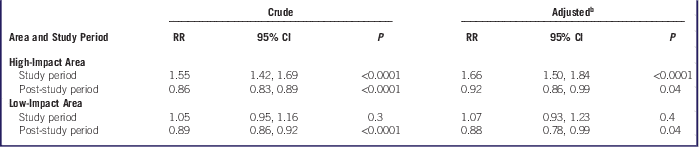
The crude RR for the study period compared with the non-Sandy years indicated a 55% increase in the hospitalization rate for dehydration (RR: 1.55; 95% confidence interval [CI]: 1.42, 1.69; Table 2). After adjustment for the pre-study period to correct for possible yearly changes in rates, there was a 66% increase in hospitalizations for dehydration after Hurricane Sandy compared with the prior 4 years (RR: 1.66; 95% CI: 1.50, 1.84). There appeared to be a small rebound effect in the post-study period, because the adjusted rate of hospitalization for dehydration 2 to 4 weeks after Hurricane Sandy was about 8% lower than the rate in the preceding years (RR: 0.92; 95% CI: 0.86, 0.99). In the low-impact area, there was no significant change in the hospitalization rate for dehydration during the study period. There was a 12% reduction in the rate in the low-impact area during 2012 compared with the preceding years in the post-study period (RR: 0.88; 95% CI: 0.78, 0.99).
Crude and Adjusted Relative Rates of Principal Dehydration During the Study Period and Post-Study Period for the Year of Hurricane Sandy (2012) Compared With the Prior 4 Years (2008-2011)Footnote a

a Abbreviations: RR, relative rate; CI, confidence interval.
b Adjusted for the pre-study period.
We examined the demographic characteristics of the patients who were hospitalized for dehydration during the study period after Hurricane Sandy in the high-impact area. The rate of dehydration increased by about 79% in those over 65 years of age after Hurricane Sandy compared with the prior 4 years (RR: 1.75; 95% CI: 1.58, 2.02). There was no significant difference in the rate of hospitalization in those less than 65 years of age. Both males (RR: 1.63; 95% CI: 1.28, 2.07) and females (RR: 1.40; 95% CI: 1.29, 1.52) showed increased rates of hospitalization for dehydration after Sandy. We found a significant increase in hospitalization for dehydration in non-Hispanic whites (RR: 1.61; 95% CI: 1.39, 1.87) and in African Americans, Hispanics, and other races (RR: 1.74; 95% CI: 1.43, 2.11).
DISCUSSION
In the aftermath of Hurricane Sandy, hospitalizations for patients with dehydration increased significantly. We found a rate increase of 66% in patients with dehydration over what would have been expected on the basis of the same time period in prior years. We found that those over 65 years of age accounted for the vast majority of the increase. Whereas overexertion may have been the main cause of the increased dehydration in younger New Jersey residents, other important reasons may have been responsible for the increase in those over 65. Understanding these reasons is critical for emergency preparation for the next extreme weather event.
We found that dehydration hospitalizations increased quickly after Sandy made landfall, with significant increases after just 2 days. The rate peaked a few days later and was back to normal by the 10th day after the storm’s onset. By this time, the majority of New Jersey had power restored and most of the roadways had been cleared.Reference Hoopes Halpin 4 According to recommendations from the Federal Emergency Management Agency (FEMA), food and water should be stockpiled to provide for 3 days. 10 FEMA recommends stockpiling 1 gallon of water per day per person. The length of Hurricane Sandy far exceeded 3 days, which may have left many residents with insufficient provisions.
This study had several limitations. The data set utilized was limited to those patients with cardiovascular disease. We speculate that this represents an underestimation of the true count of dehydration hospitalizations within the state in the 2 weeks after Hurricane Sandy. Dehydration hospitalizations were determined by diagnosis codes, both principal and secondary, within the NJDDCS uniform billing record. The uniform billing record has a limited number of fields available for secondary diagnoses. This limitation may have caused under-ascertainment of dehydration in patients with cardiovascular disease if other secondary diagnoses were considered of greater importance. As with all studies that use administrative data sets, overall data quality is an issue. Although the MIDAS database has been validated for myocardial infarction and stroke,Reference Kostis, Wilson and O’Dowd 5 it has not been validated for the diagnosis of dehydration.
Dehydration is an important public health concern as well as a concern for medical providers. The Agency for Healthcare Research and Quality lists dehydration among its 16 prevention quality indicators, a measurement of hospitalizations that could readily be prevented with good outpatient care. 6 This represents an important area for the public health community to work on to reduce morbidity and, concomitantly, the burden on our health care systems, especially during periods such as those following extreme weather events.