Introduction
Egan (Reference Egan1998) and Berger and Thompson (Reference Berger and Thompson2000) defined empathy as the ability to precisely assess another person's perceptions, feelings and experiences non-judgmentally, and to communicate one's understanding of these to the person concisely. Davis (Reference Davis1996) broadly defined empathy as ‘a set of constructs having to do with the responses of the individual to the experiences of another person’ (p. 12). Empathy plays a fundamental social role, allowing individuals to share experiences, needs and goals (Carr, Iacoboni, Dubeau, Mazziotta, & Lanzi, Reference Carr, Iacoboni, Dubeau, Mazziotta and Lanzi2003). It is widely recognised as an important factor contributing to successful emotion management, parenting, popularity and pro-social behaviour (Eisenberg, Miller, Shell, McNalley, & Shea, Reference Eisenberg, Miller, Shell, McNalley and Shea1991). Engaging in pro-social behaviour may be important in the development of feelings of self-worth (Laible, Carlo, & Roesch, Reference Laible, Carlo and Roesch2004), while the tendency to adopt another's perspective has been found to be positively related to self-esteem (Corte et al., Reference Corte, Buysse, Verhofstadt, Roeyers, Ponnet and Davis2007; Davis, Reference Davis1983). Personal distress has been found to be negatively associated with self-esteem (Davis, Reference Davis1983) and empathy has been found to inhibit, or at least mitigate, aggression (Miller & Eisenberg, Reference Miller and Eisenberg1988; Richardson, Hammock, Smith, Gardner, & Manuel, Reference Richardson, Hammock, Smith, Gardner and Manuel1994). The capacity to respond empathically is conducive to long-term social relationships and is one of the most important requirements for good social functioning (Bora, Gökcen, & Veznedaroglu, Reference Bora, Gökcen and Veznedaroglu2008).
There are four covert intrapersonal processes through which empathy manifests in interpersonal relationships: (a) automatic cognitive processes, such as the perception, matching and labelling of emotions, as well as identification with others’ experiences; (b) perspective taking, an individual's cognitive attempt to understand another person's point of view; (c) empathetic concern, an affective reaction that coincides with the observed emotions of another person; and (d) personal distress, the affective reaction to one's experience of another person. There is much empirical evidence suggesting that females exceed males in empathy in junior high school (Eisenberg, Shea, Carl, & Knight, Reference Eisenberg, Miller, Shell, McNalley and Shea1991), high school (Davis & Franzoi, Reference Davis and Franzoi1991) and college (Davis, Reference Davis1980). This sex difference is more evident in measures of the affective aspects of empathy than of its cognitive aspects (Davis, Reference Davis1996). Although the concept of empathy originated in the West, there is a similar understanding of it in East Asian culture. For example, in China it is considered an essential duty to take seriously the perspectives of others, and failure to do so is generally regarded as a lack of virtue (Wong, Reference Wong1998). Most empirical studies of empathy in a clinical psychology context have been carried out in the West; there have been no such studies with Taiwanese samples. In addition, several important neurological and neuropsychiatric diseases are known to disrupt various aspects of empathy, including autism (Dziobek et al., Reference Dziobek, Rogers, Fleck, Bahnemann, Heekeren, Wolf and Convit2008), fronto-temporal dementia (Eslinger et al., Reference Eslinger, Dennis, Moore, Antani, Hauck and Grossman2005; Viskontas, Possin, & Miller, Reference Viskontas, Possin and Miller2007), traumatic head injury (Eslinger, Reference Eslinger1998; McDonald & Flanagan, Reference McDonald and Flanagan2004; Neumann et al., Reference Neumann, Zupan, Babbage, Radnovich, Tomita, Hammond and Willer2012), borderline personality disorder (Dziobek et al., Reference Dziobek, Preissler, Grozdanovic, Heuser, Heekeren and Roepke2011), somatoform disorder (de Greck et al., Reference De Greck, Scheidt, Bölter, Frommer, Ulrich, Stockum and Northoff2012) and schizophrenia (Lee, Zaki, Harvey, Ochsner, & Green, Reference Lee, Zaki, Harvey, Ochsner and Green2011; Shamay-Tsoory, Shur, Harari, & Levkovitz, Reference Shamay-Tsoory, Shur, Harari and Levkovitz2007b).
Self-report is one of the most commonly used techniques for assessing empathy-related responding. There are three types of self-report measures in common use: responses to picture stories, questionnaires and responses in simulated experiments. Questionnaires are the most convenient and efficient way to measure empathy (Zhou, Valiente, & Eisenberg, Reference Zhou, Valiente, Eisenberg, Lopez and Snyder2003). Moreover, because questionnaires tap empathic reactions in a wide range of situations, they are apt to provide more stable and consistent estimates of empathic responding than measures that only assess responses to particular circumstances (Eisenberg & Miller, Reference Eisenberg and Miller1987). However, researchers should also be aware of the disadvantages of self-report questionnaires when measuring empathy in adults. The desire to see oneself in ways that reflect one's own values and needs, including those stemming from one's social role and social desirability factors, can influence self-reports of empathy (Losoya & Eisenberg, Reference Losoya, Eisenberg, Hall and Bernieri2001). Researchers in Taiwan have developed several self-report measures of empathy (Chao & Chung, Reference Chao and Chung2004; Huang, Reference Huang2003). However, all of these measures were designed to assess normal or offender populations rather than clinical patients, and they used picture stories or simulated experimental situations rather than questionnaires.
Davis (Reference Davis1980) developed a multidimensional individual-difference measure of empathy called the Interpersonal Reactivity Index (IRI). The IRI consists of four 7-item scales measuring two types of empathy: cognitive empathy and affective empathy (Davis, Reference Davis1980; Rankin et al., Reference Rankin, Gorno-Tempini, Allison, Stanley, Glenn, Weiner and Miller2006). Cognitive empathy describes one's capacity to adopt another person's psychological point of view (Davis, Reference Davis1994). It is measured by two scales: the Fantasy scale measures the tendency to imaginatively identify with the feelings and actions of fictitious characters in books, movies and plays; the Perspective Taking scale assesses the tendency to spontaneously adopt the psychological viewpoint of others. Affective empathy is the ability to react emotionally to the observed experiences of others. It is also measured by two scales: the Empathic Concern scale assesses ‘other-oriented’ feelings of sympathy and concern for unfortunate others; the Personal Distress scale measures self-oriented feelings of personal anxiety and unease in tense interpersonal settings (Davis, Reference Davis1980).
The original IRI has been used in many studies to assess both normal and clinical samples. The latter included patients suffering from depression (Connor, Berry, Weiss, & Gilbert, Reference Connor, Berry, Weiss and Gilbert2002), brain injury (Shamay-Tsoory, Aharon-Pertz, & Levkovitz, Reference Shamay-Tsoory, Aharon-Pertz and Levkovitz2007a; Shamay-Tsoory, Tomer, Berger, & Aharon-Pertz, Reference Shamay-Tsoory, Tomer, Berger and Aharon-Pertz2003; Shamay-Tsoory, Tomer, Berger, Goldsher, & Aharon-Pertz, Reference Shamay-Tsoory, Tomer, Berger, Goldsher and Aharon-Pertz2005), neurodegenerative disease (Rankin et al., Reference Rankin, Gorno-Tempini, Allison, Stanley, Glenn, Weiner and Miller2006; Rankin, Kramer, & Miller, Reference Rankin, Kramer and Miller2005) and schizophrenia (Montag, Heinz, Kunz, & Gallinat, Reference Montag, Heinz, Kunz and Gallinat2007; Shamay-Tsoory et al., Reference Shamay-Tsoory, Shur, Harari and Levkovitz2007b). Impaired empathy is considered a central characteristic of schizophrenia (Shamay-Tsoory et al., Reference Shamay-Tsoory, Shur, Harari and Levkovitz2007b) and two studies using the IRI both revealed impairment of empathic ability in patients with schizophrenia. In the study of Montag et al. (Reference Montag, Heinz, Kunz and Gallinat2007), which used the German version of the IRI, patients with schizophrenia obtained significantly lower scores on the Perspective Taking scale, and significantly higher scores on the Personal Distress scale, than healthy controls. In the study by Shamay-Tsoory et al. (Reference Shamay-Tsoory, Aharon-Pertz and Levkovitz2007a), which used the Hebrew version of the IRI, patients with schizophrenia obtained significantly lower scores than healthy controls on the total IRI, the Perspective Taking scale and the cognitive empathy subscales (Perspective Taking + Fantasy).
Because of its wide availability and convenience of use, the IRI has been translated into several languages, including German (Paulus, Reference Paulus1992), Japanese (Aketa, Reference Aketa1999), Hebrew (Shamay-Tsoory et al., Reference Shamay-Tsoory, Tomer, Berger and Aharon-Pertz2003), Dutch (Corte et al., Reference Corte, Buysse, Verhofstadt, Roeyers, Ponnet and Davis2007) and Korean (Kang et al., 2009). Zan (Reference Zan1987) developed a Chinese version of the IRI (C-IRI) for use in Taiwan and China. The C-IRI has a simpler format than the IRI, as it only consists of 22 items from the original IRI. Six items from the original IRI, specifically items 1, 3, 13, 15, 19 and 20, were deleted due to non-significant loadings (<.25) on all four factors or attributed factors inconsistent with the original construct. Since the development of the C-IRI, its application has been largely limited to the fields of developmental and educational psychology in Taiwan and China. It has seldom been applied to clinical populations (Zhang, Dong, Wang, Zan, & Hsieh, Reference Zhang, Dong, Wang, Zan and Hsieh2010). It was for this reason that Zhang et al. (Reference Zhang, Dong, Wang, Zan and Hsieh2010) validated the reliability and validity of the C-IRI on normal and schizophrenia populations in China. Their study concluded that the C-IRI had both good reliability and validity for normal and schizophrenia populations; however, conclusions drawn from this study were regarded as weak and uncertain.
The primary concern associated with the study's conclusions was related to the reliability, or lack thereof, of the Empathy Concern scale of the C-IRI. Based on the accepted standard for the reliability of a test, a reliability score of .7 is the minimum-level indicator for a good test (Kline, Reference Kline1999). George and Mallery (Reference George and Mallery2003) proposed that a Cronbach's alpha score below .6 is poor and a score below .5 indicates the unacceptable reliability of a test. In the Zan (Reference Zan1987) study, the Cronbach's alpha score for the Empathy Concern scale was .54 for females and .53 for males in a normal population. In the Zhang et al. (Reference Zhang, Dong, Wang, Zan and Hsieh2010) study, the Cronbach's alpha score for the Empathy Concern scale was .52 for the control group and .49 for the schizophrenic group. Both of these studies showed poor reliability based on the Empathy Concern scale for a normal population. The Zhang et al. (Reference Zhang, Dong, Wang, Zan and Hsieh2010) study also had unacceptable reliability for the Empathy Concern scale for patients with schizophrenia. This lack of reliability means that correlations of the assessed concept of each item based on the Empathy Concern scale were lower than expected. After careful review of these two studies, we suggested that one reason to explain the unacceptable reliabilities for the Empathy Concern scale in these two studies was that they took a lower standard of factor loading (<.25) in deciding which item should be retained. Hair, Anderson, Tatham and Black (Reference Hair, Anderson, Tatham and Black1998) suggested that an item should be deleted if its factor loading is below .40. Examining the factor loadings of the Empathy Concern scale in these two studies, we found that factor loadings of the same two items (Item 9 and Item 22) were below .40, but these were not deleted by the authors. Another reason was attributing factors consistent with the original construct of the original IRI might overlook the construct of empathy and might vary in different cultures. The second concern regarding the C-IRI is related to its renewing of norms. We found that the norms in Zan (Reference Zan1987) showed inflated scores relative to the study of Zhang et al. (Reference Zhang, Dong, Wang, Zan and Hsieh2010).
Therefore, reinvestigation into the construction of the Empathy Concern scale for a Chinese population is merited. In addition, these results demonstrate the need to develop an alternative cross-culturally standardised measure of empathy in a traditional Chinese context that is suitable for both normal adults and psychiatric patients. Therefore, the primary goal of the present study was to develop an alternative Chinese version of the Interpersonal Reactivity Index (aC-IRI) and validate its psychometric properties in adult samples.
Methods
We obtained permission from the author of the original IRI to develop and validate the aC-IRI. First, the IRI was translated into traditional Chinese and evaluated by a panel of experts for content validity, appropriate reading level and cultural relevance. Next, an item analysis was performed to examine the discriminability of each item. Finally, the psychometric properties of the aC-IRI, including its construct validity, internal consistency and test–retest reliability, were explored.
Participants
Data were collected from two samples, the testing of which was approved by the Institutional Review Board of Yuli Veterans Hospital. Data from the first sample were used for item analysis, exploratory factor analysis, and to assess the construct validity and internal consistency of the aC-IRI. This sample consisted of 516 undergraduate and graduate students from National Dong Hwa University in Eastern Taiwan and Chun Yuan Christian University in Western Taiwan. The students represented a wide range of faculties, including Psychology, Clinical and Counselling Psychology, Chemistry, Physics, Applied Mathematics, Law, English and Education. There were 227 men (43.7%) and 289 women. Their ages ranged from 18 to 30 years, with a mean of 24.50 (SD = 7.49). Their education ranged from 13 to 16 years, with a mean of 14.59 (SD = 0.98). A subsample of the first sample (N = 53) was selected using purposive sampling from National Dong Hwa University. This data set was used to test the convergent and divergent validity, and test–retest reliability of the aC-IRI.
Data from a second sample were used to assess the discriminant validity of the aC-IRI in a clinical setting which consisted of two subsamples: a clinical group and a group of normal controls matched for age and gender. The clinical group consisted of 70 patients with schizophrenia hospitalised at Yuli Veterans Hospital. There were 33 men (47.14%) and 37 women. Their ages ranged from 35 to 63 years, with a mean of 44.5 (SD = 8.64). Their total IQ scores on the WAIS-III (Full-scale intelligence quotient, FSIQ) ranged from 65 to 119, with a mean of 83.92 (SD = 14.17) with their education ranging from 6 to 16 years, with a mean of 10.95 (SD = 2.41).
The control group consisted of 35 residents of the community where the Yuli Veterans Hospital is located. These volunteers were interviewed and examined by the first author of this article and had normal intellectual functioning, with their FSIQ scores ranging from 86 to 117, with a mean of 100.40 (SD = 10.78). They had no history of psychiatric illness predating their injuries, nor did they have any developmental disorders, neurological diseases or systemic diseases with CNS complications. There were 17 men (48%) and 18 women. Their ages ranged from 37 to 57 years, with a mean of 46.05 (SD = 5.45), while their education ranged from 6 to 16 years, with a mean of 13 (SD = 2.45).
Measures
Alternative Chinese version of the Interpersonal Reactivity Index (aC-IRI)
First, the original 28-item IRI was translated into Mandarin Chinese by a clinical psychologist and then translated back into English by an English Literature academic. Discrepancies between the traditional Chinese and English versions were inspected and discussed until a consensus was reached. Second, a panel of judges composed of two clinical psychologists, one psychiatrist, one social worker and one academic in clinical psychology evaluated the aC-IRI for content validity, reading-level appropriateness and cultural relevance. The panel members fulfilled at least two of the following criteria: (a) publication of articles in academic journals related to mental functioning or mental health; (b) 5 years’ experience in psychosocial assessment in a traditional Chinese context; and (c) more than 5 years’ experience in psychotherapy, social work or counselling services in a traditional Chinese context. In the final analysis, all 28 original items were judged to be appropriate for the aC-IRI. As with the original English version, responses on the aC-IRI are recorded on five-point Likert-type scales.
In the present study, we expected patients with schizophrenia to differ significantly from normal controls on empathy, as reflected by their scores on the total aC-IRI, as well as on cognitive and affective empathy, as reflected by their scores on the four aC-IRI scales (factors).
The Global Esteem Scale
Empirical studies of the IRI have revealed that scores on the Perspective Taking scale were positively associated with self-esteem (Davis, Reference Davis1983), while scores on the Personal Distress scale were negatively associated with self-esteem (Corte et al., Reference Corte, Buysse, Verhofstadt, Roeyers, Ponnet and Davis2007; Davis, Reference Davis1983). Therefore, the Global Esteem Scale (Yang, Weng, Hsu, & Li, Reference Yang, Weng, Hsu and Li2005), which was developed in traditional Chinese, was chosen to explore the convergent and divergent validity of the aC-IRI by measuring participants’ self-esteem. This 13-item scale also employs a five-point Likert scale ranging from 1 (strongly disagree) to 5 (strongly agree). Cronbach's alpha and 4-week test–retest reliabilities were .87 and .83 respectively.
In the present study, we expected: (a) a significant positive correlation between the scores on the Perspective Taking scale (factor) of the aC-IRI and the Global Esteem Scale, thereby providing support for convergent validity; and (b) a significant negative correlation between the scores on the Personal Distress scale (factor) of the aC-IRI and the Global Esteem Scale, thereby providing support for divergent validity.
The Lai Personality Inventory
To further explore the divergent validity of the aC-IRI, the 10-item Aggression scale of the Lai Personality Inventory (Lai, Reference Lai1993), also developed in traditional Chinese, was chosen to assess participants’ aggression. It includes 13 scales. According to the manual, the test–retest reliabilities of the 13 scales range from .78 to .92, while their correlations with the Guilford–Zimmerman Temperament Survey (Guilford, Zimmerman, & Guilford, Reference Guilford, Zimmerman and Guilford1976) range from .64 to .85.
In the present study, we expected scores on the aC-IRI scales (factors) to correlate negatively with scores on the Lai Aggression scale.
Procedures
All members of all of the samples completed the aC-IRI. A subsample of the first sample (N = 53) completed the aC-IRI again, 2 weeks after the first administration. This subsample also completed the Global Esteem Scale and the Lai Aggression scale at this time.
Analysis
The Statistical Package for the Social Sciences (SPSS) was used for the basic statistical analyses.
Results
Item Analysis
Participants scoring above the 75th percentile and below the 25th percentile on the total score were compared. There were significant differences (p < .05) for all the aC-IRI items except Item 19 (p = .62). There was essentially no correlation (r = −.07) between scores on Item 19 and the other aC-IRI items. Therefore, Item 19 was deleted for subsequent analyses.
Exploratory Factor Analysis
To determine if a four-factor solution was optimal for the 27-item aC-IRI, an exploratory factor analysis (EFA) was performed. As the test sample was found to have good sampling properties (Kaiser–Meyer–Olkin measure = .81; Bartlett's test, p < .001), a principal components analysis with an oblique factor rotation was conducted. The scree plot and eigenvalues from the initial factor extraction indicated that a four-factor solution explained 42.78% of the total variance. However, Items 2, 15 and 22 had non-significant loadings (<.40) on all four factors. Item analyses showed that the Pearson correlations between scores on these three items and the aC-IRI were less than .30. After deleting these items from the aC-IRI, Cronbach's alpha improved from .77 to .78 or .79. Therefore, the three items were excluded from the second EFA, leaving 24 items for the final aC-IRI.
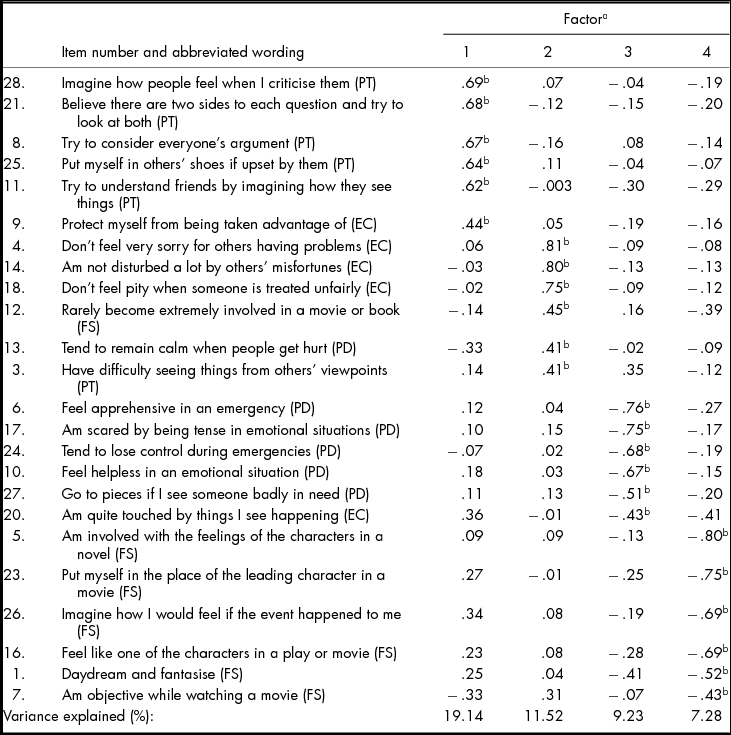
This second four-factor model explains 47.16% of the total variance, an improvement over the earlier 42.78% (see Table 1). Each of the four factors has six items. The first factor, which was labelled Perspective Taking, is composed of five items from the Perspective Taking scale with one item taken from the Empathic Concern scale. The item loadings range from .44 to .69, while the factor explains 19.14% of the total variance. The second factor is composed of three items from the Empathic Concern scale with one each taken from the Perspective Taking, Fantasy and Personal Distress scales. As this factor includes items from all four dimensions of the original IRI (Davis, Reference Davis1980), it was labelled the Empathy factor. The item loadings range from .41 to .81, while the factor explains 11.52% of the total variance. The third factor, labelled Personal Distress, contains five items from the Personal Distress scale and one item from the Empathic Concerns scale. The item loadings range from .43 to .76, with the factor explaining 9.23% of the total variance. The fourth factor, labelled Fantasy, includes six items from the Fantasy scale. The item loadings range from .43 to .80, while the factor explains 7.28% of the total variance.
Exploratory Factor Analysis of the Alternative Chinese Version of the Interpersonal Reactivity Index (First Sample)

PD, Personal Distress; EC, Empathetic Concern; PT, Perspective Taking; FS, Fantasy.
aFactor 1, Perspective Taking; Factor 2, Empathy; Factor 3, Personal Distress; Factor 4, Fantasy.
bItem has a high loading on the corresponding factor.
Sex Differences
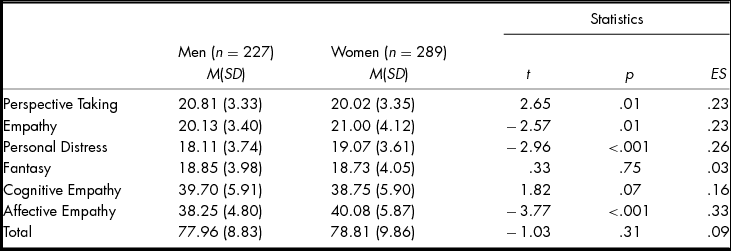
A series of t-tests was conducted to examine the effect of sex on the aC-IRI and its factors (see Table 2 for the means and standard deviations). There was no significant sex difference for the total aC-IRI, t(514) = −1.03, p = .31. Men scored significantly higher than women on Perspective Taking, t(514) = 2.65, p = .01, ES = .23; while women scored significantly higher than men on Empathy, t(514) = −2.57, p = .01, ES = .23; Personal Distress, t(514) = −2.96, p < .001, ES = .26; and Affective Empathy, t(514) = −3.77, p < .001, ES = .33.
Means (Standard Deviations) of Men and Women on the Alternative Chinese Version of the Interpersonal Reactivity Index and its Factors (First Sample)
Convergent and Divergent Validity
Table 3 displays the Pearson correlations between scores on the four aC-IRI factors and scores on the two other instruments (the Global Esteem Scale and the Lai Personality Inventory) in the first sample subgroup (N = 53). Consistent with predictions, scores on the aC-IRI Perspective Taking were positively and significantly associated with scores on the Global Esteem Scale, confirming the convergent validity of the Perspective Taking factor. However, unexpectedly, scores on the Personal Distress factor were not significantly related with scores of the Global Esteem Scale. Thus, convergent validity was not demonstrated for the aC-IRI Personal Distress factor.
Pearson Correlations Between Scores on the Alternative Chinese Version of the Interpersonal Reactivity Index Scale and Other Psychological Measures (Subgroup of First Sample)

*p < .05, **p < .01.
Also consistent with predictions, scores on all four aC-IRI factors were negatively associated with scores on the Lai Aggression scale, while the relationship was significant only for the Empathy factor. Overall, it seems that the total scores of the aC-IRI have the required validity but the subscales do not perform consistently. Thus, the evidence for the construct validity of the aC-IRI is mixed.
Internal Consistency and Test–retest Reliability
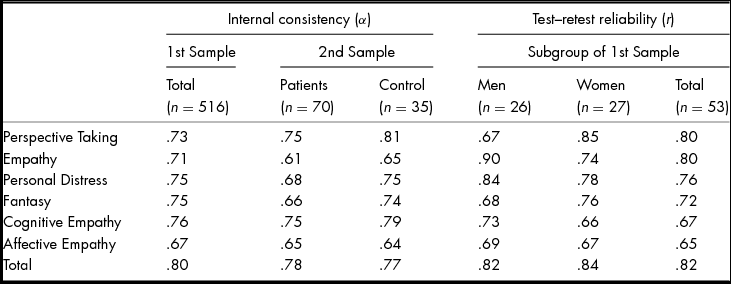
As shown in Table 4, Cronbach's alpha for the aC-IRI and its component factors ranged from .61 to .81 for different samples in the study. These results suggest that the internal consistency for the aC-IRI varies from acceptable to good. Table 4 also shows the 2-week test–retest reliability. Here the values ranged from r = .67 to r = .90. These results are comparable to those reported by Davis (Reference Davis1983, Reference Davis1994).
Internal Consistency and Test–retest Reliability of the Alternative Chinese Version of the Interpersonal Reactivity Index and its Factors
Discriminant Validity
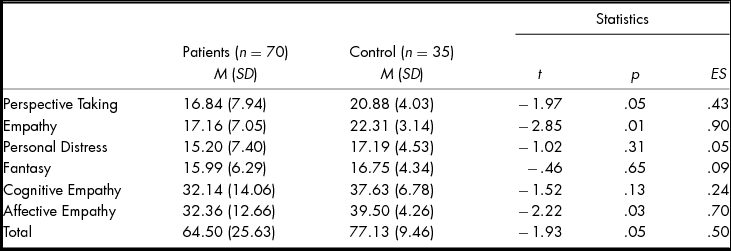
Table 5 compares the mean scores of the patients with schizophrenia and the normal controls (second sample) on the aC-IRI and its factors. The controls scored significantly higher than the patients on the total aC-IRI, t(93) = −1.93, p = .05, ES = .50. They also scored significantly higher than the patients on aC-IRI Perspective Taking, t(93) = −1.97, p = .05, ES = .43; Empathy, t(93) = −2.85, p = .01, ES = .90; and Affective Empathy, t(93) = −2.22, p = .03, ES = .70.
Means (Standard Deviations) of Patients with Chronic Schizophrenia and Normal Controls on the Alternative Chinese Version of the Interpersonal Reactivity Index and its Factors (Second Sample)
Because of the significant positive correlations between Empathy and years of education (r = .22, p = .04) and between the FSIQ and Perspective Taking (r = .31, p = .003), Empathy (r = .40, p = 0), Cognitive Empathy (r = .27, p = .01), Affective Empathy (r = .28, p = .01) and the total aC-IRI (r = .29, p = .01), an ANCOVA was performed to control for the effects of these latter two variables on the relation between Empathy and subgroup (patient vs control). The results indicated that the significance remained after co-varying for years of education, with the FSIQ only for Empathy, F (1, 104) = 4.20, p = .04 and Affective Empathy, F (1, 104) = 4.53, p = .04, but not for the total aC-IRI, F (1, 104) = 1.92, p = .17 and Perspective Taking, F (1, 104) = .55, p = .46.
Discussion
The purpose of the present study was to develop an alternative Chinese version of the Interpersonal Reactivity Index and evaluate its psychometric properties in adult samples. Factor analytic methods were applied to create a 24-item scale with good internal consistency and test–retest reliability. To test for construct validity, the 24 items were assigned to four factors (Personal Distress, Empathy, Perspective Taking and Fantasy). This factor structure is generally consistent with Davis's (Reference Davis1980, Reference Davis1983) theory of the underlying structure of the original IRI and supports the multidimensional nature of empathic responses. Because some items on the aC-IRI Empathy factor list differ from those on the Empathic Concern scale of the original IRI, the validity of the former needed to be clarified. Our data confirmed that the aC-IRI Empathy factor has acceptable validity, because it correlated negatively and significantly with aggression, with women having higher scores than men, and it successfully differentiated chronic schizophrenia patients from normal controls. The fact that women had higher scores than men on Empathy, Personal Distress and Affective Empathy is consistent with both developmental theories and previous empirical research (Davis, Reference Davis1980, Reference Davis1996). The significant positive correlations of Perspective Taking, Empathy and the total aC-IRI using the Global Esteem Scale, and the significant negative correlations of Empathy and the total aC-IRI with Lai's Aggression scale are also consistent with previous empirical findings (Miller & Eisenberg, Reference Miller and Eisenberg1988; Murphy, Jones, & Guthrie, Reference Murphy, Jones and Guthrie1998). These results indicate that the aC-IRI has acceptable construct-related validity. Collectively, the findings from the first sample support the reliability and the construct validity of the aC-IRI and its factors. The results from the second sample reveal that the aC-IRI can differentiate chronic schizophrenia patients from normal controls on aC-IRI Empathy and Affective Empathy, thereby supporting its discriminant validity in clinical settings.
The fact that skewness and kurtosis for the total aC-IRI were close to zero shows that the scores are normally distributed. Thus, this distribution of scores from the first sample can be used as norms for the Chinese young adult population in Taiwan. Combined with their ease of use and efficiency, the validity of these norms demonstrates that the aC-IRI meets the requirements for a suitable standardised test and is an appropriate instrument for objectively evaluating different aspects of empathy in Taiwan.
The factor structure found in the present study deserves comparison with the factors found by Davis (Reference Davis1980) for the original IRI. To do so, we looked at differences in item loadings for the same items of each factor for the two scales. We arbitrarily defined a significant difference in factor loadings on a given item as .20 or greater. The first factor of the aC-IRI, Perspective Taking, consists of five items from the Perspective Taking scale of the original IRI. A significant difference was found for Item 28, which had the highest factor loading on the aC-IRI but the smallest loading on the original IRI. The second factor is composed of three items from the Empathic Concern scale of the original IRI. As this factor includes items from all four dimensions of the original IRI (Davis, Reference Davis1980), it was labelled Empathy. Items 4 and 18 revealed significant differences, and both had higher factor loadings on the aC-IRI than on the original IRI. The third factor, Personal Distress, contains five items from the Personal Distress scale of the original IRI. Four of the items showed significant differences. The factor loadings of Item 17 and Item 10 were higher in the aC-IRI than in the original IRI, and the reverse was true for Items 24 and Item 27. The fourth factor, Fantasy, includes six items from the Fantasy scale of the original IRI. There were no significant differences between the aC-IRI and the original IRI for any of these items.
We tried to explain these findings by using Davis's (Reference Davis1996) organisational model of empathy. This model defines empathy broadly as a set of constructs having to do with the responses of one individual to the experiences of another. The model includes four related constructs identified with corresponding prototypical events: (1) ‘antecedents’, which refers to the characteristics of the observer, target or situation; (2) ‘processes’, which refers to the particular mechanisms by which empathic outcomes are produced; (3) ‘intrapersonal outcomes’, which refers to the cognitive and affective responses of the observer that do not manifest as overt actions directed at the target; and (4) ‘interpersonal outcomes’, which refers to actions directed at the target.
In terms of this model, the Fantasy factor of the aC-IRI can be regarded as an antecedent of empathy deduced from the characteristics of the observer. Its structure is almost the same as that of the Fantasy scale of the original IRI. The Perspective Taking factor of the aC-IRI can be regarded as measuring an empathy process represented by the most advanced cognitive process of the observer. Its structure is most similar to the Perspective Taking scale of the original IRI, except for the factor loading of Item 28: ‘Before criticising somebody, I try to imagine how I would feel if I were in their place.’ This difference in factor loadings may reflect the traditional Chinese cultural belief that people should try to examine others’ perspectives by putting themselves in their situation. The prescriptions following from this belief include ‘yi he wei gui’ (Preserve group harmony) and ‘qi suo bu yu, wu shi yu ren’ (Do not do to others what you would not want them to do to you). These cultural beliefs may help to inhibit direct criticism of others as a way to preserve harmony in personal relationships. Both the Personal Distress and Empathy factors of the aC-IRI can be regarded as measuring intrapersonal outcomes of empathy, mainly because they address the affective responses of the observer. Although the structure of the Personal Distress factor of aC-IRI is most similar to that of the Personal Distress scale of the original IRI, there were significant differences in the factor loadings of the four items. The higher factor loadings of Item 17 (‘Being in a tense emotional situation scares me’) and Item 10 (‘I sometimes feel helpless when I am in the middle of a very emotional situation’) imply that the first sample in the present study may experience greater distress and discomfort in extreme emotional situations than situations without apparent emotional loading. Owing to the fact that these reactions seem to happen to everyone regardless of culture, different factor loadings may reflect individual differences among different samples. The fact that the Empathy factor of the aC-IRI includes items from all four dimensions of the original IRI (Davis, Reference Davis1980) suggests that the first sample in the present study may have conflicting affective reactions to extremely emotional situations. In other words, in emotional situations, the Chinese may have conflicting feelings in response to the interpersonal behaviours expressed by others.
In summary, although we found four factors for the aC-IRI, only the Fantasy factor was comparable to the Fantasy scale of the original IRI. The other aC-IRI factors (Perspective Taking, Empathy and Personal Distress) have different implicit meanings than the corresponding scales of the original IRI. These differences may reflect traditional Chinese cultural beliefs. The findings suggest that a careful examination of the loadings of each item on each factor is necessary for the cross-culturally valid measurement of empathy by instruments such as the aC-IRI. The results of these cross-cultural measures of empathy must also be explained in the context of individual cultures.
The present results with the aC-IRI deserve comparison with the results from studies using the original English or other language versions of the IRI in clinical populations. Such comparisons would facilitate communication and the sharing of empathy-related research results between investigators in Taiwan or China and those from Western and other East Asian countries. For example, in the current study, patients with schizophrenia had significantly lower scores than normal controls on the Empathy and Affective Empathy factors. These findings are inconsistent with those of Shamay-Tsoory et al. (Reference Shamay-Tsoory, Aharon-Pertz and Levkovitz2007a), who used the Hebrew version of the IRI, and those of Montag et al. (Reference Montag, Heinz, Kunz and Gallinat2007), who used the German version. In the study of Shamay-Tsoory et al. (Reference Shamay-Tsoory, Aharon-Pertz and Levkovitz2007a), patients with schizophrenia had significantly lower empathy scores compared with those of healthy control subjects on the IRI total scores, the cognitive empathy IRI subscales and the Perspective Taking. In the study of Montag et al. (Reference Montag, Heinz, Kunz and Gallinat2007), patients with schizophrenia had significantly lower empathy scores compared with those of healthy control subjects on the Perspective Taking. These two studies reveal that patients with schizophrenia had lower Perspective Taking or cognitive empathy scores. Shamay-Tsoory et al. (Reference Shamay-Tsoory, Aharon-Pertz and Levkovitz2007a) thought that affective empathy involves an automatic emotion processing and does not correlate with cognitive flexibility. Decety and Jackson (Reference Decety and Jackson2004) thought that perspective-taking is a higher level empathy system that depends on the medial prefrontal cortex (Eslinger, Reference Eslinger1998; Shamay-Tsoory et al., Reference Shamay-Tsoory, Tomer, Berger and Aharon-Pertz2003). How can we explain that these findings are inconsistent with our own? We think one possible reason may come from the different demographic characteristics of samples in these studies. In our study, patients with schizophrenia were older and had been hospitalised for longer than those in the other two studies. In addition, another reason may be that our patients with schizophrenia were more heterogeneous than those in the other two studies. Thus, these two reasons make incongruent findings possible.
The present findings demonstrate that the aC-IRI is a broadly applicable screening tool that can be used in clinical settings for the early detection of empathy deficits associated with psychiatric disorders, as well as for psychiatric research. It is noteworthy in this connection that several neurological correlations of empathy have emerged in recent years. Evidence from functional neuro-imaging studies points to the involvement of the orbitofrontal and medial prefrontal cortex in empathy (Farrow et al., Reference Farrow, Zheng, Wilkinson, Spence, Deakin, Tarrier and Woodruff2001; Shamay-Tsooy et al., Reference Shamay-Tsoory, Tomer, Berger and Aharon-Pertz2003; Völlm et al., Reference Völlm, Taylor, Richardson, Corcoran, Stirling, McKie and Elliott2006). Lesion studies have implicated the role of the orbitofrontal prefrontal cortices (Eslinger, Reference Eslinger1998; Shamay-Tsoory et al., Reference Shamay-Tsoory, Tomer, Berger and Aharon-Pertz2003; Shamay-Tsoory, Tomer, Goldsher, Berger, & Aharon-Peretz, Reference Shamay-Tsoory, Tomer, Goldsher, Berger and Aharon-Peretz2004), and they have shown that the right anterior temporal and medial frontal regions are essential for empathic behaviour (Rankin et al., Reference Rankin, Gorno-Tempini, Allison, Stanley, Glenn, Weiner and Miller2006). In addition, Shamay-Tsoory, Aharon-Peretz and Perry (Reference Shamay-Tsoory, Aharon-Peretz and Perry2009), using the Hebrew version of the IRI, found a remarkable behavioural and anatomical double dissociation between deficits in cognitive empathy (mediated by the ventromedial prefrontal cortex) and emotional empathy (mediated by the inferior frontal gyrus). These neurological correlations justify administering the aC-IRI to patients with certain brain injuries and neurodegenerative diseases, as well as to patients with schizophrenia or who present with other forms of deviant behaviour related to empathy. However, in the absence of neuro-imaging data, caution should be exercised in drawing inferences about the involvement of specific neuro-anatomical regions from aC-IRI scores representing cognitive or affective empathy.
The present results reveal several limitations of the aC-IRI and the inferences that can be drawn from its results. The first refers to limitations in the suitability of the aC-IRI for certain populations. For example, Strayer (Reference Strayer, Eisenberg and Strayer1987) presented a case study that included self-reports of empathy by a person constrained by limited abilities in verbal expression and comprehension. The aC-IRI would not be appropriate for such a person; direct measures (e.g., physiological) would instead be required. Second, because the Chinese population is large and heterogeneous, it is reasonable to expect variations in implicit meanings of the same factor between Taiwanese and Chinese samples, as well as between other subgroups. Further research is required to demonstrate the generalizability of the results of the present study to other groups. Third, the present findings are based on young adult samples in Taiwan. Although it is likely that the same four factors found in young adult samples would be found with adolescent samples (Litvack-Miller et al., Reference Litvack-Miller, McDougall and Romney1997), this has yet to be demonstrated. The psychometric properties of the aC-IRI need to be validated empirically on adolescent samples before it can be properly used with adolescents. Finally, our patients were selected from a psychiatric hospital in which patients with schizophrenia were older than in another two studies, had been hospitalised long-term and were heterogeneous in their symptoms. Although we used ANCOVA to control covariances, results were incongruent with the other two studies using IRI. This limited the comparability among aC-IRI and other versions of IRI for patients with schizophrenia.