“Bell had, in short, ‘overshot himself very
grossly in this matter of going to church’”Footnote 2
1 - ‘The Monastery’: Form and Genre
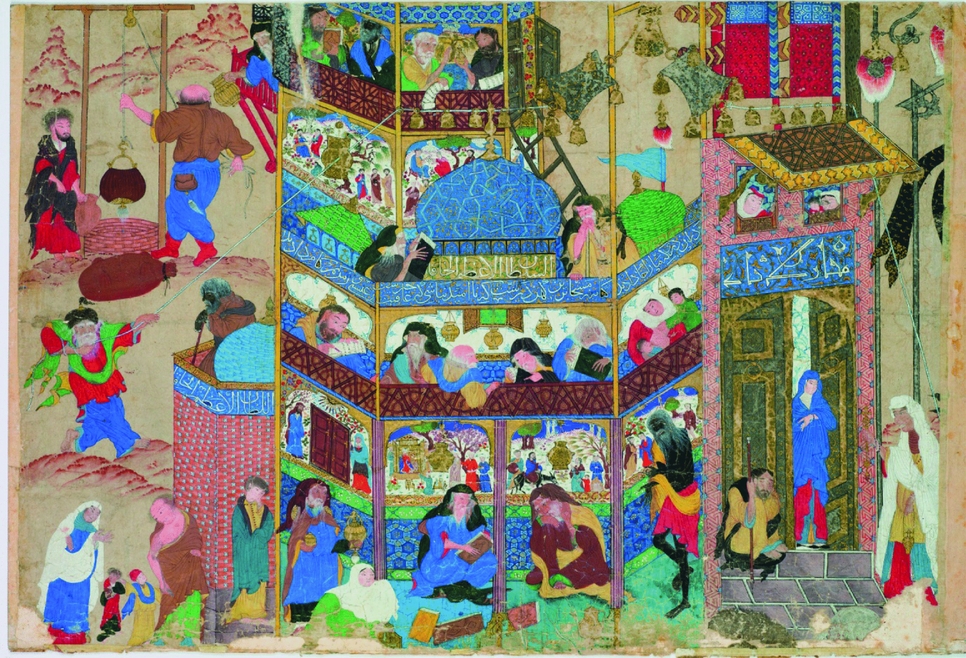
A painting now preserved in an album in the Topkapı Library (TSMK H.2153 f.131b) develops the kind of text-image relationship that resists easy formal or generic classification (Fig. 1). Dedicated in two pseudo-epigraphic inscriptions to “The Most Exalted Sulṭān”, the Khāqā[n] (al-Sulṭān al-Aʿẓam al-Khāqā[n]), the scene, which depicts a monastery (dayr), recalls panegyric poetry and presentation gifts, and suggests the commemoration of an event such as a royal birth or enthronement through the benedictory formula ‘May it be blessed’ (mubārak bād), which is inscribed over the entrance of the building. Yet a band of epigraphy that runs around the roof of the monastery, again in the manner of actual architectural inscriptions, condenses types of image found in lyric poetry and didactic masnavī into what I shall argue is the form of a chronogram. In examining the generic associations of ‘The Monastery’, this paper will therefore engage with questions of how the significance of poetic imagery and visual iconography was articulated and interpreted in fifteenth-century Iran.
‘The Monastery’. TSMK H.2153 f.131b. Image courtesy Topkapı Palace Museum.

Painted on polished paper, the large, polychrome painting (47.8 x 33.7 cm) depicts an architectural complex populated by a number of men, women and children stemming from differing ethnic and religious backgrounds.Footnote 3 As Fazio suggests, they include a sadhu,Footnote 4 and a figure akin to representations of St. John the Apostle flanking the cross.Footnote 5 Melikian Chirvani has argued that another male figure, in the bottom of the painting at the far left, “offers a loose interpretation of a Chinese arhat”.Footnote 6
In the bottom right, where the painting is torn, it is possible to make out the partial forms of two sleeping dogs, one brown, one grey, which lie facing one another in front of the monastery's threshold. The image finds an equivalent in a passage in Rūmī’s Masnavī, concerning the sick faithful who crowd the door of Jesus’ cell, praying for his intercession. The poet likens the faithful to guard dogs, and urges the reader to display the same kind of fortitude as they do:

In the upper left of the painting, in an image which may reconfigure the iconography of Jesus and the Samaritan woman, a man draws water from a well and hands it to one of the figures on an upper gallery of the monastery, while a male figure stands to the side, pitcher in hand.Footnote 8 Viewers may draw an association between the well (chāh), the ‘well’ or dimple (chāh; zanakhdān), on the chin of the sāqī (‘water-carrier’ or ‘wine-bearer’), and the idea of the monastery as a space apart from orthopraxy, which is developed to particular effect in a ghazal by Ḥāfiẓ:Footnote 9

My heart was caught in the dimple among your curling locks / Alas that it clambered out of the well and fell into the net
It's happened so, Khvāja, that you see me back at the monastery / Our lot has fallen in with the sāqī’s cheek and the lip of the wine-cup
Many of the figures depicted in the painting are clad in varying combinations of blue, yellow, red and black, colours which historically had been associated with clothing restrictions imposed on non-Muslim communities. A state decree issued in Mamluk Cairo in 700/1301, for example, stipulated that “Christian men had to wear a blue turban, Jews a yellow one, and Samaritans, a red one”, and assigned similarly coloured veils to any woman belonging to these faiths who appeared in public.Footnote 10 Another example of how non-Muslim communities could be associated with symbolic ghiyār, or distinguishing marks, is provided by Ibn al-Fuwāṭī, who reports that after Ghāzān was made Īlkhān in 694/1295, he entered Tabriz and stipulated that Jews should wear a scrap of yellow cloth (khirqat ṣafrā’) in their turbans, and that Christians should don the girdle (zunnār).Footnote 11
Such associations between appearance and religious faith informed images employed in poetry in both Arabic and Persian from as early as the tenth century. Two examples serve to show how images comparing nature and human society redefine our perceptions of both. A line by the Lahori poet Maʿsūd Saʿd Salmān (1046-1121), for example, combines the association between yellow clothing and Jewish communities together with images of Zoroastrian ritual, in order to evoke a spring garden in bloom, full of warbling birds. The juxtaposition of images of people belonging to different faiths in the line creates an atmosphere similar to ‘The Monastery’, where a number of the male figures on the balconies of the building are garbed in yellow:Footnote 12

Until the garden becomes Jewish, donning yellow clothes / There can be no recitation of the Zand, no Magian Priest nor chanterFootnote 13
We also find the colour blue associated with Christians in a well-known vaṣf poem by Kisā’ī Marvazī, active during the tenth century.Footnote 14 The figure of the Christian monk with pale yellow cheeks, evoked by Marvazī in his description of the blue water lily with its pale yellow centre, finds an equivalent in the figure of the elderly monk in ‘The Monastery’ who sits in front of the wall-paintings on the lowest storey of the building:

See the blue lily amid the water / Like a watered sword or lustrous ruby
It is the colour of the sky, and like the sky / It has the yellow yolk of a full moon
Resembling a monk, his cheeks a perpetual yellow, / Who has fashioned his gown and trousers from blue silk
It should be stressed that a number of the figures depicted in the painting wear combinations of these colours, such as the young man modelled on images of St John the Apostle, who is clothed in yellow and blue. If we take these colours to be representative of different faiths, then their juxtaposition in one figure suggests a symbolic blending of religious identities.
On an iconographic level, the male figures holding scrolls and books in ‘The Monastery’ are reminiscent of the Old Testament prophets who appear in those European Armenbibeln, or Biblia Pauperum, where each page is based on an architectonic design. In such images, the prophets, holding scrolls or books, stand in the upper loggia of a building, whilst a biblical narrative unfolds below.Footnote 16 An echo of the visual layout of these Armenbibeln scenes can be discerned in the structure of the monastery itself, since the building frames the wall-paintings just as an architectural structure may frame the biblical narratives in an Armenbibel. Comparisons with Armenbibeln may be worth pursuing on account of iconographic similarities between images in such bibles and other paintings in the album corpus. Raby, for example, has traced the connections between H.2153 ff. 39b and 137b, both of which depict lion-riders, and representations of Samson astride the lion in fourteenth and fifteenth-century Armenbibeln.Footnote 17 On the other hand, the structure of the monastery itself has also been compared with architectural representations in Arab and Persian book-culture that may have been available to the painter of ‘The Monastery’. Brend and Golombek, for example, have both argued for formal similarities between ‘The Monastery’ and the double frontispiece to the copy of Rasā’il Ikhwān al-Ṣafā that is dated in its colophon to Baghdad, 686/1287 (Süleymaniye Mosque, Esad Effendi 3638).Footnote 18 A thematic link between the two paintings is developed by the four men, identified as Christian by their blue dress, who are represented in the frontispiece.
As the foregoing has suggested, the architectural structure depicted in ‘The Monastery’ is closest in formal terms to artistic representations of buildings, as opposed to actual architectural monuments. Nevertheless, Golombek has made a survey of comparanda for the dome of the monastery in both painted representations of architecture and extant architectural monuments of the fourteenth and fifteenth centuries. As Golombek notes, this method is problematic, both because of the paucity of now extant architectural remains built during the Jalāyirid period by architects from Tabriz, who are connected with a number of later Timurid buildings, and because the architecture depicted in ‘The Monastery’ can be read from different angles: the decoration of the dome, for example, could be taken as an interior view, in which case a parallel can be found as early as the congregational mosque at Yazd, dating to c.1360.Footnote 19 What is more, in a given period, certain elements of design may be represented by painters even though they are absent from the material record of monumental architecture.Footnote 20
It is perhaps therefore unsurprising that none of the actual domes discussed by Golombek furnish a precise model, in both form and decoration, for ‘The Monastery’.Footnote 21 Golombek argues that the closest representation is to be found in the scene of Baghdad in Flood in the Shirvan Anthology of 1468 (BL Add. MS. 16561 f.60a), yet the dome of the monastery is distinctly more oval in shape.Footnote 22 Golombek's remarks should also be qualified with reference to a schematic drawing of a city-scape in the Diez Albums (Diez A fol. 70 p. 26, 3), associated by Roxburgh with the patronage of Baysunghur b. Shāhrukh (d. 837/1433),Footnote 23 which depicts two domes of the requisite profile: “bulbous” and “swelling out above a tall drum”, according to Golombek.Footnote 24 The double-page representation of the 1258 siege of Baghdad in the Paris Jāmiʿ al-Tawārīkh that is connected by Richard with the patronage of Baysunghur (BnF Supplément Persan 1113, ff. 180b-181a) depicts three large domes decorated in a comparable style to that of ‘The Monastery’.Footnote 25 The smaller, green and blue brick domes in ‘The Monastery’ can be compared with one green dome represented in the panorama of Mecca (f.363a) in Iskandar Sulṭān's anthology of 813–14/1410-11 (BL Add MS. 27261). As far as the scheme of the geometric tilework on the monastery's central dome is concerned, a close comparison is provided by the mosaic faience of the tympanum of the north portal of the mosque of Tuman Aqa in Samarqand, dated 1405.Footnote 26 Together, these examples suggest a wider range of possible datings for ‘The Monastery’ than those suggested in Golombek's conclusion.
Through the depiction of groups representing varied religious beliefs and practices, the manipulation of foreign visual sources, and the patterning in visual terms of poetic tropes, ‘The Monastery’ evokes a space away from orthodoxy and orthopraxy in the fifteenth-century Persian-speaking world, to where the painting has been ascribed most often by art historians.Footnote 27 The painting is made up of what Roxburgh terms an “accumulation of details organised into a composition”,Footnote 28 yet the piece displays coherence that derives, not from a single narrative strand, but rather from the complementary nature of its individual motifs. Melikian Chirvani has argued that the painting plays in visual and verbal terms with the image of the hexagonal dayr-i kuhan (‘ancient hermitage’) or dayr-i khākī (‘earthen hermitage’),Footnote 29 in order to create “the symbol of a world in which ascetics from all faiths pursue their quest, seeking to accede to the esoteric understanding of God, be they Brahmans, wise men from the Far East, or Farangī Christians ”.Footnote 30 Yet mystical images cannot be separated in this painting from the lyric and the panegyric. The visual suggestion of non-Muslim communities, including Buddhists, Christians, Hindus and Jews, within a building marked as being under the sulṭān’s patronage, connects the dedicatee of the painting with the ideas that these communities are perceived to represent. Melikian Chirvani has argued that Theodora Komnene, a Christian wife of the Aqqoyunlu ruler Uzun Ḥassan (d.1478), is the most likely dedicatee of the painting.Footnote 31 However it is precisely because ‘The Monastery’ responds not to Christian doctrine, but to the idea that Christianity represents one among several unorthodox modes of thought and behaviour, that we should not restrict our search by looking for a Christian patron for the painting.
2 - The Epigraphic and the Epigrammatic
The central inscription around the roof of the monastery consists of two bayts of poetry in Persian, each in a different metre. They are positioned so as to mimic the form of an actual epigraphic inscription, commenting on the building that they adorn, but at the same time they can be read independently, like a poem commenting on the painting:

In that monastery where they gave us the wine-cup / They granted us what we sought from Jesus and Mary
There is an inscription by the Messiah on this old monastery / Which reads: “Do not give up hope for the outcome is good”
Despite their metrical independence, the two lines mimic the standard form of chronograms (mavvād-i tārīkh), which have historically often been included in actual epigraphic inscriptions throughout the Persian-speaking world, as well as in occasional, epigrammatic poetry.Footnote 32 The introductory line of a two-line chronogram gives a reading context, while the second generally contains the date, often in the final miṣrāʿ. The date is given, most often in reported speech, through the numerical value of a contextually appropriate word or phrase, by using the abjad system that equates each letter of the Arabic alphabet with a numerical value.Footnote 33 Here, the presence of a date in the inscription is formally indicated by the term kitāba, which, in addition to its meaning of ‘monumental inscription’, is defined by lexicographers as ‘poetry or prose pointing to a definition or a date, which is written on the pīshṭāq of a building’ (ān naẓm yā nasr-i mushʿir bar taʿrīf yā tārīkh ki bar pīshṭaq-i ʿimārat nivisand).Footnote 34 The word ‘khayr’(ر + ی + خ) equivalent in abjad to the year 810 ah (200 + 10 + 600), or 1407–8 ce, is then marked in direct speech as the ‘conclusion’ or ‘result’ (ʿāqibat) of the chronogram.Footnote 35
The use of the term kitāba to mean an inscription pointing to a date is explicitly attested in several lines of poetry, the primary source for lexicographers in Persian. Qudsī, for example, writes:Footnote 36

When my thoughts led the inscription to its conclusion / The date was: “The inscription of the exalted throne” (= 1055/1645-6)
Using the term kitāba-nigār to indicate a craftsman who makes a monumental inscription, Muḥtasham-i Kāshānī writes:Footnote 37

Those subtle inscribers have marked the date as “the unsullied, august bath-house” (= 966/1558-9)
The reading of the epigraphic inscription in ‘The Monastery’ as one which marks a date is also supported by two fragmentary poems, both of which use the same keyword, khayr, to mark the same year: 810/1407-8. The first is a kitāba, designated as such in his collected poetry, which was penned by the historian Sharaf al-Dīn ʿAlī Yadzī for an unidentified building:

‘When the sun appeared from the East / It brought fortune's face towards this royal palace.
All night until dawn, the heavens, rejoicing at its eminent location, rained pearls.
The building is ‘good’ [khayr = 810], and its noble date is ‘good’ [khayr = 810].
/ A canny person devised this dating.’
In addition, the keyword khayr is used to mark 810/1407-8 in a chronogram on the death of the poet Muḥammad Shīrīn Maghribī, which was composed by his student, the poet and calligrapher ʿAbd al-Raḥīm Khalvatī, also known as Mashriqī:Footnote 39

When Maghribī left his bodily west for the east / I saw him walking in the gardens of Paradise
I asked him of the result [ʿāqibat] and the year of his death / He smiled and walked proudly, saying it was well [khayr = 810]
A further two contextual factors reinforce the interpretation that the line should be read as pointing to a date. Firstly, chronograms often state that a date is being announced to the world, as in a line on the death of the Ilkhānid statesman Rashīd al-Dīn, where the dating words are introduced by the phrase “Fate's scribe announced to the people of the world. . .”.Footnote 40 Exploiting the metaphor of the world as a hexagonal monastery, a number of chronograms use the term “old monastery”, instead of a prosaic term such as jahān or dunyā, to the same effect. A chronogram written for the conclusion of peace between Shāh Tahmāsp and the ‘Qaiṣar of Rūm’ in 969/1561-2, for example, runs:

The voice of good fortune in this old monastery / Cried out: ‘Peace is good’ (= 969/1561-2)
It should be noted that in this line, as in a significant number of other chronograms, the word tārīkh is absent.Footnote 42
A second factor is the close association between Jesus (ʿīsā; masīḥ; masīḥā) and the ‘science of letters’ (ʿilm-i ḥurūf) in Islamic intellectual history. Qur'anic verses such as 3:49 describe Jesus’ breath of life (nafkh), which instils meaning (maʿnā) in a form (ṣūra).Footnote 43 Consequently, those who sought to find hidden values in letters often linked their practice with Jesus in conceptual terms. In al-Fuṭūḥāt al-Makkiyya, for example, Ibn al-‘Arabī terms his own form of lettrism al-ʿilm al-ʿisawī (Jesus’ Science).Footnote 44 In the final line of epigraphic poetry in ‘The Monastery’, I would suggest that the phrase kitāba zi masīḥā recalls this association, prompting the viewer to understand the inscription as one that makes use of abjad values. As the links between the idea of Jesus and revelation are strongly felt in the poetry and the intellectual history of the late fourteenth and early fifteenth centuries, the next section will unpack some of these associations.
3 - Lettrism and Messianism
The two lines of poetry in the central band of epigraphy in ‘The Monastery’ do not only take the form of a chronogram in order to commemorate a royal celebration. They also evoke images found in lyric and didactic poetry which develop an association between Jesus and the revelation of hidden truths. A celebrated ghazal by Ḥāfiẓ (d. 1389), who died only a couple of decades before the date commemorated in ‘The Monastery’, makes use of the image, to the extent that similarities between the poem and the painting open up a possible association for the viewer. It is worth quoting several lines of the ghazal, which develops contrasting images of the hidden and the apparent, because of motifs shared between it and ‘The Monastery’:Footnote 45

For years our heart sought Jamshīd's wine-cup from us / And looked for what it had from a stranger

Last night I took my problem to the Magian priest / Who solved the riddle with his reasoned gaze

I saw him, mirthful and light-hearted, a cup of wine in hand / As he looked into that mirror with its hundred facets

I said, “Sage, when did He give you this world-viewing cup?” / He said, “The day He built this azure dome”

Our beloved, for whom he went to the gallows, said / ‘His crime was disclosing secrets’

If the Holy Spirit lends its aid again / Others too may do what the Messiah did
In this ghazal, Jamshīd's ‘world-viewing cup’ (jām-i jahānbīn or jām-i gaytīnamāy), which reveals what is hidden, is evoked in conjunction with the breath of Jesus (masīḥā). Images of Jamshīd's world-viewing cup can be employed in poetry alongside those of the Eucharist cup (jām), since the combination of the two tropes connects the perceived heterodoxy of Christian rite with the uncovering, or unveiling, of hidden truths. A line by the Safavid-Mughal poet ‘Urfī demonstrates this intentional concatenation well:Footnote 46

Intoxication and insanity have broken the Messiah's cup / Jamshīd's goblet serves no purpose at this feast
The theme of revelation in heterodoxy is pursued by Ḥāfiẓ throughout the ghazal. A wine-cup, aligned with the world-viewing cup, is placed in the hands of the head priest (pīr-i mughān), developing an association between images of heterodoxy and the revelation of hidden truths. Furthermore, in the poem the figure of Jesus is equated with revelation, and, in the final line quoted above, the image of his breath as the life-bestowing spirit is recalled. In the epigraphic inscription in ‘The Monastery’, the interconnected meanings of the word jām as the Eucharist cup, the world-viewing cup, and the wine-cup that brings intoxication, ally mental images of Christianity with the idea of revelation. The textual evocation of wine consumption in the painting itself may be visually reinforced by the vessel and cup held by a male figure in the foreground, and a ewer standing alone to the right of the composition.
The association cultivated in ‘The Monastery’ between Jesus and revelation reflects intellectual trends which gained currency throughout the eastern Islamic world during the closing decades of the fourteenth century and at the beginning of the fifteenth. At this time, as Melvin-Koushki demonstrates, occult forms of knowledge (al-ʿulūm al-gharība) like lettrism were integrated with millenarian ideologies.Footnote 47 The fact that such ideas were not restricted to intellectual circles alone is demonstrated in a short account by Clavijo, who visited Tabriz in 1404. By using images that recall Luke 21:25-32, a passage which concerns the signs heralding the advent of the Messiah, the anecdote exemplifies how elements drawn from Christian sources were reinterpreted by the majority Muslim population of Tabriz within a millenarian context:
“It is a belief among the common people that at some near future time this withered tree will put forth green leaves, and next it shall come to pass that one who is a Christian Bishop shall appear in the city, surrounded by many Christian folk, and he will bear in his hand a Cross, and forthwith he will convert all the inhabitants of Tabriz to the True Faith in Christ Jesus. For all this as they told us, a certain great saint of the Moslems, who was a Dervish hermit, had made prophecy publicly not long before, on which occasion the common folk of Tabriz much incensed had rejected [what he spoke as to that tree] despising his prophecy”.Footnote 48
A parallel, but slightly later trend at the Ottoman court is discussed by Cornell Fleischer, who writes of interest in “Abrahamic prophets and pre-Islamic history as authoritative sources of guidance, particularly through appropriate application of either mystical, lettrist, or astrological techniques. . .and particular reverence for Jesus and for Christian, as well as Jewish, wisdom traditions”.Footnote 49
It should be emphasised that interest in the numerical significance of letters was not confined to one homogeneous social or political group in early fifteenth-century Iran.Footnote 50 On the other hand, a number of communities active during the period in question incorporated lettrism into their ideological programmes, including the Ḥurūfiyya. Taking its name from the word ‘letter’ (ḥarf), the Ḥurūfiyya focused its understanding of existence on the idea that God first manifested himself through the Word.Footnote 51 As 810/1407-8, the year commemorated in ‘The Monastery’, was significant for the Ḥurūfiyya, a brief survey of the movement's history, and of some concetti used in the didactic poetry of its prominent members, will serve to highlight how ‘The Monastery’ engages with trends in the intellectual history of the period. As this Ḥurūfī poetry is multivalent, and it is unclear to me how, and by whom, it was initially read, the purpose of the following section is to examine how a number of the tropes and images employed in ‘The Monastery’ find equivalents in Ḥurūfī poetry, rather than to argue for a direct, causal link between the two.
4 - Messianic Images of Jesus: The Ḥurūfiyya
The founder and leader of the Ḥurūfiyya, Fażlallah Astarābādī, was executed in 796/1394 at Ālinja, near Nakhchivān, by Timur's son Amīrānshāh.Footnote 52 Fażlallah had cultivated an image of himself as Jesus son of Mary,Footnote 53 and the promised messiah,Footnote 54 positing that he would have a second coming,Footnote 55 and after his death, his followers envisaged his future resurrection.Footnote 56 In the writing of poets who espoused Ḥurūfī ideology, including Fażlallah's khalīfa ʿAlī al-Aʿlā (d. 822/1419),Footnote 57 images of Jesus as kalām-i nāṭiq, the speaking Word, stand against those of Amīrānshāh the Antichrist (dajjāl).Footnote 58
The idea of Jesus as the Word, made flesh (gūshtmand shuda) through his mother Mary, was taken up by Fażlallah and ʿAlī al-Aʿlā, in part because of the innate link between writing (kitābat) and revelation.Footnote 59 In his Qiyāmatnāma of 814,Footnote 60 al-Aʿlā argues that the Christian monastery (dayr) is as representative of faith as the mosque. As in ‘The Monastery’, where a figure standing to the far left of the composition rings the bells over the roof of the architectural ensemble, Al-Aʿlā evokes the image of church bells (nāqūs).Footnote 61

You know that God is like Christ (Krīstūs) / Come to the Monastery and ring the bell
You have seen that the mosque and the monastery are one / Look for no sign from another
*
Nothing came of your seven circumambulations / Yet it did of the Messiah's faith

O monk of the monastery, the door has been opened / Hear the secret from the Messiah of the age
Al-Aʿlā’s focus on Christianity is in part linked to the equation in Ḥurūfī thought between Jesus and Fażlallah. In the Qiyāmatnāma, however, al-Aʿlā emphasises the significance of Fażlallah's revelation for all, regardless of religious or sectarian affiliation:


Whoever from among the children of Adam / Saw that light, became free
Whether a Muslim or Jews / A Sabian, Magi or Hindus
The final line quoted here subverts Qur'an 22: 17, which states that God will judge between those who believe in the Qur'an and those who follow the scriptures of the Jews, Sabians, Magi and Polytheists. In suggesting that all are equal before the revelation of Fażlallah, these images form a parallel to the diversity of the figures visually represented in ‘The Monastery’. Since the lines suggest that all can be drawn to the teaching of Fażlallah, they also advance an idea equivalent to the images developed in H.2160 f. 89b. The painting (24 x 31 cm) depicts the triumphal Christ in Majesty, watched by a number of men, women and children of differing backgrounds.Footnote 65
In the years 809/1406,Footnote 66 and 810/1408, two battles were fought for the control of Tabriz between the Qaraqoyunlu, led by Qara Yūsuf, and the Timurids, led by Abā Bakr and Amīrānshāh.Footnote 67 Qara Yūsuf won both battles. In the second, which took place on 26 Dhū’l Qaʿda 810/ 21 April 1408, Amīrānshāh was killed by the forces of Qara Yūsuf, who took Tabriz and established it as the capital of his polity.Footnote 68 ʿAlī al-Aʿlā’s Kursīnāma, written in Jumāda al-Ulā 810/ November 1407,Footnote 69 seemingly between the first and second conflicts, is largely concerned with Ḥurūfī thought, although the figure of Qara Yūsuf does appear in the work. Qara Yūsuf is described as reading the Qur'an fluently in Turkish,Footnote 70 an image which recalls the importance given by Ḥurūfī writers to the vernacular as the new medium of revelation, and an overlapping identity is also created between Fażlallah and Qara Yūsuf. Playing on the idea that Qara Yūsuf, formerly imprisoned by the Mamluks, was akin to his Quranic and Biblical namesake, once imprisoned in Egypt, al-Aʿlā suggests that Qara Yūsuf had been shown divine favour:Footnote 71

In order to become a king in the Egypt of appearance / The divinity's eagle descended over the throne of Yūsuf
On this date too he killed the corrupters / When he emerged from the cave of waiting
Furthermore, al-Aʿlā termed Astarābādī’s tomb at Ālinja a synagogue, a monastery (dayr), and the legitimate successor of the Kaʿba:

May it be well when you have crossed the water at Shirvān / May your face be set to the qibla through the synagogue and the monastery (dayr).
On Resurrection Day the Kaʿba went into the Heavens / After this Ālinja became its substitute
If Ālinja was the new Kaʿba, Tabriz was the place where the essence of the Truth had been made manifest:Footnote 73

He made the Essence of the Truth manifest in Tabriz / The light came, unveiled, from Fażlallah
The images employed by al-Aʿlā construct a vision of a Messiah whose character fuses religious and political authority into a model of rule. In a sense, his use of tropes of lyric and panegyric poetry represents an engagement with the kinds of poetry composed for rulers in a courtly context. The following section will explore how arguments are patterned throughout ‘The Monastery’ in order to develop a parallel image of messianic kingship.
5 - Emotional Communities in ‘The Monastery’
In the Qiyāmatnāma Al-Aʿlā reconfigures images of the wine-cup (jām) and the cup-bearer (sāqī), concetti of lyric poetry, to ally intoxication with the impending Day of Resurrection:Footnote 74

The last line quoted remoulds images of a community brought together by the wine-cup to argue, not for the intimacy and conviviality of the majlis, but for a vision of the Final Judgement that recalls the idea of Eucharist wine as Christ's blood. In a different fashion, the first of the two lines of poetry in ‘The Monastery’ not only leads the viewer into the chronogram, but also evokes a community brought together by the Eucharist cup in the monastery, which is marked by the titular epigraphic inscriptions on the building itself as being the sulṭān’s construction.Footnote 76 In other words, the titular epigraphic inscriptions in the name of the sulṭān emphasise the dedicatee's investment, not only in the architectural structure of the monastery, but also in the set of social and ideological practices it represents.
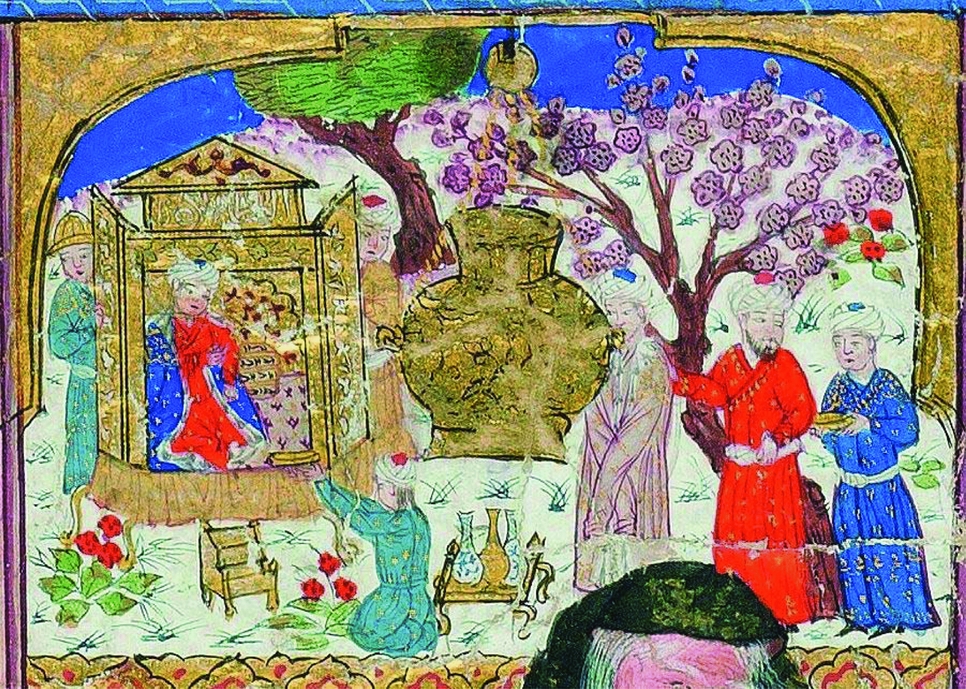
The dedicatee's identification with, and patronage of, the monastery's emotional community is also marked by the depiction of horsehair standards (tughs) in the painting.Footnote 77 The scene stands in stark contrast to an account such as Yazdī’s report of Timur's Georgian campaign in 806/1403-4, which relates how, when a church was captured by the Timurid army, tughs and the standard of the Prophet were raised over the structure, the Qur'an was recited from its roof, the Georgian men were beheaded and the women and children carried into slavery.Footnote 78 The link between the nature of the dedicatee's kingship and ideas of messianic rule may also be brought out by the wall-paintings of the monastery. In the central register, an image of a ruler seated on a golden throne is juxtaposed with a painting depicting Christ's triumphal entry into Jerusalem, connecting a vision of Persianate kingship with one of Christ the King who delivers salvation. When the image is magnified (Fig. 2), the seated ruler is revealed to be a male child. A worn, miniscule inscription in white on the throne itself, above the head of the child, reads al-sulṭān al-aʿ[ẓam], reinforcing the interpretation that the figure represents the dedicatee of the painting.Footnote 79
Detail of ‘The Monastery’. TSMK H.2153 f.131b. Image courtesy Topkapı Palace Museum.

From a technical perspective, such play with form and genre acts as a visual parallel to the writing of poets such as Ḥāfiẓ and Jahān-Malik Khātūn, who incorporated panegyric elements in their ghazal poetry as they examined ideas about the poet-patron relationship.Footnote 80 Motifs can be moulded in context in order to advance a thesis, just as when Jahān links the lyric and the panegyric by appearing to address Sulṭān Aḥmad Jalāyir as “the boy from Baghdad” (baghdādī pisar),Footnote 81 or when Ḥāfiẓ imagines a courtly majlis as a gathering of wine-drinking Magians in a panegyric ghazal.Footnote 82 This is, in essence, a question of structural elements, patterned in order to develop interconnected theses that articulate and explore ideas. I would suggest that, in a similar fashion, ‘The Monastery’ connects lyric, panegyric and mystical motifs, to explore images of unorthodox kingship. By developing interconnected arguments, ‘The Monastery’ displays some of its greatest generic parallels with contemporary, polythematic ghazal poetry. Although discussions of the function of ‘The Monastery’ and the group of large paintings with which it is stylistically linked can remain only tentative, it is worth considering the extent to which a viewing of the painting within a courtly gathering may have functioned as a visual analogue to the recitation of a polythematic ghazal.
Particularly when viewed in the context of a dating of 810/1407-8, ‘The Monastery’ is charged with ideological significance, reinforced textually by the reference to the ‘Messiah’ and the suggestion of an emotional community affiliated with the dedicatee, and also visually by the evocation of diverse groups. These ideas are also recalled in the painting H.2160 89b. As the next section will examine, it is difficult to imagine how these two images could have been considered a suitable gift for, or have been commissioned by, the Timurid Khalīl, ruling in 810 in Samarqand, or his uncle Shāhrukh, in Herat.
6 - Forms of Kingship: The Timurids and the Qaraqoyunlu
After Timur's death in 807/1405, Transoxiana and Khurasan were split between the territories of Khalīl, a younger son of Shāhrukh's older brother Amīrānshāh, and Shāhrukh himself. The public representations of power cultivated by the two rulers reflected their initial attempts to form separate political ideologies: whilst Shāhrukh had adopted the emblems of a sulṭān directly after Timur's death,Footnote 83 Khalīl had the grandson of Timur's chosen heir, the now defunct Sulṭān Muḥammad, enthroned as a puppet khan.Footnote 84 In 810/1407-8, both Shāhrukh and Khalīl were faced with internal threats from the networks of emirs who supported them: Shāhrukh campaigned in Balkh, suppressing an uprising led by Pīr ʿAlī Tāz, and then in Astarābād and Māzandarān. He suppressed another uprising led by Amīr Jahān-Malik, as well as dealing with a rebellion of nobles in Herat.Footnote 85
Khalīl, whose imprisonment by Timur's old emir Khudāydād the following year marked the beginning of the end of his brief reign,Footnote 86 supported Shāhrukh's attempts to secure the territory under Timurid control, and contributed five thousand horsemen to his brother Abā Bakr's campaign against the Qaraqoyunlu.Footnote 87 He greeted Shāhrukh's envoy announcing the defeat of Pīr ʿAlī Tāz with gifts,Footnote 88 and Shāhrukh reassured his nobles as to the stability of his political relationship with Khalīl.Footnote 89 In short, whilst the erosion of his rivals’ power left Shāhrukh in an increasingly powerful position, it seems unlikely that either he or Khalīl would wish to be represented as a sulṭān whose political authority was bolstered by their sympathy for divergent ideologies.
Shāhrukh did himself attempt to fuse political and religious authority in his own rule, for example by adopting the legend ‘God perpetuate his kingdom and caliphate’ (mulkahu wa khilāfatahu) on his coinage from 812.Footnote 90 He is also described as ‘Master of the Age’ (ṣāḥib-i īn zamān) by Sharaf al-Dīn Yazdī.Footnote 91 Yet whilst this representation engages with messianic frameworks of thought, it does so by arguing that Shāhrukh could combine political authority with orthodoxy as the ‘Renewer of Islam’ (mujaddid), and it is therefore far from the kind of messianism constructed in ‘The Monastery’ through the use of Christian visual sources.Footnote 92 As Subtelny and Khalidov note, representations of Shāhrukh as “the humā-bird guarding the egg of the Sharīʿa”, and “the one who has obliterated the practices of infidelity and heterodoxy and established the laws of rectitude and rightful guidance”, reflect the orthodoxy of his political ideology.Footnote 93 Even at this early stage in his rule, it is difficult to conceive of how Shāhrukh could have been amenable to a painting which suggested that the dedicatee was a sulṭān whose political authority did not draw on orthodoxy.Footnote 94
It should also be noted that, in the long term, Shāhrukh would face the greatest challenges to his authority from messianic movements.Footnote 95 In 827/1423, Sayyid Nūrbakhsh declared himself Messiah in Khuttalān, presenting both an ideological and a direct political threat to Shāhrukh.Footnote 96 In 830/1426-7, Shāhrukh would conduct a ‘purge’ in Herat against practitioners of the ‘science of letters’, including the Ḥurūfiyya. This followed the assassination attempt carried out against him by the Ḥurūfī, Aḥmad-i Lur, in which the calligrapher, Mawlānā Maʿrūf, was implicated as a co-conspirator. Binbaş has argued that the event was not an isolated episode, but part of Shāhrukh's continued attempts to “control and regulate the emerging public sphere in Iran and Central Asia”.Footnote 97 Since ‘The Monastery’ makes use of a palette of what could be perceived as ‘heterodox’ visual iconography and poetic imagery in order to sacralise a royal celebration, I would suggest that it is difficult to conceive of how, in ideological and political terms, such a painting could have been produced in Samarqand or Herat in 810/1407-8.
In contrast stand the Jalāyirids and the Qaraqoyunlu, who were linked through a close personal association between Sulṭān Aḥmad and Qara Yūsuf, as well as through the territory that they contested. Individuals at the two courts may also have identified with the Ḥurūfiyya. During his life, Fażlallah had developed social connections with the Jalāyirid court in Tabriz, acting as an interpreter of dreams,Footnote 98 and as we have seen, in the wake of Qara Yūsuf's victory over the Timurids, ʿAlī al-Aʿlā suggested that the Qaraqoyunlu ruler had been granted divine favour. Evidence also suggests that Qaraqoyunlu princes engaged both socially and intellectually with unorthodox communities, and a number of Qara Yūsuf's children were criticised in normative historiography for their perceived heterodoxy. Shāh Muḥammad, for example, who governed in Baghdad from 814/1411-12, was denounced for spending time at the monasteries of Arbīl and for his perceived engagement with Christianity.Footnote 99 As Minorsky discusses, sources noted that when Shāh Muḥammad gained power, he “displayed his belief in Christianity and his glorification of Jesus”.Footnote 100 He also provided support for a number of prominent Ḥurūfis.Footnote 101 Qarā Yūsuf's other son Jahānshāh (r.1435-67) is reported by Ibn al-Karbalā’ī to have entertained the Ḥurūfī community in Tabriz, headed by Fażlallah's daughter, until the scholar Najm al-Dīn Uskū’ī ratified a fatwa calling for their deaths in 845/1441-2.Footnote 102
A distinction should be drawn between, on the one hand, what we might term the emotional and intellectual sympathy of court cultures for the ideas that they perceive communities to espouse, and on the other, the policies that the state enacts in relation to those communities for tactical or economic gain. Whilst the reign of Qara Yūsuf, for example, is described as a time of “peace without disturbance” for the Christian communities of Armenia, when “the churches blossomed with priests and deacons, and those people who has apostasised during the time of. . .[Timur], returned to the faith”,Footnote 103 he nevertheless conducted targeted and bloody campaigns against Christian communities for economic benefit.Footnote 104 ‘The Monastery’ explores ideas about kingship using images of messianism that are in part reconfigured from Christian iconography. The painting does not argue that the dedicatee should protect Christians, nor can it be taken as a direct commentary on the historical nature of relations between state power and Christian groups. Rather, by depicting the flowering of diverse communities under the banner of the sulṭān, it is implicitly suggested in ‘The Monastery’ that the form of kingship practised by the dedicatee fuses state power with an unorthodox conception of Islamic religious authority.
7 - Constructing Rule: The Qaraqoyunlu in 810/1407-8
In addition to wresting Tabriz from Timurid control, Qara Yūsuf had his own young son Pīr Budaq invested as sulṭān in 810/1407-8.Footnote 105 As well as Mīrkhvānd's account, coins struck in Shamakha in 810, in the joint names of Pīr Budaq and Qara Yūsuf, confirm that Pīr Budaq was invested as sulṭān this year.Footnote 106 The move was justified legally by the fact that Sulṭān Aḥmad Jalāyir, “to whom Āzarbāijān belonged by heredity and acquisition”,Footnote 107 had dandled Pīr Budaq (b. 1403) on his knee when he and Qara Yūsuf had been imprisoned together in Syria, calling the infant “son”.Footnote 108 Since Qara Yūsuf contented himself with the titles of amīr and nuyan,Footnote 109 the enthronement of Pīr Budaq as sulṭān would have implied the resumption of dynastic rule in Tabriz, whilst ensuring that power lay in the hands of the Turkmen.Footnote 110
Mīrkhvānd writes that a delegation was sent from Tabriz to Baghdad carrying a letter and gifts from Pīr Budaq to Sulṭān Aḥmad.Footnote 111 Sulṭān Aḥmad responded in kind, confirming Pīr Budaq's right to rule by sending a “parasol and other royal luxuries (tajammulāt-i pādishāhī)” and again addressing him as “son”.Footnote 112 The author of the chronicle Tārīkh-i Turkmāniyya writes that “gifts and presents” (tuḥaf va hidāyā), as well as a golden parasol and “other instruments fitting for the possessor of the crown” accompanied Sulṭān Aḥmad's return mission.Footnote 113 The sources are conflicted as to exactly when, but the investiture was followed by a great celebration to mark to reinforce Pīr Budaq's accession to khandom (khāniyat) and sultanhood (ṣulṭāniyat).Footnote 114 Ambassadors came from the rulers of Gilān, Shirvān, Kurdistān, Ḥassan Kayf and Mārdīn in order to acknowledge the enthronement.Footnote 115 According to Tārīkh-i Turkmāniyya, the young ruler ascended his golden, ‘Solomonic throne’ (sarīr-i Sulaymānī) during the celebrations.Footnote 116
The sources build a composite picture of the fealty formally paid by Qara Yūsuf to his son. Ghaffārī, for example, reported that Qara Yūsuf would parade before Pīr Budaq with a golden mace.Footnote 117 Ḥāfiẓ Abrū writes that Qara Yūsuf served Pīr Budaq as a vassal [nawkar] would, with his hands held in a mark of respect,Footnote 118 while according to Mīrkhvānd, he would kneel before Pīr Budaq in his assemblies.Footnote 119 Royal orders made during Pīr Budaq's lifetime customarily began with the formula, “By command of the sulṭān Pīr Budaq, we Abū’l Naṣr Yūsuf Bahādur Nuyan order that. . .”, and coins of the period were issued in the names of both Qara Yūsuf and Pīr Budaq.Footnote 120 Pīr Budaq is sometimes termed al-Sulṭān al-Aʿẓam on these coins, as on the two titular inscriptions in ‘The Monastery’.Footnote 121 Ḥāfiẓ Abrū’s remarks concerning Pīr Budaq's accession to khandom and sultanhood also mirror the dual titulature of Sulṭān and Khāqān used in the painting.
Pīr Budaq's investiture as sultan provides a logical occasion for ‘The Monastery’, occurring as it did in 810/1407-8, the year commemorated in the chronogram. His age of roughly six at the time would make him a plausible match for the enthroned child depicted in the wall-painting of ‘The Monastery’. Furthermore, the form of kingship articulated in the painting may resonate with an attempt to construct an alternative model of political and religious authority. Indeed, in a sense, ‘The Monastery’ can be seen as a kind of visual panegyric, a presentation object which uses images of Christianity similar to those found in the poetry of ʿAlī al-Aʿlā, in order to celebrate a form of rule founded in a millenarian ideology. This is not, however, to suggest that ‘The Monastery’ is a work of “Ḥurūfī art”. Rather, the painting and the poetry in it display parallels with concetti that assumed a particular importance in Ḥurūfī thought, in order to argue that the dedicatee subscribed to unorthodox beliefs and favoured others who shared these beliefs.
8 - Solomon, the Prophet-King
In addition to the idea of the Messiah, images of Solomon also assumed a particular importance in Ḥurūfī writing. Astarābādī’s Jāvidānnāma, a foundational text of the movement, connects Solomon with the power of divine language, because the prophet-king knew the supreme name of God, by means of which he “subdued all demons, genie and humans”, and gained power over the divine Throne.Footnote 122 A connection is made between the divine Throne and the throne of the Queen of Sheba: Solomon's ability to have her throne transported acts as a parallel to his control over divine language.Footnote 123 In other words, the ability of Solomon to ‘decode’ the universe gives him the power to rule as a king and a prophet.
Al-Aʿlā’s Kursīnāma also develops this Solomonic imagery. The reincarnated Fażlallah, likened to a farmer (ḥāris) who had “sown the seeds” for the return,Footnote 124 is described as “the rightful inheritor of the Kingdom of Solomon” (vāris-i mulk-i Sulaymān) because he had emerged from the “stronghold of the demons” (dīvband):Footnote 125

He is the rightful inheritor of Solomon's Kingdom. He emerged from that demons’ stronghold, from the kings of the world
The image of “the rightful inheritor of the Kingdom of Solomon” connects with a trope of panegyric and lyric poetry that historically had been used to establish an aspirational, but direct relationship between Solomon and, particularly, rulers of Shiraz.Footnote 126 The image develops ideas of “inherited temporal power” and an “inherited right to rule with divinely sanctioned legitimacy” that assumed a particular potency in Fārs, where locales such as Persepolis (Takht-i Jamshīd) were reconfigured in lyric and panegyric poetry as sites of rule by Solomon and his ‘indigenous’ equivalent, Jamshīd.Footnote 127 In the Kursīnāma, Al-Aʿlā divorces this poetic trope from the setting of Fārs, in order to emphasise the right of Fażlallah to rule as a prophet.
Al-Aʿlā’s reconfiguration of the Solomon image may act as a parallel to a companion piece to ‘The Monastery’, the ‘Palanquin’ scene (H.2153 ff.164b-165a), which has been dated most often to the early fifteenth century.Footnote 128 The large handscroll (25 x 648cm) and hanging scroll (20.5 x 61.5 cm), painted in wash on silk, are often thought to depict Solomon and the Queen of Sheba being transported through the air by dīvs.Footnote 129 The ‘Palanquin’ scene has been linked to ‘The Monastery’ stylistically,Footnote 130 and through the sheer formal differences between the two images and what could normatively be classed as ‘Persian painting’.Footnote 131 The two images also share elements of decoration, such as the hexagonal design common to the panelled woodwork on the large palanquin and to the border beneath the first balcony of the monastery, and the chinoise dragon finials found in both paintings.
The handscroll depicts a couple in a large palanquin accompanied by a third figure. To the left, on an open platform, stand four winged, androgynous children, one of whom alone is crowned,Footnote 132 and all of whom are sheltered by a fairy carrying a royal parasol.Footnote 133 The figures in the palanquins contrast with the grotesque demons who carry them through the air, and whose feet are bound in chains in the hanging scroll, indicating their subservience.
Sims has noted the lām-alif design around the roof and on the front of the main palanquin.Footnote 134 Whilst the ligature is not uncommon as a decorative motif on objects, it assumes importance in the writings of Fażlallah and al-Aʿlā because it can be broken into four constituent letters,Footnote 135 bringing the total letters of the alphabet to the thirty-two of the vernacular Persian, which together represent the “building blocks. . . through which all existent entities relate to one another”.Footnote 136 In the context of a representation of Solomon and the Queen of Sheba, the depiction of the lām-alif design on the large palanquin suggests an engagement with, and reconfiguration of, the connection made between Solomon and the power over divine language in Ḥurūfī thought.
Furthermore, the equal weight given in the painting to the crowned child on the open platform and the adult group in the palanquin could be seen as mirroring the idea of Pīr Budaq as the infant sulṭān, in the company of his three brothers and his father Qara Yūsuf, whilst the depiction of the royal parasol in the painting may remind us of the parasol sent by Sulṭān Aḥmad to mark Pīr Budaq's enthronement. As with reconfigurations of the Solomon narrative in lyric and panegyric poetry, the painting may ally a historical ruling house with Solomon and his family, emphasising their authority, both spiritual and temporal. Furthermore, the painting engages with Ḥurūfī representations of the prophet-king by depicting the lām-alif motif on Solomon's palanquin. Such a representation of Solomon's family would have assumed a concrete relevance for viewers within the context of Pīr Budaq's investiture.
9 - Circulation: Diplomatic and Artistic Networks
Whilst no painting has been securely attributed to the patronage of Qara Yūsuf, the close if volatile relationship between the Qaraqoyunlu and the Jalāyirids may allow for a model of overlapping patronage. In 810/1407-8 in particular, the diplomatic situation seems to have been one of cooperation. In addition to affirming Pīr Budaq's right to rule, Sulṭān Aḥmad is reported by Ḥāfiẓ Abrū to have fought alongside Qara Yūsuf in the battle of spring 810/1408 against the Timurids.Footnote 137 This section will examine two possible models for the production of the paintings: that they could have been sent by Sulṭān Aḥmad Jalāyir as a gift to mark Pīr Budaq's accession, or that they could have been produced directly for the Qaraqoyunlu by artists once in the employ of Sulṭān Aḥmad.
It is possible that the paintings could have been produced under the patronage of Sulṭān Aḥmad, as part of the gifts and presents (tuḥuf va hidāyā) sent from Baghdad to confirm Pīr Budaq's kingship. Brend has noted a number of stylistic similarities between ‘The Monastery’ and the Jalāyirid Three Masnavīs of Khvājū Kirmanī (BL Add. 18113), dated in its colophon to Baghdad, 798/1396, particularly in the representation of architectural features.Footnote 138 Together these features suggest the engagement of the painter of ‘The Monastery’ with Jalāyirid styles.
It is worth considering the option that ‘The Monastery’ may have been among the gifts sent from Baghdad to Pīr Budaq because, as noted, the painting displays similarities with presentation objects. According to Ḥāfiẓ Abrū, Sulṭān Aḥmad was in control of Baghdad during the year 810/1407-8.Footnote 139 His son, ʿAlā al-Dawla, returned from prison in Samarqand, and promptly fathered a son, after whose birth in 810/1408 the Jalāyirid court decamped to al-Ḥilla to celebrate.Footnote 140 The atmosphere of festivity in both Jalāyirid and Qaraqoyunlu territory during this year would reinforce the grounds for gift exchange. It is clear that Sulṭān Aḥmad was able to dispense patronage in 810/1407-8, and that there was a significant amount of diplomatic traffic between Baghdad and Tabriz in the wake of the Qaraqoyunlu victory.
Furthermore, the inclusion of the paintings in the cargo of royal ‘luxuries’ sent by Sulṭān Aḥmad to Pīr Budaq would not represent an isolated act of gift exchange. A parallel can be seen two years later, in 812/1409, when Iskandar Sulṭān formally acceded to power in Fārs.Footnote 141 At that point Sulṭān Aḥmad corresponded with Iskandar, sending a large number of missives and gifts to Shiraz, which, it has been suggested, may have included paintings.Footnote 142
Yet while it is possible to model the diffusion of Jalāyirid artistic talent on the basis of gift exchange, there is also a significant amount of evidence to indicate that painters and calligraphers once in the employ of Sulṭān Aḥmad left Baghdad during the period in question in order to work elsewhere. Wright, for example, has discussed the documentary and codicological evidence to indicate the movement of a group of Jalāyirid artists from Baghdad to southern Iran between 809/1407, the date of Sulṭān Aḥmad's Istanbul Dīwān, and his death in 813/1410.Footnote 143
There is also documentary evidence to demonstrate the presence of a Jalāyirid calligrapher working in Shiraz at a slightly later date.Footnote 144 The fact that this is Mawlānā Maʿrūf, who would be implicated some years later in the Ḥurūfī assassination attempt on Shāhrukh in Herat, establishes a connection between an artist once in the employ of Sulṭān Aḥmad and the Ḥurūfiyya. An ideology which endowed the individual forms of letters with such significance may have exercised a particular appeal for painters and calligraphers, and we may wonder to what extent more artists engaged with such frameworks of thought during the first decade of the fifteenth century. Whilst there is insufficient evidence to suggest that the Ḥurūfiyya wielded power directly over the Jalāyirid or Qaraqoyunlu courts, the sympathy of individuals for Ḥurūfi ideas may have played a role as a model of unorthodox kingship was fashioned for the dedicatee of ‘The Monastery’ and the ‘Palanquin’ scene.
An anthology (TSM H.796), produced in Yazd, as its colophons demonstrate, during the late summer and autumn of 810/1407, and therefore in the same year as ‘The Monastery’, provides useful evidence for the circulation of visual styles.Footnote 145 The foreshortened, rocky landscape of H. 796 f.28a (Khusraw Recognised by Shīrīn), sparsely covered with trees, provides a parallel to the landscapes of the wall paintings depicted in ‘The Monastery’, contradicting Ettinghausen's argument that ‘The Monastery’ must date to c.1425 on the basis of a comparison between the wall paintings and the landscapes of the dispersed Majmaʿ al-Tawārīkh manuscript.Footnote 146 It has been argued that the earlier section of H. 796, including f. 28a, displays stylistic similarities with Jalāyirid painting produced in Baghdad, and that this therefore suggests the presence of at least one Jalāyirid artist in Yazd in 810/1407.Footnote 147
The Yazd anthology also has a number of stylistic features in common with the collection of Epics now split between Dublin (CBL Per 114) and London (BL Or. 2780), dated 800/1397.Footnote 148 Wright has argued that the Yazd anthology and the collection of Epics share a number of elements unfamiliar to the painting of Muẓaffarid Shiraz, including “a broad palette, a more natural rendering of figures, a more detailed and more lyrical natural environment, the attention to detail evident in architectural settings. . .”, and suggests that these features may “have resulted from the presence of Jalayirid painters”.Footnote 149
It is possible that the peripatetic work of Jalāyirid artists to which the Yazd manuscript and the collection of Epics testify may also have occurred in the case of Tabriz, and given the concerted cooperation between the Qaraqoyunlu and the Jalāyirids in 810/1407-8, the Qaraqoyunlu may have been able to draw on the services of artists who had worked for Sulṭān Aḥmad. It has been argued that the Freer Khusraw and Shīrīn (F1931.29-37) which has been dated to the opening decades of the fifteenth century on stylistic grounds, and whose partially damaged colophon states that it was copied in Tabriz without giving a date or a patron, cannot have been produced under the patronage of the Qaraqoyunlu on the grounds that the scribe's nisba is sulṭānī, “in the service of the Sulṭān”.Footnote 150 Pīr Budaq's nomination as Sulṭān Aḥmad's ‘successor’ in 810/1408, however, would contradict this thesis.
Furthermore, the use of the nisba in conjunction with the description of Tabriz in the damaged colophon as Dār al-Salṭanat,Footnote 151 ‘Royal Abode’ or ‘capital’, may suggest that the dedicatee was an independent ruler, the capital of whose state was Tabriz, thereby rendering Jalāyirid or Qaraqoyunlu patronage more likely. The idea of Tabriz as an imperial seat exercised little appeal to the Timurids when the city was predominantly under their control, during the period c.1388-1408.Footnote 152 Since the paintings in the Freer manuscript also display close stylistic affinities with works produced for Sulṭān Aḥmad, particularly, again, the Three Masnavīs of Khvājū Kirmanī (BL Add. 18113), and given the extreme brevity of Sulṭān's Aḥmad's stays in Tabriz, it is possible, on the grounds of its damaged colophon, that the Khusraw u Shīrīn could have been produced in Tabriz at some point between Pīr Budaq's accession in 810/1408 and his death in 816/1413, by painters and a scribe once patronised by the Jalāyirids.Footnote 153
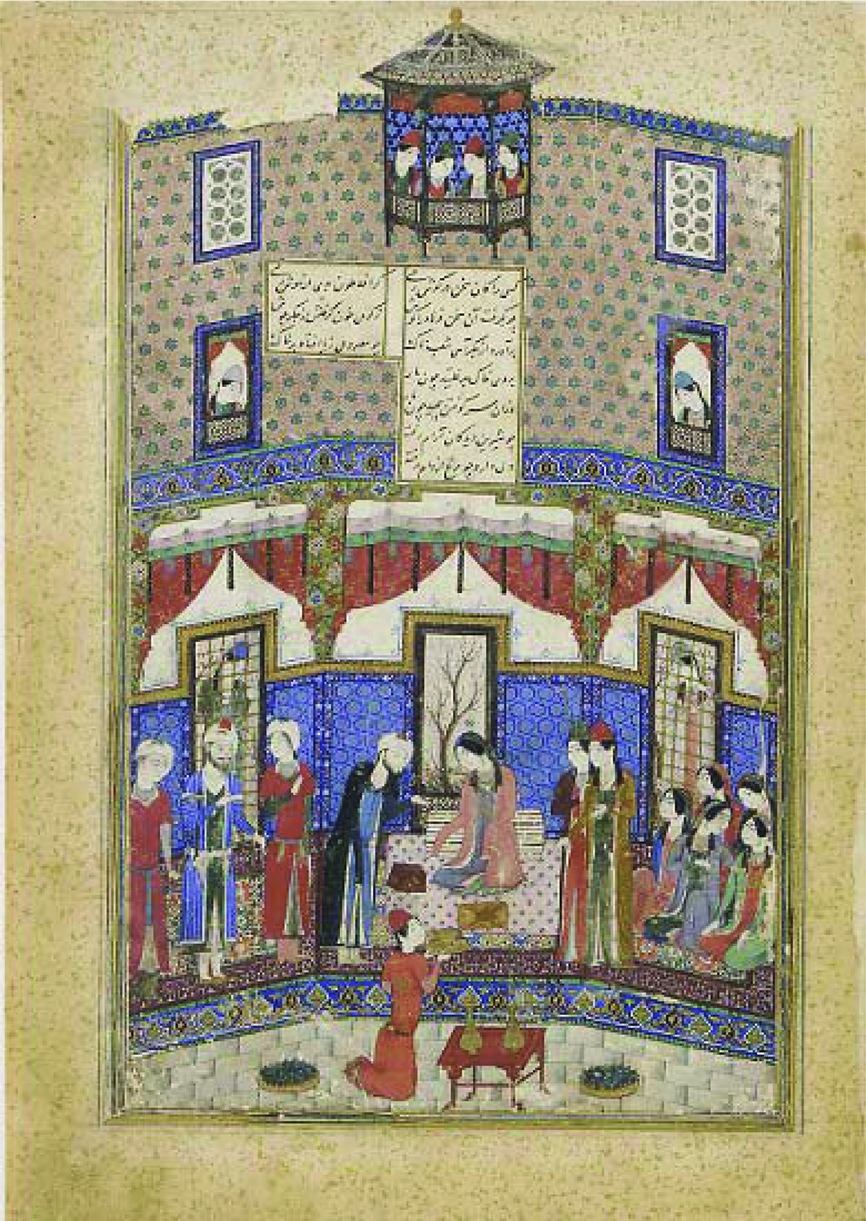
It is also worth noting that the representation of architecture in the Freer Khusraw and Shirin displays a number of similarities with ‘The Monastery’. If ‘The Monastery’ is bolder in its palette and its depiction of fuller, more rounded figures, it shares with F.1931.34 (Farhād before Shīrīn) (Fig. 3) features which structure the space depicted, including a grey stone floor, hexagonal tiled dados in dark blue beneath plaster-work bordered with blue, spandrels decorated with floral motifs, and brickwork laid in a triangular pattern. Several of these elements are also all seen in The Wedding of Humay and Humayun, f.45b of the 1396 Three Masnavīs.Footnote 154 There are also features in ‘The Monastery’ and F.1931.34 which blur the boundaries between the representation of an architectural structure and the decoration of a page even more clearly. In ‘The Monastery’, for example, the panel bearing the phrase mubārak bād, with its white ‘kufic’ inscription set against a background of gold floral motifs on blue, is reminiscent of illuminated headings from manuscripts, whilst as Sims notes, the upper ornamental registers of the building depicted in F.1931.34 “are standard passages of illumination in the repertoire of fine manuscripts”.Footnote 155 In short, while the two paintings differ greatly in their genre, they both draw on shared methods of structuring images and decorating books.
‘Farhād before Shīrīn’. Freer Gallery of Art, Smithsonian Institution, Washington D.C.: Purchase, F.1931.34.

The use of techniques like wash and materials such as silk in the Istanbul corpus, particularly in the ‘Palanquin’ scene, has led some scholars to adopt a model of geographical determinism, which sees the production of these paintings as being dependent on physical proximity to China.Footnote 156 However, Tabriz and its environs, a historically dynamic entrepôt and the former seat of Mongol power in Iran, could have provided the stage for an encounter between artists in the early fifteenth-century and the kinds of European and East Asian materials that are reconfigured in ‘The Monastery’ and the ‘Palanquin’ scene. Clavijo, passing through in 1404 when the area was under the control of the Timurid Abā Bakr, notes that the bazars of Tabriz were full of raw silk.Footnote 157 He further writes that silk was cultivated and harvested on the Caspian coast at Gilān and Shamakha, from where it was brought to nearby Sulṭāniyya and sold to Genoese and Venetian merchants.Footnote 158 Sulṭāniyya was also a starting point for the trade route to Hormuz, from where people and goods travelled to and from China.Footnote 159 The presence of Italian merchants and Dominican communities in the Tabriz area may also offer one model for the transfer of European visual sources.
This movement of people and goods across Eurasia is reflected in fourteenth and fifteenth century painting and drawing. Blair, for example, demonstrates that English Apocalypse manuscripts and Chinese wood-block printed scrolls may have been used as sources by Ilkhanid artists in Tabriz.Footnote 160 As Roxburgh notes, single-page images on paper or silk, “modelled after Chinese prototypes”, began to be produced in the early fifteenth century,Footnote 161 This deliberate fusion of styles continued during the second half of the fifteenth century, when artists such as Shaykhī (c. 1450–1500), active at the Aqqoyunlu court of Tabriz, continued to engage with foreign source material.Footnote 162 The “hybridity” that Roxburgh identifies with the work of Shaykhī,Footnote 163 a stylistic comparison with whose works is the basis for his dating of ‘The Monastery’ to c.1470-90,Footnote 164 is perhaps therefore best understood instead as an enduring aspect of fourteenth and fifteenth-century painting and drawing.
It should also be noted that a number of Shaykhī’s works respond to an accumulated corpus of paintings and drawings to which he and his fellow artists fell heir.Footnote 165 For example, Roxburgh demonstrates that a drawing and a single-page painting by Shaykhī refine elements from drawings dating from the late fourteenth century to the early fifteenth, depicting groups of dervishes.Footnote 166 Indeed, as Adamova shows, the repetition and reworking of compositions, often at a distance of decades, appear to have been integral to artistic practice throughout the fifteenth century.Footnote 167 Thus although the material in the album in which ‘The Monastery’ is preserved, H.2153, appears to have been collected under Shaykhī’s patron, Yaʿqūb Beg, and although H.2153 contains paintings ascribed to Shaykhī that respond to elements from the group of images that includes ‘The Monastery’,Footnote 168 these two facts do not constitute direct evidence that ‘The Monastery’ was produced in Shaykhī’s circle, only that he had access to the corpus, since H.2153 and the closely related album H.2160 also preserve painting and calligraphy securely dated back to the fourteenth century, and even to the thirteenth.Footnote 169
Formal considerations aside, an attribution of ‘The Monastery’ to the patronage of Yaʿqūb ignores his antipathy to millenarian movements that contested his own claims to political and religious authority. This antipathy can be seen in the historical facts of Yaʿqūb's attempts to exert control over the Mushaʿshaʿ and the Safavid order, and also in textual representations.Footnote 170 For example, Yaʿqūb's court historian, Khunjī-Iṣfahānī, describes the followers of Shaykh Ḥaydar, the Safavid, and their belief in their leaders as incarnations of the imams, in the following manner: “The fools of Rūm, who are a crowd of error and a host of devilish imagination, struck the bell of the inane claim of the Christians on the roof of the monastery of the world and, like that nation gone astray, exposed their (own) trinity (thālith-i thalātha) to exemplary punishment in the nethermost hell”.Footnote 171 It is difficult to conceive of how such a damming textual representation of Christianity and millenarianism, and ‘The Monastery’, could both be the products of Yaʿqūb's patronage.
Conclusion
‘The Monastery’ and the ‘Palanquin’ scene respond to elements from several genres. The formulae found on ‘The Monastery’ suggest that it is celebratory, and this sense is only reinforced by the presence of a chronogram which marks it out as a commemorative piece. Using elements of a ‘foreign’ iconographic palette, the painting visually and verbally responds to tropes of lyric, panegyric and didactic poetry to celebrate the unorthodox authority of a ruler who was a child. I suggest that the child represented in the painting is the Qaraqoyunlu sultan Pīr Budaq (d. 816/1413). In addition, I suggest that the ‘Palanquin’ scene establishes a correspondence between the family of Pīr Budaq and its Solomonic counterpart of history and myth. Both ‘The Monastery’ and the ‘Palanquin’ scene therefore mould formal elements from a number of genres, in order to praise a dedicatee, and to fashion an image that the dedicatee's legitimacy was connected to a millenarian conception of the prophets Jesus and Solomon.
The date given in the chronogram of ‘The Monastery’, 810/1407-8, places the painting at a time of ideological ferment in Iran, when Timur's death had renewed questions of what political authority was and who its bearers were. The continuities between ‘The Monastery’, the palanquin scene, and images employed in contemporary Ḥurūfī poetic works, suggest that the paintings’ exploration of the processes of image-making can be divorced only with difficulty from their experimentation with ideas about how society is organised and governed. In short, ‘The Monastery’ raises questions concerning the interwoven relationships between court circles, artists, and intellectual movements, in the creation of art during the early fifteenth century.