Introduction
One of the central questions of second language (L2) research is why second language users produce utterances that differ, often in systematic ways, from the input to which they are exposed; what forces shape the patterns of L2 production and development, what underlying representations they develop, and whether these converge on the kinds of representations that native speakers have. L2 production of English articles has been, in this respect, the subject of particularly close scrutiny (see e.g. the collection of articles in García Mayo & Hawkins, Reference García Mayo and Hawkins2009).
Two main factors found by previous research to influence L2 article production are first language (L1) background and L2 users’ overall L2 proficiency (which could be taken as a proxy for the amount of L2 experience). Thus, L2 users from L1 backgrounds without articles are consistently shown to experience more problems in L2 article production than their peers from L1 backgrounds with articles, but all learners are shown to improve in their article production with their overall L2 proficiency (see Hakuta, Reference Hakuta1976; Huebner, Reference Huebner1983; Ionin, Ko & Wexler, Reference Ionin, Ko and Wexler2004; Jarvis, Reference Jarvis2002; Luk & Shirai, Reference Luk and Shirai2009; Master, Reference Master1990; Ringbom, Reference Ringbom1987; Tarone, Reference Tarone1985; Thomas, Reference Thomas1989; Trenkic, Reference Trenkic2008, inter alia).
While L1 background has been established as one of the main factors shaping L2 article production and development, a more debatable issue is the extent and persistence of this influence. While some studies suggest that a full recovery from L1 transfer is possible, other studies show that even highly proficient learners from L1 backgrounds without articles show some subtle but persistent patterns of variability which are not normally found in the production of L2 users from L1 backgrounds with articles.Footnote 1
The current paper takes as its starting point three such patterns observed in previous research which might have a common cause. The observation is that second language learners omit articles more often in reference to entities that are more salient in memory than to those that are less salient: specifically, more with referents in topic than in non-topic positions (e.g. Huebner, Reference Huebner1983), more with subsequent than with first-mention referents (e.g. Trenkic, Reference Trenkic, Foster-Cohen, Ruthenberg and Poschen2002), more with evoked than with inferable referents (e.g. Sharma, Reference Sharma2005).
The standard explanation of this phenomenon in the literature invokes the pragmatic notions of clarity of discourse reference and the redundancy of definiteness marking. The explicit marking of definiteness is argued to be more redundant in contexts where referents are salient (e.g. topic, second mention, evoked).
However, both the salience effect itself, and the suggestion that it is the pragmatic notion of redundancy that explains the effect can be questioned. First, the salience of a referent is a transient state (see the next section), yet the patterns observed so far come from offline data only. Second, linguistic research suggests that articles are pragmatically redundant in most contexts (Hawkins, Reference Hawkins2004), in which case the explanation which rests on the assumption that definiteness marking is more redundant in some contexts than in others becomes problematic.
The aim of the present research was therefore twofold: first, to investigate whether the salience effect is real, i.e. whether it could be replicated in a task that directly manipulates referent salience in real time; second, using the same task, the hypothesis that the pragmatic notion of redundancy is the explaining factor for the effect was also tested. The results of our study suggest that the salience effect is indeed real, but that it cannot be explained by discourse-pragmatic factors alone. We discuss an alternative explanation, resting on the assumption that the limitations of working memory resources in reference production, coupled with a persisting L1 influence, shape the observed patterns.
Referent salience and attention
A stimulus or input is said to be salient when it stands out from the context in which it is embedded. Salience is thus a property of a stimulus that engages attention in an automatic, bottom–up way (see Styles, Reference Styles1997). An often invoked example in the domain of visual perception is a red berry against a backdrop of green foliage. When someone sees a bush with a red berry in it, their attention is automatically and involuntarily drawn to the berry.
In the domain of discourse reference, the term salient is sometimes applied to linguistic means by which referents are coded (compare “more salient coding” in Givón, Reference Givón1989, p. 218), but more often it is used to refer to the accessibility of referential representations in memory/discourse model (see Ariel, Reference Ariel1990). Note that the two stand in a close but inverse relationship: highly salient discourse referents map onto low-salience linguistic expressions, and vice versa; linguistically salient structures go with low-salience discourse referents. This is illustrated in example (1):
(1) a. I saw your sisteryesterday.
b. She was cheerful and Ø looked great.
In sentence (1a), the phonologically salient and semantically complete noun phrase your sister is used to refer to an entity that was not, until that moment, salient in the discourse model (new information). Like the red berry, it perceptually stands out from the context in which it is embedded and draws the audience's attention to itself. By doing so, it serves to promote the referent's salience in memory: at the point at which sentence (1b) is being formulated, this referent stands out, relative to other referents, in the context in which it is embedded (i.e. a discourse model). Being now salient and in the focus of attention, it can be easily accessed and is coded by less salient linguistic means (e.g. expressions of a lower semantic content such as pronouns or the zero anaphora, with less phonological prominence). This paper is primarily concerned with the memory salience of discourse referents, or referent salience for short.
Referent salience is related to attention and the accessibility of referents in memory at the moment of utterance formulation. Yet, while the focus of attention is a binary concept (something is either in the focus or it is not), referent salience has to be seen as a cline: there can be any number of referents in a discourse context, and they can be ranked by their relative salience (see Gordon, Grosz & Gilliom, Reference Gordon, Grosz and Gilliom1993). Referent salience is thus a matter of degree, and in many ways similar to what is known in the literature as the referent's level of activation (Lambrecht, Reference Lambrecht1994), its accessibility/predictability (Ariel, Reference Ariel1990; Givón, Reference Givón1989), its cognitive status (Gundel, Hedberg & Zacharski, Reference Gundel, Hedberg and Zacharski1993), its giveness (Chafe, Reference Chafe and Li1976) or assumed discourse familiarity (Prince, Reference Prince and Cole1981). Furthermore, as discourse models are fast-changing dynamic systems, referent salience is essentially a transient state: relatively inconspicuous referents may quickly gain prominence to become the most salient ones, while the previously salient referents fade away. As attention can shift up to 6 times within a second (Tomlin, Reference Tomlin, Nuyts and Pederson1997), it is paramount that the effects of salience are investigated using online tasks and measures.
Referent salience and definite descriptions
As illustrated by example (1), referent salience is closely implicated in the choice of referential expressions; referential forms are seen as a marker of the referent's memory accessibility. It is often stated in the literature that less complex and semantically specified referential expressions such as pronouns and zero anaphora are typically used when a referent is highly salient in memory, and semantically more specified expressions, such as definite descriptions are typically used when the referent is less salient.
But reference salience manifests itself not only in the choice of referential expressions, but also in the choice of grammatical roles (attended/salient referents often serve as topics and occupy subject position, see Fillmore, Reference Fillmore and Cole1977; Lambrecht, Reference Lambrecht1994), and word order (more salient precedes less salient) (for a thorough account of how referent salience serves as the most important cognitive determinant of information packaging, see Chiarcos, Reference Chiarcos, Chiarcos, Claus and Garbsky2011). Therefore some variation in the degree of salience exists even for referents encoded by the same linguistic form. For example, a referent encoded by a definite description serving as a topic of an utterance can be assumed to be more salient than a referent also encoded by a definite description but appearing in a non-topic position: in (2), the topic referent the cat might be expected to be more highly active/salient than the non-topic referent the car.
(2) The cat is hiding under the car.
Similarly, first-mention definite referents that introduce new entities into discourse have no (or little) prior activation/salience in the discourse model. The referent of the definite description the author in (3) can be assumed to be only very weakly activated (if at all) through the previous mention of a book (books have authors). In contrast, subsequent-mention definite referents, like the author in (4), refer back to referents that have already been textually evoked, and as such could be assumed to have a higher degree of activation/salience in the discourse model than when they have to be inferred through a related concept.
(3) I read an interesting book last week. The author was French.
(4) I interviewed an author and an actor last week. The author was French.
This is why second-mention (evoked) definite referents could be seen as more salient in memory than first-mention (inferred) definite referents, all other things being equal.
Referent salience and L2 article omissions
Previous research on L2 article use never explicitly considered the role of referent salience on article omissions. Yet some patterns reported in the literature could be said to suggest that articles tend to be omitted more often when reference is to more than less salient referents in memory.
A manifestation of this pattern can be observed in higher levels of article omissions in topic than in non-topic positions. This asymmetry was observed in a number of studies, on different tasks, and with various learner populations (e.g. naturalistic production of a Hmong learner of English in Huebner, Reference Huebner1983; written narratives of Finnish learners of English in Jarvis, Reference Jarvis2002; written translation by Serbian learners of English in Trenkic, Reference Trenkic, Foster-Cohen, Ruthenberg and Poschen2002; oral retelling of a picture-based story by Serbian learners of English in Avery & Radišić, Reference Avery and Radišić2007).
Another pattern observed in the literature is that the more times an L2 speaker has referred to a particular referent, the more likely the article is to be dropped on the subsequent mention of that referent. A study by Trenkic (Reference Trenkic, Foster-Cohen, Ruthenberg and Poschen2002) found that on a written translation task, a group of intermediate Serbian learners of English omitted articles more often with referents on their second or subsequent mention (referents previously introduced as either definite or indefinite, hence likely to be salient in memory), than with first-mention definite referents (referents first introduced into the discourse as definite, hence likely to be less salient in memory). Avery and Radišić (Reference Avery and Radišić2007), also exploring L2 article use by Serbian learners of English, provide the following illustrative example, elicited on an oral story retelling task:
(5) “but in the middle of the wallet there is a lottery ticket . . . he took the lottery ticket . . . He took the money and the lottery ticket . . . he checked the lottery ticket . . . to give back lottery ticket . . . the original owner of lottery ticket . . . he took money and lottery ticket”
What we observe here is that the speaker introduces the referent with an indefinite nominal phrase (a lottery ticket), goes on to refer to it three times using a definite noun phrase (the lottery ticket), and only then starts to refer to it (three more times) with a bare nominal phrase (lottery ticket). This, it could be argued, illustrates the gradedness of the effect: every mention of the referent is likely to be boosting its memory salience in the discourse model; and the more salient in memory the referent is, the more likely the article is to be omitted in reference to it.
Similarly, using Prince's (Reference Prince and Cole1981) scale of assumed familiarity, Sharma (Reference Sharma2005) observes that Indian speakers of English omit definite articles more often with NPs referring to evoked entities (referents recently mentioned or situationally salient) than with NPs referring to inferable entities (e.g. where a sight or a mention of a wedding allows the speaker to talk about the bride without a prior introduction). Again, a referent that is situationally present or has been recently mentioned is likely to be relatively more salient in memory than the one that has to be inferred; in that respect, this pattern shows similarities with the other two described above.
Standard explanation
In all previous studies which have observed the above patterns, which we call here the salience effect, a pragmatics-based explanation was proposed to account for them. For example, Sharma (Reference Sharma2005), who observed higher article omissions with evoked than with inferable referents in L2 English of Indian speakers, suggests that the pragmatic considerations of economy with respect to the clarity of discourse reference explain this pattern. The assumption is that the more salient (i.e. activated, or given) a referent is, the more obviously definite it is perceived to be, and so more pragmatically redundant the explicit marking of definiteness becomes, resulting in more article omissions. Sharma concludes that “clarity of discourse reference and economy are major considerations for [L2 speakers’] decision to use or omit an article” (2005, p. 557) and that this points to a “discourse pragmatic system of article use primarily for the purpose of disambiguation” (2005, p. 558).
Similar ideas are expressed by other researchers who have encountered this pattern. Thus, Robertson (Reference Robertson2000, p. 158) argues that “when the use of the definite article is pragmatically redundant, it is more likely to be omitted”. And Jarvis (Reference Jarvis2002, p. 416) suggests that L2 users may be following a “convention of avoiding (what [they] perceive to be) redundant markers of definiteness and indefiniteness when these properties of an NP are already salient in a given discourse context”.
In sum, all of the above explanations assume that definiteness marking can be said to be more redundant in some contexts (i.e. with highly salient referents in memory) than in others, and that, in deciding whether or not to use an article in a particular context, L2 users are guided by a discourse-pragmatic principle akin to Grice's (Reference Grice, Cole and Morgan1975) maxim of quantity: use a referential form that is sufficiently informative for your purpose, but not more informative than necessary.
Limitations of previous research
The patterns observed in the literature are suggestive of the role that referent salience plays in L2 article use. However, both this observation, and its standard interpretation, could be questioned. As the previous research never explicitly focused on the role of salience, referent salience was never directly manipulated in real time; the salience of a referent is a transient state, but the research so far was based on offline data. Therefore, it remains an empirical question whether the salience effect is real, and whether it could be replicated when referent salience is directly manipulated in an online task.
Further, if the effect is real, the question is whether the (perceived) redundancy of definiteness marking with salient referents is really the explanatory factor. While intuitively appealing, this explanation conceals a number of problems. For one, it is not clear how one could reliably measure article redundancy/clarity of reference: when is an article (communicatively) redundant and when not? When can its ‘value’ not be (easily) recovered from the context? In fact, the central assumption that definiteness marking is more redundant in some contexts than in others has been questioned, as research suggests that in communicative terms, the explicit marking of definiteness is nearly always pragmatically redundant (see Brown, Reference Brown1973; Hawkins, Reference Hawkins2004; see Trenkic, Reference Trenkic, García Mayo and Hawkins2009, for a detailed discussion).
The aim of the present study was, therefore, to investigate whether the salience effect is real, using an online task designed to manipulate referent salience in a controlled and systematic way. The clarity of discourse reference/the redundancy of definiteness marking, which had been proposed as the explanatory factor for the previously observed patterns, was kept constant, however: if the salience effect was still observed, this would suggest that the standard pragmatic explanation of this phenomenon needs to be reassessed.
The research questions (RQs) of the present study were, thus, as follows:
RQ1. Is the salience effect real? Do L2 users omit articles more often in reference to more than to less salient referents in a task that systematically manipulates referent salience in real time?
RQ2. Do all L2 users omit more articles in reference to more than to less salient referents? Specifically:
(a) Is the salience effect affected by whether L2 users’ L1 has a system of articles or not?
(b) Does the salience effect persist or disappear with increased L2 proficiency?
RQ3. Is the redundancy of definiteness marking the main cause of article omissions? Can the salience effect be observed when referent salience is manipulated but the clarity of discourse reference/article redundancy is kept constant?
Method
Participants
The participants in this study were L1 Thai and L1 French learners of L2 English.Footnote 2 These two learner populations were chosen on the grounds that Thai has no article system, whereas French has an article system in many ways similar to that in English. Previous research suggests not only that L2 users from L1 backgrounds without articles experience more problems with L2 article use than those from L1 backgrounds that have articles, but the patterns of article omissions suggestive of the salience effect have so far been reported for the former population only. Including both populations and comparing their production allowed us to investigate whether the salience effect is present in L2 learners irrespective of whether their L1 has an article system or not.
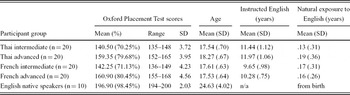
Each learner population consisted of 40 participants, of which 20 were intermediate learners and 20 advanced, as determined by the Oxford Placement Test (OPT) (Allan, Reference Allan2004). The two levels were used in order to explore whether the salience effect, if present, changes with L2 proficiency. Ten native speakers of English acted as a control group.
The L2 populations (Thai and French) were recruited and tested in Thailand. The French participants were temporarily resident in Thailand and were secondary school students (equivalent to A-levels students in the UK) and first year university students in English-medium international schools and university programmes. The Thai participants came from the same schools and university programmes. Both L2 populations thus spoke mainly English in school and their respective native languages at home. They were matched for age and proficiency, and had similar histories of learning English. The participants’ Oxford Placement Test scores, their age and L2 experience are summarised in Table 1.Footnote 3 The L1 English group was recruited and tested at a UK university. All the participants were paid for participating in the experiment.
Participants’ English proficiency, L2 history and age.

Materials and design
The salience of a referent in memory is a dynamic and transient property. In order to study its effects on article production, we needed a salience-promoting device that would maximise the probability that participants’ attention is focused on the target referent, at precisely the point of utterance formulation. Reliably manipulating participants’ attention using linguistic salience-promoting means has some inherent problems; a target referent could be primed in the clause preceding it, but as clauses unfold over thousands of milliseconds, they are temporally too coarse units to study attention shifts (Tomlin, Reference Tomlin, Nuyts and Pederson1997). For this reason, visual dynamic events were used, in which the target referent was cued visually.
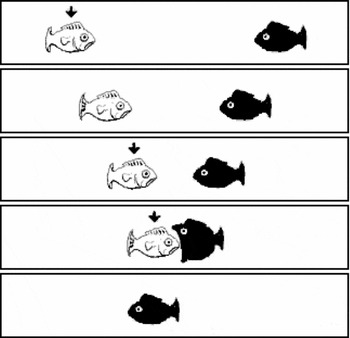
A short animated film developed by Tomlin (Reference Tomlin, Downing and Noonan1995) (freely downloadable from http://logos.uoregon.edu/tomlin/research_fishfilm.html) was employed to elicit oral production. The film consists of a set of 32 sequences of dynamic events. In each sequence, two fish of different colours swim to each other. When they approach one another, one of the fish opens its mouth wide (“the agent”) and swallows the other fish (“the patient”), and then swims away. In each trial, one of the fish is visually cued by a flashing arrow above it in order to attract attention to it (hence, salient stimulus). In half of the trials the agent fish is cued, and in the other half the patient fish is cued. The direction of the agent (coming from the left or from the right) is counterbalanced. The colour of the fish in each sequence is assigned randomly, and the order of events is random overall. Stills from the film in Figure 1 illustrate the action.
Stills from a FishFilm trial.

Participants watch and describe the events as they witness them. In order to isolate the phenomenon under investigation, the experimental task is necessarily constrained, but its nature resembles world-situated language use; people often talk about events that they witness, and while they do so, visual cues such as pointing, or some event parameters (e.g. referents’ animacy, agentivity, size, colour, etc.) compete for their attention.
The point at which participants know what the outcome of an event will be, and can thus start planning their utterance, is the moment at which the agent fish opens its mouth to swallow the patient fish. The final visual cue appears some 330 ms before the swallowing event begins and remains on screen until the event is completed.Footnote 4 As it takes around 200 ms to initiate a saccadic eye-movement (Matin, Shao & Boff, Reference Matin, Shao and Boff1993), the timing of the final cue maximises the probability that participants will look at the target referent at the point of utterance formulation: if the flashing arrow has successfully focused one's attention to the target referent, then this is where their attention is most likely to be when utterance formulation begins.
Originally, these materials were designed by Tomlin to examine the mapping of conceptual representations of visual events into language. That research suggests that the referent which has been focused on at the moment of utterance formulation is mapped onto syntactic subject, with the effect that participants tend to produce active voice sentences when the agent is cued (The black fish has eaten the white fish) and passive voice sentences when the patient is cued (The white fish has been eaten by the black fish) (Tomlin, Reference Tomlin, Downing and Noonan1995, Reference Tomlin, Nuyts and Pederson1997). This suggests that the cued/salient/attended referent normally serves as a point of departure in describing an event.
For the purpose of the present experiment, the most important aspect from the previous studies is the finding that this procedure reliably manipulates participants’ attention at the point of utterance formulation, by making one referent visually more salient than the other.
Predictions
We expected to replicate the results from the literature regarding the assignment of syntactic subject. In trials where the agent was cued, it was expected that the agent would be predominantly assigned the position of syntactic subject, resulting in active voice sentences. In trials where the patient was cued, it was expected that the patient would be predominantly assigned the position of syntactic subject, resulting in passive voice sentences.
Crucially for the present study, we reasoned that if the salience effect was real, one would expect participants to omit articles more with attended/salient referents. More precisely, they would be expected to omit more articles in reference to the agent fish than to the patient fish when the agent fish is the focus of attention (i.e. in active sentences). Similarly, more article omissions are expected in reference to the patient than to the agent fish when the patient was cued (i.e. in passive sentences). In other words, proportionately more article omissions were expected with cued/more salient than with non-cued/less salient referents, all other things being equal.
Procedure
The Oxford Placement Test and the language background questionnaire were administered prior to the main experiment. In the main experiment, the participants were tested individually. The participants were told that they would see an animated film showing a continuous set of events, in all of which two fish of different colours swim to each other, and then one of the fish eats the other fish. They were instructed to describe each event in the film as soon as they were sure that they knew what had happened (who had eaten whom). They were asked to keep up with ongoing events (there were no pauses between film sequences) as well as they could.
Each participant was seated in front of a laptop computer which played a silent version of the FishFilm. Before the recording started, each participant was given one practice trial to make sure they had understood the instructions.
The participants’ production was recorded using a Sony TCM-400DV tape recorder. A prior consent was obtained from all participants.
Scoring and analysis
The first step in the analysis was to determine whether the salience manipulation (i.e. visual cueing) worked reliably. As the previous research has shown that the referent that is more salient at the moment of utterance formulation maps onto subject, the voice of the sentence produced in each trial was taken as an index of whether the manipulation worked: for trials in which the agent was cued and the agent was mapped onto subject (active voice), and those in which the patient was cued and the patient was mapped onto subject (passive voice), the manipulation was assumed to have worked. In trials in which the agent was cued but the patient mapped onto subject (passive voice), or the patient was cued but the agent mapped onto subject (active voice), it was assumed that the manipulation did not work (it was not clear which referent was the most salient to the participant at the point of utterance formulation: the one that was visually cued or the one which was assigned to subject).Footnote 5
Next, the number of article omissions with cued (more salient) and with non-cued (less salient) referents in the agent-cued and in the patient-cued trials was calculated for each participant. The group means were calculated for cued and non-cued referents in each condition (agent-cued, patient-cued). The data were submitted to an arcsine transformation before conducting ANOVAs.
Results
Referent salience and the assignment of syntactic subject
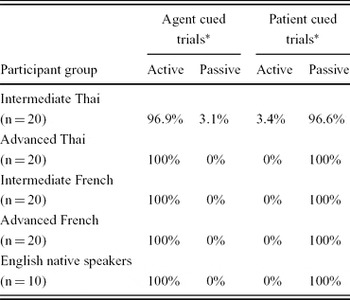
Table 2 summarises the outcome of the manipulation of referent salience on the assignment of grammatical subject (i.e. sentence voice) across groups.
The proportion of active and passive voice sentences produced in agent-cued and in patient-cued trials.

* n = 320 for learner groups; n = 160 for native speaker control group
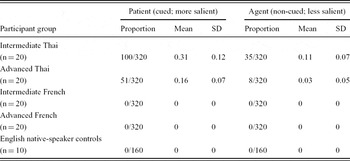
The results clearly replicate the findings of Tomlin (Reference Tomlin, Nuyts and Pederson1997), showing a robust effect of the salience manipulation on subject assignment. In the native speaker control group, the intermediate and advanced French groups, and the advanced Thai group, the participants produced active sentences in all trials in which the agent was cued, and passive sentences in all trials in which the patient was cued. The intermediate Thai group showed some minimal variation: they produced active voice sentences in 96.9% of contexts where the agent was cued and passive voice sentences in 96.6% of contexts where the patient was cued. This means that on a handful of trials (ten on which the agent was cued and eleven on which the patient was cued), the manipulation did not work.Footnote 6 The few exceptions notwithstanding, the results show that the visual manipulation worked reliably to draw participants’ attention to one of the referents, making it more salient at the point of utterance formulation.
Referent salience and article omissions
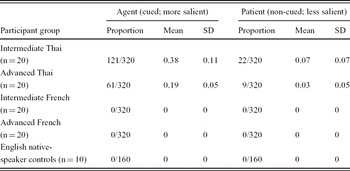
The results of referent salience on English article omissions are presented in Tables 3 and 4.Footnote 7
Article omissions in the agent-cued trials.

Article omissions in the patient-cued trials.

Referent salience had no effect on article production of the English monolinguals or the French groups. The control group of native speakers and the L1 French/L2 English participants (both intermediate and advanced) did not omit any articles in their production, and so no further analysis was done for these groups.
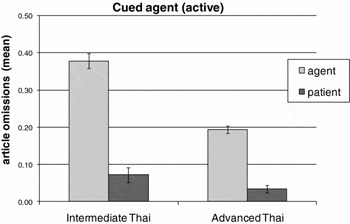
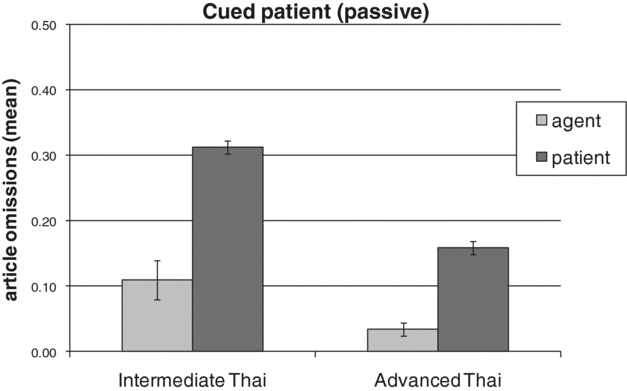
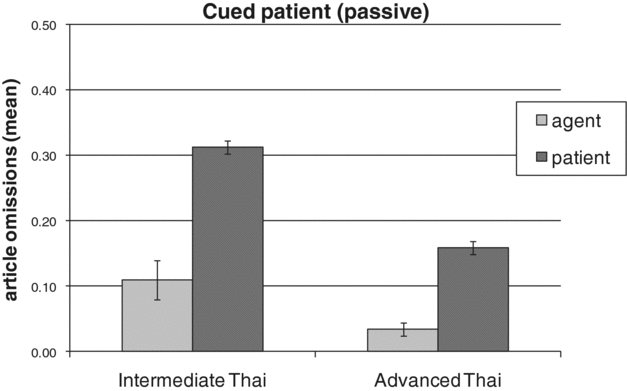
The L1 Thai/L2 English participants, however, omitted articles, showing a pattern consistent with the predictions: when the agent fish was cued, both groups omitted articles more in reference to the agent than to the patient; when the patient fish was cued, both groups omitted articles more in reference to the patient than to the agent.
The distribution of article omissions in the Thai groups is illustrated in Figures 2 and 3. The error bars represent standard error.
Article omissions by Thai participants in the agent-cued trials.

Article omissions by Thai participants in the patient-cued trials.
Two separate mixed design ANOVAs were carried out for the agent-cued and for the patient-cued trials, with the visual cue/salience as the within-subject variable (two levels), and the proficiency as the between-subject variable (two levels).
The mixed design ANOVA for the agent-cued trials showed the main effect of salience (visual cue), F1(1,38) = 733.60, p < .001, r = .98; F2(1,30) = 173.49, p < .001, r = .92. Articles were omitted significantly more with cued (agent) than with non-cued (patient) referents. There was also the main effect of proficiency, F1(1,38) = 24.98, p < .001, r = .63; F2(1,30) = 66.50, p < .001, r = .83, showing that the intermediate learners omitted significantly more articles in their production than the advanced learners. Finally, there was also a significant interaction between salience and proficiency in the subject analysis F1(1,38) = 72.99, p < .001, r = .81; F2(1,30) = 3.18, p > .05 . The interaction seems to come about because the level of article omissions with non-cued (patient) referents is approaching floor level for both groups (7.1% for the intermediate and 3.4% for the advance learners), whereas the rate of article omissions with cued (agent) referents is much higher for the intermediate learners (37.8%) than for the advanced learners (19.1%).
T-tests were used to determine whether the rate of article omission was different between more salient (cued; agent) and less salient (non-cued; patient) referents at each proficiency level. The alpha level was set at .025 (Bonferroni correction for repeated comparisons, .05 divided by 2) to avoid inflating the Type I error rate. The results show that, on average, the intermediate learners omitted more articles with salient referents (M = .38, SE = .02) than with non-salient referents (M = .07, SE = .02), and the difference was statistically significant t1(19) = 22.64, p < .001, r = .98; t2(15) = 12.97, p < .001, r = .96. Similarly, the advanced learners also omitted more articles with salient referents (M = .19, SE = .01) than with non salient referents (M = .03, SE = .01), and the difference was again statistically significant, t1(19) = 15.02, p < .001, r = .96; t2(15) = 6.97, p < .001, r = .87.
The mixed design ANOVA for the patient-cued trials also showed the main effect of salience, F1(1,38) = 138.27, p < .001, r = 0.86; F2(1,30) = 128.03, p < .001, r = .90. Articles were omitted significantly more with cued (patient) than with non-cued (agent) referents. As with agent-cued trials, there was again the main effect of proficiency, F1(1,38) = 30.22, p < 0.01, r = 0.67; F2(1,38) = 64.43, p < .001, r = .83, showing that the intermediate learners omitted significantly more articles in their production than the advanced learners. And as before, there was also a significant interaction between salience and proficiency in the subject analysis F1(1,38) = 7.8, p < .01, r = .41; F2(1,30) = .07, p > .05. Here, as well, the interaction seems to come about because the level of article omissions with non-cued (patient) referents is very low for both groups (10.9% for the intermediate and 3.4% for the advanced learners), whereas the rate of article omissions with cued (agent) referents is much higher for the intermediate learners (31.3%) than for the advanced learners (15.9%).
To determine whether the rate of article omission was different between more salient (cued; patient) and less salient (non-cued; agent) referents in patient-cued trials at each proficiency level, t-tests were administered with a Bonferroni correction for repeated comparisons (the alpha level set at .025). On average, the intermediate learners omitted more articles with salient referents (M = .31, SE = .03) than with non-salient referents (M = .11, SE = .01), and the difference was statistically significant t1(19) = 8.64, p < .001, r = .89; t2(15) = 0.39, p < .001, r = .92. Similarly, the advanced learners also omitted more articles with salient referents (M = .16, SE = .01) than with non salient referents (M = .03, SE = .01), and the difference was again statistically significant, t1(19) = 8.31, p < .001, r = .89; t2(15) = 7.60, p < .001, r = .85.
In sum, the results answered our research questions in the following way:
RQ1. Is the salience effect real? Do L2 users omit articles more often in reference to more than to less salient referents in a task that systematically manipulates referent salience in real time?
The answer to this question is “yes”: the salience effect was observed in a task that systematically manipulated referent salience in real time, in that L1 Thai/L2 English speakers in our experiment omitted articles more often in reference to more than to less salient referents.
RQ2. Do all L2 users omit more articles in reference to more than to less salient referents? Specifically:
(a) Is the salience effect affected by whether L2 users’ L1 has a system of articles or not?
(b) Does the salience effect persist or disappear with increased L2 proficiency?
In answer to (a), the results were clearly affected by the L2 users’ L1 background: the salience effect was observed only in the production of learners whose L1 does not have articles (L1 Thai) but not in the production of learners whose L1 has an article system (L1 French). In answer to (b), the salience effect did not disappear in the production of advanced L1 Thai/L2 English speakers. While the advanced group made fewer omissions than the intermediate group in all contexts, they still made significantly more omissions with salient than with less salient referents.
RQ3. Is the redundancy of definiteness marking the main cause of article omissions? Can the salience effect be observed when referent salience is manipulated but the clarity of discourse reference/article redundancy is kept constant?
The salience effect was observed in our experiment, even though the clarity of discourse reference was kept constant: both referents were visually present, and definiteness marking was communicatively redundant with both, in the sense that they could both be successfully and uniquely identified through bare nominal forms (black fish and white fish).
Discussion
Summary of findings
The results of our study show that L1 Thai/L2 English speakers omit articles more often with more salient (cued) than with less salient (not cued) referents. This pattern was found with both intermediate and advanced learners, despite the overall improvement in the advance learners’ production. The same pattern was not observed with either of the French groups, nor with the native speaker controls. The results thus suggest that the previously observed salience effect is real, but only for L2 users from L1 backgrounds without articles, and not for L2 users from L1 backgrounds with articles (or for native speakers of a language with articles). In this section we look into how these results could be explained.
Inadequacy of the discourse-pragmatic explanation
The standard explanation in the literature, as discussed earlier, assumes that L2 users decide whether to use or omit an article on the basis of a discourse-pragmatic principle akin to Grice's (Reference Grice, Cole and Morgan1975) maxim of quantity: use a referential form that is sufficiently informative for your purpose (i.e. to make discourse reference clear), but not more informative than necessary. In short: if a simpler form will do (i.e. NP), do not use a more complex one (i.e. the NP).
We accept that this principle is a powerful force in the overall dynamics of L2 article use (see below). However, we also note that this explanation falls short of accounting for several aspects of the results of the present experiment. First, on its own, it is not clear why a discourse-pragmatic principle should only play a role in L1 Thai/L2 English speakers’ production, but not in L1 French/L2 English speakers’ production, or in the production of native speakers. There is nothing particularly language- or L2-specific about the Gricean maxim of quantity; indeed, it is supposed to be universally available and applicable (though see Keenan, Reference Keenan1976). As we have seen earlier, in English native speaker production, this principle is readily observed in the distribution of pronouns vs. definite descriptions: less complex and semantically specified referential expressions, like pronouns, are typically used when a referent is highly salient in memory; semantically more specified expressions, such as definite noun phrases, are used when a referent is less salient (see Ariel, Reference Ariel1990). Yet, native speakers of English and L1 French/L2 English speakers do not extend this discourse convention to “do not use the NP when NP would do”. The reason this does not happen is because the grammar of English and French does not allow bare nominals in reference to countable concepts. The grammar of Thai does, however. If one allows for L1 transfer effects, the discourse-pragmatic explanation could in principle account for the higher rate of article omissions by L1 Thai/L2 English than L1 French/L2 English speakers, at a single point of development.Footnote 8
The second challenge, however, is to explain what accounts for the development in production. Advanced L1 Thai/L2 English speakers make fewer article omissions than intermediate learners overall, but the salience effect is still present in their production. On the standard explanation, the latter would suggest that, like the intermediate group, they still operate with “do not use the NP when NP would do”. But what drives them then to use the article in an ever increasing number of contexts? Why are bare NPs not sufficiently informative anymore in some of the contexts in which they used to be at the intermediate level?
Finally, and most importantly, in the present experiment the issue of clarity of discourse reference was effectively removed: the forms black fish/white fish were sufficiently informative for reference resolution in the given context (i.e. the visual display). Thus, on purely communicative grounds, the was redundant in reference to either fish, and an equal rate of omissions (or indeed, across-the-board omissions) should have been expected. As the results show, this was not the case.
Variable production by L1 Thai/L2 English speakers
Given the results of the present study, it seems clear that the discourse-pragmatic principle “do not use the NP when NP would do” on its own cannot explain why it is that L1 Thai/L2 English speakers show a greater variability in their article production compared to proficiency-matched L1 French/L2 English speakers, why advanced L1 Thai/L2 English speakers supply articles in an ever increasing number of contexts while still omitting articles more often in reference to more than to less salient referents, or indeed, why articles were supplied at all. As already suggested, it seems inevitable that in order to explain the full set of results, grammatical differences between Thai, French and English must first be taken into account.
As an article-less language, Thai allows bare nominals in reference to countable concepts. French and English, however, do not; the grammars of French and English demand that countable concepts be expressed through the Det + NP form. As an illustration, Figure 4 shows the mapping between the concept [+definite BLACK FISH] and a full nominal referential form in Thai, French and English, respectively.
The mapping between the concept [+definite BLACK FISH] and full nominal referential forms in Thai, French and English.

Assuming a transfer of available grammatical patterns from the L1 into the L2, it seems reasonable to suggest that L2 learners who come from article-less L1 backgrounds allow bare nominal arguments in the L2. The results of our experiment are consistent with the view that unlike the grammar of L1 English and L1 French/L2 English speakers, the grammar of L1 Thai/L2 English users permits both bare NP and Det + NP structures to refer to countable entities. Thus, for L1 Thai/L2 English speakers, the concept of [+definite BLACK FISH] can map onto the expression the black fish and onto black fish, in both production and comprehension, as represented in Figure 5. For French learners of English, however, the concept [+definite BLACK FISH] only maps onto the black fish in production (clearly, in comprehension black fish can be mapped onto the same concept (i.e. can be understood), but is perceived as grammatically anomalous).
The mapping between the concept [+definite BLACK FISH] and referential forms for L1 French/L2 English and L1 Thai/L2 English speakers.

If L1 Thai/L2 English users allow both bare NP and Det + NP patterns to refer to countable concepts, this means that the two patterns effectively compete for selection.Footnote 9 This competition, in turn, leads to variability in production; sometimes the Det + NP pattern wins, and at other times the bare NP does. The difference in what an L2 user's grammar allows, without any need for pragmatics, thus straightforwardly accounts for the first finding of our experiment (and the pattern often perceived in everyday life and reported in the previous literature): that L2 learners from L1 backgrounds without articles supply articles far less accurately than L2 learners from L1 backgrounds with articles.
Staying with the assumption that there is a parallel activation of the NP and bare NP patterns and that they compete for selection in the production of L1 Thai/L2 English speakers, one of the aspects determining the outcome of that competition will be the level of activation of each alternative (see O'Grady, Reference O'Grady2005; Truscott & Sharwood Smith, Reference Truscott and Sharwood Smith2004). The more active an alternative, the higher the probability that it will be selected. It is at this point that pragmatic principles can make their mark: the (transferred) L1 experience and the pragmatics of rational communication (e.g. the Gricean maxim of quantity) should boost the activation levels of the bare NP pattern. The L2 experience, however, should favour the Det + NP structure in reference to countable concepts. Thus, early on, while L2 experience is still limited, the new L2 patterns should be highly vulnerable to competition from the more established, and hence active, L1 alternatives; the probability of selecting bare NPs will, therefore, be high. With more L2 experience, though, the Det + NP structure is likely to become stronger and more active, and so less vulnerable to competition. This should consequently lead to increasingly more instances in which the Det + NP structure is selected. The gradually increasing activation levels of the L2 patterns can, thus, account for the finding that advanced learners omit fewer articles than intermediate learners.
The salience effect
In summary so far, our basic assumption, based on a large body of psycholinguistic literature, is that both languages in bilinguals are active. We argue that it is the parallel activation and competition between L1-licensed and L2-licensed patterns that leads to variable article production by Thai learners of English; the increasing activation levels of L2 patterns as a result of a more extensive L2 input lead to more cases in which the L2 alternative (the NP) is selected in the production of more advanced learners. Note that we only assume that there is a competition between the two structures every time a reference is attempted; we do not assume that bare NPs map onto more salient and Det + NPs onto less salient referents. The question therefore remains as to why both intermediate and advanced L1 Thai/L2 English speakers omit more articles in reference to more than to less salient referents in memory. The design of our experiment ruled out the pragmatic notion of redundancy/clarity of discourse reference. So what else could be at play?
Much recent research suggests that the consequence of the parallel activation of both languages in bilinguals is that the non-target alternatives need to be suppressed (see e.g. Abutalebi & Green, Reference Abutalebi and Green2007; Green, Reference Green1998; Grosjean, Reference Grosjean and Nicol2001; Hermans et al., Reference Hermans, Bongaerts, Bot and Schreuder1998; Kaushanskaya & Marian, Reference Kaushanskaya and Marian2007). The competition between L1 and L2 patterns and the suppression of unwanted alternatives must happen in real time, and as such it is assumed to place a burden on working memory resources. We follow the widely held assumption that working memory resources are limited (see Baddeley, Reference Baddeley1990; Baddeley & Hitch, Reference Baddeley, Hitch and Bower1974) and that they are domain general (but see Jackendoff (Reference Jackendoff1997) for an alternative modular view). If discourse representations and referential processing draw on the same pool of cognitive resources that are used to inhibit the unwanted language, this, we believe, can explain why L1 Thai/L2 English users omit articles more often with more than with less salient referents.
Salient referents are by definition highly accessible, highly activated referents in memory (Ariel, Reference Ariel1990). Being in the focus of attention means that they take more representational space (i.e. put higher burden on working memory resources) than less salient referents (see Almor, Reference Almor1999, Reference Almor, Pickering, Clifton and Crocker2000, Reference Almor, Trueswell and Tanenhaus2005; Almor & Nair, Reference Almor and Nair2007); in other words, when our attention is drawn to a referent, that referent occupies a larger chunk of our representational resources than a referent that is on the periphery of our attention. Assuming limited and domain-general working memory, it follows that salient referents should leave fewer resources for other processing demands, including the inhibition of L1 alternatives; and when L1 alternatives are not sufficiently suppressed, the probability of them being selected is higher. For L1 Thai/L2 English speakers’ article use, this means that, all other things being equal, there will be fewer working memory resources available for the inhibition of the bare NP pattern in reference to more than to less salient referents. This is why the probability of the bare NP pattern being selected (article omissions) for more salient referents will be higher. Thus, rather than being the consequence of a discourse-pragmatic principle, the salience effect appears better explained by the general architecture and mechanisms for language processing.Footnote 10
This explanation also ties in well with the finding that despite the overall improvement in article suppliance by advanced L1 Thai/L2 English participants, the salience effect persisted in their production: they still omitted articles more often with more than with less salient referents. With improved proficiency and automaticity in production, it is reasonable to assume that more cognitive resources become available to L2 users. As such, there should be fewer instances where working memory is overstretched to the extent that the inhibition of the L1 alternatives in referential production is too costly. This explains why the suppliance of articles in all contexts should increase. But in instances in which the resources do get stretched by other concurrent demands, they will still be depleted more (and the inhibition of the L1 will be weaker) when reference is to a more than to a less salient referent, all other things being equal.
Finally, we want to end with a note that this proposal also accounts well for the data on another common L2 article asymmetry, that of higher omission rates with adjectivally premodified nominals (Det + Adj + N, the black fish) compared to non-modified nouns (Det + N, the fish) (Goad & White, Reference Goad, White, Foster-Cohen, Ota, Sharwood Smith and Sorace2004; Sharma, Reference Sharma2005; Trenkic, Reference Trenkic2007). As a sequence with an extra element, Det + Adj + N requires more processing resources than the simpler Det +N structure, leaving fewer resources available for suppressing the article-less L1 alternative. Consequently, the probability of selecting the article-less alternative in this context is higher, all other things being equal.
What role for pragmatics?
The discourse-pragmatic explanation of the salience effect holds that principles of rational communication, such as the need for clarity of discourse reference, are major motivators for L2 learners to use or omit an article (Sharma, Reference Sharma2005): if article is needed for communicative reasons it is used, if it is perceived as redundant it is dropped. We have shown that this explanation falls short of accounting for the salience effect observed in the present study: the clarity of discourse reference with all referents was kept constant, yet the salience effect was still observed.
However, this does not mean that we dispute the general validity of these principles of rational communication; on the contrary, we even acknowledge their contribution to the dynamics of L2 article use. But instead of seeing pragmatics as determining L2 users’ decision to use or omit an article, the results of our study suggest (in line with the view that articles are communicatively redundant in most contexts) that pragmatics can only be a force that drives article non-suppliance – not the patterns of suppliance.
Limitations and directions for future research
We investigated the effect of referent salience on L2 article omissions through a simple and tightly controlled experiment. The experimental approach was appropriate for our study as it enabled us, for the first time, to control and manipulate the dependent variable of referent salience in a systematic way, and at the right temporal granularity. This increases the reliability of our findings and conclusions. Further research is needed, however, to establish how generalisable the results are to more complex and socially situated discourse contexts.
One further (and possibly unavoidable) limitation of the present research is that in our data salient referents, with few exceptions, appeared as subjects at the beginning of each utterance. This was not unexpected, as reference salience manifests itself not only through the choice of referential expressions, but through the choice of grammatical roles (salient referents are often found in topic/subject position), and through word order: more salient precedes less salient (Chiarcos, Reference Chiarcos, Chiarcos, Claus and Garbsky2011). But it means that our results demonstrate not only the salience effect (articles are omitted more with more salient referents), but the linear position effect as well (articles are more likely to be dropped with referents that are mentioned utterance-initially).Footnote 11 The position effect does not negate the salience effect: after all, the utterance-initial position itself is the consequence of referent salience.Footnote 12 It does, however, raise the possibility that the salience effect may be attested only when referent salience and utterance-initial position converge.
While on the basis of the present research we cannot reject this possibility, some observations from previous research make it less likely. In Trenkic (Reference Trenkic, Foster-Cohen, Ruthenberg and Poschen2002), where higher levels of article omissions were observed with second-mention than with first-mention definite referents, second-mention definite referents were not always in sentence initial positions. Similarly, in the extract from Avery and Radišić (Reference Avery and Radišić2007) cited earlier in (5), the salient referent “lottery ticket” appears six times after being first introduced, in all six cases in a non-initial position. In the first three instances, a definite nominal phrase is used (the lottery ticket), but in the last three, where the referent had more chance to become establish in memory, an article-less nominal phrase appears (lottery ticket). This suggests that the salience effect can be detected even when referent salience and sentence-initial position do not converge. While these data are indicative, a study that manipulates the position and salience in a more systematic way would be welcome to settle the issue.
Finally, the salience effect in our experiment has been attested in only one L1[–art]/L2[+art] pairing. We acknowledge that there are great structural differences among languages that could lead to different patterns of article omissions in different L1/L2 pairings. Here again, further research is needed.
Conclusion
Our study supports the proposal that L2 users from L1 backgrounds without articles omit articles more often in reference to more than to less salient referents. However, the results point against the view that this effect can be accounted for solely in terms of discourse-pragmatic principles. Instead, they seem better explained by grammatical competition between L1 and L2 structures, under the general architecture and mechanisms for language processing.
More generally, the findings suggest that L2 users can acquire new L2 grammatical structures, but at the same time, they may not be able to prevent interference from inappropriate L1 structures on their L2 production. In other words, our findings are consistent with the view that language systems within a bilingual mind cannot be kept fully apart, and that there is an automatic activation of all available forms consistent with expressing a particular idea in any of the bilingual's languages. This makes L2 structures vulnerable to competition from L1 alternatives, and unwanted L1 alternatives need to be suppressed to allow L2 structures to be selected.
The data also contribute to the debate on the extent and persistence of L1 influence on L2 production and development. The results point against the view that a full recovery from L1 transfer is possible. In fact, we want to suggest that both the metaphor of “transfer” and “recovery” may be somewhat misconceived, and that the notions of “competition” and “suppression” may be more helpful in conceptualising the phenomena. The L1 cannot be switched off, therefore one does not recover from L1 transfer; one simply learns to deal with the competition from the L1 more efficiently.