1. INTRODUCTION
1.1 Background and Context
Law librarians work in a very specialized and demanding information domain, and in an environment which has faced cutbacks in recent years. They have to manage the dramatic changes to collections which the introduction of digital materials has brought about, as well as having to deal with the governance issues surrounding the usage of cloud technologies which are increasingly being adopted. Nevertheless, it is the ongoing challenge of providing legal research training, which still remains one of the greatest areas of interest and concern for law librarians. Research lies at the very core of legal work, yet instruction in how to carry it out most effectively still remains to a very large extent, their responsibility. The British and Irish Association of Law Librarians (2012) have made attempts to bring consistency to the provision of legal research training with their Legal Information Literacy Statement, yet there still remain concerns that law graduates are leaving university and entering the profession, with inadequate skills, which needs remedying.
In a recent white paper, LexisNexis (2015), reported that, “95% of hiring partners and associates in a recent survey believe recently graduated law students lack key practical skills at the time of hiring.” Chief amongst these, were advanced research skills suited to a commercial setting:
“86% of respondents overall believe legal research skills are highly important in young associates. 81% believe advanced legal research skills are also highly important and an even higher percentage, 88% reported that proficiency using paid research services is highly important. Considering most young associates spend between 40% and 60% of their time conducting legal research, proficiency in legal research is paramount” (LexisNexis, 2015).
Yet these issues are not new, there were concerns expressed by firms over the poor research skills of trainees even over 20 years ago:
“Law librarians today are in a quandary over legal research training. Firm librarians have long been distressed by the limited and uneven research skills displayed by summer clerks and new associates. Many clerks lack even a basic knowledge of legal research. Most are uncertain how to develop a research strategy and integrate the various media and resources now available. All depend too heavily on on-line resources without fully understanding the associated costs” (Simpock-Vieweg, 1993, p. 35).
At that time, the argument was about whether librarians should even be providing legal research training. Now, it has advanced to how they can deliver it most effectively. Commenting on the LexisNexis survey, Jonjak (Reference Jonjak2015), thinks it presents great opportunities for law librarians, since:
“The role of the law firm librarian, of course, is to cover this exact gap. We conduct multiple orientations with new associates … and during these orientations, it is our explicit goal to show how legal researching is done differently in a law firm environment … This survey defines the importance of librarianship in the law firm setting”.
This dissertation will seek to establish the extent to which a research skills deficit exists, and by means of a literature review, questionnaire and interviews, will attempt to draw together the best examples of legal research training currently being provided, in order to provide practical recommendations for how law librarians can most effectively provide training to meet the legal research needs of their users.
1.2 Aims and objectives
Aims
The aim of the dissertation is to identify the most effective ways in which law librarians can provide training to meet the legal research needs of their users. It plans to draw together the latest research and examples of best practice from both Higher Education and the non-academic sector (law firms, Inns of Court and government departments), in order to arrive at a range of practical recommendations.
Objectives
-
1. To explore what legal research needs are to be addressed by law librarians
-
2. To understand why training is now such an increasingly important role for law librarians
-
3. To examine what training is currently taking place
-
4. To explore what possible alternatives there may be
-
5. To compare the similarities and differences between the way in which academic law librarians and non-academic law librarians deliver training
-
6. To discover if non-academic law librarians feel that trainees are adequately prepared by universities
-
7. To assess how successful the BIALL Legal Information Literacy Statement has been in raising legal research standards among trainees
-
8. To explore whether there could be more cooperation between the two areas of legal law librarianship
1.3 Scope and definition
For the purposes of this study, a law librarian is understood to be a professional working in a dedicated law library; this includes libraries within small law firms, large corporate law firms, Inns of Court, government departments, and universities. It excludes librarians who work in public libraries or academic libraries, which (although they may have law collections), do not specialize in legal materials.
Due to time constraints and the desire to produce a focused piece of work, it was decided to narrow the scope of law library ‘users’ to academic (university students); and vocational (trainees and pupils), law students. Training provided to refresh the legal research skills of lawyers, did not come under the scope of this piece of research.
Although the research was investigating the provision of training, which has universal applicability, the decision was taken to narrow the scope to those law librarians working within England and Wales. This was done for a number of reasons. Firstly, out of pragmatic considerations; as a short term study, the research had to be feasible. As a member of the British and Irish Association of Law Librarians (BIALL) and the Chartered Institute of Legal and Information Professionals Information Literacy Group (CILIPILG), the researcher had access to mailing lists which would facilitate the transmission of questionnaires; any widening of scope would have made data collection more difficult. Secondly, although pedagogical styles and techniques are universally applicable, the different legal systems and jurisdictions which exist, means that law librarians in different countries are handling different resources from one another. For this reason, it was decided to limit the research to just England and Wales, since they both share the same legal system. This narrowed focus should therefore enable the fulfilment of the aim of this study which is to arrive at some practical recommendations.
It was decided, however, that the literature review should have a slightly broader scope, to include recent research from other countries which also practice Common Law (sixteen jurisdictions, including the USA, Canada, Australia, New Zealand, Scotland, Northern Ireland, Republic of Ireland, and South Africa), in order to draw upon the best practice taking place elsewhere.
Any investigation into the provision of legal research instruction must address the question of information literacy; however, the decision was made to narrow the focus down to one particular aspect of legal information literacy (legal research) rather than examining it as a whole. Therefore, questions such as ‘how can law librarians best train their users in the differences between copyright in an academic and a commercial environment?’, fell beyond the remit of this study, as did the broader debates about the nature of information literacy.
Broader issues of legal education (Legal Education and Training Group, 2013), were not considered by this study because of the focus on the role of librarian as trainer, rather than examining how law lecturers provide instruction.
2. LITERATURE REVIEW
In order to place the research into context, and provide an informed starting point, a thorough review of related literature in the law librarianship, legal information and legal information literacy fields was undertaken. Given the centrality of legal research in the role of the law librarian and the crucial part they play in instructing students, trainees and lawyers in how to conduct it effectively, it is no surprise that there has been considerable discussion on this topic within the literature. As explained in greater depth in the methodology, it was necessary therefore, to establish at the very outset, clear parameters of the scope of the literature review. A focus was placed on contemporaneity within the literature, since discussions about legal research instruction in the pre-digital age are no longer as useful as they once were. The aim of the study is to create a practical set of recommendations for how best to develop a training programme for the delivery of legal research skills. To do this, it would be necessary to draw upon the best practice from within both academic and commercial law libraries, as well as considering how the process is undertaken internationally. The literature can be categorised as having four main foci, which together, greatly informed and impacted the current research.
2.1 Legal Information Literacy
The starting point for this study was the centrality of legal research in the role of the law librarian (British and Irish Association of Law Librarians, 2012; Corrall and O'Brien, Reference Corrall and O'Brien2011), and the way in which training in these skills is becoming an increasingly important part of the job. “Legal research is a mainstay of legal practice … Law librarians are the experts on legal research at their institutions, and they are the primary source of legal research instruction” (Desai, Reference Desai2014, p. 84). The provision of training in how to use a library's resources is becoming an increasingly important part of many librarians’ roles, even though many would not consider it to be one of their core roles in the same way that cataloguing or dealing with enquiries is. For law librarians in particular, this means that the delivery of essential legal research skills is becoming a routine part of their work (Sarkanen and Stoddard, Reference Sarkanen, Stoddard and Schopflin2015). Traditionally, there has been an expectation from law firms that these skills should have been inculcated in trainees whilst studying law at university but in recent years there has been increasing frustration expressed that they are not being adequately prepared (Poydras, Reference Poydras2013). This has led to discussion as to the best way to rectify the situation.
Callister (Reference Callister2010) argued that law librarianship lacked “sufficient pedagogy, both theory and methodology based on such theory” (p. 218), and proposed the adoption of an adapted Bloom's Taxonomy for legal research, in which training programmes had to take account of the ways people learn and the skills they need to develop. He concluded by arguing for a more collaborative approach from law librarians; “it is a day for our profession to rise to the challenge of Curriculum 2.0, to demonstrate our ability to collaborate … and to invigorate our intellectual roots with new and better scholarship” (p. 218). His ‘call to arms’ did not go unheeded, others too, were beginning to recognise the issue.
Even though the concept of information literacy has been around for a number of years (Society of College National and University Libraries, 2011), “legal research education has been slow to adopt … (it) as a framework” (Kim-Prieto, Reference Kim-Prieto2011, p. 605). Increasingly now, it is being used as a basis for reworking training programmes in universities and law schools (Beljaars, Reference Beljaars2009; Harker, Reference Harker2013; Lawal and Underwood, Reference Lawal and Underwood2014; Lemmer, Reference Lemmer2013; Pope, Puttick and Walton, Reference Pope, Puttick and Walton2010; Poydras, Reference Poydras2013; Talley, Reference Talley2014). Much of this work was inspired by the SCONUL 7 Pillars of Information Literacy through a Digital Literacy ‘lens’ (Society of College National and University Libraries, 2013), which took the earlier core model and reworked it to show how it could be applied to digital materials too. Still though, until very recently, such developments were restricted to the academic sector and largely in the United States.
Although legal research training has long been a topic of articles, Choolhun (Reference Choolhun2009), was the first law librarian practising within a non-academic context, to directly address the question of legal information literacy. Using the CILIP definition of information literate, whereby “Information literacy is knowing when and why you need information, where to find it, and how to evaluate, use and communicate it in an ethical manner” (p. 168), Choolhun looked at the “growing trend of lawyers, both qualified and prospective, relying on Google and running into practical difficulties” (p. 168). She explained how such errors as “expecting online searching to be easy and effective … and, more crucially, accepting information at face value without any attempt at critical evaluation” (p. 169), could not simply be attributed wholesale to a ‘Google generation’, but rather to people of all ages who have come to adopt such a mind-set. To address this, it would be necessary to re-evaluate the training provided in law firms.
A step change in attitudes towards legal research training in the UK took place at the 2011 BIALL Conference. At the Members’ Forum, there was much debate on the problem of a perceived lack of legal research skills among trainees with many practice librarians challenging their academic counterparts to look again at how they were teaching these skills. This resulted in the formation of a working group, whose purpose was to draw up a BIALL endorsed ‘legal information literacy toolkit’ which could then be adopted by members to address the reported skills deficit (Choolhun, Reference Choolhun2012).
In drawing up the Information Literacy Statement, the group addressed a number of observed issues with trainees: a lack of familiarity with paper-based resources, compared with digital; a reliance on one-hit-only searching leading to a failure to check thoroughly around their findings; extensive use of Google for finding legal sources; and a lack of persistence, diligence and organisation in searching (British and Irish Association of Law Librarians, 2013).
The Information Literacy Statement was published in 2012 and identified five essential research skills: understanding the need for the thorough investigation of all relevant factual and legal issues involved in a research task; the ability to undertake systematic and comprehensive legal research; the ability to analyse research findings effectively; the ability to present search results in an appropriate and effective manner; and refreshing the legal research skills required of a modern lawyer (British and Irish Association of Law Librarians, 2012).
Hunter (Reference Hunter2013), explains how concerns from firms over the skills of trainees led to the creation of BIALL's Information Literacy Statement, and goes on to explore how the growth in information has led to fresh challenges. The issue used to be a case of “knowing which of a limited number of sources to go to: awareness of sources was the key factor. Now, the issue is often knowing where to start searching, or more often when to stop searching, when faced with an almost infinite variety of sources; critical evaluation is the key” (p. 107). He argues that the lack of information literacy teaching is an issue at school level which will eventually feed into the ‘Google generation’ requiring more information literacy instruction as they become law students and trainees. Nevertheless, he remains positive that by adapting their training sessions, and remaining focussed on the key concepts of the BIALL information literacy standards, law librarians can help to ensure an information literate generation of lawyers in the future.
Similarly, Bates (Reference Bates2013), supports the conclusion that the ‘Google generation’ (so-called ‘digital natives’), cannot simply be taken as information literate and argues (rather counter-intuitively), that in fact, they will require more instruction than previous generations. He refers to a 2008 UCL study into the ‘Google Generation’ (born after 1993), which found that information literacy hadn't improved, indeed their “apparent facility with computers disguises some worrying problems” (p. 172). They are fast searchers of information, but at the expense of evaluating the relevance, accuracy or authority of what they've discovered. This is a concern to the legal profession, because appreciating the context, detail and authority of a source of information is a key skill. He refers to the psychological concept of Competence Theory, whereby, “students who operate at a low level of competence tend to overestimate their own skill level … Unaware of their own lack of ability, they actually display higher levels of confidence than more skilled individuals” (p. 173), resulting in them being ill-equipped to seek out assistance from peers and staff. As a consequence, many law students are likely to, “overestimate their information literacy skills … (assume) that a resource does not exist if it is not found easily on the internet … (will have) an inability to accurately identify how that deficiency might be addressed … (and will hold) a negative view of the need for library/resource instruction” (p. 173).
Three years after its Information Literacy Statement was published, concerns were raised by BIALL (Bird and Choolhun, Reference Bird and Choolhun2015), that following the Legal and Education Training Review (Legal Education and Training Group, 2013), research skills using online resources were still not being addressed sufficiently. In discussing the Solicitors Regulation Authority's programme of education and training reform, “Training for Tomorrow”, BIALL raised concerns that “the statement in general fails to address the online environment in which most solicitors are learning and practising. The draft competence statement has failed to take account of the collaborative and online nature of practising the law in the modern global marketplace. BIALL would like the statement to acknowledge and make reference to the digital environment in which lawyers practice… BIALL would like the SRA to take notice of the importance of digital literacy in learning and practising the law in an online environment. We have been aware for some time that legal information literacy should be acknowledged and addressed as part of the whole picture for any legal competencies.” These reservations cut to the very heart of the aims and objectives of this research project.
2.2 University Programmes
The majority of the literature available comes from law librarians working within the academic sector; this isn't particularly surprising, given that the overwhelming majority of journal articles of all disciplines, are generated by those working in universities. There are a range of papers which present different approaches to teaching legal research (Donaldson, Reference Donaldson2010; Eaton, Reference Eaton2010; Pope, Reference Pope2009; Sales, Reference Sales2013; Simmonds, Reference Simmonds2010; Wakefield, Reference Wakefield2007; Wieland, Reference Wieland2010).
Sales (Reference Sales2013), found that it was necessary to overhaul the delivery of legal research training at the University of Salford due to two problems, firstly, that the timetabling of the sessions in lecture rooms resulted in a passive audience experience; and secondly, that during practical sessions, students were following demonstrations of how to search “on automatic pilot”, and were neither retaining the knowledge, nor transferring it to their own research. The decision was taken to introduce a popular training method in America called ‘flipping the classroom’, in which participants study content before coming to the training room. Learning materials were placed online and included a range of forms such as videos, guides, podcasts and screencasts. Used alongside traditional face to face training, this blended learning approach points to more creative ways to teach legal research skills. In their web guide, ‘How to flip a class’, the University of Texas Center for Teaching and Learning (no date), identify the five key steps for successfully using this approach: firstly, identify where the flipped classroom model makes the most sense for your course; secondly, spend class time engaging students in application activities with feedback; thirdly, clarify connections between in class and outside of class learning; fourthly, adapt your materials for students to acquire course content in preparation of class; and finally, extend learning beyond class, through individual and collaborative practice.
Pope (Reference Pope2009), set out an earlier approach to the same difficulties raised by Sales, in her explanation of how Staffordshire University Law School redesigned its legal research module. In creating a new Skills for Knowledge in Learning and Law (SKILLS), module, the concept of information literacy was made central, and explicitly assessed. By embedding the teaching of legal research into the curriculum they sought to get the students to understand how these skills are vital, not only for their studies, but also for their future careers as practising lawyers.
Donaldson (Reference Donaldson2010), highlighted another problem faced by university law librarians; the dramatic rise in student numbers witnessed over the past ten years. This expansion of student numbers, meant that face-to-face training time was no longer an option and alternative delivery methods had to be devised in order to raise the profile and effectiveness of legal research skills training; this resulted in the creation of an online Law Learning Room.
Despite such efforts to improve legal research instruction, Haines (Reference Haines2010), explains the changes which took place with the Bar Vocational Course and how the decision to remove the assessed legal research exercise from the new Bar Professional Training Course, could cement in pupils’ minds the notion that legal research skills are not that important. This demonstrates that for all the best efforts of university law librarians, they are not operating in isolation, and are very much subject to the dramatic changes which continue to affect higher education.
2.3 Law Firm Training
Over the past few years, an increasing number of articles have been written by law librarians working in law firms and Inns of Court, explaining how they have attempted to update their legal research training and address perceived skill gaps among trainees (Fishleigh, Reference Fishleigh2013; Gow, Reference Gow2013; Rickeard and Coles, Reference Rickeard and Coles2010; Sarkanen and Stoddard, Reference Sarkanen, Stoddard and Schopflin2015; Tuckwell, Reference Tuckwell2010).
Law librarians and information professionals working in law firms and other workplaces face a slightly different set of challenges with regards to legal research training. Many of the essential skills are identical to those taught at the universities, but, as outlined by Tuckwell, (Reference Tuckwell2010), trainees’ education “both at university and subsequently at law school, does not adequately equip the majority of them to tackle a piece of research in the commercial context”. This was corroborated by a LexisNexis user group meeting of over 40 attendees, at which a number of legal research weaknesses among trainees were identified. Although good at the mechanics of getting information out of databases, they have difficulty answering a question arising from a commercial scenario; their research skills decline with lack of use, especially in the period between leaving law school and starting work; they expect to be able to find the definitive answer quickly with the minimum of effort; only a limited range of information resources are used to find an answer and there is insufficient checking against the full range of materials available; there is a lack of understanding of primary and secondary sources of legal information and when to use them; and ignorance about which standard works support which practice areas and how to use them. (Laidlaw, Reference Laidlaw2010, p. 124).
Rickeard and Coles (Reference Rickeard and Coles2010), describe how, at their large firm of solicitors, Lawrence Graham LLP, the library implements a five stage induction programme for their trainees and makes the point, central to this dissertation, that “each year, resources change, the information needs of your firm change and trainee skill levels change. Therefore, the only way to guarantee an effective induction programme is to constantly re-evaluate what you provide and reinvent the programme when required”.
Fishleigh (Reference Fishleigh2013), makes an important contribution to the literature by explaining how she has used the BIALL five stage legal research training model as part of her practice working at Payne Hicks Beach, another London law firm. This is the only paper which explicitly addresses the legal information literacy work carried out by BIALL, and given the fact that the BIALL Information Literacy Working Group has not undertaken any further research, it is hoped therefore, that this dissertation can shine more light onto how effective or not, those efforts have been.
Sarkanen and Stoddard (Reference Sarkanen, Stoddard and Schopflin2015), explore the issue of information literacy in the workplace by examining the role of librarians and information professionals in training end-users in the use of library resources. They look at both formal and informal training, and also consider what should happen after the training has taken place, to ensure that it has been carried out effectively.
Law librarians have a key role to play as trainers, because of their organisational position in relation to the firm's databases and print materials. Even though many electronic resources are fairly intuitive, the more specialised and content-heavy databases are more demanding. Their expertise with such databases puts law librarians in the key position to deliver training and demonstrate their worth to the firm. “Real value comes from the instruction that the librarians give that will allow practitioners to seamlessly integrate the resources into their daily work flow” (Azzolini, Reference Azzolini2013, p. 157).
Gray et al (Reference Gray, Miller, Scott and Stanfield2007a), make the point that “trainees are accustomed to accessing a variety of online resources at law school and arrive at their new firm with high expectations” (p. 20), but they need to be taught that the firm may not subscribe to all the same resources, and new ones will also need to be learnt. Another key difference from their experience at university is that they need to be made aware that many databases will carry a cost, and therefore need to be educated in how to use them most effectively.
2.4 Use of Technology
Librarianship has been profoundly affected by the ‘digital revolution’, and within law librarianship in particular, these ‘disruptive technologies’ have had an enormous impact.
“The increasing availability of information is constantly changing the role law libraries play in their organizations. Historically, law libraries relied on their print collections to support patrons and were the gatekeepers to those information resources. The new law library role can be classified as gatekeeper of both print and digital information. As gatekeepers of this information, law libraries must provide training and guidance on how to access and utilize it.” (Janoski-Haehlen, Reference Janoski-Haehlen and Kroski2014, p. 316).
Clarke and Hoffman (Reference Clarke, Hoffman and Kroski2014), discuss a range of products which can be utilised by law librarians, including video communication tools like Skype, which are examples of “synchronous technologies” (p. 329), encouraging collaboration. However, whilst enthusiastic about the possibilities which such technologies bring, the authors do present a caveat: “the technology must have a clear connection with the learning objectives of the course. It must support, not replace, classroom instruction and personal interaction between the instructor and students or between the students themselves” (p. 340).
The use of technology in teaching legal research skills is a popular theme for many writers. Allbon (Reference Allbon2013), discusses her innovative Lawbore web portal, and how it has evolved, with the introduction of a new area, Learnmore. This uses a range of styles including wikis, video, audio and slideshows, and is now also available as an app (the Learnmore app is also discussed in an earlier paper, Allbon and Dua, Reference Allbon and Dua2012).
The relevance of using an app for teaching legal research is corroborated by a research study carried out by Abbas, MacFarlane and Goker (Reference Abbas, MacFarlane and Goker2014), which found that smartphones are very widely used by law students for information retrieval. They raise questions about the potential for this development to weaken research skills, and in this light, the development of specific legal research apps may go some way to mollify things. It's definitely far too soon to draw definitive conclusions on the usefulness of apps as a method of providing legal research training, yet this still hasn't prevented some from describing the new technology in a hyperbolic manner; “from mobile OPACs and basic library information to advanced tutorials and interactive maps, the apps created by law libraries provide a perfect method of library instruction that satisfies the needs of tech savvy patrons” (Janoski-Haehlen, Reference Janoski-Haehlen and Kroski2014, p. 320).
Satterley (Reference Satterley2014), explores the use of tablets at Middle Temple Library, and links it with the iPads in Legal Learning (iLeEGALL) project carried out in 2011-12 by the Law Society of Ireland, Glamorgan Law School and Northumbria Law School. Their project serves “as evidence that the use of tablets in legal research teaching is both viable and appropriate”. Lustigman (Reference Lustigman2015), considers the question of how librarians can best provide training in carrying out an enterprise search, by exploring how end-users at The Standard P&I Club are trained in how to use the firm's intranet most effectively. Williams (Reference Williams2013), explains the decision to move from handouts with screenshots, to the use of videos, which “would be easier for students to follow and they would see the entire process from beginning to end, almost like an in-class demonstration. And unlike class, they could paused, rewind, and rewatch whenever necessary” (p. 15). This point is also made by Peters (Reference Peters2011), who explains the benefit of using a range of technologies, since “not all students learn the same way and therefore the more ways we use (by written guides, screencasting tutorials, interactive tutorials) to train them… the more successful they will be” (p. 213), and in this context, her paper explained how the University of Chester had been using screencasting tutorials as part of their legal resources training.
Baranich (Reference Baranich2010), further supports the argument that there is great benefit in using a range of technologies, and explains how having resources all organised in a Training and Support Wiki, makes it easy for users to locate and navigate the variety of resources on offer in a central repository. These include such things as FAQs, downloadable training guides, PowerPoint presentations, and training videos. The next evolution of web tutorials are live webinars, which give “the opportunity to watch and listen to the presenter demonstrate the library and ask questions throughout the presentation”, and which should be recorded and archived on the Wiki “to enable users to view as on-demand videos any time” (p. 122). Email alerts should be set up so that users are automatically told when new content is on the Wiki.
Digital technologies have been disruptive, but need to be embraced and recognised as offering new opportunities:
“Law librarians, with their technological knowledge and their collaborative skills, are perfectly situated to participate in – or even lead – discussions to ensure a successful integration of educational technologies as learning tools at their home institutions. They simply need to wholeheartedly embrace the opportunity as the students will the technologies” (Clarke and Hoffman, Reference Clarke, Hoffman and Kroski2014, p. 340).
3. METHODOLOGY
As described in Chapter 2, a thorough review of relevant literature on the issues of legal research skills training was first undertaken. This encompassed literature regarding information literacy, legal research instruction in university and non-academic settings and the use of technology to improve library training. The analysis of relevant literature was the first research method employed and continued throughout the research process. It functioned to ground the research in theory, ensure that the research proposed was unique, provided ideas on how best to conduct the research and helped contextualise the results. Pickard (Reference Pickard2013, p. 26), describes how a review should cover “all significant, publically available literature that contributes to an understanding of a subject”. By undertaking a facet analysis of the research question, and developing search terms, a broad range of resources was retrieved via the City University library catalogue and the Current Awareness for Legal Information Managers (CALIM), database at the Institute for Advanced Legal Studies (IALS), in a first sweep. The search was then narrowed to the aims and objectives of the study, and clear parameters were established in order to avoid wasting time: namely, only resources from countries following Common Law, and published from 2010 onwards, in order to represent the most current practices.
3.1 Survey
The study followed a post-positivist, mixed methods approach (Pickard, Reference Pickard2013, pp. 9–11 and 18–20), in which a survey was used to gather quantitative data (the ‘what?’), followed up by interviews to ‘dig in’ to the results and gather qualitative data for further analysis (the ‘how?’ and the ‘why?’). A questionnaire was selected to be used as the most appropriate data collection technique to gain an understanding of what training is currently being provided. Choolhun (Reference Choolhun2012), found that this was the best method to gain data on law librarians’ practices from a large number of respondents. Pickard (Reference Pickard2013, p. 207) highlights the strengths of questionnaires as a data collection tool such as the fact that “you can reach a large and geographically dispersed community at relatively low cost, you can harvest data from a larger sample than would be possible using any other technique, anonymity can be offered as well as confidentiality and the data analysis can be determined from the outset”. Bawden and Robinson (Reference Bawden and Robinson2012, pp. 308-309), point out the appropriateness of this method for gathering data quickly, simply and in a form which can be analysed quantitatively.
The design of the questionnaire was an important consideration since a failure at this stage would have resulted in a low response rate resulting in a lack of data. It was essential that the questions were framed in such a way that they were clear and unambiguous, because all respondents would have to interpret them in the same way (Lawal, Reference Lawal2009, p. 99). Also, they would have to be constructed in such a way as to contribute towards meeting the aims and objectives of the study. To achieve this, a pilot questionnaire was carried out with four participants in order to assess its appropriateness and make any amendments as would be needed to achieve its objectives most effectively.
Questions were designed based on two criteria: firstly, will the answer help to explain the demographic composition of the participants, allowing comparisons to be drawn between the responses of different groups? Secondly, will the answer provide information on legal research skills training, allowing the research objectives to be met? Given that the main purpose of the questionnaire was to gain quantitative evidence, it was decided that the overwhelming majority of questions should be closed questions. The final question, however was deliberately kept open in order to elicit as wide a range of responses as possible.
The questionnaire was created with, and hosted as, a Google doc and participants were directed to it in a range of ways in order to maximise participation. Each of the methods had benefits, as well as some limitations.
A tweet containing a link to the questionnaire was posted on Twitter. The researcher is currently followed by a significant number of law librarians, and it was hoped that this degree of familiarity would result in a good rate of participation. A problem with this method of questionnaire distribution is that it excludes those law librarians who are not on Twitter or who fail to see the tweet.
An email containing the link was sent to those law librarians who were already known to the researcher. This direct approach was anticipated to result in a good rate of participation, but the problem with it is that the researcher only personally knows a smaller number of law librarians, hence the need to considerably broaden the distribution of the questionnaire.
To overcome the previous concern, an email containing the link was sent to the Lis-Law and BIALL mailing lists, both of which are used by legal librarians and information professionals. The BIALL list is only for BIALL members whereas Lis-Law is an open list for anyone wishing to receive news and discussion on legal information and law libraries. The advantages of using these two lists is that they are dedicated to the group which the research is focusing upon, thus random sampling from the population of law librarians working in England and Wales should result in a good sample size of in excess of 50 participants. As with Twitter, a problem with using this method of questionnaire distribution is that people who are not subscribed to either mailing list will not be included in the sample; however, it is felt that the use of two separate mailing lists, alongside social media, and personal contacts, is nevertheless an effective means of contacting a wide range of individuals who meet the criteria for participation.
Finally, to ensure as wide a reach as possible, a snowball sampling technique was used, by asking participants whether they know any others who would be willing to participate. Snowball sampling (where participants refer the researcher on to other potential participants), is useful for building up a sample size, as well as enhancing the credibility of the researcher (Pickard, Reference Pickard2013, pp. 65-66). The researcher was fortunate in receiving the support of BIALL and a number of leading law librarians in this aspect.
3.2 Interviews
Once the questionnaires had been completed and the results analysed, the study moved into its final phase with the conducting of interviews, enabling the researcher to gain “a greater, and richer amount of information” (Bawden and Robinson, Reference Bawden and Robinson2012, p. 309). Five interviews were carried out between the 14th and 30th August 2015. The interviews were casual, and conducted in person, as it was felt that this would allow for relaxed conversational flow and the gathering of detailed information. The interviews were semi-structured, being based upon a combination of eight prepared questions and supplementary questions flowing from the responses given. Having an outline to follow in the interviews ensured that the relevant material was covered, since the same basic questions were asked of all interviewees (Beck & Manuel, Reference Beck and Manuel2008, pp. 74–75). The interview questions (see Appendix 5), were explicitly focused on the research objectives.
Under ideal circumstances, interviewing would have continued until “no new information was being added to the inquiry via new samples” (Pickard, 2007, p. 65), however, due to a number of factors this was impossible. Firstly, there was only a fairly brief window of opportunity to carry out interviews, and this coincided with a time of year (mid-late August), when many law librarians are on holiday. Secondly, the interviewing process could not be extended into September as this is one of the busiest periods in many law librarians’ calendars when they are responsible for planning and undertaking library inductions and training. Finally, the researcher was inexperienced and wished to avoid the trap of gathering more data than could meaningfully be analysed (Beck & Manuel, Reference Beck and Manuel2008, p. 99). In order to ameliorate the unavoidable constraints, the researcher selected diverse interviewees, in order to maximize the amount of relevant and unique data gathered from each interview. The resulting qualitative data was then analysed and integrated with the questionnaire results and literature review in order to draw conclusions.
4. RESULTS AND DISCUSSION
4.1 Survey
To conduct the survey, a link to an online questionnaire was sent out on the 6th August 2015, and it remained live until the 17th August. To reach as many law librarians as possible, the questionnaire was promoted in a range of ways. An initial tweet was posted on Twitter on the 6th August followed up by a ‘last call’ tweet on the 17th August. Twitter Analytics reveal that both tweets were widely viewed, with the first one viewed by 2,671 people, and the second one viewed by 1,068. These high figures can be accounted for by the fact that both tweets were retweeted many times (17 times for the first tweet and 6 times for the second), and by accounts with a far broader reach within the target community than the researcher; these included retweets from the official Twitter accounts of BIALL, CLSIG (Commercial, Legal, Scientific and Information Group of CILIP), SLA (Special Libraries Association – Academic Group), and Halsbury's Laws, as well as from LIS Research and the individual accounts of a number of well-known academics and practitioners from within the field. Given the nature of Twitter, only a small fraction actually engaged with the tweet (measured by Twitter Analytics as the moment when a viewer clicks on a link embedded within a tweet, retweets, or favourites the tweet). 77 people engaged with the first tweet (2.9% engagement rate), and 32 people engaged with the second tweet (3% engagement rate).
A link to the questionnaire was also posted to both the BIALL and LISLAW email discussion lists, and the BIALL group discussion board within the professional networking website LinkedIn. Very kindly, the questionnaire was also promoted on the BIALL Facebook page, to which the researcher does not subscribe.
Sending the questionnaire out to such a variety of groups enabled it to gain the response of 94 law librarians at final count. This was felt to be a good rate of response (particularly given the brief window in which the questionnaire was kept open, and the fact that many people are on holiday at this time of the year), and one which yielded a highly valuable set of statistics.
The questionnaire asked 23 questions in total, each of which was designed to gain solid statistics about law librarians, including their professional roles and their opinions on legal research (see Appendix 4). Seven of the questions (1, 11, 12, 13, 14, 15 and 16), were asked in order to ascertain that a broad spectrum of law librarians (by experience, sector and firm size), were included within the sample and to permit comparisons to be made between sector.
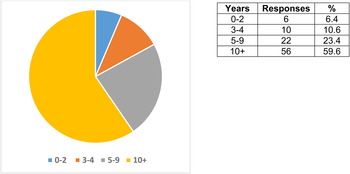
The first question asked how long the respondent had been working as a legal information professional. This wording was chosen because there is considerable variation within job titles, and by using the catch-all term, ‘legal information professional’, it was hoped that it would be inclusive of all those who perform the functions of what would traditionally be ascribed to a ‘law librarian’. This simple question produced some very revealing results (see Figure 1). Almost 60% had been working as a legal information professional for over 10 years, and over 80% had over 5 years of experience, whereas fewer than 7% were in the first two years of their career. This was not enormously surprising, because those with the greatest experience would also be those most likely to be involved in the delivery of legal research skills training, but could also be ascribed to the fact that law librarianship is a fairly small and niche profession with a stable workforce. It was nevertheless, reassuring that there was a range of respondents with different levels of experience, and a good pool of very experienced professionals prepared to share their views.
For how many years have you been working as an information professional?

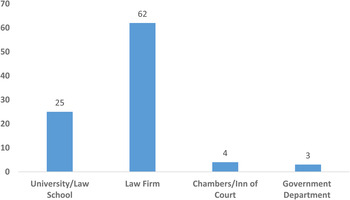
Questions 11–14 sought to establish whether the respondents worked in a university or law school, law firm; chambers or inn of court; or a government department. It was asked as four separate questions in order to facilitate easier comparison between the results of people working in the different sectors. The results were as expected (see Figure 2). The vast majority (66%), worked for law firms with another sizeable cohort (27%), working in education. Only a very small number worked in either a chambers / inn of court or for a government department. Again, it was pleasing that the survey drew responses from across the profession, and in proportions similar to the number of law libraries across the country.
Where do you work?

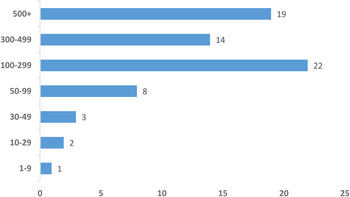
Questions 15 and 16 were only asked to the 69 respondents working outside of education (those who answered “no” to question 11, stating that they do not work in a university or law school). The respondents were asked how many legal staff work for their organisation in the UK and how many trainees / pupils their organisation took on last year. The purpose of these questions was to ascertain that responses were being drawn from a representative spread of organisations. Unsurprisingly, fewer than 10% worked in organisations with fewer than 50 legal staff, since smaller organisations are less likely to have a law library (see Figure 3); likewise, over 80% worked for organisations employing over 100 legal staff. Again, it was satisfying that the sample appeared representative.
How many legal staff work for your organisation in the UK?

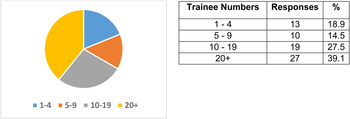
Question 16 also produced a set of results which suggest that the sample was fairly representative (see Figure 4).
How many trainees / pupils did your organisation take on last year?

Questions 2 and 3 were interested in establishing the extent to which law librarians are familiar with pedagogic and learning theories. A wide range of theories could have been chosen from, but following on from a wide range of research conducted previously (Beljaars, Reference Beljaars2009; Callister, Reference Callister2010; Choolhun, Reference Choolhun2012; Fishleigh, Reference Fishleigh2013; Hunter, Reference Hunter2013; Kim-Prieto, Reference Kim-Prieto2011; Pope, Puttick and Walton, Reference Pope, Puttick and Walton2010; Talley, Reference Talley2014), it was decided to focus upon the three with most direct application to the work of law librarians in delivering legal research skills training.
Bloom's Taxonomy is perhaps the most well-known learning theory, and is a foundation of most teacher training programmes. Given that the teaching role is growing within law librarianship (Sarkanen and Stoddard, Reference Sarkanen, Stoddard and Schopflin2015), it would be interesting to see the extent to which it has filtered down into law library training practices.
The concept of information literacy has gained considerable currency within librarianship over recent years. Its origins lie in the academic sector, but there has been a concerted effort lately (from organisations such as CILIP's Information Literacy Group and those working alongside the Journal of Information Literacy), to promote it beyond the universities. Asking respondents about SCONUL's Seven Pillars of Information Literacy (Society of College National and University Libraries, 2011) aimed to establish the extent to which the concept of information literacy had indeed managed to permeate beyond academia.
The BIALL Legal Information Literacy Statement (British and Irish Association of Law Librarians, 2012), was created as a response to concerns raised by commercial law librarians that new trainees were lacking in core research skills. Asking respondents about the statement would help to establish the extent to which it was being used in both academic and non-academic law libraries.
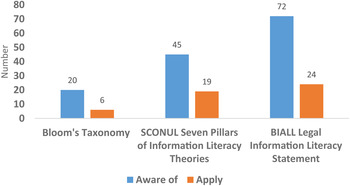
The questions produced a very revealing set of results (see Figure 5). There were very different levels of awareness of the three theories; only 20 respondents were aware of Bloom's Taxonomy, 45 were aware of SCONUL's Seven Pillars of Information Literacy, whilst 72 were aware of BIALL's Legal Information Literacy Statement. This pattern was broadly as expected for two reasons. Firstly, since the respondents were all librarians, they would be more likely to be aware of the concept of information literacy, than a pedagogic theory; and secondly, since they were all more narrowly, ‘law librarians’, it was not a surprise that there was a greater familiarity with what had been produced by their own professional association.
Are you aware of, and do you apply, any of the following theories? (Total number of respondents).

More unexpectedly however, was the extent to which theories are not applied in practice. Of the 20 people who were aware of Bloom's Taxonomy, only 6 applied it to their training; SCONUL's Seven Pillars of Information Literacy had a higher rate of application with 19 of the 46 people who were aware of it, applying it in practice; but the application rate fell again with BIALL's Legal Information Literacy Statement, with only 24 of the 72 people who were aware of it, applying it in practice. It was especially surprising how few law librarians were using the BIALL Legal Information Literacy Statement, since it had been created specifically to address the perceived shortcomings of legal research skills training which had been raised.
A number of possible explanations can be given for why this is so. It could be that practitioners feel that the theories are neither relevant nor applicable; or, it could be that they do see them as useful but have simply failed to adapt their training to incorporate them for whatever reason, a final possibility is that those who are aware of a theory, are in fact already applying aspects of it, but in an unconscious manner. Establishing which of these is most correct remains an important task if one is to fully investigate the relationship between theory and practice in the delivery of legal research skills training.
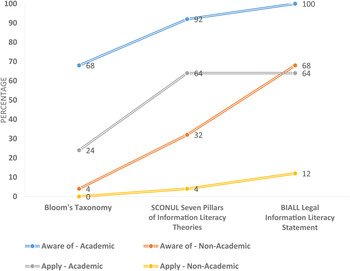
When the results are broken down by the sector in which the respondents work, a clear divide between academic law librarians and non-academic law librarians is revealed (see Figure 6).
Are you aware of, and do you apply, any of the following theories? (as a percentage of academic and non-academic law librarians).

Although librarians in both sectors share the same ranking of awareness of the three theories (with least awareness of Bloom's Taxonomy and greatest awareness of BIALL's Legal Information Literacy Statement), there is a major discrepancy in terms of how many have that awareness. Those working in the academic sector have a far greater awareness of theory (68% aware of Bloom's Taxonomy, 92% aware of SCONUL's Seven Pillars of Information Literacy, and 100% aware of BIALL's Legal Information Literacy Statement), compared to those working in a non-academic setting (4% aware of Bloom's Taxonomy, 32% aware of SCONUL's Seven Pillars of Information Literacy, and 68% aware of BIALL's Legal Information Literacy Statement). It is perhaps to be expected that within universities and law schools, theory has greater currency, but it is still, nevertheless, quite startling how in a non-academic setting, there is still such a large proportion of law librarians who are unaware of theories that could help them to deliver more effective training.
Understandably, this discrepancy extends into the realm of application of theory. 24% of academic law librarians use Bloom's Taxonomy as part of their practice, 64% use SCONUL's Seven Pillars of Information Literacy, and 64% use BIALL's Information Literacy Statement. For non-academic law librarians however, the numbers plummet; 0% use Bloom's Taxonomy, 4% use SCONUL's Seven Pillars of Information Literacy, and only 12% use BIALL's Legal Information Literacy Statement. The question of why so little theory is used to inform legal research skill training outside of universities and law schools, is certainly one which needs to be addressed.
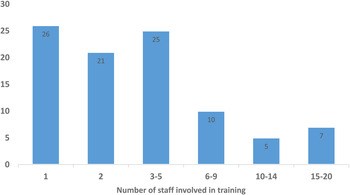
Question 4 sought to gain a picture of how many people in the respondents’ organisations are responsible for carrying out legal research training. The results reflect that librarians from a broad range of organisations took part in the survey. The majority (72 / 94), reported that training was carried out by 5 people or less, with a large number (26), carrying it out either singlehandedly, or as a pair (21). For a sizeable minority (12 / 94), training was carried out by a large team of 10 to 20 people (see Figure 7).
How many people are involved in training?

It's useful to gain an understanding of this, because there is a big difference between delivering training alone, or just with a partner, and delivering it as part of a larger team. Any enquiry into how best to deliver training, has to reflect the staffing which is available in an organisation.
Question 5 sought to establish whether external trainers are ever brought in to deliver training. Most database providers offer training in the use of their products as part of their subscription terms, and this can be an effective way to solve the problem (particularly felt by solo librarians or those in small teams), of having limited time available for training. An additional benefit of inviting in database providers to deliver training is that they have a deeper understanding of their own product and can answer questions about its capabilities and recent updates because they're specialists with just their own database (Azzolini, Reference Azzolini2013).
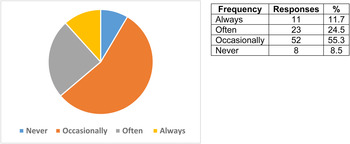
The vast majority (76%), of respondents do use vendors to deliver training (see Figure 8), although only 20% use them regularly; it is certainly worth considering whether this is an under-utilised resource. A number of legal database providers, such as LexisNexis and HeinOnline have certainly put a lot of effort in recent years, into developing their training programmes (Azzolini, Reference Azzolini2013; Baranich, Reference Baranich2010; Laidlaw, Reference Laidlaw2010) and even if a library chooses not to invite a representative in to provide training, then they should certainly be referring their users to at least a range of the online training resources which the database providers have created. In a time-strapped profession it is senseless to continually reinvent the wheel, and therefore, use should be made of the good quality training resources which already exist.
Do you ever use database providers to deliver training?

Questions 6 and 7 examined the issue of the use of digital and non-digital resources in legal research training. The annual SLS/BIALL Academic Law Library Surveys (Clinch, Reference Clinch2008; Clinch, Reference Clinch2009; Clinch, Reference Clinch2010; Clinch, Reference Clinch2011; Gee, Reference Gee2012; Gee, Reference Gee2013; Gee, Reference Gee2014), have documented an ongoing shift from print to digital resources in academic law libraries. This has led to concerns that there is an increasing lack of familiarity with paper-based resources, compared with digital (British and Irish Association of Law Librarians, 2013), and that more training needs to be provided on the use of printed citators (Choolhun, Reference Choolhun2009). Others have noted that even when training is provided on the use of non-digital resources, it can be rather cursory; “there is evidence to suggest that many academic law libraries are making significant moves from print to online provision … Many institutions are still providing some training on print research sources although this may take the form of online tutorials or a quick demonstration” (Mawson, Reference Mawson2010, p. 96). No such study has yet taken place with regards to commercial law firms, although anecdotally, it seems very apparent that there has been a shift away from hard copy resources in that sector too.
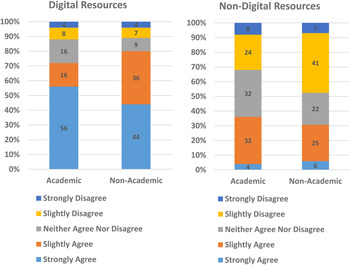
The results appear to reinforce the split between digital and non-digital materials (see Figure 9). Librarians in both sectors overwhelmingly agree that enough emphasis is being placed on digital resources in their training (72% of academic law librarians and 78% of non-academic law librarians), but this level of satisfaction drops sharply when they are asked about non-digital resources (only 36% of academic law librarians and 32% of non-academic law librarians agree that there is enough emphasis).
Do you think there is enough emphasis placed on digital and non-digital resources in your training?

The results also show a difference in attitude between academic and non-academic law librarians regarding the use of print resources. 48% of non-academic law librarians feel that more emphasis is needed on the use of non-digital resources, whereas this sentiment is only held by 32% of academic law librarians.
Mawson (Reference Mawson2010) argues that the decline in the use of print materials at universities is down to a number of factors. Firstly, economic pressures on library budgets is driving a move towards digital subscriptions; secondly, students themselves are increasingly demanding, and preferring to use, digital resources (as documented by a range of research: Abbas, MacFarlane and Goker, Reference Abbas, MacFarlane and Goker2014; Allbon, Reference Allbon2013; Bates, Reference Bates2013; Clarke and Hoffman, Reference Clarke, Hoffman and Kroski2014; Hunter, Reference Hunter2013; Janoski-Haehlen, Reference Janoski-Haehlen and Kroski2014; Satterley, Reference Satterley2014); and finally, that the widespread use of external trainers is prioritising training on online sources. Given these circumstances, it is perhaps not surprising that the use of print materials is falling in universities. However, what this questionnaire has revealed, is that with almost half (48%), of non-academic law librarians wanting a greater emphasis to be placed on such resources, academic law librarians should consider modifying their training programmes in order to ensure that they are equipping their students with the skills that are (still), needed in the workplace.
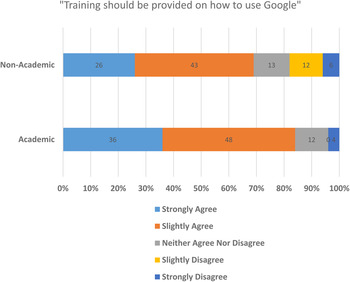
Question 8 looked at another aspect of the disruptive nature of technology upon law librarianship, by enquiring as to whether law librarians should provide training on how to use Google for legal research. The results showed that a majority of both academic (84%), and non-academic librarians (69%), agreed that it should be provided, but with greater enthusiasm from the academic sector (36% strongly agreeing, as opposed to 26% in the non-academic sector (see Figure 10).
Do you think training should be provided on how to use Google for legal research?

The results also demonstrated, that unlike the university librarians, within the non-academic sector, there is a significant minority (18%), who feel that it is not needed. Partly, this may be attributed to the fact that the question is open to a respondent overlaying their own feelings towards the use of Google. This is because the question does not suggest that Google should be used to perform legal research, it only asks about whether there should be training on the use of Google for this task. It could be argued that even if one believes that Google should never be used for legal research. In there is still validity in demonstrating why this is so. The use of Google and other search engines is so ubiquitous, that it is fair to assume that students, trainees and even lawyers will at some stage use them as part of their research. In fact, it has been recognised for some time that there is a “growing trend of lawyers, both qualified and prospective relying on Google and running into practical difficulties” (Choolhun, Reference Choolhun2009, p. 168). Such difficulties, were identified more recently by Bates (Reference Bates2013, p. 173), where he observed that “those who are accustomed to searching Google and Wikipedia have a very narrow understanding of the sources and reliability of internet resources. The ‘Digital Native’ tends to have a very shallow and basic grasp of research skills”. Furthermore, this was not only a problem confined to undergraduates, since “firms and chambers report repeatedly that students entering practice are not sufficiently equipped with necessary research skills” (Bates, Reference Bates2013, p. 173).
Consequently, there are increasing calls for training to be updated to include the use of Google (Bates, Reference Bates2013; Choolhun, Reference Choolhun2009; Hunter, Reference Hunter2013), but it is important to appreciate that when we think of the ‘Google generation’, it is not an age thing, but one of mind set, “expecting online searching to be easy and effective … and, more crucially, accepting information at face value without any attempt at critical evaluation” (Choolhun, Reference Choolhun2009, p. 169). Therefore, training must not be delivered in a mechanistic way, but rather, to inculcate in users an understanding that critical evaluation is the key.
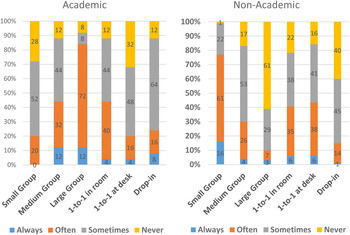
Question 9 sought to dig more deeply into the range of ways in which legal research training is presently delivered. There is a big difference between providing one-to-one or small group training, and a session aimed at a large group. Any inquiry into how best to deliver legal research training has to establish what the present pattern is. The results showed a very definite divide between how training is delivered in universities and law schools and how it is delivered in a non-academic setting (see Figure 11). Small group sesions are the norm in the non-academic sector, with 87% delivering training to this sized audience, either often (61%), or always (16%), whilst large group sessions are less common, with 61% never running them, and 29% doing so only sometimes. In the academic sector however, it is the reverse, with 84% regularly delivering training to large groups (72% often and 12% always), whilst small group sessions are only regularly run by 20%. These figures are validated by the results of the SLS / BIALL Academic Law Library Surveys, which show the increasing use of large group training in the academic sector; in 2006, 46% of those surveyed used this method, rising to 69% in 2008, 75% in 2010 and 83% in 2012 (Clinch, Reference Clinch2009; Clinch, Reference Clinch2011; Gee, Reference Gee2013).
How many people are your training sessions aimed at?

This pattern was to be expected, due to both scale and economics. Law student numbers have increased greatly over recent years, with the mean number of students per institution rising from 827 in 2011, to 876 in 2012, to 955 in 2013 (Gee, Reference Gee2012; Gee Reference Gee2013; Gee, Reference Gee2014). Against this backdrop, large group sessions are the most time-effective way to deliver legal research skills training. The non-academic sector by contrast, does not have to deal with such large numbers; 61% of the respondents stated that they have to deliver training to fewer than 20 trainees (see Figure 4), and in those circumstances it is much easier to run small training sessions. For universities to provide training sessions to students on a similar scale, would require a staff to student ratio far lower than their funding currently allows. It therefore, will have to be considered whether it is even possilble to adopt a one-size-fits-all approach to desigining legal research training programmes across sectors.
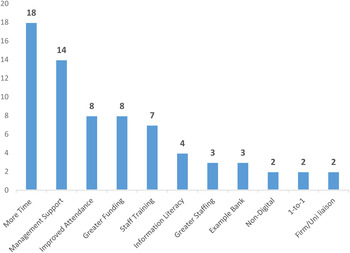
When it comes to the provision of individual sessions, we can see that there is no overarching pattern. In both sectors, one-to-one sessions are used, but never as the primary method. An obvious distinction between the two is that outside of academia, there is a significant proportion of training delivered at the attendee's desk (students rarely have a unique workspace of their own). In considering how to improve the attendance of busy fee earners and legal professionals at training sessions, a problem highlighted frequently in the literature (Fishleigh, Reference Fishleigh2013; Gow, Reference Gow2013; Peters, Reference Peters2011; Sarkanen and Stoddard, Reference Sarkanen, Stoddard and Schopflin2015), and revealed by the answers to question 23 of the survey (see Figure 18), increased provision of at-desk training could be a way forward.
Question 9 also looked at which tools were most widely used to support the delivery of legal research training (see Figure 12). The results show that almost all law librarians use guides on at least some occasions, with greatest frequency of use in academia (76% using it often or always). Their use was a little lower in non-academic libraries (19% always using them, and 46% using them often), but still commonplace. Clearly then, many law librarians have the confidence and ability to create a guide and use it as part of their training. When looking at the use of wikis and videos however, it becomes apparent that there is far less enthusiasm, and also that there appear to be differing practices between academic and non-academic librarians.
Which training methods do you use?

Few librarians create or use videos regularly to teach legal research skills; in academia, only 31% use videos regularly, whilst outside of academia just 9% do so (and 62% never use videos at all). Despite these being such low adoption rates, the figure for their usage by academic law librarians is actually considerably higher than what has been consistently found by the SLS / BIALL Academic Law Library Surveys (Clinch, Reference Clinch2008; Clinch, Reference Clinch2010; Gee, Reference Gee2012; Gee, Reference Gee2014), with the result remaining constant at 4% across the past four surveys (questions about training are only asked biannually by the survey).
A number of authors have explored how video can be a very useful tool (Allbon, Reference Allbon2013; Baranich, Reference Baranich2010; Donaldson, Reference Donaldson2010; Laidlaw, Reference Laidlaw2010; Peters, Reference Peters2011; Williams, Reference Williams2013). Printed handouts with screenshots can be helpful in a training session, but to reinforce the learning afterwards, videos, “would be easier for students to follow, and they would see the entire process from beginning to end, almost like an in-class demonstration. And unlike class, they could pause, rewind, and rewatch whenever necessary” (Williams, Reference Williams2013, p. 15). Screencasting (whereby the trainer can record their computer screen and give a demonstration), can be particularly valuable:
“The advantages of screencasting include:
-
• Students can access tutorials when and as many times as necessary so as to enforce learning and accommodate slower learners”
-
• Available online 24/7 so students can access and learn when it suits them
-
• Simple, low-cost technology
-
• The tutorial visually guides the students through using resources step-by-step
-
• Each tutorial can focus on a particular aspect of a resource (for example, logging on, how to find an Act of Parliament) so students can select the tutorial that they require” (Peters, Reference Peters2011, p. 212)
Developing a Wiki is a very useful way to have all of the legal research training materials organised, making it easy for users to locate and navigate the variety of resources on offer in a central repository, yet almost half of respondents have not done so (53% of academic law librarians and 49% of non-academic), and only around a quarter, use one regularly (24% in academic libraries and 23% in non-academic libraries). Nearly all law libraries will have produced a range of training materials, and therefore it makes sense for them to be as accessible as possible. An advantage of developing a Wiki is that you are able to make changes very quickly (allowing you to become very responsive to the users’ needs), so if trainers are repeatedly asked the same question, then it can be added to an FAQ section. Training guides and presentations can be uploaded and interconnected with other resources such as videos and webinars enabling users to view them at any time. Additionally, by linking the Wiki with social media or intranet, it is easy to inform users of any new additions such as new training guides, blog posts or videos (Baranich, Reference Baranich2010).
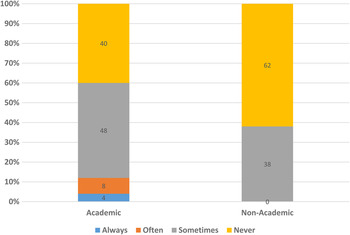
Question 10 wanted to establish the extent to which law librarians use a teaching method known as ‘flipping the classroom’, and found, overwhelmingly, that they do not. No non-academic librarians use this routinely, and only 12% of academic ones do (see Figure 13).
Do you ever ‘flip the classroom’?

It is a simple concept, but one which has been described as “revolutionising legal research training” (Sales, Reference Sales2013). In advance of a training session, attendees complete some activities so that they are more engaged with their learning. Time can then be spent more productively in the session, by focussing upon what the attendees don't understand fully, rather than telling people what they already know. Given that so many librarians wish they could have more time to spend on training (see Figure 18), this is certainly one way in which their limited availability to deliver training can be used in a more productive way.
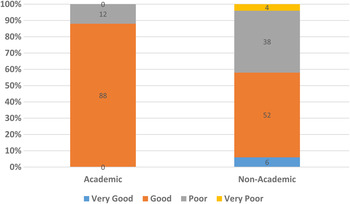
Questions 17 and 21 sought to establish whether academic law librarians and non-academc law librarians shared the same opinion as to the level of legal research skills held by law students at the end of their studies. The question was phrased slightly differently when asked to those working in the two sectors in order to increase comprehension and relevance. Academic librarians were asked to comment on the skills of the students at their institution upon graduating, and non-academic librarians were asked to comment on the skills of their lastest set of new joiners. The results showed quite a marked difference, with 88% of academic law librarians believing the students to have a good (88%), or very good (0%), level of skill, as opposed to 58% (52% good and 6% very good), of non-academic librarians (see Figure 14).
What is your opinion of the general level of legal research skills demonstrated by the students at your institution upon graduating / last round or new joiners?

There are a number of possible explanations for this discrepancy. As previously noted, academic law librarians are responsible for the legal research training of a far greater number of people than those working outside of the sector, therefore, perhaps it can be inferred that they may not have as great an understanding of the overall skill level held by their students (this may also explain the lack of nuance in their results). It could also be that librarians in the two sectors have different sets of expectations as to what constitutes ‘good’ legal research skills, and following on from this, it could also be that there are different understandings of what constitutes ‘legal research skills’ (it is possible, that librarians working in law firms might expect trainees to be able to use the more complex commercial databases, for example).
Whatever the reason behind it, the fact that 42% of non-academic law librarians believe that their new joiners had either poor (38%), or very poor (4%), legal research skills, is a concern, and evidence that this study is indeed investigating an area of need.
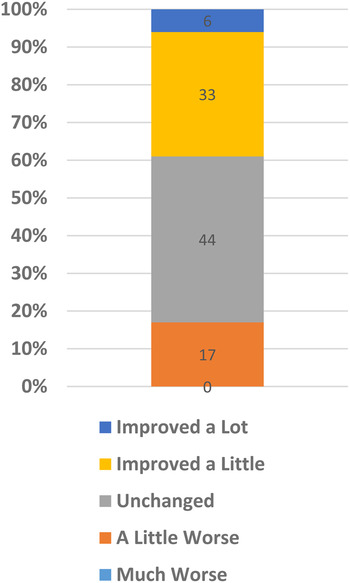
Question 19 sought to explore this issue further, by asking the non-academic law librarians whether they thought the general level of legal research skills demonstrated by new joiners, had changed over the past two years. This time frame was used because the BIALL Information Literacy Statement was published in 2012, and therefore, it was hoped that data could begin to be gathered as to its impact. The results showed a slightly positive outlook; 44% felt that there had been no change, 17% felt it had become a little worse, whereas 39% felt there had been an improvement (see Figure 15).
Do you think the general level of legal research skills demonstrated by new joiners, has changed over the past two years?

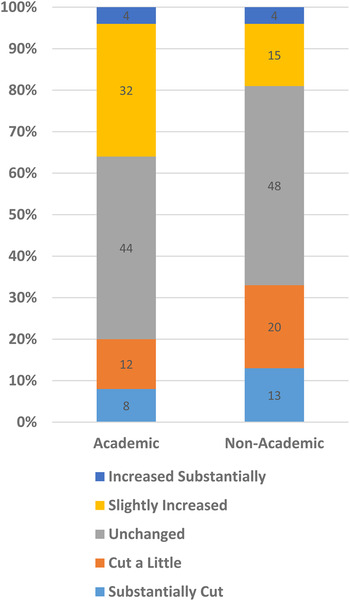
Questions 20 and 22 followed on, by attempting to establish whether there is any correlation between perceived changes in research skills, and changes in the amount of time dedicated to training. Both academic and non-academic law librarians were asked the same question separately; whether the amount of time allocated to their team for legal research training had changed over the past two years.
The results showed that although the time allocated has been unchanged for almost half of respondents (44% of academic librarians and 48% of non-academic librarians), for the others, there has been a slight change of emphasis between the two sectors (see Figure 16). Academic law librarians have tended to see their time allocated to training, rise rather than fall (36% have seen an increase and 20% have seen a reduction), whereas for non-academic law librarians the reverse is true (33% have seen a reduction and 19% have seen an increase). The academic sector figures, support the findings of the two most recent SLS / BIALL Academic Law Library Surveys asking this question, that there is an upward trend in the number of hours librarians spend delivering legal research skills instruction, with an increase from 37 to 53 (Gee, Reference Gee2012; Gee, Reference Gee2014).
Has the time allocated to your team for legal research training, changed over the past two years?

A likely explanation for the variance between the two sectors, is that the rapid rise in student numbers noted earlier, is the key factor behind the rise in the time allocated to academic law librarians to carry out legal research training. What this question has highlighted again, is that the experience of being a law librarian varies across sector, and consequently, any attempt to superimpose a one-size-fits-all solution to the question of how best to deliver legal research skills training, is likely to be unsuccessful.
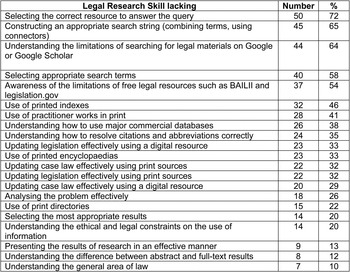
Question 18, in seeking to identify which specific legal research skills, non-academic law librarians believed to be lacking amongst their most recent cohort of new joiners, cuts to the heart of effective training, since establishing the key areas of weakness to be addressed, is essential when preparing any training programme. The 69 non-academic librarians were given a list of skills, and were asked to tick however many they felt to be lacking in their new joiners (see Figure 17).
Which legal research skills do you think the new joiners lacked?

Unsurprisingly, there was a great range of responses and a lack of uniformity, but nevertheless, some broad patterns did emerge. Firstly, there are many skills which the majority of librarians believe are not lacking in new joiners, such as the ability to update case law and legislation; resolve citations and abbreviations correctly; use printed directories and encyclopaedias; and analyse a problem effectively (all of which were only thought to be lacking by between 22% and 35% of respondents). Secondly, a stronger consensus emerges around a further five skills (selecting the most appropriate results; understanding the ethical and legal constraints on the use of information; presenting the results of research in an effective manner; understanding the difference between abstract and full-text results; and understanding the general area of law), which were felt to be lacking by only a small minority of respondents (between 10% and 20%). Both of these sets of skills should require less time being devoted to them in any induction programme, and should perhaps be assessed as a ‘flipped’ activity, only requiring greater elaboration should a need be identified.
On the other hand though, the results did highlight a number of weaknesses which any law librarian organising training ought to be aware of. Given the results to question 6 on the use of non-digital materials in training (see Figure 9), it's no surprise that a significant proportion of non-academic law librarians felt that new joiners were lacking in the skills of using printed indexes and practitioner works (46% and 41%).
Also as expected, a significant number (38%), felt that new joiners lacked understanding of how to use major commercial databases. The use of such databases (for example Bloomberg, Mergermarket and DebtXplained), would not be needed on law school courses, and therefore, instruction on how to use them, is a key role of librarians working for law firms. The weakness which needs to be addressed is not trainees’ ignorance of such databases (which can't really be helped), but more general issues with constructing an effective search which shall be highlighted shortly.
The results then showed a set of skills which the majority of respondents felt new joiners lacked. Many felt there was an issue with trainees’ usage of free legal materials available on the internet. 54% believed there was a lack of awareness of the limitations of free legal resources such as BAILII and legislation.gov and 64% felt there was a lack of understanding of the limitations of searching for legal materials on Google or Google Scholar. A similar observation was made in a recent paper discussing the legal research behaviour of law students at Cambridge University.
“Many students will search on Google for a case name or citation, and this will take them to BAILII or even Wikipedia, where they might skim the judgement. This, however, means that they do not receive any of the additional precedent and research information they would obtain from a subscription source. The student will be ignorant when a case has been distinguished or overruled, and therefore does not read the case in a suitable context.” (Bates, Reference Bates2013, p. 174)
Three of the skills perceived as most lacking, were related to the construction of an effective search. 58% of the non-academic law librarians felt that new joiners lacked the ability to select appropriate search terms, and 65% felt they were unable to construct an appropriate search string (by combining terms or using connectors), whilst the greatest weakness identified (by 72% of respondents), was trainees’ inability to select the correct resource to answer a query. Given that these skills are so fundamental to the construction of a legal information search it is concerning that so many librarians found them to be lacking. Addressing these weaknesses in particular, needs to have a stronger emphasis in training programmes across the sectors.
The final question on the questionnaire was asked of all participants, and sought to draw upon their experience, to elicit a recommendation as to the one thing which they felt would help legal information professionals deliver legal research training more effectively. No categories or options were offered, only a blank text box in which to type their answer. Many participants chose not to answer the final question (43 / 94), and of those who did, a number chose to make more than one recommendation; this resulted in a total of 71 recommendations (see Appendix 6 for the full set of responses given in answer to question 23).
In order to facilitate analysis of the results, the recommendations were grouped by themes, which grew out of the responses themselves, rather than being pre-defined (see Figure 18). Through this process, it became apparent that two concerns in particular, were widely shared; a lack of time to carry out training (18 responses), and a lack of support from management (14 responses).
What would help legal information professionals deliver legal research training more effectively?

On the issue of more time being allocated to training, some felt that it would be useful if more time was given to legal research training during trainee induction:
“More time to spend with new starters”.
Others felt extra time should be given to embed the skills later in their traineeship:
“More time for us to offer more training and also for trainees to attend training after initial induction”.
Whilst some felt it was a question of increasing the frequency of training sessions:
“Run sessions more often”.
Management support for legal research training is clearly a very important factor, particularly in firms, where librarians and training can oftentimes be seen as a cost, rather than a benefit. A number of people made observations on this point:
“Buy in to its importance from the Board and partners”.
“More senior level support within the firm”.
“More respect within the organisation that research skills are important”.
Others made the point that management support can also have a positive impact on attendance at training sessions:
“Partners taking seriously feedback from research staff as to how staff are performing in terms of their legal research skills, even seeking this out and including it as an element of annual performance reviews. This would make trainees and fee earners more inclined to attend training”.
“In terms of trainees, more encouragement and support from their supervisors would help a lot”.
Connected with the issue of management support were a further three recommendations: improved attendance (8 responses), greater staffing (3 responses), and increased funding (8 responses), or as one respondent put it:
“Funding, funding and more funding”.
Another librarian even highlighted a possible link between funding and attendance:
“I am trying to increase the incentive for 100% of the law students coming to the legal research training, with a quiz that gives marks to their course, plus with undergraduates a £5 printing voucher if they attend all the sessions”.
A number of librarians (7 responses), made the point that if one wishes to see the quality of legal research training improve, then consideration should also be given to the training which librarians themselves receive; a point also encountered in the literature (Gray et al, Reference Gray, Miller, Scott and Stanfield2007a; Gray et al, Reference Gray, Miller, Scott and Stanfield2007b; Sarkanen and Stoddard, Reference Sarkanen, Stoddard and Schopflin2015). One librarian described it as:
“Training in delivering training”.
Another, pointed out how it could lead to new methods and styles being adopted through:
“Improved knowledge of teaching/training techniques”.
Another, made the observation that she felt that training was not a strong point of many librarians, and felt that extra support would help improve the quality of the training they deliver:
“Not natural to most librarians and we aren't given enough time to practice or “buddy” with a critical friend”.
Finally, there were 5 other recommendations. Four people recommended a greater emphasis on information literacy, particularly by embedding it into law courses, rather than as something distinct:
“More embedded IL training”.
Three people believed that the creation of an examples bank would be useful:
“A bank of examples of where Google had produced the wrong results and equalled negligence on the part of the lawyer. We need to grasp the Google “nettle” more and not shy away from teaching students how to use it and the consequences of not applying additional “filters” to results”.
“The most successful sessions tend to be those that have tailored examples that show the user how a database or resource can be useful to them and the work they do”.
Two people felt there needed to be a greater emphasis on non-digital resources, whilst two others, made a convincing case for more one-to-one training:
“I believe one-to-one training at the individual's desk is by far the most effective training mechanism for legal research. You need to see the lawyer's own PC/laptop settings, check their access to the resources, watch them work in their own environment, not on a pristine training PC”.
Finally, two people suggested closer liaison between law firms and universities:
“Liaise with the universities to understand what training the students have already received”.
4.2 Interviews
Between the 14th and 30th August 2015, five interviews were conducted with experienced law librarians working in both the academic and non-academic sectors. In order to protect their anonymity, their real names have not been used and their workplaces have not been named. The five participants were: Andrew, a Senior Knowledge and Information Officer working for a City Law Firm; Sarah, a Subject Librarian working for a University Law Department; Lara, a Research Librarian working for a City Law Firm; John, a Library Manager working for a City Law Firm; and Caroline, an Information Officer working for a City Law Firm.
The interviews were explicitly tied to the study's objectives:
-
1. To explore what legal research needs are to be addressed by law librarians.
-
2. To understand why training is now such an increasingly important role for law librarians.
-
3. To examine what training is currently taking place.
-
4. To explore what possible alternatives there may be.
-
5. To compare the similarities and differences between the way in which academic law librarians and non-academic law librarians deliver training.
-
6. To discover if non-academic law librarians feel that trainees are adequately prepared by universities.
-
7. To assess how successful the BIALL Legal Information Literacy Statement has been in raising legal research standards among trainees.
-
8. To explore whether there could be more cooperation between the two areas of legal law librarianship.
All eight objectives were directly addressed, apart from objective 5, which can be explored by comparing and contrasting the responses of the academic law librarian, Sarah, with those of the other four, who work for law firms (see Appendix 5). The results of the interviews further brought into focus, and clarified, many of the issues identified in the literature review and survey.
Objective 1 was addressed by asking: “which legal research needs do you think law librarians need to address in the training that they provide?”
The interviewees identified a range of issues. Both Andrew and Caroline made the point that training must address the question of sources of information. Sometimes, people can get into bad habits where they come to rely on the same databases all the time. Law librarians need to make trainees and students aware that there are a wide range of digital and printed sources available, and that an important aspect of legal research is understanding where to find the correct information. Andrew explained that “by the end of the training the trainees have to be aware of the range of databases which are available, and know which information they can extract from each.” Caroline developed this further, by explaining that librarians also need to reinforce that printed materials are useful too. “We need to ensure that they don't just rely on online resources, especially a limited range of them… We need to make them aware of all the different resources which are available to them, and to get them to understand that hard copy resources are still useful.” This need was identified as the most lacking in new joiners by the survey, with 72% identifying it (see Figure 17).
A second need identified, was instruction on how to conduct an effective search. Caroline mentioned “basic search technique, especially the use of Boolean. The trainees think they know how to search, but they need instruction on the best method to use.” This point was expanded upon by Lara, who explained how a facet analysis of a research question is key to performing an efficient search. She also highlighted how training must ensure that trainees are aware of how the use of connectors and quotation marks will lead to more precise results:
“Things like the use of connectors. Often we see trainees trying to run a search without using quotation marks, which is a really basic thing. Also, more complex ways of searching. I don't think they are aware of which connectors to use in the different databases. Another thing we need to concentrate on, is to communicate to them that they need to read through the legal question thoroughly in order to extract the relevant key words and terms, and to write it down when they conduct their searches so that they can be more methodical and efficient in their searching. Five minutes spent on this can save them a lot of time.”
These points were borne out by the survey results, in which constructing an appropriate search string, and selecting appropriate search terms had been identified as the second and fourth most lacking skills amongst new joiners (see Figure 17).
A third need identified, was the ability to critically evaluate the information which is retrieved. Sarah described it from the perspective of university students; “knowing you have the correct information, quality issues. Being able to evaluate information and understanding the different qualities. Their main difficulties are with enquiring, analysing and critiquing the information they find.” John described the same issue, but in a commercial setting, “applying critical awareness when viewing sources.”
A final need which needs to be addressed when providing training in a law firm, is the development of commercial awareness, a skill which is not directly addressed by most law courses. Ian specifically described how trainees need to be taught how to “look for market trends, and company and industry info.”
Objective 2 was addressed by asking: “do you think that training is now an increasingly important role for law librarians?” Everyone agreed that it was, with Andrew describing it as “one of the key skills you should have.” Sarah suggested that it is particularly important, not only because it is part of being a librarian, but also because of the way in which it can raise the profile and status of a librarian within an organisation. “It's one of the parts of the job that you feel gives a validity to what you do and proves our worth. For public perceptions of our role, it's really important.”
A number of the law firm librarians made reference to the fact that with the huge range of digital resources now available, training on how to use them most effectively, was becoming more urgent; as Caroline put it, “it has always been important, but it's even more so now, with so many resources moving online.” Sarah also spoke about the value of librarians running legal research training in her university. “It's also, one of the areas where we can see our impact. Another positive thing about it, is that it is only through training that we can see where else we can make a positive impact.” She went on to link this with the fact that it is training, which is urgently needed. “Students think they can do so much more than they really can, they're really not getting the most out of the databases, which is where training is so important.” This point also arises in the literature, where a law librarian at a different university observed that:
“There is a disconnect between what students think they know about legal research and what they actually know …. The problem is overcoming the initial feeling amongst students that they already know what they're doing.” (Bates, Reference Bates2013, p. 174).
Objective 3 was addressed by asking: “what training do you currently undertake?” The interviewees all described their current practice to varying degrees. Andrew explained that because he is embedded within a particular practice area, his role is “to provide training on research specific to that area, in the first week that the trainees begin their seat.” He runs two group sessions held in a training room, in which all of the trainees have a computer to work on:
“The first session deals with internal information, our intranet, templates and knowhow, and involves making them aware of our resources …The second session deals with external databases; Mergermarket, PLC, Perfect Information, Companies House. I give tips on how to search, using filters and proximity searches.”
Lara described a similar picture in her firm:
“We run inductions twice a year. We have them for a whole day, in which we give training on how to conduct legal research, using real life case scenarios. In the afternoon we introduce them to company research. Sessions are a mixture of talks and hands-on practical exercises.”
She explained how inculcating a strong sense of commercial awareness is a key aim of the training:
“For us, the challenge is to make them understand that although they can function, in a firm, time is money, and we are there to ensure that they can get to the information they need in half of the time. Also, they need to understand that they need to cover all the bases in a search, and cannot just rely on one preferred source. They need to appreciate that they won't be able to find all of the answers in just the one database which they are comfortable with.”
She also explained why she prefers training to be delivered by the library team rather than by an external trainer:
“We provide training on all the legal databases to which we're subscribed. We only call in suppliers to run sessions for certain company information databases, but I would prefer that we ran it all in-house because sometimes suppliers run sessions which are more like demos, as opposed to training responsive to the needs of our lawyers.”
John described a different attitude towards the database providers. “We have ad hoc training from vendors as and when, e.g. if we take a new product, and a ‘Supplier Showcase’ in January each year which is effectively a mini trade exhibition.”
Like the other law firm librarians, Caroline described how introducing trainees to the commercial databases played a prominent role in the induction programme. “We give a general overview of the library's services and how to get company information. Then they're divided into practice areas where we provide customised sessions and are able to go over the resources in greater depth.” She then explained how the library team sought to consolidate the learning which takes place in the induction. “We have a library wiki, which is updated at least twice a year, so that trainees can get further information in their own time.”
As an academic law librarian, Sarah described a different picture. “Legal research is taught as a component of the Legal Method module. There's a two hour interactive workshop in which students complete group and individual exercises and learn about commands and connectors. Ideally, you want to be an integrated part of an assessed course.” She also made it clear, that academic law librarians face a lot of challenges in providing legal research training. “Hardcopy is skirted over; with the time we've got, we have to focus on digital resources, it's what they'll use. Time and student numbers has brought large pressures.”
To explore Objective 3 further, the interviewees were asked a second question: “how effective do you think the training you provide is?” All of the interviewees felt that they provided good training. A number of examples were given as to how they knew that this was the case. Lara and Andrew both mentioned how they received positive feedback from the sessions; Andrew and Caroline both noted that the library team do not receive too many basic legal research queries; Lara mentioned that attendees often recommend sessions to their colleagues. Sarah described the value of the sessions run at her university. “It does a pretty good job. It does open their eyes to the difference between a good and bad search, also, it makes them aware of what a librarian can do, and our expertise.”
Objective 4 was addressed by asking: “how do you think it could be made more effective?” Three of the law firm librarians all agreed that the sessions should be more tailored to specific practice areas. As John put it, “more targeted to individual practice groups.” Andrew elaborated on this point. “Ideally, split the training into smaller groups to make it even more tailored to the needs of the individuals. It would involve running a greater number of sessions, but they could be much shorter, because you'd only need to deal with a narrower set of needs.”
Caroline emphasised how the change of seat was the perfect opportunity to give trainees training on the resources specific to the new area. “The seat change training could be made mandatory.” Given the fact that ‘Flipping the Classroom’ was so rarely used in the non-academic sector (see Figure 13), it was interesting to hear Lara talk about how at her firm, they have introduced ‘flipped’ activities into their training. “This year we have tried to flip the classroom. We gave the trainees some exercises to complete before the session and the work submitted was good. It gave them the chance to explore one of our main company databases, and reflect upon it before the session.” This appears to support the literature which suggests that this training method can be very useful in making legal research training more effective (Lemmer, Reference Lemmer2013; Sales, Reference Sales2013; University of Texas Center for Teaching and Learning, no date).
Andrew raised the important point that in addition to the feedback from participants, it would also be helpful to hear from their supervisors whether the training has been effective or not. “It would be useful to get feedback from supervisors that they're happy with the research skills of the trainees, or otherwise.”
Sarah explained how she felt it was necessary to use the latest technology. “Students are very different now, even to a few years back. You do have to move with the times to keep them engaged. You can't just expect them to learn from you; we think it's interesting but it's not to other people.” She also made the point that the quality of teaching is an area which requires closer attention. “There needs to be a better focus at Library School on Information Literacy and training.”
The range of responses to this question is very much to be welcomed, since it illustrates the fact that the subject is a complex one in which there are no simple fixes.
Objective 6 was addressed by asking: ‘do you feel that trainees are adequately prepared by universities?’ The questionnaire had revealed a difference of opinion between the academic and non-academic librarians on this issue (see Figure 14), and therefore, it was hoped that the question would perhaps go some way to explaining why this was the case. A range of answers were given, and not necessarily in the way that the researcher had expected.
Two of the law firm librarians were largely positive about how well the universities prepared their students. Lara said, “I've seen the materials they've been given on their LPC course and they're really good, I don't know what more they could do.” John recognised that the situation was improving, “Increasingly, yes.” However, Andrew, felt that the university training was good at the basics, but lacking in the skills which are needed in a law firm. “They're comfortable researching a case, but are not so good at using Lexis in a more advanced way. They lack commercial awareness, and haven't used Companies House before. A lot of their work involves finding precedents from within the firm, and no trainee will have had experience of that.”
His criticisms of the lack of training on more advanced search skills is a valid one in many cases, but training on how to use an internal ‘Knowhow’ database or commercial database is impossible to provide at universities, since they will not have access to them. This points to the fact that law firms cannot expect the universities to produce graduates who are ‘fully formed’, and that there will always, therefore, be an important role for non-academic law librarians to play in inducting new trainees into the effective conduct of legal research once they are in practice.
Both John and Sarah commented on the fact that students need to be better prepared for how to apply what they have learnt at university, to real life problems. Sarah described how the students at her university “need to learn how to twist their problem solving skills to real life problems.” John made the point that unlike a research exercise undertaken at law school, (in which the students have to find an answer to a question), in real life, there are times when there is no solution. In other words, legal research training ought to teach the student how to explore all the possible sources, and make the informed decision to end a search once it has been established that the information does not exist to be found. “They are still not used to open–ended questions which are common in real life research. Sometimes the information just isn't there.”
Caroline was the only law firm librarian to categorically state that she felt the trainees in her firm had not been adequately prepared by their universities. “Their search skills aren't always that great, maybe universities could do a bit more about formal searching.” Given that 88% of the academic law librarians surveyed, felt that their students had a good level of research skills upon graduating (see Figure 14), it was a little surprising to hear Sarah express that she felt the graduates at her university were not adequately prepared. “No, everything is frontloaded (into their First Year). They're supposed to continue learning and developing their skills, but they don't.” When pressed on whether a training update could be provided later in their course, she acknowledged that “there's room to do a combined research / employability thing at the end.”
Lara made the point that although it could always be possible for more training to be provided, ultimately, “people just get into bad habits and want to cut corners. It's more to do with the individual and their attitude towards legal research.” This comment injects a healthy dose of realism into the debate; it's never going to be possible to devise the perfect training programme, because its effectiveness is also partly down to the attitude of the participants themselves.
Objective 7 was addressed by asking: ‘How successful do you think the BIALL Legal Information Literacy Statement has been in raising legal research standards among trainees?’ Given that all of the academic librarians, and 68% of non-academic librarians surveyed, were aware of the statement (see Figure 6), it was surprising that three of the four law firm librarians (Andrew, Lara and Caroline), were not familiar with it. The only non-academic law librarian who knew about the statement was John, a library manager. Could it be that outside of academia and managerial circles, there has been limited transmission of the statement?
John hadn't seen much evidence of it having made any particular impact on the level of research skills held by the new trainees at his firm. “I don't think it has had much impact directly on the trainees as there does not seem to be time on the LPC or GDL to include research skills.” However, he still felt that its creation had been a valid exercise, for the way in which it demonstrates that the profession is engaged with one of its key responsibilities. “I think it is a very useful tool for law firm librarians and law school librarians to show their employers, to prove the value of research skills training.”
Sarah felt that it was difficult to measure the statement's impact because as far as she was aware, BIALL had never carried out a review. She made the point that what was needed was a practical set of examples, rather than just a set of guidelines:
“I'm surprised that no one's looked at it since it was introduced. I thought it would be an ongoing thing. Live examples should be given of how it should be done, but people don't tend to share the exercises they do. We need an Information Literacy Statement pack, much like the Legal Research pack, demonstrating practically how it's done.”
Objective 8 was addressed by asking: ‘Do you think there should be more cooperation between the two areas of law librarianship?’ The academic law librarian (Sarah), and two of the law firm librarians (Lara and John), felt that there should be. Sarah was most emphatic. “Definitely, yes. There's a massive gap, it would be useful.” Lara emphasised the point that librarians at both ends of the chain can benefit from working more closely. “There should be more collaboration. The people who run the LPC courses should meet with the librarians at the law firms where the trainees are going to go. We could learn from each other.”
John made the point that although this does sometimes happen informally, there needs to be a shift in attitude from law firm management for this to become more formalised. “Yes, informally this happens occasionally, but it would be useful for law firms to recognise the value of their library staff talking to the library and academic staff at the law schools from which their trainees are taken.”
On the other hand, Andrew and Caroline were both more dismissive, and expressed reservations that had been identified in the literature. Caroline observed that, “they're completely separate institutions.”
“Research in a law firm is quite different from that experienced in academia. The stress of multiple assignments, time pressures, and cost constraints are the norm.” (Shimpock-Vieweg, Reference Shimpock-Vieweg1993, p. 35).
Andrew made the point that universities are good at teaching their law students the basics, but saw little point in there being greater cooperation with law firms, when there is already such a great difference between the practice areas within a firm. “Not really. There's so much variation, even between the different practice areas of a law firm, which universities can't be expected to prepare students fully for. They're good at getting the students up to speed with cases, and judging if it is good law or not. I don't get queries about easily accessed cases.”
“There is little common ground when identifying which research skills are required across the wide range of practice areas in a large law firm.” (Holt, Reference Holt2008, p. 12).
These responses would seem to indicate, that although it may be possible at the present time to organise informal or small-scale collaborations, anything more ambitious than this may well require a new consensus to emerge.
5. CONCLUSION
A recent US survey, carried out by one of the world's leading legal database providers, together with the wealth of literature from many countries, affirms that a lack of high quality legal research skills is not only an issue in the UK:
“Young lawyers often lack advanced legal research skills such as researching more complex legal issues in cases, statutes and regulations, determining strength of validity of primary law, and legislative/administrative intent. The survey demonstrated that, along with drafting pleadings, advanced legal research skills presented the largest gap between the importance of proficiency and the percentage of new associates actually possessing those skills.” (LexisNexis, 2015).
Commenting on the survey, it was pointed out that this situation represents a great opportunity for law librarians to demonstrate their value:
“The role of the librarian is central to successfully transition associates from law school to their first professional roles. The survey found new associates spend a mean of 43% of their time conducting legal research, and a robust mean of 12.1 hours using paid online resources. This equates to a significant cost to firms. In fact, the survey states attorneys estimate it costs $19,000 a year to train new associates. The silver lining is: educating new associates on proper researching is big business in law firms, and an area that crucially underscores the librarian's value to a firm.” (Jonjak, Reference Jonjak2015).
Throughout this research, the aim has been to identify the most effective ways in which law librarians can provide training to meet the legal research needs of their users, in order to arrive at a range of practical recommendations. To achieve this aim, eight objectives needed to be researched, and through analysis of the data gathered, conclusions have been generated about each area.
5.1 Research Objectives
Objective 1 - To explore what legal research needs are to be addressed by law librarians.
-
• Three core sets of skills need to be ingrained in the minds of law students and trainees: building an effective legal search through facet analysis and the use of connectors; using a broad range of digital and non-digital sources to perform a thorough search; and critically evaluating information.
-
• As a response to the digital revolution, training must address the limitations of free legal resources such as BAILII and legislation.gov, as well as the limitations of searching for legal materials on Google.
-
• Law firm librarians must introduce trainees to commercial, and internal Knowhow databases, with which they will be unfamiliar, as well as the commercial aspects of carrying out legal research.
Objective 2 - To understand why training is now such an increasingly important role for law librarians.
-
• The digital revolution has created a new generation who think they know more about legal research than they actually do.
-
• With the huge range of digital resources now available, training on how to use them most effectively is becoming more urgent.
Objective 3 - To examine what training is currently taking place.
-
• There is no one dominant style adopted across the whole profession, the training provided varies by institution.
-
• Group training remains very common, with the group size varying tremendously.
-
• One-to-one and drop in sessions are less common, but not a rarity.
-
• Most training is accompanied by a written guide of one form or another.
-
• Active learning styles are now the norm.
Objective 4 - To explore what possible alternatives there may be.
-
• Using ‘flipped’ activities is a way of engaging students and trainees in their learning, as well as making training sessions more focused and purposeful.
-
• The creation of a legal research Wiki is a way to pull together a range of resources (such as FAQs, screencasts, videos, written guides, presentations and blogs), which can consolidate the learning outside of the training session.
Objective 5 - To compare the similarities and differences between the way in which academic law librarians and non-academic law librarians deliver training.
-
• The differing circumstances affecting academic law librarians and non-academic law librarians, have resulted in a number of differences in the way they deliver training.
-
• In academia, large group sessions are the norm, and small group sessions happen rarely, but outside of academia, the opposite is the case.
-
• Many academic law librarians use the concept of information literacy to inform the training sessions they run, whereas this rarely happens in non-academic law libraries.
Objective 6 - To discover if non-academic law librarians feel that trainees are adequately prepared by universities.
-
• There was no consensus on this issue.
-
• Although a majority felt that they were adequately prepared, and had a good level of legal research skills, there was a very sizeable minority who disagreed.
-
• Most felt that the level of skill demonstrated by their new trainees, had either remained unchanged, or improved over the past two years.
Objective 7 - To assess how successful the BIALL Legal Information Literacy Statement has been in raising legal research standards among trainees.
-
• Despite universal awareness of the statement amongst academic law librarians, over a third have not applied it to the training they run.
-
• Outside of academia, around a third of law librarians are not even aware of the statement, and it is rarely applied.
-
• The perceived improvements in the legal research skills, of a significant proportion of new trainees in law firms over the past two years, cannot be attributed to the introduction of the statement until evidence is shown to prove that this is the case.
Objective 8 - To explore whether there could be more cooperation between the two areas of legal law librarianship.
-
• In general, there is a feeling that greater cooperation will benefit the delivery of legal research training across the profession.
5.2 Recommendations
i. Train the trainers
-
• Librarians need more training on how to deliver training effectively.
-
• Non-academic librarians need to develop a greater understanding of the benefits of information literacy as a concept to underpin their work.
-
• A greater awareness and openness to new training methods is needed.
ii. Closer links between academic and non-academic sectors
-
• Greater co-ordination is needed between the academic and non-academic sectors to ensure that students are being taught the legal research skills they will need when it comes to them practising law.
-
• Lawyers should visit universities to emphasise to students just how important it is that they develop excellent research skills as part of their studies.
iii. Further research into how legal research training is delivered
-
• BIALL need to replicate the fine work they undertake in the academic sector, in the non-academic sector, by undertaking a non-academic law librarian survey to gain a fuller impression of developments across the profession.
-
• BIALL need to carry out a review of their Information Literacy Statement in order to establish the extent to which it has been used, and assess the impact which it has, or has not, made.
-
• Further research into legal research skills training needs to move beyond law librarians to lawyers themselves, in order to establish how they feel about the current situation.
iv. More emphasis in training on specific legal research issues
-
• Greater emphasis needs to be placed on constructing effective legal searches and using print materials at universities and law schools.
-
• Law students must be taught clearly about the potential perils of using free legal information.
-
• Law firm librarians must ensure that trainees appreciate the differences between using legal, and company databases, in order to understand the commercial aspect of their legal research.
v. Win support for better resourcing of legal research training programmes
-
• The case for the benefits of legal research training needs to be articulated more loudly and clearly in order to persuade management to be more supportive.
vi. Make use of the legal research materials which are available
-
• People need to avoid re-inventing the wheel; there is a wealth of materials which currently exist.
APPENDICES
Appendix 1: Survey Questions
Investigating the delivery of legal research training by legal information professionals
Project Information
Thank you for your interest in helping with this research. This page provides some background information on the project before you begin. The survey will take approximately 5 minutes to complete.
Purpose of this Study
This research project is studying the provision of legal research skills training by legal information professionals (law librarians). The aim is to understand the range of obstacles confronting legal information professionals in the delivery of this task, and establish the most effective methods and approaches which can be taken to improve the situation.
Researcher
The research is being undertaken as part of an MSc in Information Science at City University, London. The project researcher is Steve Mishkin and the research is supervised by Dr Lyn Robinson. To contact the researcher, please email steve.mishkin@city.ac.uk
Your Participation
If you choose to participate, you will answer questions about your role as a UK based, legal information professional involved in the organisation and/or delivery of legal research skills training.
Taking the Survey
The survey is composed of structured questions; only the final question is framed in such a way as to elicit a longer response. You can return to any question to modify your response before submitting.
Data and Methodology
During the research, data will be collected via this survey tool. Data collected for this study is anonymous and asks for no personally identifiable information unless you provide it in your comments. Findings from the research will be published in my Masters dissertation.
Consent and Withdrawal
All research participants must provide consent to confirm that they have read the project information and are willing to participate in the research and that any data they provide may be used as set out above. You can withdraw your participation at any point up to the final submission of data by closing your browser window to exit the survey. If you leave the survey without submitting or saving your response, any data already entered into this survey will not be used in the research. Once you click the ‘send form’ button, you agree any data you contribute can be used as outlined in this project information.
Participant Agreement
To confirm that you have read the project information and you are willing to participate in this research, please select ‘I Agree’ and then continue with the rest of the survey. If you do not wish to participate you can close this form in your browser to exit the survey.
I have read the project information and would like to participate
-
•
 I agree
 I agree
-
1. For how long have you been working as a legal information professional?
-
•
0-2 years -
•
3-4 years -
•
5-9 years -
•
10 years plus
-
-
2. Are you aware of any of the following? Tick as many as are relevant
-
•
Bloom's Taxonomy of Learning -
•
SCONUL Seven Pillars of Information Literacy -
•
BIALL Legal Information Literacy Statement
-
-
3. Do you use any of the following as part of your practice? Tick as many as are relevant
-
•
Bloom's Taxonomy of Learning -
•
SCONUL Seven Pillars of Information Literacy -
•
BIALL Legal Information Literacy Statement
-
-
4. How many people in your organisation are responsible for carrying out legal research training? Please enter the number; e.g. 3
-
5. Do you ever use a vendor (e.g. Westlaw), to deliver training on their product?
-
•
Never -
•
Occasionally -
•
Often -
•
Always
-
-
6. Do you think enough emphasis is placed in training, on the use of non-digital legal resources, such as books?
-
•
Strongly agree -
•
Slightly agree -
•
Neither agree nor disagree -
•
Slightly disagree -
•
Strongly disagree
-
-
7. Do you think enough emphasis is placed in training on the use of digital legal resources, such as databases?
-
•
Strongly agree -
•
Slightly agree -
•
Neither agree nor disagree -
•
Slightly disagree -
•
Strongly disagree
-
-
8. Do you think training should be given in how to use Google for legal research?
-
•
Strongly agree -
•
Slightly agree -
•
Neither agree nor disagree -
•
Slightly disagree -
•
Strongly disagree
-
-
9. Which of the following methods do you use in your legal research training? Please check the relevant circle in each row
-
10. Do you ever ask attendees to complete activities in their own time, prior to attending a training session (sometimes referred to as, ‘flipping the classroom’)?
-
•
Never -
•
Occasionally -
•
Often -
•
Always
-
-
11. Do you work in a law school or university? If yes, please go to question 21
-
•
Yes -
•
No
-
-
12. Do you work in a law firm? If yes, please go to question 15
-
•
Yes -
•
No
-
-
13. Do you work in a barristers' chambers / inn of court? If yes, please go to question 15
-
•
Yes -
•
No
-
-
14. Do you work in a government department? If yes, please go to question 15
-
•
Yes -
•
No
-
-
15. How many legally trained staff work for your organisation in the UK?
-
•
1–9 -
•
10–29 -
•
30–49 -
•
50–99 -
•
100–299 -
•
300–499 -
•
500 plus
-
-
16. How many trainee solicitors or pupil barristers did your organisation take on in the last year?
-
•
1–4 -
•
5–9 -
•
10–19 -
•
20 plus
-
-
17. During the last round of new joiner training, what was your opinion of the general level of legal research skills demonstrated by the new joiners?
-
•
Very good - little room for improvement -
•
Good - major techniques mastered, though a few minor matters requiring attention -
•
Poor - significant weakness in the major techniques, but still able to obtain some correct information -
•
Very poor - had little or no research skills, and unable to find relevant information independently
-
-
18. Which of the following specific areas of legal research skills do you think the new joiners lacked? Please read through the entire list and check the boxes of all those that apply
-
•
Analysing the problem effectively -
•
Understanding the general area of law -
•
Selecting the correct resource to answer the query -
•
Selecting appropriate search terms -
•
Constructing an appropriate search string (combining terms, using connectors) -
•
Understanding how to use major commercial databases -
•
Selecting the most appropriate results -
•
Understanding the difference between abstract and full-text results -
•
Updating legislation effectively using a digital resource -
•
Updating case law effectively using a digital resource -
•
Awareness of the limitations of free legal resources such as BAILLI and legislation.gov -
•
Understanding the limitations of searching for legal materials on Google or Google Scholar -
•
Use of printed indexes -
•
Use of printed encyclopaedias -
•
Use of print directories -
•
Use of practitioner works in print -
•
Updating legislation effectively using print sources -
•
Updating case law effectively using print sources -
•
Understanding how to resolve citations and abbreviations correctly -
•
Presenting the results of research in an effective manner -
•
Understanding the ethical and legal constraints on the use of information -
•
Other:
-
-
19. Do you think the general level of legal research skills demonstrated by new joiners, has changed over the past two years?
-
•
Gotten much worse -
•
Gotten a little worse -
•
Unchanged -
•
Improved a little -
•
Improved a lot
-
-
20. Has the time allocated to your team for new joiner legal research training, changed over the past two years? After answering this question, please go to question 23
-
•
Substantially cut -
•
Cut a little -
•
Unchanged -
•
Slightly increased -
•
Increased substantially
-
-
21. What is your opinion of the general level of legal research skills demonstrated by the students at your institution upon graduating?
-
•
Very good - little room for improvement -
•
Good - major techniques mastered, though a few minor matters requiring attention -
•
Poor - significant weakness in the major techniques, but still able to obtain some correct information -
•
Very poor - had little or no research skills, and unable to find relevant information independently
-
-
22. Has the time allocated to your team for legal research training, changed over the past two years?
-
•
Substantially cut -
•
Cut a little -
•
Unchanged -
•
Slightly increased -
•
Increased substantially
-
-
23. What one thing do you think would help legal information professionals deliver legal research training more effectively? Please type in the box below (feel free to expand your answer if you so wish)

Appendix 2: Interview Questions
-
1. Which legal research needs do you think law librarians need to address in the training that they provide?
-
2. Do you think that training is now an increasingly important role for law librarians?
-
3. What training do you currently undertake?
-
4. How effective do you think the training you provide is?
-
5. How do you think it could be made more effective?
-
6. Do you feel that trainees are adequately prepared by universities?
-
7. How successful do you think the BIALL Legal Information Literacy Statement has been in raising legal research standards among trainees?
-
8. Do you think there should be more cooperation between the two areas of legal law librarianship
Appendix 3: Survey Question 23 Responses
What one thing do you think would help legal information professionals deliver legal research training more effectively?
Higher attendance!
A bank of examples of where Google had produced the wrong results and equalled negligence on the part of the lawyer. We need to grasp the Google “nettle” more and not shy away from teaching students how to use it and the consequences of not applying additional “filters” to results.
The most successful sessions tend to be those that have tailored examples that show the user how a database or resource can be useful to them and the work they do.
Funding, funding and more funding.
Improved knowledge of teaching/training techniques (e.g. I'd never heard of flipping the blackboard).
Partners taking seriously feedback from research staff as to the how staff are performing in terms of their legal research skills, even seeking this out and including it as an element of annual performance reviews. This would make trainees and fee earners more inclined to attend training.
Real-type scenarios that you can use when training.
Access to more flexible technology so not always sat at a pc.
Better understanding of printed sources.
More staff.
Mandatory courses.
For trainees to understand the relationship between print and online resources.
Training the trainers.
Buy in to it's importance from the Board and partners.
Impact. Not natural to most librarians and we aren't given enough time to practice or “buddy” with a critical friend.
Making it a mandatory requirement.
Timetabled sessions with the students (i.e. not optional sessions).
They need to demonstrate why it is important to get research correct.
More time and resources to spend on training, accompanying documentation and user support.
More compulsory timetabled events! Just more time generally, but in particular for small-group hands-on events. I know not everywhere does it the way we do, but we see students early, they quickly understand the basics, but once they start independently researching the good ones discover how much they still have to learn and the less-good ones fail…
Training in delivering training.
Time.
Sometimes feels like we are at odds with vendors - we are trying to raise standards by encouraging advanced searching etc. whilst vendors keep dumbing down their products.
More senior level support within the firm.
For students not to be hand-fed resources at university. They should have to locate the material themselves and not have it presented to them as part of their course materials.
If the “trainers” were trained better, it would be an improvement.
I am trying to increase the incentive for 100% of the law students coming to the legal research training, with a quiz that gives marks to their course, plus with undergraduates a £5 printing voucher if they attend all the sessions ie Library tour, Lexis training, Westlaw training and other research training.
More time and resoures.
More respect within the organisation that resaearch skills are important.
I believe one-to-one training at the individual's desk is by far the most effective training mechanism for legal research. You need to see the lawyer's own PC/laptop settings, check their access to the resources, watch them work in their own environment, not on a pristine training PC. I do not think that there needs to be an emphasis on print materials any more: that is just not the reality of the lawyer's work anymore.
Attend refresher legal resarch training courses and liaise with the universities to understand what training the students have already received.
In terms of trainees, more encouragement and support from their supervisers would help a lot.
More time with students.
More time to plan it and deliver it.
More money invested in training us to deliver effective training.
Time!
More effective online training tools.
Emphasis placed on the importance of training.
I have too many students and not enough time. I can not deliver all the legal research training myself. I would like to work better with the law school to develop their training. I am also looking at putting more training materials online in self-study modules.
Research skills being part of the criteria they are judged on for NQ positions.
Better collaboration between BPTC providers and the Inns of Court.
I don't think there is one thing, teaching is a complex activity with lots of variables. If you have a teaching qualification and apply good teaching and learning principles to your sessions then they should be effective.
Support and appreciation from the law firm management.
Training during lunch hours and offering sandwiches - lawyers will do anything for free food !!!
More embedded IL training.
Support from their supervisors/partners. I also think that the confidence that the new trainees have means that they don't always know what they don't know, or don't admit it. You ask if they understand Boolean logic, and they say, yes, when in fact they don't. They think because they can find things on Google that they are good searchers.
In a law firm environment it would be good to be able to spend more time with the trainees but time for training is limited.
Info skills embedded in LLB programme [why is this field so tiny? Why not use option for extended response?]
Compulsory continuing legal research skills training throughout the trainee contract and first two years NQ - with participation linked to performance reviews.
On-demand video.
More legal librarians.
In the academic arena support from academic staff emphasising the importance of training and continuous training over the 3 year degree programme
More time!
Regular one to one updating.
More time to conduct a training course.
More time.
It would help if the Law School would make an online information skills tutorial compulsory.
Ability to conduct more online inductions and to spread training over a few short sessions, rather than one big induction amongst all the others they have when joining.
Recognition of its importance.
Greater enthusiasm from the fee earners.
We should partner more in the training with fee earners and psls.
Make training obligatory, run sessions more often.
more time for us to offer more training and also for trainees to attend training after initial induction. more resources such as online training software.
More time to spend with new starters.
Better integration with academic modules - legal research (and information & digital literacy) best seen as part of the whole research process from finding to reading to writing and sharing. Not an end in itself.
Prizes.
More backing from senior management and partners.
More time and buy in from trainees - disconnect between what they think they need to know and what they actually do.
Acknowledgements
My thanks go out to all those members of the law librarian community who gave support and encouragement throughout this project, including all who promoted or completed the questionnaire, and particularly, those who gave up their time to be interviewed.
Thanks also go out to my supervisor, Dr Lyn Robinson, whose responses to my queries were always swift and helpful.
But most of all, my thanks go out to my family, without whose support, none of this would have been possible.