Central line-associated bloodstream infection (CLABSI) is one of the most significant health care-associated infections in the critical care setting.Reference Jones 1 – Reference Marschall, Mermel and Fakih 3 Throughout the 1960s and 1970s, Gram-negative organisms were most frequently isolated from patients with nosocomial bloodstream infections. Since then, infections due to Gram-positive organisms have become increasingly frequent.Reference Wisplinghoff, Bischoff, Tallent, Seifert, Wenzel and Edmond 4 In this study, we aimed to evaluate the impact of the distribution of CLABSI pathogens after the implementation of the Institute for Healthcare Improvement (IHI) central-line bundle during 12 years of surveillance.
METHODS
This retrospective, observational study was conducted in a 40-bed medical-surgical ICU and in two 40-bed SDUs with the same physical layout as that in a tertiary care, private hospital in São Paulo, Brazil. The study included 2 phases: phase 1 (January 2001 to December 2006); phase 2 (January 2007 to December 2012). In phase 1, some Centers for Disease Control and Prevention evidence-based practices were regularly applied (eg, sterile barrier precautions and 2% chlorhexidine preparation for skin antisepsis). In 2007, we implemented the IHI central-line bundle for all ICU and SDU patients requiring central venous lines. CLABSI surveillance was performed by trained infection control professionals using the Centers for Disease Control and Prevention definition.Reference Horan, Andrus and Dudeck 5 Incidence rates were calculated as number of microorganisms isolated in bloodstream infections (BSIs) per 1,000 central-line days. All of the data analyses were performed using SPSS for Windows 14.0 (SPSS, Inc., Chicago, IL). The χ2 trend test was used for the statistical analysis, and P <.05 was considered statistically significant.
RESULTS
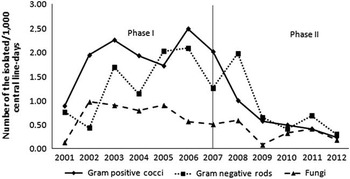
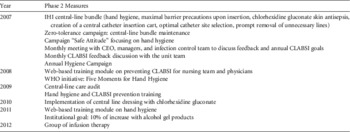
Over 12 years, 3,380 CLABSIs with 397 organisms were identified. The BSI rates decreased 57.3% in phase 2 compared to rates in phase 1, and the central-line utilization ratio in phase 1 was 0.48% vs 0.54% in phase 2 without a difference between the types of venous catheters. Of all the microorganisms identified in phase 1, 46.9% were Gram-positive, followed by Gram-negative organisms (35.3%), fungi (17.8%), Candida albicans (7.7%), and Candida parapsilosis (4.6%). In phase 2, 42.4% of microorganisms identified were Gram-positive, followed by Gram-negative organisms (38.1%), fungi (19.4%), and Candida albicans (7.2%). The mean incidence density ratio of the number of Gram-positive organisms per 1,000 central-line days was 1.9 in phase 1 and 0.7 in phase 2 (P=.90). For Gram-negative rods, the incidence density ratio was 1.4 in phase 1 and 0.7 in phase 2 (P=.80). For fungi, the incidence density ratio was 0.7 in phase 1 and 0.3 in phase 2 (P=.90). The incidence rates among microorganism isolates over the 12 years are detailed in Figure 1. The principal measures used to reduce the CLABSI rates in phase 2 are shown in Table 1.
Incidence rates for microorganism isolates in CLABSI over 12 years.

Principal Measures in Phase 2 to Reduce CLABSI Rates

NOTE. CLABSI, central line-associated bloodstream infection; CEO, chief executive officer; WHO, World Health Organization.
DISCUSSION
In this study, we retrospectively analyzed the microbiological trends of organism in patients with CLABSI admitted to a Brazilian tertiary hospital from 2001 to 2012. In phase 2 (2007–2012), the sustained reduction in CLABSI resulted from the application of the measures of prevention and infection control established by IHI, as previously described.Reference Inan, Ozgultekin and Akcay 6 – Reference Hufnagel, Burger, Bartelt, Henneke and Berner 8 Consequently, there was also a reduction in different groups of microorganisms in the comparison between the 2 phases but without a statistically significant difference (P>.05).
In other series, C. parapsilosis was the predominant non-albicans Candida, similar to what happened in our phase 1 but different from our phase 2.Reference Bassetti, Righi and Costa 9 Because C. parapsilosis is typically associated with the use of indwelling CVCs (biofilm), this finding highlights the continuing adequacy of infection control measures in phase 2.Reference Bassetti, Righi and Costa 9 , Reference Poikonen, Lyytikäinen and Anttila 10
The increase in central-line utilization ratio in phase 2, associated with reduced bloodstream infection, reflects the improvement in the quality of the insertion and the maintenance of CVCs.
This study has several limitations. First, this is a retrospective observational study, and other unmeasured factors might have occurred coincidentally with the interventions occurring since 2007, resulting in a decrease in BSI rates in our ICU and SDU. Second, we did not collect data on process measure compliance; this lack of data decreased our ability to measure the full impact of the bundles. Our study provides insight into the influence of IHI central-line bundle on CLABSIs with a reduction in the incidence of pathogens but no change in the microbiological pattern over the 12-year surveillance period.
ACKNOWLEDGMENTS
We thank the Laboratory at Hospital Albert Einstein for assistance in obtaining microbiological data. We thank Ann Conti Morcos (The Woodlands, TX) for her assistance editing this manuscript.
Financial support. No financial support was provided relevant to this article.
Potential conflicts of interest. All authors report no conflicts of interest relevant to this article.