1. Introduction
The ‘nature of the firm’, in spite of much debate and abundant contributions, is not yet clear, or is even increasingly unclear, if viewed only through the lenses of mainstream organizational economics (Demsetz, Reference Demsetz, Williamson and Winter1991; Hodgson, Reference Hodgson2002). In fact, the main ‘theories of the firm’, from transaction cost economics and property rights theory to resource-based views, leave some relevant questions unanswered and are increasingly running into anomalies in explaining firm organization in modern economies. For example: How can we reconcile the (increasing) existence, and call for, non-hierarchical, flexible, organic, networked, heterarchical, and even democratic firm organization (Burns and Stalker, Reference Burns and Stalker1961; Herbst, Reference Herbst1976; Hedlund, Reference Hedlund1986; Baharami, Reference Baharami and Myers1996; Miles et al., Reference Miles1997, Harrison and Freeman, Reference Harrison and Freeman2004), with the thesis that central planning (Coase, Reference Coase1937), authority-based hierarchy (Williamson, Reference Williamson1975), and/or unilateral power (Hart, Reference Hart1988; Hart and Moore, Reference Hart and Moore1990) are so central to the nature of the firm and its efficiency as a governance structure? How can we reconcile the (increasing) existence, and call for, project-based firms based on highly mobile and re-combinable resources, able to compete in a volatile, ever-changing economy (Lundin and Soderholm, Reference Lundin and Soderholm1995; Lindkvist, Reference Lindkvist2004) with the idea that specific investments (Williamson, Reference Williamson1975; Klein, Crawford, Alchian, Reference Klein, Crawford and Alchian1978; Grossman and Hart, Reference Grossman and Hart1986) or unique resources (Wernerfelt, Reference Wernerfelt1984) are fundamental in explaining the firm?
This paper advances a new more general conjecture on the nature of the firm, constructed by asking what types of contractual and organizational provisions would generally be needed to manage the conditions under which transactional and relational contracts of various kinds fail, rather than by observing what firms look like, historically and empirically, and searching for a (post hoc) explanation of that particular object. The approach proposed is more conducive to distinguishing which features of the firm perform fundamental functions and which are accidental, avoiding the fallacy of considering the most frequent features of the industrial firm that we are used to observing as necessary features of what is, after all, an artificial human construct. In addition, the proposed ‘zero-based’, ‘rational reconstruction’ of the types of organizational and contractual arrangements that would be needed under ‘complex’ conditions leads to a more general answer to the question of where do firms come from, with respect to the answers currently provided by the standard theory of the firm, which started off with, and remained much anchored to, the problem of vertical integration between (already existing) firms.
The argument developed here also provides a solution to some puzzles in law and economics such as how very ‘simple’ and apparently ‘incomplete’ contracts are able to regulate cooperation on very complex and uncertain matters (Al-Najjar, Reference Al-Najjar1995), and what the fundamental features of contracts, as living agreements for a risky world, are (Orr, Reference Orr2006).
The paper is organized as follows: Section 2 examines the limits of the incomplete contract-cum authority and the relational contract solutions to governance under complex conditions. Section 3 reconstructs the features of contracts that may have better properties, taking into account and integrating insights from classic (Simonian) organization theory, as well as recent relevant contributions in constitutional political economics and organizational law. Section 4 shows how the conjectured features of contracts under complexity square well with available evidence on the content of contracts regulating firm-foundings, capital ventures, and joint ventures. Section 5 highlights the conclusions, the relationship between the discovery-based theory of the firm advanced here and other theories of the firm, and some directions for future research.
2. On incomplete and relational contracts
The notion of incomplete contracts is central in the theory of the firm and governance structures, most notably in transaction cost economics (Williamson, Reference Williamson1975) and in the property rights approach (Hart, Reference Hart1995).
In particular, transaction cost economics advanced the founding observation that contracts easily become incomplete as uncertainty grows, due to the costs of describing, writing, and enforcing an interminable series of contingency clauses on possible states of the world. Authority – that is decision rights over task selection and control rights over task execution assigned to one central agent – is seen as the core governance mechanism that can complete the contract (Williamson, Reference Williamson1975).
Property rights theory also builds on the notion of incomplete contracts, and, in this respect in agreement with transaction cost economics, maintains that the assignment of property rights (including residual decision and control rights) to one party (that which provides the relatively more critical assets) alleviates the problems posed by contract incompleteness.
The ‘problems’ envisaged by these views are mainly problems of conflict among (already existing) transacting firms’ interests under partial contractual protection. These problems are seen as especially due to the presence, or to the formation, of investment specificities ‘locking-in’ parties in the transaction and exposing them to potential opportunistic behaviors (the ‘hold-up problem’).
These analyses, important as they are, originated in studies on vertical integration and tended not to address the more fundamental question of where firms come from in the first place, before facing the problem of changing their boundaries by the ‘internalization’ of specific transactions and by mergers and acquisitions between ‘locked-in’ partners. In other words, they do not tell the whole story. In particular, the predominant focus of economic theories on conflict resolution has led to overlooking the properties of contractual and organizational arrangements in knowledge governance respects (Loasby, Reference Loasby1976; Shackle, Reference Shackle1972), and to overstate the virtues of hierarchy and centralized governance (Miller, Reference Miller1992).
Organization theory can provide some important complementary insights in this respect. In fact, the analysis of the properties of organizational arrangements in information processing and knowledge governance has been central in that tradition. On that basis, content-wise, organization theory formulated much milder propositions on the efficiency of authority and hierarchy. In fact, organizational analysis has ever since acknowledged the possibility that: (a) knowledge is distributed, in the sense that no single agent, and in particular no single central agent, can know what the best actions are, either ex-ante or even after the relevant states of the world have been observed; and (b) uncertainty is strong in the sense that it is the causal relations between actions and consequences that are uncertain, rather than simply the state of the world that will materialize (Thompson and Tuden, Reference Thompson, Tuden, Thompson, Hammond, Hawkes, Junker and Tuden1959; Perrow, Reference Perrow1967). These insights provided the conceptual basis for the consistently recurring empirical finding that centralized coordination is ineffective under uncertainty (centralization is inversely correlated with uncertainty in efficiency conditions) (e.g. Van de Ven et al., Reference Van de Ven, Delbecq and Koenig1976). Hence, incomplete contracting complemented by authority or central power can be a solution only under limited uncertainty (on which ‘state of the world’ will materialize), compatible with the concentration of competence in one actor. It is not a satisfactory solution under strong ‘Knightian’ uncertainty on the ‘causal texture’ of the world and distributed partial knowledge (Grandori, Reference Grandori, Foss and Michailova2008).
It should also be observed that the virtues of authority, and more generally of central direction, have seemingly been overstated in organizational economics also in conflict resolution respects. A brief re-reading of the contribution provided by Simon (Reference Simon1951), which is used as a founding milestone both in organizational economics and in organization theory, is useful in this respect. Simon indicated that the possibility of ad hoc selection of tasks is the essential and distinctive feature of an employment contract, as compared to a contract of sale of labor services (hence, of firm organization as compared to market organization as far as labor is concerned). That which is most often forgotten about Simon's seminal contribution is that the fundamental difference between the two arrangements is not about who selects tasks, but about agreeing on a procedure for task selection rather than on the tasks themselves. Authority is only one particular procedural agreement amongst others, and its effectiveness is limited to weak conflict amongst interests. The final part of Simon's analysis of employment contracts was in fact devoted to extending his initial model, which was based on the restrictive assumption of workers’ ‘quasi-indifference’ over tasks that made the allocation of option rights over tasks selection to the employer Pareto-optimal. The more general principle is that decision rights should go to the parties who are more interested in (benefit most from) task selection, that is, in Simon's words, they should be allocated according to the ‘intensity of preferences’. The full model then predicts that decision-making rules and roles differing from authority, such as co-determination or full empowerment of agents to select their own tasks, are superior under conditions of intense uncertainty and conflict.
Another solution to the problem of contracting under uncertainty has been identified in ‘relational contracts’ (Klein, Reference Klein2000; Baker, Gibbons and Murphy, Reference Baker, Gibbson and Murphy2002; Macneil, Reference Macneil1978). It can however be argued that the main notions of ‘relational contracts’ so far developed do not seem to be especially powerful under conditions of strong uncertainty either (Grandori, Reference Grandori, Furlotti, Ariño and Reuer2006).
In fact, in one notion, relational contracting is a ‘socially enforceable’ contract, a completion of incomplete contingent contracting performed by socially defined, norm-driven definitions of proper behaviors, rather than by formal rules and hierarchy (Macauley, Reference Macaulay1963; Williamson, Reference Williamson1979; Poppo and Zenger, Reference Poppo and Zenger2002; Al-Najjar, Reference Al-Najjar1995). This notion, though, still assumes that proper actions contingent on situations are known and that actions can be observed and evaluated ex-post, so that social control can be effective. Hence, the governance capacity of this type of informal contracting in conditions of high uncertainty and distributed, differentiated competences and interests is limited.
A second notion of relational contracts has been defined in the complete contracting tradition, based on ‘self-enforceability’ (Kreps, Reference Kreps, Alt and Shepsle1990; Klein, Reference Klein2000; Baker et al., Reference Baker, Gibbson and Murphy2002): the payoffs of sticking to intended terms of trade and promised actions are known to be greater than those of other actions. In this case too, then, in order to be able to assess the payoff structure, it should be known what the proper and promised actions are and what the payoffs contingent to relevant states of the world are. In addition, these types of cooperative games are a particular case of low conflict, as it requires that cooperation is a dominant strategy for all players.
In sum, relational contracts in both the above senses are useful governance tools as they can repair some of the failures of transactional contingent contracting; but they are so in repeated, moderately uncertain, long-term relations, between – as much as within – firms, as testified by the intensive use of the concept in the inter-firm networks literature (e.g. Ring and Van de Ven, Reference Ring and Van de Ven1992).
If we were to accept that, under strong (Knightian) uncertainty, flexibility and protection cannot be simultaneously achieved, then the problem would need to be addressed as a trade-off. This is the direction that recent studies have taken in the economics of contracts (Battigalli and Maggi, Reference Battigalli and Maggi2002; Croker and Reynolds, Reference Crocker and Reynolds1993; Bernheim and Whinston, Reference Bernheim and Whinston1998): endogenize uncertainty and devise an ‘optimal degree of incompleteness’, trading-off the writing and enforcement costs with protection benefits.
The thesis advanced here is, instead, that a superior solution can be devised: protection and flexibility can be simultaneously achieved, that is there are forms of contracting that are effective under potential conflicts of interest and (Knightian) uncertainty on the nature of relevant actions and contingencies.
In order to devise this solution, we should broaden the view of contractual protection and ‘completeness’, not only as a matter of degree (to what extent is the contract articulated and comprehensive), but as a matter of quality, by asking what the qualitatively different matters are that may be formalized into contracts, in particular what else beyond actions and contingencies.
In the remainder of the paper, this indication will be developed in terms of decision-making logic (the knowledge governance side of the argument), and in terms of the protection of different interests (the conflict resolution side).
3. From action description and substantive foresight, to asset commitment and procedural rights
It has already been observed that incomplete contracts have the positive properties of leaving room for learning and adaptation, and providing flexibility (Loasby, Reference Loasby1976; Kreps, Reference Kreps, Dasgupta, Gale, Hart and Maskin1992). This observation interestingly suggests that incomplete contracts may be more the solution than the problem to be solved. However, the problem of understanding what regulates action when formal contracting does not remains, that is whether ‘flexibility’ is achieved by simply not defining anything, or whether other mechanisms operate in these conditions when contingent contracting fails for both cost and knowledge reasons.
Two types of arguments can be mobilized to respond to the question, since both address the issue of where the ‘flexible’ but still deliberately coordinated on-going economic action may come from.
The first type of argument revolves around the distinction between resources and actions and the observation that the ‘generators’ of economic actions are combinations of resources (Penrose, Reference Penrose1959; Knight, Reference Knight1921). In particular, Penrose noted that resources come in ‘bundles’ and that they are characterized by high flexibility and a breadth of possible services and applications. The potential for the growth of the firm lies in this decoupling and in the continuous imbalance between accumulated resources and the activities that can effectively flow from them.
Knight's insights can be used to link that distinction with uncertainty, and to support the point that an effective decision strategy under this type of uncertainty is to evaluate resources rather than the actions stemming from them (Reference Knight1921:III.X.13): ‘Though we cannot anticipate a concrete situation accurately enough to meet it without the intervention of conscious judgment at the moment, it can be foreseen that under certain circumstances the kind of things that will turn up will be of a character to be dealt with by a kind of capacity which can be selected and evaluated . . . Knowledge of men's capacities to know turns out to be more accurate than direct knowledge of things.’ Although in this passage Knight was addressing the entrepreneur–management relation (how managers are selected), he did seem to suggest that a shift from the knowledge of ‘things’ (actions, contingencies) to the knowledge of the resources provided by the various actors that generate them (more generally and more precisely than ‘men’) is a response to Knightian uncertainty.
A second type of argument relevant to understanding how formal, enforceable and even complete but flexible contracts may be defined relies on the basic cognitive principle that a way of generating flexibility in a system is to shift from the definition of actions to the definition of rules that can generate actions, and of procedures for selecting actions (Simon, Reference Simon1969, Reference Simon1951).
Building on these arguments, we suggest that if contingencies and appropriate actions are truly uncertain, actors are not condemned to incomplete contracting, but can still write a (complete) contract if they shift form contingent contracting over actions to non-contingent contracting over resource commitments: to make a contract on committing resources ‘no matter what’ the states of nature or actions. In fact, in order to make resource commitments it is not actually necessary to foresee contingencies if it is possible to rank resources no matter what the contingencies. In other words, actors may act upon the causal hypothesis that – ceteris paribus – the higher the quality or complementarity of resources, the better the results are expected to be, irrespective of which results will be achieved and of what contingencies will materialize.
Of course, resource ranking is always to some extent coupled with some ranking of context, but, again, far more general than predicting contingencies that may be relevant for contracting. For example, the establishment of new firms is more likely in sectors and areas that can be ranked higher, rather than lower, in terms of opportunities. These causal judgments on resources’ potential uses – variety of actions and services in unfolding unforeseen conditions – are enough to define agreements on resource commitments, while they would not be enough to define agreements on specific actions or transactions.
The difference is qualitative and not quantitative, it is a ‘difference in the kind’ of matters regulated in the contract and not in ‘the degree’ of completeness of the descriptions. More precisely, contracting over obligations of resource commitments, and related rights of decision on how to use the invested resources, reverses the usually envisaged nexus between incompleteness and lock-in ‘problems’ and governance solutions. The lock-in and protection of the committed resources is precisely what is needed, in sufficient periods and amounts to discover and test sustainable action and projects, which therefore should not be described in any detail in contracts. In other words, resource lock-in and non-specification of action are required features of contracts under uncertainty, part of the solution rather than problems to be solved.
The types of clauses and provisions that can constitute contracts with such properties are still to be specified. According to our conjecture, if we exclude for the moment the case where one single person owns and can efficiently commit all the relevant resources, such an agreement should include: (a) a specification of the pooled resources; (b) a specification of the actors or types of actors providing them; (c) a specification of which rights over resources are pooled and which are not. In particular: who owns the committed assets; how will decision rights are allocated and according to what procedures will actions and projects be selected (including conflict resolution procedures); how will the rights to residual rewards from action – where pertinent (i.e. in commercial rather than non-profit partnerships) – be distributed; (d) which specification of mechanisms will lock resources in while providing the partners with exit rights and modes (as distinct from the resources committed).
Important contributions in the fields of ‘organizational law’ and ‘constitutional political economics’ help in specifying how the different configuration of the above elements contribute to define a variety of forms of partnership, only some of which have the sought-after properties of locking resources in while leaving actions undefined.
A first point that is common to both these schools (as well as to organization theory) is that the type of interdependence that is regulated in the constitution or establishment of entities and organizations is ‘resource pooling’ rather than input–output transactional interdependence (Thompson, Reference Thompson1967; Vanberg, Reference Vanberg1994; Hansmann et al., Reference Hansmann, Kraakman and Squire2006). Here, we are adding a link between the establishment of this form of interdependence and uncertainty. The fact that ‘there is pooled interdependence’, or that ‘a firm is a collection of resources’, is usually considered the ‘independent’ unexplained starting condition, that is an ‘assumption’ in all these contributions (as well as in resource-based views of the firm). Here we have endogenized it, arguing that contracting on assets rather than on actions is a response to uncertainty.
For the rest, the recent contributions in organizational law (e.g. Blair, Reference Blair and Grandori2004; Hansmann et al., Reference Hansmann, Kraakman and Squire2006) have focused on resource lock-in devices, while constitutional economics contributions (Goldberg, Reference Goldberg1976; Vanberg, Reference Vanberg1994) have focused especially on the rule-like, procedural component of governance of any on-going concern. Let us examine how they can both contribute to defining a solution to contracting under uncertainty.
The notion of relational contracts as constitutional contracts is highly coherent with our thesis that the fundamental shift in contracting under uncertainty is not from formal court-enforceable contracts to informal ‘self-enforceable’ coordination, but primarily a shift from substantive to procedural agreements. As Goldberg stated more clearly than others, where cooperation needs time and conditions are uncertain, what is required is ‘a shift of attention in the contract from the specification of the terms of agreement to a more general statement of the process of adjusting the terms over time – the establishment, in effect, of a, constitution, governing the on-going relationship’ (Goldberg, Reference Goldberg1976: 428; italics added).
Vanberg (Reference Vanberg1994) took the further step of explicitly viewing ‘organizations’ as ‘associations of resources and actors’ regulated by ‘constitutions’. However, the establishment of a constitution governing an on-going association of partners defines a huge set of organizations, even only in the economic domain, ranging from trade associations, to alliances, partnerships, and corporations.
The notion of the establishment of an independent juridical person owning those resources (Blair, Reference Blair and Grandori2004), the separation of resources from resource providers (‘asset partitioning’), and their protection from liquidation (‘entity shielding’) (Hansmann et al., Reference Hansmann, Kraakman and Squire2006), usefully singles out a further trait of a ‘strong’ form of partnership that may be able to lock resources in and to guarantee the fulfillment of obligations while leaving partners free to discover their best uses. These authors made the important observation that the usually emphasized ‘limited liability’ provisions – that is the protection of investors’ entire resources and wealth from the claims of creditors of the ventures in which he/she invested part of them – are only one feature of the form under which a commercial enterprise can be properly conducted. Two other fundamental features are the legal separation and distinction of invested assets from the individual patrimony of the investor (‘asset partitioning’) – that is the protection of assets from creditors of the individual investors – and their lock-in into the entity in order ‘to provide security to a fluctuating group of creditors’ (‘entity shielding’) (Hansmann et al., Reference Hansmann, Kraakman and Squire2006: 1337).
Organizational law highlighted the conflict resolution property of entity establishing and shielding, whereas our argument derived the need for establishing a society holding property rights on committed assets (whereby it can be qualified as ‘proprietary’) as a solution to multi-party action under uncertainty. Considered together, they show the double function of that solution, both in conflict resolution and knowledge governance respects. In addition, if we consider both protected asset commitment, and constitutional procedural governance as fundamental components of effective contracting under strong uncertainty, then we can recognize and understand different types of legally recognized proprietary ‘societias’,Footnote 1 among which different types of firms, as particular cases. For example, ‘corporations’ (also called ‘societies of capital’ in latin countries jurisdictions) are ‘joint-stock companies’, which means ‘compagnie’ (a collection of parties) pooling financial resources, whereby their constitution typically link decision rights to stock-holding; firms called ‘partnerships’ (or ‘societies of people’) are human capital pooling and investment contracts, whereby their constitution is typically democratic with people as right holders; while the ‘statutory business trust’ form, recently legally recognized in the US, requires asset pooling, partitioning, and shielding, while leaving the definition of the constitution free.
In line with organizational law views (in particular, Hansman and Kraakman, Reference Hansmann and Kraakman2000), we are then concluding that apparently different institutions such as profit and non-profit firms, corporations, and professional partnerships, joint-venture- and capital-venture-based firms, business trusts and charitable trusts, cooperatives and foundations have a similar nature as juridical persons endowed with the assets conferred by the constituent actors.
In contrast with organizational law parlance, instead, we propose that the contrast between ‘contractual’ governance and ‘entity establishing’ governance obscures that those ‘entities’ are themselves founded on a contract, and prevents bringing that conclusion to bear on contract theory. The fact that a contract is recognized, stylized, and regulated by law as a juridical form does not nullify its contractual nature (it actually occurs also for non-entity establishing contracts, say, franchising). In some jurisdictions, the contractual nature of entity establishing is in fact recognized – for example, the legal category of ‘contrats de societé’ in France and of ‘contratti di società’ in Italy group together all types of contracts which establish societies holding full property rights on the committed assets and the output generated from the cooperation, and distinguish them from weaker contracts of association, which may also create legal entitities, and pool some property rights (such as, for example, the ‘Consortium’ or the ‘Groupment d'Interest Economique’).
At any rate, the argument developed in this paper predicts the need for society establishing proprietary contracts, independently from their observation in this or that legal system and from how they are called. We devised their features as efficient under strong (Knightian) uncertainty and conflict potential, then looked for proper instances in different times and space; in other words, if such contracts did not exist, the argument implies that they should be invented. It would have been quite surprising though if such arrangements had not been discovered, and, in fact, they were, and very early in history. As has been consistently indicated (Hodgson, Reference Hodgson2002; Brouwer, Reference Brouwer2005; Hansmann et al., Reference Hansmann, Kraakman and Squire2006), the earliest historical example of a society establishing a contract used for commercial purposes seems to be the middle-age ‘commenda’, used by merchants of various European countries to conduct large-scale uncertain explorative economic projects. The theoretical argument developed in this paper explains the structure of ancient commendas as much as that of various types of modern ventures under uncertainty, with or without commercial purpose or content. The nature of the firm is better understood as part of this broader class of proprietary society-establishing contracts.Footnote 2
The evidence presented and discussed in the next section illustrates how firm-founding contracts, as well as contracts establishing partnerships to conduct large-scale uncertain projects, exhibit the predicted features of specifying proprietary rights and obligations on committed assets and constitutional governance regimes. Before moving on to this, some noticeable differences between the proposed theory of society contracts with respect to available property rights and incomplete contract theories of the firm are worth highlighting.
First, there are some definitional implications. Society contracts are contracts on property rights: what is contracted is precisely the distribution of property rights over resources and over the selection of actions: the shares of decision rights, residual rewards, control rights, and exit/resale rights. Therefore, property rights cannot be defined as ‘residual rights’ in the sense that those rights ‘cannot be specified in contracts’ (Hart, Reference Hart1995; Hansmann, Reference Hansmann1996). Property rights can be and are specified in contracts and society contracts are all about those rights. What is ‘residual’ are the resources to which access is given (i.e. residual rewards), and the matters and uses of resources not substantively specified in the contract, on which a decision right is granted by contract.
Second, the sharing of rights among partners is a fundamental, even a defining feature, of society establishing contracts, rather than being a particular case or even an always inefficient trait with respect to ‘one party’ ownership (Hart, Reference Hart1995).
Another important difference is that the lack of substantive specification of action does not make the contract incomplete. The ‘constitutional provisions’ defining roles and rules for decision making are the filling device that make the contract complete. In other terms, proprietary society-establishing contracts can be conceived as complete contracts not involving the foresight of actions and contingencies. The core distinctive feature making this possible may be expressed also by saying that the spirit of the contract is that of a ‘promise’ (Fried, Reference Fried1981), not that of a description. In this sense, the emphasis on the ‘describability’ and ‘verifiability’ of action in the incomplete contracting literature seems somewhat misleading. In fact, what is definite in the theory of knowledge is that certain and complete knowledge of the empirical world is logically impossible, that is there is no such thing as a ‘complete description of reality’ or a perfect verifiability or knowledge of events (Nagel, Reference Nagel1963; Popper, Reference Popper1935).
Finally, resource providers are not equated with resources themselves here, as they typically are as far as human capital is concerned in organizational economics literature. If people are considered the same as ideas and knowledge, that is the immaterial assets they ‘provide’, there could be no such thing as an ‘investment’ of human capital in the firm. And, in fact, in property rights theory, the firm is seen as a ‘collection of technical assets’ because human capital is identified with people and therefore seen as entirely inalienable. This view could be an acceptable approximation in a world where human capital was mainly constituted by skills and energy embodied in and inseparable from the physical person. However, that view becomes highly counterfactual where knowledge, ideas, and relationships are important components of human capital. These components, fully deserve to be defined as forms of ‘capital’ (e.g. ‘intellectual capital’, ‘social capital’) to the extent they are in fact investible and invested into economic activities, that is their ownership is transferred from the physical person who constructed them and (de facto or de jure) owns them, to the juridical person who becomes the formal owner of such knowledge. The clearest and purest example is that of an entrepreneur investing only human capital (i.e. ideas) in a new firm and receiving share ownership in exchange. Kaplan et al. (Reference Kaplan, Sensoy and Strömberg2009) were even able to calculate ‘the value that founders retain for their ideas or initial contributions that is not related to ongoing incentives’ in a sample of US knowledge-intensive firms. These authors also interestingly discuss how the share of ownership going to human capital providers versus financial capital providers varies over the stages of development of new firms, confirming the well-known tendency toward the dilution of human capital providers’ ownership over time. Contrary to what the authors claim though, these findings do not seem to support the (rather ad hoc) view that ‘a firm must be organized around technical assets’, because otherwise it would be unclear what the ‘glue’ that holds the firm together is. Actually, if a firm were only a collection of technical assets, the entire discussion of what part of shares should go to human capital providers versus providers of financial and technical capital would not be meaningful (and firms without technical assets, based on partnerships of people only, would not exist). Instead, the findings are consistent with the view that the firm is a juridical person, holding property rights over the intellectual and social capital as well as technical and financial capital, transferred by the providers of those resources to the firm by virtue of a society establishing contract. That contract is the ‘glue’.
4. Empirical evidence and applications
Now we can illustrate the examples of real economic organization based on society contracts. These contracts, as said, should revolve around the definition and distribution of ownership rights on inputs and outputs (if they are of a type that can be owned), of decision and control rights on action selection, of residual rewards rights, and of partners’ exit rights.
We shall first consider empirical evidence on capital venture and joint-venture contracts, which have the advantage of being explicit and well-studied firm-establishing contracts. Thereafter we present results form a large data base on the governance of multi-party projects. The advantage of considering large-scale, complex projects is that, according to our theory, society-establishing contracts defining asset commitments and property rights over them should be used even if a firm proper is not formed for other reasons (e.g. the temporariness of the association and the differentiation of resources). These data, in other words, are useful to support the claim that the firm-establishing contract belongs to the wider class of society establishing proprietary contracts; but is not co-terminous with it.
Firm-founding entrepreneur/venture capital contracts
Firm-founding contracts among actors providing different types of capital, as entrepreneur/venture capitalist contracts, provide a good setting to explore the empirical grounding of our propositions. In fact, the stylized situation is that of a party, the ‘entrepreneur’, contributing knowledge resources (a business idea, and know-how, and skills on how to realize it) and a party, ‘the venture capitalist’, contributing money and managerial competence. The specific activities and tasks that the association of resources will generate, and the relevant contingencies, are largely unknown and unforeseeable at the outset.
Preliminary interviews, specifically designed to control our argument, were conducted in the most studied and important setting in this respect, namely Silicon Valley,Footnote 3 where results from other comparable researches are also available and are reported where pertinent in this section.
Parties forming a match are typically able to formulate a judgment that a joint gain will be generated, superior to that expected from the average alternative match (or even from the best currently available alternative match). How this judgment is formulated is interesting. There are standard criteria for discarding poorly formulated business hypotheses. Being standard, it is the association of investors that checks business plans for consistency, competence, and reliability; discarding plans with mistakes, unjustified claims, unclear technical arguments; and filtering out those that deserve attention from the VC community. Beyond this point, judgments of attractiveness become quite unrelated to plan content. This may be seen as ‘irrational’, but, according to our framework, it is obvious that projects may become rather indescribable in content and indistinguishable in terms of expected results if actions and contingencies cannot be foreseen.Footnote 4 Nevertheless, a decision can reliably be made based on the quality of resources and the causal hypothesis that their consequences, whatever they might be, will be better than those of lower-quality resources. Indeed, all the VCs interviewed openly and consistently declared that a judgment on competencies becomes crucial at this stage, in particular the capabilities to adapt the project to unexpected circumstances if something goes wrong.
The content of these interviews, read through the theory of the firm advanced in this paper, would indicate a way out of the dilemma, often perceived by the operators in the field, between ‘betting on the horse’ (i.e. the ‘business plan’) or ‘betting on the jockey’ (i.e. the entrepreneurial team) that seems better than trying to assess which of the two is more important (as in Kaplan et al., Reference Kaplan, Sensoy and Strömberg2009). Neither ‘the plan’ nor ‘the team’, separately and literally considered, seem to be the right thing to bet on. The ideas and competencies of an entrepreneurial team are in fact usually sector specific (Bagdadli et al., Reference Bagdadli, Solari, Usai and Grandori2003), but they can be invested in the firm – if the firm is an asset partitioning and shielding structure – while people cannot. This circumstance makes it possible to bet on resources – sector specific competencies – while allowing people to leave, at least after an initial period in which the know-how and skills that are really embodied in people (and therefore truly inalienable) are critical. These arguments and predictions are consistent with the interesting findings reported in a series of papers by Kaplan and Strömberg (Reference Kaplan and Strömberg2003, Reference Kaplan and Strömberg2004), Kaplan (Reference Kaplan, Sensoy and Strömberg2009) which can be summarized as follows. Entrepreneurs receive a substantial share of ownership as pure compensation for the invested knowledge (hence, ownership of the intellectual and social components of human capital can be transferred); and property rights of all kinds (ownership, rights on outputs, and positions in the governing boards) are widely and effectively shared among the investors of different types of capital (rather than being inescapably assigned to ‘one party’). Entrepreneurs are allocated substantial decision rights – at the time of the IPO as many as (and not ‘only’, as said in the articles) 72% of founders are still CEOs. The sector is rarely changed (what Kaplan et al., Reference Kaplan, Sensoy and Strömberg2009, call ‘lines of business’ are in fact operationalized as sectors – for example, ‘telecom service providers’, ‘sales and marketing automation software’), while business ‘plans’ and initial ‘ideas’ are actually quite often modified (as known from other studies; for example, Gustafsson, Reference Gustafsson2006; Thagard and Croft, Reference Thagard, Croft, Magnani, Nersessian and Thagard1999).Footnote 5 The people who originally invested human and financial capital (actually both entrepreneurs and venture capitalists, and not only the former) often realize the value of their investment and leave the firm sometime after the IPO, while ‘ideas’ and the value of the on-going concern remain with the firm; the actors providing resources (and not only the resources invested) are locked-in for some time by appropriate incentive structures (mainly the ‘vesting of shares’) as of course they cannot be owned, so as to guarantee that the inalienable part of human capital is actually provided at the initial stages when it is most needed. The shares vesting time is found to be significantly associated with task complexity but not with opportunism potential, supporting the idea that ‘mitigating the hold-up problem’ is not what that these contracts are all about.
Actually, as already stressed, the notion of the firm as a proprietary society based on resource commitments, solves the puzzle of how resources can be locked-in (with both guarantee and discovery functions), while participants can shift (with both individual satisfaction and innovation functions).
Moving on to the contracts, as one of the chief lawyers in the Valley with 20 years experience in writing firm-founding and inter-firm collaboration contracts put it: ‘there is one core issue to be specified in contracts: who owns what. . .’. More precisely, the core matters regulated in the contract, typically in full specification, are the shares of ownership and the holding of preferred shares, the vesting of shares, liquidation preferences in case of acquisition, the positions in the board.
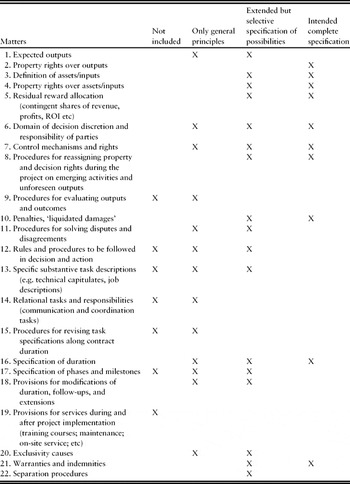
A grid for the systematic description of contract clauses was also used in these interviews. The pattern of responses is reported in Table 1, listing a variety of possible contractual matters that may enter into these contracts and the extent to which they are specified.Footnote 6 The table should be read as follows: ‘X’ indicates that the configuration described by the cell is possible, that is one or more respondents indicated that contracts typically include that matter at that level of specification; blank cells indicate that none has ticked the cell. Multiple mentions are not counted (given the reduced number of observations, a frequency-based reading is not so meaningful); that is, if only one X appears in a row, all 20 respondents indicated the same value.
Matters regulated in firm-founding contracts and degree of specification by matter

As expected, these firm-founding contracts are rather complete on the property of outputs (whatever the outputs might be, and often they are defined only in very general terms); they include very precise specifications of the resources committed and of the property rights on them, and very careful specification of partners’ separation procedures; they include general principles and sometimes extensive rules on procedural matters (especially on how to solve conflicts), while they are less specific and sometimes limited to general principles or even silent on what activities and tasks are to be conducted, and even on what outputs should be produced (and often also on how to select them).
In further support of the argument made here, if CV/entrepreneur contracts are analyzed over time, as Suchman (Reference Suchman1994) did in the Silicon Valley, they result as having converged over some 20 years to a couple of contractual formulas (that the author labels ‘close’ and ‘flexible’ contracts). These formulas are extremely concerned with fine-tuning a balanced and locking-in allocation of property rights to the key resource providers, but are rather short and undetailed on tasks, as the argument advanced here predicts. The earlier situation, at the rise of the industry, was characterized by trying out a wider variety of contractual schemes, including obligational, task contingent, long, detailed contracts (labeled ‘pre-programmed’ and ‘legalistic’ by Suchman) and market-like short-term contracts (labeled ‘minimalist’ and ‘weak’).
Project-based partnership contracts
Empirical studies on inter-firm networks generally indicate that when different partners engage in collaboration geared to innovation, and tasks are relatively complex, both informal agreements and obligational contracting, including numerous job descriptions, contingent claim clauses, and hierarchical provisions, tend to fail, and partnerships involving property right sharing tend to prevail (Grandori and Soda, Reference Grandori and Soda1995). This pattern is consistent with the argument advanced here. More precise and directly relevant evidence is provided by empirical studies on the content of contracts regulating knowledge-intensive economic collaborations and projects.
Relevant results on the incidence of property rights specification and of constitutional provisions in innovation-oriented alliances include the following. In addition to property rights on input resources and outputs, formal contracts typically mention general principles and codes of conduct that should inspire behaviors (good faith, due diligence, non-competition); procedures for conflict resolution (negotiation procedures, type of mediation, and arbitration admitted); and procedures for decision making (joint-steering committees, specialized areas where different partners can decide autonomously, information rights, and obligations) (Grandori and Furlotti, Reference Grandori2006).
In a detailed content analysis of a large sample of joint-venture contracts in the US biotechnology industry, Lerner and Merges (Reference Lerner and Merges1998) offer in a footnote the following interesting and relevant comment: ‘The detailed control rights assigned in alliance contracts are aspects of ownership that must be distinguished from mere contractual contingencies. They do not spell out a myriad of possible world-states, dictating outcomes under each of many scenarios. Instead, they are discrete aspects of the fundamental ownership right over the research results’ (p. 134).
In a further documental analysis of the texts of around one hundred research and development biotech collaboration agreements belonging to the same database, Furlotti (Reference Furlotti2007) found that in over 80% of cases, a permanent structure, or a permanent role, (distinct from the contractual parties) is assigned decision-making rights over important activities of the project. The structure is always (98.5%) a joint-steering committee; the representation in such a Committee is always egalitarian; there is moderate use of arbitration authority to solve matters even where the Committee cannot reach a majority decision (in 32% of cases). In over 70% of cases, the agreement explicitly grants the right to terminate without cause, but, in most cases, the terminating party loses rights over the intellectual property developed within the project. Non-negligible contingent task specifications are included in less than 50% of cases.
Here, we present a new analysis of the contracts regulating large multi-party projects. The data are part of the KGP database, composed of 500 questionnaires gathered in various countries in project-intensive industries.Footnote 7 The questionnaire section on contractual provisions employed in the KGP project was an aggregated version of the checklist employed to enquire on firm-founding contracts illustrated above. Table 2 presents an analysis of the differences among the mean values of specification of contract clauses in the three sectors of ‘high-tech’, creative’, and ‘engineering’. In high-tech and creative industries, uncertainty should be higher on all dimensions: lower predictability of tasks, higher need to find new solutions, lower observability of action, greater incidence of intangible assets. Hence, the hypothesis, derived from our framework, is that we should observe higher formalization of property rights and lower task specification in those two sectors with respect to engineering.Footnote 8
Contractual specification of property rights and action rights and obligations in multi-party projects

While differences between high-tech and creative industry projects are not significant, the differences between those projects and those in the construction and engineering industry are significant in the predicted direction.
Considering only the sub-sample of ‘high-tech’ industries in the Silicon Valley (for reasons of comparability with other existing empirical researches in this context, reported above, and because the sub-sample can be assumed to be most consistently characterized by high innovativeness), even the simple general frequencies of the degree of specification of matters into contracts are quite telling and supportive of the argument advanced here. The percentage of contracts that are reported to completely specify property rights is 70%, which becomes 90% when the cases of extensive specification are added. By contrast, tasks are declared to be specified in extensive or intendedly complete ways in 55% of cases.
5. Conclusions
In the light of the argument presented here, the ‘nature of the firm’ has little to do with substituting authority and central planning for decentralized governance (the reminiscence of the market versus planned economy obsession. . .) and a lot more to do with a shift from substantive to procedural governance and rationality. In addition, the formation of firm organization has a lot to do with uncertainty but much less with incomplete contracting and hold-up ‘problems’. Firms do not exist because contracts are incomplete and parties are ‘locked-in’ by specific investments, these being the ‘problems’ to be solved by some extra-contractual mechanism, as in the transaction cost and property right theory tradition. The firm itself is a contract, but not just a nexus of transactional contracts as in the agency theory tradition. It is a contract constituting a proprietary society, complete in the rights and obligations of asset commitment and on decision rights, and rationally undetermined (rather than incomplete) on tasks, contingencies, and time. The fact that contingencies cannot be foreseen is essential, but this does not imply that in the face of uncertainty contracts are necessarily ‘incomplete’, as typically maintained in the incomplete contract literature. Society establishing contracts are ‘complete’ because they are procedural rather than substantive: they specify more general rules and commitments (resource investments and decision procedures) ‘no matter what’ the tasks and contingencies might be.Footnote 9 Such a contract is a rational response, the solution rather than the problem to be solved, and it is, basically, a complete contract solution.
These conclusions respond to Demsetz's (Reference Demsetz, Williamson and Winter1991) invitation to revisit the ‘theory of the firm’, envisaging an enlarged notion of ‘firm-like contracts’ as ‘continued associations among co-specialized, dedicated assets, coordinated by conscious direction’ and paying attention to knowledge considerations. In the course of doing so, the analysis conducted here also provides various refinements and caveats with respect to Demsetz's definition. First, it clarifies that ‘conscious direction’ should not be equated with unilateral or centralized direction (as Demsetz himself tended to do). Conscious direction can be decentralized and democratic as well; and, actually, it should be so, under condition of high uncertainty and distributed knowledge. Second, the ‘co-specialization and dedication of assets’ need not be based on asset specificity or resource uniqueness. Resource complementarity of any sort can make the joint dedication of assets attractive (Richardson, Reference Richardson1972). More than asset specificity and hold-up problems to be solved, it is the hypothesis of an opportunity of joint gain and the lack of knowledge about how precisely this might be realized, coupled with the necessity of taking responsibility among partners in the venture and towards third parties, that generate the need for a contract on asset pooling and asset ownership. In other words, the explanation of the nature of the firm as a society-establishing contract has the attractive feature of being independent from the particular governance regime adopted within the firm (for example, authoritarian or democratic) and from assumptions of asset specificity. This feature of the framework squares well with the empirical evidence that hierarchical firms and firms based on the internalization of highly specific transactions seem indeed to be particular cases (Aoki, Reference Aoki and Grandori2004; Holmstrom and Roberts, Reference Holmstrom and Roberts1998; Goldberg, Reference Goldberg1980), as much as decentralized, non-hierarchical, knowledge sharing and entrepreneurial firms (Alvarez and Barney, Reference Alvarez and Barney2007; Foss and Klein, Reference Foss and Klein2002).
By specifying what precisely these contracts are about, we have also found out in what precise sense it is better to have a theory of the type of contracts to which the firm is ‘like’, rather than a ‘theory of the firm’ and ‘firm-like’ contracts. Proprietary asset pooling and constitutional contracts in fact include firms but also other types of economic societies that are not usually defined as ‘firms’ but have quite similar functions. This may help in overcoming the circularities between the legal and economic definitions of the firm (each one referring to the other to define the object) (Masten, Reference Masten, Buckley and Michie1996), while maintaining the definition of the firm anchored to legal and historical considerations (Hodgson, Reference Hodgson2002). Furthermore, it helps in explaining why organizations ranging from modern corporations and proprietary partnerships, to ancient ‘commenda’ set up to undertake large-scale projects under uncertainty have so much in common (Hodgson, Reference Hodgson2002; Brouwer, Reference Brouwer2005; Hansmann et al., Reference Hansmann, Kraakman and Squire2006).
The explanation of the formation of firms in terms of the discovery and conflict resolutions functions of proprietary society-establishing contracts does not exclude that these contracts and the firm also have other functions. In particular, it does not exclude that it has the function of reducing production and transaction costs in the exchange of specific goods and services under uncertainty.Footnote 10 Actually, any robust institution has multiple functions. However, the explanations of the firm in terms of these transaction and production cost reduction functions still need, and in fact employ, some characterization of the nature of the firm and of ‘internal’ governance. A new and wider specification of it, independent and prior with respect to its functions in also solving transactional hazard problems, has been provided in this paper.
This explanation has been shown to generate robust and innovative interpretations of relevant findings on firm foundations, joint-venture and capital-venture relations, and complex project governance. Among further applications, studies on the governance of labor and employment relations seem a particularly desirable and challenging test for the proposed view; according to which that ‘contested terrain’ can be suspected to be overly governed by authority, plans, and incentives, to the detriment of constitutional and democratic governance. On prescriptive grounds, it can also be pointed out that, once the similarity between firms and other institutions regulated by society-establishing contracts is discerned, the potential for reciprocal learning among apparently different institutions can be developed.