


INTRODUCTION
Understanding the prevalence of competition in tropical forests is essential for improving our knowledge on species coexistence and demographic processes. One of the main questions is whether competition leads to more regular tree patterns with increasing size class (Condit et al. Reference CONDIT, ASHTON, BAKER, BUNYAVEJCHEWIN, GUNATILLEKE, GUNATILLEKE, HUBBELL, FOSTER, ITOH, LAFRANKIE, LEE, LOSOS, MANOKARAN, SUKUMAR and YAMAKURA2000, He et al. Reference HE, LEGENDRE and LAFRANKIE1997). In species-poor temperate or boreal forests the neighbourhood of individuals is relatively predictable and species may evolve negative pairwise interactions (Kenkel Reference KENKEL1988). Compared with temperate forests, in the species-rich tropics, the set of species neighbours encountered by individuals of a given species is more variable (Hubbell & Foster Reference HUBBELL, FOSTER, Diamond and Case1986). For example, on Barro Colorado Island, Panama, there are an average of 14 different tree species among the 20 nearest neighbours of a given tree (Hubbell Reference HUBBELL2006), and similar findings have been shown for the Sinharaja forest in Sri Lanka (Wiegand et al. Reference WIEGAND, GUNATILLEKE and GUNATILLEKE2007). Such unpredictable neighbourhoods are due to the large number of species in combination with intraspecific aggregation, favoured, for example, by habitat association or dispersal limitation (Hurtt & Pacala Reference HURTT and PACALA1995). This has been used as support for the hypothesis of diffuse co-evolution in species-rich tropical forest communities (Hubbell Reference HUBBELL2006, Hubbell & Foster Reference HUBBELL, FOSTER, Diamond and Case1986). The argument is that such diffuse neighbourhoods do not favour specialization or closely co-evolved interactions among species, but rather promotes convergence on functionally similar and generalist life-history adaptations to average environmental conditions (Hubbell Reference HUBBELL2006). Indeed, functional equivalence could explain why heterospecific interactions can be difficult to detect in one snapshot of the spatial pattern of larger trees (Wiegand et al. Reference WIEGAND, GUNATILLEKE and GUNATILLEKE2007). However, other studies on growth and mortality based on at least two snapshots found evidence for heterospecific neighbourhood effects on plant performance (Stoll & Newbery Reference STOLL and NEWBERY2005). Pattern analysis of single snap-shot patterns of the location of trees may be insufficient for detecting more subtle effects on plant performance. This is because a change in spatial pattern can only be induced by mortality and, consequently, only by very strong competition.
Use of additional information such as tree growth within two snapshots allows analysis of distance-dependent correlations in tree performance instead of only the inter-tree distances (Getzin et al. Reference GETZIN, WIEGAND, SCHUMACHER and GOUGEON2008a, Gray & He Reference GRAY and HE2009, Penttinen et al. Reference PENTTINEN, STOYAN and HENTTONEN1992). This allows exploring if plant performance shows spatial patterns that may indicate competitive interactions even if the spatial pattern of tree locations shows no deviation from a random distribution. Such analyses can be done using mark-correlation functions for continuous marks (Illian et al. Reference ILLIAN, PENTTINEN, STOYAN and STOYAN2008, Stoyan Reference STOYAN1984). In this study, we use recent techniques of spatial point pattern analysis and data from a fully mapped 1-ha plot of the species-rich Biakoa forest, Cameroon, to detect spatial neighbourhood effects on plant performance, measured by size, i.e. diameter at breast height (dbh) and annual biomass increment (BI). We focus on the potential interactions between trees of different size strata (understorey, midstorey and overstorey). In a first group of analyses, we investigate if the spatial patterns of all trees and of the different size classes show non-random spatial patterns and if measures of plant performance are spatially correlated. In a second group of analyses, we study interaction effects between trees of different size classes, both regarding their spatial distance pattern and the measure of plant performance. We use tree height to classify different strata but not to measure plant performance. Individuals can co-exist under dense packing, but competition for essential resources such as light and nutrients may ultimately drive competitive spacing. Based on these considerations we derive three guiding hypotheses on spatial patterns expected under competition: (1) The tree distribution pattern within a stand tends to become more regular with increasing size class. This is the classical investigation of the random mortality hypothesis (Kenkel Reference KENKEL1988). (2) Dense neighbourhood has a negative impact on the tree performance measures growth and size. (3) Competitive effects between trees of different size classes are weak due to different spatial scales of resource uptake.
Our approach of integrating knowledge on age and growth rates via tree ring analysis (Worbes et al. Reference WORBES, STASCHEL, ROLOFF and JUNK2003) should be particularly suitable for our spatial analysis of tropical forest dynamics.
METHODS
Study site
The study site is the Biakoa forest, located in central Cameroon, 15 km north-east of the village Biakoa (4°40’N, 11°32’E). This semi-deciduous forest is situated at 600 m asl on a deep latosoil with 50% clay. The area receives an annual precipitation of 1900 mm with temperatures varying between 22.4 °C in July and 25.0 °C in February.
In terms of basal area Triplochiton scleroxylon K. Schum. is, with 9.43 m2, the dominant tree species but another 80 species coexist in the plot. All trees with a dbh ≥ 10 cm were stem-mapped within a 100 × 100-m plot (Figure 1). Their x, y-location, dbh and height were measured. Wood samples were taken with an increment corer for the growth analysis. The core samples served for (1) the estimation of the wood density and (2) for the determination of the age of the trees by counting the tree rings. Growth rates were determined from the age and the diameter at breast height of the individual trees. Proof for the existence of annual rings was described in detail in Worbes et al. (Reference WORBES, STASCHEL, ROLOFF and JUNK2003). According to the results of the age determinations we assume the forest as being in a late secondary successional stage. The dominant species T. scleroxylon is a long-lived pioneer with individual ages below 200 y. The mean age of all individuals in the plot above 10 cm dbh is 61 y. Both measures hint to a relatively young stand in comparison with other mature tropical forests (Worbes et al. Reference WORBES, KLINGE, REVILLA and MARTIUS1992), where tree ages of 400–500 y are typical for the oldest individuals (Worbes & Junk Reference WORBES and JUNK1999).
Map of the 1-ha study plot in Biakoa forest, central Cameroon, showing the spatial distribution of the three size classes: overstorey (○), midstorey (□) and understorey (Δ). Bubble sizes are proportional to the dbh, with smallest trees having a dbh of 0.1 m and largest trees a dbh of up to 1.3 m.

Statistics
We classified the 513 individuals into three different size strata, i.e. understorey: 4–9 m height, midstorey: 10–17 m, and overstorey: 18–55 m (Table 1). Nearest neighbour analyses as well as linear regressions between tree height and dbh, and tree height and biomass increment were done for the individuals within size strata.
Number of species, individuals, and nearest neighbour distance of trees in three size classes. For more details on structure, species composition, and site conditions of the 1-ha plot at Biakoa, Cameroon, see Worbes et al. (Reference WORBES, STASCHEL, ROLOFF and JUNK2003).

Pair-correlation functions
The pair-correlation function g(r) is a spatial correlation function that analyzes the change in tree density for various scales (Stoyan & Stoyan Reference STOYAN and STOYAN1994). Based on inter-tree distances, the g function describes clumping and regularity at a given radius r, using a standardized density. Hence, g(r) = 1 under complete spatial randomness (CSR), g(r) > 1 indicates aggregation, while g(r) < 1 indicates regularity. The univariate version of the pair-correlation function can be transformed to a bivariate version, e.g. in order to analyse the spatial relation between two height classes of trees.
Mark-correlation functions
The classical techniques of point pattern analysis described above investigate the spatial structure of a pattern of trees based on distances only. However, the trees may have additional properties (marks; e.g. size) and it might be of interest to explore if there is a spatial correlation structure in the marks, conditional on the spatial pattern of the trees that carry the marks. For example, under inhibition we expect that plants which are located close to each other should be on average smaller than the population average (Getzin et al. Reference GETZIN, WIEGAND, SCHUMACHER and GOUGEON2008a).
Mark-correlation functions (Illian et al. Reference ILLIAN, PENTTINEN, STOYAN and STOYAN2008, Stoyan Reference STOYAN1984, Stoyan & Penttinen Reference STOYAN and PENTTINEN2000) are especially adapted to investigate questions on density-dependent size reduction. The idea behind mark-correlation functions is as follows: two plants i and j which are separated by distance r are randomly picked from the pattern and the value of an appropriate test function t(mi, mj) involving the marks mi and mj of the two plants is calculated. The value of the test function is then averaged for all pairs located at distance r, for all distances r > 0, and normalized with the non-spatial expectation c t of the test function yielding the mark-correlation function k t(r). The mark-correlation function is therefore the normalized expectation of the test function of a ‘typical pair of points’ which is separated by distance r. More formally, an estimator of the mark-correlation function is given by
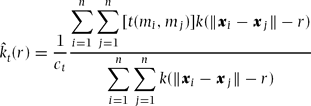
where t(mi, mj) is the test function which is a function of the mark mi and mj of points i and j, respectively, and k(‖x i−x j‖−r) is a kernel function which picks all pairs of points which are located approximately at distance r given a tolerance h (the bandwidth). If the distance ‖x i−x j‖ between the two points i and j is close to r (i.e. r − h/2 < ‖x i−x j‖ < r + h/2), the kernel function yields a value of 1 and zero otherwise. This kernel function applies to the mark- and pair-correlation functions alike.
Here we used the test function t 1(mi, mj) which is especially designed to explore questions regarding competition. This test statistic is the product of the two marks mi and mj of the points i and j, respectively, and yields the mark-correlation function

The non-spatial average of this test function yields c t1 = μ 2 where μ is the average mark taken over all points of the pattern. The subscript of the test function was selected in accordance with the terminology introduced by Illian et al. (Reference ILLIAN, PENTTINEN, STOYAN and STOYAN2008). Under mutual inhibition, we expect that the size of nearby plants will be on average smaller than that of the population average, thus k t1(r) < 1.
Mark-correlation functions can be extended to bivariate functions (Mateu Reference MATEU2000). This allows us to study potential competitive interactions between plants of two types (e.g. overstorey and understorey trees). The mark mi is now the mark of a point of pattern 1 (i.e. the typical point of pattern 1) and mj is the mark of the typical point of pattern 2 which is located at distance r from the typical point of pattern 1. Thus, only pairs of points in which a type 2 point is located at distance r away from a type 1 point are considered. Subtle effects of the size of the focal tree can be explored when using the test function t 1(mi, mj) = mi mj that returns the product of the marks of a pair of two different types of points which are distance r apart. Under mutual inhibition we would expect that the mark product of two nearby trees should be on average smaller than the product of the average marks, i.e. k m1,m2(r) < 1.
Null models
For univariate distance correlations with the pair-correlation function we used complete spatial randomness (CSR) as null model to detect regularity or aggregation in the spatial patterns. For bivariate distance correlations we contrasted the empirical pair-correlation functions against that of simulations of the null model of independence based on a toroidal shift (Goreaud & Pélissier Reference GOREAUD and PÉLISSIER2003, Wiegand & Moloney Reference WIEGAND and MOLONEY2004). Because these approaches do not hold in case of heterogeneous point densities (Wiegand & Moloney Reference WIEGAND and MOLONEY2004) we inspected the empirical pair-correlation functions. If the uni- or bivariate pair-correlation functions did not approach the value of one asymptotically at larger scales the pattern may show heterogeneity.
For univariate mark-correlation analysis we randomized the marks over the trees, i.e. we repeatedly shuffled the dbh (or biomass increment) value between pairs of trees until any potential spatial structure in the marks was removed. For bivariate mark-correlation analyses we used a null model in which we left the marks of the focal pattern 1 unchanged but randomized the marks of the second pattern following the same approach as explained above for univariate null models. This null model evaluates effects that plants of pattern 1 exert over plants of pattern 2. To verify that the marked pattern was approximately homogeneous we used the mark variogram γ m(r) (Wälder & Stoyan Reference WÄLDER and STOYAN1996) with test function t 4(mi, mj) = (mi − mj)2/2. It is especially sensitive to heterogeneity in the marks (Illian et al. Reference ILLIAN, PENTTINEN, STOYAN and STOYAN2008).
Significant departure from the null models was evaluated based on approximately 95% simulation envelopes, using the fifth-lowest and fifth-highest value of 199 Monte Carlo simulations.
RESULTS
Most individuals belonged to the size class of understorey trees and least individuals to the overstorey. Median nearest-neighbour distances increased between individuals with increasing size class, indicating that larger trees require more space (Table 1). The correlation between dbh and tree height was strongest for the overstorey trees (r 2 = 0.75) and declined rapidly for the two lower size classes (Figure 2a). Hence, the taller the trees are, the less they are negatively affected by competitive effects on plant performance. The correlation between biomass increment and tree height again was strongest for the overstorey trees but differences to lower size classes were less pronounced (Figure 2b).
Correlation between diameter at breast height and tree height (a) for the three size classes: overstorey (○), midstorey (□) and understorey (Δ), and between biomass increment and tree height (b), respectively.

Univariate patterns
The pair-correlation function of all univariate patterns approached their asymptotic value of approximately one within 25 m (Figure 3a–d) which supports the visual impression of the pattern (Figure 1) of being homogeneous. The same result was found when using mark variograms to verify homogeneity of marks (result not shown).
Distance correlations with the univariate pair-correlation function (a–d). Correlations in dbh (diameter at breast height) and BI (annual biomass increment) with the univariate mark-correlation function (e–l). If black line is below dashed line of lower confidence envelope, distances, dbh or BI are negatively correlated at radius r, indicating density-dependent mortality or competition between individuals within the same size class.

Distance correlations with the pair-correlation function revealed that ‘all trees’ analysed together had a regular pattern up to 1.5 m, being evidence for competition within the entire stand. Overstorey trees were randomly distributed but mid- and understorey trees showed marginal regularity at radius 0.5 m (Figure 3a–d). Despite an increase in nearest-neighbour distances, there was no trend toward a more regular pattern of tree spacing with increased size due to increased competition for space. Thus, surprisingly, the regularity found for all trees was not primarily caused by trees within size classes.
Analysis of spatial patterns in plant performance with the mark-correlation function revealed lack of patterning in tree size (i.e. mark dbh) and biomass increment for all trees and the three size classes separately (Figure 3e–l). Departures from the null model detected with the pair-correlation function were not observed for the mark-correlation function because all marks were uncorrelated within strata.
Bivariate patterns
The bivariate pair-correlation function of all bivariate patterns approached its asymptotic value of approximately one within 25 m (Figure 4a–c) thus indicating that the patterns were homogeneous. The same result was found when using mark variograms to verify homogeneity of marks (result not shown).
Distance correlations with the bivariate pair-correlation function (a–c). Correlations in dbh (diameter at breast height) and BI (yearly biomass increment) with the bivariate mark-correlation function (d–i). If black line is below dashed line of lower confidence envelope, distances, dbh or BI are negatively correlated at radius r, indicating density-dependent mortality or competition between individuals belonging to different size classes.

The bivariate pair-correlation function for over- vs. midstorey, over- vs. understorey, and mid- vs. understorey trees indicated clear repulsion effects between trees of different size classes (Figure 4a–c). Negative distance correlations were particularly strong (up to 1.5 m) between mid- and understorey trees. These results point to competition in the stand between these two smaller size classes. However note that it is unlikely that the bivariate repulsion is caused simply by competition for space due to the physical size of the trees because this should be also noted in our univariate analyses within strata.
While the dbh in all univariate patterns was uncorrelated, it was negatively correlated up to 0.5 m between over- and midstorey trees (Figure 4d), providing additional evidence that the strongest competition was between the size classes and not within them. For this scale, the mark-correlation function k m1,m2(r) indicates that the mean of the product of dbh1 and dbh2 is significantly smaller than the mean of the product of the dbh for over- and midstorey trees taken together. No other correlations among dbh or biomass increment revealed significant departures from the null model, except for two cases. Between understorey and overstorey trees, there was a positive correlation of dbh and biomass increment at radius 4.0–6.5 m (Figure 4e, h).
DISCUSSION
With this study of a fully mapped forest plot in tropical Cameroon we intend to add new insights to the controversy about the spatial dynamics of competing trees in tropical forests. The question of whether trees strongly compete in larger size classes (Peters Reference PETERS2003, Picard et al. Reference PICARD, BAR-HEN, MORTIER and CHADOEUF2009) or not (He et al. Reference HE, LEGENDRE and LAFRANKIE1997, Lawes et al. Reference LAWES, GRIFFITHS, MIDGLEY, BOUDREAU, EELEY and CHAPMAN2008) is an interesting question for our general understanding of tropical forest ecology. Likewise, answers to this question are also valuable for sustainable timber production, thus for adequate harvesting methods in rain forests. We are aware that contrasting findings on the dynamics of competition may partly be due to different histories of forest plots. Here we present insights from an undisturbed semi-deciduous forest in a late secondary stage that has trees of an age up to 220 y.
Besides increasing nearest-neighbour distances with increasing size class, we did not find evidence that overstorey trees are subject to strong competition. These tall trees with most access to light were just randomly distributed. Also, their dbh and annual biomass increment were uncorrelated at all scales. So we did not find evidence for mutual inhibition in this large size class. The correlation between dbh and tree height was very strong and it was also stronger between biomass increment and tree height than for the two lower height classes. Obviously, once these trees have reached such tall sizes and exceeded a demographic threshold, competition is of minor importance in this tropical forest. Our study supports findings from a comparable forest plot in African forest (Lawes et al. Reference LAWES, GRIFFITHS, MIDGLEY, BOUDREAU, EELEY and CHAPMAN2008) but it contradicts the statement of Picard et al. (Reference PICARD, BAR-HEN, MORTIER and CHADOEUF2009) who argue that ‘the spatial pattern observed . . . seems to be common for natural tropical forests, where large trees organize themselves in a regular way’. Interestingly, Pélissier (Reference PÉLISSIER1998) found for large adult trees in three different plots in tropical India three different patterns: regularity, randomness and randomness with a tendency towards regularity. While Pélissier (Reference PÉLISSIER1998) ascribed the regular pattern to strong inhibitory effects between competing adults, he explained the other patterns in part as a result of spatial heterogeneity. Abiotic heterogeneity and spatial patchiness in environmental quality causing variable conditions for growth are often a reason for ‘virtual’ aggregation (Condit et al. Reference CONDIT, ASHTON, BAKER, BUNYAVEJCHEWIN, GUNATILLEKE, GUNATILLEKE, HUBBELL, FOSTER, ITOH, LAFRANKIE, LEE, LOSOS, MANOKARAN, SUKUMAR and YAMAKURA2000, Dovčiak et al. Reference DOVČIAK, FRELICH and REICH2001, Getzin et al. Reference GETZIN, DEAN, HE, TROFYMOW, WIEGAND and WIEGAND2006) but this could not have been the reason for random patterns of overstorey trees on our plot. Generally, an explanation for our observed overstorey patterns is difficult and except for very weak effects of competition, alternative hypotheses may be valid. For example, exogenous disturbance events (Coomes Reference COOMES2003), other density-dependent mortality effects such as herbivory or disease transmission (Babweteera & Brown Reference BABWETEERA and BROWN2010, Lawes et al. Reference LAWES, GRIFFITHS, MIDGLEY, BOUDREAU, EELEY and CHAPMAN2008), or inherent facilitating population dynamics (Murrell Reference MURRELL2009) might be more important for pattern formation than the direct effects of competition among large adult trees.
We found evidence for competition between trees within the smaller size classes of mid- and understorey trees but competition within these separate size classes was lower than expected for their relatively high densities. There was only slight regularity at radius 0.5 m, and dbh and biomass increment were uncorrelated at all scales. Why then is the univariate pattern of ‘all trees’ strongly regular up to a scale of 1.5 m and hence, where does the main competition occur? The answer to this question becomes clear through the bivariate analyses.
Main competition prevailed between the different height classes because there were always significantly fewer trees of the lower height class in the neighbourhood around taller trees than expected from the density of smaller trees. Strongest repulsion occurred between mid- and understorey trees because the spatial range of negative distance correlation reached up to 1.5 m. This cannot have been simply a physical size effect because negative distance correlations between large overstorey trees with large tree crowns and smaller mid- or understorey trees, respectively, reached only up to 1.0 m. Probably, overstorey trees do not share as much of the same resource with lower size classes (e.g. have deeper roots). In contrast, the more wide-ranging and intense competition between mid- and understorey trees is likely due to more similar resource requirements for soil water, nutrients and light among these relatively smaller size classes (Getzin et al. Reference GETZIN, WIEGAND, WIEGAND and HE2008b, Lawes et al. Reference LAWES, GRIFFITHS, MIDGLEY, BOUDREAU, EELEY and CHAPMAN2008, Worbes et al. Reference WORBES, STASCHEL, ROLOFF and JUNK2003). We cannot directly differentiate between competition for above-ground light and below-ground resources. However, in terms of light, the smaller-than-average dbh at the scale of 0.5 m indicates that midstorey trees possibly have to pay a price when growing too close to the shading overstorey trees (Figure 4d). Similarly, the positively correlated dbh and biomass increment between over- and understorey trees at the scale of 4.0–6.5 m is probably just the radius outside the immediate canopy of the overstorey trees. Hence, growth of understorey trees is triggered at these critical neighbourhood scales around the periphery of large overstorey trees (see also Plotkin et al. Reference PLOTKIN, CHAVE and ASHTON2002).
It is interesting that competition between size classes was evident from the distance correlations alone while the bivariate correlations in dbh and biomass increment did not show such consistent evidence. This is surprising because mark-correlation functions are ideal to detect nuances of competition via mutual size reduction (Getzin et al. Reference GETZIN, WIEGAND, SCHUMACHER and GOUGEON2008a, Gray & He Reference GRAY and HE2009). We have also analysed all univariate and bivariate data with other mark-correlation variants t2, t3, t4 (Illian et al. Reference ILLIAN, PENTTINEN, STOYAN and STOYAN2008), for example, r-mark functions or mark variograms to detect subtle dualities in interaction such as asymmetric competition. However results did not differ from our presented analyses. Why then was the detected competition less evident from mutual inhibition of growth?
Possibly, the many tree species within one size class constitute an overriding plasticity in tree attributes such as dbh and biomass increment so the multiple controlling factors that may potentially shape the distribution pattern are more important. For example, sudden death following pathogen transmission or exogenous disturbance factors might be such reasons (Coomes Reference COOMES2003, He et al. Reference HE, LEGENDRE and LAFRANKIE1997). It could also be that the static pattern we do currently see is just the final outcome of much more important competitive processes that went on earlier in time. This means that competition and other interactions have already equilibrated (Wiegand et al. Reference WIEGAND, GUNATILLEKE and GUNATILLEKE2007) because the ‘establishment of seedlings and the fate of saplings are the likely primary determinants of tree-spacing patterns’ (Lawes et al. Reference LAWES, GRIFFITHS, MIDGLEY, BOUDREAU, EELEY and CHAPMAN2008). Such an explanation would of course only be valid for the snap-shot pattern and previous dynamics we have currently analysed but not necessarily for ongoing dynamic processes that will change the forest structure in future.
In conclusion, we used techniques of spatial point pattern analysis which are known to be very sensitive in detecting subtle effects of spatial patterning in tree locations and marks such as size or biomass increment (Getzin et al. Reference GETZIN, WIEGAND, SCHUMACHER and GOUGEON2008a, Penttinen et al. Reference PENTTINEN, STOYAN and HENTTONEN1992). To our surprise the patterns within and between strata were basically random and independent, respectively, and the marks that characterize plant performance did not show spatial correlations. The only evidence for interactions was small-scale repulsion effects among trees of different size strata. On the first view, such results reporting basically absence of expected effects may look uninteresting and insignificant however, the rise of neutral theories (Hubbell Reference HUBBELL2006) turned the attention to absence of interactions as one of the fundamental mechanisms that can explain high diversity in tropical forests. In this light it is an important finding that trees in tropical forests such as in central Cameroon do not necessarily show patterns expected by competition.
We found absence of increased regularization processes with increased ageing and suspect that once the tall trees have exceeded a certain size threshold, competition can be of minor importance for spacing patterns (Lawes et al. Reference LAWES, GRIFFITHS, MIDGLEY, BOUDREAU, EELEY and CHAPMAN2008). Competition within size classes may be relatively low in tropical forests because the great diversity of species with their variable niche differentiations and phenotypic plasticity may compensate for competitive effects (Hubbell Reference HUBBELL2006). Individual interaction in tropical forests may arise between height classes because dynamic competition between the fast-growing trees is mainly for light. A competitive edge in size dominance is therefore strongly exploited at the expense of potential resource uptake in lower height classes.
In terms of forest management, the observed findings support those from Figueira et al. (Reference FIGUEIRA, MILLER, DE SOUSA, MENTON, MAIA, DA ROCHA and GOULDEN2008) that selective logging stimulates increment rates of understorey trees in the remaining stand but does not affect growth rates of remaining trees with diameter >55 cm. This implies that an additional silvicultural treatment with the aim to reduce competition between future crop trees might also have a positive effect on growth rates (Peña-Claros et al. Reference PEÑA-CLAROS, FREDERICKSEN, ALARCÓN, BLATE, CHOQUE, LEAÑO, LICONA, MOSTACEDO, PARIONA, VILLEGAS and PUTZ2008) which is observable mainly for shade-tolerant and pioneer trees but not for long-lived pioneers.
ACKNOWLEDGEMENTS
This study was supported by the German Research Foundation. We are grateful to the Ministry of Environment and Forest in Cameroon and Dr H. L. Stoll who enabled the field studies in the Biakoa forest.



