


Introduction
Misophonia – a condition characterized by disproportionately strong affective and physiological reactions to certain sounds – is a relatively recently identifiedFootnote † condition that is empirically poorly understood (Schwartz et al. 2011). Sometimes called selective sound sensitivity syndrome (SSSS or 4S) or soft sound sensitivity, misophonia is not included in DSM-V (APA, 2013), has no formal diagnostic formulation, and has been referenced in only a few research articlesFootnote ‡. Many had never heard of the condition before it was featured in news reports from the New York Times (Cohen, Reference Cohen2011) and the Today Show (Carroll, Reference Carroll2011) among others (e.g. Berman, Reference Berman2011; Huffington Post Healthy Living, 2011; Kivi, Reference Kivi2011; Smith-Squire, Reference Smith-Squire2011; Cohen, Reference Cohen2012; Deutsch, Reference Deutsch2012; Leaker, Reference Leaker2012). One positive consequence of this recent surge of media recognition is that it prompted sufferers to come forward in greater numbers. Unfortunately, however, with such a dearth of research on misophonia and its treatment, the practitioners (most of whom are audiologists) receiving this new wave of patients often struggle with how to care for them. Presently, the most typical form of treatment for misophonia involves a tinnitus retraining therapy device (Jastreboff et al. Reference Jastreboff, Gray and Gold1996; Jastreboff & Jastreboff, 2003) or other wearable white-noise generator to minimize awareness of the offending sounds (Jastreboff, Reference Jastreboff2001). While this form of intervention can be helpful with managing symptoms, it does not treat the underlying syndrome.
In this paper we suggest that cognitive behavioural therapy (CBT) may be an effective treatment for the underlying mechanisms involved in misophonia. Based on the assumption that the condition is not an auditory disorder caused by any anatomical anomaly (Møller, 2010), but instead arises from an overly sensitized connection between the limbic and sympathetic nervous systems (SNS; Jastreboff & Hazell, 2004), we hypothesize that this SNS hypersensitivity may represent a threshold effect amenable to changes in cognition, physiology, and behaviour. Further rationale for the utility of CBT comes from the fact that misophonia sufferers often have much stronger negative reactions to the sounds produced by close others compared to those made by strangers, indicating a potent attributional component to the syndrome. Indeed, there is already some anecdotal evidence to suggest that CBT might effectively treat misophonia. Recent medical journal articles (e.g. Schwartz et al. 2011) posit that CBT may help clients manage their emotions and behaviours when hearing or anticipating offending sounds. However, no empirical study has tested the efficacy of CBT for treating misophonia, nor has any case study documented a successful CBT treatment protocol. In this paper, we present a CBT anxiety protocol adapted to treat a case of misophonia in a student presenting to a university training clinic.
What is misophonia?
The marked intolerance of specific sounds that characterizes misophonia was first termed selective sound sensitivity syndome (4S) by audiologist Marsha Johnson in the 1990s. Later, neuroscientist Pawel Jastreboff used the word misophonia (‘miso’ hatred and ‘phonia’ sound) to refer to the same ‘abnormally strong negative reactions of the autonomic and limbic systems to specific sounds resulting from enhanced functional connections between the auditory and limbic systems’ (Tinnitus and Hyperacusis Clinic, 2010). According to their conceptualization, the auditory system functions normally, without abnormally high activation. At the behavioural level, however, triggering sounds evoke strong negative reactions (Misophonia UK, 2010).
The most common reaction is extreme rage, but can also include feelings of anxiety, frustration, disgust, and harm ideation (Jastreboff & Hazell, 2004). Physiologically, the triggering sound can induce an overwhelming SNS (i.e. a ‘fight or flight’) response. Sufferers may experience a panicked desire to escape, or violent urges directed at the individual making the noxious sound. The aversive reactions misophonia sufferers experience are often so potent that they can dominate lifestyle and occupational choices. People with the condition often alienate the people they are closest to, resulting in relationship dissolution, unemployment, and social isolation (Schwartz et al. 2011). The most frequently implicated triggering sounds in misophonia are those associated with oral functions (i.e. breathing, yawning, chewing, sniffling, swallowing), but can also include typing, pencil scratching, trickling water, or crinkling paper (Schwartz et al. 2011).
Aetiology and symptom development
The aetiology of misophonia remains unknown. A sudden onset often occurs in late childhood or early adolescence (Cohen, Reference Cohen2011). Initial symptoms involve noticing a particular feature of a loved one's eating or breathing habits. The afflicted individual quickly becomes obsessed by and hypersensitive to the sound(s). This sensitivity typically becomes worse over time, and often generalizes to other noises, other people, and to visual images and actions associated with the noise (Cohen, Reference Cohen2011). Family members often react to sufferers’ first complaints with annoyance or dismissiveness. As afflicted individuals realize that their sensitivity is unique, they often feel ashamed, restrict requests for accommodation, and increase avoidance to minimize exposure. Unfortunately, sufferers tend to be triggered most by those to whom they are closest (Misophonia UK, 2010).
Case study
Client characteristics and presenting problems
LizFootnote *, a 19-year-old college student, was referred to our clinic for a profound aversion to the sounds of people's slurping, swallowing, and chewing. Although she found the chewing noises of both close others and strangers unpleasant, she did not react to the same degree with strangers as with housemates and family members. She typically responded to these sounds with disgust and intense irritation towards the perpetrator, often feeling an intense desire to harshly scold them. In reality, she tended to respond to triggers by glaring at the perpetrator or sighing repeatedly in exasperation. She speculated that she probably came across to others as angry or annoyed. Because she regarded these sentiments as sharply inconsistent with her self-identity as a compassionate and loving person, she felt helpless, deeply ashamed of her sensitivity and remorseful that she was in any way imposing upon or limiting the personal freedoms of others.
At intake, Liz reported no current or past medical conditions or mental health treatment history. She reported no familial history of mental illness, although one immediate family member had a history of tinnitus. She reported first noticing her symptoms during family dinners in middle childhood. She used to complain or sometimes exaggeratedly mimic noxious chewing noises in an attempt to communicate her distress to others, though her family members thought she was ‘just being a brat’. They sometimes temporarily (and begrudgingly) stopped making the sound, but they habitually forgot and typically reoffended minutes later. Liz had quickly grown frustrated by this pattern, which she saw as inevitable (‘no one thinks about these things like I do – of course they'll forget’). She told very few people about her misophonia, and reported significant functional impairment, including an inability to enjoy social meals, and avoidance of social events. At intake Liz was clear in her conceptualization of her sensitivity as a personal, non-relational problem, and identified ‘fixing it’ as her sole treatment goal. Together with her therapist, realistic and time-limited treatment goals were operationalized as (1) significantly increasing her threshold for triggering sounds such that noises deemed highly aversive or unbearable at pretreatment would become merely unpleasant and tolerable 6–12 weeks into treatment (the typical range for CBT interventions in the university training clinic), (2) increasing the proportion of meals eaten in common areas with her housemates from 25% to 75%, and (3) increasing the proportion of social invitations accepted from 33% to 75%.
Assessment procedures
Liz's initial intake assessment included the Structured Clinical Interview for DSM-IV Axis I Disorders (SCID; First et al. Reference First, Spitzer, Gibbon and Williams2002), the Stages of Change Questionnaire (SOC; McConnaughy et al. Reference McConnaughy, Prochaska and Velicer1983), Beck Anxiety Inventory (BAI; Beck & Steer, 1993), Beck Depression Inventory II (BDI-II; Beck et al. Reference Beck, Steer and Brown1996), and Beck Hopelessness Scale (BHS; Beck et al. Reference Beck, Weissman, Lester and Trexler1974). She did not meet diagnostic criteria for any Axis I disorder. She reported slight discomfort with public speaking, but no more than the average person. She reported past periods of sadness, but had never met criteria for depression. She endorsed no symptoms of disordered eating, no fear of weight gain, and reported a stable body mass index. Liz's SOC scores indicated she was in the contemplation and action phases. Her self-reported scores were: BAI = 1, BDI = 4, BHS = 3, indicating minimal levels of anxiety, depression, and hopelessness. Her Global Assessment of Functioning (GAF) score was 70, reflecting impairments in her social and occupational functioningFootnote *.
Treatment rationale
Because Liz's reactivity to auditory triggers differed by source, we hypothesized that her cognitions influenced her interpretation of and threshold for unpleasant sounds. Given the theoretical link CBT proposes between cognition, behaviour, and physiology, we hypothesized that this threshold would be sensitive to changes not only in cognition but in physiology and behaviour as well. We designed a brief, targeted course of CBT to treat misophonia, informed by the anxiety and hypothalamic-pituitary-adrenal (HPA) axis literature (e.g. Gaab et al. Reference Gaab, Blättler, Menzi, Pabst, Stoyer and Ehlert2003), that aimed to disrupt the pattern of negative reactivity, change coping, and decrease distress. The treatment plan included: (a) a cognitive component to challenge dysfunctional automatic thoughts, (b) a behavioural component to interrupt maladaptive and avoidant coping strategies and practice helpful ones, and (c) a physiological component to help recalibrate her autonomic reactivity.
Informed consent
A consent form was designed to inform Liz that there was no established treatment protocol for misophonia, and that we had never treated misophonia in our clinic. We explained that we had created an experimental protocol that we believed would work, but that she would be the first to try it. As alternative options, we also provided a referral list of other treatment providers in the community.
Session outline
Session 1: Creating a misophonia hierarchy and introducing the CBT model
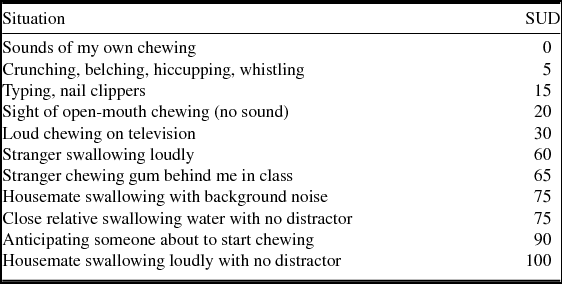
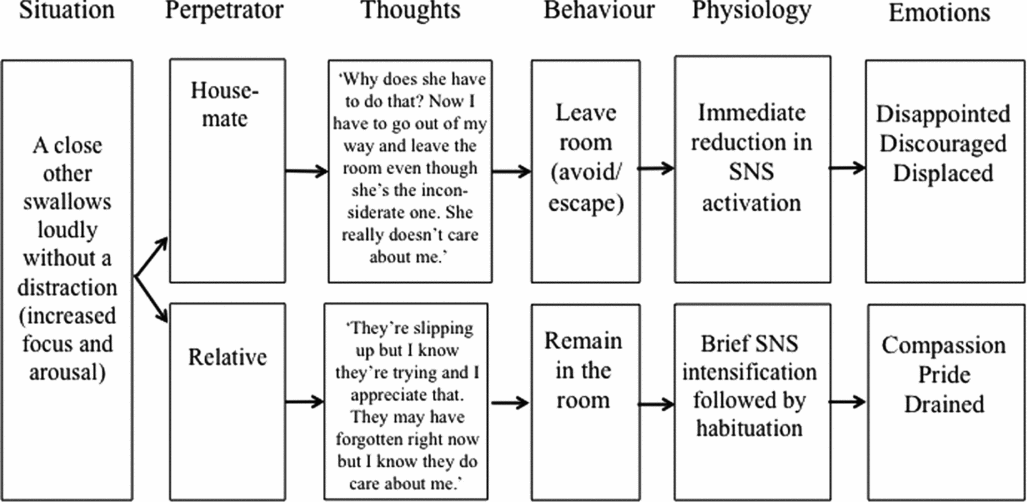
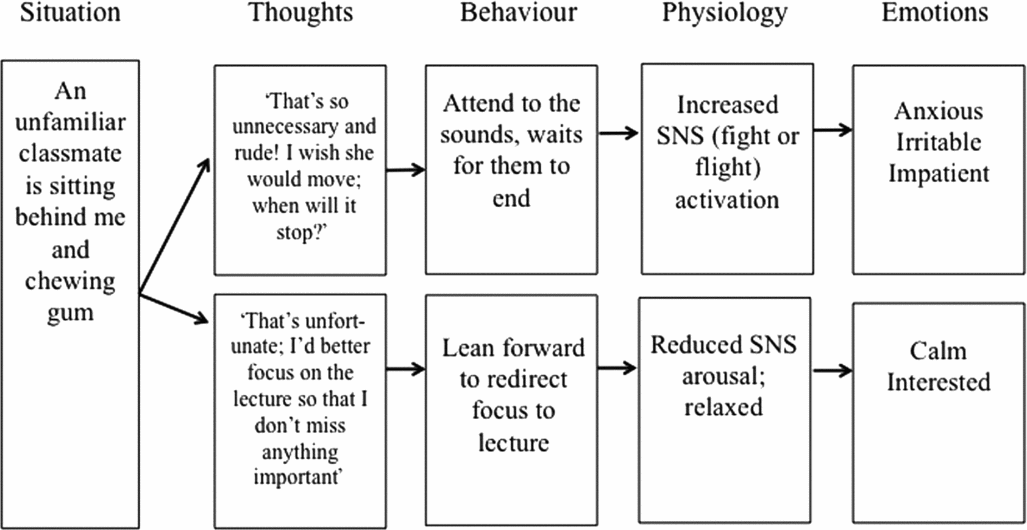
Liz and her therapist created an exposure hierarchy to systematically review the scope of her triggers. Subjective units of distress (SUD) ratings were made on a 0–100 scale (Table 1). Liz described substantial variability in her reactivity depending on her relationship to the offender, her mood at the time, and the context of the event. After identifying a range of triggers, the therapist selected several to illustrate the interrelatedness of her cognitions, physiology, affect, and behaviour. In the first diagram (Fig. 1), the therapist emphasized the power of her cognitive attributions by mapping Liz's differential responses to the swallowing sounds made by close others whom she believed were trying to be mindful of their noises (a relative, SUD = 75) vs. those made by people who, despite knowing of her sensitivity, ‘seemed to have forgotten’ (her housemate, SUD = 100). A second diagram (Fig. 2) highlighted the moderating influence of behaviour on her affect by illustrating how different coping strategies to the same moderate trigger (SUD = 65) led to divergent functional and affective outcomes. For example, while promptly leaving the vicinity was associated with immediate relief but longer-term feelings of disappointment; ‘sticking it out’ was associated with feelings of pride and accomplishment. This understanding increased Liz's motivation to persevere during triggers.
Trigger hierarchy

SUD, Subjective units of distress ratings were made on a 0–100 scale (0 = no rage, 100 = highest rage possible).
CBT model for situation 1. The interconnectivity between affect, physiology, behaviour, and cognition were illustrated in a five-column diagram. Two variants of a similar situation (one involving a housemate, the other, one immediate family member) reveal different cognitive appraisals, with divergent associated behavioural, physiological, and emotional responses. SNS, sympathetic nervous system.
CBT model for situation 2. The interconnectivity between affect, physiology, behaviour, and cognition were illustrated in a five-column diagram. While the behaviour of attending to sounds served to amplify her anxiety and physiology; leaning forward and redirecting focus acted to reduce her noticing and thinking about the noises, dampen her anxiety, and decrease her fight-or-flight response. SNS, sympathetic nervous system.
Liz and the therapist concluded from this exercise that (1) her thoughts were central determinants of her affective response such that different attributions about the intentions and understanding of others lead to divergent affective and physiological outcomes, and (2) coping behaviours were key moderators of distress. Given the first of these two conclusions, the therapist used Socratic questioning to challenge Liz's reluctance to talk to her roommates about her sensitivities and open her to the possibility that ongoing dialogue could alter her attributions and hence decrease negative affective response.
Homework. (1) Start a monitoring record for all upcoming social eating situations recording: (a) details of the situation, (b) automatic thoughts, (c) her behavioural response, (d) her physiological response, and (e) her feelings; and (2) discuss her condition with her housemates.
Session 2: Defining the problem
Liz's second session began with a review of her monitoring homework. She recorded one evening when she had ‘glared’ at her housemate who was eating a meal noisily. She suspected that her housemates discussed the incident among each other, for the next night a different housemate ate her meal extremely slowly and carefully. Liz initially felt regret and shame at this possibility, although via Socratic questioning, Liz accepted the possibility that her housemate's behaviour might signal care and consideration rather than annoyance and resentfulness.
Liz and the therapist created a reactivity timeline to identify specific micro-processes in her response to auditory triggers. This revealed that, in anticipation of an impending trigger, she experienced a short period of anxiety and dread, and maintained an increased focus on the sound source. Once the trigger could be heard, her feelings of rage and physiological reactions began. This timeline highlighted the fact that whenever she resisted the urge to leave the room, she found that her rage reliably subsided or habituated over time, rather than increasing until escape.
Liz and the therapist explored the strengths and limitations of her current behavioural repertoire by creating an exhaustive list of actual and possible coping strategies. Liz expressed reluctance to ‘overstep [her] bounds’, and a relatively low level of assertiveness. Using humour and hyperbole, the therapist modelled both appropriate and inappropriate affective responses, having Liz join her in creating outlandish possibilities. Liz and the therapist then estimated the utility of each strategy in a variety of contexts. Liz decided that the most effective strategies were: (1) distracting herself by creating other noises (e.g. humming, shuffling papers), (2) refocusing on the person instead of the triggering sounds they are making, and (3) refocusing on other available auditory stimuli (e.g. background music). Although she had only done so twice (with family members), (4) explaining her sensitivity and politely asking people to try not to make the sounds had been both helpful and well received (providing evidence that others may also be receptive).
Less effective strategies tended to be less direct and included, in order of descending utility, (5) leaning away from the source of the sound, (6) leaving the room, which, although effective, came with significant negative consequences, (7) ‘gritting her teeth and bearing it’, (8) glaring at the person making offensive sounds but saying nothing, and (9) mocking them sarcastically. Although Liz had never utilized it as a strategy, she predicted that (10) yelling, lashing out, and/or throwing food at them (hyperbolic suggestion) would be the most ineffective strategy. Liz and the therapist reflected on the fact that although she used a number of effective strategies, all were regulatory and post hoc – occurring after her physiological and emotional reactions had begun. They brainstormed ways to modify these strategies for earlier use to prevent the response cascade before it began. For example, she might distract herself with humming, shuffling papers, or focusing on background noise prior to becoming physiologically aroused, or engaging in conversation with someone before they start eating to promote a focus on the person rather than the offensive sound.
Liz had not completed her homework because she did not have a conversation with her housemates about her misophonia. She reported that she had not found the ‘right opportunity’ as she did not want to ‘disrupt or shame’ them while they were eating. In the spirit of using pre-emptive strategies, she offered to initiate such a conversation while they were not making offensive noises. Liz was nervous about initiating this conversation ‘out of the blue’, but the therapist reminded her that evidence from previous interactions with relatives and housemates suggested that she was more likely be met with sensitivity and care than anger and resistance.
Homework. (1) Continue practising effective regulatory coping strategies, (2) start using new preventative strategies, and (3) use a four-column format to record behaviours, thoughts, emotions, and physiology. Such monitoring would help test whether disrupting her automatic thoughts might prevent distress escalation, and to determine the flexibility of her cognitions.
Session 3: Testing physiology
On the third session, Liz's monitoring noted one instance of her looking away before a housemate drank water, which had kept her from becoming agitated. She also reported that she had talked with two of her housemates while out on a walk about her continued reaction to their eating sounds. Her housemates seemed surprised by her admission. They told her they had been respecting her previous assurance to them that the problem was hers; and that they should not change their behaviour on her account. Her housemates had listened and remained non-defensive during this conversation. However, she noted little if any difference in their behaviour since, which left her feeling irritated, exasperated, and doubtful that they could change. Using Socratic questioning and reviewing the evidence, Liz re-evaluated her scepticism, and reasoned that given many requests she had made of her family, one conversation with her housemates would not likely resolve everything. Reframed, this was seen as a first step towards a constructive, open dialogue, which engendered more optimism. Liz reported that she looked forward to continuing the conversation with more specifics about the triggers that are especially bothersome.
Next, the therapist introduced the role of physiology in misophonia. She described the role of the HPA axis in sound reactivity via the fight-or-flight mechanism, and the flexibility of this system to change. A brief psychoeducational segment outlined how physical exercise serves two important therapeutic functions: (1) it modifies HPA axis reactivity, and (2) increases endorphins (notable here as Liz had previously reported lowered reactivity to offensive sounds when in a good mood). Liz reported having no current meditation or exercise routine other than bike-commuting to campus. She enthusiastically agreed to complete 20 minutes of exercise immediately before dinner for three or four nights during the week. Refraining from exercising the remaining nights would serve as an experimental manipulation to test the hypothetical association between physical activity and symptomology.
Homework. (1) Eat all her evening meals in the company of others, (2) track her reactions to eating sounds after exercise, and (3) document her thoughts using a thought record during these exposures.
Session 4: Developing alternative strategies
Liz reported improvement in her symptoms. Twice she had exercised before dinner, so she and the therapist reviewed her detailed thought record. Although she enjoyed feeling more active, her uniformly low levels of self-reported distress throughout the week made it difficult to conclude whether exercise was a factor in this. Liz partially attributed her good week to her realization that ‘if someone makes an effort for me or asks questions, I'm more lenient . . . [and more] . . . willing to make the effort for them [to be forgiving or patient] because they did the same for me’. This realization came after a conversation with a housemate, who asked if it was okay to ask questions about her symptoms. To this, Liz felt immense warmth and gratitude. Liz's report of this interaction in session led to a conversation about her current communicative tendencies, and an examination of their effectiveness. The four people with whom she had discussed her symptoms responded positively and non-defensively, and three of those had made accommodative efforts. This again provided evidence that close others are receptive to these requests even though she feels reluctance and shame bringing them up.
Next, Liz and the therapist examined the difference between direct specific requests and vague or non-specific methods. They concluded that Liz's non-specific sighs and glares do a good job at communicating displeasure, but do not help the offender understand how they might behave differently. Direct specific requests, on the other hand, may seem more confrontational (and thus aversive) but are more likely to solve the problem. Liz further reflected that over time, her own indirect pleas for accommodation may have perpetuated her aggravation with others (i.e. ‘why don't they get that I'm mad, and why won't they ask me about it?’). The self-effacing verbal qualifiers she had given her housemates (e.g. ‘I'm going to therapy to work on this myself’, and ‘please don't feel you have to change for me, I know it's my issue’) were counterproductive. Once Liz understood why her current methods might be ineffective, she and the therapist role-played ways of talking openly to her housemates that felt sensitive, not demanding, and sufficiently specific. In this way, Liz would also be able to model to them that the topic was not taboo.
Once again, the therapist used humour and hyperbole to challenge Liz's conception of what was ‘too’ demanding, and to facilitate a more realistic, balanced example of appropriate assertiveness. Using a continuum, the therapist plotted extreme demanding and rude behaviour (e.g. ‘Shut up, idiot!’) at one end of the continuum and the most passive and non-specific methods (e.g. glaring, sighing) on the other. The therapist then prompted Liz to imagine what might belong in the middle. Via an iterative process, Liz generated language that was specific, friendly, optimistic, and collaborative (e.g. inviting continued dialogue, joint problem solving, and labeling offensive noises.) Using this new language, she anticipated that her housemates might feel a better sense of control, she would feel more comfortable making specific requests in ways that her housemates preferred, and all parties might feel more effective in their communication. Liz wrote down what she had composed in session, and expressed excitement about her next talk with her housemates.
Homework. (1) New communication with housemates, (2) continue exercising before meals, and (3) practice the behavioural pre-emptive and coping strategies previously covered.
Session 5: Consolidating gains
Liz continued to report improvement. She had a productive, open conversation with her housemates who reacted positively and appeared more relieved than defensive. Together, they agreed on a method by which Liz could offer feedback when she was triggered. Liz reported that she did not have to do so, however, as she had not noticed a single instance of being bothered that week.
Despite these major gains, Liz reported some uncertainties about her improvement and fears about getting better, namely, that (1) now that the ‘big stuff’ was no longer bothering her, ‘the little things’ (like crunching) would become bothersome; (2) that by talking to people more candidly about her symptoms and becoming more mindful of their oral noises, they might develop misophonia; (3) that by continuing to initiate anxiety-provoking conversations about her symptoms she might ‘use up’ her complaint ‘allowance’ on this issue, and would ‘not be able to get upset about other things like not washing dishes’; and (4) that the progress she made might be due to the weekly reinforcement of therapy, and that she might relapse without it.
The therapist responded by examining the evidence for each of her concerns. Regarding the first concerns, Liz admitted that she had not yet experienced any such change. Without supporting evidence, this fear became less concerning. Regarding her second worry, she reported that two people had reported being more bothered by eating noises since Liz had discussed her symptoms with them. Through Socratic questioning, Liz was able to distinguish ‘normal’ displeasure in hearing noises generally considered unattractive and rude from a misophonia sufferer's discomfort and rage. She concluded that other people's increased distaste for such sounds was less likely indicative of contagion and more likely due to an increased mindfulness towards its impoliteness. Still, Liz decided she did not want to tell others with whom she was not close, and felt that confrontation in those cases was not worth the effort, time, or embarrassment.
Regarding her third fear, Liz confirmed that her aversion to confrontation generalizes across domains, and that ‘in any situation, [she is] always the one to concede and let other people's needs come before [hers]’. Although being confrontational had been universally difficult, she reported generally feeling good about its outcome. Liz noticed her confidence growing, and she felt more assertive in other domains. She attributed this to the conversation she had with her housemates about the importance of honesty and open communication. Her fourth concern prompted a discussion about treatment termination and relapse prevention. The therapist suggested that they meet in 2 weeks to test whether Liz could maintain her healthy attitude without ‘weekly reminders’. At that time, they would discuss criteria for ending treatment, including Liz's perceived readiness, and strategize around relapse prevention.
Homework. (1) Track the number of times she felt bothered or irritated by misophonia to determine if her irritation escalated as more time passed from her last therapy session, and (2) continue with exercise, communication, behaviour coping.
Session 6: Termination
Liz reported that the last 2 weeks had ‘flown by’. She reported noticing only a few instances of loud chewing at a recent function, but explained they had not escalated into any strong emotional reaction. She reported that she no longer felt symptomatic as her coping had become ‘automatic’. She found different coping strategies to be helpful in different situations. With close others, she asked them to stop (despite any awkwardness); within group settings, she redirected her attention to background sounds or music.
Liz and the therapist reflected that she had entered therapy with a very specific goal, and that it appeared that she was happy with the progress she had made. Her fears about other problems had subsided, and she no longer felt her progress was dependent on attending therapy. She had the tools she needed moving forward. Hence, Liz and her therapist terminated therapy.
Treatment summary and conclusions
Throughout treatment, Liz was timely, cooperative, honest, motivated, articulate, and consistently worked on, if not completed her homework. The therapeutic relationship was collaborative and strong. The intervention was experimental, but was clearly outlined to the client before treatment began. Progress was linear although not well measured by traditional symptom inventories, and relied instead on reports of distress and functional interference by the patient. Liz's treatment entailed physiological, cognitive, and behavioural interventions. Physiological interventions used exercise before expected exposure to triggers in an effort to reduce the HPA axis threshold in sound reactivity. Because HPA activation was not directly measured, it is unknown whether this occurred.
Cognitive intervention was central to Liz's course of treatment. Detailed four-column tracking and the therapist's Socratic questioning enabled identification and subsequent modification of the maladaptive thoughts that contributed to Liz's high levels of distress. More specifically, Liz came to realize that her rage was not a response to the auditory input itself as much as a reaction to an underlying core belief that her needs were not important to those close to her. Prior to treatment, Liz had assumed that because close others had not responded to her non-specific covert signals, they were imperceptive, selfish, uncaring, unaccommodating, and dismissive of her needs – beliefs that led to feelings of rage and resentment. Because these feelings were inconsistent with her self-identity as a compassionate and loving person, they perpetuated secondary feelings of shame and a core belief of helplessness regarding her condition.
Also central to treatment was Liz and the therapist's identification and critical consideration of intermediate assumptions (i.e. ‘if I am assertive, others will reject me’; ‘disgust and rage are intolerable’), and the automatic thoughts that reinforced them (e.g. ‘I have to leave now’) to reduce Liz's affective responses and maladaptive behaviours to auditory triggers. Using Socratic questioning, the therapist repeatedly challenged Liz to examine the effectiveness of her passive communication style and aversion of confrontation to suggest changes that might reduce her symptoms. The therapist identified evidence of being met with patient understanding and earnest efforts at accommodation when she honestly and openly communicated with others.
Behavioural interventions included identifying existing pre-emptive and restorative strategies, outlining the contexts in which they worked best, discussing the ways in which they might be improved, and articulating novel methods. Effective coping strategies included regular exercise, redirecting her attention towards other ambient or self-made sounds, and focusing on people over their eating sounds. Ineffective behavioural strategies (e.g. sighing, eye rolling, glaring) were extinguished. Additionally, therapist modelling and client–therapist role-plays allowed Liz to observe and practice new forms of sensitive assertiveness. Learning how to broach sensitive matters emerged as an important skill, as candid conversations with others led to significant symptom reduction in the context of those relationships.
At end of treatment, Liz still found chewing noises unpleasant, but these triggers no longer impaired her social or occupational functioning. She felt able to assert her needs and communicate effectively, and knew how to implement effective coping techniques flexibly and automatically. Her GAF was assessed at 85, representing absent to minimal symptoms, high life satisfaction, and good functioning across domains. These gains appeared stable for at least the 4 months following treatment, as Liz reported no symptoms of relapse at a follow-up meeting regarding the present case study, Liz's success with a brief course of CBT provides promising preliminary support for its use in treating misophonia. Future case studies and empirical work will be needed to confirm that CBT is an effective treatment for misophonia, and to identify the most ‘active ingredients’ of the multidimensional approach described here.
Acknowledgements
The authors thank Liz for her consent and input, and the University of Oregon Psychology Clinic's practicum student cohort of 2010–2011 for their helpful discussions and support.
Declaration of Interest
None.
(1) Become familiar with misophonia and the current empirical literature on its treatment.
(2) Be able to formulate a CBT case conceptualization and treatment plan for symptoms of misophonia.
(3) Identify cognitive, behavioural, and physiological interventions intended to address symptoms of misophonia.



Comments
No Comments have been published for this article.