1. INTRODUCTION
The quest to accelerate electrons to much higher energies within much shorter distances has led to the evolution of laser based accelerators (Esarey et al., Reference Esarey, Sprangle, Krall and Ting1996; Sprangle et al., 1990; Sprangle & Esarey, Reference Sprangle and Esarey1992) e.g., the laser wakefield accelerator (LWFA) (Tazima & Dawson, Reference Tazima and Dawson1979; Hogan et al., Reference Hogan, Bames, Clayton, Decker, Deng, Emma, Huang, Iverson, Johnson, Joshi, Katsouleas, Krejcik, Lu, Marsh, Mori, Mugglli, O'connell, Oz, Siemann and Walz2005; Robinson et al., Reference Robinson, Geddes, Leemans, Michel, Nagler, Nakakmura, Plateau, Schroeder, Shadwick, Toth, Tilborg, Hooker, Bruhwiler, Cary and Michel2006; Pukhov et al., Reference Pukhov, Gordienko, Kiselev and Kostyukov2004) and the laser beat wave accelerator (LBWA) (Ebrahim, Reference Ebrahim1994; Liu & Tripathi, Reference Liu and Tripathi1994). Since ultraintense laser pulses obtained from the chirped pulse amplification technique became available, LBWA have been intensively investigated theoretically and experimentally, and compared with other acceleration methods (Nakamura, Reference Nakamura2000; Lotov, Reference Lotov2001; Balakirev et al., Reference Balakirev, Karas and Levchenko2001, Reference Balakirev, Karas, Levchenko and Bornatici2004; Geddes et al., Reference Geddes, Toth, Van Tilborg, Esarey, Schroeder, Bruhwiler, Nieter, Cary and Leemans2004; Faure et al., Reference Faure, Glinec, Pukhov, Kiselev, Gordienko, Lefebvre, Rousseau, Burgy and Malka2004; Mangles et al., Reference Mangles, Murphy, Najmudin, Thomas, Collier, Dangor, Divall, Foster, Gallacher, Hooker, Jaroszynski, Langley, Mori, Norreys, Tsung, Viskup, Walton and Krushelnick2004; Reitsma et al., Reference Reitsma, Cairns, Bingham and Jaroszynski2005; Li et al., Reference Li, Ishiguro, Skoric, Takamaru and Sato2004; Reitsma & Jaroszynski, Reference Reitsma and Jaroszynski2004; Hoffmann et al., Reference Hoffmann, Blazevicv, Ni, Rosmej, Roth, Tahir, Tauschwitz, Udrea, Varentsov, Weyrich and Maron2005; Mourou et al., Reference Mourou, Tajima and Bulanov2006; Joshi, Reference Joshi2007; Hora, Reference Hora2007; Shi, 2007; Nickles et al., Reference Nickles, Ter-Avetisyan, Schnuerer, Sokolink, Sandner, Schreiber, Hilscher, Jahnke, Andrew and Tikhonchuk2007; Chen et al., Reference Chen, Unick, Vafaei-Najafabadi, Tsui, Fedosejevs, Naseri, Masson-Laborde and Rozmus2008; Kulagin et al., Reference Kulagin, Cherepenin, Hur, Lee and Suk2008; Limpouch et al., Reference Limpouch, Psikal, Andreev, Platonov and Kawata2008). In these schemes, an intense short pulse laser or two collinear laser pulses excite a large amplitude large phase velocity plasma wave that traps energetic electrons in its potential energy minima and accelerates them to ultra-relativistic energies. The acceleration is limited by the dephasing of accelerated electrons with respect to the accelerating plasma wave, radial escape of electrons, and amplitude of the plasma wave.
Katsouleas and Dawson (Reference Katsouleas and Dawson1983) put forth the surfatron concept by which the interaction of a transverse static magnetic field could effectively increase the interaction length leading to much higher energy gain. Later experiments on intense short pulse laser plasma interaction revealed that strong magnetic fields (>100 MG) are intrinsically produced and open up a new scheme of direct laser interaction of electrons. Singh et al. (Reference Singh, Gupta, Bhasin and Tripathi2003) noted that an axial magnetic field parallel to the direction of plasma wave propagation localizes the electrons radially, and thus supports their energy gain. Recently, Niu et al. (Reference Niu, He, Qiao and Zhou2008) have studied the resonant acceleration of plasma electrons by circularly polarized Gaussian laser pulses theoretically and numerically with the self generated quasistatic fields. They have shown that some of the resonant electrons are accelerated to velocities larger than the laser group velocity and thus gain high energy with relative energy width around 24% for peak laser intensity I 0 = 1020 W/cm2 and plasma density n 0 = 1 n cr. Malik (Reference Malik2007) also used the scheme of beat wave excitation of a large amplitude plasma wave by two co-propagating lasers with frequency difference equal to the electron plasma frequency, but he has investigated an oscillating two-stream instability (OTSI) only in a plasma composed of hot and cold positive ions, negative ions, and electrons. Torrisi et al. (Reference Torrisi, Margarone, Gammino and Ando2007) showed the increment of the plasma ion energy due to the presence of the axial magnetic field. The magnetic field value is ~300 Gauss at the target surface and increases to zero at some distance. However, a magnetic field can not accelerate ions; it can perturb the electrical field developed inside the plasma that produces the acceleration of the ions injected from the non-equilibrium plasma. Xie et al. (Reference Xie, Aimidula, Niu, Liu and Yu2009) also simply studied the electron acceleration by an asymmetric laser pulse without considering any magnetic field effects. Most of the earlier theories are lacking the simultaneous effect of axial magnetic field and ion space charge on LBWA of electrons, which we have incorporated in our present study and also introduced the concept of surfatron acceleration.
In this paper, we study the effect of an axial magnetic field and the ion space charge on LBWA. The magnetic field enhances the oscillatory velocity of the plasma electrons due to cyclotron resonance, leading to an enhancement of the ponderomotive force and the amplitude of the driven plasma wave. The quasi-static ponderomotive force causes a radial displacement of plasma electrons, creating a quasi-static space charge field (Schroeder et al., Reference Schroeder, Esarey, Shadwick and Leemans2006; Tripathi et al., Reference Tripathi, Taguchi and Liu2005). This field causes betatran oscillations (Liu & Tripathi, Reference Liu and Tripathi2005) of electrons and opens up the possibilities of resonant electron acceleration under the combined field of the plasma wave and the ion space charge. We also study the effect of a guide magnetic field on surfatron acceleration of electrons. A surfatron transverse magnetic field (Yagumi et al., Reference Yugami, Kikuta and Nishida1996) deflects the electrons parallel to the phase fronts of the accelerating wave keeping them in phase with it. However, the electron continues to move away radially. The axial magnetic field may inhibit the transverse escape and enhance the efficiency of electron acceleration. In Section 2, we study the excitation of a large amplitude plasma wave by beating two laser waves. In Section 3, we estimate the electron acceleration in such a large amplitude Langmuir wave. Section 4 presents the study of the effect of axial magnetic field on electron acceleration. Section 5 contains the discussion of the results.
2. LASER BEAT WAVE (LBW) EXCITATION OF PLASMA WAVE
Consider plasma of electron density n 0 embedded in a dc magnetic field B s . Two collinear circularly polarized lasers propagate through the plasma along .

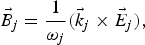

where ωp = ω1 − ω2 = (n 0 e 2/mɛ0)1/2, ωc = eB s/m, −e and m are the electronic charge and mass, and ɛ0 is the permittivity of the vacuum. The lasers impart oscillatory velocities to plasma electrons,
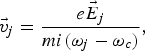
and exert a ponderomotive force on them at the difference frequency

where
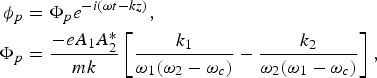
k = k 1 − k 2 and ω = ω1 − ω2. The ponderomotive force drives a Langmuir wave of the potential

where Φ is in the general complex and possesses a weak time dependence. As the amplitude of the plasma wave increases, the electrons acquire a larger drift velocity and their relativistic mass increases. This leads to a frequency mismatch between ω and ωp and saturates the plasma wave amplitude. Following Rosenbluth and Liu (Reference Rosenbluth and Liu1972), we include the mass correction factor in the equation of motion of electrons and find the perturbed electron velocity and density as
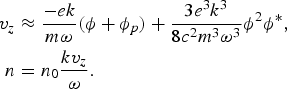
Using Eq. (7) in the Poisson's equation ∇2φ = en/ɛ0, we get
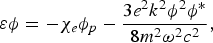
where χe = −ωp2/ω2, ɛ = 1 − ωp2/ω2.
Replacing ω by  , we obtain the following equation governing the plasma wave amplitude

writing Φ = A(t)e -iψ(t), we get
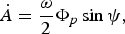

where
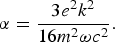
The amplitude saturates when Ψ = π and A 3 = −ω/2αΦp or
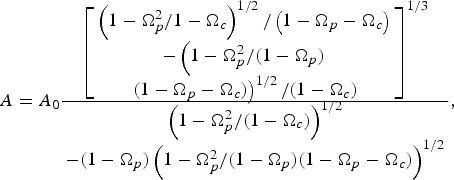
where

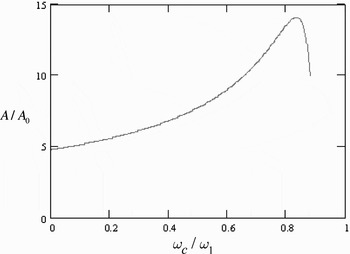
In Figure 1 we have plotted the normalized saturation amplitude of the plasma wave as a function of ωc/ω1 for Ωp = 0.1 (corresponding to n 0 = 2.5 × 1019 cm−3, 2πc/ω1 = 1 µm). As the magnetic field increases, the amplitude of the plasma wave increases and attains a maximum at ωc/ω ≈ 0.8 and then falls off. One can not go too close to the cyclotron resonance as the pump laser suffers from strong reflection from the plasma.
Variation of saturation amplitude of plasma wave with static magnetic field as a function of ωc/ω1 for Ωp = 0.1 (corresponding to n 0 = 2 × 1019 cm−3, 2πc/ω1 = 1 µm).

The above analysis is valid for lasers with uniform intensity along the wave front. For lasers with small spot size, the axial ponderomotive force driving the Langmuir wave is maximum on axis and decreases with transverse distance r. Further, the lasers exert a dc radial ponderomotive force on the electrons and can create a density depression on the laser axis. The Langmuir wave in such a channel will be radially non-uniform. We model the potential of the plasma wave as

where A is given by Eq. (12) and r 0 is on the order of the spot size of the laser. The electron depleted channel also has a radial electric field. We may model it as

3. ELECTRON ACCELERATION
We examine the acceleration of an energetic electron in the plasma wave with potential φ and static space charge field  . The equation of motion is

Eq. (15) in component form represents a set of three coupled equations. This set is supplemented by

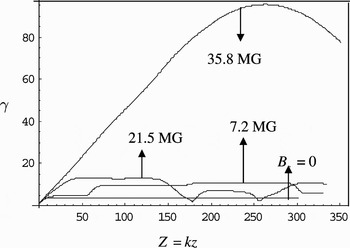
where 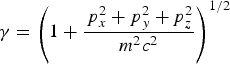 is the energy gain. Figure 2 shows the variation of the energy gain γ as a function of distance of propagation Z = kz ignoring the effect of radial space charge field. We have solved these equations numerically for the following parameters: K = kc/ω = 1.01, k = k 1 − k 2, R 0 = kr 0 = 2, n 0 = 2 × 1019 cm−3, laser intensity I = 4.4 × 10¹⁶ W/cm2, ω1 = 1.97 × 10¹⁵ rad s−1, and ω2 = 1.72 × 10¹⁵ rad s−1, the results are displayed in Figures 3 to 5. The energy gain increases with Z up to an optimum distance and then falls off due to dephasing. The maximum energy gain is greatly enhanced by the application of the dc magnetic field, the higher the magnetic field, the stronger the energy gains.
Variation of γ with the normalized distance of propagation Z for B s = 0, 7.2 MG, 21.5 MG, and 38.5 MG. E r = 0, K = kc/ω = 1.01, k = k 1 − k 2, R 0 = kr 0 = 2, and n 0 = 2 × 1019 cm−3. The electron was initially on the axis.

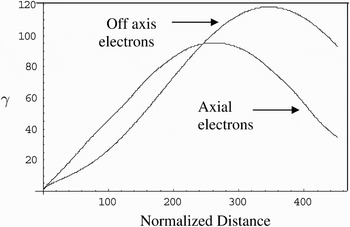
Variation of electron Lorentz force with the normalized distance of propagation Z in the presence of finite dc space charge field E r ≠ 0 at X 0 = kx = 0.8, and B s = 35.8 MG.

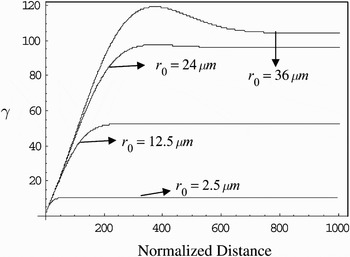
Effect of laser spot size on the electron acceleration in the presence of transverse magnetic field (B s1 ~ 2.86 MG) for K = kc/ω = 1.01, B s = 35.8 MG.

Effect of transverse magnetic field on acceleration with a fixed guided magnetic field for K = 1.01, R 0 = 40, and B s = 35.8 MG.

In the variation of the electron Lorentz force with Z, the distance of propagation in the presence of a finite dc space charge field E r ≠ 0, the E r field exerts an additional force on the off axis electrons, that is why they are accelerated more as shown in Figure 3. The acceleration of axial electrons and off axis electrons is shown for X 0 = kx = 0.8 and B s = 35.8 MG. We note that γ varies from 90 to 115 for the off axis electrons.
4. EFFECT OF AXIAL MAGNETIC FIELD ON SURFATRON ACCELERATION
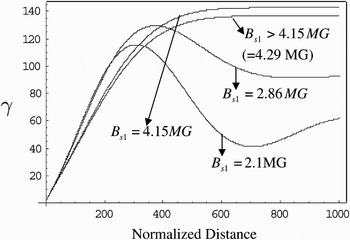
Now we introduce a transverse static magnetic field  , besides the axial magnetic field, into the equation of motion. The effect of laser spot size on the electron acceleration in the presence of transverse magnetic field (B s1 = 2.86 MG) is shown in Figure 4. The various curves are drawn for r 0 = 2.5 µm, 12 µm, 24 µm, and 36 µm for the parameters K = kc/ω = 1.01 and B s = 35.8 MG, respectively. There is an enhancement in γ due to the increasing spot size because in the radial direction, the gyrating electrons experience the effect of electric field for a longer time. The effect of transverse magnetic field on the acceleration with a fixed guided magnetic field is shown in Figure 5. The curves are drawn for the values, B s1 = 2.1 MG, 2.86 MG, 4.15 MG, and 4.29 MG for the parameters, K = 1.01, R 0 = 40, and B s = 35.8 MG. We note that for a fixed value of axial magnetic field, as we increase the transverse magnetic field, the gain in energy increases up to γ = 140. The value of magnetic field depends upon the value of R 0, we also see that at B s1 = 4.29 MG, γ decreases significantly which shows that for a larger value of R 0, the value of B s1 at which there would be a decrease in γ is also large. We have seen that due to the transverse magnetic field, the particles are deflected along the phase fronts of the plasma wave and are trapped for a longer time, and an efficient amount of energy is transferred from the wave to the particle. For all the curves in the simulation, we have assumed that at zero time, the electrons started from origin with a finite normalized momentum value = 0.006.
5. DISCUSSION
The presence of a guide magnetic field causes an increase in the amplitude of the beat plasma wave due to cyclotron resonance enhancement of electron velocities due to the pump lasers. This growth manifests itself in the increase in energy gain of the accelerating electrons. For normalized laser amplitudes a 1 = 0.171 and a 2 = 0.195, the normalized plasma amplitude turns out to be ~0.383 at ωc/ω ~ 0. The plasma wave amplitude attains a three-fold enhancement due to magnetic field. The electron energy gain for these parameters is ~45 MeV. In case of LBW, we have a large value of γ ~ 90 i.e., 45 MeV, but it decreases very sharply due to wave particle dephasing over a length of Z = kz = 350 only. The space charge field E r enhances the electron acceleration up to 55 MeV due to the additional Lorentz forces on the off axis electrons. When we apply the static magnetic field B s1, which provides a long-term trapping of particles in the wave leading to an efficient energy gain, γ ~ 140, i.e., 70 MeV. The maximum value of B s1 up to which there is an increase in γ, depends on R 0. For larger values of R 0 we may have even more energy gain. This is the first kind of study where we have observed the surfatron acceleration and space charge field effect in LBWA embedded with a guiding static magnetic field.
Surfatron acceleration could provide a strong acceleration of cosmic ray electrons at supernova remnant shocks (McClements et al., Reference McClements, Dieckmann, Ynnerman, Chapman and Dendy2001).
ACKNOWLEDGEMENT
One of the authors, R. Prasad, is grateful to the Department of Science and Technology, Delhi, India for the financial support.