Introduction
In comparison with the general population, mortality is substantially higher for individuals with serious mental illnesses (SMI), mainly schizophrenia and bipolar disorder (BPD) (Hoang et al. Reference Hoang, Stewart and Goldacre2011; Wahlbeck et al. Reference Wahlbeck, Westman, Nordentoft, Gissler and Laursen2011). This mortality gap can be considered an indicator of health inequality that people with SMI may not equally benefit from social and healthcare advancement experienced by the general population. People with schizophrenia were reported to have a 2.5-fold risk of death, compared with the general population, and a fairly high risk in death of suicide, which was around 12 times that of the general population (Saha et al. Reference Saha, Chant and McGrath2007). Standardized mortality ratios (SMR) for BPD individuals were reported to be around doubling that of the general population estimate (Chang et al. Reference Chang, Hayes, Broadbent, Fernandes, Lee, Hotopf and Stewart2010). Albeit with high risk in death of unnatural causes, around three fourths of all deaths in those with SMI were certified as natural (Hoang et al. Reference Hoang, Stewart and Goldacre2011), stressing the potential relevance of sedentary lifestyles, smoking, obesity, adverse effects of medications, and inadequate health services delivered to those with SMI (Lahti et al. Reference Lahti, Tiihonen, Wildgust, Beary, Hodgson, Kajantie, Osmond, Raikkonen and Eriksson2012; Laursen et al. Reference Laursen, Mortensen, MacCabe, Cohen and Gasse2014; Morgan et al. Reference Morgan, McGrath, Jablensky, Badcock, Waterreus, Bush, Carr, Castle, Cohen, Galletly, Harvey, Hocking, McGorry, Neil, Saw, Shah, Stain and Mackinnon2014; Gardner-Sood et al. Reference Gardner-Sood, Lally, Smith, Atakan, Ismail, Greenwood, Keen, O'Brien, Onagbesan, Fung, Papanastasiou, Eberhard, Patel, Ohlsen, Stahl, David, Hopkins, Murray and Gaughran2015), to the gap in the excess mortality.
From the 1970s, 1980s, and 1990s, the secular trend towards widening gap in the excess mortality was reported in people with schizophrenia with the median SMRs being 1.84, 2.98, and 3.20, respectively (Saha et al. Reference Saha, Chant and McGrath2007). With a mean of 11.5 years follow-up, a cohort study with first-contact psychosis patients showed that the mortality gap increased for all causes of death and for all natural causes over the four decades of the study (Dutta et al. Reference Dutta, Murray, Allardyce, Jones and Boydell2012). In addition, this mortality gap in people with SMI continued to widen with deaths from natural causes such as cardiovascular and respiratory diseases accounting for most of the increase over the more recent years (Hoang et al. Reference Hoang, Stewart and Goldacre2011). Concerns are thus raised regarding the possibility of worsening health inequality in the recognition and treatment of risk factors and comorbid physical illnesses in people with SMI (Lahti et al. Reference Lahti, Tiihonen, Wildgust, Beary, Hodgson, Kajantie, Osmond, Raikkonen and Eriksson2012; Laursen et al. Reference Laursen, Mortensen, MacCabe, Cohen and Gasse2014). On the other hand, over-diagnosis issue, including a continual broadening of the concept and diagnostic boundaries of BPD, may possibly lead to over-treatment (Mitchell, Reference Mitchell2012). It is linked with adverse health outcomes associated with newer generation medications (Hennekens et al. Reference Hennekens, Hennekens, Hollar and Casey2005) – such as weight gain and metabolic syndrome (Remington, Reference Remington2006) – that in turn may contribute to the increase in the cardiovascular and all-cause mortality (Lakka et al. Reference Lakka, Laaksonen, Lakka, Niskanen, Kumpusalo, Tuomilehto and Salonen2002).
Introduction of the second-generation antipsychotic (SGA) medications in the early 1990s has largely changed prescription behaviors of physicians. After several SGAs received FDA approval and guideline endorsement for treatment of BPD in the 2000s (American Psychiatric Association, 2002; The National Institute for Health and Care Excellence, 2006; Yatham et al. Reference Yatham, Kennedy, Parikh, Schaffer, Beaulieu, Alda, O'Donovan, Macqueen, McIntyre, Sharma, Ravindran, Young, Milev, Bond, Frey, Goldstein, Lafer, Birmaher, Ha, Nolen and Berk2013), the inevitable increase in the use of SGA medications in people with BPD has been evident (Miller et al. Reference Miller, Li, Penfold, Lee, Smith, Osser, Bajor and Bauer2014). Notwithstanding the existence of conflicting results (Tiihonen et al. Reference Tiihonen, Lonnqvist, Wahlbeck, Klaukka, Niskanen, Tanskanen and Haukka2009; Hayes et al. Reference Hayes, Downs, Chang, Jackson, Shetty, Broadbent, Hotopf and Stewart2015), concerns have remained over the potential adverse health outcomes related to the increased use of SGAs in the longer term. For instance, a recent Taiwanese study has indicated that use of antipsychotic drugs is associated with an increased risk of ventricular arrhythmia and sudden cardiac death. Of those with such grave outcomes, 17.84% have diagnoses of mood disorders, followed by anxiety disorders (17.26%), and schizophrenia or other psychoses (9.65%) (Wu et al. Reference Wu, Tsai and Tsai2015). Given the dramatic fourfold increase in the SGA prescriptions in Taiwan over the past decade (online Supplement 1), data are urgently wanted to examine the ongoing trend of physician's prescription behaviors as well as its potential associations with any changes in the morbidity and the excess mortality for people with SMI.
Therefore, the current study aimed to examine the recent trends of the excess mortality in people with schizophrenia and BPD, using two nationwide cohorts in Taiwan who were diagnosed and treated with SMI in 2003 and in 2008, respectively. Three-year SMRs were calculated for each of the two cohorts using the claims data from the National Health Insurance Research Database (NHIRD) and changes in the trends were compared. The primary aim of this study was to investigate how the mortality gap of people with SMI had been changing over the study years. Additionally, considering the possibility of a selective increase of SGA prescriptions in people with BPD, the second aim of this study was to explore whether the changing trend of the excess mortality in BPD individuals would differ from that in people with schizophrenia.
Materials and methods
Settings
Taiwan is a country with population of approximate 23 million. On a purchasing power parity basis, its GDP per capita in 2008/2009 is 31 100/32 000 international dollars (1 International Dollar = 16.99 New Taiwan Dollars) [World Economic Outlook (WEO) data IMF, 2017]. National Health Insurance (NHI) in Taiwan is a compulsory social insurance system with a single payer, centralizing the disbursement of healthcare funds and guaranteeing equal access to health care for all citizens and legal foreign workers. In 2003, there are around 21.98 million individuals enrolled in the NHI with a coverage rate of 96% and, in 2008, a total of 22.92 million individuals are enrolled with a coverage rate of 99% (National Health Insurance Administration, 2004, 2017). The NHIRD consists of data characterizing healthcare utilization of nearly whole Taiwanese population, including demographics, expenditures, and medical procedures/treatments. Diagnosis in NHIRD is given based on the International Classification of Diseases, 9th revision, clinical modification (ICD-9-CM) codes.
In this study, death is defined as withdrawal of the person from the NHI program (Wu et al. Reference Wu, Chen, Ho, Hsu, Kuo, Wu and Lin2012b ) and without re-join it for any healthcare service ever since (Pan et al. Reference Pan, Yeh, Chen and Chan2016a , Reference Pan, Yeh, Chen, Kuo and Chang b ). There are three kinds of situations when a person withdraws from Taiwan's NHI program: (1) death; (2) missing for more than 6 months; and (3) disqualification as an insurance applicant of the NHI program such as immigration and the expiration of the duration of stay of aliens. Missing for more than 6 months is closely related to death and the proportion of disqualification as an insurance applicant is negligible given the fact that foreigners only constitute around 2% of all insured individuals of Taiwan's NHI (National Health Insurance Administration, 2011). One previous study has shown that the difference between the number of actual deaths in Taiwan and that estimated by withdrawal from the NHI is lower than 2.37% (Lee et al. Reference Lee, Yang and Wang2011). For those with death outcomes within the 3-year observation period in this study, natural and unnatural causes of death are operationally defined (Lee et al. Reference Lee, Yang and Wang2011; Ministry of Health and Welfare, 2016) with the details shown in online Supplement 2.
SMR calculation and stratified analysis
All subjects in NHIRD who were diagnosed with schizophrenia (ICD-9-CM codes: 295*) or BPD (ICD-9-CM codes: 296.0, 296.1, 296.4–296.7) in 2003 and aged 15 years or over on the index date of diagnosis were qualifying as subjects of the 2003 SMI cohort. Those diagnosed with schizophrenia or BPD in 2008 and aged 15 years or over on the index date were qualifying to be included in the 2008 SMI cohort. In these cohorts with mixed incident and prevalent cases, we calculated age- and sex-SMRs as the indicator of relative risk of general mortality during the 3-year observational periods for schizophrenia and BPD separately, with the 2009/2010 general population of Taiwan as the standard population. Age- and sex-specific mortality rates were generated using 5-year age bands (namely, 15–19, 20–24, 25–29, … 85–89, and 90+) and gender (male and female) strata. The age- and sex-specific mortality rates of Taiwan's general population in 2009/2010 were applied to each of the strata for the cohorts with schizophrenia and BPD to generate the expected number of deaths as the denominator of SMR (Chang et al. Reference Chang, Hayes, Broadbent, Fernandes, Lee, Hotopf and Stewart2010; Wu et al. Reference Wu, Chang, Hayes, Broadbent, Hotopf and Stewart2012a ). The number of deaths observed in these 3-year periods (2003–2006 for the 2003 cohort; 2008–2011 for the 2008 cohort) was treated as the numerator of SMR. The confidence intervals were estimated as described elsewhere (Higham et al. Reference Higham, Flowers and Hall2005). In addition, we calculated SMRs by three broader age groups (15–44, 45–64, and 65+), by gender, as well as by cause of deaths (natural and unnatural), respectively. All statistical analyses were performed via SPSS version 17.0 (Chicago, IL, USA). Alpha level was set at 0.05 (p value) for statistical significance.
Results
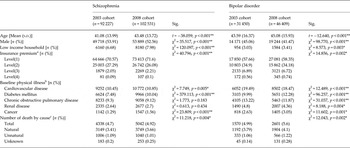
Estimated from the calendar cohorts, the treated prevalence of schizophrenia who were 15 years old or over in 2003 was 0.51% in Taiwan; that in 2008 was 0.54%. For those with BPD who were 15 years old or over, the treated prevalence in 2003 was 0.17%; that in 2008 was 0.24% (Taiwan's Ministry of the Interior, 2017). Table 1 saw that the mean age of the cohorts was between 41 and 45 years old. The gender distributions differed by disease diagnosis with more men in the schizophrenia cohorts and more women in the BPD cohorts. Of the two SMIs, people with schizophrenia were more likely to be from low-income households and have lower income premiums. Compared with the other comorbid physical illnesses, prevalence of diabetes mellitus increased more noticeably in the 2008 SMI cohorts, compared with their 2003 counterparts. With regard to death outcomes, the death rates over the follow-up period up to 3 years were 4.7–4.92% for schizophrenia and 4.99–5.6% for BPD. Around 2.87–5.04% of deaths were certified as deaths of unknown causes. Over three fourths of all deaths in those with SMIs in Taiwan were certified as natural, which was consistent with previous studies from different countries (Hoang et al. Reference Hoang, Stewart and Goldacre2011).
Demographic and clinical characteristics of the schizophrenia and BPD cohorts

s.d., standard deviation. *p < 0.01 **p < 0.001.
Chi-squared test was used for comparisons of categorical variables and Student's t test used for continuous variables.
a Insurance premium was classified into four different levels: Level(1): Under 17 280 New Taiwan Dollar (NTD). Level(2): Between 17 281 NTD to 36 300NTD. Level(3): Between 36 301NTD to 72 800NTD. Level(4): Above 72 801NTD.
b Baseline physical illnesses were measured over the 12-month pre-index period.
c Number of deaths occurred during the 3-year observational period.
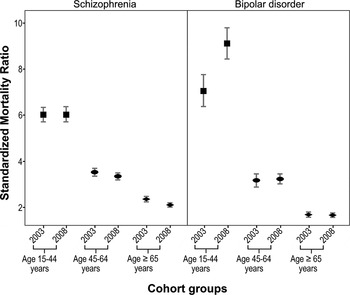
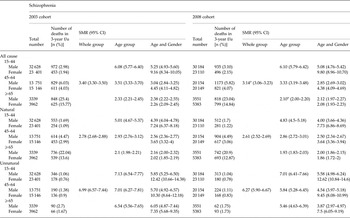
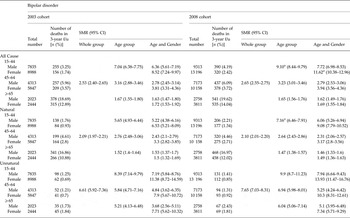
The SMRs for people with schizophrenia decreased only slightly over the study periods with the 3-year SMRs being 3.40 (95% CI 3.30–3.50) for the 2003 cohort and 3.14 (95% CI 3.06–3.23) for the 2008 cohort. On the other hand, for BPD subjects as a whole, the SMRs did not change significantly over the years (2003 cohort SMR = 2.53, 95% CI 2.40–2.65; 2008 cohort SMR = 2.65, 95% CI 2.55–2.76). The number of deaths over each of the 3-year study periods and results of SMRs by age group, gender, cause of death, and SMI diagnosis were presented in Tables 2 and 3. Among the broader age groups, the excess mortality decreased in people with schizophrenia aged 65 years old or over, from a SMR of 2.33 (95% CI 2.21–2.45) for the 2003 cohort to 2.10 (95% CI 2.00–2.20) for the 2008 cohort (Table 2; Fig. 1). On the contrary, the relative risks of mortality increased significantly in those BPD individuals aged 15–44 years (2003 cohort SMR = 7.04, 95% CI 6.38–7.75; 2008 cohort SMR = 9.10, 95% CI 8.44–9.79) (Table 3; Fig. 1). In the further analyses based on causes of death, we found that the relative risks of mortality for natural causes increased significantly in BPD individuals aged 15–44 years over the study years (2003 cohort SMR = 5.65, 95% CI 4.93–6.44; 2008 cohort SMR = 7.16, 95% CI 6.46–7.91) (Table 3).
Standardized all cause mortality ratios by age.

Standardized mortality ratios in schizophrenia

SMR, standardized mortality ratio; CI, confidence interval.
a The SMR in the 2008 cohort significantly differed from that in the 2003 cohort.
Standardized mortality ratios in bipolar disorder

SMR, standardized mortality ratio; CI, confidence interval.
a The SMR in the 2008 cohort significantly differed from that in the 2003 cohort.
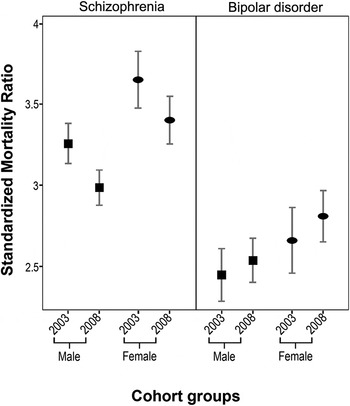
Figure 2 saw that regardless of gender, the mortality gap appeared to widen in BPD patients when that in people with schizophrenia reduced. The excess mortality in male patients with schizophrenia decreased from an SMR of 3.25 (95% CI 3.13–3.38) for the 2003 cohort to 2.98 (95% CI 2.87–3.09) for the 2008 cohort. Further, the decreased ratio seemed to be partly accounted for by the decrease in unnatural deaths in males with schizophrenia (2003 cohort SMR = 5.83, 95% CI 5.39–6.31; 2008 cohort SMR = 4.94, 95% CI 4.55–5.35) as revealed in the analyses on causes of death.
Standardized all cause mortality ratios by gender.

The excess mortality was found lower for SMI people who were older and the youngest group with schizophrenia and BPD had the highest SMRs compared with the general populations. Specifically, in subjects with schizophrenia, the SMRs for those aged 15–44, 45–65, and ⩾65 were 6.08, 3.51 and 2.33, respectively, for the 2003 cohort; the corresponding figures for the 2008 schizophrenia cohort were 6.10, 3.33, and 2.10. In people with BPD, the SMRs for those aged 15–44, 45–65, and ⩾65 were 7.04, 3.16, and 1.67, respectively, for the 2003 cohort; the corresponding figures were 9.10, 3.23, and 1.65 for the 2008 BPD cohort (Fig. 1; Tables 2 and 3).
Discussion
Compared with the general population, the risk of death for people with SMI in Taiwan was elevated, with an over two folds of relative risk in people with BPD and over three folds of relative risk in people with schizophrenia, which was consistent with prior results from different countries. Apart from the persistent mortality gap, we showed in this study a differential pattern in the trends of SMRs between schizophrenia and BPD: despite the existence of variations, SMRs seemed to increase in certain age groups of BPD patients over the study years when SMRs in schizophrenia decreased slightly. The opposite directions in the changing trends of the excess mortality in people with schizophrenia and BPD, underscore the potential relevance of over-diagnosis/over-treatment issue in BPD to the excess mortality as well as the importance to closely monitor the related adverse health outcomes in people with SMI. Future efforts to reduce gap in the under-recognition and/or under-treatment of risk factors and comorbid physical illnesses in people with SMI are also warranted.
Over the study years, the excess mortality increased significantly in those BPD patients aged 15–44 years (Table 3 & Fig. 1). With the over 200% difference within such a short period, we pondered whether the widening gap in the excess mortality of those younger BPD individuals could be a warning sign that major changes occurring over the study years – for instance, an increase in the use of SGAs (online Supplement 1) or any policy change in the healthcare delivery system – should be scrutinized. We found in the present study that prevalence of comorbid diabetes mellitus increased significantly for the 2008 cohort compared with the 2003 one, which could possibly contribute to the elevated morbidity and mortality from natural causes (Table 1). However, the increasing trend of comorbid diabetes mellitus was noted not only in patients with BPD but also in those with schizophrenia; the increase was evident across broader age groups. In further analyses based on causes of death, SMRs for natural causes indeed rose significantly for BPD patients aged 15–44 years, suggesting natural causes of death a contributor to the increased all-cause mortality (Table 3). Yet, there was some weak evidence that unnatural-cause-mortality also increased in this age group of BPD patients despite that CIs were overlapped (Table 3). In this regard, whether the increase in the excess mortality in BPD patients aged 15–44 years is predominantly due to natural or unnatural causes of death remains to be further elucidated.
Although evidence as to whether treatment exposure to SGAs increases mortality in people with SMI remains equivocal (Tiihonen et al. Reference Tiihonen, Lonnqvist, Wahlbeck, Klaukka, Niskanen, Tanskanen and Haukka2009; Correll et al. Reference Correll, Joffe, Rosen, Sullivan and Joffe2015; Hayes et al. Reference Hayes, Downs, Chang, Jackson, Shetty, Broadbent, Hotopf and Stewart2015), a potential link between the possibility of a selective increase in the use of SGAs among younger BPD patients and the widening mortality gap now or in the future needs to be cautiously examined. A US study showed that the number of BPD patients prescribed with SGAs doubled from 2003 to 2010 and those initiating SGAs were on average several years younger than non-initiators (Miller et al. Reference Miller, Li, Penfold, Lee, Smith, Osser, Bajor and Bauer2014). Younger people with BPD seemed more likely to be prescribed a SGA, which to some extent could be attributable to the timing of launch dates of newer medications. Despite the concerns of adverse health outcomes in the longer term (Correll et al. Reference Correll, Joffe, Rosen, Sullivan and Joffe2015; Correll & Blader, Reference Correll and Blader2015), an increase in the antipsychotic use was manifest for adolescents and young adults, with depression being the most common diagnosis (34.5%), followed by BPD (26.6%) and anxiety disorder (22.9%) (Olfson et al. Reference Olfson, King and Schoenbaum2015). As in many other countries, such extended use of SGAs in a broad range of non-psychotic mental illnesses (Alexander et al. Reference Alexander, Gallagher, Mascola, Moloney and Stafford2011; Maher et al. Reference Maher, Maglione, Bagley, Suttorp, Hu, Ewing, Wang, Timmer, Sultzer and Shekelle2011) had been happening in Taiwan. A recent Taiwanese study documented antipsychotic medications as a risk factor for sudden cardiac death and a substantial portion of victims were relatively young and with diagnoses of mood disorders, anxiety disorders, and schizophrenia (Wu et al. Reference Wu, Tsai and Tsai2015). Along with those prior results, the current finding of the increasing SMR among younger BPD individuals suggested strategies including more cautious evaluations, considerations of alternative treatments before initiating long-term SGA medications, and monitoring of adverse health outcomes on a regular basis.
On the other hand, the excess mortality for people with schizophrenia appeared to decrease slightly over the study periods. Subgroup analyses revealed similar trends in both genders but the mortality gap reduced significantly only in men but not in women (Fig. 2). Analyses based on causes of death exhibited that only in male patients with schizophrenia, SMRs for unnatural causes decreased significantly (2003 cohort SMR = 5.83, 95% CI 5.39–6.31; 2008 cohort SMR = 4.94, 95% CI 4.55–5.35). Among the broader age groups, the more significant reduction occurred in those who were 65 years old or over. Although not reaching statistical significance, we found that SMRs for unnatural causes tended to decrease more noticeably in males with schizophrenia who were 65 years old or over (Table 2). One potential explanation for the decreased unnatural deaths could be that the improvement in the access to mental health and social welfare services over time afforded protection from suicide and other mortality outcomes resulting from unnatural causes. For instance, intervention programs and contacts with specialist services were shown to be effective in decreasing suicide risk and all-cause mortality in those with early psychosis (Harris et al. Reference Harris, Burgess, Chant, Pirkis and McGorry2008; Chen et al. Reference Chen, Tang, Hui, Chiu, Lam, Law, Yew, Wong, Chung, Tso, Chan, Yip, Hung and Honer2011). Family involvement at early contact also reduced risk of unnatural-cause-mortality in a 10-year follow-up of patients with schizophrenia and other psychoses (Reininghaus et al. Reference Reininghaus, Dutta, Dazzan, Doody, Fearon, Lappin, Heslin, Onyejiaka, Donoghue, Lomas, Kirkbride, Murray, Croudace, Morgan and Jones2015). In this regard, the reduced mortality gap in the certain groups of people with schizophrenia might be partly accounted for by the improvement in the quality of care and accessibility to the services provided by the related healthcare and social welfare systems over the study years.
In agreement with prior research (Hoang et al. Reference Hoang, Stewart and Goldacre2011; Reininghaus et al. Reference Reininghaus, Dutta, Dazzan, Doody, Fearon, Lappin, Heslin, Onyejiaka, Donoghue, Lomas, Kirkbride, Murray, Croudace, Morgan and Jones2015), we reported in this study a much higher SMR due to unnatural causes, which was around three fold that of natural-cause SMR in both schizophrenia and BPD cohorts. Besides, we documented a negative gradient of SMRs across the broader age groups in both schizophrenia and BPD as well as in both cohorts, in 2003 and in 2008. In a previous UK study, the 1-year mortality ratios for people with schizophrenia compared with the general population were reported to be 6.2, 3.9, and 2.0 for those <45, 45–64, and 65–84 years, respectively (Hoang et al. Reference Hoang, Stewart and Goldacre2011). In the same way, the 3-year SMRs for people with schizophrenia in this study were 6.10, 3.33, 2.10 for those aged 15–44, 45–64, and ⩾65 years, respectively in the 2008 cohort; the corresponding figures for people with BPD were 9.10, 3.23, and 1.65. It seemed reasonable that the excess mortality for the young SMI patients would be higher than that of their older counterparts considering that young people in the general population were relatively healthier. Beyond the issue of competing risks, an emerging body of literature exhibited another plausible explanation that young people might be more prone to adverse effects of psychiatric medications. Evidence from animal studies raised concerns regarding antipsychotic safety on the developing mammalian brains (Choi et al. Reference Choi, Moran-Gates, Gardner and Tarazi2010; Mandell et al. Reference Mandell, Unis and Sackett2011; Bardgett et al. Reference Bardgett, Franks-Henry, Colemire, Juneau, Stevens, Marczinski and Griffith2013). Human studies also showed that SGAs posed more weight gain and dyslipidemia to children than to adults (Correll et al. Reference Correll, Manu, Olshanskiy, Napolitano, Kane and Malhotra2009; Tarricone et al. Reference Tarricone, Ferrari Gozzi, Serretti, Grieco and Berardi2010). In light of the longer life expectancy of young people, thus longer period at risk to develop adverse health outcomes, it might be recommended that young people presenting for mental health care should receive a trial of relevant psychosocial interventions and consider alternative pharmacological treatments whenever possible.
Strengths, limitations, and conclusions
The strengths of the current study included whole country coverage, inclusion of schizophrenia and BPD subjects diagnosed in all clinical settings, and follow-up for consecutive 3 years, which could be of great interest to both clinicians and policy makers. Although use of proxy for death outcome and cause of death was a limitation, the focus of the current study was to examine changes in the SMRs between the 2003 and 2008 cohorts and in this regard, use of proxy outcomes would not substantially influence the comparability because we applied the same definitions of death outcomes in both calendar year cohorts. There were no data on specific causes of death such as suicide or cardiovascular event. Besides, we were unable to measure the exposure dosage of antipsychotic agents on a personal level, which limited the interpretations of current results.
In conclusion, the current study – based on large nationwide cohorts – suggested that compared with the general population, the mortality gap in people with SMI persisted in Taiwan. Of note, we reported a differential pattern in the change of trend in the excess mortality between schizophrenia and BPD – the excess mortality decreased slightly in people with schizophrenia but increased in those BPD individuals aged 15–44 years old. Although speculative, we emphasized in this study the importance to further elucidate the association between the increased use of SGA and the widening mortality gap in patients with BPD. To make a clearer link between treatment exposure to SGA and change in the natural-cause-mortality, a longer follow-up may be required in the future research. Further efforts to examine mechanisms underlying the changes in the excess mortality and to optimize the general health of people with SMI warrant urgent attention.
Supplementary material
For supplementary material accompanying this paper visit https://doi.org/10.1017/S0033291717001040.
Acknowledgements
This study was supported by grants from the Ministry of Science and Technology (NSC-101-2314-B-418-008; MOST 104-2314-B-418-003) and Far Eastern Memorial Hospital, Taiwan (FEMH-101-2314-B-418-008; FEMH-2015-C-011; FEMH 104-2314-B-418-003; FEMH-2017-C-017). The funding bodies played no role in study design, analysis or interpretation of data in this paper. This study is based in part on data from the National Health Insurance Research Database provided by the National Health Insurance Administration, Ministry of Health and Welfare and managed by National Health Research Institutes, Taiwan. The interpretation and conclusions contained herein do not represent those of National Health Insurance Administration, Ministry of Health and Welfare or National Health Research Institutes.
Declaration of Interest
All authors have declared no conflicts of interest.