Urine cultures are commonly obtained, especially in hospitalized patients and residents of long-term care facilities. Unfortunately, a large proportion of urine cultures are obtained from patients with no symptoms of a urinary tract infection; thus, any bacterial growth represents asymptomatic bacteriuria (ASB). Among the large number of patients in acute or long-term care with ASB, only 2 populations clearly benefit from antimicrobial therapy: pregnant patients and those about to undergo urologic surgery.Reference Cardenas and Hooton 1 Unfortunately, most patients receiving antimicrobials for ASB are neither pregnant nor undergoing urologic surgery; they derive no benefit from antibiotic treatment and therefore no benefit from the screening urine culture.Reference Zalmanovici Trestioreanu, Lador, Sauerbrun-Cutler and Leibovici 2 Despite known harms of antibiotic overuse, unnecessary screening for and treatment of ASB are rampant, and mistaking ASB for urinary tract infection is one of the main reasons for inappropriate antibiotic use in the inpatient setting.Reference Fridkin, Baggs and Fagan 3
Prior surveys of physicians and prescribing providers describe knowledge gaps, lack of awareness of guidelines, social norms, and unease with leaving ASB untreated as reasons for why physicians treat ASB.Reference Grigoryan, Naik and Horwitz 4 – Reference Lee, Kim and Kim 7 A nationwide survey of 1,626 nursing personnel in long-term care facilities found that knowledge gaps regarding the difference between ASB and urinary tract infection drove inappropriate requests for urine cultures.Reference Trautner, Greene and Krein 8 Additionally, a survey of nurses’ knowledge of and adherence to infection control practices revealed that nurses’ attitudes about infection control practices were associated with compliance with infection control best practices, whereas knowledge was not.Reference Russell, Dowding and McDonald 9 Prior interventions to decrease unnecessary urine cultures and thus unnecessary antibiotic use in both acute and long-term care have made it clear that including nurses and clinical nursing assistants in these interventions was key to success.Reference Mody, Greene and Meddings 10 , Reference Trautner, Grigoryan and Petersen 11 However, no single study has examined knowledge of and attitudes toward ASB among providers, nurses, and clinical nurse assistants. Similarly, the influence of institutional factors, such as the safety climate (healthcare workers’ attitudes about issues relevant to patient safety) Reference Sexton, Helmreich and Neilands 12 and the level of teamwork in the facility, have not been explored in the context of antibiotic stewardship. Given that previous studies found a relationship between lower scores on safety climate and higher risk of adverse events, safety climate may also be relevant to antibiotic stewardship.Reference Fan, Pawlik and Daniels 13 , Reference DiCuccio 14
In preparation for a multisite antibiotic stewardship intervention for ASB, we conducted surveys of knowledge and attitudes toward ASB, urine culture orders, and antibiotic stewardship as well as teamwork and safety climate among providers and frontline healthcare professionals. Our goal was to identify actionable gaps in knowledge and modifiable aspects of teamwork and safety climate. We also explored whether providers’ attitudes toward ASB management were correlated with their perception of local teamwork or safety climate.
Methods
Design
We collected baseline surveys at 4 VA facilities during the first year of a dissemination project entitled Less is More (VA HSR&D IIR 16-025), which builds on a previous successful antimicrobial stewardship intervention to improve management of ASB in a Veterans’ Affairs (VA) hospitals and long-term care facilities.Reference Trautner, Grigoryan and Petersen 11 Surveyed wards included inpatient medicine and long-term care units because prior studies identified these units as key sites where overtreatment of ASB occurs.Reference Trautner, Grigoryan and Petersen 11
Participants
We enrolled an interprofessional sample of healthcare providers, nurses, and clinical nurse assistants. Providers included staff (attending) physicians, residents and fellow physicians in training, nurse practitioners, and physician assistants. Nurses were licensed as either registered nurses or licensed practical nurses, and nursing assistants were trained as clinical nurse assistants.
Survey instruments
The Kicking CAUTI survey was created and validated in 3 versions for the different types of healthcare professionals (1) providers, (2) nurses, and (3) clinical nurse assistants (Appendix online).Reference Grigoryan, Naik and Horwitz 4 , Reference Trautner, Petersen, Hysong, Horwitz, Kelly and Naik 5 The provider version contained 17 questions about knowledge of how to manage ASB (when to test and when to treat), assessed through very brief case scenarios, 15 questions about behavioral constructs (eg, self-efficacy, social norms about how the provider would behave, in the context of cases of ASB), and 1 question on guidelines acceptance. Examples of the behavioral construct questions are included in Table 1. Knowledge questions were scored as yes/no answers, whereas the behavioral constructs employed a 5-point Likert scale from strongly disagree to strongly agree. The surveys given to nurses asked 5 knowledge questions about when to send a urine culture and when to treat with antibiotics, and the CNA survey asked 3 knowledge questions about when to send a urine culture and possible consequences of antibiotic use.Reference Trautner, Greene and Krein 8 The nurse and CNA surveys only had 1 question in common, and neither shared any questions with the provider version. However, all 3 versions explored the same themes of appropriate indications for urine cultures and antibiotic use.
Scores on Individual Cognitive and Behavioral Constructs, Guideline Acceptance, and Knowledge Score by Site and Overalla

Note. SD, standard deviation.
a Individual response options were strongly disagree, disagree, neutral, agree, strongly agree, and don’t know. “Don’t know” answers were excluded. Examples of the behavioral construct questions include self-efficacy, eg, “I feel confident that I know how to manage bacteriuria”; behavior, eg, “I usually prescribe antibiotics to treat catheter-associated bacteriuria in patients who have pyuria”; social norms, eg,”the other clinicians I work with usually treat patients with urinary catheters and a positive urine culture with antimicrobial agents”; and risk perceptions, eg, “asymptomatic bacteriuria requires treatment more often in geriatric patients than in younger patients.”
All 3 surveys included the Safety Attitudes Questionnaire (SAQ) Short Form on the last page.Reference Sexton, Helmreich and Neilands 12 The SAQ-Short Form has been used in infection prevention work. It contains 6 items measuring teamwork climate and 7 items measuring safety climate.Reference Meeks, Lally and Carrick 15 Responses were measured on a Likert scale from strongly disagree to strongly agree.
Survey distribution
Research assistants at each of 4 sites distributed the surveys on paper between January 31, 2018, and June 7, 2018. Surveys were handed to individual participants, distributed at the beginning of conferences and collected at the end, distributed by nurse leaders to other nurses, or left in staff break rooms with instructions. Evening and night staff were included in survey distribution. Response rates were calculated from the number of surveys returned of all of the surveys distributed. All study activities were approved by the Baylor College of Medicine Institutional Review Board and by the institutional review boards of all participating sites.
Survey analyses
Descriptive statistics were used to describe survey responses to knowledge questions. For all questions scored on a Likert scale, “don’t know” was included as a response category, and “don’t know” responses were combined with missing values in the data analysis. Scores of negatively worded items were reversed so that higher scores for all constructs were more desirable (eg, more self-efficacy) or more consistent with practice guidelines. On the provider surveys, the percentage of correct answers to 17 knowledge questions represented the respondent’s knowledge score; “don’t know” was scored as 0 points. One-way ANOVA was used to compare provider knowledge scores between different sites, followed by post-hoc tests with Bonferroni corrections for multiple comparisons. For the SAQ, mean scores for team work climate and safety climate factors (scales) were calculated using the following formula: (mean scores of items belonging to the scale − 1) × 25.Reference Fan, Pawlik and Daniels 13 One-way ANOVA was used to compare the mean scores of safety culture and teamwork climate between residents, staff providers, nurses, and CNAs, followed by post hoc tests with Bonferroni corrections for multiple comparisons. Within the provider respondents, we performed separate multivariable linear regression analyses, with teamwork/safety climate scores as dependent variables and knowledge score, cognitive behavioral constructs, guidelines acceptance and provider type as independent variables. The relationship between safety and teamwork scores was studied using Pearson correlation coefficient. Analysis was carried out using SPSS version 25 software (SPSS, Chicago, IL).
Results
Survey response rate
In total, 534 surveys were completed, with 48% coming from providers, 37% from nurses, and 15% from CNAs. Each of the 4 sites was well represented among each respondent type. The response rates were 114 of 153 (75%) in Ann Arbor, 143 of 176 (81%) in Greater Los Angeles, 146 of 256 (57%) in Miami, and 131 of 231 (57%) in Minneapolis. For all sites, response rates per healthcare professional type were 76% (87 of 114) for staff providers, 82% (169 of 205) for residents, 58% (200 of 344) for nurses, and 53% (78 of 148) for CNAs.
Provider Kicking CAUTI survey results
The 256 provider respondents were largely from residents (66%), with staff physicians of various specialties comprising the next largest group (23%), followed by a smaller number of fellows (7%), nurse practitioners (4%), and physician assistants (<1%). The overall average knowledge score among providers was 78%, indicating that on average providers answered 78% of the yes/no questions on whether to treat a patient with a positive urine culture in accordance with practice guidelines. Average provider knowledge scores ranged from 74% to 83% by site, differing significantly only between the sites with highest and lowest scores (P = .04) (Table 1).
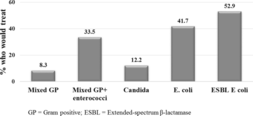
In response to the scenario of an inpatient who has recovered from a respiratory illness and is now ready for discharge, varying the organism and susceptibilities reported in the admission urine culture impacted providers’ stated intention to treat with antibiotics (Fig. 1). For example, only 8% indicated they would treat with mixed gram-positive organisms in the urine culture, whereas 53% indicated they would treat if the culture reported an extended-spectrum β-lactamase–producing Escherichia coli (Fig. 1). Notably, the patient in this scenario did not need to be treated with antibiotics, regardless of what organism ultimately grew from the urine culture at admission, because his admission symptoms of respiratory distress had resolved.
Percentage of providers who would treat a patient with no urinary symptoms and an indwelling urinary catheter with antibiotics given these urine culture results.

Questions assessing providers’ cognitive and behavioral constructs appear in Table 1. Responses by site and overall showed that self-efficacy ratings (mean, 4.2) and guideline acceptance (mean, 4.2) were high. In contrast, behavior and social norms scores were both lower (means, 3.4 and 2.9, respectively), suggesting that despite professed self-confidence and acceptance of guidelines, providers’ behavioral intentions when deciding whether to culture/treat patients with ASB, and the behavior they perceive among peers, differ from evidence-based guidelines.
Nurse Kicking CAUTI survey results
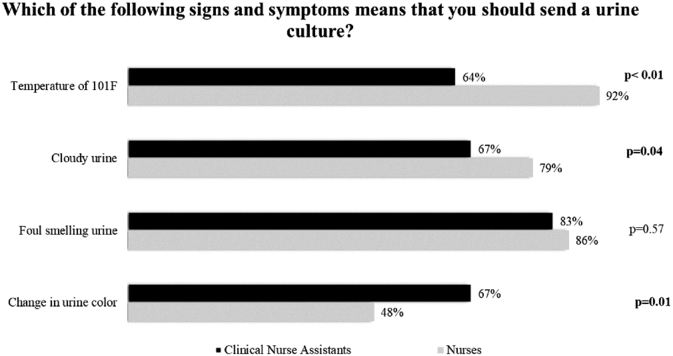
The 200 licensed nurse participants reported an average of 10 years in practice (standard deviation [SD], 8.3). The salient finding from both the nursing surveys and clinical nurse assistant (CNA) surveys is that understanding of the appropriate reasons to collect a urine culture is limited. Among nurses, 79% indicated that cloudy urine was an indication for sending a culture; 86%, indicated that a foul smell was an indication for sending a culture; and 49%, indicated that change in urine color was an indication for sending a culture. However, in all cases, these are not evidence-based justifications for urine cultures (Fig. 2). Recognition of fever of 38.3°C (101°F) as a potentially appropriate indication for urine culture and treatment with antibiotics was high (92% for both scenarios). Although 92% of nurses knew that ASB is common in patients with indwelling catheters, 51% also endorsed that a screening urine culture should be sent from all patients with indwelling catheters upon admission, and 69% thought incorrectly that pyuria could be used to distinguish ASB from symptomatic urinary tract infection.
Urine culture triggers for clinical nurse assistants and nurses.

CNA Kicking CAUTI survey results
The 78 CNA respondents had an average of 14 years in practice (standard deviation, 10.6). Among CNAs, most felt that the following (misleading) urine characteristics justified a urine culture: cloudy (67%), foul smell (83%), or color change (68%) (Fig. 2). Although 88% of CNAs agreed that treating bacteria in the urine of a patient without symptoms of UTI can lead to a multidrug resistant organism, 86% also agreed that cloudy, smelly urine should be routinely cultured.
Safety Attitudes Questionnaire results
We found significant differences in both teamwork climate and safety climate among our 4 groups of healthcare professionals, with CNAs having highest perceptions of teamwork and safety climates, followed by staff providers, nurses, then resident physicians. Resident physicians had significantly lower scores in both teamwork and safety climate than other providers, nurses or CNAs (Table 2). The differences in teamwork and safety climate were significant also between nurses and CNAs.
Comparison of Knowledge, Safety, and Teamwork Scores Across Healthcare Professional Types, Analyzing Residents and Staff Providers as Different Groups (N=256)

Note. SD, standard deviation; CNAs, certified nursing assistants; NA, not applicable.
a Includes 9 nurse practitioners, 1 PA, 60 physicians and 17 fellows.
b 1-way ANOVA test.
Among all providers, we looked for correlations between teamwork and safety climate and (1) behavioral constructs and (2) knowledge scores. Knowledge score was not significantly correlated with teamwork or safety climate. Among the behavioral constructs, behavior and risk perceptions were significantly associated with the safety culture score (P = .04 and P = .02, respectively). For example, respondents with higher scores on the safety culture questions (indicating a stronger sense of safety culture) were more likely to agree that untreated ASB is generally not harmful. A similar analysis with teamwork climate revealed that teamwork scores were correlated with social norms (P = .04). For example, respondents who scored higher in the teamwork questionnaire (indicating a stronger sense of teamwork) were more likely to agree that other clinicians they work with do not routinely screen for and treat ASB. Safety and teamwork scores were highly correlated (r = 0.74; P < .001).
Discussion
We conducted these baseline surveys prior to starting an antibiotic and diagnostic stewardship intervention to uncover knowledge gaps and cognitive biases that lead to excessive and unnecessary urine culturing and, thus, to unnecessary antibiotic use in patients with ASB. Among all 3 groups of healthcare professionals, most respondents endorsed simple declarative statements about the definition of ASB or the need for antibiotic stewardship (eg, “ASB is common in catheterized patients”), yet their responses to case scenarios showed guidelines-discordant behavior patterns. For example, providers’ treatment decisions were driven by organism type in an asymptomatic patient, whereas >80% of both nurses and CNAs believe that a foul smell is an indication for a urine culture. For the intervention, we will design both teaching cases and audit and feedback scenarios to address the specific clinical scenarios that survey respondents commonly answered incorrectly.
In addition, CNAs endorsed higher safety culture and teamwork than nurses, and staff providers endorsed higher safety culture and teamwork than the providers still in residency training. These findings imply that we should design case scenarios for the residents that model how to speak up about withholding unnecessary tests and treatment. Likewise, the correlations observed between providers’ behavioral constructs and either safety or teamwork climate raise the intriguing question of whether a stronger safety climate reinforces guidelines-compliant behavior.Reference Hessels and Larson 16 A prior study found that improvements in safety climate, as measured by the SAQ, were associated with decreased serious safety events, Reference Berry, Davis and Bartman 17 so the local safety climate in our intervention sites may prove to be relevant to implementing antibiotic stewardship.
We did not find site-specific differences in knowledge, safety climate, or teamwork climate but instead identified nearly universal knowledge gaps. Many of the gaps we identified are consistent with prior work by our group and others. For example, cloudy urine, foul smelling urine, and pyuria have been identified in other surveys projects as drivers for unnecessary urine cultures or antibiotics.Reference Grigoryan, Naik and Horwitz 4 – Reference Lee, Kim and Kim 7 Previous surveys have likewise reported that ASB is assumed to be more harmful and thus more likely to be treated with antibiotics in older patientsReference Lee, Kim and Kim 7 or in patients with a multidrug-resistant organism in the urine.Reference Drekonja, Abbo, Kuskowski, Gnadt, Shukla and Johnson 6 The knowledge gaps we identified among nurses and CNAs in both acute and long-term care units are likewise consistent with those identified through a AHRQ-funded survey in 184 non-VA nursing homes.Reference Trautner, Greene and Krein 8 If frontline workers themselves do not understand the valid indications for a urine culture, then we have identified a clear area for improvement through our intervention.
Strengths of this study include that we used established surveysReference Trautner, Greene and Krein 8 , Reference Sexton, Helmreich and Neilands 12 , Reference Grigoryan, Naik and Horwitz 18 to collect data from 4 sites across the United States, surveying providers, nurses, and CNAs from both acute and long-term care wards in the same study. Although all 4 sites are VA facilities, limiting the generalizability outside the VA system, the gaps and cognitive biases we uncovered are remarkably similar to those identified in prior non-VA surveys addressing understanding ASB.Reference Lee, Kim and Kim 7 , Reference Trautner, Greene and Krein 8 The fact that all 4 sites are teaching hospitals (thus, most provider respondents were residents) may limit the generalizability of our findings to nonteaching hospitals. In this project we conducted surveys, not observations of actual behavior, and respondents’ answers may have followed ASB practice guidelines more closely than they would in practice. Although sampling within each site was not strictly random, we reached broadly representative samples in each site.
In conclusion, our findings demonstrate substantial misunderstanding about how to manage ASB among providers, nurses, and CNAs. The incorrect mental cues that drive unnecessary urine cultures (pyuria, cloudy urine) as well as the incorrect cues that drive unnecessary antibiotic treatment of ASB (older patients, resistant urinary organisms) will be targeted through our case-based teaching studies.Reference Naik, Skelton, Amspoker, Glasgow and Trautner 19 , Reference Trautner, Bhimani and Amspoker 20 Given the common areas of misunderstanding identified through our work and that of others, our teaching cases may have widespread applicability for use at other sites and through other stewardship interventions. Additionally, our discovery that the sense of teamwork and safety climate differs significantly by healthcare professional type is likely relevant to this and other antibiotic stewardship interventions, as providers’ scores in both areas were also correlated with behavioral constructs, such as perception of the risk of untreated ASB. Socioadaptive training (eg, team building, communication) is increasingly recognized as a key component of infection prevention interventions.Reference Mody, Greene and Meddings 10 , Reference Saint, Greene and Krein 21 Empowering healthcare professionals to speak up when a urine culture is not needed, or when antibiotics are not indicated, can advance antibiotic stewardship efforts. Having measured the baseline elements of knowledge and behavioral constructs relevant to management of ASB, as well as the local teamwork and safety climates, we are well-informed to launch the “Less is More” intervention to improve urine culturing practices and antibiotic treatment of ASB.
Author ORCIDs
Barbara W. Trautner, https://orcid.org/0000-0001-7986-9099
Acknowledgments
None.
Financial support
This work was supported by the Veterans’ Affairs Health Services Research and Development Service (grant no. IIR 16-025) and by the Center for Innovations in Quality, Effectiveness and Safety (grant no. CIN 13-413) at the Michael E. DeBakey VA Medical Center, Houston, Texas.
Conflicts of interest
Drs Trautner and Grigoryan received funding support from Zambon Pharmaceuticals.