



%20--%3e%3c!DOCTYPE%20svg%20PUBLIC%20'-//W3C//DTD%20SVG%201.0//EN'%20'http://www.w3.org/TR/2001/REC-SVG-20010904/DTD/svg10.dtd'%3e%3csvg%20version='1.0'%20id='Layer_1'%20xmlns='http://www.w3.org/2000/svg'%20xmlns:xlink='http://www.w3.org/1999/xlink'%20x='0px'%20y='0px'%20width='64px'%20height='64px'%20viewBox='5.5%20-3.5%2064%2064'%20enable-background='new%205.5%20-3.5%2064%2064'%20xml:space='preserve'%3e%3cg%3e%3ccircle%20fill='%23FFFFFF'%20fill-opacity='0'%20cx='37.785'%20cy='28.501'%20r='28.836'/%3e%3cpath%20fill='%23595959'%20d='M37.441-3.5c8.951,0,16.572,3.125,22.857,9.372c3.008,3.009,5.295,6.448,6.857,10.314%20c1.561,3.867,2.344,7.971,2.344,12.314c0,4.381-0.773,8.486-2.314,12.313c-1.543,3.828-3.82,7.21-6.828,10.143%20c-3.123,3.085-6.666,5.448-10.629,7.086c-3.961,1.638-8.057,2.457-12.285,2.457s-8.276-0.808-12.143-2.429%20c-3.866-1.618-7.333-3.961-10.4-7.027c-3.067-3.066-5.4-6.524-7-10.372S5.5,32.767,5.5,28.5c0-4.229,0.809-8.295,2.428-12.2%20c1.619-3.905,3.972-7.4,7.057-10.486C21.08-0.394,28.565-3.5,37.441-3.5z%20M37.557,2.272c-7.314,0-13.467,2.553-18.458,7.657%20c-2.515,2.553-4.448,5.419-5.8,8.6c-1.354,3.181-2.029,6.505-2.029,9.972c0,3.429,0.675,6.734,2.029,9.913%20c1.353,3.183,3.285,6.021,5.8,8.516c2.514,2.496,5.351,4.399,8.515,5.715c3.161,1.314,6.476,1.971,9.943,1.971%20c3.428,0,6.75-0.665,9.973-1.999c3.219-1.335,6.121-3.257,8.713-5.771c4.99-4.876,7.484-10.99,7.484-18.344%20c0-3.543-0.648-6.895-1.943-10.057c-1.293-3.162-3.18-5.98-5.654-8.458C50.984,4.844,44.795,2.272,37.557,2.272z%20M37.156,23.187%20l-4.287,2.229c-0.458-0.951-1.019-1.619-1.685-2c-0.667-0.38-1.286-0.571-1.858-0.571c-2.856,0-4.286,1.885-4.286,5.657%20c0,1.714,0.362,3.084,1.085,4.113c0.724,1.029,1.791,1.544,3.201,1.544c1.867,0,3.181-0.915,3.944-2.743l3.942,2%20c-0.838,1.563-2,2.791-3.486,3.686c-1.484,0.896-3.123,1.343-4.914,1.343c-2.857,0-5.163-0.875-6.915-2.629%20c-1.752-1.752-2.628-4.19-2.628-7.313c0-3.048,0.886-5.466,2.657-7.257c1.771-1.79,4.009-2.686,6.715-2.686%20C32.604,18.558,35.441,20.101,37.156,23.187z%20M55.613,23.187l-4.229,2.229c-0.457-0.951-1.02-1.619-1.686-2%20c-0.668-0.38-1.307-0.571-1.914-0.571c-2.857,0-4.287,1.885-4.287,5.657c0,1.714,0.363,3.084,1.086,4.113%20c0.723,1.029,1.789,1.544,3.201,1.544c1.865,0,3.18-0.915,3.941-2.743l4,2c-0.875,1.563-2.057,2.791-3.541,3.686%20c-1.486,0.896-3.105,1.343-4.857,1.343c-2.896,0-5.209-0.875-6.941-2.629c-1.736-1.752-2.602-4.19-2.602-7.313%20c0-3.048,0.885-5.466,2.658-7.257c1.77-1.79,4.008-2.686,6.713-2.686C51.117,18.558,53.938,20.101,55.613,23.187z'/%3e%3c/g%3e%3c/svg%3e)
%20--%3e%3c!DOCTYPE%20svg%20PUBLIC%20'-//W3C//DTD%20SVG%201.0//EN'%20'http://www.w3.org/TR/2001/REC-SVG-20010904/DTD/svg10.dtd'%3e%3csvg%20version='1.0'%20id='Layer_1'%20xmlns='http://www.w3.org/2000/svg'%20xmlns:xlink='http://www.w3.org/1999/xlink'%20x='0px'%20y='0px'%20width='64px'%20height='64px'%20viewBox='5.5%20-3.5%2064%2064'%20enable-background='new%205.5%20-3.5%2064%2064'%20xml:space='preserve'%3e%3cg%3e%3ccircle%20fill='%23FFFFFF'%20fill-opacity='0'%20cx='37.637'%20cy='28.806'%20r='28.276'/%3e%3cg%3e%3cpath%20fill='%23595959'%20d='M37.443-3.5c8.988,0,16.57,3.085,22.742,9.257C66.393,11.967,69.5,19.548,69.5,28.5c0,8.991-3.049,16.476-9.145,22.456%20C53.879,57.319,46.242,60.5,37.443,60.5c-8.649,0-16.153-3.144-22.514-9.43C8.644,44.784,5.5,37.262,5.5,28.5%20c0-8.761,3.144-16.342,9.429-22.742C21.101-0.415,28.604-3.5,37.443-3.5z%20M37.557,2.272c-7.276,0-13.428,2.553-18.457,7.657%20c-5.22,5.334-7.829,11.525-7.829,18.572c0,7.086,2.59,13.22,7.77,18.398c5.181,5.182,11.352,7.771,18.514,7.771%20c7.123,0,13.334-2.607,18.629-7.828c5.029-4.838,7.543-10.952,7.543-18.343c0-7.276-2.553-13.465-7.656-18.571%20C50.967,4.824,44.795,2.272,37.557,2.272z%20M46.129,20.557v13.085h-3.656v15.542h-9.944V33.643h-3.656V20.557%20c0-0.572,0.2-1.057,0.599-1.457c0.401-0.399,0.887-0.6,1.457-0.6h13.144c0.533,0,1.01,0.2,1.428,0.6%20C45.918,19.5,46.129,19.986,46.129,20.557z%20M33.042,12.329c0-3.008,1.485-4.514,4.458-4.514s4.457,1.504,4.457,4.514%20c0,2.971-1.486,4.457-4.457,4.457S33.042,15.3,33.042,12.329z'/%3e%3c/g%3e%3c/g%3e%3c/svg%3e)
%20--%3e%3c!DOCTYPE%20svg%20PUBLIC%20'-//W3C//DTD%20SVG%201.0//EN'%20'http://www.w3.org/TR/2001/REC-SVG-20010904/DTD/svg10.dtd'%3e%3csvg%20version='1.0'%20id='Layer_1'%20xmlns='http://www.w3.org/2000/svg'%20xmlns:xlink='http://www.w3.org/1999/xlink'%20x='0px'%20y='0px'%20width='64px'%20height='64px'%20viewBox='5.5%20-3.5%2064%2064'%20enable-background='new%205.5%20-3.5%2064%2064'%20xml:space='preserve'%3e%3cg%3e%3ccircle%20fill='%23FFFFFF'%20fill-opacity='0'%20cx='36.924'%20cy='28.403'%20r='28.895'/%3e%3cpath%20fill='%23595959'%20d='M37.442-3.5c8.99,0,16.571,3.085,22.743,9.256C66.393,11.928,69.5,19.509,69.5,28.5c0,8.992-3.048,16.476-9.145,22.458%20C53.88,57.32,46.241,60.5,37.442,60.5c-8.686,0-16.19-3.162-22.513-9.485C8.644,44.728,5.5,37.225,5.5,28.5%20c0-8.762,3.144-16.343,9.429-22.743C21.1-0.414,28.604-3.5,37.442-3.5z%20M12.7,19.872c-0.952,2.628-1.429,5.505-1.429,8.629%20c0,7.086,2.59,13.22,7.77,18.4c5.219,5.144,11.391,7.715,18.514,7.715c7.201,0,13.409-2.608,18.63-7.829%20c1.867-1.79,3.332-3.657,4.398-5.602l-12.056-5.371c-0.421,2.02-1.439,3.667-3.057,4.942c-1.622,1.276-3.535,2.011-5.744,2.2%20v4.915h-3.714v-4.915c-3.543-0.036-6.782-1.312-9.714-3.827l4.4-4.457c2.094,1.942,4.476,2.913,7.143,2.913%20c1.104,0,2.048-0.246,2.83-0.743c0.78-0.494,1.172-1.312,1.172-2.457c0-0.801-0.287-1.448-0.858-1.943l-3.085-1.315l-3.771-1.715%20l-5.086-2.229L12.7,19.872z%20M37.557,2.214c-7.276,0-13.428,2.571-18.457,7.714c-1.258,1.258-2.439,2.686-3.543,4.287L27.786,19.7%20c0.533-1.676,1.542-3.019,3.029-4.028c1.484-1.009,3.218-1.571,5.2-1.686V9.071h3.715v4.915c2.934,0.153,5.6,1.143,8,2.971%20l-4.172,4.286c-1.793-1.257-3.619-1.885-5.486-1.885c-0.991,0-1.876,0.191-2.656,0.571c-0.781,0.381-1.172,1.029-1.172,1.943%20c0,0.267,0.095,0.533,0.285,0.8l4.057,1.83l2.8,1.257l5.144,2.285l16.397,7.314c0.535-2.248,0.801-4.533,0.801-6.857%20c0-7.353-2.552-13.543-7.656-18.573C51.005,4.785,44.831,2.214,37.557,2.214z'/%3e%3c/g%3e%3c/svg%3e)
%20--%3e%3c!DOCTYPE%20svg%20PUBLIC%20'-//W3C//DTD%20SVG%201.1//EN'%20'http://www.w3.org/Graphics/SVG/1.1/DTD/svg11.dtd'%3e%3csvg%20version='1.1'%20id='Layer_1'%20xmlns='http://www.w3.org/2000/svg'%20xmlns:xlink='http://www.w3.org/1999/xlink'%20x='0px'%20y='0px'%20width='64.000977px'%20height='64px'%20viewBox='0%200%2064.000977%2064'%20enable-background='new%200%200%2064.000977%2064'%20xml:space='preserve'%3e%3cg%3e%3ccircle%20fill='%23FFFFFF'%20fill-opacity='0'%20cx='32.064453'%20cy='31.788086'%20r='29.012695'/%3e%3cg%3e%3cpath%20fill='%23595959'%20d='M31.943848,0C40.896484,0,48.476562,3.105469,54.6875,9.314453C60.894531,15.486328,64.000977,23.045898,64.000977,32%20s-3.048828,16.457031-9.145508,22.513672C48.417969,60.837891,40.779297,64,31.942871,64%20c-8.648926,0-16.152832-3.142578-22.513672-9.429688C3.144043,48.286133,0,40.761719,0,32.000977%20c0-8.723633,3.144043-16.285156,9.429199-22.68457C15.640137,3.105469,23.14502,0,31.943848,0z%20M32.060547,5.771484%20c-7.275391,0-13.429688,2.570312-18.458496,7.714844C8.381836,18.783203,5.772949,24.954102,5.772949,32%20c0,7.125,2.589844,13.256836,7.77002,18.400391c5.181152,5.181641,11.352051,7.770508,18.515625,7.770508%20c7.123047,0,13.332031-2.608398,18.626953-7.828125C55.713867,45.466797,58.228516,39.353516,58.228516,32%20c0-7.3125-2.553711-13.484375-7.65625-18.513672C45.504883,8.341797,39.333984,5.771484,32.060547,5.771484z%20M44.117188,24.456055%20v5.485352H20.859863v-5.485352H44.117188z%20M44.117188,34.743164v5.481445H20.859863v-5.481445H44.117188z'/%3e%3c/g%3e%3c/g%3e%3c/svg%3e)
Introduction
Community assembly in ecological systems reflects the interplay between environmental filtering, resource heterogeneity, and dispersal processes. In host-associated systems, host traits can generate discrete habitat patches that impose physicochemical filters on colonising taxa, potentially structuring associated microbial, and consumer assemblages in deterministic ways. However, different trophic levels linked to the same host may respond differently to such filters. Microbial communities may be structured primarily by local environmental conditions, whereas mobile consumer assemblages may be more strongly influenced by dispersal and regional species pools. Understanding whether host traits couple or decouple assembly across trophic levels remains an open question.
Carnivorous pitcher plants of the genus Nepenthes represent discrete, naturally replicated microecosystems in which host morphology and trophic strategy generate contrasting resource regimes. Pitchers capture insect prey and host diverse microbial and arthropod communities – including both digested prey and live inquilines – that contribute to nutrient mobilisation (Miller et al. Reference Miller, Bradshaw, Holzapfel, Ellison and Adamec2017). Inquilines such as dipteran larvae can enhance nutrient availability through waste production and prey processing (Bradshaw and Creelman Reference Bradshaw and Creelman1984), and pitchers may alternate between acquiring nitrogen from digested prey and exploiting bacterial nitrogen fixation (Bittleston et al. Reference Bittleston, Wolock, Maeda, Infante, Ané, Pierce and Pringle2023). At the same time, pitchers serve as microhabitats for specialised insect larvae, including Culicidae and Formicidae (Dahelmi et al. Reference Dahelmi, Hikmah and Nurainas2023; Maquart et al. Reference Maquart, Rahola, Chhuoy, Heng, Chhum, Suor and Boyer2023; Tarigan et al. Reference Tarigan, Corebima Aloysius, Zubaidah and Rohman2021; Tyagi et al. Reference Tyagi, Munirathinam, Krishnamoorthy, Baskaran, Govindarajan, Krishnamoorthi, Mariappan and Venkatesh2015). However, DNA-based surveys of pitcher fluid recover sequences from both living residents and digested prey, and distinguishing between these sources requires complementary observational data. Despite this limitation, these interactions make pitcher systems tractable models for investigating how host traits structure multi-trophic communities.
Nepenthes is a diverse genus of pitcher plants, comprising well over 140 species distributed from Asia to Madagascar and Australia (Benzing Reference Benzing1987; Cheek and Jebb Reference Cheek and Jebb2014). Sympatric species frequently occupy the same habitats but differ in nutrient acquisition strategies and morphological traits that reflect ecological niche differentiation (Gaume et al. Reference Gaume, Bazile, Huguin and Bonhomme2016; Moran et al. Reference Moran, Booth and Charles1999; Thorogood et al. Reference Thorogood, Bauer and Hiscock2018). For example, Nepenthes ampullaria captures substantial leaf litter, indicating partial detritivory (Moran et al. Reference Moran, Clarke and Hawkins2003; Pavlovič et al. Reference Pavlovič, Slováková and Šantrůček2011), whereas Nepenthes gracilis and Nepenthes rafflesiana rely primarily on insect prey, employing distinct trapping strategies (Di Giusto et al. Reference Di Giusto, Bessière, Guéroult, Lim, Marshall, Hossaert-McKey and Gaume2010; Lenz and Bauer Reference Lenz and Bauer2022; Moran et al. Reference Moran, Booth and Charles1999). These differences in trophic strategy are likely to alter resource inputs, fluid chemistry, and pH, thereby modifying the strength and nature of environmental filtering experienced by associated microbial communities. Importantly, the physicochemical conditions experienced by pitcher colonists arise from at least two distinct sources. Some conditions are directly generated or regulated by the host – for example, secretion and acidification of digestive fluid and pitcher morphology governing prey interception – whereas others emerge from interactions within the pitcher microecosystem itself, including resource decomposition, microbial metabolism, inquiline activity, and successional change with pitcher age. Because these processes feed back on one another, an observed correlation between host species and fluid chemistry need not indicate direct host control, as the same physicochemical state may be co-produced by the community it appears to filter. We therefore distinguish host-generated from emergent, ecosystem-level filters throughout.
Previous research indicates that pitcher microbiomes vary with physicochemical conditions such as pH (Kanokratana et al. Reference Kanokratana, Mhuanthong, Laothanachareon, Tangphatsornruang, Eurwilaichitr, Kruetreepradit, Mayes and Champreda2016), with nitrogen-fixing bacteria associated with less acidic fluid environments (Bittleston et al. Reference Bittleston, Wolock, Maeda, Infante, Ané, Pierce and Pringle2023; Sickel et al. Reference Sickel, Grafe, Meuche, Steffan-Dewenter and Keller2016). Bacterial communities can differ between open and closed pitchers (Kanokratana et al. Reference Kanokratana, Mhuanthong, Laothanachareon, Tangphatsornruang, Eurwilaichitr, Kruetreepradit, Mayes and Champreda2016; Takeuchi et al. Reference Takeuchi, Chaffron, Salcher, Shimizu-Inatsugi, Kobayashi, Diway, von Mering, Pernthaler and Shimizu2015). Surveys of fungal communities remain limited, although yeasts are known to be associated with the pitcher fluids of several Nepenthes species (Lee et al. Reference Lee, Tan and Ting2014; Shivas and Brown Reference Shivas and Brown1989). Pitcher-associated arthropod assemblages, encompassing both true inquilines and captured prey, also vary among host species and pitcher types, with community composition influenced by pitcher morphology, scent, acidity, and vertical position (Gaume et al. Reference Gaume, Bazile, Huguin and Bonhomme2016; Lam et al. Reference Lam, Yeo, Lim, Wong, Lam-Phua, Fashing, Neo, Wang, Cheong, Ng and Tan2020; Tarigan et al. Reference Tarigan, Corebima Aloysius, Zubaidah and Rohman2021). Elevated pitchers tend to collect more flying insects, whereas lower pitchers more frequently contain ground-dwelling taxa (Adam Reference Adam1997; Tarigan et al. Reference Tarigan, Corebima Aloysius, Zubaidah and Rohman2021).
Despite these advances, microbial and arthropod assemblages (often termed inquiline communities in prior work) have largely been examined in isolation. Consequently, it remains unclear whether host trophic strategy structures microbial and pitcher-associated arthropod communities in parallel or whether assembly becomes decoupled across trophic levels. Additionally, the relative importance of host identity versus vertical position in structuring these assemblages has not been tested simultaneously within sympatric species.
We asked whether host traits couple community assembly across trophic levels in pitcher microecosystems or whether microbes and arthropod consumers respond to different filters and dispersal constraints. Specifically, we tested whether host trophic strategy (detritivory vs insectivory) and pitcher position (ground vs suspended) structure bacterial, fungal, and pitcher-associated assemblages in sympatric Nepenthes. We used COI metabarcoding to characterise the arthropod assemblage in pitcher fluid, acknowledging that this approach recovers DNA from both digested prey and true inquilines (living residents) without distinguishing between them. We predicted that sensitivity to host-defined environmental filtering declines with trophic level, such that microbial assemblages show stronger species sorting than arthropod assemblages, due to the greater movement capacity of the latter.
Materials and methods
Specimen collection
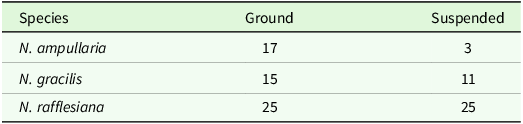
Specimens were collected from Kent Ridge Park, Singapore (1.28381,103.79112) between February and June 2021. We performed non-destructive sampling by aspirating the pitcher contents from 20 N. ampullaria plants, 26 N. gracilis plants, and 50 N. rafflesiana plants (Table 1; Figure 1). We selected one pitcher from each plant; sampled plants were at least 1 m apart. Pitcher age could not be determined at collection, representing a genuine confound in the interpretation of species and position effects. As fluid chemistry, prey accumulation, and microbial community composition change substantially over pitcher ontogeny (Kocáb et al. Reference Kocáb, Bačovčinová, Bokor, Šebela, Lenobel, Schöner, Schöner and Pavlovič2021; Koopman et al. Reference Koopman, Fuselier, Hird and Carstens2010), differential age distributions across species or pitcher positions could contribute to the community differences we report.
Pitcher plant species and diversity measures. (A–B) Nepenthes ampullaria pitchers on the ground and suspended. (C) Bacterial (16S-V4) Chao1 and Shannon diversity across all three species and positions. (D–E) Nepenthes gracilis pitchers on the ground and suspended. (F) Fungal (ITS) Chao1 and Shannon diversity across all three species and positions. (G–H) Nepenthes rafflesiana pitchers on the ground and suspended. (I) Arthropod (COI) Chao1 and Shannon diversity across all three species and positions. White bars on images represent 1 cm

Species of pitcher plants collected and the pitcher locations

Table 1 Long description
A table comparing the number of pitcher plants collected from ground and suspended locations. The table has three rows and three columns. The columns are labeled Species, Ground, and Suspended. The rows are labeled with the species names: N. ampullaria, N. gracilis, and N. rafflesiana. Row 1: N. ampullaria, Ground: 17, Suspended: 3. Row 2: N. gracilis, Ground: 15, Suspended: 11. Row 3: N. rafflesiana, Ground: 25, Suspended: 25.
To compare fungal, bacterial, and arthropod assemblages between ground-dwelling and suspended pitchers, we sampled across both positions for each species. Pitcher fluid was collected only from intact pitchers using sterile Pasteur pipettes, and pitchers were left otherwise undisturbed. Specimens were stored on ice during transport and then at −20°C until DNA extraction. DNA was extracted using the DNeasy Blood and Tissue Kit (QIAGEN). We pelleted particulate material (including arthropod remains) from each pitcher-fluid sample and used the pellet as the extraction input, following the manufacturer’s protocol thereafter. Although 20 N. ampullaria plants, 26 N. gracilis plants, and 50 N. rafflesiana plants were sampled in the field, not all pitchers yielded recoverable arthropod DNA after quality filtering. This is likely due to degradation of prey DNA within pitchers, as pitchers actively digest captured arthropods within 48 hours (Kocáb et al. Reference Kocáb, Bačovčinová, Bokor, Šebela, Lenobel, Schöner, Schöner and Pavlovič2021), reducing the quality and quantity of amplifiable DNA.
Amplification of bacterial, fungal, and arthropod DNA
PCR amplification of the V4 region of the 16S SSU rRNA gene was performed using the primers 515F (5’- GTG CCA GCM GCC GCG GTA A-3’) and 806R (5’ - GGA CTA CHV GGG TWT CTA AT -3’) that were modified to include Illumina adaptors, a linker and a unique barcode (Caporaso et al. Reference Caporaso, Lauber, Walters, Berg-Lyons, Lozupone, Turnbaugh, Fierer and Knight2011). Each reaction was performed in a total volume of 25 µl, containing 0.75 µl of each primer at 10 µM, 12.5 µl of buffer, 1.5 of µl BSA at 10 mg/mL, 0.5 µl of MgCl2, 0.1 µl of enzyme (KAPA 3G, Kapa Biosystems, Inc., Wilmington, MA, USA), 1 µl of undiluted DNA, and H2O to 25 µl. PCR cycling was 94°C for 180 s for initial denaturation, followed by 35 cycles of 94°C for 45 s, 50°C for 60 s, and 72°C for 90 s, and a final extension at 72°C for 10 min. Prior to pooling, PCR products were cleaned and normalised using the SequalPrep Normalisation Plate Kit (Invitrogen, Thermo Fisher Scientific).
Fungal DNA amplification was performed with the ITS1F (5’-CTT GGT CAT TTA GAG GAA GTA A-3’; (Gardes and Bruns Reference Gardes and Bruns1993)) and ITS2 (5’-GCT GCG TTC TTC ATC GAT GC-3’; White et al. Reference White, Bruns, Lee, Taylor, Innis, Gelfand, Sninsky and White1990) primer set. Primers were modified to include a unique barcode, linker, and Illumina adaptor (see Smith and Peay Reference Smith and Peay2014 for details). Each reaction was performed in a total volume of 25 µl, containing 0.75 µl of each primer at 10 µM, 12.5 µl of buffer, 1.5 µl of BSA at 10 mg/mL, 0.5 µl of MgCl2, 0.1 µl of enzyme (KAPA 3G, Kapa Biosystems, Inc., Wilmington, MA, USA), 1 µl of undiluted DNA, and H2O to 25 µl. PCR cycling was 95°C for 3 min for initial denaturation, followed by 35 cycles of 95°C for 20 s, 53°C for 15 s, 72°C for 20 s with a final extension at 72°C for 60 s. Prior to pooling, PCR products were cleaned and normalised using the SequalPrep Normalisation Plate Kit (Invitrogen, Thermo Fisher Scientific).
We amplified an approximate 420 bp fragment of the COI gene using the BF3 (5’-CCH GAY ATR GCH TTY CCH CG-3’) and BR2 (5’-TCD GGR TGN CCR AAR AAY CA-3’) primer set (Elbrecht et al. Reference Elbrecht, Braukmann, Ivanova, Prosser, Hajibabaei, Wright, Zakharov, Hebert and Steinke2019). Following Ng et al. (Reference Ng, Soon, Chang and Wainwright2022), we modified these primers to include an overhang that allows the attachment of Illumina adaptors and a unique barcode sequence in a subsequent PCR. The initial PCR was performed in 12.5 µl reaction volumes containing 6.25 µl of Kapa HiFi Hotstart ReadyMix (Roche Molecular Systems, Inc.), 0.5 µl of forward and reverse primer at 10 µM each, 4.25 µl of water, and 1 µl of undiluted DNA template. Cycling conditions consisted of 3 min at 95°C for initial denaturation, followed by 25 cycles of 95°C for 30 s, 46°C for 30 s, and 72°C for 30 s, with a final extension of 72°C for 3 min. Successful amplification was confirmed on a 1% agarose gel; reactions were then bead cleaned by adding a 1.8× volume of AMPure XP beads (Beckman Coulter, Inc.). Using the methods described by Soon et al. (Reference Soon, Quek, Pohl and Wainwright2023), Illumina adaptors and a unique barcode were then added to each sample in a reduced cycle PCR. This second round PCR used product from the initial PCR as a template and contained 6.25 µl Kapa HiFi Hotstart ReadyMix, 0.5 µl of forward and reverse primer at 10 µM, 2 µl of template, and water to 12.5 µl. Cycling was performed with an initial step of 3 min at 95°C, followed by 8 cycles of 95°C for 30 s, 55°C for 30 s, and 72°C for 30 s, with a final extension of 72°C for 3 min. Prior to pooling, PCR products were cleaned and normalised using the SequalPrep Normalisation Plate Kit (Invitrogen, Thermo Fisher Scientific).
Negative controls using molecular-grade water as a template were included and sequenced in each of the three libraries to identify any potential contamination issues. No contamination was identified. All libraries were sequenced on the Illumina MiSeq platform (600 cycles, V3 chemistry, 300 bp paired-end reads) with a 30% Phi-X spike by Macrogen Inc. Each library was sequenced independently.
Bioinformatics and sequence processing
Sequences were processed using the DADA2 package v1.34.0 (Callahan et al. Reference Callahan, McMurdie, Rosen, Han, Johnson and Holmes2016) to infer distinct amplicon sequence variants (ASVs). Using the trimLeft parameter in DADA2 to remove primers, bacterial and fungal reads were trimmed to 250/200 bp (forward/reverse), while COI reads were trimmed and merged to 420–448 bp (median = 438 bp). Potential chimeric sequences were removed, and the inferred ASVs were classified using the Naïve Bayesian Classifier algorithm implemented in DADA2 with the reference database SILVA v138.2 (McLaren and Callahan Reference McLaren and Callahan2021) for bacteria and UNITE v10.0 eukaryote for fungi (Abarenkov et al. Reference Abarenkov, Zirk, Piirmann, Pöhönen, Ivanov, Nilsson and Kõljalg2024).
Taxonomic identities of COI ASVs were queried locally against the COInr reference database using blastn (release dated 23 May 2025; Meglecz Reference Meglecz2025). Taxonomy was assigned with a Top-percent consensus/LCA strategy: for each ASV, we retained hits within 10% of the best bit score, applied an 80% majority rule from species upward, and reported the lowest common ancestor when no majority emerged. Species-level calls additionally required ≥97% identity, ≥80% query coverage, and E-value ≤ 1 × 10⁻²⁰. Downstream diversity analyses used a phyloseq object built from the ASV count matrix (samples × ASVs), the consensus taxonomy table, and sample metadata. Importantly, COI metabarcoding of pitcher fluid detects DNA from all arthropod sources present in the fluid, including digested prey, partially digested remains, and any living inquilines (e.g., dipteran larvae and mites). Because pitchers actively digest captured prey within approximately 48 hours (Kocáb et al. Reference Kocáb, Bačovčinová, Bokor, Šebela, Lenobel, Schöner, Schöner and Pavlovič2021), the majority of arthropod DNA recovered from pitcher fluid is expected to derive from prey items rather than from living residents. We therefore refer to the COI-derived assemblage as the ‘arthropod’ or ‘metazoan’ assemblage throughout, rather than as an inquiline assemblage, and interpret compositional patterns as reflecting the combined signal of prey capture and any resident inquiline fauna. True inquiline status for specific taxa (e.g., culicid and phorid larvae, certain formicid species) is noted where supported by prior observational studies but was not independently validated in this study. For COI-appropriate ecological interpretation, we restricted analyses to Metazoa (i.e., a subset of ASVs with kingdom = Metazoa). Of 45 Metazoa-assigned COI samples, six samples (13.3%) fell below 1,500 reads and were excluded from the primary rarefied α-diversity analysis; one additional sample (G101, 993 reads) was excluded only in the 1,000-read sensitivity analysis, leaving 39 and 44 samples, respectively. All community composition analyses were conducted in parallel on both rarefied and unrarefied libraries (McMurdie and Holmes Reference McMurdie and Holmes2014; Weiss et al. Reference Weiss, Xu, Peddada, Amir, Bittinger, Gonzalez, Lozupone, Zaneveld, Vázquez-Baeza, Birmingham, Hyde and Knight2017). Results from both approaches are reported; where conclusions differ between rarefied and unrarefied analyses, this is noted explicitly.
Following quality filtering of sequence data, usable arthropod profiles were obtained from a subset of sampled pitchers (ground and suspended combined: N. ampullaria n = 10, N. gracilis n = 2, and N. rafflesiana n = 33). This reduction relative to field sample sizes (20 N. ampullaria, 26 N. gracilis, and 50 N. rafflesiana plants) is expected given that pitchers actively digest trapped prey (Kocáb et al. Reference Kocáb, Bačovčinová, Bokor, Šebela, Lenobel, Schöner, Schöner and Pavlovič2021), leading to degradation of prey DNA and reduced recovery of intact sequences. Of the 4,767 Metazoa COI ASVs retained after quality filtering and taxonomic consensus calling, 24.4% were assigned to species, 36.2% to genus, and 91.3% to family (97.3% to order). Because arthropod community analyses in this study are interpreted primarily at the family level and above, incomplete species-level resolution does not materially limit our main conclusions, although species composition within families remains unresolved for most ASVs. The final dataset was 8,462 bacterial 16S-V4 ASVs, 2,972 fungal ITS ASVs, and 4,767 arthropod COI ASVs.
Data analyses
We calculated alpha-diversity – Shannon diversity and Chao1 richness – using vegan (Oksanen et al. Reference Oksanen, Blanchet, Friendly, Kindt, McGlinn, OHara, Simpson, Solymos, Stevens, Szoecs and Wagner2019). For bacterial and fungal α-diversity, per-sample sequencing depth was calculated as total reads per sample with phyloseq (McMurdie and Holmes Reference McMurdie and Holmes2013). To account for unequal sequencing effort in α-diversity analyses, Shannon diversity, Chao1 richness, and observed ASV richness were residualised against log-transformed depth using robust linear models before testing species and location effects. As pellet mass was not standardised or recorded across samples, this was a potential source of variation in COI amplification efficiency. While unequal tissue input could introduce noise into relative abundance estimates, we note that rarefaction to a uniform read depth prior to community analysis partially mitigates the effect of unequal input by normalising library sizes across samples. Nonetheless, we treat COI-based community composition results with appropriate caution and focus our interpretation on presence-based community patterns rather than fine-scale abundance differences among arthropod taxa. For α-diversity, we rarefied COI libraries to 1,500 reads per sample (primary analysis) with a 1,000-read sensitivity run; in parallel, we computed indices without rarefaction and modelled log10(library size) as a covariate. This reflected the lower and more variable sequencing depth achieved for arthropod communities relative to bacterial and fungal libraries. As assumption checks (group-wise Shapiro–Wilk and Levene tests) indicated non-normality, non-parametric analyses followed. Depth-adjusted residuals for Shannon diversity and Chao1 richness were analysed with a two-way, non-parametric aligned rank transform (ART) model from ARTool (Wobbrock et al. Reference Wobbrock, Findlater, Gergle and Higgins2011) to include fixed effects of pitcher species (N. ampullaria, N. gracilis, and N. rafflesiana), location (ground, suspended), and their interaction. When the interaction was non-significant, we estimated main-effect pairwise contrasts with emmeans and Benjamini–Hochberg (BH) adjustment. We ran stratified Van Elteren rank tests as a robustness check targeting marginal (conditioned) effects, which tested pitcher species while conditioning on location and location while conditioning on pitcher species, implemented in the coin package (Hothorn et al. Reference Hothorn, Hornik, van de Wiel and Zeileis2008), with a two-sided alternative and a Monte Carlo permutation approach (nresample = 9,999) to estimate P-values.
We tested for differences in community composition using PERMANOVA on Bray–Curtis dissimilarities computed from relative-abundance data using phyloseq (McMurdie and Holmes Reference McMurdie and Holmes2013). We fitted a two-factor model with interaction of pitcher species and location using 9,999 permutations. Because PERMANOVA assumes homogeneous multivariate dispersion among groups, we evaluated this assumption for pitcher species and location. Group differences are highlighted with 95% confidence ellipses around group centroids.
To identify taxa that were specifically associated with each Nepenthes species, we performed an indicator species analysis using the indicspecies package (De Cáceres and Legendre Reference De Cáceres and Legendre2009). Samples with zero reads and taxa occurring in fewer than two samples were removed prior to analysis. Indicator values were computed using the multipatt function with 9,999 permutations, applying the group-size-corrected IndVal.g statistic and restricting associations to single groups. Resulting P-values were adjusted for multiple testing using the BH procedure (FDR ≤ 0.05). Full results, including specificity (A), fidelity (B), and adjusted P-values for all taxa, are provided in Supplementary Tables S1–4.
Putative ecological and biogeochemical functions of bacterial ASVs from the 16S rRNA gene dataset were inferred using FAPROTAX v1.2.12 (Louca et al. Reference Louca, Parfrey and Doebeli2016). Functional profiles were summarised across groups (e.g., pitcher species × ground vs suspended) and visualised using heatmaps. Heatmaps show per-function standardised values (row-wise z-scores) to emphasise relative differences in functional composition across samples/groups (Figure 3A). Among 8,462 bacterial ASVs in the final 16S dataset, FAPROTAX v1.2.12 assigned 38.0% (3,218 ASVs) to at least one putative functional group, accounting for ∼59% of total bacterial reads; 282 ASVs lacking phylum-level assignment were excluded from FAPROTAX input. Putative ecological guilds and trophic modes of fungal ASVs were inferred using the FUNGuildR package in R (Nguyen et al. Reference Nguyen, Song, Bates, Branco, Tedersoo, Menke, Schilling and Kennedy2016). Group-level summaries were obtained by averaging relative abundances across samples within pitcher plant species and pitcher position (ground vs suspended). Heatmaps were used to visualise patterns in trophic mode composition across groups (Figure 3B). Overall, 1,543 of 2,972 fungal ASVs (51.9%) were assigned to at least one trophic mode via FUNGuild, accounting for 47.0% of total fungal reads, spanning 9 distinct trophic modes.
Results
Bacteria
Bacterial alpha diversity differed strongly among host species (F 2,89 = 9.6, P < 0.001) and weakly by pitcher position (F 1,89 = 6.1, P = 0.016) (Figure 1C). Ground pitchers supported greater diversity than suspended pitchers (t 89 = 2.461, P = 0.0158; Figure 1C), with NMDS ordination revealing clear host-associated clustering of bacterial communities (stress = 0.16; Figure 2A). PERMANOVA on Bray–Curtis dissimilarities confirmed that bacterial community composition differed significantly among pitcher species (R 2 = 0.125, F 2,87 = 7.35, P = 0.0015) and between ground and suspended pitchers (R 2 = 0.019, F 1,88 = 9.86, P = 0.003), with a significant but modest interaction (R 2 = 0.027, F = 1.47, P = 0.028). Together, species, position, and their interaction explained approximately 17.1% of total compositional variation. However, multivariate dispersion differed among pitcher species (PERMDISP, P = 0.002) and between positions (P = 0.003), so PERMANOVA results should be interpreted with this caveat. IndVal.g analysis (presence/absence; 9,999 permutations) identified 1,154 ASVs associated with pitcher species at P ≤ 0.05, of which 405 remained significant after BH correction (FDR ≤ 0.05). Most indicators were associated with N. ampullaria (277), followed by N. rafflesiana (74) and N. gracilis (54). Indicators associated with N. ampullaria were dominated by phyla commonly associated with soil environments, nutrient cycling, and plant growth-promoting traits, including Pseudomonadota, Planctomycetota, Bacteroidota, and Acidobacteriota (Tables S1 and S2; Gonçalves et al. Reference Gonçalves, Fernandes, Tupy, Ferreira, Almeida, Creevey and Santana2024; Klimek et al. Reference Klimek, Lage and Calusinska2025; Pan et al. Reference Pan, Raaijmakers and Carrión2023; Villafuerte et al. Reference Villafuerte, Comeau, Soria, Ortega, Wright and Miralles2026). Nepenthes gracilis and N. rafflesiana harboured broadly overlapping communities dominated by acidophilic taxa such as Acidocella and Mycobacterium (Figure 2D). Together, these patterns suggest host-associated structuring in N. ampullaria consistent with environmental filtering.
Taxa distributions for bacterial (16S-V4; A–D), fungal (ITS; E–H), and arthropod (COI; I–L) communities. NMDS (A, E, I) and upSet (B, F, J) plots by pitcher species. Top 20 classes (C) and genera (D) of bacteria; top 20 classes (G); and genera (H) of fungi; arthropod orders (K) and families (L). COI-derived arthropod assemblages represent a composite of prey and putative inquiline DNA. NMDS plots at 95% CI. Teal ellipses represent N. rafflesiana; brown ellipses represent N. ampullaria; purple ellipses represent N. gracilis

FAPROTAX (A) and FUNGuild (B) heatmaps of trophic functions.

Predicted bacterial functional profiles using FAPROTAX (Louca et al. Reference Louca, Parfrey and Doebeli2016) differed consistently between ground and suspended pitchers across species (Figure 3A). Based on these inferred profiles, ground pitchers exhibited broader predicted functional profiles, with higher Z-scores across metabolic categories, whereas suspended pitchers showed lower and more uniform profiles. These patterns suggest that pitcher position is associated with shifts in predicted functional potential, though these inferences represent hypotheses regarding functional capacity rather than direct measurements of metabolic activity. Functional categories associated with organic matter degradation and elemental cycling were particularly enriched in ground pitchers, including putative functions related to catabolism of complex carbon substrates (e.g., aromatic and hydrocarbon compound degradation, cellulolysis, and ligninolysis), as well as nitrogen and sulphur transformations (e.g., nitrate reduction, denitrification, nitrogen respiration, sulphate respiration, and sulphur compound respiration). Suspended pitchers showed weaker enrichment of these putative functions, suggesting a more metabolically constrained microbial community. Species-specific differences were evident, with N. ampullaria and N. rafflesiana ground pitchers displaying the strongest functional enrichment, while N. gracilis showed a more moderate but consistent position contrast.
Fungi
Fungal diversity did not differ across host species, with only N. gracilis showing significantly higher diversity in ground pitchers (estimate = 22.0 ± 10.2, P = 0.035; Figure 1F). NMDS ordination indicated subtle host associations (stress = 0.21; Figure 2E). Fungal community composition differed significantly among pitcher species and between ground vs suspended locations. PERMANOVA analysis showed that pitcher species (R 2 = 0.042, P < 0.001) and location (R 2 = 0.020, P = 0.006) were associated with fungal community variation, while the interaction was marginal (R 2 = 0.027, P = 0.064); betadisper did not indicate dispersion differences for species or location (F 2,87 = 1.01, P = 0.376) or between locations (F 1,88 = 0.30, P = 0.584). Indicator analysis of fungal ASVs (IndVal.g) identified 32 taxa associated with individual pitcher species at the raw α = 0.05 level, predominantly in N. ampullaria (26 ASVs), with fewer in N. gracilis (4 ASVs), and N. rafflesiana (2 ASVs). After BH correction, only one ASV remained significant. Overall, of 424 fungal ASVs tested for host association (present in ≥2 samples across the three focal Nepenthes species), most were not significantly host-specific (1 ASV at BH-adjusted P < 0.05; 32 at raw P < 0.05), indicating limited fungal specialisation among pitcher species. Indicators preferentially associated with N. ampullaria, dominated by Ascomycetes and Basidiomycetes, are fungi typical of decomposing leaf litter (Figure 2G; Tables S3 and S4; Osono Reference Osono2020; Vandepol et al. Reference Vandepol, Liber, Desirò, Na, Kennedy, Barry, Grigoriev, O.’Donnell, Stajich J.E. and Bonito2020). Together with yeasts (Yamadazyma, Heterocephalacria), these taxa suggest a decomposer guild distinct from the predominantly Saccharomycetes yeasts previously reported in other Nepenthes species (Bittleston et al. Reference Bittleston, Baker, Strominger, Pringle and Pierce2016; Gilbert et al. Reference Gilbert, Bittleston, Naive, Kiszewski, Buenavente, Lohman and Pierce2020a).
Fungal trophic composition predicted using FUNGuild (Nguyen et al. Reference Nguyen, Song, Bates, Branco, Tedersoo, Menke, Schilling and Kennedy2016) suggested differences between ground and suspended pitchers across the Nepenthes species (Figure 3B). Assemblages were largely composed of saprotrophic and pathotrophic guilds, with symbiotrophs consistently present at lower relative proportions. Ground pitchers had higher proportions of saprotrophic and mixed trophic modes, while suspended pitchers appeared to contain higher proportions of pathotrophic and pathotroph-associated guilds. This pattern was consistent across N. ampullaria, N. gracilis, and N. rafflesiana, indicating that pitcher position exerts a strong influence on fungal trophic structure. Mixed trophic guilds displayed the most pronounced differences between pitcher locations. Pathotroph–saprotroph and pathotroph–saprotroph–symbiotroph guilds were more abundant in ground pitchers, especially in N. gracilis and N. rafflesiana, while suspended pitchers showed elevated proportions of pathotroph–symbiotroph guilds in N. ampullaria. Pathotroph–saprotroph guilds were also elevated in suspended pitchers of N. gracilis. Purely symbiotrophic fungi were rare, while saprotroph–symbiotroph guilds were detected at low to moderate levels with limited variation among species. Together, these guild-level patterns suggest that ground pitchers may support more functionally flexible fungal communities with higher saprotrophic capacity, while suspended pitchers may harbour fungal assemblages skewed towards host-associated lifestyles. However, FUNGuild assignments are based on taxonomic identity rather than direct functional assays, and guild classifications for many tropical taxa remain incomplete, so these inferences should be treated as indicative rather than definitive.
Pitcher-associated arthropods
Usable arthropod profiles were recovered from only a subset of pitchers, with especially low recovery in N. gracilis, so species-level comparisons should be interpreted cautiously. Because COI metabarcoding of pitcher fluid does not distinguish DNA from living inquilines and digested prey, the assemblages described here represent a composite of both sources. Across Nepenthes species, arthropod richness differed significantly (Chao1; P = 0.027), driven by higher richness in N. rafflesiana compared with N. ampullaria, with Shannon diversity showing a similar trend (P = 0.062; Figure 1I). Species effects weakened in non-rarefied models adjusting for library size. Arthropod diversity was higher in suspended pitchers, but this effect weakened after rarefaction. PERMANOVA detected a significant species effect on arthropod community composition (marginal R 2 = 0.063, P = 0.002). Dispersion differed significantly among host species (F 2,42 = 38.3, P<0.001) but not clearly between locations (F 1,43 = 3.73, P = 0.065); species-level PERMANOVA should be interpreted with this caveat, especially given only two N. gracilis samples. Patterns were consistent across Bray–Curtis (relative abundance) and Jaccard (presence/absence) distances, with significant PERMANOVA models in both cases. Communities were dominated by Diptera (Phoridae, Culicidae) and Formicidae (Figure 2K, L). Among these, culicid and phorid larvae are well-documented inquilines of Nepenthes pitchers, whereas most Hymenoptera (including many Formicidae), Coleoptera, and other detected orders are established prey groups (Dahelmi et al. Reference Dahelmi, Hikmah and Nurainas2023; Lam et al. Reference Lam, Chong, Anand and Tan2017, Reference Lam, Yeo, Lim, Wong, Lam-Phua, Fashing, Neo, Wang, Cheong, Ng and Tan2020; Lim et al. Reference Lim, Wong, Lam, Yeo, Lam-Phua, Fashing, Wang, Cheong, Koh, Neo and Tan2019; Tarigan et al. Reference Tarigan, Corebima Aloysius, Zubaidah and Rohman2021). The dominance of known prey taxa in the COI dataset is consistent with the expectation that most arthropod DNA in pitcher fluid derives from captured and digested prey rather than from living residents. Family-level taxonomic composition was broadly conserved across pitcher species and positions, with neither ground nor suspended pitchers hosting exclusive families. At finer taxonomic resolution, dominant ASVs differed between ground and suspended pitchers, indicating a largely shared arthropod assemblage whose composition likely reflects local prey availability and, to a lesser extent, inquiline colonisation. Across assemblages, bacterial communities showed the strongest host-associated clustering, fungal communities showed only subtle host-associated patterning, and arthropod communities showed modest host effects that were sensitive to uneven recovery and dispersion.
Discussion
Across three sympatric Nepenthes species, host-associated compositional differences were strongest in bacteria, weaker in fungi, and modest in pitcher-associated arthropods, where host identity explained only a small fraction of variation (PERMANOVA R 2 = 0.063) and species effects were further complicated by unequal dispersion. This asymmetry aligns with the broader view of pitcher plants as replicated, host-defined microecosystems in which plant traits generate discrete physicochemical habitats that filter microbial colonists (Gilbert et al. Reference Gilbert, Bittleston, Tong and Pierce2020b). The strong structuring of bacterial communities by host species identity is consistent with pH-mediated environmental filtering, given the well-documented interspecific differences in fluid pH among our three focal species and the established role of pH in structuring microbial communities in Nepenthes fluid (Gilbert et al. Reference Gilbert, Bittleston, Tong and Pierce2020b) and other aquatic microhabitats. However, as fluid chemistry was not measured in this study, we cannot directly attribute the observed community differences to pH. Our interpretation of pH as a proximate filter therefore rests on inference by association with host species identity rather than direct analytical support and should be treated as a motivated hypothesis for future work rather than a demonstrated mechanism.
Bacterial communities showed the strongest host-species structuring of the three assemblages examined. This pattern is consistent with Gilbert et al. (Reference Gilbert, Bittleston, Tong and Pierce2020b), who demonstrated that pH was the primary fluid trait explaining bacterial community structure across 15 Nepenthes species in a common garden setting. Though our field-based design cannot isolate pH from correlated fluid properties, the convergence with those controlled experimental results lends support to this interpretation. Microbial colonisation of pitcher fluid begins at or soon after pitcher opening, but initial conditions vary among systems. Early work suggested unopened pitchers may contain sterile or near-sterile fluid (Shivas and Brown Reference Shivas and Brown1989), yet more recent molecular surveys have detected substantial bacterial communities even in unopened Nepenthes pitchers, including taxa resembling phyllosphere and endophytic assemblages (Takeuchi et al. Reference Takeuchi, Chaffron, Salcher, Shimizu-Inatsugi, Kobayashi, Diway, von Mering, Pernthaler and Shimizu2015). This suggests that assembly may begin with plant-associated reservoirs and subsequently be reshaped by prey-mediated inputs, airborne microbes, and rapid physicochemical change. Time-dependent succession has been documented in pitcher systems (Koopman et al. Reference Koopman, Fuselier, Hird and Carstens2010), and enzyme activity and fluid chemistry can shift rapidly in response to prey capture (Kocáb et al. Reference Kocáb, Bačovčinová, Bokor, Šebela, Lenobel, Schöner, Schöner and Pavlovič2021).
Pitcher age was not controlled in this study (see Materials and Methods), and our field design precluded the kind of age-stratified analysis performed by Gilbert et al. (Reference Gilbert, Bittleston, Tong and Pierce2020b) in a glasshouse setting. Nonetheless, the consistency of host-associated microbial differentiation across pitchers, which would be expected to vary considerably if age were the dominant structuring force, suggests that deterministic host filtering contributes to the patterns reported here, though this inference remains tentative without direct age data.
Pitcher fluid acidity covaries strongly with microbial composition in Nepenthes and is often invoked as a major axis of filtering, with less acidic pitchers more likely to harbour nitrogen-fixing taxa (Bittleston et al. Reference Bittleston, Wolock, Maeda, Infante, Ané, Pierce and Pringle2023; Kanokratana et al. Reference Kanokratana, Mhuanthong, Laothanachareon, Tangphatsornruang, Eurwilaichitr, Kruetreepradit, Mayes and Champreda2016). Reported Nepenthes fluid pH spans approximately pH 2–7 across species and pitcher ontogeny (Bittleston et al. Reference Bittleston, Wolock, Maeda, Infante, Ané, Pierce and Pringle2023), with the detritus-associated N. ampullaria typically less acidic than the insectivorous N. gracilis and N. rafflesiana. However, fluid pH is unlikely to be a purely host-controlled variable: it may reflect the combined influence of host physiology, resource inputs, microbial metabolism, and pitcher age. Accordingly, even a strong pH–composition association would not by itself demonstrate direct host filtering, as pH may be partly an emergent property of the same community it structures. Because fluid chemistry was not measured in this study, we treat pH as a motivated hypothesis rather than a demonstrated mechanism. This distinction between host-generated and emergent filters applies equally to the substrate regime of the detritivorous N. ampullaria, whose plant-derived particulate inputs favour decomposer guilds capable of processing complex carbon substrates, in contrast to the strongly acidic fluids of insectivorous species, which may constrain communities towards acid-tolerant lineages and narrower realised niches. These patterns are consistent with ecological differentiation among sympatric Nepenthes species linked to trap morphology and resource partitioning (Gaume et al. Reference Gaume, Bazile, Huguin and Bonhomme2016).
Although pitcher position exerted weaker effects on microbial taxonomic composition, it consistently structured predicted functional potential. Vertical position influences prey spectra and inoculation pathways in Nepenthes: lower pitchers capture more ground-dwelling arthropods and receive soil-associated inputs, whereas upper pitchers primarily intercept flying insects (Adam Reference Adam1997; Lam et al. Reference Lam, Yeo, Lim, Wong, Lam-Phua, Fashing, Neo, Wang, Cheong, Ng and Tan2020; Tarigan et al. Reference Tarigan, Corebima Aloysius, Zubaidah and Rohman2021). Such differences in particulate input plausibly explain the enrichment of predicted organic matter degradation and elemental cycling functions in ground pitchers. Function–taxonomy decoupling is common in microbial ecology, as similar metabolic capacities can be distributed across diverse taxa (Louca et al. Reference Louca, Parfrey and Doebeli2016), and our observation of functional divergence without complete taxonomic turnover is therefore consistent with broader theory. Experimental work in Nepenthes further supports the ecological relevance of these functional shifts: dipteran larvae and microbial communities can enhance ammonium release and nutrient sequestration within pitchers (Lam et al. Reference Lam, Chong, Anand and Tan2017), and fungal isolates from pitcher systems exhibit enzymatic capabilities relevant to prey and litter degradation (Lee et al. Reference Lee, Tan and Ting2014). While our functional assignments are inference-based and should be interpreted cautiously, they align with experimentally demonstrated nutrient-processing roles.
In contrast to microbes, pitcher-associated arthropod assemblages exhibited weaker host specificity. This pattern is expected given that the COI-derived assemblage predominantly reflects prey capture rather than resident inquiline fauna: prey composition is likely governed by local arthropod availability and pitcher trapping efficiency rather than by the fine-scale physicochemical conditions that filter microbial colonists. For the subset of taxa that are true inquilines (e.g., culicid and phorid larvae), mobile consumers are likely structured more strongly by dispersal dynamics, encounter rates, and regional species pools than by physicochemical differences among sympatric hosts. Even within classic pitcher-plant systems, both resource inputs and top predators regulate community structure (Kneitel and Miller Reference Kneitel and Miller2002), and keystone consumers can substantially alter bacterial diversity (Peterson et al. Reference Peterson, Day, Wolfe, Ellison, Kolter and Pringle2008). Evolutionary responses within inquiline communities can further reshape interaction networks (terHorst Reference terHorst2010), indicating that higher trophic assembly is context-dependent and not strictly host-determined. In other Nepenthes studies based locally, inquiline and prey assemblages vary with pitcher type and habitat context (Lam et al. Reference Lam, Yeo, Lim, Wong, Lam-Phua, Fashing, Neo, Wang, Cheong, Ng and Tan2020; Lim et al. Reference Lim, Wong, Lam, Yeo, Lam-Phua, Fashing, Wang, Cheong, Koh, Neo and Tan2019), but families are often broadly shared across hosts. Our results are consistent with this framework: host identity appears to define strong microbial filters, whereas arthropod assemblages, which are dominated by prey-derived DNA, reflect broader accessibility, local prey pools, and stochastic capture or colonisation processes within a shared landscape.
A central contribution of sampling three assemblages within the same host-defined microhabitats is the ability to compare the strength of host structuring across trophic levels. The gradient we observe – strongest host effects in bacteria, intermediate in fungi, and weakest in arthropods – is consistent with a decline in the relative importance of local environmental filtering and a rise in the importance of dispersal and regional species pools as organismal mobility and size increase. Bacteria, with limited independent dispersal and high sensitivity to fluid chemistry, should track host-generated conditions most closely, whereas winged and actively colonising inquilines can sample many hosts and are governed more by encounter rates and landscape context; consistent with this, both resource inputs and top predators are known to regulate pitcher inquiline structure (Kneitel and Miller Reference Kneitel and Miller2002; Peterson et al. Reference Peterson, Day, Wolfe, Ellison, Kolter and Pringle2008). Fungi, dispersing via airborne spores yet metabolically responsive to substrate, occupy an intermediate position. A comparable decoupling is seen in the plant phyllosphere, where bacterial communities are often more strongly structured by host identity than co-occurring fungal communities, suggesting that differential host filtering across microbial groups may be a general feature of host-associated systems rather than a peculiarity of pitchers.
Limitations and future directions
Several limitations temper interpretation. Arthropod DNA recovery was uneven across host species, reducing inferential power, and necessitating caution in interpreting host effects. Furthermore, because COI metabarcoding does not distinguish prey-derived DNA from that of living inquilines, the arthropod assemblages reported here should be interpreted as composite communities. Future studies combining metabarcoding with direct observational surveys of living pitcher inhabitants would allow prey and inquiline contributions to be disentangled. Because pitcher age was not explicitly controlled, microbial and arthropod assemblages likely represent composites of multiple successional stages. Fluid chemistry was not directly measured, and functional profiles were inferred from reference databases rather than directly quantified through metatranscriptomics or enzyme assays. Nonetheless, the concordance between host trophic strategy, microbial differentiation, and functional inference supports the interpretation that deterministic environmental filtering plays a dominant role at the microbial level.
Future work integrating repeated sampling across pitcher ontogeny, continuous pH measurements, and shotgun metagenomic or transcriptomic approaches would allow direct testing of the mechanisms proposed here, including whether pH mediates the relationship between host trophic strategy and microbial community composition. Simultaneous quantification of arthropod abundance and biomass through direct observation alongside DNA data would allow prey-derived and inquiline-derived signals to be distinguished and would clarify whether host traits differentially filter living residents versus passively captured prey. By sampling bacteria, fungi, and metazoans within the same host-defined microhabitats, this study reinforces the value of Nepenthes pitchers as tractable natural microcosms for examining when community assembly processes couple across trophic levels and when they decouple. In this system, microbial communities track host-defined environmental filters more tightly than arthropod assemblages, highlighting how host traits can differentially structure ecological networks within the same confined habitat while also underscoring the need to distinguish active biological filtering from passive prey accumulation when interpreting DNA-based surveys of pitcher fauna.
Supplementary material
The supplementary material for this article can be found at https://doi.org/10.1017/S026646742610087X.
Data availability material
Sequencing data are deposited in the NCBI SRA under BioProject accessions PRJNA1041069 (ITS), PRJNA1043418 (16S), and PRJNA1043422 (COI).
Acknowledgements
The authors thank the National Parks Board permit NP/RP21-001 for access to the pitcher plants; Yan Hong Poh, students of Field Biology class 2021, Ryan Koh, Yan Zhen Lim for assisting with the collections and DNA extractions of the pitcher contents; Vera Lim for depositing the sequencing data.
Author contribution
EJT led the study; EJT and MABS conceived the project; BJW prepared samples for sequencing; EJT processed and analysed data; CG and SBP advised on analyses; EJT wrote the manuscript with input from all authors.
Funding statement
This work was supported by Yale-NUS College Internal Grant IG21-SG102 and Ministry of Education (Singapore) Tier 1 grant A-8000495-01-00 to EJT.
Competing interests
The authors declare no commercial or financial conflicts of interest.
Consent for publication
All authors consent to publication of this manuscript.



 Open access

