Estimating the share of informal caregivers is strategically essential for both the planning and implementation of policies addressed at people with long-term care needs. This is particularly true for older adults in view of their rapidly increasing numbers worldwide, and it should be tackled at both macro and micro levels. At the macro level, long-term care policies cannot be designed and adopted effectively unless the substantial role of informal caregivers is taken into account (United Nations, 2017; Fiest et al., Reference Fiest, McIntosh, Demiantschuk, Leigh and Stelfox2018). Reliable data on the share and characteristics of these caregivers would facilitate the planning and implementation of formal care services, allowing policy-relevant goals on ageing to be put in place – for instance, by means of stronger home care provision and enough caregivers for its effective realization. At the micro level, providing informal care has been acknowledged to be a risk factor for poor health and well-being among informal caregivers (Bom et al., Reference Bom, Bakx, Schut and van Doorslaer2019; Williams et al., Reference Williams, Moghaddam, Ramsden and De Boos2019). Accordingly, reliable information about their share in the population is fundamental for effective public health targeting. The continuing rise in population ageing, and increasing demand for formal care, may be reflected in cost shifts if informal care providers replace formal caregivers.
The COVID-19 pandemic underlines even more the protective role of informal care for frail older people (Chan et al., Reference Chan, Gobat, Kim, Newnham, Huang and Hung2020; EC, 2021), suggesting the urgency of more systematic support for those who provide ‘invisible front-line care’ (Phillips et al., Reference Phillips, Paul and Fahy2020). For this purpose, and to facilitate more effective policy-supported interaction with the other components of our welfare systems, we need to know the share and main characteristics of these caregivers.
Official statistics already recognize that informal caregivers represent ‘the largest care service’. Estimates of the shares of informal caregivers in the adult population (aged 18+) reach 17% in both the USA and Europe (EC, 2018; AARP, 2020), and 7% and 13%, respectively, in the 50+ group in the USA (AARP, 2020) and Europe (OECD, 2019; EC, 2021). Other studies also seem to provide diverging findings in this regard (Eurofound, 2017; Verbakel et al., Reference Verbakel, Tamlagsrønning, Winstone, Fjær and Eikemo2017; Ciccarelli and Van Soest, Reference Ciccarelli and Van Soest2018), suggesting that a comparative approach may be appropriate to prevent the possibility of miscalculations in long-term care planning due to biased results (contingent on different definitions or methodologies).
One fundamental challenge in estimating the share of informal caregivers lies in the definition of the group. A recent study by Tur-Sinai et al. (Reference Tur-Sinai, Teti, Rommel, Hlebec and Lamura2020) analysed the prevalence of informal care using data from three large cross-national surveys and considered core factors such as sex, age and education. After a brief explanation of the methodology of this study, a summary of the main findings and a discussion of their implications are offered as a contribution to promoting more rigorous, evidence-based long-term care policies in this crucial field in ageing societies.
The current study analysed data from three international surveys: the European Quality of Life Survey (EQLS), the European Health Interview Survey (EHIS) and the European the Health Interview Survey (EHIS). On the basis of a review of the scientific and grey literature, Tur-Sinai et al. (Reference Tur-Sinai, Teti, Rommel, Hlebec and Lamura2020) formulated a reliable definition of informal caregiving, which serves as the theoretical basis for the present contribution. Thus, an informal caregiver can be defined as someone who (1) provides care at least weekly, (2) cares for someone who has a chronic illness, disability or other long-lasting health, social or long-term care need, (3) provides care on an unpaid, non-contractual voluntary basis outside any professional or formal framework. Finally, the care and support provided refer to both supportive (cooking, shopping, housekeeping, going for a walk together, etc.) and caring (giving medication, washing, dressing, going to the doctor, etc.) activities.
The EQLS covers all European Union (EU) member states and sets out to capture multiple dimensions of quality of life by documenting the living conditions and social situation of European citizens. The EHIS is a general population survey that yields statistical information on health status, health determinants and health care activities in the EU in order to support the monitoring and impact of policies on social inclusion and protection, health inequalities and healthy ageing. The SHARE survey seeks to better understand the dynamics of the 50+ population by providing a research infrastructure for public policymaking in this field.
For comparability purposes, the analysis focused only on the 50+ age group and considered only the fifteen countries examined by all three surveys (Denmark, Luxembourg, Greece, Austria, Croatia, Germany, Italy, Poland, Slovenia, Czech Republic, Estonia, Portugal, Spain, Belgium and Sweden), referring to the closest year of data collection (2016 for EQLS, 2014 for EHIS and 2015 for SHARE). Questions in each survey concerning ‘giving informal assistance’ were considered. For a more detailed explanation, see Tur-Sinai et al., Reference Tur-Sinai, Teti, Rommel, Hlebec and Lamura2020.
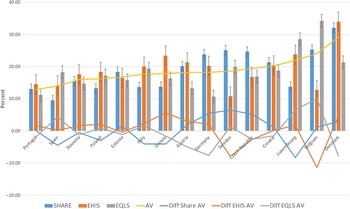
The share of informal caregivers aged 50+ in the countries covered by the three surveys is reported in Figure 1. This value – which ranges from nearly 13% in Portugal and Spain to over 25% in Belgium and Denmark – is similar in all three surveys for only three countries: Slovenia, Estonia and Croatia. In most countries, the share of informal caregivers varies, sometimes markedly, among the three surveys. In Denmark and Austria, for example, it is significantly lower in EQLS than in the other two surveys, while in Spain and Belgium the opposite is true. In Poland, Italy and Luxembourg, the prevalence of informal caregivers is significantly lower in SHARE than in EQLS and EHIS, whereas the reverse situation is found in Germany, Sweden and the Czech Republic.
Weighted percentages of informal caregivers aged over 50 years using EHIS, SHARE and EQLS data. AV = Average, Diff = Difference.

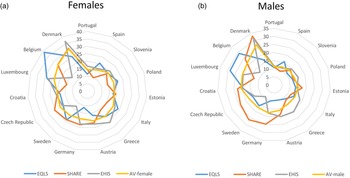
As for sex, while confirming the well-known higher prevalence of caregivers among women than among men, the three surveys show large sex variations among most countries (Figure 2a and b). A similar situation occurs with regard to age (data not reported here), demonstrating, in general, a declining prevalence of caregiving in older age groups.
Weighted percentages of informal caregivers aged over 50 years by sex using EHIS, SHARE and EQLS data. AV = Average, Diff = Difference.

Meeting the long-term care (LTC) needs of ageing populations is becoming a prime cause of concern for decision-makers worldwide. The growing demand and declining supply of care (due to under-investment, care staff shortages and poor working conditions) and quality and sustainability of care services are challenges that affect all countries to a greater or lesser extent. The (over)reliance on informal caregivers – who provide the lion’s share of LTC – has an adverse impact of informal caregivers’ health, access to education and employment, and can result in social exclusion and poverty.
In this context, collecting reliable and comparable data about the prevalence of informal care is vital for the development and monitoring of effective policies that address the needs of a group central to the sustainability of care systems. As it stands, though, the available datasets offer only a partial and inconsistent picture, while the success of initiatives aimed at supporting caregivers depends on a broad and integrated set of social, health and employment policies. Incidentally, in several countries many recent policy initiatives (on sex equality, work–life balance, disability, ageing and economic affairs) explicitly call for better support of caregivers and enhanced mechanisms to monitor their situation and needs. None of these good intentions will materialize without adequate information and indicators of progress. Therefore, the collection of disaggregated data on informal caregivers’ profile and socioeconomic circumstances is as important as the prevalence of caregivers for informing policy responses. Yet while EQLS, EHS and SHARE all yield useful insights into the issue of caregiving, they all fail to deliver the comprehensive portrait that Europe needs to deliver on its ambitions. Moreover, the study findings suggest that many of the variations trace to methodological differences. Data collection on informal caregiving activities, while comparable among the three surveys, is often semantically incongruent. Differences in the wording of survey questions, however, cannot be the only explanation because this would result in a structured pattern across all countries (e.g. wider definitions eliciting higher rates of informal caregiving and more restricted definitions leading to lower rates). Therefore, the variations probably originate from other factors, such as the sampling and/or recruitment methodologies applied by the three surveys in different countries. Since the investigation of these elements goes beyond the scope of this study, we appeal for closer coordination between funding institutions and methodological interpretation in adapting surveys on the topic of informal caregiving. Furthermore, accurate harmonization of survey items among extensive representative studies in Europe is vital to obtaining valid results.
Against this background, it is urgent to promote concerted international action to gather comprehensive informal caregiving information by establishing a harmonized methodology for international surveys for core indicators (e.g. type, frequency and intensity of activities that meet the definition of informal care, and the main characteristics of providers and recipients) and/or exploring in greater depth the different intercultural understandings of informal care itself. In the specific case of the three surveys analysed in this study, all of which receive financial support from the EU, the promotion of a more coordinated and comparable approach may be achieved quite easily – for instance, by means of a working group, possibly supported by Eurostat, composed of representatives of the three surveys and established for the specific purpose of identifying possible solutions to this issue. While the attainment of this goal may be more challenging beyond the borders of the EU, the examples of recent UN efforts in the broader area of ageing (UNECE, 2016) provide some hope for the future, given the increasing importance of the issue of informal caregiving in the cross-national political agenda.
Acknowledgments
This paper used data from SHARE Wave 6 (doi:10.6103/SHARE.w6.700); see Börsch-Supan et al. (Reference Börsch-Supan, Brandt, Hunkler, Kneip, Korbmacher and Malter2013) for methodological details. The SHARE data collection has been funded by the European Commission through FP5 (QLK6-CT-2001-00360), FP6 (SHARE-I3: RII-CT-2006-062193, COMPARE: CIT5-CT-2005-028857, SHARELIFE: CIT4-CT-2006-028812), FP7 (SHARE-PREP: GA N°211909, SHARE-LEAP: GA N°227822, SHARE M4: GA N°261982) and Horizon 2020 (SHARE-DEV3: GA N°676536, SERISS: GA N°654221) and by DG Employment, Social Affairs and Inclusion. Additional funding from the German Ministry of Education and Research, the Max Planck Society for the Advancement of Science, the U.S. National Institute on Aging (U01_AG09740-13S2, P01_AG005842, P01_AG08291, P30_AG12815, R21_AG025169, Y1-AG-4553-01, IAG_BSR06-11, OGHA_04-064, HHSN271201300071C) and from various national funding sources is gratefully acknowledged (see www.share-project.org). In addition, data from EQLS in 2016 and EHIS in 2014 are used in this paper. The data underlying this article were provided by SHARE, EQLS and EHIS under licence/by permission. Data will be shared on request to the corresponding author with permission of SHARE, EQLS and EHIS.
Funding
This study received no external funding.
Conflicts of Interest
The authors declare no conflict of interest.
Ethical Approval
The authors assert that all procedures contributing to this work comply with the ethical standards of the relevant national and institutional committees on human experimentation and with the Helsinki Declaration of 1975, as revised in 2008.
Author Contributions
All author contributed jointly to the paper’s conceptualization and methodology, data collection, analysis and writing. All authors have read and agreed to the published version of the manuscript. Conceptualization: AT-S, AT, AR, VH, SY and GL; methodology: AT-S, AT, AR, VH, SY and GL; validation: AT-S, AT, AR, VH, SY and GL; formal analysis: AT-S, AT, AR, VH and GL; investigation: AT-S, AT, AR, VH, SY and GL; resources: AT-S, AR and VH; writing (original draft preparation): AT-S, AT, AR, VH, SY and GL; writing (review and editing): AT-S, AT, AR, VH, SY and GL; project administration: AT-S, AT and GL.