I. INTRODUCTION
Transition metal dichalcogenides (TMDs), which have been intensively studied for decades as tribological and semiconducting materials, recently gained new attention as two-dimensional (2D) layered materials with possible applications in nanoelectronics and optoelectronics.Reference Wang, Kalantar-Zadeh, Kis, Coleman and Strano1–Reference Lee, Min, Chang, Park, Nam, Kim, Kim, Ryu and Im10 TMD crystals have a layered structure with one layer of the transition metal between two layers of chalcogenides. They have strong in-plane bonds and weak van der Waals forces between the layers. Investigation of layer-dependent properties of TMDs became a hot topic in materials science, as some properties of the 2D materials differ significantly from those of the corresponding bulk materials. Some TMDs, for instance, MoS2, MoSe2, WS2, and WSe2, have sizable band gaps that are indirect in the bulk material but turn direct when reducing their slab thickness to a monolayer.Reference Wang, Kalantar-Zadeh, Kis, Coleman and Strano1,Reference Kuc, Zibouche and Heine5 This opens the possibility of new applications, such as transistors, photodetectors, and electroluminescent devices.Reference Podzorov, Gershenson, Kloc, Zeis and Bucher2–Reference Lee, Min, Chang, Park, Nam, Kim, Kim, Ryu and Im10
2D sheets of layered materials can be produced by e.g., micromechanical cleavage,Reference Novoselov, Jiang, Schedin, Booth, Khotkevich, Morozov and Geim11 different chemical exfoliation methods, like liquid exfoliation,Reference Coleman, Lotya, O’Neill, Bergin, King, Khan, Young, Gaucher, De, Smith, Shvets, Arora, Stanton, Kim, Lee, Kim, Duesberg, Hallam, Boland, Wang, Donegan, Grunlan, Moriarty, Shmeliov, Nicholls, Perkins, Grieveson, Theuwissen, McComb, Nellist and Nicolosi12 intercalation method,Reference Dines13 and also by chemical vapor deposition methods. WS2, for example, can also be synthesized by sulfidization of WO3, i.e., by adding sulfur to a W-containing phase.Reference Feldman, Frey, Homyonfer, Lyakhovitskaya, Margulis, Cohen, Hodes, Hutchison and Tenne14 An alternative way to synthesize TMDs is by chemical reactions, where layered materials are formed from a metastable chalcogenide-containing phase. This is frequently observed in tribological contacts, where low-friction properties are required. TMDs are excellent lubricants, due to the weak van der Waals interactions between their layers, which allow easy, low-strength shearing, leading to low friction.Reference Cohen, Rapoport, Ponomarev, Cohen, Tsirlina, Tenne and Lévy-Clément15 Large efforts were therefore focused on methods to form such low-friction tribolayers of TMDs in sliding contacts. This possibility was e.g., explored in the W–S–C system, where low friction coefficients are observed, due to a spontaneous formation of a self-lubricating WS2 film in the sliding interface.Reference Nossa and Cavaleiro16–Reference Nyberg, Sundberg, Särhammar, Gustavsson, Kubart, Nyberg, Jansson and Jacobson22 In Ti-doped WS2 films, Ti induces a dramatic change in the microstructure by making it amorphous with well-dispersed nanocrystalline precipitates.Reference Scharf, Rajendran, Banerjee and Sequeda23 These films show improved tribological properties compared to pure WS2 coatings and a low friction due to WS2 formation in the contact. Similar results were obtained for MoSx–Ti nanocomposite films.Reference Savan, Simmonds, Huang, Constable, Creasey, Gerbig, Haefke and Lewis24 In a previous paper,Reference Sundberg, Nyberg, Särhammar, Kádas, Wang, Eriksson, Nyberg, Jacobson and Jansson25 we showed that WS2 can be formed from Ti–C–S films. By reactive sputtering, we were able to form nanocrystalline TiCxSy grains surrounded by amorphous carbon (a-C). The solid solubility of sulfur in cubic TiC is very limited, but magnetron sputtering carried out far from equilibrium makes it possible to deposit films with up to 21 at.% sulfur. The resulting TiCxSy phase is metastable. During annealing or in a tribiological contact, sulfur will diffuse from the carbide grain under the formation of a sulfur-containing phase at the carbide surface. In the presence of tungsten, layered WS2 will be formed. In these earlier experiments, we measured significantly lower friction coefficient against W-coated steel counter-surface (0.05) than against steel (0.2) and showed by transmission electron microscopy that this is due to the generation of crystalline WS2 in the contact.Reference Sundberg, Nyberg, Särhammar, Kádas, Wang, Eriksson, Nyberg, Jacobson and Jansson25
The results of Ref. Reference Sundberg, Nyberg, Särhammar, Kádas, Wang, Eriksson, Nyberg, Jacobson and Jansson25 clearly show that multilayer WS2 films can be formed on the surface of a metastable TiCxSy/a-C film, provided that W is available at the interface. This opens up an interesting question: can 2D TMD layers be formed on the surface of single-crystalline TiC1−xAx surfaces (A = S, Se, and Te) by a chemical process where W is allowed to react with a chalcogen diffusing out from a metastable TiC1−xAx grain? In the present work, we examined this concept. In Sec. III. A, we investigated the structural misfits between a TiC1−xAx surface and different TMDs and demonstrated that the conditions for such formation exist. In Sec. III. B, we used first principle theory to study the Ti–C–Se and Ti–C–Te systems and compared them to Ti–C–S. We also investigated how the lattice parameter, the bulk modulus, and the electronic structure of the carbides are influenced by the addition of these chalcogens. In Sec. III. C, we examined the reaction of Ti–C–S, Ti–C–Se, and Ti–C–Te with tungsten and provided a theoretical prediction for the most favorable source for TMD formation. Finally, in Sec. III. D, we examined some aspects of experimental studies.
II. COMPUTATIONAL DETAILS
We performed first principle calculations by means of the projector augmented waveReference Blöchl26,Reference Kresse and Joubert27 method as implemented in the Vienna ab initio simulation package.Reference Kresse and Hafner28–Reference Kresse and Furthmuller30 This method is based on the density functional theory.Reference Hohenberg and Kohn31,Reference Kohn and Sham32 To calculate the exchange-correlation energy, we used the generalized gradient approximation with the Perdew, Burke, and Ernzerhof functional.Reference Perdew, Burke and Ernzerhof33 This scheme is known to accurately describe the physical properties of transition metal carbides and nitrides.Reference Kádas, Eriksson and Skorodumova34–Reference Kádas, Andersson, Holmström, Wende, Karis, Urbonaite, Butorin, Nikitenko, Kvashnina, Jansson and Eriksson36 We considered supercells of 64 atoms. In TiC1−xAx (A = S, Se or Te), the A atoms are substituted for C atoms. In the supercell calculations, we used a plane-wave energy cutoff of 600 eV and used a Monkhorst-Pack k-point grid of 8 × 8 × 8 to sample the Brillouin zone. We applied the special quasirandom structure methodReference Zunger, Wei, Ferreira and Bernard37 to model the substitutional disorder of chalcogen atoms in TiC, which is widely used in the theoretical investigation of alloys and solid solutions.
III. RESULTS AND DISCUSSION
A. Structural relationship between TMDs and TiC
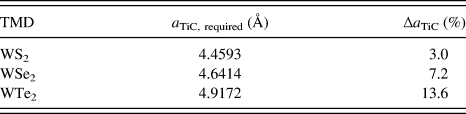
In Fig. 1, we show the interface between TiC(111) and WS2. TiC crystallizes in the Fm3m (rock salt type) structure, while WS2 has P63/mmc structure.Reference Schutte, Boer and Jellinek38 The (111) surface of TiC has Ti atoms in a hexagonal arrangement, which match the hexagonal symmetry of sulfur atoms of the W–S plane in WS2. At this interface, sulfur atoms are situated in hollow positions above three Ti atoms. This geometry allows for the formation of three Ti–S bonds, which is the most common bonding geometry in Ti–S compounds. To achieve a “perfect” fitting of the two surfaces, i.e., zero mismatch of lattice parameters at this interface, would require that TiC has a lattice parameter of 4.4593 Å (Table I), which is 3.0% larger than the experimental one (a TiC = 4.328 ÅReference Martienssen and Warlimont39). WSe2 has the same structure as WS2; therefore, the interface shown in Fig. 1 represents the optimal fitting for WSe2, as well. However, for the interface between TiC(111) and WSe2, a larger TiC lattice parameter is required for the optimal fitting (4.6414 Å, see Table I).
Schematic representation of the TiC(111)/WS2 interface [(a) top view, (b) side view]. In panel (a), only W–S bonds are displayed for a clear representation. Here, C atoms lie under S atoms. Ti, C, W, and S atoms are displayed by blue, brown, gray, and yellow, respectively.

Required lattice parameter of TiC at the TiC(111)/TMD interface, shown in Fig. 1, to achieve optimal fitting (see text). ∆a TiC is the deviation from the experimental lattice parameter of pure TiC.
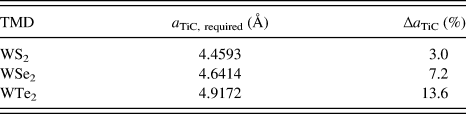
Fitting TiC(111) and WTe2 is more complicated, since WTe2 is of orthorhombic Pmn21 structure giving a puckered layer structure.Reference Mar, Jobic and Ibers40 However, a similar fit as the one shown in Fig. 1 is possible, and fitting TiC (111) to the a = 3.477 Å lattice parameter of WTe2 would require TiC having a lattice parameter of 4.9172 Å, which is 13.6% larger than the experimental one (Table I).
We note that it is possible to fit TiC(100) and TMDs when the TMD is rotated by 45° with respect to TiC(100). This fitting would require the same lattice expansion of TiC as for the interface shown in Fig. 1. At this interface, however, different Ti-chalcogen bonds are formed. Some of the chalcogen atoms are situated in bridge positions above two Ti atoms, and some are in hollow positions above four Ti atoms. Such bonds occur in different Ti-chalcogenides. Nevertheless, some chalcogen atoms at this interface possess top positions above Ti atoms, which is an unfavorable geometry.
B. Formation and properties of TiC1−xSx, TiC1−xSex, and TiC1−xTex
In a previous study, we showed that it is possible to synthesize TiC with a large fraction of S atoms on the carbon sites using the magnetron sputtering technique.Reference Sundberg, Nyberg, Särhammar, Kádas, Wang, Eriksson, Nyberg, Jacobson and Jansson25 This technique allows a solid solubility of S above the thermodynamic solubility limit at equilibrium and leads therefore to the formation of a metastable TiC1−xSx phase. Since sulfur has a larger atomic radius than carbon, the solid solution causes a notable expansion of the lattice. The theoretical lattice parameters of this system, calculated with both supercell and coherent potential approximation (CPA), agree with the experimental lattice parameter of Ti–C–S.Reference Sundberg, Nyberg, Särhammar, Kádas, Wang, Eriksson, Nyberg, Jacobson and Jansson25 We note that in the experiments, the Ti–C–S phase also contained vacancies on the C sites, which is commonly observed in sputtered Ti-carbides. However, the effect of vacancies on the lattice parameter was negligible compared to that of S substitution. We obtained similar lattice parameters with the supercell and the CPA method; the difference being 0.1–0.9% for 0.0625 ≤ x ≤ 0.5. In the present study, we apply the supercell approximation only.
First, we determine how Se and Te substitution influences the lattice parameter of TiC and compare that to S substitution. Figure 2 shows the theoretical lattice parameters of TiC1−xSx, TiC1−xSex, and TiC1−xTex for x values between 0.0625 and 0.4375. As can be seen, the lattice parameter increases monotonically with increasing chalcogen concentration for all the three systems. We calculate the largest lattice parameters in TiC1−xTex, followed by TiC1−xSex and TiC1−xSx at each chalcogen concentration. At the highest chalcogen concentration, x = 0.4375, S addition leads to 6.6% lattice expansion compared to pure TiC, whereas Se increases the lattice parameter by 10.1%, and Te addition leads to 16.2% expansion. This is in line with the increasing covalent atomic radii of the chalcogens (S: 104 pm, Se: 117 pm, Te: 137 pm).Reference Martienssen and Warlimont39 We note that all the three chalcogens have larger atomic radius than carbon (77 pm). Furthermore, comparing the calculated lattice parameters with those required for optimal fitting of the TiC(111) surface with TMDs (Table I), we conclude that optimal fitting of chalcogen-containing TiC with TMDs is indeed possible. We obtain lattice parameters required for optimal fitting for x ≈ 0.2 in TiC1−xSx, x ≈ 0.3 in TiC1−xSex, and x ≈ 0.35 in TiC1−xTex. In the whole chalcogen concentration range examined in our study, the maximal mismatch of the lattice parameters is 3.7% for TiC1−xSx, 5.1% for TiC1−xSex, and 9.4% for TiC1−xTex.
Calculated equilibrium lattice parameters in TiC1−xSx (black line), TiC1−xSex (red line), and TiC1−xTex (green line).
Substitution of chalcogens for carbon atoms in TiC leads to decreasing bulk moduli, B (Fig. 3) with increasing chalcogen concentration. The largest chalcogen, Te, causes the largest change in B, and it is followed by Se and S. At the highest chalcogen concentration (x = 0.4375), S, Se, and Te addition decreases the bulk modulus by 24.9, 34.6, and 48.1% compared to pure TiC, respectively. Introduction of larger chalcogen atoms and higher chalcogen concentrations consistently leads to a reduced bulk modulus in TiC. As the bulk modulus gives information about the average bond strength of materials, the observed trend in B also means that S, Se, and Te decrease the average bond strength in chalcogen-containing TiC, the largest decrease caused by Te. We note that in TiC1−xSx, a similar decreasing trend can be observed in the measured Young's modulus (not shown) with increasing sulfur content.
Calculated equilibrium bulk moduli in TiC1−xSx (black line), TiC1−xSex (red line), and TiC1−xTex (green line).
In the following, we examine the electronic structure of TiC1−xSx, TiC1−xSex, and TiC1−xTex and compare it to that of pure TiC. In Fig. 4, we show the most important partial electronic density of state (DOS) curves, i.e., Ti d, C s and p, and the chalcogen s and p states. In TiC, there is a pseudogap at the Fermi level, E F [Fig. 4(a)]. States below this pseudogap are bonding, whereas those above it are of antibonding character.Reference Jansson, Lewin, Rasander, Eriksson, Andre and Wiklund41 In TiC, the bonding states are filled, and the antibonding states are empty. Figure 4(a) shows that the DOS below E F is dominated by Ti d and C p orbitals, and these states correspond to the strong TiC bonds. The empty antibonding states above E F are built up by Ti d orbitals that hybridize with C 2p states. In TiC1−xSx, TiC1−xSex, and in TiC1−xTex, however, the Fermi level lies above the pseudogap, i.e., some of the antibonding states are filled (see Figs. 4b–4d). In chalcogen-containing TiC, Ti d and C p orbitals corresponding to Ti–C bonds give about equal contributions to the states right below the pseudo gap. Mainly chalcogen p orbitals build up the DOS feature between −8 and −4 eV, with a smaller contribution from Ti d orbitals. These states correspond to the Ti-chalcogen (Ti–S, Ti–Se, Ti–Te) bonds, which are weaker than the Ti–C bonds. This feature moves slightly to higher energies with increasing atomic number of the chalcogen, i.e., from TiC1−xSx to TiC1−xTex (see Figs. 4b–4d), which correlates with the Ti-chalcogen bond strength decreasing in this order. In all the three TiC1−xAx systems, there is a peak at the Fermi level, which is an indication of a possible instability. This peak, and accordingly the DOS at E F, increases from TiC1−xSx to TiC1−xTex. Experimentally, it was shown previously that Ti–C–S nanocomposite coatings can be synthesized by means of reactive sputtering,Reference Sundberg, Nyberg, Särhammar, Kádas, Wang, Eriksson, Nyberg, Jacobson and Jansson25 and it is known that the conditions during magnetron sputtering are far from equilibrium. It is also known that metastable solid solutions are easily obtained in TiC.Reference Jansson, Lewin, Rasander, Eriksson, Andre and Wiklund41 Therefore, the possible instability due to S-, Se-, and Te-addition is likely not to hinder the synthesis of Ti–C–S, Ti–C–Se, and Ti–C–Te coatings.
Electronic DOSs calculated for TiC (a), TiC1−xSx (b), TiC1−xSex (c), and TiC1−xTex (d), for x = 0.4375. Ti d, C s, C p, chalcogen s, and chalcogen p DOSs are displayed by black, green, red, cyan, and blue, respectively.
C. Reaction of TiC1−xSx, TiC1−xSex, and TiC1−xTex with W and a-C
In our previous study, we showed that the reason for the observed low friction of the Ti–C–S nanocomposite coatings against W-coated steel is the formation of WS2 in the tribological contact.Reference Sundberg, Nyberg, Särhammar, Kádas, Wang, Eriksson, Nyberg, Jacobson and Jansson25 We speculate that a similar reaction can occur in Se- or Te-containing TiC. To examine how different chalcogens influence the tribochemical formation of W-dichalcogenides, we investigate the stability of TiC1–xSx, TiC1–xSex, and TiC1–xTex in contact with tungsten. To this end, we calculate the formation energies (ΔE) of the following reactions:
 $${\rm{Ti}}{{\rm{C}}_{1 - x}}{{\rm{S}}_x} + {x \over 2}{\rm{W}} \to {\rm{Ti}}{{\rm{C}}_{1 - x}} + {x \over 2}{\rm{W}}{{\rm{S}}_2}\quad ,$$
 $${\rm{Ti}}{{\rm{C}}_{1 - x}}{\rm{S}}{{\rm{e}}_x} + {x \over 2}{\rm{W}} \to {\rm{Ti}}{{\rm{C}}_{1 - x}} + {x \over 2}{\rm{WS}}{{\rm{e}}_2}\quad ,$$
 $${\rm{Ti}}{{\rm{C}}_{1 - x}}{\rm{T}}{{\rm{e}}_x} + {x \over 2}{\rm{W}} \to {\rm{Ti}}{{\rm{C}}_{1 - x}} + {x \over 2}{\rm{WT}}{{\rm{e}}_2}\quad ,$$
where W is of bcc structure, WS2 and WSe2 are of P63/mmc structure,Reference Schutte, Boer and Jellinek38 WTe2 is of Pmn21 structure.Reference Mar, Jobic and Ibers40 A negative formation energy means that the right-hand sides of Eqs. (1)–(3) represent stable phases.
For reaction (1), negative formation energies are obtained in the x = 0.0625–0.4 range (black curve in Fig. 5), i.e., formation of WS2 is energetically favorable. Above x ≈ 0.4, ΔE becomes positive, since the formation of TiCx, which has more than 40% vacancies on the carbon site, becomes increasingly energetically unfavorable with increasing vacancy content. We know, however, from experiments, that the tribochemical reaction described in Eq. (1) takes place even for these high chalcogen concentrations.Reference Sundberg, Nyberg, Särhammar, Kádas, Wang, Eriksson, Nyberg, Jacobson and Jansson25 It is therefore possible and even likely that not all sulfur in TiC1−xSx form WS2 at high S contents. Considering this scenario, we analyzed the following reaction:
 $${\rm{Ti}}{{\rm{C}}_{1 - x}}{{\rm{S}}_x} + {y \over 2}{\rm{W}} \to {\rm{Ti}}{{\rm{C}}_{1 - x}}{{\rm{S}}_{x - y}} + {y \over 2}{\rm{W}}{{\rm{S}}_2}\quad ,$$
and we found that the formation energies are negative even for high sulfur concentrations. For y = 0.125, we calculate ΔE = −0.024 eV/f.u. at x = 0.40625, and ΔE = −0.003 eV/f.u. at x = 0.4375. This shows that at higher S concentrations, only a part of sulfur can form WS2.
In the above discussion, we did not take into account that in the experimentally synthesized coatings, the TiC1−xSx phase is embedded in an amorphous carbon matrix. Therefore, in the following, we discuss the role of the surrounding a-C matrix. With this aim, we propose that upon the tribochemical reaction, carbon atoms of the matrix enter into the carbide and occupy vacancy sites in Ti–C–S. To investigate the possibility of this scenario, we calculate formation energies for the following reaction:
 $${\rm{Ti}}{{\rm{C}}_{1 - x}}{{\rm{S}}_x} + {x \over 2}{\rm{W}} + y{\rm{C}} \to {\rm{Ti}}{{\rm{C}}_{1 - x + y}} + {x \over 2}{\rm{W}}{{\rm{S}}_2}\quad ,$$
where 1 − x + y ≤ 1. Here, the energy of the a-C matrix is approximated by that of graphite. For y = 0.34375, i.e., when almost all the vacancy sites are “filled up” by carbon atoms from the a-C matrix, 1 − x + y being 0.9375, we calculate ΔE = −0.564 eV/f.u. as the formation energy for reaction (5) (see the blue triangle in Fig. 5). This energy is much lower than any of the formation energies obtained for reaction (1), where the a-C matrix was not considered (black curve in Fig. 5). This indicates that an amorphous carbon matrix can strongly stabilize the reaction of TiC1−xSx with tungsten. This argument finds further support from the fact that we obtain negative formation energy for the reaction in Eq. (5), ΔE = −0.195 eV/f.u., even for y = 0.03125, when only ≈3% of the vacancy sites are occupied by C atoms from the a-C matrix (see the magenta triangle in Fig. 5). Consequently, the amorphous matrix can support the formation of WS2 by providing C atoms, which occupy the vacancy sites left in the Ti–C–S phase after sulfur diffusion. In this way, all the sulfur can form WS2, even at high sulfur concentrations.
In the following, we discuss the reaction of TiC1−xSex with tungsten [Eq. (2)]. For this reaction, we obtain negative formation energies in the whole chalcogen concentration range (red curve in Fig. 5). The formation energies are found to be substantially lower than those calculated for Ti–C–S (black curve in Fig. 5), the difference being 0.601 eV/f.u. at x = 0.3125. This means that the reaction of TiC1−xSex is energetically much more favorable than that of TiC1−xSx. Analyzing reactions (1) and (2), we establish that TiC1−xSex has higher energy than TiC1−xSx at each y chalcogen concentration, which favors the reaction to form WSe2. However, WS2 has lower energy than WSe2, which favors the reaction of TiC1−xSx. The energy difference of the two carbides with chalcogens, E(TiC1−xSex) − E(TiC1−xSx), increases with increasing y, and the energy difference of the tungsten dichalcogenides [y/2 E(WSe2) − E(WS2)] cannot compensate it; therefore, the formation energy of reaction (2) is lower than that of reaction (1) for each chalcogen concentration. The formation of WSe2 is so favorable energetically, that all the Se of TiC1−xSex can form WSe2, even at high chalcogen concentrations. Furthermore, the reaction can take place without the a-C matrix providing C atoms to fill up the vacancy sites in the carbide phase.
We calculate large negative formation energies for the reaction of TiC1−xTex with tungsten described in reaction (3), as seen in the green curve in Fig. 5. This reaction is the most favorable energetically to such an extent that all the Te can form WTe2 in the whole chalcogen concentration range, and the reaction can take place without the support from the surrounding a-C matrix. Comparing the three chalcogens in TiC considered in the present study, we find that the formation of WTe2 is the most favorable, followed by WSe2 and WS2. This can be explained by their atomic size: the larger the chalcogen is compared to carbon, the more unfavorable a solid solution on the carbon site is, and consequently, the more favorable the TMD formation becomes.Reference Hugosson, Eriksson, Jansson and Abrikosov42
D. Suggestion for experimental studies
Our calculations clearly show that solid solutions of TiC1−xAx (A = S, Se, Te) are suitable as “precursors” for TMD growth. This was also demonstrated experimentally for WS2 in Ref. Reference Sundberg, Nyberg, Särhammar, Kádas, Wang, Eriksson, Nyberg, Jacobson and Jansson25. From a thermodynamic point of view, the solid solubility of the chalcogenides on the carbon sites is low (at equilibrium conditions), and all compositions calculated in this study can therefore be considered as metastable solid solutions. Magnetron sputtering at reduced temperatures is known to produce extremely high quenching rates (>106 K/s), which favors the formation of such metastable solid solutions.Reference Voevodin, O’Neill, Prasad and Zabinski43 Our calculations show that Te (with the largest atomic radius) forms the energetically most unfavorable solid solution followed by Se and S. We suggest, however, that solid solutions of TiC1−xSex as well as TiC1−xTex can be deposited by magnetron sputtering, although the maximum solubility of the chalcogenides is expected to be lower in these compounds compared to TiC1−xSx. Furthermore, to be an acceptable source for the formation of 2D TMDs, an epitaxial growth of the TiC1−xAx film is required. This was demonstrated for pure TiC and solid solutions thereof, e.g., MgO(111).Reference Palmquist, Birch and Jansson44 We suggest that similar epitaxial films of TiC1−xAx can be deposited by magnetron sputtering, although we predict that the quality of the films will be reduced with increasing amount of chalcogens. To form a TMD, tungsten then has to be added in a controlled manner. We suggest that this can be achieved by e-beam evaporation or short pulses of sputtering. During a subsequent annealing process, the chalcogen will then diffuse out from the TiC1−xAx phase forming a TMD. If the amount of W is limited, a 2D film of the TMD should be possible to form.
The formation of 2D TMDs described above is certainly experimentally possible, albeit a challenge. From a technological point of view, however, a more obvious application of our results is the use of TiC1−xAx materials in low-friction coatings. This concept was already demonstrated for Ti–C–S films in Ref. Reference Sundberg, Nyberg, Särhammar, Kádas, Wang, Eriksson, Nyberg, Jacobson and Jansson25. Our calculations suggest that Ti–C–Se and Ti–C–Te films should exhibit similar and possible superior low-friction properties.
IV. CONCLUSIONS
In the present work, we studied the formation of 2D transition metal dichalcogenides on TiC1−xSx, TiC1−xSex, and TiC1−xTex surfaces, x being between 0.0625 and 0.4375. We showed that the addition of S, Se, and Te leads to increasing lattice expansion. Furthermore, we demonstrated that due to this expansion, fitting of the (111) surface of chalcogen-containing TiC with TMDs is possible and found that x ≈ 0.2 in TiC1−xSx, x ≈ 0.3 in TiC1−xSex, and x ≈ 0.35 in TiC1−xTex are optimal for fitting, i.e., produce zero mismatch of lattice parameters. The chalcogens decrease the bulk modulus of the carbides with Te causing the largest change, followed by Se and S. We discussed the influence of the chalcogens on the electronic structure of the carbides and that they introduce an occupation of antibonding states. We investigated the reaction of the chalcogen-containing carbides with tungsten, assuming that a similar reaction occurs in Se- or Te-containing TiC as in Ti–C–S.Reference Sundberg, Nyberg, Särhammar, Kádas, Wang, Eriksson, Nyberg, Jacobson and Jansson25 In these reactions, chalcogen atoms diffuse out from TiC1−xAx, being in contact with tungsten, and form W-dichalcogenides, WS2, WSe2, or WTe2 in the tribological contact. We also showed that in TiC1−xSx, at higher S concentrations, only a part of sulfur can form WS2 without considering that the surrounding amorphous carbon matrix can take part in the reaction. Furthermore, we demonstrated that the amorphous carbon matrix can stabilize the reaction with tungsten in the high chalcogen concentration range, so that carbon atoms of the matrix enter into the carbide and occupy vacancy sites upon the reaction. In this way, all the sulfur in TiC1−xSx can form WS2 even at high S contents. The reaction of Se- and Te-containing TiC with tungsten is more favorable energetically than that of TiC1−xSx to such an extent that all the chalcogens can form W-dichalcogenides in the whole chalcogen concentration range, without support from the surrounding a-C matrix. In other words, diffusion of larger chalcogens from chalcogen-containing TiC to form TMDs is more favorable. Accordingly, the reaction with tungsten is the most favorable for Ti–C–Te. Therefore, we predict that Ti–C–Te and Ti–C–Se are the favorable sources for dichalcogenide formation. Our results demonstrate that solid solutions of TiC1−xAx (A = S, Se, and Te) are suitable as “precursors” for TMD growth, which may be an alternative way to produce 2D materials in general. We suggest that solid solutions of TiC1−xSex as well as TiC1−xTex can be deposited by magnetron sputtering. Finally, we propose that in tribological applications, the use of Ti–C–Te or Ti–C–Se in nanocomposite coatings may be more advantageous than Ti–C–S.
ACKNOWLEDGMENTS
We acknowledge financial support from the Swedish Research Council (VR), Swedish Foundation for Strategic Research (SSF, via the program Technical advancement through controlled tribofilms). O.E. is in addition grateful to the ERC (project 247062—ASD) and KAW foundation for support. Support from eSSENCE is also acknowledged. We also acknowledge Swedish National Infrastructure for Computing (SNIC) for the allocation of time in high performance supercomputers at NSC Linköping and HPC2N Umeå.