Understanding self-regulation processes is crucial for understanding children's adjustment (Posner & Rothbart, Reference Posner and Rothbart2000), and research has demonstrated the importance of self-regulation in the development of adaptive and maladaptive functioning (Rothbart, Ahadi, & Evans, Reference Rothbart, Ahadi and Evans2000). Dimensions such as ego control, ego resilience, effortful control, and undercontrol have been shown to predict children's social adaptation and problem behaviors (e.g., Eisenberg, Fabes, Karbon, & Murphy Reference Eisenberg, Fabes, Karbon and Murphy1996; Hart, Atkins, & Fegley, Reference Hart, Atkins and Fegley2003; Kochanska, Murray, Jacques, Koenig, & Vandegeest, Reference Kochanska, Murray, Jacques, Koenig and Vandegeest1996; Rothbart & Bates, Reference Rothbart, Bates, Damon and Eisenberg1998; Rubin, Coplan, Fox, & Calkins, Reference Rubin, Coplan, Fox and Calkins1995). Children's self-regulation may be particularly important when children experience the effects of risk factors that increase the likelihood that children will develop adjustment problems. Self-regulation may serve to protect children under conditions of risk and may be a key to resilient development (Masten & Coatsworth, Reference Masten and Coatsworth1998). For example, self-regulation has been shown to differentiate resilient versus nonresilient responses to poverty (Buckner, Mezzacappa, & Beardslee, Reference Buckner, Mezzacappa and Beardslee2003) and cumulative risk (Lengua, Reference Lengua2002). This study examined effortful control as a moderator of the relation between contextual risk and growth in internalizing and externalizing problems from middle-childhood into early adolescence.
A bioecological model posits that development occurs within multiple contexts and is affected by factors at many levels, including individual factors, proximal interpersonal processes, and contextual factors, as well as the interactions among these levels (Bronfenbrenner & Morris, Reference Bronfenbrenner, Morris, Damon and Lerner1998). A number of risk factors at the contextual level, including demographic, psychosocial, and environmental factors, have been shown to predict adverse outcomes for children. For example, low income or poverty (Duncan & Brooks-Gunn, Reference Duncan and Brooks-Gunn1997; McLoyd, Reference McLoyd1998), exposure to high-risk neighborhoods (Leventhal & Brooks-Gunn, Reference Leventhal and Brooks-Gunn2000), poor-quality home environments (Dubow & Ippolito, Reference Dubow and Ippolito1994), household density (Evans, Reference Evans2003), and maternal depression (Shaw, Keenan & Vondra, Reference Shaw, Keenan and Vondra1994) are all associated with greater adjustment problems in children. Each of these risk factors can contribute to a context that is more disruptive, negative, or stressful for children, and might engender more coercive family relationships that can lead to adjustment problems. In addition, many of these risk factors tend to co-occur. For example, low family income is associated with higher levels of maternal depression, greater neighborhood risk (e.g., Duncan, Brooks-Gunn, & Klebenov, Reference Duncan, Brooks-Gunn and Klebenov1994), household density (Evans, Reference Evans2003), and a host of other risk factors.
Given the co-occurrence of many contextual risk factors, a useful way to index the degree of risk in a child's context is through a cumulative risk model. Cumulative risk is a count of the presence of stable demographic, psychosocial, and environmental risk factors (e.g., poverty, low parental education, single-parent household, household density, parental history of psychopathology, neighborhood risk, etc.). Studies of cumulative risk counts consistently show a relation between the number of risk factors present and children's cognitive, social, and psychological adjustment (e.g., Liaw & Brooks-Gunn, Reference Liaw and Brooks-Gunn1994; Sameroff, Seifer, Barocas, Zax, & Greenspan, Reference Sameroff, Seifer, Barocas, Zax and Greenspan1987; Werner, Bierman, & French, Reference Werner, Bierman and French1971; Werner & Smith, Reference Werner and Smith1982). The examination of the number of such risk factors reflects the assumption that children's developmental outcomes are better predicted by combinations of risk factors than by individual factors alone. Research has demonstrated that cumulative risk predicts child outcomes equally well or better than consideration of any one factor (e.g., Deater-Deckard, Dodge, Bates, & Pettit, Reference Deater-Deckard, Dodge, Bates and Pettit1998; Sameroff et al., Reference Sameroff, Seifer, Barocas, Zax and Greenspan1987). Cumulative risk studies allow for tests of ecological models in which demographic, psychosocial, and environmental risk factors are jointly considered in predicting children's developmental outcomes (Elder & Caspi, Reference Elder and Caspi1988; Sampson & Laub, Reference Sampson and Laub1994). They also model the effect that the co-occurrence of risk factors can have, where contextual risk factors tend to be concentrated among the poor (Evans, Reference Evans2003).
Other studies have used a different approach to testing the effects of cumulative risk on child adjustment, examining risk factors simultaneously using multiple regression. Greenberg et al. (Reference Greenberg, Lengua, Coie, Pinderhughes, Bierman and Dodge1999) tested demographic, socioeconomic status (SES), family, and neighborhood risk factors for their unique and combined effects on children's social competence, internalizing and externalizing problems. Individual risk factors within each category demonstrated unique prediction of adjustment, and the set of risk factors in each category predicted significant proportions of variance in adjustment. Deater-Deckard et al. (Reference Deater-Deckard, Dodge, Bates and Pettit1998) used both a cumulative risk count and multiple regression analyses to examine the effects of child, sociocultural, parenting, and peer-related risk factors. Risk factors within each domain were identified as significant predictors of child externalizing problems, and cumulative risk predicted later externalizing problems after controlling for earlier problems. These two studies point to the value of examining the effects of cumulative risk while also distinguishing types of risk.
One problem with the treatment of cumulative risk in the literature is that differential effects of various types of risks are masked by the combination of multiple risk factors into a single score. In this study, three separate variables representing socioeconomic, maternal, and environmental risk factors were used to allow for examination of the potentially different effects of different types of risk. A second problem with many cumulative risk studies is that cumulative risk is indexed as the sum of the number of risk factors present. A limitation of this approach is that some risk factors might be better construed as continuous variables rather than as dichotomous variables, and important information may be lost or associations with other variables may be less likely to be detected. Therefore, in this study, factors that were more appropriately represented as continuous variables were standardized and summed in the cumulative risk scores. Each of the three risk variables was the sum of the standardized component risk factors. This approach capitalized on the strengths of a cumulative risk approach while also addressing some of its limitations. Socioeconomic, maternal, and environmental risk were expected to relate to higher initial levels and greater increases in internalizing and externalizing problems across the 3 years of the study.
Although cumulative contextual risk accounts for considerable proportions of variance in children's adjustment, greater contextual risk does not lead to problems for all children. In fact, some children have been shown to be resilient to cumulative risk, demonstrating little symptomatology or overall positive adjustment (e.g., Cowen et al., Reference Cowen, Work, Wyman, Parker, Wannon and Gribble1992; Masten, Reference Masten2001; Masten, Best, & Garmazy, Reference Masten, Best and Garmazy1990; Werner & Smith, Reference Werner and Smith1982). Child characteristics are among the factors that are associated with resilience in children (e.g., Kim-Cohen, Moffitt, Caspi, & Taylor, Reference Kim-Cohen, Moffitt, Caspi and Taylor2004; Wyman, Cowen, Work, & Parker, Reference Wyman, Cowen, Work and Parker1991), and have been shown to moderate the effects of stress or risk on children's adjustment problems (e.g., Coplan, Bowker & Cooper, Reference Coplan, Bowker and Cooper2003; Lengua, Reference Lengua2002; Wertlieb, Weigel, Springer, & Feldstein, 1987). Children's effortful control may be an important child characteristic that determines how children respond to heightened contextual risk.
Effortful control is a core aspect of self-regulation and refers to the attentional and inhibitory control mechanisms that facilitate the inhibition of a dominant response for a preferred or correct nondominant response (Rothbart, Ahadi, & Evans, Reference Rothbart, Ahadi and Evans2000). Effortful control serves to monitor and control thought and action, and includes cognitive flexibility, response inhibition, and resistance to interference (Kochanska et al., Reference Kochanska, Murray, Jacques, Koenig and Vandegeest1996). Effortful control consists of attention regulation and inhibitory control. Attention regulation is seen as important for the regulation of emotion-related physiological processes and internal emotional states (Eisenberg, Fabes, Guthrie, & Reiser, Reference Eisenberg, Fabes, Guthrie and Reiser2000). Modulation of emotional arousal is accomplished through attention shifting and focusing, regulating exposure to stimuli and cognitive processes related to emotional experiences (e.g., Derryberry & Reed, Reference Derryberry and Reed1996; Rothbart et al., Reference Rothbart, Ahadi and Evans2000). Attentional processes may also be used to manage overt behaviors associated with emotions when the emotion itself is not adequately regulated (Eisenberg et al., Reference Eisenberg, Fabes, Guthrie and Reiser2000). Inhibitory control refers to the ability to plan and suppress inappropriate approach responses or to initiate and maintain unpleasant activities (Rothbart, Reference Rothbart, Kohnstamm, Bates and Rothbart1989), and it involves regulation of emotion-related behaviors (Eisenberg, Fabes, Karbon, et al., Reference Eisenberg, Fabes, Karbon and Murphy1996). Inhibitory control is related to lower levels of negative affectivity, particularly irritability (Rothbart et al., Reference Rothbart, Ahadi and Evans2000), and appears to have important implications for active inhibition of antisocial behaviors and acquisition of prosocial behavior (Kochanska, Reference Kochanska1997; Winsler et al., Reference Winsler, De Leon, Carlton, Barry, Jenkins and Carter1997). Effortful control is related to children's social competence, internalizing, and externalizing problems (e.g., Kochanska et al., Reference Kochanska, Murray, Jacques, Koenig and Vandegeest1996; Lengua, Reference Lengua2003; Olson, Sameroff, Kerr, Lopez, & Wellman, Reference Olson, Sameroff, Kerr, Lopez and Wellman2005; Rothbart, Ahadi, & Hershey, Reference Rothbart, Ahadi and Hershey1994). In addition, effortful control has been shown to predict children's adjustment problems above the effects of psychosocial risk factors (Gartstein & Fagot, Reference Gartstein and Fagot2003; Olson et al., Reference Olson, Sameroff, Kerr, Lopez and Wellman2005).
Effortful control may moderate the relation between contextual risk and adjustment problems. It may buffer the intensity of the distress experienced by children, allowing them to divert or focus their attention and energy in ways that allow them to deal best with the experience of risk. Effortful control may also serve to modulate emotional and behavioral responses to stress, facilitating more constructive and socially appropriate responses (e.g., Eisenberg et al., Reference Eisenberg, Valiente, Fabes, Smith, Reiser and Shepard2003; Strelau, Reference Strelau, Spielberger, Sarason, Brebner, Greenglass, Laungani and O'Roark1995). There is evidence that indicators of self-regulation that are similar to effortful control moderate the effects of contextual risk. In a study examining self-regulation in low-income youth, self-regulation was assessed using a Q-sort measure that tapped children's executive attention, inhibitory control, and emotion regulation capacities (Buckner et al., Reference Buckner, Mezzacappa and Beardslee2003). Among low-income children, self-regulation predicted resilient versus nonresilient status. Similarly, another study found that behavioral measures of self- regulation moderated the relation between cumulative risk and adjustment problems. Attention regulation and inhibitory control each moderated the association between cumulative risk and adjustment problems. Cumulative risk was more strongly related to adjustment problems for children who were lower in attention regulation and inhibitory control compared to children with higher attention regulation and inhibitory control (Lengua, Reference Lengua2002).
The present study examined cumulative contextual risk as a predictor of the development of internalizing and externalizing problems from middle childhood into early adolescence, and children's effortful control was tested as a moderator of the effects of contextual risk. Three domains of contextual risk were examined including socioeconomic (family income, maternal education), maternal (adolescent parent, maternal depression, maternal history of mental health or legal problems), and environmental risk (household density, quality of the home and neighborhood environments). Contextual risk was expected to relate to higher initial levels and greater increases in internalizing and externalizing problems across 3 years. However, the effects of contextual risk were expected to be stronger for children lower in effortful control compared to those higher in effortful control. That is, effortful control was expected to protect children from developing adjustment problems in relation to higher levels of contextual risk. These relations were examined during middle childhood and early adolescence when increases in adjustment problems might pave the way for more serious problems in adolescence (e.g., Capaldi, Reference Capaldi1991). A community sample of children was used to identify processes that lead to emergence and increases in problems which is more difficult to examine in a sample of children already showing elevated levels of problems.
Method
Participants
This study utilized a community sample of 189 third- to fifth-grade children and their female primary caregivers. The original sample consisted of 214 participants at Time 1. The study used data from three time points, each separated by approximately 1 year. Only families with complete data at all three time points were included in this study. Ten families were not interviewed at Time 2 but were interviewed at Time 3, 6 families were not interviewed at Time 3 but were interviewed at Time 2, and 7 families were missing data at both Time 2 and Time 3. Two families were missing the Time 1 behavioral measure of child effortful control.
Participants were recruited through children's public school classrooms. Schools were selected to represent the range of sociodemographic characteristics of the urban area surrounding this Pacific Northwest university to ensure the sample included adequate representation of families of color, one- and two-parent households, and a full range of family income. Approximately 1,280 information forms were distributed to families from 59 classrooms in 13 schools; 697 families returned the information forms, with 313 families indicating interest in participating. The target sample size for this study was approximately 200 families. One child in the target grades per family was asked to participate, and if there was more than one child in the target grades in the family, one child was randomly selected to participate. Children with developmental disabilities and families who were not fluent in English were excluded from participating in the study so as to ensure adequate comprehension of the questionnaires used in this study. A female primary caregiver was required to participate, whereas, a male primary caregiver's participation was optional. Only data from the interviews of female caregivers and children were used to retain the majority of the sample for analyses.
At Time 1 children's mean age was 9.5 years (SD = 1.01, range = 8–12). The sample of 189 included 16% African American children, 3% Asian American children, 70% European American children, 4% Latino or Hispanic children, 2% Native American children, and 5% children with multiple ethnic or racial backgrounds. Fifty-seven percent of the children were female. Ninety-five percent of the female primary caregivers were biological mothers, 3% were adoptive mothers, and 2% were grandmothers. Seventy percent of the families consisted of two-parent households, and 30% were one-parent households. Annual family income was distributed roughly evenly across sextiles of income: 9% <$20,000, 19% $21,000–$40,000, 17% $41,000–$60,000, 17% $61,000–$80,000, 21% $81,000–$100,000, and 17% >$100,000. Fourteen percent of families met criteria for poverty status (compared to roughly 10% in the general population) based on the 2002 Federal DHHS Poverty Guidelines, the year closest to the completion of Time 1 data collection. Mothers' modal level of educational attainment was college/university graduate. For 5% of the mothers, educational attainment was some high school or high school graduate, 28% had some college or technical/professional school training, 32% had graduated from college, 28% had attended some graduate school or achieved a masters degree, and 7% had doctorate level training.
The sample represented a range of children's adjustment problems at Time 1 with rates of clinical levels of problems consistent with those expected in a community sample. Using a clinical cutoff of 18 on the Child Depression Inventory (CDI), 4% of the sample met criteria for depression. Using a cutoff of 14 to detect borderline levels, 8% reported borderline levels of depression. Using the Child Behavior Checklist (CBCL) clinical and borderline t-score cutoffs for boys and girls separately, 4 and 8% of the sample met criteria for clinical and borderline levels of externalizing problems, respectively. Although the sample demonstrated overall decreases in adjustment problems across time, 31 and 38% of the sample demonstrated some degree of increase in internalizing and externalizing problems, respectively, from Time 1 to Time 2, and 36 and 33% demonstrated increases in internalizing and externalizing problems, respectively, from Time 2 to Time 3.
Procedures
Data were collected using highly structured, scripted 2.5- hr interviews and structured tasks that were conducted in the families' homes. After confidentiality was explained, mothers signed informed consent forms, and children signed assent forms. The assent forms indicated that children's responses would not be shared with their mothers unless there was concern about child safety (i.e., high level of depression, suicidal ideation, or child abuse). Mothers and children were interviewed by separate, trained interviewers in separate rooms (when possible) to ensure the privacy of their responses. Questionnaire measures were administered during the structured interviews with interviewers reading scripted instructions and all items on the questionnaires to the participants. Following the child interview, children engaged in structured tasks designed to assess children's effortful control (described below). These tasks were video taped. Families were scheduled for their second and third assessments which took place approximately 1 (M = 1.04, SD = 0.11) and 2 (M = 2.00, SD = 0.15) years, respectively, after their first assessments. Families received $40 ($50 if two parents participated) compensation for participating at Time 1, with compensation increasing by $10 each year the families participated.
Measures
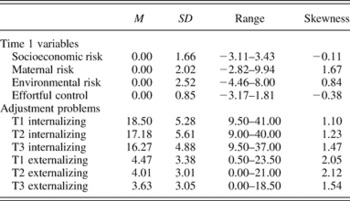
Descriptive statistics for all measures used in the study are presented in Table 1.
Descriptive statistics for the study variables

Contextual risk
Three contextual risk scores were calculated to reflect socioeconomic, maternal, and environmental risk in the first year of the study. Socioeconomic risk consisted of the sum of standardized values for family income and maternal education. The score was reversed such that higher scores reflected greater socioeconomic risk.
Maternal risk consisted of adolescent parent status, maternal depression, and maternal history of mental health or legal problems. Adolescent parent status at the target child's birth was coded 0 for mothers who were 19 years or older (n = 180) and 1 for mothers who were <19 at the time of the child's birth (n = 9). Mothers reported on their depressive symptoms over the previous month using the 20-item Center for Epidemiological Studies—Depression Scale (CES-D; Radloff, Reference Radloff1977). The internal consistency reliability as assessed by Cronbach α was .91, and scores ranged from 1 to 53 (M = 17.28, SD = 9.89). Maternal history of problems was assessed using mother report of the presence (0 = no, 1 = yes) of (a) metal illness, (b) depression, (c) alcohol or drug problems, (d) legal problems or arrest in the mother's lifetime. Maternal history of problems scores were the number of problems present. In previous research, this scale related to lower child social competence and higher adjustment problems (Greenberg et al., Reference Greenberg, Lengua, Coie, Pinderhughes, Bierman and Dodge1999). Scores ranged from 0 to 3 (M = 1.0, SD = 0.86). The maternal risk score was calculated as the sum of the standardized scores for adolescent parent status, maternal depression, and maternal history of problems.
Environmental risk consisted of household density, quality of the home environment, and quality of the neighborhood environment. Density in the home (M = 1.55, SD = 0.61) was the ratio of number of people in the home (M = 3.99, SD = 1.25, range = 2–9) to number of rooms in the home, which was rated on a 4-point scale (1 = 1 to 3 rooms, 2 = 4 to 6 rooms, 3 = 7 to 8 rooms, 4 = more than 8; M = 2.69, SD = 0.68). The quality of home environment was assessed using interviewer ratings on the Post Visit Inventory (PVI; Dodge, Bates, & Pettit, Reference Dodge, Bates and Pettit1990). The PVI was completed by both the mother and child interviewers subsequent to completing the interview with the family. The PVI assesses the cleanliness, safety, amenities, and size of the home. A scale score was calculated as the mean of the items on the scale, and risk scores were the average of both interviewers' scale scores, which were correlated .64 with each other. Neighborhood conditions were assessed by parent report on the Neighborhood Questionnaire (NQ), which assesses neighborhood safety, social involvement and services (Conduct Problems Prevention Research Group, 1995), and interviewer ratings on the PVI, which assesses the apparent safety of the neighborhood. Interviewer ratings of the neighborhood were correlated .56 with each other and were combined. Parent report on the NQ was correlated .38 with the PVI neighborhood ratings. Neighborhood risk scores were the average of standardized NQ and PVI scores (Greenberg et al., Reference Greenberg, Lengua, Coie, Pinderhughes, Bierman and Dodge1999). The environmental risk score was calculated as the sum of the standardized scores for household density, quality of the home environment, and quality of the neighborhood environment.
Effortful control
Behavioral measures of effortful control were obtained at Time 1. Effortful control is defined as attentional and inhibitory control mechanisms that facilitate the inhibition of a dominant response (Rothbart et al., Reference Rothbart, Ahadi and Evans2000), therefore, behavioral measures of effortful control were selected to index attentional and behavioral inhibition of a dominant response. Attentional inhibition was assessed using the Stroop Color and Word Test (Golden, Reference Golden1978). In this task, an individual is asked to read pages with “words” in three different trials. The first trial (word) involves reading a page containing the words “blue, red, green” listed 100 times in varying order. The second trial (color) involves reading a page containing 100 repetitions of “xxxx” printed in blue, red, and green. The third trial, or interference trial (color-word), involves reading a page containing the words “blue, red, green” printed in a color different than the word (e.g., the word “blue” printed in red). The individual is to name the color of the ink, ignoring the word that is printed. Scores for each trial are the number of words read in 45 s. The score for the third trial was used as an indicator of attention regulation. The Stroop assesses individual differences in resistance to interference (Golden, Reference Golden1978), selective attention (e.g., Lezak, Reference Lezak1995), and attention focusing (e.g., Mirsky, Reference Mirsky, Lyon, Reid and Krasnegor1996). The task requires an individual to shift attention from irrelevant information (i.e., the printed word) and focus on relevant information (i.e., the color of the ink). Thus, the attentional requirements may be similar to those required for emotion regulation, in which emotion regulation is accomplished as attention is shifted away from stimuli arousing negative affect and focused on less negative or positive stimuli (Derryberry & Rothbart, Reference Derryberry and Rothbart1997).
The Simon Says task was an adaptation of a task developed by Kochanska et al. (Reference Kochanska, Murray, Jacques, Koenig and Vandegeest1996), and was intended to assess behavioral inhibitory control. In this task, the child was to perform a movement indicated by a verbal command given and performed by the interviewer, but only if the command was preceded by the phrase “Simon says.” Interviewers presented children with 37 commands, 13 of which were not preceded by “Simon says.” Interviewers enacted all of the commands. Children were to refrain from performing the commands not preceded by “Simon says,” indicating children's ability to inhibit a prepotent response (i.e., to follow the command and imitate the interviewer enacting the command). Observational ratings of children's inhibitory control were made from video recordings of the task. Raters determined whether the child fully inhibited movement (2 points), partially enacted the movement (1 point), or completely enacted the movement (0 points). Scores were the mean weighted sums of the ratings for the 13 non Simon says items (range = 0–26) with higher scores reflecting higher inhibitory control. To assess the reliability of ratings, the video recordings of 20% of the sample were coded twice by independent coders. Kappa values for the individual non Simon says items ranged from .62 to 1.0 with a mean κ of .81. Interrater reliability for the overall score, that is, sum of 13 non Simon says items, was assessed using the intraclass correlation, which was .95. Stroop and Simon Says scores were correlated .34 (p < .001) and were combined by summing the standardized scores of each to create an indicator of children's effortful control. The validity of this measure is indicated by its correlation of .36 (p < .001) with a mother-report measure of effortful control that was a combination of the attention regulation subscale of the Early Adolescent Temperament Questionnaire (Capaldi & Rothbart, Reference Capaldi and Rothbart1992) and the inhibitory control subscale of the Child Behavior Questionnaire (Rothbart, Ahadi, Hershey, & Fisher, Reference Rothbart, Ahadi, Hershey and Fisher2001).
Child internalizing and externalizing problems
Both mother and child report of adjustment problems were obtained and combined to create cross-reporter measures of adjustment at all three time points. Multiple reporters of adjustment were sought to partially address the effects of shared method variance and reporter bias. Combining reporters has been suggested to capture differing perspectives of behavior (e.g., Bird, Gould, & Staghezza, Reference Bird, Gould and Staghezza1993; Hinshaw & Park, Reference Hinshaw, Park, Quay and Hogan1999) and reduces the number of statistical tests conducted. Although there are limitations to combining reporters (e.g., Tein, Roosa, & Michaels, Reference Tein, Roosa and Michaels1994), including modest to moderate correlations across reporters and loss of information from differing perspectives, it is suggested that the practice results in substantial reduction in distortion because of bias and an increase in statistical power (Biesanz & West, Reference Biesanz and West2004; Hoyt, 2000) and can produce a more reliable estimate of the construct, increasing the generalizability of the findings (Cook & Goldstein, Reference Cook and Goldstein1993). Mothers reported on children's internalizing and externalizing problems using the CBCL (Achenbach, Reference Achenbach1991a). The alphas for internalizing and externalizing for the present sample were .75 and .82, respectively. Children reported on their own internalizing and externalizing problems. Depression was assessed using the 27-item CDI (Kovacs, Reference Kovacs1981). Alpha values for the scale have ranged from .71 (Kovacs, Reference Kovacs1981) to .94 (Saylor, Finch, Spirito, & Bennet, Reference Saylor, Finch, Spirito and Bennett1984). The alpha value for the current sample was .80. Children reported on their anxiety on the Revised Children's Manifest Anxiety Scale (RCMAS; Reynolds & Richmond, Reference Reynolds and Richmond1978). The RCMAS consists of 28 items (9 lie scale items) to which the child responds “yes” or “no” and assesses both the degree and quality of anxiety experienced by children and adolescents from age 6 to 19. Internal consistency reliability in the present study was .85. Scores on the CDI and RCMAS were correlated .64 and were combined by summing the two scores to create a child report internalizing problems score that had an internal consistency reliability of .90. Child-report externalizing problems were assessed using the delinquent and aggressive behavior subscales (28 items) of the Youth Self-Report (YSR; Achenbach, Reference Achenbach1991b). The YSR has been found to discriminate clinic referred and nonreferred adolescents. The alpha value for the child-report externalizing scale was .82 in this study.
Confirmatory factor analyses (CFA) were conducted to test the feasibility of combining measures of adjustment problems across reporter. A multitrait, multimethod model with correlated uniquenesses (i.e., estimated error covariances) within method (mother report, child report) was used (Marsh, Byrne, & Craven, Reference Marsh, Byrne and Craven1992). At each time point, a CFA model was specified in which an externalizing factor loaded on mother and child report of externalizing problems, and an internalizing factor loaded on mother report of internalizing and child report of depression and anxiety. Error covariances within reporter were estimated. The CFAs, based on the covariance matrix and using maximum likelihood estimation, demonstrated adequate fit to the data at all three time points: Time 1: χ2 (1) = 0.02, ns, comparative fit index (CFI) = 1.0, normalized fit index (NFI) = 1.0; Time 2: χ2 (1) = 6.80, p < .01, CFI = .98, NFI = .98; Time 3: χ2 (1) = 2.14, ns, CFI = 1.0, NFI = .99) with all estimated factor loadings being significant. At Time 1, factor loadings ranged from .20 for mother report of internalizing to .90 for child report of depression (M = .67), and the correlation between the internalizing and externalizing factors was .71. At Time 2, factor loadings ranged from .20 for mother report of internalizing to .99 for child report of externalizing (M = .70), and the correlation between the internalizing and externalizing factors was .59. At Time 3, factor loadings ranged from .22 for mother report of internalizing to .99 for child report of externalizing (M = .61), and the correlation between the internalizing and externalizing factors was .70. Mother and child report of internalizing were correlated .20 (p < .01) at all three time points, and mother and child report of externalizing were correlated .40, .40, and .42 (all p < .001) at Times 1, 2, and 3, respectively. The composite alpha values for the cross-reporter measures of internalizing and externalizing were .88 and .87, respectively. Mother and child report of internalizing and externalizing problems were summed to create aggregate adjustment problems measures. These scores were not standardized prior to combining so as to retain an equivalent scale of measurement across the 3 years of assessment, required for growth analyses.
Results
Overview of analyses
First, the correlations among cumulative contextual risk variables, effortful control, and internalizing and externalizing problems were examined across the 3 years of the study. Second, the correlations of individual risk factors that compose the three cumulative risk variables with adjustment problems across time are presented to identify individual risk factors that might account for the observed relations between the cumulative risk variables and adjustment problems. Third, latent growth curve analyses were used to determine whether internalizing and externalizing problems demonstrated change across 3 years and variability in growth parameters. Fourth, conditional growth models were tested that examined the growth in internalizing and externalizing problems conditioned on socioeconomic, maternal, and environmental risk. Fifth, these conditional growth models were tested for consistency across levels of children's effortful control.
Correlations among the study variables
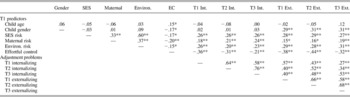
Correlations among child age, gender, cumulative contextual risk, effortful control, internalizing, and externalizing problems are presented in Table 2. Child age was modestly related to higher effortful control. Child gender was modestly related to effortful control such that boys demonstrated lower effortful control. In addition, boys demonstrated higher levels of externalizing problems at all three time points. The cumulative contextual risk variables were moderately intercorrelated, suggesting that the domains of risk tended to co-occur. All three contextual risk variables were significantly related to higher levels of internalizing and externalizing problems at all three time points, indicating that the cumulative risk variables were viable predictors of adjustment problems over time. The cumulative risk variables were modestly negatively correlated with effortful control. Thus, although higher risk was related to lower effortful control, children in higher risk contexts could be expected to demonstrate a range of effortful control abilities. Time 1 effortful control was related to lower levels of internalizing and externalizing problems across the 3 years of the study. Internalizing and externalizing problems were moderately to highly stable across the 3 years of the study.
Correlations among study variables

Note: SES, socieconomic status; EC, effortful control.
*p < .05. **p < .01.
Correlations of individual risk factors to adjustment problems
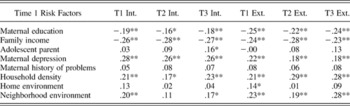
The correlations of the individual risk factors that compose the three cumulative risk variables with adjustment problems over time are presented in Table 3. Maternal education, family income, maternal depression, quality of the home environment, and quality of the neighborhood environment were significantly related to internalizing and externalizing problems across time. Maternal adolescent parent status was correlated with internalizing problems only at Time 3, and household density was correlated with externalizing problems only at Time 1. These correlations suggest that most of the risk factors contributed to the predictive value of the cumulative risk variables.
Correlations of individual risk factors to internalizing and externalizing problems across time

*p < .05. **p < .01.
Growth in internalizing and externalizing problems
Given the moderate to high stability in internalizing and externalizing problems, it was important to demonstrate whether there were significant changes in these variables over time. Latent growth curve models were used to examine growth in internalizing and externalizing problems. Using maximum likelihood estimation in LISREL and the matrix of first and second moments (i.e., means and covariances), models were specified in which factor loadings were set to define the intercept as levels of the variable at the first time point and the slope as indicating linear change in the variable across the 3 years of the study. These unconditional models were tested for internalizing and externalizing separately. Initial levels of both internalizing and externalizing were significantly different from zero, and variances for the intercepts were both significant (variance for internalizing intercept = 20.79, z = 7.09, p < .001; variance for externalizing intercept = 8.20, z = 7.26, p < .001), indicating significant individual differences in initial levels of internalizing and externalizing. The slope estimates for both internalizing (−1.04, z = −6.07, p < .001) and externalizing (−0.39, z = 3.60, p < .01) were significant and negative, indicating that the average levels of problems decreased across the 3 years of the study. Variances for the slopes of internalizing (1.39, z = 1.98, p < .05) and externalizing (0.76, z = 2.74, p < .01) were significant, suggesting significant individual variation in the slopes of those variables.
Growth in internalizing and externalizing conditioned on contextual risk
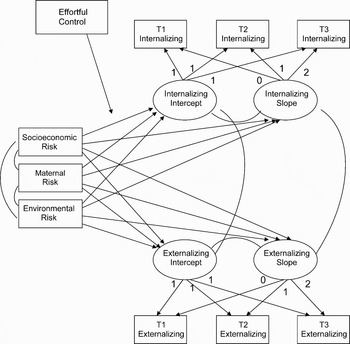
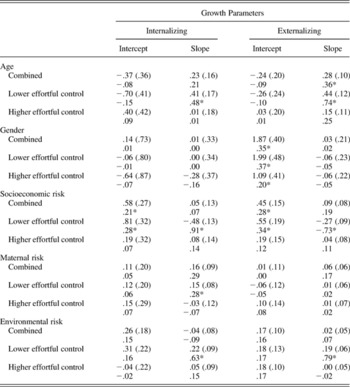
Next, a model was tested in which the intercept and slope factors of both internalizing and externalizing problems were conditioned simultaneously on socioeconomic, maternal, and environmental risk variables (see Figure 1). Child age and gender were included as covariates in the model. The model demonstrated reasonable fit to the data, χ2 (30) = 86.77, p < .001, CFI = .93, root mean square error of approximation (RMSEA) = .10. Child age was positively related to the slope of externalizing, indicating that older children demonstrated greater increases in externalizing problems. Child gender was positively related to the intercept of externalizing, indicating that boys had higher initial levels of externalizing problems. Of the contextual risk factors, only socioeconomic risk was significantly directly related to higher initial levels of both internalizing and externalizing problems above the effects of the other risk factors (see Table 4). Neither maternal nor environmental risk was uniquely related to the intercepts or slopes of internalizing or externalizing problems.
The model testing linear growth in internalizing and externalizing problems conditioned on socioeconomic, maternal, and environmental risk and moderated by effortful control.

Structural coefficients for the cross-group tests of the growth in internalizing and externalizing problems conditioned on contextual risk across lower and higher effortful control groups
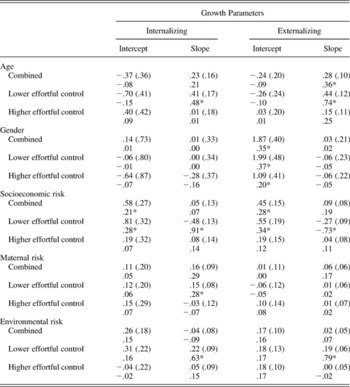
Note: Values are the unstandardized coefficients (standard errors) and common metric standardized beta coefficients.
*p < .05.
Effects of contextual risk moderated by effortful control
Evidence of significant moderation of this model suggests that the model parameters differed across levels of children's effortful control, and the direct effects should be interpreted with caution. To test the moderating effect of effortful control, the sample was divided at the median (.02) of effortful control to create lower (n = 95) and higher (n = 94) effortful control groups. A cross-group (or “stacked”) model in structural equation modeling was used to test for differences in the structural components of the model (i.e., predictive paths among the factors).Footnote 1
The cross-group model in which all parameters were free to differ across groups, χ 2 (64) = 164.11, p < .001, was compared to the identical model in which the Beta matrix (or structural components) was constrained to be invariant across the lower and higher effortful control groups, χ 2 (84) = 196.17, p < .001. This test yielded a significant difference in the structural parameters across levels of effortful control, Δχ 2 (20) = 32.06, p < .05. The model parameters for the lower and higher effortful control groups are presented in Table 4.
Child age was positively related to the slopes of internalizing and externalizing for children lower in effortful control, indicating that older children with lower effortful control demonstrated greater increases in problems than younger children with lower effortful control. Age was unrelated to the intercepts or slopes of problems for children higher in effortful control. Child gender was related to higher initial levels of externalizing problems both for children lower and higher in effortful control. Gender was not related to the other growth factors.
Socioeconomic risk was associated with higher initial levels of both internalizing and externalizing problems for children lower in effortful control but not for children higher in effortful control (see Table 4). Socioeconomic risk was related to decreases in internalizing and externalizing problems for children lower in effortful control, which was in the direction opposite than expected. Maternal risk was associated with increases in internalizing problems for children lower in effortful control, but not for those higher in effortful control. Environmental risk was associated with increases in both internalizing and externalizing problems for children lower in effortful control, but not those higher in effortful control (see Table 4).
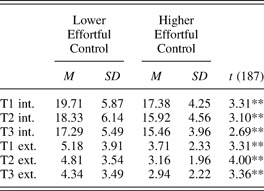
To better understand the unexpected association of socioeconomic risk with decreases in internalizing and externalizing problems, follow-up descriptive analyses were conducted. Mean levels of problems across children lower and higher in effortful control were examined first. Children lower in effortful control had significantly higher levels of both internalizing and externalizing problems than children higher in effortful control at all three time points, with the highest levels at Time 1 (see Table 5). Thus, despite the negative association between socioeconomic risk and the slopes of internalizing and externalizing, lower effortful control children had higher adjustment problems across time.
Mean levels and differences in internalizing and externalizing problems across childrens lower and higher in effortful control

**p < .01.
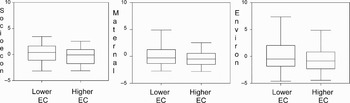
Other possible explanations for the pattern of findings include low variances or restricted ranges of the risk factors in the higher effortful control group or over representation of higher socioeconomic risk in the lower effortful control group. The distributions of the risk factors within the lower and higher effortful control groups are presented in Figure 2. The possibility that there was less variability in the contextual risk factors for the group of children higher in effortful control was tested with Levene's test for equality of variances across the lower and higher effortful control groups. There were no significant differences in the variances of the contextual risk factors across groups (socioeconomic risk F = 0.57, ns, maternal risk F = 0.88, ns, environmental risk F = 0.62, ns). Although the lower effortful control group had slightly higher levels of risk, as indicated by the modest significant correlations of effortful control with the contextual risk factors, there was notable overlap in the distributions of the risk factors across groups.
Distributions of socioeconomic, maternal, and environmental risk factors across lower and higher levels of effortful control.

Discussion
The importance of children's self-regulation to the development of adjustment problems is widely recognized (Posner & Rothbart, Reference Posner and Rothbart2000). Less clear is the role of self-regulation in the presence of contextual risk. Cumulative contextual risk is consistently shown to relate to greater adjustment problems. However, children's individual differences in self-regulation may serve as a key protective factor. The results of this study show that effortful control moderates the effects of socioeconomic, maternal, and environmental risk, mitigating their effects on the development of internalizing and externalizing problems. This study was unique in using a growth modeling approach to examine the effects of cumulative contextual risk on the development of internalizing and externalizing problems and in testing effortful control as a moderator of the effects of contextual risk on the growth of adjustment problems.
Socioeconomic, maternal, and environmental risk factors were each correlated with higher levels of adjustment problems across the 3 years of the study. This replicates the extensive prior evidence of their adverse impact on children's adjustment. However, by examining three risk domains rather than a single cumulative risk count, we were able to uncover distinct patterns of relations of different risk domains to adjustment problems.
When the individual effects of socioeconomic, maternal, and environmental risk were tested simultaneously, only socioeconomic risk retained a significant association with higher initial levels of internalizing and externalizing problems. Thus, it appears that socioeconomic risk accounted for the effects of the other two risk factors on children's initial level of problems. Socioeconomic risk is associated with numerous other risk factors, and thus it is not surprising that it would account for the effects of the other risk factors on levels of problems.
However, the associations of the risk factors to initial levels and changes in internalizing and externalizing problems depended on children's level of effortful control. This is consistent with previous evidence that the effects of poverty (Buckner et al., Reference Buckner, Mezzacappa and Beardslee2003) and cumulative risk (Lengua, Reference Lengua2002) differed across levels of self-regulation. In this study, none of the risk factors was related to levels of or growth in adjustment problems for children higher in effortful control. For children lower in effortful control, the risk factors predicted changes in their levels of adjustment problems. Before interpreting these results, it is important to point out that the pattern of findings is not accounted for by variances or covariances among the study variables. For instance, one alternative explanation for the nonsignificant associations of the risk factors to the growth factors of internalizing and externalizing in the higher effortful control group might have been a lack of variability on the risk factors in this group. Follow-up analyses showed slight mean differences on the risk factors between the lower and higher effortful control groups, but no differences in variability. Similarly, a high correlation between effortful control and socioeconomic risk might have resulted in a disproportionate number of lower effortful control children having higher socioeconomic risk. However, there was only a modest association between effortful control and socioeconomic risk, and there was notable overlap in the distributions of socioeconomic risk across levels of effortful control groups. Thus, the pattern of findings cannot be accounted for by the distributional properties of the data.
For children low in effortful control socioeconomic risk was associated with higher initial levels of internalizing and externalizing problems, but decreases in problems over time. Despite decreases in levels, children lower in effortful control had higher adjustment problems than children higher in effortful control at all three time points. Because low effortful control children with higher socioeconomic risk had higher initial and ultimate levels of problems, the significant decrease in their levels of adjustment problems might reflect some regression to the mean. The pattern might also reflect a purported temporary equalization of the impact of SES during adolescence (Lupien, King, Meaney, & McEwen, Reference Lupien, King, Meaney and McEwen2001), with lower SES children's levels of adjustment problems approaching the levels of problems in middle and upper SES children. Nonetheless, socioeconomic risk was particularly problematic for the emotional and behavioral adjustment of children with low effortful control. Even among children with higher initial levels of problems, that is, children lower in effortful control, socioeconomic risk was associated with greater problems.
Maternal and environmental risk did not relate to initial levels of adjustment problems above the effects of socioeconomic risk. However, both maternal and environmental risk predicted increases in adjustment problems in children low in effortful control. Maternal risk predicted increases in internalizing problems. For low effortful control children, maternal risk factors such as depression and history of mental health and legal problems increases the likelihood of children developing internalizing problems. The maternal risk factor was relatively more weighted with maternal depression, which might account for the association being specific to increases in child internalizing (e.g., Downey & Coyne, Reference Downey and Coyne1990). The correlations of individual risk factors also suggest that the effect of maternal risk was accounted for by maternal depression. Maternal problems, and maternal depression in particular, might lead to increases in children's depression through experiences of stress, negative parenting, and family environmental factors such as family discord (e.g., Burt et al., Reference Burt, Van Dulmen, Carlivati, Egeland, Sroufe and Forman2005; Goodman & Gotlieb, Reference Goodman and Gotlieb2002; Hammen, Brennan, & Shih, Reference Hammen, Brennan and Shih2004). Maternal depression might also lead to internalizing problems in children through a genetic liability (e.g., Rice, Harold, & Thapar, Reference Rice and Thapar2002). Children low in effortful control may be less able to modulate their negative emotions or behaviors elicited by family risk. For example, negative parenting behaviors are particularly detrimental for children low in effortful control (e.g., Lengua, Wolchik, Sandler, & West, Reference Lengua, Wolchik, Sandler and West2000; Morris et al., Reference Morris, Silk, Steinberg, Sessa, Avenevoli and Essex2002). In addition, children low in effortful control or self-regulation may employ less adaptive appraisals and coping strategies (e.g., Eisenberg, Fabes, Murphy, et al., Reference Eisenberg, Fabes, Murphy, Karbon, Smith and Maszk1996; Lengua & Long, Reference Lengua and Long2002; Salmon & Pereira, Reference Salmon and Pereira2002) that render them more vulnerable to the effects of risk factors.
Environmental risk predicted increases in both internalizing and externalizing problems in children lower in effortful control. For children lower in effortful control, disorderly, crowded, dangerous, and crime-ridden environments may be particularly detrimental. Children lower in effortful control may have difficulty modulating anxiety or distress aroused by a high-risk context, and they may struggle to avoid dangerous or risky contexts or to select more positive and adaptive settings and experiences. This is supported by the scant previous evidence pointing to the more adverse effects of high-risk neighborhoods on children who are high in impulsivity (Lynam et al., Reference Lynam, Caspi, Moffit, Wikstrom, Loeber and Novak2000). In the future, it will be important to understand the potential mechanisms of risk for internalizing and externalizing problems for children low in effortful control, including poor modulation of negative affect, greater vulnerability to parenting and family risk factors, and less adaptive appraisal and coping strategies.
It is interesting to note that the effects of maternal and environmental risk on increases in internalizing and externalizing problems were above the effects of socioeconomic risk, which was itself related to decreases in problems. Thus, maternal and environmental risk account for increases in adjustment problems despite their co-occurrence with socioeconomic risk and in addition to elevated levels of adjustment problems associated with socioeconomic risk. Whereas socioeconomic risk may represent an overarching risk factor that is associated with numerous other risk factors, maternal and environmental risk factors may be more proximal and experienced more directly by children, leading to increases in problems above the effects of socioeconomic status. It is also interesting that none of the risk domains fully accounted for the effects of the others, and each was needed to understand the development of children's adjustment problems. This supports the value of cumulative risk models in understanding the effects of contextual risk on children's adjustment problems. Although socioeconomic risk was associated with elevated levels of adjustment problems, the added risk of maternal problems and adverse home and neighborhood environments predicted increases in problems above the effects of socioeconomic risk. It is important to examine the effects of the accumulation or co-occurrence of multiple risk factors on children's adjustment (Evans, Reference Evans2003).
A viable alternative model not tested in this study is one in which effortful control is influenced by the contextual risk factors examined and might mediate the relation between contextual risk and adjustment problems. Evidence suggests that cumulative contextual risk, and poverty in particular, is related to lower levels of effortful control and other indicators of self-regulation (Buckner et al., Reference Buckner, Mezzacappa and Beardslee2003; Evans & English, Reference Evans and English2002; Hart et al., Reference Hart, Atkins and Fegley2003). In this study, the contextual risk factors were indeed related to lower levels of effortful control, which was in turn related to lower adjustment problems. However, the associations of the contextual risk factors with effortful control were modest, which means any mediated effect would be quite small. The effects of contextual risk factors on effortful control might be more marked at earlier developmental stages when effortful control is developing more precipitously (e.g., Kochanska et al., Reference Kochanska, Murray, Jacques, Koenig and Vandegeest1996). It is likely that effortful control is partially shaped by contextual risk, and at the same time moderates the relation between contextual risk and adjustment. However, these two mechanisms cannot be tested simultaneously in a single model.
Some limitations of the study should be noted. The sample is a community sample representing the full range on each of the risk factors. However, the sample is not representative of the population at large. Although families living under the poverty line were oversampled, the sample is also overrepresented by higher income families. Thus, the findings are generalizable to a population of typically developing children who are exposed to varying levels of contextual risk factors. The findings might have differed if the models were tested using a sample that had been selected to be high on a particular risk factor or on child adjustment problems. However, by using a sample that represents the full range on multiple risk factors and on adjustment problems, we were able to examine the unique and combined effects of numerous risk factors on adjustment more adequately. The use of a community sample also limits conclusions that can be drawn about clinical levels of problems or psychopathology. However, the results are informative about factors that are related to emerging and increasing levels of adjustment problems in typically developing children.
In addition, the size of the sample used in this study did not allow the examination of the simultaneous unique effects of multiple individual risk factors to unpack the mechanisms of the effects of the contextual risk domains. Further, the sample size of children low in effortful control was relatively small, restricting the examination of potential mechanisms of the effects of risk for children low in effortful control. However, by examining three domains of risk, socioeconomic, maternal, and environmental risk, the results provide direction for future examinations of specific risk factors. For example, maternal risk emerged as a specific predictor of growth in internalizing problems. Examining the correlations of the individual risk factors with internalizing, it appears that this is primarily accounted for by maternal depression, which promises to be a useful risk factor to include in future tests of specific mechanisms of risk. In addition, environmental risk predicted growth in internalizing and externalizing problems, and both the quality of the home and neighborhood environments appeared to contribute to this association, suggesting both should be included in future examinations of mechanisms of risk.
Moreover, although almost a third of the sample represents ethnic or racial minorities, there was relatively limited representation of each ethnic or racial minority group. This precludes the test of the model across ethnic groups, which will be another important direction for future research. Another limitation of the study is the lack of control of intellectual ability or intelligence, which, unfortunately, was not measured. Evidence suggests that intelligence and effortful control are related, although their association is generally modest to moderate in magnitude, and effortful control has been shown to predict adjustment problems above the effects of intellectual ability (e.g., Lengua, Honorado, & Bush, Reference Lengua, Honorado and Bush2007; Olson et al., Reference Olson, Sameroff, Kerr, Lopez and Wellman2005).
The results of this study have implications for our etiological models of children's adjustment, as well as for prevention efforts aimed at diminishing the negative impact of contextual risk. A bioecological model of development (Bronfenbrenner & Morris, Reference Bronfenbrenner, Morris, Damon and Lerner1998) would point to contextual, interpersonal and individual factors as contributing to the development of adjustment problems. The results of this study suggest that the accumulation of contextual risk factors plays a role in the development of internalizing and externalizing problems. It also points to effortful control as a potentially critical protective factor for children experiencing higher levels of contextual risk. Children higher in effortful control may be able to better manage the stress and distress associated with contextual risk. They may be able to focus on or divert their attention and energy to more adaptive or productive pursuits and avoid more dangerous or risky situations. In addition, they may be able to inhibit less adaptive emotional and behavioral responses to their stressful situations.
An important future direction for research is to expand our understanding of the processes associated with the development of effortful control. Such research would identify potential targets for preventive interventions aimed at mitigating the negative impact of risk on children's adjustment and promoting positive adjustment in children in high-risk settings. The results of this study suggest that interventions aimed at enhancing effortful control in children exposed to contextual risk might reduce adjustment problems. However, it is important to note that a focus on individual characteristics such as effortful control should not replace efforts to better understand the social and interpersonal mechanisms of risk associated with cumulative risk (e.g., Deater-Deckard et al., Reference Deater-Deckard, Dodge, Bates and Pettit1998; Greenberg et al., Reference Greenberg, Lengua, Coie, Pinderhughes, Bierman and Dodge1999). In addition to targeting child factors, community, family, and interpersonal factors should also be identified as potential mediators of the effects of cumulative risk and potential targets of preventive interventions aimed at mitigating the impact of contextual risk on children's adjustment problems.