Have modern American presidents become too powerful (Schlesinger Reference Schlesinger1973) or too weak (Heclo and Salmon Reference Heclo and Salamon1981)? The origin, and fuel, for this longstanding debate is, in the words of Scott C. James (Reference James2005, 31–2), the ‘intentional ambiguity’ of article II of the US constitution. That the expressed powers of the executive are purposefully vague makes correctly gauging the empirical balance of policy-making power between the executive and legislative branches in the United States a challenging undertaking. Competing perspectives of executive authority are borne out in the study of budgetary politics. Modern presidents’ formal prerogative to propose budgets not only serves as a critical element of executive authority (Rossiter Reference Rossiter1960; Berman Reference Berman1979; Whittington and Carpenter Reference Whittington and Carpenter2003); it also shapes budgetary outcomes (for example, Kamlet and Mowery Reference Kamlet and Mowery1987; Kiewiet and McCubbins Reference Kiewiet and McCubbins1988, Reference Kiewiet and McCubbins1991; Berry, Burden and Howell Reference Berry, Burden and Howell2010; Canes–Wrone Reference Canes–Wrone2006; Howell, Jackman and Rogowski Reference Howell, Jackman and Rogowski2013).
Executive budget proposals are constructed in a strategic bargaining environment that encapsulates demands from both the political and policy environments (externally induced budgetary preferences) and presidents’ partisan policy priorities (internally induced budgetary preferences). Gauging the precise nature of presidential budgetary influence over congressional appropriation decisions therefore requires identifying the elements that comprise executive budget proposals. A stochastic decomposition method is advanced for addressing precisely this concern: parsing funding levels demanded by both political and policy constraints from those constituting partisan policy priorities embedded in presidents’ budget proposals.Footnote 1 Estimates of partisan policy priorities can allow one to gauge the independent impact of partisan presidents’ different policy priorities on budgetary outcomes (for example, Ferejohn and Krehbiel Reference Ferejohn and Krehbiel1987; Kiewiet and Krehbiel Reference Kiewiet and Krehbiel2000), net of external political and policy considerations.
Statistical estimates of internally induced presidential budgetary preferences are used to test alternative theories of partisan-oriented presidential influence over budgetary outcomes for a panel of 32 US federal agencies. This stochastic decomposition approach resolves the dilemma posed by existing studies of presidential budgetary influence over congressional appropriation decisions that erroneously conflate external constraints due to both political and policy conditions (extrinsic motivations) with those reflecting partisan policy priorities (intrinsic motivations). These findings underscore the limitations associated with existing means of gauging presidential budgetary influence, which utilize either the absolute difference between observed presidential requests and appropriation outcomes or instrumental variables estimation.
Substantively, the statistical findings reveal that presidents exert independent budgetary influence over congressional appropriations for US federal agencies. Consistent with research espousing the potency of executive veto authority (Rohde and Simon Reference Rohde and Simon1985; Gilmour Reference Gilmour1995; Cameron Reference Cameron2000), the empirical results show that presidents are marginally more effective at shaping budgetary outcomes consistent with partisan policy priorities during periods of divided party government. Contrary to the bilateral veto bargaining theory (Kiewiet and McCubbins Reference Kiewiet and McCubbins1988, Reference Kiewiet and McCubbins1991), the statistical evidence indicates that a president’s partisan policy priorities play a vital role in shaping legislative appropriation outcomes even when Congress seeks to limit executive authority in the budgetary process. On a substantive level, this study uncovers empirical evidence of executive authority being effectively exercised under alternative institutional conditions typically thought to effectively constrain presidential policy influence.
We begin by discussing the rationale, logic and analytics underlying a stochastic decomposition of presidential budgetary proposals. The following section presents a statistical model of externally induced presidential budgetary preferences that focuses on the extrinsic basis for exercising executive authority. Next, the internally induced components of presidents’ budgetary preferences are parsed out by estimating a stochastic generalized proposal model. The subsequent section empirically examines presidential budgetary influence over congressional appropriation outcomes based on estimates of executive proposals generated from the stochastic decomposition method advanced in this study. The final section covers conclusions drawn from this investigation, and its relevance for understanding the exercise of executive authority.
The Decision-Theoretic Foundations of Executive Budget Proposals
While budgets represent policy choices undertaken by entire governments (Fenno Reference Fenno1966; Berman Reference Berman1979; Wildavsky Reference Wildavsky1988), they are the product of significant power struggles between executive and legislative institutions. Gauging presidential budgetary influence is thus critically important for understanding the balance of policy-making powers between the executive and legislative branches. Article I, section 9, clause 7 of the US constitution vests Congress with a formidable constraint on executive budget authority: constitutional authority for appropriating any government expenditure. Presidents’ proposed budgets must account for Congress’ preferences and other relevant institutional constraints (for example, fiscal rules), as well as broader policy conditions to avoid not only inefficient policy planning and execution of government programs (Kiewiet and McCubbins Reference Kiewiet and McCubbins1991, 200, 202), but also damaged credibility in annual budgetary deliberations with Congress (for example, Bendor, Taylor and Van Gaalen Reference Bendor, Taylor and Van Gaalen1985; Banks Reference Banks1989; Schick Reference Schick1990, 90–91).
Any observed executive budget proposal is a revealed preference comprising three distinct components: (1) externally induced budgetary preferences reflecting a president’s estimation of what budget is acceptable, given current political and policy circumstances, (2) internally induced budgetary preferences capturing what presidents intrinsically want, net of political or policy considerations noted above, plus (3) random error.Footnote 2 By definition, internally induced budgetary preferences represent deviations between a president’s observed proposal and the externally induced budgetary position. To illustrate the logic, consider a simple example with two simplifying assumptions. First, the random error component is zero. Second, an exactly proportional relationship exists between externally induced budgetary preferences and revealed budgetary preferences. If presidents prefer to spend more than what is predicted by (1) the external conditions component, then it must follow that (2) the internal preferences component is positive, leading to a revealed budgetary preference that exceeds externally induced budgetary preferences. Conversely, when presidents seek to spend less than what is predicted by (1), then (2) must be negative by definition. Presidents therefore confront a constrained decision-making problem: how to formulate a budget proposal that accounts for extant political conditions and addresses policy demands, while also pursuing their own policy goals. Because this stochastic decomposition method allows for a firmer understanding of how executive budget proposals are formulated, one can subsequently ascertain the precise nature of executive authority when analyzing presidential budgetary influence over congressional appropriation decisions.
The Limitations of an Instrumental Variables Approach
Isolating the independent impact of presidential partisan budgetary
priorities on legislative appropriations is more challenging than is
portrayed by existing studies of executive – legislative relations. The
standard approach is to employ the absolute difference between observed
presidential budget proposals and legislative appropriations (that is,
executive proposal – legislative funding). This standard approach of
analyzing executive authority in the budgetary process is inherently
problematic because it may represent several observationally equivalent
situations: a budget gap resulting from (1) presidents acquiescing to
Congress, (2) the effective exercise of executive authority by presidents or
(3) some combination thereof. Certainly, a standard instrumental variable
approach can be quite useful in generic terms for assessing presidential
budgetary influence (for example, Canes–Wrone Reference Canes–Wrone2006; Howell, Jackman and Rogowski Reference Howell, Jackman and Rogowski2013). This approach, however, does
not solve the problem posed here. Identification restrictions required to
isolate presidential budgetary influence employing the instrumental variable
approach require that the executive budget proposal serve as an endogenous
regressor, despite it being a composite function of both exogenous
instruments and covariates from a structural model. An instrumental variable
framework computes an instrumental variable estimate (
 $\hat{X}$
) of the executive budget proposal that represents
presidents’ budgetary preferences. This estimate is a function of both
exogenous instruments, usually denoted by a vector
Z,
pertaining in our model to internally induced
budgetary preferences (for example, administration party dummies), as well
as covariates in the structural equation model, usually denoted by a vector
W,
pertaining in our model to externally induced
budgetary preferences (for example, unemployment rate, budget rules,
partisan composition of Congress). The problem arises because
 $\hat{X}$
is a linear combination of both
Z
and
W
. Although the standard instrumental variable approach can be
usefully applied to address generic endogeneity between revealed budgetary
preferences captured in the president’s proposal and congressional
appropriations, this method cannot pinpoint the precise nature of executive
budgetary influence embodied within the executive proposal.
A stochastic decomposition method is preferable to a standard instrumental variable estimation approach because exclusion restrictions required of the latter may often be violated in empirical settings (Stovey and Green Reference Stovey and Green2010). Satisfying the exclusion restriction requires that the instrumental variables (that is, presidents’ partisan budgetary priorities) have no direct effect on appropriation outcomes. While this claim cannot be directly assessed in a standard instrumental variables framework (for example, Angrist and Pischke Reference Angrist and Pischke2009, 116–17, 153–4), such an exclusion restriction is moot, since presidents’ partisan budgetary priorities (captured by the internally induced preference estimate) and political and policy considerations contained in executive budget proposals exert distinct effects on congressional appropriation outcomes.Footnote 3
The one obstacle inherent to the stochastic decomposition approach is that it requires both valid externally induced budget preference and generalized proposal model estimates (defined below) to arrive at meaningful estimates of partisan budgetary preferences. Valid statistical inference requires robustness to potential ‘unobservables,’ where key variables are omitted or functional forms are misspecified. Of course, this dilemma also arises in the application of instrumental variable estimation methods, since a strong instrument does not preclude the possibility of an underspecified instrumental variable equation. To address this issue, robustness checks involving model specification choices are employed later in this study—as well as in the online appendix—to assess whether alternative externally induced budgetary preference model specifications yield substantively similar prediction estimates. In addition, RESET model specification tests are implemented to ensure that externally induced budgetary preference model estimates suffer from neither improper functional form nor omitted variable bias (Ramsey Reference Ramsey1969).
Stochastic Decomposition of Executive Budget Proposals: Analytical Foundations
We begin by adhering to the common practice of considering executive budget proposals in terms of their short-run dynamics (for example, Kiewiet and McCubbins Reference Kiewiet and McCubbins1991, 192). Observed executive budget proposals are therefore defined as the annual growth rate in executive budget proposals (r t ) formally submitted to the legislature: r t =[ln(R t ) – ln(R t-1 )] × 100. The president may have the ability to propose a budget, but he or she always has to reconcile personal policy preferences with the external constraints posed by both political and policy conditions. How these differences affect the executive proposals can be captured in loss function, seen as underlying the formulation of executive budget proposals.
Let the executive loss function underlying executive budget proposals be
defined as
 $L_{t} =\left| {r_{{\rm 1}} {-}r_{t}^{{\ast}} } \right|$
, where r
t
is the observed proposal and
 $r_{t}^{{\ast}} $
represents externally induced budgetary preferences.
Minimizing this loss function, then, is the focus of presidential concern,
and can be expressed as solving an optimization problem that requires the
president to evaluate current politics and policy in order to arrive at the
terms in the function. The externally induced budgetary preference is
generated by
 $r_{t}^{{\ast}} $
=E(r
t
|
t
Ω
t-p
), p=0, 1, where political and policy information
(Ω) is premised on what is observed contemporaneously
(p=0) or with a one-year lag
(p=1). The executive’s optimal decision
rule is thus
 ${\vskip -3pt \mathop{{\min }}\limits_{{r_{{\rm 1}} ,.....,r_{n} }}} \,Mean\left| {r_{t} {-}r_{t}^{{\ast}} } \right|$
. The solution corresponding to this decision rule is to
minimize the mean absolute prediction errors with respect to a finite
sequence of observed proposals (
 $\bar{r}_{{\rm 1}} ,......,\bar{r}_{n} $
) such that
 $\bar{r}_{t} =r_{t}^{{\ast}} ,\,\forall \ t,\,{\rm 1}\leq t\leq n$
. That is, this externally induced component posits that
executives, on average, will formulate budget proposals that reflect their
extrinsic preferences for spending, conditional on both external political
and policy considerations. The ‘information set,’ Ω, thus provides a best
unbiased linear prediction (that is, rational expectation) of the
president’s revealed budgetary preferences consistent with a politically
credible budget proposal.
Executive budget proposals, however, constitute more than merely a response
to external political and policy conditions. Presidents, after all, wish to
use budget proposals to advance their policy priorities. They seek to
construct budget proposals that reflect their underlying policy priorities
(that is, internally induced preferences) in the optimal budget proposal
decision problem. Recall that internally induced budgetary preferences
constitute deviations between the observed budget proposal and externally
induced budgetary preferences. Presidents requesting more (less) funding
than this externally induced budgetary preference estimate yields rational
executive ‘overfunding’ (‘underfunding’) biases. If one posits that
presidents possess partisan policy priorities that are reflected in their
budgetary proposals, then ideological congruence between presidents and
public agencies must be considered when analyzing executive funding
‘biases’. Taken together, internally induced budgetary preferences translate
into a president’s rational bias for overfunding agencies that support
policies they advocate, and underfunding agencies with ideological policy
missions at odds with their own policy priorities. Under these premises, a
president’s budget can be viewed as a target optimal budget, plus
ωt such that
 $\tilde{r}_{t} =E\left( {r_{t} \,\mid\,r_{t}^{{\ast}} ,\,\omega _{t} } \right)$
under symmetric loss. Note that this expression includes
externally induced executive budgetary preferences (
 $r_{t}^{{\ast}} $
), and incorporates partisan policy priorities captured as
excess funding bias (ωt).
These partisan policy priorities can also be empirically augmented by gauging the extent to which presidents prefer to overfund vs. underfund public agencies (asymmetric funding aversion). Empirically estimating presidents’ asymmetric funding preferences that reflect greater support for ideologically allied agencies than for ideologically rival agencies is implemented by applying a stochastic Linlin (linear–piecewise) loss function (Granger Reference Granger1969; Christoffersen and Diebold Reference Christoffersen and Diebold1997). This generalized loss function relaxes the maintained assumption of symmetry exhibited in canonical linear risk-neutral loss functions. For example, overfunding (positive deviations) may be penalized at a lower rate than underfunding (negative deviations) for ideologically allied agencies (for example, Republican presidents and conservative agencies). By jointly embedding the externally induced component, excess funding bias, and asymmetric funding aversion in the executive’s loss function, one can ascertain presidents’ rational relative aversion between overfunding and underfunding public agencies.Footnote 4 As is standard in the modern practice of US federal budgeting, presidents are considered ‘constrained advocates’ for their policy priorities, and pursue them accordingly through the mechanism of executive budget proposals (Wildavsky Reference Wildavsky1988; Schick Reference Schick1990; Meyers Reference Meyers1994).
Technical exposition of the preceding argument proceeds as follows. First, the president optimizes a generic Linlin (piecewise linear) loss function defined as:
 $$L(c_{t} )=\left\{ {\matrix{ {a\left| {r_{t} {-}c_{t} } \right|,} & {if\,r_{t} > c_{t} } \cr {b\left| {r_{t} {-}c_{t} } \right|,} & {if\,r_{t} \leq c_{t} } \cr } \,\,t=1,2,\,\ldots\,,n\,,} \right.$$
where c=(c
1
,…., c
n
) is a threshold vector and a, b are
positive real numbers.Footnote
5
The Linlin loss function shape parameters, a and
b, provide a measure of executive asymmetric funding
aversion. When a>b, executives prefer
to underfund relative to externally induced budgetary preferences
(rational overfunding aversion), and the converse holds
true when a <b (rational
underfunding aversion). When
a=b, presidents exhibit rational
indifference between overfunding and underfunding relative to externally
induced budgetary preferences. The value of c that
minimizes the mean expected loss conditional on
 $r_{t}^{{\ast}} $
and ω
t
for (1) is defined as:
 $$\left( {\tilde{r}_{{\rm 1}}^{{Linlin}} ,\,\ldots\,\,\ldots\,..,\tilde{r}_{n}^{{Linlin}} } \right)=\mathop{{\arg \,\min }}\limits_{c} \left\{ {Mean\left[ {E(L(c_{t} ))\,\mid\,r_{t}^{{\ast}} ,\omega _{t} } \right]} \right\}.$$
Plugging the optimal predictor under Equation 2 into Equation 1 yields the generalized loss function associated with the president’s budget proposal:
 $$L(r_{t} {-}\tilde{r}_{t}^{{Linlin}} )=\left\{ {\matrix{ {a\left| {r_{t} {-}\tilde{r}_{t}^{{Linlin}} } \right|,} & {if\,r_{t} > \tilde{r}_{t}^{{Linlin}} } \cr {b\left| {r_{t} {-}\tilde{r}_{t}^{{Linlin}} } \right|,} & {if\,r_{t} \leq \tilde{r}_{t}^{{Linlin}} } \cr } } \right..^6$$
Equation 3
Footnote
involves the executive minimizing the mean absolute prediction
errors involving observed budget proposals (r
t
) and the generalized loss function (
 $$\tilde{r}_{t}^{{Linlin}} $$
) parameterized with respect to the finite sequence of
budget proposals (
 $\tilde{r}_{{\rm 1}} ,\,\ldots\,.\tilde{r}_{n} $
) given by
 $\bar{r}_{t} =r_{t}^{{Linlin}} ,\,\forall t,\,{\rm 1}\leq t\leq n.$
Presidents construct budget proposals consistent with the optimal executive decision rule for budget formulation under Linlin loss, which is:
 $$\mathop{{\min }}\limits_{{\tilde{r}_{t}^{{Linlin}} }} \left\{ {a\,\mathop{\int}\nolimits_{\!\!\!\!\tilde{r}_{t}^{{Linlin}} }^\infty {\left( {r_{t}\ {–}\ \tilde{r}_{t}^{{Linlin}} } \right)} \,f\left( {r_{t} \,\mid\,r_{t}^{{\ast}} ,\,\omega _{t} } \right)dr_{t} \ {–}\ b\mathop{\int}\nolimits_{\!\!\!\!{-}\infty}^{\tilde{r}_{t}^{{Linlin}} } {\left( {r_{t} {-}\tilde{r}_{t}^{{Linlin}} } \right)} \,f\left( {r_{t} \,\mid\,r_{t}^{{\ast}} ,\,\omega _{t} } \right)dr_{t} } \right\}$$
Intuitively, Equation 4 translates into presidents’ formulating optimal
budget proposals that account for their own excess funding bias and
asymmetric funding aversion. Because
 $$\tilde{r}_{t}^{{Linlin}} $$
is an optimal predictor in Equation 2, solving for the
first-order condition of Equation 4 yields:
 $${-}a\left[ {1{-}F\left( {r_{t}^{{Linlin}} \,\mid\,r_{t}^{{\ast}} ,\omega _{t} } \right)} \right]\,{\rm {+}}\ b\left[ {F\left( {r_{t}^{{Linlin}} \,\mid\,r_{t}^{{\ast}} ,\omega _{t} } \right)} \right]{\rm =0}{\rm .}^7$$
Equation 5
Footnote
can be expressed as closed-form solution for the optimal predictor
reflected by the generalized proposal at t:
 $$F\left( {\tilde{r}_{t}^{{Linlin}} \,\mid\,r_{t}^{{\ast}} ,\omega _{t} } \right){\rm =}{a \over {a\;{+}\;b}}.$$
Moreover, F(∙|r
t
, ω
t
) is a location-scale distribution function that captures presidents’
asymmetric funding aversion by the Linlin loss shape parameters,
a and b. Therefore, the generalized
executive budgetary proposal can be restated as a linear prediction
equation:
 $$\tilde{r}_{t}^{{Linlin}} \;{\rm =}\;E\left[ {r_{t} \,\mid\,r_{t}^{{\ast}} ,\,\omega _{t} } \right]{\rm {+}}\Phi ^{{{-}{\rm 1}}} \left[ {{a \over {a{\rm {+}}b}}} \right]\sigma _{t} ,$$
where externally induced budgetary preferences and excess
funding bias are captured deterministically by
 $r_{t}^{{\ast}} $
, and w
t
, respectively. Asymmetric funding aversion is accounted for
stochastically by
 $\delta =\Phi ^{{{-}{\rm 1}}} \left[ {{a \over {a\;{+}\;b}}} \right]$
, where Φ–1 is a quantile function.Footnote
8
The regression equation for the generalized proposal in Equation
6 is simply a
conditional mean equation with a time-varying conditional risk volatility
term representing asymmetric funding aversion:
 $$r_{t} =\phi r_{t}^{{\ast}} {+}\beta \omega _{t} {+}\delta \sigma {_{\varepsilon}_{___t}} {+}{\varepsilon}_{t} ,$$
where
 $\delta =\Phi ^{{{-}{\rm 1}}} \left[ {{a \over {a\;{+}\;b}}} \right].$
In the limiting case, presidents’ budget proposals consist
only of externally induced budgetary preferences, plus some random
variations when ϕ=1, β=0 and
δ=0. Presidents propose larger (smaller) spending than
merited by political and policy conditions when β>0
(β<0). Presidents exhibit rational underfunding
aversion when δ<0
(a<b), rational overfunding aversion
when δ>0 (a>b), and
rational indifference consistent with symmetric loss when
δ=0 (a=b). Next, the
empirical modeling of the externally induced budgetary preference component
is covered.
Statistical Estimation of Presidents’ Externally Induced Budgetary Preferences
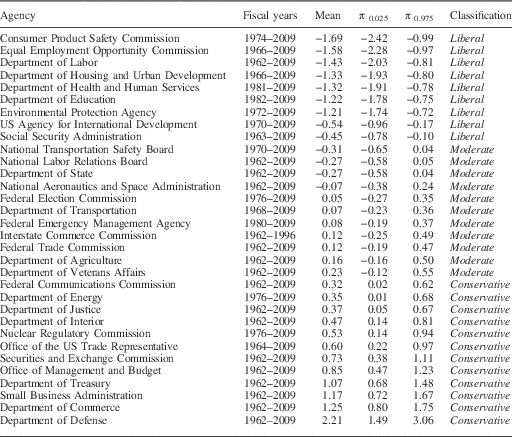
Presidential budget proposals for discretionary budgetary authority contained in the US government budget are analyzed for an unbalanced panel of 32 US federal government agencies for fiscal years 1962–2009.Footnote 9 Agency information relating to their respective sample fiscal years, plus both continuous and discrete ideological classification based on the agency ideology scores of Clinton and Lewis (Reference Clinton and Lewis2008), are reported in Table 1. Based on a 95 percent Bayesian posterior credibility interval interpretation of Clinton and Lewis’ agency ideology estimates, the sample is comprised of nine liberal agencies (negative scores), 11 moderate agencies (mixed scores) and 12 conservative agencies (positive scores).
Sample Information on US Federal Government Agencies

Note: ideological mission scores for selected agencies. Source: Clinton and Lewis Reference Clinton and Lewis2008: 17–19.
Modeling externally induced preferences requires that we arrive at valid model specifications, which means that we must properly account for both the political and policy conditions that are widely perceived as affecting how presidents formulate budget proposals. In addition, unobserved heterogeneity unaccounted for by these political and policy constraint covariates is modeled by including both agency-level and time-specific fixed effects (unrestricted models) or only agency-level fixed effects (restricted models).Footnote 10 The unrestricted model possessing two-way fixed effects takes the form:
 $$r_{{it}} \,=\,\alpha _{0} \,{+}\,\mathop{\sum}\limits_{i\,=\,{\rm 2}}^N {\alpha _{{{\rm 1}i}} u_{i} } \,{+}\,\mathop{\sum}\limits_{t\,=\,{\rm 2}}^T {\alpha _{{{\rm 2}t}} v_{t} } \,{+}\,\mathop{\sum}\limits_{s\,=\,{\rm 1}}^S {\alpha _{{{\rm 3}s}} X_{{s\,it{-}p}} \,{+}\,e_{{it}} \,,} $$
where executive budget proposals are a function of both N–1 agency-specific (u i ) and T–1 time-specific unit effects (v t ), an s vector of covariates representing political and policy considerations confronting presidents when they formulate their budget proposal (X s it– p ), plus a random disturbance (e it ) term.Footnote 11
The main covariates in Equation 8 pertain to the legislative environment (partisan composition of legislature, partisan realignments, electoral cycles, Appropriations Subcommittee chairmen characteristics and previous year’s budget outcomes) and policy conditions (unemployment, budget deficits, major wars and major budgetary rules).Footnote 12 Both % Democratic (House) t and % Democratic (Senate) t measure the percentage of Democratic-controlled seats in the US House and Senate.Footnote 13 These coefficients are hypothesized as having positive signs since Democrats are generally expected to be more favorable toward fiscal spending than Republicans (Kiewiet and McCubbins Reference Kiewiet and McCubbins1991, 192–3).Footnote 14 To account for legislators’ electoral-based incentives for increased spending in election years, a binary variable (Congressional Election Year t ) is coded 1 during a congressional election year, and 0 otherwise. The anticipated fiscal consequences of legislative partisan realignments are measured using an ordinal variable (Congressional Majority Party Change it ) that is coded as +1 (−1) or +2 (−2) for conservative (liberal) agencies when partisan control of one or two chambers of Congress shifts from a Democratic majority to a Republican majority or when a Republican majority to Democratic majority shift occurs for liberal (conservative) agencies. Presidents’ tactical construction of their budget proposal must account for House Appropriations Subcommittee chairmen’s role in vetting this policy document. Longer-tenured subcommittee chairmen will be in a better position to alter the president’s budget proposal (Appropriations Subcommittee Chairmen Experience it equals the number of years served in this capacity in fiscal year t for agency i); their 1st dimension Common Space ideological score (Carroll et al. Reference Carroll, Lewis, Lo, Poole and Rosenthal2009) accounts for these individuals’ ideological predispositions (Appropriations Subcommittee Chairmen Ideology it ).Footnote 15 Presidents may engage in serial updating by incrementally increasing their budget proposals in response to higher relative budget outcomes from the preceding year (Wildavsky Reference Wildavsky1988). This variable (Lagged Appropriations–Request Gap it ) is operationalized as the logged percentage difference between Appropriations and Budget Proposals in the preceding fiscal year t − 1 for agency i.
Policy conditions also affect how presidents craft budget proposals. Unemployment Rate (President) t is measured as the seasonally adjusted average unemployment rate for the six-month period (July–December) prior to when the president submits his or her budget to Congress.Footnote 16 Rising unemployment rates should bring to bear greater expansionary fiscal pressures that will be reflected in executive budget proposals. Federal Surplus/Deficit t-1 is the annual government budget deficit (−) / surplus (+) as a percentage of GDP in the preceding fiscal year, and should be positively associated with presidents’ budgetary expectations.Footnote 17 To account for budgetary expansions during major wartime periods, the model includes a binary indicator termed Major Wars it that is coded 1 for the Department of Defense during FY1966–FY1973 (Vietnam War) and FY2004–FY2009 (Iraq War), and 0 otherwise. The Budget Impoundment Act of 1974 (coded as 1 from FY1976–FY2009, 0 otherwise) is also thought to affect the balance of US executive-legislative budgetary power in favor of legislative interests (Schick 1980). Therefore, executive budget proposals should be greater following this act, given that presidents no longer have rescission authority over spending bills, which makes it more difficult for them to cut spending approved by Congress. Gramm–Rudman–Hollings [GRH] (coded 1 for FY1986–FY1991 for domestic agencies, and 0 otherwise) restrictions that placed formal budgetary ceilings on domestic spending should yield lower growth in domestic agency executive proposals during this period. Also, presidents can react to the supplemental appropriations process in a strategic manner to further their own policy goals (Wlezien Reference Wlezien1993), for example by offering a lower budget proposal during the regular annual appropriations process. This is captured through a binary indicator, Supplemental Appropriations Dummy, which is coded 1 if an agency received at least one supplemental appropriation in a given fiscal year, and 0 otherwise.Footnote 18
Findings
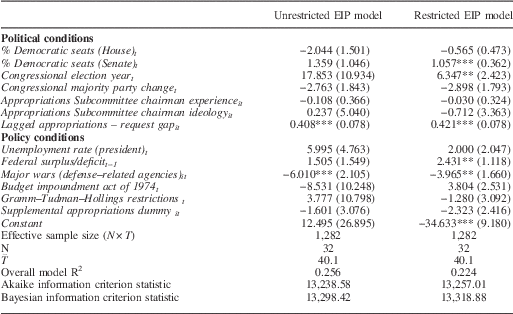
Arriving at valid externally induced presidential budgetary preference estimates, conditional on both political and policy circumstances, is the purpose of the first-stage regression. Results appear in Table 2. The key aspect of this model is centered on overall model prediction (that is, predicted values of the dependent variable). Each of the three model fit statistics (R2, AIC and BIC) reveals that the unrestricted model provides superior prediction of executive budget proposals. The overall R2 goodness of fit statistic of 0.256 suggests that the predicted values of the unrestricted model specification (r it * ) are correlated with observed executive budget proposals (r it ) at nearly 0.51. The model fit is respectable, considering that the panel-based sample comprises 1,282 observations, that all variables are demeaned by agency and that the dependent variable is temporally detrended to eliminate any potential spurious relationships. A series of Ramsey (Reference Ramsey1969) RESET tests indicates that neither the unrestricted nor restricted variants of this statistical model are plagued by non-linear functional forms or omitted variable misspecification errors.Footnote 19 The results from alternative model specifications (available in Table A2 of the online appendix) reveal that they have no substantive bearing on the internally induced component of presidential budgetary preference estimates obtained in the next section. Therefore one can be quite confident that these statistical estimates are suitable for extracting internally induced budgetary preferences from presidential budget requests.
The major difference between the restricted and unrestricted models is the loss of statistical significance in several covariates when year dummies are included to mitigate any potential omitted variable bias arising from unique temporal shocks that may affect executive budget proposals for all agencies in a given fiscal year.Footnote 20 Only the Lagged Appropriations–Request Gap it covariate is similar in both magnitude and significance between both model specifications. Surprisingly, executive budget proposals tend to be lower for defense-related agencies during major wars (Major Wars it ) in both model specifications. This counterintuitive finding may hint that funding for major wars has relied heavily on supplemental appropriations allocated for ‘overseas contingency operations,’ which serves as a direct substitute for increasing the Defense Department budget. For example, much of President George W. Bush’s defense-related funding occurred outside the regular appropriations process (Veillette et al. Reference Veillette, Epstein, Margesson and Tarnoff2008).Footnote 21 Budget proposals remain significantly higher in congressional election years for both models; coefficients increase nearly threefold, though they are estimated with additional uncertainty when time-specific fixed effects are incorporated into the unrestricted model. Both Democratic Senate seat shares [% Democratic (Senate) t ] and partisan change in congressional majorities (Congressional Majority Party Change it ) produce significant shifts in executive budget proposals in the restricted model that disappear when time-specific fixed effects are included in such models. Appropriations Subcommittee chairmen’s ideology and experience exert no discernible impact on executive budget proposals in either type of first-stage model specification.
Externally Induced Executive Budgetary Preference (EIP) Regression Model Estimates

Note: OLS–LSDV estimates. Robust standard errors (clustered by agency) in parentheses. Unrestricted EIP model specification contains both agency-level and non-collinear annual year fixed effect dummies to account for both unobserved cross-sectional and temporal heterogeneity (see footnote 10). Restricted EIP model specification contains only agency-level fixed effect dummies to account for unobserved cross-sectional heterogeneity. ***p<0.01, **p<0.05, *p<0.10.
Presidents’ tactical responses to both political and policy conditions when formulating their budget proposals are captured by these first-stage externally induced budgetary preference estimates. The unrestricted model estimates exhibit an average annual proposed agency budget growth of 3.85 percent (minimum=−403.62 percent, maximum=175.18 percent). Because the distribution of these predicted values exhibits a negative skewness coefficient of −3.06, presidents are seemingly more inclined to bias budget proposals toward expansion rather than retrenchment when it comes to accounting for both external political and policy conditions.Footnote 22 On a substantive level, this suggests that presidents are biased toward appeasing distributive-minded legislators and favoring expansionary fiscal policy in response to fiscal surpluses. Next, the statistical estimation of the generalized proposal model is discussed.
Statistical Estimation of Presidents’ Generalized Budget Proposal
Recall that isolating presidents’ partisan policy priorities reflected in their internally induced budgetary preferences requires finding the difference between (1) the budget proposal a president estimates to be dictated by external political and policy concerns and (2) an estimate of the generalized budget proposal. The former values were recovered in the prior section. The generalized proposal model covered in this section estimates internally induced budgetary preferences in the form of both rational excess and asymmetric funding biases. Democratic (Republican) presidents are hypothesized to have a pro(anti)-spending inclination for programs implemented by liberal agencies; the opposite will be true for programs implemented in conservative agencies, with moderate agencies falling somewhere in between. This logic makes a finer partisan distinction compared to previous studies, which posit that Democratic presidents place a greater premium on domestic spending than defense spending, while Republican counterparts behave otherwise (Ferejohn and Krehbiel Reference Ferejohn and Krehbiel1987; Kiewiet and Krehbiel Reference Kiewiet and Krehbiel2000).
This second-stage model is estimated using pooled OLSFootnote 23 with bootstrapped standard errors based on a cluster random resampling on each agency:
 $$\eqalignno{ r_{{it}} = & \,\,\beta ''_{0} \,{+}\,\phi ''\hat{r}_{{it}}^{{\ast}} \,{+}\,\beta ''_{1} Party_{t} \,{+}\,\beta ''_{2} ModAgency_{i} \,{+}\,\beta ''_{3} LibAgency_{i} \cr & {+}\,\beta ''_{4} \left( {Party_{t} \,{\times}\,ModAgency_{i} } \right)\,{+}\,\beta ''_{5} \left( {Party_{t} \,{\times}\,LibAgency_{i} } \right) $$
 $$\ \ \, \eqalignno{& {+}\,\delta '_{1} \sqrt {\hat{h}'_{{it}} } \,{+}\,\delta _{2} \left( {\sqrt {\hat{h}'_{{it}} } \,{\times}\,Party_{t} } \right)\,{+}\,\delta '_{3} \left( {\sqrt {\hat{h}'_{{it}} } \,{\times}\,ModAgency_{i} } \right)\,{+}\,\delta '_{4} \left( {\sqrt {\hat{h}'_{{it}} } \,{\times}\,LibAgency_{i} } \right).^{24} \cr & {+}\,\delta '_{5} \left( {\sqrt {\hat{h}'_{{it}} } \,{\times}\,Party_{t} \,{\times}\,ModAgency_{i} } \right)\,{+}\,\delta '_{6} \left( {\sqrt {\hat{h}'_{{it}} } \,{\times}\,Party_{t} \,{\times}\,LibAgency_{i} } \right)\,{+}\,{\varepsilon}''_{{it}} $$
PartyFootnote
is a binary variable that equals 1 for Democratic presidents, and 0
for Republican presidents; ModAgency is a binary variable that
equals 1 if an agency is classified as ideologically moderate as defined in
Table 1, and 0 otherwise;
LibAgency is a binary variable that equals 1 if an agency
is classified as being liberal, and 0 otherwise; and
 $$\sqrt {\hat{h}'_{{it}} } $$
is the estimated conditional volatility risk term generated
from the nonparametric bootstrap procedure described in the online
appendix.Footnote
25
The baseline effects captured in Equation 9 account for Republican presidential budgetary
preferences for conservative agencies, as they pertain to excess funding bias (
 $$\beta ''_{0} $$
) and asymmetric funding bias (
 $\delta '_{1} $
).
The substantive aim of this section is to obtain estimates of the presidents’
partisan policy priorities. These take the form of estimated excess funding
bias and asymmetric funding aversion relative to preferences based solely on
external political and policy conditions. The values for each of the six
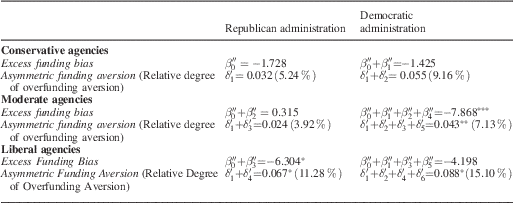
possible president-agency ideological combinations are displayed in Table 3.Footnote
26
For conservative agencies, Republican presidents exhibit weak
underfunding bias (
 $$\beta ''_{0} ={-}1.728$$
), and a modest degree of relative overfunding aversion of
5.24 percent (
 $\delta '_{{\rm 1}} ={\rm 0}{\rm .032,}\,{{ a} \over {{ a\;{+}\;b}}}={\rm 0}{\rm .5128}$
). Democratic presidents also exhibit weak underfunding bias
for conservative agencies (
 $$\beta ''_{0} {+}\beta ''_{1} ={-}1.425$$
), though they reveal a substantial level of overfunding
aversion that is 9.16 percent greater than underfunding aversion, albeit the
magnitude of this effect is not statistically discernible from rational loss
indifference at conventional significance levels (
 $\delta '_{{\rm 1}} {+}\delta '_{{\rm 2}} ={\rm 0}{\rm .055}\quad {\rm [p}> {\rm 0}{\rm .10],}\,{a \over {a\;{+}\;b}}={\rm 0}{\rm .5219}$
).Footnote
27
Partisan presidents differ by a modest average of 0.80 percent in their
internally induced preference to alter their budget proposals for such agencies (
 $\bar{x}$
IP:Republican=−0.692 percent;
 $\bar{x}$
IP:Democratic=0.118 percent, t=−2.772, p=0.006).Footnote
28
This evidence, in conjunction with a partisan comparison of externally
induced proposal components, reveals a similar pattern (
 $\bar{x}$
EIP:Republican=2.160 percent;
 $\bar{x}$
EIP:Democratic=6.462 percent, t=−2.314, p=0.021), suggesting that
Republican administrations adopt a more fiscally austere stance for
conservative agencies than do Democratic administrations.Footnote
29
Summary of Executive Partisan Budgetary Policy Priorities by Partisan Administration-Agency Ideological Classification

Note: generalized executive budget proposal model estimates. Entries represent the linear combination of relevant coefficients from Table 3 pertaining to Excess Funding Bias and Asymmetric Funding Aversion, respectively. The baseline scenario is measured for Republican presidents in relation to conservative agencies. The Relative Degree of Overfunding Aversion is calculated as {[a / (a+b)] / [1 – (a / (a+b))] −1} x 100. ***p<0.01, **p<0.05, *p<0.10.
The generalized proposal estimates for moderate agencies reveal that Republican
presidents offer budget proposals that possess slight (and statistically
insignificant) overfunding bias (
 $$\beta ''_{0} {+}\beta ''_{2} =0.315$$
), but this fiscal generosity is partially offset given that
they are only 3.92 percent more likely to display a bias toward rational
overfunding aversion (
 $\delta '_{{\rm 1}} {+}\delta '_{{\rm 3}} ={\rm 0}{\rm .024},\,{a \over {a{+}b}}={\rm 0}{\rm .5096}$
). Democratic presidents not only have both substantial and
statistically discernible underfunding biases (
 $$\beta ''_{0} {+}\beta ''_{1} {+}\beta ''_{2} {+}\beta ''_{4} ={-}7.868$$
); they are also 7.13 percent more likely to display relative
overfunding aversion (
 $\delta '_{{\rm 1}} {+}\delta '_{{\rm 2}} {+}\delta '_{{\rm 3}} {+}\delta '_{{\rm 5}} ={\rm 0}{\rm .043,}\,{a \over {a{+}b}}={\rm 0}{\rm .5172}$
).
These estimates surprisingly show that Democratic presidents prefer to fund
moderate agencies by an average of 6.14 percent less than Republican
counterparts (
 $\bar{x}$
IP:Republican=1.172 percent;
 $\bar{x}$
IP:Democratic=−4.963 percent, t=15.790, p=0.000).Footnote
30
Albeit slightly attenuated, this finding is robust to excluding the
four most liberal-leaning moderate agencies listed in Table 1 (
 $\bar{x}$
IP:Republican=1.277 percent;
 $\bar{x}$
IP:Democratic=−4.179 percent, t=9.095, p=0.000).Footnote
31
Similarly, this result also holds when the four most
conservative-leaning ideologically moderate agencies are excluded (
 $\bar{x}$
IP:Republican=1.155 percent;
 $\bar{x}$
IP:Democratic=−5.048 percent, t=13.712, p=0.000).Footnote
32
Presidents’ partisan policy priorities for ideologically moderate agencies reveal that Democratic administrations appear to be more ‘sensitive’ or ‘elastic’ to these external demands in their funding generosity for such agencies compared to Republican counterparts. In turn, both Democratic and Republican presidents’ internally induced budgetary preferences exhibit funding reversion in response to offsetting these externally induced budgetary preference estimates. Consistent with this funding reversion logic, simple difference-in-means tests uncover that externally induced presidential budget proposal estimates for ideologically moderate agencies are considerably larger under Democratic presidents than Republican administrations,Footnote 33 and partisan administration differences in the generalized presidential budget proposal estimates are modest.Footnote 34 These empirical patterns make sense if one presumes that ideologically moderate agencies should be treated similarly by both Democratic and Republican presidents, since they are situated between them in spatial ideological terms.
One possible alternative ideological-based calculus for understanding why presidents’ internally induced budgetary preferences run counter to the ally principle logic is that presidents may have sufficiently strong incentives to ensure compliance by offering public agencies greater positive inducements when the actors’ preferences are not aligned. Such positive inducements, however, may exhibit a greater return on the president’s investment when an agency is sufficiently malleable (for example, ideologically moderate agencies) than when they are diametrically opposed to the principal’s objectives (for example, a staunch liberal agency under a Republican president or a staunch conservative agency under a Democratic president). In such instances, the president’s marginal net benefit associated with a positive inducement to an ideologically moderate agency will be much greater, and hence, may impact their extrinsic and intrinsic funding motivations in a differential manner.
There may also be non-ideological reasons why partisan presidents exhibit funding reversion behavior between internally and externally induced budgetary preference estimates. From a managerial perspective, presidents may prefer to avoid sharp budgetary swings in order to induce agency stability relating to organizational routines, task environment and administration policy priorities.Footnote 35 Relatedly, presidents’ budget proposals may exhibit funding reversion behavior in order to create a stable executive funding stream over time by mitigating the need to systematically overfund (or underfund) agencies in response to either political or policy pressures in subsequent years.
Republican presidents’ budget proposals for liberal agencies reveal a
marginally significant and sizable underfunding bias (
 $\beta ''_{{\rm 0}} {+}\beta ''_{3} ={-}{\rm 6}{\rm .304}$
), as well as an 11.28 percent greater aversion to overfunding
than underfunding (
 $\delta '_{{\rm 1}} {+}\delta '_{{\rm 4}} ={\rm 0}{\rm .067},\,{a \over {a{+}b}}={\rm 0}{\rm .5267}$
). Democratic presidents exhibit underfunding biases for
agencies that do not statistically differ from zero (
 $\beta ''_{{\rm 0}} {+}\beta ''_{{\rm 1}} {+}\beta ''_{{\rm 3}} {+}\beta ''_{{\rm 5}} ={-}{\rm 4}{\rm .198}$
), and are 15.10 percent more likely to engage in overfunding
aversion than underfunding aversion, (
 $\delta '_{{\rm 1}} {+}\delta '_{{\rm 2}} {+}\delta '_{{\rm 4}} {+}\delta '_{{\rm 6}} ={\rm 0}{\rm .088},\,{a \over {a{+}b}}={\rm 0}{\rm .5351}$
). Democratic presidents typically prefer an average of 3.82
percent higher funding levels for liberal agencies relative to Republican
presidents (
 $\bar{x}$
IP:Republican=−1.914 percent;
 $\bar{x}$
IP:Democratic=1.880 percent, t=−4.131, p=0.0001).
Additional issues regarding the veracity of the estimates generated from the stochastic decomposition methods are worth noting. First, the internally induced budget preferences must be orthogonal to observed budget proposals to allay any concerns about observational equivalence involving these covariates. This condition is satisfied, since ρ=−0.035 for the observed presidential budgetary proposals and internally induced presidential budgetary preference estimates. Second, any resulting evidence of presidential budgetary influence (or lack thereof) is robust to both alternative externally induced and generalized budgetary preference model specification choices: internally induced budgetary preference estimates from the pair of generalized proposal models reported in the manuscript (plus an additional pair reported in the online appendix) are highly correlated (0.879≤ρ≤0.974). Third, restricting generalized proposal model predicted value estimates to only the subset of internally induced presidential budgetary preference covariates is rather weakly correlated with the error terms in the subsequent congressional appropriation growth models when testing for partisan presidential budgetary influence (0.014≤ρ≤0.070). Finally, the ‘full’ generalized proposal model estimates (based on the unrestricted externally induced budgetary preference estimates reported in Table A3 of the online appendix) reveal even weaker correlations with the error terms in these same congressional appropriation growth models (0.003≤ρ≤0.006). Taken together, these ancillary results suggest that presidents’ partisan policy priorities are exogenous to congressional appropriations, while observed presidential requests appear to be endogenous to congressional appropriation decisions.Footnote 36
Reconsidering Presidential Influence over Appropriations
Having separated the observed executive budget proposal into its constituent parts, it is now possible to consider each component’s independent influence over appropriations. Congressional appropriation outcomes are evaluated at the agency fiscal year level. As with proposals, the dynamics of funding are of central concern, so appropriations growth is used, which is defined as a it =[ln(Ait) – ln(Ait-1)] × 100. The appropriations growth model specifications comprise the following: a vector of political and policy covariates that may affect congressional appropriation decisions; N − 1 agency-level unit effects (u i ), M − 1 administration-specific dummies (Admin t ) to account for individual presidents’ varying bargaining capabilities, independent of factors accounted for in the statistical model (Neustadt Reference Neustadt1990); and a disturbance term (ε it ). The only changes across the baseline model specifications are the various measures of executive budget proposals: (1) observed budget proposal, (2) generalized proposal estimates of the budget proposal, and the stochastically decomposed budget proposal using both (3) externally induced and (4) internally induced presidential budgetary preference estimates. Standard errors are computed with 10,000 bootstrap replications using cluster random resampling by agencies.Footnote 37 For brevity purposes, only the results of the covariates of interest are discussed in the text.
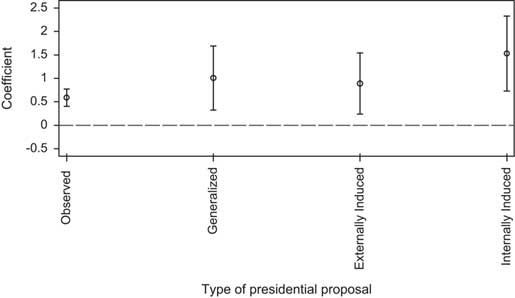
Figure 1 presents the core statistical findings analyzing symmetric presidential budgetary influence over congressional appropriations for each of the four measures of executive budget proposals. Presidents exert budgetary influence over appropriation outcomes by making budgetary alterations based on their partisan preferences in conjunction with agency ideology. The internally induced preference estimate reveals that each 1 percent rise in a president’s partisan budgetary priorities, net of political and policy considerations, results in a 1.531 percent increase in congressional appropriations growth. Substantively, an increase in this variable from the 25th percentile [−3.016 percent] to the 75th percentile [0.864 percent] yields a 5.94 percent per annum average increase in congressional appropriation growth. The positive impact of the internally induced preference estimate on appropriations growth is, on average, almost 74 percent greater than it is relative to the externally induced preference estimate (1.531 / 0.881=1.738]). Congress clearly responds to a president’s request for greater (as well as lower) spending according to internally induced preferences, and does so more strongly than to changes in the externally induced component.
Proposal impact of symmetric presidential budget proposal influence on congressional appropriations. Note: coefficient estimates and 95 percent confidence intervals.

Testing symmetric presidential budgetary influence ignores the conditional potency of executive budget proposal authority under varying political circumstances. Presidents, for instance, may experience differential success in shaping budgetary outcomes when their party controls both chambers of Congress when they do not. Put simply, presidential budgetary influence may be of an asymmetric nature. Some studies, for instance, assert that presidents find it easier to exert budgetary influence when their party controls both executive and legislative institutions, since Democratic and Republican parties have different spending preferences (Ferejohn and Krehbiel Reference Ferejohn and Krehbiel1987; Kiewiet and Krehbiel Reference Kiewiet and Krehbiel2000). Still other research contends that presidents will exert greater influence under divided party government over legislative appropriations since the threat (and use) of executive veto authority becomes more necessary and effective than when all branches are controlled by the same party (Rohde and Simon Reference Rohde and Simon1985; Gilmour Reference Gilmour1995; Cameron Reference Cameron2000).
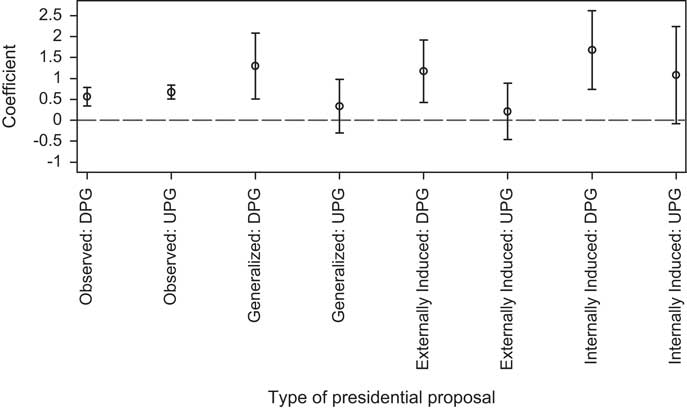
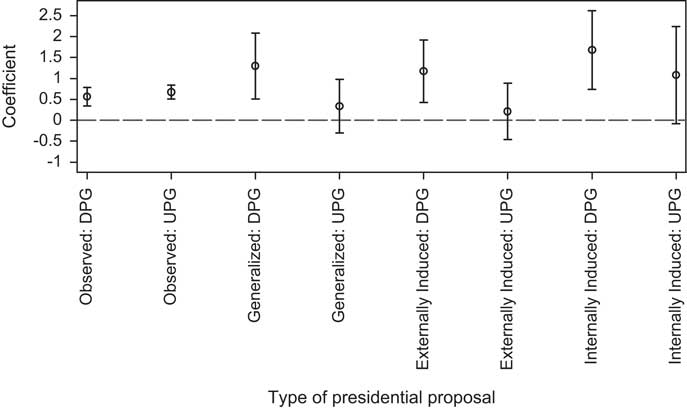
These competing theoretical perspectives can be adjudicated by analyzing the differential impact of internally induced presidential budgetary preference estimates on congressional appropriation decisions. Consistent with the executive veto authority hypothesis, Figure 2 provides empirical evidence that presidential budgetary influence is significantly potent under divided party government. In particular, partisan budgetary preferences (that is, internally induced presidential budgetary preferences) exert a statistically significant positive impact on agency funding outcomes under divided party government [1.678, p<0.001], albeit at a somewhat diminished rate during times of unified party government [1.078, p=0.069].Footnote 38 This evidence offers marginal support for the notion that presidents’ partisan policy priorities are more effectively translated into budgetary outcomes during divided party government (Rohde and Simon Reference Rohde and Simon1985; Gilmour Reference Gilmour1995; Cameron Reference Cameron2000). Nonetheless, these findings indicate that presidents are effective at translating their partisan policy priorities into budgetary outcomes under both types of partisan regimes. Although externally induced budgetary preferences effectively influence budgetary outcomes under divided party government [1.173, p=0.002], this does not hold under unified party government [0.212, p=0.538].Footnote 39 This finding is hardly surprising, given that the effectiveness of presidents’ responses to external conditions is less important when their party controls both chambers of Congress, since there is less need to submit a pleasing proposal to Congress under a unified partisan regime.
Proposal impact of asymmetric presidential budget proposal influence on congressional appropriations (UNIFIED VERSUS DIVIDED PARTY GOVERNMENT)Note: Coefficient estimates and 95 percent confidence intervals.
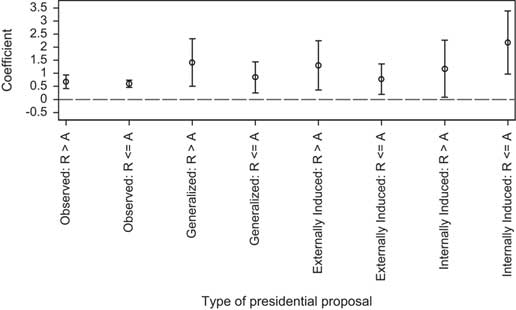
A major testable implication of Kiewiet and McCubbins’ (Reference Kiewiet and McCubbins1988, Reference Kiewiet and McCubbins1991) bilateral veto bargaining model is that presidents’ influence over appropriation decisions is contingent on Congress choosing not to limit executive funding. This legislative abdication condition only arises when budget requests do not exceed what the legislature is willing to appropriate. To test this asymmetric hypothesis, each budgetary preference covariate is interacted with a binary indicator that equals 1 when the president’s budget proposal for agency i in fiscal year t does not exceed Congress’s appropriation, and 0 otherwise.
The estimates for the various presidential budget proposal covariates are shown in Figure 3. The results from both the observed budget proposal and the generalized proposal model estimates indicate that presidents are effective in shaping budgetary outcomes when they seek more funding than what Congress is proposing. The only instance consistent with the bilateral veto bargaining logic is when one focuses on partisan-based (internally induced) budgetary preferences. Specifically, each 1 percent increase in the internally induced preference estimate produces a 1.176 percent increase in agency funding growth when executive requests exceed legislative appropriations. This effect increases to 2.187 percent in instances where presidents do not seek funding greater than what Congress is proposing. While this estimate—which captures the partial difference between these particular budgetary regimes—is only moderately precise (p=0.098, one-tailed test), the substantive impact of presidential budgetary influence under this scenario nearly doubles and the p-value drops from 0.034 to 0.0004 for the full difference between these budgetary regimes. Moreover, the influence of the internally induced presidential budgetary preference estimates on congressional appropriations is significantly greater than externally induced budgetary presidential budgetary preference effects when requests do not exceed appropriations under the same conditions (2.187 versus 0.774, χ2 ~ [1]=10.31 [p=0.0013]). Yet there are no tangible differences between internally and externally induced presidential budgetary preference estimates in the budgetary regime when requests exceed appropriations (1.177 versus 1.305, χ2 ~ [1]=0.09 [p=0.767]).
Proposal impact of Asymmetric Presidential Budget Proposal Influence on Congressional Appropriations (BILATERAL VETO BARGAINING) Note: Coefficient estimates and 95 percent confidence intervals.
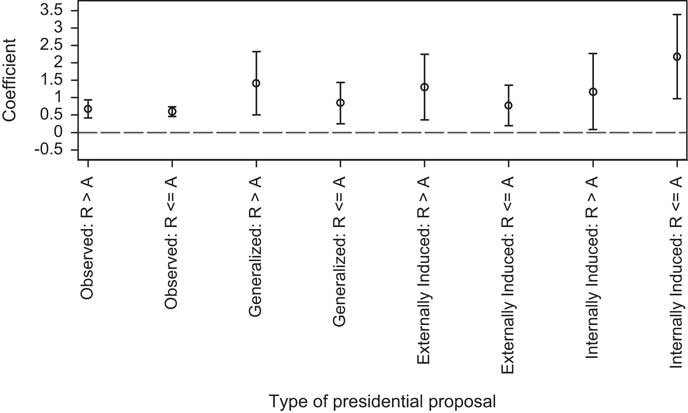
On a broader level, the statistical evidence consistently points to Congress’ ineffectiveness at limiting spending consistent with presidential partisan budgetary priorities when presidential budget proposals exceed congressional appropriations. This finding runs counter to Kiewiet and McCubbins’s (Reference Kiewiet and McCubbins1988, Reference Kiewiet and McCubbins1991) assertion that presidents only have budgetary influence over appropriation decisions when Congress is willing to accommodate the executive branch. However, it must also be noted that presidents are somewhat more successful in channeling their partisan policy priorities into budgetary outcomes when they seek lower or equal funding in relation to Congress, consistent with the bilateral veto bargaining logic of Kiewiet and McCubbins (Reference Kiewiet and McCubbins1988, Reference Kiewiet and McCubbins1991). Presidents thus effectively use their budget proposal authority as a positive agenda control mechanism that enables them to substantively shape the content of final agency funding outcomes consistent with their partisan policy priorities, subject to congressional constraint. Although an instrumental variable approach has merits for assessing endogeneity in a generic sense, such an approach cannot shed light on the different motivations underlying how presidents exercise executive agenda-setting authority.
Discussion
To what extent are American presidents capable of parlaying their formal budget proposal authority into budgetary outcomes that are consistent with their own partisan policy priorities? Addressing this question requires pinpointing the specific mechanisms of executive influence over budgetary outcomes. This study advances a novel stochastic decomposition method that parses out presidential budget requests into two distinct components in order to assess executive partisan budgetary influence. This stochastic decomposition method relies on modeling presidents’ partisan policy priorities as both excess funding biases and asymmetric funding aversion reflected in observed executive budget proposals. Standard treatments of executive budgetary influence that rely on the gap between presidential requests and congressional appropriations (or use instrumental variable estimates to address the endogeneity of presidential budget proposals) cannot pinpoint the precise nature of presidential influence over budgetary outcomes.
This study demonstrates that intrinsic motivations corresponding to presidents’ partisan policy priorities are more influential in explaining budgetary outcomes than their extrinsic motivations centered on responding to both political and policy conditions. Put another way, presidential influence over congressional appropriation decisions is comparatively stronger than the impact of executive acquiescence reflected as a result of the budgetary process. Moreover, the statistical evidence also shows that the greater use, or threat, of the presidential veto during times of divided party government results in marginally greater executive budgetary influence reflecting an administration’s policy priorities. Contrary to Kiewiet and McCubbins’ (Reference Kiewiet and McCubbins1988, Reference Kiewiet and McCubbins1991) theoretical claims, and corroborative empirical evidence based on instrumental variable estimation, the evidence presented here reveals that presidents’ partisan policy priorities are highly influential in shaping budgetary outcomes, irrespective of whether Congress seeks to limit such executive influence by limiting spending. That is, presidents effectively use budget proposals as an agenda-setting tool for policy influence, even when the legislature is not seemingly willing to abdicate budgetary authority. To be sure, the executive branch is somewhat more effective at translating its partisan policy priorities into budgetary outcomes when the legislative branch is willing to acquiesce, as maintained by Kiewiet and McCubbins (Reference Kiewiet and McCubbins1988, Reference Kiewiet and McCubbins1991). But while the legislature surely constrains executive budgetary influence on some level, these empirical findings highlight precisely both where and when Congress is ineffective at subverting executive policy-making authority.
This study is motivated by a simple premise: observed executive budget proposals are not directly informative for determining whether presidents influence congressional appropriation outcomes consistent with their intrinsic partisan policy priorities. Nonetheless, this policy instrument can be usefully applied in other empirical settings. Observed executive budget proposals, for example, may constitute informative signals of presidential budgetary signals in a constrained political environment for third parties such as public agencies, interest groups, voters or the media. Comparing the absolute gap between observed executive budget proposals and congressional appropriation decisions can serve as a valid measure of the severity of common agency problems (for example, Dixit Reference Dixit1997) pertaining to presidential-congressional policy conflict. For instance, convergence (divergence) between observed executive proposals and legislative appropriations for a given bureaucracy provide a less (more) noisy budgetary signal to a public agency regarding the severity of a common agency problem between the president and Congress. Further delving into the micro foundations of executive choice holds considerable promise for better understanding both the scope and limits of executive authority, as well as the balance of power between executives and legislatures operating within shared and separated policy-making systems.