Introduction
With the continuous development of assisted reproductive technology (ART), multiple pregnancy has become a notable problem, increasing the risk of maternal and neonatal complications (Mackie et al., Reference Mackie, Rigby, Morris and Kilby2019; Ibiebele et al., Reference Ibiebele, Humphries, Torvaldsen, Ford, Morris, Bowen and Randall2020). Multiple studies have shown that single embryo transfer (SET) has a significant effect on reducing the multiple pregnancy rate (Racca et al., Reference Racca, Drakopoulos, Van Landuyt, Willem, Santos-Ribeiro, Tournaye, Blockeel and Polyzos2020; Mersereau et al., Reference Mersereau, Stanhiser, Coddington, Jones, Luke and Brown2017). In view of the high pregnancy rate of ART and the growing maturity of embryo culture and freezing technologies in China, individualized embryo transfer strategies have become the focus of how to further reduce the number of transferred embryos.
Throughout the development of ART, the transfer of two cleavage-stage embryos has been and continues to be the mainstream approach to stabilizing the pregnancy rate, resulting in a persistently high multiple pregnancy rate. The latest Chinese Society of Reproductive Medicine (CSRM) data show that the multiple pregnancy rate of fresh cycles in China was up to 26.04% in 2019 (Zhang et al., Reference Zhang, Deng, Huang, Liu, Zhou, Feng, Hao, Lu, Quan and Shen2022). Based on the conventional morphological embryo selection method, day-3 single cleavage-stage embryo transfer (SCT) has a lower pregnancy rate (Glujovsky et al., Reference Glujovsky, Farquhar, Quinteiro Retamar, Alvarez Sedo and Blake2016). With progress in embryo culture technologies, blastocyst culture, a method for topping out embryos, can reduce the proportion of aneuploid embryos (Li et al., Reference Li, Liu and Lv2021). Day-5 single blastocyst transfer (SBT), with the advantage of a higher implantation rate, can effectively reduce the multiple pregnancy rate (Marconi et al., Reference Marconi, Allen, Bhattacharya and Maheshwari2022) and thereby become the main direction of current SET; however, it may also lead to an increased cycle cancellation rate, a lower embryo utilization rate, sex-ratio imbalance and other risks (Spangmose et al., Reference Spangmose, Ginström Ernstad, Malchau, Forman, Tiitinen, Gissler, Opdahl, Romundstad, Bergh, Wennerholm, Henningsen and Pinborg2020).
At present, the choice of a single SET stage is still inconclusive for patients with multiple good-quality cleavage-stage embryos on day 3 in the fresh cycle. Therefore, this article presents a retrospective analysis of the pregnancy and perinatal outcomes of day-3 SCT, day-4 SMT and day-5 SBT in fresh cycles in our centre and further explores how to select an individualized embryo transfer strategy while seeking to balance live birth from a single transfer cycle with multiple pregnancy, thereby providing clinical guidance.
Material and methods
Patient selection
The data of patients who underwent in vitro fertilization and embryo transfer (IVF-ET) in our reproductive medicine centre from January 1, 2018, to September 30, 2020, were retrospectively analysed.
The inclusion criteria were as follows: ① Maternal age ≤ 40 years; ② Number of cycles ≤ 2; ③ Number of oocytes retrieved = 5–20; ④ Number of 2PN-derived grade I embryos with 8–10 cells on Day-3 ≥ 4; ⑤ Underwent SET; ⑥ Endometrial thickness ≥ 8 mm. The exclusion criteria were as follows: ① Combined with chromosome abnormality, endometriosis, uterine leiomyoma, immune infertility or other diseases that affect embryo implantation; ② Preimplantation genetic testing or oocyte donation cycle; ③ Systematic disease, etc.
Controlled ovarian stimulation and oocyte harvest
The routine practice of our centre was followed. The starting dose of gonadotropin was selected according to the patient’s age, basal follicle-stimulating hormone (FSH) level, body mass index (BMI) and antral follicle count. In the presence of at least 1 ovarian follicle ≥ 18 mm, 10,000 IU human chorionic gonadotropin (HCG) (Serono, Switzerland) or 250 μg recombinant human chorionic gonadotropin alfa for injection (Ovidrel, Serono, Switzerland) was administered as the trigger. Oocytes were retrieved through paracentesis as directed by vaginal ultrasound at 36–38 h after injection, and then the harvested oocytes were washed in Gamete medium (Vitrolife, Sweden) and transferred into IVF medium (Vitrolife, Sweden) for subsequent fertilization.
Fertilization and embryo culture
Conventional IVF fertilization was performed in the form of short-term fertilization after the retrieved oocytes were cultured in vitro for 3 h; namely, the oocytes and sperm were mixed at a 1:10000 ratio and incubated for 5 h to denude the cumulus cells. After the fertilization was judged as successful based on the release of the second polar body, the fertilized eggs were transferred to a time-lapse imaging petri dish containing G1 cleavage-stage medium (Vitrolife, Sweden) and cultured in the Embryoscope time-lapse imaging (TLI) system (Vitrolife, Sweden). For patients suitable for intracytoplasmic sperm injection (ICSI), cumulus cells were denuded 2 h after oocyte retrieval, after which the mature oocytes were subjected to ICSI and transferred to a TLI petri dish with G1 cleavage-stage medium (Vitrolife, Sweden). Pronuclei were observed 16–20 h after fertilization, and the presence of double pronuclei (2PN) and two polar bodies (2PB) indicated normal fertilization. On day-3 after oocyte retrieval, except for the embryos to be transferred and frozen, the remaining embryos were transferred to the same position of a petri dish containing G2 blastocyst medium (Vitrolife, Sweden) and cultured until the end of day-6.
Embryo assessment
The scores of cleavage-stage embryos were assessed from the cell number, fragmentation and homogeneity according to the Alpha/ESHRE consensus (2011) (Alpha Scientists in Reproductive Medicine and ESHRE Special Interest Group of Embryology, 2011) using the stratified screening model established by our centre based on the TLI system. The morulae and blastocysts were assessed according to the Gardner scoring criteria (Gardner and Schoolcraft, Reference Gardner and Schoolcraft1999). The definition of the top-quality embryo was 2PN-derived grade I embryos with 810 cells on day-3.
Embryo transfer (ET) and pregnancy determination
SET was performed by selecting top-quality cleavage-stage embryos, morulae or blastocysts on day-3, day-4 or day-5 after oocyte retrieval. Progesterone gel (Merck Serono, Switzerland) was routinely administered at the vagina as luteal phase support after transfer, and the blood HCG value was determined 2 weeks later. A diagnosis of biochemical pregnancy was made when HCG was ≥40 U/L. Clinical pregnancy was defined as the presence of a gestation sac(s) on ultrasound at 4–6 weeks after ET. Early spontaneous miscarriage was defined as spontaneous miscarriage occurring within 12 weeks of clinical pregnancy.
Statistical analysis
SPSS 25.0 was used for analysis and statistics. The measurement data are expressed as the mean ± standard deviation (
 $\bar \chi$
± s), and the samples of the three groups were compared by analysis of variance. The enumeration data are expressed as the constituent ratio or rate and were compared by means of the chi-square test or Fisher’s precision probability test. The dichotomous logistic regression model was adopted for multivariate analysis. P < 0.05 indicated that the difference was statistically significant.
Results
As shown in Table 1, there were no significant differences in maternal age, BMI, infertility years, infertility factors, basal FSH, basal luteinizing hormone (LH), endometrial thickness on embryo transfer day or proportion of ICSI cycles among the three groups (P > 0.05). However, there were significant differences in the number of oocytes retrieved and estradiol level on the trigger day (P < 0.05), which were smaller in the day-3 SCT group than in the day-4 SMT and day-5 SBT groups.
Maternal and cycle characteristics among the different groups

a Values in parenthesis are expressed in percentage.
SCT = single cleavage-stage embryo transfer; SMT = single morula transfer; SBT = single blastocyst transfer; BMI= body mass index; FSH = follicle-stimulating hormone; LH = luteinizing hormone; IVF = in vitro fertilization; ICSI = intracytoplasmic sperm injection.
Comparison of pregnancy and perinatal outcomes
As shown in Table 2 and Table 3, there were no significant differences in the clinical pregnancy rate, miscarriage rate, ectopic pregnancy rate, live birth rate, premature birth rate, gestational age, newborn weight, body height or birth defects among the three groups (P > 0.05). The monozygotic twin (MZT) rate of day-3 SCT was significantly lower than that of day-5 SBT (P < 0.05). The day-5 SBT group had a significantly higher proportion of newborn boys than the day-3 SCT group (P < 0.05).
Clinical pregnancy outcomes among the three groups

a Values in parenthesis are expressed in percentage.
SCT = single cleavage-stage embryo transfer; SMT = single morula transfer; SBT = single blastocyst transfer.
Neonatal outcomes among the three groups

a Values in parenthesis are expressed in percentage.
SCT = single cleavage-stage embryo transfer; SMT = single morula transfer; SBT = single blastocyst transfer.
The influence of confounding factors on SET pregnancy
As shown in Table 4, maternal age had significant effects on the clinical pregnancy rate and live birth rate of SET (P < 0.05). Basal FSH, basal LH, BMI, endometrial thickness on embryo transfer day, number of oocytes retrieved and period of embryo transfer had no significant effect on the clinical pregnancy rate and live birth rate of SET (P > 0.05).
Multivariate analysis of clinical pregnancy and live birth rates according to maternal and cycle characteristics

OR = odds ratio; CI = confidence interval; FSH = follicle-stimulating hormone; LH = luteinizing hormone; BMI = body mass index; SCT = single cleavage-stage embryo transfer; SMT = single morula transfer; SBT = single blastocyst transfer.
Clinical outcomes after age stratification
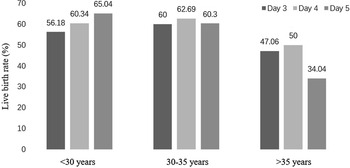
There were no significant differences in the clinical pregnancy rate and live birth rate of patients <35 years of age among the three groups (Figures 1, 2). Patients >35 years of age in the day-5 SBT group showed a downward trend in the clinical pregnancy and live birth rates, but the differences were not significant (Figures 1, 2).
Clinical pregnancy rate among the three groups according to female age.

Live birth rate among the three groups according to female age.

Discussion
The results of this study showed that no significant difference was found in the clinical pregnancy rate, miscarriage rate, ectopic pregnancy rate or live birth rate among the three groups. The MZT rate in the day-3 SCT group was significantly lower than that in the day-5 SBT group. The proportion of newborn boys in the day-5 SBT group was significantly higher than that in the day-3 SCT group. With the help of the TLI system, day-3 SCT can obtain comparative clinical outcomes to day-4 or 5 while reducing the risks of MZT and gender imbalance.
In terms of pregnancy outcomes, multiple studies have reported that the implantation rate of blastocyst transfer is significantly higher than that of cleavage-stage embryo transfer (Yang et al., Reference Yang, Cai, Zhang, Kong, Gu, Lu, Dai, Gong, Lu and Lin2018; Zeng et al., Reference Zeng, Su and Li2018). This may be attributed to the fact that some aneuploid embryos and embryos with poor developmental potential were eliminated by the blastocyst culture process. In addition, blastocyst embryo transfer can improve uterine/embryonic synchronicity (Neuhausse et al., Reference Neuhausser, Vaughan, Sakkas, Hacker, Toth and Penzias2020). According to the results of this study, the clinical pregnancy and live birth rates of day-5 SBT were higher than those of day-3 SCT, but there were no significant differences, which might be attributed to the use of the TLI system and morphodynamic models. In this study, the pregnancy outcomes of day-5 SBT were similar to those of day-4 SMT and slightly higher than those of day-3 SCT, which is consistent with the study findings of Li et al. (Reference Li, Hwu, Lee, Li and Lin2018). After embryo densification, the silent genome is activated, resulting in a reduction in morula-stage chimeric embryos (Vassena et al., Reference Vassena, Boué, González-Roca, Aran, Auer, Veiga and Izpisua Belmonte2011). In addition, day-4 is closer to the window phase of the endometrium than day-3, so the day-4 strategy is more flexible. However, the current scoring criteria for morula are still immature, imposing certain limitations on their actual clinical application.
The choice of embryos for transfer plays an essential role in the success of SET. Our centre established a mature stratified screening model using time-lapse imaging technology on day-3 and applied it to day-3 SCT, leading to a stable implantation rate above 60% (Wang et al., Reference Wang, Chen, Fang, Jiang and Zhang2019), which might avoid the risk that patients cancel cycles due to concerns about the lack of embryos available for transfer.
The data of multiple large-sample-size studies showed that patient age is a factor directly affecting the implantation rate (Cimadomo et al., Reference Cimadomo, Fabozzi, Vaiarelli, Ubaldi, Ubaldi and Rienzi2018), and subsequent analysis was performed with age stratification. In this study, for younger patients (<30 years of age and 31–35 years of age), day-5 SBT achieved higher clinical pregnancy and live birth rates than day-3 SCT, although this result was not significantly different. For older patients (36–40 years of age), the clinical pregnancy and live birth rates of day-5 SBT were lower than those of day-3 SCT, and blastocyst transfer did not improve the pregnancy outcomes of this population but increased the risk of cancelling embryo transfer (Chen et al., Reference Chen, Li, Jia, Fang and Liang2018). In a prior randomized controlled trial (RCT) (Papanikolaou et al., Reference Papanikolaou, Camus, Kolibianakis, Van Landuyt, Van Steirteghem and Devroey2006), in young patients <36 years of age, the pregnancy and live birth rates of SBT were significantly higher than those of SCT, but the population >36 years of age was not studied. Multiple guidelines, including those of the ASRM (Practice Committee of the American Society for Reproductive Medicine 2017), also recommend <35 years as the age for receiving elective SET. However, some studies have also shown that the effect of maternal age on the pregnancy rate will decrease after the embryos develop to the blastocyst stage (Maheshwari et al., Reference Maheshwari, Griffiths and Bhattacharya2011), and blastocyst culture and transfer could significantly increase the pregnancy rate per embryo transfer cycle and might be appropriate in some older patients with a good clinical prognosis (Sainte-Rose et al., Reference Sainte-Rose, Petit, Dijols, Frapsauce and Guerif2021).
The secondary sex ratio is generally defined as the ratio of males to females at live births. In this study, the results showed that the proportion of newborn boys in the day-5 SBT group was significantly higher than that in the day-3 SCT group, which is consistent with the meta-analysis results from 18 reproductive medicine centres (Bu et al., Reference Bu, Chen, Huang, Zhang, Wu, Ma, Shi, Xu, Zhang, Zhang, Zhao, Zhang, Huang, Sun, Kang, Wu, Wu, Sun and Sun2014). Luke et al. (Reference Luke, Brown, Grainger, Baker, Ginsburg and Stern2009) found that male embryos develop faster than female embryos, which makes them more likely to be selected for transfer. According to the study conducted by Maalouf et al. (Reference Maalouf, Mincheva, Campbell and Hardy2014), the genes controlling glucose uptake and metabolism (glucose-6-phosphate dehydrogenase) and antioxidants (hypoxanthine phosphoribosyl transferase) are located on the X chromosome, and the second X chromosome exists only in females; thus, female embryos have higher glucose uptake and detoxification of oxygen radicals, and potentially, the double dose of enzyme activity can explain the delayed development of female embryos. In addition, a study reported that trophectoderm grade is also correlated with the sex ratio (Lou et al., Reference Lou, Li, Zhang, Sun, Wang, Hao and Cui2020), and male embryos with more trophoblasts are morphologically more likely to be selected for transfer. However, there are also some reports that blastocyst transfer will not significantly increase the sex ratio, and the reason for such an inconsistency may be that ICSI technology decreases the proportion of male babies, which offsets the effect of blastocyst transfer on increasing the sex ratio (Wang et al., Reference Wang, Liu, Zhang, Li, Liu, Zhang and Yu2020).
MZT is a serious complication of ART, and in this study, the MZT rate of day-5 SBT was significantly higher than that of day-3 SCT. A meta-analysis by Busnelli et al. (Reference Busnelli, Dallagiovanna, Reschini, Paffoni, Fedele and Somigliana2018) showed that extended in vitro culture may increase the MZT rate. The possible mechanism is that extended in vitro culture may stimulate the splitting of the inner cell mass and affect cell-to-cell adhesion.
In summary, for patients with multiple good-quality embryos on day-3, prolonging the culture time can improve the clinical pregnancy and live birth rates but may bring risks of gender imbalance and increased monozygotic twin rates. For day-3 SCT, each centre should establish a kinetic parameter model based on a suitable embryo screening system, which can also achieve satisfactory pregnancy outcomes and further benefit people with fewer good-quality embryos on day-3 and older patients. In the future, further expansion of the sample size and multicentre RCTs should be conducted to continuously optimize individualized embryo transfer strategies, stabilize the implantation rate, effectively reduce the multiple pregnancy rate and guarantee the safety of mothers and babies.
Data availability statement
The dataset generated for this study are available on request to the corresponding author.
Acknowledgements
We thank all our patients without whom this work would have been impossible.
Funding
Not applicable.
Competing interests
The authors have no relevant financial or non-financial interests to disclose.
Ethical standards
The Ethics Committee of Nanjing Drum Tower Hospital, the Affiliated Hospital of Nanjing University Medical School, approved this study (No. 2021–151). Informed consent was received from all enrolled patients.