




No CrossRef data available.
Article contents
Eyes, amygdala, and other models of face processing: Questions for the SIMS model
Published online by Cambridge University Press: 20 December 2010
Abstract
This commentary raises general questions about the parsimony and generalizability of the SIMS model, before interrogating the specific roles that the amygdala and eye contact play in it. Additionally, this situates the SIMS model alongside another model of facial expression processing, with a view to incorporating individual differences in emotion perception.
Information
- Type
- Open Peer Commentary
- Information
- Copyright
- Copyright © Cambridge University Press 2010
References
Aviezer, H., Hassin, R. R., Ryan, J., Grady, C., Susskind, J., Anderson, A., Moscovitch, M. & Bentin, S. (2008) Angry, disgusted, or afraid?
Psychological Science
19(7):724.CrossRefGoogle ScholarPubMed
Bach, P., Peatfield, N. A. & Tipper, S. P. (2007) Focusing on body sites: The role of spatial attention in action perception. Experimental Brain Research
178(4):509–17.CrossRefGoogle ScholarPubMed
Bruce, V. & Young, A. (1986) Understanding face-recognition. British Journal of Psychology
77:305–27.CrossRefGoogle ScholarPubMed
Chakrabarti, B., Bullmore, E. & Baron-Cohen, S. (2006) Empathising with basic emotions: Common and discrete neural substrates. Social Neuroscience
1(3–4):364–84.CrossRefGoogle Scholar
Chong, T. T. J., Williams, M. A., Cunnington, R. & Mattingley, J. B. (2008) Selective attention modulates inferior frontal gyrus activity during action observation. NeuroImage
40(1):298–307.CrossRefGoogle ScholarPubMed
Dalton, K. M., Nacewicz, B. M., Johnstone, T., Schaefer, H. S., Gernsbacher, M. A., Goldsmith, H. H., Alexander, A. & Davidson, R. J. (2005) Gaze fixation and the neural circuitry of face processing in autism. Nature Neuroscience
8:519–26.CrossRefGoogle ScholarPubMed
Ekman, P. & Friesen, W. V. (1978) Facial action coding system: A technique for the measurement of facial movement. Consulting Psychologists Press.Google Scholar
Golan, O. & Baron-Cohen, S. (2006) Systemizing empathy: Teaching adults with Asperger's Syndrome and High Functioning Autism to recognize emotions using interactive multimedia. Development and Psychopathology
18(2):589–617.CrossRefGoogle ScholarPubMed
Goldman, A. I. & Sripada, C. S. (2005) Simulationist models of face-based emotion recognition. Cognition
94(3):193–213.CrossRefGoogle ScholarPubMed
Haxby, J., Hoffman, E. & Ida Gobbini, M. (2000) The distributed human neural system for face perception. Trends in Cognitive Sciences
4:223–33.CrossRefGoogle ScholarPubMed
Hess, U., Blairy, S. & Kleck, R. E. (2000) The influence of facial emotion displays, gender, and ethnicity on judgments of dominance and affiliation. Journal of Nonverbal Behavior
24(4):265–83.CrossRefGoogle Scholar
Hooker, C. I., Paller, K. A., Gitelman, D. R., Parrish, T. B., Mesulam, M. & Reber, P. J. (2003) Brain networks for analyzing eye gaze. Cognitive Brain Research
17(2):406–18.CrossRefGoogle ScholarPubMed
Keysers, C. & Perrett, D. (2004) Demystifying social cognition: A Hebbian perspective. Trends in Cognitive Science
8(11):501–507.CrossRefGoogle ScholarPubMed
Keysers, C., Wicker, B., Gazzola, V., Anton, J. L., Fogassi, L. & Gallese, V. (2004) A touching sight: SII/PV activation during the observation and experience of touch. Neuron
42(2):335–46.CrossRefGoogle ScholarPubMed
Lawrence, E., Shaw, P., Baker, D., Baron-Cohen, S. & David, A. (2004) Measuring empathy – Reliability and validity of the empathy quotient. Psychological Medicine
34:911–19.CrossRefGoogle ScholarPubMed
Singer, T., Seymour, B., O'Doherty, J., Kaube, H., Dolan, R. & Frith, C. (2004) Empathy for pain involves the affective but not sensory components of pain. Science
303(5661):1157–67.CrossRefGoogle Scholar
Wicker, B., Keysers, C., Plailly, J., Royet, J. P., Gallese, V. & Rizzolatti, G. (2003) Both of us disgusted in my insula: The common neural basis of seeing and feeling disgust. Neuron
40:655–64.CrossRefGoogle Scholar
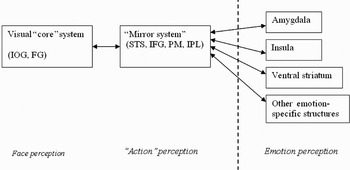
Figure 1. A generalized model of facial expression (Chakrabarti et al. 2006). Left of the dotted line indicates systems involved in perception of all emotion expressions. Right of the dotted line indicates structures that may selectively respond to specific emotions. IOG=Inferior Occipital Gyrus, FG = Fusiform Gyrus, STS = Superior Temporal Sulcus, IFG = Inferior Frontal Gyrus, PM = Premotor Cortex, IPL = Inferior Parietal Lobule.
 You have
Access
The target article proposes a new model for processing smiles, as a specific case within the broader domain of facial expressions of emotion. Niedenthal et al. suggest that three types of smiles – dominance, affliative, and enjoyment – are distinguished from one another using an embodied simulation (ES) based framework. ES, according to the authors, can be driven both by eye contact as well as by activation of conceptual stereotypes or memory. This work extends current simulation-theory based models of facial expression perception (Goldman & Sripada Reference Goldman and Sripada2005), by suggesting a key role for eye contact in triggering ES. This is a novel suggestion, and one that will be examined later in this commentary.
In order to understand the SIMS model, it is important to first evaluate the exact nature of the differences between the three kinds of smiles. The authors point out that Duchenne markers are not sufficient to discriminate between these three smiles, and it is unclear whether there are physical differences in facial musculature among these expressions (e.g., as coded for by facial action units; Ekman & Friesen Reference Ekman and Friesen1978). It is also not clear if this has been tested empirically, using a standard emotion recognition paradigm, where facial expressions are presented with and without social context. If it is not possible to discriminate between the three kinds of smiles based purely on their physical properties (e.g., facial musculature and dynamics), then the differences might lie in processing of other variables such as the context (Aviezer et al. Reference Aviezer, Hassin, Ryan, Grady, Susskind, Anderson, Moscovitch and Bentin2008), or the conceptual stereotypes involved (e.g., race, ethnicity; Hess et al. Reference Hess, Blairy and Kleck2000).
The three types of smiles that the authors suggest can be regarded as examples of smiles in three among many possible contexts. Indeed, Bharata's treatise on the dramatic arts (Natyasastra, c. 200 A.D.) discusses at least six different kinds of smiles and more than eight different elicitors for them (Vatsyayan Reference Vatsyayan1996). More recent work suggests at least 30 different emotion states to be linked with smiles, at varying levels of social complexity (Golan & Baron-Cohen Reference Golan and Baron-Cohen2006). In view of this, one could think of emotion recognition as a two-component process, consisting of (a) perception of the physical properties of the face, and (b) processing of the contextual information (including conceptual stereotypes), which together lead to recognizing an emotion expression. These components might be processed in parallel. The question for the proposed model in its current form, therefore, is: Does it offer the most parsimonious explanation for this two-component process? Or would this model require additional “modules” in order to explain processing of expressions other than smiles, or smiles of a type that has not been explicitly discussed in the model (e.g., a mischievous or a derisive smile)?
Keeping questions about the parsimony of the model to one side, the current form of the model raises two questions about the proposed role of eye contact. The first is anatomical: Is there any support for the proposition that the amygdala promotes eye contact? While it is known that eye contact often results in amygdala activation in the observer, the evidence in support of the suggested causal link in the opposite direction appears limited. Hooker et al. (Reference Hooker, Paller, Gitelman, Parrish, Mesulam and Reber2003) reported higher amygdala activation for trials with no direct gaze compared to those with a 40 percent probability of a direct gaze. It is not clear if this reflected a generalised increase in arousal for monitoring any salient event, or whether it was specific to monitoring eye contact. Amygdala response in people with Autism Spectrum Conditions (ASC) was found to correlate positively with fixation on the eyes region of the stimuli, but this is possibly due to social anxiety in people with ASC, experienced particularly while looking at someone's eyes. Moreover, this relation between gaze fixation time and amygdala activation was not found for the controls in the same study (Dalton et al. Reference Dalton, Nacewicz, Johnstone, Schaefer, Gernsbacher, Goldsmith, Alexander and Davidson2005). In summary, it is not clear whether the proposed model predicts higher or lower amygdala activation in response to eye contact, and how that relates to the extent of ES observed.
The second question asks: How crucial is eye contact for ES to occur, and is its role emotion-specific? ES has been shown to occur while viewing body parts only (e.g., studies on perception of pain [Singer et al. Reference Singer, Seymour, O'Doherty, Kaube, Dolan and Frith2004] and touch [Keysers et al. Reference Keysers, Wicker, Gazzola, Anton, Fogassi and Gallese2004]) in the absence of any eye contact. This raises the question of whether the role of eye contact in the proposed model is anything more than a device to capture spatial attention. Indeed, it has been shown that attention can influence ES during action perception (Bach et al. Reference Bach, Peatfield and Tipper2007; Chong et al. Reference Chong, Williams, Cunnington and Mattingley2008). It is reasonable to hypothesise that the same mechanisms for ES operate during perception of any body part or the face, and that the eyes function as a spatial orienting signal to the face. Arguably, the mouth region might be more informative for other facial expressions (e.g., disgust), in which case attending to the mouth should provoke a greater degree of ES. This hypothesis could be tested using Wicker et al.'s (Reference Wicker, Keysers, Plailly, Royet, Gallese and Rizzolatti2003) elegant paradigm by directing attention to the mouth or the eyes of the facial stimuli expressing disgust, and measuring the observer's insula response in the two conditions.
Finally, the SIMS model could be extended to other emotions by situating it alongside other models of facial expression processing, derived from behavioural and neuroimaging evidence (Bruce & Young Reference Bruce and Young1986; Chakrabarti et al. Reference Chakrabarti, Bullmore and Baron-Cohen2006; Haxby et al. Reference Haxby, Hoffman and Ida Gobbini2000). Although these earlier models explicitly deal with processing of the physical properties of the facial expression, they do not postulate a crucial role for eye contact to trigger ES. Additionally, they do not include a module for contextual processing, as is implicit in the SIMS model (e.g., the orbitofrontal contribution to understanding affiliative smiles). The key element in the Chakrabarti et al. (Reference Chakrabarti, Bullmore and Baron-Cohen2006) model is an “action perception” (AP) module, situated between structures that process invariant features of a face (including the fusiform gyrus and lateral occipital cortex) and ones involved in the experience of different emotions (e.g., limbic structures). (See Fig. 1.)
A generalized model of facial expression (Chakrabarti et al. Reference Chakrabarti, Bullmore and Baron-Cohen2006). Left of the dotted line indicates systems involved in perception of all emotion expressions. Right of the dotted line indicates structures that may selectively respond to specific emotions. IOG=Inferior Occipital Gyrus, FG = Fusiform Gyrus, STS = Superior Temporal Sulcus, IFG = Inferior Frontal Gyrus, PM = Premotor Cortex, IPL = Inferior Parietal Lobule.
Regions involved in the AP module have sometimes been referred to as a “mirror system” (Keysers & Perrett Reference Keysers and Perrett2004), and overlap largely with the structures involved in ES in the SIMS model. It would be particularly interesting to explore the predictions of the SIMS model on individual differences in empathy, a trait that correlates with emotion recognition abilities (Lawrence et al. Reference Lawrence, Shaw, Baker, Baron-Cohen and David2004). Arguably, if processing of social context and conceptual stereotypes depends on the prefrontal cortex, as the SIMS model suggests, prefrontal activity should correlate positively with the cognitive component of trait empathy. In parallel, one might speculate that the emotional/affective component of empathy will correlate more with the neural substrates underlying ES (similar to Chakrabarti et al. Reference Chakrabarti, Bullmore and Baron-Cohen2006).