

Bureaucratic agencies are an essential, though often underappreciated, part of democratic governance. They hold a substantial amount of power through their authority to create regulations governing many aspects of political, social, and economic life. Once enacted, these rules hold the force of law, despite the fact that they are crafted by unelected officials. This potential conflict leads many to look for ways to limit bureaucratic influence through legislative and executive means (McCubbins, Noll, and Weingast Reference McCubbins, Noll and Weingast1987; McCubbins and Schwartz Reference McCubbins and Schwartz1984). However, bureaucratic rulemaking does not occur in a vacuum, affected only by the whims of legislatures and executives. External factors – such as current events, economic shifts, or state culture – may play a role in these decisions as well, just as the viewpoints of constituents weigh into the decisions made by elected representatives (Meier Reference Meier1985).
In the case of bureaucratic agents, the external environment is less defined, often coming in the form of a general perception of the agency by the public (Gormley and Balla Reference Gormley and Balla2013). Informing these perceptions, however, are broader ideas about the appropriate role of government and public policy, which determine the population’s willingness to accept bureaucratic policymaking. These perspectives form the boundaries within which a bureaucratic agency must act, as violating the norms they create can cause reputational damage and risk the political support of an agency. In this article, I focus on one such factor that may influence the ability of an agency to take rulemaking action – political culture.
Political culture is “the system of empirical beliefs, expressive symbols, and values which defines the situation in which political action takes place” (Verba Reference Verba, Pye and Verba1965). In Elazar’s (Reference Elazar1966) measure of the concept, a state’s culture is grounded in its historical experience as well as dominant perspectives of the appropriate role of government. Thus, it reflects the prevailing views toward government shared by the public and elected officials in a state. The differences between states and their histories led to Elazar’s creation of three categories of political culture – traditionalistic, moralistic, and individualistic. Traditionalistic states tend to be broadly skeptical of government, preferring to be led by the political elite with limited interference by bureaucracy or other government interventions. Moralistic states are much more positive toward government, viewing it as a tool for the public good, including a professional bureaucracy. In individualistic cultures, government is seen as more utilitarian, useful for improving a politician’s personal position but also serving the public interest in some instances (Sharkansky Reference Sharkansky1969). These categorizations have continually been shown to impact a number of political outputs at the state level (Carman and Barker Reference Carman and Barker2005; Erikson, Wright, and McIver Reference Erikson, Wright and McIver1993; Fisher Reference Fisher2010). Given this breadth of influence, political culture may affect bureaucratic activity as well. The remainder of this article seeks to answer this question by using political culture to predict the rulemaking activity of state-level bureaucratic agencies.
First, the existing literatures on rulemaking, political culture, and bureaucratic discretion and trust are reviewed to inform the theoretical expectations with regard to the research question. Based on these literatures, I present hypotheses related to both the number and content of bureaucratic rules in each cultural context. Specifically, I hypothesize that moralistic states will produce the most rules on the broadest array of topics, followed by individualistic states and traditionalistic states. I test these hypotheses in the next two sections, beginning with the frequency of proposed regulations across every US state over a multiyear period. A state’s political culture is used as the primary predictor variable, with additional controls for various measures of state politics. The data are analyzed using OLS regression, which finds some support for a relationship between a state’s political culture and its propensity for bureaucratic regulation. I then move toward an assessment of the bureaucratic agenda in each type of state utilizing entropy scores, ANOVA, and Kolmogorov–Smirnov tests. These results again suggest differences between the three types of political cultures, though in a somewhat different direction. Lastly, I conduct an exploratory analysis of the topics of regulation which are most prevalent in each type of culture, showing distinct patterns of predicted probabilities across states. The final sections of the paper discuss the results and the conclusions that can be drawn from them.
Bureaucratic policymaking
Government agencies are one of the biggest contributors to lawmaking in the United States. For each piece of legislation that passes through a legislature, there are often a number of bureaucratic rules issued to guide its implementation. In fact, administrative rules may make up as much as 90% of American law (Warren Reference Warren2004). Once finalized, these rules carry the full force of law, despite being promulgated outside the realm of elected officials. This is not to say that bureaucratic regulations are proposed and passed without external review, however. Before publishing a final rule, agencies must go through a lengthy approval process involving any number of interested parties.
Much of this process is defined by Administrative Procedure Acts which exist at both the federal and state levels. These laws specify the process for proposal and eventual adoption of a new regulation, typically based on the federal Administrative Procedure Act of 1946. In most settings, bureaucratic rulemaking first requires publication of a proposed rule in a designated outlet designed to make the public aware of bureaucratic activity (usually known by names such as the State Register or Administrative Bulletin). This is followed by a notice and comment period, which enables affected parties – whether citizens, organizations, corporate entities, or other government officials – to critique the proposed action and draw attention to any potentially worrisome effects (Potter Reference Potter2019; West Reference West2004). Once comments have been received, the agency must take them into account for editing the proposed rule into a final version, thereby allowing external audiences an avenue of influence for regulation.
In addition to the formal side of this process, evidence also suggests that informal influence may take place prior to rule introduction. Interest groups, in particular, have been shown to impact agencies’ regulatory agendas, in terms of both shaping rules under development and blocking unwanted regulations altogether (Furlong Reference Furlong1997; Naughton et al. Reference Naughton, Schmid, Yackee and Zhan2009; Yackee Reference Yackee2012). Such influence can come through “off the record” conversations relaying policy and political information (Yackee Reference Yackee2012) or through more formal invitations to input, such as stakeholder workshops or public consultations (Crow, Albright, and Koebele Reference Crow, Albright and Koebele2017; Joosen Reference Joosen2020). In some cases, organized interests may even intimidate agencies into acquiescence by threatening to appeal to an agency’s overseers (Acs and Coglianese Reference Acs and Coglianese2022).
At the state level, these dynamics take on even greater significance, as regulation by executive agencies may be even more necessary to guide implementation than at the federal level. As legislatures have declined in professionalism over the past several decades, it has frequently fallen to the bureaucracy to fill in the details of legislation (Boushey and McGrath Reference Boushey and McGrath2017). Accordingly, bureaucratic regulation can be seen as a sort of substitute for traditional legislative policymaking in which a less active legislature leaves more work for agencies to flesh out specific requirements or expectations associated with the statute through rulemaking. As a result, some states may issue greater numbers of regulations in a sort of tradeoff between policymaking venues. This tendency leads to many more regulations issued each year by states than by the federal government, underscoring the extent of impact these rules can have on the lives of residents.
As the regulatory power of the bureaucracy grows, so too do concerns about the potentially undemocratic idea of allowing public policy to be made by nonelected officials. This concept and the opportunity it creates for moral hazard have been the subject of scholarly attention for decades. Much of this attention has been focused on mechanisms that can be used by Congress and the president to control wayward bureaucratic agents, including administrative procedures, political appointments, and the structure of agencies themselves, among others (McCubbins, Noll, and Weingast Reference McCubbins, Noll and Weingast1987; Shapiro Reference Shapiro2002; Whitford Reference Whitford2002; Wood and Waterman Reference Wood and Waterman1991). Some have even looked toward interest groups to play a monitoring function of sorts by alerting the bureaucracy’s political principals to abuses of power or other misbehaviors (Banks and Weingast Reference Banks and Weingast1992; McCubbins and Schwartz Reference McCubbins and Schwartz1984; Woods Reference Woods2005). Few scholars have looked beyond the traditional political establishment to external actors and influences that may constrain bureaucratic action. Of the external factors that have been considered, most relate to the bureaucracy itself, through mechanisms such as the agency’s reputation and ability to bargain with legislators (Carpenter Reference Carpenter2010; Huber and Shipan Reference Huber and Shipan2002). Yet, external factors have been shown to influence politics and political participation in a variety of ways (Andrews Reference Andrews1997; Gibson Reference Gibson1981; Newton Reference Newton2016), implying that they may impact bureaucratic actions as well.
This is again especially important to consider at the state level, as some evidence suggests that traditional political controls are not as effective in these environments (Potoski and Woods Reference Potoski and Woods2001; Shapiro Reference Shapiro2002). Moreover, many of the regulatory analysis requirements often imposed on bureaucratic agencies are actually “associated with decreases in the perceived influence of elected political officials” when enacted at the state level (Woods Reference Woods2018, 299). Instead, agencies are typically able to utilize discretion in fairly autonomous ways, pushing the limits of the authority they have been granted by legislators to issue proposed rules that align with their own policy objectives (Potter and Shipan Reference Potter and Shipan2019; West and Raso Reference West and Raso2013). Thus, while the authority to do so must originally be granted by a legislature, bureaucratic rulemaking is in many ways a discretionary process, with some agencies feeling more freedom to make policy decisions than others. In fact, up to two-thirds of agency rulemaking is discretionary in that it results from “permissive” statutes, which allow agencies to issue regulations, rather than “mandatory” statutes, which require rulemaking on a given topic (West and Raso Reference West and Raso2013). Furthermore, agencies frequently choose not to issue regulations at all, responding to as few as 41% of statutory authorizations they are granted, a value which only rises to 63% for mandatory statutes (Yackee and Yackee Reference Yackee and Yackee2016). Ultimately, responses of bureaucratic agencies to legislative delegations of authority are uncertain at best given the degree of discretion they can choose to exercise.
Unfortunately, these responses are even more uncertain at the state level, as there is relatively little research related to regulation by state agencies despite their importance for governance. In fact, much of the research on state regulation focuses on the participation of interest groups or members of the public rather than the bureaucracies issuing the rules (Crow, Albright, and Koebele Reference Crow, Albright and Koebele2016, Reference Crow, Albright and Koebele2020; Woods Reference Woods2009, Reference Woods2015). Though research is beginning to emerge related to bureaucratic influences in the policy process at the state level (Kroeger Reference Kroeger2022), there remains much we do not know about these agencies, their level of discretion, and their role in shaping policy outcomes.
State political culture
In this article, I contribute to deepening this understanding by focusing on a single external factor that may enable or constrain discretion in bureaucratic rulemaking: state political culture. According to the original definition offered by Elazar, political culture refers to “the particular pattern of orientation to political action in which each political system is embedded” (Elazar Reference Elazar1984, 109). This orientation provides the structure within which political decisions are made, based on the historical experiences and general attitudes held within a state. In defining perceptions of what can be expected by government, political culture shapes the “actual way in which the art of government is practiced” at the state level (Elazar Reference Elazar1984, 112). Thus, while similar to ideology, political culture represents a deeper perspective about government in general rather than particular issues or politicians of the day.
In providing this deeper perspective about the role of government, state culture also serves as an informal constraint on bureaucratic activity. Informal constraints on institutions are arguably just as important as the formal rules by which they are bound, as informal constraints define the ways in which various tasks are carried out (North Reference North1989). Furthermore, constraints such as accepted norms of behavior and unwritten codes of conduct are more resistant to change than formal rules (North Reference North1992). To the extent that norms resulting from political culture do change, they are frequently self-reinforcing as the actions taken by bureaucrats bolster the idea that such actions are within the bounds of accepted norms which guide future decisions (Greif and Laitin Reference Greif and Laitin2004). Thus, state political culture may have substantial and enduring influence on the actions of bureaucratic agents.
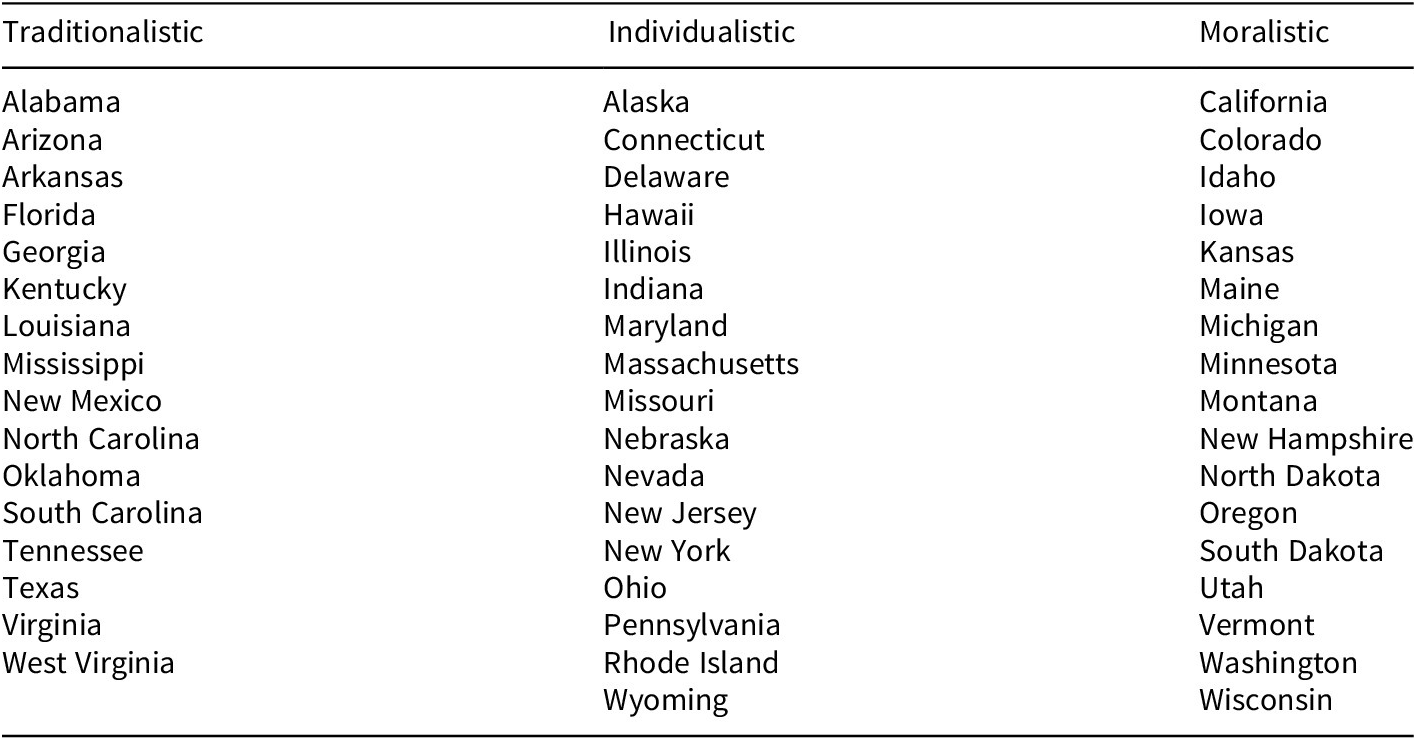
The specifics of this influence depend on which of the three cultures – traditionalistic, moralistic, or individualistic – best describes the state in question (shown in Table A1). Each culture includes its own logic of appropriateness (March and Olsen Reference March and Olsen1998) defining the role of bureaucratic institutions and the acceptability of the actions they take, with some cultures granting wider latitudes than others. Since this cultural understanding is shared by those within and outside bureaucratic institutions, it becomes a key (if sometimes unconscious) consideration in whether an agency’s actions will be consented to or face substantial pushback. In this way, culture shapes the norms that bridge between public perceptions and constraints on bureaucratic rulemaking activity.
The traditionalistic culture holds the most negative perspective toward the bureaucracy (and government in general), viewing it as necessary only to maintain the current status quo. Within this culture, political leaders rarely initiate new programs based on their own beliefs or observations, instead waiting until conditions demand action on a problem to preserve the political order. Consequently, traditionalistic cultures tend to be highly skeptical of bureaucratic action, as these actions disrupt the established system of personal relationships among elite actors (Elazar Reference Elazar1984; Sharkansky Reference Sharkansky1969). Instead, the logic of appropriateness in traditionalistic states encourages bureaucratic restraint, as the legislature is more likely to be viewed as the suitable venue for policy change. The elite-centric nature of politics in traditionalistic cultures also limits the political engagement of everyday citizens, in turn reducing their trust in government institutions and support for government action (Chanley, Rudolph, and Rahn Reference Chanley, Rudolph and Rahn2000; Christensen and Laegreid Reference Christensen and Laegreid2005). As a result, agencies in traditionalistic states are likely to face greater pushback from the public – and potentially political overseers by extension – if they engage in an abundance of rulemaking activity.
States with moralistic cultures take a much more positive view of the bureaucracy, encouraging government programs to progress toward the public good. Individuals are urged to participate in politics to a greater extent than in traditionalistic cultures, furthering support for government action to address policy concerns (Chanley, Rudolph, and Rahn Reference Chanley, Rudolph and Rahn2000; Johnson Reference Johnson1976). These norms result in greater acceptance of interference in the private lives of citizens, so long as the action is deemed necessary for the general welfare of the community. This leaves bureaucracy with a relatively positive reputation as an element of government working toward the public good through the efforts of an extensive and professional administrative staff (Elazar Reference Elazar1984; Sharkansky Reference Sharkansky1969). Such high legitimacy leads to a wider acceptance of bureaucratic activity as appropriate, ultimately providing greater freedom for agencies in these states to regulate without fear of political reprisal.
The individualistic culture views government primarily as utilitarian, instituted to fulfill the wishes of the people with minimal interference into their private lives. In this environment, policymakers only expand government activity when there is strong public pressure to do so rather than to enact their own political beliefs. Ultimately, government initiatives are viewed relatively indifferently, as is the role of the bureaucracy (Elazar Reference Elazar1984; Erikson, Wright, and McIver Reference Erikson, Wright and McIver1993). Thus, the logic of appropriateness in individualistic states implies a belief in bureaucratic neutrality – not as proactive as agencies in moralistic states nor as restrained as agencies in traditionalistic states. This perspective suggests that bureaucracies in individualistic states will face minimal backlash in scenarios that support the will of the public but remain more bounded in pursuits of innovative policy change (Morgan and Watson Reference Morgan and Watson1991).
Beyond Elazar’s initial categorizations and the scale furthered by Sharkansky, political culture has shown to be an influential element of state politics. As early as 1987, Erikson, McIver, and Wright found political culture to be a dominant factor in differentiating public opinion across states. Furthermore, culture played a large role in determining voting in presidential elections (Erikson, McIver, and Wright Reference Erikson, McIver and Wright1987). This trend continued over time, as state political culture was found to be similarly significant in predicting the scheduling of state primary elections (Carman and Barker Reference Carman and Barker2005) and in predicting support for Barack Obama in the 2008 Democratic presidential primaries (Fisher Reference Fisher2010).
In addition to the electoral role, scholars have found state political culture to have statistically significant relationships with a variety of political and government activities, including state budgets, representation style, interparty competition, voter turnout, policy innovation, and local emphasis and administration of government programs (Erikson, Wright, and McIver Reference Erikson, Wright and McIver1993; Johnson Reference Johnson1976; Koven and Mausolff Reference Koven and Mausolff2002; Morgan and Watson Reference Morgan and Watson1991). It has even been found to have a substantial influence on the funding of higher education (Tandberg Reference Tandberg2010a, Reference Tandberg2010b) and various indicators of state performance (Lieske Reference Lieske2010, Reference Lieske2012). Thus, while the original measure of state political culture was introduced several decades ago, research continues to show it is an influential factor in state politics. Culture is also a consistent factor among states, as it forms the basis of many norms surrounding the acceptability of government action and when it is or is not appropriate (March and Olsen Reference March and Olsen1998; North Reference North1989). These unwritten aspects of politics tend to be stable across time, in some cases even more so than the formal institutions themselves, implying that the classification of cultures remains accurate despite the age of the measure (North Reference North1989, Reference North1992). The question remains, however, to what extent this influence affects state bureaucracies and their rulemaking activities.
Mechanisms of cultural influence on rulemaking
I posit that the rulemaking impacts of state political culture stem from the way culture shapes bureaucrats’ perspective of their role. In states where the dominant culture produces perceived legitimacy and trust in bureaucratic activity, agencies will feel empowered to use more discretion in rulemaking. On the other hand, if a state’s culture limits the degree to which the public trusts government and views its actions as legitimate, bureaucrats will feel more restricted in their use of discretion, ultimately reducing the number and breadth of rules they propose. Thus, the mechanisms of trust, legitimacy, and discretion generate distinct patterns of rulemaking across the three cultural types.
Trust in bureaucracy reflects the extent to which the public believes an agency will “act in a benevolent and competent manner” (Myers et al. Reference Myers, Kotcher, Stenhouse, Anderson, Maibach, Beall and Leiserowitz2017, 845). Thus, a trustworthy agency is one that is committed to acting in the interests of the public and has the necessary expertise to carry out its functions well (Levi and Stoker Reference Levi and Stoker2000). Though there are numerous individual factors that influence agency trust – such as an individual’s race, partisanship, education, personal experiences, or exposure to media coverage, among others (Gupta et al. Reference Gupta, Ripberger, Jenkins-Smith and Silva2020; Rahn and Rudolph Reference Rahn and Rudolph2005; Reinhardt Reference Reinhardt2015) – there are also several agency-specific components. Agency performance, conduct, processes, and perceived character can all be significant drivers of trust in government bureaucracies (Myers et al. Reference Myers, Kotcher, Stenhouse, Anderson, Maibach, Beall and Leiserowitz2017; Robinson et al. Reference Robinson, Liu, Stoutenborough and Vedlitz2013; Van Ryzin Reference Van Ryzin2011). Trust is also positively associated with the accessibility and transparency of an agency as well as the integrity of officials working within it (Robinson et al. Reference Robinson, Liu, Stoutenborough and Vedlitz2013). These types of perceptions are in turn influenced by contextual factors, as highlighted by Levi and Stoker (Reference Levi and Stoker2000, 481): “Although citizens do not all agree about the trustworthiness of politicians and government, their disagreements reflect…the influence of their local social and political contexts.” Furthermore, Christensen and Lægreid suggest it is these “political-cultural variables [that] have the strongest overall effect on variation in people’s trust in government” (Reference Christensen and Laegreid2005, 505). In this sense, agency trust is one of the key mechanisms through which state political culture can influence bureaucratic activity.
When bureaucracies enjoy trust from their public, they also gain the legitimacy and respect needed to complete their work effectively (Reinhardt Reference Reinhardt2015; Xiao, Gong, and Tu Reference Xiao, Gong and Tu2024). Such legitimacy can increase agency perceptions of discretion, through which they are able to interpret or implement policies in ways not explicitly prescribed by legislation (Huber and Shipan Reference Huber and Shipan2002). Though all agencies possess at least a minimal level of discretion, the extent to which discretion is exercised largely depends on whether bureaucratic action is viewed as legitimate by political principals, including the public (Epstein and O’Halloran Reference Epstein and O’Halloran1994). As a result, bureaucrats in states which grant them greater trust and legitimacy may have a larger “discretionary space” in which they feel comfortable making policy decisions without fear of being sanctioned (Smith and Yackee Reference Smith and Yackee2024). In practice, this makes discretion the other piece of the puzzle when it comes to cultural impacts on bureaucratic regulatory proposals, as it shapes the perceived appropriateness of various actions.
Based on the existing literature, I expect there to be distinct differences in the amount and diversity of rulemaking activity undertaken by bureaucratic agencies in states characterized by each of the three political cultures. The patterns described below emerge within what Ostrom (Reference Ostrom2010) terms a polycentric governance system, in which multiple centers of decision-making interact and reinforce one another. In this type of system, feedback flows between bureaucratic actions and public expectations, further strengthening cultural norms and their differential influence on agency discretion in various states (Greif and Laitin Reference Greif and Laitin2004).
In traditionalistic states, which “tend to be distinctively antibureaucratic” (Elazar Reference Elazar1984, 119), citizens are likely to view the bureaucracy with suspicion rather than trust. Because it can interfere with the informal interpersonal relationships that typically characterize politics in these states, bureaucracy is generally relegated to a limited role carefully controlled by those with political power. As a result of reduced legitimacy, agencies in these states likely perceive the exercise of discretion as outside the logic of appropriateness and therefore politically risky (Xiao, Gong, and Tu Reference Xiao, Gong and Tu2024). Accordingly, the bureaucracy should be primarily reactive rather than proactive as it seeks to implement policies strictly in line with what the legislature has authorized. Venturing outside these parameters may leave the agency vulnerable to negative public reactions, ultimately influencing legislators’ support of the agency and potentially leading to budgetary reductions or other sanctions. In response to this threat, agency leaders are likely to propose rules only when necessary to maintain the status quo or implement recent legislation rather than to pursue policy goals, resulting in lower numbers of proposed regulations.
H1a: Compared to those in moralistic and individualistic states, bureaucracies in traditionalistic states will issue fewer proposed rules.
The content of proposed regulations is also likely to be constrained by the traditionalistic political culture. Given the general distrust of bureaucratic policymaking, the public is likely to be unsupportive of broad activity. As a result, agencies may be hesitant to employ strategic tools to pursue their preferred agenda. Rather than prioritizing the implementation of certain favorable legislation or utilizing “procedural politicking” to reduce the likelihood of political interference, bureaucrats may be more likely to remain squarely in line with both the explicit and implicit goals of legislative delegations of authority (Acs Reference Acs2016; Potter Reference Potter2019). Such a situation would generate a less diverse array of proposed regulations as bureaucracies focus their efforts on specific issues.
H1b: Compared to those in moralistic and individualistic states, bureaucracies in traditionalistic states will produce a narrower agenda of proposed regulations.
Moralistic states, on the other hand, should experience the opposite trend. Citizens in states with this culture are more likely to view government as a force for the public good and welcome “intervention for the good of the commonwealth” (Sharkansky Reference Sharkansky1969, 69). This perspective extends to bureaucracy, so long as it demonstrates trustworthiness through its competence and efficiency in pursuing the public interest (Levi and Stoker Reference Levi and Stoker2000). As a result, bureaucratic agencies in moralistic states are likely to feel empowered to use discretion liberally and take the initiative to institute policies that move the general welfare forward. These agencies are less likely to be constrained by legitimacy concerns from the public, providing them security to propose innovative policies through rulemaking, even if it requires reaching back to an older statute or interpreting legislation more creatively to establish delegated authority. The moralistic culture, then, suggests that bureaucracies will be able to issue a greater number of administrative rules with less fear of disproportionate negative consequences.
H2a: Compared to those in traditionalistic and individualistic states, bureaucracies in moralistic states will issue more proposed rules.
Similarly, this discretion likely enables bureaucratic agencies in moralistic states to take greater initiative to issue proposed rules on a variety of topics. Because bureaucratic action is perceived as generally appropriate in moralistic states, these agencies enjoy greater legitimacy to issue rules they may otherwise be hesitant to pursue. In practice, this can look like speeding the process for some rules and waiting to pursue others in order to shift policy in a preferred direction (Gersen and O’Connell Reference Gersen and O’Connell2008; Haeder and Yackee Reference Haeder and Yackee2022). Doing so broadens the range of policy areas in which bureaucratic activity might be expected, as agencies do not feel as tightly bound to recent delegations of authority. Accordingly, we can expect proposed regulations in moralistic states to cover a wider selection of topics than those in states representing the other two cultures.
H2b: Compared to those in traditionalistic and individualistic states, bureaucracies in moralistic states will produce a broader agenda of proposed regulations.
In many ways, the individualistic culture lies somewhere between the other two. Members of the public in these states are somewhat “ambivalent about the place of bureaucracy in the political order” (Elazar Reference Elazar1984, 116). When bureaucracy pursues actions aligned with public demands, it is viewed as a legitimate means for policy change. However, subscribers to an individualistic political culture also recoil from what they perceive as undue interference in the lives of citizens. In practice, this can lead to a lack of trust if bureaucracies are perceived as overreaching their appropriate role (Levi and Stoker Reference Levi and Stoker2000; Myers et al. Reference Myers, Kotcher, Stenhouse, Anderson, Maibach, Beall and Leiserowitz2017). Thus, the use of bureaucratic rulemaking can be seen as conditionally acceptable, enabling agencies to act relatively freely within a prescribed sphere of influence but discouraging agencies from venturing outside it. As a result, bureaucratic rulemaking will likely be more prominent than it is in traditionalistic states, but not quite to the level seen in moralistic states.
H3a: Bureaucracies in individualistic states will issue more proposed rules than those in traditionalistic states, but fewer proposed rules than agencies in moralistic states.
The same is likely to be true of the topics on which proposed rules focus. The public in individualistic states is typically willing to accept bureaucratic activity in general, but not without boundaries. To translate this into specific policy areas requires defining which topics the public views as appropriate for bureaucratic action. In those areas in which bureaucratic discretion is seen as legitimate, agencies will be able to publish a wider array of proposed rules. In areas where discretion is considered less appropriate, agencies will issue narrower regulatory proposals, ultimately leading to a moderate level of diversity in the bureaucratic agenda.
H3b: Bureaucracies in individualistic states will issue proposed rules related to a broader number of topics than those in traditionalistic states, but issue proposed rules related to a narrower set of topics than agencies in moralistic states.
Quantity of rules
Data and methods
To test Hypotheses 1a, 2a, and 3a, I analyze the publication of proposed regulations from bureaucratic agencies over a 10-year period across all 50 states. I use proposed rules because they are often somewhat more flexible than final rules, which are dependent on prior actions. As such, proposed regulations represent an earlier position of bureaucracies prior to adjustments emanating from the public comment period. Accordingly, proposed regulations better reflect the freedom or limitations felt by bureaucrats with regard to issuing rules.Footnote 1 Proposed rules also encompass all rulemaking activity by an agency rather than limiting the analysis to the subset of rules that complete the process to be entered into a state’s administrative code, making them a better measure of the theoretical expectations being tested here.
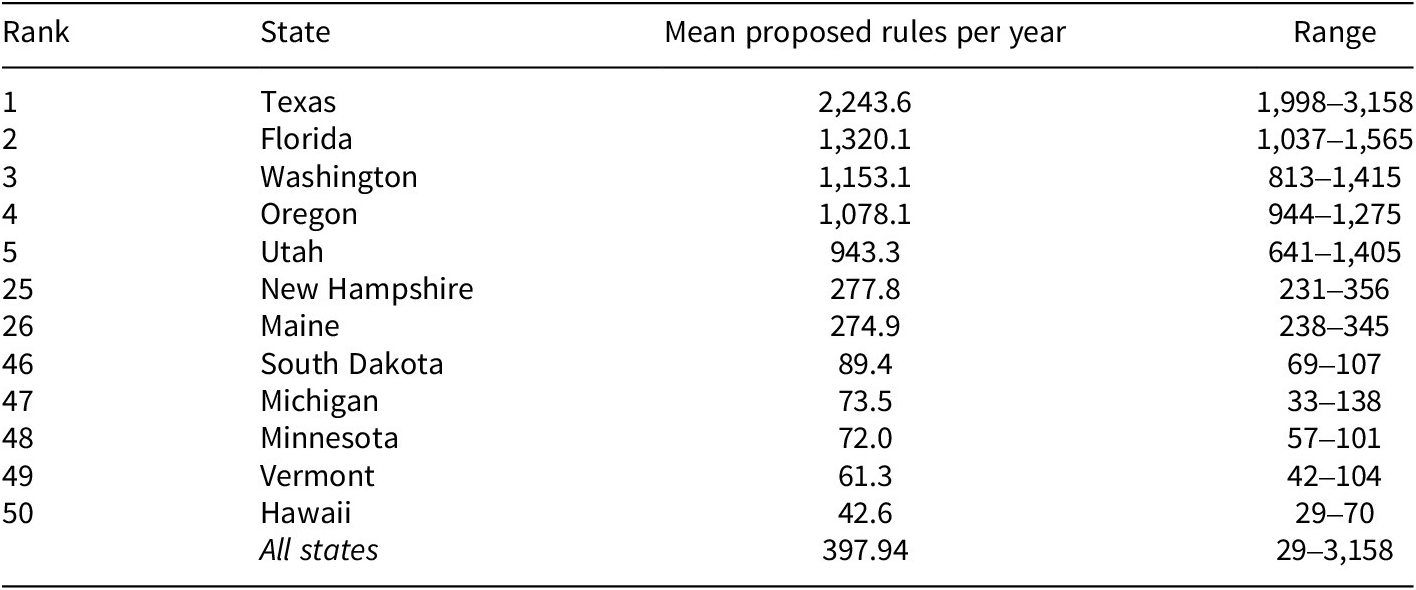
The regulations were gathered through the Lexis Nexis State Regulation Tracking database. This resource contains information related to regulatory activity across states and agencies in a standardized format, facilitating the inclusion of all proposed rules issued at the state level between 2004 and 2013 (amounting to 198,969 total proposed rules). The database was used to construct a state-year count of proposed regulations issued in each state for each year of the study period to be used as the dependent variable. Though all states regularly issue bureaucratic rules, they do so at highly variable rates (as shown in Table 1). Not only are the number of proposed regulations different from state to state but also within the states themselves in many cases. I argue that these differences may be partially attributable to the political culture in each state, which encourages or inhibits bureaucratic rulemaking.
Summary of annual rulemaking, selected states

Table 1. Long description
Twelve states were selected to demonstrate the breadth of rulemaking across states, showing the mean and range of proposed rules per year. The table includes the top 5 rulemaking states (Texas, Florida, Washington, Oregon, and Utah), two mid-level rulemaking states (New Hampshire and Maine), and the 5 least rulemaking states (South Dakota, Michigan, Minnesota, Vermont, and Hawaii). It also includes an average of all U.S. states for comparison.
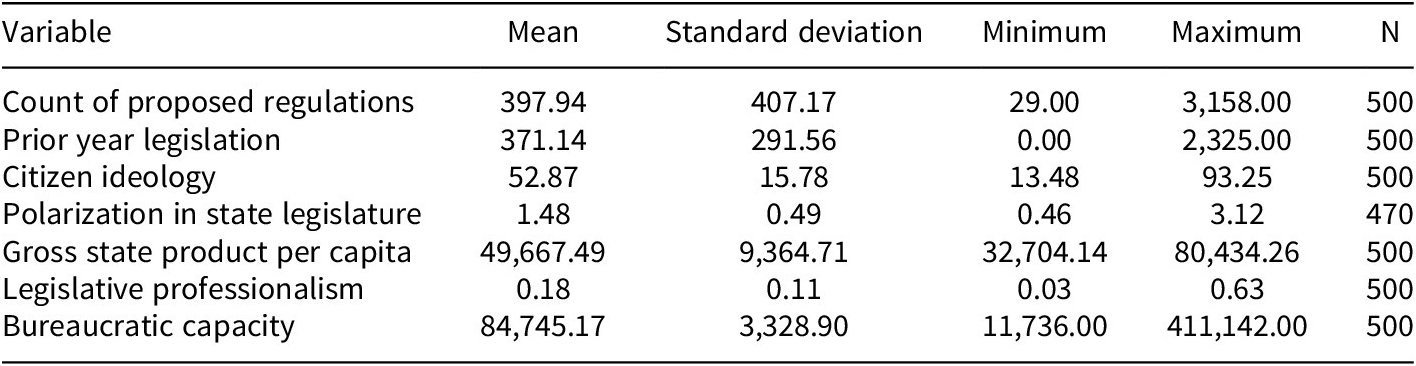
In addition to the dependent variable described above, the dataset also contains a number of control variables measuring factors which may influence the results (Table 2). The first is prior year legislation, which accounts for legislative productivity in a state. Though this measure does not directly account for delegation to bureaucracies, it controls for the general level of legislative activity in a state, thereby helping to ensure any observed variation in bureaucratic rulemaking is not reflective of a state government’s general level of activity in producing policy outputs. In this way, the inclusion of prior year legislation better isolates the influence of political culture on bureaucratic rulemaking. This variable was gathered from the Lexis Nexis Advance Legislative Service database, which contains all bills passed at the state level (N = 182,949). The database was used to create an annual count for each state, which was then lagged by one year before being included in the model.
Descriptive statistics

Table 2. Long description
Variables included in the table include Count of Proposed Regulations, Prior Year Legislation, Citizen Ideology, Polarization in State Legislature, Gross State Product per Capita, Legislative Professionalism, and Bureuacratic Capacity. For each variable, the table shows mean, standard deviation, minimum, maximum, and N size.
The second factor controlled for is a measure of the ideology of a state’s citizens drawn from Berry et al. (Reference Berry, Ringquist, Fording and Hanson1998, Reference Berry, Fording, Ringquist, Hanson and Klarner2010). This measure reflects the general beliefs of the electorate in a state based on the actions of its congressional delegation, outcomes of congressional elections, and partisan division within the state legislature. Though similar to political culture at first glance, ideology is much more grounded in current political happenings, whereas culture relates to a population’s worldview related to the role of government in society broadly. Thus, controlling for citizen ideology helps to ensure the results are driven by stable characteristics of the political environment rather than current public opinion, which is often relatively capricious. The measure is calculated for each year in the dataset, with higher values indicating a more liberal electorate.
Thirdly, the model contains polarization in the state legislature, measured as the ideological distance between party medians. This factor is derived from measures of each state legislative chamber created by Shor and McCarty (Reference Shor and McCarty2011). The measure used here is an average of Shor and McCarty’s scores for the upper (Senate) and lower (House) chambers in each state,Footnote 2 thus accounting for polarization across a state’s legislature. Inclusion of polarization in the model accounts for the possibility that extreme division among legislators drives up regulatory activity as a result of policy stalemate in the statehouse.
Next is an economic measure, namely, a state’s per capita gross state product (GSP) each year. This factor ensures the results are not driven by wealthier or less affluent states. The measure was created by dividing a state’s GSP by the population, both of which were measured in millions. The GSP measure was obtained from the Bureau of Economic Analysis for each year in the dataset, using chained 2012 dollars. The population data were derived from the US Census Bureau’s annual Intercensal Estimates.
The model also contains a measure of the professionalism of a state’s legislature. This measure is included to account for the findings of Boushey and McGrath (Reference Boushey and McGrath2017), which suggest bureaucracies are more powerful in states with less professionalized legislatures – a trend that is particularly common across the Southern states. Notably, Smith and Yackee (Reference Smith and Yackee2024) find that agencies in Southern states enjoy greater discretion than those elsewhere despite their classification as traditionalistic. However, this counterintuitive result may result from lower legislative professionalism rather than political culture. Accordingly, controlling for legislative professionalism helps account for this possibility and better isolate the effects of political culture on rulemaking. Legislative professionalism is measured using the 2003 Squire Index (Squire Reference Squire2007), which considers the conditions of legislatures in the year immediately preceding the sample. It is modeled as a constant given the limited availability of scores throughout the period of analysis. However, given the slow change of professionalizing factors, this limitation is unlikely to affect the generalizability of the results.
The final control variable is the number of personnel employed by the state’s government, measured in full-time equivalents. This is a proxy measure for bureaucratic capacity in a state, which indicates the level of resources and expertise available for bureaucratic policymaking (Gailmard and Patty Reference Gailmard and Patty2007; Huber and McCarty Reference Huber and McCarty2004). As a result, states with a larger bureaucratic workforce may be able to produce greater numbers of regulations than those with a lower number of employees. These data were obtained from the Book of the States published annually by the Council of State Governments.
Each of these variables was included in an ordinary least squares regression model, using the number of regulations in a state each year as the dependent variable. The last two controls – legislative professionalism and bureaucratic capacity – were also interacted to capture the impact of the institutional environment on bureaucratic activity. The independent variable of interest is state political culture, measured on a categorical basis through the use of indicator variables. The reference category for state political culture is individualistic states, as the number of rules issued by agencies in these states is expected to fall between the other two types. This allows for simpler interpretation of results, as the hypotheses suggest a positive coefficient for moralistic states and a negative coefficient for traditionalistic states.
Findings
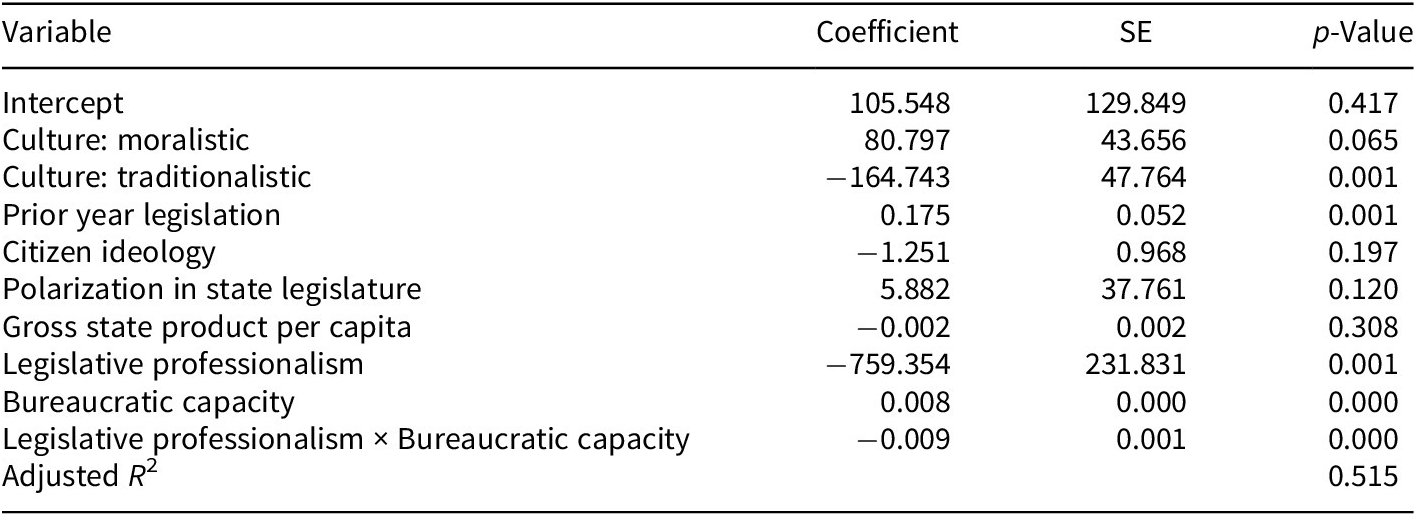
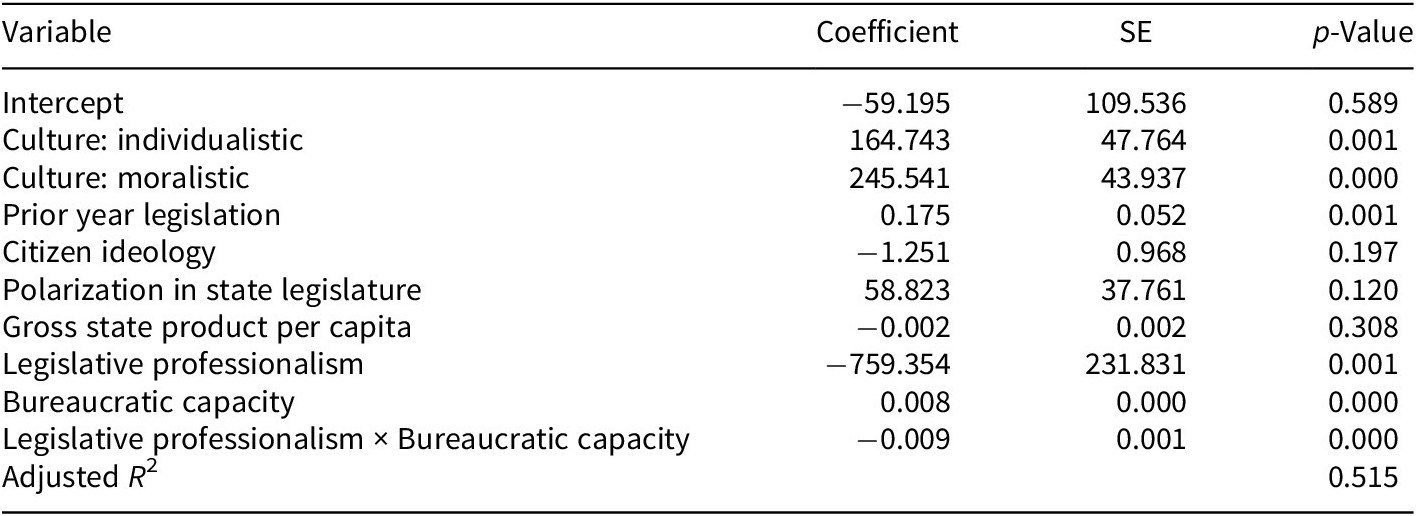
The results from the regression model are presented in Table 3. Hypothesis 1a is supported by the results, as the coefficient for traditionalistic states is both negative and statistically significant (p = 0.01). Furthermore, the magnitude of the coefficient is quite large, suggesting that the number of proposed regulations is much lower in these states than in individualistic or moralistic states. The coefficient for moralistic states was positive, suggesting agencies in moralistic states produced the most proposed regulations, as predicted by Hypotheses 2a and 3a. However, this relationship was only statistically significant at the 0.1 level, meaning that there is little distinguishable difference between the number of regulations proposed in the two types of states.
OLS regression results

Table 3. Long description
Table shows coefficient, standard error, and p-values for each of the following variables: Intercept, Moralistic Culture, Traditionalistic Culture, Prior Year Legislation, Citizen Ideology, Polarization in State Legislature, Gross State Product per Capita, Legislative Professionalism, Bureaucratic Capacity, and an interaction effect between Legislative Professionalism and Bureaucratic Capacity. The model returned statistically signifcant results for Moralistic Culture, Traditionalistic Culture, Prior Year Legislation, Legislative Professionalism, Bureaucratic Capacity, and the interaction effect. Adjusted R square for the model was 0.515.
Note: N = 470.
The model also included several control variables related to state politics. Of these, several were found to be statistically significant at the 0.05 level. The coefficient for prior year legislation is positively significant, indicating that bureaucratic agencies issued more regulatory proposals following a particularly active year by the state legislature. Additionally, both institutional variables were statistically significant but in opposite directions. These results suggest that more professional legislatures tend to rely less heavily on bureaucratic rulemaking, while agencies with greater staff capacity are able to produce more regulations in a given year. The interaction between these factors was also statistically significant, though the negative coefficient implies that they do not play an equal role in determining the number of regulations proposed by the state’s bureaucracy. The more political variables of citizen ideology and party polarization in the legislature were not found to be statistically significant, nor was the economic measure of per capita GSP.
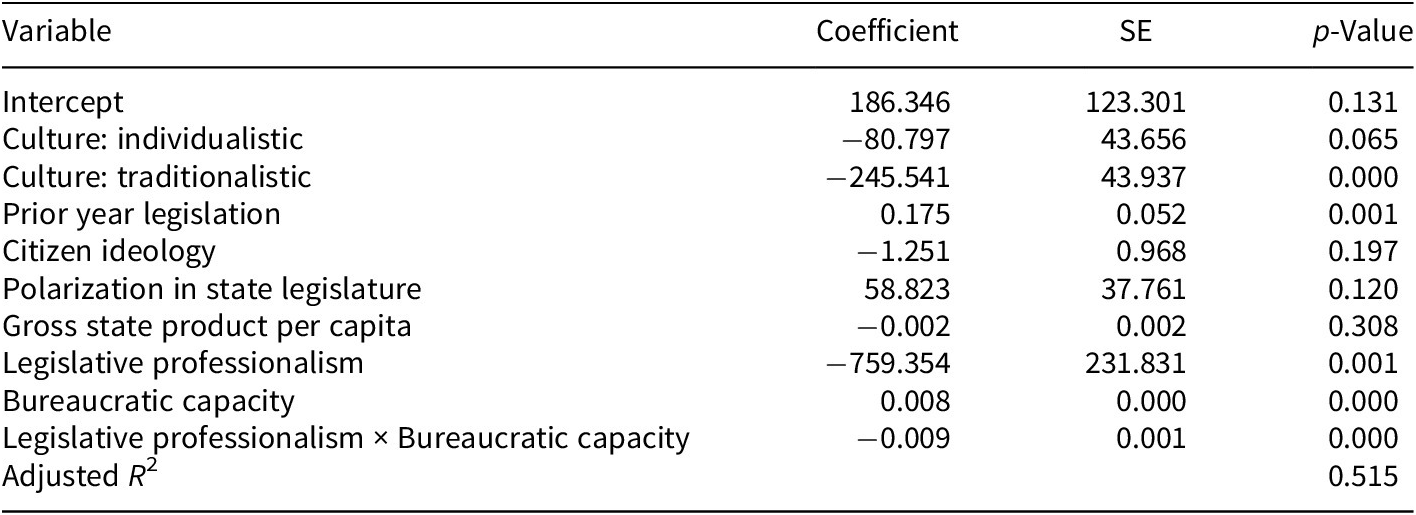
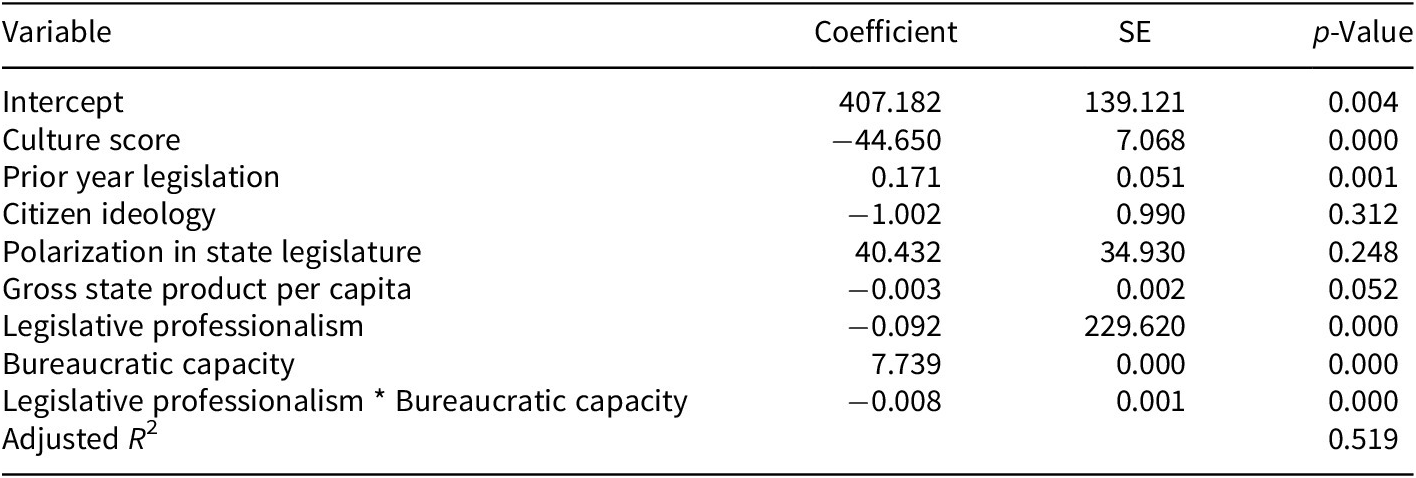
To substantiate these results, I also conducted several robustness checks of the model. The first was to alter the reference category used for the primary independent variable to enable a direct comparison of all categories of state political culture. These models (shown in Tables B1 and B2) confirm that the number of regulations issued by traditionalistic states is statistically significantly lower than both moralistic and individualistic states, but there is limited distinguishable difference between the other two types of states. Secondly, I replicated the model using Sharkansky’s (Reference Sharkansky1969) political culture score for the 48 states in the continental United States rather than the categorical measure used in the model presented above. This measure ranges from 1 (entirely moralistic) to 9 (entirely traditionalistic), enabling researchers to account for states with blended cultures that are difficult to place neatly into one of Elazar’s original three categories.Footnote 3 The results from this model (shown in Table B3) are similar to the original measure, with a statistically significant and negative coefficient for the culture variable suggesting fewer proposed regulations as a state becomes more traditionalistic. The consistency of results with these alternative specifications lends support to the robustness of the model used above and provides confidence in the validity of the results.
Content of rules
Data and methods
To assess Hypotheses 1b, 2b, and 3b, I conducted a secondary analysis using summaries of regulations from six states. The states were selectively chosen based on their classifications as traditionalistic, moralistic, or individualistic. Within each of the three political cultures, the two states represent a traditionally Republican and traditionally Democratic polity in order to limit potential partisanship effects. The states included in the sample are Alaska (Republican-leaning individualistic state), New Jersey (Democratic-leaning individualistic state), Utah (Republican-leaning moralistic state), Washington (Democratic-leaning moralistic state), Mississippi (Republican-leaning traditionalistic state), and Virginia (Democratic-leaning traditionalistic state). For each proposed rule from these states, I collected the summary provided by the proposing agency as listed in the state’s equivalent of the Federal Register. The summaries were then topically coded using a combination of hand coding and machine learning approaches. Each rule was assigned to one of 20 mutually exclusive and jointly exhaustive policy areas according to the codebook of the Pennsylvania Policy Database Project.Footnote 4 This codebook was developed as an extension of the Comparative Agendas Project, which classifies policy activities according to a single consistent coding scheme. The Pennsylvania codebook makes slight adjustments to the national (and international) codebooks to better suit state-level priorities, making it an ideal fit for the current data.
To analyze these data, I begin with assessments of the diversity of the bureaucratic agenda in states representing each cultural type. The breadth of rulemaking across topic areas is first evaluated using entropy scores calculated through Shannon’s diversity index to demonstrate the spread of rules for each culture (Shannon Reference Shannon1948; Shannon and Weaver Reference Shannon and Weaver1949). Such scores have been consistently used in the study of institutional agendas and are appropriate for measures of agenda diversity (Baumgartner, Jones, and MacLeod Reference Baumgartner, Jones and MacLeod2000; Boydstun, Bevan, and Thomas Reference Boydstun, Bevan and Thomas2014). Next, I tested the statistical significance of the differences between these distributions using an ANOVA model substantiated by a Tukey test. Finally, I conducted a series of Kolmogorov–Smirnov (K-S) tests with p-values predicted through Monte Carlo simulations with 1,000 replications. This is a nonparametric test which assesses the differences between two distributions, with significant results indicating that two samples represent different underlying distributions. Combined, these tests provide a robust picture of the distributions of proposed rules for each of the three cultural types.
Further insights are generated by an exploratory analysis looking at the topics themselves across the three cultural types. I utilize a multinomial logistic regression model to develop predicted probabilities demonstrating the likelihood of regulation on each policy type within each culture. This model also controls for the proportion of Democrats in a state’s legislature collected from the annual Book of the States. This variable accounts for the political leanings of a state’s government, ensuring a clearer picture of the impact of culture on the focus of regulatory activity in a state. This analysis cannot provide detailed insights about the mechanisms at play, but it can establish whether political culture is a factor in bureaucratic decision-making surrounding regulation.
Findings
The entropy scores across the three cultures are presented in Table 4. With this measure, higher scores indicate a wider spread of attention from the bureaucracy, with proposed regulations being issued on a greater number of topics. In this case, the maximum entropy score would be 3.00 if the rules were perfectly divided among the 20 substantive policy topics.Footnote 5 Lower scores indicate an agenda focused primarily on a few topics with little variation. Thus, the theoretical expectations presented above would predict the highest entropy score for moralistic states, followed by individualistic and traditionalistic states. The findings support only some of these expectations, as traditionalistic states produce a lower entropy score than the other two cultures. This suggests that the bureaucratic agenda in these states is centered on fewer topics than in states with other cultures. As with the quantity of proposed rules, moralistic and individualistic states are reversed from the hypotheses presented, with individualistic states having the highest entropy score and broadest array of proposed regulations. However, it is important to note that these differences are fairly small across the three cultures, suggesting the need for alternative approaches to assessing the differences in content of regulations.
Entropy scores

Table 4. Long description
Entropy scores for each cultural type are displayed as follows: Traditionalistic 2.12, Moralistic 2.14, and Individualistic 2.18
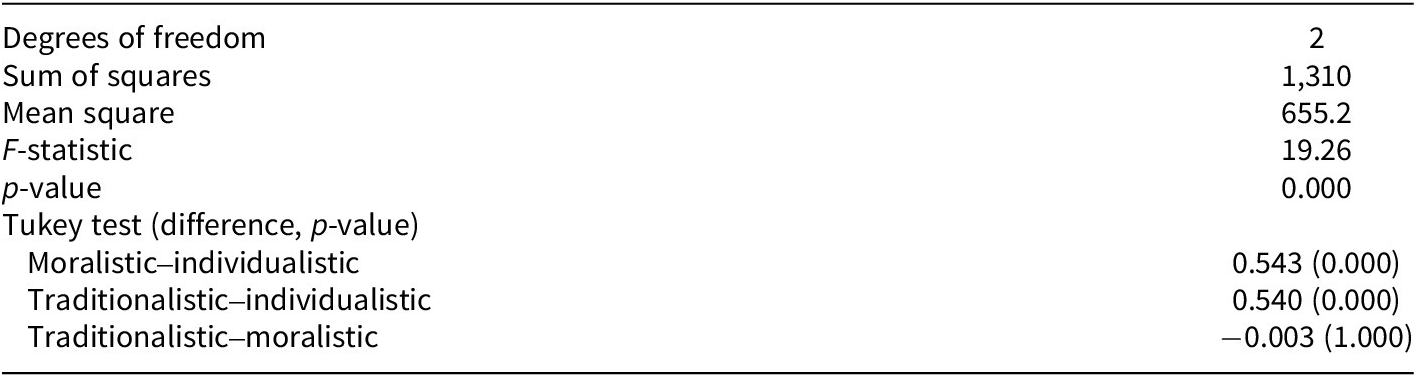
To further explore the differences in content between the proposed rules of the three cultures, I conducted an ANOVA model and Tukey test (shown in Table 5). The results mirror the findings of the OLS model used to assess the quantity of proposed rules, with a significant result from the ANOVA test and two of the three comparisons within the Tukey test. However, in this case, it is the individualistic states that are statistically significantly different from the other two cultures rather than the traditionalistic states. Paired with the entropy scores presented above, this suggests that agencies in individualistic states address a wider range of topics through proposed rules than agencies in the other two cultures. This is further substantiated by a series of Kolmogorov–Smirnov tests (presented in Table 6), which find the distribution underlying regulatory proposals in individualistic states to be significantly different from the underlying distribution of moralistic or traditionalistic states.
ANOVA and Tukey test results

Table 5. Long description
For the ANOVA model, table shows degrees of freedom, sum of squares, mean square, f-statistic, and p-value (p = 0.000). The Tukey test results show the difference between each cultural type and its p-value. Moralistic—Individualistic and Traditionalistic—Individualistic are statistically significant, while Traditionalistic—Moralistic is not.
Kolmogorov–Smirnov test results

Table 6. Long description
Table shows the test statistic and p-value for the comparison between each cultural type. Comparisons between Moralistic—Individualistic and Traditionalistic—Individualistic were significant at the 0.05 level (p = 0.000), while the comparison of Traditionalistic—Moralistic was significant at the 0.10 level (p = 0.092)
Based on these results, the diversity of rulemaking across states does not fully support Hypotheses 1b, 2b, and 3b. Entropy scores suggest that traditionalistic states issue proposed rules on fewer topics as predicted by Hypothesis 1b, but moralistic and individualistic states are the reverse of expectations. Furthermore, the ANOVA model and K-S tests suggest that it is individualistic states that are substantially different from the other two cultural types. Thus, the results indicate that there are differences in the distribution of regulations across the three cultures, but further research is needed to examine the nuances of these differences.
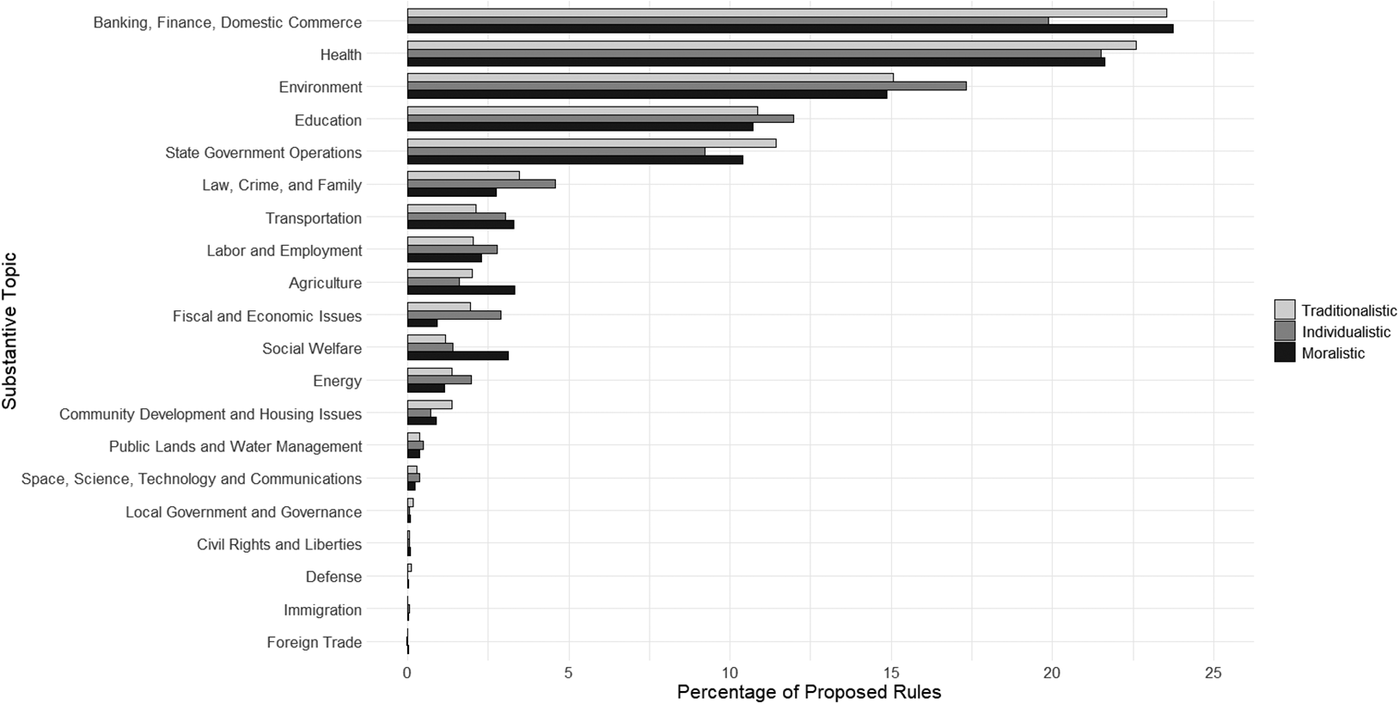
To begin this exploration, I turn to a simple distribution of proposed rules across policy topics for the three state cultures (shown in Figure 1). Though there are some similarities across cultures in terms of which topics are most highly regulated, the proportion of rules focused on specific issues varies considerably. For example, while Banking, Finance, and Domestic Commerce is the most common topic in all three cultures, it makes up nearly 4% less of the distribution in individualistic states than in moralistic states. Though this difference seems small at first glance, it is substantial when considered among 20 substantive topics as it represents a shift of 0.68 standard deviations toward a single topic. Such differences are even more pronounced among the less common topics, such as Social Welfare. This topic was the subject of a proposed rule more than twice as often in moralistic states as either of the other two cultures.
Percentage of proposed rules related to each substantive policy topic by state political culture.

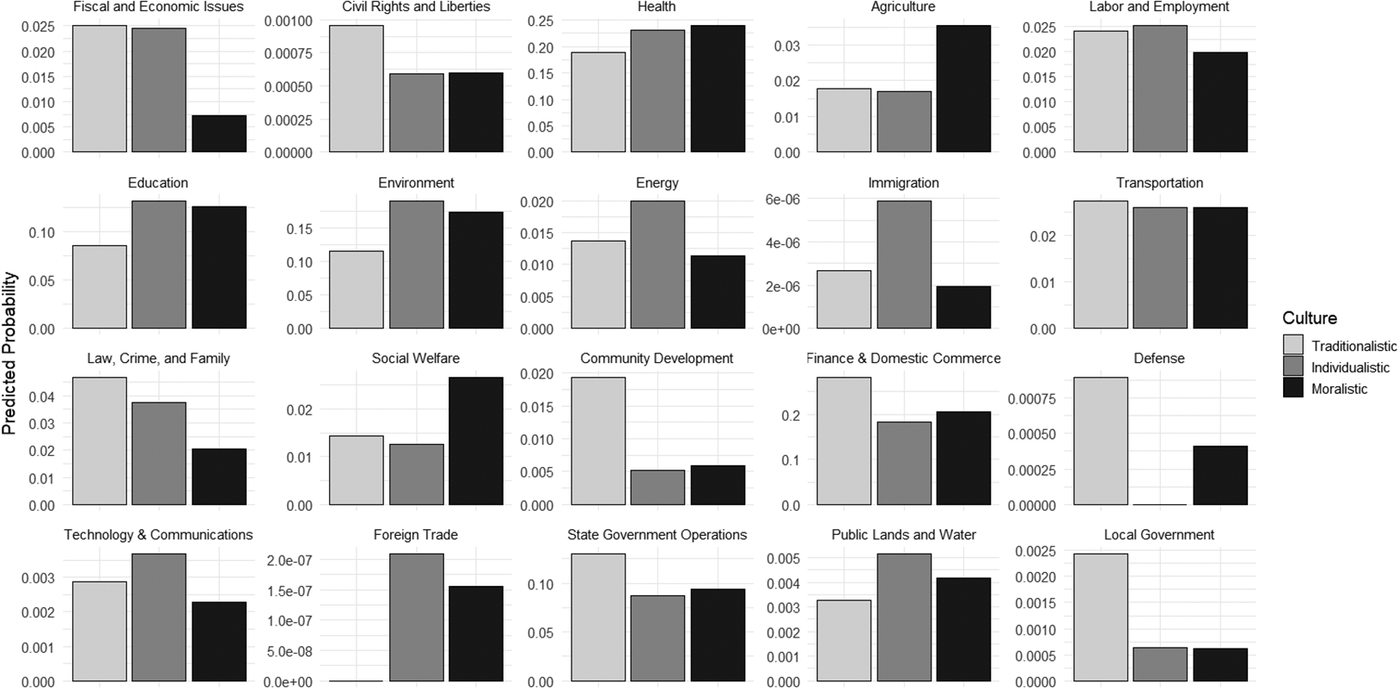
Such distinctions are also evident in the results of a multinomial regression model, which returned statistically significant differences across cultures in many policy areas.Footnote 6 Predicted probabilities from this model are shown in Figure 2, which demonstrates stark differences in regulatory activity across cultures. Moralistic states were found to be substantially more likely to issue proposed regulations related to social welfare and foreign trade than either of the other two cultural types. These states were also much less likely than agencies in other cultures to propose regulations related to fiscal and economic issues or community development and somewhat less likely to regulate issues of law, crime, and family.
Predicted probabilities of regulation on each policy topic, by political culture.

The diversity of the regulatory agenda in individualistic states was apparent, as agencies in these states were most likely to issue rules on a variety of topics. These included substantial increases in the predicted probability of regulations on the issues of fiscal and economic issues, civil rights and liberties, agriculture, labor and employment, energy, immigration, finance and domestic commerce, and public lands and water along with more subtle increases in regulation related to transportation and community development. The only topics on which individualistic states were expected to issue substantially fewer regulations than the other two cultural types were the environment and defense, on which no individualistic state issued a proposed rule throughout the decade under study.
Traditionalistic states, meanwhile, have the highest predicted probabilities for 8 of the 20 policy topics. The biggest differences were on the issues of law, crime, and family; defense; technology and communications; and local government. There were smaller increases in the areas of health, education, environment, and state government operations. Traditionalistic states are also moderately less likely than other states to regulate on topics like agriculture, labor and employment, immigration, transportation, social welfare, and foreign trade (on which no traditionalistic state issued a proposed regulation).
Discussion
Though the findings presented above were not fully supportive of all hypotheses, they provide some very interesting insights into the drivers of bureaucratic rulemaking at the state level. Specifically, traditionalistic political culture appears to be a significant inhibitor of bureaucratic rulemaking in both frequency and breadth, as predicted by Hypotheses 1a and 1b. In states with this type of culture, residents tend to be more wary of bureaucratic policymaking and less accepting of expansive regulation. Instead, rulemaking is more likely to be viewed as policy change without popular consent due to the unelected nature of bureaucrats. From this perspective, substantial regulation is inappropriate and potentially illegitimate, meaning residents will be largely opposed to the practice in many cases. As a result, we see bureaucratic agencies in these states refraining from using discretion too liberally, preferring instead to remain strictly within specific delegations of authority from the state’s legislature.
This is less the case in states with moralistic or individualistic cultures, where residents are more likely to trust bureaucratic agencies to use regulation as a means for improving their lives. Though there was less statistical difference in the number of proposed rules issued by agencies in these two cultures, both rely on bureaucratic rulemaking more than their counterparts in traditionalistic states. To the extent that members of the public in these states can accept regulation as a legitimate mechanism for pursuing the public good, bureaucrats are likely to enjoy greater flexibility to issue proposed rule changes in a somewhat proactive manner without fear of reprisal for their actions. Accordingly, the frequency of public policy made through bureaucratic means in states with moralistic or individualistic political cultures is higher than that in traditionalistic states.
These trends suggest that bureaucratic agencies are cognizant of and responsive to the levels of trust and discretion afforded by the political cultures in their state. These factors impact bureaucratic perceptions of the likelihood of pushback on various rulemaking activities, giving them different levels of confidence in issuing proposed rules. However, these perceptions run deeper than the current political environment, as indicated by the insignificance of the citizen ideology and party polarization variables. Explicitly partisan considerations are at best a limited factor in the decision to issue a proposed rule, as bureaucrats instead seem to be paying attention to institutional factors like legislative professionalism and bureaucratic capacity (and the interaction between the two).
The amount of legislation passed in the previous year was also a significant predictor of regulatory output, indicating that the level of legislative productivity is associated with bureaucratic policymaking. This could be due to an increase in delegations of authority or a simple tendency in some states to generate more public policy than others, which could itself be influenced by a state’s political culture. Unfortunately, the current data cannot discern between these two mechanisms, meaning further research will be needed to investigate the interaction of delegation with political culture. Broader factors such as the gross state product per capita seem to be less influential on the number of proposed rules issued by state agencies, suggesting economic factors are not as influential in rulemaking as the cultural environment. Overall, the findings presented here demonstrate that a state’s traditionalistic political culture serves as an informal constraint on bureaucratic activity by limiting the use of proposed rulemaking compared to the relative freedom provided by an individualistic or moralistic culture.
In terms of the content of the proposed rules, it is individualistic states that stand apart from the other two. Entropy scores show that agencies in these states are able to regulate on a wider range of policy topics than their counterparts in moralistic or traditionalistic states. An ANOVA model and K-S tests further substantiate this distinction, with statistically significant differences between the distribution across policy topics in individualistic states and the distributions present in the other two cultural types. This finding is in contrast to the OLS results related to the quantity of regulations, implying quantity and content of proposed rules may be impacted differently by state political culture.
These differences were further apparent through the predicted probabilities generated by a multinomial logit model, which showed vastly different agendas for agencies in moralistic, individualistic, and traditionalistic states. Though this analysis was primarily exploratory rather than testing stated hypotheses, the results in many cases are fairly intuitive. For example, bureaucracies in traditionalistic states have a much higher probability of issuing regulations related to defense and local government than agencies in states with other cultures. Both these issues relate to preserving the status quo, which is a key component of how the role of government is perceived in these states. Moralistic states, meanwhile, are predicted to issue a greater number of regulations related to social welfare, as this cultural type encourages government to be seen as a means to improve the public good.
On the other hand, there were also a few surprising results in the predicted probabilities. For example, traditionalistic and moralistic states were predicted to have roughly equal likelihood of issuing regulations on civil rights and liberties and health. These are two areas where we would expect bureaucratic influence to be minimal in the traditionalistic culture or at least well below the other cultural types. However, it is important to note that the current analysis does not account for the direction of the regulation, meaning it is entirely possible that these high probabilities are driven by proposed rules intended to de-regulate these issues. From this perspective, it could be the case that traditionalistic states are reducing regulatory requirements related to health issues in favor of a freer market, which would align more closely with a traditional perspective toward the role of government. Ultimately, further research will be needed to clarify these relationships and fully evaluate the mechanisms by which state political culture impacts the content of bureaucratic regulations.
Conclusions
Bureaucratic rulemaking is a significant element of state government, as states issued an average of 397.94 proposed rules each year from 2004 to 2013. Across the 50 states, this amounts to nearly 20,000 proposed rules issued by state bureaucratic agencies each year. Though a portion of these rules are undoubtedly direct delegations of power from state legislatures, the magnitude of this number warrants consideration of which factors influence the choice to use the regulatory process to enact policy change. Many scholars to date have assumed that the largest factors are the accountability mechanisms and procedures imposed by legislatures and executives (Hammond and Knott Reference Hammond and Knott1996; McCubbins, Noll, and Weingast Reference McCubbins, Noll and Weingast1987; McCubbins and Schwartz Reference McCubbins and Schwartz1984; Whitford Reference Whitford2005). Others have used the opposite approach, positing that bureaucrats often use informal factors, including strategic considerations, in deciding whether to issue proposed regulations (Haeder and Yackee Reference Haeder and Yackee2022; Potter Reference Potter2019; Potter and Shipan Reference Potter and Shipan2019). This article has built upon the latter perspective, showing that the broader political environment in which agencies operate can affect the number of proposed rules they issue each year.
Specifically, the results demonstrate that there is a relationship between a state’s political culture and the amount of state policymaking done by bureaucratic agencies through regulation. This impact is most pronounced for traditionalistic states, whose agencies issue significantly fewer proposed rules than counterparts in either individualistic or moralistic states, as expected in Hypothesis 1a. Contrary to Hypotheses 2a and 3a, the results showed little difference in the number of rules proposed in individualistic and moralistic states, though both produced more rules than traditionalistic states. These findings lend support to the notion that state political culture can serve as an informal constraint on bureaucratic rulemaking activity, as agencies are hesitant to issue more proposed rules than would be deemed legitimate or acceptable.
The findings related to the content of proposed rules are less clear. While the bureaucracies of traditionalistic states did have narrower agendas than in either of the other two political cultures based on entropy scores (consistent with Hypothesis 1b), distributional assessments suggest that it is individualistic states that are the outliers in this case (contrary to Hypotheses 2b and 3b). Predicted probabilities by topic lend some insight to this question, showing clear differences in the topics addressed by agencies in states with each political culture. The magnitude of these differences are substantial and statistically significant in many cases, indicating that culture can be an important factor directing the activity of a state’s bureaucracy. Nonetheless, these results warrant further investigation to explain the difference in findings between the quantity and content of proposed rules and represent a key limitation of the current approach.
There are two other limitations of the current research that bear mentioning to fully contextualize the findings. First is that the models do not include a direct measure of legislative delegation to the bureaucracy. As a result, the possibility remains that the number of proposed rules issued by bureaucratic agencies is at least partially driven by differences in delegation across states, potentially in a way that is unrelated to state political culture. Unfortunately, the current data do not support an assessment of this relationship, meaning it must be left to future research to determine the extent to which delegation conditions the relationships observed here. Secondly, the age of the initial categorizations of political culture used in the present analysis may be concerning to some readers. I posit culture is a stable norm that is resistant to short-term change (Greif and Laitin Reference Greif and Laitin2004; North Reference North1989, Reference North1992), which would render the age of the variable less problematic. However, an updated measure of state political culture to confirm this theoretical position would be a most welcome addition to the literature.
The theoretical implications of the findings presented in this article are twofold. First, I have described a new factor influencing regulatory policymaking which has not previously been considered. This is the major benefit of utilizing state rather than federal rulemaking as the setting for research, as it allows us to gain an improved understanding of bureaucratic politics in a way that is not possible at the federal level. The inclusion of political culture expands our conception of bureaucratic control beyond government institutions and shows another way citizens and public preferences can influence policy outcomes. Given the current political environment, such checks are likely to become increasingly important over time as legislatures and executives become less able to perform effective oversight (Boushey and McGrath Reference Boushey and McGrath2017, Reference Boushey and McGrath2020). Relatedly, the findings demonstrate the continuing utility of state political culture as a consideration in state politics. Though external to the system of government, culture influences the level of trust and discretion given to the bureaucracy and therefore when a bureaucratic venue will be considered appropriate and acceptable for government action. As a result, these findings give us greater insight into the dynamics of state policymaking and the various factors that are considered in producing it, which in turn opens new lines of research exploring other links between state politics and bureaucratic policymaking in more nuanced ways.
From a more practical perspective, the findings also demonstrate how political culture can shape the public’s experience of government through bureaucratic rulemaking. If political culture influences both the quantity and content of proposed rules, the regulatory environment may vary meaningfully across states, creating different day-to-day experiences for citizens. Such differences can affect perceptions of bureaucratic responsiveness, which in turn may shift public trust in government more broadly. Ultimately, the patterns of rulemaking described in this article show how cultural context can affect the role of government as well as its tangible impacts on the lives of citizens.
Data availability statement
Replication materials are available on SPPQ Dataverse at https://dataverse.harvard.edu/dataset.xhtml?persistentId=doi%3A10.7910%2FDVN%2F6B1CRS&version=DRAFT (Bark 2026).
Funding statement
The author received no financial support for the research, authorship, and/or publication of this article.
Competing interests
The author declared no potential competing interests with respect to the research, authorship, and/or publication of this article.
Author biography
Tracey Bark is an Associate Professor of Political Science and Public Administration at Auburn University at Montgomery. Her research focuses on state level bureaucracy, primarily in the areas of regulation, information provision, and higher education governance.
Appendix A: Additional tables
Political culture categorizations

Table A1. Long description
Traditionalistic states include: AL, AZ, AR, FL, GA, KY, LA, MS, NM, NC, OK, SC, TN, TX, VA, WV. Individualistic states include: AK, CT, DE, HI, IL, IN, MD, MA, MO, NE, NV, NJ, NY, OH, PA, RI, WY. Moralistic states include: CA, CO, ID, IA, KS, ME, MI, MN, MT, NH, ND, OR, SD, UT, VT, WA, WI.
Multinomial logistic regression results (reference category: individualistic)

Table A2. Long description
Table shows results by regulation topic. The following topics were statistically significant at the 0.05 level for moralistic states: Health; Labor, Employment, Immigration; Education; Environment; Transportation; Law, Crime, and Family; Social Welfare; Banking, Finance, Domestic Commerce; Defense; Space, Science, Technology, Communications; and State Government Operations. Agriculture and Foreign Trade were significant at the 0.10 level. For traditionalistic states, the following topics were statistically significant at the 0.05 level: Health; Environment; Immigration; Defense; and Foreign Trade. At the 0.10 level, Agriculture; Law, Crime, and Family; and State Government Operations were also significant. The Proportion of Democrats in the State Legislature was also significant at the 0.05 level for the following regulation topics: Agriculture; Environment; Social Welfare; Community Development, Housing Issues; and Banking, Finance, and Domestic Commerce.
Note: N = 19,866. *p < 0.05; †p < 0.10.
No regulations related to defense were proposed by individualistic states. No regulations related to foreign trade were proposed by traditionalistic states. The estimates associated with these topics should be interpreted with caution.
Appendix B: Robustness checks
OLS regression results (reference category: traditionalistic)

Table B1. Long description
Table includes coefficient, standard error, and p-value for the following variables: Intercept, Individualistic Culture, Moralistic Culture, Prior Year Legislation, Citizen Ideology, Polarization in State Legislature, Gross State Product per Capita, Legislative Professionalism, Bureaucratic Capacity, and an interaction effect between Legislative Professionalism and Bureaucratic Capacity. The model returned statistically significant results at the 0.05 level for Individualistic Culture, Moralistic Culture, Prior Year Legislation, Legislative Professionalism, Bureaucratic Capacity, and the interaction effect. Adjusted R square for the model was 0.515.
Note: N = 470. *p < 0.05; †p < 0.10.
No regulations related to defense were proposed by individualistic states. No regulations related to foreign trade were proposed by traditionalistic states. The estimates associated with these topics should be interpreted with caution.
OLS regression results (reference category: moralistic)

Table B2. Long description
Table includes coefficient, standard error, and p-value for the following variables: Intercept, Individualistic Culture, Traditionalistic Culture, Prior Year Legislation, Citizen Ideology, Polarization in State Legislature, Gross State Product per Capita, Legislative Professionalism, Bureaucratic Capacity, and an interaction effect between Legislative Professionalism and Bureaucratic Capacity. The model returned statistically significant results at the 0.05 level for Traditionalistic Culture, Prior Year Legislation, Legislative Professionalism, Bureaucratic Capacity, and the interaction effect. Individualistic Culture was significant at the 0.10 level (p = 0.065). Adjusted R square for the model was 0.515.
Note: N = 470.
OLS regression results, culture measured as scale

Table B3. Long description
Table includes coefficient, standard error, and p-value for the following variables: Intercept, Culture Score, Prior Year Legislation, Citizen Ideology, Polarization in State Legislature, Gross State Product per Capita, Legislative Professionalism, Bureaucratic Capacity, and an interaction effect between Legislative Professionalism and Bureaucratic Capacity. The model returned statistically significant results at the 0.05 level for Culture Score, Prior Year Legislation, Legislative Professionalism, Bureaucratic Capacity, and the interaction effect. Gross State Product per Capita was significant at the 0.10 level (p = 0.052). Adjusted R square for the model was 0.515.
Note: N = 454.