INTRODUCTION
The loggerhead turtle, Caretta caretta, has a circumglobal distribution (Marquez, Reference Márquez1990), frequenting tropical and temperate zones, oceanic and shallow coastal waters. It is considered as the most common and widespread sea turtle species in the Mediterranean Sea (Groombridge, Reference Groombridge1990) and is currently classified as globally endangered by the World Conservation Union (Hylton-Taylor, Reference Hylton-Taylor2000). During their life, loggerheads inhabit both oceanic and neritic waters in a complex stage-specific pattern (Bolten, Reference Bolten, Bolten and Witherington2003). Post-hatchling turtles spend several years in the open sea, drifting passively in the surface currents (oceanic developmental stage) before recruiting to neritic habitats to complete their development (neritic developmental stage) (Carr, Reference Carr1987). Turtles either may utilize the same neritic developmental habitat all through maturation, or they may move among different areas and finally settle in an adult foraging habitat (Casale et al., Reference Casale, Abbate, Freggi, Conte, Oliverio and Argano2008a). Due to their amphibious life cycles, loggerhead turtles are adversely affected by a large variety of factors. Human activities such as pollution, habitat degradation of the nesting beaches, incidental catch and intentional killing (for blood and meat), represent the major threats to the survival and to the general decline of marine turtle populations in the Mediterranean Sea (Margaritoulis et al., Reference Margaritoulis, Argano, Baran, Bentivegna, Bradai, Camiñas, Casale, De Metrio, Demetropoulos, Gerosa, Godley, Houghton, Laurent, Lazar, Bolten and Witherington2003).
In recent years, there has been a rising awareness of the global threats posed to sea turtles through incidental mortality as a result of fisheries by-catch (Lewison et al., Reference Lewison, Freeman and Crowder2004; Deflorio et al., Reference Deflorio, Aprea, Corriero, Santamaria and De Metrio2005; Camiñas et al., Reference Camiñas, Baez, Valeiras and Real2006; Carranza et al., Reference Carranza, Domingo and Estrades2006; Casale et al., Reference Casale, Cattarino, Freggi, Rocco and Argano2007; Jribi et al., Reference Jribi, Echwikhi, Bradai and Bouain2008; Lucchetti & Sala, Reference Lucchetti and Sala2009; Echwikhi et al., Reference Echwikhi, Jribi, Bradai and Bouain2010a).
In the Gulf of Gabès in Tunisia, a part of the North African shelf, considered as neritic foraging area for Mediterranean and Atlantic loggerhead turtle (Margaritoulis et al., Reference Margaritoulis, Argano, Baran, Bentivegna, Bradai, Camiñas, Casale, De Metrio, Demetropoulos, Gerosa, Godley, Houghton, Laurent, Lazar, Bolten and Witherington2003; Casale et al., Reference Casale, Freggi, Gratton, Argano and Oliverio2008b; Bradai et al., Reference Bradai, Bentivegna, Jribi, El Ouaer, Maatoug, El Abed, Demetropoulos and Turkozan2009; Lucchetti & Sala, Reference Lucchetti and Sala2009), recent studies have shown that loggerhead turtles in this area interact with fisheries (Jribi et al., Reference Jribi, Bradai and Bouain2007; Echwikhi et al., Reference Echwikhi, Jribi, Bradai and Bouain2010a, Reference Echwikhi, Jribi, Bradai and Bouainb).
Bottom longline exploit fish that inhabit irregular sea bottoms (Hovgard & Lassen, Reference Hovgard and Lassen2000). This fishing gear used in the summer period in the south of the Gulf of Gabès, targeting groupers Epinepheleus aeneus and Epinepheleus marginatus, affects the loggerhead population (Jribi et al., Reference Jribi, Echwikhi, Bradai and Bouain2008) generally concentrated in shallow depth (Polovina et al., Reference Polovina, Howell, Parker and Balazs2003).
By-catch of loggerheads depends on several factors and parameters related to the fishing gear (number of hooks, length of the mainline, baits used, etc.) and to the fishing operation such as fishing depth, fishing zone and soak time (the time between the start setting and retrieval of a fishing gear). This latter parameter affects the by-catch and mortality of sea turtles with many fishing gears such as pelagic longline (Watson et al., Reference Watson, Epperly, Shah and Foster2005; Gilman et al., Reference Gilman, Zollet, Beverly, Nakano, Davis, Shiode, Dalzell and Kinan2006) and gillnets (Echwikhi et al., Reference Echwikhi, Jribi, Bradai and Bouain2010b). In fact, in some cases, when the animal is captured, it cannot reach the water surface to replenish its oxygen stores and unload the cumulated carbon dioxide.
This study aims at: (i) showing the current interaction of loggerhead turtles with bottom longline in the south of the Gulf of Gabès; (ii) analysing the effect of fishing soak time on catch rate and mortality of sea turtles; and (iii) proposing measures to reduce bottom longline–sea turtle interactions.
MATERIALS AND METHODS
Area and period of study
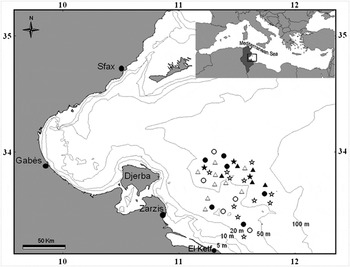
The investigation was carried out during the 2007 and 2008 fishing seasons on-board fishing boats connected to the ports of Zarzis (33°30′00″N 11°07′00″E), Djerba (33°31′50″N 10°41′20″E) and El Ketf (33°11′00″N 11°30′00″E), located in the southern part of the Gulf of Gabès (Figure 1). Data were obtained from records taken by on-board observers during 38 fishing sets from 20 randomly selected trips taking places from July to September 2007 and 2008. The fishing sets represent the average effort of the bottom longline fishery in this area, because the different trips were conducted on-board different boats from different ports.
The Gulf of Gabès: location of bottom longline sets. Stars, sets of class I (★ incidental capture, ☆ no capture); triangles, sets of class II (▴ incidental capture, △ no capture); circles, sets of class III (● incidental capture, ○ no capture).

Gear and fishing operation
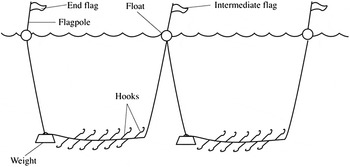
Tunisian traditional bottom longline (Figure 2) consists of a 10 to 12 km mainline anchored to the bottom, suspended by a series of monofilament polyamide branch lines separated with a distance of about 7 m, each branch line is 1 m long and 2 mm diameter terminating with a single baited J hook (Mustad model number 92671). The number of hooks ranges from 1200 to 1800 and the hook sizes are 78 mm length and 41 mm width; frozen round sardinella (Sardinella aurita) or common cuttlefish (Sepia officinalis) are the baits mainly used.
Tunisian bottom longline (Echwikhi et al., Reference Echwikhi, Jribi, Bradai and Bouain2006).

Fishing operations were monitored by an on-board observer. Target and incidentally captured specimens were identified to species level. For each set, information concerning the fishing operation (number of hooks, gear setting and hauling times), and weather (atmospheric and sea conditions) were recorded. Information on sea turtles captured included species, geographical position, curved carapace length notch to tip (CCLn-t ) (Bolten, Reference Bolten, Eckert, Bjorndal, Abreu-Grobois and Donnelly1999) and physical condition, which was classified as active (lively movements), comatose (dazed and apparently dead but eyes or cloacae responding to touch after a few hours on-board) and dead (no sign of breathing; eyes not responding to touch). Before the release of active turtles or turtles recovered from a comatose state, an attempt was made whenever possible to unhook the turtle, otherwise the branch line was cut as close to the mouth as possible and the turtle was released with a hook in the mouth or in the digestive tract.
During all trips conducted, bottom longline was deployed at any moment of the daylight and retrieval could start immediately or after some hours (the number of sets deployed ranged from 1 to 3 in one single trip). Taking in consideration the soak time, all fishing sets were classified into three classes; sets of class I: the retrieval of the gear began immediately after setting; sets of class II: sets with soak times lasting between 1 and 2 hours; sets of class III: sets with soak times taking more than 2 hours.
Statistical analysis
In order to compare catch rates within and between studies, catch rate,  , which is catch per unit of effort (CPUE), was calculated as number of specimens per 1000 hooks. To test for an effect of the fishing soak time on catch rate, we calculated
 for the three classes of sets.
To estimate total turtle catch from the total fishing effort, another catch rate,  (turtle/fishing trip), was calculated and total catch of sea turtles was estimated by applying
 to the total fishing effort H (number of trips (Source DGPA: General Directorate of Fishing and Aquaculture)).
Anaysis of variance (ANOVA) was applied to verify the effect of the soak time on the capture of turtles and groupers (the principal targets species) CPUEs.
The direct mortality p is the proportion of sea turtle found dead during all the fishing sets. To show the effect of soak time on the mortality rate of sea turtle, we calculate p for the three classes of sets. ANOVA was applied to test for an effect of soak time on the mortality rate of sea turtles. Total mortality was estimated by applying total capture to p.
The basic unit of effort of longline (the hook) can have only two possible conditions: no capture/capture (0, 1). As a consequence, the distribution is exactly binomial and can be easily derived from monitored data. Hence, 95% confidence intervals of longline standard catch rates could be calculated with the method for binomial distributions (Zar, Reference Zar1998).
RESULTS
All overview species
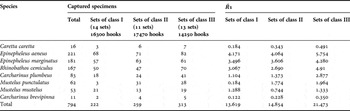
A total of 794 specimens belonging to 8 species were captured during all the fishing trips. The total numbers of individuals per species captured and corresponding CPUE values are summarized in Table 1. When considering the whole of captured specimens per 1000 hooks, difference between catch rates registered in the three classes of sets was not significant (F2,21 = 0.825, P = 0.451).
Numbers and CPUEs (number of specimen per 1000 hooks) for each species captured by different set-classes. Species are listed in decreasing captures order, except Caretta caretta.

Sea turtles
In total, 48,020 hooks were set during 20 trips (38 sets). Altogether, 16 sea turtles (all were loggerhead turtles) were caught which represent a catch rate  of 0.333 (0.190–0.541) turtles per 1000 hooks and
 of 0.8 (0.563–0.942) turtles per trip (Table 2). Turtles were captured in 14 sets (48% of the total of sets); generally we recorded one capture in one single set but in two cases, we observed a capture of two turtles in a single set. The mean fishing effort in study area during the study period H was 177.5 trip/year, giving total captures estimated to 142 (99.9325–167.205) (Table 2).
 was 0.184 (0.037–0.537), 0.343 (0.126–0.747) and 0.491 (0.197–1.011) turtle/1000 hooks for sets of classes I, II and III, respectively (Table 1). The catch rate of loggerheads was not affected by the soak time (F2,35 = 1. 39, P = 0.260).
Fishing effort, catch rates and total capture of loggerhead sea turtles estimated in the study area.

Turtles were captured throughout the entire zone of study and throughout the three months of the campaigns in the two-year study. The majority of captures occurred between 50 and 60 m, and there was no apparent distinguishing feature in terms of location between sets that did or did not catch turtles. The distribution of fishing efforts depends mainly on target species (Figure 1).
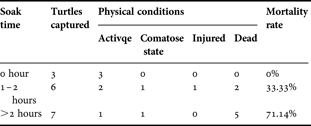
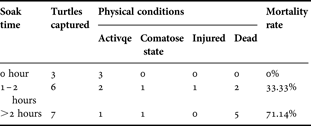
Among the captured turtles, six were in good condition (37.5%), two were in comatose state (12.5%), one specimen presented old scars and specific damages and was classified as injured externally but healthy (6.25%) and seven were dead (43.75%). Total annual direct mortality reflects uncertainty in the capture rate but not in the per-capture mortality rate. It was estimated to 62.125 (43.720–73.152).
We did not record any case of mortality when the retrieval of the gear was immediate. The mortality was estimated to 33.33% for sets of class II and 71.14% for sets of class III (Table 3). The soak time affects the mortality rate of loggerheads (F2,35= 3.447, P = 0.042).
Physical conditions of loggerhead turtles captured in different class of soak time periods.
The way by which the animals were captured differs; seven specimens were hooked in the mouth (43.75%), six were hooked in the digestive tract (37.5%), and three were entangled in the lines (18.75%) before releasing, the hooks were easily removed from 2 specimens (12.5%), but 3 active turtles (18.75%) were released with hooks inside their digestive tracts after cutting the branchline.
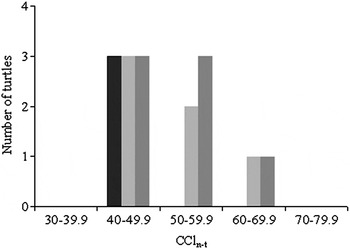
The size of captured turtles ranged between 42 and 65 cm with an average of 50.12 cm. On the basis of the size of adult females nesting in the Mediterranean (Margaritoulis et al., Reference Margaritoulis, Argano, Baran, Bentivegna, Bradai, Camiñas, Casale, De Metrio, Demetropoulos, Gerosa, Godley, Houghton, Laurent, Lazar, Bolten and Witherington2003) and according to Casale et al. (Reference Casale, Freggi, Basso and Argano2005), all captured specimens were juveniles (Figure 3).
Distribution of curved carapace length (CCLn-t) frequencies of loggerhead turtles caught in the study area by bottom longlines. Turtles captured in sets of class I (N = 3); ■, turtles captured in sets of class II (N = 6);  , turtles captured in sets of class III (N = 7)
 .

DISCUSSION
Catch rates recorded and total loggerhead captures estimated show that bottom longline represents an additional threat affecting sea turtle populations in the Gulf of Gabès an important neritic habitat, foraging zone and wintering area for loggerhead turtles in the Mediterranean Sea (Laurent et al., Reference Laurent, Casale, Bradai, Godley, Gerosa, Broderick, Schroth, Schierwater, Levy, Freggi, Abd El-Mawla, Hadoud, Gomati, Domingo, Hadjichristophorou, Kornaraky, Demirayak and Gautier1998; Margaritoulis et al., Reference Margaritoulis, Argano, Baran, Bentivegna, Bradai, Camiñas, Casale, De Metrio, Demetropoulos, Gerosa, Godley, Houghton, Laurent, Lazar, Bolten and Witherington2003; Casale et al., Reference Casale, Cattarino, Freggi, Rocco and Argano2007, Reference Casale, Freggi, Gratton, Argano and Oliverio2008b).
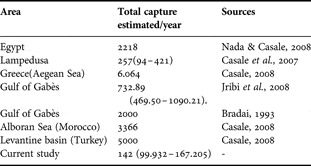
The catch rate recorded  (number of turtles caught per 1000 hooks) in this study can be considered as similar to the one registered in a previous study carried out in Zarzis (part of the study area (0.278 turtles per 1000 hooks) (Jribi et al., Reference Jribi, Echwikhi, Bradai and Bouain2008)) but is lower than that reported in the Strait of Sicily 0.873 (0.436–1.562) (Casale et al., Reference Casale, Cattarino, Freggi, Rocco and Argano2007). The extent to which bottom longlines are dangerous clearly depends on the depth at which they are placed. Bottom longline used at a depth of 200–700 m should not arouse concern (Bolten et al., Reference Bolten, Bjorndal, Martins, Balazs and Pooley1994). However, in some fishing grounds such as the study area, this method is used at a much shallower depth, causing numerous captures of loggerhead turtles; this species appears to spend almost all the time at less than 100 m depth and more than 90% of the time at less than 60 m (Polovina et al., Reference Polovina, Howell, Parker and Balazs2003). In the Mediterranean Sea, available data suggest that the annual number of captures by Mediterranean bottom longliners may well be above 35,000 (Casale, Reference Casale2008). It should be taken into account that these are capture events and not individual turtles, because the same turtle can be caught more than one time (Casale, Reference Casale2008). The most affected marine areas being the North African continental shelf (Tunisia, Libya and Egypt), the Alboran Sea (Morocco), the Levantine basin (Turkey) and the Aegean (Greece) (Table 4).
Estimate of total loggerhead turtle captures by bottom longliners in the Mediterranean.

Specimens captured in our study were juveniles, in neritic stage. Many studies showed that the wide continental shelves of the eastern Mediterranean (Tunisia and Libya; north Adriatic; Egypt; south-east Turkey) and the Gulf of Gabès specially are neritic foraging habitats for loggerhead turtle (Margaritoulis et al., Reference Margaritoulis, Argano, Baran, Bentivegna, Bradai, Camiñas, Casale, De Metrio, Demetropoulos, Gerosa, Godley, Houghton, Laurent, Lazar, Bolten and Witherington2003; Casale et al., Reference Casale, Freggi, Gratton, Argano and Oliverio2008b). Moreover, some adult turtles frequenting the Gulf of Gabès in winter leave the area during the summer period to reproduce in the north of the Mediterranean Sea (Cyprus, Greece and Turkey), thus increasing the proportion of juveniles in the study area.
Mortality of sea turtles caught is particularly problematic in this fishery component. The direct mortality induced by bottom longlines appears to be higher than that recorded by other gears such as benthic trawl (3.33%) (Jribi et al., Reference Jribi, Bradai and Bouain2007) and pelagic longline (20.68%) (Echwikhi et al., Reference Echwikhi, Jribi, Bradai and Bouain2010a) in the same area, also the delayed mortality is a cause of concern because it is widely unknown and it is suspected to be very high. The post-release mortality strongly depends on the hook's position in different parts of the digestive tract (mouth, oesophagus, stomach, intestine, etc) (Camiñas & Valeiras, Reference Camiñas and Valeiras2001). In particular, if the hook is swallowed in the lower oesophagus or in the stomach like the case of this study (three of the six active turtles captured (50%) were released with hooks inside their digestive tracts after cutting the branchline); the turtle has a very low chance of surviving. Jribi et al. (Reference Jribi, Echwikhi, Bradai and Bouain2008) stated that bottom longline has the potential to be more harmful than pelagic longlines; this opinion was supported by Casale (Reference Casale2008) who reported that bottom longlines seem to be responsible for a potential mortality (delayed) of about 40% and total mortality is estimated to 14,000 turtles per year in the Mediterranean.
This study shows that the soak time did not affect the capture of loggerhead and target species. This is also supported by Gardner et al. (Reference Gardner, Sullivan, Epperly and Morreale2008) who reported that ‘contrary to water temperature, region, and bottom depth, the soak time is not a significant predicator of the number of loggerheads captured by longlines’. The mortality rate of loggerheads was affected by the soak time. In fact, hooks are close to the bottom and the turtles captured are smaller; therefore they might not be able to reach the surface to breathe as a result of forced submergence (i.e. drowning) especially when the gear is set deep and when the soak time passes the apnoea endurance of a sea turtle. Bentivegna et al. (Reference Bentivegna, Horchscheid and Minucci2008) showed that in summer, the dive time of loggerhead turtle did not exceed 40 minutes, whereas in winter single dives of up to 120 minutes were recorded.
In conclusion, the current study demonstrates that bottom longliners pose an additional threat to the loggerhead population in the Gulf of Gabès. Compared to those registered with pelagic longline (Jribi et al., Reference Jribi, Echwikhi, Bradai and Bouain2008; Echwikhi et al., Reference Echwikhi, Jribi, Bradai and Bouain2010a) and bottom trawl (Jribi et al., Reference Jribi, Bradai and Bouain2007), the loggerhead mortality rate recorded with bottom longline in the study area seems to be the highest. Furthermore, turtle mortality seems to be correlated to the soak time: soak time exceeds two hours, the majority of captured turtles die. This parameter should be more studied and fishermen should take it into consideration in their fishing operations to mitigate sea turtle capture.
Actually, no solutions were developed to reduce bottom longline–sea turtle interactions. In this context, we recommend: (1) reducing the fishing soak time, which should be lower than 2 hours; and (2) increasing the number of sets and decreasing the soak time period.
The use of circle hook which is effective for pelagic longline (Watson et al., Reference Watson, Epperly, Shah and Foster2005; Piovano et al., Reference Piovano, Swimmer and Giacoma2009) should be tested with bottom longline. The problem is the typical small size of target species and the small size of the hooks used by this gear so that the feasibility of increasing hook size, to reduce turtle catch rate, is questionable and should be investigated. Furthermore, long term conservation of sea turtles in the Mediterranean Sea requires international cooperation among bordering countries in order to obtain a complete assessment of the scale of the threats of different gears, develop and implement possible national regulations and international agreements and monitor the implementation of measures to protect turtle populations.
ACKNOWLEDGEMENTS
This paper was made possible thanks to the invaluable efforts of many individuals: fishermen, volunteers, crews, scientists and on-board observers who have participated in this work. We thank also Professor Ahmed Rebai for his help in statistical analysis. We also thank two anonymous referees for their valuable comments on a first version of this article.