


Introduction
According to Eurostat (2023), the percentage of people aged 65+ between 2011 and 2021 increased in Poland by 5.1 p.p. (while the average for EU countries was 3 p.p.). EUROPOP2019 forecasts indicate a further acceleration of aging: in the case of people aged 65+ from 17.7% in 2019 to 25.3% in 2040 (Eurostat, 2020a), and in the case of people 80+ from 4.4% in 2019 to 9.2% in 2040 (Eurostat, 2020b). Between 2019 and 2040, the number of dependent people will grow by 20%; the expected increase will be 45% among inpatient care recipients, and 46% in home-based care (European Commission, 2021a).
In the definition proposed by the OECD, LTC is understood as a range of services provided to people dependent on assistance in performing activities of daily living (ADLs) – measured with the Katz scale (Katz et al., Reference Katz, Ford, Moskowitz, Jackson and Jaffe1963), or assistance with instrumental activities of daily living (IADL) – measured with the Lawton scale (Lawton and Brody, Reference Lawton and Brody1969), for a prolonged period of time. Issues related to physical disability and mental capacity are the most common themes in LTC (Gonzalez-Aquines et al., Reference Gonzalez-Aquines, Singh, Krol-Jankowska and Koziel2024).
ADL is a significant cost-generating predictor in LTC, not only because it increases the likelihood of using LTC services (Wu et al., Reference Wu, Hu, Huang, Fang, Chou and Li2014; Borrayo et al., Reference Borrayo, Salmon, Polivka and Dunlop2002), including residential care, but also because it generates more hours of direct care for people with more functional limitations (Boaz and Hu, Reference Boaz and Hu1997; Døhl et al., Reference Døhl, Garasen, Kalseth and Magnussen2014). Numerous studies confirm the relationship between the degree of dependency and the costs of health care or LTC (Liu et al., Reference Liu, Manton and Liu1985; Liu et al., Reference Liu, Wall and Wissoker1997; Fried et al, Reference Fried, Bradley, Williams and Tinetti2001a; Chan et al., Reference Chan, Beaver, Maclehose, Jha, Maciejewski and Doctor2002; Guralnik et al., Reference Guralnik, Alecxih, Branch and Wiener2002; Lindholm et al., Reference Lindholm, Gustavsson, Jönsson and Wimo2013; Mitra et al., Reference Mitra, Palmer, Kim, Mont and Groce2017; van Lier et al., Reference van Lier, van der Roest, Oosten, Garms-Homolová, Onder, Finne-Soveri, Jónsson, Ljunggren, Henrard, Topinkova, Sørbye, Bernabei, van Hout and Bosmans2019). Most studies show that the loss of dependency is gradual and occurs in a specific sequence with some exceptions. Katz theorized that the activities that we learn first in life disappear last, and vice versa (Katz and Akpom, Reference Katz and Akpom1976). The literature indicates that early cognitive impairment affects the difficulties of IADL (Boyle et al., Reference Boyle, Malloy, Salloway, Cahn-Weiner, Cohen and Cumming2003; Farias et al., Reference Farias, Park, Harvey, Simon, Reed, Carmichael and Mungas2013) but does not affect the ability to perform ADL (Jefferson et al., Reference Jefferson, Cahn-Weiner, Boyle, Paul, Moser, Gordon and Cohen2006). Although the results of studies indicate a difference in the sequence of loss of middle and last ADLs, it is indisputable that in most studies bathing independently remains the first ADL to be lost (Jagger et al., Reference Jagger, Arthur, Spiers and Clarke2001; Yeung et al., Reference Yeung, Jones, Jhangri, Gibson, Hunter and Wagg2019; Han et al., Reference Han, Xue and Pei2021). However, there is no full agreement as to the last lost ADL. According to the order proposed in the ADL scale, this activity will be eating (Katz et al., Reference Katz, Ford, Moskowitz, Jackson and Jaffe1963; Yeung et al., Reference Yeung, Jones, Jhangri, Gibson, Hunter and Wagg2019). It is worth emphasizing that difficulties in IADL, especially problems with taking medications (Lieto and Schmidt, Reference Lieto and Schmidt2005), or with shopping, walking outside, doing laundry or performing heavy housework (Finlayson et al., Reference Finlayson, Mallinson and Barbosa2005) also increase the likelihood of using LTC, although they are more often associated with the transition to assisted living/home care rather than to nursing homes (Mitzner et al., Reference Mitzner, Chen, Kemp and Rogers2011).
The variation in the definition of LTC in EU countries implies that the organisation and funding arrangements of LTC also differ, but we can identify some common themes (European Commission Reference Spasova, Baeten, Coster, Ghailani, Peña-Casas and Vanhercke2018; Gonzalez-Aquines et al., Reference Gonzalez-Aquines, Singh, Krol-Jankowska and Koziel2024). LTC includes cash and in-kind benefits and is provided by three sectors: the health care, social assistance and private sector. Two levels can be distinguished: formal care provided at home or in inpatient facilities and informal care (most often provided by family members) (Costa-Font and Patxot, Reference Costa-Font and Patxot2005; Jurek, Reference Jurek2007; Błędowski and Maciejasz, Reference Błędowski and Maciejasz2013). Regarding inpatient facilities in Poland, similar to most other European countries we can distinguish between several types of inpatient facilities, e.g. health-related care provided in nursing homes (called ZOLs in our study), social-related care provided at social residential homes (called DPSs in our study), and private care provided at private rest homes. Because the responsibility for the LTC is distributed between the national, regional or local level (European Commission, Reference Spasova, Baeten, Coster, Ghailani, Peña-Casas and Vanhercke2018), the costs of staying in individual facilities in Poland vary strongly regionally.
The functioning of and criteria for access to residential care facilities in Poland are regulated by relevant legal acts. DPSs and private rest homes are intended for persons who are dependent and require 24-hour care due to their age, health condition or disability, while in the case of ZOLs, these persons additionally require medical care. These facilities differ in the way they are paid for. While the stay in private facilities is fully covered by out-of-pocket funds, in the case of DPS and ZOL, residents pay no more than 70% of their income. In the case of people with low income, the payment for the stay is covered by the family and then by the municipality. Basically, the privately financed part covers the cost of accommodation and meals, while the cost of care in ZOL is financed by the National Health Fund. Hence, to become a ZOL patient it is not enough to have a Barthel-scale assessment of independence, but health insurance is also necessary. For access to publicly funded LTC facilities, it is necessary to provide documents confirming the residents’ health and financial situation (Ustawa o pomocy społecznej, 2004; Ustawa o świadczeniach opieki zdrowotnej, 2004).
In Poland, LTC is poorly developed. Spending on LTC, which in 2019 accounted for 0.8% of GDP, is one of the lowest among the EU-27 countries. Although in the years 2014–2018 the number of employees in the LTC sector increased by 21%, the employment rate in Poland is still very low, with 0.5 LTC employee per 100 elderly people in 2016 (for comparison, the average for the EU-27 countries was almost 8 times higher). Similarly, the average number of beds in long-term residential care is 4 times lower than the OECD average. As of the end of 2020, there were approximately 34.8 thousand places in ZOLs, 81 thousand places in DPS and 25.5 thousand places in private nursing homes (Statistics Poland, 2020; MRPiPS-05 Report, 2020). There is also unequal access to residential care, which is better developed in cities than in rural areas (European Commission, Reference Spasova, Baeten, Coster, Ghailani, Peña-Casas and Vanhercke2018; Błędowski, Reference Błędowski, Błędowski, Grodzicki, Mossakowska and Zdrojewski2021). Formal care is not well developed and informal care provided by families dominates in Poland (Golinowska, Reference Golinowska2010). Although benefits supporting informal carers were introduced in 2019, to be eligible they are required to give up work, which makes it difficult to combine care with work (European Commission, 2021b). Estimations from 2019 show that inpatient and home-based care in Poland covered 2.7% and 3.4% of the 65+ population, respectively. Given the data on the estimated number of dependent people (24.3% of people 65+, experienced moderate, and 35% serious difficulties in ADL and IADL) (European Commission, 2021b), this means that a significant part of the population of dependent people does not receive help at all, or is supported by informal caregivers.
In some European countries, there are clear trends towards the deinstitutionalisation of LTC and the prioritisation of home or community-based care that promotes ageing in place. Despite the many advantages of this trend, such as the high quality of care and respect for the dignity or freedom of people who need support, experts point to the possible risks of not being able to care for dependents when community care is relatively poorly developed (European Commission, Reference Spasova, Baeten, Coster, Ghailani, Peña-Casas and Vanhercke2018; Jurek, Reference Jurek and Błędowki2021). Although deinstitutionalisation may apparently be associated with a reduction in public spending on LTC, in reality the opposite is often the case (Jurek, Reference Jurek and Błędowki2021). Economies of scale in LTC facilities result in lower overall costs for such care compared to individualised care provided at home (Knapp et al., Reference Knapp, Beecham, McDaid, Matosevic and Smith2011), particularly for people with high levels of dependency. For those with low levels of dependency, deinstitutionalisation can be cost-effective as a lower range of care needs generates lower costs when care services are provided at home (Jurek, Reference Jurek and Błędowki2021).
Therefore, looking for possible ways to reduce LTC costs, or better allocate those requiring LTC support to particular types of care seems fully justified. As a result, places for people with greater need of inpatient care can be unlocked i.e. more people could be helped for the same cost or, alternatively, costs could be cut supporting the same number of people. Poland’s experience can be also applicable to other less developed countries where LTC services are not well developed. The aim of the article is to examine the efficiency of LTC Sector based on the assessment of the ADL functional status among residents of public and private LTC facilities in Poland. In this study, we will verify the following research hypotheses:
-
(1) Better allocation of people with a low level of dependency and without cognitive impairment results in lower public spending on LTC and increased access for people with a higher level of dependency.
-
(2) Among the users of long-term residential care, ADL loss occurs in the order proposed by Katz (from bathing to eating).
Data and method
We collected the data on individual LTC residents between July 2021 and March 2022 using the CAWI, CATI and CAPI methods. Our questionnaire, designed for self-completion by staff about all their residents, was sent to full-time inpatient LTC facilities: social residential homes (DPSs), nursing homes (ZOLs) and private rest homes. In our study, we deliberately excluded psychiatric facilities (except for private facilities where such an exclusion was not possible) and hospices because we focused on the analysis of dependency based on the ADL. We selected randomly facilities of each type in each of the 16 voivodeships (which are the main administrative unit in Poland), taking into account their profile and size of the place of location, based on public registers of LTC inpatient facilities. For DPSs and ZOLs we used the CAWI method, but in the case of the private sector most questionnaires were completed using the CATI method, and sometimes with using CAPI method. The data came from thirty seven private facilities, twenty nine social residential homes, nineteen nursing homes. Overall, our nationwide and unique database about LTC residents (with information regarding their socio-demographic characteristics; family relationships; level of disability or health status and payment) included 3875 observations (DPSs: N=2258; ZOLs: N=872; Private rest homes: N=745).
In order to estimate possible savings in DPSs and ZOLs, we first conducted an analysis of the prevalence and combination of the indicators of needs we selected: ADL and cognitive impairment (Alzheimer’s disease or dementia) and mental disorders among LTC residents (Seitz et al., Reference Seitz, Purandare and Conn2010; Wu et al., Reference Wu, Hu, Huang, Fang, Chou and Li2014; Kehyayan et al., Reference Kehyayan, Chen and Hirdes2021; Brown and Mutambudzi, Reference Brown and Mutambudzi2022). Based on the frequency of prevalence of a given ADL for a given number of ADLs, we checked the sequence of prevalence of functional limitations among inpatient LTC residents.
For the analysis of possible savings in inpatient LTC, we selected the following groups of people with a relatively low level of functional dependency: 0-ADL, 1-ADL (bathing), 2-ADL (bathing, dressing). The choice of only these groups was dictated by the possibility of offering them an alternative, perhaps less expensive form of care. In addition, some research indicates that longer stays in residential institutions are required for people with inability to perform more than 2 ADLs (Abrahamson et al., Reference Abrahamson, Hass and Arling2020). Bathing difficulty rates are also believed to be artificially inflated by the facilities, which is caused by the standards of care rather than a real need (Williams et al., Reference Williams, Fries, Foley, Schneider and Gavazzi1994). In the case of limitations in dressing, we made assumption that this activity can be performed more often independently, which means that such people could also be provided with care other than inpatient. This assumption is supported by research that shows that the use of appropriate strategies brings positive results in improving independence in dressing, even for people with cognitive impairments (Beck et al., Reference Beck, Heacock, Mercer, Walton and Shook1991, Reference Beck, Heacock, Mercer, Walls, Rapp and Vogelpohl1997). Also, better results in explaining the variance in direct care costs are obtained using only late ADLs, while serious dressing constraints tend to occur in the company of late ADLs limitations (Williams et al., Reference Williams, Fries, Foley, Schneider and Gavazzi1994).
The first objective was to identify possible reasons for institutionalization of these residents, so we conducted an analysis of their socio-demographic and health characteristics. Secondly, to simplify our estimates, we calculated the actual public costs for the selected groups with 0–2ADL limitations in each facility as follows: as the difference between the average monthly cost of living in the facility and the average amount of private funds in the total sample. As the costs of accommodation and meals (so-called hotel costs) are mainly covered by private funds, we have excluded them from the calculation to avoid overestimating the savings. Our decision to use averaged costs from the whole sample, rather than for the 0–2ADL groups, was motivated by the fact that the amount of monthly charges in the facilities was the same for all residents of a given institution (it did not vary according to the degree of dependency). In addition, the prices of stay differed strongly regionally and locally, within a given voivodship. Using a larger number of observations allowed us to obtain more robust and less biased results. To estimate possible savings in the public sector, alternative public costs for the selected 0–2ADL groups were calculated by using care vouchers similar to those used in Germany under LTCI (European Commission, 2017). The value of vouchers was recalculated against PPP for 2021 for private consumption. In this analysis, we assumed that people who are currently in a private facility do not use vouchers. This constraint was based on the fact that publicly subsidised facilities often have income criteria. Hence, if someone could afford to pay for a stay in a private facility, they would similarly not be eligible for vouchers.
Three types of vouchers in the form of benefits were considered: monthly vouchers for home care or inpatient care and a voucher for adapting the apartment to the needs of a dependent person (e.g. bathroom renovation), which can only be granted once. Since we assumed that housing conditions could have influenced the placement of 0–2ADL persons in an inpatient LTC, we arbitrarily assumed that this voucher could be awarded to each of these persons, if they opted for home care.
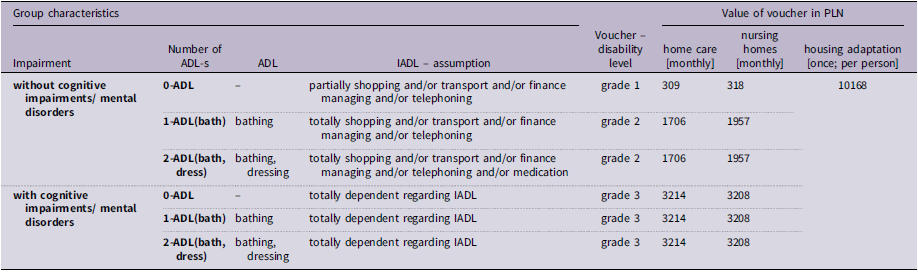
To assign each group of individuals the appropriate value of LTC service vouchers (Table A1, Appendix) we had to assume that these individuals had some difficulties with IADL according to the loss sequence presented by Edjolo et al. (Reference Edjolo, Proust-Lima, Delva, Dartigues and Pérès2016), and take a pessimistic assumption that these are severe impairments. Accordingly, we assumed that in the case of people without cognitive impairment, the maximum IADL limits would be the following:
-
(1) 0-ADL – partially limited in shopping and/or transportation and/or managing finances and/or making phone calls;
-
(2) 1-ADL (bathing) – fully limited in transport and/or shopping; and/or financial management and/or making telephone calls;
-
(3) 2-ADL (bathing, dressing) – fully limited in transport and/or shopping; and/or managing finances and/or making phone calls and/or taking medication.
In the group of people with cognitive impairment, we assumed full dependency in performing IADL activities, regardless of the number of ADL limitations.
The levels of dependency used in the valuation of vouchers in Germany were not corresponding to the data we had, so we had to match them subjectively. In addition, because we did not know how advanced were the cognitive or mental disorders among LTC residents from 0 to 2ADL groups, we also assumed a pessimistic scenario that these disorders cause serious functional limitations (equal to grade three in the German voucher system), even when there are no physical limitations (0-ADL). Thus the value of vouchers derived from our simulations might be even higher than it should be. Also, it has to be noted that the value of the vouchers depends on level of disability and type of care. As a result, the value of a voucher for home care when the level of dependency is advanced is higher than value of voucher for inpatient care for the same level of dependency.
We have used 3 scenarios to calculate alternative public costs:
-
(1) Scenario I – assumes a strong preference for home care, therefore, each group with 0–2 ADLs will choose the monthly home care vouchers and the home modernization voucher;
-
(2) Scenario II – assumes a strong preference for residential care and that the level of budget constraints of families and residents is equal to the current amount of private funds which covered the stay in a public facility (DPS or ZOL). Thus, inpatient care (in private facilities) may be chosen only by those groups of people for whom the sum of the mean monthly private funds and the monthly amount of the voucher is equal to or higher than the mean of monthly payment for staying in a private facility (>=3467.72PLN). Others will choose the monthly home care vouchers and the home modernization voucher.
-
(3) Scenario III – assumes a very strong preference for residential care, therefore only people with 0-ADL without cognitive impairments or mental disorders will choose the monthly home care vouchers and the home modernization voucher (because the value of the voucher for residential care is too low and the contribution of private funds would have to be more than twice as high to cover the costs of residential care in the private sector); the remaining groups will choose the monthly vouchers for inpatient (private) care.
The adopted form of vouchers, provides an important control role because they are dedicated to a strictly defined purpose, and because we assume that they can only be used in officially registered facilities and those that meet certain standards of care (or by persons performing the functions of a formal caregiver, although there is a certain field of abuse). Certainly, the form of a voucher could also help to increase the involvement of neighbours or relatives in helping with IADL.
In our scenarios, we omitted the issue of inflation and the valorization of the level of the monthly payment for staying in an inpatient LTC. This simplification was to some extent dictated by the fact that we did not assume annual indexation of care vouchers. Thus, in several years’ perspective, the actual costs could be higher than assumed (in the projections we assumed fixed costs from 2021), and vouchers would be sufficient for a slightly narrower range of care services.
In the cost simulations, we used not only an 1-year perspective, but also a 5-year horizon for several reasons. As the probability of surviving one more year rises with age, we observe an increase in life expectancy among older people. Hence, for Polish people who had already reached the age of 75 in 2021 (the mean age of residents of LTC facilities in our total sample oscillated around or even exceeded this value in particular types of facilities), life expectancy was 8.8 years for men and 11.3 years for women (Statistics Poland, 2022). Unfortunately, we did not have data on length of stay. However, if the difference between the mean age at admission and the mean age at the time of the survey is taken as a proxy for the length of stay in the facilities, the average length of stay in DPS for the whole sample was 5.11 years.
Results
ADL among LTC residents
In almost all types of facilities, people with five or six ADL limitations are the largest group (Fig. 1). The combination of 6-ADL and 5-ADL (without eating) is the most common combination both in private institutions and in ZOLs (25.5% and 26% in private institutions, respectively, and 41.9% and 17.6% in ZOL). In the case of DPSs, the percentage of 6-ADL and 5-ADL (without eating) was 15.4% and 16.8% and was much lower than in the case of ZOLs or private facilities. Figure 1 shows that another very large group consists of people with no functional limitations or with only one limitation. This is especially noticeable in case of DPSs where group 0-ADL accounts for 19 % and 1-ADL for 20% of all DPS residents – over two times more than in private facilities and over three times more than in ZOLs. According to the adopted theoretical assumptions, we should expect that a group of 2–4 ADL people will dominate in DPSs, but in fact, although the percentages are higher there than in private rest homes or ZOLs, they account for approx. 26% of all DPS residents.
Residents by number of ADL and type of LTC facilities [%] [sample, weighted data].
Source: Own calculations using data collected in 2021/2022 database of residents of LTC facilities.

In the case of private facilities and ZOLs, in groups of people without any functional limitations or having only 1-ADL, people without cognitive impairment or mental disorders are the majority. The exception is observed for DPSs where people with disorders dominate among DPS residents with 0-ADL or 1-ADL (mainly due to the large number of people with mental disorders rather than cognitive impairment). But still, in DPSs people without cognitive impairments or mental disorders are the largest group among all types of facilities (7.6% for 0-ADL and 8.7% for 1-ADL).
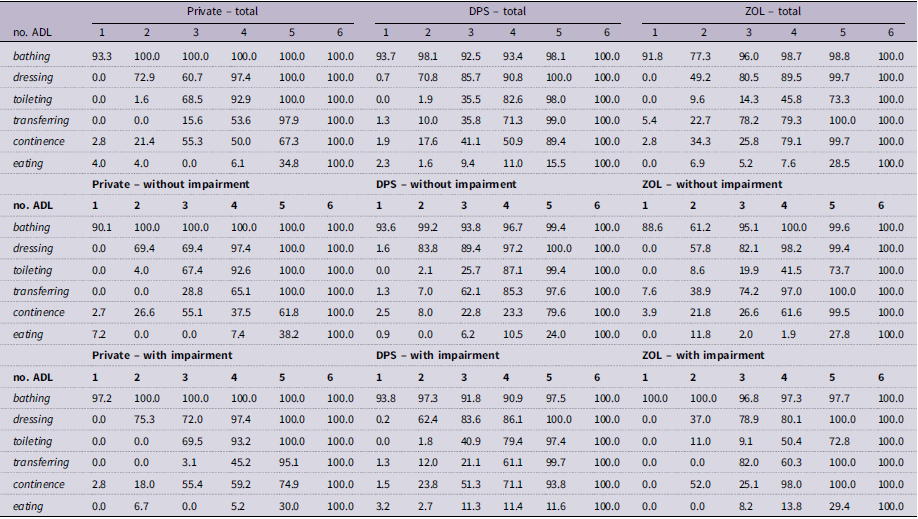
Since we had no longitudinal data, and therefore no way to track the development of dependency trajectories over time among LTC residents, we calculated the frequency of specific ADLs for the sum of the individual ADLs (Fig. 2; Table A2 in Appendix). On this basis, we obtained a proxy for the sequence of occurrence of subsequent difficulties in ADL among residents of LTC facilities in Poland, which showed that difficulties in: bathing, dressing, transferring, toileting, continence, eating appear sequentially. This sequence coincided with most previous studies (Katz and Akpom, Reference Katz and Akpom1976; Jagger et al., Reference Jagger, Arthur, Spiers and Clarke2001; Yeung et al., Reference Yeung, Jones, Jhangri, Gibson, Hunter and Wagg2019), especially in the first and last ADL. Most of the illogical combinations either did not occur at all or the percentage of cases was very low. Combinations where late ADLs occur before early ADLs (bathing and dressing) occur much less often than combinations where early ADLs occur before late ADLs. However, unlike British studies (Jagger et al., Reference Jagger, Arthur, Spiers and Clarke2001), we did not come to the same conclusion that lower limb strength (bathing, transferring, toileting) decreases before upper limb strength (dressing, eating), because dressing was the second ADL in our sample.
Distribution of ADLs by number of ADLs and selected type of LTC facilities [sample, weighted data].
Source: Own elaborations using data collected in 2021/2022 database of residents of LTC facilities.

In general, the results of the ADL loss sequence remained similar in all 3 types of LTC institutions, with slight differences in the 3-ADL and 4-ADL groups. The most homogeneous result (92–94%) was for bathing, the first ADL indicated in all facilities. Slightly greater discrepancies were observed in the 2-ADL group. Here, the most common indications were ADL-bathing and ADL-dressing, with ADL-dressing in private facilities and DPS occurring in 73–71% of patients with 2-ADL, respectively, and in the case of ZOLs, although still the most common ADL after bathing, it was much less frequent – 49%. This was dictated by the fact that in the 2-ADL group in ZOLs, limitations related to continence and transferring appeared much more often (which indicated greater dependency).
Low level of dependency in ADL – residents’ characteristics
Table 1 presents the characteristics of residents 0-ADL, 1-ADL (bathing) and 2-ADL (bathing, dressing). A significant health reason why these people stay in LTC facilities are mental disorders and Alzheimer’s disease or dementia (on average, they occurred in slightly more than 50% of residents of all facilities). The high share of people with mental illnesses is particularly visible in DPSs, although we intentionally omitted this type of facility when selecting facilities for the sample. Other diseases, particularly visible among the residents of DPSs, include hypertension and heart disease, which may indicate the need for regular medication (and thus the problem with medication management in the face of limited cognitive functions could have influenced the decision to transfer to an inpatient facility). Regardless of the facility, the 0-ADL groups are dominated by men (almost 60%), and their share is decreasing with increasing the number of limitations in ADL. The strongest female dominance is visible in the 1-ADL (bathing) group – 80% – in ZOLs. Level of education (as a proxy of income) is higher in private institutions. In ZOLs people with primary education dominate, and in DPSs there is a comparable number of people with primary and secondary education. Most of these people do not have a living partner, and the percentage of people with living children is highest in private institutions than other facilities. Thus, people in DPSs are at higher risk of being lonely, as indicated by not having children or living partner and low frequency of family member visits in their case.
Characteristics of 0-ADL, 1-ADL(bathing), 2-ADL(bathing, dressing) residents [sample, weighted data]

Note: mean monthly cost is not always a sum of private and public payment because of missing data regarding private payment for almost 10% of all the observations from total sample. The public burden for 0–2ADL individuals was calculated for observations where we had complete data.
The average monthly total payments across the total sample were: 3468 PLN (Private); 4407 PLN (DPS); 4342 (ZOL). The average monthly private payments across the total sample were: 3438 PLN (Private); 1350 PLN (DPS); 1360 (ZOL).
Source: Own calculations using data collected in 2021/2022 database of residents of LTC facilities.
Taking into account the size of the place of origin, people from large cities and villages are generally most numerous, which may be driven by the fact that in the countryside, due to difficult housing conditions (e.g. the need to heat the house, lack of access to infrastructure), these people (or their families) decide for transition to the facility. In the case of large cities, this can be explained by greater availability of facilities, as well as less intimate relations (European Commission, Reference Spasova, Baeten, Coster, Ghailani, Peña-Casas and Vanhercke2018; Błędowski, Reference Błędowski, Błędowski, Grodzicki, Mossakowska and Zdrojewski2021).
In all the considered 0–2ADL groups, the age at the time of admission was the lowest among DPS residents, which is particularly visible in the case of the 0-ADL group, admitted on average at the age of 64 (i.e. on average thirteen years younger than in the case of private facilities and eleven years less than in the case of ZOLs). It turned out that the fact of mental illness and/or Alzheimer’s disease and/or dementia might impact the age of admission to the facility, which is five years lower as compared to people who do not have such disorders in the case of the 0-ADL group, and two years lower in case of 1-ADL(bathing) and 2-ADL(bathing, dressing). Still, this means that people with a low degree of disability due to ADL, without cognitive impairments or mental disorders, spend long years in DPSs. Therefore, the possibility of offering alternative forms of care or activities supporting independence should be considered especially for them. This is justified because in the case of these people, the average monthly burden on public funds in DPSs is comparable or only slightly lower than the corresponding costs in ZOLs (which, by definition, offer a wider range of medical care).
Projection of public savings
The number of people in the 0–2 ADL group is a significant burden on public finances, especially when it comes to the DPSs (Fig. 3). The annual public costs generated by these groups of people in the analyzed types of DPSs are four times higher than in the case of ZOLs (574.7 million PLN vs. 145.2 million PLN). Annually, 0-ADL persons generated public costs of 238.3 million PLN in DPSs, persons 1-ADL (bathing) – 236.7 million PLN, and persons 2-ADL (bathing, dressing) – 99.8 million PLN. For comparison, in ZOLs the cost was only: for 0-ADL – 106.4 million PLN, for 1-ADL (bathing) – 29.1 million PLN and for 2-ADL (bathing, dressing) – 9.7 million PLN. Therefore, it seems that from the perspective of seeking savings or ensuring greater access to LTC, the social assistance sector should be particularly taken into account.
Public costs in 1-year and 5-year perspective [in million PLN; constant prices from 2021] for LTC residents by 0-ADL, 1-ADL (bathing), 2-ADL (bathing, dressing) and selected type of facility – estimation for Poland.
Source: Own calculations using data collected in 2021/2022 database of residents of LTC facilities.

Figure 3 presents projections of public spendings on LTC according to three proposed scenarios. In one year horizon, only in the case of ZOLs, all three scenarios generate public savings (the largest decrease – 26.9% – is observed for scenario III and the smallest for scenario I – 11%). In the case of DPSs, scenario I can be expected to generate 4.5% higher public costs than in case when no changes are made. Public savings are achievable for scenario II and scenario III (decrease in public costs by 11.9% and 16.6%, respectively). This is due to the fact that in one–year horizon, the vouchers for apartment modernization significantly increase public costs, which is no longer noticeable when public costs are calculated over a longer period, e.g. five years.
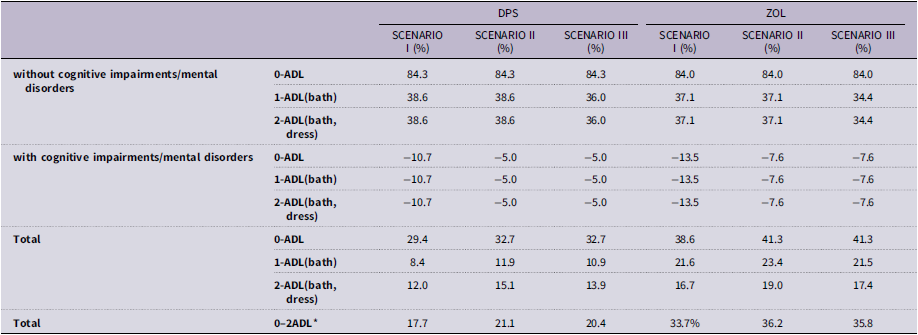
In the longer horizon, all three scenarios indicate a lower level of public expenditure in relation to the current costs, with Scenario II being the most favorable in terms of public savings (the highest reduction of public costs by 21.1% for DPSs and 36.2% for ZOLs). However, the assumptions adopted for the construction of the scenarios make it possible to assess which groups generate savings and which generate losses in relation to the current LTC costs (Table 2).
Public savings as a difference between 5-year actual costs and 5-year alternative costs [as a % of 5-year actual costs] by level of need and impairment

* 0-ADL, 1-ADL(bath), 2-ADL(bath,dress).
Source: Own calculations using data collected in 2021/2022 database of residents of LTC facilities and based on (European Commission, 2017).
In the group without cognitive impairments or mental disorders we observe that public costs decreased in both DPSs and ZOLs and in all three scenarios, regardless the number of ADLs. However, the highest public savings are noticed for 0-ADL (84.3% in DPSs and 84% in ZOLs). For the other two groups 1-ADL (bathing) and 2-ADL (bathing, dressing), public savings range between 34.4% and 38.6% for both types of facilities. Losses, understood as higher public costs of the alternative care proposed in the scenarios, are generated only in the group of people with cognitive impairments or mental disorders regardless of the number of ADLs difficulties, in all three scenarios and for both types of facilities (lower losses are observed in Scenarios II and III, which results directly from the fact that the assumed value of vouchers is slightly lower for residential care than home care assumed in Scenario I).
The analysis carried out shows that the greatest savings after the introduction of vouchers will be generated by people without cognitive impairments or mental disorders and without ADL limitations (i.e. staying in inpatient LTC facilities mainly due to loneliness and/or lack of appropriate housing or financial conditions to provide other types of care), which results directly from the lowest value of vouchers in this group of people. Since the 0-ADL group is very numerous in DPSs, public savings should be observed especially in the social welfare sector. The assumptions regarding the value of vouchers for people with cognitive impairments or mental disorders cause these groups to generate losses (an even higher public burden than in the case of currently incurred public costs), and yet they are offset by savings generated by people without disabilities. This means that if the assumptions as to the efficiency of these people were less pessimistic than in our projections, the potential public savings could be much higher.
Limitations
We limited our simulations to costs at the in-patient care level. We have not considered the impact of the introduction of vouchers on changes in the cost of home care or cash benefits. Similarly, we do not take into account the potential changes in the labour market that could be induced by the implementation of such a care solution, or the administrative costs of handling vouchers. Hence, our study should be seen as a demonstration of potential inefficiencies in the LTC sector based on a reasonable assumption of optimal allocation of care resources relative to the level of dependency (Jurek, Reference Jurek2007), rather than a comprehensive cost analysis. As mentioned earlier, deinstitutionalisation is not intended to reduce public costs, nor is it intended to lead to the deprivation or reduction of care where it is needed. We draw attention to the necessity to look at the real reasons for the use of residential forms of care for people with low levels of dependency and the possibility to support these people in their place of living, as long as this is in line with their preferences.
In our study, as we only relied on information about ADL disability reported by staff, there is a risk that some ADLs were overestimated due to accepted standards of care, e.g. bathing. Of course, this also has its advantages – if the data came from the residents themselves, due to the frequent cognitive impairment in their case, we might get less consistent results; or if they are more physically fit, higher savings can be expected.
Due to the method of data collection, we were unable to determine the degree of ADL loss (we only asked whether such a limitation exists). In addition, we did not measure IADL, assuming that people in LTC facilities will in most cases be highly dependent in this respect. Meanwhile, some studies suggest that IADL in the case of residents of inpatient facilities may affect the amount of care received (Døhl et al., Reference Døhl, Garasen, Kalseth and Magnussen2014). The omission of IADL is important because in the case of offering alternatives to residential forms of care to people 0–2 ADL, especially in the community or home care, the limitations of IADL omitted in the analysis will affect the costs of such alternative care (especially in the case of people living alone). However, the IADL levels we adopted may not be true at all, due to the fact that populations may differ in their patterns of dependency and we considered only pessimistic assumption.
Since we did not measure the time spent directly on care, we were unable to estimate how much time it takes to care depending on the level of dependency. The amount of the monthly payment was the same for all residents in particular social residential homes and private facilities, while the costs in nursing homes were somewhat volatile. This means that people who require less care, pay the same amount as people who are more dependent. As a result, if people with disabilities are admitted to a given facility, there is a risk that the overall quality of care (number of hours of direct care) will decrease, because the fee is fixed throughout the year and the same for everyone. In fact, the monthly costs in LTC facilities could be even higher when the composition of residents changes in favor of less independent persons. This limitation is important because the literature suggests that nursing homes can compensate for a greater number of cases of people who require more intensive care by lowering the average hours of care (Døhl et al., Reference Døhl, Garasen, Kalseth and Magnussen2014). As a result, even if access to residential care improves, the quality of care may deteriorate.
Additional limitation of the analysis is that having cross-section data not panel data we cannot assess if the level of needs and impairment have been changing in the populations of each type of home across time. Also, during the survey we had to use three data collection methods – CAWI, CATI and CAPI. Although we believe that the use of these methods should not affect the comparability of data for the different types of facilities, it should be noted that the use of different methods may have affected the quality of the data obtained. In the case of DPSs and ZOLs, the questionnaires were most often completed by social workers or nurses selected by the managers of the facilities. In the case of private facilities, they rarely had such persons available, hence they were less likely to complete the questionnaire themselves. If we had not used additional data collection methods in the case of private facilities – the response rate from these facilities would have been lower.
Although we tried to ensure a sufficiently large number of observations included in the survey, our sample is not representative, as we selected for the draw (where possible) only facilities of a specific type (for the older people, somatically or physically ill). In addition, in order to include data from all voivodeships (in the case of ZOLs, this was not possible for 2 voivodeships out of 16), we drew from facilities with a similar profile of services and size of location. As the facilities varied in terms of the number of places (as a rule, DPSs offered several times more places than private facilities), we had to increase the number of observations used in the cost calculations to the whole sample in order to ensure differentiation of cost variables.
Discussion and conclusion
In view of the large percentage of people with low level of dependency (0–2 ADL difficulties) in LTC inpatient facilities, it is suggested that new alternative care solutions are sought for this group. Vouchers for the organization of home or inpatient care on the market and activities aimed at developing community care, including coordinated care, may be a solution. However, taking into account the fact that mental illnesses are common among people with a low degree of dependency who stay in institutions, it is important to extend the care offered specifically to these people. In the case of common problems such as Alzheimer’s disease or dementia, measures should be taken to promote delaying the onset of cognitive impairment in the early years of life. This is particularly important because in Poland, cognitive impairments occur on average in one in six people aged 60 years and over (Klich-Rączka et al., Reference Klich-Rączka, Piotrowicz, Kujawska-Danecka, Zagożdżon, Mossakowska, Błędowski, Grodzicki, Mossakowska and Zdrojewski2021). In addition, a high rate of underdiagnosis of dementia among older people is indicated (Wojszel, Reference Wojszel2020). As the risk of dementia in Poland is high and increases with age, the dynamic population ageing causes an increase in the number of people with neurodegenerative diseases (Karczewska and Bień, Reference Karczewska and Bień2019). According to statistics, the share of the population with dementia will increase from 1.38% in 2018 to 3.23% in 2050 (Alzheimer Europe, 2019), and Poland will be among the top EU countries with the largest absolute increase in dementia prevalence.
Some findings show positive effects of relatively cheap restorative home services among those who required LTC support aimed at improving their independent functioning (e.g. in terms of bathing) and in consequence leading to savings (Lewin et al., Reference Lewin, Allan, Patterson, Knuiman, Boldy and Hendrie2014; Zingmark et al., Reference Zingmark, Nilsson, Norström, Sahlén and Lindholm2016; Szanton et al., Reference Szanton, Leff, Li, Breysse, Spoelstra, Kell, Purvis, Xue, Wilson and Gitlin2021). It is important, especially that actions aimed at stopping progressive dependency no longer bring clear results among people who are in facilities but they can be effective in delaying dependency when it has not yet occurred or is at a very early stage (Laffon et al., Reference Laffon de Mazières, Morley, Levy, Agenes, Barbagallo, Cesari, De Souto Barreto, Donini, Fitten, Franco, Izquierdo, Kane, Martin, Onder, Ouslander, Pitkälä, Saliba, Sinclair, Manas, Vellas and Rolland2017). Some literature suggests that Frailty Scale (Fried et al., Reference Fried, Tangen, Walston, Newman, Hirsch, Gottdiener, Seeman, Tracy, Kop, Burke and McBurnie2001b) can be a tool for early detection of dependency (frailty is diagnosed when observing the presence of at least three symptoms from: uncontrolled weight loss, exhaustion, muscle weakness, decreased walking speed, or decreased physical activity), because it has been shown that there is a relationship between frailty and an increased risk of falls, disability or mortality (Fried et al., Reference Fried, Tangen, Walston, Newman, Hirsch, Gottdiener, Seeman, Tracy, Kop, Burke and McBurnie2001b). Among nonfrail individuals, the probability of deepening disability is lower (Hardy et al., Reference Hardy, Dubin, Holford and Gill2005).
Hence, it seems that costs in both health care and LTC should not be forecasted on the basis of a one-off assessment of functional disability, but rather follow the trajectories of disability development in order to be able to capture stable cases of disability as well as its aggravation over time (Liu et al., Reference Liu, Wall and Wissoker1997). It is indicated that despite the decline in overall disability rates in the population, there may be no decrease in spending because the costs of care provided to older people with the least degree of disability may increase faster than for the most severely disabled, as it was the case among Americans using Medicare (Chernew et al., Reference Chernew, Goldman, Pan and Shang2005). In this context, in-depth description of the characteristics of people with lower degrees of dependency seems important, due to the fact that factors such as loneliness can lead to institutionalization because there are no longer social networks which could support informal care at home (Boaz and Hu, Reference Boaz and Hu1997). Another issue is that the quality of life of dependent people should not only come down to satisfying care needs but also address the socialization needs. Research conducted in Denmark (Amilon et al., Reference Amilon, Ladenburg, Siren and Østergaard2020) showed that people would be willing to pay more for care if it involves social contacts with the carer. Therefore, it is necessary to know the care preferences of elderly individuals in accordance with their financial capabilities, so that the type of care can remain a free choice of the dependent person (Jurek, Reference Jurek2007) and their family. There is probably also the problem of moral hazard, where people are placed in nursing homes not because they need it, but because it is financially a better solution (Jurek, Reference Jurek, Kowaleski and Szukalski2008; Kubicki et al., Reference Kubicki, Jurek, Łuczak and Błędowski2020).
The introduction of vouchers can help to develop free market services, through privatisation and decentralisation, which on the one hand can improve the quality of care and increase its efficiency, but can also lead to abuse. Growing groups of private actors can strongly influence the regulation of the care market, e.g. by forcing public authorities to lower their requirements for care standards or even by offering only those groups of services that are less cost-intensive, leaving the more labour-intensive services to public actors (Kubicki et al., Reference Kubicki, Jurek, Łuczak and Błędowski2020).
The use of care vouchers proposed in our study requires an analysis of the housing conditions of older people, including the possibility of adapting the dwelling to provide care in it (Błędowski, Reference Błędowski and Synak2002) or availability of different form of care. In villages and small towns, where older building types predominate, difficulties with access to lifts or central heating are more common than in larger cities (Szweda-Lewandowska, Reference Szweda-Lewandowska, Błędowski, Grodzicki, Mossakowska and Zdrojewski2021). As a number of studies indicate that access to professional care services is more difficult in rural areas compared to urban areas (Quigley et al., Reference Quigley, Chastain, Kang, Bronstein, Dick, Stone and Shang2022; Szweda-Lewandowska, Reference Szweda-Lewandowska, Błędowski, Grodzicki, Mossakowska and Zdrojewski2021), we might expect that people living in rural areas will face more barriers to using vouchers, and home care will not be possible even after housing improvements.
The results of our study indicate the lack of optimal allocation of dependent people in relation to their needs, as a result of which broader access to residential care is blocked by people for whom such care is more adequate in relation to the level of dependency. Our study is in line with the issue of deinstitutionalization of care discussed in recent years, indicating that in the case of people with a high degree of dependency, from the economic point of view, residential care may still seem to be the best solution but for residents with low level of dependency we showed that offering alternative form of care with using vouchers leads to public savings. However the reallocation of people from receiving support in care homes to receiving care in their own homes, and thus enabling more people who are not receiving care or only informal care to receive appropriate support, could be cost increasing if more people are then supported. But the purpose of this analysis was not only to look for savings in public spending on LTC, but to indicate possible solutions leading to an increase in the availability of LTC services and thus an improvement in the quality of life of people in need of care. It should be emphasized that any government interference in limiting institutional care may indeed reduce public expenditure but also cause an increase in social costs. In a situation where the financial and/or family care capabilities of dependent people are limited, it will not be possible to provide care in their place of residence (Jurek, Reference Jurek2007). So it seems that the increase in LTC costs is inevitable but can be slowed down. However, savings are rather expected to come from the privatization of services and strong development of coordinated private care (inpatient facilities and community care) at the place of residence and/or in housing estates for seniors.
Acknowledgements
This research was conducted as a part of research grant funded by University of Warsaw, grant number 01/IDUB/2019/94. We would like to thank Paweł Kaczmarczyk for his comments.
Funding
This work was supported by University of Warsaw, grant number 01/IDUB/2019/94.
Competing interests
The authors declare that they have no competing interests.
Appendix
Assumption regarding voucher’s value [value in PLN based on 2021 PPP for private consumption]

Source: Own elaborations based on (European Commission, 2017).
Distribution of ADLs by number of ADLs and selected type of LTC facilities [sample, weighted data, %]

Source: Own calculations using data collected in 2021/2022 database of residents of LTC facilities.



 Open access

